EP0142222A1 - Ensemble mit Rohransatz und Schlauch zur Infusion - Google Patents
Ensemble mit Rohransatz und Schlauch zur Infusion Download PDFInfo
- Publication number
- EP0142222A1 EP0142222A1 EP84305591A EP84305591A EP0142222A1 EP 0142222 A1 EP0142222 A1 EP 0142222A1 EP 84305591 A EP84305591 A EP 84305591A EP 84305591 A EP84305591 A EP 84305591A EP 0142222 A1 EP0142222 A1 EP 0142222A1
- Authority
- EP
- European Patent Office
- Prior art keywords
- tubing
- hub
- assembly
- polyurethane
- infusion
- Prior art date
- Legal status (The legal status is an assumption and is not a legal conclusion. Google has not performed a legal analysis and makes no representation as to the accuracy of the status listed.)
- Withdrawn
Links
- 238000001802 infusion Methods 0.000 title claims abstract description 26
- 229920002635 polyurethane Polymers 0.000 claims abstract description 33
- 239000004814 polyurethane Substances 0.000 claims abstract description 33
- 238000001990 intravenous administration Methods 0.000 claims abstract description 16
- 239000003978 infusion fluid Substances 0.000 claims abstract description 12
- 238000010438 heat treatment Methods 0.000 claims abstract description 8
- 238000000034 method Methods 0.000 claims description 10
- 239000000463 material Substances 0.000 claims description 6
- 238000003780 insertion Methods 0.000 claims description 3
- 230000037431 insertion Effects 0.000 claims description 3
- 239000012530 fluid Substances 0.000 description 9
- 238000003466 welding Methods 0.000 description 7
- 239000002904 solvent Substances 0.000 description 6
- 150000001875 compounds Chemical class 0.000 description 4
- 230000000712 assembly Effects 0.000 description 3
- 238000000429 assembly Methods 0.000 description 3
- 210000003462 vein Anatomy 0.000 description 3
- 239000000853 adhesive Substances 0.000 description 2
- 238000004026 adhesive bonding Methods 0.000 description 2
- 230000001070 adhesive effect Effects 0.000 description 2
- 230000015556 catabolic process Effects 0.000 description 2
- 238000009826 distribution Methods 0.000 description 2
- 239000000203 mixture Substances 0.000 description 2
- 229920000642 polymer Polymers 0.000 description 2
- 239000000243 solution Substances 0.000 description 2
- 231100000331 toxic Toxicity 0.000 description 2
- 230000002588 toxic effect Effects 0.000 description 2
- 206010028980 Neoplasm Diseases 0.000 description 1
- 230000001580 bacterial effect Effects 0.000 description 1
- 230000015572 biosynthetic process Effects 0.000 description 1
- 230000000903 blocking effect Effects 0.000 description 1
- 201000011510 cancer Diseases 0.000 description 1
- 239000003795 chemical substances by application Substances 0.000 description 1
- 239000000470 constituent Substances 0.000 description 1
- 238000010276 construction Methods 0.000 description 1
- 238000011109 contamination Methods 0.000 description 1
- 230000005684 electric field Effects 0.000 description 1
- 238000004519 manufacturing process Methods 0.000 description 1
- 239000002184 metal Substances 0.000 description 1
- 230000003014 reinforcing effect Effects 0.000 description 1
Images
Classifications
-
- A—HUMAN NECESSITIES
- A61—MEDICAL OR VETERINARY SCIENCE; HYGIENE
- A61M—DEVICES FOR INTRODUCING MEDIA INTO, OR ONTO, THE BODY; DEVICES FOR TRANSDUCING BODY MEDIA OR FOR TAKING MEDIA FROM THE BODY; DEVICES FOR PRODUCING OR ENDING SLEEP OR STUPOR
- A61M25/00—Catheters; Hollow probes
- A61M25/0009—Making of catheters or other medical or surgical tubes
- A61M25/0014—Connecting a tube to a hub
-
- B—PERFORMING OPERATIONS; TRANSPORTING
- B29—WORKING OF PLASTICS; WORKING OF SUBSTANCES IN A PLASTIC STATE IN GENERAL
- B29C—SHAPING OR JOINING OF PLASTICS; SHAPING OF MATERIAL IN A PLASTIC STATE, NOT OTHERWISE PROVIDED FOR; AFTER-TREATMENT OF THE SHAPED PRODUCTS, e.g. REPAIRING
- B29C65/00—Joining or sealing of preformed parts, e.g. welding of plastics materials; Apparatus therefor
- B29C65/02—Joining or sealing of preformed parts, e.g. welding of plastics materials; Apparatus therefor by heating, with or without pressure
- B29C65/04—Dielectric heating, e.g. high-frequency welding, i.e. radio frequency welding of plastic materials having dielectric properties, e.g. PVC
-
- B—PERFORMING OPERATIONS; TRANSPORTING
- B29—WORKING OF PLASTICS; WORKING OF SUBSTANCES IN A PLASTIC STATE IN GENERAL
- B29C—SHAPING OR JOINING OF PLASTICS; SHAPING OF MATERIAL IN A PLASTIC STATE, NOT OTHERWISE PROVIDED FOR; AFTER-TREATMENT OF THE SHAPED PRODUCTS, e.g. REPAIRING
- B29C66/00—General aspects of processes or apparatus for joining preformed parts
- B29C66/01—General aspects dealing with the joint area or with the area to be joined
- B29C66/05—Particular design of joint configurations
- B29C66/10—Particular design of joint configurations particular design of the joint cross-sections
- B29C66/12—Joint cross-sections combining only two joint-segments; Tongue and groove joints; Tenon and mortise joints; Stepped joint cross-sections
- B29C66/122—Joint cross-sections combining only two joint-segments, i.e. one of the parts to be joined comprising only two joint-segments in the joint cross-section
- B29C66/1222—Joint cross-sections combining only two joint-segments, i.e. one of the parts to be joined comprising only two joint-segments in the joint cross-section comprising at least a lapped joint-segment
-
- B—PERFORMING OPERATIONS; TRANSPORTING
- B29—WORKING OF PLASTICS; WORKING OF SUBSTANCES IN A PLASTIC STATE IN GENERAL
- B29C—SHAPING OR JOINING OF PLASTICS; SHAPING OF MATERIAL IN A PLASTIC STATE, NOT OTHERWISE PROVIDED FOR; AFTER-TREATMENT OF THE SHAPED PRODUCTS, e.g. REPAIRING
- B29C66/00—General aspects of processes or apparatus for joining preformed parts
- B29C66/01—General aspects dealing with the joint area or with the area to be joined
- B29C66/05—Particular design of joint configurations
- B29C66/10—Particular design of joint configurations particular design of the joint cross-sections
- B29C66/12—Joint cross-sections combining only two joint-segments; Tongue and groove joints; Tenon and mortise joints; Stepped joint cross-sections
- B29C66/122—Joint cross-sections combining only two joint-segments, i.e. one of the parts to be joined comprising only two joint-segments in the joint cross-section
- B29C66/1224—Joint cross-sections combining only two joint-segments, i.e. one of the parts to be joined comprising only two joint-segments in the joint cross-section comprising at least a butt joint-segment
-
- B—PERFORMING OPERATIONS; TRANSPORTING
- B29—WORKING OF PLASTICS; WORKING OF SUBSTANCES IN A PLASTIC STATE IN GENERAL
- B29C—SHAPING OR JOINING OF PLASTICS; SHAPING OF MATERIAL IN A PLASTIC STATE, NOT OTHERWISE PROVIDED FOR; AFTER-TREATMENT OF THE SHAPED PRODUCTS, e.g. REPAIRING
- B29C66/00—General aspects of processes or apparatus for joining preformed parts
- B29C66/50—General aspects of joining tubular articles; General aspects of joining long products, i.e. bars or profiled elements; General aspects of joining single elements to tubular articles, hollow articles or bars; General aspects of joining several hollow-preforms to form hollow or tubular articles
- B29C66/51—Joining tubular articles, profiled elements or bars; Joining single elements to tubular articles, hollow articles or bars; Joining several hollow-preforms to form hollow or tubular articles
- B29C66/53—Joining single elements to tubular articles, hollow articles or bars
- B29C66/534—Joining single elements to open ends of tubular or hollow articles or to the ends of bars
- B29C66/5344—Joining single elements to open ends of tubular or hollow articles or to the ends of bars said single elements being substantially annular, i.e. of finite length, e.g. joining flanges to tube ends
-
- B—PERFORMING OPERATIONS; TRANSPORTING
- B29—WORKING OF PLASTICS; WORKING OF SUBSTANCES IN A PLASTIC STATE IN GENERAL
- B29C—SHAPING OR JOINING OF PLASTICS; SHAPING OF MATERIAL IN A PLASTIC STATE, NOT OTHERWISE PROVIDED FOR; AFTER-TREATMENT OF THE SHAPED PRODUCTS, e.g. REPAIRING
- B29C66/00—General aspects of processes or apparatus for joining preformed parts
- B29C66/50—General aspects of joining tubular articles; General aspects of joining long products, i.e. bars or profiled elements; General aspects of joining single elements to tubular articles, hollow articles or bars; General aspects of joining several hollow-preforms to form hollow or tubular articles
- B29C66/63—Internally supporting the article during joining
-
- B—PERFORMING OPERATIONS; TRANSPORTING
- B29—WORKING OF PLASTICS; WORKING OF SUBSTANCES IN A PLASTIC STATE IN GENERAL
- B29C—SHAPING OR JOINING OF PLASTICS; SHAPING OF MATERIAL IN A PLASTIC STATE, NOT OTHERWISE PROVIDED FOR; AFTER-TREATMENT OF THE SHAPED PRODUCTS, e.g. REPAIRING
- B29C66/00—General aspects of processes or apparatus for joining preformed parts
- B29C66/70—General aspects of processes or apparatus for joining preformed parts characterised by the composition, physical properties or the structure of the material of the parts to be joined; Joining with non-plastics material
- B29C66/71—General aspects of processes or apparatus for joining preformed parts characterised by the composition, physical properties or the structure of the material of the parts to be joined; Joining with non-plastics material characterised by the composition of the plastics material of the parts to be joined
-
- B—PERFORMING OPERATIONS; TRANSPORTING
- B29—WORKING OF PLASTICS; WORKING OF SUBSTANCES IN A PLASTIC STATE IN GENERAL
- B29C—SHAPING OR JOINING OF PLASTICS; SHAPING OF MATERIAL IN A PLASTIC STATE, NOT OTHERWISE PROVIDED FOR; AFTER-TREATMENT OF THE SHAPED PRODUCTS, e.g. REPAIRING
- B29C66/00—General aspects of processes or apparatus for joining preformed parts
- B29C66/70—General aspects of processes or apparatus for joining preformed parts characterised by the composition, physical properties or the structure of the material of the parts to be joined; Joining with non-plastics material
- B29C66/73—General aspects of processes or apparatus for joining preformed parts characterised by the composition, physical properties or the structure of the material of the parts to be joined; Joining with non-plastics material characterised by the intensive physical properties of the material of the parts to be joined, by the optical properties of the material of the parts to be joined, by the extensive physical properties of the parts to be joined, by the state of the material of the parts to be joined or by the material of the parts to be joined being a thermoplastic or a thermoset
- B29C66/731—General aspects of processes or apparatus for joining preformed parts characterised by the composition, physical properties or the structure of the material of the parts to be joined; Joining with non-plastics material characterised by the intensive physical properties of the material of the parts to be joined, by the optical properties of the material of the parts to be joined, by the extensive physical properties of the parts to be joined, by the state of the material of the parts to be joined or by the material of the parts to be joined being a thermoplastic or a thermoset characterised by the intensive physical properties of the material of the parts to be joined
- B29C66/7315—Mechanical properties
- B29C66/73151—Hardness
- B29C66/73152—Hardness of different hardness, i.e. the hardness of one of the parts to be joined being different from the hardness of the other part
-
- B—PERFORMING OPERATIONS; TRANSPORTING
- B29—WORKING OF PLASTICS; WORKING OF SUBSTANCES IN A PLASTIC STATE IN GENERAL
- B29C—SHAPING OR JOINING OF PLASTICS; SHAPING OF MATERIAL IN A PLASTIC STATE, NOT OTHERWISE PROVIDED FOR; AFTER-TREATMENT OF THE SHAPED PRODUCTS, e.g. REPAIRING
- B29C66/00—General aspects of processes or apparatus for joining preformed parts
- B29C66/80—General aspects of machine operations or constructions and parts thereof
- B29C66/81—General aspects of the pressing elements, i.e. the elements applying pressure on the parts to be joined in the area to be joined, e.g. the welding jaws or clamps
- B29C66/814—General aspects of the pressing elements, i.e. the elements applying pressure on the parts to be joined in the area to be joined, e.g. the welding jaws or clamps characterised by the design of the pressing elements, e.g. of the welding jaws or clamps
- B29C66/8141—General aspects of the pressing elements, i.e. the elements applying pressure on the parts to be joined in the area to be joined, e.g. the welding jaws or clamps characterised by the design of the pressing elements, e.g. of the welding jaws or clamps characterised by the surface geometry of the part of the pressing elements, e.g. welding jaws or clamps, coming into contact with the parts to be joined
- B29C66/81431—General aspects of the pressing elements, i.e. the elements applying pressure on the parts to be joined in the area to be joined, e.g. the welding jaws or clamps characterised by the design of the pressing elements, e.g. of the welding jaws or clamps characterised by the surface geometry of the part of the pressing elements, e.g. welding jaws or clamps, coming into contact with the parts to be joined comprising a single cavity, e.g. a groove
-
- B—PERFORMING OPERATIONS; TRANSPORTING
- B29—WORKING OF PLASTICS; WORKING OF SUBSTANCES IN A PLASTIC STATE IN GENERAL
- B29C—SHAPING OR JOINING OF PLASTICS; SHAPING OF MATERIAL IN A PLASTIC STATE, NOT OTHERWISE PROVIDED FOR; AFTER-TREATMENT OF THE SHAPED PRODUCTS, e.g. REPAIRING
- B29C66/00—General aspects of processes or apparatus for joining preformed parts
- B29C66/80—General aspects of machine operations or constructions and parts thereof
- B29C66/83—General aspects of machine operations or constructions and parts thereof characterised by the movement of the joining or pressing tools
- B29C66/832—Reciprocating joining or pressing tools
- B29C66/8322—Joining or pressing tools reciprocating along one axis
-
- B—PERFORMING OPERATIONS; TRANSPORTING
- B29—WORKING OF PLASTICS; WORKING OF SUBSTANCES IN A PLASTIC STATE IN GENERAL
- B29C—SHAPING OR JOINING OF PLASTICS; SHAPING OF MATERIAL IN A PLASTIC STATE, NOT OTHERWISE PROVIDED FOR; AFTER-TREATMENT OF THE SHAPED PRODUCTS, e.g. REPAIRING
- B29C66/00—General aspects of processes or apparatus for joining preformed parts
- B29C66/80—General aspects of machine operations or constructions and parts thereof
- B29C66/84—Specific machine types or machines suitable for specific applications
- B29C66/857—Medical tube welding machines
-
- B—PERFORMING OPERATIONS; TRANSPORTING
- B29—WORKING OF PLASTICS; WORKING OF SUBSTANCES IN A PLASTIC STATE IN GENERAL
- B29C—SHAPING OR JOINING OF PLASTICS; SHAPING OF MATERIAL IN A PLASTIC STATE, NOT OTHERWISE PROVIDED FOR; AFTER-TREATMENT OF THE SHAPED PRODUCTS, e.g. REPAIRING
- B29C66/00—General aspects of processes or apparatus for joining preformed parts
- B29C66/80—General aspects of machine operations or constructions and parts thereof
- B29C66/81—General aspects of the pressing elements, i.e. the elements applying pressure on the parts to be joined in the area to be joined, e.g. the welding jaws or clamps
- B29C66/814—General aspects of the pressing elements, i.e. the elements applying pressure on the parts to be joined in the area to be joined, e.g. the welding jaws or clamps characterised by the design of the pressing elements, e.g. of the welding jaws or clamps
- B29C66/8141—General aspects of the pressing elements, i.e. the elements applying pressure on the parts to be joined in the area to be joined, e.g. the welding jaws or clamps characterised by the design of the pressing elements, e.g. of the welding jaws or clamps characterised by the surface geometry of the part of the pressing elements, e.g. welding jaws or clamps, coming into contact with the parts to be joined
- B29C66/81411—General aspects of the pressing elements, i.e. the elements applying pressure on the parts to be joined in the area to be joined, e.g. the welding jaws or clamps characterised by the design of the pressing elements, e.g. of the welding jaws or clamps characterised by the surface geometry of the part of the pressing elements, e.g. welding jaws or clamps, coming into contact with the parts to be joined characterised by its cross-section, e.g. transversal or longitudinal, being non-flat
- B29C66/81421—General aspects of the pressing elements, i.e. the elements applying pressure on the parts to be joined in the area to be joined, e.g. the welding jaws or clamps characterised by the design of the pressing elements, e.g. of the welding jaws or clamps characterised by the surface geometry of the part of the pressing elements, e.g. welding jaws or clamps, coming into contact with the parts to be joined characterised by its cross-section, e.g. transversal or longitudinal, being non-flat being convex or concave
- B29C66/81423—General aspects of the pressing elements, i.e. the elements applying pressure on the parts to be joined in the area to be joined, e.g. the welding jaws or clamps characterised by the design of the pressing elements, e.g. of the welding jaws or clamps characterised by the surface geometry of the part of the pressing elements, e.g. welding jaws or clamps, coming into contact with the parts to be joined characterised by its cross-section, e.g. transversal or longitudinal, being non-flat being convex or concave being concave
-
- B—PERFORMING OPERATIONS; TRANSPORTING
- B29—WORKING OF PLASTICS; WORKING OF SUBSTANCES IN A PLASTIC STATE IN GENERAL
- B29C—SHAPING OR JOINING OF PLASTICS; SHAPING OF MATERIAL IN A PLASTIC STATE, NOT OTHERWISE PROVIDED FOR; AFTER-TREATMENT OF THE SHAPED PRODUCTS, e.g. REPAIRING
- B29C66/00—General aspects of processes or apparatus for joining preformed parts
- B29C66/90—Measuring or controlling the joining process
- B29C66/91—Measuring or controlling the joining process by measuring or controlling the temperature, the heat or the thermal flux
- B29C66/919—Measuring or controlling the joining process by measuring or controlling the temperature, the heat or the thermal flux characterised by specific temperature, heat or thermal flux values or ranges
-
- B—PERFORMING OPERATIONS; TRANSPORTING
- B29—WORKING OF PLASTICS; WORKING OF SUBSTANCES IN A PLASTIC STATE IN GENERAL
- B29C—SHAPING OR JOINING OF PLASTICS; SHAPING OF MATERIAL IN A PLASTIC STATE, NOT OTHERWISE PROVIDED FOR; AFTER-TREATMENT OF THE SHAPED PRODUCTS, e.g. REPAIRING
- B29C66/00—General aspects of processes or apparatus for joining preformed parts
- B29C66/90—Measuring or controlling the joining process
- B29C66/94—Measuring or controlling the joining process by measuring or controlling the time
- B29C66/949—Measuring or controlling the joining process by measuring or controlling the time characterised by specific time values or ranges
-
- B—PERFORMING OPERATIONS; TRANSPORTING
- B29—WORKING OF PLASTICS; WORKING OF SUBSTANCES IN A PLASTIC STATE IN GENERAL
- B29L—INDEXING SCHEME ASSOCIATED WITH SUBCLASS B29C, RELATING TO PARTICULAR ARTICLES
- B29L2031/00—Other particular articles
- B29L2031/753—Medical equipment; Accessories therefor
- B29L2031/7542—Catheters
Definitions
- This invention relates generally to intravenous infusion and, more particularly, to an infusion hub and tubing assembly for intravenous infusion which is assembled from a plurality of polyurethane parts and formed into an integral unit by means of dielectric heating using radio frequency energy.
- intravenous infusion assemblies comprise needle and catheter sets wherein a needle extends within a flexible catheter.
- the catheter assembly is connected to the infusion source by a length of catheter tubing which is joined to a hub where the connection is made.
- the parts have also been glued together by means of an appropriate adhesive.
- gluing requires a biocompatible adhesive and is typically messy. Gluing also can lead to inadvertent blockage of a portion of the assembly passageway particularly when small gauge catheters are utilized.
- Solvent bonding has also been utilized.
- each of the parts is made from a material which is soluble in a particular solvent.
- solvent bonding has proved to be only marginally reliable in preventing leakage.
- Solvent bonding also is expensive and time consuming when used for the assembly of intravenous infusion devices.
- Radio frequency welding or bonding has not been applied in the manufacture of intravenous infusion assemblies. Problems encountered in RF bonding have centered around the frequencies and power levels utilized as well as the formation of the power applying electrodes. For example, if insufficient power is applied to the parts, the welds or bonds are not reliable. On the other hand, excessive power can lead to arcing of the radio frequency energy at the electrodes and may damage the RF power supply and/or cause the small openings of the passageways through the intravenous infusion assembly to be blocked.
- a hub and tubing assembly suitable for use in for intravenous infusion, which assembly is formed as an integral unit from polyurethane and comprises:
- Another aspect of the present invention provides a method for making an integral polyurethane hub and tubing assembly suitable for use in intravenous infusion, the assembly comprising a fluid-receiving hub and a length of tubing, the hub having a first end region adapted to be connected to a source of infusion fluid, a second end region adapted to receive one end of the tubing, and a passageway for allowing infusion fluid to form from the first to the second end of the hub; which method comprises:-
- a hub and tubing assembly for intravenous infusion is formed as an integral unit from a plurality of polyurethane parts by means of welding the parts together using dielectric heating created by radio - frequency energy. It has been found that catheter assemblies bonded by radio frequency heating in accordance with the present invention are particularly advantageous because the assembly can be manufactured from parts made from polyurethanes having the same or different hardness ratings and yet these parts can be integrally bonded together such that there is intermingling of their constituent polymers and they cannot be separated.
- a section of flexible polyurethane tubing is inserted into a polyurethane fluid receiving hub and radio frequency energy is applied to the portion of the hub into which the tubing is inserted to heat the tubing and the hub such that they melt into one another to form a reliable weld or bond.
- the fluid receiving hub includes tubing stop means, for example, an internal shoulder sized to engage the end of the tubing, for defining a tubing insertion point beyond which the tubing cannot be inserted into the hub.
- Such assembly and welding operations using radio frequency energy provide a hub and tubing-assembly which is an integral unit, i.e., the individual elements forming the infusion assembly are so bonded to one another that the polymers at the interface of the hub and tubing are intermingled.
- the present invention also provides a process for making an integral polyurethane catheter hub and tubing assembly for intravenous infusion comprising the steps of interconnecting the hub and tubing together and applying the appropriate frequency and energy levels of RF energy to the section of the hub receiving the tubing such that the polyurethane compounds of the energized portions of the hub and tubing are heated such that they flow into one another to form an integral assembly.
- an object of the present invention to provide an improved intravenous hub and tubing assembly which is formed as an integral unit from a hub and a tubing formed from polyurethane compounds having the same or different hardness, the individual hub and tubing being assembled and welded to form an integral unit by means of the application of the appropriate frequency and energy levels of radio frequency energy to interengaging portions of the assembly to thereby fuse the interengaging portions and firmly weld them to one another.
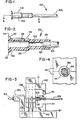
- an infusion hub and tubing assembly 100 in accordance with the present invention comprises a fluid receiving hub 102, and a section of flexible tubing 104, formed into an integral unit by means of radio frequency welding or bonding as will be described hereinafter.
- the fluid receiving hub 102 shown in cross-section in Fig. 2, comprises a hollow, generally cylindrical, body molded from a relatively rigid polyurethane compound.
- the polyurethane forming the hub has a Shore Durometer D rating of about 50 to 75 and the polyurethane forming the tubing has a Shore Durometer A hardness of about 55 to 70.
- the proximal end of the hub 102 has a collar 110 with radially and circumferentially extending lugs 112 that may be used with conventional equipment employing Luer locks for external connection to a source of infusion fluid.
- Reinforcing ribs 114 run approximately two-thirds of the way along the hub from the collar 110 toward the distal end of the hub.
- the hub 102 comprises a primary fluid receiving cavity 116 opening to its proximal end and a tubing receiving canal 118 opening to the distal end of the hub 102.
- the primary fluid receiving cavity 116 and the tubing receiving canal 118 are interconnected by a diameter reducing frustoconical section 120 and a generally cylindrical interconnecting canal 122 which is of a smaller diameter than the diameter of the generally cylindrical tubing receiving canal 118.
- the reduced diameter canal 122 forms a tubing stop means or shoulder 124 such that when the tubing 104 is inserted into the tubing receiving canal 118, it is extended only until it engages the shoulder 124 to provide a selected or defined length of the tubing 104 extending into the hub 102.
- Fig. 3 shows a jig for welding the tubing 104 to the hub 102.
- RF energy from a Solidyne KH 8 RF generator from Solidyne, Inc. (not shown) is connected to terminal lugs 132 of the jig shown in Fig. 3 which in turn is connected to a metal pin 136 on which the hub and tubing assembly is mounted as it is welded.
- An alternating current is delivered to the pin 136 by the generator which causes the polarity of the pin to rapidly oscillate between a highly positive and a highly negative polarity with respect to ground.
- an alternating electric field is set up between the pin 136 and the electrodes 140 which are grounded.
- electrodes 140 are designed with smaller dimension tips 141 where the field is concentrated.
- the portions of the catheter hub and tubing assembly in the alternating field between the electrode tips 141 heat in a known manner. It is not essential that there be a space (Fig. 4) between the catheter assembly 100 and the ground electrodes 140 to prevent arcing. Sharp points and edges are avoided in the electrodes wherever possible since these points are the first places that breakdown occurs.
- a generally cylindrical pin l36 extends from the framework 138 of the jig shown in Fig. 3 with the generally cylindrical pin 136 being connected to the RF generator.
- the ground electrodes 140 are closed to engage one another and form an intimate contact from the forward portion of the hub 102 into which the tubing 104 has been inserted.
- Bonding conditions will vary depending on the characteristics of the specific polyurethanes used, the electrode construction and the surroundings. The maximum voltage that can be used is limited by the voltage breakdown characteristics.
- the frequency should be as high as possible so that the lowest voltage can be employed.
- the equipment is more costly, it is difficult to deliver the power to the material as efficiently and it is more difficult to maintain uniform voltage distribution.
- RF energy at 1 to 100 mHz, preferably 25 to 70 mHz and most preferably 55 to 65 mHz is preferred for bonding the polyurethane parts of the hub and tubing assembly of the present invention.
- RF energy at 1 to 100 mHz, preferably 25 to 70 mHz and most preferably 55 to 65 mHz is preferred for bonding the polyurethane parts of the hub and tubing assembly of the present invention.
- the RF energy is connected at a power level of about 10 to 5,000 watts for a period of approximately 0.1 to 60 seconds, preferably 100 to 300 watts for 2 to 11 seconds, and actually at 200 watts for 4 seconds. It should be understood that the period can vary from 3 to 7 seconds depending upon the specific composition of the polyurethane compounds making up the tubing 104 and the hub 102 as well as the specific size and thickness of the hub and tubing.
- the RF field is maintained for a period sufficient to melt the parts of the assembly only in the vicinity of the desired bond such that the polyurethanes forming the hub and tubing mingle but without loosing their form or blocking the channel through the assembly.
- the use of the electrode pin 136 makes the upper limits of the RF power applied to weld the tubing 104 to the hub 102 somewhat less restrictive, since the pin 136 maintains the opening into the tubing 104 in spite of marginal excesses of heating generated by the RF energy passing through the polyurethane materials.
Landscapes
- Engineering & Computer Science (AREA)
- Mechanical Engineering (AREA)
- Health & Medical Sciences (AREA)
- Life Sciences & Earth Sciences (AREA)
- Heart & Thoracic Surgery (AREA)
- Pulmonology (AREA)
- Anesthesiology (AREA)
- Biomedical Technology (AREA)
- Biophysics (AREA)
- Hematology (AREA)
- Animal Behavior & Ethology (AREA)
- General Health & Medical Sciences (AREA)
- Public Health (AREA)
- Veterinary Medicine (AREA)
- Infusion, Injection, And Reservoir Apparatuses (AREA)
- Media Introduction/Drainage Providing Device (AREA)
- Lining Or Joining Of Plastics Or The Like (AREA)
Applications Claiming Priority (2)
| Application Number | Priority Date | Filing Date | Title |
|---|---|---|---|
| US52472783A | 1983-08-19 | 1983-08-19 | |
| US524727 | 1983-08-19 |
Publications (1)
| Publication Number | Publication Date |
|---|---|
| EP0142222A1 true EP0142222A1 (de) | 1985-05-22 |
Family
ID=24090429
Family Applications (1)
| Application Number | Title | Priority Date | Filing Date |
|---|---|---|---|
| EP84305591A Withdrawn EP0142222A1 (de) | 1983-08-19 | 1984-08-17 | Ensemble mit Rohransatz und Schlauch zur Infusion |
Country Status (2)
| Country | Link |
|---|---|
| EP (1) | EP0142222A1 (de) |
| JP (1) | JPS6096264A (de) |
Cited By (5)
| Publication number | Priority date | Publication date | Assignee | Title |
|---|---|---|---|---|
| EP0227230A1 (de) * | 1985-10-17 | 1987-07-01 | Menlo Care, Inc. | Kathetereinheit |
| AU578948B2 (en) * | 1984-05-04 | 1988-11-10 | Warner-Lambert Company | Multilumen catheter and associated IV tubing |
| GB2252733A (en) * | 1991-02-15 | 1992-08-19 | Smiths Industries Plc | Intravenous needle assembly |
| EP0987042A3 (de) * | 1998-09-15 | 2000-11-02 | Medtronic, Inc. | Auslegung und Methode zur Hersellung eines röntgendichten Markierungsbandes für einen PCTA-Ballon |
| US7744568B2 (en) | 2001-03-04 | 2010-06-29 | Icu Medical, Inc. | Infusion hub assembly and fluid line disconnect system |
Families Citing this family (1)
| Publication number | Priority date | Publication date | Assignee | Title |
|---|---|---|---|---|
| JPH0674016B2 (ja) * | 1985-12-16 | 1994-09-21 | 富士重工業株式会社 | 無段変速機の制御装置 |
Citations (4)
| Publication number | Priority date | Publication date | Assignee | Title |
|---|---|---|---|---|
| US3769975A (en) * | 1971-11-26 | 1973-11-06 | Johnson & Johnson | Slit sleeve for preventing displacement in a catheter assembly |
| US4177809A (en) * | 1977-09-15 | 1979-12-11 | Warner-Lambert Company | Intravenous catheter apparatus and method |
| US4192305A (en) * | 1978-08-21 | 1980-03-11 | Abbott Laboratories | Catheter placement assembly having axial and rotational alignment means |
| EP0040508A1 (de) * | 1980-05-14 | 1981-11-25 | Shiley Incorporated | Röhrchen zum Einführen in den Körper |
-
1984
- 1984-08-17 JP JP59170524A patent/JPS6096264A/ja active Pending
- 1984-08-17 EP EP84305591A patent/EP0142222A1/de not_active Withdrawn
Patent Citations (4)
| Publication number | Priority date | Publication date | Assignee | Title |
|---|---|---|---|---|
| US3769975A (en) * | 1971-11-26 | 1973-11-06 | Johnson & Johnson | Slit sleeve for preventing displacement in a catheter assembly |
| US4177809A (en) * | 1977-09-15 | 1979-12-11 | Warner-Lambert Company | Intravenous catheter apparatus and method |
| US4192305A (en) * | 1978-08-21 | 1980-03-11 | Abbott Laboratories | Catheter placement assembly having axial and rotational alignment means |
| EP0040508A1 (de) * | 1980-05-14 | 1981-11-25 | Shiley Incorporated | Röhrchen zum Einführen in den Körper |
Cited By (8)
| Publication number | Priority date | Publication date | Assignee | Title |
|---|---|---|---|---|
| AU578948B2 (en) * | 1984-05-04 | 1988-11-10 | Warner-Lambert Company | Multilumen catheter and associated IV tubing |
| EP0227230A1 (de) * | 1985-10-17 | 1987-07-01 | Menlo Care, Inc. | Kathetereinheit |
| US4781703A (en) * | 1985-10-17 | 1988-11-01 | Menlo Care, Inc. | Catheter assembly |
| GB2252733A (en) * | 1991-02-15 | 1992-08-19 | Smiths Industries Plc | Intravenous needle assembly |
| GB2252733B (en) * | 1991-02-15 | 1994-10-05 | Smiths Industries Plc | Intravenous needle assemblies |
| EP0987042A3 (de) * | 1998-09-15 | 2000-11-02 | Medtronic, Inc. | Auslegung und Methode zur Hersellung eines röntgendichten Markierungsbandes für einen PCTA-Ballon |
| US7744568B2 (en) | 2001-03-04 | 2010-06-29 | Icu Medical, Inc. | Infusion hub assembly and fluid line disconnect system |
| US8152769B2 (en) | 2001-03-04 | 2012-04-10 | Tecpharma Licensing Ag | Infusion hub assembly and fluid line disconnect system |
Also Published As
| Publication number | Publication date |
|---|---|
| JPS6096264A (ja) | 1985-05-29 |
Similar Documents
| Publication | Publication Date | Title |
|---|---|---|
| US4710175A (en) | Intravenous infusion assembly formed as an integral part | |
| US7175734B2 (en) | Porous medical catheter and methods of manufacture | |
| US7472505B2 (en) | Connector assembly for an implantable medical device and process for making | |
| US6183305B1 (en) | High strength connector design for passive fixation pacing lead | |
| US7175482B2 (en) | Connector assembly for an implantable medical device and process for making | |
| US6498952B2 (en) | Hermetically sealed feedthrough connector using shape memory alloy for implantable medical device | |
| US20070190866A1 (en) | Connector assembly for an implantable medical device and process for making | |
| JP2935574B2 (ja) | 壁厚の薄いカテーテルに軟質チップを取り付ける方法 | |
| EP0484483B1 (de) | Aus mehreren teilen gegossener herzschrittmacherstecker, herstellungsverfahren und verbindungsvorrichtung für herzschrittmacher | |
| US9106004B2 (en) | Implantable medical electrical leads and connector assemblies thereof | |
| US9008797B2 (en) | In-line connector terminals for implantable medical electrical leads | |
| US20040093052A1 (en) | Multi-polar connector | |
| EP0830873A3 (de) | Mit einer implantierten Vorrichtung verbundener medizinischer Draht und Methode zur Anwendung | |
| US9687661B2 (en) | Systems and methods for attaching pre-fabricated header connector assembly to housing of implantable electronic device | |
| US20190117962A1 (en) | Implantable pulse generator headers including connectors having offset segments | |
| JPH0444565B2 (de) | ||
| EP0142223B1 (de) | Als integrierte Einheit ausgebildetes Ensemble zur intravenösen Infusion | |
| US10105544B2 (en) | Implantable medical devices including a laser etched surface in bonded areas | |
| US5211637A (en) | Device for connecting catheter and injection tube | |
| JPS6096264A (ja) | 注入用ハブ−チユ−ブ集成体 | |
| EP0161863A2 (de) | Verfahren zur Herstellung einer Vorrichtung zur Infusion von medizinischen Flüssigkeiten in einen Patienten | |
| US5792988A (en) | Radio frequency heat sealing of cable assemblies | |
| EP1295367B1 (de) | Vorrichtung aus thermoplastischem material und zugehöriges zweistufiges giessverfahren | |
| US8880181B2 (en) | Implantable electrical connector having unitary contacts | |
| EP0997161A2 (de) | Herzelektrode mit teilweise isolierter Nadel |
Legal Events
| Date | Code | Title | Description |
|---|---|---|---|
| PUAI | Public reference made under article 153(3) epc to a published international application that has entered the european phase |
Free format text: ORIGINAL CODE: 0009012 |
|
| AK | Designated contracting states |
Designated state(s): DE FR GB |
|
| STAA | Information on the status of an ep patent application or granted ep patent |
Free format text: STATUS: THE APPLICATION IS DEEMED TO BE WITHDRAWN |
|
| 18D | Application deemed to be withdrawn |
Effective date: 19860123 |
|
| RIN1 | Information on inventor provided before grant (corrected) |
Inventor name: IRELAND, DAVID BRUCE Inventor name: DAUGHERTY, CHARLES WILLIAM Inventor name: CARTMELL, ROBERT LOUIS |