EP0140312B1 - Organische Silikonatzusätze für alkalische elektrochemische Zinkzellen - Google Patents
Organische Silikonatzusätze für alkalische elektrochemische Zinkzellen Download PDFInfo
- Publication number
- EP0140312B1 EP0140312B1 EP84112658A EP84112658A EP0140312B1 EP 0140312 B1 EP0140312 B1 EP 0140312B1 EP 84112658 A EP84112658 A EP 84112658A EP 84112658 A EP84112658 A EP 84112658A EP 0140312 B1 EP0140312 B1 EP 0140312B1
- Authority
- EP
- European Patent Office
- Prior art keywords
- zinc
- anode
- electrochemical cell
- alkaline electrochemical
- electrolyte
- Prior art date
- Legal status (The legal status is an assumption and is not a legal conclusion. Google has not performed a legal analysis and makes no representation as to the accuracy of the status listed.)
- Expired
Links
- HCHKCACWOHOZIP-UHFFFAOYSA-N Zinc Chemical compound [Zn] HCHKCACWOHOZIP-UHFFFAOYSA-N 0.000 title claims description 72
- 239000011701 zinc Substances 0.000 title claims description 72
- 229910052725 zinc Inorganic materials 0.000 title claims description 72
- 239000000654 additive Substances 0.000 title claims description 6
- 230000000996 additive effect Effects 0.000 title claims description 6
- 125000005625 siliconate group Chemical group 0.000 title description 2
- OKTJSMMVPCPJKN-UHFFFAOYSA-N Carbon Chemical compound [C] OKTJSMMVPCPJKN-UHFFFAOYSA-N 0.000 claims description 26
- 229920001296 polysiloxane Polymers 0.000 claims description 24
- -1 polysiloxanes Polymers 0.000 claims description 23
- 229910052799 carbon Inorganic materials 0.000 claims description 22
- 239000003792 electrolyte Substances 0.000 claims description 21
- XLOMVQKBTHCTTD-UHFFFAOYSA-N Zinc monoxide Chemical compound [Zn]=O XLOMVQKBTHCTTD-UHFFFAOYSA-N 0.000 claims description 18
- XUIMIQQOPSSXEZ-UHFFFAOYSA-N Silicon Chemical compound [Si] XUIMIQQOPSSXEZ-UHFFFAOYSA-N 0.000 claims description 12
- 229910052710 silicon Inorganic materials 0.000 claims description 12
- 239000010703 silicon Substances 0.000 claims description 12
- XLYOFNOQVPJJNP-UHFFFAOYSA-N water Substances O XLYOFNOQVPJJNP-UHFFFAOYSA-N 0.000 claims description 9
- 239000011787 zinc oxide Substances 0.000 claims description 9
- 239000011248 coating agent Substances 0.000 claims description 5
- 238000000576 coating method Methods 0.000 claims description 5
- 125000000962 organic group Chemical group 0.000 claims description 4
- 125000004432 carbon atom Chemical group C* 0.000 claims description 3
- 239000000463 material Substances 0.000 claims description 3
- 239000000203 mixture Substances 0.000 claims description 3
- 229920001577 copolymer Polymers 0.000 claims description 2
- LYCAIKOWRPUZTN-UHFFFAOYSA-N ethylene glycol Natural products OCCO LYCAIKOWRPUZTN-UHFFFAOYSA-N 0.000 claims description 2
- 239000012530 fluid Substances 0.000 claims description 2
- WGCNASOHLSPBMP-UHFFFAOYSA-N hydroxyacetaldehyde Natural products OCC=O WGCNASOHLSPBMP-UHFFFAOYSA-N 0.000 claims description 2
- 239000002344 surface layer Substances 0.000 claims description 2
- KWYUFKZDYYNOTN-UHFFFAOYSA-M Potassium hydroxide Chemical compound [OH-].[K+] KWYUFKZDYYNOTN-UHFFFAOYSA-M 0.000 claims 3
- 239000000853 adhesive Substances 0.000 claims 2
- 230000001070 adhesive effect Effects 0.000 claims 2
- NUJOXMJBOLGQSY-UHFFFAOYSA-N manganese dioxide Chemical compound O=[Mn]=O NUJOXMJBOLGQSY-UHFFFAOYSA-N 0.000 claims 2
- BQCADISMDOOEFD-UHFFFAOYSA-N Silver Chemical compound [Ag] BQCADISMDOOEFD-UHFFFAOYSA-N 0.000 claims 1
- QSHDDOUJBYECFT-UHFFFAOYSA-N mercury Chemical group [Hg] QSHDDOUJBYECFT-UHFFFAOYSA-N 0.000 claims 1
- 229910000474 mercury oxide Inorganic materials 0.000 claims 1
- 125000002496 methyl group Chemical group [H]C([H])([H])* 0.000 claims 1
- 239000004332 silver Substances 0.000 claims 1
- 229910001923 silver oxide Inorganic materials 0.000 claims 1
- 235000013870 dimethyl polysiloxane Nutrition 0.000 description 12
- 229920000435 poly(dimethylsiloxane) Polymers 0.000 description 12
- 238000006243 chemical reaction Methods 0.000 description 11
- 239000010410 layer Substances 0.000 description 8
- 230000000694 effects Effects 0.000 description 7
- QVGXLLKOCUKJST-UHFFFAOYSA-N atomic oxygen Chemical compound [O] QVGXLLKOCUKJST-UHFFFAOYSA-N 0.000 description 5
- 239000001301 oxygen Substances 0.000 description 5
- 229910052760 oxygen Inorganic materials 0.000 description 5
- 230000015572 biosynthetic process Effects 0.000 description 4
- 230000000607 poisoning effect Effects 0.000 description 4
- 239000000376 reactant Substances 0.000 description 4
- 230000006870 function Effects 0.000 description 3
- 239000007789 gas Substances 0.000 description 3
- 230000000670 limiting effect Effects 0.000 description 3
- 231100000572 poisoning Toxicity 0.000 description 3
- 230000009467 reduction Effects 0.000 description 3
- 238000007086 side reaction Methods 0.000 description 3
- CURLTUGMZLYLDI-UHFFFAOYSA-N Carbon dioxide Chemical compound O=C=O CURLTUGMZLYLDI-UHFFFAOYSA-N 0.000 description 2
- UFHFLCQGNIYNRP-UHFFFAOYSA-N Hydrogen Chemical compound [H][H] UFHFLCQGNIYNRP-UHFFFAOYSA-N 0.000 description 2
- 230000004888 barrier function Effects 0.000 description 2
- 230000003247 decreasing effect Effects 0.000 description 2
- 238000004519 manufacturing process Methods 0.000 description 2
- 230000007246 mechanism Effects 0.000 description 2
- 239000012528 membrane Substances 0.000 description 2
- 239000002574 poison Substances 0.000 description 2
- 231100000614 poison Toxicity 0.000 description 2
- 239000000126 substance Substances 0.000 description 2
- 230000003213 activating effect Effects 0.000 description 1
- 239000010405 anode material Substances 0.000 description 1
- 239000000729 antidote Substances 0.000 description 1
- 125000004429 atom Chemical group 0.000 description 1
- 239000006227 byproduct Substances 0.000 description 1
- 229910002092 carbon dioxide Inorganic materials 0.000 description 1
- 239000001569 carbon dioxide Substances 0.000 description 1
- 239000003054 catalyst Substances 0.000 description 1
- 230000003197 catalytic effect Effects 0.000 description 1
- 239000010406 cathode material Substances 0.000 description 1
- 230000008859 change Effects 0.000 description 1
- 230000000052 comparative effect Effects 0.000 description 1
- 150000001875 compounds Chemical class 0.000 description 1
- 239000004020 conductor Substances 0.000 description 1
- 238000010276 construction Methods 0.000 description 1
- 238000002788 crimping Methods 0.000 description 1
- 230000007423 decrease Effects 0.000 description 1
- 238000009792 diffusion process Methods 0.000 description 1
- 229940008099 dimethicone Drugs 0.000 description 1
- 125000000118 dimethyl group Chemical group [H]C([H])([H])* 0.000 description 1
- 239000004205 dimethyl polysiloxane Substances 0.000 description 1
- 230000005611 electricity Effects 0.000 description 1
- 238000003487 electrochemical reaction Methods 0.000 description 1
- 239000003623 enhancer Substances 0.000 description 1
- 125000001153 fluoro group Chemical group F* 0.000 description 1
- 239000003574 free electron Substances 0.000 description 1
- 150000002500 ions Chemical class 0.000 description 1
- 239000007788 liquid Substances 0.000 description 1
- 230000005923 long-lasting effect Effects 0.000 description 1
- YVUZUKYBUMROPQ-UHFFFAOYSA-N mercury zinc Chemical compound [Zn].[Hg] YVUZUKYBUMROPQ-UHFFFAOYSA-N 0.000 description 1
- 238000000034 method Methods 0.000 description 1
- 150000002926 oxygen Chemical class 0.000 description 1
- BSWGGJHLVUUXTL-UHFFFAOYSA-N silver zinc Chemical compound [Zn].[Ag] BSWGGJHLVUUXTL-UHFFFAOYSA-N 0.000 description 1
- 239000002904 solvent Substances 0.000 description 1
- 239000004094 surface-active agent Substances 0.000 description 1
- SZKTYYIADWRVSA-UHFFFAOYSA-N zinc manganese(2+) oxygen(2-) Chemical compound [O--].[O--].[Mn++].[Zn++] SZKTYYIADWRVSA-UHFFFAOYSA-N 0.000 description 1
Images


Classifications
-
- H—ELECTRICITY
- H01—ELECTRIC ELEMENTS
- H01M—PROCESSES OR MEANS, e.g. BATTERIES, FOR THE DIRECT CONVERSION OF CHEMICAL ENERGY INTO ELECTRICAL ENERGY
- H01M10/00—Secondary cells; Manufacture thereof
- H01M10/24—Alkaline accumulators
- H01M10/28—Construction or manufacture
-
- H—ELECTRICITY
- H01—ELECTRIC ELEMENTS
- H01M—PROCESSES OR MEANS, e.g. BATTERIES, FOR THE DIRECT CONVERSION OF CHEMICAL ENERGY INTO ELECTRICAL ENERGY
- H01M10/00—Secondary cells; Manufacture thereof
- H01M10/24—Alkaline accumulators
- H01M10/26—Selection of materials as electrolytes
-
- H—ELECTRICITY
- H01—ELECTRIC ELEMENTS
- H01M—PROCESSES OR MEANS, e.g. BATTERIES, FOR THE DIRECT CONVERSION OF CHEMICAL ENERGY INTO ELECTRICAL ENERGY
- H01M12/00—Hybrid cells; Manufacture thereof
- H01M12/04—Hybrid cells; Manufacture thereof composed of a half-cell of the fuel-cell type and of a half-cell of the primary-cell type
- H01M12/06—Hybrid cells; Manufacture thereof composed of a half-cell of the fuel-cell type and of a half-cell of the primary-cell type with one metallic and one gaseous electrode
-
- H—ELECTRICITY
- H01—ELECTRIC ELEMENTS
- H01M—PROCESSES OR MEANS, e.g. BATTERIES, FOR THE DIRECT CONVERSION OF CHEMICAL ENERGY INTO ELECTRICAL ENERGY
- H01M4/00—Electrodes
- H01M4/02—Electrodes composed of, or comprising, active material
- H01M4/36—Selection of substances as active materials, active masses, active liquids
- H01M4/38—Selection of substances as active materials, active masses, active liquids of elements or alloys
- H01M4/42—Alloys based on zinc
-
- H—ELECTRICITY
- H01—ELECTRIC ELEMENTS
- H01M—PROCESSES OR MEANS, e.g. BATTERIES, FOR THE DIRECT CONVERSION OF CHEMICAL ENERGY INTO ELECTRICAL ENERGY
- H01M6/00—Primary cells; Manufacture thereof
- H01M6/04—Cells with aqueous electrolyte
-
- Y—GENERAL TAGGING OF NEW TECHNOLOGICAL DEVELOPMENTS; GENERAL TAGGING OF CROSS-SECTIONAL TECHNOLOGIES SPANNING OVER SEVERAL SECTIONS OF THE IPC; TECHNICAL SUBJECTS COVERED BY FORMER USPC CROSS-REFERENCE ART COLLECTIONS [XRACs] AND DIGESTS
- Y02—TECHNOLOGIES OR APPLICATIONS FOR MITIGATION OR ADAPTATION AGAINST CLIMATE CHANGE
- Y02E—REDUCTION OF GREENHOUSE GAS [GHG] EMISSIONS, RELATED TO ENERGY GENERATION, TRANSMISSION OR DISTRIBUTION
- Y02E60/00—Enabling technologies; Technologies with a potential or indirect contribution to GHG emissions mitigation
- Y02E60/10—Energy storage using batteries
Definitions
- This invention relates to zinc electrochemical cells having metallic zinc anodes and air cathodes, commonly known as zinc-air cells.
- Zinc-air cells are electrochemical cells wherein the oxygen in the air acts as the cathode material and amalgamated zinc is the anode material. Air enters the electrochemical cell through ports on one side of the cell, is allowed to diffuse through a catalytic layer where the oxygen reacts with water to form hydroxide ions which react with metallic zinc in an alkaline environment to produce the electric energy.
- the air diffuses into an air cathode sub-assembly where the oxygen is reacted.
- This air cathode sub-assembly generally consists of mixtures of activating chemicals supported by a complex physical structure.
- the air cathode sub-assembly also slows the diffusion of other gases, particularly carbon dioxide and water vapor, through the electrode to the reaction site.
- gases in air, particularly water vapor have a profound limiting effect on the capacity of the cell.
- the activated oxygen diffuses through a separtor, a moisture barrier usually of a plastic- like material impervious to liquids such as the alkaline electrolyte, and reacts with the water in the electrolyte, consuming electrons and producing hydroxide ions. These ions then oxidize the metallic zinc, generally producing 2 electrons for each atom of zinc reacted.
- a moisture barrier usually of a plastic- like material impervious to liquids such as the alkaline electrolyte
- the present invention is directed to the reduction in cell efficiency which occurs after the zinc-air cell has been substantially discharged.
- This limitation in rate capacity is related to events occurring in the zinc anode during discharge.
- a zinc oxide layer forms on the surface of the metallic zinc.
- Zinc oxide is a known poor conductor of electricity.
- the rate capacity is further limited by side reactions which compete with the main reaction for the metallic zinc. These side reactions consume zinc without producing any free electrons.
- a very rate limiting side reaction is:
- the objective of the present invention is to extend the capacity of zinc-air button cell by lessening the effects of the rate limitations which originate in the zinc anode.
- an alkaline electrochemical cell comprising an air cathode sub-assembly with a means for supplying air to the cathode sub-assembly, a zinc anode, an electrolyte in contact with the zinc anode and a non-metallic separator between the cathode and the anode is characterized in that the anode is in contact with an organopolysiloxane containing up to 6 carbon atoms in the organic groups.
- the polysiloxanes may be introduced to the zinc anode as an additive to the electrolyte, as a coating on the metallic zinc, or as an additive or coating on the non-metallic barrier which contacts the electrolyte containing in the zinc anode.
- the amount or organic polysiloxanes necessary to practice this invention ranges from trace amounts up to 50 ppm silicon (from organic polysiloxanes versus zinc weight).
- the amount of silicon is 20 to 100 ppm in the case of carbon-laced zinc anodes. While the invention can be practiced with organic polysiloxanes generally dimethylpolysiloxanes are preferred.
- organic polysiloxanes increases the capacity of zinc-air cells. While the mechanism is not fully understood, it is believed that the organic polysiloxanes reduce the rate of formation of the crystalline structure of the zinc layer on the surface of the metallic zinc by coating the surfaces of the amalgamated zinc.
- the organic groups incorporated in the polysiloxane compound give the zinc increased surface activity, while maintaining a high level of surface stability. Since the reaction rate is proportional to the number of reaction sites, the decreased formation of zinc oxide increases the number of reaction sites within the anode. The decreased formation of zinc oxide also reduces the internal charge resistance within the anode.
- An unexpected result of this invention is the effect of organic polysiloxanes on carbon, a heretobefore known poison of zinc anodes.
- the use of organic polysiloxanes as disclosed by this invention stops the poisoning effect of carbon on zinc anodes, even when carbon is present in the zinc anode in amounts of up to 500 ppm versus zinc weight.
- the presence of carbon in zinc anodes when organic polysiloxanes are used according to the present invention, may actually increase the rate capability of zinc-air cells. This increase in the capacity probably stems from a reduction in charge resistance within the anode, since carbon is a known conductivity enhancer.
- the organic polysiloxanes of the present invention appear to affect the ability of carbon to catalyze the reaction of zinc and water to zinc oxide and hyrogen gas without affecting the charge conductivity properties of carbon.
- the present invention i.e., the use of organic polysiloxanes in the zinc anode, includes the use of carbon-laced zinc anodes in zinc-air button cells.
- the amount of carbon which can be added to the zinc anode according to the present invention varies up to 500 ppm versus zinc weight when the silicon (introduced as organic polysiloxanes) contained in the botton cell is increased to approximately 0.01 % of the zinc by weight.
- the invention is applicable to all alkaline cells as claimed in the appended claims, including zinc- mercury, zinc-silver and zinc-manganese dioxide alkaline cells.
- button cells has been adopted for very small, disc-like electrochemical cells.
- Button cells which are approximately the size of garment buttons, have diameters ranging up to about 25 mm and heights ranging up to about 15 mm. Button cells are used as power sources for a wide variety of devices, including watches, calculators, hearing aids, and many other electric devices requiring low power, long-lasting sources of energy.
- buttons cells because of their minute dimensions, must be efficient and complete.
- any button cell reactant which cannot be replaced e.g. metallic zinc
- any button cell reactant which cannot be replaced e.g. metallic zinc
- very small changes in the amount of reactants, reaction poisons, catalysts, etc. will have profound effects on the capacity of button cells.
- the generation of side products, albeit from incomplete "good" reactions or undesired reactions will lead to a rapid increase in internal cell pressure. Therefore, the increases in cell efficiency resulting from applying the teachings of the present invention are magnified in button cells.
- Zinc-air button cells are normally constructed in two steps; the anode section and the cathode section of zinc-air button cells are usually separately assembled and then joined together prior to the cell being permanently sealed.
- the cathode section is contained in a topless, hollow metallic can with a small air entry hole- in the can bottom.
- the air cathode sub-assembly which is covered with a non-metallic separator, is slightly compressed within the cathode section.
- the zinc anode section consists of a topless, hollow metallic can into which a measured amount of zinc is placed. An alkaline electrolyte is then metered directly onto the surface of the zinc.
- Electrodes After the electrodes have been made, they are joined by inverting the cathode section and placing it in the open end of the anode can.
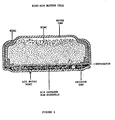
- the button cell is then sealed, usually by crimping the edges into a non-metallic grommet Figure 1 shows the conventional zinc air button cell.
- the disclosed benefits of the present invention were measured by comparative tests of standard, commercial RAYOVAC zinc-air button cells (rated capacity-400 mA. h) and zinc-air button cells in which dimethyl polysiloxanes are an additive to the electrolyte, but otherwise identical to the standard commercial cells.
- the dimethyl polysiloxane-doped electrolyte used in the test cells was prepared as follows:
- a cell containing 5 ppm silicon (introduced as dimethyl polysiloxanes) versus zinc weight was constructed according to the present invention.
- a 625 ⁇ load was applied to a control cell and the test cell containing 5 ppm silicon.
- the potential in volts as a function of time in hours was measured.
- the discharge curves were identical for the first 180 hours.
- the control cell more quickly reached the voltage end point (VEP) (1.1 volts). Therefore, Figure 2 shows that the increased efficiency of cells constructed according to this invention results in an increase in capacity attributable to increased zinc anode efficiency.
- VEP voltage end point
- a series of cells were constructed according to the present invention with varying amounts of dimethyl polysiloxanes incorporated therein as described by the above procedure.
- a 625 ⁇ load was applied to each cell and the capacity (mA.h), to the voltage end point (1.1 V), was measured. It was found that as the amount of silicon in the cell, introduced dimethyl polysiloxanes, increased from 0 ppm up to approximately 2.0 ppm versus zinc weight, the increased concentration of silicon linearly increased the capacity of the zinc-air button cell. At concentrations > 2.0 ppm, there was no appreciable increase in capacity with increased silicon concentration versus zinc weight.
- Figure 3 graphically present the results of these tests.
- a series of cells were constructed according to the present invention with varying amounts of dimethyl polysiloxanes therein added to the electrolyte, wherein 300 ppm carbon versus zinc weight has been mixed with amalgamated zinc. The capacity, to the voltage end point was then measured under both 150 ⁇ and 625 0 loads.
- Figure 5 shows that dimethyl polysiloxanes is an effective antidote for carbon poisoning in zinc air cells (where the zinc anode is laced with 300 ppm of carbon), when the amount of silicon from the dimethyl polysiloxanes is at least 30 ppm versus zinc weight.
Landscapes
- Engineering & Computer Science (AREA)
- Manufacturing & Machinery (AREA)
- Chemical & Material Sciences (AREA)
- Chemical Kinetics & Catalysis (AREA)
- Electrochemistry (AREA)
- General Chemical & Material Sciences (AREA)
- Hybrid Cells (AREA)
- Primary Cells (AREA)
- Battery Electrode And Active Subsutance (AREA)
- Silicon Compounds (AREA)
Claims (10)
und Kathoden- und Anodennapf so angeordnet sind, daß sich der nichtmetallische Separator zwischen der Luftkathoden-Anordnung und der Anode befindet.
Applications Claiming Priority (2)
| Application Number | Priority Date | Filing Date | Title |
|---|---|---|---|
| US54342983A | 1983-10-19 | 1983-10-19 | |
| US543429 | 1983-10-19 |
Publications (2)
| Publication Number | Publication Date |
|---|---|
| EP0140312A1 EP0140312A1 (de) | 1985-05-08 |
| EP0140312B1 true EP0140312B1 (de) | 1989-03-01 |
Family
ID=24168014
Family Applications (1)
| Application Number | Title | Priority Date | Filing Date |
|---|---|---|---|
| EP84112658A Expired EP0140312B1 (de) | 1983-10-19 | 1984-10-19 | Organische Silikonatzusätze für alkalische elektrochemische Zinkzellen |
Country Status (8)
| Country | Link |
|---|---|
| EP (1) | EP0140312B1 (de) |
| JP (1) | JPS60167282A (de) |
| KR (1) | KR920007379B1 (de) |
| CA (1) | CA1236159A (de) |
| DE (1) | DE3476947D1 (de) |
| DK (1) | DK497484A (de) |
| ES (1) | ES8603115A1 (de) |
| NO (1) | NO844202L (de) |
Families Citing this family (3)
| Publication number | Priority date | Publication date | Assignee | Title |
|---|---|---|---|---|
| US5382482A (en) * | 1992-08-07 | 1995-01-17 | Nippon Oil Company, Limited | Zinc electrode for alkaline storage battery |
| CN106450513A (zh) * | 2016-11-02 | 2017-02-22 | 董亚婵 | 一种可充电的湿电池 |
| WO2024197844A1 (zh) * | 2023-03-31 | 2024-10-03 | 广东邦普循环科技有限公司 | 高镍三元正极材料表面改性的方法及其应用 |
Family Cites Families (5)
| Publication number | Priority date | Publication date | Assignee | Title |
|---|---|---|---|---|
| GB1411911A (en) * | 1973-01-19 | 1975-10-29 | Shell Int Research | Potassium hydroxide electrolyte containing silicate ions |
| DE3025476A1 (de) * | 1979-07-27 | 1981-02-12 | Gould Inc | Metall/luft-zelle |
| EP0058090A1 (de) * | 1981-02-09 | 1982-08-18 | Ray-O-Vac Corporation | Kathodenanordnung für Metall-Luft-Knopfzellen |
| US4343869A (en) * | 1981-02-09 | 1982-08-10 | Ray-O-Vac Corporation | Seal for metal-air batteries |
| US4369568A (en) * | 1981-02-09 | 1983-01-25 | Ray-O-Vac Corporation | Method for manufacturing cells utilizing centrifuging techniques |
-
1984
- 1984-10-17 CA CA000465619A patent/CA1236159A/en not_active Expired
- 1984-10-17 DK DK497484A patent/DK497484A/da not_active Application Discontinuation
- 1984-10-19 DE DE8484112658T patent/DE3476947D1/de not_active Expired
- 1984-10-19 JP JP59220342A patent/JPS60167282A/ja active Pending
- 1984-10-19 EP EP84112658A patent/EP0140312B1/de not_active Expired
- 1984-10-19 KR KR1019840006512A patent/KR920007379B1/ko not_active Expired
- 1984-10-19 NO NO844202A patent/NO844202L/no unknown
- 1984-10-19 ES ES536953A patent/ES8603115A1/es not_active Expired
Also Published As
| Publication number | Publication date |
|---|---|
| DE3476947D1 (en) | 1989-04-06 |
| KR850003071A (ko) | 1985-05-28 |
| KR920007379B1 (ko) | 1992-08-31 |
| CA1236159A (en) | 1988-05-03 |
| ES536953A0 (es) | 1985-11-16 |
| EP0140312A1 (de) | 1985-05-08 |
| ES8603115A1 (es) | 1985-11-16 |
| DK497484A (da) | 1985-04-20 |
| NO844202L (no) | 1985-04-22 |
| JPS60167282A (ja) | 1985-08-30 |
| DK497484D0 (da) | 1984-10-17 |
Similar Documents
| Publication | Publication Date | Title |
|---|---|---|
| US5069988A (en) | Metal and metal oxide catalyzed electrodes for electrochemical cells, and methods of making same | |
| EP1297584B1 (de) | Katalysator zur rekombination von wasserstoff | |
| US4617242A (en) | Organic siliconate additive for alkaline zinc electrochemical cells | |
| US5308711A (en) | Metal-air cathode and cell having catalytically active manganese compounds of valence state +2 | |
| US5162169A (en) | Catalytic recombination of hydrogen in alkaline cells | |
| US6060196A (en) | Storage-stable zinc anode based electrochemical cell | |
| US6780347B2 (en) | Manganese oxide based electrode for alkaline electrochemical system and method of its production | |
| Yamanaka et al. | Direct synthesis of H2O2 acid solutions on carbon cathode prepared from activated carbon and vapor-growing-carbon-fiber by a H2/O2 fuel cell | |
| EP0140312B1 (de) | Organische Silikonatzusätze für alkalische elektrochemische Zinkzellen | |
| US3419900A (en) | Fuel cells with alkali metal hydroxide electrolyte and electrode containing fluorocarbon polymer | |
| Bonino et al. | Electrochemical behavior of solid cathode materials in organic electrolyte lithium batteries: Copper sulfides | |
| US5344722A (en) | Phosphoric acid fuel cell | |
| JPH10270057A (ja) | 固体高分子型燃料電池 | |
| GB2059141A (en) | Metal-air electric cell | |
| EP1453131B1 (de) | Brennstoffzelle mit interner Hilfselektrode und Verfahren zur Regelung | |
| US3297482A (en) | Carbon electrode with polytetrafluoroethylene on one side and platinium on the otherside, fuel cell with same and electrodepositing method of preparing same | |
| EP1911721A1 (de) | Vorrichtung zur erzeugung von wasserstoff | |
| AU2001253290A1 (en) | Electrochemical conversion system using hydrogen storage materials | |
| WO1991020102A1 (en) | Metal and metal oxide catalyzed electrodes for electrochemical cells, and methods of making same | |
| US20210399311A1 (en) | Compositions and processes for optimizing oxygen reduction and oxygen evolution reactions | |
| US4020239A (en) | Cathode for hydrazine/air cell | |
| Hiroi | Copper (II) formate cathodes for seawater batteries | |
| KR101884066B1 (ko) | 아연공기 이차전지용 음극활물질 및 이를 포함하는 아연공기 이차전지 | |
| WO2000041264A1 (en) | Reduced leakage metal-air electrochemical cell | |
| KR20250061597A (ko) | 금속공기 배터리의 고에너지 밀도 및 사이클 안정성을 위한 캐스케이드 혐기성 및 호기성 배터리 모드를 통해 효율적인 산소 환원 및 발생을 허용하는 이중 기능성 톱니 모양의 질소 도핑된 구리 황화물 산화물 전극 |
Legal Events
| Date | Code | Title | Description |
|---|---|---|---|
| PUAI | Public reference made under article 153(3) epc to a published international application that has entered the european phase |
Free format text: ORIGINAL CODE: 0009012 |
|
| AK | Designated contracting states |
Designated state(s): BE CH DE FR GB IT LI NL SE |
|
| 17P | Request for examination filed |
Effective date: 19850530 |
|
| 17Q | First examination report despatched |
Effective date: 19860603 |
|
| RAP1 | Party data changed (applicant data changed or rights of an application transferred) |
Owner name: RAYOVAC CORPORATION |
|
| GRAA | (expected) grant |
Free format text: ORIGINAL CODE: 0009210 |
|
| ITF | It: translation for a ep patent filed | ||
| AK | Designated contracting states |
Kind code of ref document: B1 Designated state(s): BE CH DE FR GB IT LI NL SE |
|
| PG25 | Lapsed in a contracting state [announced via postgrant information from national office to epo] |
Ref country code: SE Effective date: 19890301 Ref country code: NL Effective date: 19890301 Ref country code: BE Effective date: 19890301 |
|
| REF | Corresponds to: |
Ref document number: 3476947 Country of ref document: DE Date of ref document: 19890406 |
|
| ET | Fr: translation filed | ||
| NLV1 | Nl: lapsed or annulled due to failure to fulfill the requirements of art. 29p and 29m of the patents act | ||
| PGFP | Annual fee paid to national office [announced via postgrant information from national office to epo] |
Ref country code: SE Payment date: 19891027 Year of fee payment: 6 |
|
| PLBE | No opposition filed within time limit |
Free format text: ORIGINAL CODE: 0009261 |
|
| STAA | Information on the status of an ep patent application or granted ep patent |
Free format text: STATUS: NO OPPOSITION FILED WITHIN TIME LIMIT |
|
| 26N | No opposition filed | ||
| ITTA | It: last paid annual fee | ||
| REG | Reference to a national code |
Ref country code: GB Ref legal event code: 732E |
|
| PGFP | Annual fee paid to national office [announced via postgrant information from national office to epo] |
Ref country code: CH Payment date: 19951229 Year of fee payment: 12 |
|
| PG25 | Lapsed in a contracting state [announced via postgrant information from national office to epo] |
Ref country code: LI Effective date: 19961031 Ref country code: CH Effective date: 19961031 |
|
| REG | Reference to a national code |
Ref country code: CH Ref legal event code: PL |
|
| PGFP | Annual fee paid to national office [announced via postgrant information from national office to epo] |
Ref country code: GB Payment date: 19970917 Year of fee payment: 14 |
|
| PGFP | Annual fee paid to national office [announced via postgrant information from national office to epo] |
Ref country code: FR Payment date: 19971007 Year of fee payment: 14 |
|
| PGFP | Annual fee paid to national office [announced via postgrant information from national office to epo] |
Ref country code: DE Payment date: 19971030 Year of fee payment: 14 |
|
| PG25 | Lapsed in a contracting state [announced via postgrant information from national office to epo] |
Ref country code: GB Free format text: LAPSE BECAUSE OF NON-PAYMENT OF DUE FEES Effective date: 19981019 |
|
| GBPC | Gb: european patent ceased through non-payment of renewal fee |
Effective date: 19981019 |
|
| PG25 | Lapsed in a contracting state [announced via postgrant information from national office to epo] |
Ref country code: FR Free format text: LAPSE BECAUSE OF NON-PAYMENT OF DUE FEES Effective date: 19990630 |
|
| REG | Reference to a national code |
Ref country code: FR Ref legal event code: ST |
|
| PG25 | Lapsed in a contracting state [announced via postgrant information from national office to epo] |
Ref country code: DE Free format text: LAPSE BECAUSE OF NON-PAYMENT OF DUE FEES Effective date: 19990803 |