EP0140311A1 - Apparatus for reducing friction between rotating drill pipe and the well bore - Google Patents
Apparatus for reducing friction between rotating drill pipe and the well bore Download PDFInfo
- Publication number
- EP0140311A1 EP0140311A1 EP84112654A EP84112654A EP0140311A1 EP 0140311 A1 EP0140311 A1 EP 0140311A1 EP 84112654 A EP84112654 A EP 84112654A EP 84112654 A EP84112654 A EP 84112654A EP 0140311 A1 EP0140311 A1 EP 0140311A1
- Authority
- EP
- European Patent Office
- Prior art keywords
- sleeve
- well bore
- tubular body
- section
- drill string
- Prior art date
- Legal status (The legal status is an assumption and is not a legal conclusion. Google has not performed a legal analysis and makes no representation as to the accuracy of the status listed.)
- Withdrawn
Links
- 238000005553 drilling Methods 0.000 claims description 18
- 239000012530 fluid Substances 0.000 claims description 11
- 239000000463 material Substances 0.000 claims description 3
- 239000002245 particle Substances 0.000 claims description 2
- 239000002184 metal Substances 0.000 claims 1
- 239000013536 elastomeric material Substances 0.000 abstract description 6
- 230000001012 protector Effects 0.000 description 8
- XLYOFNOQVPJJNP-UHFFFAOYSA-N water Substances O XLYOFNOQVPJJNP-UHFFFAOYSA-N 0.000 description 2
- VYZAMTAEIAYCRO-UHFFFAOYSA-N Chromium Chemical compound [Cr] VYZAMTAEIAYCRO-UHFFFAOYSA-N 0.000 description 1
- 230000015572 biosynthetic process Effects 0.000 description 1
- 229910052804 chromium Inorganic materials 0.000 description 1
- 239000011651 chromium Substances 0.000 description 1
- 238000010276 construction Methods 0.000 description 1
- 230000005484 gravity Effects 0.000 description 1
- 239000000314 lubricant Substances 0.000 description 1
- 230000035515 penetration Effects 0.000 description 1
- 239000004576 sand Substances 0.000 description 1
Images


Classifications
-
- E—FIXED CONSTRUCTIONS
- E21—EARTH OR ROCK DRILLING; MINING
- E21B—EARTH OR ROCK DRILLING; OBTAINING OIL, GAS, WATER, SOLUBLE OR MELTABLE MATERIALS OR A SLURRY OF MINERALS FROM WELLS
- E21B17/00—Drilling rods or pipes; Flexible drill strings; Kellies; Drill collars; Sucker rods; Cables; Casings; Tubings
- E21B17/10—Wear protectors; Centralising devices, e.g. stabilisers
- E21B17/1042—Elastomer protector or centering means
Definitions
- This invention relates to drilling apparatus generally, and in particular to apparatus for use in drilling well bores that are inclined from the vertical.
- More and more directional wells are being drilled at inclinations from the vertical of 30 to 40° or more.
- so called “drainage” wells are being planned or considered where the well bore will extend along the plane of the producing formation for one or two thousand feet.
- To successfully drill such wells it is necessary to be able to drill a relatively long, substantially horizontal, well bore.
- the drill pipe in inclined wells such as these, and “inclined” is intended to include horizontal wells, is urged toward the low side of the hole by gravity and the tool joints of the drill pipe and sometimes even the center portions of the drill pipe between the tool joints rub against the wall of the well bore and any casing that has been set in the well bore as the drill string is rotated.
- It is another object of this invention to provide apparatus for reducing the friction resisting rotation of a drill string while drilling that includes a tubular body for connecting into a drill string having a section of reduced diameter and a sleeve of elastomeric material mounted on the section of reduced diameter with the sleeve having an outside diameter larger than the tool joint of the pipe string to keep the tool joint from engaging the wall of the casing or the wall of the well bore in an uncased well bore and an inside diameter slightly larger than that of the section of reduced diameter of the body to allow the sleeve to remain stationary in engagement with the wall of the well bore or casing while the pipe string is free to rotate relative to the sleeve.
- the friction reducing apparatus of this invention indicated generally by the numbers 10 and 12 are connected into the drill pipe at preselected spaced intervals to engage wall 14 of well bore 16 and keep tool joints 18 of the drill pipe from rubbing against the low side of the well bore.
- FIGS. 2A and 2B The details of construction of the friction reducing apparatus of this invention are shown in Figures 2A and 2B. It includes tubular body 20 having central section 22 with an outside diameter smaller than the rest of the body to provide two oppositely facing shoulders 24 and 26. Mounted on--section 22 is sleeve 30 of elastomeric material constructed similarly to the stretch-on type pipe protectors that have been in use for some time.
- the sleeve In conventional stretch-on type pipe protectors, the sleeve remains stretched when placed on the drill pipe so that it will grip the pipe and be held in position by friction between the sleeve and the pipe.
- sleeve 30 it is desired for sleeve 30 to freely rotate relative to body 20, therefore, its inside diameter is designed to be slightly greater than that of the outside diameter of section 22 in its relaxed condition. It is positioned on section 22 in the same manner that conventional pipe protectors are placed on drill pipe, that is, by stretching them sufficiently to clear the tool joints on the end of the pipe after which they are placed on the body of the pipe itself but still sufficiently stretched to provide the desired friction to hold the protectors in place.
- the sleeve will be stretched sufficiently to clear upper tool joint section 32 of the body after which it is moved onto section 22 where it is then in its relaxed condition and is free to rotate relative to body 20.
- drilling fluid While drilling, drilling fluid is pumped down the drill pipe and back to the surface through annulus 34.
- the upward flow of the drilling fluid will move sleeve 30 into engagement with upper shoulder 24.
- Also tending to move the sleeve upwardly is the downward movement of the drill pipe, but this will be a relatively minor influence compared to the upward force of the drilling fluid flowing by the sleeve.
- stretch on type protectors Under certain conditions, stretch on type protectors have been forced over tool joints and up the string due to the force of the upwardly flowing drilling . fluid.
- shoulder 24 is inclined outwardly and downwardly about 30°, as shown in the drawing, to overlap the lower portion of the end of sleeve 30 to provide a force component urging the end of the sleeve inwardly toward the pipe.
- Upwardly facing shoulder 26 is provided with a plurality of slots 36 into which portions of the lower end of the sleeve can be forced to hold the sleeve against rotation during washover operations.
- the elastomeric material used to form the sleeve can be provided with hard, sharp edged particles 40, such as sand, adjacent the outer surface of the sleeve to increase the coefficient of friction between the sleeve and the open hole or casing.
- the outside surface of section 22 and opposing shoulders 24 and 26 are preferably plated with a hard, very smooth, material such as chromium.
- the drill pipe should be able to rotate relative to the sleeve with a minimum of friction thereby substantially reducing the torque required to be exerted in the drill string at the surface in order to obtain the desired torque at the bit.
- sleeve 30 is substantially shorter than .the distance between shoulders 24 and 26. This will allow the driller to pick up his pipe string a short distance to move shoulder 24 away from the upper end of sleeve 30 and get a reasonably accurate indication of what his drill string weighs. Knowing this, he can allow for the amount of weight supported by sleeves 20 while drilling and come closer to knowing what his weight indicator should read with the desired weight on the bit.
- Upper tool joint section 32 and lower tool joint section 42 are provided with a box and pin connection for :onnecting body 20 into the drill string.
- FIG. 4 An alternate embodiment of the friction reducing apparatus of this invention is shown installed in drilling string 50 at spaced intervals.
- the apparatus is indicated by the numbers 52 and 54. Both of the apparatus is the same, so only one will be described in detail.
- Apparatus 52 includes tubular body 56 that is of substantially the same design as tubular body 20 described above.
- Sleeve 58 is mounted on reduced section 60 of the body in the same manner as was sleeve 30 as described above. It is free to remain stationary while the drill pipe rotates relative to it.
- sleeve 58 which, in this embodiment, has an outside diameter equal to or slightly less than that of the well bore in which it is located. As shown in Figures 4 and 5, sleeve 58 is in engagement with the wall of the well bore. In order to allow fluid to flow by the apparatus, longitudinal grooves 62 are formed on the outer surface to allow the fluid to flow through the grooves as it moves toward the surface in annulus 66. There is a slight clearance between the inside surface of sleeve 58 and section 60 of body 56 and consequently sleeve 58 will not hold the drill string exactly in the center of the hole, but very close to it.
- FIG 6. An alternate embodiment of the apparatus of this invention is shown in Figure 6. This embodiment is designed to accomplish the same result as the embodiment shown in Figures 4 and 5. The difference here is that annular grooves 70 for the drilling fluid are located on the inside surface of sleeve 72 as opposed to the outside surface of sleeve 58.
- Body 74 is of the same design as body 56 and body 20 described above.
Landscapes
- Engineering & Computer Science (AREA)
- Life Sciences & Earth Sciences (AREA)
- Geology (AREA)
- Mining & Mineral Resources (AREA)
- Mechanical Engineering (AREA)
- Physics & Mathematics (AREA)
- Environmental & Geological Engineering (AREA)
- Fluid Mechanics (AREA)
- General Life Sciences & Earth Sciences (AREA)
- Geochemistry & Mineralogy (AREA)
- Earth Drilling (AREA)
- Processing Of Stones Or Stones Resemblance Materials (AREA)
Abstract
An apparatus is disclosed for reducing the friction resisting rotation of a drill string in inclined cased or uncased well bores that includes a tubular body 20 to allow connecting Into a drill string with a sleeve 30 of elastomeric material loosely mounted on the body 20 to allow rotation of the body 20 relative to the sleeve 30 to reduced the frictional resistance to rotation of the pipe string in an inclined well bore.
Description
- This invention relates to drilling apparatus generally, and in particular to apparatus for use in drilling well bores that are inclined from the vertical.
- More and more directional wells are being drilled at inclinations from the vertical of 30 to 40° or more. Also, so called "drainage" wells are being planned or considered where the well bore will extend along the plane of the producing formation for one or two thousand feet. To successfully drill such wells, it is necessary to be able to drill a relatively long, substantially horizontal, well bore. The drill pipe in inclined wells such as these, and "inclined" is intended to include horizontal wells, is urged toward the low side of the hole by gravity and the tool joints of the drill pipe and sometimes even the center portions of the drill pipe between the tool joints rub against the wall of the well bore and any casing that has been set in the well bore as the drill string is rotated. This greatly increases the amount of torque that must be placed in the drill string at the surface to set the desired torque at the bit because of the friction between the drill pipe and the side of the well bore or casing. In fact, in some very deep, highly inclined holes only a small percentage of the torque applied at the surface reaches the bit.
- Even when pipe protectors are installed on the drill pipe to hold the tool joints of the drill pipe away from the side of the well bore and the casing, the friction between the pipe protectors and well bore produces the same result.
- There is not only a frictional resistance to rotation created by this condition, but there is a frictional re- sistance to longitudinal movement of the drill string. This creates problems for the driller. He looks at his weight indicator and thinks the drill string is exerting a certain weight on the bit. A lot of it, however, is being supported by the friction between the tool joints or pipe protectors in engagement with the casing or well bore. The driller knows this, but the amount of weight so supported is difficult to estimate and since the driller doesn't want to overload the bit, the result is the bit is operating at something less than the proper amount of weight. This reduces the rate of penetration and wastes valuable time.
- It is an object of this invention to provide friction reducing apparatus for use either in a cased or uncased well bore that will hold the drill string out of contact with the casing or well bore while allowing the drill string to rotate relative apparatus thereby greatly reducing the torque required to rotate the drill string.
- It is a further object of this invention to provide apparatus for reducing the friction resisting rotation of a drill string while drilling that includes a tubular body or sub for connecting between sections of the drill string that has a sleeve of elastomeric material loosely mounted on the body to allow relative rotation between the body and sleeve.
- It is another object of this invention to provide apparatus for reducing the friction resisting rotation of a drill string while drilling that includes a tubular body for connecting into a drill string having a section of reduced diameter and a sleeve of elastomeric material mounted on the section of reduced diameter with the sleeve having an outside diameter larger than the tool joint of the pipe string to keep the tool joint from engaging the wall of the casing or the wall of the well bore in an uncased well bore and an inside diameter slightly larger than that of the section of reduced diameter of the body to allow the sleeve to remain stationary in engagement with the wall of the well bore or casing while the pipe string is free to rotate relative to the sleeve.
- It is another object of this invention to provide apparatus for use in drilling inclined well bores that includes a tubular body for connecting into a drill string having a section of reduced diameter with opposing shoulders on each side of the section and a sleeve of elastomeric material mounted on the section of reduced diameter between the shoulders with the sleeve having an outside diameter larger than the tool joint of the pipe string to keep the tool joint from engaging the wall of the casing or the wall of the well bore in an uncased well bore, an inside diameter slightly larger than that of the section of reduced diameter to allow the sleeve to remain stationary in engagement with the wall of the well bore or casing while the pipe string is free to rotate relative to the sleeve, and a length substantially less than the length of the section of reduced diameter to allow the driller to get a substantially accurate indication of the weight of his drill string by raising it slightly to move the sleeve away from the upper shoulder.
- It is another object of this invention to provide such apparatus that will hold the drill string substantially in the center of an inclined well bore.
- It is another object of this invention to provide such apparatus in which the sleeve that is loosely mounted on the body of the apparatus has an outside diameter equal to or slightly smaller than the diameter of the well bore to substantially center the drill string and is provided with longitudinal grooves-through which drilling fluid can flow by the sleeve.
- These and other objects, advantages, and features of this invention will be apparent to those skilled in the art from a consideration of this specification including the attached drawings and appended claims.
- In the drawings:
- Figure 1 is a cross sectional view through an inclined uncased well bore showing a portion of a drill string equipped with the apparatus of this invention;
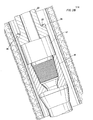
- Figure 2A and 2B are sectional views on an enlarged scale of the apparatus of this invention in an inclined well bore that is cased;
- Figure 3 is a sectional view taken along line 3-3 of Figure 2A;
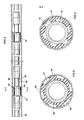
- Figure 4 is a cross section through a horizontal well bore in which is located a drill string equipped with an alternate embodiment of this invention;
- Figure 5 is a sectional view taken along line 5-5 of Figure 4; and
- Figure 6 is a view similar to Figure 5 of another embodiment of this invention.
- In Figure 1, the friction reducing apparatus of this invention, indicated generally by the
numbers wall 14 of well bore 16 and keeptool joints 18 of the drill pipe from rubbing against the low side of the well bore. There may be one or several joints of drill pipe between each friction reducing apparatus depending upon the relative diameters of the apparatus and the tool joints and the inclination of the well bore in which they are to be used. Obviously, as the inclination of the well bore increases, the amount the drill pipe will bend toward the low side of the hole increases and the closer the friction reducing apparatus have to be spaced to insure that the drill pipe and the tool joints on the drill pipe do not come into contact with the side of the well bore, whether it be an uncased open hole as shown in Figure 1 or a cased hole as shown in Figures 2A and 2B. - The details of construction of the friction reducing apparatus of this invention are shown in Figures 2A and 2B. It includes
tubular body 20 havingcentral section 22 with an outside diameter smaller than the rest of the body to provide two oppositely facingshoulders section 22 issleeve 30 of elastomeric material constructed similarly to the stretch-on type pipe protectors that have been in use for some time. - In conventional stretch-on type pipe protectors, the sleeve remains stretched when placed on the drill pipe so that it will grip the pipe and be held in position by friction between the sleeve and the pipe. Here it is desired for
sleeve 30 to freely rotate relative tobody 20, therefore, its inside diameter is designed to be slightly greater than that of the outside diameter ofsection 22 in its relaxed condition. It is positioned onsection 22 in the same manner that conventional pipe protectors are placed on drill pipe, that is, by stretching them sufficiently to clear the tool joints on the end of the pipe after which they are placed on the body of the pipe itself but still sufficiently stretched to provide the desired friction to hold the protectors in place. Here the sleeve will be stretched sufficiently to clear uppertool joint section 32 of the body after which it is moved ontosection 22 where it is then in its relaxed condition and is free to rotate relative tobody 20. - While drilling, drilling fluid is pumped down the drill pipe and back to the surface through
annulus 34. The upward flow of the drilling fluid will movesleeve 30 into engagement withupper shoulder 24. Also tending to move the sleeve upwardly is the downward movement of the drill pipe, but this will be a relatively minor influence compared to the upward force of the drilling fluid flowing by the sleeve. Under certain conditions, stretch on type protectors have been forced over tool joints and up the string due to the force of the upwardly flowing drilling . fluid. To prevent this from happening tosleeve 30,shoulder 24 is inclined outwardly and downwardly about 30°, as shown in the drawing, to overlap the lower portion of the end ofsleeve 30 to provide a force component urging the end of the sleeve inwardly toward the pipe. - Upwardly facing
shoulder 26 is provided with a plurality ofslots 36 into which portions of the lower end of the sleeve can be forced to hold the sleeve against rotation during washover operations. - To insure that the sleeve tends to remain stationary while the pipe and
body 20 rotate relative to the sleeve, the elastomeric material used to form the sleeve can be provided with hard, sharpedged particles 40, such as sand, adjacent the outer surface of the sleeve to increase the coefficient of friction between the sleeve and the open hole or casing. In addition, to decrease the coefficient of friction betweenbody 20 andsleeve 30, the outside surface ofsection 22 and opposingshoulders - Since most drilling muds are water based and water is an excellent lubricant for rubber, the drill pipe should be able to rotate relative to the sleeve with a minimum of friction thereby substantially reducing the torque required to be exerted in the drill string at the surface in order to obtain the desired torque at the bit.
- Preferably,
sleeve 30 is substantially shorter than .the distance betweenshoulders shoulder 24 away from the upper end ofsleeve 30 and get a reasonably accurate indication of what his drill string weighs. Knowing this, he can allow for the amount of weight supported bysleeves 20 while drilling and come closer to knowing what his weight indicator should read with the desired weight on the bit. - Upper
tool joint section 32 and lowertool joint section 42 are provided with a box and pin connection for :onnectingbody 20 into the drill string. - The worst condition for friction between the drill string and well bore is when the well bore is substantially horizontal. In this situation the apparatus of this invention is modified somewhat to better insure that the drill pipe stays out of engagement with the bottom or low side of the well bore. In Figure 4, an alternate embodiment of the friction reducing apparatus of this invention is shown installed in
drilling string 50 at spaced intervals. The apparatus is indicated by thenumbers Apparatus 52 includestubular body 56 that is of substantially the same design astubular body 20 described above.Sleeve 58 is mounted on reducedsection 60 of the body in the same manner as was sleeve 30 as described above. It is free to remain stationary while the drill pipe rotates relative to it. - The major structural difference is in
sleeve 58, which, in this embodiment, has an outside diameter equal to or slightly less than that of the well bore in which it is located. As shown in Figures 4 and 5,sleeve 58 is in engagement with the wall of the well bore. In order to allow fluid to flow by the apparatus,longitudinal grooves 62 are formed on the outer surface to allow the fluid to flow through the grooves as it moves toward the surface inannulus 66. There is a slight clearance between the inside surface ofsleeve 58 andsection 60 ofbody 56 and consequentlysleeve 58 will not hold the drill string exactly in the center of the hole, but very close to it. - An alternate embodiment of the apparatus of this invention is shown in Figure 6. This embodiment is designed to accomplish the same result as the embodiment shown in Figures 4 and 5. The difference here is that
annular grooves 70 for the drilling fluid are located on the inside surface ofsleeve 72 as opposed to the outside surface ofsleeve 58.Body 74 is of the same design asbody 56 andbody 20 described above. - From the foregoing, it will be seen that this invention is one well adapted to attain all of the ends and objects hereinabove set forth, together with other advantages that are obvious and that are inherent to the apparatus and structure.
- It will be understood that certain features and subcombinations are of utility and may be employed without reference to other features and subcombinations. This is contemplated by and is within the scope of the claims.
- Because many possible embodiments may be made of this invention without departing from the scope thereof, it is to be understood that all matter herein set forth or shown in the accompanying drawings is to be interpreted as illustrative and not in a limiting sense.
Claims (9)
1. Apparatus for reducing the friction resisting rotation of a drill string in inclined cased or uncased well bores characterized in that the apparatus comprises a tubular body for connecting into a pipe string, said body having a section of reduced diameter intermediate its ends to provide oppositely facing shoulders at each end of the section, a sleeve of elastometric material mounted on the section of reduced diameter, said sleeve having an outside diameter greater than the largest diameter of the tubular body and an inside diameter slightly greater than the diameter of the section of reduced diameter to allow the sleeve to hold the pipe string away from the wall of the casing or the well bore if uncased and to allow the drill string including the tubular body to rotate relative to the sleeve to reduce the torque required to rotate the drill string.
2. The apparatus of claim 1 characterized in that the section of reduced diameter is plated with a hard metal to reduce the coefficient of friction between the rotating tubular body and the sleeve.
3. The apparatus of claim 1 characterized in that the downwardly facing shoulder on the tubular body is inclined outwardly and downwardly and the end of the sleeve facing the shoulder is inclined at the same angle.
4. The apparatus of claim 1 characterized in that the tubular body has grooves cut into its outer surface above the downwardly facing shoulder that intersect the shoulder to provide openings through which drilling fluid flowing between the sleeve and the body can flow into the annulus above the shoulder between the body and the well bore.
5. The apparatus of claim 1 characterized in that particles of a hard, sharp edged, material are embedded in the outer surface of the sleeve to increase the coefficient of friction between the sleeve and the well bore.
6. The apparatus of claim 1 characterized in that the sleeve is substantially shorter than the distance between the oppositely facing shoulders to allow the pipe string to move the pipe upwardly to move the sleeve to a position between the shoulders and get a reasonable indication of the weight of the drill string.
7. The apparatus of claim 1 characterized in that the outside diameter of the sleeve is about equal to the diameter of the casing or the well bore.
8. The apparatus of claim 7 characterized in that the sleeve has longitudinally extending grooves on its outer surface through which drilling fluid can flow between the sleeve and the wall of the well bore or the casing.
9. The apparatus of claim 7 characterized in that the sleeve has longitudinally extending grooves on its inner surface through which drilling fluid can flow between the sleeve and the tubular body.
Applications Claiming Priority (2)
| Application Number | Priority Date | Filing Date | Title |
|---|---|---|---|
| US54457983A | 1983-10-24 | 1983-10-24 | |
| US544579 | 1983-10-24 |
Publications (1)
| Publication Number | Publication Date |
|---|---|
| EP0140311A1 true EP0140311A1 (en) | 1985-05-08 |
Family
ID=24172764
Family Applications (1)
| Application Number | Title | Priority Date | Filing Date |
|---|---|---|---|
| EP84112654A Withdrawn EP0140311A1 (en) | 1983-10-24 | 1984-10-19 | Apparatus for reducing friction between rotating drill pipe and the well bore |
Country Status (4)
| Country | Link |
|---|---|
| EP (1) | EP0140311A1 (en) |
| JP (1) | JPS60112985A (en) |
| AU (1) | AU3409784A (en) |
| NO (1) | NO844220L (en) |
Cited By (12)
| Publication number | Priority date | Publication date | Assignee | Title |
|---|---|---|---|---|
| GB2204895A (en) * | 1987-05-21 | 1988-11-23 | Stephen Francis Lloyd | Drill pipe tubing and casing protectors |
| US4832137A (en) * | 1986-05-29 | 1989-05-23 | Phillips Petroleum Company | Method for protecting a pipe casing from a drill pipe string |
| GB2211523A (en) * | 1987-10-28 | 1989-07-05 | K D Engineering Plastics Limit | Guiding drill rods |
| GB2233690A (en) * | 1989-06-29 | 1991-01-16 | Red Baron | Drill string component |
| US5009826A (en) * | 1986-05-29 | 1991-04-23 | Phillips Petroleum Company | Method of molding a composite drill collar |
| FR2690481A1 (en) * | 1992-04-22 | 1993-10-29 | Total Sa | Pressure regulation device in concentric tubings - comprises compressible elements esp. of syntactic foam |
| US5901798A (en) * | 1993-10-14 | 1999-05-11 | Hydril U.K. Limited | Drill pipe tubing and casing protectors |
| GB2340523A (en) * | 1998-07-30 | 2000-02-23 | Vetco Gray Inc Abb | Drill pipe protection rings |
| US8701759B1 (en) | 2013-03-14 | 2014-04-22 | Summit Energy Services, Inc. | Casing centralizer |
| CN106593313A (en) * | 2016-12-20 | 2017-04-26 | 中国石油化工股份有限公司 | Horizontal well completion pipe string guide resistance reducing device |
| USD849800S1 (en) | 2012-04-04 | 2019-05-28 | Summit Energy Services, Inc. | Casing centralizer having spiral blades |
| US10711535B2 (en) | 2013-05-29 | 2020-07-14 | Paradigm Drilling Services Limited | Downhole apparatus and method |
Citations (8)
| Publication number | Priority date | Publication date | Assignee | Title |
|---|---|---|---|---|
| US1814183A (en) * | 1929-05-20 | 1931-07-14 | Patterson Ballagh Corp | Pipe coupling and tool joint |
| US1910631A (en) * | 1929-12-30 | 1933-05-23 | Chikgan Oil Tool Company Ltd | Guide for drill pipe |
| US1985229A (en) * | 1929-12-27 | 1934-12-25 | Sullivan Machinery Co | Drilling apparatus |
| US2715552A (en) * | 1954-03-01 | 1955-08-16 | Guiberson Corp | Drill string bushing tool |
| US2813697A (en) * | 1953-06-15 | 1957-11-19 | Security Engineering Division | Stabilizer for drill collars and drill pipes |
| US3103391A (en) * | 1963-09-10 | Drill string stabilizer | ||
| US3320004A (en) * | 1964-06-19 | 1967-05-16 | Drilco Oil Tool Inc | Earth boring apparatus |
| USRE31016E (en) * | 1980-12-22 | 1982-08-24 | Conoco Inc. | Anti-friction sucker rod guide assembly |
-
1984
- 1984-10-10 AU AU34097/84A patent/AU3409784A/en not_active Abandoned
- 1984-10-19 EP EP84112654A patent/EP0140311A1/en not_active Withdrawn
- 1984-10-23 NO NO844220A patent/NO844220L/en unknown
- 1984-10-23 JP JP59221378A patent/JPS60112985A/en active Pending
Patent Citations (8)
| Publication number | Priority date | Publication date | Assignee | Title |
|---|---|---|---|---|
| US3103391A (en) * | 1963-09-10 | Drill string stabilizer | ||
| US1814183A (en) * | 1929-05-20 | 1931-07-14 | Patterson Ballagh Corp | Pipe coupling and tool joint |
| US1985229A (en) * | 1929-12-27 | 1934-12-25 | Sullivan Machinery Co | Drilling apparatus |
| US1910631A (en) * | 1929-12-30 | 1933-05-23 | Chikgan Oil Tool Company Ltd | Guide for drill pipe |
| US2813697A (en) * | 1953-06-15 | 1957-11-19 | Security Engineering Division | Stabilizer for drill collars and drill pipes |
| US2715552A (en) * | 1954-03-01 | 1955-08-16 | Guiberson Corp | Drill string bushing tool |
| US3320004A (en) * | 1964-06-19 | 1967-05-16 | Drilco Oil Tool Inc | Earth boring apparatus |
| USRE31016E (en) * | 1980-12-22 | 1982-08-24 | Conoco Inc. | Anti-friction sucker rod guide assembly |
Cited By (17)
| Publication number | Priority date | Publication date | Assignee | Title |
|---|---|---|---|---|
| US4832137A (en) * | 1986-05-29 | 1989-05-23 | Phillips Petroleum Company | Method for protecting a pipe casing from a drill pipe string |
| US5009826A (en) * | 1986-05-29 | 1991-04-23 | Phillips Petroleum Company | Method of molding a composite drill collar |
| GB2204895A (en) * | 1987-05-21 | 1988-11-23 | Stephen Francis Lloyd | Drill pipe tubing and casing protectors |
| GB2204895B (en) * | 1987-05-21 | 1991-11-27 | Stephen Francis Lloyd | Drill pipe tubing and casing protectors |
| GB2211523A (en) * | 1987-10-28 | 1989-07-05 | K D Engineering Plastics Limit | Guiding drill rods |
| GB2233690A (en) * | 1989-06-29 | 1991-01-16 | Red Baron | Drill string component |
| GB2233690B (en) * | 1989-06-29 | 1993-02-03 | Red Baron | Drill string component |
| FR2690481A1 (en) * | 1992-04-22 | 1993-10-29 | Total Sa | Pressure regulation device in concentric tubings - comprises compressible elements esp. of syntactic foam |
| US5901798A (en) * | 1993-10-14 | 1999-05-11 | Hydril U.K. Limited | Drill pipe tubing and casing protectors |
| GB2340523A (en) * | 1998-07-30 | 2000-02-23 | Vetco Gray Inc Abb | Drill pipe protection rings |
| GB2340523B (en) * | 1998-07-30 | 2002-06-12 | Vetco Gray Inc Abb | Drill pipe protection rings |
| USD849800S1 (en) | 2012-04-04 | 2019-05-28 | Summit Energy Services, Inc. | Casing centralizer having spiral blades |
| USD983231S1 (en) | 2012-04-04 | 2023-04-11 | Summit Casing Services, Llc | Casing centralizer having spiral blades |
| US8701759B1 (en) | 2013-03-14 | 2014-04-22 | Summit Energy Services, Inc. | Casing centralizer |
| US9057229B2 (en) | 2013-03-14 | 2015-06-16 | Summit Energy Services, Inc. | Casing centralizer |
| US10711535B2 (en) | 2013-05-29 | 2020-07-14 | Paradigm Drilling Services Limited | Downhole apparatus and method |
| CN106593313A (en) * | 2016-12-20 | 2017-04-26 | 中国石油化工股份有限公司 | Horizontal well completion pipe string guide resistance reducing device |
Also Published As
| Publication number | Publication date |
|---|---|
| AU3409784A (en) | 1985-05-02 |
| JPS60112985A (en) | 1985-06-19 |
| NO844220L (en) | 1985-04-25 |
Similar Documents
| Publication | Publication Date | Title |
|---|---|---|
| AU755488B2 (en) | Improvements in or relating to downhole tools | |
| US4428441A (en) | Method and apparatus for reducing the differential pressure sticking tendency of a drill string | |
| US8668007B2 (en) | Non-rotating casing centralizer | |
| US7140432B2 (en) | Dual diameter and rotating centralizer/sub and method | |
| US3820611A (en) | Well drilling method and apparatus | |
| US6209638B1 (en) | Casing accessory equipment | |
| US2715552A (en) | Drill string bushing tool | |
| CA2381212C (en) | Anti-rotation device for use with well tools | |
| US6082457A (en) | Method of using a drill string tool | |
| EP0778914B1 (en) | Drill casing installation equipment with external friction reducing means | |
| EP0140311A1 (en) | Apparatus for reducing friction between rotating drill pipe and the well bore | |
| US2999552A (en) | Tubular drill string member | |
| US7156171B2 (en) | Dual diameter and rotating centralizer/sub | |
| GB2362900A (en) | Friction reduction means for downhole equipment | |
| GB2565432B (en) | Stop collar | |
| GB2261238A (en) | Turbine vibrator assembly | |
| US5033558A (en) | Well tool for use with down-hole drilling apparatus | |
| US3762472A (en) | Casing stand-off band for use during the running and cementing of casing in wellbores | |
| US4043410A (en) | Anti-sticking tool for drill pipe | |
| US4919208A (en) | Method and apparatus for manipulating tubing in a well | |
| RU2183250C2 (en) | Stabilizer |
Legal Events
| Date | Code | Title | Description |
|---|---|---|---|
| PUAI | Public reference made under article 153(3) epc to a published international application that has entered the european phase |
Free format text: ORIGINAL CODE: 0009012 |
|
| AK | Designated contracting states |
Designated state(s): AT BE CH DE FR GB IT LI LU NL SE |
|
| STAA | Information on the status of an ep patent application or granted ep patent |
Free format text: STATUS: THE APPLICATION IS DEEMED TO BE WITHDRAWN |
|
| 18D | Application deemed to be withdrawn |
Effective date: 19860108 |
|
| RIN1 | Information on inventor provided before grant (corrected) |
Inventor name: ANDERS, EDWARD O. |