EP0136635A2 - Sekundärzelle - Google Patents
Sekundärzelle Download PDFInfo
- Publication number
- EP0136635A2 EP0136635A2 EP84111300A EP84111300A EP0136635A2 EP 0136635 A2 EP0136635 A2 EP 0136635A2 EP 84111300 A EP84111300 A EP 84111300A EP 84111300 A EP84111300 A EP 84111300A EP 0136635 A2 EP0136635 A2 EP 0136635A2
- Authority
- EP
- European Patent Office
- Prior art keywords
- cell
- double bonds
- polyacetylene
- mol
- electrode
- Prior art date
- Legal status (The legal status is an assumption and is not a legal conclusion. Google has not performed a legal analysis and makes no representation as to the accuracy of the status listed.)
- Granted
Links
- 229920000642 polymer Polymers 0.000 claims abstract description 26
- -1 nitrile compound Chemical class 0.000 claims abstract description 15
- 239000003792 electrolyte Substances 0.000 claims abstract description 14
- 239000002516 radical scavenger Substances 0.000 claims description 15
- 238000006243 chemical reaction Methods 0.000 claims description 9
- 238000000354 decomposition reaction Methods 0.000 claims description 7
- 239000000126 substance Substances 0.000 claims description 5
- 239000003463 adsorbent Substances 0.000 claims description 4
- 230000036647 reaction Effects 0.000 claims description 3
- HSFWRNGVRCDJHI-UHFFFAOYSA-N alpha-acetylene Natural products C#C HSFWRNGVRCDJHI-UHFFFAOYSA-N 0.000 abstract description 37
- 229920001197 polyacetylene Polymers 0.000 abstract description 36
- 239000008151 electrolyte solution Substances 0.000 abstract description 15
- 125000000843 phenylene group Chemical group C1(=C(C=CC=C1)*)* 0.000 abstract description 3
- 229920000128 polypyrrole Polymers 0.000 abstract description 2
- 238000007599 discharging Methods 0.000 description 18
- 239000002019 doping agent Substances 0.000 description 16
- 229940021013 electrolyte solution Drugs 0.000 description 15
- 239000002904 solvent Substances 0.000 description 14
- QIGBRXMKCJKVMJ-UHFFFAOYSA-N Hydroquinone Chemical compound OC1=CC=C(O)C=C1 QIGBRXMKCJKVMJ-UHFFFAOYSA-N 0.000 description 12
- 229910019785 NBF4 Inorganic materials 0.000 description 8
- BASFCYQUMIYNBI-UHFFFAOYSA-N platinum Substances [Pt] BASFCYQUMIYNBI-UHFFFAOYSA-N 0.000 description 7
- WEVYAHXRMPXWCK-UHFFFAOYSA-N Acetonitrile Chemical compound CC#N WEVYAHXRMPXWCK-UHFFFAOYSA-N 0.000 description 5
- 150000001450 anions Chemical class 0.000 description 4
- 230000000694 effects Effects 0.000 description 4
- 229910052739 hydrogen Inorganic materials 0.000 description 4
- 229910001496 lithium tetrafluoroborate Inorganic materials 0.000 description 4
- RUOJZAUFBMNUDX-UHFFFAOYSA-N propylene carbonate Chemical compound CC1COC(=O)O1 RUOJZAUFBMNUDX-UHFFFAOYSA-N 0.000 description 4
- 238000007086 side reaction Methods 0.000 description 4
- PNEYBMLMFCGWSK-UHFFFAOYSA-N aluminium oxide Inorganic materials [O-2].[O-2].[O-2].[Al+3].[Al+3] PNEYBMLMFCGWSK-UHFFFAOYSA-N 0.000 description 3
- 230000000052 comparative effect Effects 0.000 description 3
- 238000004925 denaturation Methods 0.000 description 3
- 230000036425 denaturation Effects 0.000 description 3
- 239000001257 hydrogen Substances 0.000 description 3
- 229910052751 metal Inorganic materials 0.000 description 3
- 239000002184 metal Substances 0.000 description 3
- 238000000034 method Methods 0.000 description 3
- 229910052697 platinum Inorganic materials 0.000 description 3
- XLYOFNOQVPJJNP-UHFFFAOYSA-N water Substances O XLYOFNOQVPJJNP-UHFFFAOYSA-N 0.000 description 3
- MYRTYDVEIRVNKP-UHFFFAOYSA-N 1,2-Divinylbenzene Chemical compound C=CC1=CC=CC=C1C=C MYRTYDVEIRVNKP-UHFFFAOYSA-N 0.000 description 2
- UFHFLCQGNIYNRP-UHFFFAOYSA-N Hydrogen Chemical compound [H][H] UFHFLCQGNIYNRP-UHFFFAOYSA-N 0.000 description 2
- VYPSYNLAJGMNEJ-UHFFFAOYSA-N Silicium dioxide Chemical compound O=[Si]=O VYPSYNLAJGMNEJ-UHFFFAOYSA-N 0.000 description 2
- PPBRXRYQALVLMV-UHFFFAOYSA-N Styrene Chemical compound C=CC1=CC=CC=C1 PPBRXRYQALVLMV-UHFFFAOYSA-N 0.000 description 2
- 238000007259 addition reaction Methods 0.000 description 2
- QVGXLLKOCUKJST-UHFFFAOYSA-N atomic oxygen Chemical compound [O] QVGXLLKOCUKJST-UHFFFAOYSA-N 0.000 description 2
- OJIJEKBXJYRIBZ-UHFFFAOYSA-N cadmium nickel Chemical compound [Ni].[Cd] OJIJEKBXJYRIBZ-UHFFFAOYSA-N 0.000 description 2
- 229910052799 carbon Inorganic materials 0.000 description 2
- 125000004432 carbon atom Chemical group C* 0.000 description 2
- 229910001914 chlorine tetroxide Inorganic materials 0.000 description 2
- 125000004122 cyclic group Chemical group 0.000 description 2
- 230000003247 decreasing effect Effects 0.000 description 2
- 150000004820 halides Chemical class 0.000 description 2
- 150000002430 hydrocarbons Chemical group 0.000 description 2
- MHCFAGZWMAWTNR-UHFFFAOYSA-M lithium perchlorate Chemical compound [Li+].[O-]Cl(=O)(=O)=O MHCFAGZWMAWTNR-UHFFFAOYSA-M 0.000 description 2
- 229910001486 lithium perchlorate Inorganic materials 0.000 description 2
- 239000012528 membrane Substances 0.000 description 2
- 229910052760 oxygen Inorganic materials 0.000 description 2
- 239000001301 oxygen Substances 0.000 description 2
- VLTRZXGMWDSKGL-UHFFFAOYSA-M perchlorate Chemical compound [O-]Cl(=O)(=O)=O VLTRZXGMWDSKGL-UHFFFAOYSA-M 0.000 description 2
- VLTRZXGMWDSKGL-UHFFFAOYSA-N perchloric acid Chemical compound OCl(=O)(=O)=O VLTRZXGMWDSKGL-UHFFFAOYSA-N 0.000 description 2
- 238000006116 polymerization reaction Methods 0.000 description 2
- WQGWDDDVZFFDIG-UHFFFAOYSA-N pyrogallol Chemical compound OC1=CC=CC(O)=C1O WQGWDDDVZFFDIG-UHFFFAOYSA-N 0.000 description 2
- 230000000717 retained effect Effects 0.000 description 2
- HXJUTPCZVOIRIF-UHFFFAOYSA-N sulfolane Chemical compound O=S1(=O)CCCC1 HXJUTPCZVOIRIF-UHFFFAOYSA-N 0.000 description 2
- JIGUICYYOYEXFS-UHFFFAOYSA-N 3-tert-butylbenzene-1,2-diol Chemical compound CC(C)(C)C1=CC=CC(O)=C1O JIGUICYYOYEXFS-UHFFFAOYSA-N 0.000 description 1
- 239000004925 Acrylic resin Substances 0.000 description 1
- 229910017048 AsF6 Inorganic materials 0.000 description 1
- OKTJSMMVPCPJKN-UHFFFAOYSA-N Carbon Chemical compound [C] OKTJSMMVPCPJKN-UHFFFAOYSA-N 0.000 description 1
- RWSOTUBLDIXVET-UHFFFAOYSA-N Dihydrogen sulfide Chemical class S RWSOTUBLDIXVET-UHFFFAOYSA-N 0.000 description 1
- 229910001290 LiPF6 Inorganic materials 0.000 description 1
- 229910020939 NaC104 Inorganic materials 0.000 description 1
- 239000004743 Polypropylene Substances 0.000 description 1
- NINIDFKCEFEMDL-UHFFFAOYSA-N Sulfur Chemical compound [S] NINIDFKCEFEMDL-UHFFFAOYSA-N 0.000 description 1
- DHXVGJBLRPWPCS-UHFFFAOYSA-N Tetrahydropyran Chemical compound C1CCOCC1 DHXVGJBLRPWPCS-UHFFFAOYSA-N 0.000 description 1
- 238000000862 absorption spectrum Methods 0.000 description 1
- 229910001413 alkali metal ion Inorganic materials 0.000 description 1
- 229910052782 aluminium Inorganic materials 0.000 description 1
- XAGFODPZIPBFFR-UHFFFAOYSA-N aluminium Chemical compound [Al] XAGFODPZIPBFFR-UHFFFAOYSA-N 0.000 description 1
- 229910000323 aluminium silicate Inorganic materials 0.000 description 1
- 125000000129 anionic group Chemical group 0.000 description 1
- 239000003125 aqueous solvent Substances 0.000 description 1
- 230000008901 benefit Effects 0.000 description 1
- 125000002091 cationic group Chemical group 0.000 description 1
- 150000001768 cations Chemical class 0.000 description 1
- 230000002860 competitive effect Effects 0.000 description 1
- 150000001875 compounds Chemical class 0.000 description 1
- 229920001940 conductive polymer Polymers 0.000 description 1
- 229920001577 copolymer Polymers 0.000 description 1
- 230000007797 corrosion Effects 0.000 description 1
- 238000005260 corrosion Methods 0.000 description 1
- 230000006378 damage Effects 0.000 description 1
- 230000002950 deficient Effects 0.000 description 1
- 238000010586 diagram Methods 0.000 description 1
- ZXSBDSGRQIWJPM-UHFFFAOYSA-N dimethylcarbamothioic s-acid Chemical class CN(C)C(S)=O ZXSBDSGRQIWJPM-UHFFFAOYSA-N 0.000 description 1
- HNPSIPDUKPIQMN-UHFFFAOYSA-N dioxosilane;oxo(oxoalumanyloxy)alumane Chemical compound O=[Si]=O.O=[Al]O[Al]=O HNPSIPDUKPIQMN-UHFFFAOYSA-N 0.000 description 1
- 238000003487 electrochemical reaction Methods 0.000 description 1
- 239000007772 electrode material Substances 0.000 description 1
- 125000002534 ethynyl group Chemical group [H]C#C* 0.000 description 1
- 230000001747 exhibiting effect Effects 0.000 description 1
- 239000004744 fabric Substances 0.000 description 1
- 125000000524 functional group Chemical group 0.000 description 1
- 239000011521 glass Substances 0.000 description 1
- 238000011835 investigation Methods 0.000 description 1
- 150000002500 ions Chemical class 0.000 description 1
- 239000000463 material Substances 0.000 description 1
- 230000007246 mechanism Effects 0.000 description 1
- 239000000203 mixture Substances 0.000 description 1
- 239000004570 mortar (masonry) Substances 0.000 description 1
- 230000007935 neutral effect Effects 0.000 description 1
- 125000002560 nitrile group Chemical group 0.000 description 1
- 150000002825 nitriles Chemical class 0.000 description 1
- 229910052757 nitrogen Inorganic materials 0.000 description 1
- 239000005486 organic electrolyte Substances 0.000 description 1
- 239000003960 organic solvent Substances 0.000 description 1
- 230000003647 oxidation Effects 0.000 description 1
- 238000007254 oxidation reaction Methods 0.000 description 1
- 230000001590 oxidative effect Effects 0.000 description 1
- 230000036961 partial effect Effects 0.000 description 1
- 229920001155 polypropylene Polymers 0.000 description 1
- 229910001487 potassium perchlorate Inorganic materials 0.000 description 1
- 238000002360 preparation method Methods 0.000 description 1
- 230000008569 process Effects 0.000 description 1
- 229940079877 pyrogallol Drugs 0.000 description 1
- 150000004053 quinones Chemical class 0.000 description 1
- 230000009467 reduction Effects 0.000 description 1
- 239000011347 resin Substances 0.000 description 1
- 229920005989 resin Polymers 0.000 description 1
- 238000007493 shaping process Methods 0.000 description 1
- 239000000377 silicon dioxide Substances 0.000 description 1
- 229910052709 silver Inorganic materials 0.000 description 1
- FVAUCKIRQBBSSJ-UHFFFAOYSA-M sodium iodide Inorganic materials [Na+].[I-] FVAUCKIRQBBSSJ-UHFFFAOYSA-M 0.000 description 1
- 229910052717 sulfur Inorganic materials 0.000 description 1
- 239000011593 sulfur Substances 0.000 description 1
- UGNWTBMOAKPKBL-UHFFFAOYSA-N tetrachloro-1,4-benzoquinone Chemical compound ClC1=C(Cl)C(=O)C(Cl)=C(Cl)C1=O UGNWTBMOAKPKBL-UHFFFAOYSA-N 0.000 description 1
- 125000002221 trityl group Chemical group [H]C1=C([H])C([H])=C([H])C([H])=C1C([*])(C1=C(C(=C(C(=C1[H])[H])[H])[H])[H])C1=C([H])C([H])=C([H])C([H])=C1[H] 0.000 description 1
Images


Classifications
-
- H—ELECTRICITY
- H01—ELECTRIC ELEMENTS
- H01M—PROCESSES OR MEANS, e.g. BATTERIES, FOR THE DIRECT CONVERSION OF CHEMICAL ENERGY INTO ELECTRICAL ENERGY
- H01M4/00—Electrodes
- H01M4/02—Electrodes composed of, or comprising, active material
- H01M4/13—Electrodes for accumulators with non-aqueous electrolyte, e.g. for lithium-accumulators; Processes of manufacture thereof
- H01M4/137—Electrodes based on electro-active polymers
-
- C—CHEMISTRY; METALLURGY
- C08—ORGANIC MACROMOLECULAR COMPOUNDS; THEIR PREPARATION OR CHEMICAL WORKING-UP; COMPOSITIONS BASED THEREON
- C08G—MACROMOLECULAR COMPOUNDS OBTAINED OTHERWISE THAN BY REACTIONS ONLY INVOLVING UNSATURATED CARBON-TO-CARBON BONDS
- C08G61/00—Macromolecular compounds obtained by reactions forming a carbon-to-carbon link in the main chain of the macromolecule
- C08G61/12—Macromolecular compounds containing atoms other than carbon in the main chain of the macromolecule
- C08G61/122—Macromolecular compounds containing atoms other than carbon in the main chain of the macromolecule derived from five- or six-membered heterocyclic compounds, other than imides
- C08G61/123—Macromolecular compounds containing atoms other than carbon in the main chain of the macromolecule derived from five- or six-membered heterocyclic compounds, other than imides derived from five-membered heterocyclic compounds
-
- H—ELECTRICITY
- H01—ELECTRIC ELEMENTS
- H01M—PROCESSES OR MEANS, e.g. BATTERIES, FOR THE DIRECT CONVERSION OF CHEMICAL ENERGY INTO ELECTRICAL ENERGY
- H01M10/00—Secondary cells; Manufacture thereof
- H01M10/05—Accumulators with non-aqueous electrolyte
-
- H—ELECTRICITY
- H01—ELECTRIC ELEMENTS
- H01M—PROCESSES OR MEANS, e.g. BATTERIES, FOR THE DIRECT CONVERSION OF CHEMICAL ENERGY INTO ELECTRICAL ENERGY
- H01M10/00—Secondary cells; Manufacture thereof
- H01M10/05—Accumulators with non-aqueous electrolyte
- H01M10/056—Accumulators with non-aqueous electrolyte characterised by the materials used as electrolytes, e.g. mixed inorganic/organic electrolytes
- H01M10/0564—Accumulators with non-aqueous electrolyte characterised by the materials used as electrolytes, e.g. mixed inorganic/organic electrolytes the electrolyte being constituted of organic materials only
- H01M10/0566—Liquid materials
- H01M10/0567—Liquid materials characterised by the additives
-
- H—ELECTRICITY
- H01—ELECTRIC ELEMENTS
- H01M—PROCESSES OR MEANS, e.g. BATTERIES, FOR THE DIRECT CONVERSION OF CHEMICAL ENERGY INTO ELECTRICAL ENERGY
- H01M4/00—Electrodes
- H01M4/02—Electrodes composed of, or comprising, active material
- H01M4/36—Selection of substances as active materials, active masses, active liquids
- H01M4/60—Selection of substances as active materials, active masses, active liquids of organic compounds
- H01M4/602—Polymers
-
- H—ELECTRICITY
- H01—ELECTRIC ELEMENTS
- H01M—PROCESSES OR MEANS, e.g. BATTERIES, FOR THE DIRECT CONVERSION OF CHEMICAL ENERGY INTO ELECTRICAL ENERGY
- H01M4/00—Electrodes
- H01M4/02—Electrodes composed of, or comprising, active material
- H01M4/62—Selection of inactive substances as ingredients for active masses, e.g. binders, fillers
-
- H—ELECTRICITY
- H01—ELECTRIC ELEMENTS
- H01M—PROCESSES OR MEANS, e.g. BATTERIES, FOR THE DIRECT CONVERSION OF CHEMICAL ENERGY INTO ELECTRICAL ENERGY
- H01M10/00—Secondary cells; Manufacture thereof
- H01M10/42—Methods or arrangements for servicing or maintenance of secondary cells or secondary half-cells
- H01M10/4235—Safety or regulating additives or arrangements in electrodes, separators or electrolyte
-
- H—ELECTRICITY
- H01—ELECTRIC ELEMENTS
- H01M—PROCESSES OR MEANS, e.g. BATTERIES, FOR THE DIRECT CONVERSION OF CHEMICAL ENERGY INTO ELECTRICAL ENERGY
- H01M6/00—Primary cells; Manufacture thereof
- H01M6/14—Cells with non-aqueous electrolyte
- H01M6/16—Cells with non-aqueous electrolyte with organic electrolyte
- H01M6/162—Cells with non-aqueous electrolyte with organic electrolyte characterised by the electrolyte
- H01M6/168—Cells with non-aqueous electrolyte with organic electrolyte characterised by the electrolyte by additives
-
- Y—GENERAL TAGGING OF NEW TECHNOLOGICAL DEVELOPMENTS; GENERAL TAGGING OF CROSS-SECTIONAL TECHNOLOGIES SPANNING OVER SEVERAL SECTIONS OF THE IPC; TECHNICAL SUBJECTS COVERED BY FORMER USPC CROSS-REFERENCE ART COLLECTIONS [XRACs] AND DIGESTS
- Y02—TECHNOLOGIES OR APPLICATIONS FOR MITIGATION OR ADAPTATION AGAINST CLIMATE CHANGE
- Y02E—REDUCTION OF GREENHOUSE GAS [GHG] EMISSIONS, RELATED TO ENERGY GENERATION, TRANSMISSION OR DISTRIBUTION
- Y02E60/00—Enabling technologies; Technologies with a potential or indirect contribution to GHG emissions mitigation
- Y02E60/10—Energy storage using batteries
Definitions
- This invention relates to a secondary cell and more particularly, to a chargeable polymer secondary cell.
- Polymers having conjugated double bonds such as polyacetylene have been known to form p-type or n-type conductive polyacetylene by electrochemically doping with anions such as ClO 4 - , PF 6 or BF 4 , or with cations such as Li + or (C 4 H 9 ) 4 N + [J.C.S. Chem. Comm. (1979), pp. 594 - 595; C & E N , 26, 39 (1981)], and there have been disclosed chargeable cells utilizing the electrochemical doping.
- anions such as ClO 4 - , PF 6 or BF 4
- cations such as Li + or (C 4 H 9 ) 4 N +
- a cell comprising positive and negative electrodes made of polyacetylene membrane and an organic electrolyte solution prepared by dissolving (C 4 H 9 ) 4 NClO 4 in propylene carbonate can afford an open-circuit vcltage of 2.5V and a short-circuit current of 11.1 mA [J.C.S. Chem. Comm. (1981), pp. 317 - 319].
- Wh/kg high energy density
- W/kg high output density
- An object of this invention is to provide a polymer secondary cell having superior life characteristics.
- the present polymer secondary cell comprising electrodes, wherein at least either positive or negative electrode is composed of a polymer having conjugated double bonds, and an electrolyte interposed between the positive and negative electrodes is characterized in that a means is provided to control the loss in the conjugated double bonds in said polymer.
- the present inventors have made various studies and finally attained the present invention based on new findings as follows. It has been clarified that the main cause for the cell life to decrease by repeated charging and discharging is that in the course of a cell reaction, particularly during the charging process, the electrolyte is decomposed by a side reaction occurring therein, or the organic solvent in which the electrolyte is dissolved is decomposed, to give active decomposition products, by which the conjugated double bonds in the polymer electrode are destroyed gradually. Accordingly, it has been confirmed that the cell life can be improved if only such decomposition products can be controlled from occurring or they can be trapped.
- the polymers having conjugated double bonds which can be used in this invention include various polymers such as polyacetylene, poly-phenylene, polythienylene and polypyrrole.
- the conductive polymers which can be used currently as secondary cell electrode material include poly-phenylene and polyacetylene.
- polyacetylene as a copolymer of acetylene may be thought to be the best polymer.
- polymerization methods for the preparation of polyacetylene used for such polymer electrodes see, e.g., "Gosei Kinzoku" pp. 15, Kagaku Dojin (1980)]
- polyacetylene prepared by any of known polymerization methods can be used in this invention.
- the electrolytes which can be used for doping the polyacetylene, i.e. dopant ions include (i) anions of halides of Group Va elements, such as PF 6 - , SbF 6 - and AsF 6 - , (ii) anions of halides of Group IIIa elements, such as BF 4 - , (iii) halide anions, such as I - (I 3 - ), Br - , Cl - and F - , (iv) anions of perchloric acid, such as ClO 4 - , (v) alkali metal ions, such as Li , Na + , K + and Cs + , (vi) quaternary ammonium ions, such as R 4 N + (wherein R is a hydrocarbon group having 1 to 20 carbon atoms) and (vii) phosphonium ions, such as R 4 P + (where R is a hydrocarbon group having 1 to 20 carbon atoms).
- the compounds which can yield the above-mentioned anionic and cationic dopants include, for example, LiPF 6 .
- LiBF 4 , LiClO 4 , NaI, NaC10 4 , KClO 4 , (C 2 Hs)4NBF4, (C 2 H 5 ) 4 NClO 4 , (C 4 H 9 ) 4 NBF 4 and (C 4 H 9 ) 4 NClO 4 though they shall not be limited to these examples.
- These dopants may be used alone or as a mixture thereof.
- the electrolyte solution used in this invention is prepared by dissolving the dopant in water or a non-aqueous solvent, among which the latter is preferably used, because a high cell voltage can be available thereby.
- the electrolyte of this invention should be in a concentration ranging from 0.001 to 10 mol/1, which varies with the electrolyte (dopant) and solvent used.
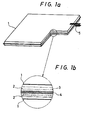
- Fig. 1 shows an example of the structure of a single cell comprising polyacetylene electrodes and the above-mentioned dopant and solvent. Since polyacetylene and the doped polyacetylene are unstable to water and oxygen, the external wall as the cell casing is protected with a resin film 1 laminated with an aluminum membrane (1 to 100 um in thickness). Moreover, an expanded metal sheet or metal gauze 3 made of a corrosion-resistant material such as SUS is embedded in each electrode, so that the polyacetylene electrode 2 can be provided with an increased current collecting effect and the electrode terminals 5 be taken out readily.
- a corrosion-resistant material such as SUS
- a separator 4 made of a polypropylene or glass cloth, so that the electrodes be prevented from short-circuiting and the electrolyte solution be retained well.
- Fig. 1 shows a structural diagram of a single cell, but it is also possible to laminate them by placing a suitable conductive separator between the single cells to prevent the electrolyte solution from moving from one single cell to another.
- the present cell comprising inherently light electrodes, can achieve weight saving by employing a cell casing reinforced with a metal laminate which is impermeable to oxycen and water. Its effective energy density is also greater than 25 Wh/kg for the nickel-cadmium cell or 30 Wh/kg for the lead cell.
- a test cell was prepared from polyacetylene having a thickness of 200 um, using (C 2 H 5 ) 4 NBF 4 as the dopant, CH 3 CN as the solvent, and the electrolyte solution in a concentration of 1 mol/i.
- the cell was tested for charging and discharging cycles at a current density of 5 mA/cm 2 and a doping rate of 4 mol % to find that its life was about 50 cycles as shown in Fig. 3.
- the cell having such a short charging and discharging cycle life cannot afford a secondary cell displaying its functions to the full.
- the short cycle life is believed to be due to the denaturation of the polyacetylene electrodes.
- FIG. 2 shows a cyclic voltamgram of the electrolyte solution [dopant: (C 2 H 5 ) 4 NBF 4 , solvent: CH 3 CN) where the active electrode is composed of a platinum plate.
- the reference electrode comprising Ag/Ag was used. A reduction occurred at potentials of -2.0 V or below, so that a reducing current flowed, while an oxidation occurred at potentials of +2.2 V or above, so that an oxidizing current flowed.
- Fig. 3 shows changes in the electrode.potential at the 35th charging and discharging cycle. The potential on the negative electrode went down to -2.5 V, based on the Ag/Ag + 3 reference electrode.
- the addition reaction of the nitrile group and hydrogen to polyacetylene (CH) may be represented by the following scheme, though its reaction mechanism has not been clarified as yet.
- the rate of decrease in the conjugated double bonds was variable at the respective cycles: It was small during the initial charging and discharging cycles and became greater in later cycles. The rate of decrease was small as long as the radical scavenger was retained in an enough amount.
- the polymer secondary cell as intended in this invention can be relaized by allowing the polymer electrode to carry on its surface or inside a substance capable of trapping radicals formed by the side reactions of the electrode.
- the polyacetylene electrode or the electrolyte solution with at least one member selected from adsorbents for the above-mentioned decomposition products, such as inorganic adsorbents, for example, active alumina, silica or aluminosilicate, and organic adsorbents, for example, styrene, crosslinked divinylbenzene gel, acrylate resin, active carbon or polyacetylene.
- adsorbents for the above-mentioned decomposition products such as inorganic adsorbents, for example, active alumina, silica or aluminosilicate, and organic adsorbents, for example, styrene, crosslinked divinylbenzene gel, acrylate resin, active carbon or polyacetylene.
- the radical scavengers include, for example, mercaptans, aromatic nitro compounds, hydroquinone, diphenylpyridylhydrazide, 1-3-5-triphenyl verdazine, quinones, t-butylcatechol, chloranil, pyrogallol, dimethylthiocarbamates, oxygen and sulfur.
- the trapping of hydrogen radicals by hydroquinone is believed to proceed according to the reaction formulas (8) and (9).
- the cell life depends on the competitive reactions (7) and (8). When hydroquinone has completely been consumed by the reactions (8) and (9), the reaction (7) will proceed to denature the electrode.
- the amount of the radical scavenger to be added to the electrolyte system varies with the kind of radical scavengers which are different in activity, so that its consentration must be selected properly, depending on its kind.
- concentration of hydroquinone for exhibiting its effect of extending the cell life was found to be in the range from 1 x 10 -3 to 1 mol/I, though depending on the cycle life as well.
- a stable solvent for the electrolyte as shown is effective in controlling the reactions (1) through (7) and extending the cell life.
- Table 2 shows the stable potential ranges observed with various solvents on platinum plates. CH 3 CN and sulfolane afford wide potential ranges, whereas nitrile compounds are particularly effective in view of the fact that they are superior in solubility and can afford a high conductivity.
- the electrolyte solution herein was prepared by using (C 2 H 5 ) 4 NBF 4 as a dopant in a concentration of 1 mol/l and CH 3 CN as a solvent and adding thereto 1.2x10 -2 mol/l of hydroquinone as a radical scavenger.
- the quantity of the electrolyte solution used was 0.5 ml.
- the polyacetylene used had a density of 0.3 g/cm 3 and a thickness of 100 ⁇ m.
- the polyacetylene electrode was cut out to 10 mm in diameter, and a platinum gauze (100 um in mesh size) was used as a current collector.
- the cell was charged and discharged in repeated cycles at a current density of 5 mA/cm l and a doping rate of 4 mol %.
- the results are represented by curve A in Fig. 3.
- the initial coulomb efficiency was 99% or above, the cycle number was 320 at a point where the coulomb efficiency went down below 50%, and the loss of the double bonds per cycle was 0.08 mol %.
- Example 2 The same electrolyte-solution as in Example 1 was used, and 5X10 -2 mol/l of diphenylpyridylhydrazide was added as a radical scavenger. The cell was charged and discharged, using the same polyacetylene electrodes and cycle test conditions as in Example 1. It was found that the cycle number was 305 at a point where the coulomb efficiency went down below 50%, and the loss of the double bonds at this time was 0.13 mol %/ cycle.
- (C 4 H 9 ) 4 NBF 4 was used as a dopant in a concentration of 1 mol/l, and propylene carbonate as a solvent.
- Hydroquinone was used as a radical scavenger, which was added in an amount of 6-wt % of polyacetylene and mixed in a mortar under an Ar atmosphere. The polyacetylene was press-molded for shaping into an electrode and cut out to 10 mm in diameter. The cell was charged and discharged in repeated cycles under the same cycle test conditions as in Example 1. The cycle number was 310 at a point where the coulomb efficiency went down below 50%. The loss of the double bonds was 0.16 mol %/cyc1e.
- a cell was constructed by the use of (C 2 Hs) 4 NBF 4 as a dopant in a concentration of 1 mol/l, CH 3 CN as a solvent, and polyacetylene in the same specification as in Example 1.
- the charging and discharging cycle test was carried out at a charge/discharge current density of 5 mA/cm 2 , doping rate of 1 mol % and a discharge termination voltage of 1 V.
- Fig. 4 shows the relation of the cycle number with the charge termination voltage (curve A) and the coulomb efficiency (curve B).
- the coulomb efficiency was 93% at the 300th cycle, and the charge termination voltage at this time was 2.92 V.
- the loss of the double bonds was 0.04 mol %/cycle, indicating that the polyacetylene underwent very little denaturation.
- LiBF 4 was used as a dopant in a concentration of 1 mol/l
- propylene carbonate was used as a solvent
- powdery active alumina was incorporated in the separator.
- the polyacetylene used had a density of 0.3 g/cm 3 and a thickness of 100 um, which was cut out to 100 mm in diameter for use as the electrode.
- the active alumina was neutral and had a specific surface area of 450 m 2 /g, which was used in an amount of 0.5 g.
- the cell thus prepared was submitted to a charging and discharging cycle test under the same conditions as in Example 1.
- the cycle number was 170 at a point where the coulomb efficiency went down below 50%, and the loss of the double bonds in polyacetylene was 0.28 mol % per cycle.
Landscapes
- Chemical & Material Sciences (AREA)
- Chemical Kinetics & Catalysis (AREA)
- Electrochemistry (AREA)
- General Chemical & Material Sciences (AREA)
- Engineering & Computer Science (AREA)
- Manufacturing & Machinery (AREA)
- Medicinal Chemistry (AREA)
- Health & Medical Sciences (AREA)
- Materials Engineering (AREA)
- Polymers & Plastics (AREA)
- Organic Chemistry (AREA)
- Physics & Mathematics (AREA)
- Condensed Matter Physics & Semiconductors (AREA)
- General Physics & Mathematics (AREA)
- Inorganic Chemistry (AREA)
- Secondary Cells (AREA)
- Battery Electrode And Active Subsutance (AREA)
Applications Claiming Priority (2)
| Application Number | Priority Date | Filing Date | Title |
|---|---|---|---|
| JP173056/83 | 1983-09-21 | ||
| JP58173056A JPS6065478A (ja) | 1983-09-21 | 1983-09-21 | ポリマ2次電池 |
Publications (3)
| Publication Number | Publication Date |
|---|---|
| EP0136635A2 true EP0136635A2 (de) | 1985-04-10 |
| EP0136635A3 EP0136635A3 (en) | 1986-12-30 |
| EP0136635B1 EP0136635B1 (de) | 1991-08-14 |
Family
ID=15953397
Family Applications (1)
| Application Number | Title | Priority Date | Filing Date |
|---|---|---|---|
| EP84111300A Expired - Lifetime EP0136635B1 (de) | 1983-09-21 | 1984-09-21 | Sekundärzelle |
Country Status (5)
| Country | Link |
|---|---|
| US (1) | US4879192A (de) |
| EP (1) | EP0136635B1 (de) |
| JP (1) | JPS6065478A (de) |
| CA (1) | CA1232940A (de) |
| DE (1) | DE3484915D1 (de) |
Cited By (3)
| Publication number | Priority date | Publication date | Assignee | Title |
|---|---|---|---|---|
| EP0241644A3 (de) * | 1986-04-03 | 1988-10-05 | VARTA Batterie Aktiengesellschaft | Wasserfreier organischer Elektrolyt |
| EP0316107A1 (de) * | 1987-11-12 | 1989-05-17 | EIC Laboratories, Inc. | Elektrochemische Zelle |
| FR2685122A1 (fr) * | 1991-12-13 | 1993-06-18 | Alsthom Cge Alcatel | Supercondensateur a base de polymere conducteur. |
Families Citing this family (14)
| Publication number | Priority date | Publication date | Assignee | Title |
|---|---|---|---|---|
| US4999263A (en) * | 1987-04-15 | 1991-03-12 | Ricoh Company, Ltd. | Sheet-shaped electrode, method or producing the same, and secondary battery |
| JPH044561A (ja) * | 1990-04-19 | 1992-01-09 | Furukawa Electric Co Ltd:The | 電池 |
| JP2993272B2 (ja) * | 1992-05-07 | 1999-12-20 | 松下電器産業株式会社 | 可逆性電極 |
| FR2697261B1 (fr) * | 1992-10-28 | 1995-01-06 | Centre Ntal Detudes Spatiales | Composé d'insertion polyacétylène-lithium, son utilisation dans un accumulateur électrique, et procédé de préparation de composés d'insertion du type polymère conjugué-lithium. |
| DE69421238T2 (de) * | 1993-02-23 | 2000-04-13 | Yuasa Corp., Takatsuki | Verfahren zur herstellung einer zelle |
| GB2335073A (en) * | 1998-03-07 | 1999-09-08 | Lexcel Technology Ltd | Non-aqueous electrochemical cell containing conjugated polyimine functionality coupled to sulphur trioxide |
| US6165647A (en) * | 1999-04-09 | 2000-12-26 | Matsushita Electric Industrial Co., Ltd. | Secondary battery comprising a polymerizable material in its electrolyte solution |
| US6303250B1 (en) * | 1999-04-09 | 2001-10-16 | Matsushita Electric Industrial Co., Ltd. | Secondary battery including an electrolytic solution with an organic additive |
| US20050123835A1 (en) * | 2003-12-09 | 2005-06-09 | Luying Sun | Non-aqueous electrolytes having an extended temperature range for battery applications |
| US20070023291A1 (en) * | 2005-07-15 | 2007-02-01 | Sai Bhavaraju | Metal Trap |
| CN102067365B (zh) * | 2008-04-28 | 2013-10-30 | 菲利普圣日耳曼股份公司 | 用于产生电的装置 |
| KR101716907B1 (ko) | 2008-08-19 | 2017-03-15 | 데이진 가부시키가이샤 | 비수계 2 차 전지용 세퍼레이터 |
| JP4685974B2 (ja) * | 2009-02-24 | 2011-05-18 | 帝人株式会社 | 非水系二次電池用多孔膜、非水系二次電池用セパレータ、非水系二次電池用吸着剤および非水系二次電池 |
| CN113206297B (zh) * | 2021-05-07 | 2022-07-29 | 徐文忠 | 多功能复合电解液添加剂 |
Family Cites Families (13)
| Publication number | Priority date | Publication date | Assignee | Title |
|---|---|---|---|---|
| GB906230A (en) * | 1960-03-14 | 1962-09-19 | Gen Aniline & Film Corp | Stabilized vinyl alkyl ether-maleic anhydride interpolymer composition |
| US4321114A (en) * | 1980-03-11 | 1982-03-23 | University Patents, Inc. | Electrochemical doping of conjugated polymers |
| US4333996A (en) * | 1980-09-29 | 1982-06-08 | Union Carbide Corporation | Solid state cell in which an inert nonconductive material is dispersed in the cathode |
| US4356301A (en) * | 1980-12-22 | 1982-10-26 | Rohm And Haas Company | Polyacetylene with anthraquinone system |
| DE3049551A1 (de) * | 1980-12-31 | 1982-07-29 | Basf Ag, 6700 Ludwigshafen | Elektrisch leitfaehige poly(pyrrol)-derivate |
| EP0076119B1 (de) * | 1981-09-25 | 1986-07-23 | Showa Denko Kabushiki Kaisha | Verstärkte Acetylen-Hochpolymere, Verfahren zu ihrer Herstellung und Batterie mit denselben |
| JPS58111275A (ja) * | 1981-12-23 | 1983-07-02 | Sanyo Electric Co Ltd | 有機電解質二次電池 |
| FR2532476A1 (fr) * | 1982-09-01 | 1984-03-02 | Commissariat Energie Atomique | Perfectionnement aux generateurs electrochimiques comportant un polymere organique comme matiere active d'electrode |
| JPS5973864A (ja) * | 1982-10-20 | 1984-04-26 | Showa Denko Kk | 積層型シ−ト状ポリマ2次電池 |
| US4479971A (en) * | 1982-11-04 | 1984-10-30 | General Foods Inc. | Glyceride fat based clouds for ready-to-drink beverages |
| DE3244900A1 (de) * | 1982-12-04 | 1984-06-07 | Basf Ag, 6700 Ludwigshafen | Batterie oder elektrochemischer speicher auf basis von elektrochemisch oxidierbaren und/oder reduzierbaren polymeren |
| US4472487A (en) * | 1983-11-30 | 1984-09-18 | Allied Corporation | Battery having polymeric anode coated with reaction product of oxirane compound |
| US4471038A (en) * | 1983-12-02 | 1984-09-11 | At&T Bell Laboratories | Nickel-cadmium battery |
-
1983
- 1983-09-21 JP JP58173056A patent/JPS6065478A/ja active Granted
-
1984
- 1984-09-18 CA CA000463489A patent/CA1232940A/en not_active Expired
- 1984-09-20 US US06/652,476 patent/US4879192A/en not_active Expired - Fee Related
- 1984-09-21 DE DE8484111300T patent/DE3484915D1/de not_active Expired - Lifetime
- 1984-09-21 EP EP84111300A patent/EP0136635B1/de not_active Expired - Lifetime
Cited By (5)
| Publication number | Priority date | Publication date | Assignee | Title |
|---|---|---|---|---|
| EP0241644A3 (de) * | 1986-04-03 | 1988-10-05 | VARTA Batterie Aktiengesellschaft | Wasserfreier organischer Elektrolyt |
| EP0316107A1 (de) * | 1987-11-12 | 1989-05-17 | EIC Laboratories, Inc. | Elektrochemische Zelle |
| FR2685122A1 (fr) * | 1991-12-13 | 1993-06-18 | Alsthom Cge Alcatel | Supercondensateur a base de polymere conducteur. |
| EP0548660A1 (de) * | 1991-12-13 | 1993-06-30 | Alcatel | Leitfähiges Polymer enthaltender Superkondensator |
| US5442197A (en) * | 1991-12-13 | 1995-08-15 | Alcatel Alsthom Compagnie Generale D'electricite | Super-capacitor comprising positive and negative electrodes made of a p-doped electron conductive polymer and an electrolyte containing an organic redox compound |
Also Published As
| Publication number | Publication date |
|---|---|
| US4879192A (en) | 1989-11-07 |
| JPH0460304B2 (de) | 1992-09-25 |
| CA1232940A (en) | 1988-02-16 |
| EP0136635B1 (de) | 1991-08-14 |
| DE3484915D1 (de) | 1991-09-19 |
| JPS6065478A (ja) | 1985-04-15 |
| EP0136635A3 (en) | 1986-12-30 |
Similar Documents
| Publication | Publication Date | Title |
|---|---|---|
| US4879192A (en) | Secondary cell | |
| KR100374679B1 (ko) | 인돌 고분자 화합물을 사용한 2차 전지 및 커패시터 | |
| CN102160228B (zh) | 含有低共熔混合物的电解质和含有该电解质的电化学装置 | |
| US3352720A (en) | Polymeric depolarizers | |
| US4609600A (en) | Electrochemical cell containing electrode made of polymeric compound and electrolyte containing organic complex ligand | |
| Maxfield et al. | Energy Density, Power Density, and Polarization Studies of the Partially Oxidized (“p‐Doped”) Polyacetylene Cathode | |
| KR100413360B1 (ko) | 프로톤 전도성 폴리머의 2차 전지 | |
| EP0165589A2 (de) | Sekundärbatterie und Verfahren zu ihrer Herstellung | |
| Yata et al. | Polymer battery employing polyacenic semiconductor | |
| US4079174A (en) | Accumulator equipped with cathodes of manganese dioxide or lead dioxide | |
| US4740437A (en) | Electrochemical battery having an electrolytically reduced product of a saccharide as the electrode material | |
| EP0350066A1 (de) | Lithiumsekundärzelle | |
| US4840858A (en) | Secondary cell | |
| US4816359A (en) | Electrochemical secondary element with at least one polymer electrode | |
| Kolosnitsyn et al. | Cycling a sulfur electrode in mixed electrolytes based on sulfolane: Effect of ethers | |
| EP0118026A1 (de) | Polymeres Material enthaltende Sekundärzelle | |
| CN116706264A (zh) | 高电压水系钾离子全电池和稳定普鲁士蓝类负极材料的方法 | |
| Yashima et al. | Lithium batteries and electric double-layer capacitors composed of activated carbon fibre electrodes | |
| JP2811389B2 (ja) | 充放電可能な電池 | |
| Mu | The electrochemical properties and stability of polyacetylene in organic electrolyte solutions | |
| US3181972A (en) | Nitrol compounds as depolarizers | |
| CA2060712C (en) | High voltage lithium rechargeable electrochemical cell | |
| JP2567644B2 (ja) | 二次電池 | |
| CN1274962A (zh) | 锂离子二次电池过充电保护方法 | |
| CN119725730A (zh) | 一种耐高压钠离子电池电解液 |
Legal Events
| Date | Code | Title | Description |
|---|---|---|---|
| PUAI | Public reference made under article 153(3) epc to a published international application that has entered the european phase |
Free format text: ORIGINAL CODE: 0009012 |
|
| 17P | Request for examination filed |
Effective date: 19841220 |
|
| AK | Designated contracting states |
Designated state(s): CH DE FR GB IT LI NL SE |
|
| PUAL | Search report despatched |
Free format text: ORIGINAL CODE: 0009013 |
|
| AK | Designated contracting states |
Kind code of ref document: A3 Designated state(s): CH DE FR GB IT LI NL SE |
|
| 17Q | First examination report despatched |
Effective date: 19880728 |
|
| GRAA | (expected) grant |
Free format text: ORIGINAL CODE: 0009210 |
|
| AK | Designated contracting states |
Kind code of ref document: B1 Designated state(s): CH DE FR GB IT LI NL SE |
|
| REF | Corresponds to: |
Ref document number: 3484915 Country of ref document: DE Date of ref document: 19910919 |
|
| ITF | It: translation for a ep patent filed | ||
| ET | Fr: translation filed | ||
| PLBE | No opposition filed within time limit |
Free format text: ORIGINAL CODE: 0009261 |
|
| STAA | Information on the status of an ep patent application or granted ep patent |
Free format text: STATUS: NO OPPOSITION FILED WITHIN TIME LIMIT |
|
| PGFP | Annual fee paid to national office [announced via postgrant information from national office to epo] |
Ref country code: FR Payment date: 19920716 Year of fee payment: 9 |
|
| 26N | No opposition filed | ||
| PGFP | Annual fee paid to national office [announced via postgrant information from national office to epo] |
Ref country code: SE Payment date: 19920813 Year of fee payment: 9 |
|
| PGFP | Annual fee paid to national office [announced via postgrant information from national office to epo] |
Ref country code: GB Payment date: 19920914 Year of fee payment: 9 |
|
| PGFP | Annual fee paid to national office [announced via postgrant information from national office to epo] |
Ref country code: NL Payment date: 19920930 Year of fee payment: 9 |
|
| PGFP | Annual fee paid to national office [announced via postgrant information from national office to epo] |
Ref country code: CH Payment date: 19921125 Year of fee payment: 9 |
|
| PGFP | Annual fee paid to national office [announced via postgrant information from national office to epo] |
Ref country code: DE Payment date: 19921127 Year of fee payment: 9 |
|
| PG25 | Lapsed in a contracting state [announced via postgrant information from national office to epo] |
Ref country code: GB Effective date: 19930921 |
|
| PG25 | Lapsed in a contracting state [announced via postgrant information from national office to epo] |
Ref country code: SE Effective date: 19930922 |
|
| PG25 | Lapsed in a contracting state [announced via postgrant information from national office to epo] |
Ref country code: LI Effective date: 19930930 Ref country code: CH Effective date: 19930930 |
|
| PG25 | Lapsed in a contracting state [announced via postgrant information from national office to epo] |
Ref country code: NL Effective date: 19940401 |
|
| NLV4 | Nl: lapsed or anulled due to non-payment of the annual fee | ||
| GBPC | Gb: european patent ceased through non-payment of renewal fee |
Effective date: 19930921 |
|
| PG25 | Lapsed in a contracting state [announced via postgrant information from national office to epo] |
Ref country code: FR Free format text: LAPSE BECAUSE OF NON-PAYMENT OF DUE FEES Effective date: 19940531 |
|
| REG | Reference to a national code |
Ref country code: CH Ref legal event code: PL |
|
| PG25 | Lapsed in a contracting state [announced via postgrant information from national office to epo] |
Ref country code: DE Effective date: 19940601 |
|
| REG | Reference to a national code |
Ref country code: FR Ref legal event code: ST |
|
| EUG | Se: european patent has lapsed |
Ref document number: 84111300.4 Effective date: 19940410 |