EP0135444B1 - Dérivés pyroglutamiques, procédé de préparation, intermédiaires de synthèse de préparation de ceux-ci et compositions antibactérien ou antifongiques, cosmetiques ou pharmaceutiques - Google Patents
Dérivés pyroglutamiques, procédé de préparation, intermédiaires de synthèse de préparation de ceux-ci et compositions antibactérien ou antifongiques, cosmetiques ou pharmaceutiques Download PDFInfo
- Publication number
- EP0135444B1 EP0135444B1 EP84401803A EP84401803A EP0135444B1 EP 0135444 B1 EP0135444 B1 EP 0135444B1 EP 84401803 A EP84401803 A EP 84401803A EP 84401803 A EP84401803 A EP 84401803A EP 0135444 B1 EP0135444 B1 EP 0135444B1
- Authority
- EP
- European Patent Office
- Prior art keywords
- formula
- pyroglutamic
- see diagramm
- derivative
- group
- Prior art date
- Legal status (The legal status is an assumption and is not a legal conclusion. Google has not performed a legal analysis and makes no representation as to the accuracy of the status listed.)
- Expired
Links
- 238000000034 method Methods 0.000 title claims description 16
- 230000000844 anti-bacterial effect Effects 0.000 title claims description 14
- 239000002537 cosmetic Substances 0.000 title claims description 6
- 239000008194 pharmaceutical composition Substances 0.000 title claims description 6
- 238000002360 preparation method Methods 0.000 title description 12
- 239000000543 intermediate Substances 0.000 title description 10
- 230000000855 fungicidal effect Effects 0.000 title 1
- 150000001875 compounds Chemical class 0.000 claims abstract description 26
- 239000000047 product Substances 0.000 claims abstract description 12
- 125000004185 ester group Chemical group 0.000 claims abstract description 9
- 239000003795 chemical substances by application Substances 0.000 claims abstract description 8
- 239000000460 chlorine Substances 0.000 claims abstract description 7
- 150000002148 esters Chemical class 0.000 claims abstract description 7
- 150000004820 halides Chemical class 0.000 claims abstract description 5
- WASQWSOJHCZDFK-UHFFFAOYSA-N diketene Chemical compound C=C1CC(=O)O1 WASQWSOJHCZDFK-UHFFFAOYSA-N 0.000 claims abstract description 4
- ZAMOUSCENKQFHK-UHFFFAOYSA-N Chlorine atom Chemical compound [Cl] ZAMOUSCENKQFHK-UHFFFAOYSA-N 0.000 claims abstract description 3
- 239000002253 acid Substances 0.000 claims abstract description 3
- 238000006136 alcoholysis reaction Methods 0.000 claims abstract description 3
- 229910052801 chlorine Inorganic materials 0.000 claims abstract description 3
- 229910052736 halogen Inorganic materials 0.000 claims abstract description 3
- 150000002367 halogens Chemical class 0.000 claims abstract description 3
- 230000007062 hydrolysis Effects 0.000 claims abstract description 3
- 238000006460 hydrolysis reaction Methods 0.000 claims abstract description 3
- 239000013067 intermediate product Substances 0.000 claims abstract description 3
- 238000004519 manufacturing process Methods 0.000 claims abstract 2
- ZMANZCXQSJIPKH-UHFFFAOYSA-N Triethylamine Chemical compound CCN(CC)CC ZMANZCXQSJIPKH-UHFFFAOYSA-N 0.000 claims description 12
- 239000000203 mixture Substances 0.000 claims description 12
- IJOOHPMOJXWVHK-UHFFFAOYSA-N chlorotrimethylsilane Chemical compound C[Si](C)(C)Cl IJOOHPMOJXWVHK-UHFFFAOYSA-N 0.000 claims description 11
- ODHCTXKNWHHXJC-VKHMYHEASA-N 5-oxo-L-proline Chemical compound OC(=O)[C@@H]1CCC(=O)N1 ODHCTXKNWHHXJC-VKHMYHEASA-N 0.000 claims description 8
- ODHCTXKNWHHXJC-GSVOUGTGSA-N Pyroglutamic acid Natural products OC(=O)[C@H]1CCC(=O)N1 ODHCTXKNWHHXJC-GSVOUGTGSA-N 0.000 claims description 8
- ODHCTXKNWHHXJC-UHFFFAOYSA-N acide pyroglutamique Natural products OC(=O)C1CCC(=O)N1 ODHCTXKNWHHXJC-UHFFFAOYSA-N 0.000 claims description 8
- 230000015572 biosynthetic process Effects 0.000 claims description 8
- 238000003786 synthesis reaction Methods 0.000 claims description 8
- 229940121375 antifungal agent Drugs 0.000 claims description 7
- VEXZGXHMUGYJMC-UHFFFAOYSA-M Chloride anion Chemical compound [Cl-] VEXZGXHMUGYJMC-UHFFFAOYSA-M 0.000 claims description 6
- -1 alkyl chloroformate Chemical compound 0.000 claims description 3
- LFQSCWFLJHTTHZ-UHFFFAOYSA-N Ethanol Chemical compound CCO LFQSCWFLJHTTHZ-UHFFFAOYSA-N 0.000 claims description 2
- 239000004480 active ingredient Substances 0.000 claims description 2
- 150000008064 anhydrides Chemical class 0.000 claims description 2
- 239000003242 anti bacterial agent Substances 0.000 claims description 2
- 239000012871 anti-fungal composition Substances 0.000 claims description 2
- 239000003429 antifungal agent Substances 0.000 claims description 2
- 230000032050 esterification Effects 0.000 claims description 2
- 238000005886 esterification reaction Methods 0.000 claims description 2
- 125000003178 carboxy group Chemical group [H]OC(*)=O 0.000 abstract 4
- YXFVVABEGXRONW-UHFFFAOYSA-N Toluene Chemical compound CC1=CC=CC=C1 YXFVVABEGXRONW-UHFFFAOYSA-N 0.000 description 15
- 230000000843 anti-fungal effect Effects 0.000 description 9
- WYURNTSHIVDZCO-UHFFFAOYSA-N Tetrahydrofuran Chemical compound C1CCOC1 WYURNTSHIVDZCO-UHFFFAOYSA-N 0.000 description 8
- 239000000126 substance Substances 0.000 description 7
- QGZKDVFQNNGYKY-UHFFFAOYSA-N Ammonia Chemical compound N QGZKDVFQNNGYKY-UHFFFAOYSA-N 0.000 description 6
- 230000000694 effects Effects 0.000 description 5
- RTZKZFJDLAIYFH-UHFFFAOYSA-N Diethyl ether Chemical compound CCOCC RTZKZFJDLAIYFH-UHFFFAOYSA-N 0.000 description 4
- 238000010992 reflux Methods 0.000 description 4
- 238000007363 ring formation reaction Methods 0.000 description 4
- 238000006467 substitution reaction Methods 0.000 description 4
- YLQBMQCUIZJEEH-UHFFFAOYSA-N tetrahydrofuran Natural products C=1C=COC=1 YLQBMQCUIZJEEH-UHFFFAOYSA-N 0.000 description 4
- 241000894006 Bacteria Species 0.000 description 3
- YMWUJEATGCHHMB-UHFFFAOYSA-N Dichloromethane Chemical compound ClCCl YMWUJEATGCHHMB-UHFFFAOYSA-N 0.000 description 3
- OKKJLVBELUTLKV-UHFFFAOYSA-N Methanol Chemical compound OC OKKJLVBELUTLKV-UHFFFAOYSA-N 0.000 description 3
- 229910021529 ammonia Inorganic materials 0.000 description 3
- 238000006243 chemical reaction Methods 0.000 description 3
- 150000002825 nitriles Chemical class 0.000 description 3
- 239000002244 precipitate Substances 0.000 description 3
- 125000002924 primary amino group Chemical group [H]N([H])* 0.000 description 3
- 125000000026 trimethylsilyl group Chemical group [H]C([H])([H])[Si]([*])(C([H])([H])[H])C([H])([H])[H] 0.000 description 3
- 0 CC(C)CCC(N*)=O Chemical compound CC(C)CCC(N*)=O 0.000 description 2
- 241000233866 Fungi Species 0.000 description 2
- VEXZGXHMUGYJMC-UHFFFAOYSA-N Hydrochloric acid Chemical compound Cl VEXZGXHMUGYJMC-UHFFFAOYSA-N 0.000 description 2
- 125000002252 acyl group Chemical group 0.000 description 2
- 230000010933 acylation Effects 0.000 description 2
- 238000005917 acylation reaction Methods 0.000 description 2
- 125000000217 alkyl group Chemical group 0.000 description 2
- 230000003385 bacteriostatic effect Effects 0.000 description 2
- 230000005764 inhibitory process Effects 0.000 description 2
- 230000008018 melting Effects 0.000 description 2
- 238000002844 melting Methods 0.000 description 2
- 244000005700 microbiome Species 0.000 description 2
- 235000013379 molasses Nutrition 0.000 description 2
- 229940043131 pyroglutamate Drugs 0.000 description 2
- ZMANHJAOMFOXNP-LURJTMIESA-N (2s)-5-oxo-1-trimethylsilylpyrrolidine-2-carboxylic acid Chemical compound C[Si](C)(C)N1[C@H](C(O)=O)CCC1=O ZMANHJAOMFOXNP-LURJTMIESA-N 0.000 description 1
- WGOIHPRRFBCVBZ-VKHMYHEASA-N (2s)-5-oxopyrrolidine-2-carboxamide Chemical compound NC(=O)[C@@H]1CCC(=O)N1 WGOIHPRRFBCVBZ-VKHMYHEASA-N 0.000 description 1
- RYHBNJHYFVUHQT-UHFFFAOYSA-N 1,4-Dioxane Chemical compound C1COCCO1 RYHBNJHYFVUHQT-UHFFFAOYSA-N 0.000 description 1
- PKUPAJQAJXVUEK-UHFFFAOYSA-N 2-phenoxyacetyl chloride Chemical compound ClC(=O)COC1=CC=CC=C1 PKUPAJQAJXVUEK-UHFFFAOYSA-N 0.000 description 1
- VMZCDNSFRSVYKQ-UHFFFAOYSA-N 2-phenylacetyl chloride Chemical compound ClC(=O)CC1=CC=CC=C1 VMZCDNSFRSVYKQ-UHFFFAOYSA-N 0.000 description 1
- 235000016068 Berberis vulgaris Nutrition 0.000 description 1
- 241000335053 Beta vulgaris Species 0.000 description 1
- 208000031888 Mycoses Diseases 0.000 description 1
- 150000001263 acyl chlorides Chemical class 0.000 description 1
- 150000001266 acyl halides Chemical class 0.000 description 1
- 239000002168 alkylating agent Substances 0.000 description 1
- 229940100198 alkylating agent Drugs 0.000 description 1
- 230000002152 alkylating effect Effects 0.000 description 1
- 230000029936 alkylation Effects 0.000 description 1
- 238000005804 alkylation reaction Methods 0.000 description 1
- 230000002421 anti-septic effect Effects 0.000 description 1
- 239000008346 aqueous phase Substances 0.000 description 1
- 230000002490 cerebral effect Effects 0.000 description 1
- 238000007796 conventional method Methods 0.000 description 1
- 150000001916 cyano esters Chemical class 0.000 description 1
- 125000004093 cyano group Chemical group *C#N 0.000 description 1
- 239000002781 deodorant agent Substances 0.000 description 1
- 230000008020 evaporation Effects 0.000 description 1
- 238000001704 evaporation Methods 0.000 description 1
- 230000001408 fungistatic effect Effects 0.000 description 1
- 230000002401 inhibitory effect Effects 0.000 description 1
- QSHDDOUJBYECFT-UHFFFAOYSA-N mercury Chemical compound [Hg] QSHDDOUJBYECFT-UHFFFAOYSA-N 0.000 description 1
- 229910052753 mercury Inorganic materials 0.000 description 1
- XMJHPCRAQCTCFT-UHFFFAOYSA-N methyl chloroformate Chemical compound COC(Cl)=O XMJHPCRAQCTCFT-UHFFFAOYSA-N 0.000 description 1
- 125000002496 methyl group Chemical group [H]C([H])([H])* 0.000 description 1
- 229910052757 nitrogen Inorganic materials 0.000 description 1
- 125000004433 nitrogen atom Chemical group N* 0.000 description 1
- 239000012074 organic phase Substances 0.000 description 1
- XUQNOECNHFRNGQ-QMMMGPOBSA-N pentyl (2s)-5-oxopyrrolidine-2-carboxylate Chemical compound CCCCCOC(=O)[C@@H]1CCC(=O)N1 XUQNOECNHFRNGQ-QMMMGPOBSA-N 0.000 description 1
- 230000000144 pharmacologic effect Effects 0.000 description 1
- HNJBEVLQSNELDL-UHFFFAOYSA-N pyrrolidin-2-one Chemical compound O=C1CCCN1 HNJBEVLQSNELDL-UHFFFAOYSA-N 0.000 description 1
- 150000004040 pyrrolidinones Chemical class 0.000 description 1
- 238000006884 silylation reaction Methods 0.000 description 1
- 239000002904 solvent Substances 0.000 description 1
- 239000007858 starting material Substances 0.000 description 1
- 238000006227 trimethylsilylation reaction Methods 0.000 description 1
- XLYOFNOQVPJJNP-UHFFFAOYSA-N water Substances O XLYOFNOQVPJJNP-UHFFFAOYSA-N 0.000 description 1
Classifications
-
- C—CHEMISTRY; METALLURGY
- C07—ORGANIC CHEMISTRY
- C07D—HETEROCYCLIC COMPOUNDS
- C07D207/00—Heterocyclic compounds containing five-membered rings not condensed with other rings, with one nitrogen atom as the only ring hetero atom
- C07D207/02—Heterocyclic compounds containing five-membered rings not condensed with other rings, with one nitrogen atom as the only ring hetero atom with only hydrogen or carbon atoms directly attached to the ring nitrogen atom
- C07D207/18—Heterocyclic compounds containing five-membered rings not condensed with other rings, with one nitrogen atom as the only ring hetero atom with only hydrogen or carbon atoms directly attached to the ring nitrogen atom having one double bond between ring members or between a ring member and a non-ring member
- C07D207/22—Heterocyclic compounds containing five-membered rings not condensed with other rings, with one nitrogen atom as the only ring hetero atom with only hydrogen or carbon atoms directly attached to the ring nitrogen atom having one double bond between ring members or between a ring member and a non-ring member with hetero atoms or with carbon atoms having three bonds to hetero atoms with at the most one bond to halogen, e.g. ester or nitrile radicals, directly attached to ring carbon atoms
- C07D207/24—Oxygen or sulfur atoms
- C07D207/26—2-Pyrrolidones
- C07D207/273—2-Pyrrolidones with hetero atoms or with carbon atoms having three bonds to hetero atoms with at the most one bond to halogen, e.g. ester or nitrile radicals, directly attached to other ring carbon atoms
- C07D207/277—Carbon atoms having three bonds to hetero atoms with at the most one bond to halogen, e.g. ester or nitrile radicals
- C07D207/28—2-Pyrrolidone-5- carboxylic acids; Functional derivatives thereof, e.g. esters, nitriles
-
- A—HUMAN NECESSITIES
- A61—MEDICAL OR VETERINARY SCIENCE; HYGIENE
- A61P—SPECIFIC THERAPEUTIC ACTIVITY OF CHEMICAL COMPOUNDS OR MEDICINAL PREPARATIONS
- A61P31/00—Antiinfectives, i.e. antibiotics, antiseptics, chemotherapeutics
- A61P31/04—Antibacterial agents
Definitions
- the present invention relates to a new pyroglutamic derivative, an antibacterial and / or antifungal, cosmetic or pharmaceutical composition containing them, a method of preparation and new synthesis intermediates for the preparation thereof.
- the pyroglutamic nitrile also known as cyano-5 pyrrolidone-2 N-unsubstituted or N-substituted, is already known in the literature without specifying any pharmacological activity (see Japanese patent applications filed under No. 68/24956 on 16 April 1968 and 69/4410 filed on January 23, 1969 in the name of Toa Gosei Chemical Industry Co, Ltd, published respectively after examination under the numbers 73 02538 on January 25, 1973 and 73 22698 on July 7, 1973 and whose abstract was published respectively in the journal "Chemical Abstract" of 1973, 78, 147 791 c and of 1974, 80 36 987 t).
- the pyroglutamic nitrile is prepared by cyclization of a cyano ester with either NH 3 to give the N-unsubstituted pyroglutamic nitrile, or by cyclization of the cyano ⁇ -formylpropionate by treatment with a primary amine substituted with a organic radical with various meanings.
- the two applications in fact relate to the same process of cyclization from a straight chain cyano derivative by reaction with ammonia or a primary amine.
- this process has major drawbacks since it requires the preparation in several stages of the linear chain and then its cyclization by reaction with ammonia or a primary amine. Several steps are expensive and not easy to carry out, which greatly limits the application of this process.
- EP-A-0 057 846 describes pyrrolidone derivatives, as well as a synthetic process using a silylation step to obtain a 1-trimethylsilyl intermediate (see example 3). These derivatives have an activity against cerebral insufficiency.
- document FR-A-2 218 342 relates to silylating agents, in general.
- the present invention aims to provide new pyroglutamic derivatives endowed with antibacterial or antifungal properties, thus making it possible to prepare antibacterial and / or antifungal, cosmetic or pharmaceutical compositions.
- Another object of the present invention is to provide new pyroglutamic derivatives endowed with antibacterial or antifungal activities prepared by an easier process, making it possible to start from simple starting substances, inexpensive and easily accessible on the market.
- the invention makes it possible to solve these new technical problems for the first time in a satisfactory manner.
- the invention also relates to an antibacterial and / or antifungal composition, characterized in that it comprises, as antibacterial and / or antifungal agent, a pyroglutamic derivative of formula (I), as defined above.
- the present invention also relates to a cosmetic or pharmaceutical composition, characterized in that it contains, as active ingredient, at least one pyroglutamic derivative as defined above.
- This composition comprises from 0.01 to 5% by weight of at least one aforementioned pyroglutamic derivative, preferably from 0.1 to 5% by weight, and more preferably from 0.6 to 5% by weight of the above-mentioned pyroglutamic derivative .
- Compound (IV) is advantageously prepared by esterification of pyroglutamic acid.
- the above-mentioned compound of formula (II) is reacted in which W is a group -COOSiMe 3 with a corresponding organic chloride; and the resulting intermediate compound is reacted with alkyl chloroformate preferably in the presence of triethylamine to obtain a mixed anhydride which is reacted with an appropriate alcohol to give the desired ester of formula (I).
- the pyroglutamic acid and ester readily give the pyroglutamic amide by a simple reaction with ammonia.
- the method according to the invention provides for the use as chloride of trimethylsilyl or chlorotrimethylsilane which is a compound giving excellent yields, in combination with simple substitution reactions with a substitution agent (for example alkylation, acylation) such as a halide and preferably an organic chloride.
- a substitution agent for example alkylation, acylation
- the synthesis intermediate corresponding to the preceding formula VI is of primary interest because the trimethylsilyl group substituting the nitrogen atom is easily substituted by all known substitution agents, and in particular alkylating agents or acylation such as alkyl or acyl halides and preferably alkyl or acyl chlorides; or diketene.
- the yield is 79% in pure product, distilling at 98 ° C under 0.3 mm of mercury.
- Example II To the solution obtained in Example II, before evaporation, 100 ml of water containing 10 ml are added. hydrochloric acid; and left in contact for 15 minutes.
- the test compound causes at least the inhibition of a microorganism, of a bacterium or darkens under the conditions of the conventional method of antibiogram
- the compound in question is considered to have an antibacterial effect s' it inhibits the crossance of a bacterium or antifungal if it inhibits the growth of a fundus, or if necessary both.
- the inhibition effect obtained from the test compound is compared with that of known antibacterial or antifungal substances and if this effect is less than or equal to that of the known substance, the test compound is eliminated as having no activity. sufficient antibacterial or antifungal.
- Table 1 gives examples of results obtained with pyroglutamic derivatives of the above-mentioned formula in comparison with known substances.
- the compounds having antibacterial or antifungal activity can be incorporated in various compositions in an amount of 0.01% to 5% by weight relative to the total weight of the composition, preferably in an amount of 0.1 to 5% by weight of the composition. total composition and more preferably at a rate of 0.5 to 5% by weight of the total composition.
- composition mention may be made of deodorant or hair products thanks to the antiseptic properties of the products selected, in cosmetics, thanks to the bacteriostatic effects of the products selected and in the form of a pharmaceutical composition, in particular in the use against skin mycoses.
Landscapes
- Chemical & Material Sciences (AREA)
- Organic Chemistry (AREA)
- Health & Medical Sciences (AREA)
- Life Sciences & Earth Sciences (AREA)
- General Health & Medical Sciences (AREA)
- General Chemical & Material Sciences (AREA)
- Medicinal Chemistry (AREA)
- Nuclear Medicine, Radiotherapy & Molecular Imaging (AREA)
- Oncology (AREA)
- Pharmacology & Pharmacy (AREA)
- Communicable Diseases (AREA)
- Animal Behavior & Ethology (AREA)
- Chemical Kinetics & Catalysis (AREA)
- Public Health (AREA)
- Veterinary Medicine (AREA)
- Pharmaceuticals Containing Other Organic And Inorganic Compounds (AREA)
- Organic Low-Molecular-Weight Compounds And Preparation Thereof (AREA)
- Pyrrole Compounds (AREA)
- Agricultural Chemicals And Associated Chemicals (AREA)
- Peptides Or Proteins (AREA)
- Medicines That Contain Protein Lipid Enzymes And Other Medicines (AREA)
Description
- La présente invention concerne un nouveau dérivé pyroglutamique, une composition antibactérienne et/ou antifongique, cosmétique ou pharmaceutique les contenant, un procédé de préparation et nouveaux intermédiaires de synthèse de préparation de ceux-ci.
- On connaît déjà dans la littérature le nitrile pyroglutamique encore dénommé cyano-5 pyrrolidone-2 N-non substitué ou N-substitué sans spécification d'une quelconque activité pharmacologique (voir les demandes de brevets japonaises déposées sous les n° 68/24956 le 16 avril 1968 et 69/4410 déposée le 23 janvier 1969 au nom de la Société Toa Gosei Chemical Industry Co, Ltd, publiées respectivement après examen sous les n°s 73 02538 le 25 janvier 1973 et 73 22698 le 7 juillet 1973 et dont l'abrégé a été publié respectivement dans la revue "Chemical Abstract" de 1973, 78, 147 791 c et de 1974, 80 36 987 t).
- Dans ces deux demandes de brevets, on prépare le nitrile pyroglutamique par cyclisation d'un cyano ester avec soit NH3 pour donner le nitrile pyroglutamique N-non substitué, soit par cyclisation du cyano β-formylpropionate par traitement avec une amine primaire substituée par un radical organique ayant diverses significations. On peut donc constater que les deux demandes concernent en fait le même procédé de cyclisation à partir d'un dérivé cyano à chaîne linéaire par réaction avec l'ammoniac ou une amine primaire. Cependent, ce procédé présente des inconvénients majeurs étant donné qu'il nécessite la préparation en plusieurs étapes de la chaîne linéaire et ensuite sa cyclisation par réaction avec l'ammoniac ou une amine primaire. Plusieurs étapes sont coûteuses et peu aisées à réaliser ce qui limite grandement l'application de ce procédé.
- Le document EP-A-0 057 846 décrit des dérivés de pyrrolidone, ainsi qu'un procédé de synthèse utilisant une étape de silylation pour obtenir un intermédiaire 1-triméthylsilyle (voir exemple 3). Ces dérivés possèdent une activité contre l'insuffisance cérébrale.
- Enfin le document FR-A-2 218 342 est relatif à des agents silylants, d'une manière générale.
- La présente invention a pour but de fournir de nouveaux dérivés pyroglutamiques doués de propriétés antibactériennes ou antifongiques, en permettant ainsi de préparer des compositions antibactériennes et/ ou antifongiques, cosmétiques ou pharmaceutiques.
- La présente invention a encore pour but de fournir de nouveaux dérivés pyroglutamiques doués d'activités antibactériennes ou antifongiques préparés par un procédé plus aisé, permettant de partir de substances de départ simples, peu coûteuses et facilement accessibles sur le marché.
- L'invention permet de résoudre ces nouveaux problèmes techniques pour la première fois d'une manière satisfaisante.
- Ainsi, la présente invention fournit tout d'abord de nouveaux dérivés pyroglutamiques répondant à la formule II1 suivante:

- Y et Z ont les significations suivantes:


- L'invention concerne aussi une composition antibactérienne et/ou antifongique, caractérisée en ce qu'elle comprend, à titre d'agent antibactérien et/ou antifongique, un dérivé pyroglutamique de formule (I), tel que défini ci-dessus.
- La présente invention concerne encore une composition cosmétique ou pharmaceutique, caractérisée en ce qu'elle contient, comme ingrédient actif, au moins un dérivé pyroglutamique tel que défini ci-dessus.
- Cette composition comprend de 0,01 à 5% en poids d'au moins un dérivé pyroglutamique précité, de préférence de 0,1 à 5% en poids, et encore de préférence de 0,6 à 5% en poids de dérivé pyroglutamique précité.
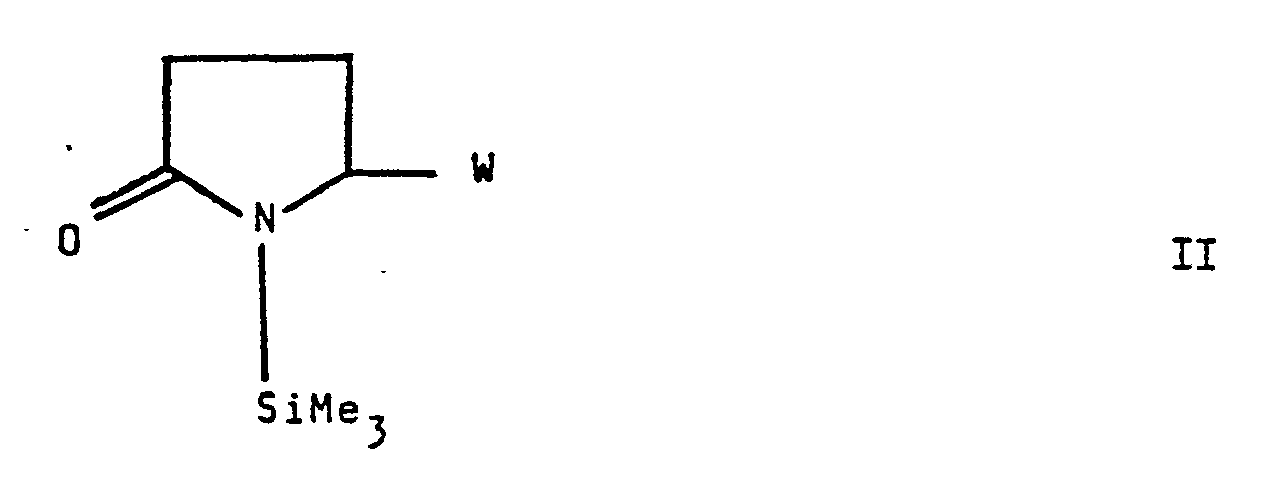
- Selon au autre aspect, la présente invention fournit un procédé de préparation d'un dérivé pyroglutamique de formule (I) tel que ci-dessus défini, caractérisé en ce qu'on fait réagir un composé de formule (II) suivante:

- Selon une caractéristique particulière, pour préparer le composé de formule (II) précitée, dans laquelle W est un groupe ester, on fait réagir le composé de formule (IV) suivante:

- Le composé (IV) est préparé avantageusement par estérification de l'acide pyroglutamique.
- Selon une autre caractéristique du procédé de l'invention, pour préparer le composé de formule (II) précitée dans laquelle W est un group ―COOSiMe3, on fait réagir l'acide pyroglutamique avec le chlorure de triméthylsilyle.
- Selon une autre caractéristique particulière, on fait réagir le composé de formule (II) précitée dans laquelle W est un groupe -COOSiMe3 avec un chlorure organique correspondant; et le composé intermédiaire résultant est mis à réagir avec du chloroformiate d'alkyle de préférence en présence de triéthylamine pour obtenir un anhydride mixte qui est mis à réagir avec un alcool approprié pour donner l'ester désiré de formule (I).
- On peut donc constater que tous les composés répondant à la formule (I) peuvent être préparés à partir de l'acide pyroglutamique qui est un produit chimique courant qui se trouve facilement dans les mélasses et notamment dans les mélasses de betterave. Il s'agit donc d'un produit peu coûteux et disponible en grande-quantité.
- D'autre part, l'acide et l'ester pyroglutamiques donnent aisément l'amide pyroglutamique par une réaction simple avec l'ammoniac.
- D'autre part, à partir de cette substance de départ simple et. non coûteuse qu'est l'acide pyroglutamique, le procédé selon l'invention prévoit l'utilisation comme réactif principal du chlorure de triméthylsilyle ou chlorotriméthylsilane qui est un composé donnant d'excellents rendements, en combinaison avec des réactions simples de substitution avec un agent de substitution (par exemple alcoylation, acylation) tel qu'un halogènure et de préférence un chlorure organique.
- La présente invention concerne également de nouveaux intermédiaires de synthèse répondant aux formules suivantes (VI) et (VIII)

- Z est un groupe ester ou in groupe -COOSiMe3

- Y est tel que précédemment défini.
- L'intermédiaire de synthèse répondant à la formule VI précédente est d'un intérêt primordial car le groupe triméthylsilyle substituant l'atome d'azote est aisément substitué par tous les agents de substitution connus, et en particulier les agents d'alcoylation ou d'acylation comme les halogénures d'alcoyle ou d'acyle et de préférence les chlorures d'alcoyle ou d'acyle; ou le dicétène.
- La présente invention sera maintenant décrite en référence è divers exemples donnés simplement à titre d'illustration.
- Préparation de l'intermédiaire de synthèse (VI) précité dans lequel W est un group - soit:


- On chauffe à 60°C, jusqu'à dissolution, 200 g (1,55 M) d'acide pyroglutamique dans 650 ml (470 g, 4,65 M) de triéthylamine, puis on additionne 200 ml de toluène.
- On monte la température à 65-70°C et on additonne en 1 h 30 une solution de 500 ml (423 g, 3,88 M) de chlorotriméthylsilane dans 300 ml de toluène. On garde ensuite 3 heures à reflux, on laisse refroidir, on filtre, on lave le précipité avec du toluène, on évapore et on distille.
- Le rendement est de 79% en produit pur, distillant à 98°C sous 0,3 mm de mercure.
- Le même produit est obtenu avec un rendement de 98% par triméthylsilylation de l'acide N-triméthylsilyl pyroglutamique lui-même préparé selon le même mode opératoire mais avec une quantité plus faible de chlorotriméthylsilane.
- Préparation de l'intermédiaire de synthèse (VIII) précité dans lequel


- On additionne et 30 mn une solution de 13,6 g (0,088 M) de chlorure de l'acide phènyl acétique dans 25 ml de tétrahydrofuranne, à une solution de 20 g du produit obtenu dans l'exemple 1 dissous dans 100 ml de tétrahydrofuranne, puis on agite une nuit et évapore les solvants. Le rendement est de 85%.
- Tous les autres intermédiaires de synthèse sont obtenus de la même manière par emploi d'un agent de substitution classique, comme un agent d'alcoylation ou d'acylation tel qu'un halogènure et de préférence un chlorure.
- Préparation du dérivé pyroglutamique de formule:

- A la solution obtenue dans l'exemple II, avant évaporation, on additionne 100 ml d'eau contenant 10 ml. d'acide chlorhydrique; et on laisse en contact 15 minutes.
- La phase aqueuse est extraite au chlorure de méthylène, les phases organiques sont séchées et évaporées. Le précipité est recristallisé dans le dioxane contenant un peu d'éther. Le rendement est de 78% en produit de point de fusion = 144°C.
- Les autres nouveaux dérivés pyroglutamiques sont obtenus de la même manière.
- Préparation du nouveau dérivé pyroglutamique de formule (I) suivante:

- Une solution de N-chloracétyl pyroglutamate de triméthylsilyle, obtenue comme dans l'exemple II, est additionée de deux équivalents de triéthylamine. On refroidit à 0°C, puis on additionne lentement 1,2 équivalent de chloroformiate de méthyle, puis, après 15 mn, deux équivalents de méthanol. On laisse reposer 40 mn, on filtre, on évapore et on distille. Le rendement est de 85% on produit de point de fusion 66°C (éther); E0.15 = 142°C.
- Les autres composàs de formule (1) dans laquelle Z est un groupe ester et Y est un groupe acyle tel que précédemment défini sont obtenus de la même manière.
- Préparation du nouveau dérivé de formule (I) dans laquelle


- On dissout 32 g (0,15 M) de N-triméthylsilyl pyroglutamate de méthyle dans 70 ml de tétrahydrofurane, on additionne en 1 heure 25 g (0,15 M) de chlorure de phénoxyacétyle dissous dans 30 ml de tétrahydrofurane, et on porte à reflux une nuit. On obtient 25 g de produit, PF = 112°C. Les autres nouveaux composés de formule (I) dans lesquels Z est un groupe ester et Y un groupe acyle, peuvent être obtenus de la même manière.
- Préparation de l'intermédiaire de synthèse de formule (II) dans laquelle W est un groupe ester, par exemple ―COOC5H11, soit:

- On porte à léger reflux un mélange de 100 g (0,503 M) de pyroglutamate de n-pentyle et on additionne en 30 mn, 50 ml de toluène contenant 76,5 ml (0,603 M; 65,5 g) de chlorotriméthylsilane. On garde le reflux 5 heures, on filtre, on lave le précipité au toluène et on distille. Le rendement est de 92% en produit, Eo,2 = 151-2°C. Les autres composés estérifiés de formule (11) peuvent être obtenus de la même manière.
- Préparation d'autres nouveaux dérivés de formule I précitée: En procédant comme décrit aux exemples III à V, on obtient par exemple les composés suivants:

- Pour déterminer si les dérivés pyroglutamiques de formule 1 précitée ont un effet antibactérien ou antifongique, on procède par la méthode classique d'antibiogramme, ce qui permet de vérifier leur effet d'inhibition de croissance de divers micro-organismes, bactéries ou fonges ("Fungi").
- Dans le cas où le composé testé provoque au moins l'inhibition d'un micro-organisme, d'une bactérie ou fonge dans les conditions de la méthode classique d'antibiogramme, le composé en question est considéré comme ayant un effet antibactérien s'il inhibe la crossance d'une bactérie ou antifongique s'il inhibe la croissance d'un fonge, ou le cas échéant des deux.
- De préférence, l'effet d'inhibition obtenu du composé testé est comparé avec celui de substances antibactériennes ou antifongiques connues et si cet effet est inférieur ou égal à celui de la substance connue, on élimine le composé testé comme ne présentant pas d'activité antibactérienne ou antifongique suffisante.
- On donne dans le tableau 1 ci-après des exemples de résultats obtenus avec des dérivés pyroglutamiques de formule précitée en comparaison avec des substances connues.
- Les composés ayant une activité antibactérienne ou antifongique peuvent être incorporés dans diverses compsitions à raison de 0,01% à 5% en poids par rapport au poids total de la composition, de préférence à raison de 0,1 à 5% en poids de la composition totale et encore de préférence à raison de 0,5 à 5% en poids de la composition totale.
- On peut citer comme exemples de composition des produits déodorants ou capillaires grâce aux propriétés antiseptiques des produits retenus, en cosmétique, grâce aux effets bactériostatiques des produits retenus et sous forme de composition pharmaceutique en particulier dans l'utilisation contre les mycoses cutanées.

Claims (12)




Priority Applications (1)
| Application Number | Priority Date | Filing Date | Title |
|---|---|---|---|
| AT84401803T ATE40113T1 (de) | 1983-09-12 | 1984-09-12 | Pyroglutamsaeurederivates, verfahren deren herstellung,zwischenprodukte und fungizide und/oder bakterizide mittel sowie kosmetische oder pharmazeutische mittel. |
Applications Claiming Priority (2)
| Application Number | Priority Date | Filing Date | Title |
|---|---|---|---|
| FR8314480A FR2551751B1 (fr) | 1983-09-12 | 1983-09-12 | Nouveau procede de preparation d'un derive pyroglutamique, nouveaux derives pyroglutamiques, nouveaux intermediaires de synthese de preparation de ceux-ci et utilisation ou application des derives pyroglutamiques comme agents antibacteriens ou antifongiques |
| FR8314480 | 1983-09-12 |
Publications (2)
| Publication Number | Publication Date |
|---|---|
| EP0135444A1 EP0135444A1 (fr) | 1985-03-27 |
| EP0135444B1 true EP0135444B1 (fr) | 1989-01-18 |
Family
ID=9292130
Family Applications (1)
| Application Number | Title | Priority Date | Filing Date |
|---|---|---|---|
| EP84401803A Expired EP0135444B1 (fr) | 1983-09-12 | 1984-09-12 | Dérivés pyroglutamiques, procédé de préparation, intermédiaires de synthèse de préparation de ceux-ci et compositions antibactérien ou antifongiques, cosmetiques ou pharmaceutiques |
Country Status (5)
| Country | Link |
|---|---|
| EP (1) | EP0135444B1 (fr) |
| JP (1) | JPS60149559A (fr) |
| AT (1) | ATE40113T1 (fr) |
| DE (1) | DE3476198D1 (fr) |
| FR (1) | FR2551751B1 (fr) |
Families Citing this family (4)
| Publication number | Priority date | Publication date | Assignee | Title |
|---|---|---|---|---|
| DE4338922A1 (de) * | 1993-11-15 | 1995-05-18 | Degussa | Aktivatoren für anorganische Persauerstoffverbindungen |
| US6613793B2 (en) | 2001-07-02 | 2003-09-02 | Dabur Research Foundation | Anticancer activity of imino acid conjugates or methylglyoxal |
| AU2002347589A1 (en) * | 2002-10-08 | 2004-05-04 | Dabur Research Foundation | An oral formulation of methylglyoxal and its imino acid conjugates for human use |
| ITMI20052077A1 (it) * | 2005-10-31 | 2007-05-01 | Roda S R L | Agente batteriostatica e-o battericida per preparazioni cosmetiche e-o dermofarmaceutiche e preparazioni contenenti questo agente |
Family Cites Families (2)
| Publication number | Priority date | Publication date | Assignee | Title |
|---|---|---|---|---|
| ES411867A1 (es) * | 1973-02-21 | 1976-01-01 | Gema Sa | Procedimiento para la preparacion de agentes sililantes. |
| CH646149A5 (de) * | 1981-02-05 | 1984-11-15 | Hoffmann La Roche | Pyrrolidin-derivat. |
-
1983
- 1983-09-12 FR FR8314480A patent/FR2551751B1/fr not_active Expired
-
1984
- 1984-09-12 DE DE8484401803T patent/DE3476198D1/de not_active Expired
- 1984-09-12 JP JP59191420A patent/JPS60149559A/ja active Pending
- 1984-09-12 EP EP84401803A patent/EP0135444B1/fr not_active Expired
- 1984-09-12 AT AT84401803T patent/ATE40113T1/de not_active IP Right Cessation
Also Published As
| Publication number | Publication date |
|---|---|
| JPS60149559A (ja) | 1985-08-07 |
| EP0135444A1 (fr) | 1985-03-27 |
| ATE40113T1 (de) | 1989-02-15 |
| FR2551751B1 (fr) | 1986-04-25 |
| FR2551751A1 (fr) | 1985-03-15 |
| DE3476198D1 (en) | 1989-02-23 |
Similar Documents
| Publication | Publication Date | Title |
|---|---|---|
| EP0358584A1 (fr) | Diorganopolysiloxane à fonction benzalmalonate | |
| BE1004159A5 (fr) | Nouveaux produits de condensation de silanols, leurs preparation et applications. | |
| WO1993007130A1 (fr) | 3-ureido-benzodiazepinones utiles comme antagonistes de cck ou de gastrine | |
| EP0835254B1 (fr) | Derives d'oxazolidinone, leur preparation et leur application en therapeutique | |
| EP0461958B1 (fr) | Dérivés de 2-(aminoalkyl)-5-(arylalkyl)-1,3-dioxanes, leur préparation et leur application en thérapeutique | |
| EP0374041B1 (fr) | Médicaments à base de dérivés de la benzothiazolamine-2, dérivés et leur préparation | |
| FR2662695A1 (fr) | Amino-2 polyfluoroalcoxy-6 benzoselenazoles, leur preparation et les medicaments les contenant. | |
| EP0418933A1 (fr) | Dérivés d'alcadiènes, leurs préparations, les médicaments les contenant et produits intermédiaires | |
| EP0135444A1 (fr) | Dérivés pyroglutamiques, procédé de préparation, intermédiaires de synthèse de préparation de ceux-ci et compositions antibactérien ou antifongiques, cosmetiques ou pharmaceutiques | |
| CA2296742C (fr) | Procede de preparation de derives amines d'alkyloxyfuranone, composes issus de ce procede et utilisation de ces composes | |
| BE881862A (fr) | Composes antibacteriens et inhibiteurs de beta-lactamase, procede pour les preparer et leur usage comme medicaments | |
| EP0021923A1 (fr) | Procédé de préparation de dérivés vincaminiques et dérivés vincaminiques | |
| LU85292A1 (fr) | Procede pour la preparation de 1,8-dihydroxy-10-acyl-9-anthrones,en particulier pour une utilisation dans le traitement du psoriasis | |
| CA1196331A (fr) | Derives substitues de la thiamorpholinone et leurs procedes de preparation | |
| EP0685473B1 (fr) | Composés benzohétérocycliques, en tant qu'antioxydants | |
| EP0069001A1 (fr) | Procédé de préparation de dérivés de la tétrahydro-5,6,7,7a 4H-thiéno (3,2-C) pyridinone-2 | |
| EP1687276B1 (fr) | Nouveau procede de preparation de quinoleines 3-fluorees | |
| EP0403318A1 (fr) | Procédé de préparation d'une nouvelle substance antitumorale, l'amino-3 (amino-2 1H-imidazolyl-4-)-1 chloro-2 propanol-1 et de ses sels sous forme racémique thréo, utilisable comme médicament | |
| EP0607329A1 (fr) | Nouveaux derives de l'acide fluoro quinoleine carboxylique-3 et leur preparation | |
| BE884977A (fr) | Nouveau n-phenyl-benzamides utiles dans le traitement de l'inflammation et de la douleur des mammiferes | |
| BE876466A (fr) | Derive de l'acide penicillanique et son procede de preparation | |
| EP0885232B1 (fr) | Nouveaux derives de l'acide 1(2h) quinoleine carboxylique, leur procede de preparation et leur application a la synthese de produits doues de proprietes antibiotiques | |
| EP0125975A1 (fr) | Diphénylazométhines portant une chaîne esterifiée, leur préparation et leur application en thérapeutique | |
| FR2653765A1 (fr) | Procede pour la preparation enantioselective de 2-aminotetralines. | |
| CH639085A5 (en) | Process for the preparation of xanthone derivatives |
Legal Events
| Date | Code | Title | Description |
|---|---|---|---|
| PUAI | Public reference made under article 153(3) epc to a published international application that has entered the european phase |
Free format text: ORIGINAL CODE: 0009012 |
|
| AK | Designated contracting states |
Designated state(s): AT BE CH DE GB IT LI LU NL SE |
|
| 17P | Request for examination filed |
Effective date: 19850502 |
|
| 17Q | First examination report despatched |
Effective date: 19860605 |
|
| GRAA | (expected) grant |
Free format text: ORIGINAL CODE: 0009210 |
|
| AK | Designated contracting states |
Kind code of ref document: B1 Designated state(s): AT BE CH DE GB IT LI LU NL SE |
|
| PG25 | Lapsed in a contracting state [announced via postgrant information from national office to epo] |
Ref country code: SE Effective date: 19890118 Ref country code: NL Effective date: 19890118 Ref country code: IT Free format text: LAPSE BECAUSE OF FAILURE TO SUBMIT A TRANSLATION OF THE DESCRIPTION OR TO PAY THE FEE WITHIN THE PRESCRIBED TIME-LIMIT;WARNING: LAPSES OF ITALIAN PATENTS WITH EFFECTIVE DATE BEFORE 2007 MAY HAVE OCCURRED AT ANY TIME BEFORE 2007. THE CORRECT EFFECTIVE DATE MAY BE DIFFERENT FROM THE ONE RECORDED. Effective date: 19890118 Ref country code: AT Effective date: 19890118 |
|
| REF | Corresponds to: |
Ref document number: 40113 Country of ref document: AT Date of ref document: 19890215 Kind code of ref document: T |
|
| GBT | Gb: translation of ep patent filed (gb section 77(6)(a)/1977) | ||
| REF | Corresponds to: |
Ref document number: 3476198 Country of ref document: DE Date of ref document: 19890223 |
|
| NLV1 | Nl: lapsed or annulled due to failure to fulfill the requirements of art. 29p and 29m of the patents act | ||
| PG25 | Lapsed in a contracting state [announced via postgrant information from national office to epo] |
Ref country code: LU Free format text: LAPSE BECAUSE OF NON-PAYMENT OF DUE FEES Effective date: 19890930 Ref country code: LI Effective date: 19890930 Ref country code: CH Effective date: 19890930 Ref country code: BE Effective date: 19890930 |
|
| PLBE | No opposition filed within time limit |
Free format text: ORIGINAL CODE: 0009261 |
|
| STAA | Information on the status of an ep patent application or granted ep patent |
Free format text: STATUS: NO OPPOSITION FILED WITHIN TIME LIMIT |
|
| 26N | No opposition filed | ||
| BERE | Be: lapsed |
Owner name: LABORATOIRES SEROBIOLOGIQUES S.A. Effective date: 19890930 |
|
| REG | Reference to a national code |
Ref country code: CH Ref legal event code: PL |
|
| PGFP | Annual fee paid to national office [announced via postgrant information from national office to epo] |
Ref country code: GB Payment date: 19960903 Year of fee payment: 13 |
|
| PGFP | Annual fee paid to national office [announced via postgrant information from national office to epo] |
Ref country code: DE Payment date: 19961129 Year of fee payment: 13 |
|
| PG25 | Lapsed in a contracting state [announced via postgrant information from national office to epo] |
Ref country code: GB Free format text: LAPSE BECAUSE OF NON-PAYMENT OF DUE FEES Effective date: 19970912 |
|
| GBPC | Gb: european patent ceased through non-payment of renewal fee |
Effective date: 19970912 |
|
| PG25 | Lapsed in a contracting state [announced via postgrant information from national office to epo] |
Ref country code: DE Free format text: LAPSE BECAUSE OF NON-PAYMENT OF DUE FEES Effective date: 19980603 |