EP0135323B1 - Production of sodium bicarbonate by reversion of nahc03-containing double salt - Google Patents
Production of sodium bicarbonate by reversion of nahc03-containing double salt Download PDFInfo
- Publication number
- EP0135323B1 EP0135323B1 EP84305201A EP84305201A EP0135323B1 EP 0135323 B1 EP0135323 B1 EP 0135323B1 EP 84305201 A EP84305201 A EP 84305201A EP 84305201 A EP84305201 A EP 84305201A EP 0135323 B1 EP0135323 B1 EP 0135323B1
- Authority
- EP
- European Patent Office
- Prior art keywords
- reversion
- sodium bicarbonate
- liquor
- slurry
- bicarbonate
- Prior art date
- Legal status (The legal status is an assumption and is not a legal conclusion. Google has not performed a legal analysis and makes no representation as to the accuracy of the status listed.)
- Expired
Links
- UIIMBOGNXHQVGW-UHFFFAOYSA-M Sodium bicarbonate Chemical compound [Na+].OC([O-])=O UIIMBOGNXHQVGW-UHFFFAOYSA-M 0.000 title claims abstract description 138
- 229910000030 sodium bicarbonate Inorganic materials 0.000 title claims abstract description 69
- 235000017557 sodium bicarbonate Nutrition 0.000 title claims abstract description 69
- 150000003839 salts Chemical class 0.000 title claims abstract description 23
- 238000004519 manufacturing process Methods 0.000 title claims description 8
- 239000002002 slurry Substances 0.000 claims abstract description 67
- 229910002092 carbon dioxide Inorganic materials 0.000 claims abstract description 62
- CURLTUGMZLYLDI-UHFFFAOYSA-N Carbon dioxide Chemical compound O=C=O CURLTUGMZLYLDI-UHFFFAOYSA-N 0.000 claims abstract description 56
- 239000007787 solid Substances 0.000 claims abstract description 51
- 239000000203 mixture Substances 0.000 claims abstract description 37
- WCTAGTRAWPDFQO-UHFFFAOYSA-K trisodium;hydrogen carbonate;carbonate Chemical compound [Na+].[Na+].[Na+].OC([O-])=O.[O-]C([O-])=O WCTAGTRAWPDFQO-UHFFFAOYSA-K 0.000 claims abstract description 33
- 229910000031 sodium sesquicarbonate Inorganic materials 0.000 claims abstract description 31
- 235000018341 sodium sesquicarbonate Nutrition 0.000 claims abstract description 31
- BVKZGUZCCUSVTD-UHFFFAOYSA-M Bicarbonate Chemical compound OC([O-])=O BVKZGUZCCUSVTD-UHFFFAOYSA-M 0.000 claims abstract description 23
- 239000001569 carbon dioxide Substances 0.000 claims abstract description 23
- 230000000694 effects Effects 0.000 claims abstract description 6
- 229920006395 saturated elastomer Polymers 0.000 claims abstract description 5
- UIIMBOGNXHQVGW-DEQYMQKBSA-M Sodium bicarbonate-14C Chemical compound [Na+].O[14C]([O-])=O UIIMBOGNXHQVGW-DEQYMQKBSA-M 0.000 claims description 10
- 238000011084 recovery Methods 0.000 claims description 6
- BVKZGUZCCUSVTD-UHFFFAOYSA-L Carbonate Chemical compound [O-]C([O-])=O BVKZGUZCCUSVTD-UHFFFAOYSA-L 0.000 claims description 2
- 238000011437 continuous method Methods 0.000 claims description 2
- 238000004064 recycling Methods 0.000 claims description 2
- 238000006243 chemical reaction Methods 0.000 abstract description 8
- 238000010587 phase diagram Methods 0.000 abstract description 3
- 238000000034 method Methods 0.000 description 50
- CDBYLPFSWZWCQE-UHFFFAOYSA-L Sodium Carbonate Chemical compound [Na+].[Na+].[O-]C([O-])=O CDBYLPFSWZWCQE-UHFFFAOYSA-L 0.000 description 39
- 229910000029 sodium carbonate Inorganic materials 0.000 description 21
- 239000007789 gas Substances 0.000 description 18
- 235000017550 sodium carbonate Nutrition 0.000 description 14
- 239000013078 crystal Substances 0.000 description 13
- 239000000243 solution Substances 0.000 description 12
- 239000010448 nahcolite Substances 0.000 description 11
- 241001625808 Trona Species 0.000 description 9
- 238000001816 cooling Methods 0.000 description 7
- XLYOFNOQVPJJNP-UHFFFAOYSA-N water Substances O XLYOFNOQVPJJNP-UHFFFAOYSA-N 0.000 description 7
- 239000000463 material Substances 0.000 description 6
- 229940071207 sesquicarbonate Drugs 0.000 description 6
- 238000010521 absorption reaction Methods 0.000 description 5
- 238000002425 crystallisation Methods 0.000 description 5
- 230000008025 crystallization Effects 0.000 description 5
- 239000002245 particle Substances 0.000 description 5
- 238000001953 recrystallisation Methods 0.000 description 4
- 238000000926 separation method Methods 0.000 description 4
- 238000004513 sizing Methods 0.000 description 4
- 239000007790 solid phase Substances 0.000 description 4
- HFNQLYDPNAZRCH-UHFFFAOYSA-N carbonic acid Chemical compound OC(O)=O.OC(O)=O HFNQLYDPNAZRCH-UHFFFAOYSA-N 0.000 description 3
- 239000012535 impurity Substances 0.000 description 3
- 239000012047 saturated solution Substances 0.000 description 3
- 239000011734 sodium Substances 0.000 description 3
- IJGRMHOSHXDMSA-UHFFFAOYSA-N Atomic nitrogen Chemical compound N#N IJGRMHOSHXDMSA-UHFFFAOYSA-N 0.000 description 2
- PMZURENOXWZQFD-UHFFFAOYSA-L Sodium Sulfate Chemical compound [Na+].[Na+].[O-]S([O-])(=O)=O PMZURENOXWZQFD-UHFFFAOYSA-L 0.000 description 2
- FAPWRFPIFSIZLT-UHFFFAOYSA-M Sodium chloride Chemical compound [Na+].[Cl-] FAPWRFPIFSIZLT-UHFFFAOYSA-M 0.000 description 2
- RAHZWNYVWXNFOC-UHFFFAOYSA-N Sulphur dioxide Chemical compound O=S=O RAHZWNYVWXNFOC-UHFFFAOYSA-N 0.000 description 2
- 239000007864 aqueous solution Substances 0.000 description 2
- 238000005260 corrosion Methods 0.000 description 2
- 230000007797 corrosion Effects 0.000 description 2
- 238000000354 decomposition reaction Methods 0.000 description 2
- 238000010586 diagram Methods 0.000 description 2
- 239000003085 diluting agent Substances 0.000 description 2
- 238000010438 heat treatment Methods 0.000 description 2
- 239000002609 medium Substances 0.000 description 2
- 239000002243 precursor Substances 0.000 description 2
- 238000002360 preparation method Methods 0.000 description 2
- 229910052938 sodium sulfate Inorganic materials 0.000 description 2
- GEHJYWRUCIMESM-UHFFFAOYSA-L sodium sulfite Chemical compound [Na+].[Na+].[O-]S([O-])=O GEHJYWRUCIMESM-UHFFFAOYSA-L 0.000 description 2
- 235000011152 sodium sulphate Nutrition 0.000 description 2
- -1 Ca++ ion Chemical class 0.000 description 1
- OKTJSMMVPCPJKN-UHFFFAOYSA-N Carbon Chemical compound [C] OKTJSMMVPCPJKN-UHFFFAOYSA-N 0.000 description 1
- 229910000975 Carbon steel Inorganic materials 0.000 description 1
- 229910001209 Low-carbon steel Inorganic materials 0.000 description 1
- 241000656145 Thyrsites atun Species 0.000 description 1
- FNYLWPVRPXGIIP-UHFFFAOYSA-N Triamterene Chemical compound NC1=NC2=NC(N)=NC(N)=C2N=C1C1=CC=CC=C1 FNYLWPVRPXGIIP-UHFFFAOYSA-N 0.000 description 1
- 238000009825 accumulation Methods 0.000 description 1
- 230000002411 adverse Effects 0.000 description 1
- 238000007605 air drying Methods 0.000 description 1
- 239000003513 alkali Substances 0.000 description 1
- 229910045601 alloy Inorganic materials 0.000 description 1
- 239000000956 alloy Substances 0.000 description 1
- 239000012736 aqueous medium Substances 0.000 description 1
- QVGXLLKOCUKJST-UHFFFAOYSA-N atomic oxygen Chemical compound [O] QVGXLLKOCUKJST-UHFFFAOYSA-N 0.000 description 1
- 230000015572 biosynthetic process Effects 0.000 description 1
- 238000001354 calcination Methods 0.000 description 1
- 238000005119 centrifugation Methods 0.000 description 1
- 238000001311 chemical methods and process Methods 0.000 description 1
- 239000011248 coating agent Substances 0.000 description 1
- 238000000576 coating method Methods 0.000 description 1
- 238000007796 conventional method Methods 0.000 description 1
- 125000004122 cyclic group Chemical group 0.000 description 1
- 238000001035 drying Methods 0.000 description 1
- 238000010410 dusting Methods 0.000 description 1
- 238000001704 evaporation Methods 0.000 description 1
- 230000008020 evaporation Effects 0.000 description 1
- 238000001914 filtration Methods 0.000 description 1
- 239000008246 gaseous mixture Substances 0.000 description 1
- 238000000227 grinding Methods 0.000 description 1
- 229910052500 inorganic mineral Inorganic materials 0.000 description 1
- 239000007788 liquid Substances 0.000 description 1
- 238000003801 milling Methods 0.000 description 1
- 235000010755 mineral Nutrition 0.000 description 1
- 239000011707 mineral Substances 0.000 description 1
- 239000003607 modifier Substances 0.000 description 1
- 229910052757 nitrogen Inorganic materials 0.000 description 1
- 229910052760 oxygen Inorganic materials 0.000 description 1
- 239000001301 oxygen Substances 0.000 description 1
- 230000000737 periodic effect Effects 0.000 description 1
- 239000012071 phase Substances 0.000 description 1
- 230000001737 promoting effect Effects 0.000 description 1
- 238000010926 purge Methods 0.000 description 1
- 238000000746 purification Methods 0.000 description 1
- 238000012216 screening Methods 0.000 description 1
- 239000011780 sodium chloride Substances 0.000 description 1
- 235000010265 sodium sulphite Nutrition 0.000 description 1
- 230000009466 transformation Effects 0.000 description 1
- 239000002912 waste gas Substances 0.000 description 1
Images

Classifications
-
- C—CHEMISTRY; METALLURGY
- C01—INORGANIC CHEMISTRY
- C01D—COMPOUNDS OF ALKALI METALS, i.e. LITHIUM, SODIUM, POTASSIUM, RUBIDIUM, CAESIUM, OR FRANCIUM
- C01D7/00—Carbonates of sodium, potassium or alkali metals in general
- C01D7/10—Preparation of bicarbonates from carbonates
Definitions
- This invention relates to the preparation of sodium bicarbonate from sodium sesquicarbonate and/or Wegscheider's salt, by effecting a reversion of the solid feed, in an aqueous medium, to crystalline sodium bicarbonate.
- Sodium bicarbonate (NaHC0 3 ) is conventionally prepared by carbonation of aqueous sodium carbonate (Na 2 C0 3 ); see R. N. Shreve et al, Chemical Process Industries, McGraw-Hill Book Co., 4th ed., 1977, p. 213.
- the crystallized sodium bicarbonate is withdrawn from the carbonating tower as an aqueous slurry, filtered, and dried.
- the aqueous liquor that remains afterfiltration ofthe solid sodium bicarbonate is used to dissolve more soda ash to continue the cyclic carbonation process.
- European Patent Application Publication No. 5,981 (assigned to Stauffer Chemical Co.) describes the carbonation of a saturated solution of sodium carbonate and sodium bicarbonate or, alternatively, a slurry of sodium bicarbonate in such saturated solution, or a slurry of sodium bicarbonate and sodium sesquicarbonate in such saturated solution.
- a satisfactory crystalline sodium bicarbonate product is ensured by the presence of specific amounts of Ca ++ ion in solution during the carbonation.
- U.S. Patent No. 2,704,239 issued to Pike on March 15, 1955, describes the production of a sodium bicarbonate intermediate from trona ore and next calcining the crystalline sodium bicarbonate to yield a light density soda ash.
- the bicarbonate intermediate is obtained by first dissolving trona ore in an aqueous, hot liquor containing sodium bicarbonate and sodium carbonate, treating such solution with carbon dioxide to increase its bicarbonate content and then cooling or concentrating such solution to crystallize sodium bicarbonate.
- the crystalline sodium bicarbonate may be recovered and dried or, alternatively, calcined to form a light soda ash.
- the method of this invention yields a sodium bicarbonate product with good crystal habit and sizing without resorting to the conventional direct carbonation crystallization processes of the prior art.
- sodium bicarbonate is produced in a continuous method which involves introducing granular solid sodium sesquicarbonate or Wegscheider's salt into an aqueous reversion slurry, saturated with respect to sodium bicarbonate and containing at least about 10 wt.
- % solids to effect rapid and direct reversion of the crystalline feed to crystalline sodium bicarbonate; withdrawing a portion of the aqueous reversion slurry and separating crystalline sodium bicarbonate from the aqueous reversion liquor, the bicarbonate being substantially free of solid sodium sesquicarbonate or Wegscheider's salt; recycling aqueous reversion liquor, that remains after recovery of the bicarbonate product, to the aqueous reversion slurry; adjusting the bicarbonate content of the reversion liquor, via introduction of carbon dioxide to convert soluble carbonate to bicarbonate, to maintain a relatively constant composition in the aqueous liquor portion of the reversion slurry.
- the aqueous liquor of the reversion slurry is desirably maintained at a relatively constant composition such that sodium bicarbonate is the stable solid phase and such that the equilibrium partial pressure of C0 2 vapor above the liquor is minimized.
- the reversion liquor composition is preferably selected so as to maintain the equilibrium partial pressure of C0 2 vapor below 13 kPa, and more preferably below 6.7 kPa.
- Thetemperature of the reversion slurry is preferably maintained at 20 ⁇ 120°C, more preferably 35-85°C.
- the crystal slurry density of the reversion slurry is most preferably maintained at 15 ⁇ 40 wt. % solids.
- the reversion is desirably performed in a well-stirred vessel, preferably of a size that provides an average residence time of from 0.25 ⁇ 4 hours.
- the reversion and carbonation adjustment may be carried out as a single operation or separately.
- the carbon dioxide is introduced into the recycled reversion liquor, prior to its return to the reversion slurry.
- the method of this invention is especially suited for use with carbon dioxide gas mixtures, which preferably contain at least 10 vol. % C0 2 in the mixture.
- the solid feed employed in the production of sodium bicarbonate by this method is characterized in that it is a double salt that contains sodium bicarbonate. It may be sodium sesquicarbonate (Na 2 C0 3 NaHC0 3 2H 2 0) or Wegscheider's salt (Na 2 C0 3 3NaHC0 3 ), or combinations of these two salts.
- Trona ore a crude sodium sesquicarbonate found in large subterranean deposits in southwest Wyoming, is one preferred source of sodium sesquicarbonate for this invention.
- Ore containing a significant amount of insoluble shale associated with the soluble trona is desirably beneficiated, for example, by crushing and screening, to recover a crude sodium sesquicarbonate with a reduced level of insolubles.
- the presence of the usual soluble impurities in trona such as nahcolite (NaHC0 3 ), sodium chloride (NaCI), sodium sulfate (Na z S0 4 ), and the like, does not adversely affect the method of this invention.
- Another preferred solid sesquicarbonate feed is the so-called "green cake” from a sesquicarbonate soda ash process; green cake is crystalline sodium sesquicarbonate that is crystallized during the production of sodium carbonate from trona via the "sesqui” process. Sesquicarbonate suitable for use in this invention may also be refined sodium sesquicarbonate, for example, obtained by recrystallization of green cake.
- Ore obtained from the lakebed deposits of Owens Lake in California is still another suitable source of crude sodium sesquicarbonate suitable for use as solid sodium sesquicarbonate feed.
- Wegscheider's salt may also be used as the solid feed for this method. Wegscheider's salt prepared from trona or other soda sources and the naturally-occurring mineral, wegscheiderite, are both suitable.
- the solid feed should be granulare. Particle sizing should be such that substantially all of the granular feed is less than 850 um sieve in size (ASTM E11-70). Granular feed whose average particle size is less than 425 um sieve and larger than 75 um sieve is particularly preferred.
- the NaHC0 3 - containing feed solids are converted, or recrystallized, into crystalline sodium bicarbonate via a technique called reversion.
- the reversion effects a transformation of the NaHC0 3 -containing double salt feed material into crystalline sodium bicarbonate, without the necessity of (i) forming a solution, (ii) carbonating the solution and (iii) crystallizing sodium bicarbonate, as is required in prior art bicarbonate production methods.
- an important advantage of this invention with its reversion procedure for converting the solid feed to crystalline sodium bicarbonate, is that it does not require an energy- intensive crystallization step (cooling, evaporation, vacuum, etc.) and thus it consumes minimal energy.
- Equipment fouling a common problem in prior art carbonation/crystallization bicarbonate methods, is also minimized in this invention since there is no conventional cooling crystallization of bicarbonate.
- the aqueous reversion slurry employed in the reversion procedure is an aqueous liquor containing at least about 10 wt. % solids.
- the solids are crystalline sodium bicarbonate.
- Slurry densities (percentage of solids based on the weight of the slurry) for the reversion slurry are preferably within the range of from 10-70 wt. %, and more preferably from 15 ⁇ 40 wt. %.
- the aqueous liquor of the reversion slurry has a composition that is substantially saturated with respect to sodium bicarbonate, which is the stable solid phase.
- the method of this invention utilizes the discovery that when crystalline sodium sesquicarbonate or Wegscheider's salt is added to the reversion slurry, such crystalline solids are rapidly and directly reverted, or recrystallized, to sodium bicarbonate.
- the sodium bicarbonate that results from this reversion process is relatively pure, containing very little, if any, traces of its precursor crystal.
- the reversion process appears to involve a complete conversion by recrystallization of the solid feed material, which contains both sodium bicarbonate and sodium carbonate, to a crystalline solid that is essentially all sodium bicarbonate.
- the reversion process is in no way simply a coating procedure, in which sodium bicarbonate is crystallized from the saturated reversion slurry onto the feed crystals.
- the feed crystals are unstable in the reversion slurry and thus are completely and directly recrystallized to sodium bicarbonate in the reversion medium.
- the crystal habit of the resultant sodium bicarbonate moreover, is that typical of sodium bicarbonate and is not a pseudomorphic sodium bicarbonate based on the precursor sodium sesquicarbonate or Wegscheider's salt crystals.
- the aqueous reversion may be carried out in a single well-stirred vessel or tank, but multi-stage units provide the advantage of assuring complete conversion of the solid feed, with minimal feed solids being present in the recovered sodium bicarbonate. Because the reversion procedure occurs very rapidly, multi-stage operation is only a significant consideration where the particle sizing of the feed solids is relatively large, causing a slower reversion rate.
- the reversion procedure is carried out on a continuous basis, which assures uniformity in the crystalline sodium bicarbonate product that results.
- the aqueous reversion slurry should be maintained at a temperature within the range of 20 to 120°C.
- the slurry is preferably maintained at a temperature of from 35 to 85°C.
- the lower operating temperatures, below about 50°C, are especially preferred.
- the preferred lower operating temperatures allow the use of carbon or mild steel equipment instead of the corrosion-resistant alloys that are ordinarily required to resist the corrosiveness of sodium bicarbonate at higher temperatures.
- Low operating temperatures are also more energy efficient, since high solution temperatures need not be maintained.
- Another advantage of the low temperatures is that the equilibrium C0 2 partial pressures are also low, which permits more efficient (C0 2 ) absorption of dilute carbon dioxide gas mixtures during the carbonation adjustment.
- the solid feed, crystalline sodium sesquicarbonate or Wegscheider's salt is ordinarly introduced directly into the reversion slurry, whereupon its conversion to sodium bicarbonate occurs.
- the solid sesquicarbonate feed may first be slurried in aqueous solution before its introduction to the reversion slurry.
- a preferred version of this latter procedure calls for the solid sodium sesquicarbonate feed to be slurried in the recycled aqueous reversion liquor, after the recovery of the solid sodium bicarbonate and prior to the return of such liquor to the reversion slurry.
- This procedure allows for the efficient introduction of solid sodium sesquicarbonate feed to a reversion slurry vessel operated above atmospheric pressure. Wegscheider's salt is suscpetible to decomposition in aqueous solution at low-moderate temperatures, so slurrying of this solid feed is best avoided.
- the feed rate of solids introduced to the reversion slurry, and withdrawal rate of crystalline sodium bicarbonate, are preferably controlled such that the average residence time in the slurry ranges from about 15 minutes up to 4 hours.
- the relatively high slurry densities employed for the reversion slurry in this invention facilitate the use of long residence times in a moderately-sized reversion vessel. Longer residence times have the advantage of promoting growth of large crystals of good crystal habit.
- Crystal habit modifiers such as those described in U.S. Patents No. 2,954,282 and No. 3,852,427, may be used as desired to improve crystal habit, but are not required.
- a portion of the reversion slurry is withdrawn, desirably as a continuous flowstream, and conventional solids-liquid separation techniques are used to separate the crystalline product from the aqueous liquor. Centrifugation, hydrocloning, and filtration procedures are satisfactory for this purpose.
- the solids separation is desirably performed at about atmospheric pressure.
- the separated sodium bicarbonate solids are preferably washed, for example, to remove traces of entrained reversion liquor.
- the separated sodium bicarbonate crystals are then dried, by conventional methods used for drying bicarbonate, to yield a free-flowing crystalline product. Air drying of the damp bicarbonate at a moderate temperature satisfactorily dries the recovered crystals without causing any significant decomposition of the bicarbonate.
- the free-flowing sodium bicarbonate product that results from the method of this invention is very pure, typically at least 99.8 wt. % NaHC0 3 .
- the reversion liquor composition in the slurry In order to assure that the reversion liquor composition in the slurry remains relatively constant and to allow the reversion process to be carried out continuously, carbon dioxide is added as necessary to convert the soluble sodium carbonate to sodium bicarbonate. As noted previously, the reversion liquor composition must be such that sodium bicarbonate is the stable solid phase. Expressed differently, the aqueous liquor of the reversion slurry must have a composition that lies within the sodium bicarbonate portion of the Na 2 C0 3 -NaHC0 3 -H 2 0 phase diagram.
- the carbon dioxide addition is controlled to maintain the composition of the reversion liquor at a relatively constant value.
- the carbonation adjustment step thus ensures that soluble sodium carbonate does not accumulate in concentration in the reversion liquor.
- the carbonation that is required in this invention differs significantly from prior art carbonation procedures: (i) reversion is the means used to effect bicarbonate crystallization in this method, and (ii) carbon dioxide requirements in this method are minimized by the fact that a portion of the feed material is already carbonated, i.e., sodium bicarbonate is present in the double salt feed.
- the aqueous reversion liquor composition is desirably maintained at a composition that minimizes the equilibrium partial pressure of CO 2 above such liquor. This promotes efficient utilization of the C0 2 that is introduced into contact with the reversion liquor during the carbonation adjustment step. It will be recognized that the equilibrium C0 2 partial pressure depends on the temperature of the solution and thus will vary according to the particular operating temperature selected for the aqueous reversion slurry.
- composition of the aqueous liquor is preferably such that it has an equilibrium partial pressure of C0 2 above such liquor below 13 kPa, more preferably below 6.7 kPa.
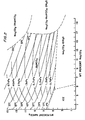
- Fig. 2 illustrates equilibrium partial pressures of C0 2 vapor for various compositions in which sodium bicarbonate is the stable solid phase.
- Introduction of the carbon dioxide to the aqueous reversion liquor may be carried out in any of several ways. Such carbonation is desirably performed continuously but can also be done intermittently.
- the C0 2 is desirably introduced in gaseous form.
- the carbon dioxide adjustment can be performed concurrently with the reversion, the two being carried out in a single vessel. Carbonation in this situation may be effected by introducing the C0 2 to a side stream of aqueous reversion liquor diverted for this purpose.
- the carbon dioxide may alternatively be introduced in a carbonation step that is separate from the reversion procedure.
- a preferred procedure involves introducing the carbon dioxide to the aqueous liquor, from which the solid sodium bicarbonate product has been removed, prior to the reintroduction of such recycled liquor to the reversion slurry.
- the carbon dioxide adjustment may be made prior to recovery of the crystalline sodium bicarbonate from the withdrawn reversion slurry flowstream.
- the C0 2 -treated liquor flowstream in either of these alternatives is then recycled to the aqueous reversion slurry to continue the method of the invention and thereby maintain a relatively constant composition in the aqueous liquor of the reversion slurry.
- the carbon dioxide may be introduced as a pure gas, containing essentially 100% C0 2 .
- the method of this invention is particularly well suited for use with gaseous mixtures that contain dilute C0 2 concentrations. Such mixtures are often deemed waste gas streams because of their low C0 2 content and are otherwise simply vented to the atmosphere.
- Gaseous C0 2 mixtures typically contain water, oxygen and/or nitrogen as the diluent gases, but other gases may also be present provided they are relatively inert with respect to the reversion.
- sulfur dioxide in appreciable concentrations is undesirable as a diluent gas since its absorption into the reversion liquor results in the formation of sodium sulfite and possibly sodium sulfate.
- Gas mixtures that contain at least 10 vol. % C0 2 are suitable for use in this invention, with gas mixtures having at least 40 vol. % C0 2 being preferred.
- the reversion liquor is desirably maintained at a composition that minimizes the equilibrium partial pressure of C0 2 above such liquor, the modest concentrations (partial pressure) of C0 2 in the dilute gas mixtures employed for this invention are nevertheless sufficient to assure efficient absorption of the C0 2 into the liquor.
- Total operating pressure during the reversion and carbonation adjustment procedures is desirably maintained at or slightly above one atmosphere pressure (about 100 kPa), so as to minimize the complexity of the equipment required. Total pressure may range, however, from about 100 kPa up to 500 kPa, as desired. Pressure in the reversion vessel, if carbonation is separate from reversion, is desirably maintained at about atmopsheric pressure, even when superatmospheric pressures are utilized during the carbonation adjustment.
- Introduction of the carbon dioxide may be used, as desired, to help control the heat balance of the overall process. Removal of exothermic reaction heat from the system may be obtained by introducing the carbon dioxide at a temperature below the operating temperature of the aqueous reversion slurry, to provide some of the necessary cooling.
- any impurities associated with the solid feed remain behind in the aqueous reversion liquor.
- the reversion thus effects a purification of the solid feed, as well as its conversion to sodium bicarbonate.
- a portion of the recycled aqueous reversion liquor is purged, to prevent the accumulation of impurities in the aqueous reversion medium and to maintain the water balance of the reversion system.
- Sodium bicarbonate is prepared in this Example from crystalline sodium sesquicarbonate feed, at a rate of 1000 kg NaHC0 3 /h, by the following continuous procedure.
- the description of this Example utilizes the schematic flow diagram shown in Figure 1, with reference numerals being those used in the drawing.
- Solid sodium sesquicarbonate 1 is continuously introduced at a rate of 922 kg/h to a reversion slurry in an agitated reversion tank 100.
- the reversion slurry a total of about 10,000 kg being contained in the tank 100, contains about 20 wt. % crystalline sodium bicarbonate and is maintained at a temperature of 50°C.
- Reversion of the introduced solid sesquicarbonate in the slurry is very rapid, so that the solids in the reversion slurry are essentially all sodium bicarbonate.
- Slurry 2 is continuously withdrawn from the tank at a rate of 5000 kg/h, which provides a two-hour residence time in the reversion vessel.
- the reversion recrystallization of sesquicarbonate to sodium bicarbonate is only slightly exothermic, and no special heating/cooling provisions are required for maintaining the desired 50°C operating temperature.
- the withdrawn slurry 2 is hydrocloned and centrifuged, shown as block 200 in the drawing, to recover crystalline sodium bicarbonate as a damp . cake 3 produced at a rate of 1070 kg/h (1000 kg/h dry basis).
- the reversion liquor 4 that remains after the separation step is treated further before being reintroduced to the reversion slurry.
- a portion 5 of the reversion liquor about 26 kg/h, is purged and discarded to maintain the proper water balance in the system. Reversion of sodium sesquicarbonate to sodium bicarbonate, it should be noted, produces one mole of water for each mole of sodium sesquicarbonate introduced as feed.
- the remaining reversion liquor 6 is treated with carbon dioxide, shown as block 300 in the drawing, to ensure that the proper, constant carbonate-bicarbonate composition is maintained in the reversion slurry tank liquor: 14.0 wt. % Na 2 C0 3 and 7.0 wt. % NaHC0 3 .
- the gas mixture 7 is contacted with the liquor stream 6 at one atmosphere total operating pressure, with the operating steady-state partial pressure of C0 2 in the exiting gas mixture 8 being 23.5 kPa. Because the equilibrium partial pressure of C0 2 vapor above the reversion liquor stream is just 2.0 kPa at 50°C (see Fig. 2), the CO 2 in the gas mixture 7 is readily absorbed into the recycled liquor flowstream, at a rate of 174 kg/h, which is a C0 2 absorption efficiency of 85%.
- the CO 2 -treated flowstream 9 contains 3.1 wt. % Na 2 C0 3 and 23.0 wt. % NaHC0 3 , a portion of the bicarbonate being present in solid form.
- This flowstream 9 is continuously recycled to the reversion tank 100, at a rate of 4078 kg/h, to maintain the reversion slurry liquor composition at the desired constant value and thereby continue the bicarbonate process.
- Wegscheider's salt is used as the feed material in this Example to produce sodium bicarbonate continuously at a rate of 1000 kg/h, using basically the same procedure as in Example 1 except for a lower operating temperature, 35°C instead of 50°C.
- Wegscheider's salt is continuously introduced in solid form at a rate of 869 kg/h to a reversion slurry containing about 20 wt. % crystalline sodium bicarbonate and maintained at 35°C. Reversion of the introduced Wegscheider's salt to sodium bicarbonate in the slurry is very rapid, and the solids in the slurry are essentially all sodium bicarbonate. Slurry is continuously withdrawn from the agitated tank at a rate of 5000 kg/ h. As in Example 1, no special provisions for heating/cooling are required to maintain the desired 35°C operating temperature since the reversion recrystallization is only mildly exothermic.
- the withdrawn slurry is centrifuged to yield a damp sodium bicarbonate cake, at a rate of 1070 kg/h (1000 kg/h dry basis).
- the reversion liquor stream from the solids- separation step, before being recycled to the reversion slurry, is next treated with C0 2 to adjust its carbonate-bicarbonate content to ensure that the reversion liquor composition in the reversion slurry remains relatively constant during the continuous operation of this method.
- C0 2 carbonate-bicarbonate content
- the conversion of Wegscheider's salt to sodium bicarbonate consumes one mole of water for each mole of salt, so make- up water is added to the system in this Example, at a rate of 98 kg H 2 0/h during the carbonation adjustment.
- the composition of the reversion liquor in the reversion slurry is desirably maintained at 14 wt. % Na 2 C0 3 and 5.7 wt. % NaHC0 3 .
- the reversion liquor flowstream is contacted with a carbon dioxide gas mixture containing 66 vol. % CO 2 and the balance air at a rate of 162 kg/h to adjust its carbonate-bicarbonate content.
- the gas mixture is contacted with the reversion liquor stream at one atmosphere total operating pressure, with the operating steady-state partial pressure of the exiting CO 2 gas being 23.5 kPa. Since the equilibrium partial pressure of CO 2 vapor above the reversion liquor stream is only 1.1 kPa at 35°C (see Fig. 2), the C0 2 in the gas mixture is readily absorbed into the recycled liquor flowstream at a rate of about 103 kg/h, which is a CO 2 absorption efficiency of 85%.
- the C0 2 -treated flowstream contains about 7.3 wt. % Na 2 C0 3 and 14.9 wt. % NaHC0 3 , a portion of the bicarbonate being present in solid form.
- This flowstream is continuously recycled to the reversion slurry, at a rate of 4131 kg/h to maintain the reversion slurry liquor composition at the desired constant value and to thereby continue the bicarbonate recovery process.
Landscapes
- Chemical & Material Sciences (AREA)
- Organic Chemistry (AREA)
- Engineering & Computer Science (AREA)
- Materials Engineering (AREA)
- Inorganic Chemistry (AREA)
- Organic Low-Molecular-Weight Compounds And Preparation Thereof (AREA)
- Pharmaceuticals Containing Other Organic And Inorganic Compounds (AREA)
- Paper (AREA)
- Coloring Foods And Improving Nutritive Qualities (AREA)
- Coloring (AREA)
- Medicines That Contain Protein Lipid Enzymes And Other Medicines (AREA)
- Medicines Containing Material From Animals Or Micro-Organisms (AREA)
- Treating Waste Gases (AREA)
- Fodder In General (AREA)
- Seasonings (AREA)
- Detergent Compositions (AREA)
Priority Applications (1)
| Application Number | Priority Date | Filing Date | Title |
|---|---|---|---|
| AT84305201T ATE39678T1 (de) | 1983-08-18 | 1984-07-31 | Verfahren zur herstellung von natriumbicarbonat durch umwandlung von nahco3-haltigen doppelsalzen. |
Applications Claiming Priority (2)
| Application Number | Priority Date | Filing Date | Title |
|---|---|---|---|
| US52448683A | 1983-08-18 | 1983-08-18 | |
| US524486 | 1983-08-18 |
Publications (3)
| Publication Number | Publication Date |
|---|---|
| EP0135323A2 EP0135323A2 (en) | 1985-03-27 |
| EP0135323A3 EP0135323A3 (en) | 1986-06-04 |
| EP0135323B1 true EP0135323B1 (en) | 1989-01-04 |
Family
ID=24089409
Family Applications (1)
| Application Number | Title | Priority Date | Filing Date |
|---|---|---|---|
| EP84305201A Expired EP0135323B1 (en) | 1983-08-18 | 1984-07-31 | Production of sodium bicarbonate by reversion of nahc03-containing double salt |
Country Status (9)
| Country | Link |
|---|---|
| EP (1) | EP0135323B1 (enExample) |
| JP (1) | JPS6060925A (enExample) |
| AT (1) | ATE39678T1 (enExample) |
| BR (1) | BR8404115A (enExample) |
| CA (1) | CA1248732A (enExample) |
| DE (1) | DE3475902D1 (enExample) |
| ES (1) | ES535256A0 (enExample) |
| MX (1) | MX168092B (enExample) |
| TR (1) | TR22159A (enExample) |
Families Citing this family (1)
| Publication number | Priority date | Publication date | Assignee | Title |
|---|---|---|---|---|
| JP5934003B2 (ja) * | 2012-03-19 | 2016-06-15 | 住友精化株式会社 | 炭酸水素ナトリウムの製造方法および製造装置 |
Family Cites Families (5)
| Publication number | Priority date | Publication date | Assignee | Title |
|---|---|---|---|---|
| US2704239A (en) * | 1951-06-01 | 1955-03-15 | Robert D Pike | Production of sodium bicarbonate and soda ash from trona |
| US2798790A (en) * | 1954-02-01 | 1957-07-09 | Kenneth B Ray | Production of sodium sesquicarbonate |
| US3780160A (en) * | 1971-08-02 | 1973-12-18 | Intermountain Res & Dev Corp | Carbonation process for the manufacture of sodium bicarbonate |
| US3852427A (en) * | 1973-04-12 | 1974-12-03 | Allied Chem | Sodium bicarbonate spherulites from sodium d esquicarbonate |
| BR7903330A (pt) * | 1978-05-30 | 1979-12-11 | Stauffer Chemical Co | Processo de carbonatacao para fabricacao de biocarbonato de sodio |
-
1984
- 1984-07-18 CA CA000459101A patent/CA1248732A/en not_active Expired
- 1984-07-31 EP EP84305201A patent/EP0135323B1/en not_active Expired
- 1984-07-31 DE DE8484305201T patent/DE3475902D1/de not_active Expired
- 1984-07-31 AT AT84305201T patent/ATE39678T1/de active
- 1984-08-13 TR TR22159A patent/TR22159A/xx unknown
- 1984-08-17 MX MX202433A patent/MX168092B/es unknown
- 1984-08-17 JP JP59171404A patent/JPS6060925A/ja active Granted
- 1984-08-17 ES ES535256A patent/ES535256A0/es active Granted
- 1984-08-17 BR BR8404115A patent/BR8404115A/pt not_active IP Right Cessation
Also Published As
| Publication number | Publication date |
|---|---|
| ES8505897A1 (es) | 1985-06-16 |
| JPH0359004B2 (enExample) | 1991-09-09 |
| MX168092B (es) | 1993-05-03 |
| ES535256A0 (es) | 1985-06-16 |
| DE3475902D1 (en) | 1989-02-09 |
| ATE39678T1 (de) | 1989-01-15 |
| JPS6060925A (ja) | 1985-04-08 |
| TR22159A (tr) | 1986-07-04 |
| EP0135323A2 (en) | 1985-03-27 |
| BR8404115A (pt) | 1985-07-23 |
| EP0135323A3 (en) | 1986-06-04 |
| CA1248732A (en) | 1989-01-17 |
Similar Documents
| Publication | Publication Date | Title |
|---|---|---|
| US4654204A (en) | Production of sodium bicarbonate by reversion of soda-type feed salt | |
| US5283054A (en) | Process for producing sodium salts from brines of sodium ores | |
| US5955043A (en) | Production of sodium carbonate from solution mine brine | |
| US6228335B1 (en) | Process for the production of sodium carbonate crystals | |
| US4288419A (en) | Enhanced recovery of sodium carbonate from NaCl-containing sodium carbonate solutions | |
| US20020192140A1 (en) | Process for preparing soda ash from solution mined bicarbonate brines | |
| US6576206B2 (en) | Bicarbonate conversion in a carbonate monohydrate process | |
| US7638109B2 (en) | Production of sodium sesquicarbonate and sodium carbonate monohydrate | |
| US6692720B1 (en) | Method for producing sodium chloride crystals | |
| US4044097A (en) | Recovery of soda values from sodium carbonate crystallizer purge liquors | |
| US5989505A (en) | Method for recovery of alkali values from trona using air stripping | |
| US3451767A (en) | Process of preparing anhydrous sodium carbonate from crude sodium bicarbonate | |
| US3656892A (en) | Method of producing soda ash | |
| US4519806A (en) | Enhanced recovery of soda ash from aqueous sodium carbonate solutions containing Na2 SO4 - and NaCl | |
| US3991160A (en) | Recovery of soda values from sodium carbonate crystallizer purge liquors | |
| US2764472A (en) | Brine purification | |
| US4158043A (en) | Process for producing soda ash from natural alkali metal carbonate-containing ores | |
| EP0135323B1 (en) | Production of sodium bicarbonate by reversion of nahc03-containing double salt | |
| US3843768A (en) | Process for the preparation of sodium carbonate monohydrate from a sodium hydroxide solution produced according to the diaphragm process | |
| US4112061A (en) | Production of sodium sulfite utilizing mother liquor from the sodium metabisulfite process | |
| CA1078581A (en) | Method of treating alkali metal sulfide and carbonate mixtures | |
| US3103413A (en) | Sodium cakbonate manufacture | |
| US3842157A (en) | Process for the preparation of sodium carbonate monohydrate from a sodium hydroxide solution produced according to the diaphragm process | |
| JPH0621033B2 (ja) | 高純度炭酸ソーダの製造法 | |
| US2863809A (en) | Process for concentration of caustic cell liquor |
Legal Events
| Date | Code | Title | Description |
|---|---|---|---|
| PUAI | Public reference made under article 153(3) epc to a published international application that has entered the european phase |
Free format text: ORIGINAL CODE: 0009012 |
|
| AK | Designated contracting states |
Designated state(s): AT BE CH DE FR GB IT LI LU NL SE |
|
| PUAL | Search report despatched |
Free format text: ORIGINAL CODE: 0009013 |
|
| AK | Designated contracting states |
Kind code of ref document: A3 Designated state(s): AT BE CH DE FR GB IT LI LU NL SE |
|
| 17P | Request for examination filed |
Effective date: 19870121 |
|
| 17Q | First examination report despatched |
Effective date: 19880301 |
|
| GRAA | (expected) grant |
Free format text: ORIGINAL CODE: 0009210 |
|
| AK | Designated contracting states |
Kind code of ref document: B1 Designated state(s): AT BE CH DE FR GB IT LI LU NL SE |
|
| REF | Corresponds to: |
Ref document number: 39678 Country of ref document: AT Date of ref document: 19890115 Kind code of ref document: T |
|
| ITF | It: translation for a ep patent filed | ||
| REF | Corresponds to: |
Ref document number: 3475902 Country of ref document: DE Date of ref document: 19890209 |
|
| ET | Fr: translation filed | ||
| PLBE | No opposition filed within time limit |
Free format text: ORIGINAL CODE: 0009261 |
|
| STAA | Information on the status of an ep patent application or granted ep patent |
Free format text: STATUS: NO OPPOSITION FILED WITHIN TIME LIMIT |
|
| 26N | No opposition filed | ||
| ITTA | It: last paid annual fee | ||
| EPTA | Lu: last paid annual fee | ||
| EAL | Se: european patent in force in sweden |
Ref document number: 84305201.0 |
|
| PGFP | Annual fee paid to national office [announced via postgrant information from national office to epo] |
Ref country code: FR Payment date: 19950612 Year of fee payment: 12 |
|
| PGFP | Annual fee paid to national office [announced via postgrant information from national office to epo] |
Ref country code: GB Payment date: 19950616 Year of fee payment: 12 Ref country code: AT Payment date: 19950616 Year of fee payment: 12 |
|
| PGFP | Annual fee paid to national office [announced via postgrant information from national office to epo] |
Ref country code: SE Payment date: 19950619 Year of fee payment: 12 |
|
| PGFP | Annual fee paid to national office [announced via postgrant information from national office to epo] |
Ref country code: DE Payment date: 19950620 Year of fee payment: 12 |
|
| PGFP | Annual fee paid to national office [announced via postgrant information from national office to epo] |
Ref country code: CH Payment date: 19950622 Year of fee payment: 12 Ref country code: BE Payment date: 19950622 Year of fee payment: 12 |
|
| PGFP | Annual fee paid to national office [announced via postgrant information from national office to epo] |
Ref country code: NL Payment date: 19950628 Year of fee payment: 12 |
|
| PGFP | Annual fee paid to national office [announced via postgrant information from national office to epo] |
Ref country code: LU Payment date: 19950701 Year of fee payment: 12 |
|
| PG25 | Lapsed in a contracting state [announced via postgrant information from national office to epo] |
Ref country code: LU Free format text: LAPSE BECAUSE OF NON-PAYMENT OF DUE FEES Effective date: 19960731 Ref country code: LI Effective date: 19960731 Ref country code: GB Effective date: 19960731 Ref country code: CH Effective date: 19960731 Ref country code: BE Effective date: 19960731 Ref country code: AT Effective date: 19960731 |
|
| PG25 | Lapsed in a contracting state [announced via postgrant information from national office to epo] |
Ref country code: SE Effective date: 19960801 |
|
| BERE | Be: lapsed |
Owner name: FMC CORP. Effective date: 19960731 |
|
| PG25 | Lapsed in a contracting state [announced via postgrant information from national office to epo] |
Ref country code: NL Effective date: 19970201 |
|
| REG | Reference to a national code |
Ref country code: CH Ref legal event code: PL |
|
| GBPC | Gb: european patent ceased through non-payment of renewal fee |
Effective date: 19960731 |
|
| PG25 | Lapsed in a contracting state [announced via postgrant information from national office to epo] |
Ref country code: FR Effective date: 19970328 |
|
| NLV4 | Nl: lapsed or anulled due to non-payment of the annual fee |
Effective date: 19970201 |
|
| PG25 | Lapsed in a contracting state [announced via postgrant information from national office to epo] |
Ref country code: DE Effective date: 19970402 |
|
| EUG | Se: european patent has lapsed |
Ref document number: 84305201.0 |
|
| REG | Reference to a national code |
Ref country code: FR Ref legal event code: ST |