EP0134604B1 - Offenmaschiges Gewebe - Google Patents
Offenmaschiges Gewebe Download PDFInfo
- Publication number
- EP0134604B1 EP0134604B1 EP84201063A EP84201063A EP0134604B1 EP 0134604 B1 EP0134604 B1 EP 0134604B1 EP 84201063 A EP84201063 A EP 84201063A EP 84201063 A EP84201063 A EP 84201063A EP 0134604 B1 EP0134604 B1 EP 0134604B1
- Authority
- EP
- European Patent Office
- Prior art keywords
- elements
- fabric
- warp
- weft
- fabric strip
- Prior art date
- Legal status (The legal status is an assumption and is not a legal conclusion. Google has not performed a legal analysis and makes no representation as to the accuracy of the status listed.)
- Expired
Links
- 239000004744 fabric Substances 0.000 title claims description 61
- 229910000831 Steel Inorganic materials 0.000 claims description 9
- 239000010959 steel Substances 0.000 claims description 9
- 239000002759 woven fabric Substances 0.000 claims description 7
- 239000004636 vulcanized rubber Substances 0.000 claims description 4
- 238000003780 insertion Methods 0.000 claims description 3
- 230000037431 insertion Effects 0.000 claims description 3
- 238000010276 construction Methods 0.000 description 4
- HCHKCACWOHOZIP-UHFFFAOYSA-N Zinc Chemical compound [Zn] HCHKCACWOHOZIP-UHFFFAOYSA-N 0.000 description 2
- 238000005452 bending Methods 0.000 description 2
- 238000005260 corrosion Methods 0.000 description 2
- 230000007797 corrosion Effects 0.000 description 2
- 238000000034 method Methods 0.000 description 2
- 239000004033 plastic Substances 0.000 description 2
- 239000000843 powder Substances 0.000 description 2
- 239000011701 zinc Substances 0.000 description 2
- 229910052725 zinc Inorganic materials 0.000 description 2
- 241000238424 Crustacea Species 0.000 description 1
- 229910000677 High-carbon steel Inorganic materials 0.000 description 1
- 230000003373 anti-fouling effect Effects 0.000 description 1
- 238000009360 aquaculture Methods 0.000 description 1
- 244000144974 aquaculture Species 0.000 description 1
- 239000010426 asphalt Substances 0.000 description 1
- 239000011248 coating agent Substances 0.000 description 1
- 238000000576 coating method Methods 0.000 description 1
- 230000000694 effects Effects 0.000 description 1
- 230000003628 erosive effect Effects 0.000 description 1
- 238000000605 extraction Methods 0.000 description 1
- 239000000835 fiber Substances 0.000 description 1
- 238000010438 heat treatment Methods 0.000 description 1
- 238000007654 immersion Methods 0.000 description 1
- 239000000463 material Substances 0.000 description 1
- 239000006223 plastic coating Substances 0.000 description 1
- 230000003014 reinforcing effect Effects 0.000 description 1
- 239000002689 soil Substances 0.000 description 1
- 239000000126 substance Substances 0.000 description 1
- 238000004073 vulcanization Methods 0.000 description 1
- XLYOFNOQVPJJNP-UHFFFAOYSA-N water Substances O XLYOFNOQVPJJNP-UHFFFAOYSA-N 0.000 description 1
- 238000009941 weaving Methods 0.000 description 1
- 238000004804 winding Methods 0.000 description 1
Images

Classifications
-
- E—FIXED CONSTRUCTIONS
- E02—HYDRAULIC ENGINEERING; FOUNDATIONS; SOIL SHIFTING
- E02B—HYDRAULIC ENGINEERING
- E02B3/00—Engineering works in connection with control or use of streams, rivers, coasts, or other marine sites; Sealings or joints for engineering works in general
- E02B3/04—Structures or apparatus for, or methods of, protecting banks, coasts, or harbours
- E02B3/12—Revetment of banks, dams, watercourses, or the like, e.g. the sea-floor
- E02B3/122—Flexible prefabricated covering elements, e.g. mats, strips
-
- Y—GENERAL TAGGING OF NEW TECHNOLOGICAL DEVELOPMENTS; GENERAL TAGGING OF CROSS-SECTIONAL TECHNOLOGIES SPANNING OVER SEVERAL SECTIONS OF THE IPC; TECHNICAL SUBJECTS COVERED BY FORMER USPC CROSS-REFERENCE ART COLLECTIONS [XRACs] AND DIGESTS
- Y10—TECHNICAL SUBJECTS COVERED BY FORMER USPC
- Y10T—TECHNICAL SUBJECTS COVERED BY FORMER US CLASSIFICATION
- Y10T442/00—Fabric [woven, knitted, or nonwoven textile or cloth, etc.]
- Y10T442/10—Scrim [e.g., open net or mesh, gauze, loose or open weave or knit, etc.]
- Y10T442/102—Woven scrim
- Y10T442/109—Metal or metal-coated fiber-containing scrim
Definitions
- the invention relates to an open-mesh, flexible and dimensionally stable woven fabric of wire elements, e.g. wire strands or cords, which in particular is usable as an underwater covering mat.
- covering mats for river-beds or banks, for dams or dikes, in order to protect them against erosion by wash or currents.
- These mats may comprise a supporting netting to which ballast blocks, for example asphalt plates, are attached.
- a similar synthetic woven fabric is disclosed in FR-A-2.076.016.
- the interwoven groups of warp and weft elements are also locked to each other at the crossing points by means of binding threads.
- binding threads or other means as disclosed in DE-A-3.120.661
- binding threads or other means as disclosed in DE-A-3.120.661
- This flexibility is required as the fabric must faithfully follow and adjust itself against the relief and inequalities of the bed or bank to be covered.
- This dimensional stability requires that the warp and weft wires in the fabric can shift only a little with respect to each other under the influence of the ballast weights which are attached at spaced locations to the fabric, for example by means of binding wires or cords or hooks. Hence the meshes should not excessively deform in the areas where the ballast weights are attached.
- ballast-loaded covering mat for example to the sea-bottom at a depth of some 30 meters, usually the mat is unrolled from a ship and it is lowered to the sea-bottom (substantially vertically) over the zones to be covered in order to stabilize these zones, for example in the construction of pillars for bridges, walls for harbours, docks, locks, etc.
- This hanging and loaded mat must thus be capable of sustaining a large tensile force when being lowered.
- the fabric warp which extends in the unrolling direction, must be adapted for this purpose. The fabric strength in the warp direction will therefore normally be selected higher than in the weft direction.
- these requirements of flexibility, strength and mesh stability are met by arranging the warp wires in groups and by selecting the distance "a" between each two successive warp groups, as well as the distance "b” between every two successive weft elements between 0.8 cm and 6 cm.
- the clamping or holding force of the warp elements per warp group on the weft elements is sufficiently high.
- this holding force is sufficient when the weft elements start to shift in their axial direction in the fabric when they are subjected to an axial tensile load of at least 1% of their tensile strength (or breaking load in tension).
- said holding force is such that the weft elements only start to shift in the axial direction when they are loaded in tension in the fabric to 2% or more of their strength.
- the fabric according to Figure 1 comprises warp elements 1 which alternately extend under and over the. weft elements 2 so that these elements 2 are clamped between the elements 1.
- warp elements 1 are arranged in groups 3 which preferably comprise an even number of equal elements
- the clamping force on the weft cords will rise in accordance with the increase of the rigidity of the warp (and weft) cords and as the distance b between successive weft cords becomes smaller, since in this way the sinusoidal deformation of the warp cords becomes more pronounced.
- an excessive sinusoidal deformation of the warp cords reduces their tensile strength in the fabric. Therefore, in this case, it will be necessary to seek an optimal compromise. It is evident that also this clamping force will also increase when the warp elements are loaded in tension, for example under the influence of the attached ballast weights when the fabric hangs down in the warp direction.
- a sufficient clamping force of the warp steel cords on the weft steel cords is present in an unloaded fabric when the following equation is met: where D is the thickness of the weft cords (measured crosswisely to the fabric), d, the diameter of the filament i in a warp cord and n, the number of filaments with diameter d, in this cord.
- the ⁇ symbol refers to the total number of the filaments in one warp cord.
- the invention also relates to a fabric strip comprising a number of juxtaposed fabrics of the type described above.
- the longitudinal edges of these fabrics overlap and are mutually connected, for example by means of vulcanized rubber strips 4 as shown in Figure 2.
- This fabric strip can be loaded by attaching ballast weights or floats at spaced locations.
- the lateral ends of the fibre fabric are, provided with a plate connection which may be vulcanized to the fabric end.
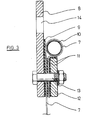
- FIG 3 is a cross-sectional view of a suitable end-connection construction for a fabric strip which is to be loaded with ballast weights.
- This end connection comprises a thick steel plate 8 which is connected to the fabric end 7 via the insertion of a rubber strip 9.
- This fabric end is looped around a tube 10 and clamped between the plate 8 and the counterplate 12 by means of the insertion of extra rubber strips 11.
- the plates 8 and 12 are bolted together at regular intervals by means of clamping bolts 13. The fabric end can now be handled by inserting hooks in suitable bores 14 in plate 8.
- a woven steel wire cord fabric with the following parameters was made: the zinc-coated warp and weft cords (of high-carbon steel) have a construction 3x0.60 (i.e. 3 twisted steel filaments each with a diameter of 0.6 mm). The cord thickness was substantially 1.3 mm and the breaking load approximately 1950 N.
- each warp group of 6 cords was approximately 12 mm, while the distance "b" was equal to approximately 18 mm and the distance "a” was equal to approximately 28 mm.
- a piece of 41 cm wide (containing ten warp cord groups) and 2 m long was cut out of this fabric. The warp cords were held at both ends without applying a tension in the warp direction. Subsequently one weft cord was axially pulled near the middle of the piece near one longitudinal edge of the fabric while the two adjacent weft cords (one on the left and one on the right) were held at the opposite longitudinal edge of the piece. An axial pull-out force of 450 N was required.
- a non-vulcanized rubber strip 4 of suitable width and thickness (in this example 5 mm thick and 5 cm wide) can be inserted between the edges and this edge zone can be vulcanized in a hot press; see Figure 2.
- the cords 1, 2 are sufficiently embedded and anchored into the rubber strip 4.
- the upper and/or undersides of the connection zone can optionally be covered with a protecting strip 5 during the vulcanization. This prevents sticking together of the rubber strips when winding or unwinding the strip.
- the thus produced fabric strip possessed a tensile force in the direction of the warp of 200 kN per metre of fabric width.
- an extra fabric strip is fixed with a slightly higher tensile strength and that the eventual outer edges of these strips are bordered with a rubber strip vulcanized to them to prevent unravelment of the outer edges.
- a rubber strip vulcanized to them to prevent unravelment of the outer edges.
- to the transverse starting end of the mat thick steel plates can be vulcanized to make handling (with cranes, etc.) possible. These plate connections must obviously form a sufficiently large contact surface with the fabric end embedded in the rubber to support the total load of the suspended strip and ballast weights.
- connection strength must be at least 200 kN per running meter of plate connection when the fabric tensile force in the longitudinal direction is 200 kN/m. Hence good adhesion of the rubber to the plate is essential.
- the thickness of the plate 8 and the counterplate 12 was fifteen mm.
- the diameter of a tube 10 was 25 mm.
- Clamping bolts 13 were fitted every 20 cm across the width of the fabric strip.
- ballast weights are tied by means of cords 6 to the fabric strips.
- these cords are attached to hooks which engage through the fabric meshes around the weft groups 3.
- the clamping force of the warp on the weft is such that every place of attachment can support at least 250 kg without noticeable deformation of the surrounding meshes.
- This clamping effect has the further consequence that the local loading in a point of attachment is substantially 50% transmitted to the surrounding warp groups. This stimulates an even load distribution throughout the entire fabric, respectively the entire fabric strip.
- the zinc coating on the relatively thin steel cords also produces the result that, on the one hand, the corrosion resistance against (sea)water is improved so that the durability of the strip remains sufficient, and that, on the other hand, a good adhesion of the cords in the rubber strips is ensured.
- the fabric of the invention is specifically applicable as an open-mesh underwater covering mat other applications are also contemplated.
- these fabrics can be used as a supporting structure or reinforcing structure for flexible strips or sheets.
- holders or floats can be attached to the fabrics instead of ballast blocks, or a combination of ballast weights and floats with flexible sheets.
- artificial soils can be formed for aquaculture with regulatable sinking depth of immersion by using floats which can be inflated to different selected degrees.
- the fabrics can also be covered with a plastic coating, for example by heating them and passing them through a fluidized bed of plastic powder. This may improve the corrosion resistance.
- a plastic coating for example by heating them and passing them through a fluidized bed of plastic powder.
- an anti-fouling material can be incorporated into the plastic (for example Cu-Ni-powder) or a known lime-like substance can be deposited on the fabrics to serve as a feeding bottom for raising crustaceans.
Landscapes
- Engineering & Computer Science (AREA)
- General Engineering & Computer Science (AREA)
- Environmental & Geological Engineering (AREA)
- Ocean & Marine Engineering (AREA)
- Mechanical Engineering (AREA)
- Civil Engineering (AREA)
- Structural Engineering (AREA)
- Woven Fabrics (AREA)
- Revetment (AREA)
Claims (12)

Applications Claiming Priority (2)
| Application Number | Priority Date | Filing Date | Title |
|---|---|---|---|
| NL8302739A NL8302739A (nl) | 1983-08-02 | 1983-08-02 | Openmazig weefsel. |
| NL8302739 | 1983-08-02 |
Publications (2)
| Publication Number | Publication Date |
|---|---|
| EP0134604A1 EP0134604A1 (de) | 1985-03-20 |
| EP0134604B1 true EP0134604B1 (de) | 1988-08-17 |
Family
ID=19842224
Family Applications (1)
| Application Number | Title | Priority Date | Filing Date |
|---|---|---|---|
| EP84201063A Expired EP0134604B1 (de) | 1983-08-02 | 1984-07-17 | Offenmaschiges Gewebe |
Country Status (6)
| Country | Link |
|---|---|
| US (1) | US4623281A (de) |
| EP (1) | EP0134604B1 (de) |
| JP (1) | JPS6075633A (de) |
| CA (1) | CA1235045A (de) |
| DE (1) | DE3473485D1 (de) |
| NL (1) | NL8302739A (de) |
Cited By (2)
| Publication number | Priority date | Publication date | Assignee | Title |
|---|---|---|---|---|
| DE4202106A1 (de) * | 1992-01-27 | 1993-07-29 | Froendenberger Kettenfabrik He | Auf dem grund von gewaessern ablegbare, flexible endlosbahn mit einer beschwerung an ihren laengskanten |
| CN105074092A (zh) * | 2013-04-04 | 2015-11-18 | 贝卡尔特公司 | 包括联接至基体或集成在基体中的成组金属长丝组件的用于加固路面的结构 |
Families Citing this family (14)
| Publication number | Priority date | Publication date | Assignee | Title |
|---|---|---|---|---|
| US5157434A (en) * | 1988-09-14 | 1992-10-20 | Asahi Kogaku Kogyo Kabushiki Kaisha | Autofocusing system for camera |
| DE9105132U1 (de) * | 1991-04-23 | 1991-06-20 | Müller Elastotex GmbH & Co KG, 1000 Berlin | Abstands-Struktur-Textilmatte |
| ATE159993T1 (de) * | 1993-06-17 | 1997-11-15 | Tt1U Sl | Verbundfäden und daraus erstellte stoffe und verfahren zu deren erhalt |
| US5370797A (en) * | 1993-07-15 | 1994-12-06 | Cagle; William S. | High aspect ratio triple-plus warp wire mesh |
| ZA963715B (en) * | 1995-05-12 | 1996-11-20 | Tensar Corp | Bonded composite open mesh structural textiles |
| US5795835A (en) * | 1995-08-28 | 1998-08-18 | The Tensar Corporation | Bonded composite knitted structural textiles |
| GB2324100A (en) * | 1997-04-07 | 1998-10-14 | Soar Engineering Ltd | Woven protective mesh |
| TW515456U (en) * | 2002-04-18 | 2002-12-21 | Polyglas Applied Material Co L | Anisotropic grid used in civil construction |
| PL2411572T5 (pl) * | 2009-03-23 | 2023-12-04 | Tessitura Tele Metalliche Rossi S.R.L. | Półprodukt z metalowej siatki i sposób jego realizacji |
| GB2480488A (en) * | 2010-05-20 | 2011-11-23 | Stingray Geophysical Ltd | Seabed installations |
| RS57402B1 (sr) | 2013-07-24 | 2018-09-28 | Integrated Composite Products Inc | Kompozitni konstrukcijski proizvod |
| WO2016025564A2 (en) | 2014-08-13 | 2016-02-18 | Integrated Composite Products, Inc. | Reinforcing article |
| CA2976444A1 (en) | 2015-02-12 | 2016-08-18 | Integrated Composite Products, Inc. | Pre-stressed fiber reinforcing member |
| US9528201B1 (en) * | 2015-07-13 | 2016-12-27 | Smart Textile Products, LLC | Insulating sheer fabric |
Family Cites Families (11)
| Publication number | Priority date | Publication date | Assignee | Title |
|---|---|---|---|---|
| US2024806A (en) * | 1931-06-19 | 1935-12-17 | Tyler Co W S | Woven wire screen |
| US2052808A (en) * | 1934-12-11 | 1936-09-01 | American Brakeblok Corp | Backing for composition friction elements |
| US2092183A (en) * | 1935-12-02 | 1937-09-07 | Rehfeld George William | Mat for protecting banks of streams |
| US2361163A (en) * | 1942-10-07 | 1944-10-24 | Oscar F Arthur | Wire mat |
| US2922442A (en) * | 1958-11-04 | 1960-01-26 | New York Wire Cloth Company | Woven screen cloth |
| NL6803322A (de) * | 1968-03-08 | 1969-09-10 | ||
| DE2000937C3 (de) * | 1970-01-09 | 1978-06-01 | H. & J. Huesker & Co, 4423 Gescher | Gittergewebe zum Bewehren bitumengebundener Platten und Schichten |
| BE788449A (fr) * | 1971-09-07 | 1973-06-06 | Bayer Ag | Elements de construction anti-erosion en forme de nappes de fibres aiguilletees |
| DE2434328C3 (de) * | 1974-07-17 | 1979-10-11 | Dynamit Nobel Ag, 5210 Troisdorf | Schutzlage für Flächendichtungen im Hoch-, Tief- und Ingenieurbau und Verfahren zum kontinuierlichen Herstellen der Schutzlage |
| US4002188A (en) * | 1975-12-15 | 1977-01-11 | Phifer Wire Products, Inc. | Woven shade screen |
| DE3120661C2 (de) * | 1981-05-23 | 1986-08-07 | Huesker Synthetic GmbH & Co, 4423 Gescher | Gittergewebe, insbesondere zum Bewehren von Platten und Schichten |
-
1983
- 1983-08-02 NL NL8302739A patent/NL8302739A/nl not_active Application Discontinuation
-
1984
- 1984-07-17 DE DE8484201063T patent/DE3473485D1/de not_active Expired
- 1984-07-17 EP EP84201063A patent/EP0134604B1/de not_active Expired
- 1984-07-18 CA CA000459195A patent/CA1235045A/en not_active Expired
- 1984-07-26 US US06/634,568 patent/US4623281A/en not_active Expired - Fee Related
- 1984-08-02 JP JP59163470A patent/JPS6075633A/ja active Pending
Cited By (2)
| Publication number | Priority date | Publication date | Assignee | Title |
|---|---|---|---|---|
| DE4202106A1 (de) * | 1992-01-27 | 1993-07-29 | Froendenberger Kettenfabrik He | Auf dem grund von gewaessern ablegbare, flexible endlosbahn mit einer beschwerung an ihren laengskanten |
| CN105074092A (zh) * | 2013-04-04 | 2015-11-18 | 贝卡尔特公司 | 包括联接至基体或集成在基体中的成组金属长丝组件的用于加固路面的结构 |
Also Published As
| Publication number | Publication date |
|---|---|
| JPS6075633A (ja) | 1985-04-30 |
| EP0134604A1 (de) | 1985-03-20 |
| NL8302739A (nl) | 1985-03-01 |
| DE3473485D1 (en) | 1988-09-22 |
| CA1235045A (en) | 1988-04-12 |
| US4623281A (en) | 1986-11-18 |
Similar Documents
| Publication | Publication Date | Title |
|---|---|---|
| EP0134604B1 (de) | Offenmaschiges Gewebe | |
| US5091247A (en) | Woven geotextile grid | |
| US4960349A (en) | Woven geotextile grid | |
| US4477206A (en) | Flexible mattress-like element usable at ballast for immobilizing and protecting underwater pipelines | |
| US3973670A (en) | Conveyor belt | |
| EP0018082B1 (de) | Struktur zum Kontrollieren von Unterwassererosion | |
| US4564311A (en) | Protective jacket for use in revetment structures | |
| RU2147051C1 (ru) | Клееные композитные сетчатые строительные текстильные материалы | |
| US4534675A (en) | Artificial seaweed | |
| US4650068A (en) | Reinforcing structure for elastomeric article and article thereby obtained | |
| WO1980002436A1 (en) | Safety mat for use in protection of waterwashed areas against erosion and/or undermining | |
| CA2345948C (en) | Geotextile fabric | |
| US3922865A (en) | Mattress, method of sinking a mattress and vessel suitable for use in said method | |
| FI85527C (fi) | Lamellmatta foer filtrering av partikelformigt material fraon undervattensstroemmar samt foerfarande foer framstaellning av lamellmatta. | |
| US2454292A (en) | Revetment mat | |
| US3811287A (en) | Bottom and bank facing | |
| RU2000100022A (ru) | Армированный брезент | |
| US3577879A (en) | Floating barrier means | |
| US5876151A (en) | Frame and method for installing viscous drag and non-laminar flow components of an underwater erosion control system | |
| KR20230082687A (ko) | 수중 계류 로프 | |
| US3722222A (en) | Support means for slope revetments | |
| EP0021467B1 (de) | Gewebte Matte | |
| US3745771A (en) | Influencing sedimentation | |
| US3727411A (en) | Influencing sedimentation | |
| GB2159842A (en) | Reinforcing net |
Legal Events
| Date | Code | Title | Description |
|---|---|---|---|
| PUAI | Public reference made under article 153(3) epc to a published international application that has entered the european phase |
Free format text: ORIGINAL CODE: 0009012 |
|
| AK | Designated contracting states |
Designated state(s): BE DE FR GB IT NL SE |
|
| 17P | Request for examination filed |
Effective date: 19850906 |
|
| 17Q | First examination report despatched |
Effective date: 19860611 |
|
| R17C | First examination report despatched (corrected) |
Effective date: 19870327 |
|
| GRAA | (expected) grant |
Free format text: ORIGINAL CODE: 0009210 |
|
| AK | Designated contracting states |
Kind code of ref document: B1 Designated state(s): BE DE FR GB IT NL SE |
|
| REF | Corresponds to: |
Ref document number: 3473485 Country of ref document: DE Date of ref document: 19880922 |
|
| ITF | It: translation for a ep patent filed | ||
| EN | Fr: translation not filed | ||
| PGFP | Annual fee paid to national office [announced via postgrant information from national office to epo] |
Ref country code: DE Payment date: 19890527 Year of fee payment: 6 |
|
| PGFP | Annual fee paid to national office [announced via postgrant information from national office to epo] |
Ref country code: FR Payment date: 19890530 Year of fee payment: 6 |
|
| PGFP | Annual fee paid to national office [announced via postgrant information from national office to epo] |
Ref country code: SE Payment date: 19890531 Year of fee payment: 6 Ref country code: GB Payment date: 19890531 Year of fee payment: 6 |
|
| PGFP | Annual fee paid to national office [announced via postgrant information from national office to epo] |
Ref country code: BE Payment date: 19890606 Year of fee payment: 6 |
|
| PLBE | No opposition filed within time limit |
Free format text: ORIGINAL CODE: 0009261 |
|
| STAA | Information on the status of an ep patent application or granted ep patent |
Free format text: STATUS: NO OPPOSITION FILED WITHIN TIME LIMIT |
|
| PGFP | Annual fee paid to national office [announced via postgrant information from national office to epo] |
Ref country code: NL Payment date: 19890731 Year of fee payment: 6 |
|
| 26N | No opposition filed | ||
| PG25 | Lapsed in a contracting state [announced via postgrant information from national office to epo] |
Ref country code: GB Effective date: 19900717 |
|
| PG25 | Lapsed in a contracting state [announced via postgrant information from national office to epo] |
Ref country code: SE Effective date: 19900718 |
|
| PG25 | Lapsed in a contracting state [announced via postgrant information from national office to epo] |
Ref country code: BE Effective date: 19900731 |
|
| BERE | Be: lapsed |
Owner name: N.V. BEKAERT S.A. Effective date: 19900731 |
|
| PG25 | Lapsed in a contracting state [announced via postgrant information from national office to epo] |
Ref country code: NL Effective date: 19910201 |
|
| GBPC | Gb: european patent ceased through non-payment of renewal fee | ||
| NLV4 | Nl: lapsed or anulled due to non-payment of the annual fee | ||
| PG25 | Lapsed in a contracting state [announced via postgrant information from national office to epo] |
Ref country code: DE Effective date: 19910403 |
|
| EUG | Se: european patent has lapsed |
Ref document number: 84201063.9 Effective date: 19910402 |
|
| PG25 | Lapsed in a contracting state [announced via postgrant information from national office to epo] |
Ref country code: FR Free format text: LAPSE BECAUSE OF NON-PAYMENT OF DUE FEES Effective date: 19900731 |