EP0124538B1 - Control of microflora and preparations therefor - Google Patents
Control of microflora and preparations therefor Download PDFInfo
- Publication number
- EP0124538B1 EP0124538B1 EP83903231A EP83903231A EP0124538B1 EP 0124538 B1 EP0124538 B1 EP 0124538B1 EP 83903231 A EP83903231 A EP 83903231A EP 83903231 A EP83903231 A EP 83903231A EP 0124538 B1 EP0124538 B1 EP 0124538B1
- Authority
- EP
- European Patent Office
- Prior art keywords
- preparations
- boundaries
- phase
- interfaces
- bacteria
- Prior art date
- Legal status (The legal status is an assumption and is not a legal conclusion. Google has not performed a legal analysis and makes no representation as to the accuracy of the status listed.)
- Expired
Links
Images
Classifications
-
- A—HUMAN NECESSITIES
- A61—MEDICAL OR VETERINARY SCIENCE; HYGIENE
- A61Q—SPECIFIC USE OF COSMETICS OR SIMILAR TOILETRY PREPARATIONS
- A61Q11/00—Preparations for care of the teeth, of the oral cavity or of dentures; Dentifrices, e.g. toothpastes; Mouth rinses
-
- A—HUMAN NECESSITIES
- A23—FOODS OR FOODSTUFFS; TREATMENT THEREOF, NOT COVERED BY OTHER CLASSES
- A23K—FODDER
- A23K20/00—Accessory food factors for animal feeding-stuffs
- A23K20/10—Organic substances
- A23K20/179—Colouring agents, e.g. pigmenting or dyeing agents
-
- A—HUMAN NECESSITIES
- A23—FOODS OR FOODSTUFFS; TREATMENT THEREOF, NOT COVERED BY OTHER CLASSES
- A23K—FODDER
- A23K20/00—Accessory food factors for animal feeding-stuffs
- A23K20/20—Inorganic substances, e.g. oligoelements
- A23K20/24—Compounds of alkaline earth metals, e.g. magnesium
-
- A—HUMAN NECESSITIES
- A61—MEDICAL OR VETERINARY SCIENCE; HYGIENE
- A61K—PREPARATIONS FOR MEDICAL, DENTAL OR TOILETRY PURPOSES
- A61K31/00—Medicinal preparations containing organic active ingredients
- A61K31/12—Ketones
-
- A—HUMAN NECESSITIES
- A61—MEDICAL OR VETERINARY SCIENCE; HYGIENE
- A61K—PREPARATIONS FOR MEDICAL, DENTAL OR TOILETRY PURPOSES
- A61K31/00—Medicinal preparations containing organic active ingredients
- A61K31/33—Heterocyclic compounds
- A61K31/335—Heterocyclic compounds having oxygen as the only ring hetero atom, e.g. fungichromin
- A61K31/35—Heterocyclic compounds having oxygen as the only ring hetero atom, e.g. fungichromin having six-membered rings with one oxygen as the only ring hetero atom
-
- A—HUMAN NECESSITIES
- A61—MEDICAL OR VETERINARY SCIENCE; HYGIENE
- A61K—PREPARATIONS FOR MEDICAL, DENTAL OR TOILETRY PURPOSES
- A61K33/00—Medicinal preparations containing inorganic active ingredients
-
- A—HUMAN NECESSITIES
- A61—MEDICAL OR VETERINARY SCIENCE; HYGIENE
- A61K—PREPARATIONS FOR MEDICAL, DENTAL OR TOILETRY PURPOSES
- A61K8/00—Cosmetics or similar toiletry preparations
- A61K8/18—Cosmetics or similar toiletry preparations characterised by the composition
- A61K8/19—Cosmetics or similar toiletry preparations characterised by the composition containing inorganic ingredients
-
- A—HUMAN NECESSITIES
- A61—MEDICAL OR VETERINARY SCIENCE; HYGIENE
- A61K—PREPARATIONS FOR MEDICAL, DENTAL OR TOILETRY PURPOSES
- A61K8/00—Cosmetics or similar toiletry preparations
- A61K8/18—Cosmetics or similar toiletry preparations characterised by the composition
- A61K8/30—Cosmetics or similar toiletry preparations characterised by the composition containing organic compounds
- A61K8/33—Cosmetics or similar toiletry preparations characterised by the composition containing organic compounds containing oxygen
- A61K8/35—Ketones, e.g. benzophenone
Definitions
- the present invention relates to preparations for removing undesired microorganisms, including those of pathogenic nature, attached to surfaces, phase boundaries and interfaces.
- the invention also relates to preparations for effecting an adhesion-stimulating result for desired microorganisms by administering adhesion-stimulating substances.
- the present invention can be used to prevent the establishment of pathogenic bacteria flora and to eliminate such flora already established in pigs, calves and poultry.
- poultry is meant chickens, turkeys, geese and ducks, for instance.
- the mortality rate of such animals is at present high as a result of the establishment and colonization of pathogenic bacteria in the stomach and intestines.
- Pathogenic bacteria out the normal bacteria flora adhere to the bonding sites on the walls of the intestines, give rise to disease symptoms such as diarrhoea and result in increased mortality.
- Some farms lose large numbers of animals following an outbreak of pathogenic bacteria such as Escherichia coli, Salmonella typhimurium, Salmonella Sp., Shigella sp. and Clostridium perfringens.
- Non-selectivity which also causes a reduction in the natural intestinal flora
- High cost The appearance of resistant strains; It is time-consuming and impractical when the farm worker cannot be responsible for all steps of the treatment himself; Legislative control of treatment with antibiotics.
- the substance used to increase the degree of adhesion of the non-pathogenic bacteria are curcumin or derivatives thereof of the formula
- curcumin or derivatives thereof are included in smaller or larger quantities, including turmeric, the preparation containing these substances individually or in combination.
- the object of the present invention is to provide preparations for controlling micro- organisms adhered to surfaces, phase-boundaries interfaces or any kind of inert surface and also surfaces and phase-boundaries, interfaces in biological materials, these preparations being characterized in that they contain substances which alter the waterstructure-binding capacity of surfaces, phase-boundaries and interfaces, such substances being selected from organic an inorganic salts of magnesium and ammonium in combination with erythrosine or being composed of the adhesion-stimulating substance curcumin or derivatives thereof in combination with bacteria to be adhered.
- Example 1 Relating to pigs and calves
- the following bacterial preparations were produced for oral administration to pigs in skimmed milk fermented with Lactobacillus acidophilus. Capsules (sterilized) were used containing 1 01°/ml Streptococcus faecalis or S. faecium fimbriated Enterobacteria and curcumin or analogous compounds, in sizes suited to the size of the animals. Curcumin is active of administered in amounts of 0.8 g/body-weight per day. This bacteria preparation was administered immediately after the treatment described under A.
- Example 1 A and B as in Example 1, with the exception of the Lactobacillus acidophilus.
- the preparation was administration in drinking water.
- Stages A and B can be repeated as necessary at intervals.
- Some of the mechanisms binding micro-organisms to phase boundaries or interfaces are responsible for irreversible binding which acts over short distances (2-5 nm). This results in strong adhesion which is only mechanically broken by tearing away the components belonging to the adhered micro-organisms. Hydrophobic interaction is primarily responsible for this type of irreversible binding.
- Successful treatment i.e. removal of micro-organisms adhered in this manner, is effected by modifying the quantity of substances, salts or other components, able to alter the water-structure binding properties in the surfaces, phase boundaries and interfaces of the system.
- the result of the method is also illustrated by but not limited to the following experiments in a model system.
- magnesium sulphate (MgS0 4 ) gave the strongest detaching effect.
- magnesium chloride (MgCI) and ammonium acetate (MH 4 Ac) solutions also gave good results, whereas ammonium sulphate ((NH 4 ) 2 S0 4 ) solutions gave a slightly different pattern.
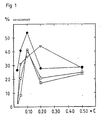
- Figure 1 shows the detachment of irreversibly adhered bacteria after treatment with salt solutions of various concentrations.
- the salt concentration is expressed in multiples of the basic solution C.
- the number of irreversibly adhered bacteria is ca. 3.0 x 10 6 per glass tube before treatment.
Landscapes
- Health & Medical Sciences (AREA)
- Life Sciences & Earth Sciences (AREA)
- Chemical & Material Sciences (AREA)
- Animal Behavior & Ethology (AREA)
- General Health & Medical Sciences (AREA)
- Public Health (AREA)
- Veterinary Medicine (AREA)
- Epidemiology (AREA)
- Polymers & Plastics (AREA)
- Inorganic Chemistry (AREA)
- Medicinal Chemistry (AREA)
- Pharmacology & Pharmacy (AREA)
- Food Science & Technology (AREA)
- Birds (AREA)
- Animal Husbandry (AREA)
- Zoology (AREA)
- Engineering & Computer Science (AREA)
- Emergency Medicine (AREA)
- Oral & Maxillofacial Surgery (AREA)
- Pharmaceuticals Containing Other Organic And Inorganic Compounds (AREA)
- Medicines Containing Material From Animals Or Micro-Organisms (AREA)
- Acyclic And Carbocyclic Compounds In Medicinal Compositions (AREA)
- Cosmetics (AREA)
- Organic Low-Molecular-Weight Compounds And Preparation Thereof (AREA)
- Agricultural Chemicals And Associated Chemicals (AREA)
Abstract
Description
- The present invention relates to preparations for removing undesired microorganisms, including those of pathogenic nature, attached to surfaces, phase boundaries and interfaces. The invention also relates to preparations for effecting an adhesion-stimulating result for desired microorganisms by administering adhesion-stimulating substances.
- In the following the invention will be described first as applied to the care of livestock, other applications being dealt with afterwards.
- The present invention can be used to prevent the establishment of pathogenic bacteria flora and to eliminate such flora already established in pigs, calves and poultry. By "poultry" is meant chickens, turkeys, geese and ducks, for instance.
- The mortality rate of such animals is at present high as a result of the establishment and colonization of pathogenic bacteria in the stomach and intestines. Pathogenic bacteria out the normal bacteria flora, adhere to the bonding sites on the walls of the intestines, give rise to disease symptoms such as diarrhoea and result in increased mortality. Some farms lose large numbers of animals following an outbreak of pathogenic bacteria such as Escherichia coli, Salmonella typhimurium, Salmonella Sp., Shigella sp. and Clostridium perfringens.
- Current methods of reducing the risk of outbreaks of the type mentioned above can be divided into two categories:
- 1. Treatment with antibiotics
- 2. Oral administration of non-pathogenic bacteria in pure or mixed cultures.
- There are a number of drawbacks in treating animals with antibiotics, which makes the method less attractive.
- Examples are: Non-selectivity, which also causes a reduction in the natural intestinal flora; High cost; The appearance of resistant strains; It is time-consuming and impractical when the farm worker cannot be responsible for all steps of the treatment himself; Legislative control of treatment with antibiotics.
- It has been impossible to follow up successful laboratory experiments with oral administration of non-pathogenic bacteria resulting in reduced risk of diarrhoea in pigs, under full-scale conditions. Careful tests with commercial products containing, e.g. Lactobacillus acidophilus and Lactobacillus bulgaricus have not given significant positive results. Neither has it been possible to colonize the intestines of pigs with Streptococcus faecium. It has not been possible to establish Lactobacillus acidophilus in chicken intestines and there have been no successful large-scale experiments with oral administration to chickens.
- More recent experiments with plasmid-carrying strains to increase adhesion appear to be futile due to instability of the plasmids and difficulties in maintaining suitable selection pressure for their preservation.
- Initial studies of the adhesion of bacteria to the intestinal walls revealed surprisingly that oral administration of e.g. solutions of MgS04 or erythrosine is anyway an extremely successful method of preventing the establishment, colonization and growth of pathogenic bacteria in the stomach and intestines of pigs, calves and poultry.
- The following points comprise the basis of the process forming the grounds of the present invention.
- 1. The stomach and intestines is rendered substantially bacteria-free by treating with anti-microbial substances or substances which adhere to the walls and block the adhesion of bacteria.
- 2. Substances are used which increase the degree of adhesion of the orally administered non-pathogenic bacteria.
- 3. Non-pathogenic enterobacteria are cultivated in a special way to produce specific protein- protrusions, fimbria, giving rise to greatly increased adhesion of bacteria to the surface of intestinal walls.
- The substance used to increase the degree of adhesion of the non-pathogenic bacteria are curcumin or derivatives thereof of the formula

- where n = 0, 1, 2 or 3,
- and x = 1, 2, 3 or 4,
- and R 1-5 is H, OH, OCH3, OCH2CH3, CH3, CH2CH3, COOH, CH2-COOH,
- or oleo-resins and products in which curcumin or derivatives thereof are included in smaller or larger quantities, including turmeric, the preparation containing these substances individually or in combination.
- Accordingly the object of the present invention is to provide preparations for controlling micro- organisms adhered to surfaces, phase-boundaries interfaces or any kind of inert surface and also surfaces and phase-boundaries, interfaces in biological materials, these preparations being characterized in that they contain substances which alter the waterstructure-binding capacity of surfaces, phase-boundaries and interfaces, such substances being selected from organic an inorganic salts of magnesium and ammonium in combination with erythrosine or being composed of the adhesion-stimulating substance curcumin or derivatives thereof in combination with bacteria to be adhered.
- The invention is further illustrated with reference to the following non-limiting examples of its application:
- A. Erythrosine, anti-oxidants or MgS04 were mixed into the fodder or drinking water in concentrations expressed in g/kg bodyweight per day; 0.06, 1, 0.5, respectively. Observation of laboratory animals (mice) with a scanning transmission electron microscope has revealed that the bacterial flora in the intestines were greatly reduced. Large bacteria-free areas were observed using erythrosine and anti-oxidants and the use of MgS04 resulted in completely bacteria-free intestines.
- B. Faeces samples from uncontaminated animals were coated on Mac-Conkey plates. The isolated samples were tested using a screening test, for Enterobacteriaceae in order to avoid Escherichia coli and Salmonella types. A suitable culture was selected and cultivated to produce fimbria which were checked with the yeast agglutination method. Intestinal wall was at the same time taken with caecum and large intestine of uncontaminated animals. Irreversibly bound bacteria plus intestinal wall was homogenized and fimbria-carrying bacteria were produced as described above.
- Binding studies revealed that curcumin and similar compounds increased the degree of adhesion of Lactobacillus acidophilus to pig intestines byfive times.
- The following bacterial preparations were produced for oral administration to pigs in skimmed milk fermented with Lactobacillus acidophilus. Capsules (sterilized) were used containing 1 01°/ml Streptococcus faecalis or S. faecium fimbriated Enterobacteria and curcumin or analogous compounds, in sizes suited to the size of the animals. Curcumin is active of administered in amounts of 0.8 g/body-weight per day. This bacteria preparation was administered immediately after the treatment described under A.
- A and B as in Example 1, with the exception of the Lactobacillus acidophilus. The preparation was administration in drinking water.
- Stages A and B can be repeated as necessary at intervals.
- Some of the mechanisms binding micro-organisms to phase boundaries or interfaces are responsible for irreversible binding which acts over short distances (2-5 nm). This results in strong adhesion which is only mechanically broken by tearing away the components belonging to the adhered micro-organisms. Hydrophobic interaction is primarily responsible for this type of irreversible binding.
- Successful treatment, i.e. removal of micro-organisms adhered in this manner, is effected by modifying the quantity of substances, salts or other components, able to alter the water-structure binding properties in the surfaces, phase boundaries and interfaces of the system.
- Experiments with infectious bacteria in wounds and micro-organisms adhered to teeth showed surprisingly that the principles and substances used in the experiments with livestock described above were also extremely effective in the following widely differing fields of application.
- The following points constituted the bases of the process used in these new fields of application.
- 1. Substances altering the degree of adhesion and hydrophobic interaction between surface and micro- organisms are added to the surface/phase boundaries being treated, so that smaller or large portions of the irreversibly adhere micro-organisms become detached.
- 2. Substances promoting adhesion of specifically supplied micro-organisms are added to the system treated under point 1.
- The procedure is further illustrated with reference to the following non-limiting examples.
- In both model system and during clinical testing using dentifrice or mouthwash with the addition of magnesium sulphate (MgS04) for brushing teeth or rising out the mouth, a significant reduction in the number of bacteria adhered was established.
- Bathing liquids to which magnesium sulphate and/or antioxidants had been added were applied to a wound. Here too a significant reduction in the number of bacteria adhered to the wound surface was noted. It was also noted that cleaning the surface of the wound in this manner stimulated healing.
- The result of the method is also illustrated by but not limited to the following experiments in a model system.
- A number of glass tubes, all the same size, were immersed in a suspension of bacteria marked with a radioactive isotope (tritium) and the bacteria were allowed to adhere over a period of 30 minutes. The glass tubes were then removed one by one and rinsed by repeated dipping (30 times) in a buffer solution in order to remove reversibly bound bacteria. Only the irreversibly bound bacteria then remained on the glass tube. The glass tube was then immersed in a salt solution for 5 minutes. After rinsing, the quantity of bacteria adhered to the tube was determined by measuring the radiation in a liquid scintillator.
- A comparison of the various glass tubes which had been immersed in salt solution of various concentrations with control tubes which had undergone the same treatment with the exception of immersion in the salt solution, enabled assessment of the effect of the salt solution on the irreversible bound bacteria. The table below and the drawing show the effects of the various salts on detachment of the irreversibly adhered bacteria, expressed in percentage of the quantity of irreversibly adhered bacteria before the salt treatment. The concentrations of the solutions are in multiples of a specific critical concentration (C) of the basic solution.
- Of the salts tested in this series of experiments, magnesium sulphate (MgS04) gave the strongest detaching effect. However, magnesium chloride (MgCI) and ammonium acetate (MH4Ac) solutions also gave good results, whereas ammonium sulphate ((NH4)2S04) solutions gave a slightly different pattern.
- Several other compounds and salts have been tested besides those mentioned in this series of experiments, and the results were similar.

- Figure 1 shows the detachment of irreversibly adhered bacteria after treatment with salt solutions of various concentrations. The salt concentration is expressed in multiples of the basic solution C. The number of irreversibly adhered bacteria is ca. 3.0 x 10⁶ per glass tube before treatment.
- The curves are designated as follows:

Claims (9)

Priority Applications (1)
| Application Number | Priority Date | Filing Date | Title |
|---|---|---|---|
| AT83903231T ATE45879T1 (en) | 1982-11-03 | 1983-10-06 | CONTROL PROCEDURES FOR MICROFLORA AND COMPOSITIONS THERETO. |
Applications Claiming Priority (2)
| Application Number | Priority Date | Filing Date | Title |
|---|---|---|---|
| SE8206250A SE8206250L (en) | 1982-11-03 | 1982-11-03 | REGULATION OF GAS MICROFLORA |
| SE8206250 | 1982-11-03 |
Publications (2)
| Publication Number | Publication Date |
|---|---|
| EP0124538A1 EP0124538A1 (en) | 1984-11-14 |
| EP0124538B1 true EP0124538B1 (en) | 1989-08-30 |
Family
ID=20348451
Family Applications (1)
| Application Number | Title | Priority Date | Filing Date |
|---|---|---|---|
| EP83903231A Expired EP0124538B1 (en) | 1982-11-03 | 1983-10-06 | Control of microflora and preparations therefor |
Country Status (7)
| Country | Link |
|---|---|
| US (1) | US4581227A (en) |
| EP (1) | EP0124538B1 (en) |
| JP (1) | JPS59501984A (en) |
| AT (1) | ATE45879T1 (en) |
| DE (1) | DE3380476D1 (en) |
| SE (1) | SE8206250L (en) |
| WO (1) | WO1984001713A1 (en) |
Families Citing this family (13)
| Publication number | Priority date | Publication date | Assignee | Title |
|---|---|---|---|---|
| SE463598B (en) * | 1984-11-08 | 1990-12-17 | Chemical Dynamics Sweden Ab | PREPARATION, PROVIDED TO INCREASE THE ADMINISTRATION OF BACTERIA TO THE GIANT GAS OF HUMAN AND ANIMALS, AND A MANUFACTURING PROCEDURE FOR THIS |
| SE8500102L (en) * | 1985-01-10 | 1986-07-11 | Chemical Dynamics Sweden Ab | MICROFLORA DELIVERY PROCEDURE |
| US4987124A (en) * | 1987-10-13 | 1991-01-22 | Coors Biotech, Inc. | Method for inhibiting the growth of salmonella |
| US4902674A (en) * | 1987-10-13 | 1990-02-20 | Coors Biotech, Inc. | Method for inhibiting the growth of salmonella |
| US5032579A (en) * | 1987-10-13 | 1991-07-16 | Coors Biotech, Inc. | Method for inhibiting the growth of salmonella |
| DE3929411A1 (en) * | 1988-09-22 | 1990-03-29 | Siegfried Natterer | Pharmaceutical preparation and process for its preparation |
| PL313171A1 (en) * | 1993-08-23 | 1996-06-10 | Henkel Kgaa | Method of distinguishing organic food residues on hard surfaces |
| US5500206A (en) * | 1994-04-29 | 1996-03-19 | The Procter & Gamble Company | Oral compositions comprising actinomyces viscosus fimbriae |
| US20040101488A1 (en) * | 2000-03-24 | 2004-05-27 | Balaram Ghosh | Method for the prevention of septic shock lethality using curcumin |
| DE10055557C2 (en) * | 2000-11-09 | 2002-09-26 | Ecolab Gmbh & Co Ohg | Procedure for the simultaneous recording of several types of residues |
| US20050059731A1 (en) * | 2003-09-16 | 2005-03-17 | Ceramoptec Industries, Inc. | Erythrosin-based antimicrobial photodynamic therapy compound and its use |
| IL160950A (en) * | 2004-03-18 | 2008-12-29 | Shlomo Navarro | Pest-impervious packaging material and pest-control composition |
| JP2008013532A (en) * | 2006-07-10 | 2008-01-24 | Keio Gijuku | PI3 kinase-dependent inflammatory cytokine synthesis inhibitor and inhibition method |
Family Cites Families (16)
| Publication number | Priority date | Publication date | Assignee | Title |
|---|---|---|---|---|
| US2118225A (en) * | 1935-11-01 | 1938-05-24 | Pierce John Stanton | Antiseptic products |
| DE970722C (en) * | 1950-02-08 | 1958-10-23 | Blendax Werke G M B H | Oral and dental care products |
| CA945901A (en) * | 1967-07-24 | 1974-04-23 | Leonard J. Svajda | Composition for desensitizing sensitive teeth |
| GB1334933A (en) * | 1971-02-19 | 1973-10-24 | Ahrens G W | Reaction products of caldium ascorbate and preparation containing them |
| US3932603A (en) * | 1971-05-28 | 1976-01-13 | General Foods Corporation | Oral preparations for reducing the incidence of dental caries |
| JPS5525163B2 (en) * | 1972-06-06 | 1980-07-04 | ||
| FR2336925A1 (en) * | 1975-12-30 | 1977-07-29 | Mouney Guy | Dentifrice contg. haemostatic agent, esp. ascorbic acid or salt - has curative action on lesions of gingival epithelium etc. |
| JPS54980A (en) * | 1977-06-06 | 1979-01-06 | Hitachi Ltd | Manufacture for semiconductor device |
| US4229430A (en) * | 1978-08-21 | 1980-10-21 | Fahim Mostafa S | Oral composition for improving oral health |
| JPS5618573A (en) * | 1979-07-24 | 1981-02-21 | Suisanchiyou Chokan | Preparation of ground krill flesh |
| JPS5673014A (en) * | 1979-11-15 | 1981-06-17 | Dentaru Kagaku Kk | Toothpaste composition |
| US4283385A (en) * | 1980-05-09 | 1981-08-11 | Richardson-Merrell Inc. | Dentifrices with improved soluble fluoride availability |
| JPS5746912A (en) * | 1980-07-23 | 1982-03-17 | Sunstar Inc | Composition to be applied to tip part of toothpick and flat type connected toothpick coated with it |
| CA1136990A (en) * | 1980-07-24 | 1982-12-07 | Crowson, Doris P. | Anti-hemorrhagic and anti-inflammatory oral rinse |
| US4446125A (en) * | 1981-08-13 | 1984-05-01 | International Flavors & Fragrances Inc. | Use of isomeric farnesene product-by-process for augmenting or enhancing the aroma or taste of foodstuffs, chewing gums, medicinal products and toothpastes |
| US4457909A (en) * | 1982-09-27 | 1984-07-03 | Tames Theobaldo | Oral rinse formulation and method of treating mouth and throat irritations therewith |
-
1982
- 1982-11-03 SE SE8206250A patent/SE8206250L/en not_active Application Discontinuation
-
1983
- 1983-10-06 AT AT83903231T patent/ATE45879T1/en active
- 1983-10-06 EP EP83903231A patent/EP0124538B1/en not_active Expired
- 1983-10-06 US US06/613,772 patent/US4581227A/en not_active Expired - Lifetime
- 1983-10-06 JP JP83503213A patent/JPS59501984A/en active Pending
- 1983-10-06 DE DE8383903231T patent/DE3380476D1/en not_active Expired
- 1983-10-06 WO PCT/SE1983/000348 patent/WO1984001713A1/en not_active Ceased
Also Published As
| Publication number | Publication date |
|---|---|
| JPS59501984A (en) | 1984-11-29 |
| ATE45879T1 (en) | 1989-09-15 |
| WO1984001713A1 (en) | 1984-05-10 |
| SE8206250D0 (en) | 1982-11-03 |
| DE3380476D1 (en) | 1989-10-05 |
| SE8206250L (en) | 1984-05-04 |
| US4581227A (en) | 1986-04-08 |
| EP0124538A1 (en) | 1984-11-14 |
Similar Documents
| Publication | Publication Date | Title |
|---|---|---|
| Berchieri Jr et al. | The activity in the chicken alimentary tract of bacteriophages lytic for Salmonella typhimurium | |
| Barrow et al. | Intestinal colonisation in the chicken by food‐poisoning Salmonella serotypes; Microbial characteristics associated with faecal excretion | |
| US4581227A (en) | Control of microflora | |
| Bailey et al. | Effect of fructooligosaccharide on Salmonella colonization of the chicken intestine | |
| Spring | Effects of mannanoligosaccharide on different cecal parameters and on cecal concentrations of enteric pathogens in poultry | |
| DE69422501T2 (en) | COMPETITIVELY DISPLACING MUCALINE FLORA | |
| EP0033584A2 (en) | Process for the production of a bacterial preparation for the prophylaxis of intestinal disturbances in poultry | |
| CN113583971B (en) | Salmonella bacteriophage capable of simultaneously cracking escherichia coli and application thereof | |
| MXPA01000885A (en) | Method of vaccination of newly hatched poultry. | |
| DE3853888T2 (en) | USE OF A FRUCTO-OLIGOSACCHARID FOR PRODUCING A BACTERIOSTATIC COMPOSITION FOR PREVENTING THE GROWTH OF SALMONELLA AND A METHOD FOR PREVENTING THE GROWTH OF SALMONELLA. | |
| Reynolds et al. | Evaluation of combined antibiotic and competitive exclusion treatment in broiler breeder flocks infected with Salmonella enterica serovar Enteritidis | |
| JP2002503084A (en) | Competitive exclusion culture of livestock mucosa to reduce enteropathogenic bacteria | |
| Devriese et al. | Quantitative aspects of the Staphylococcus aureus flora of poultry | |
| Schneitz et al. | Comparison of two different types of competitive exclusion products | |
| Stas et al. | Experimental infection of chickens with Campylobacter jejuni: strains differ in their capacity to colonize the intestine | |
| JP3534792B2 (en) | Disease resistant feed | |
| Notermans et al. | The effect of cultural procedures on the attachment of bacteria to chicken breast meat | |
| CN110478267A (en) | A kind of efficient anti-caries children's toothpaste and preparation method thereof | |
| Martin et al. | Drinking water delivery of a defined competitive exclusion culture (Preempt) in 1-day-old broiler chicks | |
| DE69726465T2 (en) | ANTIBACTERIAL AMINE DERIVATIVES | |
| CN1190183C (en) | Safety toothpaste for preventing and curing oral cavity disease | |
| DE69313850T2 (en) | VETERINAER PRODUCT FOR REHYDRATION | |
| Stanek et al. | Growth of various bacteria and yeasts in a peptide and an elemental diet | |
| DE698833C (en) | Protective bushing for rotating shafts | |
| UPHILL et al. | Vitamin B12 Production by the Gastro‐intestinal Microflora of Baboons Fed either a Vitamin B12 Deficient Diet or a Diet Supplemented with Vitamin B12 |
Legal Events
| Date | Code | Title | Description |
|---|---|---|---|
| PUAI | Public reference made under article 153(3) epc to a published international application that has entered the european phase |
Free format text: ORIGINAL CODE: 0009012 |
|
| 17P | Request for examination filed |
Effective date: 19840508 |
|
| AK | Designated contracting states |
Designated state(s): AT BE CH DE FR GB LI LU NL SE |
|
| GRAA | (expected) grant |
Free format text: ORIGINAL CODE: 0009210 |
|
| AK | Designated contracting states |
Kind code of ref document: B1 Designated state(s): AT BE CH DE FR GB LI LU NL SE |
|
| PG25 | Lapsed in a contracting state [announced via postgrant information from national office to epo] |
Ref country code: LI Effective date: 19890830 Ref country code: CH Effective date: 19890830 Ref country code: BE Effective date: 19890830 Ref country code: AT Effective date: 19890830 |
|
| REF | Corresponds to: |
Ref document number: 45879 Country of ref document: AT Date of ref document: 19890915 Kind code of ref document: T |
|
| REF | Corresponds to: |
Ref document number: 3380476 Country of ref document: DE Date of ref document: 19891005 |
|
| PG25 | Lapsed in a contracting state [announced via postgrant information from national office to epo] |
Ref country code: LU Free format text: LAPSE BECAUSE OF NON-PAYMENT OF DUE FEES Effective date: 19891031 |
|
| ET | Fr: translation filed | ||
| REG | Reference to a national code |
Ref country code: CH Ref legal event code: PL |
|
| PLBE | No opposition filed within time limit |
Free format text: ORIGINAL CODE: 0009261 |
|
| STAA | Information on the status of an ep patent application or granted ep patent |
Free format text: STATUS: NO OPPOSITION FILED WITHIN TIME LIMIT |
|
| 26N | No opposition filed | ||
| EAL | Se: european patent in force in sweden |
Ref document number: 83903231.5 |
|
| PGFP | Annual fee paid to national office [announced via postgrant information from national office to epo] |
Ref country code: GB Payment date: 19971006 Year of fee payment: 15 |
|
| PGFP | Annual fee paid to national office [announced via postgrant information from national office to epo] |
Ref country code: SE Payment date: 19971028 Year of fee payment: 15 |
|
| PGFP | Annual fee paid to national office [announced via postgrant information from national office to epo] |
Ref country code: FR Payment date: 19971030 Year of fee payment: 15 |
|
| PGFP | Annual fee paid to national office [announced via postgrant information from national office to epo] |
Ref country code: NL Payment date: 19971031 Year of fee payment: 15 |
|
| PGFP | Annual fee paid to national office [announced via postgrant information from national office to epo] |
Ref country code: DE Payment date: 19971229 Year of fee payment: 15 |
|
| PG25 | Lapsed in a contracting state [announced via postgrant information from national office to epo] |
Ref country code: GB Free format text: LAPSE BECAUSE OF NON-PAYMENT OF DUE FEES Effective date: 19981006 |
|
| PG25 | Lapsed in a contracting state [announced via postgrant information from national office to epo] |
Ref country code: SE Free format text: LAPSE BECAUSE OF NON-PAYMENT OF DUE FEES Effective date: 19981007 |
|
| PG25 | Lapsed in a contracting state [announced via postgrant information from national office to epo] |
Ref country code: NL Free format text: LAPSE BECAUSE OF NON-PAYMENT OF DUE FEES Effective date: 19990501 |
|
| GBPC | Gb: european patent ceased through non-payment of renewal fee |
Effective date: 19981006 |
|
| EUG | Se: european patent has lapsed |
Ref document number: 83903231.5 |
|
| PG25 | Lapsed in a contracting state [announced via postgrant information from national office to epo] |
Ref country code: FR Free format text: LAPSE BECAUSE OF NON-PAYMENT OF DUE FEES Effective date: 19990630 |
|
| NLV4 | Nl: lapsed or anulled due to non-payment of the annual fee |
Effective date: 19990501 |
|
| REG | Reference to a national code |
Ref country code: FR Ref legal event code: ST |
|
| PG25 | Lapsed in a contracting state [announced via postgrant information from national office to epo] |
Ref country code: DE Free format text: LAPSE BECAUSE OF NON-PAYMENT OF DUE FEES Effective date: 19990803 |