EP0111833A2 - Manganese dioxide and process for the production thereof - Google Patents
Manganese dioxide and process for the production thereof Download PDFInfo
- Publication number
- EP0111833A2 EP0111833A2 EP83112303A EP83112303A EP0111833A2 EP 0111833 A2 EP0111833 A2 EP 0111833A2 EP 83112303 A EP83112303 A EP 83112303A EP 83112303 A EP83112303 A EP 83112303A EP 0111833 A2 EP0111833 A2 EP 0111833A2
- Authority
- EP
- European Patent Office
- Prior art keywords
- manganese dioxide
- temperature
- value
- hours
- manganous nitrate
- Prior art date
- Legal status (The legal status is an assumption and is not a legal conclusion. Google has not performed a legal analysis and makes no representation as to the accuracy of the status listed.)
- Withdrawn
Links
Images

Classifications
-
- H—ELECTRICITY
- H01—ELECTRIC ELEMENTS
- H01M—PROCESSES OR MEANS, e.g. BATTERIES, FOR THE DIRECT CONVERSION OF CHEMICAL ENERGY INTO ELECTRICAL ENERGY
- H01M4/00—Electrodes
- H01M4/02—Electrodes composed of, or comprising, active material
- H01M4/36—Selection of substances as active materials, active masses, active liquids
- H01M4/48—Selection of substances as active materials, active masses, active liquids of inorganic oxides or hydroxides
- H01M4/50—Selection of substances as active materials, active masses, active liquids of inorganic oxides or hydroxides of manganese
- H01M4/502—Selection of substances as active materials, active masses, active liquids of inorganic oxides or hydroxides of manganese for non-aqueous cells
-
- C—CHEMISTRY; METALLURGY
- C01—INORGANIC CHEMISTRY
- C01G—COMPOUNDS CONTAINING METALS NOT COVERED BY SUBCLASSES C01D OR C01F
- C01G45/00—Compounds of manganese
- C01G45/02—Oxides
-
- C—CHEMISTRY; METALLURGY
- C01—INORGANIC CHEMISTRY
- C01P—INDEXING SCHEME RELATING TO STRUCTURAL AND PHYSICAL ASPECTS OF SOLID INORGANIC COMPOUNDS
- C01P2002/00—Crystal-structural characteristics
- C01P2002/02—Amorphous compounds
-
- C—CHEMISTRY; METALLURGY
- C01—INORGANIC CHEMISTRY
- C01P—INDEXING SCHEME RELATING TO STRUCTURAL AND PHYSICAL ASPECTS OF SOLID INORGANIC COMPOUNDS
- C01P2002/00—Crystal-structural characteristics
- C01P2002/70—Crystal-structural characteristics defined by measured X-ray, neutron or electron diffraction data
- C01P2002/72—Crystal-structural characteristics defined by measured X-ray, neutron or electron diffraction data by d-values or two theta-values, e.g. as X-ray diagram
-
- C—CHEMISTRY; METALLURGY
- C01—INORGANIC CHEMISTRY
- C01P—INDEXING SCHEME RELATING TO STRUCTURAL AND PHYSICAL ASPECTS OF SOLID INORGANIC COMPOUNDS
- C01P2006/00—Physical properties of inorganic compounds
- C01P2006/12—Surface area
-
- H—ELECTRICITY
- H01—ELECTRIC ELEMENTS
- H01M—PROCESSES OR MEANS, e.g. BATTERIES, FOR THE DIRECT CONVERSION OF CHEMICAL ENERGY INTO ELECTRICAL ENERGY
- H01M6/00—Primary cells; Manufacture thereof
- H01M6/14—Cells with non-aqueous electrolyte
- H01M6/16—Cells with non-aqueous electrolyte with organic electrolyte
Definitions
- This invention relates to a novel form of manganese dioxide and a process for the production thereof.
- the manganese dioxide has an X-ray diffraction pattern indicating a similar pattern but substantially more amorphousness than the X-ray diffraction pattern of crystalline beta manganese dioxide (pyrolusite).
- manganese dioxide as an active cathode material (depolarizer) in nonaqueous cells is well known.
- manganese dioxide is an active cathode material (depolarizer) in nonaqueous cells.
- manganous nitrate which is thermally decomposed to produce manganese dioxide.
- EP-B 27,076 discloses a process for the pyrolysis of manganous nitrate tetrahydrate to form entirely beta type manganese dioxide. More specifically, this process involves heating the Mn(NO 3 ) 2 ⁇ 4H 2 O at 150°C, washing the product so obtained first with warm distilled water and subsequently with 1% ammonium hydroxide solution, and then drying the material at a temperature on the order of 400°C to 450°C.
- moisture resistant manganese dioxide produced using the process of this patent was employed in lithium/non-aqueous cells, such cells did not yield commercially useful efficiencies at temperatures of 21°C and 35°C. Applicant believes that the reason for the poor performance at these temperatures of such thermally decomposed manganous nitrate is that the beta manganese dioxide produced possesses a highly crystalline form.
- This invention relates to a novel form of manganese dioxide which unexpectedly possesses a low surface area coupled with a high degree of amorphousness. As a consequence of these properties, such manganese dioxide is resistant to water pickup and possesses desirable electrochemical properties. In another aspect, this invention relates to a process for the production of manganese dioxide from manganous nitrate hexahydrate-containing material.
- This process involves the steps of:
- the manganese dioxide produced using this process exhibits an X-ray pattern similar to that shown in Figure 1.
- Such manganese dioxide possesses a surface area of no more than about 15 m 2 /gram, preferably less than about 10 m 3 /gram, and most preferably less than about 5 m 2 /gram. This manganese dioxide is unexpectedly resistant to water pickup and possesses desirable electrochemical properties.
- the rate of which a particular form of manganese dioxide will pick up water is directly related to the surface area of such manganese dioxide. It is therefore theorized that the manganese dioxide of this invention exhibits increased resistance to water pickup due to its relatively low surface area. In addition, it is theorized that manganese dioxide which possesses a less ordered form will exhibit superior electrochemical properties relative to manganese dioxide which possesses a highly crystalline structure. It is thus believed that because the manganese dioxide of this invention possesses a relatively amorphous structure it is admirably suited for use in electrochemical cells.
- the manganous nitrate which is employed as the starting material in the process of this invention is hexahydrated.
- other species such as anhydrous manganous nitrate, manganous nitrate tetrahydrate, etc. may also be used in conjunction with the manganous nitrate hexahydrate as the starting material.
- the presence of these other species may produce a manganese dioxide product which has an increased surface area relative to the manganese dioxide produced from the use of the hexahydrate alone. Thus, the resistance to water pickup of such product will be reduced accordingly.
- Procedures for the production of the desired hydrate of manganous nitrate are disclosed in "Nitrate hydrates des Metaux bivalens," D. Weigel, B. Imelik and M. Prettre, Bull. Soc. Chem. Fr. 836 (1964).
- the process of this invention is typically carried out in a closed reactor so that the humidity in the reactor may be controlled.
- the reactor should be equipped with an inlet so that oxygen or an oxygen-containing gas may be pumped in.
- the reactor should also possess a vent through which the gas liberated by the reaction may exit.
- An oil-filled trap may be employed in conjunction with such venting means in order to prevent the back diffusion of air or water vapor.
- the manganous nitrate starting material is placed in the reactor and a continuous flow of dry or wet oxygen-containing gas is begun.
- dry oxygen-containing gas refers to a gas which has not been bubbled though water prior to its entry into the reactor.
- wet oxygen-containing gas refers to a gas which has been bubbled through water prior to its entry into the reactor.
- the reactor is then preferably slowly heated to between about 120°C and about 180°C, preferably to about 150°C. Such heating step should take preferably from about 15 to about 30 minutes, although longer or shorter time periods may be employed.
- the system is maintained at such temperature until a substantially complete decomposition of the manganous nitrate into manganese dioxide has occurred.
- This decomposition is indicated by the formation of a black mass.
- such temperature is maintained for a period of between about 1 and about 4 hours, preferably for about 2 hours. As will be recognized by one skilled in the art, this period will depend upon the temperature selected, reaction batch size, the composition of the starting material, as well as upon other similar factors.
- the oxygen-containing gas which is fed into the reactor during this constant temperature perioa may be wet or dry.
- reaction product of such step is further heated to between about 210° and about 300°C, preferably to about 250°C.
- this second temperature increase is preferably carried out over a period of between about 15 and about 60 minutes, most preferably over a period of about 20 minutes.
- This second heating step may take place in the presence of a wet or dry oxygen-containing atmosphere.
- the reaction is maintained at such temperature for a period sufficient to alter the characteristics of the manganese dioxide produced such that the product possesses a surface area of no more than about 15 m 2 /gm and a degree of amorphousness such that the X-ray diffraction patterns of such manganese dioxide will possess intensities, relative to crystalline beta manganese dioxide (I.C. No. 6), of no greater than about 30% at d value 3.12 A, of no greater than about 80% at d value 2.41 ⁇ , of no greater than about 65% at d value 1.53 ⁇ and of no greater than about 65% at d value 1.31 ⁇ .
- this period is of a duration of between about 1 and about 4 hours, preferably for about 2 hours. Care should be taken to avoid maintaining this higher temperature for too long a period or the product will become too crystalline, approaching the X-ray pattern of pure beta manganese dioxide, which is shown in FIGURE 2, and will thus exhibit less desirable electrochemical properties. This latter result may be avoided by periodically subjecting a sample of the manganese dioxide produced to x-ray diffraction analysis. The product may then be allowed to cool to room temperature, such cooling preferably being done in a dry oxygen-containing atmosphere.
- the manganese dioxide produced in accordance with the process of this invention exhibits unexpectedly improved resistance to water pickup coupled with desirable electrochemical properties.
- Such material possesses a surface area of no more than about 15 m 2 /gram, preferably of no more than about 10 m 2 /gram and most preferably no more than about 5 m 2 /gram.
- the manganese dioxide of this invention possesses a high degree of amorphousness. This is seen from a comparison of FIGURES 1 and 2 and from Table I below which summarizes data taken from these FIGURES. As is apparent to one skilled in the art, intensity is measured on an arbitrary scale.
- the manganese dioxide of this invention is substantially more amorphous than is crystalline beta manganese dioxide.
- the preferred manganese dioxide of the instant invention should generally pick up no more than about 750 parts per million water in 5 hours when exposed to an atmosphere possessing a relative humidity of 20% at a temperature of 21°C.
- a quantity of manganous nitrate hexahydrate was prepared by the dehydration, in a vacuum desiccator at 5°C over sulphuric acid, of a 50% manganous nitrate solution following the procedure of W. Ewing and H. Rasmussen, The Temperature-Composition Relations of the Binary System Manganous Nitrate-Water J. Amer. Chem. Soc. 64, 1443 (1942). Such manganous nitrate solution is available commercially.
- the flask was placed in a furnace and the temperature was raised from room temperature to 150°C over a 20 minute period. During this period dry oxygen was fed into the flask directly from the tank at the rate of about 1 cubic ft/hour.
- the system When the temperature reached 150°C, the system was maintained at this temperature for a period of about two hours. The temperature was then raised to about 250°C over a half hour period. Throughout this entire period (i.e. the 2-hour hold at 150°C and the subsequent raising of the temperature to 250°C) dry oxygen continued to flow into the flask airectly from the tank at the rate of about 1 cubic ft/hr.
- the temperature of the flask was maintained at 250°C for two hours, and was then allowed to cool to room temperature. Dry oxygen was continually fed into the reactor during this period.
- reaction product weighed 11.57 grams and elemental analysis revealed that such product was manganese dioxide of the formula MnO 1.97 .
- the surface area of such product was found to be 1 m 2 /gm by conventional nitrogen gas adsorption.
- Example 2 Using the apparatus employed in Example 1, forty grams of manganous nitrate hexahydrate were treated in a process similar to that disclosed in Example 1 except that air was fed into the flask rather than oxygen. This resulted in the production of 11.83 grams of product, which elemental analysis revealed to be manganese dioxide having a formula of MnO 1.92 . This material possessed a surface area of 1.2 m /gm.
- Example 3 Forty grams of manganous nitrate hexahydrate were treated as in Example 3, except that air was used in place of oxygen for the entire process. This resulted in the production of 11.71 grams of product, which was analyzed to be manganese dioxide of the formula MnO 1.93 . This material possessed a surface area of 0.9 m 2 /gm.
- Manganese dioxide was produced following the procedure of Example 1 utilizing the manganous nitrate starting materials listed in Table II. These hydrates of manganous nitrate were prepared by the dehydration of a 50% manganous nitrate solution following the procedure of W. Ewing and H. Rasmussen, cited in Example 1 above. The surface areas of such products are also listed in Table II.
- MnO 2 samples from Examples 1 and 3 were stored in an oven overnight at 150°C. The materials were transferred to a dry box having a water content of approximately 10-50 parts per million and allowed to cool to room temperature. The samples were then removed and exposed to air having a water content of about 20% relative humidity.
- the reported MnO 2 water content was corrected for the water content of the'electrolyte.
- the samples tested indicated a water pickup of no more than 400 parts per million after 5 hours exposure to a 20% relative humidity atmosphere.
- the water pickup for heat-treated TekkoshaTM EMD previously heated for 3 hours at 360°C in air, was found to be about 4,000 parts per million after 5 hours in a 20% relative humidity atmosphere.
- a flat-type cell was constructed utilizing a stainless steel base having therein a shallow depression into which the cell contents were placed and over which a spring-loaded stainless steel plate was placed.
- the contents of the cell consisted of 40 milligrams of lithium; about 1.5 ml of an electrolyte consisting of about 40 volume percent 1,3-dioxolane, about 30 volume percent 1,2-dimethoxyethane, about 30 volume percent 3-methyl-2-oxazolidone plus a trace (less than 0.2 volume percent) of 3,5-dimethylisoxazole and containing 1 mole per liter of solvent of LiCF 3 SO 3 ; a nonwoven polypropylene separator, which absorbed some of the electrolyte; and 0.35 gram of a cathode mix which consisted of 86.2 weight percent manganese dioxide (produced as described in Example 1), 8.5 weight percent graphite, 2.1 weight percent acetylene black and 3.2 weight percent polytetrafluoroethylene.
- Load resistors of 30,000.ohms (0.1 mA/cm2 cathode current density) were used for continuous discharge and a superimposed load of 250 ohms for 2 seconds once every 3 days for a pulse discharge.
- the manganese dioxide delivered a 90% efficiency (on 1 electron) to a 2 volt cutoff at 21°C and an efficiency of 86.3% at 35°C.
Landscapes
- Chemical & Material Sciences (AREA)
- Inorganic Chemistry (AREA)
- Organic Chemistry (AREA)
- Chemical Kinetics & Catalysis (AREA)
- Electrochemistry (AREA)
- General Chemical & Material Sciences (AREA)
- Battery Electrode And Active Subsutance (AREA)
- Inorganic Compounds Of Heavy Metals (AREA)
Abstract
Manganese dioxide is produced from manganous nitrate hexahydrate-containing material by heating such man- gous nitrate-containing material to about 150°C under an oxygen-containing atmosphere until a substantially complete decomposition to manganese dioxide has occurred further elevating the temperature to about 250°C, and maintaining this temperature until the manganese dioxide has a surface area no greater than about 15 m2tgm and a high degree of amorphousness relative to crystalline beta manganese dioxide.
Description
- This invention relates to a novel form of manganese dioxide and a process for the production thereof. The manganese dioxide has an X-ray diffraction pattern indicating a similar pattern but substantially more amorphousness than the X-ray diffraction pattern of crystalline beta manganese dioxide (pyrolusite).
- The use of manganese dioxide as an active cathode material (depolarizer) in nonaqueous cells is well known. Among the readily available manganese compounds which have been employed as a source of manganese dioxide is manganous nitrate, which is thermally decomposed to produce manganese dioxide. For example Advanced Inorganic Chemistry,
- F. A. Cotton and G. Wilkinson, published by Interscience - John Wiley and Sons (3rd Ed. 1972) states, at page 852, that manganese dioxide is normally made by heating manganous nitrate hexahydrate in air at a temperature of about 530°C. However, such procedure leads to the production of a highly crystalline beta form of manganese dioxide, or pyrolusite. This material has been used in aqueous batteries of the Leclanche type but in general does not produce as satisfactory results as do other forms of manganese dioxide.
- For example, EP-B 27,076 discloses a process for the pyrolysis of manganous nitrate tetrahydrate to form entirely beta type manganese dioxide. More specifically, this process involves heating the Mn(NO3)2·4H2O at 150°C, washing the product so obtained first with warm distilled water and subsequently with 1% ammonium hydroxide solution, and then drying the material at a temperature on the order of 400°C to 450°C. However when moisture resistant manganese dioxide produced using the process of this patent was employed in lithium/non-aqueous cells, such cells did not yield commercially useful efficiencies at temperatures of 21°C and 35°C. Applicant believes that the reason for the poor performance at these temperatures of such thermally decomposed manganous nitrate is that the beta manganese dioxide produced possesses a highly crystalline form.
- Other approaches for the production of electrochemically useful manganese dioxide from manganous nitrate have also been=adopted. Among the more useful of these are processes such as that described in US-A 4,048,027 which involves producing amorphous electrolytic manganese dioxide ("EMD") by the electrolysis of manganous nitrate hexahydrate. In general EMD, which may be heat treated to reduce its water content as is described in GB-A 1,199,426 and US-A 4,133,856
- possesses desirable electrochemical properties for non-aqueous cell usage. However, even heat-treated EMD picks up water so rapidly upon exposure to ambient humidity that, even in a dry room having a relative humidity of from 3-5%, it is difficult to assemble lithium batteries which will maintain capacity. As is well known in the art, moisture present in Mn°2 will react with lithium and/or the nonaqueous electrolyte in a manner which may result in a cell bulging from its initial height. It is therefore an object of this invention to provide a form of manganese dioxide possessing increased resistance to water pickup.
- It is also an object of this invention to provide a form of manganese dioxide which possesses a high degree of amorphousness as determined by X-ray diffraction and which is suitable for battery application over a wide range of temperatures.
- Further, it is an object of this invention to provide a simple and effective process for the production of a novel form of manganese dioxide from manganous nitrate which is suitable for use in non-aqueous cells.
-
- Figure 1 shows an X-ray pattern of a typical representative of the manganese dioxide of this invention.
- Figure 2 shows the X-ray pattern of crystalline beta manganese dioxide. (I.C. Sample No. 6 described by A. Kozawa and R.A. Powers in Proceedings of the First Manganese Dioxide Symposium, pg. 4, Volume 1, Cleveland, 1975, published by the Electrochemical Society, Inc. This is essentially the same pattern as that reported as ASTM Card No. 24-735)
- This invention relates to a novel form of manganese dioxide which unexpectedly possesses a low surface area coupled with a high degree of amorphousness. As a consequence of these properties, such manganese dioxide is resistant to water pickup and possesses desirable electrochemical properties. In another aspect, this invention relates to a process for the production of manganese dioxide from manganous nitrate hexahydrate-containing material.
- This process involves the steps of:
- (a) heating manganous nitrate hexahydrate-containing material to a temperature of between about 120°C and about 180°C, preferably to about 150°C, in an oxygen-containing atmosphere until a substantially complete decomposition of the manganous nitrate into manganese dioxide has occurred; and
- (b) further elevating the temperature to between about 210°C and about 300°C, preferably to about 250°C, and maintaining this temperature until the manganese dioxide produced has a surface area of no more than about 15 m2/gm and an x-ray diffraction pattern which indicates intensities, compared to crystalline beta manganese dioxide (I.C. No. 6) under identical instrumental conditions, of no greater than about 30% at d value 3.12 A, of no greater than about 80% at d value 2.41 A, of no greater than about 65% at d value 1.53 A and of no greater than about 65% at d value 1.31 A.
- The manganese dioxide produced using this process exhibits an X-ray pattern similar to that shown in Figure 1. Such manganese dioxide possesses a surface area of no more than about 15 m2/gram, preferably less than about 10 m3/gram, and most preferably less than about 5 m2/gram. This manganese dioxide is unexpectedly resistant to water pickup and possesses desirable electrochemical properties.
- It is believed that the rate of which a particular form of manganese dioxide will pick up water is directly related to the surface area of such manganese dioxide. It is therefore theorized that the manganese dioxide of this invention exhibits increased resistance to water pickup due to its relatively low surface area. In addition, it is theorized that manganese dioxide which possesses a less ordered form will exhibit superior electrochemical properties relative to manganese dioxide which possesses a highly crystalline structure. It is thus believed that because the manganese dioxide of this invention possesses a relatively amorphous structure it is admirably suited for use in electrochemical cells.
- The manganous nitrate which is employed as the starting material in the process of this invention is hexahydrated. However, other species such as anhydrous manganous nitrate, manganous nitrate tetrahydrate, etc. may also be used in conjunction with the manganous nitrate hexahydrate as the starting material. However, it should be noted that the presence of these other species may produce a manganese dioxide product which has an increased surface area relative to the manganese dioxide produced from the use of the hexahydrate alone. Thus, the resistance to water pickup of such product will be reduced accordingly. Procedures for the production of the desired hydrate of manganous nitrate are disclosed in "Nitrate hydrates des Metaux bivalens," D. Weigel, B. Imelik and M. Prettre, Bull. Soc. Chem. Fr. 836 (1964).
- The process of this invention is typically carried out in a closed reactor so that the humidity in the reactor may be controlled. The reactor should be equipped with an inlet so that oxygen or an oxygen-containing gas may be pumped in. The reactor should also possess a vent through which the gas liberated by the reaction may exit. An oil-filled trap may be employed in conjunction with such venting means in order to prevent the back diffusion of air or water vapor.
- The manganous nitrate starting material is placed in the reactor and a continuous flow of dry or wet oxygen-containing gas is begun. As used herein, the term "dty oxygen-containing gas" refers to a gas which has not been bubbled though water prior to its entry into the reactor. Conversely, the term "wet oxygen-containing gas" refers to a gas which has been bubbled through water prior to its entry into the reactor. The reactor is then preferably slowly heated to between about 120°C and about 180°C, preferably to about 150°C. Such heating step should take preferably from about 15 to about 30 minutes, although longer or shorter time periods may be employed.
- Once the desired temperature has been reached, the system is maintained at such temperature until a substantially complete decomposition of the manganous nitrate into manganese dioxide has occurred. This decomposition is indicated by the formation of a black mass. Typically, such temperature is maintained for a period of between about 1 and about 4 hours, preferably for about 2 hours. As will be recognized by one skilled in the art, this period will depend upon the temperature selected, reaction batch size, the composition of the starting material, as well as upon other similar factors. The oxygen-containing gas which is fed into the reactor during this constant temperature perioa may be wet or dry.
- After the first heating step discussed above is complete, the reaction product of such step is further heated to between about 210° and about 300°C, preferably to about 250°C. When employed as a single process, this second temperature increase is preferably carried out over a period of between about 15 and about 60 minutes, most preferably over a period of about 20 minutes. This second heating step may take place in the presence of a wet or dry oxygen-containing atmosphere.
- Once the desired temperature of this second heating step has been reached, the reaction is maintained at such temperature for a period sufficient to alter the characteristics of the manganese dioxide produced such that the product possesses a surface area of no more than about 15 m2/gm and a degree of amorphousness such that the X-ray diffraction patterns of such manganese dioxide will possess intensities, relative to crystalline beta manganese dioxide (I.C. No. 6), of no greater than about 30% at d value 3.12 A, of no greater than about 80% at d value 2.41 Å, of no greater than about 65% at d value 1.53 Å and of no greater than about 65% at d value 1.31 Å. Typically, this period is of a duration of between about 1 and about 4 hours, preferably for about 2 hours. Care should be taken to avoid maintaining this higher temperature for too long a period or the product will become too crystalline, approaching the X-ray pattern of pure beta manganese dioxide, which is shown in FIGURE 2, and will thus exhibit less desirable electrochemical properties. This latter result may be avoided by periodically subjecting a sample of the manganese dioxide produced to x-ray diffraction analysis. The product may then be allowed to cool to room temperature, such cooling preferably being done in a dry oxygen-containing atmosphere.
- The manganese dioxide produced in accordance with the process of this invention exhibits unexpectedly improved resistance to water pickup coupled with desirable electrochemical properties. Such material possesses a surface area of no more than about 15 m2/gram, preferably of no more than about 10 m2/gram and most preferably no more than about 5 m2/gram.
- In addition, the manganese dioxide of this invention possesses a high degree of amorphousness. This is seen from a comparison of FIGURES 1 and 2 and from Table I below which summarizes data taken from these FIGURES. As is apparent to one skilled in the art, intensity is measured on an arbitrary scale.

- It is thus apparent that the manganese dioxide of this invention, as typified by the sample shown in Figure 1, is substantially more amorphous than is crystalline beta manganese dioxide.
- The preferred manganese dioxide of the instant invention should generally pick up no more than about 750 parts per million water in 5 hours when exposed to an atmosphere possessing a relative humidity of 20% at a temperature of 21°C.
- The following Examples are intended to further illustrate the invention and are not intended to limit the scope of the invention in any manner.
- A quantity of manganous nitrate hexahydrate was prepared by the dehydration, in a vacuum desiccator at 5°C over sulphuric acid, of a 50% manganous nitrate solution following the procedure of W. Ewing and H. Rasmussen, The Temperature-Composition Relations of the Binary System Manganous Nitrate-Water J. Amer. Chem. Soc. 64, 1443 (1942). Such manganous nitrate solution is available commercially.
- Forty grams of the manganous nitrate hexahydrate produced was placed in a 500 ml conical flask equipped with a two hole rubber stopper. The flask was connected to an oxygen tank through one of the holes, while the other provided a gas outlet. The gas leaving the flask was bubbled through an oil filled trap.
- The flask was placed in a furnace and the temperature was raised from room temperature to 150°C over a 20 minute period. During this period dry oxygen was fed into the flask directly from the tank at the rate of about 1 cubic ft/hour.
- When the temperature reached 150°C, the system was maintained at this temperature for a period of about two hours. The temperature was then raised to about 250°C over a half hour period. Throughout this entire period (i.e. the 2-hour hold at 150°C and the subsequent raising of the temperature to 250°C) dry oxygen continued to flow into the flask airectly from the tank at the rate of about 1 cubic ft/hr.
- The temperature of the flask was maintained at 250°C for two hours, and was then allowed to cool to room temperature. Dry oxygen was continually fed into the reactor during this period.
- The reaction product weighed 11.57 grams and elemental analysis revealed that such product was manganese dioxide of the formula MnO1.97. The surface area of such product was found to be 1 m2/gm by conventional nitrogen gas adsorption.
- Using the apparatus employed in Example 1, forty grams of manganous nitrate hexahydrate were treated in a process similar to that disclosed in Example 1 except that air was fed into the flask rather than oxygen. This resulted in the production of 11.83 grams of product, which elemental analysis revealed to be manganese dioxide having a formula of MnO1.92. This material possessed a surface area of 1.2 m /gm.
- Forty grams of manganous nitrate hexahydrate were treated as in Example 1, except that the oxygen was bubbled through water prior to its entry into the flask during the two hour hold at 150°C, during the elevation period to 250°C, during the two hour hold at 250°C, and during the cool down period until the temperature had dropped to 150°C. This resulted in the production of 11.63 grams of product. Elemental analysis indicated that the product was manganese dioxide of the formula MnO1.97. This material possessed a surface area of 1.1 m /gm.
- Forty grams of manganous nitrate hexahydrate were treated as in Example 3, except that air was used in place of oxygen for the entire process. This resulted in the production of 11.71 grams of product, which was analyzed to be manganese dioxide of the formula MnO1.93. This material possessed a surface area of 0.9 m2/gm.
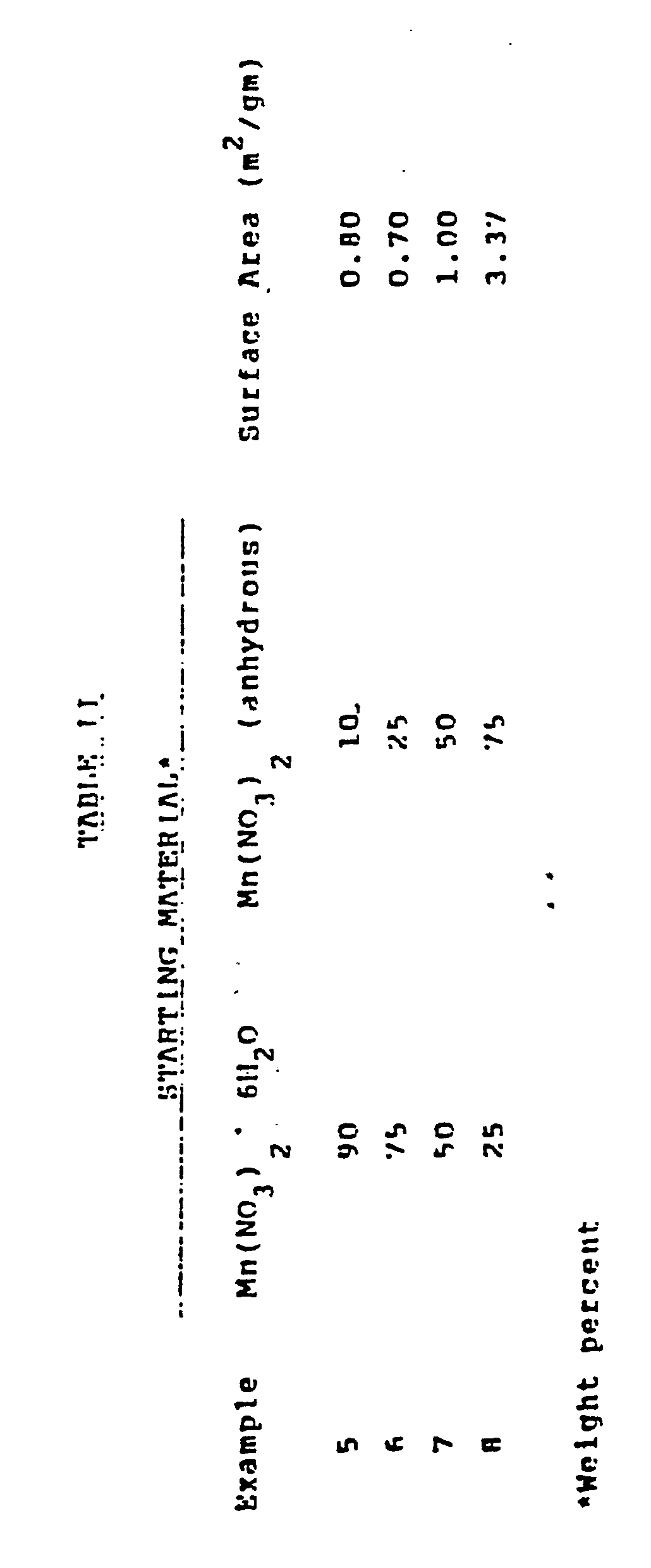
- Manganese dioxide was produced following the procedure of Example 1 utilizing the manganous nitrate starting materials listed in Table II. These hydrates of manganous nitrate were prepared by the dehydration of a 50% manganous nitrate solution following the procedure of W. Ewing and H. Rasmussen, cited in Example 1 above. The surface areas of such products are also listed in Table II.
- In order to test the water pickup of the manganese dioxide produced the following test was run. MnO2 samples from Examples 1 and 3 were stored in an oven overnight at 150°C. The materials were transferred to a dry box having a water content of approximately 10-50 parts per million and allowed to cool to room temperature. The samples were then removed and exposed to air having a water content of about 20% relative humidity. After 5 hours of exposure time, 2.5 grams of the samples were mixed with 10 milliliters of an electrolyte (composed of 40 volume percent dioxolane; 30 volume percent dimethoxyethane; 30 volume percent 3-methyl-2-oxazolidone with a trace (less than 0.2 volume percent) of 3,5-dimethylisoxazole and 1 mole of lithium trifluoromethyl sulfonate added per liter of solvent) in order to leach the water from the Mn02. After stirring and filtering, an aliquot of electrolyte was analyzed for water using the Karl-Fischer Method. This water analysis was done automatically using a Photovolt Aquatest IV TM. The reported MnO2 water content was corrected for the water content of the'electrolyte. The samples tested indicated a water pickup of no more than 400 parts per million after 5 hours exposure to a 20% relative humidity atmosphere. As a comparison, the water pickup for heat-treated Tekkosha™ EMD, previously heated for 3 hours at 360°C in air, was found to be about 4,000 parts per million after 5 hours in a 20% relative humidity atmosphere.
- Several button cells using cathodes made up of the MnO2 produced in Example 1, a lithium anode and the electrolyte described in comparative Experiment A above were prepared. As a comparison, several cells were made with Tekkosha TM EMD which was heat-treated as described in Comparative Experiment A. The cells had an initial height of 0.060 inch. As is well known in the art, moisture present in the MnO2 will react with lithium and/or the nonaqueous electrolyte which will generally result in the cell bulging from its initial height. Thus, the degree of bulging is proportional to the amount of water absorbed by the manganese dioxide during cell assembly. The results of such testing are shown in Table III.

- The results above indicate that cells prepared in a dry room with the manganese dioxide of the instant invention exhibit much less bulging than do cells containing EMD. This is indicative of the greater resistance to water pickup of the manganese dioxide of the instant invention.
- A flat-type cell was constructed utilizing a stainless steel base having therein a shallow depression into which the cell contents were placed and over which a spring-loaded stainless steel plate was placed. The contents of the cell consisted of 40 milligrams of lithium; about 1.5 ml of an electrolyte consisting of about 40 volume percent 1,3-dioxolane, about 30 volume percent 1,2-dimethoxyethane, about 30 volume percent 3-methyl-2-oxazolidone plus a trace (less than 0.2 volume percent) of 3,5-dimethylisoxazole and containing 1 mole per liter of solvent of LiCF3SO3; a nonwoven polypropylene separator, which absorbed some of the electrolyte; and 0.35 gram of a cathode mix which consisted of 86.2 weight percent manganese dioxide (produced as described in Example 1), 8.5 weight percent graphite, 2.1 weight percent acetylene black and 3.2 weight percent polytetrafluoroethylene.
- Tests'were run at 21°C and 35°C until a 2.0 volt cutoff. Load resistors of 30,000.ohms (0.1 mA/cm2 cathode current density) were used for continuous discharge and a superimposed load of 250 ohms for 2 seconds once every 3 days for a pulse discharge. The manganese dioxide delivered a 90% efficiency (on 1 electron) to a 2 volt cutoff at 21°C and an efficiency of 86.3% at 35°C.
Claims (9)
1. Manganese dioxide characterized by a surface area no greater than about 15 square meters/gram and having an X-ray diffraction pattern indicating relative intensities, when compared with crystalline beta manganese dioxide, of no greater than about 30% at d value 3.12 Å, of no greater than about 80% at d value 2.41 Å, of no greater than about 65% at d value 1.63 2 and of no greater than about 65% at d value 1.31 X.
2. The manganese dioxide of claim 1, characterized in that the surface area is no greater than about 10 square meters/gram.
3. The manganese dioxide of claim 1, characterized in that the surface area is no greater than about 5 square meters/gram.
4. The manganese dioxide of claim 1, characterized in that said manganese dioxide will not pick up more than about 750 parts per million of water in 5 hours when exposed to an atmosphere possessing a relative humidity of 20% at a temperature of 21°C.
5. A process for the production of manganese dioxide from manganous nitrate hexahydrate-containing material, characterized by the steps of:
(a) heating in an oxygen-containing atmosphere manganous nitrate hexahydrate-containing material to between about 120°C and about 180°C until a substantially complete decomposition of the manganous nitrate into manganese dioxide has occurred; and
(b) further elevating the temperature to between about 210°C and about 300°C, and maintaining this temperature until the manganese dioxide has a surface area of no greater than about 15 m2/gm and an X-ray diffraction pattern indicating relative intensities, when compared with crystalline beta manganese dioxide, of no greater than about 30% at d value 3.12 Å, no greater than about 80% at d value 2.41 Å, no greater than about 65% at d value 1.63 Å and no greater than about 65% at d value 1.31 i.
6. The process of claim 5, characterized in that the temperature is step (a) is maintained for a period of between about 1 and about 4 hours.
7. The process of claim 6, characterized in that the temperature is step (b) is maintained for a period of between about 1 and about 4 hours.
8. The process of claim 5, characterized in that the temperature in step (a) is about 150°C, and such temperature is maintained for a period of about 2 hours.
9. The process of claim 8, characterized in that the temperature is elevated in step (b) to 250°C and maintained at this temperature for about 2 hours.
Applications Claiming Priority (4)
| Application Number | Priority Date | Filing Date | Title |
|---|---|---|---|
| US45187782A | 1982-12-21 | 1982-12-21 | |
| US451877 | 1982-12-21 | ||
| US476639 | 1983-03-24 | ||
| US06/476,639 US4476104A (en) | 1982-12-21 | 1983-03-24 | Manganese dioxide and process for the production thereof |
Publications (2)
| Publication Number | Publication Date |
|---|---|
| EP0111833A2 true EP0111833A2 (en) | 1984-06-27 |
| EP0111833A3 EP0111833A3 (en) | 1985-05-22 |
Family
ID=27036553
Family Applications (1)
| Application Number | Title | Priority Date | Filing Date |
|---|---|---|---|
| EP83112303A Withdrawn EP0111833A3 (en) | 1982-12-21 | 1983-12-07 | Manganese dioxide and process for the production thereof |
Country Status (2)
| Country | Link |
|---|---|
| US (1) | US4476104A (en) |
| EP (1) | EP0111833A3 (en) |
Cited By (3)
| Publication number | Priority date | Publication date | Assignee | Title |
|---|---|---|---|---|
| GB2160854A (en) * | 1984-06-29 | 1986-01-02 | Union Carbide Corp | Manganese dioxide, production and use thereof |
| EP0269855A3 (en) * | 1986-12-01 | 1988-09-07 | Whittaker Technical Products, Inc. | Rechargeable electrochemical cell |
| WO1995010858A1 (en) * | 1993-10-15 | 1995-04-20 | Rechargeable Battery Corporation | Method of making a rechargeable manganese-oxide compound and related electrode material |
Families Citing this family (25)
| Publication number | Priority date | Publication date | Assignee | Title |
|---|---|---|---|---|
| US4590059A (en) * | 1983-09-30 | 1986-05-20 | Union Carbide Corporation | Process for the production of manganese dioxide |
| US5250374A (en) * | 1991-01-24 | 1993-10-05 | Rbc Universal | Method of preparing a rechargeable modified manganese-containing material by electrolytic deposition and related material |
| US5156934A (en) * | 1991-02-11 | 1992-10-20 | Rbc Universal Ltd. | Method of making a rechargable modified manganese dioxide material and related compound and electrode material |
| CA2068015A1 (en) * | 1991-06-17 | 1992-12-18 | Michael M. Thackeray | Electrode material |
| US6200542B1 (en) | 1995-01-20 | 2001-03-13 | Engelhard Corporation | Method and apparatus for treating the atmosphere |
| US6863984B2 (en) | 1995-01-20 | 2005-03-08 | Engelhard Corporation | Catalyst and adsorption compositions having improved adhesion characteristics |
| AU4701196A (en) | 1995-01-20 | 1996-08-07 | Engelhard Corporation | Pollutant treating device located in vehicle compartment for cleaning ambient air |
| US6214303B1 (en) | 1995-01-20 | 2001-04-10 | Engelhard Corporation | Method and apparatus for treating the atmosphere |
| US20030166466A1 (en) * | 1995-01-20 | 2003-09-04 | Hoke Jeffrey B. | Catalyst and adsorption compositions having improved adhesion characteristics |
| US6517899B1 (en) | 1995-01-20 | 2003-02-11 | Engelhard Corporation | Catalyst and adsorption compositions having adhesion characteristics |
| US6818254B1 (en) | 1995-01-20 | 2004-11-16 | Engelhard Corporation | Stable slurries of catalytically active materials |
| US5601952A (en) * | 1995-05-24 | 1997-02-11 | Dasgupta; Sankar | Lithium-Manganese oxide electrode for a rechargeable lithium battery |
| US5997831A (en) * | 1996-07-12 | 1999-12-07 | Engelhard Corporation | Method of catalytically treating the atmosphere and heat exchange devices produced thereby |
| US6156283A (en) * | 1998-03-23 | 2000-12-05 | Engelhard Corporation | Hydrophobic catalytic materials and method of forming the same |
| US6610263B2 (en) | 2000-08-01 | 2003-08-26 | Enviroscrub Technologies Corporation | System and process for removal of pollutants from a gas stream |
| US6428931B1 (en) | 2000-08-15 | 2002-08-06 | Aer Energy Resources, Inc. | Methods for making oxygen reduction catalyst using micelle encapsulation and metal-air electrode including said catalyst |
| USH2121H1 (en) | 2000-10-13 | 2005-08-02 | The United States Of America As Represented By The Secretary Of The Navy | High surface area, nanoscale, mesoporous manganese oxides with controlled solid-pore architectures and method for production thereof |
| US7232782B2 (en) | 2002-03-06 | 2007-06-19 | Enviroscrub Technologies Corp. | Regeneration, pretreatment and precipitation of oxides of manganese |
| US20030059460A1 (en) * | 2001-09-27 | 2003-03-27 | Yasuhiko Tabata | Hybrid material for regeneration of living body tissue |
| JP2005518274A (en) | 2001-12-21 | 2005-06-23 | エンバイロスクラブ テクノロジーズ コーポレイション | Manganese oxide pretreatment and regeneration |
| US6780347B2 (en) * | 2002-02-04 | 2004-08-24 | Rayovac Corporation | Manganese oxide based electrode for alkaline electrochemical system and method of its production |
| US20040101457A1 (en) * | 2002-06-11 | 2004-05-27 | Pahlman John E. | Disassociation processing of metal oxides |
| AU2004207590A1 (en) | 2003-01-28 | 2004-08-12 | Enviroscrub Technologies Corporation | Oxides of manganese processed in continuous flow reactors |
| US7488464B2 (en) | 2003-07-31 | 2009-02-10 | Enviroscrub Technologies Corporation | Metal oxide processing methods and systems |
| US7718319B2 (en) | 2006-09-25 | 2010-05-18 | Board Of Regents, The University Of Texas System | Cation-substituted spinel oxide and oxyfluoride cathodes for lithium ion batteries |
Family Cites Families (6)
| Publication number | Priority date | Publication date | Assignee | Title |
|---|---|---|---|---|
| US2885262A (en) * | 1955-08-22 | 1959-05-05 | Olin Mathieson | Stabilized manganese dioxide |
| DE2454012C3 (en) * | 1974-11-14 | 1978-06-29 | Rheinisch-Westfaelisches Elektrizitaetswerk Ag, 4300 Essen | Process for the production of a depolarization mass comprising artificial brown stone |
| JPS5342325A (en) * | 1976-09-29 | 1978-04-17 | Sanyo Electric Co | Method of making cathode of nonnaqueous battery |
| FR2466872B1 (en) * | 1979-10-02 | 1986-03-07 | Celsa Composants Electr Sa | LITHIUM BATTERY. MANGANESE BIOXIDE AND PROCESS FOR PRODUCING SUCH A BATTERY |
| JPS56103864A (en) * | 1980-01-21 | 1981-08-19 | Matsushita Electric Ind Co Ltd | Battery |
| JPS5774972A (en) * | 1980-10-24 | 1982-05-11 | Nec Corp | Manufacdure of manganese-dioxide positive electrode for lithium battery |
-
1983
- 1983-03-24 US US06/476,639 patent/US4476104A/en not_active Expired - Lifetime
- 1983-12-07 EP EP83112303A patent/EP0111833A3/en not_active Withdrawn
Cited By (4)
| Publication number | Priority date | Publication date | Assignee | Title |
|---|---|---|---|---|
| GB2160854A (en) * | 1984-06-29 | 1986-01-02 | Union Carbide Corp | Manganese dioxide, production and use thereof |
| FR2566762A1 (en) * | 1984-06-29 | 1986-01-03 | Union Carbide Corp | MANGANESE BIOXIDE, PROCESS FOR PRODUCING THE SAME AND APPLICATION THEREOF IN A GALVANIC ELEMENT |
| EP0269855A3 (en) * | 1986-12-01 | 1988-09-07 | Whittaker Technical Products, Inc. | Rechargeable electrochemical cell |
| WO1995010858A1 (en) * | 1993-10-15 | 1995-04-20 | Rechargeable Battery Corporation | Method of making a rechargeable manganese-oxide compound and related electrode material |
Also Published As
| Publication number | Publication date |
|---|---|
| EP0111833A3 (en) | 1985-05-22 |
| US4476104A (en) | 1984-10-09 |
Similar Documents
| Publication | Publication Date | Title |
|---|---|---|
| US4476104A (en) | Manganese dioxide and process for the production thereof | |
| US4133856A (en) | Process for producing a positive electrode for a non-aqueous cell | |
| CA2314950C (en) | Lithium manganate, process for producing the same, and lithium battery using the same | |
| JP2941059B2 (en) | Manganese dioxide production method | |
| EP0618630B1 (en) | Metaloxide composite-cathode material for high energy density batteries | |
| EP1252097B1 (en) | Lithiated manganese dioxide | |
| US4590059A (en) | Process for the production of manganese dioxide | |
| US4405699A (en) | Manganese dioxide electrode for lithium batteries | |
| US4585718A (en) | Lithium-manganese dioxide cell | |
| AU765967C (en) | High discharge capacity electrolytic manganese dioxide and methods of producing the same | |
| US4604336A (en) | Manganese dioxide and process for the production thereof | |
| WO1991011032A1 (en) | Cathode active materials, methods of making same and electrochemical cells incorporating the same | |
| JPS63902B2 (en) | ||
| US6878489B2 (en) | Lithium cell with improved cathode | |
| US6527941B2 (en) | High discharge capacity electrolytic manganese dioxide and methods of producing the same | |
| US4101716A (en) | Use of high surface area mixed metal oxides of manganese and calcium in electrochemical processes | |
| US5866278A (en) | Electrolytic manganese dioxide, process for preparing the same, and manganese dry cell | |
| US6475672B1 (en) | Lithium manganese oxide, and process for its production and secondary cell employing it | |
| US4965150A (en) | Preparation of VO2 (B) and a non-aqueous secondary cell using VO2 | |
| JP2002515638A (en) | Lithiated manganese oxide | |
| GB2147285A (en) | Production of manganese dioxide | |
| JP3407594B2 (en) | Method for producing lithium nickel composite oxide | |
| JP2002056847A (en) | Method of manufacturing manganese oxide for positive electrode of lithium battery | |
| JPS6352747B2 (en) | ||
| JPH0629019A (en) | Lithium-containing manganese dioxide, method for producing the same, and use thereof |
Legal Events
| Date | Code | Title | Description |
|---|---|---|---|
| PUAI | Public reference made under article 153(3) epc to a published international application that has entered the european phase |
Free format text: ORIGINAL CODE: 0009012 |
|
| AK | Designated contracting states |
Designated state(s): BE CH DE FR GB LI |
|
| PUAL | Search report despatched |
Free format text: ORIGINAL CODE: 0009013 |
|
| AK | Designated contracting states |
Designated state(s): BE CH DE FR GB LI |
|
| 17P | Request for examination filed |
Effective date: 19850629 |
|
| 17Q | First examination report despatched |
Effective date: 19860528 |
|
| STAA | Information on the status of an ep patent application or granted ep patent |
Free format text: STATUS: THE APPLICATION HAS BEEN WITHDRAWN |
|
| 18W | Application withdrawn |
Withdrawal date: 19860816 |
|
| RIN1 | Information on inventor provided before grant (corrected) |
Inventor name: MELLORS, GEOFFREY WHARTON |