EP0108322A2 - Keten-0,0-acetale und Verfahren zu ihrer Herstellung - Google Patents
Keten-0,0-acetale und Verfahren zu ihrer Herstellung Download PDFInfo
- Publication number
- EP0108322A2 EP0108322A2 EP83110596A EP83110596A EP0108322A2 EP 0108322 A2 EP0108322 A2 EP 0108322A2 EP 83110596 A EP83110596 A EP 83110596A EP 83110596 A EP83110596 A EP 83110596A EP 0108322 A2 EP0108322 A2 EP 0108322A2
- Authority
- EP
- European Patent Office
- Prior art keywords
- formula
- ketene
- radical
- acetal
- phenyl
- Prior art date
- Legal status (The legal status is an assumption and is not a legal conclusion. Google has not performed a legal analysis and makes no representation as to the accuracy of the status listed.)
- Granted
Links
Classifications
-
- C—CHEMISTRY; METALLURGY
- C07—ORGANIC CHEMISTRY
- C07D—HETEROCYCLIC COMPOUNDS
- C07D231/00—Heterocyclic compounds containing 1,2-diazole or hydrogenated 1,2-diazole rings
- C07D231/02—Heterocyclic compounds containing 1,2-diazole or hydrogenated 1,2-diazole rings not condensed with other rings
- C07D231/10—Heterocyclic compounds containing 1,2-diazole or hydrogenated 1,2-diazole rings not condensed with other rings having two or three double bonds between ring members or between ring members and non-ring members
- C07D231/12—Heterocyclic compounds containing 1,2-diazole or hydrogenated 1,2-diazole rings not condensed with other rings having two or three double bonds between ring members or between ring members and non-ring members with only hydrogen atoms, hydrocarbon or substituted hydrocarbon radicals, directly attached to ring carbon atoms
-
- C—CHEMISTRY; METALLURGY
- C07—ORGANIC CHEMISTRY
- C07C—ACYCLIC OR CARBOCYCLIC COMPOUNDS
- C07C309/00—Sulfonic acids; Halides, esters, or anhydrides thereof
-
- C—CHEMISTRY; METALLURGY
- C07—ORGANIC CHEMISTRY
- C07C—ACYCLIC OR CARBOCYCLIC COMPOUNDS
- C07C41/00—Preparation of ethers; Preparation of compounds having groups, groups or groups
- C07C41/48—Preparation of compounds having groups
-
- C—CHEMISTRY; METALLURGY
- C07—ORGANIC CHEMISTRY
- C07C—ACYCLIC OR CARBOCYCLIC COMPOUNDS
- C07C43/00—Ethers; Compounds having groups, groups or groups
- C07C43/30—Compounds having groups
- C07C43/313—Compounds having groups containing halogen
-
- C—CHEMISTRY; METALLURGY
- C07—ORGANIC CHEMISTRY
- C07D—HETEROCYCLIC COMPOUNDS
- C07D233/00—Heterocyclic compounds containing 1,3-diazole or hydrogenated 1,3-diazole rings, not condensed with other rings
- C07D233/54—Heterocyclic compounds containing 1,3-diazole or hydrogenated 1,3-diazole rings, not condensed with other rings having two double bonds between ring members or between ring members and non-ring members
- C07D233/56—Heterocyclic compounds containing 1,3-diazole or hydrogenated 1,3-diazole rings, not condensed with other rings having two double bonds between ring members or between ring members and non-ring members with only hydrogen atoms or radicals containing only hydrogen and carbon atoms, attached to ring carbon atoms
-
- C—CHEMISTRY; METALLURGY
- C07—ORGANIC CHEMISTRY
- C07D—HETEROCYCLIC COMPOUNDS
- C07D249/00—Heterocyclic compounds containing five-membered rings having three nitrogen atoms as the only ring hetero atoms
- C07D249/02—Heterocyclic compounds containing five-membered rings having three nitrogen atoms as the only ring hetero atoms not condensed with other rings
- C07D249/08—1,2,4-Triazoles; Hydrogenated 1,2,4-triazoles
Definitions
- the present invention relates to ketene-0.0-acetals and processes for their preparation by splitting off water from alpha-llydroxyacetals.
- R 1 is a tertiary alkyl radical having 4 to 6 carbon atoms or a phenyl radical which is optionally substituted by halogen
- R 2 is hydrogen
- R 3 and R 4 independently of one another are a phenyl radical optionally substituted by halogen, alkoxy, alkyl, phenyl, phenoxy, cyano, nitro, trifluoromethyl, are valuable compounds which are outstandingly suitable for the preparation of the known (DE-OS 3 100 261) ketene -O, N - acetals of formula IV in which R 1 to R 3 have the meanings given in claim 1 and -NR 5 is a triazolyl, imidazolyl, benzimidazolyl or pyrazolyl radical.
- R 1 means, for example, a tertiary butyl radical
- R 3 means, for example, a halogen (F, Cl, Br), alkoxy with 1 to 2 carbon atoms (methoxy), alkyl with 1 to 4 carbon atoms (methyl, ethyl, propyl, i-propyl, butyl, sec.
- halogen F, Cl, Br
- alkoxy with 1 to 2 carbon atoms methoxy
- alkyl with 1 to 4 carbon atoms methyl, ethyl, propyl, i-propyl, butyl, sec.
- R 4 is, for example, independently of R 3 have the same meanings as R 3 means, for example, 1- (1,2,4) -triazolyl, 1- (1,2,3-triazolyl).
- ketones of formula V are known or they can be prepared by known methods (see e.g. J. Chea. Soc., 1970, 462-464, Liebigs Ann. Chem. 735, 145 (1970)).
- the reaction of the compound of formula III with a basic compound takes place, for example, in aprotic dipolar solvents, such as dimethyl sulfoxide, dimethylformamide or hexamethylphosphoric triamide, with basic compounds, such as alkali and alkaline earth metal hydroxides, alkali and alkaline earth metal sulfides, alkali metal, alkaline earth metal and aluminum alcoholates at temperatures between 20 and 150 ° C.
- the process has the great advantage that the ketones of the formula V are easily accessible from alpha-halogen or alpha, alpha-dihalo ketones, the variation of the OR residues being practically unlimited. Any combination can be produced by successively introducing the OR 3 and OR 4 residues.
- the reduction of the ketones of the formula V is known.
- the compounds of the formula III are compounds which can be obtained in good to very good yields by the customary methods, for example from alkali metal alcoholates and sulfonic acid halides.
- the new ketene-O, O-acetals of the formula I are outstandingly suitable for the preparation of the known ketene-O, N-acetals of the formula II.
- the following compounds can be prepared in a corresponding manner using the corresponding ketene-O, O-acetals.
Landscapes
- Chemical & Material Sciences (AREA)
- Organic Chemistry (AREA)
- Organic Low-Molecular-Weight Compounds And Preparation Thereof (AREA)
- Cephalosporin Compounds (AREA)
Abstract

- R2 Wasserstoff,
- R3 und R4 unabhängig voneinander einen gegebenenfalls durch Halogen, Alkoxy, Alkyl, Phenyl, Phenoxy, Cyano, Nitro, Trifluormethyl substituierten Phenylrest bedeutet, Verfahren zu ihrer Herstellung und ihre Anwendung zur Herstellung von Keten-O,N-acetalen.
Description
- Die vorliegende Erfindung betrifft Keten-0,0-acetale und Verfahren zu ihrer Herstellung durch Abspaltung von Wasser aus alpha-llydroxyacetalen.
- Zur Herstellung von Keten-0,0-acetalen sind mehrere Verfahren bekannt (D. Borrmann in Houben-Weyl-Müller, Methoden der organischen Chemie, Band 7/4, Seite 340 ff, Thieme Verlag, Stuttgart 1968):
- 1. Abspaltung von Halogenwasserstoff aus alpha-Halogenacetalen mit Alkalialkoholen, insbesondere Kalium-tert.-butanolat. Dieses Verfahren hat jedoch einige Nachteile. Zum einen sind damit in mäßigen bis mittleren Ausbeuten nur unsubstituierte oder einfach mit Chlor, Brom oder Phenyl substituierte Keten-0,0-acetale zugänglich, während z.B. die Ausbeute beim Isopropyl-ketendiethylacetal bereits auf 22 % absinkt. Zum anderen handelt es sich bei den Alkoholkomponenten praktisch ausschließlich um einfache aliphatische Alkohole wie Methanol und Ethanol. Weiterhin sind die zur Synthese höher substituierter Keten--0,0-acetale mit Phenolen als OR-Komponente benötigten alpha-Halogenacetale bisher nicht bekannt und aufgrund verschiedener Nebenreaktionen nur schwer zugänglich.
- 2. Ein weiteres bekanntes Verfahren besteht in der Abspaltung von Alkoholen aus Orthocarbonsäuretriestern. Auch dieses Verfahren ist im Hinblick auf die Darstellung der benötigten Orthocarbonsäureester mit Phenolen als Alkoholkomponente praktisch nicht einsetzbar. Gemischte Keten-0,0-acetale sind auf diesem Wege ebenfalls nicht kontrolliert zugänglich. Die gleichen Einschränkungen gelten auch für die Synthese von Keten-0,0-acetalen durch Abspaltung von Alkylhypobromiden aus alpha-Bromcarbonsäuretriestern.
- 3. Umsetzungen von 1,1-Dihaloethylenen zu Keten-0,0-acetalen sind ebenfalls bekannt. Sie gelingen aber nur bei beta-aktivierten Ethylenen oder im speziellen Fall des 1,1-Dichlorethylens durch Umsetzung mit beta- oder gamma-Alkoxy- bzw. Dialkylaminoalkoholaten.
- Es wurde nun gefunden, daß Keten-0,0-acetale der Formel I
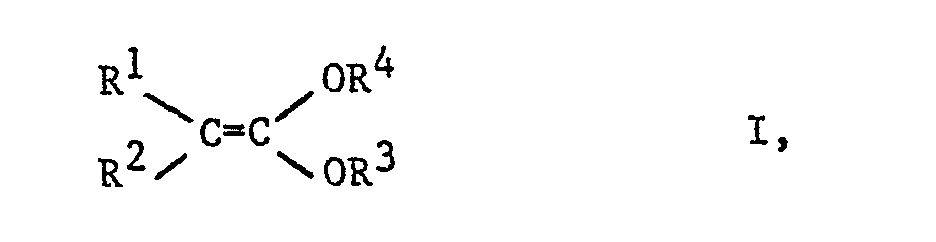
- in der R1 einen tertiären Alkylrest mit 4 bis 6 C-Atomen oder einen gegebenenfalls durch Halogen substituierten Phenylrest, R 2 Wasserstoff,
- R3 und R4 unabhängig voneinander einen gegebenenfalls durch Halogen, Alkoxy, Alkyl, Phenyl, Phenoxy, Cyano, Nitro, Trifluormethyl substituierten Phenylrest bedeuten, wertvolle Verbindungen sind, die sich hervorragend eignen zur Herstellung der bekannten (DE-OS 3 100 261) Keten-O,N--acetale der Formel IV

- R1 bedeutet beispielsweise einen tertiär-Butylrest
- R3 bedeutet beispielsweise einen durch Halogen (F, Cl, Br), Alkoxy mit 1 bis 2 C-Atomen (Methoxy), Alkyl mit 1 bis 4 C-Atomen (Methyl, Ethyl, Propyl, i-Propyl, Butyl, sek.-Butyl, tert.-Butyl, i-Butyl) substituierten Phenylrest, wobei einzelne Reste mehrfach (2-3fach) oder verschiedene Reste gleichzeitig als Substituenten auftreten, z.B. 4-Chlorphenyl, 3,4--Dichlorphenyl, 4-Chlor-3-bromphenyl, 4-Methyl-3-chlorphenyl, R4 hat beispielsweise unabhängig von R3 die gleichen Bedeutungen wie R3

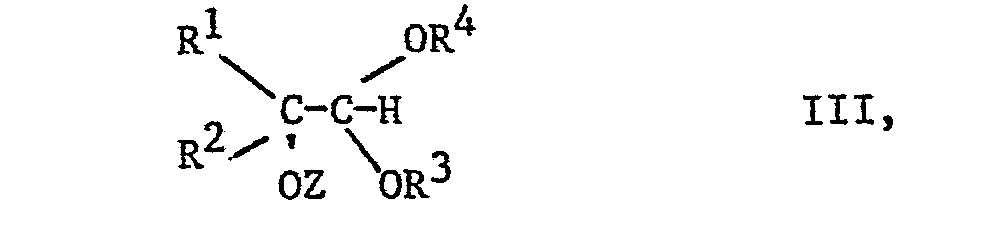
- Die neuen Keten-O,O-acetale der Formel I werden beispielsweise hergestellt, indem man
- a) ein alpha-Hydroxyacetal der Formel II


- b) und die Verbindung der Formel III mit einer basischen Verbindung zu dem Keten-0,0-acetal der Formel I gemäß Anspruch 1 umsetzt.
- Durch Reduktion der Ketone der Formel V

- Die Ketone der Formel V sind bekannt oder sie können nach bekannten Verfahren hergestellt werden (vgl. z.B. J. Chea. Soc., 1970, 462-464, Liebigs Ann. Chem. 735, 145 (1970)).
- Die Umsetzung der Verbindung der Formel III mit einer basischen Verbindung erfolgt beispielsweise in aprotisch dipolaren Lösungsmitteln, wie Dimethylsulfoxid, Dimethylformamid oder Hexamethylphosphorsäuretriamid mit basischen Verbindungen, wie Alkali- und Erdalkalihydroxiden, Alkali-und Erdalkalisulfiden, Alkali-, Erdalkali- und Aluminiumalkoholaten bei Temperaturen zwischen 20 und 150°C. Das Verfahren hat den großen Vorteil, daß die Ketone der Formel V leicht aus alpha-Halogen- bzw. alpha,alpha-Di- halogenketonen zugänglich sind, wobei der Variation der OR-Reste praktisch keine Grenzen gesetzt sind. Durch sukzessive Einführung der Reste OR3 und OR4 lassen sich beliebige Kombinationen herstellen. Die Reduktion der Ketone der Formel V ist bekannt. Bei den Verbindungen der Formel III handelt es sich um Verbindungen, die nach den üblichen Methoden, z.B. aus Alkalialkoholaten und Sulfonsüurehalogeniden in guten bis sehr guten Ausbeuten gewonnen werden können.
- Überraschend ist ferner die glatte Abspaltung der Gruppe -OZ (Z = z.B. SO2

- Die neuen Keten-O,O-acetale der Formel I eignen sich hervorragend zur Herstellung der bekannten Keten-O,N-acetale der Formel II.
- Auf diese Weise ist es möglich, die weitgehend reinen E- oder Z-Isomere der Keten-O,N-acetale der Formel II zu erhalten, die ohne weitere Reinigung direkt als Fungizide verwendet werden können.
- Herstellung der Ausgangsverbindungen
- Al. Tosylierung von 1,1-Bis-(2,4-dichlorphenoxy)-3,3-dimethylbutan-2-ol.
- 42,4 g (0,1 mol) 1,1-Bis-(2,4-dichlorphenoxy)-3,3-dimethylbutan-2--ol werden in 200 ml absoluten Tetrahydrofuran (THF bei -10°C mit der equimolaren Menge einer Lösung von n-Butyllithium in n-Hexan umgesetzt. Anschließend gibt man 19,1 g (0,1 mol) p-Toluolsulfonsäurechlorid zu, läßt auf Raumtemperatur (20°C) auftauen, rührt ca. 1 Stunde nach, destilliert das Lösungsmittel im Vakuum ab, nimmt in Essigester auf und wäscht die organische Phase zweimal mit Wasser. Nach dem Trocknen und Einengen der organischen Phase wird das Rohprodukt aus Cyclohexan/Essigester umkristallisiert.
- Ausbeute: 51,8 g (95 % d. Th.)
- Schnp.: 87-88°C
- 1H-NMR: δ = 1,25 (s, 9H); 2,4 (s, 3H); 4,85 (d, 1H); 6,05 (d, 1H);
- 6,5-7,9 (m, 10H).
- A2. Tosylierung von 1,1-Bis-(4-dichlorphenoxy)-3,3-dimethylbutan-2-ol.
- 35,6 g (0,1 mol) 1,1-Bis-4-dichlorphenoxy)-3,3-dimethylbutan-2-ol werden in 200 ml absolutem Tetrahydrofuran mit 3 g (0,1 nol) Natriumhydrid (80 %ig) versetzt und auf 40°C erhitzt. Sobald keine Gasentwicklung mehr stattfindet, gibt man 19,1 g (0,1 mol) p-Toluolsulfonsäurechlorid zu, rührt 1 Stunde bei Raumtemperatur nach, hydrolysiert anschließend mit wenig Wasser und engt im Vakuum ein. Der Rückstand wird in Essigester aufgenommen, zweimal mit Wasser gewaschen, getrocknet und erneut im Vakuum eingeengt. Das verbleibende Rohprodukt wird aus Essigester/Cyclohexan umkristallisiert.
- Ausbeute: 41,7 g (82 % d. Th.)
- Schmp.: 97°C
- 1H-NMR : δ = 1,25 (s, 9H); 2,3 (s, 3H); 4,8 (d, 1H); 5,8 (d, 1H);
- 6,5-7,9 (m 12H).
- Nach dem gleichen Verfahren wurden folgende Verbindungen hergestellt:


- Herstellung der Keten-0,0-acetale
- 1. 1,1-Bis-(2,4-dichlorphenoxy)-3,3-dimethylbuten-1
- 54,6 g (0,1 mol) Tosylat des 1,1-Bis-(2,4-dichlorphenoxy)-3,3-dimethylbutan-2-ols werden in 200 ml trockenem Dimethylsulfoxid mit der equimolaren Menge Kalium-tert.-butanolat versetzt. Nach 30 min. Rühren bei Raumtemperatur hydrolysiert man mit Wasser, extrahiert zweimal mit dem gleichen Volumen Essigsäureethylester, trocknet und destilliert das Lösungsmittel im Vakuum ab.
- Ausbeute: 38,57 g (95 % d. Th.)
- Sdp.: 175-176°C/0,5 mbar
- 1H-NHR: δ = 1,2 (s, 9H); 4,85 (s, 1H); 7,73 (m, 6H).
- 2. 1,1-Bis-(4-chlorphenoxy)-3,3-dimethylbuten-1
- 47.8 g (0,1 mol) Tosylat des 1,1-Bis-(4-chlarphenoxy)-3,3-dimethylbutan-2-ols werden in 200 ml trockenem Dimethylsulfoxid mit 39 g (0,5 mol) Natriumsulfid versetzt und so lange bei 120°C gerührt, bis keine Ausgangsverbindung mittels Hochdruckflüssigkeitschromatographie (HPLC) mehr nachweisbar ist. Anschließend kühlt man ab, versetzt mit Wasser und extrahiert zweimal mit dem gleichen Volumen Essigester, trocknet und destilliert das Lösungsmittel im Vakuum ab.
- Ausbeute: 25,3 g (75 % d. Th.)
- 1H-NMR: δ = 1,2 (s, 9H); 4,8 (s, 1H); 6,8-7,4 (m, 8H).
- Nach dem gleichen Verfahren wurden folgende Verbindungen hergestellt:

- Verwendung der Keten-0,0-acetale der Formel I zur Herstellung der aus EP-56 125 bekannten Keten-O,N-acetale der Formel II
- 30,4 g (0,075 mol) 1,1-Bis-(2,4-dichlorphenoxy)-3,3-dimethylbuten-1 und 5,2 g (0,075 mol) Triazol werden zusammen auf 180-135°C erhitzt. Sobald die Reaktionsmischung homogen erscheint und sich rötlich-braun verfärbt hat, wird mittels Hochdruckflüssibkeitschromatographie (HPLC) der Gehalt an Ausgangsverbindung bestimmt. Hat die Reaktion den gewünschten Unsetzungsgrad erreicht, kühlt man ab, nimmt in 200 ml Hexan/Essigester (1:1) auf, wäscht 2-3 mal mit dem gleichen Volumen verdünnter Natronlauge (5 %), trocknet mit Na2S04 und destilliert das Lösungsmittel im Vakuum ab. Man erhält 22,2 g Keten-O,N-acetal. Isomerenreinheit: Z-Isomeres 85 %, bestimmt mittels 1H-NMR und HPLC.
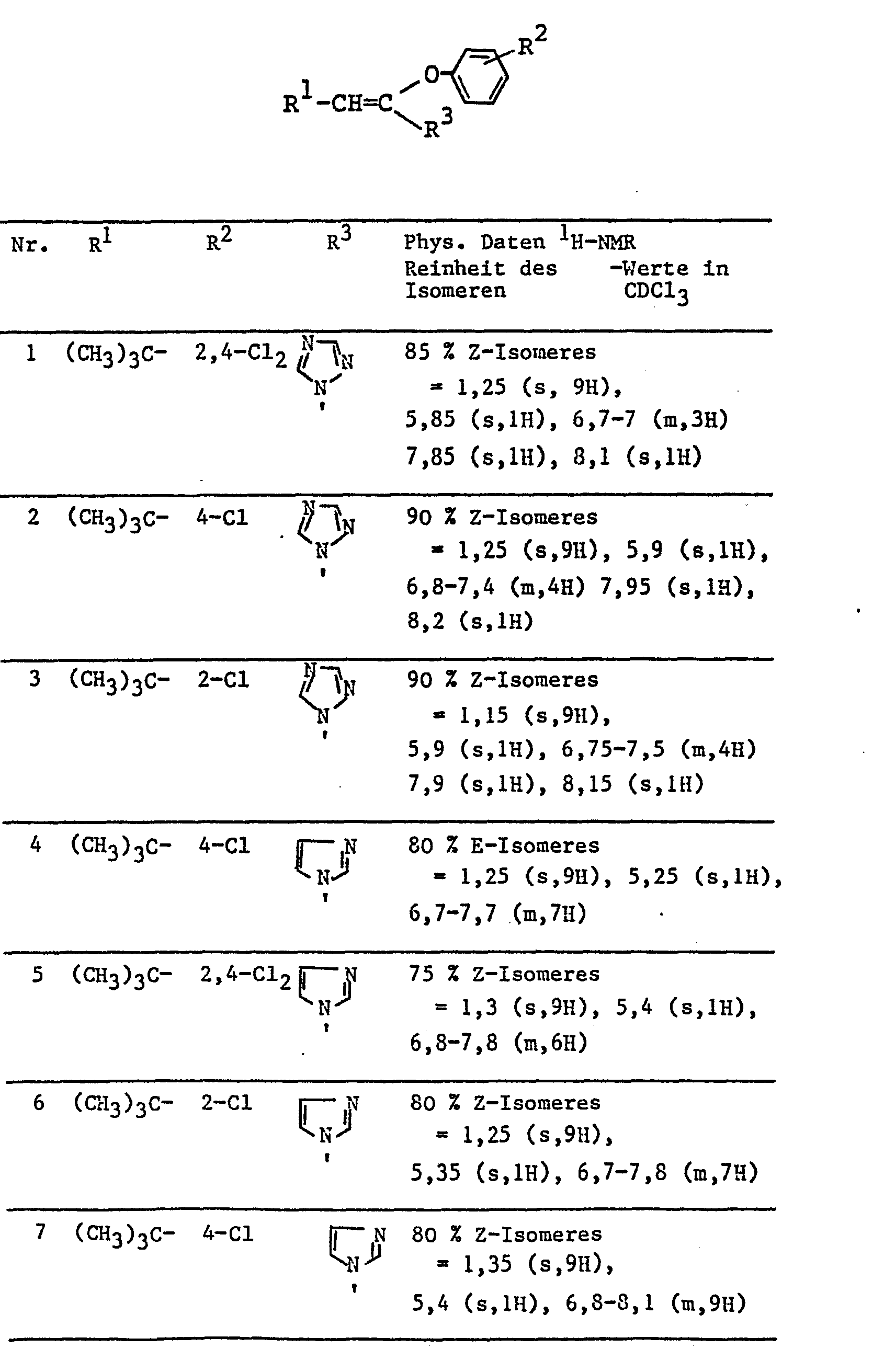
- In entsprechender Weise können die folgenden Verbindungen unter Verwendung der entsprechenden Keten-O,O-acetale hergestellt werden.
Claims (5)




durch Umsetzung des Keten-0,0-acetals der Formel I mit einer heterocyclischen Verbindung der Formel H-N R5, in der


R3 und R4 unabhängig voneinander einen gegebenenfalls durch Halogen, Alkoxy, Alkyl, Phenyl, Phenoxy, Cyano, Nitro, Trifluormethyl substituierten Phenylrest bedeuten, dadurch gekennzeichnet, daß man


durch Umsetzung des Keten-0,0-acetals der Formel I mit einer heterocyclischen Verbindung der Formel


Priority Applications (1)
| Application Number | Priority Date | Filing Date | Title |
|---|---|---|---|
| AT83110596T ATE17710T1 (de) | 1982-10-30 | 1983-10-24 | Keten-0,0-acetale und verfahren zu ihrer herstellung. |
Applications Claiming Priority (2)
| Application Number | Priority Date | Filing Date | Title |
|---|---|---|---|
| DE19823240287 DE3240287A1 (de) | 1982-10-30 | 1982-10-30 | Keten-0,0-acetale und verfahren zu ihrer herstellung |
| DE3240287 | 1982-10-30 |
Publications (3)
| Publication Number | Publication Date |
|---|---|
| EP0108322A2 true EP0108322A2 (de) | 1984-05-16 |
| EP0108322A3 EP0108322A3 (en) | 1984-08-15 |
| EP0108322B1 EP0108322B1 (de) | 1986-01-29 |
Family
ID=6177015
Family Applications (1)
| Application Number | Title | Priority Date | Filing Date |
|---|---|---|---|
| EP83110596A Expired EP0108322B1 (de) | 1982-10-30 | 1983-10-24 | Keten-0,0-acetale und Verfahren zu ihrer Herstellung |
Country Status (6)
| Country | Link |
|---|---|
| US (1) | US4539160A (de) |
| EP (1) | EP0108322B1 (de) |
| JP (1) | JPS5995232A (de) |
| AT (1) | ATE17710T1 (de) |
| CA (1) | CA1210026A (de) |
| DE (2) | DE3240287A1 (de) |
Cited By (2)
| Publication number | Priority date | Publication date | Assignee | Title |
|---|---|---|---|---|
| EP0167207A1 (de) * | 1984-06-15 | 1986-01-08 | BASF Aktiengesellschaft | Verfahren zur Herstellung von Keten-0,0-acetalen |
| EP0110116A3 (en) * | 1982-10-30 | 1986-02-19 | Basf Aktiengesellschaft | Process for the preparation of keten-o,n-acetals |
Family Cites Families (2)
| Publication number | Priority date | Publication date | Assignee | Title |
|---|---|---|---|---|
| US4060623A (en) * | 1972-09-26 | 1977-11-29 | Bayer Aktiengesellschaft | 1,2,4-Triazole antimycotic compositions and use thereof |
| DE3240288A1 (de) * | 1982-10-30 | 1984-05-03 | Basf Ag, 6700 Ludwigshafen | Verfahren zur herstellung von keten-o,n-acetalen |
-
1982
- 1982-10-30 DE DE19823240287 patent/DE3240287A1/de not_active Withdrawn
-
1983
- 1983-10-24 DE DE8383110596T patent/DE3362036D1/de not_active Expired
- 1983-10-24 CA CA000439569A patent/CA1210026A/en not_active Expired
- 1983-10-24 AT AT83110596T patent/ATE17710T1/de not_active IP Right Cessation
- 1983-10-24 EP EP83110596A patent/EP0108322B1/de not_active Expired
- 1983-10-27 US US06/545,877 patent/US4539160A/en not_active Expired - Fee Related
- 1983-10-31 JP JP58202914A patent/JPS5995232A/ja active Granted
Cited By (2)
| Publication number | Priority date | Publication date | Assignee | Title |
|---|---|---|---|---|
| EP0110116A3 (en) * | 1982-10-30 | 1986-02-19 | Basf Aktiengesellschaft | Process for the preparation of keten-o,n-acetals |
| EP0167207A1 (de) * | 1984-06-15 | 1986-01-08 | BASF Aktiengesellschaft | Verfahren zur Herstellung von Keten-0,0-acetalen |
Also Published As
| Publication number | Publication date |
|---|---|
| EP0108322A3 (en) | 1984-08-15 |
| DE3362036D1 (en) | 1986-03-13 |
| US4539160A (en) | 1985-09-03 |
| CA1210026A (en) | 1986-08-19 |
| JPH0359888B2 (de) | 1991-09-12 |
| ATE17710T1 (de) | 1986-02-15 |
| EP0108322B1 (de) | 1986-01-29 |
| DE3240287A1 (de) | 1984-05-03 |
| JPS5995232A (ja) | 1984-06-01 |
Similar Documents
| Publication | Publication Date | Title |
|---|---|---|
| EP0011768B1 (de) | Hydroxypropyl-triazole, Verfahren zu ihrer Herstellung und diese Verbindungen enthaltende Arzneimittel | |
| EP0000752A2 (de) | Alpha-azolysulfide, -sulfoxide und -sulfone, deren Salze und Metallkomplexe, Verfahren zu ihrer Herstellung, sowie sie enthaltende Mittel zur Pilzbekämpfung | |
| DE2834322A1 (de) | 4-substituierte pyrazole | |
| EP0054865A1 (de) | Substituierte 1-Azolyl-butan-2-one, Verfahren zu ihrer Herstellung und ihre Verwendung als Fungizide sowie als Zwischenprodukte | |
| DE2912288C2 (de) | ||
| EP0219799B1 (de) | Verfahren zur Herstellung von Oxiranen | |
| EP0088874B1 (de) | Azolyl-phenoxy-tetrahydrofuran-2-yliden-methane, Verfahren zu ihrer Herstellung sowie antimikrobielle Mittel, die diese Stoffe enthalten | |
| EP0071059B1 (de) | 6-(5-(Omega-(1-Imidazolyl)-alkyl)-thien-2-yl)-3-oxo-2,3,4,5-tetrahydropyridazine und deren Säureadditionssalze, Verfahren zu ihrer Herstellung und diese enthaltende pharmazeutische Präparate | |
| CA1065249A (en) | Fungicidal agents | |
| CH597199A5 (en) | 3-Phenyl pyridaz-6-ones prodn. | |
| DE2334352C3 (de) | Im Heterocyclus halogenierte 1-(1,2,4-Triazol-1-yl)-1-phenoxy-3,3-dimethyl-butan-2-on- Derivate, Verfahren zu ihrer Herstellung und ihre Verwendung als Fungizide | |
| DE3315524A1 (de) | Verfahren zur herstellung von oxiranen | |
| EP0108322B1 (de) | Keten-0,0-acetale und Verfahren zu ihrer Herstellung | |
| DE2242454A1 (de) | 1-aethyl-imidazole, verfahren zu ihrer herstellung sowie ihre verwendung als arzneimittel | |
| EP0027177B1 (de) | 1-Azolyl-1-halogen-alkan-2-one und Verfahren zur Herstellung von 1-Azolyl-1-phenoxy-alkan-2-onen | |
| EP0085842A1 (de) | Antimykotische Mittel | |
| EP0057863B1 (de) | Antimikrobielle Mittel | |
| EP0110116B1 (de) | Verfahren zur Herstellung von Keten-O,N-acetalen | |
| EP0169439A2 (de) | Verfahren und Zwischenprodukte zur Synthese von diastereomeren Triazolyl-O,N-acetalen | |
| EP0008108B1 (de) | Aminopropanolderivate des 2-(o-Hydroxyphenyl)-pyrrols, Verfahren zu ihrer Herstellung und diese enthaltende pharmazeutische Zubereitungen | |
| EP0057864A2 (de) | 2-Azolylmethyl-1,3-dioxolan- und -dioxan-Derivate, Verfahren zu ihrer Herstellung und ihre Verwendung als Fungizide | |
| EP0167207B1 (de) | Verfahren zur Herstellung von Keten-0,0-acetalen | |
| EP0069754B1 (de) | Verfahren zur herstellung von imidazolylvinylethern | |
| EP0046532B1 (de) | 3,3-Dimethyl-1-fluor-1-phenoxy-2-butanone(ole), Verfahren zu ihrer Herstellung und ihre Verwendung | |
| EP0290907B1 (de) | Verfahren zur Herstellung von Acetylenepoxiden und deren Verwendung |
Legal Events
| Date | Code | Title | Description |
|---|---|---|---|
| PUAI | Public reference made under article 153(3) epc to a published international application that has entered the european phase |
Free format text: ORIGINAL CODE: 0009012 |
|
| AK | Designated contracting states |
Designated state(s): AT BE CH DE FR GB IT LI NL SE |
|
| 17P | Request for examination filed |
Effective date: 19840315 |
|
| PUAL | Search report despatched |
Free format text: ORIGINAL CODE: 0009013 |
|
| AK | Designated contracting states |
Designated state(s): AT BE CH DE FR GB IT LI NL SE |
|
| GRAA | (expected) grant |
Free format text: ORIGINAL CODE: 0009210 |
|
| AK | Designated contracting states |
Designated state(s): AT BE CH DE FR GB IT LI NL SE |
|
| REF | Corresponds to: |
Ref document number: 17710 Country of ref document: AT Date of ref document: 19860215 Kind code of ref document: T |
|
| ITF | It: translation for a ep patent filed | ||
| REF | Corresponds to: |
Ref document number: 3362036 Country of ref document: DE Date of ref document: 19860313 |
|
| ET | Fr: translation filed | ||
| PLBE | No opposition filed within time limit |
Free format text: ORIGINAL CODE: 0009261 |
|
| STAA | Information on the status of an ep patent application or granted ep patent |
Free format text: STATUS: NO OPPOSITION FILED WITHIN TIME LIMIT |
|
| 26N | No opposition filed | ||
| ITTA | It: last paid annual fee | ||
| PGFP | Annual fee paid to national office [announced via postgrant information from national office to epo] |
Ref country code: FR Payment date: 19940916 Year of fee payment: 12 |
|
| PGFP | Annual fee paid to national office [announced via postgrant information from national office to epo] |
Ref country code: SE Payment date: 19940919 Year of fee payment: 12 Ref country code: CH Payment date: 19940919 Year of fee payment: 12 |
|
| PGFP | Annual fee paid to national office [announced via postgrant information from national office to epo] |
Ref country code: AT Payment date: 19940923 Year of fee payment: 12 |
|
| PGFP | Annual fee paid to national office [announced via postgrant information from national office to epo] |
Ref country code: GB Payment date: 19941017 Year of fee payment: 12 |
|
| PGFP | Annual fee paid to national office [announced via postgrant information from national office to epo] |
Ref country code: BE Payment date: 19941020 Year of fee payment: 12 |
|
| PGFP | Annual fee paid to national office [announced via postgrant information from national office to epo] |
Ref country code: DE Payment date: 19941024 Year of fee payment: 12 |
|
| PGFP | Annual fee paid to national office [announced via postgrant information from national office to epo] |
Ref country code: NL Payment date: 19941031 Year of fee payment: 12 |
|
| EAL | Se: european patent in force in sweden |
Ref document number: 83110596.0 |
|
| PG25 | Lapsed in a contracting state [announced via postgrant information from national office to epo] |
Ref country code: GB Effective date: 19951024 Ref country code: DE Effective date: 19951024 Ref country code: AT Effective date: 19951024 |
|
| PG25 | Lapsed in a contracting state [announced via postgrant information from national office to epo] |
Ref country code: SE Effective date: 19951025 |
|
| PG25 | Lapsed in a contracting state [announced via postgrant information from national office to epo] |
Ref country code: LI Effective date: 19951031 Ref country code: CH Effective date: 19951031 Ref country code: BE Effective date: 19951031 |
|
| BERE | Be: lapsed |
Owner name: BASF A.G. Effective date: 19951031 |
|
| PG25 | Lapsed in a contracting state [announced via postgrant information from national office to epo] |
Ref country code: NL Effective date: 19960501 |
|
| REG | Reference to a national code |
Ref country code: CH Ref legal event code: PL |
|
| GBPC | Gb: european patent ceased through non-payment of renewal fee |
Effective date: 19951024 |
|
| PG25 | Lapsed in a contracting state [announced via postgrant information from national office to epo] |
Ref country code: FR Effective date: 19960628 |
|
| EUG | Se: european patent has lapsed |
Ref document number: 83110596.0 |
|
| NLV4 | Nl: lapsed or anulled due to non-payment of the annual fee |
Effective date: 19960501 |
|
| REG | Reference to a national code |
Ref country code: FR Ref legal event code: ST |