EP0107534B1 - Chargement explosif à amorçage multiple et son procédé de fabrication - Google Patents
Chargement explosif à amorçage multiple et son procédé de fabrication Download PDFInfo
- Publication number
- EP0107534B1 EP0107534B1 EP19830401810 EP83401810A EP0107534B1 EP 0107534 B1 EP0107534 B1 EP 0107534B1 EP 19830401810 EP19830401810 EP 19830401810 EP 83401810 A EP83401810 A EP 83401810A EP 0107534 B1 EP0107534 B1 EP 0107534B1
- Authority
- EP
- European Patent Office
- Prior art keywords
- explosive
- explosive charge
- tubular members
- initiating
- charge
- Prior art date
- Legal status (The legal status is an assumption and is not a legal conclusion. Google has not performed a legal analysis and makes no representation as to the accuracy of the status listed.)
- Expired
Links
- 239000002360 explosive Substances 0.000 title claims description 92
- 230000000977 initiatory effect Effects 0.000 title claims description 41
- 238000004519 manufacturing process Methods 0.000 title claims description 10
- 238000000034 method Methods 0.000 title claims description 8
- 239000011230 binding agent Substances 0.000 claims description 13
- 238000002347 injection Methods 0.000 claims description 12
- 239000007924 injection Substances 0.000 claims description 12
- 239000010935 stainless steel Substances 0.000 claims description 11
- 229910001220 stainless steel Inorganic materials 0.000 claims description 11
- TZRXHJWUDPFEEY-UHFFFAOYSA-N Pentaerythritol Tetranitrate Chemical compound [O-][N+](=O)OCC(CO[N+]([O-])=O)(CO[N+]([O-])=O)CO[N+]([O-])=O TZRXHJWUDPFEEY-UHFFFAOYSA-N 0.000 claims description 9
- 238000010304 firing Methods 0.000 claims description 7
- 239000000463 material Substances 0.000 claims description 6
- 239000000203 mixture Substances 0.000 claims description 4
- 239000007788 liquid Substances 0.000 claims description 3
- 239000002184 metal Substances 0.000 claims description 3
- 229910052751 metal Inorganic materials 0.000 claims description 3
- 229920001296 polysiloxane Polymers 0.000 claims description 3
- -1 polysiloxanes Polymers 0.000 claims description 3
- 229920002635 polyurethane Polymers 0.000 claims description 3
- 239000004814 polyurethane Substances 0.000 claims description 3
- 239000002245 particle Substances 0.000 claims description 2
- 150000001875 compounds Chemical class 0.000 claims 6
- 239000000843 powder Substances 0.000 claims 2
- 238000005266 casting Methods 0.000 claims 1
- 230000037452 priming Effects 0.000 description 34
- 239000002131 composite material Substances 0.000 description 14
- 238000005474 detonation Methods 0.000 description 13
- 230000000694 effects Effects 0.000 description 11
- 230000005540 biological transmission Effects 0.000 description 6
- 230000009969 flowable effect Effects 0.000 description 4
- 238000009826 distribution Methods 0.000 description 2
- 229910045601 alloy Inorganic materials 0.000 description 1
- 239000000956 alloy Substances 0.000 description 1
- 230000009172 bursting Effects 0.000 description 1
- 238000005520 cutting process Methods 0.000 description 1
- 238000007872 degassing Methods 0.000 description 1
- 238000004880 explosion Methods 0.000 description 1
- 239000007769 metal material Substances 0.000 description 1
- 150000002739 metals Chemical class 0.000 description 1
- 238000012986 modification Methods 0.000 description 1
- 230000004048 modification Effects 0.000 description 1
- 239000004033 plastic Substances 0.000 description 1
- 229920003023 plastic Polymers 0.000 description 1
- 238000003466 welding Methods 0.000 description 1
Images


Classifications
-
- F—MECHANICAL ENGINEERING; LIGHTING; HEATING; WEAPONS; BLASTING
- F42—AMMUNITION; BLASTING
- F42C—AMMUNITION FUZES; ARMING OR SAFETY MEANS THEREFOR
- F42C19/00—Details of fuzes
- F42C19/08—Primers; Detonators
- F42C19/095—Arrangements of a multiplicity of primers or detonators, dispersed around a warhead, one of the primers or detonators being selected for directional detonation effects
-
- F—MECHANICAL ENGINEERING; LIGHTING; HEATING; WEAPONS; BLASTING
- F42—AMMUNITION; BLASTING
- F42D—BLASTING
- F42D1/00—Blasting methods or apparatus, e.g. loading or tamping
- F42D1/04—Arrangements for ignition
Definitions
- the present invention relates to an explosive charge with directed effects comprising a flowable explosive charge and a low energy initiation network partially embedded in this charge and allowing the transmission of the firing order.
- the invention also relates to the method of manufacturing such a load.
- initiation means connected to the initiation network, suitably distributed in the explosive charge, make it possible to initiate the charge simultaneously at several points of the latter and thus direct the detonation wave in the predetermined privileged directions.
- a low energy ignition network must be used, that is to say allowing the propagation of the detonation wave with the least possible side effects.
- Such a charge is described in US-A-3,447,463.
- This charge comprises a priming network constituted by rectilinear channels filled with a low energy explosive. These channels are connected on the one hand to a detonator placed outside the charge and to priming means distributed inside the charge.
- the disadvantage of this embodiment is that the aforementioned channels necessarily have a relatively large diameter to allow the introduction of the explosive into these channels and ensure the propagation of the detonation wave. These channels thus occupy a relatively large volume of the explosive charge, so that they affect the efficiency of the charge.
- the object of the present invention is to remedy the drawbacks of the above-mentioned embodiment by creating a directed effect load containing a priming network which has a very small footprint, which is easy to manufacture and which can have a complex configuration perfectly suited to the shape and dimensions of the explosive charge and the directed effects that one wishes to obtain.
- the explosive charge targeted by the invention comprises a flowable explosive charge and a priming network allowing the transmission of the firing order, this network being at least partly embedded in the explosive charge and comprising channels filled with explosive connected together and connected to initiating means also embedded in the charge (US-A-3,447,463).
- this explosive charge is characterized in that the above-mentioned channels consist of tubular elements made of a material having a mechanical resistance greater than that of lead and chemically resistant to explosives, in that these elements are filled by injection under pressure of a composition of an organic binder composite explosive, in that the internal diameter of these tubular elements is between 0.3 and 0.8 mm and in that the wall thickness of these tubular elements is sufficient to ability to withstand the injection pressure of the composite explosive.
- the ignition network a complex configuration, perfectly suited to the shape and dimensions of the explosive charge and to the directed effects that are desired. get.
- the tubular elements are made of stainless steel and their outside diameter is between 0.55 and 1.2 mm, their inside diameter being between 0.4 and 0.7 mm.
- Stainless steel is indeed sufficiently resistant chemically and mechanically. Thanks to this material it is possible to considerably reduce the outside diameter of the elements of the priming network.
- stainless steel can be easily bent so that it is possible to produce a priming network having curved elements with a very small radius of curvature adapted to the shape of the load.
- the composite explosive preferably contains between 73 and 82% by weight of powdery penthrite and between 18 and 27% by weight of an organic binder.
- the priming means are placed at the ends of tubular elements on generators of a cylinder coaxial with the explosive charge, these generators being regularly distributed around the axis of this charge .
- the fronts of the detonation wave emitted by each of the priming means progress simultaneously and at the same speed towards the loading axis, thereby producing a focusing of the effects towards this axis which is particularly sought after in many applications.
- the invention also relates to a method for manufacture the explosive charge according to the invention.
- the various tubular elements of the priming network are assembled and a composite explosive with a liquid organic binder is injected into the latter under pressure.
- the priming network thus obtained is then placed in a mold and then the explosive charge is poured into the latter.
- This manufacturing process is particularly simple and quick to implement.
- the initiation network can be positioned in a very precise and perfectly reproducible manner inside the mold intended to receive the flowable explosive charge, by means of an appropriate support. It is thus possible to mass produce identical loads with rigorously similar performance.
- the explosive charge with directed effects comprises a flowable explosive charge 1 of cylindrical shape and an initiation network 2 allowing the transmission of the firing order from a detonator 3.
- the entire initiation network 2 is embedded in the explosive charge 1, with the exception of the detonator 3 which is located outside of the latter.
- the priming network 2 consists of tubular elements 4, 5, 6 connected together and filled with explosive.
- tubular elements 4, 5, 6 are constituted by a bendable metallic material, having a mechanical resistance greater than that of lead and chemically resistant with respect to the explosive constituting the explosive charge 1 and the explosive contained in these elements 4. 5, 6.
- tubular elements 4, 5, 6 are filled by injection under pressure of a powdery explosive dispersed in an appropriate organic binder.
- the internal diameter of these tubular elements 4, 5, 6 is between 0.3 and 0.8 mm and the thickness of the wall of these elements is sufficient to be able to withstand the high injection pressure of the composite explosive.
- tubular elements 4, 5, 6 are thus characterized by a much smaller diameter than that of the detonating cords sheathed with lead used in conventional pyrotechnic applications.
- the tubular elements 4, 5, 6 are made of stainless steel, this material being sufficiently resistant and ductile.
- these tubular elements 4, 5, 6 are made of stainless steel their outside diameter is between 0.55 and 1.2 mm and their inside diameter is between 0.4 and 0.7 mm.
- the outside diameter of the tubular elements 4, 5, 6 can be increased up to 1.6 mm.
- the explosive injected under pressure into the tubular elements 4, 5, 6 preferably consists of pulverulent penthrite dispersed in an organic binder such as a polysiloxane or a polyurethane,
- the weight proportion of penthrite in the binder can vary between 73 and 82%.
- the powdery penthrite or other explosive introduced into these elements has a particle size between 0.5 and 10 micrometers and preferably between 1 and 7 micrometers.
- the priming network 2 comprises a main tubular element 4 connected to the detonator 3 and to several secondary elements such as the elements 5, 6 by means of connectors 7, 8 with several branches.
- FIG. 2 shows by way of example a connector 8 with three T-shaped branches.
- connection 8 is constituted by a metal tube than 9 preferably in stainless steel to which is welded at 90 degrees another tube 10 of the same diameter.
- the tubular elements 5, 6 are force fitted and welded into the ends of the tubes 9 and 10.
- the interior of the connector 8 is like the tubular elements 5, 6 filled with composite explosive 11.
- the ends of the tubular elements 6 are each connected to a priming member 12 as shown in detail in FIG. 3.
- This priming member 12 is constituted by a hollow body of revolution, one of the ends 13 of which carries a tube 14 in which the tubular element 6 is forcibly fitted and welded.
- the other end 15 of the hollow body is open towards the explosive charge 1.
- the interior recess of the hollow body 12 comprises near its open end 15 a cylindrical part 16
- a conical part 17 flared towards the end 15, which is connected to the cylindrical part 16 by an annular shoulder 18.
- the angle a formed by the conical part 17 is of the order of 30 degrees.
- the interior of the hollow body 12 is filled with the same composite explosive 19 as the explosive 11 contained in the elements 4, 5, 6, no discontinuity having to exist within this explosive.
- FIGS. 1 and 6 it can be seen that the open ends 15 of the ignition relays 12 are directed towards the axis XX 'of the load.
- these initiating members 12 are in this example placed on generators G of a cylinder C coaxial with the cylindrical load 1 and are situated on planes parallel to the opposite bases 1 a, 1b, of this load.
- the lengths of the secondary elements 5 are equal, as are the lengths of the elements 6 and the fittings 8 which connect the elements 5 to the elements 6 are placed in the middle of the latter.
- the firing order is transmitted to the initiation network 2, and the detonation front progresses within the explosive contained in the tubular elements 4, 5, 6 without initiating the charge explosive 1, the small amount of explosive in the tubular elements and in the connections, as well as the thickness of these elements and of these connections, not allowing such a lateral initiation of the explosive charge.
- the detonation front reaches the ignition relays 12, the explosive charge is then initiated simultaneously at different points.
- the Applicant has carried out various tests intended to highlight the critical parameters of the ignition network.
- the composite explosive consisted of 75 to 82% by weight of pulverulent penthrite and 18 to 27% by weight of organic binder.
- the density of this composite explosive is approximately 1.5 g / cm3 and its detonation speed is around 7,500 m / second.
- tubular elements of the priming network could be connected by multiple branch fittings, the main thing being that the network is completely filled with composite explosive and that the branches of the fittings are separated. 'from each other at an angle greater than or equal to 30 degrees.
- FIG. 4 shows by way of example a connector 20 for four tubular elements 21, 22. 23, 24 in which the branches 21a, 22a and 23a, 24a form between them an angle of the order of 30 degrees and which has provided satisfactory results.
- the initiation network could be formed from tubular elements of very small diameter and thus occupying a very reduced volume inside the explosive charge. Furthermore, due to the very small diameter of these tubular elements and the fact that the latter can be bent according to very small radii of curvature, the loading initiation network according to the invention can be composed of a very large number elements associated with numerous initiating members suitably distributed inside the load in a configuration which can be very complex and perfectly adapted to the shape of this load and to the directed effects which it is desired to obtain.
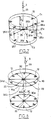
- FIGS. 7 and 8 illustrate two relatively complex configurations of priming networks which can be used in a cylindrical loading in accordance with the invention.
- the boot network comprises a main tubular element 25 connected to the detonator 3 and intended to be placed substantially along the axis of the load.
- This main tubular element 25 is connected by means of a connection 26 with six branches to six secondary elements 26a, 26b, 26c, 26d, 26e, 26f, of equal lengths arranged in a plane perpendicular to the main element 25.
- This plane is intended to be confused with a plane perpendicular to the axis of the load and located in the middle of this axis.
- the six tubular elements 26a ... 26f are connected by means of T fittings such as 27a to tubular elements such as 28a, 28b, of equal lengths arranged in the extension of one another on generatrices of a cylinder G1 focused on main element 25.
- These initiating members 12 are regularly distributed over two circles C1, C2 intended to be centered on the axis of the load.
- the initiation order is transmitted simultaneously to the initiation members 12, the detonation waves from the latter progress simultaneously and at the same speed towards the axis of the loading, join at the same time on this axis thus producing the desired directed effect.
- the volume occupied by the priming network is small, so that it can be incorporated in small volume loads.
- the distribution of the priming members 12 is identical to that of FIG. 7.
- the distribution of the tubular elements is different.
- the latter comprise a main element 29 connected to two elements of equal length 30a, 30b by means of a T30 connector. These two elements 30a, 30b extend in the axial direction of the load.
- the opposite ends of the elements 30a, 30b are connected to radial elements such as 31a by means of a connection 32 in a star with six branches.
- the radial elements 31a are connected by T-connectors 33 to elements such as 34a, 34b in the form of an arc of a circle and the ends of which are connected to initiating members 12 distributed and oriented as in the case of the figure 7.
- three ignition relays can be placed at equal distances on the axis of revolution of a cylindrical explosive charge, a first eccentric tubular transmission element connecting the detonator with a connection in the form of an orthogonal cross, and three other tubular elements of transmission of equal lengths connecting the three free ends of this cross to the three priming relays oriented axially.
- the elements thus cut are optionally folded to obtain curved elements such as 34a, 34b.
- an explosive such as penthrite suspended in an organic binder such as penthrite is then injected into the elements of the priming network.
- an explosive such as penthrite suspended in an organic binder such as penthrite is then injected into the elements of the priming network.
- polysiloxane or polyurethane in the liquid state and polymerizable at room temperature.
- the injection of the composite explosive is carried out under very high pressure, which can be greater than 800 bars and reach 1000 bars.
- the priming network is then placed in a mold 35 (see FIG. 7) or 36 (see FIG. 8), the internal shape of which is adapted to the external shape of the load which it is desired to produce.
- this priming network inside the mold 35 or 36 can be achieved by means of an external support maintaining for example the main element 25 or 29 of the priming network.
- the explosive charge constituting the actual charge is then poured inside the mold 35 or 36 so as to completely drown the initiation network in this explosive charge. After hardening of this load, the load is removed from the mold.
- the three-dimensional configuration of the priming network can be different from those described by way of examples.
- This configuration can in fact be adapted to non-cylindrical loads, such as conical or warhead-shaped loads or any other form of revolution.
Landscapes
- Engineering & Computer Science (AREA)
- General Engineering & Computer Science (AREA)
- Pressure Welding/Diffusion-Bonding (AREA)
Applications Claiming Priority (2)
| Application Number | Priority Date | Filing Date | Title |
|---|---|---|---|
| FR8216109A FR2533685A1 (fr) | 1982-09-24 | 1982-09-24 | Chargement explosif a effets diriges et son procede de fabication |
| FR8216109 | 1982-09-24 |
Publications (2)
| Publication Number | Publication Date |
|---|---|
| EP0107534A1 EP0107534A1 (fr) | 1984-05-02 |
| EP0107534B1 true EP0107534B1 (fr) | 1986-12-03 |
Family
ID=9277710
Family Applications (1)
| Application Number | Title | Priority Date | Filing Date |
|---|---|---|---|
| EP19830401810 Expired EP0107534B1 (fr) | 1982-09-24 | 1983-09-16 | Chargement explosif à amorçage multiple et son procédé de fabrication |
Country Status (3)
| Country | Link |
|---|---|
| EP (1) | EP0107534B1 (cg-RX-API-DMAC7.html) |
| DE (1) | DE3368122D1 (cg-RX-API-DMAC7.html) |
| FR (1) | FR2533685A1 (cg-RX-API-DMAC7.html) |
Cited By (1)
| Publication number | Priority date | Publication date | Assignee | Title |
|---|---|---|---|---|
| RU2156944C1 (ru) * | 1999-08-02 | 2000-09-27 | Российский Федеральный Ядерный Центр - Всероссийский Научно-Исследовательский Институт Экспериментальной Физики | Способ и устройство подрыва протяженного заряда конденсированного взрывчатого вещества |
Families Citing this family (10)
| Publication number | Priority date | Publication date | Assignee | Title |
|---|---|---|---|---|
| FR2558824A1 (fr) * | 1984-01-27 | 1985-08-02 | Poudres & Explosifs Ste Nale | Systeme d'amorcage d'un chargement explosif |
| FR2569266B1 (fr) * | 1984-08-14 | 1991-05-24 | Serat | Dispositif de securite et d'armement pour engin explosif, notamment pour grenade a main |
| US4757764A (en) * | 1985-12-20 | 1988-07-19 | The Ensign-Bickford Company | Nonelectric blasting initiation signal control system, method and transmission device therefor |
| US5183961A (en) * | 1991-12-09 | 1993-02-02 | Olin Corporation | Extended charge cartridge assembly |
| CN102631758A (zh) * | 2012-04-23 | 2012-08-15 | 哈尔滨工程大学 | 一种空间十字形中心爆管 |
| CN102778181B (zh) * | 2012-07-24 | 2014-09-17 | 西北核技术研究所 | 一种内聚爆炸压缩管道超快速封闭装置 |
| CN102927868B (zh) * | 2012-11-23 | 2014-11-19 | 中国船舶重工集团公司第七〇五研究所 | 一种爆轰波形控制装置 |
| CN103212175B (zh) * | 2013-04-03 | 2016-01-27 | 哈尔滨工程大学 | 一种空间斜十字交叉型中心爆管 |
| EP3884236B1 (en) | 2018-11-20 | 2025-07-16 | Saab Bofors Dynamics Switzerland Ltd. | Warhead with asymmetric initiation |
| CN115143850B (zh) * | 2022-06-21 | 2024-03-12 | 西北核技术研究所 | 一种空间异型爆炸载荷生成装置及方法 |
Family Cites Families (6)
| Publication number | Priority date | Publication date | Assignee | Title |
|---|---|---|---|---|
| US1923761A (en) * | 1932-07-28 | 1933-08-22 | Trojan Powder Co | Manufacture of detonating fuse |
| DE1236987B (de) * | 1964-02-14 | 1967-03-16 | Nitroglycerin Ab | Verzoegerungszuendsystem |
| US3447463A (en) * | 1967-05-01 | 1969-06-03 | Arthur Alfred Lavine | Dual ignition explosive arrangement |
| FR2166732A5 (en) * | 1972-01-06 | 1973-08-17 | Poudres & Explosifs Ste Nale | Lead sheathed detonating fuse - with stainless steel outer sheath |
| ZA76659B (en) * | 1976-02-05 | 1977-09-28 | Aeci Ltd | Containers and method of filling such containers |
| US4144814A (en) * | 1976-07-08 | 1979-03-20 | Systems, Science And Software | Delay detonator device |
-
1982
- 1982-09-24 FR FR8216109A patent/FR2533685A1/fr active Granted
-
1983
- 1983-09-16 DE DE8383401810T patent/DE3368122D1/de not_active Expired
- 1983-09-16 EP EP19830401810 patent/EP0107534B1/fr not_active Expired
Cited By (1)
| Publication number | Priority date | Publication date | Assignee | Title |
|---|---|---|---|---|
| RU2156944C1 (ru) * | 1999-08-02 | 2000-09-27 | Российский Федеральный Ядерный Центр - Всероссийский Научно-Исследовательский Институт Экспериментальной Физики | Способ и устройство подрыва протяженного заряда конденсированного взрывчатого вещества |
Also Published As
| Publication number | Publication date |
|---|---|
| FR2533685B1 (cg-RX-API-DMAC7.html) | 1984-12-28 |
| EP0107534A1 (fr) | 1984-05-02 |
| DE3368122D1 (en) | 1987-01-15 |
| FR2533685A1 (fr) | 1984-03-30 |
Similar Documents
| Publication | Publication Date | Title |
|---|---|---|
| EP0107534B1 (fr) | Chargement explosif à amorçage multiple et son procédé de fabrication | |
| EP0646762B1 (fr) | Eléments de conteneurs combustibles pour munitions d'artillerie, procédé de fabrication et utilisation de tels éléments | |
| EP3102906B1 (fr) | Charge creuse et application pour la séparation de deux étages d'un engin aéronautique ou sa neutralisation | |
| FR2529320A2 (fr) | Projectile a effet cinetique comportant un penetrateur principal et un penetrateur avant | |
| EP0082758B1 (fr) | Chargement propulsif mixte pour munitions avec douille | |
| EP0949224B1 (fr) | Procédé de fabrication d'un objet à partir d'un matériau granulaire, tube allumeur et charge propulsive obtenus avec un tel procédé | |
| EP3982002B1 (fr) | Dispositif d'amortissement bi-matériaux pour engin spatial et procédé de fabrication du dispositif d'amortissement | |
| FR2616217A1 (fr) | Systeme de maintien de charges multiples embarquees dans un projectile tournant autour de son axe longitudinal | |
| WO2001071274A1 (fr) | Tube allumeur pour une munition d'artillerie | |
| EP2791616B1 (fr) | Munition, chargement pour une telle munition et procédé de fabrication d'une telle munition | |
| FR2550857A1 (fr) | Charge militaire explosive | |
| EP0150645B1 (fr) | Système d'amorçage d'un chargement explosif | |
| FR2643142A1 (fr) | Canon a tir unique avec dispositif d'acceleration electromagnetique | |
| FR2748415A1 (fr) | Element de raccord pour un assemblage de pieces en materiaux thermoplastiques par soudage et procede de fabrication d'un tel element | |
| EP1585933B1 (fr) | Procede d assemblage d'un dispositif de separation pyrotechnique, et dispositif de separation pyrotechnique obtenu par ce procede | |
| FR2714457A1 (fr) | Tête à aérosol explosif. | |
| FR2617586A1 (fr) | Enveloppe de projectile | |
| FR3126770A1 (fr) | Anneau de découpe pyrotechnique, dispositif de liaison à séparation commandée comprenant celui-ci, et procédés de fabrication de ceux-ci | |
| FR2645635A1 (fr) | Canne de dispersion et d'allumage d'une composition incendiaire non solide | |
| WO2014095989A1 (fr) | Charge militaire a eclats et procede de fabrication | |
| EP4419496B1 (fr) | Dispositif de séquençage de l'allumage de produits pyrotechniques | |
| FR2567197A1 (fr) | Propulseur a poudre pour projectile tire dans un tube de lancement | |
| FR2704638A1 (fr) | Charge militaire multifonctions. | |
| EP1870640B1 (fr) | Tête militaire engendrant un noyau tubulaire | |
| EP0401075A1 (fr) | Dispositif explosif à éclats préfragmentés et procédé de réalisation d'un tel dispositif |
Legal Events
| Date | Code | Title | Description |
|---|---|---|---|
| PUAI | Public reference made under article 153(3) epc to a published international application that has entered the european phase |
Free format text: ORIGINAL CODE: 0009012 |
|
| AK | Designated contracting states |
Designated state(s): BE DE GB IT |
|
| 17P | Request for examination filed |
Effective date: 19840914 |
|
| 17Q | First examination report despatched |
Effective date: 19860124 |
|
| GRAA | (expected) grant |
Free format text: ORIGINAL CODE: 0009210 |
|
| AK | Designated contracting states |
Kind code of ref document: B1 Designated state(s): BE DE GB IT |
|
| ITF | It: translation for a ep patent filed | ||
| REF | Corresponds to: |
Ref document number: 3368122 Country of ref document: DE Date of ref document: 19870115 |
|
| PLBE | No opposition filed within time limit |
Free format text: ORIGINAL CODE: 0009261 |
|
| STAA | Information on the status of an ep patent application or granted ep patent |
Free format text: STATUS: NO OPPOSITION FILED WITHIN TIME LIMIT |
|
| 26N | No opposition filed | ||
| ITTA | It: last paid annual fee | ||
| PGFP | Annual fee paid to national office [announced via postgrant information from national office to epo] |
Ref country code: GB Payment date: 19970908 Year of fee payment: 15 |
|
| PGFP | Annual fee paid to national office [announced via postgrant information from national office to epo] |
Ref country code: BE Payment date: 19971020 Year of fee payment: 15 |
|
| PGFP | Annual fee paid to national office [announced via postgrant information from national office to epo] |
Ref country code: DE Payment date: 19971127 Year of fee payment: 15 |
|
| PG25 | Lapsed in a contracting state [announced via postgrant information from national office to epo] |
Ref country code: GB Free format text: LAPSE BECAUSE OF NON-PAYMENT OF DUE FEES Effective date: 19980916 |
|
| PG25 | Lapsed in a contracting state [announced via postgrant information from national office to epo] |
Ref country code: BE Free format text: LAPSE BECAUSE OF NON-PAYMENT OF DUE FEES Effective date: 19980930 |
|
| BERE | Be: lapsed |
Owner name: SOC. NATIONALE DES POUDRES ET EXPLOSIFS Effective date: 19980930 |
|
| GBPC | Gb: european patent ceased through non-payment of renewal fee |
Effective date: 19980916 |
|
| PG25 | Lapsed in a contracting state [announced via postgrant information from national office to epo] |
Ref country code: DE Free format text: LAPSE BECAUSE OF NON-PAYMENT OF DUE FEES Effective date: 19990701 |