EP0106496B2 - Poröses Material aus Polytetrafluorethylen - Google Patents
Poröses Material aus Polytetrafluorethylen Download PDFInfo
- Publication number
- EP0106496B2 EP0106496B2 EP83305190A EP83305190A EP0106496B2 EP 0106496 B2 EP0106496 B2 EP 0106496B2 EP 83305190 A EP83305190 A EP 83305190A EP 83305190 A EP83305190 A EP 83305190A EP 0106496 B2 EP0106496 B2 EP 0106496B2
- Authority
- EP
- European Patent Office
- Prior art keywords
- porous material
- psi
- mpa
- tensile strength
- densification
- Prior art date
- Legal status (The legal status is an assumption and is not a legal conclusion. Google has not performed a legal analysis and makes no representation as to the accuracy of the status listed.)
- Expired - Lifetime
Links
Images





Classifications
-
- C—CHEMISTRY; METALLURGY
- C08—ORGANIC MACROMOLECULAR COMPOUNDS; THEIR PREPARATION OR CHEMICAL WORKING-UP; COMPOSITIONS BASED THEREON
- C08J—WORKING-UP; GENERAL PROCESSES OF COMPOUNDING; AFTER-TREATMENT NOT COVERED BY SUBCLASSES C08B, C08C, C08F, C08G or C08H
- C08J5/00—Manufacture of articles or shaped materials containing macromolecular substances
- C08J5/18—Manufacture of films or sheets
-
- B—PERFORMING OPERATIONS; TRANSPORTING
- B29—WORKING OF PLASTICS; WORKING OF SUBSTANCES IN A PLASTIC STATE IN GENERAL
- B29C—SHAPING OR JOINING OF PLASTICS; SHAPING OF MATERIAL IN A PLASTIC STATE, NOT OTHERWISE PROVIDED FOR; AFTER-TREATMENT OF THE SHAPED PRODUCTS, e.g. REPAIRING
- B29C55/00—Shaping by stretching, e.g. drawing through a die; Apparatus therefor
- B29C55/005—Shaping by stretching, e.g. drawing through a die; Apparatus therefor characterised by the choice of materials
-
- D—TEXTILES; PAPER
- D01—NATURAL OR MAN-MADE THREADS OR FIBRES; SPINNING
- D01F—CHEMICAL FEATURES IN THE MANUFACTURE OF ARTIFICIAL FILAMENTS, THREADS, FIBRES, BRISTLES OR RIBBONS; APPARATUS SPECIALLY ADAPTED FOR THE MANUFACTURE OF CARBON FILAMENTS
- D01F6/00—Monocomponent artificial filaments or the like of synthetic polymers; Manufacture thereof
- D01F6/02—Monocomponent artificial filaments or the like of synthetic polymers; Manufacture thereof from homopolymers obtained by reactions only involving carbon-to-carbon unsaturated bonds
- D01F6/08—Monocomponent artificial filaments or the like of synthetic polymers; Manufacture thereof from homopolymers obtained by reactions only involving carbon-to-carbon unsaturated bonds from polymers of halogenated hydrocarbons
- D01F6/12—Monocomponent artificial filaments or the like of synthetic polymers; Manufacture thereof from homopolymers obtained by reactions only involving carbon-to-carbon unsaturated bonds from polymers of halogenated hydrocarbons from polymers of fluorinated hydrocarbons
-
- B—PERFORMING OPERATIONS; TRANSPORTING
- B29—WORKING OF PLASTICS; WORKING OF SUBSTANCES IN A PLASTIC STATE IN GENERAL
- B29K—INDEXING SCHEME ASSOCIATED WITH SUBCLASSES B29B, B29C OR B29D, RELATING TO MOULDING MATERIALS OR TO MATERIALS FOR MOULDS, REINFORCEMENTS, FILLERS OR PREFORMED PARTS, e.g. INSERTS
- B29K2027/00—Use of polyvinylhalogenides or derivatives thereof as moulding material
- B29K2027/12—Use of polyvinylhalogenides or derivatives thereof as moulding material containing fluorine
- B29K2027/18—PTFE, i.e. polytetrafluoroethylene, e.g. ePTFE, i.e. expanded polytetrafluoroethylene
-
- B—PERFORMING OPERATIONS; TRANSPORTING
- B29—WORKING OF PLASTICS; WORKING OF SUBSTANCES IN A PLASTIC STATE IN GENERAL
- B29K—INDEXING SCHEME ASSOCIATED WITH SUBCLASSES B29B, B29C OR B29D, RELATING TO MOULDING MATERIALS OR TO MATERIALS FOR MOULDS, REINFORCEMENTS, FILLERS OR PREFORMED PARTS, e.g. INSERTS
- B29K2105/00—Condition, form or state of moulded material or of the material to be shaped
- B29K2105/04—Condition, form or state of moulded material or of the material to be shaped cellular or porous
-
- C—CHEMISTRY; METALLURGY
- C08—ORGANIC MACROMOLECULAR COMPOUNDS; THEIR PREPARATION OR CHEMICAL WORKING-UP; COMPOSITIONS BASED THEREON
- C08J—WORKING-UP; GENERAL PROCESSES OF COMPOUNDING; AFTER-TREATMENT NOT COVERED BY SUBCLASSES C08B, C08C, C08F, C08G or C08H
- C08J2327/00—Characterised by the use of homopolymers or copolymers of compounds having one or more unsaturated aliphatic radicals, each having only one carbon-to-carbon double bond, and at least one being terminated by a halogen; Derivatives of such polymers
- C08J2327/02—Characterised by the use of homopolymers or copolymers of compounds having one or more unsaturated aliphatic radicals, each having only one carbon-to-carbon double bond, and at least one being terminated by a halogen; Derivatives of such polymers not modified by chemical after-treatment
- C08J2327/12—Characterised by the use of homopolymers or copolymers of compounds having one or more unsaturated aliphatic radicals, each having only one carbon-to-carbon double bond, and at least one being terminated by a halogen; Derivatives of such polymers not modified by chemical after-treatment containing fluorine atoms
- C08J2327/18—Homopolymers or copolymers of tetrafluoroethylene
Definitions
- This invention relates to porous polytetrafluoroethylene (hereinafter "PTFE”) materials having a useful combination of high strength and coarse microstructure, and a method for producing these materials. Articles made from these materials are particularly suitable for use in the medical field.
- PTFE porous polytetrafluoroethylene
- the products of this invention derived from paste formed products of PTFE.
- Paste extrusion or paste forming techniques are old in the art and consist of mixing a coagulated dispersion of PTFE resin with a liquid lubricant and forcing the mixture through an extrusion die or otherwise working the lubricated mixture to form a coherent shaped article.
- the lubricant is then removed, usually by drying, to form a porous, unsintered PTFE article having a density usually within the range of 1.4 to 1.7 gm/cc.
- densities correspond to porosities of 39% to 26%, respectively.
- the article can be raised above its crystalline melt point of about 345°C to sinter it, coalescing the porous material to form a non-porous sintered article.
- the matrix tensile strength of a porous specimen To compute the matrix tensile strength of a porous specimen, one divides the maximum force required by to break the sample by the cross-sectional area of the porous sample, and then multiplies this quantity by the ratio of the density of the PTFE polymer component divided by the density of the porous specimen.
- the density of PTFE which has never been raised above its crystalline melt point is 2.30 gm/cc while the density of PTFE which has been sintered or raised above its crystalline melt point may range from above 2.0 gm/cc to below 2.30 gm/cc.
- the average node height/width ratio is greater than 5.
- the average fibril length is greater than 50 ⁇ m.
- a porous material consisting essentially of polytetrafluoroethylene polymer, having nodes interconnected by fibrils characterised in that it has an ethanol bubble point of less than or equal to 4.0 psi (27.6 kPa), said fibrils including first fibrils oriented substantially perpendicular to second fibrils, and the ratio of the matrix tensile strength as measured along the first fibril direction to the matrix tensile strength measured along the second fibril direction is between 0.4 and 2.5 and the matrix tensile strength in the weaker direction is greater than or equal to 3000 psi (20.7 MPa).
- a fully densified unsintered article of PTFE is one in which there is no void space and such an article has a density of 2.30 gm/cc.
- densification will occur faster at higher temperatures in the range of 300° C than it will at lower temperatures. Less force may be required to achieve densification at higher temperatures. Higher temperatures, therefore, may facilitate the densification inasmuch as less time and/or less compressive force may be required.
- equivalent stretched articles are obtained independent of whether densification occurs at low temperatures or at high temperatures as long as equivalent densifications are achieved. It appears that the only significant variable is the actual densification achieved as measured by the density of the densified article prior to stretching.
- Densification can be performed through the use of presses, dies, or calendering machines.
- the use of a calendering machine to densify the dry PTFE enables the manufacturing of long lengths of film.
- the preferred conditions for densification in a die appear to involve pulling the material through the die at relatively low rates.
- the force exerted to pull the material through the die may result in stretching the material that has passed through the die.
- Lower rates required less force to pull the material through the die which results in less stretching of the material. It appears to be desirable to minimize stretching out of the die. Stretching is better controlled in process steps specifically designed to stretch the material.
- a number of processing steps can be performed prior to densification such as calendering with the lubricant present and stretching with or without the lubricant present. These steps may increase the strength of the final article, but again, such preferred processes have not been detected. Further, it may be preferred to not fully densify the material prior to stretching. It is believed that the densification can be achieved by applying compressive forces in any or all directions and that stretching can subsequently be performed in any or all directions to yield the benefits of this invention.
- Articles of the present invention have larger nodes and longer fibrils than prior art materials of similar matrix tensile strength.
- the four characteristic dimensions of the microstructure are: node height, node width, node length, and fibril length. See Figure 1 for the definition of these dimensions of nodes 2 and fibrils 1 for uniaxially stretched films.
- Fibril length 3 and node width 4 are measured in the direction of stretching.
- Node length 6 is measured in the width direction of the film; that is, orthogonal to the direction of stretching, in the plane of stretching.
- Node height 5 is measured in the thickness direction of the film; that is, orthogonal to the plane of stretching.
- node width and node length may not be obvious for films stretched in more than one direction, since the fibrils may be oriented in many directions and the nodes may be of the same size in more than one direction.
- node width is defined as the node dimension in the same direction as the longest fibrils, in the plane of stretching.
- Node height is measured in the thickness direction of the film; that is, orthogonal to the plane of stretching.
- node length and node height may not be obvious for articles with a symmetrically shaped cross-section, such as circular rods, filaments, and articles with a square cross-section. In this case, node height and node length are said to be the same dimension termed "node height" and this dimension is measured in the direction orthogonal to stretching.
- the combination of measurements of two microstructure dimensions and strength in the strongest direction can be used to distinguish between articles of this invention and prior art articles.
- the combination of the ratio of average node height to average node width, in addition to the average matrix tensile strength in the strongest direction, is useful for characterizing articles of the present invention.
- EBP ethanol bubble point
- Ethanol bubble point is inversely related to pore size; lower values of EBP indicate larger pores, or in the terminology of this application, coarser structure. It is believed that EBP can be assumed to be independent of the length of the path that the air travels through the article. In other words, it is believed that EBP provides a characterization of pore size that is not unacceptably dependent on the dimensions of the tested article.
- an EBP less than 20.7 kPa (3.0 p.s.i.) is desirable (for example about 8.3 kPa (1.2 p.s.i.) with a matrix tensile strength ratio, relative to the first and second directions, of between 0.5 and 2.0, preferably between 0.67 and 1.5.
- Gurley number is defined as the time in seconds for 100 cc of air to flow through one square inch (6.5 sq.cms) of material for a pressure of 1.2 kPa (4.9 inches of water) across the material. See ASTM D-726-58 for a method of- measuring the Gurley number.
- a "coarseness index” is defined here as the density of the stretched porous article divided by the EBP of that article. Density is an indicator of total pore volume. Should two articles be of the same density, the article with the lower EBP is said to be coarser. Should two articles have the same pore size, the article with the higher denisty is said to be coarser. Thus, the coarseness index is directly proportional to density and inversely proportional to EBP. An increase in coarseness is indicated by an increase in the coarseness index. Introducing the density in combination with EBP provides means of comparing prior art articles with articles of this invention over a wide range of matrix tensile strengths.
- Sintering a restrained stretched article does lower the EBP of the article, and usually increases the coarseness index. However, in some cases the coarseness index may not increase due to sintering since the density of the article may be lowered by sintering.
- Figure 3 present a graph of the variables, coarseness index and matrix tensile strength. Porous material and articles not heretofore available are produced with the present invention to have a matrix tensile strength greater than or equal to about 3,000 psi (20.7 MPa) and have a corresponding coarseness index greater than or equal to the value on a line connected by the points A,B,C, and D.
- Point A [3,000 psi (20.7 MPa), 0.40 (gm/cc)/psi (58gm/cc/MPa)], Point B [12,000 psi (82.2 MPa), 0.40 (gm/cc)/psi (58 gm/cc/MPa)], Point C [16,000 psi (110.4 MPa), 0.20 (gm/cc)/psi (29 gm/cc/MPa)] and Point D [25,000 psi (172.5 MPa), 0.20 (gm/cc)/psi (29 gm/cc/MPa)]. Points C and D could alternatively have coarseness indices of 0.23.
- points A,B,C and D could alternatively have coarseness indices of 0.45 (gm/cc)/psi (62.25 gm/cc/MPa).
- the crushability (as hereinafter defined) of such porous material is less than 10%.
- Porous PTFE articles may be filled with substances such as asbestos, carbon black, pigments, and mica, as taught by U.S. Patent Nos. 3,953,666 and 4,096,227.
- Articles of the present invention can be likewise filled.
- the presence of a filler may affect the measurement of coarseness index since EBP is a function of the surface tension of the porous article and the filler may affect the surface tension of the article.
- Articles of the present invention can be characterized in several ways.
- Coarseness index is particularly useful for describing the structure of thin films in which maximum node height is limited by the thickness of the film.
- the node height to node width ratio is particularly useful for describing the structure of articles too small to enable the measurement of the EBP. In many cases, either of these parameters can be used to describe the structure of the same articles.
- Films of this invention that have strength of similar magnitude in orthogonal directions can be distinguished from prior art films by the characterization of matrix tensile strength in orthogonal directions and EBP.
- This characterization includes sintered films having the ratio of matrix tensile strengths in orthogonal directions within the range of 0.4 to 2.5, where the weaker direction has a matrix tensile strength greater than or equal to about 3000 psi (20.7 MPa). Films of this invention that satisfy these strength requirements have an EBP less than or equal or about 4 psi (27.6 kPa).
- Unsintered articles extruded from preferred resins can be stretched farther and more uniformly to achieve stronger stretched products than unsintered articles extruded from non-preferred resins.
- the preferred resins are highly crystalline (such as Fluon CD123 supplied by
- densified unsintered articles can be stretched under conditions that will yield products that are similar to prior art products, such as those taught in U.S. Patent Nos. 4,187,390 and 3,962,153.
- the process of the present invention can also yield products with characteristics not heretofore available. It is these latter materials which are sought to be uniquely identified by the values of parameters set forth in the claims.
- Densifications were carried out at temperatures from ambient (22°C) to slightly above 300°C. The times to reach the desired densification temperature and the times to reach the desired densification at these temperatures were noted. The "control" pieces were subjected to the same temperature and time conditions as were used in densification. For convenience, two film samples were stacked together with a sheet of Kapton (R.T.M.) polyimide film (DuPont) between them so that two 4.5 inch by 4.5 inch (11.4 cm square) samples of film could be simultaneously densified.
- Kapton R.T.M.
- DuPont Kapton
- the 4.5 inch by 4.5 inch (11.4 cm square) specimens were weighed prior to the densification step. Thickness measurements were taken at the four corners, at about one inch (2.54 cms) from each edge, and these four readings were averaged. The density was calculated by dividing the weight of the specimen, by the area times the average thickness. This procedure yields a nominal density of the specimen, since the thickness of the specimen varied due to local inconsistencies.
- the stretched specimens were then restrained from shrinking, by placing them on a pinframe, and immersed in a 370°C salt bath for about 20 seconds, thereby sintering the specimens.
- the individual measurements for the 2.01 gm/cc materials ranged from 1.97 to 2.04 gm/cc.
- the individual measurements for the 2.27 gm/cc materials ranged from 2.19 to 2.35 gm/cc. Therefore, the nominal range of 2.27 gm/cc includes the maximum obtainable densities.
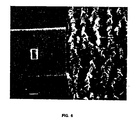
- the magnifications for the left and right sides of the micrograph in Figure 6 are about 152 and 1520, respectively.
- the magnifications for the left and right sides of the micrograph in Figure 7 are about 147 and 1470, respectively. Again, the difference in coarseness is clear.
- These micrographs also demonstrate the difference in node height through the cross-section.
- the material produced by the process of this invention not only has nodes of greater heights compared to the material that had not been densified, but a significant number of the nodes are seen to extend completely through the cross-section, unlike the case of the undensified material.
- Table 1 show the average matrix tensile strength in the stretch direction for all materials that had been densified prior to stretching to be at least of the same order of magnitude as the undensified, control materials.
- the combination of long fibril lengths, wide node widths, and high matrix tensile strengths relative to prior PTFE materials available from conventional processes is surprising.
- the fibril lengths and widths of the nodes were measured from scanning electron micrographs of cross-sections of the stretched, sintered materials in order to assess relative coarseness based upon the dimensions of the microstructure.
- the fibril length and node width measurements utilized scanning electron microscope pictures of about 150 ⁇ magnification and dual magnification of 10 ⁇ (about 1500 ⁇ original), and the following steps:
- Gurley number can characterize the coarseness of these materials. Lower values of this parameter indicate greater permeability of the structures. Permeability and, therefore, Gurley number measurements, are strongly dependent on path length. The use of Gurley number is an appropriate means of comparing the articles described in this example, however, since the materials were processed identically except for the densification step.
- the data pertaining to ethanol bubble point (EBP) also can characterize the coarseness of materials. Lower values of this parameter indicate greater maximum pore size of the structures. Greater permeability, as well as larger pore size quantify greater coarseness.
- Table 1 demonstrate the materials densified to about 1.83 and 2.01 gm/cc, upon stretching, exhibit lower values of the respective parameter than the 1.63 gm/cc control materials, and that the 2.27 gm/cc range materials had a markedly higher permeability and larger pore sizes than the 1.63 gm/cc control materials.
- the final materials that had been densified in the range of 2.27 gm/cc did have markedly lower values for these parameters than those materials that had been densified less.
- the crushability test data in Table 1 demonstrate a macroscopic manifestation of the coarse microstructure available through the present invention.
- the specimens were placed under a tensile load by applying a 0.5 lb (0.22 kg) force to the material in direction of stretching.
- a thickness measurement was taken which constituted the original thickness.
- an 18 oz (0.5 kg) weight of .012 square inch (.077 sq cm) area was applied to the specimen for 0.5 minutes and the resulting thickness recorded with the weight still applied.
- Percent crush, or crushability is defined as (t-c) (100%)/t, in which "t" is the original thickness, and "C” is the thickness under load.
- Lower values of crushabiltiy therefore, indicate a higher resistance to being crushed (i.e., a higher crush-resistance).
- a crushability of less than 10% is desirable; preferably less than 8% and more preferably less than 5%.
- the testing data indicate that densifying the dry, calendered extrudate to about 2.27 gm/cc or greater (i.e., the range of highest densities) prior to stretching had an especially pronounced effect on the "coarseness" of the stretched, heat treated PTFE materials without detracting from the matrix tensile strength.
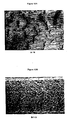
- Figures 8 and 9 present scanning electron micrographs of the surfaces of the control material (1.61 gm/cc) and the material that had been densified to 2.25 gm/cc, respectively.
- the magnifications for the left and right sides of these micrographs in Figures 8 and 9 are about 150 and 1500, respectively.
- the relative coarseness of the material that had been densified to 2.25 gm/cc is readily apparent.
- These figures demonstrate the structural differences due to the invention that result in the difference in ethanol bubble points as indicated in Table 2.
- the micrograph in Figure 9 is representative of the structure that resulted due to the inclusion of the densification step.
- the final material is not completely uniform, however, and some regions are not seen to be as coarse with regard to the dimensions of the microstructure as other regions of the same material. This non-uniformity is attributed to local inconsistencies during the densification.
- Part A illustrates the effect a densification die can have on the microstructure of a uniaxially stretched filament.
- the processing of the two finished filaments described herein was adjusted to yield materials with equivalent diamters, densities, and matrix tensile strengths.
- PTFE dispersion powder (“Fluon CD-123” resin produced by
- Isopar is a trade mark
- the Isopar M was evaporated from a sample of the extruded filament.
- the density of this sample was about 1.49 gm/cc, and its matrix tensile strength was about 900 pounds per square inch (6.2 MPa).
- the extruded filament still containing Isopar M was immersed in a container of Isopar M at 60°C, and stretched nine-fold (800%) between capstans with an output velocity of about 86.4 ft/min (26.3 m/min). These capstans had a diameter of about 2.8 inches (7.1 cms) and a center-to-center distance of about 4.5 inches (11.4 cms). The diameter of the filament was reduced from about 0.106 inch (0.269 cm) to about 0.039 inch (.099 cm) by this stretching. The Isopar M was removed from this stretched material. The density of the stretched filament was about 1.3 gm/cc, and the matrix tensile strength was about 5,400 pounds per square inch (37.3 MPa).
- the output velocity of the material exiting the die was about 7.2 ft/minute (2.2 m/min).
- the opening in the die tapered at a 10° included angle from about .050 inch diameter (.013 cm) to .030 inch (.076 cm) diameter, and was then constant for a land length of about .030 inches (.076 cm).
- the die diameter of .030 inches (.076 cm) was chosen on the basis of two assumptions:
- the stretched filament which had been pulled through the die, was then heated in a 300°C oven and further stretched seven-fold (600%), from an initial length of about 7.2 inches (18.3 cms), in a batch manner with a constant velocity of about 37 ft/min (11.3 m/min).
- the filament was restrained from shrinking and heated in a 367°C oven for 30 seconds.
- One end of a length of the A-16 filament was heated, densified and then swaged onto a standard 0.022 inch (0.056 cm) diameter surgical needle, making a prototype suture with matching needle and thread diameters.
- This needle/thread combination is not currently available in the marketplace and has the potential advantage of reducing suture line bleeding in vascular anastomoses.
- This material was sewn into the tissue of a guinea pig and harvested after 30 days. Fibroblast cells had penetrated into the structure of the suture, and substantial collagen was formed throughout the inner structure of the suture (see Figure 11A). Also, the suture became well embedded in the tissue.
- Another material (3-1-3) was manufactured using a process similar to that described above with the major exception that the stretched filament was not pulled through a densification die. Minor processing changes were necessary to achieve this equivalence.
- the extruded filament had a diameter of about .090" (.229 cm), a matrix tensile strength of about 1200 psi (8.3 MPa) and it underwent a total stretch of 52:1 through the process.
- Table 4 demonstrates that this material has a diameter, matrix tensile strength, and density nearly identical to that of the material which had.been pulled through the die.
- the A-16 material had much longer fibril lengths, and nodes where its height/width (H/W) ratio was substantially greater than in the undensified (3-1-3) material.
- the only materials with matrix tensile strengths greater than or equal to about 15,000 psi (103.5 MPa) having a node H/W ratio greater than or equal to about 3 are those materials which undergo a densification step prior to stretching, where the densification increases the specific gravity of the material to greater than or equal to about 2.0 g/cc. It appears from this example, that densification prior to final stretching may yield filaments having longer fibril lengths than would be achieved with similar amounts of stretch in a process not including a densification step.
- PTFE dispersion powder (“Fluon CD-123” resin produced by
- the Isopar M was evaporated from a sample of the extruded filament.
- the density of this sample was 1.48 gm/cc and its matrix tensile strength was about 1,700 pounds per square inch (11.7 MPa).
- the extruded filament still containing Isopar M was immersed in a container of Isopar M at 60°C and stretched seven-fold (600%) between capstans with an output velocity of about 57.6 ft/min (17.6 m/min). These capstans had a diameter of about 2.8 inches (7.1 cms) and a center-to-center distance of about 4.5 inches (11.4 cms). The diameter of the filament was reduced from about 0.108 inch (0.274 cm) to about .049 inch (.125 cm) by this stretching. The Isopar M was removed from this stretched material. The density of the stretched filament was 1.02 g/cc and the matrix tensile strength was about 7,900 pounds per square inch (54.5 MPa).
- the output velocity of the material exiting the die was about 1.9 ft/minute (.58 m/min).
- the opening in the die tapered at a 10° included angle from about .075 inch (.19 cm) diameter to .026 inch (.066 cm) diameter, and was then constant for a land length of about .026 inch (.066 cm).
- the stretched filament (Lot 665), which had not been pulled through the die, was heated in a 300°C oven and further stretched eight-fold (700%) between the same capstan setup just described, using an output velocity of about 11.5 ft/min (3.5 m/min).
Landscapes
- Chemical & Material Sciences (AREA)
- Engineering & Computer Science (AREA)
- Manufacturing & Machinery (AREA)
- Chemical Kinetics & Catalysis (AREA)
- Materials Engineering (AREA)
- Textile Engineering (AREA)
- General Chemical & Material Sciences (AREA)
- Health & Medical Sciences (AREA)
- Medicinal Chemistry (AREA)
- Polymers & Plastics (AREA)
- Organic Chemistry (AREA)
- Mechanical Engineering (AREA)
- Manufacture Of Porous Articles, And Recovery And Treatment Of Waste Products (AREA)
- Shaping By String And By Release Of Stress In Plastics And The Like (AREA)
- Organic Low-Molecular-Weight Compounds And Preparation Thereof (AREA)
Claims (31)
- Poröses Material, das im wesentlichen aus PTFE-Polymer besteht. welches Material eine Mikrostruktur besitzt, die untereinander durch Fibrillen verbundene Knoten aufweist, dadurch gekennzeichnet, daß es. gemessen längs mindestens einer Richtung, eine mittlere Matrixzugfestigkeit von größer als 40 000 psi (276 MPa) und ein mittleres Verhältnis von Knotenhöhe/Breite von größer als 3 aufweist, eine mittlere Fibrillenlänge von größer als 15 µm besitzt und daß das Material in Fadenform vorliegt.
- Poröses Material nach Anspruch 1, dadurch gekennzeichnet, daß das mittlere Verhältnis von Knotenhöhe/Breite größer als 5 ist.
- Poröses Material nach Anspruch 1 oder 2, dadurch gekennzeichnet. daß es eine mittlere Fibrillenlänge von größer als 50 µm aufweist.
- Poröses Material nach Anspruch 1 oder 2, dadurch gekennzeichnet. daß die mittlere Matrixzugfestigkeit etwa 49 000 psi (338 MPa), die mittlere Länge etwa 120 µm und das mittlere Verhältnis Knotenhöhe/Breite etwa 6 betragen.
- Poröses Matenal nach Anspruch 1 oder 2, dadurch gekennzeichnet. daß die mittlere Matrixzugfestigkeit etwa 55 000 psi (380 MPa), die mittlere Fibrillenlänge etwa 74 µm und das mittlere Verhältnis Knotenhöhe/Breite etwa 7 betragen.
- Poröses Material, das im wesentlichen aus Polytetrafluorethylen-Polymer besteht, das untereinander durch Fibrillen verbundene Knoten aufweist, dadurch gekennzeichnet, daß das Material eine Matrixzugfestigkeit von größer als oder gleich 3 000 psi (20.7 MPa) und weniger als oder gleich 25 000 psi (172,5 MPa) aufweist und einen entsprecnenden Grobheitsindex von größer als oder gleich dem Wert auf einer die in der folgenden Tabelle definierten Punkte A, B, C und D verbindenden Linie besitzt:
Matrixzugfestigkeit Grobheitsindex psi MPa g/cm3/psi g/cm3/MPa A 3 000 20,7 0,40 57,97 B 12 000 82,8 0,40 57,97 C 16 000 110,4 0,20 29,0 D 25 000 172,5 0,20 29,0 - Poröses Material nach Anspruch 6, dadurch gekennzeichnet, daß Punkt C und Punkt D einen Grobheitsindex von 0.23 (g/cm3)/psi (33,35 g/cm3/MPa) aufweisen.
- Poröses Material nach Anspruch 6, dadurch gekennzeichnet. daß Punkt C und Punkt D einen Grobheitsindex von 0.40 (g/cm3)/psi (57.97 g/cm3/MPa) aufweisen.
- Poröses Material nach Anspruch 6, dadurch gekennzeichnet. daß die Punkte A, B, C und D einen Grobheitsindex von 0.45 (g/cm2)/psi (65,25 g/cm2/MPa) aufweisen.
- Poröses Material nach einem der Ansprüche 6 bis 9, dadurch gekennzeichnet, daß es in Filmform vorliegt.
- Poröses Material nach Anspruch 10, dadurch gekennzeichnet, daß es eine Quetschbarkeit von weniger als 8% aufweist.
- Poröses Material nach Anspruch 10, dadurch gekennzeichnet, daß es eine Quetschbarkeit von weniger als 5% aufweist.
- Poröses Material, daß im wesentlichen aus Polytetratluorethylen-Polymer besteht, weiches untereinander durch Fibrillen verbundene Knoten aufweist, dadurch gekennzeichnet, daß es einen Ethanolblasenpunkt von weniger als oder gleich 4,0 psi (27,6 kPa) aufweist, die Fibrillen erste Fibrillen einschließen, die im wesentlichen senkrecht zu zweiten Fibrillen orientiert sind, und das Verhältnis der Matrixzugfestigkeit, gemessen längs der ersten Fibrillenrichtung, zur Matrixzugfestigkeit, gemessen längs der zweiten Fibrillenrichtung, zwischen 0,4 und 2.5 beträgt, und die Matrixzugfestigkeit in der schwächeren Richtung größer als oder gleich 3 000 psi (20,7 MPa) ist.
- Poröses Material nach Anspruch 13, dadurch gekennzeichnet, daß der Ethanolblasenpunkt weniger als 3,0 beträgt.
- Poröses Material nach Anspruch 13. dadurch gekennzeichnet, daß der Ethanolblasenpunkt etwa 1.2 beträgt.
- Poröses Material nach einem der Ansprüche 13 bis 15, dadurch gekennzeichnet, daß das Matrixzugfestigkeitsverhältnis 0,5 bis 2.0 beträgt.
- Poröses Material nach Anspruch 16. dadurch gekennzeichnet, daß das Matrixzugfestigkeitsverhältnis 0,67 bis 1.5 beträgt.
- Poröses Matenai nach einem der Ansprüche 6 bis 17, dadurch gekennzeichnet, daß es in Filmform vorliegt und sich eine signifikante Zahl der Knoten über die Filmdicke erstreckt.
- Verfahren zum Herstellen eines porösen Materials aus Polytetrafluoretylen-Polymer. welches Matenal einem der vorhergehenden Ansprüche entspricht und welches Material aus pastenextrudiertem Polytetrafluorethylenextrudat gebildet wurde, aus dem sämtliches Extrusionshilfsgleitmittel entfernt worden ist, dadurch gekennzeichnet, daß das Verfahren die Schritte des(a) Erhöhens der Dichte des trockenen Extrudats auf mindestens 2,02 g/cm3 bei einer erhöhten Temperatur, die niedriger als die Kristallschmelztemperatur des PTFE ist, und(b) Streckens des verdichteten trockenen Extrudats bei erhöhter Temperatur, die niedriger als die Kristallschmelztemperatur ist,umfaßt.
- Verfahren nach Anspruch 19, dadurch gekennzeichnet, daß der Verdichtungsschritt die Dichte des trockenen Extrudats auf mehr als 2,2 g/cm3 ernöht.
- Verfahren nach Anspruch 19, dadurch gekennzeichnet, daß der Verdichtungsschritt die Dichte des trockenen Extrudats auf etwa ihren Maximalwert erhöht.
- Verfahren nach Anspruch 19. dadurch gekennzeichnet, daß der Verdichtungsschritt durch Verdichten des trockenen Extrudats in einer Presse bewirkt wird.
- Verfahren nach Anspruch 19, dadurch gekennzeichnet, daß der Verdichtungsschritt durch Kalandern des trockenen Extrudats bewirkt wird.
- Verfahren nach Anspruch 19, dadurch gekennzeichnet, daß der Verdichtungsschritt durch Zehen des trockenen Extrudats durch eine Verdichtungsform bewirkt wird.
- Verfahren nach Anspruch 19, dadurch gekennzeichnet, daß das verdichtete trockene Extrudat uniaxial gestreckt wird.
- Verfahren nach Anspruch 19, dadurch gekennzeichnet, daß das verdichtete trockene Extrudat biaxial gestreckt wird.
- Verfahren nach Anspruch 19, dadurch gekennzeichnet, daß der Streckschritt bei etwa 300°C durchgeführt wird.
- Verfahren nach Anspruch 19, dadurch gekennzeichnet, daß der Verdichtungsschritt bei etwa 300°C durchgeführt wird.
- Verfahren nach Anspruch 19, dadurch gekennzeichnet, daß es den Schritt des Erhitzens des gestreckten Gegenstandes auf oberhalb die Kristallschmelztemperatur einschließt, während der gestreckte Gegenstand am Schrumpfen gehindert wird.
- Verfahren nach einem der Ansprüche 19, 23 oder 24, dadurch gekennzeichnet, daß der Verdichtungs- und Streckschritt kontinuierlich durchgeführt werden.
- Verfahren nach einem der Ansprüche 19 bis 21, gekennzeichnet durch den Schritt des Streckens des trockenen Extrudats vor dem Verdichtungsschritt.
Priority Applications (1)
| Application Number | Priority Date | Filing Date | Title |
|---|---|---|---|
| AT83305190T ATE35560T1 (de) | 1982-09-10 | 1983-09-07 | Poroeses material aus polytetrafluorethylen. |
Applications Claiming Priority (4)
| Application Number | Priority Date | Filing Date | Title |
|---|---|---|---|
| US41646582A | 1982-09-10 | 1982-09-10 | |
| US416465 | 1982-09-10 | ||
| US06/416,466 US4482516A (en) | 1982-09-10 | 1982-09-10 | Process for producing a high strength porous polytetrafluoroethylene product having a coarse microstructure |
| US416466 | 1982-09-10 |
Publications (4)
| Publication Number | Publication Date |
|---|---|
| EP0106496A2 EP0106496A2 (de) | 1984-04-25 |
| EP0106496A3 EP0106496A3 (en) | 1986-02-19 |
| EP0106496B1 EP0106496B1 (de) | 1988-07-06 |
| EP0106496B2 true EP0106496B2 (de) | 1996-09-11 |
Family
ID=27023364
Family Applications (1)
| Application Number | Title | Priority Date | Filing Date |
|---|---|---|---|
| EP83305190A Expired - Lifetime EP0106496B2 (de) | 1982-09-10 | 1983-09-07 | Poröses Material aus Polytetrafluorethylen |
Country Status (7)
| Country | Link |
|---|---|
| EP (1) | EP0106496B2 (de) |
| DE (1) | DE3377288D1 (de) |
| DK (1) | DK410383A (de) |
| ES (1) | ES525496A0 (de) |
| FI (1) | FI77880C (de) |
| NO (1) | NO833230L (de) |
| PT (1) | PT77321B (de) |
Cited By (1)
| Publication number | Priority date | Publication date | Assignee | Title |
|---|---|---|---|---|
| US6923927B2 (en) | 2000-10-03 | 2005-08-02 | Atrium Medical Corporation | Method for forming expandable polymers having drugs or agents included therewith |
Families Citing this family (14)
| Publication number | Priority date | Publication date | Assignee | Title |
|---|---|---|---|---|
| DE3608158A1 (de) * | 1986-03-12 | 1987-09-17 | Braun Melsungen Ag | Mit vernetzter gelatine impraegnierte gefaessprothese und verfahren zu ihrer herstellung |
| US4867881A (en) * | 1987-09-14 | 1989-09-19 | Minnesota Minning And Manufacturing Company | Orientied microporous film |
| US4877661A (en) * | 1987-10-19 | 1989-10-31 | W. L. Gore & Associates, Inc. | Rapidly recoverable PTFE and process therefore |
| DE3879613T2 (de) * | 1987-10-19 | 1993-10-07 | Gore & Ass | Schnellrückstellbares PTFE und Verfahren zu dessen Herstellung. |
| US4902423A (en) * | 1989-02-02 | 1990-02-20 | W. L. Gore & Associates, Inc. | Highly air permeable expanded polytetrafluoroethylene membranes and process for making them |
| US5296292A (en) * | 1990-09-04 | 1994-03-22 | W. L. Gore & Associates, Inc. | Elongated cylindrical tensile article |
| DE69419265T2 (de) * | 1994-07-27 | 2000-01-05 | W.L. Gore & Associates, Inc. | Höchfeste poröse folie aus ptfe |
| US5552100A (en) * | 1995-05-02 | 1996-09-03 | Baxter International Inc. | Method for manufacturing porous fluoropolymer films |
| US6616876B1 (en) | 2000-10-03 | 2003-09-09 | Atrium Medical Corporation | Method for treating expandable polymer materials |
| WO2003045666A1 (en) * | 2001-11-21 | 2003-06-05 | Atrium Medical Corporation | Method for treating expandable polymer materials and products produced therefrom |
| WO2003051232A1 (de) | 2001-12-14 | 2003-06-26 | Aesculap Ag & Co. Kg | Gefässprothese, insbesondere zum ersatz von herznahen bereichen der aorta |
| EP1355204A3 (de) * | 2002-04-19 | 2004-04-14 | W.L. Gore & Associates, Inc. | Polytetrafluorethylenfilm und Verfahren zu seiner Herstellung |
| US12397250B2 (en) * | 2019-12-05 | 2025-08-26 | Nitto Denko Corporation | Stretched porous polytetrafluoroethylene membrane, air-permeable medium using the same, and filter member using the same |
| JP7397997B2 (ja) * | 2019-12-13 | 2023-12-13 | ダブリュ.エル.ゴア アンド アソシエイツ,インコーポレイティド | マクロテクスチャ表面を有する多孔質ポリテトラフルオロエチレン膜及びその製造方法 |
Family Cites Families (4)
| Publication number | Priority date | Publication date | Assignee | Title |
|---|---|---|---|---|
| US3962153A (en) * | 1970-05-21 | 1976-06-08 | W. L. Gore & Associates, Inc. | Very highly stretched polytetrafluoroethylene and process therefor |
| CA962021A (en) * | 1970-05-21 | 1975-02-04 | Robert W. Gore | Porous products and process therefor |
| US4049589A (en) * | 1973-03-19 | 1977-09-20 | Sumitomo Electric Industries, Ltd. | Porous films of polytetrafluoroethylene and process for producing said films |
| JPS5334868A (en) * | 1976-09-13 | 1978-03-31 | Sumitomo Electric Industries | Fine porous tube |
-
1983
- 1983-09-06 FI FI833179A patent/FI77880C/fi not_active IP Right Cessation
- 1983-09-07 EP EP83305190A patent/EP0106496B2/de not_active Expired - Lifetime
- 1983-09-07 DE DE8383305190T patent/DE3377288D1/de not_active Expired
- 1983-09-08 ES ES525496A patent/ES525496A0/es active Granted
- 1983-09-09 PT PT77321A patent/PT77321B/pt not_active IP Right Cessation
- 1983-09-09 DK DK410383A patent/DK410383A/da not_active Application Discontinuation
- 1983-09-09 NO NO833230A patent/NO833230L/no unknown
Cited By (1)
| Publication number | Priority date | Publication date | Assignee | Title |
|---|---|---|---|---|
| US6923927B2 (en) | 2000-10-03 | 2005-08-02 | Atrium Medical Corporation | Method for forming expandable polymers having drugs or agents included therewith |
Also Published As
| Publication number | Publication date |
|---|---|
| ES8502637A1 (es) | 1985-01-16 |
| EP0106496B1 (de) | 1988-07-06 |
| PT77321A (en) | 1983-10-01 |
| EP0106496A2 (de) | 1984-04-25 |
| DE3377288D1 (en) | 1988-08-11 |
| FI77880B (fi) | 1989-01-31 |
| FI833179L (fi) | 1984-03-11 |
| DK410383A (da) | 1984-03-11 |
| EP0106496A3 (en) | 1986-02-19 |
| FI833179A0 (fi) | 1983-09-06 |
| NO833230L (no) | 1984-03-12 |
| PT77321B (en) | 1986-02-06 |
| FI77880C (fi) | 1989-05-10 |
| DK410383D0 (da) | 1983-09-09 |
| ES525496A0 (es) | 1985-01-16 |
Similar Documents
| Publication | Publication Date | Title |
|---|---|---|
| US4598011A (en) | High strength porous polytetrafluoroethylene product having a coarse microstructure | |
| US4482516A (en) | Process for producing a high strength porous polytetrafluoroethylene product having a coarse microstructure | |
| EP0106496B1 (de) | Poröses Material aus Polytetrafluorethylen | |
| EP0313263B1 (de) | Schnellrückstellbares PTFE und Verfahren zu dessen Herstellung | |
| US6099791A (en) | Methods of manufacture of multiaxially oriented fluoropolymer films | |
| US3556161A (en) | Structures of polytetrafluoroethylene resins and their manufacture | |
| EP0267719B1 (de) | Verfahren zum Extrudieren und zur Dehnung von Polytetrafluorethylen-Rohren und erzeugte Produkte | |
| US3315020A (en) | Process for preparing biaxially fibrillated sheets | |
| US4187390A (en) | Porous products and process therefor | |
| US4876051A (en) | Apparatus and method for extruding and expanding polytetrafluoroethylene tubing and the products produced thereby | |
| EP0288021B1 (de) | Verstrecktes mikroporöses Material | |
| DE2417901C3 (de) | Verfahren zur Herstellung eines porösen Formkörper« aus einem Tetrafluoräthylen-Polymeren | |
| DE69019694T2 (de) | Verfahren zur Herstellung einer mehrschichtigen porösen Membran aus Polytetrafluoräthylen. | |
| DE68919883T2 (de) | Zusammensetzung und Verfahren zur Herstellung poröser Gegenstände aus Polyäthylen von ultra hohem Molekulargewicht. | |
| US4707314A (en) | Process for producing polytetrafluoroethylene porous films | |
| DE69226183T2 (de) | Mit fluessigkeiten behandelte polytetrafluroaethylenprodukte und ihre herstellung | |
| JPH0717782B2 (ja) | 超高分子量ポリエチレンの微孔質膜 | |
| EP0661336A1 (de) | Poröser Polytetrafluorethylenfilm und Verfahren zu seiner Herstellung | |
| DE69531423T2 (de) | Poröse biaxial-orientierte Folie aus hochmolekularen Ethylen-Alpha-Olefin Copolymeren und ihre Anwendung | |
| CA1216716A (en) | High strength porous polytetrafluoroethylene product having a coarse microstructure | |
| DE69032396T2 (de) | Dünne selbsttragende anorganische grünlinge und verfahren zu ihrer herstellung | |
| EP0767200A2 (de) | Hochfeste poröse Folie und Herstellungsverfahren | |
| US20050212160A1 (en) | Method of processing colloidal size polytetrafluoroethylene resin particles to produce biaxially-oriented structures | |
| DE69221186T2 (de) | Formverfahren zur Herstellung poröser Polytetrafluoroethylen-Gegenstände | |
| EP0344860A1 (de) | Verfahren und Apparat zur Herstellung von endlosen Plastikgegenständen |
Legal Events
| Date | Code | Title | Description |
|---|---|---|---|
| PUAI | Public reference made under article 153(3) epc to a published international application that has entered the european phase |
Free format text: ORIGINAL CODE: 0009012 |
|
| AK | Designated contracting states |
Designated state(s): AT BE CH DE FR GB IT LI LU NL SE |
|
| PUAL | Search report despatched |
Free format text: ORIGINAL CODE: 0009013 |
|
| AK | Designated contracting states |
Designated state(s): AT BE CH DE FR GB IT LI LU NL SE |
|
| 17P | Request for examination filed |
Effective date: 19860122 |
|
| 17Q | First examination report despatched |
Effective date: 19861014 |
|
| D17Q | First examination report despatched (deleted) | ||
| GRAA | (expected) grant |
Free format text: ORIGINAL CODE: 0009210 |
|
| AK | Designated contracting states |
Kind code of ref document: B1 Designated state(s): AT BE CH DE FR GB IT LI LU NL SE |
|
| REF | Corresponds to: |
Ref document number: 35560 Country of ref document: AT Date of ref document: 19880715 Kind code of ref document: T |
|
| REF | Corresponds to: |
Ref document number: 3377288 Country of ref document: DE Date of ref document: 19880811 |
|
| ET | Fr: translation filed | ||
| PG25 | Lapsed in a contracting state [announced via postgrant information from national office to epo] |
Ref country code: LU Free format text: LAPSE BECAUSE OF NON-PAYMENT OF DUE FEES Effective date: 19880930 |
|
| ITF | It: translation for a ep patent filed | ||
| PLBI | Opposition filed |
Free format text: ORIGINAL CODE: 0009260 |
|
| 26 | Opposition filed |
Opponent name: SUMITOMO ELECTRIC INDUSTRIES LTD Effective date: 19890405 |
|
| NLR1 | Nl: opposition has been filed with the epo |
Opponent name: SUMITOMO ELECTRIC INDUSTRIES LTD. |
|
| PGFP | Annual fee paid to national office [announced via postgrant information from national office to epo] |
Ref country code: CH Payment date: 19900814 Year of fee payment: 8 |
|
| PGFP | Annual fee paid to national office [announced via postgrant information from national office to epo] |
Ref country code: SE Payment date: 19900816 Year of fee payment: 8 Ref country code: AT Payment date: 19900816 Year of fee payment: 8 |
|
| PGFP | Annual fee paid to national office [announced via postgrant information from national office to epo] |
Ref country code: LU Payment date: 19900822 Year of fee payment: 8 |
|
| PGFP | Annual fee paid to national office [announced via postgrant information from national office to epo] |
Ref country code: BE Payment date: 19900829 Year of fee payment: 8 |
|
| ITTA | It: last paid annual fee | ||
| PGFP | Annual fee paid to national office [announced via postgrant information from national office to epo] |
Ref country code: NL Payment date: 19900930 Year of fee payment: 8 |
|
| PG25 | Lapsed in a contracting state [announced via postgrant information from national office to epo] |
Ref country code: AT Effective date: 19910907 |
|
| PG25 | Lapsed in a contracting state [announced via postgrant information from national office to epo] |
Ref country code: SE Effective date: 19910908 |
|
| PG25 | Lapsed in a contracting state [announced via postgrant information from national office to epo] |
Ref country code: LI Effective date: 19910930 Ref country code: CH Effective date: 19910930 Ref country code: BE Effective date: 19910930 |
|
| BERE | Be: lapsed |
Owner name: W.L. GORE & ASSOCIATES INC. Effective date: 19910930 |
|
| PG25 | Lapsed in a contracting state [announced via postgrant information from national office to epo] |
Ref country code: NL Effective date: 19920401 |
|
| NLV4 | Nl: lapsed or anulled due to non-payment of the annual fee | ||
| REG | Reference to a national code |
Ref country code: CH Ref legal event code: PL |
|
| EUG | Se: european patent has lapsed |
Ref document number: 83305190.7 Effective date: 19920408 |
|
| PLAW | Interlocutory decision in opposition |
Free format text: ORIGINAL CODE: EPIDOS IDOP |
|
| PLAW | Interlocutory decision in opposition |
Free format text: ORIGINAL CODE: EPIDOS IDOP |
|
| PUAH | Patent maintained in amended form |
Free format text: ORIGINAL CODE: 0009272 |
|
| STAA | Information on the status of an ep patent application or granted ep patent |
Free format text: STATUS: PATENT MAINTAINED AS AMENDED |
|
| 27A | Patent maintained in amended form |
Effective date: 19960911 |
|
| AK | Designated contracting states |
Kind code of ref document: B2 Designated state(s): AT BE CH DE FR GB IT LI LU NL SE |
|
| REG | Reference to a national code |
Ref country code: CH Ref legal event code: AEN Free format text: MAINTIEN DU BREVET DONT L'ETENDUE A ETE MODIFIEE |
|
| ET3 | Fr: translation filed ** decision concerning opposition | ||
| REG | Reference to a national code |
Ref country code: GB Ref legal event code: IF02 |
|
| PGFP | Annual fee paid to national office [announced via postgrant information from national office to epo] |
Ref country code: FR Payment date: 20020819 Year of fee payment: 20 |
|
| PGFP | Annual fee paid to national office [announced via postgrant information from national office to epo] |
Ref country code: GB Payment date: 20020904 Year of fee payment: 20 |
|
| PGFP | Annual fee paid to national office [announced via postgrant information from national office to epo] |
Ref country code: DE Payment date: 20020930 Year of fee payment: 20 |
|
| PG25 | Lapsed in a contracting state [announced via postgrant information from national office to epo] |
Ref country code: GB Free format text: LAPSE BECAUSE OF EXPIRATION OF PROTECTION Effective date: 20030906 |
|
| REG | Reference to a national code |
Ref country code: GB Ref legal event code: PE20 |
|
| APAH | Appeal reference modified |
Free format text: ORIGINAL CODE: EPIDOSCREFNO |
|
| PLAB | Opposition data, opponent's data or that of the opponent's representative modified |
Free format text: ORIGINAL CODE: 0009299OPPO |