EP0105798B1 - Perfectionnement apporté aux piles thermiques à cathode de chromate de calcium - Google Patents
Perfectionnement apporté aux piles thermiques à cathode de chromate de calcium Download PDFInfo
- Publication number
- EP0105798B1 EP0105798B1 EP19830401902 EP83401902A EP0105798B1 EP 0105798 B1 EP0105798 B1 EP 0105798B1 EP 19830401902 EP19830401902 EP 19830401902 EP 83401902 A EP83401902 A EP 83401902A EP 0105798 B1 EP0105798 B1 EP 0105798B1
- Authority
- EP
- European Patent Office
- Prior art keywords
- calcium
- electrolyte
- chromate
- calcium chromate
- thermal
- Prior art date
- Legal status (The legal status is an assumption and is not a legal conclusion. Google has not performed a legal analysis and makes no representation as to the accuracy of the status listed.)
- Expired
Links
- BCFSVSISUGYRMF-UHFFFAOYSA-N calcium;dioxido(dioxo)chromium;dihydrate Chemical compound O.O.[Ca+2].[O-][Cr]([O-])(=O)=O BCFSVSISUGYRMF-UHFFFAOYSA-N 0.000 title claims description 11
- 239000003792 electrolyte Substances 0.000 claims description 14
- OYPRJOBELJOOCE-UHFFFAOYSA-N Calcium Chemical compound [Ca] OYPRJOBELJOOCE-UHFFFAOYSA-N 0.000 claims description 10
- 229910052791 calcium Inorganic materials 0.000 claims description 10
- 239000011575 calcium Substances 0.000 claims description 10
- PXHVJJICTQNCMI-UHFFFAOYSA-N Nickel Chemical compound [Ni] PXHVJJICTQNCMI-UHFFFAOYSA-N 0.000 claims description 6
- RMISVBXFFXBNAD-UHFFFAOYSA-N calcium;oxido-(oxido(dioxo)chromio)oxy-dioxochromium Chemical compound [Ca+2].[O-][Cr](=O)(=O)O[Cr]([O-])(=O)=O RMISVBXFFXBNAD-UHFFFAOYSA-N 0.000 claims description 6
- 239000008240 homogeneous mixture Substances 0.000 claims description 4
- 229910052759 nickel Inorganic materials 0.000 claims description 3
- 239000000374 eutectic mixture Substances 0.000 claims description 2
- 229910001220 stainless steel Inorganic materials 0.000 claims description 2
- 239000010935 stainless steel Substances 0.000 claims description 2
- OIXNWRCFKACQTK-UHFFFAOYSA-N [Cr](=O)(=O)([O-])O[Cr](=O)(=O)[O-].[Ca+2].[Cr](=O)(=O)([O-])[O-].[Ca+2] Chemical compound [Cr](=O)(=O)([O-])O[Cr](=O)(=O)[O-].[Ca+2].[Cr](=O)(=O)([O-])[O-].[Ca+2] OIXNWRCFKACQTK-UHFFFAOYSA-N 0.000 claims 1
- 230000005496 eutectics Effects 0.000 description 7
- 239000000203 mixture Substances 0.000 description 7
- XEEYBQQBJWHFJM-UHFFFAOYSA-N Iron Chemical compound [Fe] XEEYBQQBJWHFJM-UHFFFAOYSA-N 0.000 description 5
- UQSXHKLRYXJYBZ-UHFFFAOYSA-N Iron oxide Chemical compound [Fe]=O UQSXHKLRYXJYBZ-UHFFFAOYSA-N 0.000 description 4
- 150000002500 ions Chemical class 0.000 description 4
- ZCDOYSPFYFSLEW-UHFFFAOYSA-N chromate(2-) Chemical compound [O-][Cr]([O-])(=O)=O ZCDOYSPFYFSLEW-UHFFFAOYSA-N 0.000 description 3
- 239000011651 chromium Substances 0.000 description 3
- SOCTUWSJJQCPFX-UHFFFAOYSA-N dichromate(2-) Chemical compound [O-][Cr](=O)(=O)O[Cr]([O-])(=O)=O SOCTUWSJJQCPFX-UHFFFAOYSA-N 0.000 description 3
- 239000003349 gelling agent Substances 0.000 description 3
- GNTDGMZSJNCJKK-UHFFFAOYSA-N divanadium pentaoxide Chemical compound O=[V](=O)O[V](=O)=O GNTDGMZSJNCJKK-UHFFFAOYSA-N 0.000 description 2
- 238000010438 heat treatment Methods 0.000 description 2
- 229910052742 iron Inorganic materials 0.000 description 2
- OKTJSMMVPCPJKN-UHFFFAOYSA-N Carbon Chemical compound [C] OKTJSMMVPCPJKN-UHFFFAOYSA-N 0.000 description 1
- MBMLMWLHJBBADN-UHFFFAOYSA-N Ferrous sulfide Chemical compound [Fe]=S MBMLMWLHJBBADN-UHFFFAOYSA-N 0.000 description 1
- 229910010199 LiAl Inorganic materials 0.000 description 1
- RTAQQCXQSZGOHL-UHFFFAOYSA-N Titanium Chemical compound [Ti] RTAQQCXQSZGOHL-UHFFFAOYSA-N 0.000 description 1
- WGLPBDUCMAPZCE-UHFFFAOYSA-N Trioxochromium Chemical compound O=[Cr](=O)=O WGLPBDUCMAPZCE-UHFFFAOYSA-N 0.000 description 1
- QCWXUUIWCKQGHC-UHFFFAOYSA-N Zirconium Chemical compound [Zr] QCWXUUIWCKQGHC-UHFFFAOYSA-N 0.000 description 1
- MUUVTDRUSIMKJP-UHFFFAOYSA-N [Cr](=O)(=O)([O-])[O-].[Ca+2].[Ca+2].[Cr](=O)(=O)([O-])[O-] Chemical compound [Cr](=O)(=O)([O-])[O-].[Ca+2].[Ca+2].[Cr](=O)(=O)([O-])[O-] MUUVTDRUSIMKJP-UHFFFAOYSA-N 0.000 description 1
- 230000004913 activation Effects 0.000 description 1
- 239000003513 alkali Substances 0.000 description 1
- QFFVPLLCYGOFPU-UHFFFAOYSA-N barium chromate Chemical compound [Ba+2].[O-][Cr]([O-])(=O)=O QFFVPLLCYGOFPU-UHFFFAOYSA-N 0.000 description 1
- 229940083898 barium chromate Drugs 0.000 description 1
- 244000309464 bull Species 0.000 description 1
- 150000003841 chloride salts Chemical class 0.000 description 1
- 229910000423 chromium oxide Inorganic materials 0.000 description 1
- 230000000052 comparative effect Effects 0.000 description 1
- 150000001875 compounds Chemical class 0.000 description 1
- 239000000470 constituent Substances 0.000 description 1
- 230000005611 electricity Effects 0.000 description 1
- 238000003487 electrochemical reaction Methods 0.000 description 1
- 238000011156 evaluation Methods 0.000 description 1
- 230000008020 evaporation Effects 0.000 description 1
- 238000001704 evaporation Methods 0.000 description 1
- 230000004927 fusion Effects 0.000 description 1
- 229910052500 inorganic mineral Inorganic materials 0.000 description 1
- 238000009413 insulation Methods 0.000 description 1
- 238000011835 investigation Methods 0.000 description 1
- 150000004715 keto acids Chemical class 0.000 description 1
- 239000011707 mineral Substances 0.000 description 1
- VVRQVWSVLMGPRN-UHFFFAOYSA-N oxotungsten Chemical class [W]=O VVRQVWSVLMGPRN-UHFFFAOYSA-N 0.000 description 1
- 229920001021 polysulfide Polymers 0.000 description 1
- 239000005077 polysulfide Substances 0.000 description 1
- 150000008117 polysulfides Polymers 0.000 description 1
- 230000000717 retained effect Effects 0.000 description 1
- 150000003839 salts Chemical class 0.000 description 1
- 239000007784 solid electrolyte Substances 0.000 description 1
- 239000010936 titanium Substances 0.000 description 1
- 229910052719 titanium Inorganic materials 0.000 description 1
- OCDVSJMWGCXRKO-UHFFFAOYSA-N titanium(4+);disulfide Chemical compound [S-2].[S-2].[Ti+4] OCDVSJMWGCXRKO-UHFFFAOYSA-N 0.000 description 1
- 229910001930 tungsten oxide Inorganic materials 0.000 description 1
- 229910052726 zirconium Inorganic materials 0.000 description 1
Images
Classifications
-
- H—ELECTRICITY
- H01—ELECTRIC ELEMENTS
- H01M—PROCESSES OR MEANS, e.g. BATTERIES, FOR THE DIRECT CONVERSION OF CHEMICAL ENERGY INTO ELECTRICAL ENERGY
- H01M4/00—Electrodes
- H01M4/02—Electrodes composed of, or comprising, active material
- H01M4/36—Selection of substances as active materials, active masses, active liquids
- H01M4/58—Selection of substances as active materials, active masses, active liquids of inorganic compounds other than oxides or hydroxides, e.g. sulfides, selenides, tellurides, halogenides or LiCoFy; of polyanionic structures, e.g. phosphates, silicates or borates
- H01M4/5825—Oxygenated metallic salts or polyanionic structures, e.g. borates, phosphates, silicates, olivines
-
- H—ELECTRICITY
- H01—ELECTRIC ELEMENTS
- H01M—PROCESSES OR MEANS, e.g. BATTERIES, FOR THE DIRECT CONVERSION OF CHEMICAL ENERGY INTO ELECTRICAL ENERGY
- H01M6/00—Primary cells; Manufacture thereof
- H01M6/30—Deferred-action cells
- H01M6/36—Deferred-action cells containing electrolyte and made operational by physical means, e.g. thermal cells
Definitions
- the present invention relates to improvements in the operation of thermal cells with a calcium chromate cathode CaCr0 4 , mainly to an increase in the electromotive force (emf) and to a better stability of the latter over time.
- thermal battery denotes an electrochemical generator comprising a positive electrode and a negative electrode between which is disposed a layer of a solid electrolyte generally consisting of a fusible mineral salt which is not conductive at room temperature, but which becomes conductive. during its fusion by heating then producing electricity by electrochemical reactions between the anode and the cathode.
- thermo battery is understood more generally to mean any assembly comprising several electrochemical generators of the above-mentioned type connected in parallel or in series, means capable of producing the heat necessary for the heating of said generators and any means of thermal insulation. ensuring that a suitable temperature is maintained for at least the operating time.
- thermal batteries are used as an energy source in numerous applications, in particular those requiring long storage periods.
- cathode is one of the factors determining the fem of the battery.
- the most commonly used compounds are polysulfides (iron sulfide FeS and FeS 2 , or titanium TiS 2 ) higher oxides (tungsten oxides W0 3. Iron oxide aFe 2 0 3 , vanadium pentoxide V 2 0 5 ) or the calcium chromate CaCr0 4 .
- thermal cells with calcium chromate CaCr0 4 this is either one of the constituents of a tablet containing in addition the fusible electrolyte and the gelling agent, or agglomerated on a current collector.
- the electrolyte is a mixture of alkali chlorides, more specifically the eutectic LiCI KCI.
- the inter-electrode space is kept constant by an insulating mesh which retains the eutectic when it is melted or by the addition of a gelling agent.
- the object of the invention is to stabilize the f.e.m. of the thermal cell during discharge and improve its value.
- this object is achieved by adding a buffer of oxide ions in the eutectic LiCI KCI.
- This 0 2- ion buffer is the oxoacid-oxobase calcium chromate / calcium dichromate pair. It is then found, thanks to this addition, that the concentration of ions 0 2- is constant in the eutectic LiCI KCI; that the fem of the stack is stable; that this concentration is lower since an oxoacid is added; and that the fem is higher.
- the positive electrode consists of a homogeneous mixture of mass composition: electrolyte 33%, calcium chromate-calcium bichromate 67%.
- the ratio of calcium dichromate to calcium chromate can be between 1 and 5.
- Such a cell is thermally activated by means of a pyrotechnic mixture based on zirconium and barium chromate BaCr0 4 .
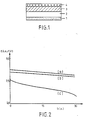
- Figure 1 is a schematic view of a cell according to the invention.
- FIG. 2 illustrates the evolution of the fem expressed in volts (V) as a function of time in cells produced according to the invention, comparative ment to a cell not comprising the improvement according to the invention.
- the positive electrode has been designated by the reference 1, the electrolyte by the reference 2, the negative electrode by the reference 3 and finally the pyrotechnic composition by the reference 4.
Landscapes
- Chemical & Material Sciences (AREA)
- Chemical Kinetics & Catalysis (AREA)
- Electrochemistry (AREA)
- General Chemical & Material Sciences (AREA)
- Crystallography & Structural Chemistry (AREA)
- Inorganic Chemistry (AREA)
- Engineering & Computer Science (AREA)
- Manufacturing & Machinery (AREA)
- Primary Cells (AREA)
- Battery Electrode And Active Subsutance (AREA)
Description
- La présente invention se rapporte aux améliorations de fonctionnement des piles thermiques à cathode de chromate de calcium CaCr04, principalement à une augmentation de la force électromotrice (f.e.m.) et à une meilleure stabilité de cette dernière au cours du temps.
- Dans la présente description, on désigne par pile thermique, un générateur électrochimique comprenant une électrode positive et une électrode négative entre lesquelles est disposée une couche d'un électrolyte solide généralement constitué d'un sel minéral fusible non conducteur à température ambiante, mais devenant conducteurs lors de sa fusion par chauffage produisant alors de l'électricité par des réactions électrochimiques entre l'anode et la cathode.
- On entend plus généralement par « batterie thermique » tout ensemble comprenant plusieurs générateurs électrochimiques du type ci-dessus rappelé reliés en parallèle ou en série, des moyens capables de produire la chaleur nécessaire à l'échauffement desdits générateurs et les éventuels moyens d'isolation thermique assurant le maintien d'une température convenable pendant au moins la durée de fonctionnement.
- Ces batteries thermiques sont utilisées comme source d'énergie dans de nombreuses applications, notamment celles nécessitant de longues durées de stockage.
- De nombreux systèmes électrochimiques sont employés dans les piles thermiques. Le choix de la cathode est l'un des facteurs déterminant la f.e.m. de la pile. Les composés les plus fréquem- ment utilisés sont les polysulfures (sulfure de fer FeS et FeS2, ou de titane TiS2) les oxydes supérieurs (oxydes de tungstène W03. oxyde de fer aFe203, pentoxyde de vanadium V205) ou le chromate de calcium CaCr04.
- A titre d'exemple, on citera les articles : de A. Nissen « A study of the anode - Electrolyte interface in a thermal battery », J. Electrochem. Soc., 126, (1979), 176, dans lequel est décrite une cellule de pile thermique composée d'une anode de calcium, déposé par évaporation sur un disque de fer, d'un disque d'électrolyte (eutectique LiCI-KCI 56 % masse) contenant un gélifiant (Si02 7 % masse) et le dépolarisant (CaCr04 37 % masse) et d'un disque de fer servant de collecteur de courant ;
- de H. M. Thackeray et J. Coetzer, « a preliminary investigation of the electrochemical performance of aFe203 and Fe304 - Cathodes in high temperature cells » Mat. Res. Bull., 16, (1981), 591 décrivent des piles à électrolyte fondu (eutectique LiCI KCI), dont la cathode est constituée par un mélange d'oxyde de fer aFe203 et de poudre conductrice de graphite ; et
- de Z. Tomczuk et al. « Evaluation of high temperature LiAl/TiS2 Cells » J. Electrochem. Soc., 127 (1980), 1881 qui décrit une cellule de pile thermique à électrolyte fondu (eutectique LiCI KCI) dont la cathode est à base de sulfure de titane TiS2.
- Dans le cas des piles thermiques à chromate de calcium CaCr04, celui-ci est soit l'un des constituants d'une pastille contenant en outre l'électrolyte fusible et le gélifiant, soit aggloméré sur un collecteur de courant. L'électrolyte est un mélange de chlorures alcalins, plus particulièrement l'eutectique LiCI KCI. L'espace interélectrodes est maintenu constant par une trame isolante qui retient l'eutectique lorsqu'il est fondu ou par adjonction d'un gélifiant.
- Malheureusement dans les piles thermiques à chromate de calcium, la réduction de l'électrode positive en oxyde de chrome Cr203 entraîne une augmentation de la concentration d'ions oxyde 02― au sein de l'électrode. Cette augmentation provoque une baisse de la f.e.m. puisque le potentiel du système électrochimique Cr (lll)/Cr (VI), est proportionnel au cologarithme de la concentration d'ions 02-.
- Or le but de l'invention est de stabiliser la f.e.m. de la pile thermique au cours de la décharge et d'améliorer sa valeur.
- Selon la présente invention, ce but est atteint par adjonction d'un tampon d'ions oxyde dans l'eutectique LiCI KCI. Ce tampon d'ions 02- est le couple oxoacide-oxobase chromate de cal- cium/bichromate de calcium. On constate alors, grâce à cette adjonction que la concentration d'ions 02- est constante dans l'eutectique LiCI KCI ; que la f.e.m. de la pile est stable ; que cette concentration est plus faible puisqu'un oxoacide est ajouté ; et que la f.e.m. est plus élevée.
- Suivant une forme de réalisation avantageuse, la cellule unitaire comprend :
- une électrode négative en calcium fixé à un collecteur en nickel ou acier inoxydable ;
- un électrolyte LiCI-KCI en mélange eutectique retenu dans l'espace interélectrodes par l'intermédiaire d'un gel ou d'une maille inerte ;
- une électrode positive constituée d'un mélange homogène d'électrolyte, de chromate de calcium et de bichromate de calcium.
- De façon plus particulière l'électrode positive est constituée d'un mélange homogène de composition massique : électrolyte 33 %, chromate de calcium-bichromate de calcium 67 %.
- Le rapport de bichromate de calcium sur chromate de calcium peut être compris entre 1 et 5.
- Une telle cellule est activée thermiquement par l'intermédiaire d'un mélange pyrotechnique à base de zirconium et de chromate de baryum BaCr04.
- Les autres caractéristiques et avantages de l'invention ressortiront plus clairement de la description qui va suivre faite en regard des dessins annexés sur lesquels :
- la figure 1 est une vue schématique d'une cellule selon l'invention ; et
- la figure 2 illustre l'évolution de la f.e.m. exprimée en volts (V) en fonction du temps dans des cellules réalisées selon l'invention, comparativement à une cellule ne comportant pas le perfectionnement selon l'invention.
- En se référant à la figure 1. on a désigné par la référence 1 l'électrode positive, par la référence 2 l'électrolyte, par la référence 3 l'électrode négative et enfin par la référence 4 la composition pyrotechnique.
- Pour évaluer les possibilités qu'offre une telle cellule, on l'a branchée, dès activation, à un dispositif électrique tel que le débit soit de 200 mAlcm2 d'électrode.
- Les courbes de la figure 2 représentent l'évolution de la f.e.m. dans chacun des trois cas suivants :
- c) cellule de référence sans ajout de CaCr20,, (1/3 électrolyte, 2/3 CaCr04)
- b) cellule obtenue en remplaçant les deux tiers du chromate de calcium par le bichromate de calcium, (1/6 CaCr04-1/2 CaCr207)
- a) cellule obtenue en remplaçant la moitié du chromate de calcium par le bichromate de calcium, (1/3 CaCr04-1/3 CaCr207).
- A l'examen de ces courbes, on voit immédiatement que la f.e.m. est plus élevée dans les cas (a) et (b) et que cette f.e.m. est stabilisée comparativement aux cas (c).
- Il va du reste de soi que la présente invention n'a été décrite qu'à titre purement explicatif et nullement limitatif.
Claims (2)
Applications Claiming Priority (2)
| Application Number | Priority Date | Filing Date | Title |
|---|---|---|---|
| FR8216288 | 1982-09-28 | ||
| FR8216288A FR2533760A1 (fr) | 1982-09-28 | 1982-09-28 | Perfectionnement apporte aux piles thermiques a cathode de chromate de calcium |
Publications (2)
| Publication Number | Publication Date |
|---|---|
| EP0105798A1 EP0105798A1 (fr) | 1984-04-18 |
| EP0105798B1 true EP0105798B1 (fr) | 1987-05-06 |
Family
ID=9277801
Family Applications (1)
| Application Number | Title | Priority Date | Filing Date |
|---|---|---|---|
| EP19830401902 Expired EP0105798B1 (fr) | 1982-09-28 | 1983-09-28 | Perfectionnement apporté aux piles thermiques à cathode de chromate de calcium |
Country Status (3)
| Country | Link |
|---|---|
| EP (1) | EP0105798B1 (fr) |
| DE (1) | DE3371447D1 (fr) |
| FR (1) | FR2533760A1 (fr) |
Families Citing this family (2)
| Publication number | Priority date | Publication date | Assignee | Title |
|---|---|---|---|---|
| US6622663B2 (en) | 2001-03-27 | 2003-09-23 | Exxonmobil Research And Engineering Company | Fuel composition supply means for driving cycle conditions in spark ignition engines |
| CN111477898B (zh) * | 2020-04-24 | 2021-03-23 | 贵州梅岭电源有限公司 | 一种热电池用加热材料及其制备方法 |
Family Cites Families (4)
| Publication number | Priority date | Publication date | Assignee | Title |
|---|---|---|---|---|
| US4041217A (en) * | 1964-06-23 | 1977-08-09 | Catalyst Research Corporation | Thermal battery with metal-metal oxide heating composition |
| GB1286537A (en) * | 1968-09-16 | 1972-08-23 | Eagle Picher Ind Inc | Thermal battery |
| US3658592A (en) * | 1970-07-15 | 1972-04-25 | Mallory & Co Inc P R | Lithium-metal chromate organic electrolyte cell |
| JPS541889B2 (fr) * | 1973-08-09 | 1979-01-30 |
-
1982
- 1982-09-28 FR FR8216288A patent/FR2533760A1/fr active Granted
-
1983
- 1983-09-28 EP EP19830401902 patent/EP0105798B1/fr not_active Expired
- 1983-09-28 DE DE8383401902T patent/DE3371447D1/de not_active Expired
Also Published As
| Publication number | Publication date |
|---|---|
| DE3371447D1 (en) | 1987-06-11 |
| FR2533760A1 (fr) | 1984-03-30 |
| FR2533760B1 (fr) | 1985-02-15 |
| EP0105798A1 (fr) | 1984-04-18 |
Similar Documents
| Publication | Publication Date | Title |
|---|---|---|
| US4002492A (en) | Rechargeable lithium-aluminum anode | |
| US5523179A (en) | Rechargeable positive electrode | |
| US5536600A (en) | Li-alloy electrode for Li-alloy/metal sulfide cells | |
| Gay et al. | Performance Characteristics of Solid Lithium‐Aluminum Alloy Electrodes | |
| US3930888A (en) | Molten metal anode | |
| US4268587A (en) | Solid state, ambient temperature electrochemical cell | |
| CA2305454A1 (fr) | Batteries d'accumulateurs soufre-lithium a electrolytes liquides | |
| JPS5948512B2 (ja) | 遷移金属カルコゲン化物の陽極を備えたリチウム−溶融塩電池 | |
| US4840859A (en) | Thermal battery | |
| WO2008012776A2 (fr) | Pile | |
| US5085955A (en) | Non-aqueous electrochemical cell | |
| CA1077562A (fr) | Electrodes pour accumulateur | |
| US5534367A (en) | Molten salt electrolyte separator | |
| CA1045680A (fr) | Electrode au lithium-silicium pour cellule rechargeable | |
| US5004657A (en) | Battery | |
| US3891460A (en) | Thermal battery and molten metal anode therefore | |
| US3506492A (en) | Solid electrolyte battery having lithium or lithium alloy anode | |
| US4117207A (en) | Molybdenum chloride-tetrachloroaluminate thermal battery | |
| US4844996A (en) | Lithium cell | |
| Licht et al. | A high energy and power novel aluminum/nickel battery | |
| US3506490A (en) | Solid electrolyte battery having lithium or lithium alloy anode | |
| GB1603154A (en) | Electrochemical cells with solid electrolytes and electrodes | |
| JP3777582B2 (ja) | 熱電池 | |
| US3811947A (en) | Electrical energy storage device utilizing an electrode composed of an amorphous carbon and sulfur-carbon complex | |
| CA2024986A1 (fr) | Pile thermique a electrode composee |
Legal Events
| Date | Code | Title | Description |
|---|---|---|---|
| PUAI | Public reference made under article 153(3) epc to a published international application that has entered the european phase |
Free format text: ORIGINAL CODE: 0009012 |
|
| AK | Designated contracting states |
Designated state(s): DE GB IT NL SE |
|
| 17P | Request for examination filed |
Effective date: 19840519 |
|
| ITF | It: translation for a ep patent filed | ||
| GRAA | (expected) grant |
Free format text: ORIGINAL CODE: 0009210 |
|
| AK | Designated contracting states |
Kind code of ref document: B1 Designated state(s): DE GB IT NL SE |
|
| REF | Corresponds to: |
Ref document number: 3371447 Country of ref document: DE Date of ref document: 19870611 |
|
| PLBE | No opposition filed within time limit |
Free format text: ORIGINAL CODE: 0009261 |
|
| STAA | Information on the status of an ep patent application or granted ep patent |
Free format text: STATUS: NO OPPOSITION FILED WITHIN TIME LIMIT |
|
| 26N | No opposition filed | ||
| ITTA | It: last paid annual fee | ||
| EAL | Se: european patent in force in sweden |
Ref document number: 83401902.8 |
|
| PGFP | Annual fee paid to national office [announced via postgrant information from national office to epo] |
Ref country code: GB Payment date: 19950824 Year of fee payment: 13 |
|
| PGFP | Annual fee paid to national office [announced via postgrant information from national office to epo] |
Ref country code: SE Payment date: 19950927 Year of fee payment: 13 |
|
| PGFP | Annual fee paid to national office [announced via postgrant information from national office to epo] |
Ref country code: NL Payment date: 19950929 Year of fee payment: 13 |
|
| PGFP | Annual fee paid to national office [announced via postgrant information from national office to epo] |
Ref country code: DE Payment date: 19951113 Year of fee payment: 13 |
|
| PG25 | Lapsed in a contracting state [announced via postgrant information from national office to epo] |
Ref country code: GB Effective date: 19960928 |
|
| PG25 | Lapsed in a contracting state [announced via postgrant information from national office to epo] |
Ref country code: SE Effective date: 19960929 |
|
| PG25 | Lapsed in a contracting state [announced via postgrant information from national office to epo] |
Ref country code: NL Effective date: 19970401 |
|
| GBPC | Gb: european patent ceased through non-payment of renewal fee |
Effective date: 19960928 |
|
| NLV4 | Nl: lapsed or anulled due to non-payment of the annual fee |
Effective date: 19970401 |
|
| PG25 | Lapsed in a contracting state [announced via postgrant information from national office to epo] |
Ref country code: DE Effective date: 19970603 |
|
| EUG | Se: european patent has lapsed |
Ref document number: 83401902.8 |