EP0105201B1 - Chelate resins, process for their production and their use - Google Patents
Chelate resins, process for their production and their use Download PDFInfo
- Publication number
- EP0105201B1 EP0105201B1 EP83108599A EP83108599A EP0105201B1 EP 0105201 B1 EP0105201 B1 EP 0105201B1 EP 83108599 A EP83108599 A EP 83108599A EP 83108599 A EP83108599 A EP 83108599A EP 0105201 B1 EP0105201 B1 EP 0105201B1
- Authority
- EP
- European Patent Office
- Prior art keywords
- group
- resin
- formula
- hydroxylamine
- chelate
- Prior art date
- Legal status (The legal status is an assumption and is not a legal conclusion. Google has not performed a legal analysis and makes no representation as to the accuracy of the status listed.)
- Expired
Links
Classifications
-
- B—PERFORMING OPERATIONS; TRANSPORTING
- B01—PHYSICAL OR CHEMICAL PROCESSES OR APPARATUS IN GENERAL
- B01J—CHEMICAL OR PHYSICAL PROCESSES, e.g. CATALYSIS OR COLLOID CHEMISTRY; THEIR RELEVANT APPARATUS
- B01J45/00—Ion-exchange in which a complex or a chelate is formed; Use of material as complex or chelate forming ion-exchangers; Treatment of material for improving the complex or chelate forming ion-exchange properties
-
- C—CHEMISTRY; METALLURGY
- C08—ORGANIC MACROMOLECULAR COMPOUNDS; THEIR PREPARATION OR CHEMICAL WORKING-UP; COMPOSITIONS BASED THEREON
- C08F—MACROMOLECULAR COMPOUNDS OBTAINED BY REACTIONS ONLY INVOLVING CARBON-TO-CARBON UNSATURATED BONDS
- C08F8/00—Chemical modification by after-treatment
- C08F8/30—Introducing nitrogen atoms or nitrogen-containing groups
-
- C—CHEMISTRY; METALLURGY
- C08—ORGANIC MACROMOLECULAR COMPOUNDS; THEIR PREPARATION OR CHEMICAL WORKING-UP; COMPOSITIONS BASED THEREON
- C08F—MACROMOLECULAR COMPOUNDS OBTAINED BY REACTIONS ONLY INVOLVING CARBON-TO-CARBON UNSATURATED BONDS
- C08F8/00—Chemical modification by after-treatment
- C08F8/30—Introducing nitrogen atoms or nitrogen-containing groups
- C08F8/32—Introducing nitrogen atoms or nitrogen-containing groups by reaction with amines
-
- C—CHEMISTRY; METALLURGY
- C08—ORGANIC MACROMOLECULAR COMPOUNDS; THEIR PREPARATION OR CHEMICAL WORKING-UP; COMPOSITIONS BASED THEREON
- C08F—MACROMOLECULAR COMPOUNDS OBTAINED BY REACTIONS ONLY INVOLVING CARBON-TO-CARBON UNSATURATED BONDS
- C08F2810/00—Chemical modification of a polymer
- C08F2810/20—Chemical modification of a polymer leading to a crosslinking, either explicitly or inherently
Definitions
- This invention relates to chelate resins and a process for producing the same and their use for removing metal ions from liquids containing metal ions.
- Chelate resins are very useful for the purification of industrial water, the treatment of waste water, the recovery of valuable metal elements, and the like because when they are used, metal ions can selectively be removed from a liquid containing the metal ions.
- a resin having amidoxime groups is produced by reacting a resin having nitrile groups with hydroxylamine DE-B 1 050 055 and/or a derivative thereof.
- the resulting compound can be further treated with another base, e.g. diethylamine or ethylendiamine (DE-B 1 130 593).
- DE-B 1 130 593 another base
- the thus obtained resin satisfactorily adsorbs metal ions such as uranium, gold, iron, mercury, copper, lead and the like (US-A-3,088,799, JP-A-53,593n6, and 126,088/78).
- said chelate resin has small adsorption capacity and is desired to be improved in this point.
- a process for producing a chelate resin having amidoxime groups by subjecting to polymerization a monomer mixture comprising a crosslinking agent selected from the group consisting of polyacrylates of polyalkylene polyols whose alkylene groups have 2 to 4 carbon atoms, and polymethacrylates of said polyols, and an ethylenically unsaturated compound having one or more nitrile groups, and then reacting the resulting polymer with hydroxylamine (JP-A-53,106/81).
- a crosslinking agent selected from the group consisting of polyacrylates of polyalkylene polyols whose alkylene groups have 2 to 4 carbon atoms, and polymethacrylates of said polyols, and an ethylenically unsaturated compound having one or more nitrile groups
- the improved chelate resin described above has an improved metal ion adsorption rate as compared with conventional resins having amidoxime groups but does not always have a sufficiently improved adsorption capacity for metal ions. Therefore, when a large amount of a liquid is subjected to adsorption treatment, the improved chelate resin is disadvantageous, for example, in that the amount treated per unit time decreases, that many treating apparatuses are needed, and that the construction and operation costs increase.
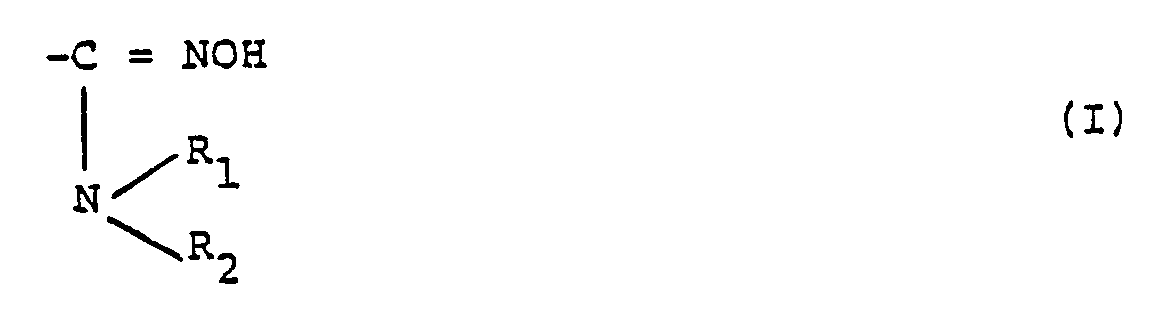
- R 1 and R 2 are each independently a hydrogen atom, an alkyl group, an aminoalkyl group or a phenyl group and functional groups represented by the formula: wherein R 3 is an amino group or a substituted amino group, e.g. an alkylamino group,
- This invention further provides a process for producing the above-mentioned chelate resin, which comprises reacting a resin having nitrile groups with a mixture of hydroxylamine and/or its derivative and an amino compound other than hydroxylamine and/or its derivative (hereinafter referred to merely as "the amino compound").
- the chelate resin of this invention having in its resin substrate functional groups represented by the formula: and functional groups represented by the formula: is characterized in that it has much larger metal ion adsorption ability than the well-known chelate resins having only amidoxime groups.
- R 3 is an amino group, a hydrazino group, an alkylamino group having 1 to 4 carbon atoms, or a polyethylenepolyamino group having 2 to 10 carbon atoms and 2 to 6 nitrogen atoms.
- R, and R 2 are each a hydrogen atom and R 3 is a hydrazino group or a polyethylenepolyamino group having 2 to 10 carbon atoms and 2 to 6 nitrogen atoms is particularly preferred.
- the equivalent ratio between the functional groups represented by each of the general formulas (I) and (II), i.e., (11)/(1), is 0.1 to 1.
- the equivalent ratio is less than 0.1, the effect of improving the adsorption ability for metal ions is insufficient.
- the equivalent ratio is usually adjusted to 1 or less.
- the chelate resin of this invention can be produced by reacting a resin having nitrile groups with a mixture of hydroxylamine and/or its derivative and the amino compound.
- the following polymers, copolymers and resins can be usually used:
- vinyl cyanide series monomer such as acrylonitrile, methacrylonitrile, ethacrylonitrile, fumarylonitrile or vinylidene cyanide, or copolymers of any of these vinyl cyanide series monomers and divinylbenzene, diethylene glycol dimethacrylate, ethylene glycol dimethacrylate, polyethylene glycol dimethacrylate, vinyl acetate or the like.
- the resin having nitrile groups is not particularly limited in its polymerization degree so long as it is insoluble in water, though in general, those having a polymerization degree of about 500 or more are preferably used.
- resins in any of powder form, fiber form, honeycomb form, particle form, spherical form and liquid form may be used, and the form may properly be selected depending on purposes, though in general, spherical or powdery resins are preferably used from the viewpoint of handling.
- any one may be used so long as it reacts with the nitrile groups to form amidoxime groups represented by the formula (I).
- hydroxylamine and/or derivatives thereof there are exemplified hydroxylamine, N-methylhydroxylamine, N-ethylhydroxylamine, N-aminomethylhydroxylamine, and their hydrochlorides, sulfates, and nitrates.
- any one may be used so long as it reacts with the nitrile groups, has such basicity that it can react with acid ions in a liquid to form a salt, and forms a complex with a metal ion.
- amines such as ammonia, methylamine, ethylamine, propylamine, butylamine and the like
- hydrazine and its derivatives such as hydrazine, hydrazine hydrate, phenylhydrazine, p-hydrazinophenol, 1-aminopiperazine, N-methylhydrazine, hydrazinoethanol, semicarbazide
- amidine and its derivatives such as acetamidine, hexaneamidine, guanidine and its derivatives such as guanidine, biguanide, 1,3-dimethylguanidine, 1,1,2-trimethylguanidine
- amidoxime and its derivatives such as formamidoxime, acetamidoxime, N-methylacetamidoxime
- amidrazone and its derivatives such as benzamide hydrazone, benzaldehyde hydrazone
- polyethylenepolyamines and their derivatives such as ethylened
- the reaction of the resin having nitrile groups with the hydroxylamine and/or its derivative and the amino compound is effected by a method wherein the resin having nitrile groups is reacted with hydroxylamine and/or its derivative and the amino compound which coexist with each other, to form functional groups of each of the formulas (I) and (II) at the same time.
- the reaction of the resin having nitrile groups with hydroxylamine and/or its derivative and the amino compound can be effected at ordinary temperatures (about 20°C) to 150°C, preferably at 50° to 120°C in the absence of a solvent or in the presence of a solvent.
- the solvent are water, methanol, ethanol, propanol, butanol, N,N-dimethylformamide, formamide, N,N-dimethyl sulfoxide, toluene, xylene, carbon tetrachloride, 1,2-dichloroethane and the like.
- reaction temperature When the reaction temperature is lower than ordinary temperatures, the reaction rate decreases, so that the reaction must be effected for a long time, and when the reaction temperature is higher than about 150°C, a phenomenon of the decomposition of the formed functional groups occurs. Therefore, such reaction temperatures are not preferable.
- the reaction is effected at the temperature described above, usually for about 0.1 to 24 hours, preferably for 0.5 to 6 hours. But a still longer reaction time may be used. Although the reaction is usually effected at atmospheric pressure, it may be effected under pressure.
- the reaction proportions of the hydroxylamine and/or the derivative thereof and of the amino compound to the resin having nitrile groups it is sufficient that the hydroxylamine and/or the derivative thereof and the amino compound are used in amounts of 1/5 mole or more and 1/20 mole or more, respectively, per equivalent of the nitrile groups in the resin.
- the hydroxylamine and/or the derivative thereof and the amino compound are preferably used in amounts in the ranges from 2/5 to 10 moles and from 1/10 to 3 moles, respectively, per equivalent of the nitrile groups in the resin.
- reaction proportions of the hydroxylamine and/or the derivative thereof and of the amino compound to the resin having nitrile groups are smaller than those described above, the amounts of chelate-forming functional groups introduced decreases, so that the metal absorption capacity of the resulting reaction product chelate resin decreases. Therefore, it is not desirable.
- the hydroxylamine and/or the derivative thereof used in the above-mentioned reaction is a salt with hydrochloric acid, sulfuric acid, nitric acid, phosphoric acid, acetic acid or the like
- the resin having nitrile groups is reacted with the hydroxylamine derivative and the amino compound in the presence, in the reaction system, of the same amount as said salt or more of sodium hydroxide, potassium hydroxide, a tertiary amine such as trimethylamine, triethylamine, pyridine, N,N-dimethylaniline or the like, or the aforesaid amino compound.
- reaction product produced in the manner described above may be used as a chelate resin as it is or after being washed and then dried.
- the chelate resin produced by the process of this invention contains groups of each of the formula (I) and the formula (II) as main functional groups, and although the reason why the chelate resin produced by the process of this invention has a higher adsorption rate and a larger adsorption capacity than those of the heretofore well-known amidoxime type chelate resins is not apparent, it is presumed to be as follows.
- the reason is thought to be that in the reaction of the resin having nitrile groups with the hydroxylamine and/or the derivative thereof and the amino compound, owing to the electrical interaction between the amino compound and the nitrile groups in the resin, the reactivity of the hydroxylamine and/or the derivative thereof with the nitrile groups is improved as compound with that in a system free from the amino compound, resulting in an increase of the amount introduced of the functional group represented by the formula (I), and that owing to the interaction between the functional group represented by the formula (11), which is formed by the reaction of the nitrile groups with the amino compound, and the functional group represented by the formula (I), the chelate adsorption ability is increased as compared with that in the case where the functional group of the formula (I) alone is present.
- the chelate resin produced by the process of this invention can very effectively be utilized for the adsorption and removal of metal ions such as uranium, gallium, indium, copper, iron, mercury, lead and the like.
- a resin having nitrile groups i.e. an acrylonitrile-divinylbenzene copolymer having a degree of crosslinking of 10 mole% and a particle size of 20 to 50 mesh were added 139 parts of hydroxylamine hydrochloride, 100 parts of hydrazine hydrate and 300 parts of water.
- the resulting mixture was reacted at 90° to 107°C for 4 hours, followed by filtration and washing, to obtain 169 parts by weight (undried) of a chelate resin.
- the chelate resin obtained there were detected a functional group in an amount of 6.0 mole/liter resin and a functional group in an amount of 1.8 mole/liter resin.
- a reaction was effected in the same manner as in Example 1, except that the hydrazine hydrate, i.e., the amino compound used in Example 1 and the used amount thereof were replaced by the individual amino compounds and amounts shown in Table 1, to synthesize a chelate resin.
- the thus obtained chelate resins were subjected to performance characteristic tests. The results are shown in Table 1.
- a resin having nitrile groups i.e., vinylidene cyanide-divinylbenzene having a degree of crosslinking of 8 mole% and a particle size of 20 to 50 mesh were added 164 parts of hydroxylamine sulfate, 267 parts of a 30% aqueous sodium hydroxide solution and 103 parts of diethylenetriamine.
- the resulting mixture was reacted at 90° to 103°C for 2 hours, followed by filtration and washing, to obtain 284 parts (undried) of a chelate resin.
- the chelate resin obtained there were detected a functional group in an amount of 9.8 mole/liter resin, and a functional group in an amount of 3.0 mole/liter resin.
- Performance characteristic tests on the resin obtained were carried out by the same methods as in Example 1 to find that the Ga concentration in the aqueous layer was 3 ppm and the U concentration therein 5 ppm.
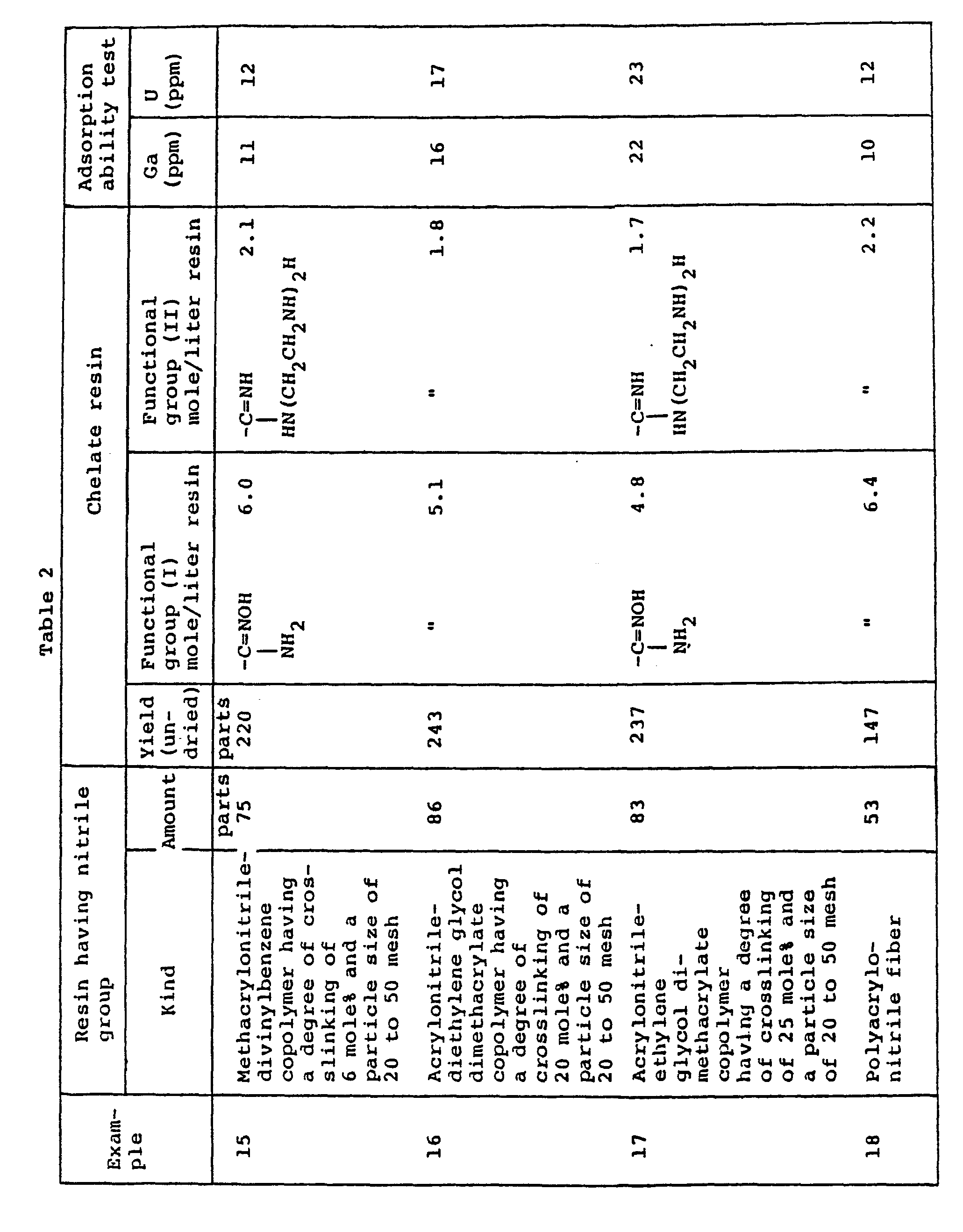
- a reaction was effected in the same manner as in Example 14, except that the kind and amount of the resin having nitrile groups were replaced by the individual resins and amounts shown in Table 2, to synthesize a chelate resin.
- the thus obtained chelate resins were subjected to performance characteristic tests. The results are shown in Table 2.
- a resin having nitrile groups i.e., an acrylonitrile-divinylbenzene copolymer having a degree of crosslinking of 10 mole% and a particle size of 20 to 50 mesh were added 94 parts of N-methylhydroxylamine, 50 parts of hydrazine hydrate and 400 parts of water.
- the resulting mixture was reacted at 70 to 103°C for 6 hours, followed by filtration and washing to obtain 224 parts (undried) of a chelate resin.
- the chelate resin obtained there were detected a functional group in an amount of 5.3 mole/liter resin, and a functional group in an amount of 2.3 mole/liter resin.
- Performance characteristic tests on the resin obtained were carried out by the same methods as in Example 1 to find that the Ga concentration in the aqueous layer was 18 ppm and the U concentration therein 23 ppm.
- Example 19 A reaction was effected in the same manner as in Example 19, except that the kinds and amounts of the hydroxylamine derivative and the amino compound used in Example 19 were changed as shown in Table 3, to synthesize a chelate resin.
- the thus obtained chelate resins were subjected to performance characteristic tests. The results are shown in Table 3.
- Example 2 A reaction was effected in the same manner as in Example 1, except that the hydrazine hydrate used in Example 1 was replaced by 80 parts of sodium hydroxide, to synthesize a chelate resin. As a result, 147 parts (undried) of the chelate resin was obtained. In the chelate resin obtained, there was detected a functional group
- a reaction was effected in the same manner as in Example 14, except that 86 parts of an acrylonitrile- diethylene glycol dimethacrylate polymer having a degree of crosslinking of 20 mole% and a particle size of 20 to 50 mesh was used as a resin having nitrile groups and that 103 parts of the diethylenetriamine was omitted, to synthesize a chelate resin. As a result, 211 parts (undried) of the chelate resin was obtained. The chelate resin obtained contained a functional group in an amount of 1.9 mole/liter resin. Performance characteristic tests on the chelate resin obtained were carried out by the same methods as in Example 1 to find that the concentration of Ga remaining in the aqueous layer was 93 ppm and the U concentration 32 ppm.
- Adsorption capacity tests on Duolite CS-346 (manufactured by Diamond Shamrock Corp.), a commercially available chelate resin having amidoxime groups were carried out by the same methods as in Example 1 to find that the concentration of Ga remaining in the aqueous layer was 114 ppm and the U concentration 37 ppm.
Landscapes
- Chemical & Material Sciences (AREA)
- Chemical Kinetics & Catalysis (AREA)
- Organic Chemistry (AREA)
- General Chemical & Material Sciences (AREA)
- Health & Medical Sciences (AREA)
- Medicinal Chemistry (AREA)
- Polymers & Plastics (AREA)
- Addition Polymer Or Copolymer, Post-Treatments, Or Chemical Modifications (AREA)
- Manufacture Of Macromolecular Shaped Articles (AREA)
Description
- This invention relates to chelate resins and a process for producing the same and their use for removing metal ions from liquids containing metal ions.
- Chelate resins are very useful for the purification of industrial water, the treatment of waste water, the recovery of valuable metal elements, and the like because when they are used, metal ions can selectively be removed from a liquid containing the metal ions.
- It has heretofore been well known that a resin having amidoxime groups is produced by reacting a resin having nitrile groups with hydroxylamine DE-B 1 050 055 and/or a derivative thereof. The resulting compound can be further treated with another base, e.g. diethylamine or ethylendiamine (DE-B 1 130 593). The thus obtained resin satisfactorily adsorbs metal ions such as uranium, gold, iron, mercury, copper, lead and the like (US-A-3,088,799, JP-A-53,593n6, and 126,088/78). However, said chelate resin has small adsorption capacity and is desired to be improved in this point.
- Recently, in order to improve such a disadvantage of said chelate resin, there has been proposed a process for producing a chelate resin having amidoxime groups by subjecting to polymerization a monomer mixture comprising a crosslinking agent selected from the group consisting of polyacrylates of polyalkylene polyols whose alkylene groups have 2 to 4 carbon atoms, and polymethacrylates of said polyols, and an ethylenically unsaturated compound having one or more nitrile groups, and then reacting the resulting polymer with hydroxylamine (JP-A-53,106/81). The improved chelate resin described above has an improved metal ion adsorption rate as compared with conventional resins having amidoxime groups but does not always have a sufficiently improved adsorption capacity for metal ions. Therefore, when a large amount of a liquid is subjected to adsorption treatment, the improved chelate resin is disadvantageous, for example, in that the amount treated per unit time decreases, that many treating apparatuses are needed, and that the construction and operation costs increase.
- In consideration of these circumstances, in order to produce an amidoxime group type chelate resin having an excellent adsorption capacity and a high adsorption rate as compared with well-known amidoxime group type chelate resins, the present inventors have devoted themselves to investigations to accomplish this invention.
- This invention provides a chelate resin having functional groups represented by the formula:

- This invention further provides a process for producing the above-mentioned chelate resin, which comprises reacting a resin having nitrile groups with a mixture of hydroxylamine and/or its derivative and an amino compound other than hydroxylamine and/or its derivative (hereinafter referred to merely as "the amino compound").
- The chelate resin of this invention having in its resin substrate functional groups represented by the formula:


- As the functional groups represented by the formula (II), functional groups in which R3 is an amino group, a hydrazino group, an alkylamino group having 1 to 4 carbon atoms, or a polyethylenepolyamino group having 2 to 10 carbon atoms and 2 to 6 nitrogen atoms, are preferred. Such a combination that R, and R2 are each a hydrogen atom and R3 is a hydrazino group or a polyethylenepolyamino group having 2 to 10 carbon atoms and 2 to 6 nitrogen atoms is particularly preferred.
- The equivalent ratio between the functional groups represented by each of the general formulas (I) and (II), i.e., (11)/(1), is 0.1 to 1. When the equivalent ratio is less than 0.1, the effect of improving the adsorption ability for metal ions is insufficient. On the other hand, even when the equivalent ratio is increased, the effect of improving the adsorption ability for metal ions does not increase proportionately thereto, and therefore the equivalent ratio is usually adjusted to 1 or less.
- The chelate resin of this invention can be produced by reacting a resin having nitrile groups with a mixture of hydroxylamine and/or its derivative and the amino compound.
- As the resin having nitrile groups used in the process of this invention, the following polymers, copolymers and resins can be usually used:
- (D Polymers of a vinyl cyanide series monomer or copolymers of a vinyl cyanide series monomer and an ethylenically unsaturated monomer copolymerizable therewith. Examples of the vinyl cyanide series monomers are acrylonitrile, a-chloroacrylonitrile, vinylidene cyanide, methacrylonitrile, ethacrylonitrile, fumarodinitrile, crotononitrile, 2-cyanoethyl acrylate, 2-cyanoethyl methacrylate and the like. Examples of the ethylenically unsaturated monomer copolymerizable therewith are divinylbenzene, diethylene glycol dimethacrylate, ethylene glycol dimethacrylate, polyethylene glycol dimethacrylate, vinyl acetate or the like.
- (2) Resins obtained by reacting a polymer having an amine-reactive group (hereinafter referred to as "the resin having an amine-reactive group") with a nitrile compound having one or more amino or imino groups. Examples of the amine-reactive group are a chloromethyl group, a sulfonyl chloride group, a carbonyl chloride group, an isocyanate group, an epoxy group, an aldehyde group and the like. Examples of the resins having an amine-reactive group are a styrene-divinylbenzene copolymer, a phenol resin, a polyethylene, a polypropylene, a polyvinyl chloride and the like. Examples of the nitrile compound having one or more amino groups or imino groups are aminoacetonitrile, aminomalononitrile, diaminomaleo- nitrile, dicyandiamide, iminodiacetonitrile, 1-amino-2-cyanoethane, 4-aminobenzonitrile, 1-amino-3-cyano- propane and the like. But, the resin having nitrile groups is not limited to those obtained from the above mentioned nitrile compounds.
- There are particularly preferably used polymers of a vinyl cyanide series monomer such as acrylonitrile, methacrylonitrile, ethacrylonitrile, fumarylonitrile or vinylidene cyanide, or copolymers of any of these vinyl cyanide series monomers and divinylbenzene, diethylene glycol dimethacrylate, ethylene glycol dimethacrylate, polyethylene glycol dimethacrylate, vinyl acetate or the like.
- The resin having nitrile groups is not particularly limited in its polymerization degree so long as it is insoluble in water, though in general, those having a polymerization degree of about 500 or more are preferably used.
- As to the form of the resin having nitrile groups, resins in any of powder form, fiber form, honeycomb form, particle form, spherical form and liquid form may be used, and the form may properly be selected depending on purposes, though in general, spherical or powdery resins are preferably used from the viewpoint of handling.
- As the hydroxylamine and/or the derivative thereof reacted in order to form amidoxime groups in the resin having nitrile groups which are used in practicing the process of this invention, any one may be used so long as it reacts with the nitrile groups to form amidoxime groups represented by the formula (I). As such hydroxylamine and/or derivatives thereof, there are exemplified hydroxylamine, N-methylhydroxylamine, N-ethylhydroxylamine, N-aminomethylhydroxylamine, and their hydrochlorides, sulfates, and nitrates.
- As the amino compound used in order to impart a group of the formula (II) to the chelate resin in practicing the process of this invention, any one may be used so long as it reacts with the nitrile groups, has such basicity that it can react with acid ions in a liquid to form a salt, and forms a complex with a metal ion. As such an amino compound, there are exemplified, amines such as ammonia, methylamine, ethylamine, propylamine, butylamine and the like; hydrazine and its derivatives such as hydrazine, hydrazine hydrate, phenylhydrazine, p-hydrazinophenol, 1-aminopiperazine, N-methylhydrazine, hydrazinoethanol, semicarbazide; amidine and its derivatives such as acetamidine, hexaneamidine, guanidine and its derivatives such as guanidine, biguanide, 1,3-dimethylguanidine, 1,1,2-trimethylguanidine; amidoxime and its derivatives such as formamidoxime, acetamidoxime, N-methylacetamidoxime; amidrazone and its derivatives such as benzamide hydrazone, benzaldehyde hydrazone; and polyethylenepolyamines and their derivatives such as ethylenediamine, diethylenetriamine, triethylenetetramine, tetraethylenepentamine, pentaethylenehexamine, hexamethylenediamine, trimethylenediamine, tetramethylenediamine, pentaethylenediamine and the like.
- The reaction of the resin having nitrile groups with the hydroxylamine and/or its derivative and the amino compound is effected by a method wherein the resin having nitrile groups is reacted with hydroxylamine and/or its derivative and the amino compound which coexist with each other, to form functional groups of each of the formulas (I) and (II) at the same time.
- The reaction of the resin having nitrile groups with hydroxylamine and/or its derivative and the amino compound can be effected at ordinary temperatures (about 20°C) to 150°C, preferably at 50° to 120°C in the absence of a solvent or in the presence of a solvent. Examples of the solvent are water, methanol, ethanol, propanol, butanol, N,N-dimethylformamide, formamide, N,N-dimethyl sulfoxide, toluene, xylene, carbon tetrachloride, 1,2-dichloroethane and the like. When the reaction temperature is lower than ordinary temperatures, the reaction rate decreases, so that the reaction must be effected for a long time, and when the reaction temperature is higher than about 150°C, a phenomenon of the decomposition of the formed functional groups occurs. Therefore, such reaction temperatures are not preferable.
- The reaction is effected at the temperature described above, usually for about 0.1 to 24 hours, preferably for 0.5 to 6 hours. But a still longer reaction time may be used. Although the reaction is usually effected at atmospheric pressure, it may be effected under pressure.
- As to the reaction proportions of the hydroxylamine and/or the derivative thereof and of the amino compound to the resin having nitrile groups, it is sufficient that the hydroxylamine and/or the derivative thereof and the amino compound are used in amounts of 1/5 mole or more and 1/20 mole or more, respectively, per equivalent of the nitrile groups in the resin. However, since the employment of the reactants in larger amounts than are necessary is accompanied by recovery treatment after the reaction and hence makes the treatment procedure troublesome, the hydroxylamine and/or the derivative thereof and the amino compound are preferably used in amounts in the ranges from 2/5 to 10 moles and from 1/10 to 3 moles, respectively, per equivalent of the nitrile groups in the resin. When the reaction proportions of the hydroxylamine and/or the derivative thereof and of the amino compound to the resin having nitrile groups are smaller than those described above, the amounts of chelate-forming functional groups introduced decreases, so that the metal absorption capacity of the resulting reaction product chelate resin decreases. Therefore, it is not desirable.
- When the hydroxylamine and/or the derivative thereof used in the above-mentioned reaction is a salt with hydrochloric acid, sulfuric acid, nitric acid, phosphoric acid, acetic acid or the like, it is sufficient that the resin having nitrile groups is reacted with the hydroxylamine derivative and the amino compound in the presence, in the reaction system, of the same amount as said salt or more of sodium hydroxide, potassium hydroxide, a tertiary amine such as trimethylamine, triethylamine, pyridine, N,N-dimethylaniline or the like, or the aforesaid amino compound.
- The reaction product produced in the manner described above may be used as a chelate resin as it is or after being washed and then dried.
- The chelate resin produced by the process of this invention contains groups of each of the formula (I) and the formula (II) as main functional groups, and although the reason why the chelate resin produced by the process of this invention has a higher adsorption rate and a larger adsorption capacity than those of the heretofore well-known amidoxime type chelate resins is not apparent, it is presumed to be as follows.
- That is to say, the reason is thought to be that in the reaction of the resin having nitrile groups with the hydroxylamine and/or the derivative thereof and the amino compound, owing to the electrical interaction between the amino compound and the nitrile groups in the resin, the reactivity of the hydroxylamine and/or the derivative thereof with the nitrile groups is improved as compound with that in a system free from the amino compound, resulting in an increase of the amount introduced of the functional group represented by the formula (I), and that owing to the interaction between the functional group represented by the formula (11), which is formed by the reaction of the nitrile groups with the amino compound, and the functional group represented by the formula (I), the chelate adsorption ability is increased as compared with that in the case where the functional group of the formula (I) alone is present.
- The chelate resin produced by the process of this invention can very effectively be utilized for the adsorption and removal of metal ions such as uranium, gallium, indium, copper, iron, mercury, lead and the like.
- According to the process of this invention described above in detail, there is such an advantage in that there can be produced a chelate resin having a high adsorption rate and large adsorption capacity as compared with the well-known amidoxime type chelate resins. Accordingly, when the chelate resin obtained by the process of this invention is used, the superficial velocity in column can be increased owing to the high adsorption rate and the large adsorption capacity: therefore said chelate resin is very effective for treating a large amount of a liquid, has advantages of, for example, low construction and operation costs of the treating facilities, and hence has a very high industrial value.
- This invention is further explained below in more detail referring to Examples, wherein all parts and percents are by weight unless otherwise specified.
- To 61 parts of a resin having nitrile groups, i.e. an acrylonitrile-divinylbenzene copolymer having a degree of crosslinking of 10 mole% and a particle size of 20 to 50 mesh were added 139 parts of hydroxylamine hydrochloride, 100 parts of hydrazine hydrate and 300 parts of water. The resulting mixture was reacted at 90° to 107°C for 4 hours, followed by filtration and washing, to obtain 169 parts by weight (undried) of a chelate resin. In the chelate resin obtained, there were detected a functional group


- A reaction was effected in the same manner as in Example 1, except that the hydrazine hydrate, i.e., the amino compound used in Example 1 and the used amount thereof were replaced by the individual amino compounds and amounts shown in Table 1, to synthesize a chelate resin. The thus obtained chelate resins were subjected to performance characteristic tests. The results are shown in Table 1.


- To 82 parts of a resin having nitrile groups, i.e., vinylidene cyanide-divinylbenzene having a degree of crosslinking of 8 mole% and a particle size of 20 to 50 mesh were added 164 parts of hydroxylamine sulfate, 267 parts of a 30% aqueous sodium hydroxide solution and 103 parts of diethylenetriamine. The resulting mixture was reacted at 90° to 103°C for 2 hours, followed by filtration and washing, to obtain 284 parts (undried) of a chelate resin. In the chelate resin obtained, there were detected a functional group

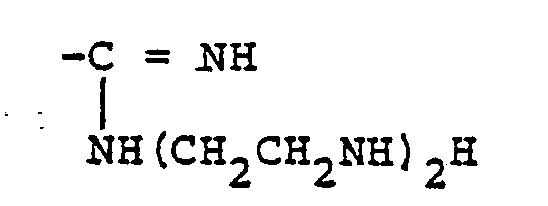
- A reaction was effected in the same manner as in Example 14, except that the kind and amount of the resin having nitrile groups were replaced by the individual resins and amounts shown in Table 2, to synthesize a chelate resin. The thus obtained chelate resins were subjected to performance characteristic tests. The results are shown in Table 2.
- To 67 parts of a resin having nitrile groups, i.e., an acrylonitrile-divinylbenzene copolymer having a degree of crosslinking of 10 mole% and a particle size of 20 to 50 mesh were added 94 parts of N-methylhydroxylamine, 50 parts of hydrazine hydrate and 400 parts of water. The resulting mixture was reacted at 70 to 103°C for 6 hours, followed by filtration and washing to obtain 224 parts (undried) of a chelate resin. In the chelate resin obtained, there were detected a functional group


- A reaction was effected in the same manner as in Example 19, except that the kinds and amounts of the hydroxylamine derivative and the amino compound used in Example 19 were changed as shown in Table 3, to synthesize a chelate resin. The thus obtained chelate resins were subjected to performance characteristic tests. The results are shown in Table 3.

- A reaction was effected in the same manner as in Example 1, except that the hydrazine hydrate used in Example 1 was replaced by 80 parts of sodium hydroxide, to synthesize a chelate resin. As a result, 147 parts (undried) of the chelate resin was obtained. In the chelate resin obtained, there was detected a functional group

- Performance characteristic tests on the chelate resin obtained were carried out by the same methods as in Example 1 to find that the concentration of Ga remaining in the aqueous layer was 89 ppm and the U concentration 34 ppm.
- A reaction was effected in the same manner as in Example 14, except that 86 parts of an acrylonitrile- diethylene glycol dimethacrylate polymer having a degree of crosslinking of 20 mole% and a particle size of 20 to 50 mesh was used as a resin having nitrile groups and that 103 parts of the diethylenetriamine was omitted, to synthesize a chelate resin. As a result, 211 parts (undried) of the chelate resin was obtained. The chelate resin obtained contained a functional group

- Adsorption capacity tests on Duolite CS-346 (manufactured by Diamond Shamrock Corp.), a commercially available chelate resin having amidoxime groups were carried out by the same methods as in Example 1 to find that the concentration of Ga remaining in the aqueous layer was 114 ppm and the U concentration 37 ppm.
- From Examples 1 to 23 and Comparative Examples 1 to 3, it is clear that the chelate resins obtained by effecting the reaction of a resin having nitrile groups with hydroxylamine and/or its derivative according to the process of this invention in the presence of an amino compound have a higher adsorption rate and a larger adsorption capacity for metal ions than those of amidoxime group type chelate resins produced by a well-known process. Thus, the present invention is industrially very useful.
Claims (9)


Applications Claiming Priority (2)
| Application Number | Priority Date | Filing Date | Title |
|---|---|---|---|
| JP153028/82 | 1982-09-01 | ||
| JP57153028A JPS5941307A (en) | 1982-09-01 | 1982-09-01 | Chelate resin and its preparation |
Publications (3)
| Publication Number | Publication Date |
|---|---|
| EP0105201A2 EP0105201A2 (en) | 1984-04-11 |
| EP0105201A3 EP0105201A3 (en) | 1985-05-15 |
| EP0105201B1 true EP0105201B1 (en) | 1988-11-17 |
Family
ID=15553383
Family Applications (1)
| Application Number | Title | Priority Date | Filing Date |
|---|---|---|---|
| EP83108599A Expired EP0105201B1 (en) | 1982-09-01 | 1983-08-31 | Chelate resins, process for their production and their use |
Country Status (4)
| Country | Link |
|---|---|
| US (2) | US4564659A (en) |
| EP (1) | EP0105201B1 (en) |
| JP (1) | JPS5941307A (en) |
| DE (1) | DE3378472D1 (en) |
Cited By (1)
| Publication number | Priority date | Publication date | Assignee | Title |
|---|---|---|---|---|
| US12291458B2 (en) | 2019-11-27 | 2025-05-06 | Wacker Chemie Ag | Method for removing an impurity from a chlorosilane mixture |
Families Citing this family (23)
| Publication number | Priority date | Publication date | Assignee | Title |
|---|---|---|---|---|
| JPS6142335A (en) * | 1984-08-03 | 1986-02-28 | Sumitomo Chem Co Ltd | Eluting method for metal adsorbed by chelating agent |
| JPH0623231B2 (en) * | 1985-08-07 | 1994-03-30 | ミヨシ油脂株式会社 | Process for producing polymer having chelate forming ability |
| EP0285055B1 (en) * | 1987-04-03 | 1992-06-24 | Sumitomo Chemical Company, Limited | Process for recovery of gallium by chelate resin |
| US4879352A (en) * | 1988-12-30 | 1989-11-07 | Polysar Limited | Adducts of an aminoalcohol and nitrile rubber |
| US5252692A (en) * | 1990-11-23 | 1993-10-12 | Kingston Technologies, Inc. | Hydrophilic acrylic copolymers and method of preparation |
| JP2888316B2 (en) * | 1992-10-23 | 1999-05-10 | 日本発条株式会社 | Conductive contact |
| EP0872490B1 (en) * | 1997-04-16 | 2006-05-17 | Sony Corporation | High-molecular flocculant, method for producing the flocculant and water-treatment method employing the flocculant |
| JP3982046B2 (en) | 1997-04-16 | 2007-09-26 | ソニー株式会社 | Polymer flocculant |
| US6248842B1 (en) * | 1999-02-25 | 2001-06-19 | The United States Of America As Represented By The Secretary Of The Navy | Synthetic polymer matrices including pre-organized chelation sites for the selective and reversible binding of metals |
| ES2356474T3 (en) * | 2006-10-26 | 2011-04-08 | Bridgestone Corporation | POLYMER FUNCTIONED WITH HYDRAZINE. |
| US8853352B2 (en) * | 2006-12-20 | 2014-10-07 | Bridgestone Corporation | Functionalized polymer and method for making |
| TW200940706A (en) * | 2007-10-29 | 2009-10-01 | Ekc Technology Inc | Methods of cleaning semiconductor devices at the back end of line using amidoxime compositions |
| US20090111965A1 (en) * | 2007-10-29 | 2009-04-30 | Wai Mun Lee | Novel nitrile and amidoxime compounds and methods of preparation |
| JP2009167036A (en) * | 2008-01-11 | 2009-07-30 | Toagosei Co Ltd | Method for producing high purity alkali metal carbonate aqueous solution |
| WO2010085622A2 (en) | 2009-01-23 | 2010-07-29 | Bridgestone Corporation | Polymers functionalized with nitrile compounds containing a protected amino group |
| RU2543165C2 (en) | 2009-01-23 | 2015-02-27 | Бриджстоун Корпорейшн | Polymers, functionalised with polycyanocompounds |
| US8338544B2 (en) * | 2009-12-21 | 2012-12-25 | Bridgestone Corporation | Polymers functionalized with polyoxime compounds and methods for their manufacture |
| EP2733134A3 (en) * | 2010-04-22 | 2017-10-11 | Pacific Scientific Energetic Materials Company | Alternative to tetrazene |
| US8748531B2 (en) | 2010-12-10 | 2014-06-10 | Bridgestone Corporation | Polymers functionalized with oxime compounds containing an acyl group |
| US8962766B2 (en) | 2011-09-15 | 2015-02-24 | Bridgestone Corporation | Polymers functionalized with polyhydrazone compounds |
| RU2550192C2 (en) * | 2013-08-27 | 2015-05-10 | Федеральное государственное бюджетное образовательное учреждение высшего профессионального образования "Волгоградский государственный технический университет" (ВолгГТУ) | Method of ion-exchange purification of sewage waters and technological solutions from metal ions |
| DE102014203393B4 (en) | 2014-02-25 | 2021-07-29 | Saverio Nobbe | Energetic, thermolabile polymers, processes for their production and their use |
| CN112023884B (en) * | 2019-06-04 | 2022-04-15 | 东北师范大学 | Aminoxime-based porous skeleton material, preparation method thereof and application thereof in adsorption separation of uranium ions |
Family Cites Families (8)
| Publication number | Priority date | Publication date | Assignee | Title |
|---|---|---|---|---|
| US2671076A (en) * | 1951-10-24 | 1954-03-02 | American Cyanamid Co | Polymerizable and polymerized compositions comprising an n-vinyl-n-alkyl guanidine |
| DE1050055B (en) * | 1954-09-24 | 1959-02-05 | Gevaert Photo Prod Nv | Process for modifying high molecular weight organic substances containing nitrile groups using an inorganic nitrogen base |
| BE541496A (en) * | 1955-03-30 | |||
| US3088799A (en) * | 1959-05-25 | 1963-05-07 | Nopco Chem Co | Metal extraction process |
| US3878170A (en) * | 1971-01-18 | 1975-04-15 | American Cyanamid Co | Polymers containing cyclo-1,1-diallylguanidine linkages and wet strength paper having a content thereof |
| JPS4939514B2 (en) * | 1971-08-16 | 1974-10-25 | ||
| FR2327233A1 (en) * | 1975-10-06 | 1977-05-06 | Raffinage Cie Francaise | NEW N-SUBSTITUTED ACRYLAMIDINES, COPOLYMERS OF N-SUBSTITUTED ACRYLAMIDINES AND ACRYLIC AND METHACRYLIC ACID ESTERS AND APPLICATIONS OF SUCH COPOLYMERS |
| US4350801A (en) * | 1981-02-27 | 1982-09-21 | Polaroid Corporation | Process for preparing polymeric oximes |
-
1982
- 1982-09-01 JP JP57153028A patent/JPS5941307A/en active Granted
-
1983
- 1983-08-22 US US06/525,473 patent/US4564659A/en not_active Expired - Fee Related
- 1983-08-31 DE DE8383108599T patent/DE3378472D1/en not_active Expired
- 1983-08-31 EP EP83108599A patent/EP0105201B1/en not_active Expired
-
1985
- 1985-05-28 US US06/738,369 patent/US4605706A/en not_active Expired - Fee Related
Cited By (1)
| Publication number | Priority date | Publication date | Assignee | Title |
|---|---|---|---|---|
| US12291458B2 (en) | 2019-11-27 | 2025-05-06 | Wacker Chemie Ag | Method for removing an impurity from a chlorosilane mixture |
Also Published As
| Publication number | Publication date |
|---|---|
| JPH0428724B2 (en) | 1992-05-15 |
| EP0105201A3 (en) | 1985-05-15 |
| DE3378472D1 (en) | 1988-12-22 |
| US4564659A (en) | 1986-01-14 |
| US4605706A (en) | 1986-08-12 |
| JPS5941307A (en) | 1984-03-07 |
| EP0105201A2 (en) | 1984-04-11 |
Similar Documents
| Publication | Publication Date | Title |
|---|---|---|
| EP0105201B1 (en) | Chelate resins, process for their production and their use | |
| US4039446A (en) | Heavy metal-binding agent process | |
| US4999171A (en) | Process for recovery of gallium by chelate resin | |
| CA1194699A (en) | Method for recovery of gallium | |
| US3766088A (en) | Process for the regeneration of catalyst for hydration of nitrile compounds | |
| MXPA02001050A (en) | Method for preparing highly stabilised hydroxylamine solutions. | |
| JP2579773B2 (en) | Purification method of alkaline solution | |
| US5510097A (en) | Hydroxylammonium nitrate free of ammonium nitrate | |
| US3337630A (en) | Process for the purification of amines | |
| JPH0459326B2 (en) | ||
| NL8102884A (en) | PROCESS FOR PURIFYING AN AQUEOUS ACRYLIC AMIDE SOLUTION. | |
| JPH0689058B2 (en) | Chelate resin | |
| JP2608712B2 (en) | Manufacturing method of chelating resin | |
| CA1308261C (en) | Recovery of gallium | |
| JP2508162B2 (en) | Heavy metal recovery method | |
| JPS621325B2 (en) | ||
| US2999881A (en) | Acrylamide monomer polymerization inhibitor | |
| JPH0429682B2 (en) | ||
| JPS61261215A (en) | Recovery of molyblenum | |
| JPS621571B2 (en) | ||
| JPS60260423A (en) | Method for recovering germanium | |
| JPH0521846B2 (en) | ||
| US2927942A (en) | Stabilization of acrylamide | |
| JPS6011231A (en) | Method for recovering uranium | |
| JPH0651744B2 (en) | Method for producing chelate resin |
Legal Events
| Date | Code | Title | Description |
|---|---|---|---|
| PUAI | Public reference made under article 153(3) epc to a published international application that has entered the european phase |
Free format text: ORIGINAL CODE: 0009012 |
|
| AK | Designated contracting states |
Designated state(s): DE FR GB NL |
|
| PUAL | Search report despatched |
Free format text: ORIGINAL CODE: 0009013 |
|
| AK | Designated contracting states |
Designated state(s): DE FR GB NL |
|
| 17P | Request for examination filed |
Effective date: 19851028 |
|
| 17Q | First examination report despatched |
Effective date: 19861127 |
|
| D17Q | First examination report despatched (deleted) | ||
| GRAA | (expected) grant |
Free format text: ORIGINAL CODE: 0009210 |
|
| AK | Designated contracting states |
Kind code of ref document: B1 Designated state(s): DE FR GB NL |
|
| REF | Corresponds to: |
Ref document number: 3378472 Country of ref document: DE Date of ref document: 19881222 |
|
| ET | Fr: translation filed | ||
| RAP4 | Party data changed (patent owner data changed or rights of a patent transferred) |
Owner name: SUMITOMO CHEMICAL COMPANY, LIMITED |
|
| PLBE | No opposition filed within time limit |
Free format text: ORIGINAL CODE: 0009261 |
|
| STAA | Information on the status of an ep patent application or granted ep patent |
Free format text: STATUS: NO OPPOSITION FILED WITHIN TIME LIMIT |
|
| 26N | No opposition filed | ||
| PGFP | Annual fee paid to national office [announced via postgrant information from national office to epo] |
Ref country code: GB Payment date: 19960822 Year of fee payment: 14 |
|
| PGFP | Annual fee paid to national office [announced via postgrant information from national office to epo] |
Ref country code: FR Payment date: 19960828 Year of fee payment: 14 |
|
| PGFP | Annual fee paid to national office [announced via postgrant information from national office to epo] |
Ref country code: NL Payment date: 19960831 Year of fee payment: 14 |
|
| PGFP | Annual fee paid to national office [announced via postgrant information from national office to epo] |
Ref country code: DE Payment date: 19961030 Year of fee payment: 14 |
|
| PG25 | Lapsed in a contracting state [announced via postgrant information from national office to epo] |
Ref country code: GB Free format text: LAPSE BECAUSE OF NON-PAYMENT OF DUE FEES Effective date: 19970831 |
|
| PG25 | Lapsed in a contracting state [announced via postgrant information from national office to epo] |
Ref country code: NL Free format text: LAPSE BECAUSE OF NON-PAYMENT OF DUE FEES Effective date: 19980301 |
|
| GBPC | Gb: european patent ceased through non-payment of renewal fee |
Effective date: 19970831 |
|
| PG25 | Lapsed in a contracting state [announced via postgrant information from national office to epo] |
Ref country code: FR Free format text: LAPSE BECAUSE OF NON-PAYMENT OF DUE FEES Effective date: 19980430 |
|
| PG25 | Lapsed in a contracting state [announced via postgrant information from national office to epo] |
Ref country code: DE Free format text: LAPSE BECAUSE OF NON-PAYMENT OF DUE FEES Effective date: 19980501 |
|
| NLV4 | Nl: lapsed or anulled due to non-payment of the annual fee |
Effective date: 19980301 |
|
| REG | Reference to a national code |
Ref country code: FR Ref legal event code: ST |