EP0104692B1 - Enclosure member consisting of polyethylene - Google Patents
Enclosure member consisting of polyethylene Download PDFInfo
- Publication number
- EP0104692B1 EP0104692B1 EP83201277A EP83201277A EP0104692B1 EP 0104692 B1 EP0104692 B1 EP 0104692B1 EP 83201277 A EP83201277 A EP 83201277A EP 83201277 A EP83201277 A EP 83201277A EP 0104692 B1 EP0104692 B1 EP 0104692B1
- Authority
- EP
- European Patent Office
- Prior art keywords
- formaldehyde
- resin
- furfuryl alcohol
- weight
- reaction
- Prior art date
- Legal status (The legal status is an assumption and is not a legal conclusion. Google has not performed a legal analysis and makes no representation as to the accuracy of the status listed.)
- Expired
Links
- -1 polyethylene Polymers 0.000 title claims description 19
- 239000004698 Polyethylene Substances 0.000 title claims description 18
- 229920000573 polyethylene Polymers 0.000 title claims description 18
- XPFVYQJUAUNWIW-UHFFFAOYSA-N furfuryl alcohol Chemical compound OCC1=CC=CO1 XPFVYQJUAUNWIW-UHFFFAOYSA-N 0.000 claims abstract description 66
- 229920005989 resin Polymers 0.000 claims abstract description 59
- 239000011347 resin Substances 0.000 claims abstract description 59
- WSFSSNUMVMOOMR-UHFFFAOYSA-N Formaldehyde Chemical compound O=C WSFSSNUMVMOOMR-UHFFFAOYSA-N 0.000 claims abstract description 47
- 239000000203 mixture Substances 0.000 claims abstract description 19
- 238000006243 chemical reaction Methods 0.000 claims abstract description 12
- XSQUKJJJFZCRTK-UHFFFAOYSA-N Urea Chemical compound NC(N)=O XSQUKJJJFZCRTK-UHFFFAOYSA-N 0.000 claims abstract description 7
- 229920000642 polymer Polymers 0.000 claims abstract description 7
- 229920000877 Melamine resin Polymers 0.000 claims abstract description 6
- 239000004202 carbamide Substances 0.000 claims abstract description 6
- 125000004435 hydrogen atom Chemical group [H]* 0.000 claims abstract description 6
- JDSHMPZPIAZGSV-UHFFFAOYSA-N melamine Chemical compound NC1=NC(N)=NC(N)=N1 JDSHMPZPIAZGSV-UHFFFAOYSA-N 0.000 claims abstract description 6
- 239000002904 solvent Substances 0.000 claims abstract description 6
- 239000007787 solid Substances 0.000 claims abstract description 5
- BDHFUVZGWQCTTF-UHFFFAOYSA-N sulfonic acid Chemical compound OS(=O)=O BDHFUVZGWQCTTF-UHFFFAOYSA-N 0.000 claims abstract description 4
- 125000001273 sulfonato group Chemical group [O-]S(*)(=O)=O 0.000 claims abstract description 3
- 239000000446 fuel Substances 0.000 claims abstract 2
- AKEJUJNQAAGONA-UHFFFAOYSA-N sulfur trioxide Chemical compound O=S(=O)=O AKEJUJNQAAGONA-UHFFFAOYSA-N 0.000 claims description 20
- 238000000576 coating method Methods 0.000 claims description 11
- 239000011248 coating agent Substances 0.000 claims description 9
- 238000000034 method Methods 0.000 claims description 8
- 230000008569 process Effects 0.000 claims description 6
- 238000005406 washing Methods 0.000 claims description 4
- 239000007789 gas Substances 0.000 claims description 3
- 239000000243 solution Substances 0.000 claims description 3
- 239000007864 aqueous solution Substances 0.000 claims description 2
- 238000010438 heat treatment Methods 0.000 claims description 2
- 230000005540 biological transmission Effects 0.000 claims 1
- 239000006185 dispersion Substances 0.000 claims 1
- 238000009877 rendering Methods 0.000 claims 1
- 230000035699 permeability Effects 0.000 abstract description 22
- OKTJSMMVPCPJKN-UHFFFAOYSA-N Carbon Chemical compound [C] OKTJSMMVPCPJKN-UHFFFAOYSA-N 0.000 abstract description 3
- 125000003118 aryl group Chemical group 0.000 abstract description 2
- 229910052799 carbon Inorganic materials 0.000 abstract description 2
- WSFSSNUMVMOOMR-NJFSPNSNSA-N methanone Chemical compound O=[14CH2] WSFSSNUMVMOOMR-NJFSPNSNSA-N 0.000 abstract 2
- 125000004432 carbon atom Chemical group C* 0.000 abstract 1
- CTQNGGLPUBDAKN-UHFFFAOYSA-N O-Xylene Chemical compound CC1=CC=CC=C1C CTQNGGLPUBDAKN-UHFFFAOYSA-N 0.000 description 23
- 239000008096 xylene Substances 0.000 description 23
- IJGRMHOSHXDMSA-UHFFFAOYSA-N Atomic nitrogen Chemical compound N#N IJGRMHOSHXDMSA-UHFFFAOYSA-N 0.000 description 12
- QGZKDVFQNNGYKY-UHFFFAOYSA-N Ammonia Chemical compound N QGZKDVFQNNGYKY-UHFFFAOYSA-N 0.000 description 11
- XLYOFNOQVPJJNP-UHFFFAOYSA-N water Substances O XLYOFNOQVPJJNP-UHFFFAOYSA-N 0.000 description 10
- 239000003921 oil Substances 0.000 description 8
- 238000010521 absorption reaction Methods 0.000 description 7
- 229910052757 nitrogen Inorganic materials 0.000 description 6
- 239000003960 organic solvent Substances 0.000 description 6
- 230000004888 barrier function Effects 0.000 description 5
- 230000000052 comparative effect Effects 0.000 description 5
- 238000011109 contamination Methods 0.000 description 5
- 238000002347 injection Methods 0.000 description 5
- 239000007924 injection Substances 0.000 description 5
- LFQSCWFLJHTTHZ-UHFFFAOYSA-N Ethanol Chemical compound CCO LFQSCWFLJHTTHZ-UHFFFAOYSA-N 0.000 description 4
- 229910021529 ammonia Inorganic materials 0.000 description 4
- HEMHJVSKTPXQMS-UHFFFAOYSA-M Sodium hydroxide Chemical compound [OH-].[Na+] HEMHJVSKTPXQMS-UHFFFAOYSA-M 0.000 description 3
- 229920001807 Urea-formaldehyde Polymers 0.000 description 3
- GZCGUPFRVQAUEE-SLPGGIOYSA-N aldehydo-D-glucose Chemical compound OC[C@@H](O)[C@@H](O)[C@H](O)[C@@H](O)C=O GZCGUPFRVQAUEE-SLPGGIOYSA-N 0.000 description 3
- 229920003180 amino resin Polymers 0.000 description 3
- 230000008859 change Effects 0.000 description 3
- 230000004580 weight loss Effects 0.000 description 3
- IMNFDUFMRHMDMM-UHFFFAOYSA-N N-Heptane Chemical compound CCCCCCC IMNFDUFMRHMDMM-UHFFFAOYSA-N 0.000 description 2
- 229910000831 Steel Inorganic materials 0.000 description 2
- 238000007664 blowing Methods 0.000 description 2
- 238000004140 cleaning Methods 0.000 description 2
- 229920001577 copolymer Polymers 0.000 description 2
- 238000005336 cracking Methods 0.000 description 2
- 238000001035 drying Methods 0.000 description 2
- 239000000178 monomer Substances 0.000 description 2
- 125000002924 primary amino group Chemical group [H]N([H])* 0.000 description 2
- 239000000047 product Substances 0.000 description 2
- 230000009467 reduction Effects 0.000 description 2
- 239000010959 steel Substances 0.000 description 2
- 239000003513 alkali Substances 0.000 description 1
- 239000005030 aluminium foil Substances 0.000 description 1
- 239000006227 byproduct Substances 0.000 description 1
- 239000012159 carrier gas Substances 0.000 description 1
- KRVSOGSZCMJSLX-UHFFFAOYSA-L chromic acid Substances O[Cr](O)(=O)=O KRVSOGSZCMJSLX-UHFFFAOYSA-L 0.000 description 1
- 239000003086 colorant Substances 0.000 description 1
- 239000007859 condensation product Substances 0.000 description 1
- 230000006378 damage Effects 0.000 description 1
- 238000007598 dipping method Methods 0.000 description 1
- AWJWCTOOIBYHON-UHFFFAOYSA-N furo[3,4-b]pyrazine-5,7-dione Chemical compound C1=CN=C2C(=O)OC(=O)C2=N1 AWJWCTOOIBYHON-UHFFFAOYSA-N 0.000 description 1
- 238000004817 gas chromatography Methods 0.000 description 1
- 229920001519 homopolymer Polymers 0.000 description 1
- 239000007788 liquid Substances 0.000 description 1
- 230000007774 longterm Effects 0.000 description 1
- 239000010687 lubricating oil Substances 0.000 description 1
- 239000000463 material Substances 0.000 description 1
- 239000010705 motor oil Substances 0.000 description 1
- 238000006386 neutralization reaction Methods 0.000 description 1
- 230000003472 neutralizing effect Effects 0.000 description 1
- 239000012466 permeate Substances 0.000 description 1
- 239000000049 pigment Substances 0.000 description 1
- 238000003860 storage Methods 0.000 description 1
- 238000003466 welding Methods 0.000 description 1
Images


Classifications
-
- C—CHEMISTRY; METALLURGY
- C08—ORGANIC MACROMOLECULAR COMPOUNDS; THEIR PREPARATION OR CHEMICAL WORKING-UP; COMPOSITIONS BASED THEREON
- C08G—MACROMOLECULAR COMPOUNDS OBTAINED OTHERWISE THAN BY REACTIONS ONLY INVOLVING UNSATURATED CARBON-TO-CARBON BONDS
- C08G16/00—Condensation polymers of aldehydes or ketones with monomers not provided for in the groups C08G4/00 - C08G14/00
- C08G16/02—Condensation polymers of aldehydes or ketones with monomers not provided for in the groups C08G4/00 - C08G14/00 of aldehydes
- C08G16/025—Condensation polymers of aldehydes or ketones with monomers not provided for in the groups C08G4/00 - C08G14/00 of aldehydes with heterocyclic organic compounds
- C08G16/0256—Condensation polymers of aldehydes or ketones with monomers not provided for in the groups C08G4/00 - C08G14/00 of aldehydes with heterocyclic organic compounds containing oxygen in the ring
- C08G16/0262—Furfuryl alcohol
-
- C—CHEMISTRY; METALLURGY
- C08—ORGANIC MACROMOLECULAR COMPOUNDS; THEIR PREPARATION OR CHEMICAL WORKING-UP; COMPOSITIONS BASED THEREON
- C08J—WORKING-UP; GENERAL PROCESSES OF COMPOUNDING; AFTER-TREATMENT NOT COVERED BY SUBCLASSES C08B, C08C, C08F, C08G or C08H
- C08J7/00—Chemical treatment or coating of shaped articles made of macromolecular substances
- C08J7/04—Coating
- C08J7/0427—Coating with only one layer of a composition containing a polymer binder
-
- C—CHEMISTRY; METALLURGY
- C08—ORGANIC MACROMOLECULAR COMPOUNDS; THEIR PREPARATION OR CHEMICAL WORKING-UP; COMPOSITIONS BASED THEREON
- C08J—WORKING-UP; GENERAL PROCESSES OF COMPOUNDING; AFTER-TREATMENT NOT COVERED BY SUBCLASSES C08B, C08C, C08F, C08G or C08H
- C08J7/00—Chemical treatment or coating of shaped articles made of macromolecular substances
- C08J7/04—Coating
- C08J7/048—Forming gas barrier coatings
-
- C—CHEMISTRY; METALLURGY
- C08—ORGANIC MACROMOLECULAR COMPOUNDS; THEIR PREPARATION OR CHEMICAL WORKING-UP; COMPOSITIONS BASED THEREON
- C08J—WORKING-UP; GENERAL PROCESSES OF COMPOUNDING; AFTER-TREATMENT NOT COVERED BY SUBCLASSES C08B, C08C, C08F, C08G or C08H
- C08J7/00—Chemical treatment or coating of shaped articles made of macromolecular substances
- C08J7/12—Chemical modification
- C08J7/14—Chemical modification with acids, their salts or anhydrides
-
- C—CHEMISTRY; METALLURGY
- C09—DYES; PAINTS; POLISHES; NATURAL RESINS; ADHESIVES; COMPOSITIONS NOT OTHERWISE PROVIDED FOR; APPLICATIONS OF MATERIALS NOT OTHERWISE PROVIDED FOR
- C09D—COATING COMPOSITIONS, e.g. PAINTS, VARNISHES OR LACQUERS; FILLING PASTES; CHEMICAL PAINT OR INK REMOVERS; INKS; CORRECTING FLUIDS; WOODSTAINS; PASTES OR SOLIDS FOR COLOURING OR PRINTING; USE OF MATERIALS THEREFOR
- C09D161/00—Coating compositions based on condensation polymers of aldehydes or ketones; Coating compositions based on derivatives of such polymers
-
- C—CHEMISTRY; METALLURGY
- C09—DYES; PAINTS; POLISHES; NATURAL RESINS; ADHESIVES; COMPOSITIONS NOT OTHERWISE PROVIDED FOR; APPLICATIONS OF MATERIALS NOT OTHERWISE PROVIDED FOR
- C09D—COATING COMPOSITIONS, e.g. PAINTS, VARNISHES OR LACQUERS; FILLING PASTES; CHEMICAL PAINT OR INK REMOVERS; INKS; CORRECTING FLUIDS; WOODSTAINS; PASTES OR SOLIDS FOR COLOURING OR PRINTING; USE OF MATERIALS THEREFOR
- C09D161/00—Coating compositions based on condensation polymers of aldehydes or ketones; Coating compositions based on derivatives of such polymers
- C09D161/34—Condensation polymers of aldehydes or ketones with monomers covered by at least two of the groups C09D161/04, C09D161/18 and C09D161/20
-
- C—CHEMISTRY; METALLURGY
- C08—ORGANIC MACROMOLECULAR COMPOUNDS; THEIR PREPARATION OR CHEMICAL WORKING-UP; COMPOSITIONS BASED THEREON
- C08J—WORKING-UP; GENERAL PROCESSES OF COMPOUNDING; AFTER-TREATMENT NOT COVERED BY SUBCLASSES C08B, C08C, C08F, C08G or C08H
- C08J2323/00—Characterised by the use of homopolymers or copolymers of unsaturated aliphatic hydrocarbons having only one carbon-to-carbon double bond; Derivatives of such polymers
- C08J2323/02—Characterised by the use of homopolymers or copolymers of unsaturated aliphatic hydrocarbons having only one carbon-to-carbon double bond; Derivatives of such polymers not modified by chemical after treatment
- C08J2323/04—Homopolymers or copolymers of ethene
- C08J2323/06—Polyethene
-
- C—CHEMISTRY; METALLURGY
- C08—ORGANIC MACROMOLECULAR COMPOUNDS; THEIR PREPARATION OR CHEMICAL WORKING-UP; COMPOSITIONS BASED THEREON
- C08J—WORKING-UP; GENERAL PROCESSES OF COMPOUNDING; AFTER-TREATMENT NOT COVERED BY SUBCLASSES C08B, C08C, C08F, C08G or C08H
- C08J2461/00—Characterised by the use of condensation polymers of aldehydes or ketones; Derivatives of such polymers
-
- Y—GENERAL TAGGING OF NEW TECHNOLOGICAL DEVELOPMENTS; GENERAL TAGGING OF CROSS-SECTIONAL TECHNOLOGIES SPANNING OVER SEVERAL SECTIONS OF THE IPC; TECHNICAL SUBJECTS COVERED BY FORMER USPC CROSS-REFERENCE ART COLLECTIONS [XRACs] AND DIGESTS
- Y10—TECHNICAL SUBJECTS COVERED BY FORMER USPC
- Y10T—TECHNICAL SUBJECTS COVERED BY FORMER US CLASSIFICATION
- Y10T428/00—Stock material or miscellaneous articles
- Y10T428/13—Hollow or container type article [e.g., tube, vase, etc.]
- Y10T428/1352—Polymer or resin containing [i.e., natural or synthetic]
-
- Y—GENERAL TAGGING OF NEW TECHNOLOGICAL DEVELOPMENTS; GENERAL TAGGING OF CROSS-SECTIONAL TECHNOLOGIES SPANNING OVER SEVERAL SECTIONS OF THE IPC; TECHNICAL SUBJECTS COVERED BY FORMER USPC CROSS-REFERENCE ART COLLECTIONS [XRACs] AND DIGESTS
- Y10—TECHNICAL SUBJECTS COVERED BY FORMER USPC
- Y10T—TECHNICAL SUBJECTS COVERED BY FORMER US CLASSIFICATION
- Y10T428/00—Stock material or miscellaneous articles
- Y10T428/26—Web or sheet containing structurally defined element or component, the element or component having a specified physical dimension
- Y10T428/269—Web or sheet containing structurally defined element or component, the element or component having a specified physical dimension including synthetic resin or polymer layer or component
-
- Y—GENERAL TAGGING OF NEW TECHNOLOGICAL DEVELOPMENTS; GENERAL TAGGING OF CROSS-SECTIONAL TECHNOLOGIES SPANNING OVER SEVERAL SECTIONS OF THE IPC; TECHNICAL SUBJECTS COVERED BY FORMER USPC CROSS-REFERENCE ART COLLECTIONS [XRACs] AND DIGESTS
- Y10—TECHNICAL SUBJECTS COVERED BY FORMER USPC
- Y10T—TECHNICAL SUBJECTS COVERED BY FORMER US CLASSIFICATION
- Y10T428/00—Stock material or miscellaneous articles
- Y10T428/31504—Composite [nonstructural laminate]
- Y10T428/31855—Of addition polymer from unsaturated monomers
- Y10T428/31909—Next to second addition polymer from unsaturated monomers
- Y10T428/31913—Monoolefin polymer
-
- Y—GENERAL TAGGING OF NEW TECHNOLOGICAL DEVELOPMENTS; GENERAL TAGGING OF CROSS-SECTIONAL TECHNOLOGIES SPANNING OVER SEVERAL SECTIONS OF THE IPC; TECHNICAL SUBJECTS COVERED BY FORMER USPC CROSS-REFERENCE ART COLLECTIONS [XRACs] AND DIGESTS
- Y10—TECHNICAL SUBJECTS COVERED BY FORMER USPC
- Y10T—TECHNICAL SUBJECTS COVERED BY FORMER US CLASSIFICATION
- Y10T428/00—Stock material or miscellaneous articles
- Y10T428/31504—Composite [nonstructural laminate]
- Y10T428/31855—Of addition polymer from unsaturated monomers
- Y10T428/31909—Next to second addition polymer from unsaturated monomers
- Y10T428/31928—Ester, halide or nitrile of addition polymer
Definitions
- the present invention relates to an enclosure member consisting essentially of solid polyethylene, the enclosure having an inner and outer surface having a portion of the hydrogen atoms replaced by sulphonic acid or sulphonate groups and being coated with a cured thin (of at least 2 ⁇ m) layer of resin.
- enclosure members e.g. drums-consisting essentially of solid, non-aromatic polymers that have a plurality of free hydrogen atoms attached to the carbon atoms-particularly polyethylene-to organic solvents, even when wet with water, may be reduced considerably by replacing a proportion of the hydrogen atoms at least one major surface thereof with sulphonic acid groups by reaction with sulphur trioxide and coating this surface with a thin layer of resin consisting essentially of a condensation product of either formaldehyde and urea or formaldehyde and melamine.
- the first object of this invention is to provide a solution for the above problem.
- the second object is to reduce the absorption of the enclosure members to organic solvents and oils.
- the third object is to provide a treatment for the said enclosure members such that after they have been cleaned they can be reused as nearly new containers.
- the said objects may be achieved by treating the surface of the enclosure member with sulphur trioxide, removing excess sulphur trioxide with a stream of dry air followed by washing with water, as described above, and coating with a layer of a mixture of
- the resin is conveniently dried and cured by heating the container for a few minutes at about 80°C.
- the modified amino resin from urea and formaldehyde is preferably prepared in a molar ratio of from 1:1.2 to 1:1.5.
- the modified amino resin is prepared from melamine and formaldehyde the molar ratio is preferably 1:1.5 to 1:3.0. Since the furfuryl alcohol is added during the course of the reaction a substantial part thereof reacts with the resin. The amount of furfuryl alcohol added preferably is 40 to 50 weight %.
- the degree of polymerisation of the polymer of furfuryl alcohol present in the oligomer is preferably 3.
- the mixture of amino resin and oligomer consists of 25 weight % resin and 75 weight % of oligomer.
- drums are manufactured by welding injection moulded ends to extruded tube and subsequently treated by sulphonating the surface and neutralising with alkali as in the process according to USP 2.786.780 this does not provide an adequate barrier to organic solvents, either dry or wet on the injection moulded ends. Whereas the process described herein does provide such an adequate barrier.
- a further two bottles were treated with sulphur trioxide as described above but the surface was not neutralised with ammonia. They were thoroughly washed and dried and then filled with a 50 weight % aqueous solution of a urea formaldehyde resin which had had furfuryl alcohol added during the reaction such that the resin contained 35 weight % furfuryl alcohol of which most had reacted with the resin. The resin was poured out and after allowing it to drain the bottles were placed in an oven at 80°C for five minutes and then cooled.
- Resin 1 was dissolved in water (as in the comparative example) and Resin 1/Oligomer A mixtures were dissolved in a mixture of water and ethanol. The other mixtures were dissolved in ethanol although some of those containing furfuryl alcohol had a sufficiently low viscosity that no solvent was required.
- the resin concentrations in solvent were adjusted to give a coating weight of resin on the bottle of 10 g/m 2 . Generally a concentration of about 50 weight % was required.
- Resin 2 was somewhat more resistant to cracking in dry xylene than resin 1 but in the inevitable areas where the resin was thicker than average it did invariably crack.
- a resin oligomer ratio of 25:75 gives satisfactory results and is easily applied to the sulphonated surface.
- One drum of each type was sulphonated by passing 100 litres of dry nitrogen through the drum to remove all moistair. 100 litres of mixture of sulphur trioxide (15weight %) and dry nitrogen (85 weight %) was then passed through the drum. The gas flow was stopped for 2 minutes to allow the sulphur trioxide to react with the polyethylene before being blown out of the drum with nitrogen. Ammonia gas was passed into the drum to neutralise the surface of the drum and this was blown out with air. Finally the drums were washed and dried.
- drums of type b Two more drums of type b) were sulphonated as above except that the use of ammonia was omitted. After washing and drying, the drums were coated by pouring in about 1 litre of resin mixture as used in example 1. The drum was rotated to ensure that the whole of the internal surface was covered and excess resin was removed. The drums were heated to 80°C for 15 minutes to cure the resin.
- the drums (including one of each type which had not been treated) were sealed and weighed at intervals. After a few weeks the rate of weight loss from the drums remained fairly constant and the results are recorded in table 3.
- the permeability of the blow moulded drum was reduced to zero by sulphonation/neutralisation whereas the fabricated drum was still permeable, albeit at a much lower rate. With the sulphonation/resin treatment the fabricated drums had very low permeabilities even if water was added to the xylene.
- Discs of 80 mm diameter were cut from the extruded bodies and ends of the drums and the permeability measured by placing the disc in a permeability cell with xylene on the treated side of the disc. On the other side of the disc a carrier gas flowed through constantly. At intervals this gas stream was analysed by gas chromatography and the concentration of xylene determined. The permeability in g/m 2 /day was calculated and the results are shown in table 4.
- the sulphonated/neutralised bodies had a very low permeability to xylene when dry but higher when wet.
- the permeability of the injection moulded ends was fairly high whether the xylene was dry or wet. On the other hand if the drum was sulphonated and resin coated both ends and bodies had a very low permeability to both wet and dry xylene.
- Samples cut from an extruded body and an injection moulded end of a 200 litre fabricated drum were hung inside a 25 litre drum.
- the drum was sulphonated by following the procedure described in example 4.
- Some samples were neutralised with ammonia gas and others were coated by dipping in the resin described in example 1, and curing at 80°C.
- the treated samples were immersed in engine oil and xylene, with and without 1 weight % water added.
- the samples in the appropriate medium were stored at 20, 40 or 60°C and were removed and weighed at intervals. For comparison untreated samples were tested in the same way.
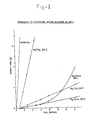
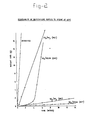
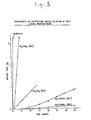
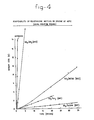
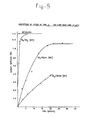
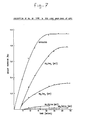
- Figures 58 show how the weight of the various samples from the end of the drum increased with time. Similar results were obtained from samples from the body of the drum. In all cases the sulphonated/resin coated samples absorbed the oil or xylene at a lower rate than the sulphonated/ neutralised samples. The samples in xylene ultimately reach the same saturation level as the untreated samples. Surprisingly, with oil, the saturation level as well as the rate of absorption is reduced by the treatment.
- the modulus of the ends appear to increase when they are sulphonated and resin coated. However, of greater importance is the dramatic reduction in the modulus of untreated polyethylene in the presence of xylene and to a lesser extent by oil. This reduction is prevented if the drum is sulphonated.
Landscapes
- Chemical & Material Sciences (AREA)
- Organic Chemistry (AREA)
- Health & Medical Sciences (AREA)
- Chemical Kinetics & Catalysis (AREA)
- Medicinal Chemistry (AREA)
- Polymers & Plastics (AREA)
- Life Sciences & Earth Sciences (AREA)
- Engineering & Computer Science (AREA)
- Materials Engineering (AREA)
- Wood Science & Technology (AREA)
- General Chemical & Material Sciences (AREA)
- Laminated Bodies (AREA)
- Polymers With Sulfur, Phosphorus Or Metals In The Main Chain (AREA)
- Treatments Of Macromolecular Shaped Articles (AREA)
- Polyoxymethylene Polymers And Polymers With Carbon-To-Carbon Bonds (AREA)
- Compositions Of Macromolecular Compounds (AREA)
- Details Of Rigid Or Semi-Rigid Containers (AREA)
- Coating Of Shaped Articles Made Of Macromolecular Substances (AREA)
- Gloves (AREA)
- Packages (AREA)
- Particle Accelerators (AREA)
- Vacuum Packaging (AREA)
- Paints Or Removers (AREA)
- Fittings On The Vehicle Exterior For Carrying Loads, And Devices For Holding Or Mounting Articles (AREA)
- Packaging Of Annular Or Rod-Shaped Articles, Wearing Apparel, Cassettes, Or The Like (AREA)
- Wrappers (AREA)
- Manufacture Of Porous Articles, And Recovery And Treatment Of Waste Products (AREA)
- Separation, Recovery Or Treatment Of Waste Materials Containing Plastics (AREA)
- Processing And Handling Of Plastics And Other Materials For Molding In General (AREA)
- Pens And Brushes (AREA)
- Materials For Medical Uses (AREA)
- Closures For Containers (AREA)
Priority Applications (1)
| Application Number | Priority Date | Filing Date | Title |
|---|---|---|---|
| AT83201277T ATE24454T1 (de) | 1982-09-07 | 1983-09-05 | Verschlussteil aus polyethylen. |
Applications Claiming Priority (2)
| Application Number | Priority Date | Filing Date | Title |
|---|---|---|---|
| GB08225441A GB2126500B (en) | 1982-09-07 | 1982-09-07 | Enclosure members |
| GB8225441 | 1982-09-07 |
Publications (3)
| Publication Number | Publication Date |
|---|---|
| EP0104692A2 EP0104692A2 (en) | 1984-04-04 |
| EP0104692A3 EP0104692A3 (en) | 1984-11-07 |
| EP0104692B1 true EP0104692B1 (en) | 1986-12-30 |
Family
ID=10532734
Family Applications (1)
| Application Number | Title | Priority Date | Filing Date |
|---|---|---|---|
| EP83201277A Expired EP0104692B1 (en) | 1982-09-07 | 1983-09-05 | Enclosure member consisting of polyethylene |
Country Status (13)
| Country | Link |
|---|---|
| US (1) | US4503103A (enExample) |
| EP (1) | EP0104692B1 (enExample) |
| JP (1) | JPS59140055A (enExample) |
| AT (1) | ATE24454T1 (enExample) |
| AU (1) | AU557137B2 (enExample) |
| BR (1) | BR8304851A (enExample) |
| CA (1) | CA1203130A (enExample) |
| DE (1) | DE3368574D1 (enExample) |
| DK (1) | DK404183A (enExample) |
| ES (1) | ES525430A0 (enExample) |
| GB (1) | GB2126500B (enExample) |
| PT (1) | PT77297B (enExample) |
| ZA (1) | ZA836647B (enExample) |
Families Citing this family (4)
| Publication number | Priority date | Publication date | Assignee | Title |
|---|---|---|---|---|
| US4615914A (en) * | 1985-10-07 | 1986-10-07 | The Dow Chemical Company | Treatment of the interior surfaces of resinous enclosure members |
| ATE156867T1 (de) * | 1990-05-04 | 1997-08-15 | Battelle Memorial Institute | Bildung eines dünnen keramischen oxidfilms durch niederschlagung auf modifizierten polymeroberflächen |
| US6358343B1 (en) | 1999-12-22 | 2002-03-19 | C. Winfield Scott | Method for manufacturing plastic drums |
| US7908080B2 (en) | 2004-12-31 | 2011-03-15 | Google Inc. | Transportation routing |
Family Cites Families (4)
| Publication number | Priority date | Publication date | Assignee | Title |
|---|---|---|---|---|
| US2634255A (en) * | 1949-09-23 | 1953-04-07 | American Cyanamid Co | Craze-resistant adhesive having improved storage stability |
| US2786780A (en) * | 1956-05-25 | 1957-03-26 | Dow Chemical Co | Coating process for polyethylene and composite articles obtained thereby |
| CS160818B1 (enExample) * | 1972-04-10 | 1975-05-04 | ||
| NL8006626A (nl) * | 1980-02-12 | 1981-09-01 | Leer Koninklijke Emballage | Voor oplosmiddelen en brandstoffen niet-doorlatende houder of deel daarvan. |
-
1982
- 1982-09-07 GB GB08225441A patent/GB2126500B/en not_active Expired
-
1983
- 1983-08-19 CA CA000434947A patent/CA1203130A/en not_active Expired
- 1983-09-05 EP EP83201277A patent/EP0104692B1/en not_active Expired
- 1983-09-05 AT AT83201277T patent/ATE24454T1/de not_active IP Right Cessation
- 1983-09-05 DE DE8383201277T patent/DE3368574D1/de not_active Expired
- 1983-09-06 AU AU18750/83A patent/AU557137B2/en not_active Ceased
- 1983-09-06 JP JP58164055A patent/JPS59140055A/ja active Granted
- 1983-09-06 DK DK404183A patent/DK404183A/da not_active Application Discontinuation
- 1983-09-06 BR BR8304851A patent/BR8304851A/pt not_active IP Right Cessation
- 1983-09-06 PT PT77297A patent/PT77297B/pt not_active IP Right Cessation
- 1983-09-07 US US06/529,947 patent/US4503103A/en not_active Expired - Fee Related
- 1983-09-07 ES ES525430A patent/ES525430A0/es active Granted
- 1983-09-07 ZA ZA836647A patent/ZA836647B/xx unknown
Also Published As
| Publication number | Publication date |
|---|---|
| PT77297A (en) | 1983-10-01 |
| PT77297B (en) | 1986-12-12 |
| ES8501291A1 (es) | 1984-12-16 |
| ATE24454T1 (de) | 1987-01-15 |
| GB2126500B (en) | 1986-02-12 |
| EP0104692A2 (en) | 1984-04-04 |
| DE3368574D1 (en) | 1987-02-05 |
| CA1203130A (en) | 1986-04-15 |
| US4503103A (en) | 1985-03-05 |
| AU557137B2 (en) | 1986-12-04 |
| JPH0254781B2 (enExample) | 1990-11-22 |
| ZA836647B (en) | 1984-10-31 |
| DK404183A (da) | 1984-03-08 |
| DK404183D0 (da) | 1983-09-06 |
| ES525430A0 (es) | 1984-12-16 |
| EP0104692A3 (en) | 1984-11-07 |
| AU1875083A (en) | 1984-03-15 |
| BR8304851A (pt) | 1984-04-24 |
| JPS59140055A (ja) | 1984-08-11 |
| GB2126500A (en) | 1984-03-28 |
Similar Documents
| Publication | Publication Date | Title |
|---|---|---|
| CA1212809A (en) | Method of fluorinating the surface layer of bodies molded from plastic | |
| US4311250A (en) | Container having internal wall surfaces modified to reduce carbonation loss | |
| Jeong et al. | Preparation and characterization of comb-like PEO gradient surfaces | |
| EP0104692B1 (en) | Enclosure member consisting of polyethylene | |
| EP0035292B1 (en) | An enclosure member substantially impermeable to the transmission of solvents and fuels | |
| US5030399A (en) | Method of in-mold sulfonation of molded plastic article | |
| FI91728B (fi) | Tulenkestäviä komposiittimateriaaleja | |
| CA1324871C (en) | In mold sulfonation system | |
| CA1138614A (en) | Fluorinated poly(arylene sulfides) | |
| KR840001085B1 (ko) | 반응기에서 중합체의 응집을 제거하는 방법 | |
| AU608635B2 (en) | Containers having a low permeability to hydrocarbon vapours, and process for producing them | |
| CN112839912A (zh) | 用于制造诸如经涂覆的玻璃容器之类的经涂覆的玻璃制品的方法 | |
| JPH03643A (ja) | 保護被覆を備えた硝子、セラミック容器 | |
| US5156783A (en) | Two stage process for sulfonating plastic containers | |
| Ogiwara et al. | Factors affecting photografting of methacrylic acid on polyethylene film in liquid phases system | |
| CA1157322A (en) | Enclosure member substantially impermeable to the transmission of solvents and fuels | |
| JP2022543441A (ja) | ポリシアヌレートを含むコーティングを備えた医薬品パッケージ | |
| CA1152279A (en) | Enclosure member substantially impermeable to the transmission of solvents and fuels | |
| US5932304A (en) | Barrier layer composition for polyolefin bodies | |
| GB2068977A (en) | Solvent etc. resistant surface modified containers | |
| US4918117A (en) | Polybutadiyne coated carbon fiber reinforced polymer composites | |
| JPH01203437A (ja) | オレフィン系樹脂製容器 | |
| Fritzsche | Effect of ionizing radiation on styrene/acrylonitrile copolymer hollow fiber membranes | |
| JPH0260577B2 (enExample) | ||
| JPS61164947A (ja) | 樹脂製中空容器 |
Legal Events
| Date | Code | Title | Description |
|---|---|---|---|
| PUAI | Public reference made under article 153(3) epc to a published international application that has entered the european phase |
Free format text: ORIGINAL CODE: 0009012 |
|
| AK | Designated contracting states |
Designated state(s): AT BE CH DE FR IT LI NL SE |
|
| PUAL | Search report despatched |
Free format text: ORIGINAL CODE: 0009013 |
|
| AK | Designated contracting states |
Designated state(s): AT BE CH DE FR IT LI NL SE |
|
| 17P | Request for examination filed |
Effective date: 19850130 |
|
| GRAA | (expected) grant |
Free format text: ORIGINAL CODE: 0009210 |
|
| AK | Designated contracting states |
Kind code of ref document: B1 Designated state(s): AT BE CH DE FR IT LI NL SE |
|
| REF | Corresponds to: |
Ref document number: 24454 Country of ref document: AT Date of ref document: 19870115 Kind code of ref document: T |
|
| REF | Corresponds to: |
Ref document number: 3368574 Country of ref document: DE Date of ref document: 19870205 |
|
| ET | Fr: translation filed | ||
| ITF | It: translation for a ep patent filed | ||
| PLBE | No opposition filed within time limit |
Free format text: ORIGINAL CODE: 0009261 |
|
| STAA | Information on the status of an ep patent application or granted ep patent |
Free format text: STATUS: NO OPPOSITION FILED WITHIN TIME LIMIT |
|
| 26N | No opposition filed | ||
| PG25 | Lapsed in a contracting state [announced via postgrant information from national office to epo] |
Ref country code: SE Effective date: 19890906 |
|
| PGFP | Annual fee paid to national office [announced via postgrant information from national office to epo] |
Ref country code: AT Payment date: 19890913 Year of fee payment: 7 |
|
| PG25 | Lapsed in a contracting state [announced via postgrant information from national office to epo] |
Ref country code: LI Effective date: 19890930 Ref country code: CH Effective date: 19890930 |
|
| REG | Reference to a national code |
Ref country code: CH Ref legal event code: PL |
|
| PG25 | Lapsed in a contracting state [announced via postgrant information from national office to epo] |
Ref country code: AT Effective date: 19900905 |
|
| PGFP | Annual fee paid to national office [announced via postgrant information from national office to epo] |
Ref country code: FR Payment date: 19910924 Year of fee payment: 9 |
|
| ITTA | It: last paid annual fee | ||
| PGFP | Annual fee paid to national office [announced via postgrant information from national office to epo] |
Ref country code: NL Payment date: 19910930 Year of fee payment: 9 Ref country code: DE Payment date: 19910930 Year of fee payment: 9 |
|
| PGFP | Annual fee paid to national office [announced via postgrant information from national office to epo] |
Ref country code: BE Payment date: 19911106 Year of fee payment: 9 |
|
| PG25 | Lapsed in a contracting state [announced via postgrant information from national office to epo] |
Ref country code: BE Effective date: 19920930 |
|
| BERE | Be: lapsed |
Owner name: KONINKLIJKE EMBALLAGE INDUSTRIE VAN LEER B.V. Effective date: 19920930 |
|
| PG25 | Lapsed in a contracting state [announced via postgrant information from national office to epo] |
Ref country code: NL Effective date: 19930401 |
|
| NLV4 | Nl: lapsed or anulled due to non-payment of the annual fee | ||
| PG25 | Lapsed in a contracting state [announced via postgrant information from national office to epo] |
Ref country code: FR Effective date: 19930528 |
|
| PG25 | Lapsed in a contracting state [announced via postgrant information from national office to epo] |
Ref country code: DE Effective date: 19930602 |
|
| REG | Reference to a national code |
Ref country code: FR Ref legal event code: ST |
|
| EUG | Se: european patent has lapsed |
Ref document number: 83201277.7 Effective date: 19900521 |