EP0104662A2 - Verfahren und Apparat für Informationssignalübertragung zu und/oder von einem Aufzeichnungsmedium - Google Patents
Verfahren und Apparat für Informationssignalübertragung zu und/oder von einem Aufzeichnungsmedium Download PDFInfo
- Publication number
- EP0104662A2 EP0104662A2 EP83109752A EP83109752A EP0104662A2 EP 0104662 A2 EP0104662 A2 EP 0104662A2 EP 83109752 A EP83109752 A EP 83109752A EP 83109752 A EP83109752 A EP 83109752A EP 0104662 A2 EP0104662 A2 EP 0104662A2
- Authority
- EP
- European Patent Office
- Prior art keywords
- recording medium
- acoustic wave
- light beam
- surface acoustic
- scanning
- Prior art date
- Legal status (The legal status is an assumption and is not a legal conclusion. Google has not performed a legal analysis and makes no representation as to the accuracy of the status listed.)
- Withdrawn
Links
Images


Classifications
-
- H—ELECTRICITY
- H04—ELECTRIC COMMUNICATION TECHNIQUE
- H04N—PICTORIAL COMMUNICATION, e.g. TELEVISION
- H04N1/00—Scanning, transmission or reproduction of documents or the like, e.g. facsimile transmission; Details thereof
- H04N1/04—Scanning arrangements, i.e. arrangements for the displacement of active reading or reproducing elements relative to the original or reproducing medium, or vice versa
- H04N1/12—Scanning arrangements, i.e. arrangements for the displacement of active reading or reproducing elements relative to the original or reproducing medium, or vice versa using the sheet-feed movement or the medium-advance or the drum-rotation movement as the slow scanning component, e.g. arrangements for the main-scanning
- H04N1/126—Arrangements for the main scanning
- H04N1/1275—Arrangements for the main scanning using a solid-state deflector, e.g. an acousto-optic deflector or a semiconductor waveguide device
-
- G—PHYSICS
- G02—OPTICS
- G02F—OPTICAL DEVICES OR ARRANGEMENTS FOR THE CONTROL OF LIGHT BY MODIFICATION OF THE OPTICAL PROPERTIES OF THE MEDIA OF THE ELEMENTS INVOLVED THEREIN; NON-LINEAR OPTICS; FREQUENCY-CHANGING OF LIGHT; OPTICAL LOGIC ELEMENTS; OPTICAL ANALOGUE/DIGITAL CONVERTERS
- G02F1/00—Devices or arrangements for the control of the intensity, colour, phase, polarisation or direction of light arriving from an independent light source, e.g. switching, gating or modulating; Non-linear optics
- G02F1/29—Devices or arrangements for the control of the intensity, colour, phase, polarisation or direction of light arriving from an independent light source, e.g. switching, gating or modulating; Non-linear optics for the control of the position or the direction of light beams, i.e. deflection
- G02F1/33—Acousto-optical deflection devices
- G02F1/335—Acousto-optical deflection devices having an optical waveguide structure
-
- H—ELECTRICITY
- H04—ELECTRIC COMMUNICATION TECHNIQUE
- H04N—PICTORIAL COMMUNICATION, e.g. TELEVISION
- H04N1/00—Scanning, transmission or reproduction of documents or the like, e.g. facsimile transmission; Details thereof
- H04N1/04—Scanning arrangements, i.e. arrangements for the displacement of active reading or reproducing elements relative to the original or reproducing medium, or vice versa
- H04N1/12—Scanning arrangements, i.e. arrangements for the displacement of active reading or reproducing elements relative to the original or reproducing medium, or vice versa using the sheet-feed movement or the medium-advance or the drum-rotation movement as the slow scanning component, e.g. arrangements for the main-scanning
-
- H—ELECTRICITY
- H04—ELECTRIC COMMUNICATION TECHNIQUE
- H04N—PICTORIAL COMMUNICATION, e.g. TELEVISION
- H04N1/00—Scanning, transmission or reproduction of documents or the like, e.g. facsimile transmission; Details thereof
- H04N1/04—Scanning arrangements, i.e. arrangements for the displacement of active reading or reproducing elements relative to the original or reproducing medium, or vice versa
- H04N1/19—Scanning arrangements, i.e. arrangements for the displacement of active reading or reproducing elements relative to the original or reproducing medium, or vice versa using multi-element arrays
- H04N1/195—Scanning arrangements, i.e. arrangements for the displacement of active reading or reproducing elements relative to the original or reproducing medium, or vice versa using multi-element arrays the array comprising a two-dimensional array or a combination of two-dimensional arrays
- H04N1/19505—Scanning picture elements spaced apart from one another in at least one direction
-
- H—ELECTRICITY
- H04—ELECTRIC COMMUNICATION TECHNIQUE
- H04N—PICTORIAL COMMUNICATION, e.g. TELEVISION
- H04N1/00—Scanning, transmission or reproduction of documents or the like, e.g. facsimile transmission; Details thereof
- H04N1/04—Scanning arrangements, i.e. arrangements for the displacement of active reading or reproducing elements relative to the original or reproducing medium, or vice versa
- H04N1/19—Scanning arrangements, i.e. arrangements for the displacement of active reading or reproducing elements relative to the original or reproducing medium, or vice versa using multi-element arrays
- H04N1/195—Scanning arrangements, i.e. arrangements for the displacement of active reading or reproducing elements relative to the original or reproducing medium, or vice versa using multi-element arrays the array comprising a two-dimensional array or a combination of two-dimensional arrays
- H04N1/19505—Scanning picture elements spaced apart from one another in at least one direction
- H04N1/1951—Scanning picture elements spaced apart from one another in at least one direction in one direction
-
- H—ELECTRICITY
- H04—ELECTRIC COMMUNICATION TECHNIQUE
- H04N—PICTORIAL COMMUNICATION, e.g. TELEVISION
- H04N1/00—Scanning, transmission or reproduction of documents or the like, e.g. facsimile transmission; Details thereof
- H04N1/04—Scanning arrangements, i.e. arrangements for the displacement of active reading or reproducing elements relative to the original or reproducing medium, or vice versa
- H04N1/19—Scanning arrangements, i.e. arrangements for the displacement of active reading or reproducing elements relative to the original or reproducing medium, or vice versa using multi-element arrays
- H04N1/195—Scanning arrangements, i.e. arrangements for the displacement of active reading or reproducing elements relative to the original or reproducing medium, or vice versa using multi-element arrays the array comprising a two-dimensional array or a combination of two-dimensional arrays
- H04N1/19505—Scanning picture elements spaced apart from one another in at least one direction
- H04N1/19521—Arrangements for moving the elements of the array relative to the scanned image or vice versa
- H04N1/19526—Optical means
- H04N1/19536—Refracting elements
-
- H—ELECTRICITY
- H04—ELECTRIC COMMUNICATION TECHNIQUE
- H04N—PICTORIAL COMMUNICATION, e.g. TELEVISION
- H04N1/00—Scanning, transmission or reproduction of documents or the like, e.g. facsimile transmission; Details thereof
- H04N1/04—Scanning arrangements, i.e. arrangements for the displacement of active reading or reproducing elements relative to the original or reproducing medium, or vice versa
- H04N1/203—Simultaneous scanning of two or more separate pictures, e.g. two sides of the same sheet
-
- H—ELECTRICITY
- H04—ELECTRIC COMMUNICATION TECHNIQUE
- H04N—PICTORIAL COMMUNICATION, e.g. TELEVISION
- H04N1/00—Scanning, transmission or reproduction of documents or the like, e.g. facsimile transmission; Details thereof
- H04N1/04—Scanning arrangements, i.e. arrangements for the displacement of active reading or reproducing elements relative to the original or reproducing medium, or vice versa
- H04N1/203—Simultaneous scanning of two or more separate pictures, e.g. two sides of the same sheet
- H04N1/2032—Simultaneous scanning of two or more separate pictures, e.g. two sides of the same sheet of two pictures corresponding to two sides of a single medium
Definitions
- the invention relates to a method and apparatus for transferring information signals to and/or off a recording medium by at Least one Light medium transverse to the moving direction in parallel manner.
- the advantages offered by the invention are mainly that there are no mechanical moving parts for scannig the Light beam. This permits high speed recording and reading of information as required by modern telecommunication and electronic data processing equipments.
- the invention concerns the use of acousto-optic scanning techniques to achieve a quiet, versatile font high speed, high resolution print station capability.
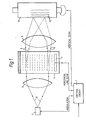
- information to be transferred to a recording medium is received in the form of electrical signals representing either digital encoded information or tone coded signals at control circuitry 1.
- the incoming signals are used to generate modulation signals which are applied to a Laser 2.
- the output Light beam 8 from the Laser is passed, via optics 3, to a surface acoustic wave Bragg cell 4.
- the control circuitry also generates a deflection signal which is applied to a transducer 7 on the Bragg cell 4 to cause a horizontal line scan deflection of the modulated Light beam 8.
- the scanning beam 9 is then focussed by optics 5 onto a moving recording medium, e.g. a selenium drum 6 which is rotating under the control of circuit 1 to provide a vertical scan.
- the electrostatic images 10 formed on the drum 6 can then be transferred to paper using conventional copier techniques.
- the essential feature of this approach is the surface acoustic wave device 4 comprising a Lithium Niobate or similar substrate suitably processed by diffusion or ion implantation techniques to produce a surface Layer of higher refractive index than the body of the substrate and in which the optical beam 8 can subsequently be guided.
- Light is coupled to and from this Layer by separate prism or other suitable coupling assemblies which, with the appropriate optics 3 and 5 respectively, interface to the Light source 2 and photosensitive medium 10.
- the transducer 7 generates an acoustic wave in this Layer at right angles to the Light beam 8 causing the refractive index of the Layer to be modulated and so producing a diffraction grating.
- the device 4 can operate with either a gas or semiconductor Laser source 2, utilizing selenium drum technology for plain paper operation, otherwise writing onto suitable photosensitive paper for direct application.
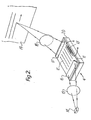
- Figure 2 shows a basic surface acoustic wave deflection device 4 comprising a substrate 20 supporting a Layer 11 of waveguide material in which surface acoustic waves 12 can be propagated from transducer 13.
- a beam of modulated Light from a Laser 14 is directed via collimating optics 15 onto a prism 16 whereby the Light is coupled into the Layer of waveguide material, the light propagating in a direction transverse the direction of propagation of the surface acoustic waves.
- the Light is coupled out of the waveguide material by a second prism 17 and is focussed by optics 18 onto a surface 19.
- an r.f. signal is applied to the transducer 13 a surface acoustic wave pattern is propagated of the light occurs.
- r.f. By suitably modulating the r.f.
- characters can be built-up in a manner similar to that already known in certain types of facsimile apparatur in which the scanning of a rotating recording medium is achieved electro-mechanically.
- the advantage of the arrangement as describea before is that it has no moving parts other than those required to move the surface 19 past the single scanning line position. Hence the scanning and modulation of the Light beam can be accomplished at very high speeds. If the surface 19 is a selenium drum as is used in photocopiers images can be built-up very rapidly on the drum and these images can then be transferred in permanent visual form to paper by standard photocopier techniques.
- an acoustic wave energy absorbent wax 32 may be placed on the far side of the substrate 20 to absorb the wave energy once it has traversed the light path.
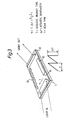
- ReguLar Line scanning of the beam is effected by applying a ramp waveform to the transducer 13.
- the number of resolvable spots N is given by
- Alternatively methods of coupling the light beam with the surface acoustic wave device 4 include edge coupling, or coupling by means of an optical grating.
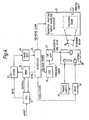
- Figure 4 illustrates in more practical detail a print station based on the elements of Figure 1 and 2 respectively.
- the incoming signals e.g. a digital input
- the CPU provides the interfaces with the external equipment ahd the functional controls of the printer. Combining the flexibility of a microprocessor with programmable peripheral devices given a selection of interfaces. As well as a parallel interface, both synchronous and asynchronous serial interfaces can be provided with a variety of transmission rates.
- the CPU recognises control codes in print data to ensure correct storage of the text and start of printing.
- the text is sent to a text store 22, which allows a full page of text to be transferred to the printer at the full transmission rate.
- a direct memory access (DMA) 23 provides high speed data retrieval of text codes from the text store for rapid printing, these being converted by a character generator 24 into paterns defining the character shapes.
- the interface circuits 25 convert the character shape patterns into a serial data stream with end of line and end of page blanking.
- a line scan voltage ramp is generated in synchronism with the serial data stream and a page synchronisation pulse is generated to start the printer mechanisms.
- a line scan frequency ramp is generated from the voltage ramp by a voltage controlled oscillator (VCO) 26 and this frequency ramp is applied via RF amplifier 27 to the deflector D and optics to focus the laser beam onto a photosensitive surface.
- the Laser L is powered from a supply 29.
- the laser modulator drive circuits 30 convert the logic pulses in the serial data stream to suitable voltage and current LeveLs for driving a modulator M for a CW Laser (or driving the modulation of a semiconductor Laser directly).
- a selenium drum and paper handling mechanism 31 is used to provide the hard copy printing facility.
- the Laser is focussed to write on to the drum, producing an electrostatic pattern of the text or graphics characters.
- the drum picks up powder ink on the electrostatic pattern and deposits it on to plain paper.
- the ink is set in e.g. a pressure process to produce the printed copy.
- An apparatus such as that of Figure 4 is that the Laser may be required to scan a line typically 2oo mm wide.
- An inherent characteristic of acousto-optic scanning techniques is the relatively small angular deflection of the scanning beam which is restricted to within a few degrees of its centre point.
- an optical system with a focal Length of several metres has to be used in order to form a scan of the correct size. CLearLy, it is not practicable to accommodate this distance between the deflector and the image plane and expansion optics can be designed which will form a Line scan of the required lenght within a "practical" distance of the deflector.
- the effective focal Length of a Lens system is measured from the system's secondary principal point, a point where the secondary principle plane intersects the axis of the system. If the secondary principal plane is positioned some distance before the first element of the system, the distance from the first Lens element to the image plane (the throw) will be Less than the focal Length (Figure 5).
- Figures 6 and 7 show two systems where this is true.
- Lenses A, B and C have positive focal Lengths and A and B are positioned so that their focal planes coincide.
- the collimated input beam is focussed by Lens A and recollimated by Lens B, producing an angular magnification of f A /f B (the ratio of the focal Lengths of Lenses A and B).
- Lens C focusses the output.
- Figure 7 shows a similar system but where Lens B has a negative focal Length. In both cases Lens C could be omitted and its operation performed by Lens B.
- the system may use several Lenses to correct aberrations and the operation of each element may not be clear cut.
- the expansion optics also need to be anamorphic because acousto-optic deflectors have rectangular apertures and, therefore, the system may include cylindrical elements, prisms or other anamorphic elements.
- optical scanning techniques can be adapted to provide high speed work stations with functional needs for data input, output and storage.
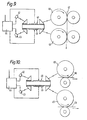
- two surface acoustic wave deflection devices fabricated in a "back-to-back" configuration on a common substrate can provide two scanning operations which may be inter-related or independent.
- each deflection device is of the type shown in Figure 1 and 2 respectively, i.e. each device ha L its own optical coupling means and r.f. signal transducer.
- the two deflection devices are provided with independent laser sources 42, 43 (for the sake of simplicity all the collimating and focussing optics have been omitted from this and subsequent Figures - such optics are assumed.)
- Input data is received by a control circuit 44 where timing information is extracted and timing modulation controls generated.
- the two Lasers are independently modulated whilst the deflection devices are operated in synchronism so as to build-up two sets of images on respective selenium drums 45, 46.
- the two sets of images are then transferred in permanent visual form to two sides of a single sheet recording medium, i.e. a sheet of paper 47.
- This double sided printer can print the two sides of the paper in the same or different colours.
- the input data can be derived from a remote Location from whence it can be transmitted to the printer via electric conductors, optical fibres or even radio signals.
- the invention is particuLarLy suitable for operation in a full duplex facsimile system.
- only one of the surface acoustic wave deflection devices is provided with information modulated Light for printing via a selenium drum.
- the other deflection device 52 scans unmodulated Light across a platen, Figure 11, on which graphical material is carried, e.g. a drum 53 with paper 54 wrapped around it.
- each deflection device is of the type shown in Figure 1 and 2 respectively, i.e. each device has its own input and output optical coupling prisms and its r.f. signal transducer for Launching surface acoustic waves across the optical path.
- each device has its own input and output optical coupling prisms and its r.f. signal transducer for Launching surface acoustic waves across the optical path.
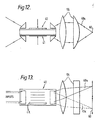
- the output optics 55 are arranged so that the two scanned outputs 40a, 41a are directed to scan different parts of the same Line 60. This is shown more clearly in Figure 13, in which output 40a is shown as scanning one half of a Line 60 whilst output 41a scans the other half of the Line 60.
- the optical inputs can be either both derived from a single source, via suitable optics (not shown) or from separate sources (not shown).
- the modulated optical signal can be applied to separate deflection devices 40, 41 simultaneously or sequentially.
- the r.f. deflection signals are applied to the two devices sequentially so that the modulated Light beam are first scanned by one device 40 across one half of the Line 60 and then by the other device 41 across the second half of the line 60.
- the amount of deflection obtainable from a surface acoustic wave device is Limited, typically deflections of + 1.5°
- two devices working in the manner shown in Figure 13 can together achieve a total deflection coverage of about + 30
Landscapes
- Engineering & Computer Science (AREA)
- Multimedia (AREA)
- Signal Processing (AREA)
- Physics & Mathematics (AREA)
- Nonlinear Science (AREA)
- General Physics & Mathematics (AREA)
- Optics & Photonics (AREA)
- Facsimile Scanning Arrangements (AREA)
- Combination Of More Than One Step In Electrophotography (AREA)
Applications Claiming Priority (6)
| Application Number | Priority Date | Filing Date | Title |
|---|---|---|---|
| GB08227750A GB2128355A (en) | 1982-09-29 | 1982-09-29 | Method of transferring information to a recording medium |
| GB08227752A GB2129150B (en) | 1982-09-29 | 1982-09-29 | A method of transferring information to a recording medium |
| GB8227751 | 1982-09-29 | ||
| GB8227752 | 1982-09-29 | ||
| GB8227750 | 1982-09-29 | ||
| GB08227751A GB2128356B (en) | 1982-09-29 | 1982-09-29 | A method of transferring information to a recording medium |
Publications (2)
| Publication Number | Publication Date |
|---|---|
| EP0104662A2 true EP0104662A2 (de) | 1984-04-04 |
| EP0104662A3 EP0104662A3 (de) | 1986-08-06 |
Family
ID=27261755
Family Applications (1)
| Application Number | Title | Priority Date | Filing Date |
|---|---|---|---|
| EP83109752A Withdrawn EP0104662A3 (de) | 1982-09-29 | 1983-09-29 | Verfahren und Apparat für Informationssignalübertragung zu und/oder von einem Aufzeichnungsmedium |
Country Status (1)
| Country | Link |
|---|---|
| EP (1) | EP0104662A3 (de) |
Family Cites Families (5)
| Publication number | Priority date | Publication date | Assignee | Title |
|---|---|---|---|---|
| CH568593A5 (en) * | 1973-06-29 | 1975-10-31 | Sandoz Ag | Colour printing device with selective point exposures - uses sensitive layer and four colour electrostatic system |
| CA1029310A (en) * | 1974-04-08 | 1978-04-11 | Bruno J. Vieri | Combined copier/facsimile transceiver apparatus and method |
| US4015081A (en) * | 1975-02-03 | 1977-03-29 | Xerox Corporation | Multifunction scanning system |
| CA1074430A (en) * | 1976-03-26 | 1980-03-25 | J. Bradford Merry | Multi-color acoustooptic deflector |
| DE3116426A1 (de) * | 1980-04-26 | 1982-02-25 | Canon K.K., Tokyo | "strahlablenkeinrichtung" |
-
1983
- 1983-09-29 EP EP83109752A patent/EP0104662A3/de not_active Withdrawn
Also Published As
| Publication number | Publication date |
|---|---|
| EP0104662A3 (de) | 1986-08-06 |
Similar Documents
| Publication | Publication Date | Title |
|---|---|---|
| US4205348A (en) | Laser scanning utilizing facet tracking and acousto pulse imaging techniques | |
| GB1596726A (en) | Flying spot scanning system | |
| US4422099A (en) | Optical communication on variable power beam | |
| US3475760A (en) | Laser film deformation recording and erasing system | |
| US4679096A (en) | Image processing apparatus | |
| US4201455A (en) | Laser-operated apparatus for data and signal recording | |
| US4012585A (en) | Input and output flying spot scanning system | |
| JPS62239119A (ja) | 高速高解像度ラスタ出力走査装置 | |
| US4015081A (en) | Multifunction scanning system | |
| US4963900A (en) | Multiple laser beam scanning optics | |
| US4499437A (en) | Apparatus and method providing improved control of a laser beam | |
| US4552449A (en) | Compound image recording apparatus | |
| US4060322A (en) | Image information handling device | |
| JPS5879216A (ja) | 2ビ−ム走査光学系 | |
| US4307929A (en) | Method of scanning a laser beam in a straight line | |
| US4495521A (en) | Electronic copying apparatus | |
| EP0104662A2 (de) | Verfahren und Apparat für Informationssignalübertragung zu und/oder von einem Aufzeichnungsmedium | |
| GB2128355A (en) | Method of transferring information to a recording medium | |
| US4268868A (en) | Beam scanning type electronic copying apparatus | |
| GB2129150A (en) | A method of transferring information to a recording medium | |
| GB2139842A (en) | Acoustic optic device | |
| GB2128356A (en) | A method of transferring information to a recording medium | |
| JPS5974775A (ja) | レ−ザプリンタ | |
| Meye | Optical character generation for a high-speed non-impact Printer | |
| EP0490013A1 (de) | Elektro-optischer Abtaster |
Legal Events
| Date | Code | Title | Description |
|---|---|---|---|
| PUAI | Public reference made under article 153(3) epc to a published international application that has entered the european phase |
Free format text: ORIGINAL CODE: 0009012 |
|
| AK | Designated contracting states |
Designated state(s): DE FR IT SE |
|
| PUAL | Search report despatched |
Free format text: ORIGINAL CODE: 0009013 |
|
| AK | Designated contracting states |
Kind code of ref document: A3 Designated state(s): DE FR IT SE |
|
| STAA | Information on the status of an ep patent application or granted ep patent |
Free format text: STATUS: THE APPLICATION IS DEEMED TO BE WITHDRAWN |
|
| 18D | Application deemed to be withdrawn |
Effective date: 19860331 |
|
| RIN1 | Information on inventor provided before grant (corrected) |
Inventor name: COOKE, ROGER ERNEST Inventor name: HEEKS, JOHN STUART |