EP0103497A1 - Xanthine derivatives, process for their preparation and pharmaceutical compositions containing them - Google Patents
Xanthine derivatives, process for their preparation and pharmaceutical compositions containing them Download PDFInfo
- Publication number
- EP0103497A1 EP0103497A1 EP83401518A EP83401518A EP0103497A1 EP 0103497 A1 EP0103497 A1 EP 0103497A1 EP 83401518 A EP83401518 A EP 83401518A EP 83401518 A EP83401518 A EP 83401518A EP 0103497 A1 EP0103497 A1 EP 0103497A1
- Authority
- EP
- European Patent Office
- Prior art keywords
- radical
- xanthine
- carbon atoms
- isobutyl
- alkyl
- Prior art date
- Legal status (The legal status is an assumption and is not a legal conclusion. Google has not performed a legal analysis and makes no representation as to the accuracy of the status listed.)
- Granted
Links
- 0 C*C1CNCC1 Chemical compound C*C1CNCC1 0.000 description 3
- JMPQQXWPKDTARU-UHFFFAOYSA-N CC1C2CCC1C2 Chemical compound CC1C2CCC1C2 JMPQQXWPKDTARU-UHFFFAOYSA-N 0.000 description 1
Classifications
-
- C—CHEMISTRY; METALLURGY
- C07—ORGANIC CHEMISTRY
- C07D—HETEROCYCLIC COMPOUNDS
- C07D239/00—Heterocyclic compounds containing 1,3-diazine or hydrogenated 1,3-diazine rings
- C07D239/02—Heterocyclic compounds containing 1,3-diazine or hydrogenated 1,3-diazine rings not condensed with other rings
- C07D239/24—Heterocyclic compounds containing 1,3-diazine or hydrogenated 1,3-diazine rings not condensed with other rings having three or more double bonds between ring members or between ring members and non-ring members
- C07D239/28—Heterocyclic compounds containing 1,3-diazine or hydrogenated 1,3-diazine rings not condensed with other rings having three or more double bonds between ring members or between ring members and non-ring members with hetero atoms or with carbon atoms having three bonds to hetero atoms with at the most one bond to halogen, directly attached to ring carbon atoms
- C07D239/46—Two or more oxygen, sulphur or nitrogen atoms
- C07D239/52—Two oxygen atoms
- C07D239/54—Two oxygen atoms as doubly bound oxygen atoms or as unsubstituted hydroxy radicals
- C07D239/545—Two oxygen atoms as doubly bound oxygen atoms or as unsubstituted hydroxy radicals with other hetero atoms or with carbon atoms having three bonds to hetero atoms with at the most one bond to halogen, directly attached to ring carbon atoms
-
- A—HUMAN NECESSITIES
- A61—MEDICAL OR VETERINARY SCIENCE; HYGIENE
- A61P—SPECIFIC THERAPEUTIC ACTIVITY OF CHEMICAL COMPOUNDS OR MEDICINAL PREPARATIONS
- A61P11/00—Drugs for disorders of the respiratory system
-
- A—HUMAN NECESSITIES
- A61—MEDICAL OR VETERINARY SCIENCE; HYGIENE
- A61P—SPECIFIC THERAPEUTIC ACTIVITY OF CHEMICAL COMPOUNDS OR MEDICINAL PREPARATIONS
- A61P11/00—Drugs for disorders of the respiratory system
- A61P11/08—Bronchodilators
-
- A—HUMAN NECESSITIES
- A61—MEDICAL OR VETERINARY SCIENCE; HYGIENE
- A61P—SPECIFIC THERAPEUTIC ACTIVITY OF CHEMICAL COMPOUNDS OR MEDICINAL PREPARATIONS
- A61P37/00—Drugs for immunological or allergic disorders
-
- A—HUMAN NECESSITIES
- A61—MEDICAL OR VETERINARY SCIENCE; HYGIENE
- A61P—SPECIFIC THERAPEUTIC ACTIVITY OF CHEMICAL COMPOUNDS OR MEDICINAL PREPARATIONS
- A61P37/00—Drugs for immunological or allergic disorders
- A61P37/08—Antiallergic agents
-
- A—HUMAN NECESSITIES
- A61—MEDICAL OR VETERINARY SCIENCE; HYGIENE
- A61P—SPECIFIC THERAPEUTIC ACTIVITY OF CHEMICAL COMPOUNDS OR MEDICINAL PREPARATIONS
- A61P43/00—Drugs for specific purposes, not provided for in groups A61P1/00-A61P41/00
-
- C—CHEMISTRY; METALLURGY
- C07—ORGANIC CHEMISTRY
- C07D—HETEROCYCLIC COMPOUNDS
- C07D473/00—Heterocyclic compounds containing purine ring systems
- C07D473/02—Heterocyclic compounds containing purine ring systems with oxygen, sulphur, or nitrogen atoms directly attached in positions 2 and 6
- C07D473/04—Heterocyclic compounds containing purine ring systems with oxygen, sulphur, or nitrogen atoms directly attached in positions 2 and 6 two oxygen atoms
- C07D473/06—Heterocyclic compounds containing purine ring systems with oxygen, sulphur, or nitrogen atoms directly attached in positions 2 and 6 two oxygen atoms with radicals containing only hydrogen and carbon atoms, attached in position 1 or 3
-
- C—CHEMISTRY; METALLURGY
- C07—ORGANIC CHEMISTRY
- C07D—HETEROCYCLIC COMPOUNDS
- C07D473/00—Heterocyclic compounds containing purine ring systems
- C07D473/02—Heterocyclic compounds containing purine ring systems with oxygen, sulphur, or nitrogen atoms directly attached in positions 2 and 6
- C07D473/04—Heterocyclic compounds containing purine ring systems with oxygen, sulphur, or nitrogen atoms directly attached in positions 2 and 6 two oxygen atoms
- C07D473/06—Heterocyclic compounds containing purine ring systems with oxygen, sulphur, or nitrogen atoms directly attached in positions 2 and 6 two oxygen atoms with radicals containing only hydrogen and carbon atoms, attached in position 1 or 3
- C07D473/08—Heterocyclic compounds containing purine ring systems with oxygen, sulphur, or nitrogen atoms directly attached in positions 2 and 6 two oxygen atoms with radicals containing only hydrogen and carbon atoms, attached in position 1 or 3 with methyl radicals in positions 1 and 3, e.g. theophylline
-
- C—CHEMISTRY; METALLURGY
- C07—ORGANIC CHEMISTRY
- C07D—HETEROCYCLIC COMPOUNDS
- C07D473/00—Heterocyclic compounds containing purine ring systems
- C07D473/02—Heterocyclic compounds containing purine ring systems with oxygen, sulphur, or nitrogen atoms directly attached in positions 2 and 6
- C07D473/04—Heterocyclic compounds containing purine ring systems with oxygen, sulphur, or nitrogen atoms directly attached in positions 2 and 6 two oxygen atoms
- C07D473/06—Heterocyclic compounds containing purine ring systems with oxygen, sulphur, or nitrogen atoms directly attached in positions 2 and 6 two oxygen atoms with radicals containing only hydrogen and carbon atoms, attached in position 1 or 3
- C07D473/10—Heterocyclic compounds containing purine ring systems with oxygen, sulphur, or nitrogen atoms directly attached in positions 2 and 6 two oxygen atoms with radicals containing only hydrogen and carbon atoms, attached in position 1 or 3 with methyl radicals in positions 3 and 7, e.g. theobromine
-
- C—CHEMISTRY; METALLURGY
- C07—ORGANIC CHEMISTRY
- C07D—HETEROCYCLIC COMPOUNDS
- C07D473/00—Heterocyclic compounds containing purine ring systems
- C07D473/02—Heterocyclic compounds containing purine ring systems with oxygen, sulphur, or nitrogen atoms directly attached in positions 2 and 6
- C07D473/04—Heterocyclic compounds containing purine ring systems with oxygen, sulphur, or nitrogen atoms directly attached in positions 2 and 6 two oxygen atoms
- C07D473/06—Heterocyclic compounds containing purine ring systems with oxygen, sulphur, or nitrogen atoms directly attached in positions 2 and 6 two oxygen atoms with radicals containing only hydrogen and carbon atoms, attached in position 1 or 3
- C07D473/12—Heterocyclic compounds containing purine ring systems with oxygen, sulphur, or nitrogen atoms directly attached in positions 2 and 6 two oxygen atoms with radicals containing only hydrogen and carbon atoms, attached in position 1 or 3 with methyl radicals in positions 1, 3, and 7, e.g. caffeine
Definitions
- the present invention relates to new xanthine derivatives, their preparation process and the pharmaceutical compositions containing them.
- the condensation is preferably carried out in a solvent chosen from alcohols containing up to 5 carbon atoms, such as for example methanol, ethanol, propanol or butanol. It is advantageous to operate at a temperature between 64 and 130 ° C., in the presence of an acceptor of the hydracid formed during the reaction.
- This acceptor can be chosen from alkaline carbonates such as sodium and potassium carbonates, tertiary amines such as triethylamine or an excess of the amino derivative of formula III used for the reaction.
- the raw materials of general formula III are known products.
- the condensation is preferably carried out in a suitable solvent such as, for example, dimethylformamide at a temperature between 80 and 120 ° C, in the presence of an acceptor of the hydracid formed during the reaction.
- This acceptor may be, inter alia, an alkaline carbonate such as for example sodium or potassium carbonate.
- the new derivatives of general formula I can be transformed into addition salts with acids, salts which are therefore part of the invention.
- acids which can be used for the formation of these salts mention may, for example, be made in the mineral series: hydrochloric, hydrobromic, sulfuric, phosphoric acids, and in the organic series, acetic, propionic, maleic, fumaric, tartaric, citric acids, oxalic, benzoic, sulphonic methane and isethionic.
- These new derivatives can be purified by physical methods such as crystallization, chromatography or chemicals such as the formation of addition salts with acids and the decomposition of these salts by alkaline agents.
- the derivatives of general formula I and their physiologically tolerable salts have interesting pharmacological and therapeutic properties, in particular bronchodilator, anti-allergic and phosphodiesterase inhibitor properties.
- mice Their toxicity is low and their LD 50 determined in mice is greater than 100 mg / kg intraperitoneally, and greater than 800 mg / kg orally.
- the bronchodilator activity has been studied in guinea pigs by the method of H. KONZETT and R. ROSSLER Arch. Exp. U. Pharm. 195, 71 (1940). It has thus been observed that the derivatives of the present invention injected intravenously at varying doses, depending on the derivatives from 1 to 5 mg / kg completely inhibit the bronchospasm caused by the intravenous administration of either histamine or serotonin, and partially the effect of acetylcholine and the Slow Reacting Substance.
- certain compounds of the invention have a specific agonist effect with respect to central and peripheral purinergic receptors of type A 1 and / or A 2 which can lead to a specificity of therapeutic effect.
- oral administration of 5 mg / kg of the compound of Example 1 inhibits, for more than 48 hours, the bronchospasm caused by a histamine aerosol at 4%. Furthermore, a reduction in the anaphylactic skin reaction is observed in rats after the single administration of 20 mg / kg per os of this compound.
- the pharmacological properties described above, as well as the low toxicity of the derivatives of general formula I and their physiologically salts tolerable allow their use in therapy especially in the treatment of all diseases where it is necessary to inhibit antigen - antibody reactions like autoimmune, allergic and inflammatory diseases and in particular those in which a bronchodilator effect is welcome such as asthmatic dyspnea and chronic obstructive pulmonary disease, especially spastic.
- the long duration of action allows a crisis treatment as well as a basic treatment of simple or interesting asthmatic disease.
- spasmolytic properties are an indication in the treatment of renal or hepatic colic.
- the present invention also relates to pharmaceutical compositions containing as active ingredient a derivative of general formula I, or one of its physiologically tolerable salts, mixed or associated with a suitable pharmaceutical excipient. It relates in particular to the dosage forms containing from 25 to 250 mg of active principle.
- compositions thus obtained are advantageously presented in various dosage forms such as, for example, tablets, dragees, capsules, glosettes or galenical preparations suitable for sublingual administration, suppositories, injectable or drinkable solutions, as well as in forms suitable for aerosol administration. They can be administered orally, rectally, or parenterally in doses of 25 to 250 mg of active ingredient, 1 to 2 times a day.
- NB The derivatives * were prepared by analogy with G. EHRHAR et al., Arch. der Pharm. 289,453-459, (1956), according to the following diagram: NB: The derivatives of formula VI were prepared according to the following operating scheme:
Landscapes
- Chemical & Material Sciences (AREA)
- Organic Chemistry (AREA)
- Health & Medical Sciences (AREA)
- Chemical Kinetics & Catalysis (AREA)
- Life Sciences & Earth Sciences (AREA)
- General Chemical & Material Sciences (AREA)
- Medicinal Chemistry (AREA)
- Nuclear Medicine, Radiotherapy & Molecular Imaging (AREA)
- Bioinformatics & Cheminformatics (AREA)
- Pharmacology & Pharmacy (AREA)
- Engineering & Computer Science (AREA)
- Animal Behavior & Ethology (AREA)
- General Health & Medical Sciences (AREA)
- Public Health (AREA)
- Veterinary Medicine (AREA)
- Pulmonology (AREA)
- Immunology (AREA)
- Pharmaceuticals Containing Other Organic And Inorganic Compounds (AREA)
- Organic Low-Molecular-Weight Compounds And Preparation Thereof (AREA)
Abstract
Nouveaux dérivés de la xanthine, utilisables comme médicaments, et répondant à la formule: <IMAGE> dans laquelle: R1 est hydrogène ou un alkyle de C1 à C5; R2 est un radical hydrocarboné jusqu'en C6 ayant éventuellement une double liaison, un radical phényle, ou un radical benzyle. R3 est hydrogène, alkyle, hydroxyalkyle ou dihydroxyalkyle chacun de C1 à C5; R4 représente <IMAGE> Y étant hydrogène, halogène, alkyle ou alkoxy de C1 à C5, ou hydroxyle; Z est méthylène ou un radical hydrocarboné en chaine droite ou ramifiée de C2 à C5, éventuellement substitué par un hydroxyle; et A est un reste aminé de formule: <IMAGE> p étant 1 ou 3, ou <IMAGE> X q étant 1 ou 2, et X étant une liaison simple, oxygène ou <IMAGE> R5 étant hydrogène, alkyle ou alkylène jusqu'en C5, ou <IMAGE> dans lequel: m est un nombre entier de 2 à 6 et R6 est alkyle de C1 à C5. Ces nouveaux composés et leurs sels physiologiquement tolérables peuvent être utilisés en thérapeutique notamment dans le traitement de toutes les maladies où il est nécessaire d'inhiber les réactions entigène anticorps.New xanthine derivatives, usable as medicaments, and corresponding to the formula: <IMAGE> in which: R1 is hydrogen or C1 to C5 alkyl; R2 is a hydrocarbon radical up to C6 optionally having a double bond, a phenyl radical, or a benzyl radical. R3 is hydrogen, alkyl, hydroxyalkyl or dihydroxyalkyl each of C1 to C5; R4 represents <IMAGE> Y being hydrogen, halogen, C1 to C5 alkyl or alkoxy, or hydroxyl; Z is methylene or a straight or branched chain hydrocarbon radical from C2 to C5, optionally substituted by a hydroxyl; and A is an amino residue of formula: <IMAGE> p being 1 or 3, or <IMAGE> X q being 1 or 2, and X being a single bond, oxygen or <IMAGE> R5 being hydrogen, alkyl or alkylene up to in C5, or <IMAGE> in which: m is an integer from 2 to 6 and R6 is C1 to C5 alkyl. These new compounds and their physiologically tolerable salts can be used in therapy, in particular in the treatment of all diseases where it is necessary to inhibit the entigenic antibody reactions.
Description
La présente invention a pour objet de nouveaux dérivés de la xanthine, leur procédé de préparation et les compositions pharmaceutiques les renfermant.The present invention relates to new xanthine derivatives, their preparation process and the pharmaceutical compositions containing them.
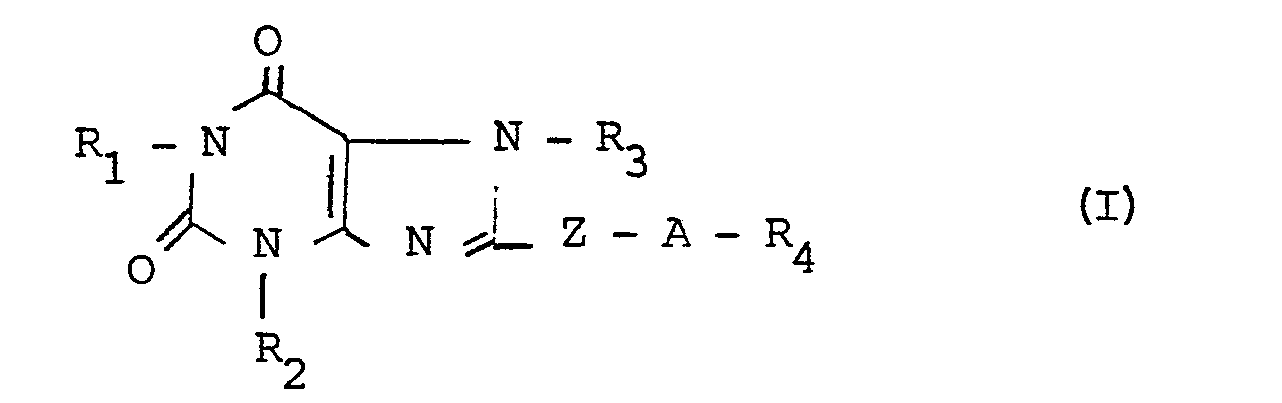
Elle concerne particulièrement les dérivés de la xanthine de formule générale I :

- - R1 représente un atome d'hydrogène ou un radical alkyle en chaîne droite ou ramifiée, renfermant de 1 à 5 atomes de carbone ;
- - R2 représente un radical hydrocarboné en chaîne droite ou ramifiée renfermant jusqu'à 6 atomes de carbone, et comportant éventuellement une double liaison, un radical phényle, ou un radical benzyle ;
- - R3 représente un atome d'hydrogène ou un radical alkyle, hydroxyalkyle ou dihydroxyalkyle renfermant chacun de 1 à 5 atomes de carbone ;
- - R4 représente un groupe de formule :

- - Z représente un radical méthylène ou un radical hydroxycarboné en chaîne droite ayant de 2 à 5 atomes de carbone éventuellement substitué par un radical hydroxyle ; et
- - A représente un reste aminé de type :


- q prend les valeurs 1, ou 2, et
- X représente une liaison simple, un atome d'oxygène ou un groupe

- R5 représente un atome d'hydrogène ou un radical alkyle ou alkylène ayant chacun de 1 à 5 atomes de carbone ; ou

- m représente un nombre entier de 2 à 6 et,
- R6 représente un radical alkyle renfermant de 1 à 5 atomes de carbone.
- - R 1 represents a hydrogen atom or an alkyl radical in a straight or branched chain, containing from 1 to 5 carbon atoms;
- - R 2 represents a straight or branched chain hydrocarbon radical containing up to 6 carbon atoms, and optionally comprising a double bond, a phenyl radical, or a benzyl radical;
- - R 3 represents a hydrogen atom or an alkyl, hydroxyalkyl or dihydroxyalkyl radical each containing 1 to 5 carbon atoms;
- - R 4 represents a group of formula:
- - Z represents a methylene radical or a straight chain hydroxycarbon radical having from 2 to 5 carbon atoms optionally substituted by a hydroxyl radical; and
- - A represents an amino residue of type:
- q takes the values 1, or 2, and
- X represents a single bond, an oxygen atom or a group
- R 5 represents a hydrogen atom or an alkyl or alkylene radical each having from 1 to 5 carbon atoms; or
- m represents an integer from 2 to 6 and,
- R 6 represents an alkyl radical containing from 1 to 5 carbon atoms.
La présente invention a également pour objet le procédé de préparation des dérivés de formule générale I caractérisé en ce que :
- - l'on condense un dérivé halogéné de formule générale II :

- - avec un dérivé aminé de formule générale III

- - a halogenated derivative of general formula II is condensed:
- - with an amino derivative of general formula III
La condensation s'effectue de préférence dans un solvant choisi parmi les alcools renfermant jusqu'à 5 atomes de carbone, tel que par exemple le méthanol, l'éthanol, le propanol ou le butanol. Il est avantageux d'opérer à une température comprise entre 64 et 130°C, en présence d'un accepteur de l'hydracide formé au cours de la réaction. Cet accepteur peut-être choisi parmi les carbonates alcalins tels que les carbonates de sodium et de potassium, les amines tertiaires telles que la trié- thylamine ou un excès du dérivé aminé de formule III utilisé pour la réaction.The condensation is preferably carried out in a solvent chosen from alcohols containing up to 5 carbon atoms, such as for example methanol, ethanol, propanol or butanol. It is advantageous to operate at a temperature between 64 and 130 ° C., in the presence of an acceptor of the hydracid formed during the reaction. This acceptor can be chosen from alkaline carbonates such as sodium and potassium carbonates, tertiary amines such as triethylamine or an excess of the amino derivative of formula III used for the reaction.
Les matières premières de formule générale II ont été préparées selon le schéma opératoire suivant :

Les matières premières de formule générale III sont des produits connus.The raw materials of general formula III are known products.
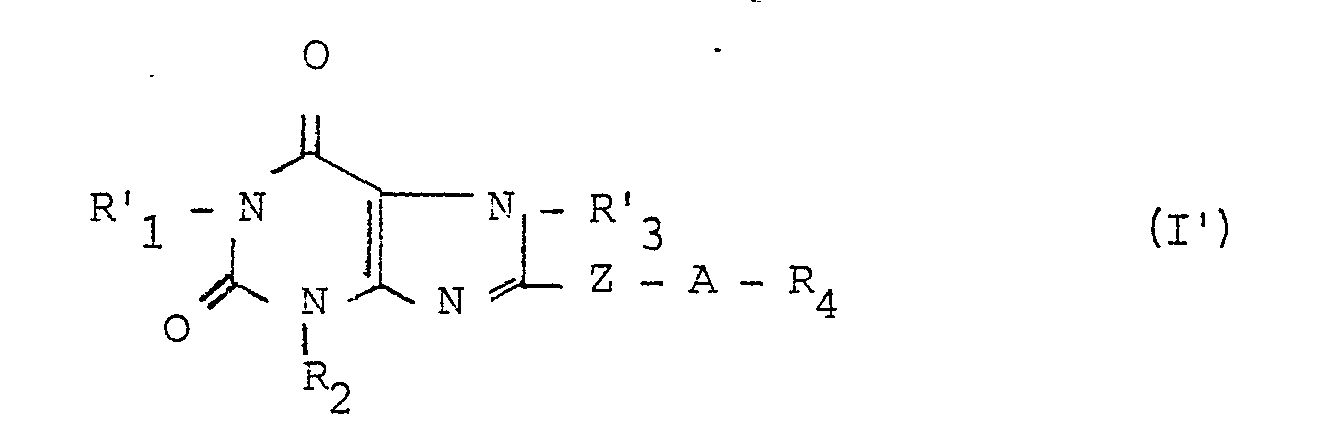
La présente invention a également pour objet le procédé de préparation des dérivés (I) répondant à la formule générale I' :
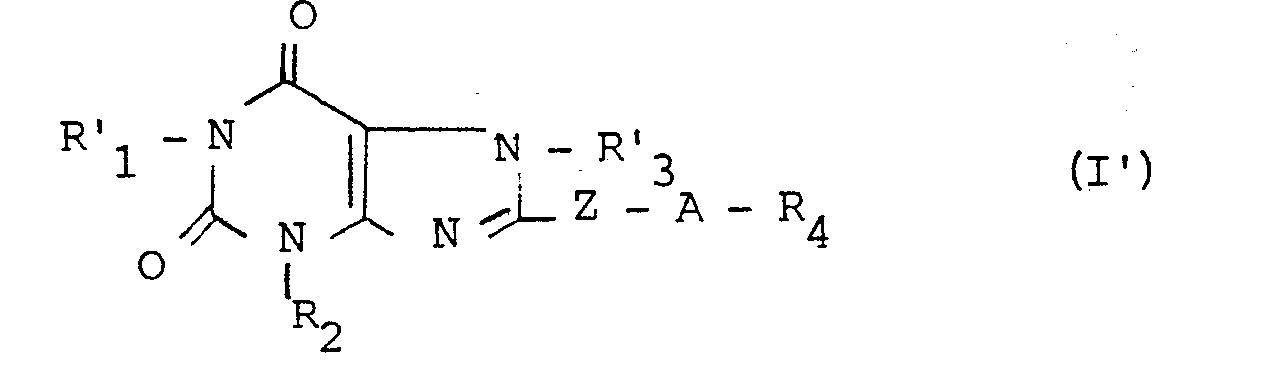
- - R2, R4, Z et A ont les significations précédemment définies,
- - R'1 représente un radical alkyle en chaîne droite ou ramifiée, rénfermant de 1 à 5 atomes de carbone et
- - R'3 représente un radical alkyle, hydroxyalkyle ou dihydroxyalkyle contenant chacun de 1 à 5 atomes de carbone ; caractérisé en ce que :
- - l'on condense un dérivé de formule II' :


- - R 2 , R 4 , Z and A have the meanings previously defined,
- - R ' 1 represents a straight or branched chain alkyl radical containing from 1 to 5 carbon atoms and
- - R'3 represents an alkyl, hydroxyalkyl or dihydroxyalkyl radical each containing from 1 to 5 carbon atoms; characterized in that:
- - a derivative of formula II ′ is condensed:
La condensation s'effectue de préférence dans un solvant adéquat tel que par exemple, le diméthylformamide à une température comprise entre 80 et 120°C, en présence d'un accepteur de l'hydracide formé au cours de la réaction. Cet accepteur peut-être, entre autre, un carbonate alcalin comme par exemple le carbonate de sodium ou de potassium.The condensation is preferably carried out in a suitable solvent such as, for example, dimethylformamide at a temperature between 80 and 120 ° C, in the presence of an acceptor of the hydracid formed during the reaction. This acceptor may be, inter alia, an alkaline carbonate such as for example sodium or potassium carbonate.
Les nouveaux dérivés de formule générale I peuvent être transformés en sels d'addition avec les acides, sels qui font à ce titre, partie de l'invention. Comme acides utilisables pour la formation de ces sels, on peut citer par exemple dans la série minérale : les acides chlorhydrique, bromhydrique, sulfurique, phosphorique, et dans la série organique, les acides acétique, propionique, maléique, fumarique, tartrique, citrique, oxalique, benzoique, méthane sulfonique et isé- thionique.The new derivatives of general formula I can be transformed into addition salts with acids, salts which are therefore part of the invention. As acids which can be used for the formation of these salts, mention may, for example, be made in the mineral series: hydrochloric, hydrobromic, sulfuric, phosphoric acids, and in the organic series, acetic, propionic, maleic, fumaric, tartaric, citric acids, oxalic, benzoic, sulphonic methane and isethionic.
Ces nouveaux dérivés peuvent être purifiés par des méthodes physiques telles que cristallisation, chromatographie ou chimiques telles que formation de sels d'addition avec des acides et décomposition de ces sels par les agents alcalins.These new derivatives can be purified by physical methods such as crystallization, chromatography or chemicals such as the formation of addition salts with acids and the decomposition of these salts by alkaline agents.
Les dérivés de formule générale I et leurs sels physiologiquement tolérables possèdent des propriétés pharmacologiques et thérapeutiques intéressantes, notamment des propriétés bronchodilatatrice, anti-allergique et inhibitrice de la phosphodiesterase.The derivatives of general formula I and their physiologically tolerable salts have interesting pharmacological and therapeutic properties, in particular bronchodilator, anti-allergic and phosphodiesterase inhibitor properties.
Leur toxicité est faible et leur D L 50 déterminée chez la souris est supérieure à 100 mg/kg par voie intrapéritonéale, et supérieure à 800 mg/kg par voie orale.Their toxicity is low and their LD 50 determined in mice is greater than 100 mg / kg intraperitoneally, and greater than 800 mg / kg orally.
L'activité bronchodilatatrice a été étudiée chez le cobaye par la méthode de H. KONZETT et R. ROSSLER Arch. Exp. U. Pharm. 195, 71 (1940). On a ainsi observé que les dérivés de la présente invention injectés par voie intraveineuse à des doses variant, selon les dérivés de 1 à 5 mg/kg inhibent totalement le bronchospasme provoqué par l'administration intraveineuse soit d'histamine, soit de sérotonine, et partiellement l'effet de l'acétylcholine et de la Slow Reacting Substance.The bronchodilator activity has been studied in guinea pigs by the method of H. KONZETT and R. ROSSLER Arch. Exp. U. Pharm. 195, 71 (1940). It has thus been observed that the derivatives of the present invention injected intravenously at varying doses, depending on the derivatives from 1 to 5 mg / kg completely inhibit the bronchospasm caused by the intravenous administration of either histamine or serotonin, and partially the effect of acetylcholine and the Slow Reacting Substance.
Soumis au test de A. K. Armitage, Brit. J. Pharmacol. 17, 196, (1961), les dérivés de l'invention administrés par voie orale à des doses variant de 0,5 à 10 mg/kg selon les composés, inhibent de 50 % l'effet produit chez le cobaye par un aérosol d'histamine à 4 Pour certains de ces composés, l'effet est encore très important 48 heures après l'administration orale.Tested by A. K. Armitage, Brit. J. Pharmacol. 17, 196, (1961), the derivatives of the invention administered orally at doses varying from 0.5 to 10 mg / kg depending on the compounds, inhibit by 50% the effect produced in guinea pigs by an aerosol of histamine 4 For some of these compounds, the effect is still very significant 48 hours after oral administration.
En outre, certains composés de l'invention possèdent un effet agoniste spécifique vis à vis des récepteurs purinergiques centraux et périphériques de type A 1 et/ou A 2 qui peut conduire à une spécificité d'effet thérapeutique.In addition, certain compounds of the invention have a specific agonist effect with respect to central and peripheral purinergic receptors of type A 1 and / or A 2 which can lead to a specificity of therapeutic effect.
A titre d'exemple non-limitatif, l'administration orale de 5 mg/kg du composé de l'exemple 1 inhibe, pendant plus de 48 heures, le bronchospasme provoqué par un aérosol d'histamine à 4 %. Par ailleurs une diminution de la réaction cutanée anaphylactique est observée chez le rat après l'administration unique de 20 mg/kg per os de ce composé.By way of nonlimiting example, oral administration of 5 mg / kg of the compound of Example 1 inhibits, for more than 48 hours, the bronchospasm caused by a histamine aerosol at 4%. Furthermore, a reduction in the anaphylactic skin reaction is observed in rats after the single administration of 20 mg / kg per os of this compound.
Ce composé de l'exemple 1 est plus fortement agoniste des récepteurs A 2 (IC 60 = 15y M) que des récepteurs A 1 (I C 50 > 100µM).This compound of Example 1 is more strongly agonist of the A 2 receptors (IC 60 = 15y M) than of the A 1 receptors (I C 50> 100 μM).
Les propriétés pharmacologiques ci-dessus décrites, ainsi que la faible toxicité des dérivés de formule générale I et de leurs sels physiologiquement tolérables permettent leur utilisation en thérapeutique notamment dans le traitement de toutes les maladies où il nécessaire d'inhiber les réactions antigène - anticorps commes les maladies autoimmunes, allergiques et inflammatoires et en particulier celles dans lesquelles un effet bronchodilatateur est bienvenu telles que la dyspnée asthmatique et les bronchopneumopathies chroniques obstructives, en particulier à forme spastique. La longue durée d'action permet un traitement de crise aussi bien qu'un traitement de fond de la maladie asthmatique simple ou intriguée.The pharmacological properties described above, as well as the low toxicity of the derivatives of general formula I and their physiologically salts tolerable allow their use in therapy especially in the treatment of all diseases where it is necessary to inhibit antigen - antibody reactions like autoimmune, allergic and inflammatory diseases and in particular those in which a bronchodilator effect is welcome such as asthmatic dyspnea and chronic obstructive pulmonary disease, especially spastic. The long duration of action allows a crisis treatment as well as a basic treatment of simple or intriguing asthmatic disease.
Par ailleurs, les propriétés spasmolytiques sont une indication dans le traitement des coliques néphrétiques ou hépatiques.Furthermore, the spasmolytic properties are an indication in the treatment of renal or hepatic colic.
La présente invention a également pour objet les compositions pharmaceutiques contenant comme principe actif un dérivé de formule générale I, ou un de ses sels physiologiquement tolérables, mélangé ou associé à un excipient pharmaceutique approprié. Elle concerne notamment les formes dosées renfermant de 25 à 250 mg de principe actif.The present invention also relates to pharmaceutical compositions containing as active ingredient a derivative of general formula I, or one of its physiologically tolerable salts, mixed or associated with a suitable pharmaceutical excipient. It relates in particular to the dosage forms containing from 25 to 250 mg of active principle.
Les compositions pharmaceutiques ainsi obtenues, sont présentées avantageusement sous des formes dosées diverses telles que par exemple comprimés, dragées, gélules, glosettes ou préparations galéniques appropriées pour une administration sublinguale, suppositoires, solutions injectables ou buvables, ainsi que sous des formes adaptées à l'administration par aérosol. Elles peuvent être administrées par la voie orale, rectale, ou parentérale aux doses de 25 à 250 mg de principe actif, 1 à 2 fois par jour.The pharmaceutical compositions thus obtained are advantageously presented in various dosage forms such as, for example, tablets, dragees, capsules, glosettes or galenical preparations suitable for sublingual administration, suppositories, injectable or drinkable solutions, as well as in forms suitable for aerosol administration. They can be administered orally, rectally, or parenterally in doses of 25 to 250 mg of active ingredient, 1 to 2 times a day.
Les exemples suivants, donnés à titre non-limitatif, illustrent l'invention. Les points de fusion sauf mention contraire, ont été déterminés à la platine chauffante de KOFLER.The following examples, given without limitation, illustrate the invention. Melting points Unless otherwise stated, were determined on the KOFLER heating plate.
méthyl-1 isobutyl-3 [(diphénylméthyl-4 pipérazinyl)-2 éthyl] -8 xanthine.1-methyl-3-isobutyl [(4-diphenylmethyl piperazinyl) -2 ethyl] -8 xanthine.

Une suspension de 12,2 g de méthyl-1 isobutyl-3 bromoéthyl-8 xanthine et de 23 g de benzhydryl-1 pipéra- zine dans 200 ml d'éthanol est chauffée à reflux. On observe une dissolution progressive et on chauffe ainsi pendant 20 à 24 heures. On évapore ensuite à sec et reprend le résidu par une solution à 10 % de bicarbonate- de sodium. On extrait plusieurs fois avec CH2Cl2, sèche sur Na2SO4 et concentre à sec. Le résidu huileux est purifié par chromatographie flash sur 1 kg de silice 0,04-0,063 mm, en éluant avec de l'acétate d'éthylé puis avec un mélange d'acétate d'éthyle méthanol (95/5). Après fractionnement et évaporation des éluats, on recueille 14 g de produit pur fondant à 200-202° C.A suspension of 12.2 g of 1-methyl-3-isobutyl-8-bromoethyl-xanthine and 23 g of 1-benzhydryl-piperazine in 200 ml of ethanol is heated to reflux. A progressive dissolution is observed and it is thus heated for 20 to 24 hours. It is then evaporated to dryness and the residue is taken up in a 10% solution of sodium bicarbonate. It is extracted several times with CH 2 Cl 2 , dried over Na 2 SO 4 and concentrated to dryness. The oily residue is purified by flash chromatography on 1 kg of silica 0.04-0.063 mm, eluting with ethyl acetate then with a mixture of ethyl acetate methanol (95/5). After fractionation and evaporation of the eluates, 14 g of pure product are collected, melting at 200-202 ° C.
La méthyl-1 isobutyl-3 bromoéthyl-8 xanthine de départ, fondant à 210° C, a été préparée par bromuration avec H Br à 48 % du dérivé méthoxy éthyl-8 correspondant, fondant à 163° C, lui-même préparé par cyclisation avec Na OH de l'isobutyl-1 méthyl-3 dioxo-2,4 tétrahydro-1, 2, 3, 4 (méthoxy-3 propionamido) -5 amino-6 pyrimidine fondant à 200° C, elle-même préparée par condensation de l'acide méthoxy-3 propionique avec la diamino-5,6 isobutyl-1 méthyl-3 dioxo-2,4 tétrahydro-1, 2, 3, 4, pyrimidine, elle-même préparée par réduction, en présence de nickel de Raney comme catalyseur, sous une pression d'hydrogène de six atmosphères, du dérivé nitroso-5 correspondant fondant à 228° C, lui-même préparé par nitrosation avec Na N02/CH3 CO OH de l'isobutyl-1 méthyl-3 dioxo-2,4 amino-6 tétrahydro-1, 2, 3, 4, pyrimidine.The starting methyl-3-isobutyl-8-bromoethyl-xanthine, melting at 210 ° C., was prepared by bromination with H Br at 48% of the corresponding 8-methoxy ethyl derivative, melting at 163 ° C., itself prepared by cyclization with Na OH of 1-isobutyl-3-methyl-2,4-dioxo-tetrahydro-1, 2, 3, 4 (3-methoxypropionamido) -5 amino-6 pyrimidine melting at 200 ° C, itself prepared by condensation of 3-methoxy-propionic acid with diamino-5,6 isobutyl-1 methyl-3 dioxo-2,4 tetrahydro-1, 2, 3, 4, pyrimi dine, itself prepared by reduction, in the presence of Raney nickel as catalyst, under a hydrogen pressure of six atmospheres, of the corresponding nitroso-5 derivative melting at 228 ° C, itself prepared by nitrosation with Na N0 2 / CH 3 CO OH of 1-isobutyl-3-methyl-2,4-dioxo-6 amino-tetrahydro-1,2,3,4, pyrimidine.
Les dérivés suivants ont été préparés selon le procédé décrit dans l'exemple 1 :
- 2) La diméthyl-1,3 (diphénylméthyl-4 pipérazinyl méthyl)-8 xanthine, P. F. : 2410 C (méthanol)
- 3) La diméthyl-1,3 [(diphénylméthyl-4 pipera- zinyl) -2 éthyl] -8 xanthine, P. F. (capillaire) : 103-106° C (chlorure de méthylène).
- 4) La diméthyl-1,3 [(diphénylméthyl-4 pipérazinyl)-3 propyl]-8 xanthine, P. F. (capillaire) du dichlorhydrate hémihydrate correspondant : 249-250° C (méthanol)
- 5) La méthyl-1 isobutyl-3 [(diphénylméthyl-1 pipérazinyl)-3 propyl] -8 xanthine, P. F. (capillaire) du dichlorhydrate monohydrate correspondant : 217-220° C (éthanol).
- 6) La triméthyl-1, 3, 7 [(diphénylméthyl-4 pipérazinyl)-3 propyl]-8 xanthine, P. F. du fumarate correspondant : 198° C (éthanol)
- 7) La diméthyl-1,7 isobutyl-3[(diphénylméthyl-4 pipérazinyl)-3 propyl]-8 xanthine, P. F. du fumarate correspondant : 182° C (éthanol/éther)
- 8) La diméthyl-1,7 isobutyl-3 [(diphénylméthyl-4 pipérazinyl)-2 éthyl]-8 xanthine, P. F. (capillaire) du dichlorhydrate correspondant : 214-218° C (n. propanol- /éther)
- 9) La diméthyl-1,7 phényl-3 [(diphénylméthyl-4 pipérazinyl)-3 propyl]-8 xanthine, P. F. : 150° C (isopropanol)
- 10) La méthyl-1 isobutyl-3[(diparafluorophényl- méthyl-4 pipérazinyl)-2 éthyl] -8 xanthine, P. F. : 184° C (acétate d'éthyle)
- 11) La diméthyl-1,7 isobutyl-3 [diparafluoro- phénylméthyl-4 pipérazinyl)-2 éthyl]-8 xanthine, P. F. du dimaléate correspondant : 174° C (n. propanol)
- 12) La diméthyl-1,7 isobutyl-3 {[(diparafluoro- phénylméthyl)-4 pipérazinyl]-3 propyl}-8 xanthine, P. F. du fumarate correspondant = 180° C (éthanol)
- 13) La méthyl-1 isobutyl-3{[N-(N'-diphénylméthyl N'-éthylamino)-2 éthyl]N-éthylamino-2 éthyl}-8 xanthine, P. F. (capillaire) du dichlorhydrate correspondant : 135-140° C (isopropanol/éther)
- 14) La diméthyl-1,7 isobutyl-3{[N-(N'-diphénylméthyl N'-éthylamino)-2 éthyl] N-éthylamino-2 éthyl} -8 xanthine, P. F. (capillaire) du dichlorhydrate correspondant : 130-140° C (isopropanol/éther)
- 15) La diméthyl-1,7 isobutyl-3 {[N-(N'-diphénylméthyl N'-éthylamino)-2 éthyl] N-éthylamino-3 propyl}-8 xanthine, P. F. (capillaire) du dichlorhydrate correspondant : 125-135° C.
- 16) La diméthyl-1,7 n. propyl-3[(diphénylméthyl-4 pipérazinyl)-3 propyl] -8 xanthine, P. F. du fumarate correspondant : 200° C (éthanol).
- 17) La méthyl-1 isobutyl-3 [diphénylméthyloxy-4 pipéridino)-2 éthyl] -8 xanthine, P. F. (capillaire) du dichlorhydrate correspondant :163-167° C (isopropanol /éther)
- 18) La diméthyl-1,7 isobutyl-3[(diphénylméthyloxy-4 pipéridino)-2 éthyl] -8 xanthine, P. F. (capillaire) du fumarate correspondant : 173-177° C (n. propanol)
- 19) La diméthyl-1,7 isobutyl-3[(diphénylméthyloxy-4 pipéridino)-3 propyl] -8 xanthine, P. F. du fumarate correspondant : 194° C (éthanol)
- 20) La méthyl-1 isobutyl-3 (diphénylméthyl-4 pipérazinyl méthyl)-8 xanthine, P. F. 182° C
- 21) La méthyl-1 isobutyl-3 [(diparafluorophényl- méthyl-4 pipérazinyl)-2 éthyl]-8 xanthine, P. F. : 200°C.
- 22) La méthyl-1 isobutyl-3 [(cinnamyl-4 pipérazinyl)-2 éthyl]-8 xanthine, P. F. :140° C (chlorure de méthylène).
- 23) L'éthyl-1 isobutyl-3 [(diphénylméthyl-4 pipérazinyl)-3 propyl]-8 xanthine, P. F. (capillaire) du fumarate correspondant :201-205° C (n. propanol)
- 24) L'éthyl-1 isobutyl-3 méthyl-7[diphénylméthyl-4 pipérazinyl)-3 propyl]-8 xanthine, P. F. du maléate correspondant : 193° C (n. propanol)
- 25) L'isobutyl-3 [(diphénylméthyl-4 pipérazinyl)-2 éthyl]-8 xanthine, P.F. : 240°C (acétate d'éthyle).
- 26) La benzyl-3 [(diphénylméthyl-4 pipérazinyl)-2 éthyl] -8 xanthine, P.F. : (capillaire) : 232-235°C (acétate d'éthyle).
- 27) La méthyl-1 isobutyl-3 (dihydroxy-2,3 propyl)-7 [(diphénylméthyl-4 pipérazinyl)-2 éthyl] -8 xanthine, P.F. (capillaire) du dichlorhydrate correspondant : 145-155°C (isopropanol/éther).
- 28) La méthyl-1 isobutyl-3 (hydroxy-2 éthyl)-7 [(diphénylméthyl-4 pipérazine)-2 éthyl] -8 xanthine, P.F. (capillaire) du dichlorhydrate correspondant : 190-200°C (isopropanol/éther).
- 29) La R,S méthyl-1 isobutyl-3 hydroxy-1 [diphénylméthyl-4 pipérazinyl)-2 éthyl] -8 xanthine, P.F. : 212°C (éther éthylique).
- 30) L'isobutyl-3 [hydroxy-1 (diphénylméthyl-4 pipérazinyl)-2 éthyl] xanthine, P.F. : 234°C avec décomposition (acétate d'éthyle).
- 2) 1,3-dimethyl (4-diphenylmethylpiperazinyl methyl) -8 xanthine, PF: 241 ° C. (methanol)
- 3) 1,3-dimethyl [(4-diphenylmethylpiperazinyl) -2 ethyl] -8 xanthine, mp (capillary): 103-106 ° C (methylene chloride).
- 4) 1,3-dimethyl [(4-diphenylmethylpiperazinyl) -3 propyl] -8 xanthine, PF (capillary) of the dihydrochloride hemihydrate corresponding: 249-250 ° C (methanol)
- 5) Methyl-1 isobutyl-3 [(diphenylmethyl-1 piperazinyl) -3 propyl] -8 xanthine, mp (capillary) of the corresponding dihydrochloride monohydrate: 217-220 ° C (ethanol).
- 6) Trimethyl-1, 3, 7 [(4-diphenylmethyl-piperazinyl) -3 propyl] -8 xanthine, mp of the corresponding fumarate: 198 ° C. (ethanol)
- 7) Dimethyl-1,7 isobutyl-3 [(diphenylmethyl-4 piperazinyl) -3 propyl] -8 xanthine, mp of the corresponding fumarate: 182 ° C. (ethanol / ether)
- 8) Dimethyl-1,7 isobutyl-3 [(diphenylmethyl-4 piperazinyl) -2 ethyl] -8 xanthine, mp (capillary) of the corresponding dihydrochloride: 214-218 ° C (n. Propanol- / ether)
- 9) 1,7-dimethyl-3-phenyl [(4-diphenylmethyl-piperazinyl) -3 propyl] -8 xanthine, mp: 150 ° C (isopropanol)
- 10) Methyl-1 isobutyl-3 [(diparafluorophenyl-methyl-4 piperazinyl) -2 ethyl] -8 xanthine, mp: 184 ° C (ethyl acetate)
- 11) Dimethyl-1,7 isobutyl-3 [diparafluorophenyl-methyl-4 piperazinyl) -2 ethyl] -8 xanthine, mp of the corresponding dimaleate: 174 ° C. (n. Propanol)
- 12) Dimethyl-1,7 isobutyl-3 {[(diparafluorophenylmethyl) -4 piperazinyl] -3 propyl} -8 xanthine, mp of the corresponding fumarate = 180 ° C (ethanol)
- 13) Methyl-1 isobutyl-3 {[N- (N'-diphenylmethyl N'-ethylamino) -2 ethyl] N-ethylamino-2 ethyl} -8 xanthine, PF (capillary) of the corresponding dihydrochloride: 135-140 ° C (isopropanol / ether)
- 14) Dimethyl-1,7 isobutyl-3 {[N- (N'-diphenylmethyl N'-ethylamino) -2 ethyl] N-2-ethylamino ethyl} -8 xanthine, PF (capillary) of the corresponding dihydrochloride: 130- 140 ° C (isopropanol / ether)
- 15) Dimethyl-1,7 isobutyl-3 {[N- (N'-diphenylmethyl N'-ethylamino) -2 ethyl] N-ethylamino-3 propyl} -8 xanthine, PF (capillary) of the corresponding dihydrochloride: 125- 135 ° C.
- 16) Dimethyl-1,7 n. propyl-3 [(4-diphenylmethyl-piperazinyl) -3 propyl] -8 xanthine, mp of the corresponding fumarate: 200 ° C. (ethanol).
- 17) Methyl-1 isobutyl-3 [4-diphenylmethyloxy-piperidino) -2 ethyl] -8 xanthine, mp (capillary) of the corresponding dihydrochloride: 163-167 ° C (isopropanol / ether)
- 18) Dimethyl-1,7 isobutyl-3 [(diphenylmethyloxy-4 piperidino) -2 ethyl] -8 xanthine, PF (capillary) of the corresponding fumarate: 173-177 ° C (n. Propanol)
- 19) 1,7-Dimethyl-3-isobutyl [(4-diphenylmethyloxy-piperidino) -3 propyl] -8 xanthine, mp of the corresponding fumarate: 194 ° C. (ethanol)
- 20) Methyl-1 isobutyl-3 (diphenylmethyl-4 piperazinyl methyl) -8 xanthine, mp 182 ° C
- 21) Methyl-1 isobutyl-3 [(diparafluorophenyl-methyl-4 piperazinyl) -2 ethyl] -8 xanthine, mp: 200 ° C.
- 22) Methyl-1 isobutyl-3 [(cinnamyl-4 piperazinyl) -2 ethyl] -8 xanthine, mp: 140 ° C (methylene chloride).
- 23) Ethyl-1 isobutyl-3 [(diphenylmethyl-4 piperazinyl) -3 propyl] -8 xanthine, PF (capillary) of the corresponding fumarate: 201-205 ° C (n. Propanol)
- 24) 1-Ethyl-3-isobutyl-7-methyl [4-diphenylmethyl-4 piperazinyl) -3 propyl] -8 xanthine, mp of the corresponding maleate: 193 ° C (n. Propanol)
- 25) Isobutyl-3 [(4-diphenylmethyl-piperazinyl) -2 ethyl] -8 xanthine, mp: 240 ° C (ethyl acetate).
- 26) Benzyl-3 [(4-diphenylmethylpiperazinyl) -2 ethyl] -8 xanthine, mp: (capillary): 232-235 ° C (ethyl acetate).
- 27) Methyl-1 isobutyl-3 (2,3-dihydroxy propyl) -7 [(diphenylmethyl-4 piperazinyl) -2 ethyl] -8 xanthine, PF (capillary) of the corresponding dihydrochloride: 145-155 ° C (isopropanol / ether).
- 28) Methyl-1 isobutyl-3 (2-hydroxy-ethyl) -7 [(4-diphenylmethyl-piperazine) -2 ethyl] -8 xanthine, PF (capillary) of the corresponding dihydrochloride: 190-200 ° C (isopropanol / ether) .
- 29) R, S methyl-1 isobutyl-3 hydroxy-1 [4-diphenylmethyl-piperazinyl) -2 ethyl] -8 xanthine, mp: 212 ° C (ethyl ether).
- 30) Isobutyl-3 [hydroxy-1 (4-diphenylmethyl-piperazinyl) -2 ethyl] xanthine, mp: 234 ° C. with decomposition (ethyl acetate).
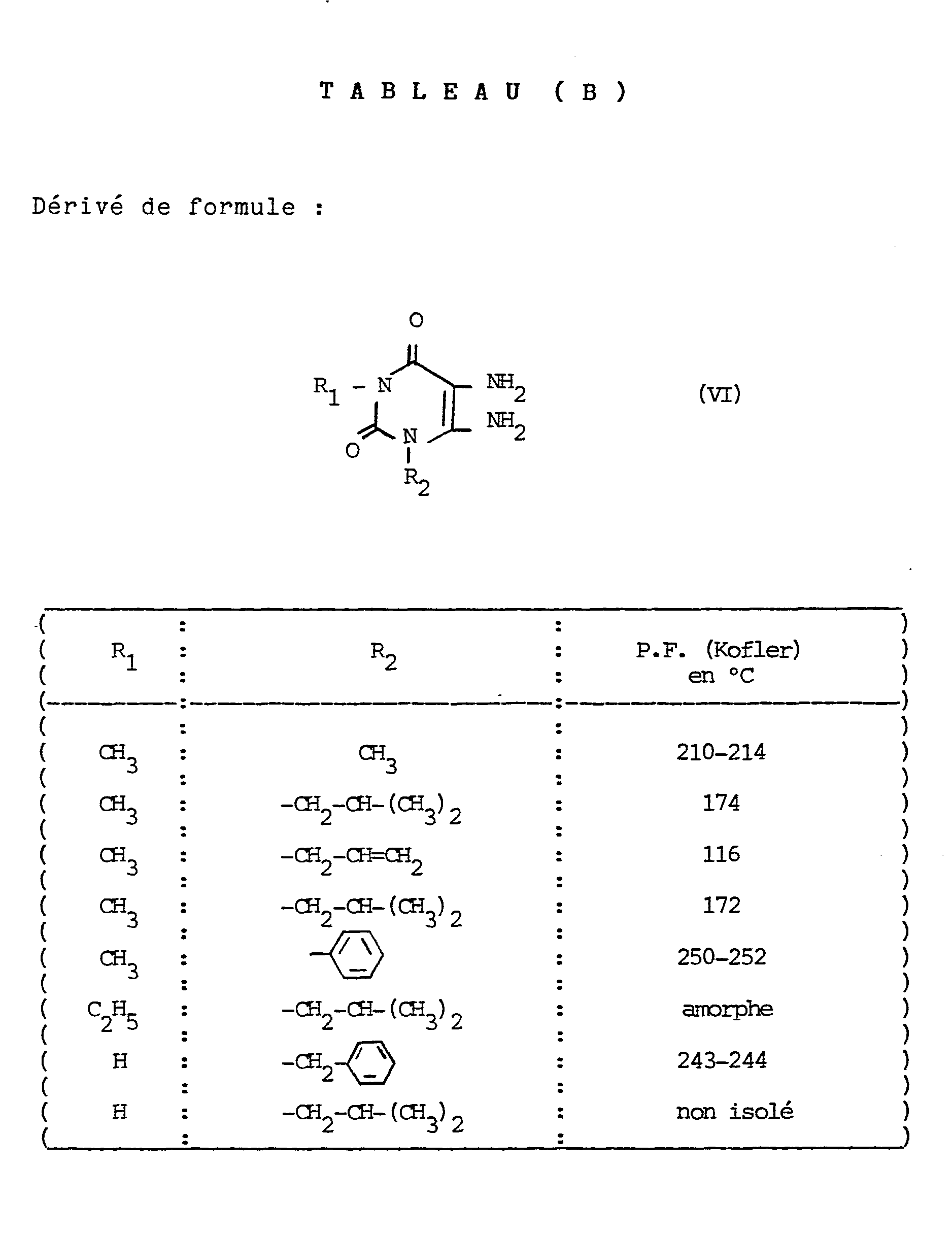
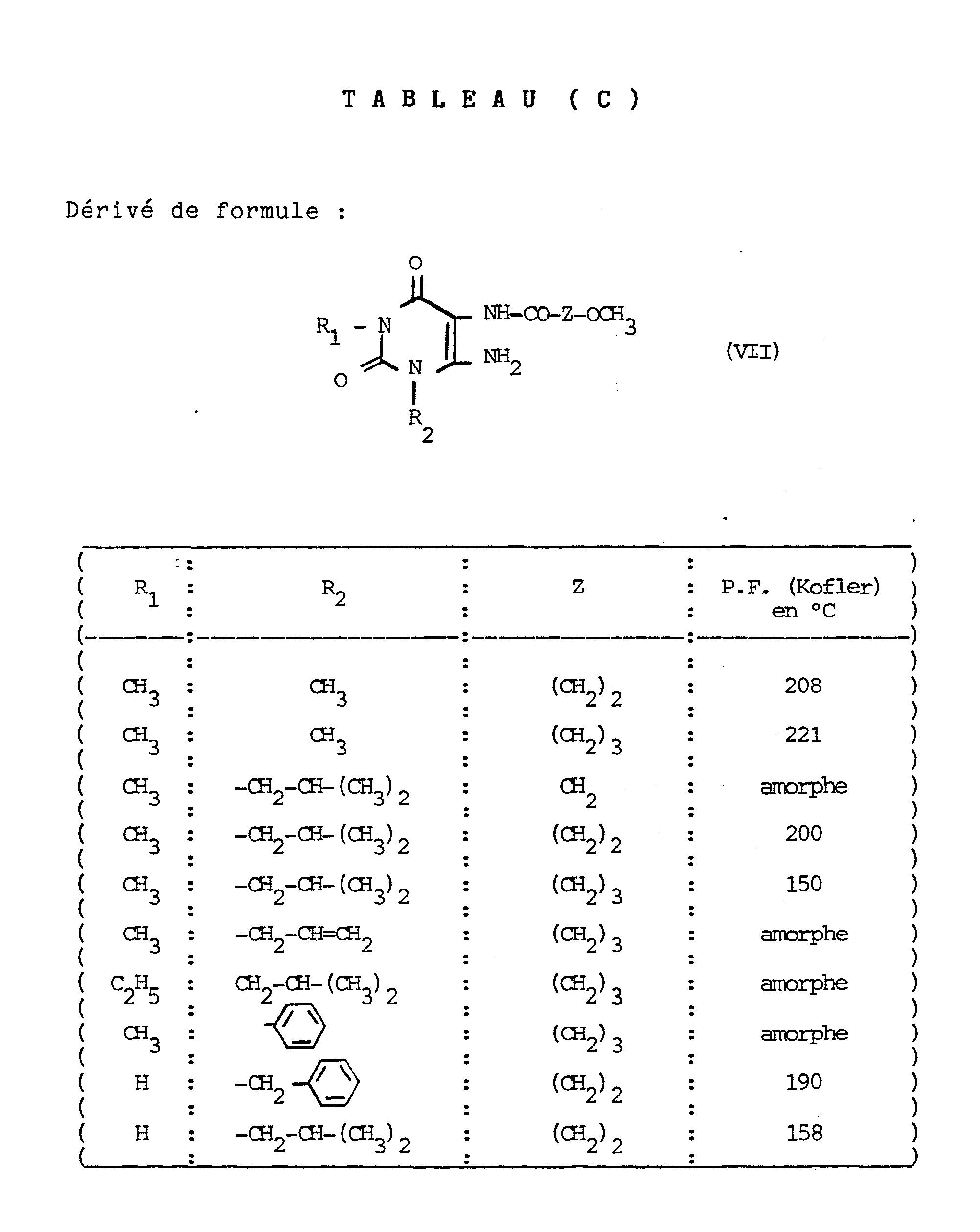
Les produits objets des exemples 2 à 30 ont été préparés à partir des composés de formule II a dont les caractéristiques sont regroupées ci-après dans le tableau (A). Ces produits de formule IIa ont eux-mêmes été préparés selon le procédé objet du schéma opératoire donné précédemment, à partir des composés dont les caractéristiques sont regroupées ci-après dans les tableaux (B), (C) et (D).

NB : Les dérivés * ont été préparés par analogie avec G. EHRHAR et coll., Arch. der Pharm. 289,453-459, (1956), selon le schéma suivant :



par analogie avec la méthode de G.N. KRUIOVSKIKH et coll. Pharmaceutical Chemistry Journal (1977) 11(2), 224

Méthyl-1 isobutyl-3 (hydroxy-2 éthyl)-7[(diphénylméthyl-4 pipérazinyl)-2 éthyl] -8 xanthine

10 g de méthyl-1 isobutyl-3 [(diphénylméthyl-4 pipérazinyl)-2 éthylj-8 xanthine et 37,6 g de carbonate de potassium sont agités dans 200 ml de diméthylformamide et portés à 100°C. On ajoute rapidement 10 ml de chlorhydrine du glycol et agite 1 heure à 110°C. On ajoute ensuite rapidement 20 ml de chlorhydrique du glycol et maintient 1 heure à 110°C sous agitation, on ajoute ensuite 40 g de carbonate de potassium, puis 20 ml de chlorhydrine du glycol. L'ensemble est maintenu à 110°C pendant 3 heures 30, puis à température ambiante pendant 72 heures. Le mélange est alors concentré'à sec, le résidu est repris dans un mélange de chlorure de méthylène et d'eau. La phase organique est séchée sur sulfate de sodium puis concentrée à sec. On effectue une chromatographie sur 750 g de silice (0,04-0,063 mm). On élue d'abord, au chlorure de méthylène, puis à l'acétate d'éthyle pur, ensuite avec un mélange acétate d'éthyle- méthanol (95-5) et enfin avec un mélange acétate d'éthyle-méthanol (90-10).10 g of 1-methyl-3-isobutyl [(4-diphenylmethyl-piperazinyl) -2 8-ethylj xanthine and 37.6 g of potassium carbonate are stirred in 200 ml of dimethylformamide and brought to 100 ° C. 10 ml of glycol hydrochlorine are rapidly added and the mixture is stirred for 1 hour at 110 ° C. Then quickly added 20 ml of hydrochloric acid glycol and maintained for 1 hour at 110 ° C with stirring, then added 40 g of potassium carbonate, then 20 ml of hydrochloride glycol. The whole is maintained at 110 ° C for 3 hours 30 minutes, then at room temperature for 72 hours. The mixture is then concentrated to dryness, the residue is taken up in a mixture of methylene chloride and water. The organic phase is dried over sodium sulfate and then concentrated to dryness. Chromatography is carried out on 750 g of silica (0.04-0.063 mm). First eluted with methylene chloride, then with pure ethyl acetate, then with an ethyl acetate-methanol mixture (95-5) and finally with an ethyl acetate-methanol mixture (90- 10).
On obtient 8,6 g de base que l'on dissous dans 50 ml d'isopropanol. On ajoute suffisamment d'éther chlorhydrique pour avoir un milieu légèrement acide. On précipite le chlorhydrate du produit cherché avec un gros excès d'éther anhydre. On essore et lave à l'éther. Après séchage, à 115°C sous 0,6 mm Hg, on obtient 8,7 g de dichlorhydrate de méthyl-1 isobutyl-3 (hydroxy-2 éthyl)-7 [(diphénylméthyl-4 pipérazinyl)-2 éthyl] -8 xanthine, P.F. (capillaire) 190-200°C (isopropanol/éther) ;8.6 g of base are obtained which is dissolved in 50 ml of isopropanol. Sufficient hydrochloric ether is added to have a slightly acidic medium. The hydrochloride of the sought product is precipitated with a large excess of anhydrous ether. It is filtered and washed with ether. After drying, at 115 ° C. under 0.6 mm Hg, 8.7 g of 1-methyl-isobutyl-3 (2-hydroxyethyl) dihydrochloride-7 [(4-diphenylmethyl piperazinyl) -2 ethyl] -8 xanthine, mp (capillary) 190-200 ° C (isopropanol / ether);
Rendement 71 %.Yield 71%.
La méthyl-1 isobutyl-3 (dihydroxy-2,3 propyl)-7[(diphénylméthyl-4 pipérazinyl)-2 éthyl] -8 xanthine, dont le dichlorhydrate fond (capillaire) à 145-155°C (isopropanol/éther).1-methyl-isobutyl-3 (2,3-dihydroxy propyl) -7 [(diphenylmethyl-4 piperazinyl) -2 ethyl] -8 xanthine, of which the dihydrochloride melts (capillary) at 145-155 ° C (isopropanol / ether) .
Claims (19)




Priority Applications (1)
| Application Number | Priority Date | Filing Date | Title |
|---|---|---|---|
| AT83401518T ATE17728T1 (en) | 1982-07-28 | 1983-07-25 | XANTHIN DERIVATIVES, PROCESS FOR THEIR PRODUCTION AND PHARMACEUTICAL COMPOSITIONS CONTAINING THEM. |
Applications Claiming Priority (2)
| Application Number | Priority Date | Filing Date | Title |
|---|---|---|---|
| FR8213155 | 1982-07-28 | ||
| FR8213155A FR2531085A1 (en) | 1982-07-28 | 1982-07-28 | NOVEL XANTHINE DERIVATIVES, PROCESS FOR THEIR PREPARATION AND PHARMACEUTICAL COMPOSITIONS COMPRISING SAME |
Publications (2)
| Publication Number | Publication Date |
|---|---|
| EP0103497A1 true EP0103497A1 (en) | 1984-03-21 |
| EP0103497B1 EP0103497B1 (en) | 1986-01-29 |
Family
ID=9276395
Family Applications (1)
| Application Number | Title | Priority Date | Filing Date |
|---|---|---|---|
| EP83401518A Expired EP0103497B1 (en) | 1982-07-28 | 1983-07-25 | Xanthine derivatives, process for their preparation and pharmaceutical compositions containing them |
Country Status (24)
| Country | Link |
|---|---|
| US (1) | US4548820A (en) |
| EP (1) | EP0103497B1 (en) |
| JP (1) | JPS5942383A (en) |
| KR (1) | KR870001268B1 (en) |
| AT (1) | ATE17728T1 (en) |
| AU (1) | AU560809B2 (en) |
| CA (1) | CA1207766A (en) |
| DD (1) | DD216934A5 (en) |
| DE (1) | DE3362022D1 (en) |
| DK (1) | DK157550C (en) |
| ES (1) | ES524532A0 (en) |
| FR (1) | FR2531085A1 (en) |
| GR (1) | GR78891B (en) |
| HU (1) | HU188353B (en) |
| IE (1) | IE55773B1 (en) |
| IL (1) | IL69362A (en) |
| MA (1) | MA19860A1 (en) |
| NO (1) | NO159091C (en) |
| NZ (1) | NZ205035A (en) |
| OA (1) | OA07508A (en) |
| PH (1) | PH19275A (en) |
| PT (1) | PT77110B (en) |
| SU (2) | SU1240361A3 (en) |
| ZA (1) | ZA835496B (en) |
Cited By (6)
| Publication number | Priority date | Publication date | Assignee | Title |
|---|---|---|---|---|
| EP0307014A1 (en) * | 1987-07-10 | 1989-03-15 | Janssen Pharmaceutica N.V. | Anti-allergic 2-(heterocyclyl alkyl) imidazo pyridines and 2-(heterocyclyl alkyl) purines |
| EP0215736B1 (en) * | 1985-09-05 | 1990-08-29 | Sandoz Ag | Xanthine derivatives, processes for their production and their use as pharmaceuticals |
| EP0590919A1 (en) * | 1992-09-28 | 1994-04-06 | Kyowa Hakko Kogyo Co., Ltd. | Therapeutic agents for parkinson's disease |
| WO2006045565A1 (en) * | 2004-10-22 | 2006-05-04 | Smithkline Beecham Corporation | Xanthine derivatives with hm74a receptor activity |
| US7153824B2 (en) | 2003-04-01 | 2006-12-26 | Applied Research Systems Ars Holding N.V. | Inhibitors of phosphodiesterases in infertility |
| EP2193808A1 (en) | 1999-08-21 | 2010-06-09 | Nycomed GmbH | Synergistic combination |
Families Citing this family (21)
| Publication number | Priority date | Publication date | Assignee | Title |
|---|---|---|---|---|
| CH648559A5 (en) * | 1981-07-20 | 1985-03-29 | Siegfried Ag | THEOPHYLINE DERIVATIVES AND METHOD FOR THE PRODUCTION THEREOF. |
| FR2558162B1 (en) * | 1984-01-17 | 1986-04-25 | Adir | NOVEL XANTHINE DERIVATIVES, PROCESSES FOR THEIR PREPARATION AND PHARMACEUTICAL COMPOSITIONS CONTAINING THEM |
| US4810706A (en) * | 1985-12-20 | 1989-03-07 | Recherche Syntex | Piperazine derivatives of theophylline and theobromine |
| US5298508A (en) * | 1988-07-19 | 1994-03-29 | The United States Of America As Represented By The Department Of Health And Human Services | Irreversible inhibitors of adenosine receptors |
| US5290782A (en) * | 1989-09-01 | 1994-03-01 | Kyowa Hakko Kogyo Co., Ltd. | Xanthine derivatives |
| FR2659656B1 (en) * | 1990-03-15 | 1994-09-09 | Sanofi Sa | PYRIMIDINEDIONE-2,4 DERIVATIVES AND MEDICINAL PRODUCTS CONTAINING THEM. |
| DE4019892A1 (en) * | 1990-06-22 | 1992-01-02 | Boehringer Ingelheim Kg | New xanthine derivs. are selective A1 adenosine antagonists - useful for treating CNS disorders (e.g. senile dementia) and heart and circulation disorders |
| MX9203323A (en) * | 1991-07-11 | 1994-07-29 | Hoechst Ag | THE USE OF XANTHINE DERIVATIVES FOR THE TREATMENT OF SECONDARY INJURIES OF THE NERVOUS CELLS AND FUNCTIONAL DISORDERS AFTER CRANIAL-BRAIN TRAUMA. |
| US5484920A (en) * | 1992-04-08 | 1996-01-16 | Kyowa Hakko Kogyo Co., Ltd. | Therapeutic agent for Parkinson's disease |
| TW252044B (en) * | 1992-08-10 | 1995-07-21 | Boehringer Ingelheim Kg | |
| AU6781194A (en) * | 1993-05-03 | 1994-11-21 | United States Of America, Represented By The Secretary, Department Of Health And Human Services, The | 8-substituted 1,3,7-trialkyl-xanthine derivatives as a2-selective adenosine receptor antagonists |
| US5661153A (en) * | 1994-07-19 | 1997-08-26 | Japan Energy Corporation | 1-arylpyrimidine derivatives and pharmaceutical use thereof |
| DE19702785A1 (en) * | 1997-01-27 | 1998-07-30 | Bayer Ag | New cyclic urea derivatives |
| GB0008694D0 (en) * | 2000-04-07 | 2000-05-31 | Novartis Ag | Organic compounds |
| CN1859913A (en) | 2003-04-25 | 2006-11-08 | 美国诺华卡迪亚公司 | Method of improved diuresis in individuals with impaired renal function |
| US20050239759A1 (en) * | 2004-04-16 | 2005-10-27 | Lauren Otsuki | Method of treatment of disease using an adenosine A1 receptor antagonist and an aldosterone inhibitor |
| US20100029681A1 (en) * | 2006-05-26 | 2010-02-04 | Hassan Pajouhesh | Heterocyclic compounds as calcium channel blockers |
| JP2008025761A (en) * | 2006-07-24 | 2008-02-07 | Kanaflex Corporation | Drain pipe-reclaiming resin pipe |
| RU2333212C3 (en) * | 2007-03-29 | 2019-08-26 | Общество С Ограниченной Ответственностью "Фармвинг" | 1- AND 7- [ω- (BENZHYDRIL-4-PIPERAZINYL-1) ALKYL] -3-ALKYLXANTINE DERIVATIVES PREVENTING ANTI-HISTAMIN AND ANTIALLERGIC ACTIVITY |
| EP2159226B1 (en) * | 2007-03-29 | 2016-08-31 | Joint-stock Company "Obninsk Chemical Pharmaceutical Company" | Antihistaminic and antiallergic agent and a method for the production thereof. |
| RU2373207C1 (en) * | 2008-03-17 | 2009-11-20 | Общество С Ограниченной Ответственностью "Фармвинг" | Method of producing 3-methyl-7-[4-(benzhydryl-4-piperazinyl-1) butyl]xanthine and salts thereof with organic or inorganic acids |
Citations (6)
| Publication number | Priority date | Publication date | Assignee | Title |
|---|---|---|---|---|
| CH409974A (en) * | 1959-03-25 | 1966-03-31 | Merckle Kg Chem Pharm L | Process for the preparation of new therapeutically active caffeino- (8) -alkylenediamines |
| FR5086M (en) * | 1964-12-08 | 1967-05-16 | ||
| FR7828M (en) * | 1967-11-13 | 1970-05-25 | ||
| EP0023350A1 (en) * | 1979-07-25 | 1981-02-04 | Eisai Co., Ltd. | Theophylline derivatives, a process for the preparation of the same and a therapeutical composition |
| FR2489331A1 (en) * | 1980-09-04 | 1982-03-05 | Eisai Co Ltd | THEOPHYLLINE AND THEOBROMINE DERIVATIVES, PROCESSES FOR THEIR PREPARATION AND THERAPEUTIC COMPOSITION CONTAINING SAME |
| FR2514003A1 (en) * | 1981-10-06 | 1983-04-08 | Invest Tecnica Aplicada | NOVEL XANTHINE WITH PHARMACOLOGICAL ACTIVITY, PROCESS FOR OBTAINING THEM, PHARMACEUTICAL COMPOSITIONS CONTAINING THEM AND THEIR USE IN HUMAN MEDICINE |
Family Cites Families (2)
| Publication number | Priority date | Publication date | Assignee | Title |
|---|---|---|---|---|
| JPS55118488A (en) * | 1979-03-05 | 1980-09-11 | Eisai Co Ltd | Theobromine derivative and its preparation |
| DE3046927A1 (en) * | 1980-12-11 | 1982-07-15 | Josef Dipl.-Chem.Dr.rer.nat. 1000 Berlin Klosa | 8-DIALKYLAMINOALKYLAETHER-COFFEIN-PLATINUM COMPLEXES, PROCESS FOR THEIR PRODUCTION AND MEDICINAL PRODUCTS CONTAINING THE SAME |
-
1982
- 1982-07-28 FR FR8213155A patent/FR2531085A1/en active Granted
-
1983
- 1983-07-22 KR KR1019830003383A patent/KR870001268B1/en not_active Expired
- 1983-07-25 AT AT83401518T patent/ATE17728T1/en not_active IP Right Cessation
- 1983-07-25 US US06/516,946 patent/US4548820A/en not_active Expired - Fee Related
- 1983-07-25 DE DE8383401518T patent/DE3362022D1/en not_active Expired
- 1983-07-25 EP EP83401518A patent/EP0103497B1/en not_active Expired
- 1983-07-26 GR GR72044A patent/GR78891B/el unknown
- 1983-07-26 SU SU833621202A patent/SU1240361A3/en active
- 1983-07-27 CA CA000433287A patent/CA1207766A/en not_active Expired
- 1983-07-27 DK DK342883A patent/DK157550C/en not_active IP Right Cessation
- 1983-07-27 ZA ZA835496A patent/ZA835496B/en unknown
- 1983-07-27 HU HU832638A patent/HU188353B/en not_active IP Right Cessation
- 1983-07-27 AU AU17361/83A patent/AU560809B2/en not_active Ceased
- 1983-07-27 PH PH29308A patent/PH19275A/en unknown
- 1983-07-27 NO NO832742A patent/NO159091C/en unknown
- 1983-07-27 IE IE1762/83A patent/IE55773B1/en not_active IP Right Cessation
- 1983-07-27 DD DD83253414A patent/DD216934A5/en not_active IP Right Cessation
- 1983-07-27 NZ NZ205035A patent/NZ205035A/en unknown
- 1983-07-27 PT PT77110A patent/PT77110B/en active IP Right Revival
- 1983-07-27 IL IL69362A patent/IL69362A/en not_active IP Right Cessation
- 1983-07-28 OA OA58075A patent/OA07508A/en unknown
- 1983-07-28 JP JP58138664A patent/JPS5942383A/en active Granted
- 1983-07-28 MA MA20081A patent/MA19860A1/en unknown
- 1983-07-28 ES ES524532A patent/ES524532A0/en active Granted
-
1984
- 1984-06-13 SU SU843749947A patent/SU1245261A3/en active
Patent Citations (6)
| Publication number | Priority date | Publication date | Assignee | Title |
|---|---|---|---|---|
| CH409974A (en) * | 1959-03-25 | 1966-03-31 | Merckle Kg Chem Pharm L | Process for the preparation of new therapeutically active caffeino- (8) -alkylenediamines |
| FR5086M (en) * | 1964-12-08 | 1967-05-16 | ||
| FR7828M (en) * | 1967-11-13 | 1970-05-25 | ||
| EP0023350A1 (en) * | 1979-07-25 | 1981-02-04 | Eisai Co., Ltd. | Theophylline derivatives, a process for the preparation of the same and a therapeutical composition |
| FR2489331A1 (en) * | 1980-09-04 | 1982-03-05 | Eisai Co Ltd | THEOPHYLLINE AND THEOBROMINE DERIVATIVES, PROCESSES FOR THEIR PREPARATION AND THERAPEUTIC COMPOSITION CONTAINING SAME |
| FR2514003A1 (en) * | 1981-10-06 | 1983-04-08 | Invest Tecnica Aplicada | NOVEL XANTHINE WITH PHARMACOLOGICAL ACTIVITY, PROCESS FOR OBTAINING THEM, PHARMACEUTICAL COMPOSITIONS CONTAINING THEM AND THEIR USE IN HUMAN MEDICINE |
Cited By (6)
| Publication number | Priority date | Publication date | Assignee | Title |
|---|---|---|---|---|
| EP0215736B1 (en) * | 1985-09-05 | 1990-08-29 | Sandoz Ag | Xanthine derivatives, processes for their production and their use as pharmaceuticals |
| EP0307014A1 (en) * | 1987-07-10 | 1989-03-15 | Janssen Pharmaceutica N.V. | Anti-allergic 2-(heterocyclyl alkyl) imidazo pyridines and 2-(heterocyclyl alkyl) purines |
| EP0590919A1 (en) * | 1992-09-28 | 1994-04-06 | Kyowa Hakko Kogyo Co., Ltd. | Therapeutic agents for parkinson's disease |
| EP2193808A1 (en) | 1999-08-21 | 2010-06-09 | Nycomed GmbH | Synergistic combination |
| US7153824B2 (en) | 2003-04-01 | 2006-12-26 | Applied Research Systems Ars Holding N.V. | Inhibitors of phosphodiesterases in infertility |
| WO2006045565A1 (en) * | 2004-10-22 | 2006-05-04 | Smithkline Beecham Corporation | Xanthine derivatives with hm74a receptor activity |
Also Published As
Similar Documents
| Publication | Publication Date | Title |
|---|---|---|
| EP0103497B1 (en) | Xanthine derivatives, process for their preparation and pharmaceutical compositions containing them | |
| EP0149578B1 (en) | Xanthine derivatives, processes for their preparation and pharmaceutical compositions containing them | |
| EP0099789B1 (en) | 3-aminoquinuclidin derivatives, process for their preparation and their use as therapeutical agents | |
| EP0202164B1 (en) | (benzoyl-4-piperidino)-2-phenyl-1-alkanol derivatives, their preparation and their use as medicines | |
| EP0370901B1 (en) | Central nervous system active chromane derivatives, process for their preparation and pharmaceutical compositions containing them | |
| EP0373998B1 (en) | Propenone oxime ethers, method for their preparation and pharmaceutical compositions containing them | |
| EP0307303B1 (en) | 1-[(2-Pyrimidinyl)-aminoalkyl] piperidines, their preparation and their use in therapy | |
| FR2476088A2 (en) | NOVEL NOR-TROPANE DERIVATIVES, PROCESS FOR THEIR PREPARATION AND THEIR THERAPEUTIC APPLICATION | |
| JP2776919B2 (en) | Fluoxetine analog | |
| CA1155123A (en) | Processes for preparing new piperidylbenzimidazolinone derivatives | |
| EP0090733A1 (en) | Disubstituted polymethylene imines, processes for their preparation and pharmaceutical compositions containing them | |
| JPH04338383A (en) | Substituted benzoxazepine and benzothiazepine | |
| CA1228359A (en) | Process for preparing new quinoline derivatives | |
| EP0306408A1 (en) | Imidazo[1,2,-b]pyridazines, process for their preparation and pharmaceutical compositions containing them | |
| JP2852681B2 (en) | 2-Amino-7-hydroxytetralin carboxyalkyl ethers and method for producing the same | |
| EP0406739A2 (en) | Piperidine derivative, method for preparation thereof, and a pharmaceutical composition comprising the same | |
| EP0301936B1 (en) | Piperidine derivatives, their preparation and their therapeutical use | |
| FR2753970A1 (en) | N- (BENZOTHIAZOL-2-YL) PIPERIDINE-1-ETHANAMINE DERIVATIVES, THEIR PREPARATION AND THEIR THERAPEUTIC USE | |
| EP0008259A1 (en) | Piperidyl-benzimidazolinone derivatives, processes for their preparation and pharmaceutical compositions containing them | |
| FR2547822A1 (en) | SUBSTITUTED ACYLPIPERAZINOQUINAZOLINES USEFUL AS MEDICAMENTS AND PROCESS FOR THEIR PREPARATION | |
| EP0005091B1 (en) | Monosubstituted piperazines, processes for their preparation and pharmaceutical compositions containing them | |
| FR2514003A1 (en) | NOVEL XANTHINE WITH PHARMACOLOGICAL ACTIVITY, PROCESS FOR OBTAINING THEM, PHARMACEUTICAL COMPOSITIONS CONTAINING THEM AND THEIR USE IN HUMAN MEDICINE | |
| FR2531709A1 (en) | Diazabicyclooctanes, process for preparing them and pharmaceutical compositions containing them | |
| EP1383761B1 (en) | Phenyl- and pyridyl-piperidines with tnf activity | |
| EP0157762B1 (en) | New substituted piperidinoguanidines, preparation process and pharmaceutical compositions containing them |
Legal Events
| Date | Code | Title | Description |
|---|---|---|---|
| PUAI | Public reference made under article 153(3) epc to a published international application that has entered the european phase |
Free format text: ORIGINAL CODE: 0009012 |
|
| AK | Designated contracting states |
Designated state(s): AT BE CH DE FR GB IT LI LU NL SE |
|
| 17P | Request for examination filed |
Effective date: 19840405 |
|
| ITF | It: translation for a ep patent filed | ||
| GRAA | (expected) grant |
Free format text: ORIGINAL CODE: 0009210 |
|
| AK | Designated contracting states |
Designated state(s): AT BE CH DE FR GB IT LI LU NL SE |
|
| REF | Corresponds to: |
Ref document number: 17728 Country of ref document: AT Date of ref document: 19860215 Kind code of ref document: T |
|
| RIN1 | Information on inventor provided before grant (corrected) |
Inventor name: BOULANGER, MICHELLE Inventor name: DUHAULT, JACQUES Inventor name: GUILLONNEAU, CLAUDE Inventor name: REGNIER, GILBERT |
|
| REF | Corresponds to: |
Ref document number: 3362022 Country of ref document: DE Date of ref document: 19860313 |
|
| PLBE | No opposition filed within time limit |
Free format text: ORIGINAL CODE: 0009261 |
|
| STAA | Information on the status of an ep patent application or granted ep patent |
Free format text: STATUS: NO OPPOSITION FILED WITHIN TIME LIMIT |
|
| 26N | No opposition filed | ||
| PGFP | Annual fee paid to national office [announced via postgrant information from national office to epo] |
Ref country code: SE Payment date: 19940518 Year of fee payment: 12 |
|
| PGFP | Annual fee paid to national office [announced via postgrant information from national office to epo] |
Ref country code: AT Payment date: 19940526 Year of fee payment: 12 |
|
| PGFP | Annual fee paid to national office [announced via postgrant information from national office to epo] |
Ref country code: CH Payment date: 19940622 Year of fee payment: 12 |
|
| PGFP | Annual fee paid to national office [announced via postgrant information from national office to epo] |
Ref country code: GB Payment date: 19940701 Year of fee payment: 12 |
|
| PGFP | Annual fee paid to national office [announced via postgrant information from national office to epo] |
Ref country code: FR Payment date: 19940726 Year of fee payment: 12 |
|
| PGFP | Annual fee paid to national office [announced via postgrant information from national office to epo] |
Ref country code: DE Payment date: 19940728 Year of fee payment: 12 |
|
| ITTA | It: last paid annual fee | ||
| PGFP | Annual fee paid to national office [announced via postgrant information from national office to epo] |
Ref country code: NL Payment date: 19940731 Year of fee payment: 12 Ref country code: LU Payment date: 19940731 Year of fee payment: 12 |
|
| PGFP | Annual fee paid to national office [announced via postgrant information from national office to epo] |
Ref country code: BE Payment date: 19940804 Year of fee payment: 12 |
|
| EPTA | Lu: last paid annual fee | ||
| EAL | Se: european patent in force in sweden |
Ref document number: 83401518.2 |
|
| PG25 | Lapsed in a contracting state [announced via postgrant information from national office to epo] |
Ref country code: LU Free format text: LAPSE BECAUSE OF NON-PAYMENT OF DUE FEES Effective date: 19950725 Ref country code: GB Effective date: 19950725 Ref country code: AT Effective date: 19950725 |
|
| PG25 | Lapsed in a contracting state [announced via postgrant information from national office to epo] |
Ref country code: SE Effective date: 19950726 |
|
| PG25 | Lapsed in a contracting state [announced via postgrant information from national office to epo] |
Ref country code: LI Effective date: 19950731 Ref country code: CH Effective date: 19950731 Ref country code: BE Effective date: 19950731 |
|
| BERE | Be: lapsed |
Owner name: ADIR Effective date: 19950731 |
|
| PG25 | Lapsed in a contracting state [announced via postgrant information from national office to epo] |
Ref country code: NL Effective date: 19960201 |
|
| REG | Reference to a national code |
Ref country code: CH Ref legal event code: PL |
|
| GBPC | Gb: european patent ceased through non-payment of renewal fee |
Effective date: 19950725 |
|
| NLV4 | Nl: lapsed or anulled due to non-payment of the annual fee |
Effective date: 19960201 |
|
| PG25 | Lapsed in a contracting state [announced via postgrant information from national office to epo] |
Ref country code: DE Effective date: 19960402 |
|
| EUG | Se: european patent has lapsed |
Ref document number: 83401518.2 |
|
| PG25 | Lapsed in a contracting state [announced via postgrant information from national office to epo] |
Ref country code: FR Effective date: 19960430 |
|
| REG | Reference to a national code |
Ref country code: FR Ref legal event code: ST |
|
| REG | Reference to a national code |
Ref country code: FR Ref legal event code: ST |
|
| REG | Reference to a national code |
Ref country code: FR Ref legal event code: ST |