EP0103436A2 - Process for preparing 5-perfluoroalkyl-5,6-dihydrouracil derivatives and compounds for use therein - Google Patents
Process for preparing 5-perfluoroalkyl-5,6-dihydrouracil derivatives and compounds for use therein Download PDFInfo
- Publication number
- EP0103436A2 EP0103436A2 EP83304968A EP83304968A EP0103436A2 EP 0103436 A2 EP0103436 A2 EP 0103436A2 EP 83304968 A EP83304968 A EP 83304968A EP 83304968 A EP83304968 A EP 83304968A EP 0103436 A2 EP0103436 A2 EP 0103436A2
- Authority
- EP
- European Patent Office
- Prior art keywords
- mmoles
- compound
- hydroxycarbonyl
- mixture
- formula
- Prior art date
- Legal status (The legal status is an assumption and is not a legal conclusion. Google has not performed a legal analysis and makes no representation as to the accuracy of the status listed.)
- Granted
Links
- 0 CC(C*C(NC)=O)C(C)=O Chemical compound CC(C*C(NC)=O)C(C)=O 0.000 description 2
- BONMJPAQJCJNMW-UHFFFAOYSA-N CN(C(C(CN1)C(F)(F)F)=O)C1=S Chemical compound CN(C(C(CN1)C(F)(F)F)=O)C1=S BONMJPAQJCJNMW-UHFFFAOYSA-N 0.000 description 1
Classifications
-
- C—CHEMISTRY; METALLURGY
- C07—ORGANIC CHEMISTRY
- C07D—HETEROCYCLIC COMPOUNDS
- C07D239/00—Heterocyclic compounds containing 1,3-diazine or hydrogenated 1,3-diazine rings
- C07D239/02—Heterocyclic compounds containing 1,3-diazine or hydrogenated 1,3-diazine rings not condensed with other rings
- C07D239/20—Heterocyclic compounds containing 1,3-diazine or hydrogenated 1,3-diazine rings not condensed with other rings having two double bonds between ring members or between ring members and non-ring members
- C07D239/22—Heterocyclic compounds containing 1,3-diazine or hydrogenated 1,3-diazine rings not condensed with other rings having two double bonds between ring members or between ring members and non-ring members with hetero atoms directly attached to ring carbon atoms
-
- A—HUMAN NECESSITIES
- A61—MEDICAL OR VETERINARY SCIENCE; HYGIENE
- A61P—SPECIFIC THERAPEUTIC ACTIVITY OF CHEMICAL COMPOUNDS OR MEDICINAL PREPARATIONS
- A61P35/00—Antineoplastic agents
-
- C—CHEMISTRY; METALLURGY
- C07—ORGANIC CHEMISTRY
- C07C—ACYCLIC OR CARBOCYCLIC COMPOUNDS
- C07C275/00—Derivatives of urea, i.e. compounds containing any of the groups, the nitrogen atoms not being part of nitro or nitroso groups
- C07C275/04—Derivatives of urea, i.e. compounds containing any of the groups, the nitrogen atoms not being part of nitro or nitroso groups having nitrogen atoms of urea groups bound to acyclic carbon atoms
- C07C275/06—Derivatives of urea, i.e. compounds containing any of the groups, the nitrogen atoms not being part of nitro or nitroso groups having nitrogen atoms of urea groups bound to acyclic carbon atoms of an acyclic and saturated carbon skeleton
- C07C275/16—Derivatives of urea, i.e. compounds containing any of the groups, the nitrogen atoms not being part of nitro or nitroso groups having nitrogen atoms of urea groups bound to acyclic carbon atoms of an acyclic and saturated carbon skeleton being further substituted by carboxyl groups
-
- C—CHEMISTRY; METALLURGY
- C07—ORGANIC CHEMISTRY
- C07C—ACYCLIC OR CARBOCYCLIC COMPOUNDS
- C07C275/00—Derivatives of urea, i.e. compounds containing any of the groups, the nitrogen atoms not being part of nitro or nitroso groups
- C07C275/04—Derivatives of urea, i.e. compounds containing any of the groups, the nitrogen atoms not being part of nitro or nitroso groups having nitrogen atoms of urea groups bound to acyclic carbon atoms
- C07C275/20—Derivatives of urea, i.e. compounds containing any of the groups, the nitrogen atoms not being part of nitro or nitroso groups having nitrogen atoms of urea groups bound to acyclic carbon atoms of an unsaturated carbon skeleton
- C07C275/24—Derivatives of urea, i.e. compounds containing any of the groups, the nitrogen atoms not being part of nitro or nitroso groups having nitrogen atoms of urea groups bound to acyclic carbon atoms of an unsaturated carbon skeleton containing six-membered aromatic rings
-
- C—CHEMISTRY; METALLURGY
- C07—ORGANIC CHEMISTRY
- C07C—ACYCLIC OR CARBOCYCLIC COMPOUNDS
- C07C275/00—Derivatives of urea, i.e. compounds containing any of the groups, the nitrogen atoms not being part of nitro or nitroso groups
- C07C275/28—Derivatives of urea, i.e. compounds containing any of the groups, the nitrogen atoms not being part of nitro or nitroso groups having nitrogen atoms of urea groups bound to carbon atoms of six-membered aromatic rings of a carbon skeleton
-
- C—CHEMISTRY; METALLURGY
- C07—ORGANIC CHEMISTRY
- C07C—ACYCLIC OR CARBOCYCLIC COMPOUNDS
- C07C335/00—Thioureas, i.e. compounds containing any of the groups, the nitrogen atoms not being part of nitro or nitroso groups
- C07C335/04—Derivatives of thiourea
- C07C335/06—Derivatives of thiourea having nitrogen atoms of thiourea groups bound to acyclic carbon atoms
- C07C335/08—Derivatives of thiourea having nitrogen atoms of thiourea groups bound to acyclic carbon atoms of a saturated carbon skeleton
-
- C—CHEMISTRY; METALLURGY
- C07—ORGANIC CHEMISTRY
- C07C—ACYCLIC OR CARBOCYCLIC COMPOUNDS
- C07C335/00—Thioureas, i.e. compounds containing any of the groups, the nitrogen atoms not being part of nitro or nitroso groups
- C07C335/04—Derivatives of thiourea
- C07C335/06—Derivatives of thiourea having nitrogen atoms of thiourea groups bound to acyclic carbon atoms
- C07C335/10—Derivatives of thiourea having nitrogen atoms of thiourea groups bound to acyclic carbon atoms of an unsaturated carbon skeleton
- C07C335/12—Derivatives of thiourea having nitrogen atoms of thiourea groups bound to acyclic carbon atoms of an unsaturated carbon skeleton the carbon skeleton containing six-membered aromatic rings
-
- C—CHEMISTRY; METALLURGY
- C07—ORGANIC CHEMISTRY
- C07C—ACYCLIC OR CARBOCYCLIC COMPOUNDS
- C07C335/00—Thioureas, i.e. compounds containing any of the groups, the nitrogen atoms not being part of nitro or nitroso groups
- C07C335/04—Derivatives of thiourea
- C07C335/16—Derivatives of thiourea having nitrogen atoms of thiourea groups bound to carbon atoms of six-membered aromatic rings of a carbon skeleton
-
- C—CHEMISTRY; METALLURGY
- C07—ORGANIC CHEMISTRY
- C07C—ACYCLIC OR CARBOCYCLIC COMPOUNDS
- C07C51/00—Preparation of carboxylic acids or their salts, halides or anhydrides
- C07C51/10—Preparation of carboxylic acids or their salts, halides or anhydrides by reaction with carbon monoxide
-
- C—CHEMISTRY; METALLURGY
- C07—ORGANIC CHEMISTRY
- C07C—ACYCLIC OR CARBOCYCLIC COMPOUNDS
- C07C51/00—Preparation of carboxylic acids or their salts, halides or anhydrides
- C07C51/58—Preparation of carboxylic acid halides
- C07C51/60—Preparation of carboxylic acid halides by conversion of carboxylic acids or their anhydrides or esters, lactones, salts into halides with the same carboxylic acid part
-
- C—CHEMISTRY; METALLURGY
- C07—ORGANIC CHEMISTRY
- C07H—SUGARS; DERIVATIVES THEREOF; NUCLEOSIDES; NUCLEOTIDES; NUCLEIC ACIDS
- C07H13/00—Compounds containing saccharide radicals esterified by carbonic acid or derivatives thereof, or by organic acids, e.g. phosphonic acids
- C07H13/12—Compounds containing saccharide radicals esterified by carbonic acid or derivatives thereof, or by organic acids, e.g. phosphonic acids by acids having the group -X-C(=X)-X-, or halides thereof, in which each X means nitrogen, oxygen, sulfur, selenium or tellurium, e.g. carbonic acid, carbamic acid
-
- C—CHEMISTRY; METALLURGY
- C07—ORGANIC CHEMISTRY
- C07H—SUGARS; DERIVATIVES THEREOF; NUCLEOSIDES; NUCLEOTIDES; NUCLEIC ACIDS
- C07H19/00—Compounds containing a hetero ring sharing one ring hetero atom with a saccharide radical; Nucleosides; Mononucleotides; Anhydro-derivatives thereof
- C07H19/02—Compounds containing a hetero ring sharing one ring hetero atom with a saccharide radical; Nucleosides; Mononucleotides; Anhydro-derivatives thereof sharing nitrogen
- C07H19/04—Heterocyclic radicals containing only nitrogen atoms as ring hetero atom
- C07H19/06—Pyrimidine radicals
Definitions
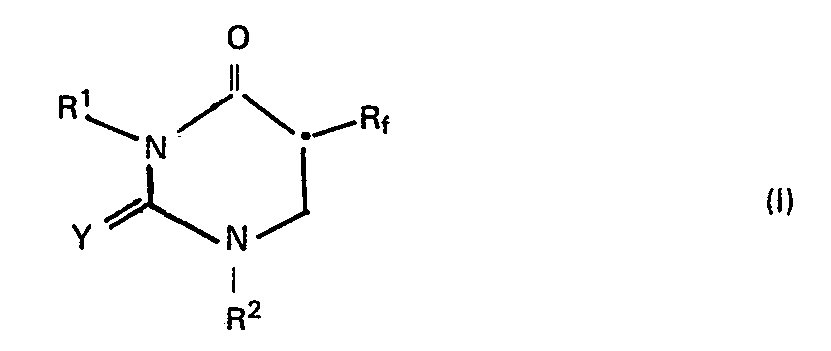
- This invention relates to the production of 5-perfluoroalkyldihydrouracil derivatives. More specifically, it relates to a process for preparing 5-perfluoroalkyl-5,6-dehydrouracil derivatives of the following formula wherein R f represents a perfluoroalkyl group, each of R 1 and R2 represents a hydrogen atom or an alkyl, cycloalkyl, aryl, aralkyl or heterocyclic group, and Y is an oxygen or sulfur atom; and to novel intermediate compounds useful for this process.
- 5-trifluoromethyldihydrouracil is a known compound which can be converted to trifluorothymine by reacting it with bromine in acetic acid followed by heating [C. Heidelberger, D. G. Parsons and D. C. Remy, J. Med. Chem., 7 1(1964)]. Condensation of trifluorothymine with a sugar can yield trifluorothymidine or its derivative which has anticancer and antiviral activities and is useful as a drug for treating ceratitis and herpes.
- the compounds of formula (I) other than 5-trifluoromethyldihydrouracil are novel compounds which are not described in the prior literature. They have antitumor activity against ascitic mastocarcinoma and are expected to be useful as an anticancer agent.
- One conventional method for synthesizing 5-trifluoromethyldihydrouracil comprises converting trifluoroacetone to cyanohydrin, acetylating the product, heat-decomposing the acetylated product, reacting the resulting alpha-trifluoroacrylonitrile with hydrogen bromide in methanol to form beta- bromo-alpha-trifluoromethylpropionamide, reacting the amide with urea or acetylurea, and cyclizing the resulting compound in hydrochloric acid [C. Heidelberger, D. G. Parsons and D. C. Remy, J. Med. Chem., 7, 1 (1964)].
- the above conventional method includes many steps, and the total yield attained is as low as 7 to 16 %. It has never proved to be commercially satisfactory.
- Another object of this invention is to provide novel intermediate compounds which are useful for the above manufacturing process.
- the 5- perfluoroalkyldihydrouracil derivatives of formula (I) are prepared by a process which comprises
- the "perfluoroalkyl group" represented by R f is a group resulting from substitution of fluorine atoms for all of the hydrogen atoms bonded to the carbon atom or atoms of an alkyl group, and may be linear or branched. It may contain 1 to 20, preferably 1 to 5, carbon atoms.
- perfluoroalkyl group examples include trifluoromethyl, pentafluoroethyl, n-heptafluoro- propyl, heptafluoro-isopropyl, nonafluorobutyl, nonafluoro-isobutyl, nonafluoro-sec-butyl, nonafluoro-tert-butyl, perfluoropentyl, perfluoroheptyl and perfluorooctyl.
- alkyl group represented by R 1 and/or R 2 in formula (III) may be linear or branched, and includes, for example, methyls ethyl, propyl, isopropyl, butyl, isobutyl, see-butyl, tert-butyl, pentyl, isoamyl, hexyl, heptyl, octyl, 2-ethylhexyl and decyl.
- these alkyl groups contain up to 10 carbon atoms, and more preferably they are lower alkyl groups.
- the "cycloalkyl group” may generally contain 3 to 10 carbon atoms, and may further contain a lower alkyl group such as methyl on the ring. Examples include cyclopropyl, cyclobutyl, cyclopentyl, cyclohexyl, methylcyclohexyl, cycloheptyl, cyclooctyl and cyclo[4.4.0]decyl.
- the "aryl group” includes, for example, phenyl, tolyl, xylyl and naphthyl, and a phenyl group is preferred.
- the "aralkyl group” is an aryl-substituted alkyl group in which the alkyl and aryl have the aforesaid meanings. Examples include benzyl, alpha-phenethyl and beta- phenethyl. Benzyl is preferred.
- the "heterocyclic group” includes 5- or 6-membered heterocyclic groups such as tetrahydrofuryl, furyl, 2-oxo-3-tetrahydrofuryl, 2,3,4,6-tetra-O-acetyl-beta-D-glucopyranosyl or 3,5-di-O-benzoyl-deoxy-beta-D-2- ribofuranosyl.
- This reaction can be carried out in the absence of solvent. Usually, however, it is performed in a solvent which does not participate in the reaction.
- ether solvents such as tetrahydrofuran, dibutyl ether, . dioxane, dimethoxyethane and diglyme
- hydrocarbon solvents such as benzene, toluene and xylene
- aprotic polar solvents such as dimethylformamide (DMF), dimethylsulfoxide (DMSO), 1,3-dimethyl-2-imidazolidinone, hexamethylphosphonamide and acetonitrile.
- aprotic polar solvents are preferred.
- Examples of the condensing agent which can be used in this invention include dicyclohexylcarbodiimide (DCC), polyphosphoric acid, p-toluene-sulfonic acid and carboxylic acid anhydrides of the formula (R3CO)20 (wherein R 3 represents a hydrogen atom, a lower alkyl group, a lower haloalkyl group or an aryl group, or the two R 3 is may together form a lower alkylene group) such as formic anhydride, acetic anhydride, propionic anhydride, trifluoroacetic anhydride, benzoic anhydride, succinic anhydride, glutaric anhydride, and adipic anhydride,
- DCC dicyclohexylcarbodiimide
- polyphosphoric acid polyphosphoric acid
- p-toluene-sulfonic acid and carboxylic acid anhydrides of the formula (R3CO)20 (wherein R 3 represents a hydrogen atom
- DCC and carboxylic acid anhydrides are preferred.
- the amount of the condensing agent used is not critical. Generally, it is 1 to 10 moles per mole of the compound of formula (I).
- the carboxylic acid anhydride may be used in large excess to cause it to serve also as a solvent.
- the above reaction is carried out optionally in the presence of an acid-trapping agent.
- acid-trapping agents that can be used for this purpose include tertiary amines such as triethylamine, pyridine and N-methylmorpholine, and alkalies such as sodium hydrogen carbonate, sodium carbonate, sodium hydroxide and potassium hydroxide.
- the amount of the acid-trapping agent used is neither critical. Its suitable amount is generally 1 to 5, preferably 1 to 1.2, equivalents, per mole of the compound of formula (II) .
- the temperature at which the above reaction is carried out is not strictly limited, and can be varied depending upon the types of the starting materials, etc. Generally, it is about -50 °C to the refluxing temperature of the reaction mixture, preferably about -20 °C to about 120 °C. The more preferred reaction temperature may be selected suitably according to the starting compound of formula (II) used. For example, when compound of formula (II) in which X is a halogen atom is used, relatively low reaction temperatures of about -20 °C to about 50 °C are advantageously used.
- reaction temperatures in the range of about -20 °C to about 120 °C are preferred.
- reaction temperatures in the range of about 50 °C to. about 200 °C, especially about-80 °C to about 120 °C, are conveniently used.
- the amount of the compound of formula (III) relative to the compound of formula (II) is not critical, and can be varied depending upon the types of the starting materials used, etc. Generally, its suitable amount is 0.5 to 2 moles per mole of the compound of formula (II).
- the alpha-perfluoroalkylacrylic acid or its halide of formula (II) used as a starting material in the above reaction can be obtained, for example, by reacting an ⁇ -halo- ⁇ -perfluoroalkylethylene, carbon monoxide and water and as required, halogenating the reaction product.
- reaction conditions for this reaction reference may be had to Referential Examples 1 to 3 given hereinbelow.
- Examples of the compound of formula (II) include alpha-trifluoromethylacrylic acid, alpha-pentafluoroethylacrylic acid, alpha-heptafluoropropylacrylic acid, alpha- heptafluoro-isopropylacrylic acid, alpha-nona- fluorobutylacrylic acid, alpha-nonafluoro-isobutyl- acrylic acid, alpha-nonafluoro-sec-butylacrylic acid, alpha-nonafluoro-tert-butylacrylic acid, alpha- perfluoropentylacrylic acid, alpha-perfluoroheptyl- acrylic acid, alpha-perfluorooctylacrylic acid, and the corresponding halides such as the chlorides and bromides thereof.
- the (thio)urea derivatives of formula (III) to be reacted with the compounds of formula (II) are known compounds or can be produced in accordance with the methods of production of the known compounds. Examples include urea, methylurea, ethylurea, cyclo- hexylurea, phenylurea; benzylurea, 2-tetrahydro- furylurea, 1,3-dimethylurea, 1,3-diphenylurea, 1,3-dibenzylurea, 1-methyl-3-(2-tetrahydrofuryl)urea, and the corresponding thiourea derivatives.
- the cyclization reaction can be carried out in the absence of a solvent. Usually, however, it is carried out in a solvent which does not participat in the reaction.
- the solvent are ether solvents such as tetrahydrofuran, dibutyl ether, dioxane, dimethoxyethane and diglyme, hydrocarbon solvents such as benzene, toluene and xylene, aprotic polar solvents such as dimethylformamide, dimethyl sulfoxide, 1,3-dimethyl-2-imidazolidinone, hexamethylphosphonamide and acetonitrile.
- ether solvents such as tetrahydrofuran, dibutyl ether, dioxane, dimethoxyethane and diglyme
- hydrocarbon solvents such as benzene, toluene and xylene
- aprotic polar solvents such as dimethylformamide, dimethyl sulfoxide, 1,3-dimethyl
- the cyclization may be carried out in the presence of the same condensing agent as described above, preferably dicyclohexylcarbodiimide (DCC) and acetic anhydride.
- DCC dicyclohexylcarbodiimide
- acetic anhydride preferably dicyclohexylcarbodiimide (DCC) and acetic anhydride.
- the amount of the condensing agent is not critical.
- it is used generally in an amount of 1 to 1.2 moles per mole of the compound of formula (IV).
- the condensing agent is a carboxylic acid anhydride, it may be used in large excess to cause it to serve also as a solvent.
- the cyclization reaction temperature is neither critical, and can be varied widely depending upon the types of the compound of formula (IV) and the condensing agent, etc.
- the temperature is generally about -20 °C to about 200 °C, preferably about 0 °C to about 120 °C.
- the compound of.formula (IV) used as a starting material in this reaction is a novel compound not described in the prior literature, and can be produced by the addition-reaction of a (thio)urea derivative of the following formula wherein R l , R2 and Y are as defined above, with an alpha-perfluoroalkylacrylic acid of the following formula wherein R f is as defined hereinabove.
- the above addition-reaction can be carried out in a solvent of the types exemplified hereinabove with regard to the reaction of the compound of formula (II) with the compound of formula (III).
- the reaction can be advantageously carried out under heating conditions generally at a temperature of from about 50 °C to the refluxing temperature of the reaction mixture, preferably from about 80 °C to about 150 °C.
- the amount of the compound of formula (III) relative to the compound of formula (II-1) is not critical.
- the suitable amount of the compound of formula (III) is generally 0.5 to 10 moles, preferably 1 to 2 moles, per mole of the compound of formula (II-1).
- the compound of formula (IV) can be isolated from the reaction mixture and purified by methods known per se such as chromatography, recrystallization, or distillation..But without isolating it, its cyclization may be carried out successively to the addition-reaction as a one-pot process, and this is preferred.
- the compound of formula (I) produced by embodiment (a) or (b) can be isolated from the reaction mixture, and purified, by methods known per se such as chromatography, recrystallization, and distillation.
- a compound corresponding to formula (I) in which R f is trifluoromethyl and both R and R 2 are hydrogen atoms i.e. 5-trifluoromethyldihydrouracil
- R f is trifluoromethyl and both R and R 2 are hydrogen atoms
- 5-trifluoromethyldihydrouracil is an important intermediate for the production of trifluorothymidine and its derivatives having anticancer and antiviral activities. It can be converted to trifluorothymidine by the route schematically shown below (for details of the reaction, see C. Heidelberger, D.G. Parsons and D.C. Remy, J. Med, Chem., 7, 1(1964).
- Some of the compounds of formula (I) produced by the process of this invention have antitumor activity as demonstrated by the following animal experiment, and may find utility as an anticancer agent.
- mice CDF 1 , C3H/Me, were purchased from Charles River Japan, Inc., and after feeding them for one week, five-week old male mice were used in the experiment.(6 per group).
- Tumor cells (1 x 10 6 ) of ascitic mastocarcinoma MM2 were transplanted into the abdominal cavity of each of CDF 1 and C3H/Me mice to give tumor bearing mice.
- Each of the compounds produced in Examples 1 and 4 below (OF-1 to OF-3) was suspended in 0.5% CMC.
- the suspension was intraperitoneally administered to the mice in a dose of 50 mg/kg continuously (1 to 5 days) after transplantation of the tumor cells.
- the antitumor effect was assessed from the rate of apothanasia (T/C %).
- the antitumor effects of the compounds tested on mouse ascitic mastocarcinoma MM2 are shown in Table 2.
- the average number of days of survival of the control group was 16.5+0.4 days.
- an apothanasia rate of about 33 to about 52% was noted.
- OF-1, OF-2 and OF-3 cases of complete cure were observed.
- Mass spectrum m/e (relative intensity) M + 210 (93), 57 (100).
- Mass spectrum m/e (relative intensity) M + 226 (100), 129 (30), 74 (60), 73 (31), 42 (65).
- a mixture of a-trifluoromethylacrylic acid (700 mg; 5.0 mmoles) and methylurea (370 mg; 5.0 mmoles) in DMF (5 ml) was heated at 80 °C with stirring for 3 hours. After cooling to 0 °C, a solution of dicyclohexylcarbodiimide (DCC) (1.05 g; 5.1 mmoles) in 3 ml of DMF was added dropwise. The mixture was stirred for 1 hour, and the precipitated solid was filtered off and washed with ethyl acetate. The solvent was evaporated under reduced pressure from the combined filtrates.
- DCC dicyclohexylcarbodiimide
- Mass spectrum m/e (relative intensity) M + 196 (100), 99 (50), 96 (46), 95 (32), 77 (35), 58 (66), 56 (54).
- Mass spectrum m/e (relative intensity) M + 196 (100), 77 (20), 57 (92), 56 (21), 44 (62), 43 (39), 42 (88).
- Mass spectrum m/e (relative intensity) M + 182 (100), 96 (66), 95 (60), 44 (47), 43 (75), 30 (53), 29 (44).
- Mass spectrum m/e (relative intensity) M + 272 (100), 147 (56), 105 (58), 104 (99), 91 (97).
- a mixture of a-trifluoromethylacrylic acid (700 mg; 5.0 mmoles) and methylthiourea (460 mg; 5.1 mmoles) in DMF (5 ml) was. heated at 80 °C with stirring for 4 hours. After cooling to 0 °C, a solution of DCC (1.09 g; 5.3 mmoles) in DMF (3 ml) was added dropwise to the reaction mixture. The mixture was stirred for 1 hour, and the precipitated solid was filtered off and washed with ethyl acetate. The solvents were evaporated under reduced pressure from the combined filtrates.
- Mass spectrum m/e (relative intensity) M + 212 (100), 56 (28), 43 (39), 42 (57).
- Mass spectrum m/e (relative intensity) M + 198 (100), 69 (18), 60 (51), 59 (31), 43 (19), 42 (21).
- Mass spectrum m/e (relative intensity) M + 290(18), 106 (100).
Landscapes
- Chemical & Material Sciences (AREA)
- Organic Chemistry (AREA)
- Engineering & Computer Science (AREA)
- Health & Medical Sciences (AREA)
- General Health & Medical Sciences (AREA)
- Life Sciences & Earth Sciences (AREA)
- Biochemistry (AREA)
- Oil, Petroleum & Natural Gas (AREA)
- Molecular Biology (AREA)
- Genetics & Genomics (AREA)
- Biotechnology (AREA)
- Chemical Kinetics & Catalysis (AREA)
- Medicinal Chemistry (AREA)
- General Chemical & Material Sciences (AREA)
- Veterinary Medicine (AREA)
- Public Health (AREA)
- Pharmacology & Pharmacy (AREA)
- Animal Behavior & Ethology (AREA)
- Nuclear Medicine, Radiotherapy & Molecular Imaging (AREA)
- Pharmaceuticals Containing Other Organic And Inorganic Compounds (AREA)
- Organic Low-Molecular-Weight Compounds And Preparation Thereof (AREA)
Abstract


Description
- This invention relates to the production of 5-perfluoroalkyldihydrouracil derivatives. More specifically, it relates to a process for preparing 5-perfluoroalkyl-5,6-dehydrouracil derivatives of the following formula

- Among the 5-perfluoroalkyldihydrouracils of formula (1), 5-trifluoromethyldihydrouracil is a known compound which can be converted to trifluorothymine by reacting it with bromine in acetic acid followed by heating [C. Heidelberger, D. G. Parsons and D. C. Remy, J. Med. Chem., 7 1(1964)]. Condensation of trifluorothymine with a sugar can yield trifluorothymidine or its derivative which has anticancer and antiviral activities and is useful as a drug for treating ceratitis and herpes. The compounds of formula (I) other than 5-trifluoromethyldihydrouracil are novel compounds which are not described in the prior literature. They have antitumor activity against ascitic mastocarcinoma and are expected to be useful as an anticancer agent.
- One conventional method for synthesizing 5-trifluoromethyldihydrouracil comprises converting trifluoroacetone to cyanohydrin, acetylating the product, heat-decomposing the acetylated product, reacting the resulting alpha-trifluoroacrylonitrile with hydrogen bromide in methanol to form beta- bromo-alpha-trifluoromethylpropionamide, reacting the amide with urea or acetylurea, and cyclizing the resulting compound in hydrochloric acid [C. Heidelberger, D. G. Parsons and D. C. Remy, J. Med. Chem., 7, 1 (1964)].
- The above conventional method includes many steps, and the total yield attained is as low as 7 to 16 %. It has never proved to be commercially satisfactory.
- It is an object of this invention to provide a novel and commercial process for producing the 5- perfluoroalkyldihydrouracil derivatives of general formula (I) above.
- Another object of this invention is to provide novel intermediate compounds which are useful for the above manufacturing process.
- Other objects and advantages of this invention will become apparent from the following detailed description.
- According to the present invention, the 5- perfluoroalkyldihydrouracil derivatives of formula (I) are prepared by a process which comprises
- (a) reacting a compound of the general formula


- (b) cyclizing a compound of the general formula

- In formulae (I), (II) and (IV), the "perfluoroalkyl group" represented by Rf is a group resulting from substitution of fluorine atoms for all of the hydrogen atoms bonded to the carbon atom or atoms of an alkyl group, and may be linear or branched. It may contain 1 to 20, preferably 1 to 5, carbon atoms. Examples of the perfluoroalkyl group include trifluoromethyl, pentafluoroethyl, n-heptafluoro- propyl, heptafluoro-isopropyl, nonafluorobutyl, nonafluoro-isobutyl, nonafluoro-sec-butyl, nonafluoro-tert-butyl, perfluoropentyl, perfluoroheptyl and perfluorooctyl. Lower perfluoroalkyl groups, particularly trifluoromethyl, are preferred.
- In the present specification, the term "lower" is used to show that a compound or group qualified by this term has not more than 5 carbon atoms.
- The "alkyl group" represented by R1 and/or R 2 in formula (III) may be linear or branched, and includes, for example, methyls ethyl, propyl, isopropyl, butyl, isobutyl, see-butyl, tert-butyl, pentyl, isoamyl, hexyl, heptyl, octyl, 2-ethylhexyl and decyl. Preferably, these alkyl groups contain up to 10 carbon atoms, and more preferably they are lower alkyl groups. The "cycloalkyl group" may generally contain 3 to 10 carbon atoms, and may further contain a lower alkyl group such as methyl on the ring. Examples include cyclopropyl, cyclobutyl, cyclopentyl, cyclohexyl, methylcyclohexyl, cycloheptyl, cyclooctyl and cyclo[4.4.0]decyl. The "aryl group" includes, for example, phenyl, tolyl, xylyl and naphthyl, and a phenyl group is preferred. The "aralkyl group" is an aryl-substituted alkyl group in which the alkyl and aryl have the aforesaid meanings.. Examples include benzyl, alpha-phenethyl and beta- phenethyl. Benzyl is preferred. The "heterocyclic group" includes 5- or 6-membered heterocyclic groups such as tetrahydrofuryl, furyl, 2-oxo-3-tetrahydrofuryl, 2,3,4,6-tetra-O-acetyl-beta-D-glucopyranosyl or 3,5-di-O-benzoyl-deoxy-beta-D-2- ribofuranosyl.
- In embodiment (a) of the process of this invention, the alpha-perfluoroalkylacrylic acid or its halide of formula (II) is reacted with the (thio)urea derivative of formula (III).
- This reaction can be carried out in the absence of solvent. Usually, however, it is performed in a solvent which does not participate in the reaction.' For example, there can be used ether solvents such as tetrahydrofuran, dibutyl ether, . dioxane, dimethoxyethane and diglyme, hydrocarbon solvents such as benzene, toluene and xylene, aprotic polar solvents such as dimethylformamide (DMF), dimethylsulfoxide (DMSO), 1,3-dimethyl-2-imidazolidinone, hexamethylphosphonamide and acetonitrile. Of these, aprotic polar solvents are preferred.
- When a compound of formula (II) in which X. represents a hydroxyl group and a compound of formula (III) in which at least one of R1 and R2 is a hydrogen atom are used as the starting materials, this reaction is carried out in the presence of a condensing agent. Even in the absence of a condensing agent, the desired compound of formula (I) may sometimes be formed in a very low yield as seen, for example, in Example 9 given hereinbelow. The presence of a condensing agent, however, can always lead to high yields of the desired compound of formula (I). Examples of the condensing agent which can be used in this invention include dicyclohexylcarbodiimide (DCC), polyphosphoric acid, p-toluene-sulfonic acid and carboxylic acid anhydrides of the formula (R3CO)20 (wherein R3 represents a hydrogen atom, a lower alkyl group, a lower haloalkyl group or an aryl group, or the two R3 is may together form a lower alkylene group) such as formic anhydride, acetic anhydride, propionic anhydride, trifluoroacetic anhydride, benzoic anhydride, succinic anhydride, glutaric anhydride, and adipic anhydride,
- Of these condensing agents, DCC and carboxylic acid anhydrides,particularly acetic anhydride, are preferred. The amount of the condensing agent used is not critical. Generally, it is 1 to 10 moles per mole of the compound of formula (I). The carboxylic acid anhydride may be used in large excess to cause it to serve also as a solvent.
- When a compound of formula (II) in which X is a halogen atom is used, and particularly when the (thio)urea derivative of formula (III) having a functional substituent sensitive to hydrogen halide generated during the reaction is used, the above reaction is carried out optionally in the presence of an acid-trapping agent. Examples of acid-trapping agents that can be used for this purpose include tertiary amines such as triethylamine, pyridine and N-methylmorpholine, and alkalies such as sodium hydrogen carbonate, sodium carbonate, sodium hydroxide and potassium hydroxide. The amount of the acid-trapping agent used is neither critical. Its suitable amount is generally 1 to 5, preferably 1 to 1.2, equivalents, per mole of the compound of formula (II) .
- The temperature at which the above reaction is carried out is not strictly limited, and can be varied depending upon the types of the starting materials, etc. Generally, it is about -50 °C to the refluxing temperature of the reaction mixture, preferably about -20 °C to about 120 °C. The more preferred reaction temperature may be selected suitably according to the starting compound of formula (II) used. For example, when compound of formula (II) in which X is a halogen atom is used, relatively low reaction temperatures of about -20 °C to about 50 °C are advantageously used. When a compound of formula (II) in which X represents a hydroxyl group is to be reacted with a compound of formula (III) in which at least one of R1 and R 2 represents a hydrogen atom in the presence of the aforesaid condensing agent, reaction temperatures in the range of about -20 °C to about 120 °C are preferred. In the reaction of a compound of formula (II) in which X represents a hydroxyl group with a compound of formula (III) in which R1 and R2.both represent substituents other than a hydrogen atom, relatively elevated temperatures of about 50 °C to. about 200 °C, especially about-80 °C to about 120 °C, are conveniently used.
- The amount of the compound of formula (III) relative to the compound of formula (II) is not critical, and can be varied depending upon the types of the starting materials used, etc. Generally, its suitable amount is 0.5 to 2 moles per mole of the compound of formula (II).
- - The alpha-perfluoroalkylacrylic acid or its halide of formula (II) used as a starting material in the above reaction can be obtained, for example, by reacting an α-halo-α-perfluoroalkylethylene, carbon monoxide and water and as required, halogenating the reaction product. For specific reaction conditions for this reaction, reference may be had to Referential Examples 1 to 3 given hereinbelow. Examples of the compound of formula (II) include alpha-trifluoromethylacrylic acid, alpha-pentafluoroethylacrylic acid, alpha-heptafluoropropylacrylic acid, alpha- heptafluoro-isopropylacrylic acid, alpha-nona- fluorobutylacrylic acid, alpha-nonafluoro-isobutyl- acrylic acid, alpha-nonafluoro-sec-butylacrylic acid, alpha-nonafluoro-tert-butylacrylic acid, alpha- perfluoropentylacrylic acid, alpha-perfluoroheptyl- acrylic acid, alpha-perfluorooctylacrylic acid, and the corresponding halides such as the chlorides and bromides thereof.
- The (thio)urea derivatives of formula (III) to be reacted with the compounds of formula (II) are known compounds or can be produced in accordance with the methods of production of the known compounds. Examples include urea, methylurea, ethylurea, cyclo- hexylurea, phenylurea; benzylurea, 2-tetrahydro- furylurea, 1,3-dimethylurea, 1,3-diphenylurea, 1,3-dibenzylurea, 1-methyl-3-(2-tetrahydrofuryl)urea, and the corresponding thiourea derivatives.
- In embodiment (b) of the process in accordance with this inventionf the compound of formula (IV) is cyclizedo
- The cyclization reaction can be carried out in the absence of a solvent. Usually, however, it is carried out in a solvent which does not participat in the reaction. Examples of the solvent are ether solvents such as tetrahydrofuran, dibutyl ether, dioxane, dimethoxyethane and diglyme, hydrocarbon solvents such as benzene, toluene and xylene, aprotic polar solvents such as dimethylformamide, dimethyl sulfoxide, 1,3-dimethyl-2-imidazolidinone, hexamethylphosphonamide and acetonitrile.
- The cyclization may be carried out in the presence of the same condensing agent as described above, preferably dicyclohexylcarbodiimide (DCC) and acetic anhydride. The amount of the condensing agent is not critical. Advantageously, it is used generally in an amount of 1 to 1.2 moles per mole of the compound of formula (IV). When the condensing agent is a carboxylic acid anhydride, it may be used in large excess to cause it to serve also as a solvent.
- The cyclization reaction temperature is neither critical, and can be varied widely depending upon the types of the compound of formula (IV) and the condensing agent, etc. The temperature is generally about -20 °C to about 200 °C, preferably about 0 °C to about 120 °C.
- The compound of.formula (IV) used as a starting material in this reaction is a novel compound not described in the prior literature, and can be produced by the addition-reaction of a (thio)urea derivative of the following formula


- The above addition-reaction can be carried out in a solvent of the types exemplified hereinabove with regard to the reaction of the compound of formula (II) with the compound of formula (III). The reaction can be advantageously carried out under heating conditions generally at a temperature of from about 50 °C to the refluxing temperature of the reaction mixture, preferably from about 80 °C to about 150 °C.
- The amount of the compound of formula (III) relative to the compound of formula (II-1) is not critical. The suitable amount of the compound of formula (III) is generally 0.5 to 10 moles, preferably 1 to 2 moles, per mole of the compound of formula (II-1).
- The compound of formula (IV) can be isolated from the reaction mixture and purified by methods known per se such as chromatography, recrystallization, or distillation..But without isolating it, its cyclization may be carried out successively to the addition-reaction as a one-pot process, and this is preferred.
- Typical examples of the compound of formula (IV) are given below.
- (2-hydroxycarbonyl-3,3,3-trifluoropropyl)urea,
- (2-hydroxycarbonyl-3,3,3-trifluoropropyl)-thiourea,
- 1-methyl-3-(2-hydroxycarbonyl-3,3,3-trifluoropropyl)urea,
- 1-methyl-3-(2-hydroxycarbonyl-3,3,3-trifluoropropyl)thiourea,
- 1,3-dimethyl-3-(2-hydroxycarbonyl-3,3,3-trifluoropropyl)urea,
- 1,3-dimethyl-3-(2-hydroxycarbonyl-3,3,3-trifluoropropyl)thiourea,
- l-ethyl-3-(2-hydroxycarbonyl-3,3,3-trifluoropropyl) urea,
- l-ethyl-3-(2-hydroxycarbonyl-3,3,3-trifluoropropyl)thiourea,
- 1-phenyl-3-(2-hydroxycarbonyl-3,3,3-trifluoropropyl)urea,
- 1-phenyl-3-(2-hydroxycarbonyl-3,3,3-trifluoropropyl)thiourea,
- 1,3-phenyl-3-(2-hydroxycarbonyl-3,3,3-trifluoropropyl) urea,
- 1,3-phenyl-3-(2-hydroxycarbonyl-3,3,3-trifluoropropyl)thiourea,
- l-phenyl-3-methyl-3-(2-hydroxycarbonyl-3,3,3-trifluoropropyl)urea,
- 1-phenyl-3-methyl-3-(2-hydroxycarbonyl-3,3,3-trifluoropropyl)thiourea,
- I-benzyl-3-(2-hydroxycarbonyl-3,3,3-trifluoropropyl)urea,
- 1-benzyl-3-(2-hydroxycarbonyl-3,3,3-trifluoropropyl)thiourea,
- 1-methyl-1-(2-hydroxycarbonyl-3,3,3-trifluoropropyl)urea,
- 1-methyl-1-(2-hydroxycarbonyl-3,3,3-trifluoropropyl)thiourea,
- 1-tetrahydrofuryl-3-(2-hydroxycarbonyl-3,3,3-trifluoropropyl)urea,
- 1-tetrahydrofuryl-3-(2-hydroxycarbonyl-3,3,3-trifluoropropyl)thiourea,
- 1-methyl-3-(2-hydroxycarbonyl-3,3,4,4,4-pentafluorobutyl)urea,
- l-methyl-3-(2-hydroxycarbonyl-3,3,4,4,4-pentafluorobutyl)thiourea,
- 1-benzyl-3-(2-hydroxycarbonyl-3,3,4,4,4-pentafluorobutyl)urea,
- 1-benzyl-3-(.2-hydroxycarbonyl-3,3,4,4,4-pentafluorobutyl)thiourea,
- 1-methyl-3-(2-hydroxycarbonyl-3,3,4,4,5,5,5- heptafluoropentyl)urea,
- 1-methyl-3-(2-hydroxycarbonyl-3,3,4,4,5,5,5- heptafluoropentyl)thiourea,
- 1-benzyl-3-(2-hydroxycarbonyl-3,3,4,4,5,5,5- heptafluoropentyl)urea,
- 1-benzyl-3-(2-hydroxycarbonyl-3,3,4,4,5,5,5- heptafluoropentyl)thiourea,
- 1-methyl-3-(2-hydroxycarbonyl-3,3,4,4,5,5,6,6,6- nonafluorohexyl)urea,
- 1-methyl-3-(2-hydroxycarbonyl-3,3,4,4,5,5,6,6,6- nonafluorohexyl)thiourea,
- 1-benzyl-3-(2-hydroxycarbonyl-3,3,4,4,5,5,6,6,6- nonafluorohexyl) urea,
- 1-benzyl-3-(2-hydroxycarbonyl-3,3,4,4,5,5,6,6,6- nonafluorohexyl)thiourea,
- l-methyl-3-(2-hydroxycarbonyl-2-perfluorooctylethyl)urea,
- 1-methyl-3-(2-hydroxycarbonyl-2-perfluorooctylethyl)thiourea,
- 1-benzyl-3-(2-hydroxycarbonyl-2-perfluorooctylethyl)urea,
- 1-benzyl-3-(2-hydroxycarbonyl-2-perfluorooctylethyl)thiouzea,
- 1-methyl-3-(2-hydroxycarbonyl-2-perfluoro-isopropyl-ethyl)urea,
- 1-methyl-3-(2-bydroxycarbonyl-2-perfluoro-iso- pcopyl-ethyl)thiourea,
- 1-bensyl-3-(2-hydroxycarbonyl-2-perfluoro-isopropyl-ethyl)urea,
- 1-benzyl-3-(2-hydroxycarbonyl-2-perfluoro-isopropyl-ethyl)thiourea,
- 1-furyl-3-(2-hydroxycarbonyl-3,3,3-trifluoropropyl) urea,
- 1-(2,3,4,6-tetra-0-acetyl-S-D-glucopyranosyl)-3-(2-hydroxylcarbonyl-3,3,3-trifluoropropyl)thiourea, and
- 1-(3,5-di-0-benzoyl-2-deoxyl-β-D-ribofuranosyl)-3-(2-hydroxycarbonyl-3,3,3-trifluoropropyl)urea.
- The compound of formula (I) produced by embodiment (a) or (b) can be isolated from the reaction mixture, and purified, by methods known per se such as chromatography, recrystallization, and distillation.
- Typical examples of the compound of formula (I) provided by the process of this invention are given below.
- 5-trifluoromethyldihydrouracil,
- 5-trifluoromethyldihydro-2-thiouracil,
- l-methyl-5-trifluoromethyldihydrouracil,
- 1-methyl-5-trifluoromethyldihydro-2-thiouracil,
- 3-methyl-5-trifluoromethyldihydrouracil,
- 3-methyl-5-trifluoromethyldihydro-2-thiouracil,
- 1,3-dimethyl-5-trifluoromethyldihydrouracil,
- l,3-dimethyl-5-trifluoromethyldihydro-2-thiouracil,
- 3-phenyl-5-trifluoromethyldihydrouracil,
- 3-phenyl-5-trifluoromethyldihydro-2-thiouracil,
- 3-benzyl-5-trifluoromethyldihydrouracil,
- 3-benzyl-5-trifluoromethyldihydro-2-thiouracil,
- 1-phenyl-5-trifluoromethyldihydrouracil,
- 1-phenyl-5-trifluoromethyldihydro-2-thiouracil,
- 1-benzyl-5-trifluoromethyldihydrouracil,
- 1-benzyl-5-trifluoromethyldihydro-2-thiouracil,
- 1-tetrahydrofuryl-5-trifluoromethyldihydrouracil,
- 1-tetrahydrofuryl-5-trifluoromethyldihydro-2-thiouracil,
- 3-tetrahydrofuryl-5-trifluoromethyldihydrouracil,
- 3-tetrahydrofuryl-5-trifluoromethyldihydro-2-thiouracil,
- 5-pentafluoroethyldihydrouracil,
- 5-pentafluoromethyldihydro-2-thiouracil,
- 3-methyl-5-pentafluoroethyldihydrouracil,
- 3-methyl-5-pentafluoroethyldihydro-2-thiouracil,
- 5-heptafluoropropyldihydrouracil,
- 5-heptafluoropropyldihydro-2-thiouracil,
- 5-nonafluorobutyldihydrouracil,
- 5-nonafluorobutyldihydro-2-thiouracil,
- 5-heptafluoro-iso-propyldihydrouracil,
- 5-heptafluoro-iso-propyldihydro-2-thiouracil,
- 5-nonafluoro-iso-butyldihydrouracil,
- 5-nonafluoro-iso-butyldihydro-2-thiouracil,
- 5-nonafluoro-sec-butyldihydrouracil,
- 5-nonafluoro-sec-butyldihydro-2-thiouracil,
- 5-nonafluoro-tert-butyldihydrouracil,
- 5-nonafluoro-tert-butyldihydro-2-thiouracil,
- 5-perfluorooctyldihydrouracil,
- 5-perfluorooctyldihydro-2-thiouracil,
- 3-tetrahydrofuryl-5-trifluoromethyldihydrouracil,
- 3-tetrahydrofuryl-5-trifluoromethyldihydro-2-thiouracil,
- 1,3-bis(tetrahydrofuryl)-5-pentafluoroethyldihydrouracil,
- 1,3-bis(tetrahydrofuryl)-S-pentafluoroethyldihydro-2-thiouracil,
- 3-furyl-5-trifluoromethyldihydrouracil,
- 3-furyl-5-trfiluoromethyldihydro-2-thiouracil,
- 3-(2,3,4,6-tetra-0-acetyl-β-D-glucopyranosyl)-5-trifluoromethyldihydrouracil,
- 3-(2,3,4,6-tetra-0-acetyl-β-D-glucopyranosyl)-5-trifluoromethyldihydro-2-thiouracil,
- 3-(3,5-di-o-benzoyl-2-deoxy-B-ribofuranosyl)-5-trifluoromethyldihydrouracil,
- 3-(3,5-di-o-benzoyl-2-deoxy-β-D-ribofuranosyl)-5-trifluoromethyldihydro-2-thiouracil,
- 3-(2,3,5-tri-o-benzoyl-β-D-ribofuranosyl)-5-trifluoromethyldihydrouracil, and
- 3-(2,3,5-tri-o-benzoyl-β-D-ribofuranosyl)-5-trifluoromethyldihydro-2-thiouracil.
- Of the compounds of formula (I) produced by the process of this invention, a compound corresponding to formula (I) in which Rf is trifluoromethyl and both R and R 2 are hydrogen atoms, i.e. 5-trifluoromethyldihydrouracil, is an important intermediate for the production of trifluorothymidine and its derivatives having anticancer and antiviral activities. It can be converted to trifluorothymidine by the route schematically shown below (for details of the reaction, see C. Heidelberger, D.G. Parsons and D.C. Remy, J. Med, Chem., 7, 1(1964).

- Some of the compounds of formula (I) produced by the process of this invention have antitumor activity as demonstrated by the following animal experiment, and may find utility as an anticancer agent.
- Inbred mice, CDF1, C3H/Me, were purchased from Charles River Japan, Inc., and after feeding them for one week, five-week old male mice were used in the experiment.(6 per group).
- Tumor cells (1 x 10⁶) of ascitic mastocarcinoma MM2 were transplanted into the abdominal cavity of each of CDF1 and C3H/Me mice to give tumor bearing mice.
- Each of the compounds produced in Examples 1 and 4 below (OF-1 to OF-3) was suspended in 0.5% CMC. The suspension was intraperitoneally administered to the mice in a dose of 50 mg/kg continuously (1 to 5 days) after transplantation of the tumor cells.
- The antitumor effect was assessed from the rate of apothanasia (T/C %).

- The antitumor effects of the compounds tested on mouse ascitic mastocarcinoma MM2 are shown in Table 2. The average number of days of survival of the control group was 16.5+0.4 days. As a result of administering 50 mg/kg of OF-1, OF-2 and OF-3, an apothanasia rate of about 33 to about 52% was noted. With OF-1, OF-2 and OF-3, cases of complete cure were observed.

- The following Referential Examples and Examples illustrate the present invention further.
-

- A mixture of dichlorobis(triphenylphosphine) palladium (5.5 g; 7.85 x 10⁻³ mole), 2-bromo-3,3,3-trifluoropropene (139 g; 0.794 mole), water (20 g; 1.11 moles) and triethylamine (109 g; 1.08 moles) in tetrahydrofuran (500 ml) was put in a one-liter stainless steel autoclave, and heated at 75 to 80 °C with stirring for 2 hours under a carbon monoxide pressure of 35 atmospheres. 2N-Hydrochloric acid was added to the reaction mixture, and the mixture was extracted with diethyl ether and then dried over anhydrous sodium sulfate. Distillation of the extract under reduced pressure gave 74.1 g (yield: 67 %) of α-trifluoromethylacrylic acid having a boiling point of 90 °/28 mmHg. m.p.: 52.5 - 53.0 °C
- 1H NMR (CDC13:TMS) : δ6.52(q, J=1.3Hz, 1H), 6.80 (q, J=1.8Hz, 1H), 9.46 (s, 1H).
- 19F NMR (CDC13:CFC13) : δ-66.5(bs).
- IR (KBr): 3600 - 2400 (νO-H), 1710 (νc=o), 1630 (νc=c)cm-1.
- Mass: m/e (rel. int) : M+140 (67), 123 (40), 120 (12), 101 (26), 95 (26), 76 (73), 75 (56), 73 (13), 69 (100), 53 (11), 45 (54), 31 (17), 27 (12), 26 (14).
-

- Thionyl chloride (11.5 ml; 158 mmoles) was added to a-trifluoromethylacrylic acid (19.7 g; 141 mmoles), and the mixture was heated under reflux for 22 hours. Distillation of the reaction mixture under atmospheric pressure gave 14.7 g (yield:66%) of a-trifluoro- methylacryloyl chloride. B.p. 89-90 °C.
- 1H NMR (CDC13:TMS) : δ6.89(m, 1H), 7.06(m, 1H) 19F NMR (CDC13:CFC13): 6-65.9(bs).
-

- A mixture of dichlorobis(triphenylphosphine) palladium (35 mg; 0.05 mmole), 2-bromo-3,3,4,4,5,5,5- heptafluoro-l-pentene (1.48 g; 5 mmoles), triethylamine (1.4 ml; 10 mmoles) and water (0.13 g; 7 mmoles) in tetrahydrofuran (5 ml) was put into a 50 ml stainless steel autoclave, and heated at 60 °C with stirring for 24 hours under a carbon monoxide pressure of 50 atmospheres. Dilute hydrochloric acid was added to the reaction mixture, and the mixture was extracted with diethyl ether and dried over anhydrous sodium sulfate. The solvent was evaporated, and the residue was subjected to preparative GLC to give 576 mg (yield:48%) of a-heptafluoropropylacrylic acid.
- 1H NMR (CDCl3:TMS) . δ6.60(bs, 1H), 7.05 (t, J=2Hz, 1H), 11.1 (bs, 1H).
- 19F NMR (CDC13:CFC13): 6-80.5 (t, J=lOHz, 3F), -109.7(m, 2F), -124.4(bs, 2F).
- IR(neat): 1725cm-1 (νc=o), 1635cm-1 (νc=o).
- Mass: m/e (rel. int): M+240 (2), 101 (100).
- Elemental analysis: C6 H 3 F 7 0 2 : C(%) H(%) Calculated 30.02 1.26 Found 30.09 1.29
-

- A mixture of a-trifluoromethylacrylic acid (700 mg; 5.0 mmoles) and 1,3-dimethylurea (441 mg; 5.0 mmoles) in dimethylformamide (DMF) (3 ml) was heated at 90 °C with stirring for 28 hours. DMF was evaporated under reduced pressure, and the residue was purified by a column chromatography on silicagel (chloroform) to give 861 mg (yield: 82 %) of 1,3-dimethyl-5-trifluoromethyl-5,6-dihydrouracil (OF-1).
- Mass spectrum: m/e (relative intensity) M+210 (93), 57 (100).
- IR (neat): 1725, 1685cm-1 (vc=o).
- 1H NMR (CDC13:TMS): 63.09 (s, 3H), 3.20 (s, 3H), 3.2 - 3.7(m, 3H).
- 19F NMR CDC13:CFC13): 6-67.9(m).
- Elemental analysis for C 7 H 9 F 3 H 2 0 2 : Calculated (%) C, 40.01; H, 4.32; N, 13.33.
- Found (%) C, 40.04; H, 4.20; N, 12.97.
-

- A mixture of a-trifluoromethylacrylic acid (700 mg; 5.0 mmoles) and 1,3-dimethylthiourea (552 mg; 5.3 mmoles) in DMF (3 ml) was heated at 90°C with stirring for 28 hours. DMF was evaporated under reduced pressure, and the residue was purified by a column chromatography on silicagel (chloroform) to give 294 mg (yield: 26%) of 1,3-dimethyl-5-trifluoromethyl-5,6-dihydro-2-thiouracil.
- Mass spectrum: m/e (relative intensity) M+226 (100), 129 (30), 74 (60), 73 (31), 42 (65).
- IR (neat) : 1710cm-1 (vc=o).
- 1H NMR (CDCl3:TMS) : 63.51 (s, 3H), 3.56(s, 3H), 3.4 - 3.7(m, 1H), 3.82 (bd, 2H).
- 19F NMR (CDC13:CFC13): 6-67.9 (d, J=8Hz).
- Elemental analysis for C7H9F3N2OS: Calculated (%): C, 37.17; H, 4.01; N, 12.38.
- Found (%): C, 37.42; H, 4.00; N, 12.38.
-

- A mixture of α-trifluoromethylacrylic acid (700 mg; 5.0 mmoles) and phenylthiourea (780 mg; 5.1 mmoles) in DMF (5 ml) was heated at 90 °C with stirring for 8 hours. After cooling to 0°C, a solution of dicyclohexylcarbodiimide (DCC) (1..10 g; 5.3 mmoles) in 3 ml of DMF was added dropwise. The mixture was stirred for 1 hour, and the precipitated solid was filtered off and washed with ethyl acetate. The solvents were evaporated under reduced pressure from the combined filtrates. The residue was purified by a column chromatography on silica gel (ethyl acetate: chloroform=1:3) to give 685 mg (yield: 50%) of 3-phenyl-5-trifluoromethyl-5,6-dihydro-2-thiouracil.
- m.p.: 185 - 186.5 °C. Mass spectrum: m/e (relative intensity) M+274 (78), 273 (100).
- IR (KBr): 3240, 3190, 3150cm-1 (νN-H), 1720cm-1 (vc=o).
- 1H NMR (CDCl3-CD3OD:TMS) : δ 3.5 - 4.0 (m, 1H), 3.98(bs, 1H), 4.0 - 4.3 (m, 2H), 6.8 - 7.7 (m, 5H).
- 19F NMR (CDCl3-CD3OD:CFCl3) : δ -67.3 (d, J=8Hz).
- Elemental analysis for C11H9F3N2OS: Calculated (%): C, 48.17; H, 3.31; N, 10.21.
- Found (%): C, 48.25; H, 3.04; N, 10.44.
-
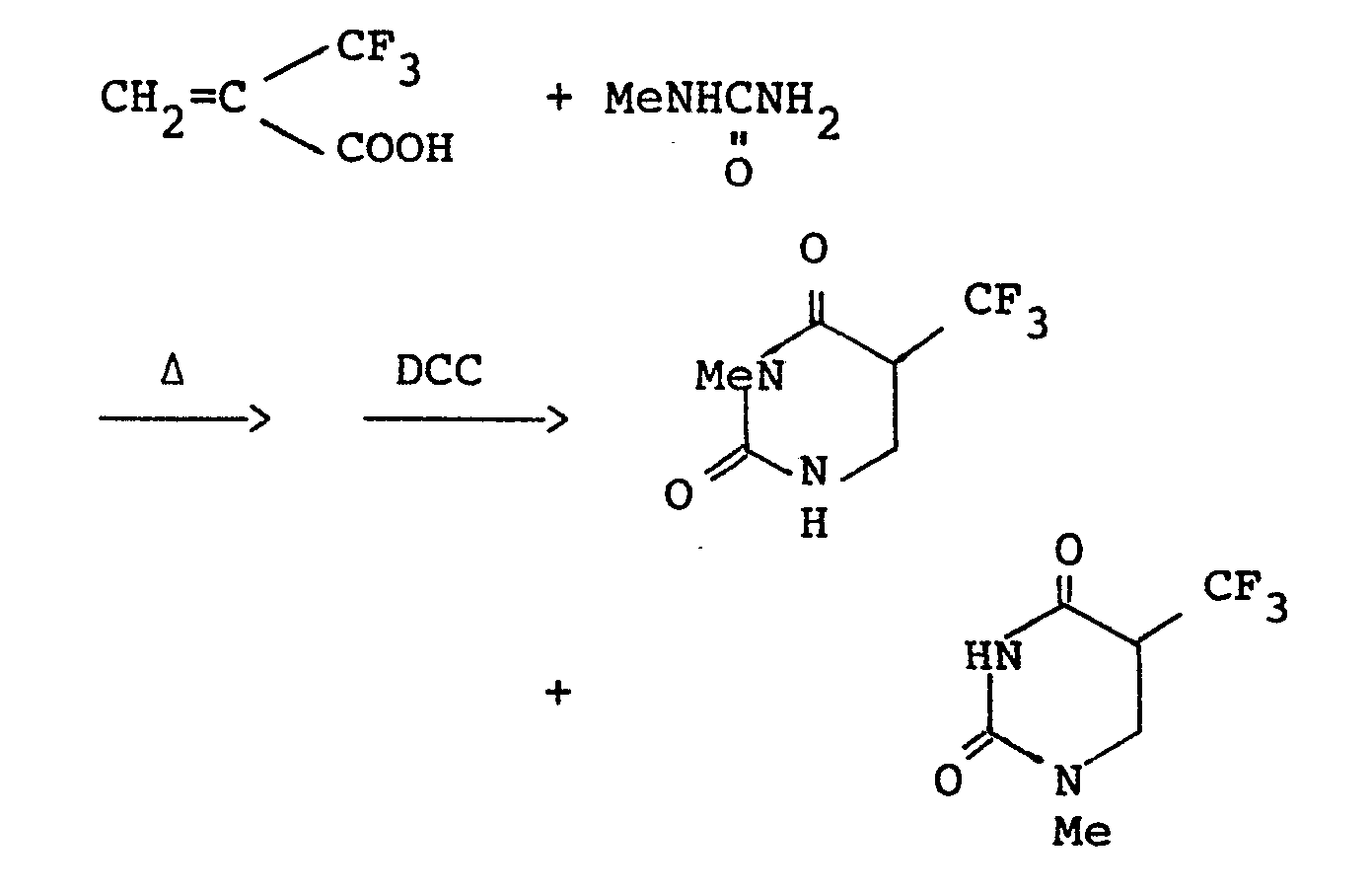
- A mixture of a-trifluoromethylacrylic acid (700 mg; 5.0 mmoles) and methylurea (370 mg; 5.0 mmoles) in DMF (5 ml) was heated at 80 °C with stirring for 3 hours. After cooling to 0 °C, a solution of dicyclohexylcarbodiimide (DCC) (1.05 g; 5.1 mmoles) in 3 ml of DMF was added dropwise. The mixture was stirred for 1 hour, and the precipitated solid was filtered off and washed with ethyl acetate. The solvent was evaporated under reduced pressure from the combined filtrates. The residue was purified by a column chromatography on silica gel (ethyl acetate: chloroform=1:3) to give 424 mg (yield: 43%) of 3-methyl-5-trifluoromethyl-5,6-dihydrouracil (OF-2) and 174 mg (yield: 18%) of 1-methyl-5-trifluoromethyl-5,6-dihydrouracil (OF-3). 3-Methyl-5-trifluoromethyl-5,6-dihydrouracil (OF-2):
- m.p.: 162 - 163 °C
- Mass spectrum: m/e (relative intensity) M+ 196 (100), 99 (50), 96 (46), 95 (32), 77 (35), 58 (66), 56 (54).
- IR (KBr) : 3260, 3140cm-1 (vN-H), 1730, 1705, 1690cm-1 (vc=o).
- 1H NMR (CD3COCD3:TMS) : 63.03(s, 3H), 3.4 - 4.0(m, 3H), 7.0(bs, 1H).
- 19F NMR (CD3COCD3:CFCl3) : 6-67.0(m).
- Elemental analysis for C6 H 7 F 3 N 2 0 2 : Calculated (%): C, 36.74; H, 3.60; N, 14.28. Found (%): C, 36.43; H, 3.47; N, 14.16. 1-Methyl-5-trifluoromethyl-5,6-dihydrouracil (OF-3):
- M.p.: 142 - 143 °C
- Mass spectrum: m/e (relative intensity) M+ 196 (100), 77 (20), 57 (92), 56 (21), 44 (62), 43 (39), 42 (88).
- IR (KBr) : 3.210, 3180cm-1 (vN-H), 1735, 1720, 1700cm-1 (vc=o).
- 1H NMR (CD3COCD3:TMS) : 62.96(s, 3H), 3.4 - 4.0 (m, 3H), 9.4(bs, 1H).
- 19F NMR (CD3COCD3:CFCl3): δ-67.0(m). Elemental analysis for C6H7F3N2O2: Calculated (%): C, 36.74; H, 3.60; N, 14.28. Found (%): C, 36.43; H, 3.41; N, 14.04.
-

- A mixture of a-trifluoromethylacrylic acid (700 mg; 5.0 mmoles) and urea (318 mg; 5.3 mmoles) in DMF (5 ml) was heated at 90 °C with stirring for 5 hours. After cooling to 0 °C, a solution of DCC (1.09 g; 5.3 mmoles) in DMF (3 ml) was added dropwise. The mixture was stirred for 1 hour, and the precipitated solid was filtered off and washed with ethyl acetate. The solvents were evaporated under reduced pressure from the combined filtrates. The residue was purified by a column chromatography on silica gel (ethyl acetate) to give 382 mg (yield: 42%) of 5-trifluoromethyl-5,6-dihydrouracil.
- m.p.: 203 - 205 °C (dec.) [value reported in the literature 203 - 205 °C (dec.)]
- Mass spectrum: m/e (relative intensity) M+182 (100), 96 (66), 95 (60), 44 (47), 43 (75), 30 (53), 29 (44).
- IR (KBr): 3230, 3120cm-1 (vN-H). 1750, 1710cm-1 (vc=o).
- 1H NMR (CD3COCD3:TMS) , 63.4 - 4.2(m, 3H) 7.0(bs, 1H), 9.5(bs, 1H).
- 19F NMR (CD3COCD3:CFCl3) : 6-66.6(m).
-

- A mixture of a-trifluoromethylacrylic acid (700 mg; 5.0 mmoles) and benzylurea (796 mg; 5.3 mmoles) in DMF (5 ml) was heated at 90 °C with stirring for 5 hours. After the reaction mixture was cooled to 0 °C, a solution of DCC (1.13 g; 5.5 mmoles) in DMF (3 ml) was added dropwise. The-mixture was stirred for 1 hour, and the precipitated solid was filtered off and washed with. ethyl acetate. The solvents were evaporated under reduced pressure from the combined filtrates. The residue was purified by a column chromatography on silica gel (ethyl acetate: chloroform=1:1) to give 979 mg (yield: 72%) of 3-benzyl-5-trifluoromethyl-5,6-dihydrouracil.
- m.p.: 129.2 - 129.7 °C.
- Mass spectrum: m/e (relative intensity) M+272 (100), 147 (56), 105 (58), 104 (99), 91 (97).
- IR (KBr): 3260, 3140cm-1 (νN-H). 1735, 1690cm-1 (vc=o).
- 1H NMR (CDCl3:TMS) : 63.1 - 3.7(m, 3H), 4.94 (bs, 2H), 6.83 (bs, 1H), 7.1 - 7.5 (m, 5H).
- 19F NMR (CDCl3:CFCl3) : -67.5 (m).
- Elemental analysis for C12H11F3N2O2: Calculated (%): C, 52.95; H, 4.07; N, 10.29. Found (%): C, 53.21; H, 3.94; N, 10.27.
-

- A mixture of a-trifluoromethylacrylic acid (700 mg; 5.0 mmoles) and methylthiourea (460 mg; 5.1 mmoles) in DMF (5 ml) was. heated at 80 °C with stirring for 4 hours. After cooling to 0 °C, a solution of DCC (1.09 g; 5.3 mmoles) in DMF (3 ml) was added dropwise to the reaction mixture. The mixture was stirred for 1 hour, and the precipitated solid was filtered off and washed with ethyl acetate. The solvents were evaporated under reduced pressure from the combined filtrates.
- The residue was purified by a column chromatography on silica bel (ethyl acetate: chloroform=1:2) to give 572 mg (yield: 54%) of 3-methyl-5-trifluoromethyl-5,6-dihydro-2-thiouracil.
- m.p.: 137.5 - 138 °C.
- Mass spectrum: m/e (relative intensity) M+212 (100), 56 (28), 43 (39), 42 (57).
- IR (KBr) : 3220, 3180, 3100cm-1 (vN-H). 1715, 1690cm 1 (νc=o).
- 1H NMR (CD3COCD3:TMS) : δ3.44(s, 3H), 3.7 - 4.3 (m, 3H), 10.1(bs, 1H).
- 19F NMR (CD3COCD3:CFC13) : 6-67.1 (m). Elemental analysis for C6H7 F 2 N 2 0S: Calculated (%): C, 33.96; H, 3.33; N, 13.20. Found (%): C, 34.05; H, 3.24; N, 13.43.
-

- A mixture of a-trifluoromethylacrylic. acid (700 mg; 5.0 mmoles) and thiourea (403 mg; 5.3 mmoles) in DMF (5 ml) was heated at 90 °C with stirring for 5 hours. After the reaction mixture was cooled to 0 °C, a solution of DCC (1.05 g; 5.0 mmoles) in DMF (3 ml) was added dropwise. The mixture was stirred for 1 hour, and the precipitated solid was filtered off and washed with ethyl acetate. The solvents were evaporated under reduced pressure from the combined filtrates. The residue was purified by a column chromatography on silica gel (ethyl acetate: chloroform=1:2) to give 536 mg (yield: 55%) of 5-trifluoromethyl-5,6-dihydro-2-thouracil.
- m.p.: 188.5 - 190 °C (dec.)
- Mass spectrum: m/e (relative intensity) M+198 (100), 69 (18), 60 (51), 59 (31), 43 (19), 42 (21).
- IR (KBr): 3190, 3110cm-1 (vN-H). 1720cm-1 (vc=o).
- 1H NMR (CDCl3-CD3OD:TMS) : δ3.4 - 3.8(m. 3H), 3.96(bs, 2H).
- 19F NMR (CDCl3-CD3OD:CFCl3) : 667.8(m).
- Elemental analysis for C5H5 F 3 N 2 0S: Calculated (%): C, 30.31; H, 2.54; N, 14.14. Found (%): C, 30.49; H, 2.21; N, 14.51.
-

- A mixture of a-trifluoromethylacrylic acid (700 mg; 5.0 mmoles) and methylurea (407 mg; 5.5 mmoles) in DMF (3 ml) was heated at 90 °C with stirring for 4 hours. DMF was evaporated under reduced pressure. The residue was purified by a column chromatography on silica gel to give 118 mg (yield 12%) of 1-methyl-5-trifluoromethyl-5,6-dihydrouracil (OF-3), 20 mg (yield: 2%) of 3-methyl-5-trifluoromethyl-5,6-dihydrouracil and 706 mg (yield: 66%) of 1-(2-hydroxycarbonyl-3,3,3-trifluoropropyl)-3-methylurea.
- 1-(2-Hydroxycarbonyl-3,3,3-trifluoropropyl)-3-methylurea:
- m.p.: 149.5 - 150.5 °C.
- Mass spectrum: m/e (relative intensity) M+214(9), 30 (100).
- IR (KBr) : 3430, 3400cm-1 (vN-H), 3600 - 2200cm-1 (vO-H). 1740, 1725, 1610cm-1 (vc=o).
- 1H NMR (CD3COCD3:TMS) : 62.70(s, 3H), 3.3 - 3.8(m, 3H), 5.9(bs, 1H). 6.1(bs, 1H), 10.7(bs, 1H).
- 19F NMR (CD3COCD3:CFC13) : δ-66.1(m).
- Elemental analysis for C6H9F3N2O3:
- Calculated (%): C, 33.65; H, 4.24; N, 13.08.
- Found (%): C, 33.81; H; 4.06; N, 13.10.
- A solution of DCC (428 mg; 2.1 mmoles) in DMF (1 ml) was added dropwise to a solution of 1-(2-hydroxycarbonyl-3,3,3-trifluoropropyl)-3-methylurea (428 mg; 2.0 mmoles) obtained above in DMF (2 ml). The mixture was stirred for 1 hour, and the precipitated solid was filtered off and washed with ethyl acetate. The solvents were evaporated under reduced pressure from the combined filtrates. The residue was purified by a column chromatography on silica gel (ethyl acetate: chloroform=1:1) to give 368 mg (yield: 94%) of 3-methyl-5-trifluoromethyl-5,6-dihydrouracil (OF-2).
-
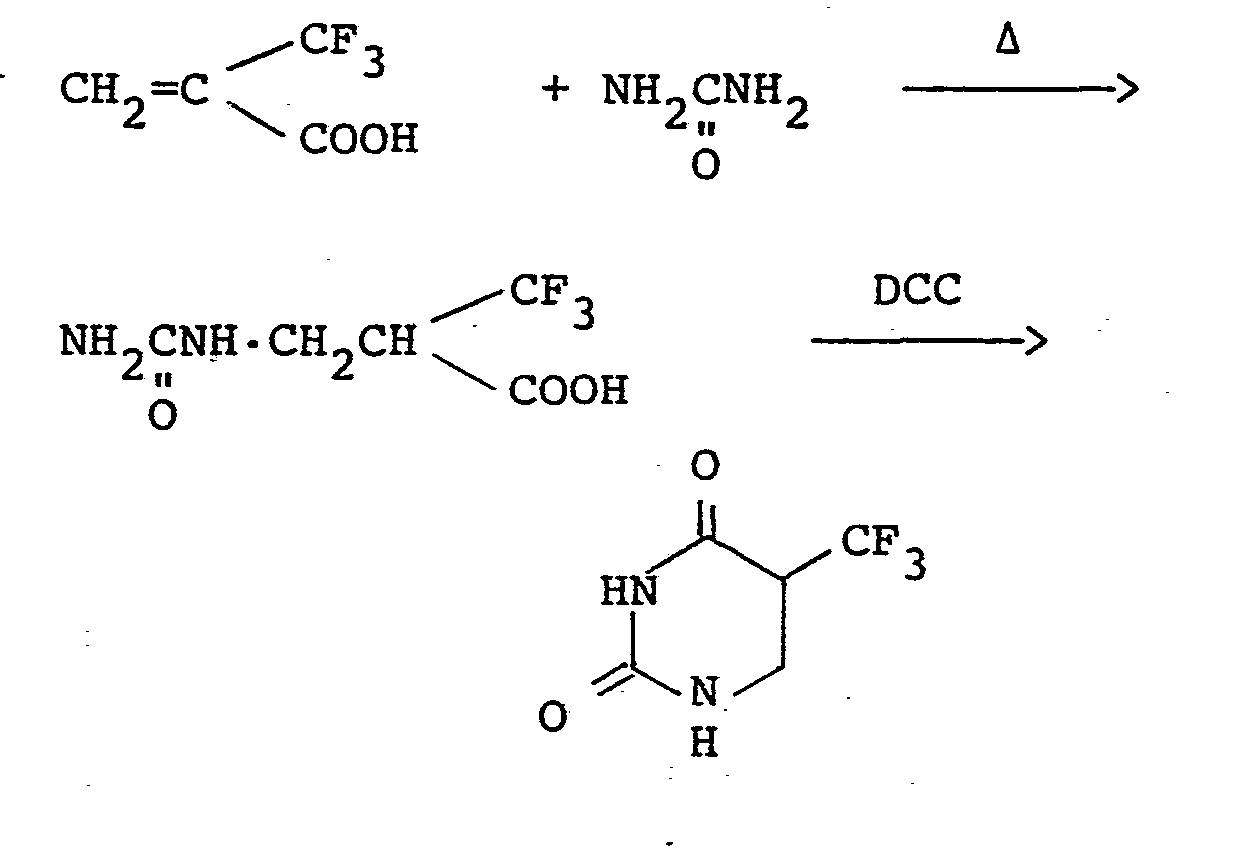
- A mixture of a-trifluoromethylacrylic acid (700 mg; 5.0 mmoles) and urea (342 mg; 5.7 mmoles) in DMF (3 ml) was heated at 90 °C with stirring for 6 hours. DMF was evaporated under reduced pressure. The residue was purified by a column chromatography on silica gel (ethyl acetate) to give 540 mg (yield: 54%) of (2-hydroxycarbonyl-3,3,3-trifluoropropyl)urea.
- m.p.: 149 - 149.5 °C.
- Mass spectrum: m/e (relative intensity) M+200 (1), 30 (100).
- IR (KBr) : 3480, 3410, 3370cm-1 (vN-H). 3700 - 2200 cm-1 (vO-H). 1730, 1640cm-1 (vc=o).
- 1H NMR (CD3COCD3:TMS) : 63.3 - 4.0(m, 3H), 5.3 - 7.0(m, 3H), 8.4(bs, 1H).
- 19F NMR (CD3COCD3:CFCl3) : 6-66.8(m).
- A solution of 200 mg (1.0 mmole) of (2-hydroxycarbonyl-3,3,3-trifluoropropyl)urea obtained above in DMF (1 ml) was cooled to 0 °C, and a solution of DCC (220 mg; 1.1 mmoles) in DMF (1 ml) was added dropwise. The mixture was stirred for 1 hour, and the precipitated solid was filtered off and washed with ethyl acetate. The solvents were evaporated under reduced pressure from the combined filtrates. The residue was purified by a column chromatography on silica gel (ethyl acetate) to give 116 mg (yield: 64%) of 5-trifluoromethyl-5,6-dihydrouracil.
-

- A mixture of a-trifluoromethylacrylic acid (700 mg; 5.0 mmoles) and phenylurea (776 mg; 5.7 mmoles) in DMF (5 ml) was heated at 90 °C with stirring for 8 hours. DMF was evaporated under reduced pressure, and the residue was purified by a column chromatography on silica gel (ethyl acetate) to give 1.09 g (yield: 79%) of 1-(2-hydroxycarbonyl-3,3,3-trifluoropropyl)-3-phenylurea.
- m.p.: 180.5 - 181 °C.
- Mass spectrum: m/e (relative intensity) M+276 (5), 93 (100).
- IR (KBr) : 3350cm-1 (vN-H). 3700 - 2300cm-1 (vO-H). 1735, 1600cm-1 (vc=o).
- 1HNMR (CD3COCD3:TMS : 63.3 - 4.0(m, 3H), 6.1(bs, 1H), 6.7 - 7.6(m, 5H), 7.8(bs, 1H), 8.1(bs, 1H).
- 19F NMR (CD3COCD3:CFCl3) : 6-66.6(m).
- Elemental analysis for C11H11F3N2O3:
- Calculated (%): C, 47.83; H, 4.01; N, 10.14.
- Found (%): C, 47.70; H, 3.65; N, 9.81.
- A solution of DCC (206 mg; 1.0 mmole) in DMF (0.5 ml) was added dropwise to a solution of 1-(2-hydroxycarbonyl-3,3,3-trifluoropropyl)-3-phenylurea (276 mg; 1.0 mmole) obtained above in DMF (1 ml), and the mixture was stirred for 1 hour. The precipitated solid was filtered off, and-washed with ethyl acetate. The solvents were evaporated under reduced pressure from the combined filtrates. The residue was purified by a column chromatography on silica gel (ethyl acetate: chloroform=1:3) to give 120 mg (yield: 47%) of 3-phenyl-5-trifluoromethyl-5,6-dihydrouracil.
- m.p.: 215 - 216 °C.
- Mass spectrum: m/e (relative intensity) M+258(73), 93 (100).
- IR (KBr) : 3240, 3130cm-1 (vN-H). 1740, 1695cm 1 (vc=o).
- 1H NMR (CD3COCD3:TMS) : 63.6 - 4.2(m. 3H), 7.0 - 7.5(m. 6H).
- . 19F NMR (CD3COCD3:CFCl3) : 6-66.5(d, J=8Hz). Elemental analysis for C11H9F3N2O2: Calculated (%): C, 51.17; H, 3.51; N, 10.85.
- Found (%): C, 51.35; H, 3.71; N, 10.87.
-

- A mixture of a-trifluoromethylacrylic acid (700 mg; 5.0 mmole) and benzylurea (841 mg; 5.6 mmoles) in DMF (3 ml) was heated at 90 °C with stirring for 28 hours. DMF was evaporated under reduced pressure, and the residue was recrystallized from ethyl acetate- chloroform to give 1.10 g (yield: 76%) of l-benzyl-3-(2-hydroxycarbonyl-3,3,3-trifluoropropyl)urea.
- m.p.: 183 - 183.5 °C.
- Mass spectrum: m/e (relative intensity) M+290(18), 106 (100).
- IR (KBr) : 3390cm-1 (vN-H). 3700 - 2300cm-1 (vO-H). 1740, 1600cm-1 (vc=o).
- 1H NMR (CD3COCD3:TMS) : δ3.4 - 3.9(m, 3H), 4.30(m, 2H), 6.15(bd, 2H), 7.27(m, 6H).
- 19F NMR (CD3COCD3:CFCl3) : 6-66.8 (m).
- Elemental analysis for C12H13F3N2O3: Calculated (%):C, 49.66; H, 4.51; N, 9.65. Found (%): C, 49.43; H, 4.55; N, 9.88.
- A solution of DCC (430 mg; 2.1 mmoles) in DMF (1 ml) was added dropwise to a solution of 1-benzyl-3-(2-hydroxycarbonyl-3,3,3-trifluoropropyl)urea (580 mg; 2.0 mmoles) obtained above in DMF (2 ml). One hour later, the precipitated solid was filtered off and washed with ethyl acetate. The solvents were evaporated under reduced pressure from the combined filtrates. The residue was purified by a column chromatography on silica gel (ethyl acetate: chloroform=1:1) to give 468 mg (yield: 86%) of 3-benzyl-5-trifluoromethyl-5,6-dihydrouracil.
-

- Acetic anhydride (5 ml) was added to 290 mg (1.0 mmole) of 1-benzyl-3-(2-hydroxycarbonyl-3,3,3-trifluoropropyl)urea synthesized in Example 12, and the mixture was heated under reflux for 30 minutes. The solvent was evaporated under reduced pressure. The residue was purified by a column chromatography on silica gel (ethyl acetate: chloroform=1:1) to give 176 mg (yield: 65%) of 3-benzyl-5-trifluoromethyl-5,6-dihydrouracil.
-

- A mixture of a-trifluoromethylacrylic acid (700 mg; 5.0 mmoles) and 1,3-dimethylurea (419 mg; 4.8 mmoles) in DMF (5 ml) was cooled to 0 °C, and then a solution of DCC (1.21 g; 5.9 mmoles) in DMF (3 ml) was added dropwise. The mixture was stirred at 0 °C for 1 hour. The precipitated solid was filtered off, and washed with ethyl acetate. The solvents were evaporated under reduced pressure from the combined filtrates. The residue was purified by a column chromatography on silica gel to give 566 mg (yield 57%) of 1,3-dimethyl-5-trifluoromethyl-5,6-dihydrouracil (OF-1).
-

- A mixture of a-trifluoromethylacrylic acid (700 mg; 5.0 mmoles) and methylurea (378 mg; 5.1 mmoles) in DMF (5 ml) was cooled to 0 °C, and a solution of DCC (1.07 g; 5.2 mmoles) in DMF (3 ml) was added dropwise. The mixture was stirred for 1 hour, and the precipitated solid was filtered off and washed with ethyl acetate. DMF was evaporated under reduced pressure from the combined filtrates. The residue was purified by a column chromatography on silica gel (ethyl acetate: chloroform=1:3) to give 420 mg (yield: 43%) of 1-methyl-5-trifluoromethyl-5,6-dihydrouracil (OF-3) and 30 mg (yield: 15%) of 3-methyl-5-triflubromethyl-5,6-dihydrouracil (OF-2).
-

- A solution of 1,3-dimethylurea (168 mg; 1.9 mmoles) in DMF (2 ml) was cooled to 0 °C, and a-trifluoro- methylacryloyl chloride (317 mg; 2.0 mmoles) and triethylamine (0.31 ml; 2.2 mmoles) were added dropwise.
- The mixture was stirred at 0 °C for 2 hours, and then water (20 ml) was added. The mixture was extracted with methylene chloride (20 ml x 1, 10 ml x 2).
- The combined extracts were dried over anhydrous magnesium sulfate, filtered and concentrated under reduced pressure. The residue was purified by a column chromatography on silica gel (chloroform) to give 197 mg (yield: 49%) of 1,3-dimethyl-5-trifluoromethyl-5,6-dihydrouracil.
-

- A solution of 1,3-dimethylurea (423 mg; 4.8 mmoles) in DMF (5 ml) was cooled to 0 °C, and a-trifluoro- methylacryloyl chloride (792 mg; 5.0 mmoles) was added dropwise. The mixture was stirred at room temperature for 1 hour. Then, water (20 ml) was added, and the mixture was extracted with methylene chloride (20 ml x 1, 10 ml x 2). The combined extracts were dried over anhhdrous magnesium sulfate, filtered, and concentrated under reduced pressure. The residue was purified by a column chromatography on silica gel (chloroform) to give 508 mg (yield: 50%) of 1,3-dimethy1-5-trif1uoro- methyl-5,6-dihydrouracil (OF-1).
-

- A solution of methylurea (148 mg; 2.0 mmoles) in DMF (2 ml) was cooled to 0 °C, and a-trifluoromethyl- acryloyl chloride (317 mg; 2.0 mmoles) was added dropwise. The mixture was stirred at room temperature for 1 hour, and water (20 ml) was added. The mixture was extracted with methylene chloride (20 ml x 1, 10 ml x 2). The combined extracts were dried over anhydrous magnesium sulfate, filtered, and concentrated under reduced pressure. The residue was purified by a column chromatography on silica gel (chloroform: ethyl acetate=3:1) to give 39 mg (yield: 10%) of 1-methyl-5-trifluoromethyl-5,6-dihydrouracil (OF-3) and 117 mg (yield: 30%) of 3-methyl-5-trifluoromethyl-5,6-dihydrouracil (OF-2).
-

- A mixture of a-trifluoromethylacrylic acid (700 mg; 5 mmoles), urea (300 mg; 5 mmoles) and acetic anhydride (2 ml) was heated at 100 °C with stirring for 1 hour. After cooling to 0 °C, the precipitated solid was filtered off to give 450 mg (yield: 40%) of 5-trifluoromethyl-5,6-dihydrouracil. The solvent was evaporated under reduced pressure from the filtrate, and the residue was recrystallized from ethanol to give additional 160 mg (yield: 2.7%) of 5-trifluoromethyl-5,6-dihydrouracil. The total yield of the product was 67%.
- The physical and spectral properties of the resulting 5-trifluoromethyl-5,6-dihydrouracil completely agreed with those of the product obtained in Example 5.
-

- A mixture of a-trifluoromethylacrylic acid (350 mg; 2.5 mmoles), urea (162 mg; 2.7 mmoles) and acetic anhydride (2 ml) was heated at 80 °C with stirring for 2 hours. After cooling to 0 °C, the precipitated white solid was filtered off to give 210 mg (yield: 46%) of 5- trifluoromethyldihydrouracil. The solvent was evaporated under reduced pressure from the filtrate. The residue was crystallized from ethanol to give additional 95 mg (yield: 21%). of the above product. The total yield was 67%.
-

- A mixture of a-trifluoromethylacrylic acid (350 mg; 2.5 mmoles), urea (170 mg: 2.8 mmoles) and acetic anhydride (1 ml) in dimethyl-formamide (2 ml) was stirred at 100 °C for 40 minutes. The solvent was evaporated under reduced pressure, and the residue was recrystallized from ethanol to give 290 mg (yield: 64%) of 5-trifluoromethyldihydrouracil.
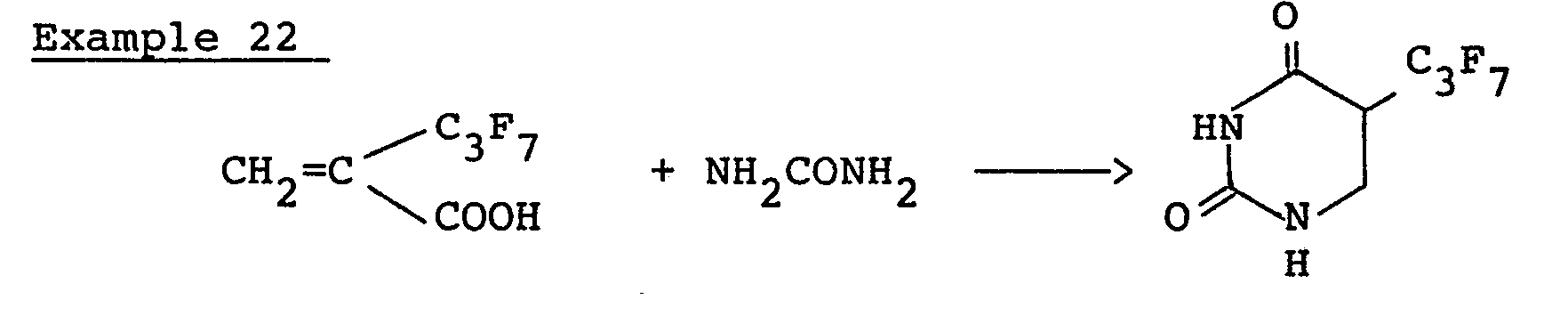
- A mixture of a-heptafluoropropylacrylic acid (240 mg; 1.0 mmole), urea (64 mg; 1.1 mmoles) and acetic anhydride (0.6 ml) was heated at 100 °C with stirring for 40 minutes. Then, ethanol (3 ml) was added to the reaction mixture to give 180 mg (yield: 64%) of 5- heptafluoropropyldihydrouracil as colorless crystals.
- m.p.: 223 - 224 (decomp.)
- 1H NMR (CD3COCD3-CD3SOCD3:TMS) : 63.3 - 4.2 (m, 3H), 7.6(bs, 1H), 10.4(bs, 1H).
- 19F NMR (CD3COCD3-CD3SOCD3: CFCl3) : 679.7(t, J=10Hz, 3F), 111.2(m, 2F), 123.2(bd, J=7Hz, 2F).
- IR (KBr) : 3250, 3140cm-1 (νN-H), 1760, 1710cm-1 (νc=o).
- Mass: m/e (refl. int.) : M+282 (18), 99 (100).
- Elemental analysis for C7H5F7N2O2 C (%) H (%) N (%)
- Calculated: 29.80 1.79 9.93 Found: 30.03 1.84 9.88
-

- A mixture of a-trifluoromethylacrylic acid (350 mg; 2.5 mmoles), methylurea (193 mg; 2.6 mmoles) and acetic anhydride (2 ml) was heated with stirring. at 100 °C for 1 hour, and the solvent was evaporated under reduced pressure. The residue was recrystallized from chloroform-hexane to give 392 mg (yield 80%) of a 2:3 mixture of 1-methyl-5-trifluoromethyldihydrouracil (OF-3) and 3-methyl-5-trifluoromethyldihydrouracil (OF-2) as in Example 4.
- The isomers were separated from each other by a column chromatography on silica gel (ethyl acetate: chloroform=1:3).

- A mixture of a-trifluoromethylacrylic acid (350 mg; 2.5 mmoles), phenylurea (353 mg; 2.6 mmoles) and acetic anhydride (2 ml) was heated at 100 °C with stirring for 1 hour. After cooling, the precipitated solid was collected by filtration to give 298 mg (yield: 46%) of 3-phenyl-5-trifluoromethyldihydrouracil. The solvent was evaporated from the filtrate, and the residue was recrystallized from chloroform/hexane to give additional 133 mg (yield: 21%) of the above product. The total yield was 67%. The physical and spectral properties of the resulting 3-phenyl-5-trifluoromethyldihydrouracil completely agreed with those of the product obtained in Example 11.
-

- A mixture of a-trifluoromethylacrylic acid (350 mg; 2.5 mmoles), benzylurea (389 mg; 2.6 mmoles) and acetic anhydride (2 ml) was heated with stirring at 100 °C for 1 hour. The solvent was evaporated under reduced pressure, and the residue was recrystallized from chloroform/hexane to give 500 mg (yield: 72%) of 3-benzyl-5-trifluoromethyldihydrouracil. The physical and spectral properties of this product completely agreed with those of the product obtained in Example 6.
- A mixture of a-trifluoromethylacrylic acid (4.31 g; 30.8 mmoles), 1,3-dimethylurea (2.75 g; 31.2 mmoles) and acetic anhydride (17 ml) was heated at 100 °C with stirring for one hour. The solvent was evaporated under reduced pressure, and the residue was purified by a column chromatography on silica gel (CHC13) to give 5.50 g (yield: 84%) of 1,3-dimethyl-5-trifluoromethyldihydrouracil.
Claims (10)


Priority Applications (1)
| Application Number | Priority Date | Filing Date | Title |
|---|---|---|---|
| AT83304968T ATE38665T1 (en) | 1982-08-31 | 1983-08-26 | PROCESS FOR THE PREPARATION OF 5-PERFLUORAKYL-5,6-DIHYDROURACYL DERIVATIVES AND USABLE INTERMEDIATE PRODUCTS. |
Applications Claiming Priority (2)
| Application Number | Priority Date | Filing Date | Title |
|---|---|---|---|
| JP57150075A JPS5939875A (en) | 1982-08-31 | 1982-08-31 | Preparation of 5-trifluoromethyldihydrouracils |
| JP150075/82 | 1982-08-31 |
Publications (3)
| Publication Number | Publication Date |
|---|---|
| EP0103436A2 true EP0103436A2 (en) | 1984-03-21 |
| EP0103436A3 EP0103436A3 (en) | 1985-07-03 |
| EP0103436B1 EP0103436B1 (en) | 1988-11-17 |
Family
ID=15488969
Family Applications (1)
| Application Number | Title | Priority Date | Filing Date |
|---|---|---|---|
| EP83304968A Expired EP0103436B1 (en) | 1982-08-31 | 1983-08-26 | Process for preparing 5-perfluoroalkyl-5,6-dihydrouracil derivatives and compounds for use therein |
Country Status (5)
| Country | Link |
|---|---|
| US (1) | US4581452A (en) |
| EP (1) | EP0103436B1 (en) |
| JP (1) | JPS5939875A (en) |
| AT (1) | ATE38665T1 (en) |
| DE (1) | DE3378467D1 (en) |
Cited By (5)
| Publication number | Priority date | Publication date | Assignee | Title |
|---|---|---|---|---|
| US4927451A (en) * | 1988-12-30 | 1990-05-22 | Uniroyal Chemical Company, Inc. | 3-aryldihydrouracils |
| US5807864A (en) * | 1996-03-07 | 1998-09-15 | American Home Products Corporation | 2-thioxo-tetrahydropyrimidin-4-one derivatives |
| FR2769911A1 (en) * | 1997-08-07 | 1999-04-23 | F Tech Inc | PROCESS FOR PREPARING 5-PERFLUOROALKYLURACILE DERIVATIVES |
| WO2000049004A1 (en) * | 1999-02-16 | 2000-08-24 | American Cyanamid Company | Process for the preparation of 6-(perfluoroalkyl) uracil compounds from urea compounds |
| CN112480197A (en) * | 2020-12-02 | 2021-03-12 | 新乡拓新药业股份有限公司 | Method for synthesizing cytosine nucleoside |
Families Citing this family (3)
| Publication number | Priority date | Publication date | Assignee | Title |
|---|---|---|---|---|
| JP2004292340A (en) * | 2003-03-26 | 2004-10-21 | Tosoh F-Tech Inc | alpha-PENTAFLUOROETHYLACRYLIC ACID DERIVATIVE AND METHOD FOR PRODUCING THE SAME |
| CN106831606B (en) * | 2017-01-20 | 2019-02-22 | 湖南有色郴州氟化学有限公司 | A kind of preparation method of 5- trifluoromethyl -5,6- dihydrouracil |
| CN112645886B (en) * | 2020-12-23 | 2022-07-15 | 浙江本立科技股份有限公司 | Green production process of uracil |
Family Cites Families (3)
| Publication number | Priority date | Publication date | Assignee | Title |
|---|---|---|---|---|
| US2572568A (en) * | 1949-08-20 | 1951-10-23 | Monsanto Chemicals | Porous composition made with substituted carbamyl amino acid as blowing agent |
| BE637200A (en) * | 1962-05-08 | |||
| US3201387A (en) * | 1963-09-18 | 1965-08-17 | Heidelberger Charles | 5-trifluoromethyluracil, derivatives thereof, and processes for preparing the same |
-
1982
- 1982-08-31 JP JP57150075A patent/JPS5939875A/en active Granted
-
1983
- 1983-08-26 DE DE8383304968T patent/DE3378467D1/en not_active Expired
- 1983-08-26 AT AT83304968T patent/ATE38665T1/en not_active IP Right Cessation
- 1983-08-26 US US06/526,880 patent/US4581452A/en not_active Expired - Lifetime
- 1983-08-26 EP EP83304968A patent/EP0103436B1/en not_active Expired
Cited By (7)
| Publication number | Priority date | Publication date | Assignee | Title |
|---|---|---|---|---|
| US4927451A (en) * | 1988-12-30 | 1990-05-22 | Uniroyal Chemical Company, Inc. | 3-aryldihydrouracils |
| US5807864A (en) * | 1996-03-07 | 1998-09-15 | American Home Products Corporation | 2-thioxo-tetrahydropyrimidin-4-one derivatives |
| FR2769911A1 (en) * | 1997-08-07 | 1999-04-23 | F Tech Inc | PROCESS FOR PREPARING 5-PERFLUOROALKYLURACILE DERIVATIVES |
| US6087499A (en) * | 1997-08-07 | 2000-07-11 | F-Tech Incorporated | Process for producing 5-perfluoroalkyluracil derivatives |
| DE19835866B4 (en) * | 1997-08-07 | 2015-03-05 | F-Tech Inc. | Process for the preparation of 5-perfluoroalkyluracil derivatives |
| WO2000049004A1 (en) * | 1999-02-16 | 2000-08-24 | American Cyanamid Company | Process for the preparation of 6-(perfluoroalkyl) uracil compounds from urea compounds |
| CN112480197A (en) * | 2020-12-02 | 2021-03-12 | 新乡拓新药业股份有限公司 | Method for synthesizing cytosine nucleoside |
Also Published As
| Publication number | Publication date |
|---|---|
| EP0103436A3 (en) | 1985-07-03 |
| EP0103436B1 (en) | 1988-11-17 |
| ATE38665T1 (en) | 1988-12-15 |
| US4581452A (en) | 1986-04-08 |
| JPS5939875A (en) | 1984-03-05 |
| JPS6148830B2 (en) | 1986-10-25 |
| DE3378467D1 (en) | 1988-12-22 |
Similar Documents
| Publication | Publication Date | Title |
|---|---|---|
| EP0543858B1 (en) | Benzimidazole derivatives, process for their preparation and application | |
| KR101139160B1 (en) | Derivatives of Dioxane-2-Alkyl Carbamates, Preparation Method Thereof and Application of Same in Therapeutics | |
| US5200412A (en) | Heterobicyclic containing benzene sulfonamides which are platelet activating factor antagonists | |
| US4264771A (en) | Alkylation of substituted oxazolinone-(5) compounds | |
| US5451676A (en) | Biphenyl ether heterobicyclic platelet activating factor antagonists | |
| EP0103436B1 (en) | Process for preparing 5-perfluoroalkyl-5,6-dihydrouracil derivatives and compounds for use therein | |
| DE69128477T2 (en) | BENZOPYRANDERIVAT | |
| JPH01149764A (en) | Bis-s-alkylbenzene derivative | |
| JPS6299361A (en) | Indeno(1,2-c)pyrazole derivative | |
| JPH0959218A (en) | L-lactic acid oligomer derivative | |
| CA1092133A (en) | Cyanoacetic acid anilide derivatives, process for their manufacture and compositions containing them | |
| JPS6360969A (en) | Production of imidazole derivative | |
| JPS6011707B2 (en) | 1-Carboxyalkylcarbamoyl-5-fluorouracil derivative and method for producing the same | |
| JPH02270841A (en) | Production of 2,2-difluoro-3,4,5-trihydroxycarboxylic acid derivative | |
| JPS609505B2 (en) | 5-Fluorouracil derivative | |
| KR930006198B1 (en) | Novel α-chloroketone derivatives and preparation method thereof | |
| JPS60181075A (en) | Pyrimidine compound, its preparation and its use | |
| KR880001760B1 (en) | Process for preparing intermediate products for the preparation of cepharosporins | |
| CA1305718C (en) | Alpha-acyloxyketone derivatives | |
| JP2671401B2 (en) | .ALPHA.-Aminothioacetamide derivative and its production method | |
| US4459415A (en) | Process for the preparation of 1-(4-chlorobenzoyl)-5-methoxy-2-methyl-3-indoleacetoxyacetic acid | |
| Wang et al. | Synthesis and biological activity of novel N‐tert‐butyl‐N, N′‐substitutedbenzoylhydrazines containing 2‐methyl‐3‐(triphenylgermanyl) propoxycarbonyl | |
| KR800000431B1 (en) | Preparing process for 3-isoxazolyl urea derivatives | |
| JPS61257977A (en) | Fluorine-containing heterocyclic compound | |
| JPS5817751B2 (en) | Method for producing isoxazole derivatives |
Legal Events
| Date | Code | Title | Description |
|---|---|---|---|
| PUAI | Public reference made under article 153(3) epc to a published international application that has entered the european phase |
Free format text: ORIGINAL CODE: 0009012 |
|
| AK | Designated contracting states |
Designated state(s): AT BE CH DE FR GB IT LI LU NL SE |
|
| 17P | Request for examination filed |
Effective date: 19841219 |
|
| PUAL | Search report despatched |
Free format text: ORIGINAL CODE: 0009013 |
|
| AK | Designated contracting states |
Designated state(s): AT BE CH DE FR GB IT LI LU NL SE |
|
| 17Q | First examination report despatched |
Effective date: 19860715 |
|
| GRAA | (expected) grant |
Free format text: ORIGINAL CODE: 0009210 |
|
| AK | Designated contracting states |
Kind code of ref document: B1 Designated state(s): AT BE CH DE FR GB IT LI LU NL SE |
|
| PG25 | Lapsed in a contracting state [announced via postgrant information from national office to epo] |
Ref country code: SE Effective date: 19881117 Ref country code: NL Effective date: 19881117 Ref country code: IT Free format text: LAPSE BECAUSE OF FAILURE TO SUBMIT A TRANSLATION OF THE DESCRIPTION OR TO PAY THE FEE WITHIN THE PRESCRIBED TIME-LIMIT;WARNING: LAPSES OF ITALIAN PATENTS WITH EFFECTIVE DATE BEFORE 2007 MAY HAVE OCCURRED AT ANY TIME BEFORE 2007. THE CORRECT EFFECTIVE DATE MAY BE DIFFERENT FROM THE ONE RECORDED. Effective date: 19881117 Ref country code: BE Effective date: 19881117 Ref country code: AT Effective date: 19881117 |
|
| REF | Corresponds to: |
Ref document number: 38665 Country of ref document: AT Date of ref document: 19881215 Kind code of ref document: T |
|
| REF | Corresponds to: |
Ref document number: 3378467 Country of ref document: DE Date of ref document: 19881222 |
|
| ET | Fr: translation filed | ||
| NLV1 | Nl: lapsed or annulled due to failure to fulfill the requirements of art. 29p and 29m of the patents act | ||
| PG25 | Lapsed in a contracting state [announced via postgrant information from national office to epo] |
Ref country code: LU Free format text: LAPSE BECAUSE OF NON-PAYMENT OF DUE FEES Effective date: 19890831 |
|
| PLBE | No opposition filed within time limit |
Free format text: ORIGINAL CODE: 0009261 |
|
| STAA | Information on the status of an ep patent application or granted ep patent |
Free format text: STATUS: NO OPPOSITION FILED WITHIN TIME LIMIT |
|
| 26N | No opposition filed | ||
| REG | Reference to a national code |
Ref country code: GB Ref legal event code: 746 Effective date: 19950601 |
|
| REG | Reference to a national code |
Ref country code: FR Ref legal event code: D6 |
|
| PGFP | Annual fee paid to national office [announced via postgrant information from national office to epo] |
Ref country code: CH Payment date: 19980909 Year of fee payment: 16 |
|
| PGFP | Annual fee paid to national office [announced via postgrant information from national office to epo] |
Ref country code: GB Payment date: 19990825 Year of fee payment: 17 |
|
| PG25 | Lapsed in a contracting state [announced via postgrant information from national office to epo] |
Ref country code: LI Free format text: LAPSE BECAUSE OF NON-PAYMENT OF DUE FEES Effective date: 19990831 Ref country code: CH Free format text: LAPSE BECAUSE OF NON-PAYMENT OF DUE FEES Effective date: 19990831 |
|
| REG | Reference to a national code |
Ref country code: CH Ref legal event code: PL |
|
| PG25 | Lapsed in a contracting state [announced via postgrant information from national office to epo] |
Ref country code: GB Free format text: LAPSE BECAUSE OF NON-PAYMENT OF DUE FEES Effective date: 20000826 |
|
| GBPC | Gb: european patent ceased through non-payment of renewal fee |
Effective date: 20000826 |
|
| PGFP | Annual fee paid to national office [announced via postgrant information from national office to epo] |
Ref country code: FR Payment date: 20010810 Year of fee payment: 19 |
|
| PGFP | Annual fee paid to national office [announced via postgrant information from national office to epo] |
Ref country code: DE Payment date: 20010820 Year of fee payment: 19 |
|
| PG25 | Lapsed in a contracting state [announced via postgrant information from national office to epo] |
Ref country code: DE Free format text: LAPSE BECAUSE OF NON-PAYMENT OF DUE FEES Effective date: 20030301 |
|
| PG25 | Lapsed in a contracting state [announced via postgrant information from national office to epo] |
Ref country code: FR Free format text: LAPSE BECAUSE OF NON-PAYMENT OF DUE FEES Effective date: 20030430 |
|
| REG | Reference to a national code |
Ref country code: FR Ref legal event code: ST |