EP0101705B1 - Composition with glass-borne plant nutrients - Google Patents
Composition with glass-borne plant nutrients Download PDFInfo
- Publication number
- EP0101705B1 EP0101705B1 EP19830900745 EP83900745A EP0101705B1 EP 0101705 B1 EP0101705 B1 EP 0101705B1 EP 19830900745 EP19830900745 EP 19830900745 EP 83900745 A EP83900745 A EP 83900745A EP 0101705 B1 EP0101705 B1 EP 0101705B1
- Authority
- EP
- European Patent Office
- Prior art keywords
- glass
- manganese
- compositions
- composition
- composition according
- Prior art date
- Legal status (The legal status is an assumption and is not a legal conclusion. Google has not performed a legal analysis and makes no representation as to the accuracy of the status listed.)
- Expired
Links
- 239000000203 mixture Substances 0.000 title claims abstract description 35
- 235000015097 nutrients Nutrition 0.000 title claims abstract description 6
- 239000011521 glass Substances 0.000 claims abstract description 51
- 239000011572 manganese Substances 0.000 claims abstract description 39
- GWEVSGVZZGPLCZ-UHFFFAOYSA-N Titan oxide Chemical compound O=[Ti]=O GWEVSGVZZGPLCZ-UHFFFAOYSA-N 0.000 claims abstract description 36
- 229910052748 manganese Inorganic materials 0.000 claims abstract description 23
- PWHULOQIROXLJO-UHFFFAOYSA-N Manganese Chemical compound [Mn] PWHULOQIROXLJO-UHFFFAOYSA-N 0.000 claims abstract description 21
- NUJOXMJBOLGQSY-UHFFFAOYSA-N manganese dioxide Chemical compound O=[Mn]=O NUJOXMJBOLGQSY-UHFFFAOYSA-N 0.000 claims abstract description 15
- PNEYBMLMFCGWSK-UHFFFAOYSA-N aluminium oxide Inorganic materials [O-2].[O-2].[O-2].[Al+3].[Al+3] PNEYBMLMFCGWSK-UHFFFAOYSA-N 0.000 claims abstract description 12
- 238000002844 melting Methods 0.000 claims abstract description 12
- 230000008018 melting Effects 0.000 claims abstract description 12
- YDZQQRWRVYGNER-UHFFFAOYSA-N iron;titanium;trihydrate Chemical compound O.O.O.[Ti].[Fe] YDZQQRWRVYGNER-UHFFFAOYSA-N 0.000 claims abstract description 11
- 238000004519 manufacturing process Methods 0.000 claims abstract description 10
- 229910019142 PO4 Inorganic materials 0.000 claims abstract description 6
- 239000004408 titanium dioxide Substances 0.000 claims abstract description 6
- 229910052500 inorganic mineral Inorganic materials 0.000 claims abstract description 5
- 239000011707 mineral Substances 0.000 claims abstract description 5
- NBIIXXVUZAFLBC-UHFFFAOYSA-K phosphate Chemical compound [O-]P([O-])([O-])=O NBIIXXVUZAFLBC-UHFFFAOYSA-K 0.000 claims abstract description 5
- 239000010452 phosphate Substances 0.000 claims abstract description 5
- 239000000654 additive Substances 0.000 claims abstract description 4
- 230000000996 additive effect Effects 0.000 claims abstract description 3
- 238000000034 method Methods 0.000 claims abstract description 3
- 239000011819 refractory material Substances 0.000 claims abstract description 3
- DLYUQMMRRRQYAE-UHFFFAOYSA-N tetraphosphorus decaoxide Chemical compound O1P(O2)(=O)OP3(=O)OP1(=O)OP2(=O)O3 DLYUQMMRRRQYAE-UHFFFAOYSA-N 0.000 claims description 12
- 239000005365 phosphate glass Substances 0.000 claims description 10
- VYPSYNLAJGMNEJ-UHFFFAOYSA-N silicon dioxide Inorganic materials O=[Si]=O VYPSYNLAJGMNEJ-UHFFFAOYSA-N 0.000 claims description 6
- 239000010453 quartz Substances 0.000 claims description 3
- 239000002689 soil Substances 0.000 description 9
- 229910052593 corundum Inorganic materials 0.000 description 8
- 238000002386 leaching Methods 0.000 description 8
- 229910001845 yogo sapphire Inorganic materials 0.000 description 8
- 239000000292 calcium oxide Substances 0.000 description 7
- ODINCKMPIJJUCX-UHFFFAOYSA-N calcium oxide Inorganic materials [Ca]=O ODINCKMPIJJUCX-UHFFFAOYSA-N 0.000 description 7
- XEEYBQQBJWHFJM-UHFFFAOYSA-N Iron Chemical compound [Fe] XEEYBQQBJWHFJM-UHFFFAOYSA-N 0.000 description 6
- 238000002474 experimental method Methods 0.000 description 6
- 239000011785 micronutrient Substances 0.000 description 6
- 235000013369 micronutrients Nutrition 0.000 description 6
- 239000000969 carrier Substances 0.000 description 5
- 230000000694 effects Effects 0.000 description 5
- 239000002245 particle Substances 0.000 description 4
- 235000021317 phosphate Nutrition 0.000 description 4
- 241000196324 Embryophyta Species 0.000 description 3
- 238000005260 corrosion Methods 0.000 description 3
- 230000007797 corrosion Effects 0.000 description 3
- 238000002425 crystallisation Methods 0.000 description 3
- 230000008025 crystallization Effects 0.000 description 3
- 239000003337 fertilizer Substances 0.000 description 3
- 229910052742 iron Inorganic materials 0.000 description 3
- UQSXHKLRYXJYBZ-UHFFFAOYSA-N iron oxide Inorganic materials [Fe]=O UQSXHKLRYXJYBZ-UHFFFAOYSA-N 0.000 description 3
- 239000000047 product Substances 0.000 description 3
- 230000001105 regulatory effect Effects 0.000 description 3
- 239000011573 trace mineral Substances 0.000 description 3
- 235000013619 trace mineral Nutrition 0.000 description 3
- QTBSBXVTEAMEQO-UHFFFAOYSA-M Acetate Chemical compound CC([O-])=O QTBSBXVTEAMEQO-UHFFFAOYSA-M 0.000 description 2
- OKTJSMMVPCPJKN-UHFFFAOYSA-N Carbon Chemical compound [C] OKTJSMMVPCPJKN-UHFFFAOYSA-N 0.000 description 2
- 241001465754 Metazoa Species 0.000 description 2
- -1 Mn2+ ions Chemical class 0.000 description 2
- 239000002253 acid Substances 0.000 description 2
- 239000003513 alkali Substances 0.000 description 2
- 229910000272 alkali metal oxide Inorganic materials 0.000 description 2
- 239000002585 base Substances 0.000 description 2
- 229910052799 carbon Inorganic materials 0.000 description 2
- 239000003795 chemical substances by application Substances 0.000 description 2
- 239000012141 concentrate Substances 0.000 description 2
- 238000010586 diagram Methods 0.000 description 2
- QDOXWKRWXJOMAK-UHFFFAOYSA-N dichromium trioxide Chemical compound O=[Cr]O[Cr]=O QDOXWKRWXJOMAK-UHFFFAOYSA-N 0.000 description 2
- JEIPFZHSYJVQDO-UHFFFAOYSA-N iron(III) oxide Inorganic materials O=[Fe]O[Fe]=O JEIPFZHSYJVQDO-UHFFFAOYSA-N 0.000 description 2
- WPBNNNQJVZRUHP-UHFFFAOYSA-L manganese(2+);methyl n-[[2-(methoxycarbonylcarbamothioylamino)phenyl]carbamothioyl]carbamate;n-[2-(sulfidocarbothioylamino)ethyl]carbamodithioate Chemical compound [Mn+2].[S-]C(=S)NCCNC([S-])=S.COC(=O)NC(=S)NC1=CC=CC=C1NC(=S)NC(=O)OC WPBNNNQJVZRUHP-UHFFFAOYSA-L 0.000 description 2
- 239000000463 material Substances 0.000 description 2
- 239000000155 melt Substances 0.000 description 2
- 235000010755 mineral Nutrition 0.000 description 2
- 230000007935 neutral effect Effects 0.000 description 2
- 150000003839 salts Chemical class 0.000 description 2
- 239000007921 spray Substances 0.000 description 2
- 230000000087 stabilizing effect Effects 0.000 description 2
- 239000000126 substance Substances 0.000 description 2
- XLYOFNOQVPJJNP-UHFFFAOYSA-N water Chemical compound O XLYOFNOQVPJJNP-UHFFFAOYSA-N 0.000 description 2
- MVXMNHYVCLMLDD-UHFFFAOYSA-N 4-methoxynaphthalene-1-carbaldehyde Chemical compound C1=CC=C2C(OC)=CC=C(C=O)C2=C1 MVXMNHYVCLMLDD-UHFFFAOYSA-N 0.000 description 1
- BVKZGUZCCUSVTD-UHFFFAOYSA-L Carbonate Chemical compound [O-]C([O-])=O BVKZGUZCCUSVTD-UHFFFAOYSA-L 0.000 description 1
- 229910000831 Steel Inorganic materials 0.000 description 1
- 240000008042 Zea mays Species 0.000 description 1
- 235000016383 Zea mays subsp huehuetenangensis Nutrition 0.000 description 1
- 235000002017 Zea mays subsp mays Nutrition 0.000 description 1
- HCHKCACWOHOZIP-UHFFFAOYSA-N Zinc Chemical compound [Zn] HCHKCACWOHOZIP-UHFFFAOYSA-N 0.000 description 1
- 238000010521 absorption reaction Methods 0.000 description 1
- 230000002378 acidificating effect Effects 0.000 description 1
- 229910001514 alkali metal chloride Inorganic materials 0.000 description 1
- 235000021028 berry Nutrition 0.000 description 1
- 230000033228 biological regulation Effects 0.000 description 1
- BRPQOXSCLDDYGP-UHFFFAOYSA-N calcium oxide Chemical compound [O-2].[Ca+2] BRPQOXSCLDDYGP-UHFFFAOYSA-N 0.000 description 1
- 239000012876 carrier material Substances 0.000 description 1
- 235000013339 cereals Nutrition 0.000 description 1
- 238000006243 chemical reaction Methods 0.000 description 1
- 150000003841 chloride salts Chemical class 0.000 description 1
- 239000000571 coke Substances 0.000 description 1
- 230000001419 dependent effect Effects 0.000 description 1
- 239000012153 distilled water Substances 0.000 description 1
- 235000013399 edible fruits Nutrition 0.000 description 1
- 230000008020 evaporation Effects 0.000 description 1
- 238000001704 evaporation Methods 0.000 description 1
- 238000003306 harvesting Methods 0.000 description 1
- 150000002500 ions Chemical class 0.000 description 1
- 230000007774 longterm Effects 0.000 description 1
- 230000003050 macronutrient Effects 0.000 description 1
- 235000021073 macronutrients Nutrition 0.000 description 1
- 230000014759 maintenance of location Effects 0.000 description 1
- 235000009973 maize Nutrition 0.000 description 1
- IPJKJLXEVHOKSE-UHFFFAOYSA-L manganese dihydroxide Chemical compound [OH-].[OH-].[Mn+2] IPJKJLXEVHOKSE-UHFFFAOYSA-L 0.000 description 1
- 229910001437 manganese ion Inorganic materials 0.000 description 1
- VASIZKWUTCETSD-UHFFFAOYSA-N manganese(II) oxide Inorganic materials [Mn]=O VASIZKWUTCETSD-UHFFFAOYSA-N 0.000 description 1
- 229910000357 manganese(II) sulfate Inorganic materials 0.000 description 1
- 238000002156 mixing Methods 0.000 description 1
- 239000008363 phosphate buffer Substances 0.000 description 1
- 150000003013 phosphoric acid derivatives Chemical class 0.000 description 1
- 239000000049 pigment Substances 0.000 description 1
- 231100000572 poisoning Toxicity 0.000 description 1
- 230000000607 poisoning effect Effects 0.000 description 1
- 229920000573 polyethylene Polymers 0.000 description 1
- 150000003112 potassium compounds Chemical class 0.000 description 1
- 239000002994 raw material Substances 0.000 description 1
- 239000005368 silicate glass Substances 0.000 description 1
- 150000004760 silicates Chemical group 0.000 description 1
- 239000000377 silicon dioxide Substances 0.000 description 1
- 150000003388 sodium compounds Chemical class 0.000 description 1
- 230000006641 stabilisation Effects 0.000 description 1
- 238000011105 stabilization Methods 0.000 description 1
- 239000003381 stabilizer Substances 0.000 description 1
- 238000010972 statistical evaluation Methods 0.000 description 1
- 239000010959 steel Substances 0.000 description 1
- 238000003756 stirring Methods 0.000 description 1
- 239000013589 supplement Substances 0.000 description 1
- 239000011701 zinc Substances 0.000 description 1
- 229910052725 zinc Inorganic materials 0.000 description 1
Classifications
-
- C—CHEMISTRY; METALLURGY
- C05—FERTILISERS; MANUFACTURE THEREOF
- C05B—PHOSPHATIC FERTILISERS
- C05B17/00—Other phosphatic fertilisers, e.g. soft rock phosphates, bone meal
Definitions
- the present invention relates to a product with specially combined glass particles containing micronutrients. and to a method of manufacturing these.
- the chelates are generally used in the form of additives when watering, or as leaf sprays. Salts of various types are normally also added to fertilizers and leaf sprays. The drawbacks with chelates are that they are expensive and must be applied frequently, often asveral times a year.
- silicates are less suitable as carriers for manganese, for instance, which is easily deposited in basic environments in the form of manganese hydroxide and is thus biologically difficult to utilize.
- Silicate glass also gives rise to silica oel which is difficult to dissolve and the solubility is therefore reduced with time.
- phosphate glass Such glass is made of phosphorus pentoxide P 2 0 5 and the solubility of the glass is generally regulated by the inclusion of calcium oxide CaO. These types of phosphate glass were developed to be used in combination with calcium cyanamide and give a fertilizer which acts slowly. Phosphate glass especially designed to fulfil the soil's iron requirement is also known. The main components in a typical composition for this purpose are P 2 0 5 and FeO, with the addition of a few per cent K 2 0.
- the aim was to manufacture a glassy product which, by slowly, continuously dissolving, gives off manganese over a relatively long period of time, perhaps about 10 years, and provides soil poor in manganese with a necessary addition of Mn2+ ions.
- the glass should have a particle size suitable for existing spreaders (1-2 mm) and the quantity to be spread is also determined by the manner in which the machines operate, giving about 200 kg glass frits per hectars. If the manganese can be released uniformly over a 10-year period, ca. 10% Mn content in the glass will give the desired quantity of Mn. An important requirement is also that the manganese released remains in soluble form and accessible for absorption by the crops.
- the carrier was phosphate-based glass which can be adjusted to slightly acid or almost neutral properties and by sequestering can keep the Mn ions in solution even in slightly alkaline environment, as well as having a more uniform release rate since no colloidal layer is formed on the surface of the particles.
- the dissolving rate of the glass is regulated by the addition of stabilizing oxides.
- the glass should contain 55-65% P 2 0 5 to make it easy to melt, stable against crystalization and to avoid unnecessary evaporation of P 2 0 5 during melting. It was found that 10% Mn, corresponding to 12,9% MnO is the manganese concentration which provides the desired Mn addition. A considerable quantity of alkali in the form of Na 2 0 or K 2 0 is desirable to stabilize the glass and regulation of the dissolving rate can be achieved by the addition of CaO and/or AIyO 3 ..
- the invention however is only concerned with glasses containing titanium dioxide as a solubility-regulating agent. The choice between K 2 0 and Na 2 0 is dependent on economic factors since sodium compounds are less expensive but potassium compounds contribute to the macronutrient supplement to the soil. Both alternatives were investigated, as well as combinations thereof. CaO was selected as dissolving rate stabilizer, primarily from the cost point of view, but since CaO alone did not give the desired dissolving rate, A1 2 0 3 was also used.
- the quantity of manganese dissolved was determined as follows:
- glass compositions and leaching results are given in Table 1 below.
- the glass compositions have been calculated theoretically without taking into account P 2 0 5 losses during the melting. The actual P 2 0 5 may be considered somewhat lower.
- Some of the glass compositions contained 20 or 30% MnO, respectively, in order to investigate the possibility of using glas with higher Mn contents, as well as to assess the effect of the MnO content on the solubility of the glass. These compositions do not contain Ti0 2 and therefore are not according to the invention.
- manganese should be in bivalent form.
- manganese was added in bivalent form, either as carbonate or acetate.
- pyrolusite Mn0 2
- Mn is reduced to bivalency in the phosphate-glass.
- compositions were tested in a leaching column and compred with MnS0 4 . This substance obviously had the greatest solubility
- the leaching here was ca. 3000 Mg over a 5-day period.
- M 34 - M 46 the leaching varied between 5 and 1 Mg over a corresponding period.
- the glasses were also tested in a receptacle experient using soil poor in Mn. The soil was thoroughly fertilized and the various glass compositions were then mixed in. The receptacles were then sown with grain cultivated in soil poor in Mn. The experiments showed that the glasses had provided an adequate supply of Mn without the content of leached Mn being noticeable. Results of the cultivation experiment are given in Table 2.
- titanium dioxide Ti0 2
- solubility-regulating component instead of Al 2 O 3 .
- Various types of TiO 2 material can be used, such as pure TiO 2 (its conventional use being as colour pigment), rutile-mineral and ilmenite.
- the latter mineral consists substantially of Ti0 2 , FeO and Fe 2 O 3 .
- This new type of phosphate glass containing TiO 2 has many advantages when it comes to producing compositions with glass-borne plant nutrients.
- Class can be produced which has a low Al 2 O 3 content or no A1 2 0 3 at all.
- the titanium dioxide has been found to be a micronutrient able to give increased harvests and is in any case not damaging.
- the use of ilmenite concentrate enables compositions to be manufactured at low cost.
- the iron in the ilmenite may also be useful.
- the leaching values indicate dissolved Mn as percentage of total quantity of Mn in the glass.
Landscapes
- Chemical & Material Sciences (AREA)
- Organic Chemistry (AREA)
- Glass Compositions (AREA)
Abstract
Description
- The present invention relates to a product with specially combined glass particles containing micronutrients. and to a method of manufacturing these.
- The need for trace elements in agriculture has increased in recent years, due to the increasing yield demands both in the production of animals and of crops. The need for trace elements for animals is relatively simple to fulfil by mixing various soluble salts into mineral fodder. However, the problems of supplying trace elements in crop cultivation are considerable and varied, primarily due to variations in the soil as a chemical environment. It is primarily alkaline and acidic soils which cause reactions of various kinds. In Scandinavia the most frequently occurring problem is in conjunction with stabilizing manganese. Manganese is also a problem internationally, and specific crops like fruit, berries and maize in alkaline soil also entail problems with zinc and iron. Chelates of various types are currently used to solve this plant nutrient problem. The chelates are generally used in the form of additives when watering, or as leaf sprays. Salts of various types are normally also added to fertilizers and leaf sprays. The drawbacks with chelates are that they are expensive and must be applied frequently, often asveral times a year.
- To achieve long-term effect glass has been used containing micronutrients which are gradually leached out of the glass. The base for the glass carriers used in the micronutrient mixtures now commercially available is silicates. However, due to their high alkali content, these types of glass are less suitable as carriers for manganese, for instance, which is easily deposited in basic environments in the form of manganese hydroxide and is thus biologically difficult to utilize. Silicate glass also gives rise to silica oel which is difficult to dissolve and the solubility is therefore reduced with time. Glass based on phosphate has therefore been assumed to be a better carrier since, with this type of glass, the pH value can be regulated upon release to the acid side or the manganese ions can be kept in solution by suquestering even if the environment is alkaline. The release rate should also be more uniform due to the absence of colloidal layer on the surface of the fertilizer particles. Another advantage with phosphate glass would be that the carrier material itself, which consists primarily of phosphates, can also be used as Plant nutrient.
- Proposals have already been put forward for the use of phosphate glass. Such glass is made of phosphorus pentoxide P205 and the solubility of the glass is generally regulated by the inclusion of calcium oxide CaO. These types of phosphate glass were developed to be used in combination with calcium cyanamide and give a fertilizer which acts slowly. Phosphate glass especially designed to fulfil the soil's iron requirement is also known. The main components in a typical composition for this purpose are P205 and FeO, with the addition of a few per cent K20.
- Through the present invention new types of glass carriers have been developed adapted to micronutrients, primarily manganese, and surprisingly good results have been achieved. An essentiel part of our invention is that we have developed glass carriers with low AI content or no AI at all. Such glasses were known, see US-A 3 958 973, but incorporate alkali metal oxides or chlorides as solubility control agent.A drawback with other previously known AI-Containing glass carriers on a phosphate base has been the high Al content which may entail risks of AI poisoning in the root system. This is a threat to forestry and agriculture. According to our invention T102 is used as solubility-regulating component.
- In the following the manufacture of glass containing manganese will be described in more detail
- The aim was to manufacture a glassy product which, by slowly, continuously dissolving, gives off manganese over a relatively long period of time, perhaps about 10 years, and provides soil poor in manganese with a necessary addition of Mn2+ ions. The glass should have a particle size suitable for existing spreaders (1-2 mm) and the quantity to be spread is also determined by the manner in which the machines operate, giving about 200 kg glass frits per hectars. If the manganese can be released uniformly over a 10-year period, ca. 10% Mn content in the glass will give the desired quantity of Mn. An important requirement is also that the manganese released remains in soluble form and accessible for absorption by the crops.
- The carrier was phosphate-based glass which can be adjusted to slightly acid or almost neutral properties and by sequestering can keep the Mn ions in solution even in slightly alkaline environment, as well as having a more uniform release rate since no colloidal layer is formed on the surface of the particles. The dissolving rate of the glass is regulated by the addition of stabilizing oxides.
- The glass should contain 55-65% P205 to make it easy to melt, stable against crystalization and to avoid unnecessary evaporation of P205 during melting. It was found that 10% Mn, corresponding to 12,9% MnO is the manganese concentration which provides the desired Mn addition. A considerable quantity of alkali in the form of Na20 or K20 is desirable to stabilize the glass and regulation of the dissolving rate can be achieved by the addition of CaO and/or AIyO3.. The invention however is only concerned with glasses containing titanium dioxide as a solubility-regulating agent. The choice between K20 and Na20 is dependent on economic factors since sodium compounds are less expensive but potassium compounds contribute to the macronutrient supplement to the soil. Both alternatives were investigated, as well as combinations thereof. CaO was selected as dissolving rate stabilizer, primarily from the cost point of view, but since CaO alone did not give the desired dissolving rate, A1203 was also used.
- The following raw products were used:

- The procedure for melting the glass was as follows:
- Batches for 100 or 200 g glass were melted in 250 ml quartz crucibles (ROTOSIL, Heraus) in an electric furnace. The melting temperature varied between 900°C and 1300°C, depending primarily on the A1203
- content. 2-3 batches were inserted at intervals of 5-10 mins. 30 minutes after the last batch was inserted, the melt was stirred with an A1203 rod. After one hour the melt was poured out onto a steel plate.
- The quantity of manganese dissolved was determined as follows:
- Precisely 1 g crushed glass fraction 1-2 mm was weighed into a 500 ml polythene bottle and 250 ml 0.01 M phosphate buffer pH 6.6 was added. Stirring was accomplished by intermittent rotation of the bottle 5 min/h with the aid of a program.
- 10 ml of the leach solution was taken out, filtered, washed in distilled water and topped up to exactly 50 ml. The quantity of manganese in this solution was determined using a flame spectrophotometer.
- Examples of glass compositions and leaching results are given in Table 1 below. The glass compositions have been calculated theoretically without taking into account P205 losses during the melting. The actual P205 may be considered somewhat lower. Some of the glass compositions contained 20 or 30% MnO, respectively, in order to investigate the possibility of using glas with higher Mn contents, as well as to assess the effect of the MnO content on the solubility of the glass. These compositions do not contain Ti02 and therefore are not according to the invention.
- Some general observations concerning the feasibility of manufacturing the glass compositions are as follows:
- 1. The P205 content should be at least 55%. Crystallization is likely to accur below this limit.
- 2. The Al2O3 content should be limited to 10%. Crystallization occurs at higher contents, or there is a risk of undissolved remnants.
- 3. CaO contents above 10% cause crystallization.
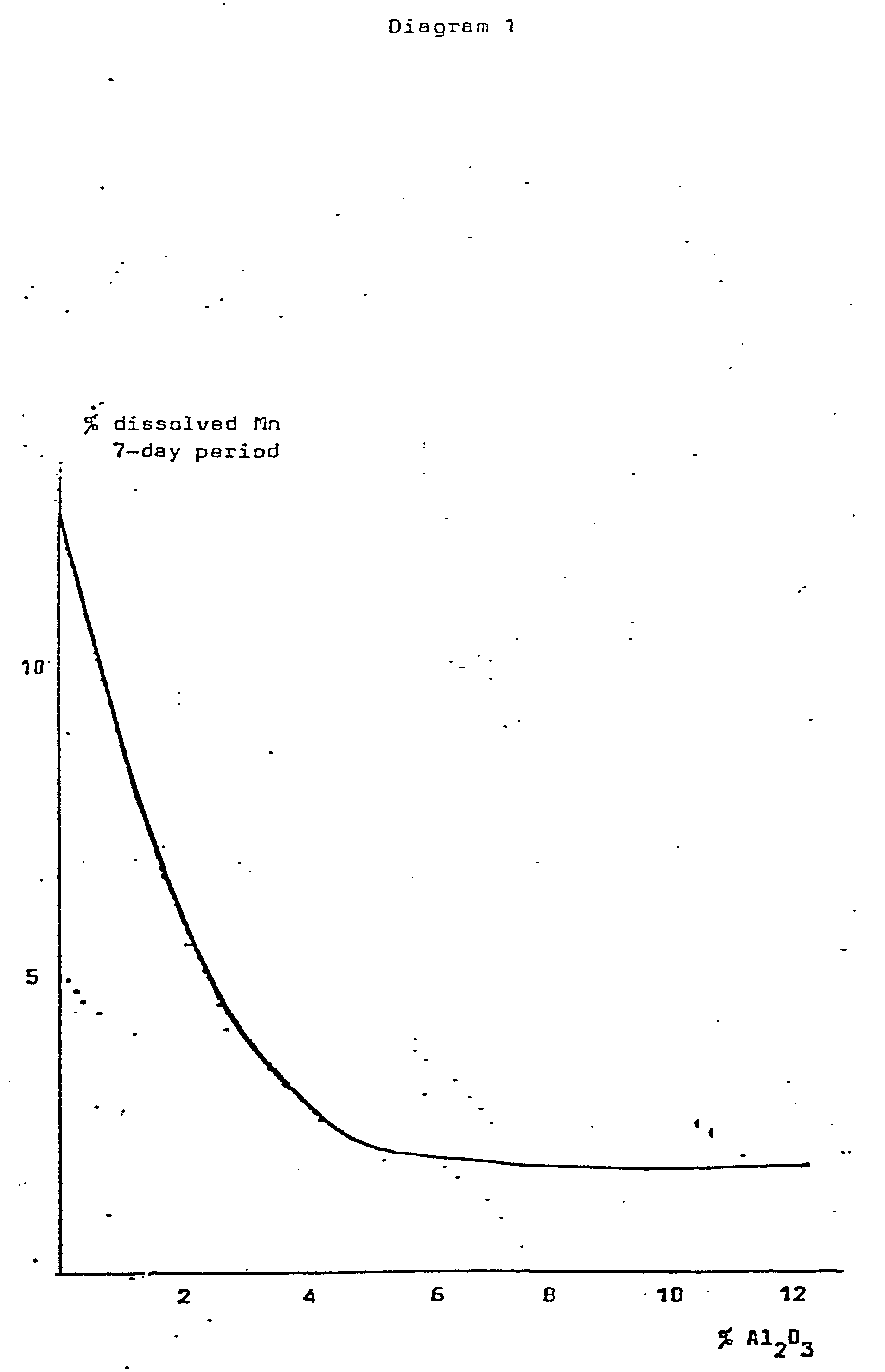
- Samples were removed from the leaching experiments after 1, 4, 7 and 14 days. It was found that 1 day was too short a time for most of the glass compositions and the most soluble compositions gave cloudy solutions. After 14 days no analysis could be performed. The most complete series was Mn contents dissolved after 7 days and a statistical evaluation has therefore been carried out on the basis of these results to calculate the effect of the components on the solubility.
- The effect of the Al2O3 content is shown in Diagram 1. This diagram shows that there is a Practical limit of about 5% AI203, which gives maximum stabilization effect and any increase gives no further improvement. (These compositions do not contain TiO2 and therefore are not according to the invention.)
- As a micronutrient, manganese should be in bivalent form. When producing the experimental glass compositions, therefore, manganese was added in bivalent form, either as carbonate or acetate. However, in normal production probably only pyrolusite (Mn02) is feasible from an economic point of view.
- It proved possible to reduce Mn02 to bivalent manganese. Three different glass compositions were melted, having the same procentual composition: (The glass compositions did not contain Ti02)
- M 30 Mn added in the form of Mn acetate
- M 31 Mn added in the form of Mn02 (pyrolusite)
- M 32 Mn added in the form of Mn02 + 25% carbon (coke)
- After melting polyvalent manganese was determined in the glass with the following results:
- M 30 could not be determined
- M 31 0.006%
- M 32 0.03%
- That M 32 had a somewhat higher content, despite the carbon additive, might be due to different melting times since this glass foamed more. The essential factor is that, irrespective of the valency stage of the raw material, Mn is reduced to bivalency in the phosphate-glass.
- Some of the glass compositions were examined to determine the pH value of the solution. Variation was found to be between pH 6.4 and 7.3, i. e. neutral.
- Orientated corrosion tests with chamotte material at 1000°C and a 5 day corrosion period showed extreme corrosion and the melting was therefore performed in higher smelt-cast refractory material such as Fondal (quartz block from Dider Werken) or ZAC (--Etectro Refractaires).

- The compositions were tested in a leaching column and compred with MnS04. This substance obviously had the greatest solubility The leaching here was ca. 3000 Mg over a 5-day period. The corresponding leaching rate from the most easily dissolved glasses, M 20 and M 48, was ca. 12 Mg per 7-day period.
- For the glasses most difficult to dissolve, M 34 - M 46, the leaching varied between 5 and 1 Mg over a corresponding period. The glasses were also tested in a receptacle experient using soil poor in Mn. The soil was thoroughly fertilized and the various glass compositions were then mixed in. The receptacles were then sown with grain cultivated in soil poor in Mn. The experiments showed that the glasses had provided an adequate supply of Mn without the content of leached Mn being noticeable. Results of the cultivation experiment are given in Table 2.
- Experiments have shown that titanium dioxide, Ti02, can be used as solubility-regulating component instead of Al2O3. Various types of TiO2 material can be used, such as pure TiO2 (its conventional use being as colour pigment), rutile-mineral and ilmenite. The latter mineral consists substantially of Ti02, FeO and Fe2O3.
- The following are descriptions of the phosphate glass produced using ilmenite, by way of example. The ilmenite used was of Norwegian origin. A typical analysis for Norwegian ilmenite is the following:
- Ti02 44.5%
- FeO 34.0
- Fe203 12.5
- MgO 5.0
- Si02 2.7
- Al2O3 0-6
- 99.3%
- remainder: CaO, MnO, Cr2O3· P205
- In the experiments described below ilmenite concentrate in finely milled form was used. The results can be seen in Table 3 showing a phosphate glass MTi in comparison with the glasses M48, M20 and M27 and a glass containing ZnO. The glasses were produced in the same manner.
- As can be seen from the table, in MTi 8% Al2O3 in the comparison glass M27 has been replaced by 8% ilmenite. From the leaching experiments it is clear that ilmenite has a much greater effect on the water solubility than Al2O3. A desired solubility can be set by adjusting the quantity added.
- There were no problems during melting.
- This new type of phosphate glass containing TiO2 has many advantages when it comes to producing compositions with glass-borne plant nutrients. Class can be produced which has a low Al2O3 content or no A1203 at all. The titanium dioxide has been found to be a micronutrient able to give increased harvests and is in any case not damaging. The use of ilmenite concentrate enables compositions to be manufactured at low cost. The iron in the ilmenite may also be useful.


Claims (7)
Applications Claiming Priority (2)
| Application Number | Priority Date | Filing Date | Title |
|---|---|---|---|
| SE8201146A SE440770B (en) | 1982-02-24 | 1982-02-24 | COMPOSITION WITH GLASS-BORN MICRONATION SUBSTANCES AND PROCEDURE FOR PREPARING THIS |
| SE8201146 | 1982-02-24 |
Publications (2)
| Publication Number | Publication Date |
|---|---|
| EP0101705A1 EP0101705A1 (en) | 1984-03-07 |
| EP0101705B1 true EP0101705B1 (en) | 1986-07-02 |
Family
ID=20346091
Family Applications (1)
| Application Number | Title | Priority Date | Filing Date |
|---|---|---|---|
| EP19830900745 Expired EP0101705B1 (en) | 1982-02-24 | 1983-02-16 | Composition with glass-borne plant nutrients |
Country Status (4)
| Country | Link |
|---|---|
| EP (1) | EP0101705B1 (en) |
| DE (1) | DE3364301D1 (en) |
| SE (1) | SE440770B (en) |
| WO (1) | WO1983002939A1 (en) |
Families Citing this family (7)
| Publication number | Priority date | Publication date | Assignee | Title |
|---|---|---|---|---|
| EP0179588A3 (en) * | 1984-10-19 | 1987-08-26 | Pilkington Plc | Improvements in or relating to the treatment of trees and bushes |
| US5254344A (en) * | 1988-05-09 | 1993-10-19 | Rhone-Poulenc Inc. | Oil-in-water pesticidal emulsion, process for application |
| WO2000023398A1 (en) * | 1998-10-21 | 2000-04-27 | Strogov, Vadim Viktorovich | Granulate fertiliser 'agrovitakvo' |
| RU2189961C2 (en) * | 1999-07-19 | 2002-09-27 | Карапетян Гарегин Оганесович | Method of immobilization of physiologically active compounds |
| RU2163587C1 (en) * | 1999-09-02 | 2001-02-27 | Карапетян Гарегин Оганесович | Prolonged-action vitrified fertilizers |
| IT1310926B1 (en) * | 1999-09-30 | 2002-02-27 | Giuseppe Macchioni | GLASS MATRIX FERTILIZER PREPARATION. |
| ITRM20060255A1 (en) * | 2006-05-12 | 2007-11-13 | Mpd Scient S R L | FERTILIZER COMPOSITION WITH GLASS MATRIX PROCEDURE FOR ITS PRODUCTION AND ITS USES |
Family Cites Families (10)
| Publication number | Priority date | Publication date | Assignee | Title |
|---|---|---|---|---|
| GB368477A (en) * | 1931-01-31 | 1932-03-10 | Ig Farbenindustrie Ag | Improvements in and apparatus for the degasification of carbonaceous materials |
| DE897073C (en) * | 1949-10-04 | 1953-11-16 | Wolfgang Dr-Ing Harries | Corrosion-resistant ceramic bodies and processes for their manufacture |
| DE1232993B (en) * | 1955-02-12 | 1967-01-26 | Saint Gobain | Synthetic glass masses as fertilizers, fertilizer components or carriers for micronutrients |
| DE1017189B (en) * | 1956-04-20 | 1957-10-10 | Ruediger Lothar Von Reppert | Process for the production of granular glass fertilizers containing trace elements and other plant nutrients |
| US3762909A (en) * | 1971-06-10 | 1973-10-02 | Steel Corpus | Phosphorus borate glass frits as plant micro nutrient carriers |
| ZA738260B (en) * | 1972-11-06 | 1974-09-25 | Ferro Corp | Improvements in or relating to ferrous iron-containing phosphate glass and plant enrichment therewith |
| US3958973A (en) * | 1973-10-18 | 1976-05-25 | Ferro Corporation | Micronutrient metal-containing phosphate glasses |
| US3930833A (en) * | 1973-10-18 | 1976-01-06 | Ferro Corporation | Micronutrient metal-containing phosphate glasses |
| BE878884A (en) * | 1978-09-29 | 1980-03-20 | Bfg Glassgroup | VITREOUS FERTILIZER AND CULTURE METHOD USING THE SAME |
| GB2037735B (en) * | 1978-12-21 | 1983-11-09 | Standard Telephones Cables Ltd | Glass composition |
-
1982
- 1982-02-24 SE SE8201146A patent/SE440770B/en not_active IP Right Cessation
-
1983
- 1983-02-16 EP EP19830900745 patent/EP0101705B1/en not_active Expired
- 1983-02-16 DE DE8383900745T patent/DE3364301D1/en not_active Expired
- 1983-02-16 WO PCT/SE1983/000051 patent/WO1983002939A1/en not_active Ceased
Also Published As
| Publication number | Publication date |
|---|---|
| DE3364301D1 (en) | 1986-08-07 |
| EP0101705A1 (en) | 1984-03-07 |
| SE440770B (en) | 1985-08-19 |
| WO1983002939A1 (en) | 1983-09-01 |
| SE8201146L (en) | 1983-08-25 |
Similar Documents
| Publication | Publication Date | Title |
|---|---|---|
| JPS62148337A (en) | Nutrient agricultural glass product | |
| US4123248A (en) | Controlled release fertilizer | |
| US3762909A (en) | Phosphorus borate glass frits as plant micro nutrient carriers | |
| WO2007132497A2 (en) | Fertilizer compound having a glass matrix, process for the production and uses thereof | |
| US3930833A (en) | Micronutrient metal-containing phosphate glasses | |
| KR101194193B1 (en) | Water-soluble inorganic composite material prepared from natural ore resources including silicate ore | |
| US3958973A (en) | Micronutrient metal-containing phosphate glasses | |
| CN109641810A (en) | Steelmaking slag for fertilizer raw material, method for producing steelmaking slag for fertilizer raw material, method for producing fertilizer, and method for applying fertilizer | |
| US3897236A (en) | Process for forming ferrous iron-containing phosphorus glasses | |
| EP0101705A1 (en) | Composition with glass-borne plant nutrients. | |
| Pyare et al. | Leachability of molybdenum from ternary phosphate glasses | |
| US2988439A (en) | Method of preparing a potassium polyphosphate glass fertilizer | |
| US6488735B1 (en) | Fertilizer compound having a glass matrix | |
| CN114787107A (en) | Use of aluminosilicate glasses to provide silicon in an absorbable form for plants, method for treating plants using said glasses and novel powders of said glasses | |
| US20140345346A1 (en) | Molten phosphorus-potassium fertilizer, and its preparation process | |
| JP7555265B2 (en) | Inorganic iron-containing glass composition for use in hydroponics | |
| US7645314B2 (en) | Composition useful for making slow release nitrogen free phosphorous, potassium and sulfur oxide glass and a process of making glass therefrom | |
| JP4105562B2 (en) | Glass composition for plant cultivation | |
| JP2717246B2 (en) | Glass containing a large amount of heavy metal and method for producing the same | |
| JP2022157253A (en) | Vitreous microelement fertilizer for hydroponics | |
| JP2021160957A (en) | Steel slag for fertilizer raw material, fertilizer, and method of applying fertilizer | |
| Kundu et al. | Release of zinc and phosphate ions from ZnO-P2O5 glass systems and its characterization | |
| JP3688274B2 (en) | Paddy rice cultivation method to suppress cadmium absorption of paddy rice | |
| JP6474601B2 (en) | Iron-containing material for rice, method for producing iron-containing material for rice, and method for applying iron-containing material for rice | |
| GB756332A (en) | Compositions as nutrients for plant growth |
Legal Events
| Date | Code | Title | Description |
|---|---|---|---|
| PUAI | Public reference made under article 153(3) epc to a published international application that has entered the european phase |
Free format text: ORIGINAL CODE: 0009012 |
|
| 17P | Request for examination filed |
Effective date: 19831006 |
|
| AK | Designated contracting states |
Designated state(s): DE FR GB NL |
|
| GRAA | (expected) grant |
Free format text: ORIGINAL CODE: 0009210 |
|
| AK | Designated contracting states |
Kind code of ref document: B1 Designated state(s): DE FR GB NL |
|
| REF | Corresponds to: |
Ref document number: 3364301 Country of ref document: DE Date of ref document: 19860807 |
|
| ET | Fr: translation filed | ||
| PGFP | Annual fee paid to national office [announced via postgrant information from national office to epo] |
Ref country code: NL Payment date: 19870228 Year of fee payment: 5 |
|
| PLBE | No opposition filed within time limit |
Free format text: ORIGINAL CODE: 0009261 |
|
| STAA | Information on the status of an ep patent application or granted ep patent |
Free format text: STATUS: NO OPPOSITION FILED WITHIN TIME LIMIT |
|
| 26N | No opposition filed | ||
| PG25 | Lapsed in a contracting state [announced via postgrant information from national office to epo] |
Ref country code: GB Effective date: 19890216 |
|
| PG25 | Lapsed in a contracting state [announced via postgrant information from national office to epo] |
Ref country code: NL Effective date: 19890901 |
|
| NLV4 | Nl: lapsed or anulled due to non-payment of the annual fee | ||
| GBPC | Gb: european patent ceased through non-payment of renewal fee | ||
| PG25 | Lapsed in a contracting state [announced via postgrant information from national office to epo] |
Ref country code: FR Free format text: LAPSE BECAUSE OF NON-PAYMENT OF DUE FEES Effective date: 19891027 |
|
| PG25 | Lapsed in a contracting state [announced via postgrant information from national office to epo] |
Ref country code: DE Effective date: 19891101 |
|
| REG | Reference to a national code |
Ref country code: FR Ref legal event code: ST |