EP0101603A2 - Neues Protein (PP13), Verfahren zu seiner Anreicherung und Gewinnung sowie seine Verwendung - Google Patents
Neues Protein (PP13), Verfahren zu seiner Anreicherung und Gewinnung sowie seine Verwendung Download PDFInfo
- Publication number
- EP0101603A2 EP0101603A2 EP83108067A EP83108067A EP0101603A2 EP 0101603 A2 EP0101603 A2 EP 0101603A2 EP 83108067 A EP83108067 A EP 83108067A EP 83108067 A EP83108067 A EP 83108067A EP 0101603 A2 EP0101603 A2 EP 0101603A2
- Authority
- EP
- European Patent Office
- Prior art keywords
- protein
- proteins
- molecular weight
- determined
- albumin
- Prior art date
- Legal status (The legal status is an assumption and is not a legal conclusion. Google has not performed a legal analysis and makes no representation as to the accuracy of the status listed.)
- Granted
Links
Images

Classifications
-
- C—CHEMISTRY; METALLURGY
- C07—ORGANIC CHEMISTRY
- C07K—PEPTIDES
- C07K14/00—Peptides having more than 20 amino acids; Gastrins; Somatostatins; Melanotropins; Derivatives thereof
- C07K14/435—Peptides having more than 20 amino acids; Gastrins; Somatostatins; Melanotropins; Derivatives thereof from animals; from humans
- C07K14/46—Peptides having more than 20 amino acids; Gastrins; Somatostatins; Melanotropins; Derivatives thereof from animals; from humans from vertebrates
- C07K14/47—Peptides having more than 20 amino acids; Gastrins; Somatostatins; Melanotropins; Derivatives thereof from animals; from humans from vertebrates from mammals
- C07K14/4701—Peptides having more than 20 amino acids; Gastrins; Somatostatins; Melanotropins; Derivatives thereof from animals; from humans from vertebrates from mammals not used
- C07K14/4715—Pregnancy proteins, e.g. placenta proteins, alpha-feto-protein, pregnancy specific beta glycoprotein
-
- C—CHEMISTRY; METALLURGY
- C07—ORGANIC CHEMISTRY
- C07K—PEPTIDES
- C07K16/00—Immunoglobulins [IG], e.g. monoclonal or polyclonal antibodies
- C07K16/18—Immunoglobulins [IG], e.g. monoclonal or polyclonal antibodies against material from animals or humans
-
- G—PHYSICS
- G01—MEASURING; TESTING
- G01N—INVESTIGATING OR ANALYSING MATERIALS BY DETERMINING THEIR CHEMICAL OR PHYSICAL PROPERTIES
- G01N33/00—Investigating or analysing materials by specific methods not covered by groups G01N1/00 - G01N31/00
- G01N33/48—Biological material, e.g. blood, urine; Haemocytometers
- G01N33/50—Chemical analysis of biological material, e.g. blood, urine; Testing involving biospecific ligand binding methods; Immunological testing
- G01N33/68—Chemical analysis of biological material, e.g. blood, urine; Testing involving biospecific ligand binding methods; Immunological testing involving proteins, peptides or amino acids
- G01N33/689—Chemical analysis of biological material, e.g. blood, urine; Testing involving biospecific ligand binding methods; Immunological testing involving proteins, peptides or amino acids related to pregnancy or the gonads
-
- Y—GENERAL TAGGING OF NEW TECHNOLOGICAL DEVELOPMENTS; GENERAL TAGGING OF CROSS-SECTIONAL TECHNOLOGIES SPANNING OVER SEVERAL SECTIONS OF THE IPC; TECHNICAL SUBJECTS COVERED BY FORMER USPC CROSS-REFERENCE ART COLLECTIONS [XRACs] AND DIGESTS
- Y10—TECHNICAL SUBJECTS COVERED BY FORMER USPC
- Y10S—TECHNICAL SUBJECTS COVERED BY FORMER USPC CROSS-REFERENCE ART COLLECTIONS [XRACs] AND DIGESTS
- Y10S530/00—Chemistry: natural resins or derivatives; peptides or proteins; lignins or reaction products thereof
- Y10S530/827—Proteins from mammals or birds
- Y10S530/85—Reproductive organs or embryos
- Y10S530/851—Placenta; amniotic fluid
Definitions
- the invention relates to a new protein (PP 13 ), a process for its enrichment and extraction from an extract of human placentas, and its use.
- the present invention describes the isolation and characterization of a new soluble protein called PP 13 .
- the isoelectric point was determined using a column (440 ml) from LKB, Sweden.
- the so-called ampholin (R) mixture had a pH range of 4.0 to 6.0 when examining the glycoprotein.
- the sedimentation coefficient was determined in an analytical ultracentrifuge from Beckman (Spinco apparatus, model E) at 60,000 rpm in double sector cells using the UV scanner technology at 280 nm. A 0.05 M phosphate buffer (pH 6.8) containing 0.2 mol / l NaCl was used as solvent. The protein concentration was adjusted to an optical density (undated) of about 3. The sedimentation coefficient was converted on the basis of water at 20 ° C.
- the sedimentation equilibrium method was used to determine the molecular weight in the ultracentrifuge.
- the concentration of the protein is about 1.0 O.D. been discontinued.
- the determination was made at 9,000 rpm.
- Registration was done with UV optics at 280 nm using the photoelectric scanner.
- SDS-PAA gel a gel with 7.5% (g / 100ml) polyacrylamide (PAA) containing 0.1% (g / 100ml) sodium dodecyl sulfate (SDS) was used.
- PAA polyacrylamide
- SDS sodium dodecyl sulfate
- HPL Human placental tactogen
- HPL human albumin and its aggregates were used as reference substances.
- the substance was 0.10% (g / 100 ml) in distilled water. solved.
- the analysis of the carbohydrates was carried out as follows: After hydrolysis of the glycosidic bonds, the released neutral sugars were separated as borate complexes via an anion exchange column (YCLee et al., Anal.Biochem. 27, 567 (1969)), in the eluate by admixing Cu ( I) -bicinchoninatreagenz (K.Mopper and M.Gindler, Anal.Biochem. 56, 440 (1973)) stained and quantified using rhamnose as an internal standard. The aminosugars were detected and determined by their reaction with ninhydrin. The neuraminic acid content was determined using the Warren method (Methods in Enzymology, Vol. VI, 463-465 (1963)).
- the amino acid analysis was carried out according to S. Moore, D.H. Packman, W.H. Stein, Anal. Chem. 30, p.1185 (1958), using the Multichrom B liquid chromatograph from Beckman. 1/2 cystine was obtained after oxidation of the proteins with performic acid (S.Moore et al., Anal. Chem. 30, p. 1185 (1958)) and subsequent chromatography (S.Moore, J.Biol.Chem., 238, p .235 (1963)) as cysteic acid. The tryptophan content was determined using the direct photometric determination according to H. Edelhoch, Biochemistry 6, p. 1948 (1967).
- the invention furthermore relates to a process for obtaining the PP13, characterized in that an extract from human placentas is fractionated using the above properties.
- the various methods of preparative electrophoresis, isoelectric focusing, gel filtration, gel chromatography or ultrafiltration or the property of the PP 13 that can be bound to weakly basic ion exchangers and can be eluted from them can be used for this purpose.
- the PP 13 can be isolated by an appropriate combination of the measures mentioned, which bring about an enrichment of the PP 13 or a separation of this protein from other proteins.
- the subject matter of the present invention can be seen in the individual steps for enriching the PP 13 and in the method for cleaning the PP 13 which results from combining the measures for enrichment.
- the extract from human placentas could be used directly for immunoadsorption.
- concentration of PP 13 in the placenta extract is relatively low, it is advisable to first enrich the protein PP13 specifically by pre-fractionating the extract with the aid of methods which are suitable for the fractionation of proteins on a larger scale; for example by fractional precipitation with neutral salts or organic cations, by gel filtration or by ion exchange chromatography.
- the immunoadsorption step could also be replaced by using other separation methods, for example by preparative electrophoresis and isoelectric focusing.
- An average of 3.7 mg of this protein can be extracted from a fully grown human placenta (600 g) with physiological saline. Extracts from other human organs (e.g. from the heart, lungs, skin, Stomach, kidney, uterus, liver, spleen, adrenal gland, colon and bladder) do not contain this protein or contain it in a much lower concentration. Also in the serum of other human body fluids, PP 13 does not normally occur or only in traces ( ⁇ 1 mg / l).
- immunochemical methods can also be used to detect and determine PP 13, for example in a fraction from a separation operation, since PP 13 has antigenic properties. Specific antibodies are formed when animals are immunized with this protein.
- An antiserum which can be used for this purpose can be obtained as follows: By immunizing rabbits with a PP 13 -containing placental protein fraction (for example a mother liquor from the crystallization of human placentalactogen (HPL) according to Bohn H., Experientia 27 (1971) 1223) polyvalent antiserum obtained, which also contains antibodies against PP 13 .
- This antiserum can be made largely specific to the antigen PP 13 by absorption with normal human serum and those placental fractions which do not contain PP 13 , or with purified placental proteins (for example HPL, PP 11 , PP 12 and PP 16 ).
- This antiserum can serve on the one hand for the immunological detection of PP 13 and on the other hand for the production of an immunoadsorbent which can be used for the enrichment and isolation of PP 13 .
- monospecific antisera can be produced by immunizing animals according to known methods.
- Figure 1a shows the immunological reaction of PP 13 with a specific rabbit antiserum after separation in an electric field in agar-containing gel.
- Figure 1b shows the separation of the proteins of the serum, made visible by their immune reaction with an antiserum from rabbits against human serum (HS).
- the gel diffusion technique according to Ouchterlony (cf. Schultze and Heremans, Molecular Biology of Human Proteins, Vol.1, pg. 134) or, if necessary, more sensitive methods such as radioimmunoassays or enzyme immunoassays can also be used.
- PP 13 is a placental "specific" protein. Such proteins are generally increased in serum as pregnancy progresses; they can therefore be used as parameters for monitoring pregnancy. On the other hand, placental-specific proteins are also detectable in serum in patients with tumors - especially in trophoblastic and embryonic tumors - or localized in the tissue of the tumors; In such diseases, they can therefore be used as markers to monitor the course of the disease and to control the therapy.
- PP 1 3 can therefore be used to produce antisera that can be used to detect and determine PP 13 .
- fraction A 1,200 g of fraction A were dissolved in water and dialyzed against a 0.01 M Tris-HCl buffer (pH 8.0) containing 0.05% (g / 100 ml) NaN 3 (buffer solution I). The remaining solution was applied to a column (60 ⁇ 65 cm) filled with Sephadex G-150 and eluted with buffer solution I. The eluates with the low molecular weight proteins (MW 10,000 - 40,000) were combined and designated as fraction B.
- fraction B The proteins of fraction B were adsorbed on DEAE cellulose (column 10 x 28 cm) .
- the column was then rinsed with buffer solution I and eluted with 5% (g / 100ml) saline.
- the eluate was concentrated on an ultrafilter and dialyzed against a 0.1 M Tris-HCl buffer of pH 8, which contained 1 mol / 1 NaCl and 0.1% sodium acid (buffer solution II) (fraction C).
- the immunoadsorbent was suspended in buffer solution II, filled into a chromatography column (5.5 ⁇ 22 cm) and rinsed with buffer solution II. Fraction C was then applied to the column, PP 13 being bound by immunoadsorption. The column was then rinsed thoroughly with buffer 11; then the adsorbed protein was eluted from the column with about 600 ml of 3 M potassium rhodanide solution. The PP 13 -containing eluates were dialyzed against buffer solution II and concentrated to about 20 ml with an ultrafilter. Yield per adsorption ⁇ 10 mg PP 13 . The adsorbent in the column was neutralized again immediately after the elution of PP 13 with buffer solution II and washed thoroughly; it was then used again for the immunoadsorptive binding of PP13.
Landscapes
- Health & Medical Sciences (AREA)
- Life Sciences & Earth Sciences (AREA)
- Chemical & Material Sciences (AREA)
- Organic Chemistry (AREA)
- Molecular Biology (AREA)
- Immunology (AREA)
- Proteomics, Peptides & Aminoacids (AREA)
- Engineering & Computer Science (AREA)
- General Health & Medical Sciences (AREA)
- Biochemistry (AREA)
- Medicinal Chemistry (AREA)
- Biomedical Technology (AREA)
- Biophysics (AREA)
- Hematology (AREA)
- Urology & Nephrology (AREA)
- Pregnancy & Childbirth (AREA)
- Gynecology & Obstetrics (AREA)
- Genetics & Genomics (AREA)
- Reproductive Health (AREA)
- Food Science & Technology (AREA)
- Analytical Chemistry (AREA)
- Physics & Mathematics (AREA)
- General Physics & Mathematics (AREA)
- Pathology (AREA)
- Toxicology (AREA)
- Zoology (AREA)
- Gastroenterology & Hepatology (AREA)
- Microbiology (AREA)
- Cell Biology (AREA)
- Biotechnology (AREA)
- Peptides Or Proteins (AREA)
- Medicines Containing Material From Animals Or Micro-Organisms (AREA)
- Medicines That Contain Protein Lipid Enzymes And Other Medicines (AREA)
- Medicines Containing Antibodies Or Antigens For Use As Internal Diagnostic Agents (AREA)
- Preparation Of Compounds By Using Micro-Organisms (AREA)
Abstract
Description
- Die Erfindung betrifft ein neues Protein (PP13), ein Verfahren zu seiner Anreicherung und Gewinnung aus einem Extrakt menschlicher Plazenten sowie seine Verwendung.
- Im Extrakt aus menschlichen Plazenten wurde bereits eine Reihe löslicher Proteine, die aus diesem Gewebe stammen, nachgewiesen (Bohn, H., Placental and Pregnancy Proteins, in Carcino-Embryonic Proteins,Vol. I, Ed., F. G. Lehmann, Elsevier/North-Holland Biomedical Press, 1979).
- Die vorliegende Erfindung beschreibt die Isolierung und Charakterisierung eines neuen löslichen Proteins, genannt PP13.
- Gegenstand der Erfindung ist das Protein PP13, gekennzeichnet durch
- a) eine elektrophoretische Beweglichkeit im Bereich von Albumin,
- b) einen isoelektrischen Punkt von 4,75 + 0,15,
- c) einen Sedimentationskoeffizienten S0 20,w von 3,1 ±0,15,
- d) ein in der Ultrazentrifuge bestimmtes Molekulargewicht von 30 000 + 5 000,
- e) ein im Natriumdodecylsulfat (SDS)-haltigen Polyacrylamidgel bestimmtes Molekulargewicht von 29 000 + 3 000,
- f) einen Extinktionskoeffizienten E1% 1cm (280 nm) von 9,8 + 0,3,
- g) einen Kohlenhydratanteil von < 1 % (g/100g) (Mannose 0, 1 + 0,05 %, Galactose 0,2 + 0,1%, Xylose 0,1+0,05%, Glucosamin 0, 2+ 0,1%, Neuraminsäure nicht nachgewiesen).
- Die Aminosäurenzusammensetzung von PP13 ist in der folgenden Tabelle angegeben:

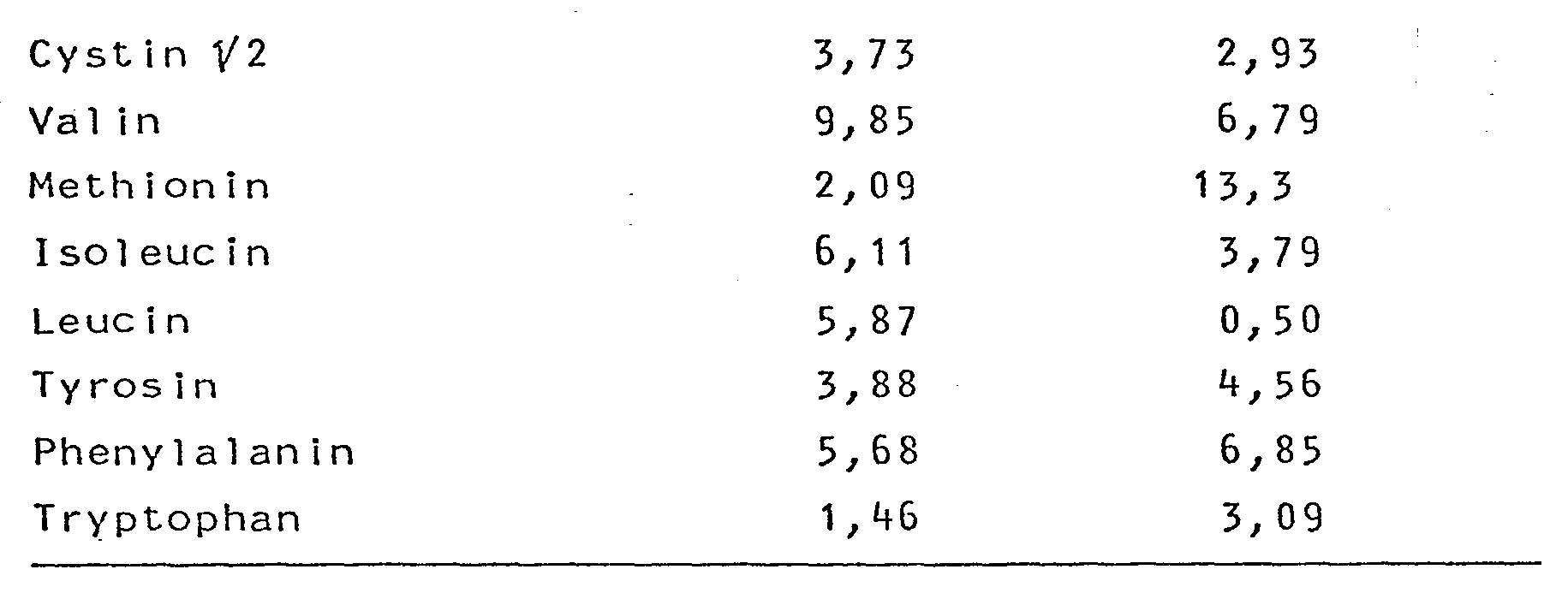
- Zur Erläuterung der kennzeichnenden Markmale des Gewebsproteins sei folgendes ausgeführt:
- Die Untersuchung der elektrpphoretischen Beweglichkeit erfolgte in der Mikromodifikation mit dem Gerät Microzone R 200 von Beckman Instruments auf Zelluloseazetatfolien (Firma Sartorius) unter Verwendung von Natriumdiäthylbarbiturat-Puffer, pH 8,6.
- Die Bestimmung des isoelektrischen Punktes wurde mit einer Säule (440 ml) der Firma LKB, Stockholm, durchgeführt. Das sogenannte Ampholin(R)-Gemisch hatte bei der Untersuchung des Glykoproteins einen pH-Bereich von 4,0 bis 6,0.
- Der Sedimentationskoeffizient wurde in einer analytischen Ultrazentrifuge der Firma Beckman(Spinco-Apparatur, Modell E) bei 60.000 UpM in Doppelsektorzellen mit Hilfe der UV-Scanner Technik bei 280 nm bestimmt. Als Lösungsmittel diente ein 0,05 M Phosphatpuffer (pH 6,8), der 0,2 Mol/l NaCl enthielt. Die Proteinkonzentration wurde auf eine optische Dichte (o.D.) von etwa 3 eingestellt. Der Sedimentationskoeffizient wurde auf die Basis von Wasser bei 20°C umgerechnet.
- Zur Ermittlung des Molekulargewichtes in der Ultrazentrifuge wurde die Sedimentationsgleichgewichtsmethode herangezogen. Die Konzentration des Proteins ist dabei auf etwa 1.0 O.D. eingestellt worden. Die Bestimmung wurde bei 9.000 UpM vorgenommen. Die Registrierung erfolgte mit UV-Optik bei 280 nm unter Einsatz des photoelektrischen Scanners.
- Zur Bestimmung des Molekulargewichtes im SDS-PAA-Gel wurde ein Gel mit 7,5% (g/100ml) Polyacrylamid(PAA),das 0,1% (g/100ml) Natriumdodecylsulfat (SDS) enthielt, verwendet. Als Vergleichssubstanz dienten humanes Plazentalaktogen (HPL) und Human-Albumin sowie dessen Aggregate.
- Zur Bestimmung des Extinktionskoeffizienten wurde die Substanz 0,10%ig (g/100 ml) in Aqua dest. gelöst.
- Die Analyse der Kohlenhydrate wurde wie folgt durchgeführt: Nach Hydrolyse der glykosidischen Bindungen wurden die freigesetzten Neutralzucker als Boratkomplexe über eine Anionenaustauschersäule getrennt (Y.C.Lee et al., Anal.Biochem. 27, 567 (1969)), im Eluat durch Zumischung von Cu(I)-bicinchoninatreagenz (K.Mopper und M.Gindler,Anal.Biochem. 56, 440 (1973)) angefärbt und unter Verwendung von Rhamnose als internem Standard quantitativ bestimmt. Die Äminozucker wurden durch ihre Reaktion mit Ninhydrin nachgewiesen und bestimmt. Der Neuraminsäuregehalt ist mit der Methode nach Warren (Methods in Enzymology, Vol. VI, 463-465 (1963)) ermittelt worden.
- Die Aminosäurenanalyse wurde nach S. Moore, D.H.Spackman, W.H.Stein, Anal. Chem. 30, S.1185 (1958), unter Verwendung des Flüssigkeitschromatographen Multichrom B der Firma Beckman durchgeführt. 1/2 Cystin wurde nach Oxydation der Proteine mit Perameisensäure (S.Moore et al., Anal. Chem. 30, S. 1185 (1958)) und nachfolgender Chromatographie (S.Moore, J.Biol.Chem., 238, S.235 (1963)) als Cysteinsäure bestimmt. Der Tryptophangehalt ist mit der direkten photometrischen Bestimmung nach H.Edelhoch, Biochemistry 6, S. 1948 (1967), ermittelt worden.
- PP13 hat folgende Eigenschaften, die sich in einem Verfahren zu seiner Isolierung verwenden lassen, indem diesen Eigenschaften entsprechende Maßnahmen getroffen werden:
- 1) Mit Ammoniumsulfat wird es bei pH 7,0 und 30-60% Sättigung aus wässrigen Lösungen gefällt.
- 2) Mit wasserlöslichen Acridinbasen, zum Beispiel 2-Äthoxi-6,9-diaminoacridinlactat (Rivanol(R)) wird es bei pH-Werten zwischen 4 - 9 und einer Konzentration der Base von 0,2 bis 0,8%(g/100 ml) präzipitiert. Bei einem pH-Wert von 6,0 und einer Rivanolkonzentration von 0,4% (g/100ml) fällt es bereits zum Teil aus.
- 3) Bei der elektrophoretischen Auftrennung wandert es bei pH 8,0 ähnlich schnell wie Albumin.
- 4) Bei der isoelektrischen Fokussierung erscheint es im pH-Bereich von 4,6 bis 4,9 mit Maximum zwischen 4,7 und 4,8.
- 5) Bei der Gelfiltrationmit Sephadex(R) verhält es sich wie Proteine mit Molekulargewichten von 10 000 bis 40 000.
- 6) Es läßt sich an schwach basische Ionenaustauscher wie beispielsweise DEAE-Cellulose oder DEAE-Sephadex bei einer Leitfähigkeit von etwa 0 - 2 mS und einem pH-Wert von etwa pH 7 bis 9 binden und wird erst unter Verwendung stärker konzentrierter Salzlösungen (1-5g/100 ml NaCl-Lösungen) vom Ionenaustauscher wieder eluiert.
- 7) Es kann,aus einer wässrigen Lösung durch Immundadsorption angereichert und isoliert werden.
- Gegenstand der Erfindung ist ferner ein Verfahren zur Gewinnung des PP13, dadurch gekennzeichnet, daß ein Extrakt aus menschlichen Plazenten, unter Verwendung der obenstehenden Eigenschaften fraktioniert wird.
- Neben Ammoniumsulfat können selbstverständlich auch andere in der präparativen Biochemie üblicherweise eingesetzte Neutralsalze zur Ausfällung des PP13 verwendet werden. Neben einer Acridinbase ist auch ein wasserlösliches Derivat einer Chinolinbase, wie sie für Proteinfraktionierungen bekannt sind, im Rahmen des erfindungsgemäßen Verfahrens einsetzbar. Einsprechend seinem elektrophoretischen Verhalten, seinem isoelektrischen Punkt, seinem Molekulargewicht, sind zur Isolierung des Proteins auch andere Maßnahmen brauchbar, die geeignet sind, ein Protein mit den angegebenen Eigenschaften von anderen Proteinen abzutrennen. Hierzu können die verschiedenen Methoden der präparativen Elektrophorese, der isoelektrischen Fokussierung, der Gelfiltration, Gelchromatographie oder Ultrafiltration oder auch die Eigenschaft des PP13, an schwach basische Ionenaustauscher gebunden und hiervon wieder eluiert werden zu können, verwendet werden. Durch eine zweckmäßige Kombination der genannten Maßnahmen, die eine Anreicherung des PP13 oder eine Abtrennung dieses Proteins von anderen Proteinen bewirken, kann das PP13 isoliert werden.
- Demzufolge ist der Gegenstand der vorliegenden Erfindung in den einzelnen Schritten zur Anreicherung des PP13 und in dem durch Kombination der Maßnahmen zur Anreicherung sich ergebenden Verfahren zur Reinigung des PP13 zu sehen.
- Die im Beispiel angegebenen Schritte zur Anreicherung und Isolierung von PP13 sind keinesfalls alle zwingend und müssen auch nicht in der dort beschriebenen Reihenfolge durchgeführt werden.
- Zur Immunadsorption könnte man direkt den Extrakt aus menschlichen Plazenten einsetzen. Da die Konzentration von PP13 im Plazentenextrakt aber relativ gering ist, ist es zweckmäßig, durch eine Vorfraktionierung des Extraktes das Protein PP13 erst spezifisch anzureichern mit Hilfe von Methoden, die sich zur Fraktionierung von Proteinen in größerem Maßstab eignen; zum Beispiel durch fraktionierte Fällung mit Neutralsalzen oder organischen Kationen, durch Gelfiltration oder durch Ionenaustauschchromatographie. Auch der Schritt der Immunadsorption könnte durch Anwendung anderer Trennmethoden, zum Beispiel durch präparative Elektrophorese und isoelektrische Fokussierung, ersetzt werden.
- Zur Hochreinigung von PP13 im Endstadium der Isolierung haben sich Gelfiltration an Sephadex G-100 und inverse Immunadsorption als brauchbar erwiesen.
- Aus einer ausgewachsenen menschlichen Plazenta (600 g) lassen sich mit physiologischer Salzlösung im Durchschnitt 3,7 mg dieses Proteins extrahieren. Extrakte anderer Organe des Menschen (zum Beispiel aus Herz, Lunge, Haut, Magen, Niere, Uterus, Leber, Milz, Nebenniere, Colon und Blase) enthalten dieses Protein nicht oder in wesentlich geringerer Konzentration. Auch im Serum von anderen Körperflüssigkeiten des Menschen kommt PP13 normalerweise nicht oder nur in Spuren (< 1 mg/l) vor.
- Zum Nachweis und zur Bestimmung des PP13 etwa in einer Fraktion aus einer Trennoperation können neben den angegebenen Parametern auch immunchernische Methoden dienen, da PP13 antigene Eigenschaften hat. Bei der Immunisierung von Tieren mit diesem Protein werden spezifische Antikörper gebildet.
- Ein für diesen Zweck brauchbares Antiserum kann folgendermaßen gewonnen werden: Durch Immunisieren von Kaninchen mit einer PP13-enthaltenden Plazentaproteinfraktion (zum Beispiel einer Mutterlauge aus der Kristallisation von humanem Placentalactogen(HPL) nach Bohn H.,Experientia 27 (1971) 1223) wird ein polyvalentes Antiserum erhalten, das unter anderem auch Antikörper gegen PP13 enthält. Dieses Antiserum kann durch Absorption mit normalem menschlichen Serum und solchen Plazentafraktionen, die PP13 nicht enthalten, beziehungsweise mit gereinigten Plazentaproteinen (zum Beispiel HPL, PP11, PP12 und PP16) gegen das Antigen PP13 weitgehend spezifisch gemacht werden.
- Dieses Antiserum kann einerseits zum immunologischen Nachweis des PP13, andererseits zur Herstellung eines Immunadsorbens dienen, das zur Anreicherung und Isolierung von PP13 eingesetzt werden kann.
- Mit Hilfe des nach der vorliegenden Anmeldung gewonnenen gereinigten PP13 lassen sich durch Immunisieren von Tieren nach bekannten Methoden monospezifische Antiseren herstellen.
- Abbildung 1a zeigt die immunologische Reaktion von PP13 mit einem spezifischen Antiserum vom Kaninchen nach Auftrennung im elektrischen Feld in Agar-haltigem Gel.
- Abbildung 1b bringt zum Vergleich dazu die Auftrennung der Proteine des Serums, sichtbar gemacht durch deren Immunreaktion mit einem Antiserum vom Kaninchen gegen Humanserum (HS).
- Zum immunologischen Nachweis von PP13 kann auch die Geldiffusionstechnik nach Ouchterlony (vgl. Schultze and Heremans, Molecular Biology of Human Proteins, Vol.1, pg. 134) oder wenn notwendig auch empfindlichere Methoden wie Radioimmunoassays oder Enzymimmunoassays herangezogen werden.
- Der Nachweis und die Bestimmung von PP13 haben diagnostische Bedeutung: PP13 ist ein plazenta-"spezifisches" Protein. Solche Proteine sind im allgemeinen mit fortschreitender Schwangerschaft in zunehmendem Maße im Serum erhöht; sie lassen sich daher als Parameter zur Überwachung der Schwangerschaft verwenden. Plazentaspezifische Proteine sind andererseits aber auch vielfach bei Patienten mit Tumoren -insbesondere bei trophoblastischen und embryonalen Tumoren- im Serum nachweisbar beziehungsweise im Gewebe der Tumoren lokalisiert; sie können daher bei solchen Erkrankungen als Marker zur Überwachung des Krankheitsverlaufs und zur Kontrolle der Therapie eingesetzt werden.
- PP 13 kann also verwendet werden, um Antiseren herzustellen, die dazu dienen können, PP13 nachzuweisen und zu bestimmen.
- Die Erfindung wird am nachstehenden Beispiel erläutert:
- 1.000 kg tiefgefrorene menschliche Plazenten wurden im Schneidmischer zerkleinert und mit 1.000 Liter einer 0,4 %igen (g/100ml) Kochsalzlösung extrahiert. Der Extrakt wurde nach Abtrennung des Geweberückstandes durch Zentrifugation mit 20 %iger(g/100ml)Essigsäure auf pH 6,0 eingestellt und unter Rühren mit 200 Liter einer 3 %igen (g/100ml) Lösung von 2-Äthoxy-6,9-Diamino- acridin-Lactat (Rivanol(R), Hoechst AG) versetzt. Der Niederschlag wurde durch Zentrifugation abgetrennt, mit 500 Liter einer 2,5 %igen (g/100ml) NaCl-Lösung versetzt und 4 Stunden gerührt. Das abgeschiedene Chlorid des 2-Äthoxy-6,9-Diaminoacridins wurde abzentrifugiert. Der Überstand ist unter Rühren langsam mit soviel festem Ammoniumsulfat versetzt worden, daß eine Endkonzentration von 30 % (g/100ml) erreicht wurde. Der Niederschlag wurde abzentrifugiert. Es wurden dabei 4,5 kg einer feuchten Paste, die im Nachfolgenden als Fraktion A bezeichnet wird, erhalten.
- 1.200 g der Fraktion A wurden in Wasser gelöst und gegen einen 0,01 M Tris-HCl-Puffer (pH 8,0), der 0,05 % (g/100ml) NaN3 enthielt (Pufferlösung I), dialysiert. Die zurückbleibende Lösung wurde auf eine mit Sephadex G-150 gefüllte Säule (60 x 65 cm) aufgetragen und mit Pufferlösung I eluiert. Die Eluate mit den niedermolekularen Proteinen (MG 10 000 - 40 000) wurden vereinigt und als Fraktion B bezeichnet.
- --------------------------------Die Proteine der Fraktion B wurden an DEAE-Cellulose (Säule 10 x 28 cm) adsorbiert. Die Säule ist dann mit Pufferlösung I gespült und mit 5 % (g/100ml) Kochsalzlösung eluiert worden. Das Eluat wurde auf einem Ultrafilter eingeengt und gegen einen 0,1 M Tris-HCI-Puffer von pH 8, der 1 Mol/1 NaCl und 0,1 % Natriumacid enthielt (Pufferlösung II), dialysiert (Fraktion C).
- -------------------------------------------1. Herstellung des Immunadsorbens. 400 ml eines Anti-PP13-Serums vom Kaninchen wurden gegen 0,02 M Phosphatpuffer (pH 7,0) dialysiert und zur Abtrennung der Immunglobuline an DEAE-Cellulose chromatographiert. Die Immunglobulinfraktion (4,69 g Protein) wurde dann mit 469 g besonders gereinigter Agarose in Kugelform (Sepharose(R) der Pharmacia, Uppsala, Schweden), die mit 58,6 g Bromcyan aktiviert worden war, umgesetzt und so kovalent an einen Träger gebunden. Das Verfahren wurde beschrieben von Axen R., Porath J., Ernbach S., Nature 214, 1302 (1967). Mit Hilfe eines auf diese Weise hergestellten Immunoadsorbens konnte PP13 aus seinen Lösungen, insbesondere aus PP13 angereicherten Plazentaextraktfraktionen isoliert werden.
- 2. Immunadsorption. Das Immunadsorbens wurde in Pufferlösung II suspendiert, in eine Chromatographiesäule gefüllt (5,5 x 22 cm) und mit Pufferlösung II nachgespült. Dann wurde Fraktion C auf die Säule aufgetragen, wobei PP13 immunadsorptiv gebunden wurde. Die Säüle wurde dann gründlich mit Puffer 11 gespült; anschließend ist das adsorbierte Protein mit etwa 600 ml 3 M Kaliumrhodanid-Lösung von der Säule eluiert worden. Die PP13-haltigen Eluate wurden gegen Pufferlösung II dialysiert und mit einem Ultrafilter auf etwa 20 ml eingeengt. Ausbeute pro Adsorption ~ 10 mg PP13. Das Adsorbens in der Säule wurde unmittelbar nach der Elution von PP13 wieder mit Pufferlösung II neutralisiert und gründlich gewaschen; es ist dann erneut zur immunadsorptiven Bindung von PP13 eingesetzt worden.
- ------------------Das durch Immunadsorption gewonnene Protein war häufig durch unspezifisch gebundene Serumproteine und andere Plazenta-Gewebsproteine verunreinigt. Die Abtrennung der Hauptmenge der Serum-Begleitproteine gelang durch Gelfiltration an Sephadex G-100. Die restlichen Begleitproteine wurden dann durch inverse oder negative Immunadsorption, das heißt mit Hilfe von trägergebundenen Antikörpern gegen die noch als Verunreinigung vorliegenden Proteine (HPL, PP12, PP16 und Serumproteine) entfernt.
Claims (12)
Priority Applications (1)
| Application Number | Priority Date | Filing Date | Title |
|---|---|---|---|
| AT83108067T ATE38521T1 (de) | 1982-08-20 | 1983-08-16 | Neues protein (pp13), verfahren zu seiner anreicherung und gewinnung sowie seine verwendung. |
Applications Claiming Priority (2)
| Application Number | Priority Date | Filing Date | Title |
|---|---|---|---|
| DE3230996 | 1982-08-20 | ||
| DE3230996A DE3230996A1 (de) | 1982-08-20 | 1982-08-20 | Neues protein (pp(pfeil abwaerts)1(pfeil abwaerts)(pfeil abwaerts)3(pfeil abwaerts)), verfahren zu seiner anreicherung und gewinnung sowie seine verwendung |
Publications (3)
| Publication Number | Publication Date |
|---|---|
| EP0101603A2 true EP0101603A2 (de) | 1984-02-29 |
| EP0101603A3 EP0101603A3 (en) | 1986-05-28 |
| EP0101603B1 EP0101603B1 (de) | 1988-11-09 |
Family
ID=6171307
Family Applications (1)
| Application Number | Title | Priority Date | Filing Date |
|---|---|---|---|
| EP83108067A Expired EP0101603B1 (de) | 1982-08-20 | 1983-08-16 | Neues Protein (PP13), Verfahren zu seiner Anreicherung und Gewinnung sowie seine Verwendung |
Country Status (7)
| Country | Link |
|---|---|
| US (1) | US4500451A (de) |
| EP (1) | EP0101603B1 (de) |
| JP (1) | JPS5959621A (de) |
| AT (1) | ATE38521T1 (de) |
| AU (1) | AU555699B2 (de) |
| CA (1) | CA1213213A (de) |
| DE (2) | DE3230996A1 (de) |
Cited By (5)
| Publication number | Priority date | Publication date | Assignee | Title |
|---|---|---|---|---|
| EP0141326A3 (en) * | 1983-10-22 | 1986-03-26 | Behringwerke Aktiengesellschaft | Protein pp20, process for its recovery and its use |
| EP0283606A1 (de) * | 1987-03-24 | 1988-09-28 | Technion Research & Development Foundation Ltd. | Verfahren zur Feststellung von Schwangerschaftsstörungen |
| WO1999038970A1 (en) * | 1998-01-29 | 1999-08-05 | Diagnostic Technologies Ltd. | Placental protein 13 |
| US7466273B2 (en) | 2004-03-31 | 2008-12-16 | Ace Technology | Multiband antenna using whip having independent power feeding in wireless telecommunication terminal |
| US7488585B2 (en) | 2002-08-29 | 2009-02-10 | Diagnostic Technologies Ltd. | Method of diagnosis of pregnancy-related complications |
Families Citing this family (9)
| Publication number | Priority date | Publication date | Assignee | Title |
|---|---|---|---|---|
| DE3404563A1 (de) * | 1984-02-09 | 1985-08-14 | Behringwerke Ag, 3550 Marburg | Gewebeprotein pp(pfeil abwaerts)1(pfeil abwaerts)(pfeil abwaerts)9(pfeil abwaerts), verfahren zu seiner gewinnung sowie seine verwendung |
| DE3418888A1 (de) * | 1984-05-21 | 1985-11-21 | Behringwerke Ag, 3550 Marburg | Gewebeprotein pp(pfeil abwaerts)1(pfeil abwaerts)(pfeil abwaerts)8(pfeil abwaerts), verfahren zu seiner gewinnung sowie seine verwendung |
| CA1265446A (en) * | 1985-09-30 | 1990-02-06 | Masahiro Maki | Anticoagulating substance, process for preparing same and anticoagulant comprising same as an effective component |
| JPH0689014B2 (ja) * | 1986-01-21 | 1994-11-09 | 興和株式会社 | トロンビン結合性物質およびその製法 |
| US5198366A (en) * | 1986-03-23 | 1993-03-30 | Technion Research & Development Foundation Ltd. | Method for the detection of pregnancy disorders |
| JP2898634B2 (ja) * | 1987-03-24 | 1999-06-02 | テクニオン リサ−チ アンド デイベロプメント フアウンデ−シヨン リミテイド | 妊娠障害の測定方法 |
| EP0302459A3 (de) * | 1987-08-04 | 1990-02-07 | Sumitomo Pharmaceuticals Company, Limited | Thermostabiler Zellwachstumsfaktor aus menschlicher Plazenta und Verfahren zu seiner Herstellung |
| US6271201B1 (en) | 1993-07-15 | 2001-08-07 | Board Of Regents, The University Of Texas System | Methods for the selective regulation of placental prostanoids and inhibition of labor using IGF-I |
| IL129273A (en) * | 1999-03-30 | 2003-10-31 | Diagnostic Technologies Ltd | Monoclonal antibody to placental protein 13 and immunoassay and kit using said antibody |
Family Cites Families (7)
| Publication number | Priority date | Publication date | Assignee | Title |
|---|---|---|---|---|
| US2042430A (en) * | 1934-06-18 | 1936-05-26 | Lakeland Foundation | Pregnancy antigen |
| DE2221261A1 (de) * | 1972-04-29 | 1973-11-15 | Behringwerke Ag | Ap-glykoproteine und verfahren zu ihrer isolierung |
| DE2640387C3 (de) * | 1976-09-08 | 1981-01-22 | Behringwerke Ag, 3550 Marburg | Gewebespezifisches Protein und Verfahren zu dessen Herstellung |
| DE2842467A1 (de) * | 1978-09-29 | 1980-04-10 | Behringwerke Ag | Neues ubiquitaeres gewebsprotein pp tief 8 |
| DE2952792A1 (de) * | 1979-12-31 | 1981-07-02 | Behringwerke Ag, 3550 Marburg | Neues protein (pp(pfeil abwaerts)15(pfeil abwaerts)) mit immunsuppressiver wirkung |
| DE3013724A1 (de) * | 1980-04-10 | 1981-10-15 | Behringwerke Ag, 3550 Marburg | Neues protein pp (pfeil abwaerts)9(pfeil abwaerts), verfahren zu seiner anreicherung und gewinnung sowieseine verwendung |
| DE3228503A1 (de) * | 1982-07-30 | 1984-02-02 | Behringwerke Ag, 3550 Marburg | Neues protein (pp(pfeil abwaerts)1(pfeil abwaerts)(pfeil abwaerts)7(pfeil abwaerts)), verfahren zu seiner anreicherung und gewinnung sowie seine verwendung |
-
1982
- 1982-08-20 DE DE3230996A patent/DE3230996A1/de not_active Withdrawn
-
1983
- 1983-08-16 DE DE8383108067T patent/DE3378414D1/de not_active Expired
- 1983-08-16 EP EP83108067A patent/EP0101603B1/de not_active Expired
- 1983-08-16 AT AT83108067T patent/ATE38521T1/de not_active IP Right Cessation
- 1983-08-18 US US06/524,201 patent/US4500451A/en not_active Expired - Lifetime
- 1983-08-19 AU AU18167/83A patent/AU555699B2/en not_active Ceased
- 1983-08-19 JP JP58150472A patent/JPS5959621A/ja active Granted
- 1983-08-19 CA CA000434930A patent/CA1213213A/en not_active Expired
Cited By (7)
| Publication number | Priority date | Publication date | Assignee | Title |
|---|---|---|---|---|
| EP0141326A3 (en) * | 1983-10-22 | 1986-03-26 | Behringwerke Aktiengesellschaft | Protein pp20, process for its recovery and its use |
| EP0283606A1 (de) * | 1987-03-24 | 1988-09-28 | Technion Research & Development Foundation Ltd. | Verfahren zur Feststellung von Schwangerschaftsstörungen |
| WO1999038970A1 (en) * | 1998-01-29 | 1999-08-05 | Diagnostic Technologies Ltd. | Placental protein 13 |
| US6548306B1 (en) | 1998-01-29 | 2003-04-15 | Diagnostic Technologies Ltd. | Placental protein 13 |
| US7211405B2 (en) | 1998-01-29 | 2007-05-01 | Diagnostic Technologies Ltd. | Placental protein 13 |
| US7488585B2 (en) | 2002-08-29 | 2009-02-10 | Diagnostic Technologies Ltd. | Method of diagnosis of pregnancy-related complications |
| US7466273B2 (en) | 2004-03-31 | 2008-12-16 | Ace Technology | Multiband antenna using whip having independent power feeding in wireless telecommunication terminal |
Also Published As
| Publication number | Publication date |
|---|---|
| AU1816783A (en) | 1984-02-23 |
| CA1213213A (en) | 1986-10-28 |
| ATE38521T1 (de) | 1988-11-15 |
| JPH0354680B2 (de) | 1991-08-20 |
| EP0101603B1 (de) | 1988-11-09 |
| DE3230996A1 (de) | 1984-02-23 |
| AU555699B2 (en) | 1986-10-02 |
| JPS5959621A (ja) | 1984-04-05 |
| US4500451A (en) | 1985-02-19 |
| EP0101603A3 (en) | 1986-05-28 |
| DE3378414D1 (en) | 1988-12-15 |
Similar Documents
| Publication | Publication Date | Title |
|---|---|---|
| DE3315000C2 (de) | ||
| DE2720704C2 (de) | Neues Glycoprotein, Verfahren zu seiner Herstellung und seine Verwendung | |
| EP0060491B1 (de) | Protein (PP16), Verfahren zu seiner Anreicherung und Gewinnung sowie seine Verwendung | |
| EP0009715B1 (de) | Neues ubiquitäres Gewebsprotein PP8 und Verfahren zu seiner Anreicherung | |
| EP0101603B1 (de) | Neues Protein (PP13), Verfahren zu seiner Anreicherung und Gewinnung sowie seine Verwendung | |
| EP0000134B1 (de) | Glykoprotein, Verfahren zu seiner Herstellung, seine Verwendung zur Gewinnung von Antiserum sowie das Antiserum | |
| EP0100522B1 (de) | Neues Protein (PP17), Verfahren zu seiner Anreicherung und Gewinnung sowie seine Verwendung | |
| EP0014756B1 (de) | Plazentaspezifisches Gewebsprotein PP10 und Verfahren zu seiner Anreicherung | |
| EP0033000B1 (de) | Neues Protein PP15, ein Verfahren zu seiner Herstellung sowie seine Verwendung | |
| DE2640387C3 (de) | Gewebespezifisches Protein und Verfahren zu dessen Herstellung | |
| EP0037963B1 (de) | Neues Protein PP9, Verfahren zu seiner Gewinnung sowie seine Verwendung | |
| EP0165476A2 (de) | Gewebeprotein PP18, Verfahren zu seiner Gewinnung sowie seine Verwendung | |
| EP0141326B1 (de) | Neues Protein PP20, Verfahren zu seiner Gewinnung sowie seine Verwendung | |
| EP0029191B1 (de) | Neues Protein PP11, ein Verfahren zu seiner Gewinnung und seine Verwendung | |
| DE3410694C2 (de) | ||
| EP0151463B1 (de) | Gewebeprotein PP19, Verfahren zu seiner Gewinnung sowie seine Verwendung | |
| EP0137345B1 (de) | Membranassoziierte Proteine (MP2), Verfahren zu ihrer Gewinnung sowie ihre Verwendung | |
| EP0125514A2 (de) | Membran-assoziiertes Plazentaprotein (MP1), Verfahren zu seiner Gewinnung sowie seine Verwendung |
Legal Events
| Date | Code | Title | Description |
|---|---|---|---|
| PUAI | Public reference made under article 153(3) epc to a published international application that has entered the european phase |
Free format text: ORIGINAL CODE: 0009012 |
|
| AK | Designated contracting states |
Designated state(s): AT BE CH DE FR GB IT LI LU NL SE |
|
| PUAL | Search report despatched |
Free format text: ORIGINAL CODE: 0009013 |
|
| AK | Designated contracting states |
Kind code of ref document: A3 Designated state(s): AT BE CH DE FR GB IT LI LU NL SE |
|
| 17P | Request for examination filed |
Effective date: 19861002 |
|
| 17Q | First examination report despatched |
Effective date: 19870813 |
|
| GRAA | (expected) grant |
Free format text: ORIGINAL CODE: 0009210 |
|
| AK | Designated contracting states |
Kind code of ref document: B1 Designated state(s): AT BE CH DE FR GB IT LI LU NL SE |
|
| REF | Corresponds to: |
Ref document number: 38521 Country of ref document: AT Date of ref document: 19881115 Kind code of ref document: T |
|
| ITF | It: translation for a ep patent filed | ||
| REF | Corresponds to: |
Ref document number: 3378414 Country of ref document: DE Date of ref document: 19881215 |
|
| ET | Fr: translation filed | ||
| GBT | Gb: translation of ep patent filed (gb section 77(6)(a)/1977) | ||
| PLBE | No opposition filed within time limit |
Free format text: ORIGINAL CODE: 0009261 |
|
| STAA | Information on the status of an ep patent application or granted ep patent |
Free format text: STATUS: NO OPPOSITION FILED WITHIN TIME LIMIT |
|
| 26N | No opposition filed | ||
| ITTA | It: last paid annual fee | ||
| EPTA | Lu: last paid annual fee | ||
| EAL | Se: european patent in force in sweden |
Ref document number: 83108067.6 |
|
| REG | Reference to a national code |
Ref country code: CH Ref legal event code: PL |
|
| REG | Reference to a national code |
Ref country code: CH Ref legal event code: AEN Free format text: WEITERBEHANDLUNG GUTGEHEISSEN |
|
| REG | Reference to a national code |
Ref country code: CH Ref legal event code: PUE Owner name: BEHRINGWERKE AKTIENGESELLSCHAFT TRANSFER- BEHRING |
|
| REG | Reference to a national code |
Ref country code: CH Ref legal event code: PFA Free format text: BEHRING DIAGNOSTICS GMBH TRANSFER- DADE BEHRING MARBURG GMBH |
|
| NLS | Nl: assignments of ep-patents |
Owner name: BEHRING DIAGNOSTICS GMBH |
|
| NLT1 | Nl: modifications of names registered in virtue of documents presented to the patent office pursuant to art. 16 a, paragraph 1 |
Owner name: DADE BEHRING MARBURG GMBH |
|
| REG | Reference to a national code |
Ref country code: FR Ref legal event code: TP |
|
| REG | Reference to a national code |
Ref country code: FR Ref legal event code: CD |
|
| PGFP | Annual fee paid to national office [announced via postgrant information from national office to epo] |
Ref country code: SE Payment date: 20000802 Year of fee payment: 18 |
|
| PGFP | Annual fee paid to national office [announced via postgrant information from national office to epo] |
Ref country code: GB Payment date: 20000803 Year of fee payment: 18 Ref country code: CH Payment date: 20000803 Year of fee payment: 18 Ref country code: AT Payment date: 20000803 Year of fee payment: 18 |
|
| PGFP | Annual fee paid to national office [announced via postgrant information from national office to epo] |
Ref country code: NL Payment date: 20000808 Year of fee payment: 18 |
|
| PGFP | Annual fee paid to national office [announced via postgrant information from national office to epo] |
Ref country code: LU Payment date: 20000809 Year of fee payment: 18 |
|
| PGFP | Annual fee paid to national office [announced via postgrant information from national office to epo] |
Ref country code: BE Payment date: 20000830 Year of fee payment: 18 |
|
| PG25 | Lapsed in a contracting state [announced via postgrant information from national office to epo] |
Ref country code: LU Free format text: LAPSE BECAUSE OF NON-PAYMENT OF DUE FEES Effective date: 20010816 Ref country code: GB Free format text: LAPSE BECAUSE OF NON-PAYMENT OF DUE FEES Effective date: 20010816 Ref country code: AT Free format text: LAPSE BECAUSE OF NON-PAYMENT OF DUE FEES Effective date: 20010816 |
|
| PG25 | Lapsed in a contracting state [announced via postgrant information from national office to epo] |
Ref country code: SE Free format text: LAPSE BECAUSE OF NON-PAYMENT OF DUE FEES Effective date: 20010817 |
|
| PG25 | Lapsed in a contracting state [announced via postgrant information from national office to epo] |
Ref country code: LI Free format text: LAPSE BECAUSE OF NON-PAYMENT OF DUE FEES Effective date: 20010831 Ref country code: CH Free format text: LAPSE BECAUSE OF NON-PAYMENT OF DUE FEES Effective date: 20010831 Ref country code: BE Free format text: LAPSE BECAUSE OF NON-PAYMENT OF DUE FEES Effective date: 20010831 |
|
| BERE | Be: lapsed |
Owner name: DADE BEHRING MARBURG G.M.B.H. Effective date: 20010831 |
|
| PG25 | Lapsed in a contracting state [announced via postgrant information from national office to epo] |
Ref country code: NL Free format text: LAPSE BECAUSE OF NON-PAYMENT OF DUE FEES Effective date: 20020301 |
|
| EUG | Se: european patent has lapsed |
Ref document number: 83108067.6 |
|
| GBPC | Gb: european patent ceased through non-payment of renewal fee |
Effective date: 20010816 |
|
| REG | Reference to a national code |
Ref country code: CH Ref legal event code: PL |
|
| NLV4 | Nl: lapsed or anulled due to non-payment of the annual fee |
Effective date: 20020301 |
|
| PGFP | Annual fee paid to national office [announced via postgrant information from national office to epo] |
Ref country code: FR Payment date: 20020731 Year of fee payment: 20 |
|
| PGFP | Annual fee paid to national office [announced via postgrant information from national office to epo] |
Ref country code: DE Payment date: 20020830 Year of fee payment: 20 |