EP0098130A2 - The manufacture of crosslinked copolymer beads, the copolymer beads themselves and their use as adsorbents or, on incorporation or addition of functional groups, as ion exchange resins - Google Patents
The manufacture of crosslinked copolymer beads, the copolymer beads themselves and their use as adsorbents or, on incorporation or addition of functional groups, as ion exchange resins Download PDFInfo
- Publication number
- EP0098130A2 EP0098130A2 EP83303681A EP83303681A EP0098130A2 EP 0098130 A2 EP0098130 A2 EP 0098130A2 EP 83303681 A EP83303681 A EP 83303681A EP 83303681 A EP83303681 A EP 83303681A EP 0098130 A2 EP0098130 A2 EP 0098130A2
- Authority
- EP
- European Patent Office
- Prior art keywords
- monomer
- seed
- copolymer
- particles
- beads
- Prior art date
- Legal status (The legal status is an assumption and is not a legal conclusion. Google has not performed a legal analysis and makes no representation as to the accuracy of the status listed.)
- Granted
Links
- 239000011324 bead Substances 0.000 title claims abstract description 80
- 239000003456 ion exchange resin Substances 0.000 title claims abstract description 20
- 229920003303 ion-exchange polymer Polymers 0.000 title claims abstract description 20
- 239000003463 adsorbent Substances 0.000 title claims abstract description 13
- 229920001577 copolymer Polymers 0.000 title claims description 100
- 238000004519 manufacturing process Methods 0.000 title claims description 10
- 238000010348 incorporation Methods 0.000 title claims 2
- 125000000524 functional group Chemical group 0.000 title abstract description 6
- 239000000178 monomer Substances 0.000 claims abstract description 182
- 239000002245 particle Substances 0.000 claims abstract description 114
- 238000006116 polymerization reaction Methods 0.000 claims abstract description 44
- 239000000725 suspension Substances 0.000 claims abstract description 36
- 230000008961 swelling Effects 0.000 claims abstract description 35
- 238000005342 ion exchange Methods 0.000 claims abstract description 25
- 125000001931 aliphatic group Chemical group 0.000 claims abstract description 24
- 229920000642 polymer Polymers 0.000 claims abstract description 24
- 239000002904 solvent Substances 0.000 claims abstract description 22
- 238000004132 cross linking Methods 0.000 claims abstract description 21
- 239000000084 colloidal system Substances 0.000 claims abstract description 11
- 230000001681 protective effect Effects 0.000 claims abstract description 11
- 238000013019 agitation Methods 0.000 claims abstract description 10
- 238000005054 agglomeration Methods 0.000 claims abstract description 7
- 230000002776 aggregation Effects 0.000 claims abstract description 7
- 238000000034 method Methods 0.000 claims description 82
- 230000008569 process Effects 0.000 claims description 54
- MYRTYDVEIRVNKP-UHFFFAOYSA-N 1,2-Divinylbenzene Chemical compound C=CC1=CC=CC=C1C=C MYRTYDVEIRVNKP-UHFFFAOYSA-N 0.000 claims description 44
- 239000011347 resin Substances 0.000 claims description 43
- 229920005989 resin Polymers 0.000 claims description 43
- PPBRXRYQALVLMV-UHFFFAOYSA-N Styrene Chemical compound C=CC1=CC=CC=C1 PPBRXRYQALVLMV-UHFFFAOYSA-N 0.000 claims description 39
- 239000004971 Cross linker Substances 0.000 claims description 37
- 239000000203 mixture Substances 0.000 claims description 36
- NWUYHJFMYQTDRP-UHFFFAOYSA-N 1,2-bis(ethenyl)benzene;1-ethenyl-2-ethylbenzene;styrene Chemical compound C=CC1=CC=CC=C1.CCC1=CC=CC=C1C=C.C=CC1=CC=CC=C1C=C NWUYHJFMYQTDRP-UHFFFAOYSA-N 0.000 claims description 11
- 239000007900 aqueous suspension Substances 0.000 claims description 10
- 238000005213 imbibition Methods 0.000 claims description 10
- -1 vinyl halide Chemical class 0.000 claims description 10
- 238000007306 functionalization reaction Methods 0.000 claims description 9
- 229920002223 polystyrene Polymers 0.000 claims description 9
- 239000004793 Polystyrene Substances 0.000 claims description 8
- YXFVVABEGXRONW-UHFFFAOYSA-N Toluene Natural products CC1=CC=CC=C1 YXFVVABEGXRONW-UHFFFAOYSA-N 0.000 claims description 5
- KGIGUEBEKRSTEW-UHFFFAOYSA-N 2-vinylpyridine Chemical group C=CC1=CC=CC=N1 KGIGUEBEKRSTEW-UHFFFAOYSA-N 0.000 claims description 4
- 244000027321 Lychnis chalcedonica Species 0.000 claims description 4
- 239000012530 fluid Substances 0.000 claims description 4
- 150000003440 styrenes Chemical class 0.000 claims description 4
- XTXRWKRVRITETP-UHFFFAOYSA-N Vinyl acetate Chemical compound CC(=O)OC=C XTXRWKRVRITETP-UHFFFAOYSA-N 0.000 claims description 3
- 230000000379 polymerizing effect Effects 0.000 claims description 3
- 229920002554 vinyl polymer Polymers 0.000 claims description 3
- SLBOQBILGNEPEB-UHFFFAOYSA-N 1-chloroprop-2-enylbenzene Chemical compound C=CC(Cl)C1=CC=CC=C1 SLBOQBILGNEPEB-UHFFFAOYSA-N 0.000 claims description 2
- SMZOUWXMTYCWNB-UHFFFAOYSA-N 2-(2-methoxy-5-methylphenyl)ethanamine Chemical compound COC1=CC=C(C)C=C1CCN SMZOUWXMTYCWNB-UHFFFAOYSA-N 0.000 claims description 2
- JLBJTVDPSNHSKJ-UHFFFAOYSA-N 4-Methylstyrene Chemical compound CC1=CC=C(C=C)C=C1 JLBJTVDPSNHSKJ-UHFFFAOYSA-N 0.000 claims description 2
- CERQOIWHTDAKMF-UHFFFAOYSA-N Methacrylic acid Chemical compound CC(=C)C(O)=O CERQOIWHTDAKMF-UHFFFAOYSA-N 0.000 claims description 2
- 125000005907 alkyl ester group Chemical group 0.000 claims description 2
- 125000000217 alkyl group Chemical group 0.000 claims description 2
- 150000001408 amides Chemical class 0.000 claims description 2
- 125000006615 aromatic heterocyclic group Chemical class 0.000 claims description 2
- MPMBRWOOISTHJV-UHFFFAOYSA-N but-1-enylbenzene Chemical compound CCC=CC1=CC=CC=C1 MPMBRWOOISTHJV-UHFFFAOYSA-N 0.000 claims description 2
- 150000002500 ions Chemical class 0.000 claims description 2
- 150000002825 nitriles Chemical class 0.000 claims description 2
- 239000011368 organic material Substances 0.000 claims description 2
- 238000005191 phase separation Methods 0.000 claims description 2
- HJWLCRVIBGQPNF-UHFFFAOYSA-N prop-2-enylbenzene Chemical compound C=CCC1=CC=CC=C1 HJWLCRVIBGQPNF-UHFFFAOYSA-N 0.000 claims description 2
- 239000000356 contaminant Substances 0.000 claims 1
- 239000012535 impurity Substances 0.000 claims 1
- 125000003944 tolyl group Chemical group 0.000 claims 1
- XLYOFNOQVPJJNP-UHFFFAOYSA-N water Chemical compound O XLYOFNOQVPJJNP-UHFFFAOYSA-N 0.000 description 25
- 239000000047 product Substances 0.000 description 24
- 238000009826 distribution Methods 0.000 description 14
- 235000019731 tricalcium phosphate Nutrition 0.000 description 14
- 239000000839 emulsion Substances 0.000 description 11
- 238000002474 experimental method Methods 0.000 description 11
- 238000012360 testing method Methods 0.000 description 11
- IJGRMHOSHXDMSA-UHFFFAOYSA-N Atomic nitrogen Chemical compound N#N IJGRMHOSHXDMSA-UHFFFAOYSA-N 0.000 description 10
- 239000006185 dispersion Substances 0.000 description 10
- 239000004094 surface-active agent Substances 0.000 description 9
- 150000001450 anions Chemical class 0.000 description 7
- 230000008901 benefit Effects 0.000 description 7
- 230000015572 biosynthetic process Effects 0.000 description 7
- 239000003995 emulsifying agent Substances 0.000 description 7
- 239000012467 final product Substances 0.000 description 7
- 239000000463 material Substances 0.000 description 7
- 239000012071 phase Substances 0.000 description 7
- 239000003381 stabilizer Substances 0.000 description 7
- 238000003756 stirring Methods 0.000 description 7
- 239000008346 aqueous phase Substances 0.000 description 6
- 239000003054 catalyst Substances 0.000 description 6
- 238000006243 chemical reaction Methods 0.000 description 6
- 239000002270 dispersing agent Substances 0.000 description 6
- WVYWICLMDOOCFB-UHFFFAOYSA-N 4-methyl-2-pentanol Chemical compound CC(C)CC(C)O WVYWICLMDOOCFB-UHFFFAOYSA-N 0.000 description 5
- OKKRPWIIYQTPQF-UHFFFAOYSA-N Trimethylolpropane trimethacrylate Chemical compound CC(=C)C(=O)OCC(CC)(COC(=O)C(C)=C)COC(=O)C(C)=C OKKRPWIIYQTPQF-UHFFFAOYSA-N 0.000 description 5
- 239000001506 calcium phosphate Substances 0.000 description 5
- 238000001816 cooling Methods 0.000 description 5
- 229910052757 nitrogen Inorganic materials 0.000 description 5
- 239000012508 resin bead Substances 0.000 description 5
- 238000012216 screening Methods 0.000 description 5
- QORWJWZARLRLPR-UHFFFAOYSA-H tricalcium bis(phosphate) Chemical compound [Ca+2].[Ca+2].[Ca+2].[O-]P([O-])([O-])=O.[O-]P([O-])([O-])=O QORWJWZARLRLPR-UHFFFAOYSA-H 0.000 description 5
- 239000004342 Benzoyl peroxide Substances 0.000 description 4
- OMPJBNCRMGITSC-UHFFFAOYSA-N Benzoylperoxide Chemical compound C=1C=CC=CC=1C(=O)OOC(=O)C1=CC=CC=C1 OMPJBNCRMGITSC-UHFFFAOYSA-N 0.000 description 4
- KAKZBPTYRLMSJV-UHFFFAOYSA-N Butadiene Chemical group C=CC=C KAKZBPTYRLMSJV-UHFFFAOYSA-N 0.000 description 4
- XJUZRXYOEPSWMB-UHFFFAOYSA-N Chloromethyl methyl ether Chemical compound COCCl XJUZRXYOEPSWMB-UHFFFAOYSA-N 0.000 description 4
- QAOWNCQODCNURD-UHFFFAOYSA-N Sulfuric acid Chemical compound OS(O)(=O)=O QAOWNCQODCNURD-UHFFFAOYSA-N 0.000 description 4
- 239000002253 acid Substances 0.000 description 4
- 238000005576 amination reaction Methods 0.000 description 4
- 238000010923 batch production Methods 0.000 description 4
- 235000019400 benzoyl peroxide Nutrition 0.000 description 4
- 239000003729 cation exchange resin Substances 0.000 description 4
- 229940023913 cation exchange resins Drugs 0.000 description 4
- 150000001768 cations Chemical class 0.000 description 4
- 229940061627 chloromethyl methyl ether Drugs 0.000 description 4
- 238000007720 emulsion polymerization reaction Methods 0.000 description 4
- 239000000499 gel Substances 0.000 description 4
- 230000006698 induction Effects 0.000 description 4
- 239000003999 initiator Substances 0.000 description 4
- 239000007788 liquid Substances 0.000 description 4
- 230000000704 physical effect Effects 0.000 description 4
- 238000002360 preparation method Methods 0.000 description 4
- 238000006277 sulfonation reaction Methods 0.000 description 4
- 229940078499 tricalcium phosphate Drugs 0.000 description 4
- 229910000391 tricalcium phosphate Inorganic materials 0.000 description 4
- YMWUJEATGCHHMB-UHFFFAOYSA-N Dichloromethane Chemical compound ClCCl YMWUJEATGCHHMB-UHFFFAOYSA-N 0.000 description 3
- PEDCQBHIVMGVHV-UHFFFAOYSA-N Glycerine Chemical compound OCC(O)CO PEDCQBHIVMGVHV-UHFFFAOYSA-N 0.000 description 3
- HEMHJVSKTPXQMS-UHFFFAOYSA-M Sodium hydroxide Chemical compound [OH-].[Na+] HEMHJVSKTPXQMS-UHFFFAOYSA-M 0.000 description 3
- 230000002378 acidificating effect Effects 0.000 description 3
- 238000007265 chloromethylation reaction Methods 0.000 description 3
- 230000001276 controlling effect Effects 0.000 description 3
- 230000001351 cycling effect Effects 0.000 description 3
- 239000008367 deionised water Substances 0.000 description 3
- 229910021641 deionized water Inorganic materials 0.000 description 3
- 239000003505 polymerization initiator Substances 0.000 description 3
- 239000002994 raw material Substances 0.000 description 3
- 239000011541 reaction mixture Substances 0.000 description 3
- 238000011069 regeneration method Methods 0.000 description 3
- 239000000523 sample Substances 0.000 description 3
- 239000000126 substance Substances 0.000 description 3
- 238000010189 synthetic method Methods 0.000 description 3
- WVAFEFUPWRPQSY-UHFFFAOYSA-N 1,2,3-tris(ethenyl)benzene Chemical compound C=CC1=CC=CC(C=C)=C1C=C WVAFEFUPWRPQSY-UHFFFAOYSA-N 0.000 description 2
- KUDUQBURMYMBIJ-UHFFFAOYSA-N 2-prop-2-enoyloxyethyl prop-2-enoate Chemical compound C=CC(=O)OCCOC(=O)C=C KUDUQBURMYMBIJ-UHFFFAOYSA-N 0.000 description 2
- FLCAEMBIQVZWIF-UHFFFAOYSA-N 6-(dimethylamino)-2-methylhex-2-enamide Chemical compound CN(C)CCCC=C(C)C(N)=O FLCAEMBIQVZWIF-UHFFFAOYSA-N 0.000 description 2
- NLHHRLWOUZZQLW-UHFFFAOYSA-N Acrylonitrile Chemical compound C=CC#N NLHHRLWOUZZQLW-UHFFFAOYSA-N 0.000 description 2
- SOGAXMICEFXMKE-UHFFFAOYSA-N Butylmethacrylate Chemical compound CCCCOC(=O)C(C)=C SOGAXMICEFXMKE-UHFFFAOYSA-N 0.000 description 2
- LYCAIKOWRPUZTN-UHFFFAOYSA-N Ethylene glycol Chemical compound OCCO LYCAIKOWRPUZTN-UHFFFAOYSA-N 0.000 description 2
- GYCMBHHDWRMZGG-UHFFFAOYSA-N Methylacrylonitrile Chemical compound CC(=C)C#N GYCMBHHDWRMZGG-UHFFFAOYSA-N 0.000 description 2
- GRYLNZFGIOXLOG-UHFFFAOYSA-N Nitric acid Chemical compound O[N+]([O-])=O GRYLNZFGIOXLOG-UHFFFAOYSA-N 0.000 description 2
- NIXOWILDQLNWCW-UHFFFAOYSA-N acrylic acid group Chemical group C(C=C)(=O)O NIXOWILDQLNWCW-UHFFFAOYSA-N 0.000 description 2
- 230000002411 adverse Effects 0.000 description 2
- 239000003518 caustics Substances 0.000 description 2
- 230000000694 effects Effects 0.000 description 2
- 238000005516 engineering process Methods 0.000 description 2
- 125000001495 ethyl group Chemical group [H]C([H])([H])C([H])([H])* 0.000 description 2
- 238000009472 formulation Methods 0.000 description 2
- 238000010438 heat treatment Methods 0.000 description 2
- 239000000543 intermediate Substances 0.000 description 2
- 238000009533 lab test Methods 0.000 description 2
- 125000005395 methacrylic acid group Chemical class 0.000 description 2
- 125000002496 methyl group Chemical group [H]C([H])([H])* 0.000 description 2
- 238000002156 mixing Methods 0.000 description 2
- 229910017604 nitric acid Inorganic materials 0.000 description 2
- 230000003204 osmotic effect Effects 0.000 description 2
- 229920000573 polyethylene Polymers 0.000 description 2
- 230000009257 reactivity Effects 0.000 description 2
- 230000002829 reductive effect Effects 0.000 description 2
- 239000012492 regenerant Substances 0.000 description 2
- GHMLBKRAJCXXBS-UHFFFAOYSA-N resorcinol Chemical compound OC1=CC=CC(O)=C1 GHMLBKRAJCXXBS-UHFFFAOYSA-N 0.000 description 2
- 238000000926 separation method Methods 0.000 description 2
- 230000035939 shock Effects 0.000 description 2
- 239000002356 single layer Substances 0.000 description 2
- 239000000344 soap Substances 0.000 description 2
- 229920006249 styrenic copolymer Polymers 0.000 description 2
- 238000010557 suspension polymerization reaction Methods 0.000 description 2
- 238000003786 synthesis reaction Methods 0.000 description 2
- UIYCHXAGWOYNNA-UHFFFAOYSA-N vinyl sulfide Chemical compound C=CSC=C UIYCHXAGWOYNNA-UHFFFAOYSA-N 0.000 description 2
- ZJQIXGGEADDPQB-UHFFFAOYSA-N 1,2-bis(ethenyl)-3,4-dimethylbenzene Chemical group CC1=CC=C(C=C)C(C=C)=C1C ZJQIXGGEADDPQB-UHFFFAOYSA-N 0.000 description 1
- FCMUPMSEVHVOSE-UHFFFAOYSA-N 2,3-bis(ethenyl)pyridine Chemical compound C=CC1=CC=CN=C1C=C FCMUPMSEVHVOSE-UHFFFAOYSA-N 0.000 description 1
- OEPOKWHJYJXUGD-UHFFFAOYSA-N 2-(3-phenylmethoxyphenyl)-1,3-thiazole-4-carbaldehyde Chemical compound O=CC1=CSC(C=2C=C(OCC=3C=CC=CC=3)C=CC=2)=N1 OEPOKWHJYJXUGD-UHFFFAOYSA-N 0.000 description 1
- SBYMUDUGTIKLCR-UHFFFAOYSA-N 2-chloroethenylbenzene Chemical compound ClC=CC1=CC=CC=C1 SBYMUDUGTIKLCR-UHFFFAOYSA-N 0.000 description 1
- LBQJCDLKJGOHEA-UHFFFAOYSA-N 2-ethenylbut-3-enylbenzene Chemical compound C=CC(C=C)CC1=CC=CC=C1 LBQJCDLKJGOHEA-UHFFFAOYSA-N 0.000 description 1
- KHAHWKLZGBIAKT-UHFFFAOYSA-N 4-(4-methylpyrimidin-2-yl)benzaldehyde Chemical compound CC1=CC=NC(C=2C=CC(C=O)=CC=2)=N1 KHAHWKLZGBIAKT-UHFFFAOYSA-N 0.000 description 1
- DBCAQXHNJOFNGC-UHFFFAOYSA-N 4-bromo-1,1,1-trifluorobutane Chemical compound FC(F)(F)CCCBr DBCAQXHNJOFNGC-UHFFFAOYSA-N 0.000 description 1
- HRPVXLWXLXDGHG-UHFFFAOYSA-N Acrylamide Chemical compound NC(=O)C=C HRPVXLWXLXDGHG-UHFFFAOYSA-N 0.000 description 1
- 229920000178 Acrylic resin Polymers 0.000 description 1
- 239000004925 Acrylic resin Substances 0.000 description 1
- LSNNMFCWUKXFEE-UHFFFAOYSA-M Bisulfite Chemical compound OS([O-])=O LSNNMFCWUKXFEE-UHFFFAOYSA-M 0.000 description 1
- 235000013162 Cocos nucifera Nutrition 0.000 description 1
- 244000060011 Cocos nucifera Species 0.000 description 1
- 239000004641 Diallyl-phthalate Substances 0.000 description 1
- 239000004908 Emulsion polymer Substances 0.000 description 1
- VGGSQFUCUMXWEO-UHFFFAOYSA-N Ethene Chemical compound C=C VGGSQFUCUMXWEO-UHFFFAOYSA-N 0.000 description 1
- 239000005977 Ethylene Substances 0.000 description 1
- 108010010803 Gelatin Proteins 0.000 description 1
- VEXZGXHMUGYJMC-UHFFFAOYSA-N Hydrochloric acid Chemical group Cl VEXZGXHMUGYJMC-UHFFFAOYSA-N 0.000 description 1
- UFHFLCQGNIYNRP-UHFFFAOYSA-N Hydrogen Chemical compound [H][H] UFHFLCQGNIYNRP-UHFFFAOYSA-N 0.000 description 1
- DGAQECJNVWCQMB-PUAWFVPOSA-M Ilexoside XXIX Chemical compound C[C@@H]1CC[C@@]2(CC[C@@]3(C(=CC[C@H]4[C@]3(CC[C@@H]5[C@@]4(CC[C@@H](C5(C)C)OS(=O)(=O)[O-])C)C)[C@@H]2[C@]1(C)O)C)C(=O)O[C@H]6[C@@H]([C@H]([C@@H]([C@H](O6)CO)O)O)O.[Na+] DGAQECJNVWCQMB-PUAWFVPOSA-M 0.000 description 1
- VVQNEPGJFQJSBK-UHFFFAOYSA-N Methyl methacrylate Chemical compound COC(=O)C(C)=C VVQNEPGJFQJSBK-UHFFFAOYSA-N 0.000 description 1
- WHNWPMSKXPGLAX-UHFFFAOYSA-N N-Vinyl-2-pyrrolidone Chemical compound C=CN1CCCC1=O WHNWPMSKXPGLAX-UHFFFAOYSA-N 0.000 description 1
- 229920001890 Novodur Polymers 0.000 description 1
- 239000004698 Polyethylene Substances 0.000 description 1
- 239000004372 Polyvinyl alcohol Substances 0.000 description 1
- DBMJMQXJHONAFJ-UHFFFAOYSA-M Sodium laurylsulphate Chemical compound [Na+].CCCCCCCCCCCCOS([O-])(=O)=O DBMJMQXJHONAFJ-UHFFFAOYSA-M 0.000 description 1
- 229920002125 Sokalan® Polymers 0.000 description 1
- 229920004896 Triton X-405 Polymers 0.000 description 1
- BZHJMEDXRYGGRV-UHFFFAOYSA-N Vinyl chloride Chemical compound ClC=C BZHJMEDXRYGGRV-UHFFFAOYSA-N 0.000 description 1
- 150000007513 acids Chemical class 0.000 description 1
- 150000001252 acrylic acid derivatives Chemical class 0.000 description 1
- BAPJBEWLBFYGME-UHFFFAOYSA-N acrylic acid methyl ester Natural products COC(=O)C=C BAPJBEWLBFYGME-UHFFFAOYSA-N 0.000 description 1
- 229920006243 acrylic copolymer Polymers 0.000 description 1
- 239000000654 additive Substances 0.000 description 1
- 230000000996 additive effect Effects 0.000 description 1
- 125000005250 alkyl acrylate group Chemical group 0.000 description 1
- 150000008051 alkyl sulfates Chemical class 0.000 description 1
- 238000004458 analytical method Methods 0.000 description 1
- GETQZCLCWQTVFV-UHFFFAOYSA-N anhydrous trimethylamine Natural products CN(C)C GETQZCLCWQTVFV-UHFFFAOYSA-N 0.000 description 1
- 239000003957 anion exchange resin Substances 0.000 description 1
- 150000004945 aromatic hydrocarbons Chemical class 0.000 description 1
- 238000010420 art technique Methods 0.000 description 1
- 125000003118 aryl group Chemical group 0.000 description 1
- ZPOLOEWJWXZUSP-AATRIKPKSA-N bis(prop-2-enyl) (e)-but-2-enedioate Chemical compound C=CCOC(=O)\C=C\C(=O)OCC=C ZPOLOEWJWXZUSP-AATRIKPKSA-N 0.000 description 1
- ZPOLOEWJWXZUSP-WAYWQWQTSA-N bis(prop-2-enyl) (z)-but-2-enedioate Chemical compound C=CCOC(=O)\C=C/C(=O)OCC=C ZPOLOEWJWXZUSP-WAYWQWQTSA-N 0.000 description 1
- VPPSHXIFIAJKMX-UHFFFAOYSA-N bis(prop-2-enyl) 2,3-dihydroxybutanedioate Chemical compound C=CCOC(=O)C(O)C(O)C(=O)OCC=C VPPSHXIFIAJKMX-UHFFFAOYSA-N 0.000 description 1
- QUDWYFHPNIMBFC-UHFFFAOYSA-N bis(prop-2-enyl) benzene-1,2-dicarboxylate Chemical compound C=CCOC(=O)C1=CC=CC=C1C(=O)OCC=C QUDWYFHPNIMBFC-UHFFFAOYSA-N 0.000 description 1
- HABAXTXIECRCKH-UHFFFAOYSA-N bis(prop-2-enyl) butanedioate Chemical compound C=CCOC(=O)CCC(=O)OCC=C HABAXTXIECRCKH-UHFFFAOYSA-N 0.000 description 1
- JKJWYKGYGWOAHT-UHFFFAOYSA-N bis(prop-2-enyl) carbonate Chemical compound C=CCOC(=O)OCC=C JKJWYKGYGWOAHT-UHFFFAOYSA-N 0.000 description 1
- FPODCVUTIPDRTE-UHFFFAOYSA-N bis(prop-2-enyl) hexanedioate Chemical compound C=CCOC(=O)CCCCC(=O)OCC=C FPODCVUTIPDRTE-UHFFFAOYSA-N 0.000 description 1
- BKXRKRANFLFTFU-UHFFFAOYSA-N bis(prop-2-enyl) oxalate Chemical compound C=CCOC(=O)C(=O)OCC=C BKXRKRANFLFTFU-UHFFFAOYSA-N 0.000 description 1
- AOESAXAWXYJFNC-UHFFFAOYSA-N bis(prop-2-enyl) propanedioate Chemical compound C=CCOC(=O)CC(=O)OCC=C AOESAXAWXYJFNC-UHFFFAOYSA-N 0.000 description 1
- CQEYYJKEWSMYFG-UHFFFAOYSA-N butyl acrylate Chemical compound CCCCOC(=O)C=C CQEYYJKEWSMYFG-UHFFFAOYSA-N 0.000 description 1
- 235000011010 calcium phosphates Nutrition 0.000 description 1
- 230000015556 catabolic process Effects 0.000 description 1
- 238000005341 cation exchange Methods 0.000 description 1
- 239000003795 chemical substances by application Substances 0.000 description 1
- HPNSNYBUADCFDR-UHFFFAOYSA-N chromafenozide Chemical compound CC1=CC(C)=CC(C(=O)N(NC(=O)C=2C(=C3CCCOC3=CC=2)C)C(C)(C)C)=C1 HPNSNYBUADCFDR-UHFFFAOYSA-N 0.000 description 1
- 229920006026 co-polymeric resin Polymers 0.000 description 1
- 238000010960 commercial process Methods 0.000 description 1
- 230000000052 comparative effect Effects 0.000 description 1
- 150000001875 compounds Chemical class 0.000 description 1
- 239000013068 control sample Substances 0.000 description 1
- 238000007334 copolymerization reaction Methods 0.000 description 1
- 229920006037 cross link polymer Polymers 0.000 description 1
- 239000003431 cross linking reagent Substances 0.000 description 1
- 230000007423 decrease Effects 0.000 description 1
- 230000003247 decreasing effect Effects 0.000 description 1
- 230000003111 delayed effect Effects 0.000 description 1
- 239000003599 detergent Substances 0.000 description 1
- 235000014113 dietary fatty acids Nutrition 0.000 description 1
- 125000004119 disulfanediyl group Chemical group *SS* 0.000 description 1
- AFOSIXZFDONLBT-UHFFFAOYSA-N divinyl sulfone Chemical compound C=CS(=O)(=O)C=C AFOSIXZFDONLBT-UHFFFAOYSA-N 0.000 description 1
- GVGUFUZHNYFZLC-UHFFFAOYSA-N dodecyl benzenesulfonate;sodium Chemical class [Na].CCCCCCCCCCCCOS(=O)(=O)C1=CC=CC=C1 GVGUFUZHNYFZLC-UHFFFAOYSA-N 0.000 description 1
- 238000001035 drying Methods 0.000 description 1
- 238000004945 emulsification Methods 0.000 description 1
- 150000002148 esters Chemical class 0.000 description 1
- HJWBBBADPXPUPA-UHFFFAOYSA-N ethyl 3-(4-chlorophenyl)-5-methyl-1,2-oxazole-4-carboxylate Chemical compound CCOC(=O)C1=C(C)ON=C1C1=CC=C(Cl)C=C1 HJWBBBADPXPUPA-UHFFFAOYSA-N 0.000 description 1
- STVZJERGLQHEKB-UHFFFAOYSA-N ethylene glycol dimethacrylate Substances CC(=C)C(=O)OCCOC(=O)C(C)=C STVZJERGLQHEKB-UHFFFAOYSA-N 0.000 description 1
- 239000000194 fatty acid Substances 0.000 description 1
- 229930195729 fatty acid Natural products 0.000 description 1
- 150000004665 fatty acids Chemical class 0.000 description 1
- 239000010419 fine particle Substances 0.000 description 1
- 239000004088 foaming agent Substances 0.000 description 1
- 238000013467 fragmentation Methods 0.000 description 1
- 238000006062 fragmentation reaction Methods 0.000 description 1
- VZCYOOQTPOCHFL-OWOJBTEDSA-L fumarate(2-) Chemical class [O-]C(=O)\C=C\C([O-])=O VZCYOOQTPOCHFL-OWOJBTEDSA-L 0.000 description 1
- 239000007789 gas Substances 0.000 description 1
- 229920000159 gelatin Polymers 0.000 description 1
- 239000008273 gelatin Substances 0.000 description 1
- 235000019322 gelatine Nutrition 0.000 description 1
- 235000011852 gelatine desserts Nutrition 0.000 description 1
- 238000007429 general method Methods 0.000 description 1
- 239000011521 glass Substances 0.000 description 1
- 150000002334 glycols Chemical class 0.000 description 1
- 229920001519 homopolymer Polymers 0.000 description 1
- 239000001257 hydrogen Substances 0.000 description 1
- 229910052739 hydrogen Inorganic materials 0.000 description 1
- 230000003301 hydrolyzing effect Effects 0.000 description 1
- WGCNASOHLSPBMP-UHFFFAOYSA-N hydroxyacetaldehyde Natural products OCC=O WGCNASOHLSPBMP-UHFFFAOYSA-N 0.000 description 1
- 230000006872 improvement Effects 0.000 description 1
- 238000011065 in-situ storage Methods 0.000 description 1
- 239000004615 ingredient Substances 0.000 description 1
- 239000003112 inhibitor Substances 0.000 description 1
- 238000003780 insertion Methods 0.000 description 1
- 230000037431 insertion Effects 0.000 description 1
- LVHBHZANLOWSRM-UHFFFAOYSA-N itaconic acid Chemical class OC(=O)CC(=C)C(O)=O LVHBHZANLOWSRM-UHFFFAOYSA-N 0.000 description 1
- 230000000670 limiting effect Effects 0.000 description 1
- VZCYOOQTPOCHFL-UPHRSURJSA-N maleic acid Chemical compound OC(=O)\C=C/C(O)=O VZCYOOQTPOCHFL-UPHRSURJSA-N 0.000 description 1
- 229910052751 metal Inorganic materials 0.000 description 1
- 239000002184 metal Substances 0.000 description 1
- FQPSGWSUVKBHSU-UHFFFAOYSA-N methacrylamide Chemical compound CC(=C)C(N)=O FQPSGWSUVKBHSU-UHFFFAOYSA-N 0.000 description 1
- 238000012986 modification Methods 0.000 description 1
- 230000004048 modification Effects 0.000 description 1
- 230000003287 optical effect Effects 0.000 description 1
- 239000003960 organic solvent Substances 0.000 description 1
- KSOCVFUBQIXVDC-FMQUCBEESA-N p-azophenyltrimethylammonium Chemical compound C1=CC([N+](C)(C)C)=CC=C1\N=N\C1=CC=C([N+](C)(C)C)C=C1 KSOCVFUBQIXVDC-FMQUCBEESA-N 0.000 description 1
- UCUUFSAXZMGPGH-UHFFFAOYSA-N penta-1,4-dien-3-one Chemical compound C=CC(=O)C=C UCUUFSAXZMGPGH-UHFFFAOYSA-N 0.000 description 1
- DBSDMAPJGHBWAL-UHFFFAOYSA-N penta-1,4-dien-3-ylbenzene Chemical compound C=CC(C=C)C1=CC=CC=C1 DBSDMAPJGHBWAL-UHFFFAOYSA-N 0.000 description 1
- WXZMFSXDPGVJKK-UHFFFAOYSA-N pentaerythritol Chemical compound OCC(CO)(CO)CO WXZMFSXDPGVJKK-UHFFFAOYSA-N 0.000 description 1
- PNJWIWWMYCMZRO-UHFFFAOYSA-N pent‐4‐en‐2‐one Natural products CC(=O)CC=C PNJWIWWMYCMZRO-UHFFFAOYSA-N 0.000 description 1
- 238000005498 polishing Methods 0.000 description 1
- 229920002451 polyvinyl alcohol Polymers 0.000 description 1
- 229920001289 polyvinyl ether Polymers 0.000 description 1
- QTECDUFMBMSHKR-UHFFFAOYSA-N prop-2-enyl prop-2-enoate Chemical compound C=CCOC(=O)C=C QTECDUFMBMSHKR-UHFFFAOYSA-N 0.000 description 1
- 230000000644 propagated effect Effects 0.000 description 1
- 238000005956 quaternization reaction Methods 0.000 description 1
- 238000010791 quenching Methods 0.000 description 1
- 230000009467 reduction Effects 0.000 description 1
- 238000010992 reflux Methods 0.000 description 1
- 230000008929 regeneration Effects 0.000 description 1
- 230000001105 regulatory effect Effects 0.000 description 1
- 239000002002 slurry Substances 0.000 description 1
- 238000002791 soaking Methods 0.000 description 1
- 239000011734 sodium Substances 0.000 description 1
- 229910052708 sodium Inorganic materials 0.000 description 1
- 235000019333 sodium laurylsulphate Nutrition 0.000 description 1
- 239000007787 solid Substances 0.000 description 1
- 241000894007 species Species 0.000 description 1
- 230000000087 stabilizing effect Effects 0.000 description 1
- 229910001220 stainless steel Inorganic materials 0.000 description 1
- 239000010935 stainless steel Substances 0.000 description 1
- 238000010561 standard procedure Methods 0.000 description 1
- 239000012258 stirred mixture Substances 0.000 description 1
- 239000000758 substrate Substances 0.000 description 1
- 125000001273 sulfonato group Chemical group [O-]S(*)(=O)=O 0.000 description 1
- 239000003760 tallow Substances 0.000 description 1
- 238000010998 test method Methods 0.000 description 1
- VZCYOOQTPOCHFL-UHFFFAOYSA-N trans-butenedioic acid Natural products OC(=O)C=CC(O)=O VZCYOOQTPOCHFL-UHFFFAOYSA-N 0.000 description 1
- KQTIIICEAUMSDG-UHFFFAOYSA-N tricarballylic acid Chemical compound OC(=O)CC(C(O)=O)CC(O)=O KQTIIICEAUMSDG-UHFFFAOYSA-N 0.000 description 1
- NZHHDFRSEQSGLN-ZRDIBKRKSA-N tris(prop-2-enyl) (e)-prop-1-ene-1,2,3-tricarboxylate Chemical compound C=CCOC(=O)C\C(C(=O)OCC=C)=C/C(=O)OCC=C NZHHDFRSEQSGLN-ZRDIBKRKSA-N 0.000 description 1
- PLCFYBDYBCOLSP-UHFFFAOYSA-N tris(prop-2-enyl) 2-hydroxypropane-1,2,3-tricarboxylate Chemical compound C=CCOC(=O)CC(O)(CC(=O)OCC=C)C(=O)OCC=C PLCFYBDYBCOLSP-UHFFFAOYSA-N 0.000 description 1
- XHGIFBQQEGRTPB-UHFFFAOYSA-N tris(prop-2-enyl) phosphate Chemical compound C=CCOP(=O)(OCC=C)OCC=C XHGIFBQQEGRTPB-UHFFFAOYSA-N 0.000 description 1
- GPRLSGONYQIRFK-MNYXATJNSA-N triton Chemical compound [3H+] GPRLSGONYQIRFK-MNYXATJNSA-N 0.000 description 1
- 230000000007 visual effect Effects 0.000 description 1
Images

Classifications
-
- C—CHEMISTRY; METALLURGY
- C08—ORGANIC MACROMOLECULAR COMPOUNDS; THEIR PREPARATION OR CHEMICAL WORKING-UP; COMPOSITIONS BASED THEREON
- C08F—MACROMOLECULAR COMPOUNDS OBTAINED BY REACTIONS ONLY INVOLVING CARBON-TO-CARBON UNSATURATED BONDS
- C08F291/00—Macromolecular compounds obtained by polymerising monomers on to macromolecular compounds according to more than one of the groups C08F251/00 - C08F289/00
-
- B—PERFORMING OPERATIONS; TRANSPORTING
- B01—PHYSICAL OR CHEMICAL PROCESSES OR APPARATUS IN GENERAL
- B01J—CHEMICAL OR PHYSICAL PROCESSES, e.g. CATALYSIS OR COLLOID CHEMISTRY; THEIR RELEVANT APPARATUS
- B01J20/00—Solid sorbent compositions or filter aid compositions; Sorbents for chromatography; Processes for preparing, regenerating or reactivating thereof
- B01J20/22—Solid sorbent compositions or filter aid compositions; Sorbents for chromatography; Processes for preparing, regenerating or reactivating thereof comprising organic material
- B01J20/26—Synthetic macromolecular compounds
-
- B—PERFORMING OPERATIONS; TRANSPORTING
- B01—PHYSICAL OR CHEMICAL PROCESSES OR APPARATUS IN GENERAL
- B01J—CHEMICAL OR PHYSICAL PROCESSES, e.g. CATALYSIS OR COLLOID CHEMISTRY; THEIR RELEVANT APPARATUS
- B01J39/00—Cation exchange; Use of material as cation exchangers; Treatment of material for improving the cation exchange properties
- B01J39/08—Use of material as cation exchangers; Treatment of material for improving the cation exchange properties
- B01J39/16—Organic material
- B01J39/18—Macromolecular compounds
- B01J39/20—Macromolecular compounds obtained by reactions only involving unsaturated carbon-to-carbon bonds
-
- C—CHEMISTRY; METALLURGY
- C08—ORGANIC MACROMOLECULAR COMPOUNDS; THEIR PREPARATION OR CHEMICAL WORKING-UP; COMPOSITIONS BASED THEREON
- C08F—MACROMOLECULAR COMPOUNDS OBTAINED BY REACTIONS ONLY INVOLVING CARBON-TO-CARBON UNSATURATED BONDS
- C08F257/00—Macromolecular compounds obtained by polymerising monomers on to polymers of aromatic monomers as defined in group C08F12/00
- C08F257/02—Macromolecular compounds obtained by polymerising monomers on to polymers of aromatic monomers as defined in group C08F12/00 on to polymers of styrene or alkyl-substituted styrenes
-
- C—CHEMISTRY; METALLURGY
- C08—ORGANIC MACROMOLECULAR COMPOUNDS; THEIR PREPARATION OR CHEMICAL WORKING-UP; COMPOSITIONS BASED THEREON
- C08F—MACROMOLECULAR COMPOUNDS OBTAINED BY REACTIONS ONLY INVOLVING CARBON-TO-CARBON UNSATURATED BONDS
- C08F271/00—Macromolecular compounds obtained by polymerising monomers on to polymers of nitrogen-containing monomers as defined in group C08F26/00
- C08F271/02—Macromolecular compounds obtained by polymerising monomers on to polymers of nitrogen-containing monomers as defined in group C08F26/00 on to polymers of monomers containing heterocyclic nitrogen
-
- C—CHEMISTRY; METALLURGY
- C08—ORGANIC MACROMOLECULAR COMPOUNDS; THEIR PREPARATION OR CHEMICAL WORKING-UP; COMPOSITIONS BASED THEREON
- C08L—COMPOSITIONS OF MACROMOLECULAR COMPOUNDS
- C08L51/00—Compositions of graft polymers in which the grafted component is obtained by reactions only involving carbon-to-carbon unsaturated bonds; Compositions of derivatives of such polymers
- C08L51/003—Compositions of graft polymers in which the grafted component is obtained by reactions only involving carbon-to-carbon unsaturated bonds; Compositions of derivatives of such polymers grafted on to macromolecular compounds obtained by reactions only involving unsaturated carbon-to-carbon bonds
Definitions
- the present invention is concerned with the preparation of crosslinked copolymer beads by aqueous suspension polymerization of lightly crosslinked seed particles.
- the invention is particularly suited to the preparation of aliphatic ethylenic or styrenic copolymer beads useful as the basis for ion exchange resins or as adsorbents utilizing a seed copolymer which is swollen by imbibing styrenic or aliphatic ethylenic monomer.
- the monomer (including monomer mixture) used is fed as an aqueous emulsion to a suspension of the seed polymer.
- the seed particles are prescreened to a uniform size resulting in consequential uniform particle size in the final product.
- Substantially all ion exchange resins are produced from crosslinked copolymer particles or "beads" by chemically treating them to attach or form functional groups therein having a capacity for ion exchange.
- copolymer beads provide the strong, insoluble and rigid substrate for carrying ion exchange functional groups.
- an ion exchange resin is no better than the crosslinked copolymer on which it is based.
- Highly porous copolymer particles (known as "macroreticular” or “macroporous” polymer particles), that is to say unfunctionalised macroreticular copolymer beads, are also useful as adsorbents for removing materials, especially organic materials, from fluid mixtures.
- ion exchange copolymer particles or beads
- ion exchange copolymer particles or beads
- the terms “functionalize”, “functionalised” or “functionalisation” refer to the chemical treatment of an insoluble crosslinked copolymer bead to attach an ion exchange group (functional group) thereto.
- the copolymer bead serves as the backbone polymer, whereas the ion exchange moiety is the active or "functional" site capable of exchanging ions with a surrounding fluid medium.
- the strongly acidic cation exchange resins the sulfonic acid resin formed by sulfonating a copolymer (e.g., with sulfuric acid) is perhaps best known in the art.
- Weakly acidic cation exchange resins are normally derived from crosslinked acrylic copolymers by merely hydrolyzing the copolymer to form carboxylic cation exchange groups.
- Chloromethylation and amination of styrenic copolymers will result in weakly basic anion resins or strongly basic anion resins.
- Methods of performing suspension polymerisation of ion exchange copolymers and of functionalizing the same to ion exchange resins can be found in the prior art and, in particular, reference is made to U.S. Patent 4,224,415.
- ion exchange copolymers have been formed by a batch process using a kettle reactor for monomer droplet formation and polymerisation of an aqueous suspension of said monomer droplets.
- the monomer droplets are formed and maintained in a suspension by use of a mechanical agitator in the kettle.
- mild agitation forms monomer droplets (and eventually copolymer beads) of relatively large size while vigorous agitation yields smaller droplets.
- agitation of this type invariably leads to beads having a wide distribution of copolymer particle sizes.
- Ion exchange resins derived from copolymers of widely differing sizes are, in consequence, of widely differing sizes. For many applications the wide distribution of bead sizes is not a major problem. For other applications it is desirable to have uniform bead sizes.
- the prior art discloses several methods of growing larger particles from smaller seed particles. Among these can be found methods for (1) growing styrenic or aliphatic ethylene polymer particles by feeding monomer into an aqueous suspension of particles having the same monomeric composition, (2) swelling of preformed styrenic polymers or copolymers with liquid monomer (in situ) followed by suspension polymerisation of the swollen particles and (3) swelling of minute low molecular weight emulsion particles by imbibition of monomer (and optionally solvent) in the suspension.
- Seed particles of polyethylene are swelled with styrene in another of the patented processes.
- the various patents mentioned disclose combinations of monomers in both the seed and the monomer mixtures and even allude to the use of crosslinkers, clearly'none of the teachings describeds a method for producing crosslinked styrenic or aliphatic ethylenic copolymers utilizing a feed containing substantial amounts of crosslinker (as is needed for ion exchange copolymer resins).
- the seed particle is a homopolymer of styrene, ethylene, or the like, or the monomer feed is comprised of a single monovinyl monomer, or both.
- hybrid resins which are produced when absorbing monomer into the macropores of a macroreticular resin, thereby forming two discrete phases within a single particle bead (see e.g., U.S. Patent 3,991,017).
- the hybrid resins Unlike the Sekisui technique which comprises the growing of particles to larger size, the hybrid resins largely imbibe the monomers into voids or spaces within the particle as well as into the gel matric of the particle itself and thereby limited swelling is normally accomplished.
- U.S. Patent 3,332,890 is an early reference showing the manufacture of "snake-cage" resins produced by imbibing monomers into a styrenic gel polymer to form a linear polymer within the crosslinked copolymer bead. The process involves soaking crosslinked copolymer beads with monomer and thereafter suspending and polymerizing the swollen beads. Other typical processes for swelling particles or beads prior to polymerization can be found in Romanian Patent 48091 and UK Patent 1,116,800. A variation wherein the monomer soaked into the bead comprises both mono- and divinyl monomer is illustrated in UK Patent 728,508. A so-called double polymerization process is taught in U.S. Patent 2,960,480.
- crosslinked copolymers of high mechanical strength and preferably narrow particle size distribution can be produced by a process involving gradual addition of monomer to a suspension of seed particles maintained under polymerization conditions.
- the process comprises: (a) forming an unprotected agitated suspension of lightly crosslinked styrenic or aliphatic ethylenic copolymer seed particles in an aqueous phase; (b) feeding to said unprotected seed suspension polyethylenically unsaturated styrenic and/or aliphatic ethylenic crosslinking monomer and optimally monoethylenically unsaturated styrenic and/or aliphatic ethylenic monomer, which monomer is imbibed by and swells the seed particles without agglomeration of the particles in the suspension system; (c) continuing the monomer addition to the suspension until the seed particles have imbibed an amount of monomer sufficient to swell the particles to the desired size (but in
- unprotected means that the dispersion is sufficiently free of protective colloids that imbibing of monomer into the suspended particles is not substantially inhibited.
- the monomer mixture will normally contain mainly monoethylenically unsaturated monomer (e.g., 98-80%) with the remainder being crosslinking monomer. In special applications the monoethylenically unsaturated monomer may be as low as a few percent.
- monomer is intended to include both a single monomer or a monomer mixture which in turn is intended to refer to combinations of different monomers whether physically admixed or not during addition to the seed particles.
- the particle size of the copolymer (and resultant functionalized ion exchange product) may be precisely controlled by the size (and.size distribution) of the lightly crosslinked seed and the amount of monomer fed thereto, thus eliminating the need for much of the bead screening required by conventional processes.
- the second advantage is that large-scale reactors may be utilized effectively because the gradual monomer addition distributes the heat of polymerization over a long period of time (e.g., several hours) with only part of the unreacted monomer charge present at the point of critical heat load; conventional batch polymerizations are difficult to control in large reactors because the entire unreacted monomer charge is present at the point of maximum polymerization rate.
- the resultant ion exchange products prepared by the aforementioned seed process can have enhanced physical stability properties, such as friability and resistance to osmotic shock, compared with products from convention batch copolymerzation processes.
- the ability to continuously or intermittently feed fresh monomer to a preformed suspension of seed particles offers flexibility not previously obtainable by the conventional prior art batch kettle process.
- the ability to control the ratio of intial seed to imbibed monomer in a wide range offers significant economic advantages. Because the rapid exotherm of a batch process is not encountered, the cooling requirements for the kettle are not as stringent as in the past. In addition, agitator requirements are drastically reduced. The agitator is not essential to the formation of the initial dispersion but rather is used only to maintain sufficient motion for imbibition of the monomer droplets into the preformed crosslinked seed. In summary, the process of the invention allows the use of polymerization kettles of far less stringent cooling and agitation requirements and, therefore, of different size configuration than useable heretofore in this particular art.
- a batch of copolymer produced by the prior art method can be "fractionated” into various size ranges, and each fraction can be utilized as seed particles to produce product of larger ultimate particle size by controlling the monomer imbibition step during polymerization.
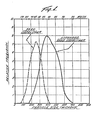
- Figures 1 and 2 appended hereto illustrate the degree of seed expansion and unique characteristics of copolymers made according to the invention. Curves representing schematically the distribution of particle sizes of a seed polymer before and after imbibing monomers are shown in Figure 1.
- Figure 2 the unusually rapid initial swelling characteristics of the swollen (expanded) seed copolymer is shown together with a conventional ion exchange copolymer available heretofore (dashed curve).
- the preformed crosslinked seed particles useful in the invention may be styrenic or aliphatic ethylenic in major composition, that is, the predominant monomer (the monovinyl monomer in the case of ion exchange particles) will be styrenic or aliphatic ethylenic.
- the crosslinker is polyethylenically unsaturated monomer which again, may be either styrenic or aliphatic ethylenic in major composition; it is possible to imbibe styrenic monomers into aliphatic ethylenic seed and vice versa.
- the effective amount of crosslinker used in the lightly crosslinked seed particles must be carefully controlled to a level depending upon the degree of swelling required to produce the final product. Our experimental evidence indicates that the degree of crosslinking of the seed is an important, if not limiting, factor controlling the amount of monomer that can be usefully imbibed within the.seed.
- the "styrenic" monoethylenically unsaturated monomers contemplated by the invention are those styrene and substituted styrene monomers and similar aromatic monomers which are useful to produce adsorbent and ion exchange resin beads, especially styrene and aliphatic and/or halogen-substituted styrene.
- Commercial grades of styrenic monomers may include mixtures of two or more species.
- styrene styrene
- ethylvinyl benzene vinyl toluene
- methyl styrene vinylbenzylchloride
- heterocyclic aromatics such as vinyl pyridine and alkyl-substituted vinyl pyridines.
- the aliphatic "ethylenic" monoethylenically and polyethylenically unsaturated monomers which are suitable for use in the process are principally, but not exclusively, the derivatives especially the esters (in particular alkyl esters) nitriles and amides of acrylic and methacrylic acid, and the acids themselves.
- esters in particular alkyl esters
- Illustrative of the class of useful aliphatic ethylenic monomers are methyl, ethyl, and butyl acrylate; methyl, ethyl, and butyl methacrylate; acrylonitrile; methacrylonitrile; acrylic and methacrylic acids, dimethylaminopropylmethacrylamide (DMAPMA), trimethylolpropanetrimethacrylate (TMPTMA), vinyl acetate, vinyl chloride, N-vinylpyrrolidone and vinylidene chloride.
- DMAPMA dimethylaminopropylmethacrylamide
- TMPTMA trimethylolpropanetrimethacrylate
- monoethylenically unsaturated comonomers such as dialkyl maleate, dialkyl fumarates, dialkyl crotonates, dialkyl itaconates, and dialkyl glutaconates.
- Suitable polyunsaturated crosslinking monomers include the styrenic and aliphatic ethylenic crosslinking compounds useful in the preparation of adsorbent and ion exchange resin backbone polymer beads. Included within this group are divinmylbenzene, divinylpyridine, divinyltoluene, diallyl phthalate, ethylene glycol diacrylate, ethylene glycol dimethacrylate, divinylxylene, divinylethylbenzene, divinylsulfone, divinylketone, divinylsulfide, allyl acrylate, diallyl maleate, diallyl fumarate, diallyl succinate, diallyl carbonate, diallyl malonate, diallyl oxalate, diallyl adipate, diallyl sebacate, divinyl sebacate, diallyl tartrate, diallyl silicate, triallyl tricarballylate, triallyl aconitate, triallyl citrate,
- the crosslinker level is generally 0.1% to'3% by weight, preferably 0.1% to 1.5%, and even more preferably 0.1% to 1% by weight, most especially 0.5 to 1% by weight.
- Polyethylenically unsaturated crosslinkers having 3 or more groups capable of crosslinking normally may be used at a lower level of crosslinker for satisfactory results.
- TMPTMA TMPTMA
- a preferred level would be between 0.1% and 2% by weight.
- the upper level of 3% for DVB would in most instances be too high for adequate imbibition of monomers.
- crosslinker In the case of macroreticular or macroporous seed, higher levels of crosslinker are possible, i.e., 3%, possibly up to about 6.0% by weight. Overall however, for both macroreticular and gel resins the most preferred level of light crosslinking is 0.5 to 1%. In general, lower levels of crosslinker foster rapid imbibition of the monomer feed but tend to lead to greater "stickiness" of the dispersion and hence increase the possibility of dispersion failure. Higher levels of crosslinker in the seed will tend to limit the overall swelling capacity of the seed and concurrently the rate and capacity for imbibition of the monomer feed.
- a 2-liter laboratory resin kettle (4" x 11") equipped with a dropping funnel, nitrogen inlet, heating mantle, thermocouple, condenser and agitator was used for all experiments; the agitator had a metal shaft fitted with 6 crossbars (0.5" x 2") and a three-bladed pitched impeller at the bottom.
- TCP tricalcium phosphate
- BPO benzoyl peroxide
- a stock TCP slurry was prepared in the following manner: 33 grams of TCP were slowly added to 67 ml of deionized water in a blender; additional water was added to increase fluidity until a final TCP concentration of 16% resulted. Thereafter 0.5 ml of an alkyl sulfate surfactant was added with blending for an additional 15 minutes.
- the water was added to the reactor, followed by the first TCP charge, and the poly(styrene) seed.
- the agitator was set at .490-500 rpm after which the nitrogen sweep was started and the batch heated to 85°C over 15-30 minutes. The surfactant was then added. Fifteen minutes later the monomer feed containing the initiator was stated by dropwise addition using the following schedule:
- the second TCP charge was added.
- the batch was then held at 80-85°C for 3 hours, followed by a one-hour cure at 95°C.
- 25 ml of concentrated nitric acid (HNO 3 ) was added to dissolve the TCP.
- the resultant polymer was then washed and dried.
- Table I presents a summary of six experiments involving crosslinker-containing monomer feed with polystyrene seed; also included in the table is a control experiment involving no DVB crosslinker, i.e., the standard prior art process for linear polystyrene.
- Another important discovery upon which this invention is based is the finding that the seed polymerization is most effectively performed using a suspension system quite unlike those previously used for aqueous suspension of copolymer droplets.
- a typical batch kettle process it has been conventional to utilize (1) protective colloids, (2) dispersants, and (3) surfactants.
- the purpose of the protective colloids is to prevent droplets from coalescing once formed and to provide some dispersant characteristics.
- Illustrative of the commonly used protective colloids are film-forming polymeric materials such as gelatin, polyvinyl alcohol, and various cellulosic materials. Dispersants are normally used in an aqueous suspension to promote the formation of new droplets and reduce the power input required by the agitator to form droplet population.
- Such dispersants are usually not emulsifiers.
- Polymeric materials such as PADMAC and Acrysols are conventionally used as dispersants.
- the purpose of a surfactant (emulsifier) is to emulsify the particles and accordingly is more typically a necessary additive for emulsion polymerization rather than suspension polymerization.
- the surfactants which are most frequently used include soaps and low molecular weight detergents such as those sold as Triton (trademark of Rohm and Haas Company) surfactants, and other materials well known in the emulsion polymerization art.
- Protective colloids are to be minimized or avoided by the present invention because they tend to prevent the seed from imbibing the monomer feed during polymerization.
- dispersants are generally not needed for the present process, they may be used, especially under circumstances where the monomer feed is not in emulsion form. Where an emulsion monomer feed is used, as is preferred in the invention, it is essential that surfactant be utilized in the feed and preferred that surfactant is also used in the initial suspension.
- surfactants which may be used to prevent'sticking during feeding of the monomer are: sodium lauryl sulfate, sodium dodecyl benzene sulfonates, Triton X405 or 100, saponified coconut or tallow fatty acids and any other soaps normally useful for emulsion polymerization.
- sodium lauryl sulfate sodium dodecyl benzene sulfonates
- Triton X405 or 100 Tritonified coconut or tallow fatty acids and any other soaps normally useful for emulsion polymerization.
- For a non-emulsified feed calcium phosphates and other conventional prior art stabilizers may also be used.
- inorganic stabilizers such as tricalcium phosphate are customarily used. Because of the stickiness encountered in the systems using a polyvinyl crosslinking monomer, tricalcium phosphate has been found to be inadequate in stabilizing the suspension, especially under the low shear conditions used in the present process. In combination with other more effective stabilizers, however, tricalcium phosphate may have some usefulness in the present process.
- Protective colloids which form a film around the suspended particles are, on the other hand, so effective at protecting the suspended droplets that they inhibit imbibition of the monomer into the seed and hence cannot generally be used in any substantial amount in the present invention.
- the prior art aqueous suspension method for making ion exchange copolymer invariably uses protective colloid to prevent bead agglomeration.
- polymerization initiators such as benzoyl peroxide (BPO)
- BPO benzoyl peroxide
- Monomer feed to the preformed suspension of seed particles can be accomplished in various ways.
- the simplest technique is to mix the polyunsaturated crosslinking monomer with the monoethylenically unsaturated monomer (if any) in the desired proportions, together with a minor amount of polymerization initiator, and thereafter feed the monomer dropwise, in a stream, continuously or intermittently.
- Some alternatives to this procedure include (a) separate feed of crosslinking monomer and monoethylenically unsaturated monomer, (b) separately metered feeding of the different monomers to an in-line mixing device whereby the relative ratios can be varied to accommodate particular desired polymerization conditions, or (c) separately feeding monomer and initiator.
- a preferred method for.feeding initiated mono-unsaturated monomer/crosslinker mixture involves preparing an aqueous emulsion thereof together with a suitable emulsifier (and optionally other ingredients) and metering this mixture to a suspension of the seed particles.
- a suitable emulsifier and optionally other ingredients
- the most desirable weight ratios of monomer feed (monounsaturated monomer plus crosslinker) to the seed is about 2 to 20:1. Superior products have been produced at monomer feed to seed ratios of 20 to 10 : 1, and accordingly, such ratios are to be preferred herein. While a broad range of feed to seed weight ratios allows for a high level of control of particle size irrespective of the initial seed size, the extreme ends of the range do present more significant problems of controlling the polymerization. When the total monomer feed exceeds about 4 to 5 times the weight of the original seed particles (assuming a typical seed made from 1% DVB crosslinker) the rate at which the seed will absorb new monomer is decreased near the end of the feeding step. Accordingly, at the higher levels of feed it may be necessary to prolong polymerization or accept a higher level of fines in the final product. The fines result from unwanted polymerization of the emulsion feed droplets before they can be imbibed by the seed particles.
- the type and amount of crosslinker initially used for the seed can also have a bearing upon the quality of the final ion exchange resin derived from the copolymer. Even when agglomeration fails to occur during addition of the monomer feed, the resulting functionalized ion exchange resin produced from such product can have poor physical properties if the seed imbibes more monomer than is desirable. For any given monomer unit composition in the seed, the weight of monomer feed that can be imbibed without'adverse effect on the final product, must be empirically determined.
- Monomer can conveniently be added to the suspended seed over a period of 2 to 8 hours, with 3 to 6 hours being preferred and 3 to 5 hours most preferred.
- Suitable reaction temperatures are those conventionally used in the known kettle polymerization process, namely, 30-90°C with 70-90°C being preferred, it being understood that the 10-hour half-life temperature is a key factor in choosing polymerization temperature. Since the uptake of monomer feed by the seed particles appears to be very rapid, it is possible to add protective colloids to the aqueous phase of the dispersion within about 15 minutes after feeding is complete while polymerization is continuing in the kettle. As described above, if any substantial amount of protective colloid is used before then, there is the possibility of creating a new population of small droplets which will appear-in the product as fines.
- the process of this invention is useful for forming both gellular and macro-porous copolymer particles using a variation of feed and seed components.
- a styrenic feed can be imbibed without crosslinker being present (at least part of the feed) and later leached out of the crosslinked bead during or after final functionalization.
- Macroreticular (macroporous) resins are generally produced using organic solvents with the monomer feed or alternatively adding the solvent to the suspension prior to addition of the monomer feed, or a combination thereof.
- the general methods for making macroreticular resins are applicable to the present seed process (see, e.g., U.S. Patent No. 4,224,415).
- a "chaser" catalyst may be desirable if a low-temperature initiator is used during polymerization and it is desired to finish off the product at an elevated temperature of about 95°C or higher.
- Emulsion feed can provide the following advantages:
- the following table illustrates specific examples of the growth of seed particles using a monomer feed/seed ratio of 4/1.
- Copolymer beads were sulfonated to form cation exchange resins with further expansion of size due to the insertion of the sulfonate group.
- Seed particles were essentially round and sizes given are diameters of beads (in microns).
- Table II above illustrates the range of sizes which would be most typically employed in the seed polymerization technique of this invention. Smaller size particles and large size particles can also be utilized as seed with resulting expanded copolymer and resin size.
- a monomer mixture containing crosslinker can first be charged to the kettle, dispersed into droplets by agitation and polymerized, utilizing only a portion of the kettle's capacity. Thereafter, after substantial polymerization of the seed particles, additional monomer can be fed to the kettle and imbibed by the seed. Because the seed is not screened to remove fines and oversized particles, the final product from the kettle has a wide distribution of sizes.
- FIG. 1 is a graph showing the size distribution of a typical seed before expansion and after imbibition of monomer and polymerization.
- the graph is a qualitative schematic representation of the relative frequency of particle sizes in the indicated range determined by multiple screenings of the seed and expanded seed polymer beads and plotting the relative percentages by weight.
- the data for the curves were obtained from a suspension-produced seed having a normal distribution of particle sizes including fines and oversized particles.
- the distribution curves of Figure 1 define a "bell" distribution.
- the monomer feed/seed ratio was 4:1 by weight which calculates to a bead diameter expansion of about 1.7 times the original bead diameter. This accounts for the broadening of the curve upon expansion.
- the expanded seed curve follows the general contour of the seed curve including the flare at either end indicating the presence of both large and fine sizes.
- Microcycling is designed to simulate, on an accelerated time scale, the conditions under which the resin will be used. These studies are conducted over a period of a few days rather than months or years typical of field conditions. Repeated exhaustion-regeneration cycles are performed on the resin at predetermined intervals in a fully automated apparatus.
- the resin to be tested is screened and examined under a microscope for appearance before microcycling: four different fields of view of a monolayer of beads are observed and the average result for each of the following is recorded:
- a small portion of the screened resin (0.5 ml) is placed in a sintered glass filter tube such that a monolayer of beads is formed in the tube. This small quantity of resin beads assures good contact between solution and resin and total conversion of the resin during each step.
- the solutions used for exhaustion and regeneration are made up in advance and stored in 50 liter tanks. The solutions used for anion and cation resins are described below:
- the Chatillon test is named for an apparatus manufactured by John Chatillon and Sons, New York, N.Y. and designed to measure resin friability.
- This instrument (MODEL LTCM, Gauge DPP-2.5KG) measures the force (grams) required to crack or fracture a resin bead when it is placed between two parallel plates, The plates are gradually brought together at a uniform rate until the resin "breakpoint" is reached.
- the purpose of this test is to simulate the frictional and pressure forces exerted on individual resin beads under actual use conditions.
- Specifications for testing include converting the resin into the proper form (hydrogen or sodium for cation resins tested herein and chloride form for anion resins tested herein) by well-known standard procedures.
- the converted resin is screened and then allowed to fully hydrate in deionized water for at least 15 minutes prior to testing. Actual testing is done on a single resin bead (covered by a small drop of water) in the Chatillon instrument using the lowest practical speed of descent of the crushing plate.
- the individual fragmentation forces are recorded from the instrument in grams per bead and the results are presented as an average (20 beads minimum, typically 30 beads), a standard deviation, a 95% confidence interval, and the percentage of beads which meet a minimum friability standard.
- an ion exchange copolymer which has exceptionally high physical stability after functionalization can be obtained.
- the preferred ccpolymer beads appear to be highly stressed but nevertheless of excellent quality.
- the high stress of the copolymer beads can be observed under polarized light in an optical microscope following the test procedure for birefringence disclosed in U.S. Patent 4,192,921, A Maltese cross, or some variation thereof being typically observed in resin strain birefringence patterns and indicating spherically symmetric stress orientation.
- the width and sharpness of the arms of the Maltese cross give a qualitative, sometimes quantitative, indication of.strain, the sharper, narrower arms indicating higher stress, especially when accompanied by bright areas between arms.
- An additional unusual characteristic of the preferred copolymers of this invention is non-uniform swelling in a swelling solvent, that is, they initially swell rapidly when placed in a swelling solvent, then swelling rate decreases (or stops) and later again begins to swell at a rapid rate until swelling is complete. Copolymers produced by the prior art suspension technique normally swell uniformly until swelling is complete.
- Figure 2 shows that, when swollen in toluene, the kinetic data demonstrate dramatic differences between conventional (prior art) copolymers and the copolymers of the invention.
- the seed-produced particles swell rapidly to about 50% of their total swelling capacity in less than one hour.
- conventional copolymer requires a much longer period of time to reach the same 50% level.
- Microscopic examination further indicates that the copolymer derived from seed swells conventionally, that is, the particles exhibit a solvent-swollen outer shell and an unswollen core. The unswollen core is apparent under the microscope during the entire induction (relaxation) period where little swelling occurs (horizontal portion of the seed curve). Depending upon the solvent used, the induction period normally lasts 1-6 hours at room temperature.
- copolymers derived from the seed process of this invention such as the acrylic resins, also demonstrate the two-stage swelling phenomenon.
- more effective solvents for example, dichloromethane (CH 2 C1 2 )
- CH 2 C1 2 dichloromethane
- Conventional resins of various compositions derived from batch kettle processes uniformly exhibit slow initial swelling followed by continuous swelling, without an induction period, until completely swollen.
- the "control" in Figure 2 is typical of the conventional resins.
- the copolymers were prepared in 1.5-2.0 liter resin kettles (6-8 crossbars with turbine impeller) at 300-400 rpm.
- the preformed seed charge and a portion of the water/emulsifier charge were added to the reactor and heated to reaction temperature (75-90°C) with stirring.
- the initiated monomer mix was emulsified, stirring as needed, and fed subsurface over a 3-5 hour period.
- the reaction mixture was held at temperature for 30-60 minutes and then heated to 95°C for a 1-2 hour finish-off.
- the copolymer beads were then washed and air-dried prior to functionalization.
- the air-dried copolymer is sulfonated in a 1-liter, 3-necked, round bottom flask equipped with stirrer, dropping funnel, condenser, and thermometer. Heat is supplied by a heating mantle and regulated by a Thermowatch/potlifter apparatus.
- the sulfuric acid is charged first, followed by the copolymer, then the EDC.
- the mixture is heated to 130°C over a three-hour period with stirring. After being held at 130°C for one hour, the mixture is cooled to 120°C and water is added at such a rate to maintain the bulk temperature ⁇ 125°C. Water is then added rapidly with stirring interspersed with siphoning to remove the buildup of wash liquors until the washes are clear.
- the hydrated resin is then neutralized with 50% caustic added over 30 minutes followed by 30 minutes stirring. The resin is batch-washed to remove excess caustic and drained to remove excess water.
- Table III summarizes a number of examples conducted by the foregoing methods: various ranges of monomer feed/seed ratio, seed crosslinker (DVB) level, monomer mix crosslinker (DVB) level, seed size, reaction temperature, initiator concentration, and addition time are illustrated. Samples with an asterisk indicate that emulsified monomer mix was used; in the other cases, the monomer mix was added neat.
- Example 35 1% crosslinked macroreticular seed particles were employed while in Examples 36-39, 0.1% to 0.5% crosslinked gellular seed particles were used. Porosity was promoted by using a solvent material (MIBC) to cause phase separation of the imbibed monomers according to the known prior art processes.
- MIBC solvent material
- Examples 35, 38 and 39 the phase extending solvent was added to the reactor with the seed and a portion of the water/emulsifier charge while in Examples 36 and 37 the phase extending solvent was added to the reactor with the monomer mix.
- the copolymers were prepared in a 4-necked, 2.0 liter round bottom kettle equipped with a nitrogen inlet, thermometer, reflux condenser and stainless steel paddle stirrer which operated at around 300 rpm.
- a portion of the water/Emulsifier charge and phase extending solvent (MIBC) were added to the kettle reactor and heated to reaction temperature (85°C) while applying a nitrogen sweep and stirring as needed.
- the initiated styrenic monomer mix was emulsified and fed to the kettle reactor over about a 3-hour period. After completion of the monomer feed, the reaction mixture was held at temperature for about 4 to 5 hours (5 hours Example 35, 4 hours Examples 38 and 39) and allowed to cool.
- the phase extending solvent (MIBC) was then distilled off from the copolymer and the product was water washed and dried to yield opaque beads.
- Example 36 and 37 the preformed gellular seed particles and a portion of the water/emulsifier charge were added to the kettle reactor and heated to reaction temperature (85°C) while applying a nitrogen sweep and stirring as needed.
- the initiated monomer mix and phase extending solvent (MIBC) were emulsified and fed to the kettle reactor over about a 3-hour period. After completion of the monomer feed, the reaction mixture was held at temperature for 4 to 6 hours (6 hours for Example 36 and 4 hours Example 37) and then allowed to cool.
- the phase extending solvent (MIBC) was then distilled off from the copolymer and the product was water washed and dried to yield opaque beads.
- the water washes in Examples 35-39 were white indicating an unknown amount of emulsion polymer was formed.
- Table V The process conditions, porosity and surface area of the final products are summarized in Table V which follows:
Landscapes
- Chemical & Material Sciences (AREA)
- Chemical Kinetics & Catalysis (AREA)
- Organic Chemistry (AREA)
- Medicinal Chemistry (AREA)
- Polymers & Plastics (AREA)
- Health & Medical Sciences (AREA)
- Analytical Chemistry (AREA)
- Addition Polymer Or Copolymer, Post-Treatments, Or Chemical Modifications (AREA)
- Graft Or Block Polymers (AREA)
- Polymerisation Methods In General (AREA)
- Solid-Sorbent Or Filter-Aiding Compositions (AREA)
- Materials For Medical Uses (AREA)
- Inks, Pencil-Leads, Or Crayons (AREA)
- Macromonomer-Based Addition Polymer (AREA)
- Polymers With Sulfur, Phosphorus Or Metals In The Main Chain (AREA)
- Macromolecular Compounds Obtained By Forming Nitrogen-Containing Linkages In General (AREA)
- Transition And Organic Metals Composition Catalysts For Addition Polymerization (AREA)
- Manufacture Of Macromolecular Shaped Articles (AREA)
- Manufacture Of Porous Articles, And Recovery And Treatment Of Waste Products (AREA)
Abstract
Description
- The present invention is concerned with the preparation of crosslinked copolymer beads by aqueous suspension polymerization of lightly crosslinked seed particles. The invention is particularly suited to the preparation of aliphatic ethylenic or styrenic copolymer beads useful as the basis for ion exchange resins or as adsorbents utilizing a seed copolymer which is swollen by imbibing styrenic or aliphatic ethylenic monomer. In one preferred embodiment the monomer (including monomer mixture) used is fed as an aqueous emulsion to a suspension of the seed polymer. In another preferred embodiment the seed particles are prescreened to a uniform size resulting in consequential uniform particle size in the final product.
- Substantially all ion exchange resins are produced from crosslinked copolymer particles or "beads" by chemically treating them to attach or form functional groups therein having a capacity for ion exchange. Thus copolymer beads provide the strong, insoluble and rigid substrate for carrying ion exchange functional groups. As regards durability and hydraulic characteristics, an ion exchange resin is no better than the crosslinked copolymer on which it is based. Highly porous copolymer particles (known as "macroreticular" or "macroporous" polymer particles), that is to say unfunctionalised macroreticular copolymer beads, are also useful as adsorbents for removing materials, especially organic materials, from fluid mixtures.
- Therefore the terms "ion exchange copolymer particles (or beads)" is intended in this specification to include such particles (or beads) which are suitable for functionalisation to ion exchange resins or have been so functionalised, or have functional groups incorporated therein or, when macroreticular and unfunctionalised, are useful as adsorbents.
- The terms "functionalize", "functionalised" or "functionalisation" refer to the chemical treatment of an insoluble crosslinked copolymer bead to attach an ion exchange group (functional group) thereto. The copolymer bead serves as the backbone polymer, whereas the ion exchange moiety is the active or "functional" site capable of exchanging ions with a surrounding fluid medium. Of the strongly acidic cation exchange resins, the sulfonic acid resin formed by sulfonating a copolymer (e.g., with sulfuric acid) is perhaps best known in the art. Weakly acidic cation exchange resins are normally derived from crosslinked acrylic copolymers by merely hydrolyzing the copolymer to form carboxylic cation exchange groups. Chloromethylation and amination of styrenic copolymers will result in weakly basic anion resins or strongly basic anion resins. Methods of performing suspension polymerisation of ion exchange copolymers and of functionalizing the same to ion exchange resins can be found in the prior art and, in particular, reference is made to U.S. Patent 4,224,415.
- Historically ion exchange copolymers have been formed by a batch process using a kettle reactor for monomer droplet formation and polymerisation of an aqueous suspension of said monomer droplets. The monomer droplets are formed and maintained in a suspension by use of a mechanical agitator in the kettle. As might be expected, mild agitation forms monomer droplets (and eventually copolymer beads) of relatively large size while vigorous agitation yields smaller droplets. In either event, agitation of this type invariably leads to beads having a wide distribution of copolymer particle sizes. Ion exchange resins derived from copolymers of widely differing sizes are, in consequence, of widely differing sizes. For many applications the wide distribution of bead sizes is not a major problem. For other applications it is desirable to have uniform bead sizes.
- To accommodate those uses where narrow distribution of resin size is preferable, most manufactures mechanically screen either the copolymer beads or the ultimate ion exchange resins to eliminate "unders" and "overs", that is, fines and oversized beads. Unfortunately, it is difficult with present technology to screen wet beads, and drying of the beads is not otherwise required for most purposes. The loss of product yield is another reason for not screening resin beads. Accordingly, there is a definite need for a commercial process to furnish uniformly sized copolymer beads that can be used as such as adsorbents, or functionalized to have ion exchange properties.
- The prior art discloses several methods of growing larger particles from smaller seed particles. Among these can be found methods for (1) growing styrenic or aliphatic ethylene polymer particles by feeding monomer into an aqueous suspension of particles having the same monomeric composition, (2) swelling of preformed styrenic polymers or copolymers with liquid monomer (in situ) followed by suspension polymerisation of the swollen particles and (3) swelling of minute low molecular weight emulsion particles by imbibition of monomer (and optionally solvent) in the suspension.
- Illustrative of the known techniques utilizing seed to grow larger particles under aqueous suspension conditons, is Canadian Patent No.890,463 in the name of Sekisui. Specific examples show uncrosslinked polystyrene and styrene/acrylonitrile copolymers used as seed and styrene or styrene/methyl methacrylate as the imbibed monomers. Continuous or intermittent addition of monomers over a three to twelve-hour period is illustrated. The teaching of this reference also requires the use of an expanding agent (foaming agent). Crosslinked seed is not exemplified.
- Further refinements of the process of feeding monomers to a suspended styrenic seed may be found in subsequent patents also assigned to Sekisui Kagaku Kogyo Kabushiki Kaisha. Among these are UK 1,416,405; UK 1,418,560;US 3,959,189; US 4,085,169; and US 4,091,054. These later references teach the use of screening techniques for the seed in order to produce a uniform styrenic bead and also variations in the techniques of adding the monomers and the catalyst mixtures. In one of the references (UK 1,418,560) the improvement involves placing the catalyst in a separate feed stream from the bulk of the monomer mixture and utilizing a solvent with the catalyst. Seed particles of polyethylene are swelled with styrene in another of the patented processes. Although the various patents mentioned disclose combinations of monomers in both the seed and the monomer mixtures and even allude to the use of crosslinkers, clearly'none of the teachings describeds a method for producing crosslinked styrenic or aliphatic ethylenic copolymers utilizing a feed containing substantial amounts of crosslinker (as is needed for ion exchange copolymer resins). In the examples of the references either the seed particle is a homopolymer of styrene, ethylene, or the like, or the monomer feed is comprised of a single monovinyl monomer, or both. As will be explained more fully hereinafter, the use of a polyethylenically unsaturated crosslinking monomer, especially in large amounts and highly reactive in type (such as divinylbenzene), presents unusual and difficult problems in maintaining a suitable aqueous suspension.
- Other techniques for imbibing monomers into a preformed suspension of particles include the formation of the so-called "hybrid" resins which are produced when absorbing monomer into the macropores of a macroreticular resin, thereby forming two discrete phases within a single particle bead (see e.g., U.S. Patent 3,991,017). Unlike the Sekisui technique which comprises the growing of particles to larger size, the hybrid resins largely imbibe the monomers into voids or spaces within the particle as well as into the gel matric of the particle itself and thereby limited swelling is normally accomplished. In order to imbibe polyethylenically unsaturated crosslinker into preformed liquid monomer containing monoethylenically unsaturated monomer and crosslinker, a very carefully controlled suspension system is required (see U.S. Patent 3,792,029). By this method monomer droplets are formed containing both styrenic monomer and crosslinking agent and thereafter an emulsion containing additional crosslinker is fed to the suspension to make up for the loss of the faster reacting crosslinker while balancing the stabilizer amount to prevent beads from agglomerating (coalescing). Although differing from the prior art techniques utilizing an initial suspension of seed particles, the process of U.S. 3,792,029 recognizes many of the problems associated with avoiding formation of a new population of fine particles when feeding monomers during polymerization.
- A second group of prior art references teaches methods for imbibing monomers into preformed particles to swell them, and subsequently polymerizing the swollen particles. U.S. Patent 3,332,890 is an early reference showing the manufacture of "snake-cage" resins produced by imbibing monomers into a styrenic gel polymer to form a linear polymer within the crosslinked copolymer bead. The process involves soaking crosslinked copolymer beads with monomer and thereafter suspending and polymerizing the swollen beads. Other typical processes for swelling particles or beads prior to polymerization can be found in Romanian Patent 48091 and UK Patent 1,116,800. A variation wherein the monomer soaked into the bead comprises both mono- and divinyl monomer is illustrated in UK Patent 728,508. A so-called double polymerization process is taught in U.S. Patent 2,960,480.
- In more recent years investigators have shown the feasibility of growing larger particles from a seed under emulsion polymerization conditions. See for example U.S. Patents 4,113,687 and 4,186,120 (also European patent application 3905 and 10,986, as well as UK Patent 1,527,312). By this emulsion process, growth of the particles is propagated by maintaining conditions such that molecular weights of the polymers remain low or by utilizing selected solvents which can swell the particles.
- In the present invention crosslinked copolymers of high mechanical strength and preferably narrow particle size distribution can be produced by a process involving gradual addition of monomer to a suspension of seed particles maintained under polymerization conditions. In general the process comprises: (a) forming an unprotected agitated suspension of lightly crosslinked styrenic or aliphatic ethylenic copolymer seed particles in an aqueous phase; (b) feeding to said unprotected seed suspension polyethylenically unsaturated styrenic and/or aliphatic ethylenic crosslinking monomer and optimally monoethylenically unsaturated styrenic and/or aliphatic ethylenic monomer, which monomer is imbibed by and swells the seed particles without agglomeration of the particles in the suspension system; (c) continuing the monomer addition to the suspension until the seed particles have imbibed an amount of monomer sufficient to swell the particles to the desired size (but insufficient to stress the particles to a point of fracturing upon subsequent functionalization or to cause particle agglomeration of the growth of a new fines population within the suspension); (d) terminating the polymerization after the feeding step when the imbibed monomer has been sufficiently polymerized (usually >95-99% polymerized); and (e) separating the resulting insoluble copolymer particles from the aqueous phase. The term "unprotected" means that the dispersion is sufficiently free of protective colloids that imbibing of monomer into the suspended particles is not substantially inhibited. When the copolymer is to be used for ion exchange, the monomer mixture will normally contain mainly monoethylenically unsaturated monomer (e.g., 98-80%) with the remainder being crosslinking monomer. In special applications the monoethylenically unsaturated monomer may be as low as a few percent. The word "monomer" is intended to include both a single monomer or a monomer mixture which in turn is intended to refer to combinations of different monomers whether physically admixed or not during addition to the seed particles.
- There are at least three important advantages which may be obtained in accordance with this invention over known prior art batch suspension copolymerization techniques. First, the particle size of the copolymer (and resultant functionalized ion exchange product) may be precisely controlled by the size (and.size distribution) of the lightly crosslinked seed and the amount of monomer fed thereto, thus eliminating the need for much of the bead screening required by conventional processes. The second advantage is that large-scale reactors may be utilized effectively because the gradual monomer addition distributes the heat of polymerization over a long period of time (e.g., several hours) with only part of the unreacted monomer charge present at the point of critical heat load; conventional batch polymerizations are difficult to control in large reactors because the entire unreacted monomer charge is present at the point of maximum polymerization rate. And, finally, the resultant ion exchange products prepared by the aforementioned seed process can have enhanced physical stability properties, such as friability and resistance to osmotic shock, compared with products from convention batch copolymerzation processes.
- The ability to continuously or intermittently feed fresh monomer to a preformed suspension of seed particles offers flexibility not previously obtainable by the conventional prior art batch kettle process. The ability to control the ratio of intial seed to imbibed monomer in a wide range offers significant economic advantages. Because the rapid exotherm of a batch process is not encountered, the cooling requirements for the kettle are not as stringent as in the past. In addition, agitator requirements are drastically reduced. The agitator is not essential to the formation of the initial dispersion but rather is used only to maintain sufficient motion for imbibition of the monomer droplets into the preformed crosslinked seed. In summary, the process of the invention allows the use of polymerization kettles of far less stringent cooling and agitation requirements and, therefore, of different size configuration than useable heretofore in this particular art.
- A batch of copolymer produced by the prior art method can be "fractionated" into various size ranges, and each fraction can be utilized as seed particles to produce product of larger ultimate particle size by controlling the monomer imbibition step during polymerization.
- Figures 1 and 2 appended hereto illustrate the degree of seed expansion and unique characteristics of copolymers made according to the invention. Curves representing schematically the distribution of particle sizes of a seed polymer before and after imbibing monomers are shown in Figure 1. In Figure 2, the unusually rapid initial swelling characteristics of the swollen (expanded) seed copolymer is shown together with a conventional ion exchange copolymer available heretofore (dashed curve).
- The preformed crosslinked seed particles useful in the invention may be styrenic or aliphatic ethylenic in major composition, that is, the predominant monomer (the monovinyl monomer in the case of ion exchange particles) will be styrenic or aliphatic ethylenic. The crosslinker is polyethylenically unsaturated monomer which again, may be either styrenic or aliphatic ethylenic in major composition; it is possible to imbibe styrenic monomers into aliphatic ethylenic seed and vice versa. The effective amount of crosslinker used in the lightly crosslinked seed particles must be carefully controlled to a level depending upon the degree of swelling required to produce the final product. Our experimental evidence indicates that the degree of crosslinking of the seed is an important, if not limiting, factor controlling the amount of monomer that can be usefully imbibed within the.seed.
- The "styrenic" monoethylenically unsaturated monomers contemplated by the invention are those styrene and substituted styrene monomers and similar aromatic monomers which are useful to produce adsorbent and ion exchange resin beads, especially styrene and aliphatic and/or halogen-substituted styrene. Commercial grades of styrenic monomers may include mixtures of two or more species. Among the monoethylenically unsaturated styrenic monomers useful are styrene, ethylvinyl benzene, vinyl toluene, methyl styrene, vinylbenzylchloride and the various nuclear halogenated derivatives of styrene such as chlorostyrene, further including heterocyclic aromatics such as vinyl pyridine and alkyl-substituted vinyl pyridines.
- The aliphatic "ethylenic" monoethylenically and polyethylenically unsaturated monomers which are suitable for use in the process are principally, but not exclusively, the derivatives especially the esters (in particular alkyl esters) nitriles and amides of acrylic and methacrylic acid, and the acids themselves. Of particular interest are alkyl acrylates, alkyl methyacrylates and acrylic and methacrylic acids, acrylamide, methacrylamide, acrylonitrile, methacrylonitrile and the various vinyl halides and vinyl acetate, and mixtures thereof. Illustrative of the class of useful aliphatic ethylenic monomers are methyl, ethyl, and butyl acrylate; methyl, ethyl, and butyl methacrylate; acrylonitrile; methacrylonitrile; acrylic and methacrylic acids, dimethylaminopropylmethacrylamide (DMAPMA), trimethylolpropanetrimethacrylate (TMPTMA), vinyl acetate, vinyl chloride, N-vinylpyrrolidone and vinylidene chloride.
- Preferably there is used, together with monomer as mentioned above other monoethylenically unsaturated comonomers such as dialkyl maleate, dialkyl fumarates, dialkyl crotonates, dialkyl itaconates, and dialkyl glutaconates.
- Suitable polyunsaturated crosslinking monomers include the styrenic and aliphatic ethylenic crosslinking compounds useful in the preparation of adsorbent and ion exchange resin backbone polymer beads. Included within this group are divinmylbenzene, divinylpyridine, divinyltoluene, diallyl phthalate, ethylene glycol diacrylate, ethylene glycol dimethacrylate, divinylxylene, divinylethylbenzene, divinylsulfone, divinylketone, divinylsulfide, allyl acrylate, diallyl maleate, diallyl fumarate, diallyl succinate, diallyl carbonate, diallyl malonate, diallyl oxalate, diallyl adipate, diallyl sebacate, divinyl sebacate, diallyl tartrate, diallyl silicate, triallyl tricarballylate, triallyl aconitate, triallyl citrate, triallyl phosphate, N,N-methylenedimethacrylamide, N,N-ethylenediacrylamide, trivinylbenzene, and the polyvinyl ethers of glycol, glycerol, pentaerythritol, resorcinol, and the monothio and dithio derivatives of glycols. Particularly preferred crosslinking monomers include aromatic hydrocarbons, such as divinylbenzene and trivinylbenzene, and acrylates such as trimethylolpropanetrimethacrylate (TMPTMA).
- Within the above broad classes of monounsaturated and polyunsaturated monomers there may be certain monomers which are not suitable for preparing copolymers which are intended for subsequent functionalization to certain ion exchange resins. To illustrate, certain polyunsaturated crosslinkers may cleave upon sulfonation and accordingly should not be used in making copolymers which are to be converted ultimately to strongly acidic cation exchange resins (by sulfonation). Such crosslinkers, however, may be useful for the preparation of anion exchange resins which are functionalized by chloromethylation and subsequent amination or quaternization. Those skilled in the art will readily understand the parameters for selecting monomers depending upon the ultimate use to be made of the copolymer beads.
- The finding that lightly crosslinked seed particles can serve to grow larger particles without undue agglomeration or loss of bead integrity, is an important discovery in relation to the present invention. The prior art kettle techniques for seed polymerization generally have begun with linear polymers rather than crosslinked polymers and accordingly one might theorize that such technology could be extrapolated to the manufacture of crosslinked ion exchange copolymer beads. Experiments have proved, however, that the starting seed by the present process must be lightly crosslinked in order to avoid dispersion failure when the more reactive crosslinking monomer is added to the dispersion. In general, a level of crosslinker units of between 0.1% and 3% by weight of the total copolymer seed is a suitable light degree of crosslinking. When for example, when using a divinyl crosslinker such as the ubiquitous divinylbenzene (DVB), the crosslinker level is generally 0.1% to'3% by weight, preferably 0.1% to 1.5%, and even more preferably 0.1% to 1% by weight, most especially 0.5 to 1% by weight. Polyethylenically unsaturated crosslinkers having 3 or more groups capable of crosslinking normally may be used at a lower level of crosslinker for satisfactory results. To illustrate, when using TMPTMA as a crosslinker, a preferred level would be between 0.1% and 2% by weight. The upper level of 3% for DVB would in most instances be too high for adequate imbibition of monomers. In the case of macroreticular or macroporous seed, higher levels of crosslinker are possible, i.e., 3%, possibly up to about 6.0% by weight. Overall however, for both macroreticular and gel resins the most preferred level of light crosslinking is 0.5 to 1%. In general, lower levels of crosslinker foster rapid imbibition of the monomer feed but tend to lead to greater "stickiness" of the dispersion and hence increase the possibility of dispersion failure. Higher levels of crosslinker in the seed will tend to limit the overall swelling capacity of the seed and concurrently the rate and capacity for imbibition of the monomer feed.
- We have demonstrated the unsuitability of a completely uncrosslinked polymer seed, in accordance with the prior art method, for seed polymerization (e.g., Sekisui, et al) by repeated experimentation. The following example illustrates one of our attempts to practice the prior art styrenic seed polymerization in the manufacture of a styrenic ion exchange copolymer. All parts are by weight unless otherwise indicated.
- A 2-liter laboratory resin kettle (4" x 11") equipped with a dropping funnel, nitrogen inlet, heating mantle, thermocouple, condenser and agitator was used for all experiments; the agitator had a metal shaft fitted with 6 crossbars (0.5" x 2") and a three-bladed pitched impeller at the bottom.
- Initial runs were meant to evaluate a prior art process with the sole modification being the presence of crosslinker (DVB) in the monomer feed. A brief summary of the formulation follows:

- Polystyrene seed (-40 + 50 mesh) was used in all experiments. The abbreviation "TCP" means tricalcium phosphate, a suspension stabilizer. The abbreviation "BPO" means benzoyl peroxide, a polymerization initiator.
- A stock TCP slurry was prepared in the following manner: 33 grams of TCP were slowly added to 67 ml of deionized water in a blender; additional water was added to increase fluidity until a final TCP concentration of 16% resulted. Thereafter 0.5 ml of an alkyl sulfate surfactant was added with blending for an additional 15 minutes.
- Charges for a typical run were:
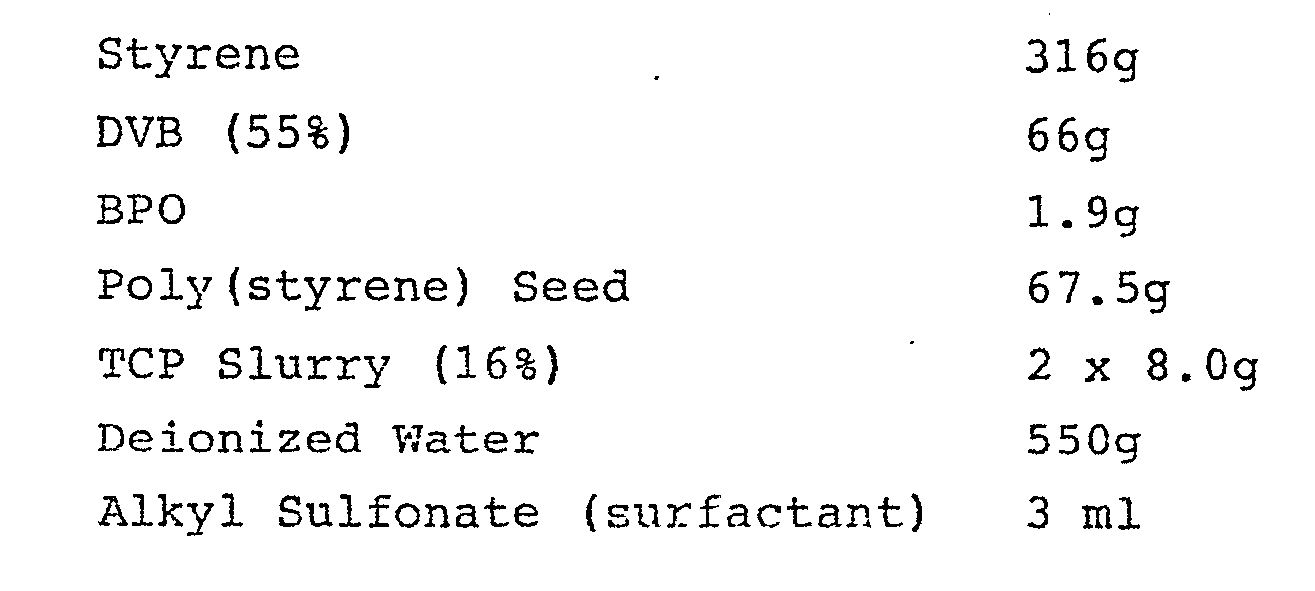
- The water was added to the reactor, followed by the first TCP charge, and the poly(styrene) seed. The agitator was set at .490-500 rpm after which the nitrogen sweep was started and the batch heated to 85°C over 15-30 minutes. The surfactant was then added. Fifteen minutes later the monomer feed containing the initiator was stated by dropwise addition using the following schedule:
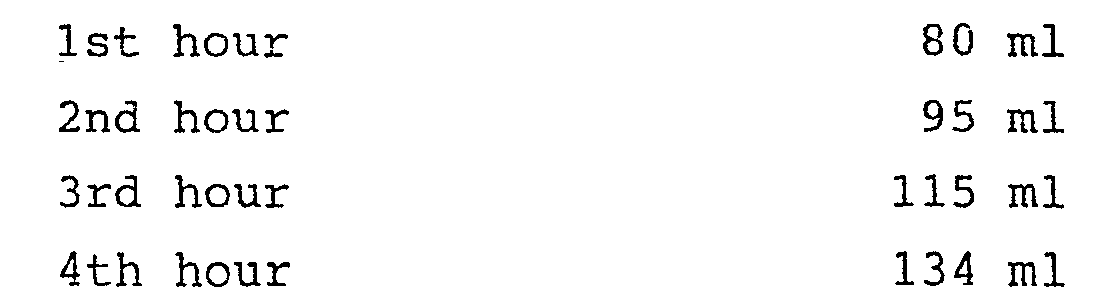
- At the end of the monomer addition, the second TCP charge was added. The batch was then held at 80-85°C for 3 hours, followed by a one-hour cure at 95°C. After cooling the batch, 25 ml of concentrated nitric acid (HNO3) was added to dissolve the TCP. The resultant polymer was then washed and dried.
- Table I below presents a summary of six experiments involving crosslinker-containing monomer feed with polystyrene seed; also included in the table is a control experiment involving no DVB crosslinker, i.e., the standard prior art process for linear polystyrene.
- The presence of crosslinker in the monomer feed was responsible for dispersion failure occurring half way through the monomer addition (Experiments 1-3); the "stickiness" of swollen crosslinkable seeds apparently exceeded the protection provided by the TCP stabilizer. Increased amounts of TCP (Experiments 4-5) improved the situation somewhat, but dispersion failure was merely delayed until after the monomer addition; increasing the rate of monomer addition (Experiment 6) was also of no substantial help. Since a control run (Experiment 7) with no crosslinker ran smoothly, it must be concluded that the experimental procedure (equipment, raw materials, etc.) was not at fault but that the TCP/polystyrene seed system is not suitable for this type of crosslinkable monomer feed.
- Another important discovery upon which this invention is based is the finding that the seed polymerization is most effectively performed using a suspension system quite unlike those previously used for aqueous suspension of copolymer droplets. In a typical batch kettle process it has been conventional to utilize (1) protective colloids, (2) dispersants, and (3) surfactants. The purpose of the protective colloids is to prevent droplets from coalescing once formed and to provide some dispersant characteristics.

- Protective colloids are to be minimized or avoided by the present invention because they tend to prevent the seed from imbibing the monomer feed during polymerization. Although dispersants are generally not needed for the present process, they may be used, especially under circumstances where the monomer feed is not in emulsion form. Where an emulsion monomer feed is used, as is preferred in the invention, it is essential that surfactant be utilized in the feed and preferred that surfactant is also used in the initial suspension.
- Among the specific surfactants which may be used to prevent'sticking during feeding of the monomer are: sodium lauryl sulfate, sodium dodecyl benzene sulfonates, Triton X405 or 100, saponified coconut or tallow fatty acids and any other soaps normally useful for emulsion polymerization. For a non-emulsified feed, calcium phosphates and other conventional prior art stabilizers may also be used.
- In the prior art seed process for manufacturing polystyrene beads, inorganic stabilizers such as tricalcium phosphate are customarily used. Because of the stickiness encountered in the systems using a polyvinyl crosslinking monomer, tricalcium phosphate has been found to be inadequate in stabilizing the suspension, especially under the low shear conditions used in the present process. In combination with other more effective stabilizers, however, tricalcium phosphate may have some usefulness in the present process. Protective colloids which form a film around the suspended particles are, on the other hand, so effective at protecting the suspended droplets that they inhibit imbibition of the monomer into the seed and hence cannot generally be used in any substantial amount in the present invention. By contrast, the prior art aqueous suspension method for making ion exchange copolymer invariably uses protective colloid to prevent bead agglomeration.
- In addition to the monomer, seed particles and suspension stabilizer, it is conventional to add polymerization initiators, such as benzoyl peroxide (BPO), to the suspension. A desirable new class of catalysts and rate moderators for polymerization are described in U.S. Patents 4,192,921; 4,246,386; and 4,283,499, and are also useful in the present invention.
- Monomer feed to the preformed suspension of seed particles can be accomplished in various ways. The simplest technique is to mix the polyunsaturated crosslinking monomer with the monoethylenically unsaturated monomer (if any) in the desired proportions, together with a minor amount of polymerization initiator, and thereafter feed the monomer dropwise, in a stream, continuously or intermittently. Some alternatives to this procedure include (a) separate feed of crosslinking monomer and monoethylenically unsaturated monomer, (b) separately metered feeding of the different monomers to an in-line mixing device whereby the relative ratios can be varied to accommodate particular desired polymerization conditions, or (c) separately feeding monomer and initiator. As the prior art suggests, it is sometimes more desirable, for bead homogeneity, to feed a higher amount of the more reactive polyunsaturated monomer at a later stage of polymerization.
- A preferred method for.feeding initiated mono-unsaturated monomer/crosslinker mixture involves preparing an aqueous emulsion thereof together with a suitable emulsifier (and optionally other ingredients) and metering this mixture to a suspension of the seed particles. We have obtained excellent results when feeding pre-emulsified, initiated styrene/DVB monomer containing 0.1-100% DVB to lightly crosslinked styrenic seed. The emulsified feed containing 1-20% by weight DVB is to be preferred and 2-12% most preferred. In most commercial ion exchange resin copolymers, at least 2% DVB is the lowest limit of acceptability in order to impart the desired strength and durability. We have found, however, that because of the increased homogeneity of the polymers produced by the present seed process, it is possible to use lower levels of crosslinker (as low as 2%) than heretofore generally utilized commercially to produce a product of equivalent physical properties. Longer periods of addition of monomer to a suspended seed tend to correspond with more effective crosslinking for a given amount of crossliner added. Thus, for example, a styrenic resin with a given amount of crosslinker monomer added over a two-hour feeding period would not appear to have the same level of crosslinking (as measured by normal testing methods) as a copolymer made by adding the same total monomer over a five-hour period.
- From the standpoint of practical economics of seed polymerization, it has been discovered that the most desirable weight ratios of monomer feed (monounsaturated monomer plus crosslinker) to the seed is about 2 to 20:1. Superior products have been produced at monomer feed to seed ratios of 20 to 10 : 1, and accordingly, such ratios are to be preferred herein. While a broad range of feed to seed weight ratios allows for a high level of control of particle size irrespective of the initial seed size, the extreme ends of the range do present more significant problems of controlling the polymerization. When the total monomer feed exceeds about 4 to 5 times the weight of the original seed particles (assuming a typical seed made from 1% DVB crosslinker) the rate at which the seed will absorb new monomer is decreased near the end of the feeding step. Accordingly, at the higher levels of feed it may be necessary to prolong polymerization or accept a higher level of fines in the final product. The fines result from unwanted polymerization of the emulsion feed droplets before they can be imbibed by the seed particles.
- The type and amount of crosslinker initially used for the seed can also have a bearing upon the quality of the final ion exchange resin derived from the copolymer. Even when agglomeration fails to occur during addition of the monomer feed, the resulting functionalized ion exchange resin produced from such product can have poor physical properties if the seed imbibes more monomer than is desirable. For any given monomer unit composition in the seed, the weight of monomer feed that can be imbibed without'adverse effect on the final product, must be empirically determined. In general, however, with a crosslinker unit content of 0.5% to 1.5% by weight of the seed, it is possible to feed monomer up to 4 to 5 times the weight of the seed to produce a copolymer which is highly resistant to bead fracture and having very good other physical parameters including solids content and ion exchange capacity.
- Monomer can conveniently be added to the suspended seed over a period of 2 to 8 hours, with 3 to 6 hours being preferred and 3 to 5 hours most preferred. Suitable reaction temperatures are those conventionally used in the known kettle polymerization process, namely, 30-90°C with 70-90°C being preferred, it being understood that the 10-hour half-life temperature is a key factor in choosing polymerization temperature. Since the uptake of monomer feed by the seed particles appears to be very rapid, it is possible to add protective colloids to the aqueous phase of the dispersion within about 15 minutes after feeding is complete while polymerization is continuing in the kettle. As described above, if any substantial amount of protective colloid is used before then, there is the possibility of creating a new population of small droplets which will appear-in the product as fines.
- The process of this invention is useful for forming both gellular and macro-porous copolymer particles using a variation of feed and seed components. Thus, with a crosslinked polystyrene seed a styrenic feed can be imbibed without crosslinker being present (at least part of the feed) and later leached out of the crosslinked bead during or after final functionalization. Macroreticular (macroporous) resins are generally produced using organic solvents with the monomer feed or alternatively adding the solvent to the suspension prior to addition of the monomer feed, or a combination thereof. The general methods for making macroreticular resins are applicable to the present seed process (see, e.g., U.S. Patent No. 4,224,415).
- After all of the monomer has been added to the suspended seed, it is desirable to hold the suspension under polymerization conditions (elevated temperature and agitation) for a further period of time, for example one hour, to complete polymerization. A "chaser" catalyst may be desirable if a low-temperature initiator is used during polymerization and it is desired to finish off the product at an elevated temperature of about 95°C or higher.
- For optimum practical commercial results it is preferable to have as much seed in suspension within the kettle during feeding as possible, as long as the suspension or the product is not affected adversely. Where there is an excess of seed, poor agitation will result and, in extreme cases, separation of the seed from the aqueous phase may be observed. Normally the seed comprises about 30-40% by weight of the kettle charge with the remainder being the aqueous phase. To maintain a high organic (seed and feed)/water ratio, it may be necessary to add water while concurrently feeding fresh monomer. When an emulsion feed is used, the organic/water balance can be maintained by the composition of the emulsion. An emulsion monomer level as high as 60% is possible; however, a somewhat lower amount such as 50-55% is more desirable for a stable suspension. Emulsion feed can provide the following advantages:
- (a) good control of distribution of feed (uniformity)
- (b) improved physical contact between feed and seed
- (c) reduced agitator power requirements
- (d) improved kinetics of pick-up (swelling).
- While uniform particle size of the final copolymer product is generally desirable, it is not an essential requirement for a suitable ion exchange product in all situations. Accordingly, it is possible to start the present process using a seed product having a wide distribution of particle sizes with the resultant product having a similar spread of particle sizes, although perhaps somewhat wider than the original seed. Prescreening of the seed particles offers a uniformity of final product sizes not heretofore obtainable directly out of the batch kettle, and accordingly is a dramatic advantage which can optionally be gained by using the present invention.
- The following table illustrates specific examples of the growth of seed particles using a monomer feed/seed ratio of 4/1. Copolymer beads were sulfonated to form cation exchange resins with further expansion of size due to the insertion of the sulfonate group. Seed particles were essentially round and sizes given are diameters of beads (in microns).

- Table II above illustrates the range of sizes which would be most typically employed in the seed polymerization technique of this invention. Smaller size particles and large size particles can also be utilized as seed with resulting expanded copolymer and resin size.
- In those applications where uniformity of the final ion exchange resin product is not essential, it may be possible to prepare the seed particles and the final product in a series of steps performed in the same polymerization kettle. In such a staged growth process a monomer mixture containing crosslinker can first be charged to the kettle, dispersed into droplets by agitation and polymerized, utilizing only a portion of the kettle's capacity. Thereafter, after substantial polymerization of the seed particles, additional monomer can be fed to the kettle and imbibed by the seed. Because the seed is not screened to remove fines and oversized particles, the final product from the kettle has a wide distribution of sizes.
- To further illustrate the seed expansion by the present process, reference is made to Figure 1 appended hereto which is a graph showing the size distribution of a typical seed before expansion and after imbibition of monomer and polymerization. The graph is a qualitative schematic representation of the relative frequency of particle sizes in the indicated range determined by multiple screenings of the seed and expanded seed polymer beads and plotting the relative percentages by weight. The data for the curves were obtained from a suspension-produced seed having a normal distribution of particle sizes including fines and oversized particles.
- As might be expected for seed produced in a batch suspension, the distribution curves of Figure 1 define a "bell" distribution. When the seed was expanded, there was both a shift of the "bell" to larger particle sizes as well as a broadening of the "bell". In this particular instance the monomer feed/seed ratio was 4:1 by weight which calculates to a bead diameter expansion of about 1.7 times the original bead diameter. This accounts for the broadening of the curve upon expansion. Except for a broader range of particle sizes, the expanded seed curve follows the general contour of the seed curve including the flare at either end indicating the presence of both large and fine sizes.
- In certain ion exchange resin processes the convenience of uniformly sized particles produced directly in the kettle is highly significant. For example, in chromatagraphic sugar separation, resins of the prior art have been very expensive to manufacture because of the large yield losses suffered in screening copolymer in order to satisfy the narrow particle size distribution required (200-500 micron range vs. the 200-1,000 micron range typical of batch process products). The narrow particle size control which can be achieved in the seed process significantly reduces the cost of specialty resins of the aforementioned type resulting in a marketplace advantage.
- Perhaps the most important advantage which can be gained by using the present invention is superior physical properties of the copolymer intermediates and the ion exchange resins and adsorbents which result. We have made by the present seed process which have, compared to conventional prior art products, (1) greater mechanical strength, (2) increased resistance to swelling pressures produced within the bead during the acid/base cycling (osmotic shock) test, (3) greater resistance to external forces such as weight of the resin column bed, and (4) high fluid flow capability (condensate polishing applications, etc.). We have formed the theory that copolymer morphology plays an important part in physical stability of the resultant ion exchange products. In general, the high DVB reactivity, relative to styrene, leads to very heterogeneous polymer structure in conventional batch polymerization. Those embodiments of the process which lead to more homogeneous polymer structure (more even spacing of crosslink sites) are believed to improve the chemical and mechanical stability of the resultant ion exchange products. The gradual addition of the monomer throughout the polymerization of the seed process offsets the effects of DVB reactivity on polymer heterogeneity.
- The improved product stability has been demonstrated by visual observation of the percentage of perfect beads after functionalization of the copolymer as well as by standard laboratory tests such as the acid base cycling (micorcycling) test and the Chatillon test for resin friability. These laboratory tests are explained in detail hereinafter.
- Microcycling is designed to simulate, on an accelerated time scale, the conditions under which the resin will be used. These studies are conducted over a period of a few days rather than months or years typical of field conditions. Repeated exhaustion-regeneration cycles are performed on the resin at predetermined intervals in a fully automated apparatus.
- The resin to be tested is screened and examined under a microscope for appearance before microcycling: four different fields of view of a monolayer of beads are observed and the average result for each of the following is recorded:
- (a) % perfect beads
- (b) % cracked beads
- (c) % fragmented/broken beads
- A small portion of the screened resin (0.5 ml) is placed in a sintered glass filter tube such that a monolayer of beads is formed in the tube. This small quantity of resin beads assures good contact between solution and resin and total conversion of the resin during each step. The solutions used for exhaustion and regeneration are made up in advance and stored in 50 liter tanks. The solutions used for anion and cation resins are described below:

- During a typical experiment, approximately 100-200 ml of exhaustion solution is added dropwise to the resin sample over 10 minutes, followed by removal of bulk exhaustant by mild vacuum, a deionized water rinse followed by mild vacuum, and dropwise addition of regenerant solution over 10 minutes followed by removal of bulk regenerant by mild vacuum and a water rinse; completion of the aforementioned process represents an exhaustion-regeneration cycle and requires approximately 30 minutes. Complete automation allows 100 cycles to be completed in about 48 hours. After completion of 100 cycles (anion 250 cycles), the resin is recovered and inspected microscopically for appearance. The reduction in % perfect bead content is recorded as the breakdown.
- The Chatillon test is named for an apparatus manufactured by John Chatillon and Sons, New York, N.Y. and designed to measure resin friability. This instrument (MODEL LTCM, Gauge DPP-2.5KG) measures the force (grams) required to crack or fracture a resin bead when it is placed between two parallel plates, The plates are gradually brought together at a uniform rate until the resin "breakpoint" is reached. The purpose of this test is to simulate the frictional and pressure forces exerted on individual resin beads under actual use conditions.
- Specifications for testing include converting the resin into the proper form (hydrogen or sodium for cation resins tested herein and chloride form for anion resins tested herein) by well-known standard procedures. The converted resin is screened and then allowed to fully hydrate in deionized water for at least 15 minutes prior to testing. Actual testing is done on a single resin bead (covered by a small drop of water) in the Chatillon instrument using the lowest practical speed of descent of the crushing plate. The individual fragmentation forces are recorded from the instrument in grams per bead and the results are presented as an average (20 beads minimum, typically 30 beads), a standard deviation, a 95% confidence interval, and the percentage of beads which meet a minimum friability standard.
- When produced according to the preferred parameters of the present invention, an ion exchange copolymer which has exceptionally high physical stability after functionalization can be obtained. Surprisingly, and contrary to prior beliefs, the preferred ccpolymer beads appear to be highly stressed but nevertheless of excellent quality. The high stress of the copolymer beads can be observed under polarized light in an optical microscope following the test procedure for birefringence disclosed in U.S. Patent 4,192,921, A Maltese cross, or some variation thereof being typically observed in resin strain birefringence patterns and indicating spherically symmetric stress orientation. The width and sharpness of the arms of the Maltese cross give a qualitative, sometimes quantitative, indication of.strain, the sharper, narrower arms indicating higher stress, especially when accompanied by bright areas between arms. An additional unusual characteristic of the preferred copolymers of this invention is non-uniform swelling in a swelling solvent, that is, they initially swell rapidly when placed in a swelling solvent, then swelling rate decreases (or stops) and later again begins to swell at a rapid rate until swelling is complete. Copolymers produced by the prior art suspension technique normally swell uniformly until swelling is complete.
- The unique non-uniform or two-stage swelling rate of gel copolymers produced by this invention is illustrated in Figure 2 appended hereto, which is a graph of % copolymer swelling in a solvent to the point of maximum swelling (100% = 1.7 times original volume). Volume increases were determined from a copolymer sample packed in a
tube 10 mm in diameter and 113 mm in height. The sample was immersed in the selected solvent and maintained in a water bath at 25°C, with frequent agitation to remove air bubbles. The height of the copolymer in the tube was determined periodically and reported as the ratio of observed height to intial height. The data observed for swelling of a copolymer produced by the present seed process (styrene/6.6% DVB) is plotted in Figure 2 (identified as "seed"). A control sample (styrene/8.0% DVB) produced by the conventional batch process was subjected to the same solvent and the data plotted in Figure 2 (identified as "control"). The non-uniform swelling of the seed particles is easily seen when plotting log time (rather than time) against % swelling. - Figure 2 shows that, when swollen in toluene, the kinetic data demonstrate dramatic differences between conventional (prior art) copolymers and the copolymers of the invention. In solvents.the seed-produced particles swell rapidly to about 50% of their total swelling capacity in less than one hour. By comparison, conventional copolymer requires a much longer period of time to reach the same 50% level This observation might indicate that the effective crosslinking level in the outer structure of the seed particles is lower than that found in conventional styrenic (8% DVB) resins. Microscopic examination further indicates that the copolymer derived from seed swells conventionally, that is, the particles exhibit a solvent-swollen outer shell and an unswollen core. The unswollen core is apparent under the microscope during the entire induction (relaxation) period where little swelling occurs (horizontal portion of the seed curve). Depending upon the solvent used, the induction period normally lasts 1-6 hours at room temperature.
- Other copolymers derived from the seed process of this invention, such as the acrylic resins, also demonstrate the two-stage swelling phenomenon. However, with more effective solvents, for example, dichloromethane (CH2C12), more rapid swelling occurs leading to a less prominent induction period in the swelling of the copolymers derived from seed. Conventional resins of various compositions derived from batch kettle processes uniformly exhibit slow initial swelling followed by continuous swelling, without an induction period, until completely swollen. The "control" in Figure 2 is typical of the conventional resins.
- It is believed that the two-stage swelling of the preferred copolymer and the apparent stress in the copolymer bead itself are due to an interpenetrating entangled polymer network created within a swollen seed particle which itself is a separate polymer network. Thus, although we are not to be bound by any theoretical explanations offered herein, we believe that the present preferred seed process may involve expansion of the seed to form openings into which the second polymer network penetrates rather than a less preferred shell core structure. The shell/core structure can be formed in copolymer beads, and evidence of this can be seen in the birefringence patterns showing two distinct Maltese crosses, one superimposed on and within the other, within a single bead. Apparently a more highly crosslinked seed is unable to swell sufficiently to imbibe the liquid monomer and, hence, a second bead forms surrounding the seed. By utilizing the lightly crosslinked seed particles of the present invention, however, we believe there is sufficient flexibility of the polymer to allow for either uniform expansion or nominal shell/core configuration.
- In the following Examples the process of the present invention is illustrated with copolymers prepared and functionalized in accordance with the following general synthetic methods for both copolymer production and functionalization (sulfonation/cation, amination/anion). The operating conditions for copolymer synthesis and the chemical and physical properties of the functionalized resin produced from the copolymer are summarized below in Table III.
- The copolymers were prepared in 1.5-2.0 liter resin kettles (6-8 crossbars with turbine impeller) at 300-400 rpm. The preformed seed charge and a portion of the water/emulsifier charge were added to the reactor and heated to reaction temperature (75-90°C) with stirring. The initiated monomer mix was emulsified, stirring as needed, and fed subsurface over a 3-5 hour period. After completion of the monomer feed, the reaction mixture was held at temperature for 30-60 minutes and then heated to 95°C for a 1-2 hour finish-off. The copolymer beads were then washed and air-dried prior to functionalization.
-

- The air-dried copolymer is sulfonated in a 1-liter, 3-necked, round bottom flask equipped with stirrer, dropping funnel, condenser, and thermometer. Heat is supplied by a heating mantle and regulated by a Thermowatch/potlifter apparatus. The sulfuric acid is charged first, followed by the copolymer, then the EDC. The mixture is heated to 130°C over a three-hour period with stirring. After being held at 130°C for one hour, the mixture is cooled to 120°C and water is added at such a rate to maintain the bulk temperature <125°C. Water is then added rapidly with stirring interspersed with siphoning to remove the buildup of wash liquors until the washes are clear. The hydrated resin is then neutralized with 50% caustic added over 30 minutes followed by 30 minutes stirring. The resin is batch-washed to remove excess caustic and drained to remove excess water.
-

- One mole of copolymer was swollen with 4 moles of chloromethylmethylether (CME) and then a solution of A1C13 (0.6-0.8 mol) in CME (75 ml) was added to the stirred mixture over a 2-4 hour period (cooling to maintain 20°C). The mixture was then held at 20-25°C for 2-4 hours after the Aid addition; the excess CME was then destroyed by a water quench while maintaining the temperature below 25°C.
- One mole of chloromethylated intermediate was slurried with water and the mixture made basic (pH >13) with 50% NaOH. Anhydrous trimethylamine, TMA (1.5 mols), was then added through a gas dispersion tube over a 1-2 hour period, cooling to maintain 0-5°C. Upon completion of the TMA add, the mixture was held near room temperature for 8-12 hours, followed by a heatup to 100°C tc remove excess TMA. The resin was then washed with water and isolated for analysis.
- Table III below summarizes a number of examples conducted by the foregoing methods: various ranges of monomer feed/seed ratio, seed crosslinker (DVB) level, monomer mix crosslinker (DVB) level, seed size, reaction temperature, initiator concentration, and addition time are illustrated. Samples with an asterisk indicate that emulsified monomer mix was used; in the other cases, the monomer mix was added neat.

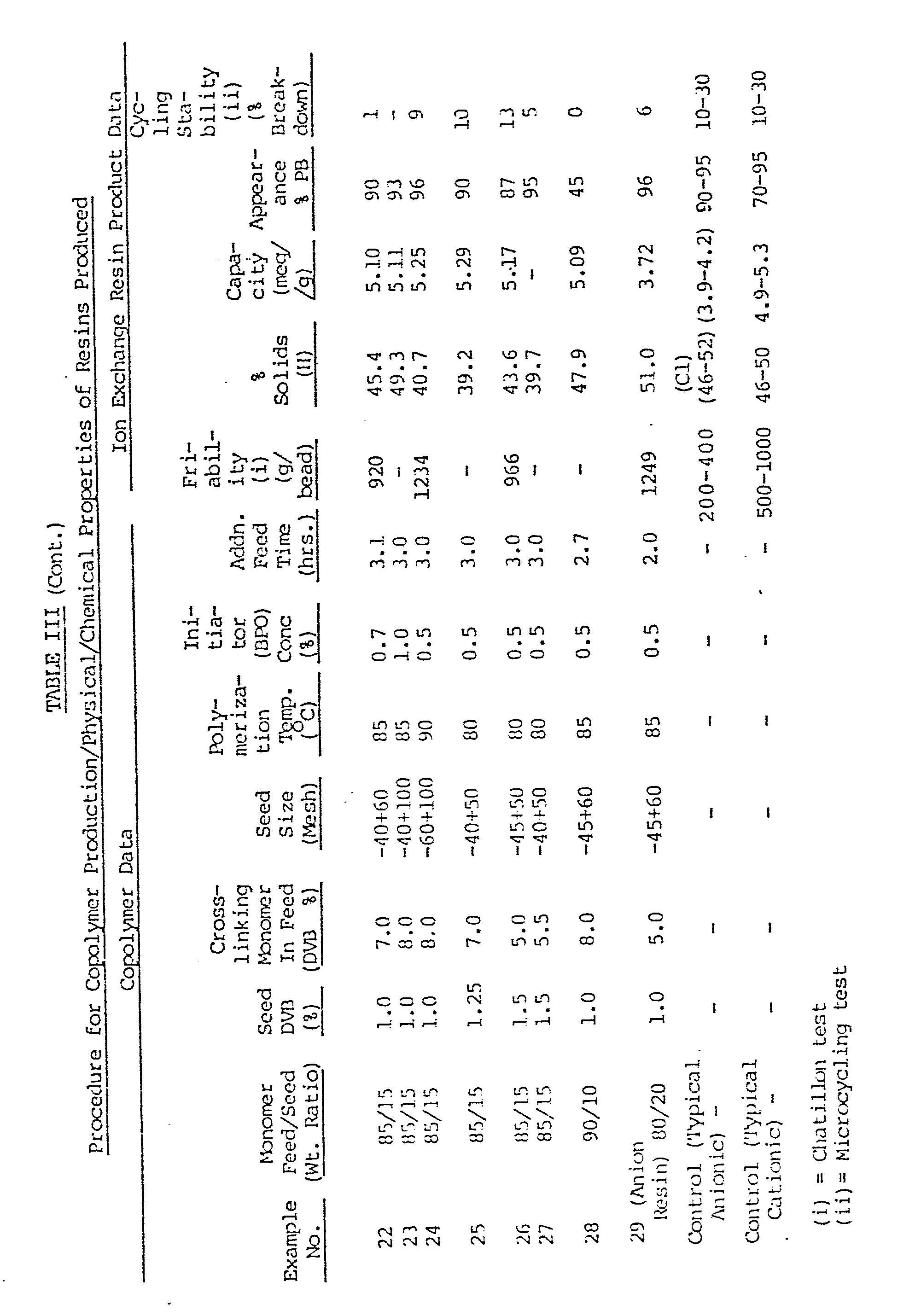
- Following the general procedure and apparatus disclosed above under "Synthetic Method", a number of ethylenic copolymers, and mixed styrenic/ethylenic copolymers were prepared. Because the monomers used to form the ethylenic copolymers are normally water-soluble, polymerization inhibitors, such as NaN02, are used in the aqueous phase. The high water solubility of certain monomers also may prevent the use of an emulsified feed, the preferred method of feeding liquid styrenic monomers. The composition of the seed, monomers and catalyst together with the feed rate and polymerization conditions of various example polymerizations are summarized in Table IV below:
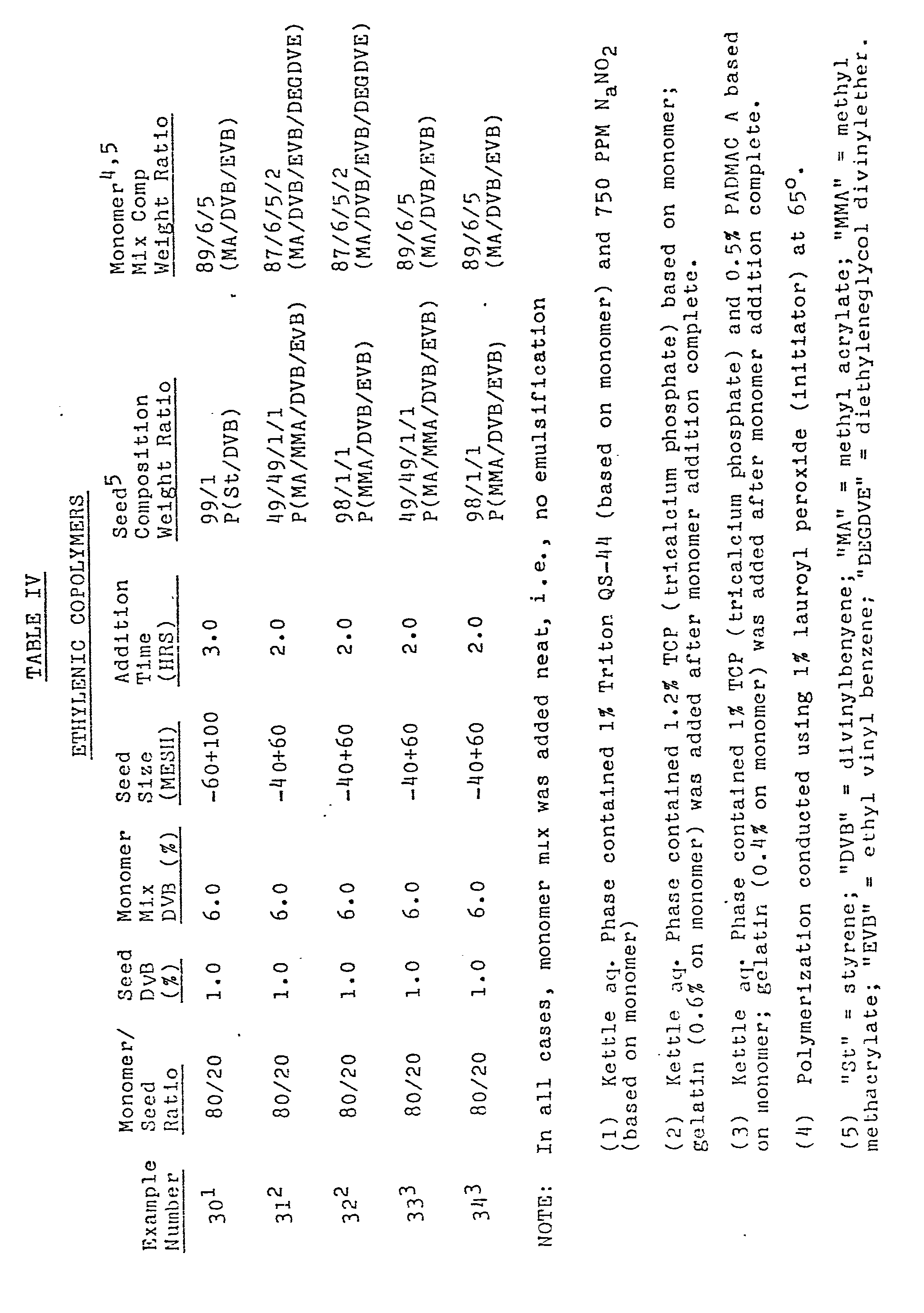
- These illustrate the production of macroreticular (porous) copolymers and adsorbents according to this invention. In each case the seed and monomer feed materials were all styrenic (i.e., styrene and DVB). In Example 35, 1% crosslinked macroreticular seed particles were employed while in Examples 36-39, 0.1% to 0.5% crosslinked gellular seed particles were used. Porosity was promoted by using a solvent material (MIBC) to cause phase separation of the imbibed monomers according to the known prior art processes. In Examples 35, 38 and 39 the phase extending solvent was added to the reactor with the seed and a portion of the water/emulsifier charge while in Examples 36 and 37 the phase extending solvent was added to the reactor with the monomer mix.
- The copolymers were prepared in a 4-necked, 2.0 liter round bottom kettle equipped with a nitrogen inlet, thermometer, reflux condenser and stainless steel paddle stirrer which operated at around 300 rpm. In Examples 35, 38 and 39 the preformed seed particles, a portion of the water/Emulsifier charge and phase extending solvent (MIBC) were added to the kettle reactor and heated to reaction temperature (85°C) while applying a nitrogen sweep and stirring as needed. The initiated styrenic monomer mix was emulsified and fed to the kettle reactor over about a 3-hour period. After completion of the monomer feed, the reaction mixture was held at temperature for about 4 to 5 hours (5 hours Example 35, 4 hours Examples 38 and 39) and allowed to cool. The phase extending solvent (MIBC) was then distilled off from the copolymer and the product was water washed and dried to yield opaque beads.
- In Examples 36 and 37 the preformed gellular seed particles and a portion of the water/emulsifier charge were added to the kettle reactor and heated to reaction temperature (85°C) while applying a nitrogen sweep and stirring as needed. The initiated monomer mix and phase extending solvent (MIBC) were emulsified and fed to the kettle reactor over about a 3-hour period. After completion of the monomer feed, the reaction mixture was held at temperature for 4 to 6 hours (6 hours for Example 36 and 4 hours Example 37) and then allowed to cool. The phase extending solvent (MIBC) was then distilled off from the copolymer and the product was water washed and dried to yield opaque beads. The water washes in Examples 35-39 were white indicating an unknown amount of emulsion polymer was formed. The process conditions, porosity and surface area of the final products are summarized in Table V which follows:

Claims (18)
Priority Applications (1)
| Application Number | Priority Date | Filing Date | Title |
|---|---|---|---|
| AT83303681T ATE48004T1 (en) | 1982-06-30 | 1983-06-27 | PRODUCTION OF NETWORKED COPOLYMER BEADS, THE COPOLYMER BEADS AND THEIR USE AS ADSORBENTS OR. AS ION EXCHANGE RESINS BY INCORPORATION OR ADDITION OF FUNCTIONAL GROUPS. |
Applications Claiming Priority (2)
| Application Number | Priority Date | Filing Date | Title |
|---|---|---|---|
| US393953 | 1982-06-30 | ||
| US06/393,953 US4419245A (en) | 1982-06-30 | 1982-06-30 | Copolymer process and product therefrom consisting of crosslinked seed bead swollen by styrene monomer |
Publications (3)
| Publication Number | Publication Date |
|---|---|
| EP0098130A2 true EP0098130A2 (en) | 1984-01-11 |
| EP0098130A3 EP0098130A3 (en) | 1985-09-18 |
| EP0098130B1 EP0098130B1 (en) | 1989-11-15 |
Family
ID=23556919
Family Applications (1)
| Application Number | Title | Priority Date | Filing Date |
|---|---|---|---|
| EP83303681A Expired EP0098130B1 (en) | 1982-06-30 | 1983-06-27 | The manufacture of crosslinked copolymer beads, the copolymer beads themselves and their use as adsorbents or, on incorporation or addition of functional groups, as ion exchange resins |
Country Status (11)
| Country | Link |
|---|---|
| US (1) | US4419245A (en) |
| EP (1) | EP0098130B1 (en) |
| JP (1) | JPH0635483B2 (en) |
| AT (1) | ATE48004T1 (en) |
| BR (1) | BR8303410A (en) |
| CA (1) | CA1228695A (en) |
| DE (1) | DE3380847D1 (en) |
| FI (1) | FI72986C (en) |
| MX (1) | MX167035B (en) |
| NO (1) | NO165444C (en) |
| ZA (1) | ZA834584B (en) |
Cited By (24)
| Publication number | Priority date | Publication date | Assignee | Title |
|---|---|---|---|---|
| EP0101943A3 (en) * | 1982-08-02 | 1985-09-18 | The Dow Chemical Company | Ion exchange resins |
| EP0225188A3 (en) * | 1985-11-29 | 1989-03-22 | Atlantic Richfield Company | Process for producing modified styrenic polymer beads for high strength foamed articles |
| EP0327400A3 (en) * | 1988-02-05 | 1990-02-28 | The Dow Chemical Company | Chromatographic separations using ion-exchange resins |
| EP0288006A3 (en) * | 1987-04-22 | 1990-08-22 | Mitsubishi Kasei Corporation | Process for producing crosslinked polymer particles |
| EP0428868A3 (en) * | 1989-10-20 | 1991-09-18 | Ebara Corporation | Materials for removing suspended impurities and use thereof |
| US5308876A (en) * | 1989-10-20 | 1994-05-03 | Ebara Corporation | Materials for removing suspended impurities and use thereof |
| US5834524A (en) * | 1996-08-26 | 1998-11-10 | Bayer Aktiengesellschaft | Process for the preparation of crosslinked polymers |
| US5932152A (en) * | 1997-04-10 | 1999-08-03 | Bayer Aktiengesellschaft | Process for preparing crosslinked bead-form polymers |
| EP1078941A1 (en) * | 1999-08-25 | 2001-02-28 | Bayer Ag | Sulfonated beads of styrene, vinyl pyridine and crosslinker |
| EP1078940A1 (en) * | 1999-08-25 | 2001-02-28 | Bayer Ag | Beads of styrene, phenol derivatives and crosslinker, products of their hydrolysis and sulfonation |
| WO2001044328A1 (en) * | 1999-12-14 | 2001-06-21 | Purolite International Limited | Method for the production of sorbents for chromatography |
| US6251314B1 (en) | 1998-06-12 | 2001-06-26 | Bayer Aktiengesellschaft | Process for the preparation of microencapsulated polymers |
| US6365683B2 (en) | 1999-12-24 | 2002-04-02 | Bayer Aktiengesellschaft | Process for preparing monodisperse crosslinked bead polymers |
| EP1110608A3 (en) * | 1999-12-24 | 2003-05-07 | Bayer Aktiengesellschaft | Method for preparing crosslinked ion exchangers from unsaturated aliphatic nitriles |
| US6667349B1 (en) | 1998-04-21 | 2003-12-23 | Bayer Aktiengesellschaft | Method for producing osmotically and mechanically stable gel-like anion exchangers |
| WO2010093398A1 (en) * | 2009-02-13 | 2010-08-19 | Dow Global Technologies Inc. | Amination of vinyl aromatic polymers with tertiary amines |
| CN102029201A (en) * | 2009-09-30 | 2011-04-27 | 朗盛德国有限责任公司 | Method for improved removal of cations using chelate resins |
| US8168070B2 (en) | 2009-01-15 | 2012-05-01 | Dow Global Technologies Llc | Method for removing chromium from water using ion exchange resins including interpenetrating polymer networks |
| US8241505B2 (en) | 2009-03-30 | 2012-08-14 | Dow Global Technologies Llc | Perchlorate removal using ion exchange resins comprising interpenetrating polymer networks |
| EP2564925A1 (en) | 2011-08-31 | 2013-03-06 | Dow Global Technologies LLC | Shell functionalized ion exchange resins |
| EP2564926A1 (en) | 2011-08-31 | 2013-03-06 | Dow Global Technologies LLC | Improved shell functionalized ion exchange resins |
| WO2019094193A1 (en) * | 2017-11-10 | 2019-05-16 | Dow Global Technonologies Llc | Component addition polymerization |
| WO2019094199A1 (en) * | 2017-11-10 | 2019-05-16 | Dow Global Technologies Llc | Polymerization process involving addition of monofunctional vinyl monomer |
| WO2023002498A1 (en) * | 2021-07-20 | 2023-01-26 | Ion Exchange (India) Limited | Two component ion exchange resins |
Families Citing this family (111)
| Publication number | Priority date | Publication date | Assignee | Title |
|---|---|---|---|---|
| US5292818A (en) * | 1982-07-20 | 1994-03-08 | Sekisui Kagaku Kogyo Kabushiki Kaisha | Method for producing a carrier for cation exchange liquid chromatography and a method for determining glycosylated hemoglobins using the carrier |
| US4564644A (en) * | 1982-08-02 | 1986-01-14 | The Dow Chemical Company | Ion exchange resins prepared by sequential monomer addition |
| US5068255A (en) * | 1982-08-02 | 1991-11-26 | The Dow Chemical Company | Ion exchange resins prepared by sequential monomer addition |
| US4582859A (en) * | 1983-12-02 | 1986-04-15 | Rohm And Haas Company | Process for producing an expanded seed copolymer and product therefrom |
| IL74893A0 (en) * | 1984-04-23 | 1985-07-31 | Dow Chemical Co | Process for the preparation of ion exchange resins using seeded polymerization technology |
| AU593225B2 (en) * | 1984-11-23 | 1990-02-08 | Dow Chemical Company, The | Method for preparation of anion exchange resins having very low chlorine content |
| NO860171L (en) * | 1985-01-30 | 1986-07-31 | Japan Synthetic Rubber Co Ltd | PROCEDURE FOR MANUFACTURE OF LARGE POLYMER PARTICLES. |
| JPS61225208A (en) * | 1985-03-30 | 1986-10-07 | Nitto Electric Ind Co Ltd | Solvent-resistant fine particle of uniform particle diameter and its production |
| JPS61225254A (en) * | 1985-03-30 | 1986-10-07 | Nitto Electric Ind Co Ltd | Fine particle having uniform particle size and production thereof |
| JPS62273215A (en) * | 1986-05-21 | 1987-11-27 | Mitsubishi Chem Ind Ltd | Seed polymerization method |
| JPH0791348B2 (en) * | 1987-01-30 | 1995-10-04 | 日本合成ゴム株式会社 | Method for producing crosslinked polymer particles |
| US5221478A (en) * | 1988-02-05 | 1993-06-22 | The Dow Chemical Company | Chromatographic separation using ion-exchange resins |
| US4952651A (en) * | 1988-03-30 | 1990-08-28 | Japan Synthetic Rubber Co., Ltd. | Highly crosslinked polymer particles and process for producing the same |
| US5431824A (en) * | 1989-10-20 | 1995-07-11 | Ebara Corporation | Method for removing suspended impurities |
| US5147937A (en) * | 1990-03-22 | 1992-09-15 | Rohm And Haas Company | Process for making controlled, uniform-sized particles in the 1 to 50 micrometer range |
| RU2040475C1 (en) * | 1990-11-09 | 1995-07-25 | Ибара Корпорейшн | Method of water purification from metal oxides or suspended impurities |
| EP0502619B1 (en) * | 1991-03-07 | 1997-01-08 | The Dow Chemical Company | Oxidation-resistant cation-exchange resins |
| US5112873A (en) * | 1991-03-28 | 1992-05-12 | The Dow Chemical Company | Resins having improved exchange kinetics |
| US5182026A (en) * | 1991-03-28 | 1993-01-26 | The Dow Chemical Company | Resins having improved exchange kinetics |
| US5141965A (en) * | 1991-03-28 | 1992-08-25 | The Dow Chemical Company | Resins having improved exchange kinetics |
| US5216096A (en) * | 1991-09-24 | 1993-06-01 | Japan Synthetic Rubber Co., Ltd. | Process for the preparation of cross-linked polymer particles |
| US5176832A (en) * | 1991-10-23 | 1993-01-05 | The Dow Chemical Company | Chromatographic separation of sugars using porous gel resins |
| US5248435A (en) * | 1991-12-17 | 1993-09-28 | Mitsubishi Kasei Corporation | Ion exchange resin, process for producing the same, and method for removing impurities from condensate |
| US5231115A (en) * | 1991-12-19 | 1993-07-27 | The Dow Chemical Company | Seeded porous copolymers and ion-exchange resins prepared therefrom |
| US5244926A (en) * | 1992-06-16 | 1993-09-14 | The Dow Chemical Company | Preparation of ion exchange and adsorbent copolymers |
| US5616622A (en) * | 1994-10-27 | 1997-04-01 | The Dow Chemical Company | Crosslinked seeded copolymer beads and process of manufacture |
| DE19647291A1 (en) * | 1996-11-15 | 1998-05-20 | Bayer Ag | Process for the preparation of microencapsulated polymers |
| GB9721603D0 (en) | 1997-10-10 | 1997-12-10 | Dyno Ind Asa | Method |
| US6251996B1 (en) | 1998-12-09 | 2001-06-26 | The Dow Chemical Company | Gel-type copolymer bead and ion-exchange resins made therefrom |
| EP1078688B1 (en) | 1999-08-27 | 2012-05-09 | LANXESS Deutschland GmbH | Method for producing monodisperse anion exchangers |
| DE50014560D1 (en) | 1999-08-27 | 2007-09-27 | Lanxess Deutschland Gmbh | Process for the preparation of monodisperse, crosslinked bead polymers with thiourea groups and their use for the adsorption of metal compounds |
| EP1078689A3 (en) | 1999-08-27 | 2003-02-26 | Bayer Ag | Method for producing monodispersed anion exchangers with strong basic functional groups |
| EP1078690B1 (en) | 1999-08-27 | 2011-10-12 | LANXESS Deutschland GmbH | Method for producing monodisperse ion exchangers with chelating groups |
| DE10049807A1 (en) * | 2000-10-09 | 2002-04-18 | Bayer Ag | Use of monodisperse ion exchangers for arsenic / antimony removal |
| CA2325240A1 (en) | 2000-11-06 | 2002-05-06 | Bayer Inc. | A process for removing iron- and rhodium-containing catalyst residues from hydrogenated nitrile rubber |
| FR2816621A1 (en) * | 2000-11-13 | 2002-05-17 | Bioracs | - Crosslinked polystyrene resins functionalized by L-tyrosine methyl ester sulfamide groups useful for purification of antifactor VIII antibodies |
| DE10056193A1 (en) * | 2000-11-13 | 2002-05-29 | Bayer Ag | Sugar decolorization using monodisperse anion exchangers |
| DE10105103A1 (en) * | 2001-02-05 | 2002-08-08 | Bayer Ag | Process for the preparation of gel-like cation exchangers |
| DE10122896A1 (en) * | 2001-05-11 | 2002-11-14 | Bayer Ag | Process for the preparation of monodisperse gel-like cation exchangers |
| DE10161979A1 (en) * | 2001-12-17 | 2003-06-18 | Bayer Ag | Monodisperse anion exchangers |
| DE10214844A1 (en) | 2002-04-04 | 2003-10-16 | Bayer Ag | Process for the preparation of coarse-grained gel-like anion exchangers |
| US7022744B2 (en) * | 2002-04-11 | 2006-04-04 | Mitsubishi Chemical Corporation | Ion exchanger for lipoproteins separation and lipoproteins separation method using the same |
| DE10326666A1 (en) * | 2003-02-24 | 2004-09-02 | Bayer Ag | mixtures |
| ITRM20030416A1 (en) * | 2003-09-04 | 2005-03-05 | Bayer Ag | PROCEDURE FOR THE PURIFICATION OF SULFURIC ACIDS. |
| US7331839B2 (en) * | 2003-10-16 | 2008-02-19 | Diffley Brett J | Floating water toy |
| DE10353534A1 (en) * | 2003-11-14 | 2005-06-16 | Bayer Chemicals Ag | chelate |
| DE102004006116A1 (en) * | 2004-02-06 | 2005-08-25 | Bayer Chemicals Ag | Process for the preparation of monodisperse porous ion exchangers |
| DE102004006115A1 (en) * | 2004-02-06 | 2005-08-25 | Bayer Chemicals Ag | Process for the preparation of monodisperse acrylic-containing bead polymers |
| US20060093822A1 (en) * | 2004-11-02 | 2006-05-04 | Keh-Ying Hsu | Polymer particle with hollow structure and method for fabricating the same |
| US20060237367A1 (en) * | 2005-04-26 | 2006-10-26 | Fisher Jon R | Polymeric adsorbent, and method of preparation and use |
| US20060266707A1 (en) * | 2005-05-26 | 2006-11-30 | Fisher Jon R | Drying method for macroporous polymers, and method of preparation and use of macroporous polymers made using the method |
| DE102005035616A1 (en) * | 2005-07-29 | 2007-02-08 | Lanxess Deutschland Gmbh | Monodisperse cation exchanger |
| DE102006009522A1 (en) | 2006-02-28 | 2007-09-06 | Lanxess Deutschland Gmbh | Combination process for the demineralization of water |
| DE102006017371A1 (en) * | 2006-04-11 | 2007-10-18 | Lanxess Deutschland Gmbh | Amphoteric ion exchangers for the adsorption of oxo anions |
| DE102006017372A1 (en) * | 2006-04-11 | 2007-10-18 | Lanxess Deutschland Gmbh | Oxoanion adsorbing ion exchangers |
| DE102007020688A1 (en) * | 2007-05-03 | 2008-11-06 | Lanxess Deutschland Gmbh | Conditioning of ion exchangers for the adsorption of oxo anions |
| US8163138B2 (en) * | 2007-05-23 | 2012-04-24 | Dow Global Technologies Llc | Method for processing effluent from chloromethylation of vinyl aromatic polymers |
| US20090022638A1 (en) * | 2007-07-19 | 2009-01-22 | Duilio Rossoni | Ion exchanger for winning metals of value |
| DE102007034732A1 (en) * | 2007-07-23 | 2009-01-29 | Lanxess Deutschland Gmbh | Process for the preparation of chelate resins |
| DE102007034733A1 (en) * | 2007-07-23 | 2009-01-29 | Lanxess Deutschland Gmbh | Process for the preparation of monodisperse chelating resins |
| DE102007034731A1 (en) | 2007-07-23 | 2009-01-29 | Lanxess Deutschland Gmbh | chelating resins |
| DE102007034621A1 (en) | 2007-07-25 | 2009-01-29 | Lanxess Deutschland Gmbh | Polyolreinigung |
| DE102007040764A1 (en) * | 2007-08-29 | 2009-03-05 | Lanxess Deutschland Gmbh | Monodisperse boron-selective resins |
| DE102007041361A1 (en) | 2007-08-30 | 2009-03-05 | Lanxess Deutschland Gmbh | Adsorption of radionuclides |
| DE102007050833A1 (en) | 2007-10-24 | 2009-04-30 | Lanxess Deutschland Gmbh | Amphoteric ion exchangers |
| DE102007060790A1 (en) * | 2007-12-18 | 2009-06-25 | Lanxess Deutschland Gmbh | Process for the preparation of cation exchangers |
| US20090198088A1 (en) * | 2008-02-01 | 2009-08-06 | Lanxess Sybron Chemicals Inc. | Process for the purification of crude glycerin utilizing ion exclusion chromatorgraphy and glycerin concentration |
| DE102008012224A1 (en) | 2008-03-03 | 2009-09-10 | Lanxess Deutschland Gmbh | picolylamine resins |
| DE102008012223A1 (en) | 2008-03-03 | 2009-09-10 | Lanxess Deutschland Gmbh | picolylamine resins |
| JP2009280751A (en) * | 2008-05-26 | 2009-12-03 | Nitto Denko Corp | Production method of porous polymer particle |
| US20110210074A1 (en) * | 2008-06-26 | 2011-09-01 | Winchester James F | Removal of myoglobin from blood and/or physiological fluids |
| WO2010104004A1 (en) * | 2009-03-10 | 2010-09-16 | オルガノ株式会社 | Ion adsorption module and method of treating water |
| US20110056887A1 (en) | 2009-09-08 | 2011-03-10 | Lanxess Deutschland Gmbh | Removal of oxo anions from water |
| US20110076207A1 (en) * | 2009-09-29 | 2011-03-31 | Lanxess Sybron Chemicals Inc. | Method and apparatus for protecting and monitoring the kinetic performance of an esterification catalyst material |
| DE102009047847A1 (en) | 2009-09-30 | 2011-03-31 | Lanxess Deutschland Gmbh | Process for the improved removal of cations by means of chelate resins |
| US9028590B2 (en) | 2009-10-19 | 2015-05-12 | Lanxess Deutschland Gmbh | Process and apparatus for carbon dioxide and carbonyl sulfide capture via ion exchange resins |
| EP2490789B1 (en) * | 2009-10-19 | 2014-08-06 | Lanxess Sybron Chemicals Inc. | Process for carbon dioxide capture via ion exchange resins |
| US8714258B2 (en) | 2010-06-07 | 2014-05-06 | Lanxess Sybron Chemicals Inc. | Process for transporting fracture (“frac”) fluid additives to oil and gas wells utilizing ion exchange resin |
| US8087462B2 (en) | 2010-06-07 | 2012-01-03 | Tirio Anthony P | Process for transporting fracture (“FRAC”) fluid additives to oil and gas wells utilizing ion exchange resin |
| US9884294B2 (en) | 2012-10-19 | 2018-02-06 | ADA-ES, Inc. | Method and system to thermally regenerate a sorbent |
| US9393532B2 (en) | 2013-02-27 | 2016-07-19 | Dow Global Technologies Llc | Swept membrane emulsification |
| WO2014204686A1 (en) | 2013-06-19 | 2014-12-24 | Dow Global Technologies Llc | Method for making anion exchange and chelant resins including aliphatic amino functional groups |
| EP2835384A1 (en) | 2013-08-09 | 2015-02-11 | LANXESS Deutschland GmbH | Method for producing monodispersed, amidomethylated vinyl aromatic bead polymers |
| RO131975A2 (en) | 2014-04-15 | 2017-06-30 | Rohm And Haas Company | Sulphonation of aromatic polymers using a fluorinated benzene compound as a swelling agent |
| EP3183275B1 (en) | 2014-08-20 | 2018-05-23 | Lanxess Deutschland GmbH | Sulphonated, aminomethylated chelate resins |
| EP3012272B1 (en) | 2014-10-21 | 2017-11-15 | LANXESS Deutschland GmbH | Method for the production of aminomethylated bead polymers |
| KR102450082B1 (en) | 2014-12-22 | 2022-10-04 | 란세스 도이치란트 게엠베하 | Method for producing amino methylated bead polymerizates |
| EP3237464B1 (en) | 2014-12-22 | 2020-11-11 | LANXESS Deutschland GmbH | Method for the preparation of aminomethylated bead polymers from n-carboxylic acid methylphthalimide esters |
| CA2974946C (en) | 2015-01-27 | 2023-01-10 | Dow Global Technologies Llc | Separation of nitrogen from hydrocarbon gas using pyrolyzed sulfonated macroporous ion exchange resin |
| BR112017016169A2 (en) | 2015-01-27 | 2018-04-17 | Dow Global Technologies Llc | alkylene bridged macroporous adsorbent hydrocarbon separation |
| US20180001228A1 (en) | 2015-02-27 | 2018-01-04 | Dow Global Technologies Llc | Chromatographic separation of saccharides using whole cracked beads of gel-type strong acid exchange resin |
| WO2016137787A1 (en) | 2015-02-27 | 2016-09-01 | Rohm And Haas Company | Chromatographic separation of saccharides using cation exchange resin beads with rough outer surface |
| EP3268102B1 (en) | 2015-03-12 | 2018-12-12 | Dow Global Technologies LLC | Chromatographic separation of saccharides using strong acid exchange resin incorporating precipitated barium sulfate |
| EP3268101B1 (en) | 2015-03-12 | 2022-05-18 | Dow Global Technologies LLC | Chromatographic separation of saccharides using polymeric macroporous alkylene-bridged resin |
| WO2016178842A1 (en) | 2015-05-04 | 2016-11-10 | Dow Global Technologies Llc | Removal of phosphorous from water using weak base anion exchange resin loaded with alumina |
| JP6714684B2 (en) | 2015-07-06 | 2020-06-24 | ランクセス・ドイチュランド・ゲーエムベーハー | Cesium selective resin |
| CN108367212A (en) | 2015-12-01 | 2018-08-03 | 陶氏环球技术有限责任公司 | Chromatographic separation of organic acids using polymeric macroporous sorbents |
| WO2017095686A1 (en) | 2015-12-01 | 2017-06-08 | Dow Global Technologies Llc | Chromatographic separation of organic acids using resin having strong and weak base anion exchange capacity |
| US20180326323A1 (en) | 2015-12-01 | 2018-11-15 | Dow Global Technologies Llc | Chromatographic separation of propionic acid using strong base anion exchange resin |
| US10975235B2 (en) | 2016-06-22 | 2021-04-13 | Lanxess Deutschland Gmbh | Method for producing amino methylated bead polymerizates |
| US11370852B2 (en) * | 2017-10-25 | 2022-06-28 | DDP Specialty Electronic Materials US, Inc. | Making low-sodium resin |
| US11548955B2 (en) * | 2017-11-10 | 2023-01-10 | DDP Specialty Electronic Materials US, Inc. | Component addition polymerization |
| KR20200088370A (en) * | 2017-11-10 | 2020-07-22 | 디디피 스페셜티 일렉트로닉 머티리얼즈 유에스, 인크. | Component addition polymerization |
| WO2019118282A1 (en) | 2017-12-13 | 2019-06-20 | Dow Global Technologies Llc | Regeneration process of an anionic exchange resin used for mercaptans removal |
| EP3898517B1 (en) | 2018-12-20 | 2023-06-14 | LANXESS Deutschland GmbH | Production of lithium carbonate from brine |
| ES2988729T3 (en) | 2019-01-31 | 2024-11-21 | Dow Global Technologies Llc | Purification process of polyethers from carbonate polyol |
| US20230374180A1 (en) | 2020-09-30 | 2023-11-23 | Lanxess Deutschland Gmbh | Novel Chelate Resins |
| CN113024738B (en) * | 2021-03-11 | 2022-05-13 | 丹东科力化工技术有限责任公司 | Preparation method of secondary repeated interpenetrating polymerization fracturing propping agent |
| EP4092054A1 (en) | 2021-05-17 | 2022-11-23 | LANXESS Deutschland GmbH | Method for producing anion exchangers |
| CN115215967A (en) * | 2022-08-15 | 2022-10-21 | 漂莱特(中国)有限公司 | Merrifield resin and preparation method and application thereof |
| CN115785349A (en) * | 2022-11-17 | 2023-03-14 | 陕西煤业化工技术研究院有限责任公司 | Micron-sized monodisperse crosslinked polystyrene microsphere and preparation method thereof |
Family Cites Families (14)
| Publication number | Priority date | Publication date | Assignee | Title |
|---|---|---|---|---|
| GB728508A (en) * | 1952-02-08 | 1955-04-20 | Permutit Co Ltd | Improvements relating to the production of ion-exchange resins |
| US2960480A (en) * | 1957-03-13 | 1960-11-15 | Nalco Chemical Co | Production of haloalkylated resin particles |
| US4224415A (en) * | 1958-07-18 | 1980-09-23 | Rohm And Haas Company | Polymerization processes and products therefrom |
| GB1151480A (en) * | 1967-06-09 | 1969-05-07 | Wolfen Filmfab Veb | Process for the production of Ion Exchange Resins |
| DE1917090C3 (en) * | 1968-04-06 | 1980-04-24 | Sekisui Kagaku Kogyo K.K., Osaka (Japan) | Process for making styrene polymer particles having uniform sizes |
| GB1292226A (en) * | 1970-03-17 | 1972-10-11 | Permutit Co Ltd | Production of copolymers |
| US4091054A (en) * | 1973-07-23 | 1978-05-23 | Sekisui Kagaku Kogyo Kabushiki Kaisha | Process of preparing styrenic polymer particles |
| US4085169A (en) * | 1973-07-23 | 1978-04-18 | Sekisui Kagaku Kogyo Kabushiki Kaisha | Process for preparing styrenic polymer particles |
| DE2338133C3 (en) * | 1973-07-27 | 1980-12-18 | Sekisui Kagaku Kogyo K.K., Osaka | Process for the production of styrene polymers |
| US3907730A (en) * | 1973-09-27 | 1975-09-23 | Goodrich Co B F | Resinous initiator suspension for olefinic polymerization reactions |
| GB1431120A (en) * | 1973-12-20 | 1976-04-07 | Sekisui Plastics | Process for producing non-foamable and foamable polyethylene resin particles |
| NO141367C (en) * | 1976-11-22 | 1980-02-27 | Sintef | PROCEDURE FOR THE PREPARATION OF FINALLY SHARED EMULSIONS OF A LITTLE WATER-SOLUBLE MATERIAL |
| US4192921A (en) * | 1977-12-28 | 1980-03-11 | Rohm And Haas Company | Crosslinked gel ion exchange resin beads characterized by strain birefringence patterns |
| CA1144700A (en) * | 1981-04-03 | 1983-04-12 | The Dow Chemical Company | Large ion exchange beads and a method for preparing same |
-
1982
- 1982-06-30 US US06/393,953 patent/US4419245A/en not_active Expired - Lifetime
-
1983
- 1983-06-16 CA CA000430497A patent/CA1228695A/en not_active Expired
- 1983-06-23 MX MX197776A patent/MX167035B/en unknown
- 1983-06-23 ZA ZA834584A patent/ZA834584B/en unknown
- 1983-06-27 DE DE8383303681T patent/DE3380847D1/en not_active Expired
- 1983-06-27 AT AT83303681T patent/ATE48004T1/en not_active IP Right Cessation
- 1983-06-27 BR BR8303410A patent/BR8303410A/en not_active IP Right Cessation
- 1983-06-27 EP EP83303681A patent/EP0098130B1/en not_active Expired
- 1983-06-29 FI FI832391A patent/FI72986C/en not_active IP Right Cessation
- 1983-06-30 NO NO832379A patent/NO165444C/en unknown
- 1983-06-30 JP JP58117180A patent/JPH0635483B2/en not_active Expired - Lifetime
Cited By (29)
| Publication number | Priority date | Publication date | Assignee | Title |
|---|---|---|---|---|
| EP0101943A3 (en) * | 1982-08-02 | 1985-09-18 | The Dow Chemical Company | Ion exchange resins |
| EP0225188A3 (en) * | 1985-11-29 | 1989-03-22 | Atlantic Richfield Company | Process for producing modified styrenic polymer beads for high strength foamed articles |
| EP0288006A3 (en) * | 1987-04-22 | 1990-08-22 | Mitsubishi Kasei Corporation | Process for producing crosslinked polymer particles |
| EP0327400A3 (en) * | 1988-02-05 | 1990-02-28 | The Dow Chemical Company | Chromatographic separations using ion-exchange resins |
| EP0428868A3 (en) * | 1989-10-20 | 1991-09-18 | Ebara Corporation | Materials for removing suspended impurities and use thereof |
| US5308876A (en) * | 1989-10-20 | 1994-05-03 | Ebara Corporation | Materials for removing suspended impurities and use thereof |
| US5834524A (en) * | 1996-08-26 | 1998-11-10 | Bayer Aktiengesellschaft | Process for the preparation of crosslinked polymers |
| US5932152A (en) * | 1997-04-10 | 1999-08-03 | Bayer Aktiengesellschaft | Process for preparing crosslinked bead-form polymers |
| US6667349B1 (en) | 1998-04-21 | 2003-12-23 | Bayer Aktiengesellschaft | Method for producing osmotically and mechanically stable gel-like anion exchangers |
| US6251314B1 (en) | 1998-06-12 | 2001-06-26 | Bayer Aktiengesellschaft | Process for the preparation of microencapsulated polymers |
| EP1078940A1 (en) * | 1999-08-25 | 2001-02-28 | Bayer Ag | Beads of styrene, phenol derivatives and crosslinker, products of their hydrolysis and sulfonation |
| EP1078941A1 (en) * | 1999-08-25 | 2001-02-28 | Bayer Ag | Sulfonated beads of styrene, vinyl pyridine and crosslinker |
| WO2001044328A1 (en) * | 1999-12-14 | 2001-06-21 | Purolite International Limited | Method for the production of sorbents for chromatography |
| US6365683B2 (en) | 1999-12-24 | 2002-04-02 | Bayer Aktiengesellschaft | Process for preparing monodisperse crosslinked bead polymers |
| EP1110608A3 (en) * | 1999-12-24 | 2003-05-07 | Bayer Aktiengesellschaft | Method for preparing crosslinked ion exchangers from unsaturated aliphatic nitriles |
| US6696503B2 (en) | 1999-12-24 | 2004-02-24 | Bayer Aktiengesellschaft | Process for preparing crosslinked ion exchangers based on unsaturated aliphatic nitriles |
| US8168070B2 (en) | 2009-01-15 | 2012-05-01 | Dow Global Technologies Llc | Method for removing chromium from water using ion exchange resins including interpenetrating polymer networks |
| WO2010093398A1 (en) * | 2009-02-13 | 2010-08-19 | Dow Global Technologies Inc. | Amination of vinyl aromatic polymers with tertiary amines |
| US8273799B2 (en) | 2009-02-13 | 2012-09-25 | Dow Global Technologies Llc | Amination of vinyl aromatic polymers with tertiary amines |
| US8241505B2 (en) | 2009-03-30 | 2012-08-14 | Dow Global Technologies Llc | Perchlorate removal using ion exchange resins comprising interpenetrating polymer networks |
| CN102029201A (en) * | 2009-09-30 | 2011-04-27 | 朗盛德国有限责任公司 | Method for improved removal of cations using chelate resins |
| EP2564925A1 (en) | 2011-08-31 | 2013-03-06 | Dow Global Technologies LLC | Shell functionalized ion exchange resins |
| EP2564926A1 (en) | 2011-08-31 | 2013-03-06 | Dow Global Technologies LLC | Improved shell functionalized ion exchange resins |
| WO2019094193A1 (en) * | 2017-11-10 | 2019-05-16 | Dow Global Technonologies Llc | Component addition polymerization |
| WO2019094199A1 (en) * | 2017-11-10 | 2019-05-16 | Dow Global Technologies Llc | Polymerization process involving addition of monofunctional vinyl monomer |
| CN111788234A (en) * | 2017-11-10 | 2020-10-16 | Ddp特种电子材料美国公司 | Polymerization Process Involving Addition of Monofunctional Vinyl Monomers |
| US11180591B2 (en) | 2017-11-10 | 2021-11-23 | DDP Specialty Electronic Materials US, Inc. | Polymerization process involving addition of monofunctional vinyl monomer |
| US11345763B2 (en) | 2017-11-10 | 2022-05-31 | Ddp Specialty Electronic Materials Us, Llc | Component addition polymerization |
| WO2023002498A1 (en) * | 2021-07-20 | 2023-01-26 | Ion Exchange (India) Limited | Two component ion exchange resins |
Also Published As
| Publication number | Publication date |
|---|---|
| DE3380847D1 (en) | 1989-12-21 |
| CA1228695A (en) | 1987-10-27 |
| EP0098130A3 (en) | 1985-09-18 |
| FI832391L (en) | 1983-12-31 |
| EP0098130B1 (en) | 1989-11-15 |
| MX167035B (en) | 1993-02-24 |
| FI832391A0 (en) | 1983-06-29 |
| FI72986B (en) | 1987-04-30 |
| ZA834584B (en) | 1984-08-29 |
| FI72986C (en) | 1987-08-10 |
| JPS5918705A (en) | 1984-01-31 |
| ATE48004T1 (en) | 1989-12-15 |
| US4419245A (en) | 1983-12-06 |
| NO832379L (en) | 1984-01-02 |
| NO165444B (en) | 1990-11-05 |
| NO165444C (en) | 1991-02-13 |
| JPH0635483B2 (en) | 1994-05-11 |
| BR8303410A (en) | 1984-02-07 |
Similar Documents
| Publication | Publication Date | Title |
|---|---|---|
| EP0098130B1 (en) | The manufacture of crosslinked copolymer beads, the copolymer beads themselves and their use as adsorbents or, on incorporation or addition of functional groups, as ion exchange resins | |
| US4582859A (en) | Process for producing an expanded seed copolymer and product therefrom | |
| US4486313A (en) | Polymerication processes and products therefrom | |
| US4382124A (en) | Process for preparing macroreticular resins, copolymers and products of said process | |
| EP0101943B1 (en) | Ion exchange resins | |
| US4564644A (en) | Ion exchange resins prepared by sequential monomer addition | |
| US7217762B1 (en) | Process for the preparation of monodisperse polymer particles | |
| EP0646142B1 (en) | An adiabatic process for the preparation of ion exchange and adsorbent copolymers | |
| EP0617714A1 (en) | Seeded porous copolymers and ion-exchange resins prepared therefrom. | |
| JP2003301016A (en) | Manufacturing method of monodisperse anion-exchange gel and monodisperse anion-exchange gel | |
| US4500652A (en) | Process for producing cation exchange resins without swelling during sulphonation process | |
| JPH0426321B2 (en) | ||
| US6251996B1 (en) | Gel-type copolymer bead and ion-exchange resins made therefrom | |
| MXPA02004644A (en) | Method for producing monodispersed gel-like cation exchangers. | |
| US8686055B2 (en) | Shell functionalized ion exchange resins | |
| KR100579675B1 (en) | Process for the Preparation of Monodisperse, Gelatinous Cation Exchangers | |
| JPH10287705A (en) | Production of crosslinked particulate polymer | |
| JP2004518016A (en) | Method for producing gel-like cation exchanger | |
| US20130053458A1 (en) | Shell Functionalized ion Exchange Resins | |
| US20050046059A1 (en) | Process for the preparation of non-microencapsulated monodisperse bead polymers |
Legal Events
| Date | Code | Title | Description |
|---|---|---|---|
| PUAI | Public reference made under article 153(3) epc to a published international application that has entered the european phase |
Free format text: ORIGINAL CODE: 0009012 |
|
| AK | Designated contracting states |
Designated state(s): AT BE CH DE FR GB IT LI LU NL SE |
|
| 17P | Request for examination filed |
Effective date: 19840521 |
|
| PUAL | Search report despatched |
Free format text: ORIGINAL CODE: 0009013 |
|
| AK | Designated contracting states |
Designated state(s): AT BE CH DE FR GB IT LI LU NL SE |
|
| 17Q | First examination report despatched |
Effective date: 19870213 |
|
| GRAA | (expected) grant |
Free format text: ORIGINAL CODE: 0009210 |
|
| AK | Designated contracting states |
Kind code of ref document: B1 Designated state(s): AT BE CH DE FR GB IT LI LU NL SE |
|
| REF | Corresponds to: |
Ref document number: 48004 Country of ref document: AT Date of ref document: 19891215 Kind code of ref document: T |
|
| ITF | It: translation for a ep patent filed | ||
| REF | Corresponds to: |
Ref document number: 3380847 Country of ref document: DE Date of ref document: 19891221 |
|
| ET | Fr: translation filed | ||
| PLBI | Opposition filed |
Free format text: ORIGINAL CODE: 0009260 |
|
| 26 | Opposition filed |
Opponent name: THE DOW CHEMICAL COMPANY Effective date: 19900814 |
|
| NLR1 | Nl: opposition has been filed with the epo |
Opponent name: THE DOW CHEMICAL COMPANY. |
|
| PGFP | Annual fee paid to national office [announced via postgrant information from national office to epo] |
Ref country code: SE Payment date: 19910521 Year of fee payment: 9 |
|
| PG25 | Lapsed in a contracting state [announced via postgrant information from national office to epo] |
Ref country code: SE Effective date: 19920628 |
|
| ITTA | It: last paid annual fee | ||
| PGFP | Annual fee paid to national office [announced via postgrant information from national office to epo] |
Ref country code: FR Payment date: 19940511 Year of fee payment: 12 |
|
| PGFP | Annual fee paid to national office [announced via postgrant information from national office to epo] |
Ref country code: AT Payment date: 19940516 Year of fee payment: 12 |
|
| PGFP | Annual fee paid to national office [announced via postgrant information from national office to epo] |
Ref country code: BE Payment date: 19940517 Year of fee payment: 12 |
|
| PGFP | Annual fee paid to national office [announced via postgrant information from national office to epo] |
Ref country code: CH Payment date: 19940520 Year of fee payment: 12 |
|
| PGFP | Annual fee paid to national office [announced via postgrant information from national office to epo] |
Ref country code: NL Payment date: 19940630 Year of fee payment: 12 Ref country code: LU Payment date: 19940630 Year of fee payment: 12 |
|
| EPTA | Lu: last paid annual fee | ||
| EUG | Se: european patent has lapsed |
Ref document number: 83303681.7 Effective date: 19930109 |
|
| PG25 | Lapsed in a contracting state [announced via postgrant information from national office to epo] |
Ref country code: LU Free format text: LAPSE BECAUSE OF NON-PAYMENT OF DUE FEES Effective date: 19950627 Ref country code: AT Effective date: 19950627 |
|
| PLBN | Opposition rejected |
Free format text: ORIGINAL CODE: 0009273 |
|
| STAA | Information on the status of an ep patent application or granted ep patent |
Free format text: STATUS: OPPOSITION REJECTED |
|
| PG25 | Lapsed in a contracting state [announced via postgrant information from national office to epo] |
Ref country code: LI Effective date: 19950630 Ref country code: CH Effective date: 19950630 Ref country code: BE Effective date: 19950630 |
|
| 27O | Opposition rejected |
Effective date: 19950522 |
|
| NLR2 | Nl: decision of opposition | ||
| BERE | Be: lapsed |
Owner name: ROHM AND HAAS CY Effective date: 19950630 |
|
| PG25 | Lapsed in a contracting state [announced via postgrant information from national office to epo] |
Ref country code: NL Effective date: 19960101 |
|
| PG25 | Lapsed in a contracting state [announced via postgrant information from national office to epo] |
Ref country code: FR Effective date: 19960229 |
|
| REG | Reference to a national code |
Ref country code: CH Ref legal event code: PL |
|
| NLV4 | Nl: lapsed or anulled due to non-payment of the annual fee |
Effective date: 19960101 |
|
| REG | Reference to a national code |
Ref country code: FR Ref legal event code: ST |
|
| PGFP | Annual fee paid to national office [announced via postgrant information from national office to epo] |
Ref country code: GB Payment date: 20010518 Year of fee payment: 19 |
|
| REG | Reference to a national code |
Ref country code: GB Ref legal event code: IF02 |
|
| PGFP | Annual fee paid to national office [announced via postgrant information from national office to epo] |
Ref country code: DE Payment date: 20020620 Year of fee payment: 20 |
|
| PG25 | Lapsed in a contracting state [announced via postgrant information from national office to epo] |
Ref country code: GB Free format text: LAPSE BECAUSE OF NON-PAYMENT OF DUE FEES Effective date: 20020627 |
|
| GBPC | Gb: european patent ceased through non-payment of renewal fee |
Effective date: 20020627 |
|
| APAH | Appeal reference modified |
Free format text: ORIGINAL CODE: EPIDOSCREFNO |