EP0095683A1 - Trifluormethylphenoxy-phenyl-Derivate, Verfahren zu ihrer Herstellung und ihre Verwendung als Herbizide - Google Patents
Trifluormethylphenoxy-phenyl-Derivate, Verfahren zu ihrer Herstellung und ihre Verwendung als Herbizide Download PDFInfo
- Publication number
- EP0095683A1 EP0095683A1 EP83105032A EP83105032A EP0095683A1 EP 0095683 A1 EP0095683 A1 EP 0095683A1 EP 83105032 A EP83105032 A EP 83105032A EP 83105032 A EP83105032 A EP 83105032A EP 0095683 A1 EP0095683 A1 EP 0095683A1
- Authority
- EP
- European Patent Office
- Prior art keywords
- formula
- represents hydrogen
- chlorine
- alkyl
- hydrogen
- Prior art date
- Legal status (The legal status is an assumption and is not a legal conclusion. Google has not performed a legal analysis and makes no representation as to the accuracy of the status listed.)
- Withdrawn
Links
- 238000000034 method Methods 0.000 title claims abstract description 142
- -1 Trifluoromethylphenoxyphenyl Chemical class 0.000 title claims abstract description 58
- 238000002360 preparation method Methods 0.000 title claims abstract description 16
- 239000004009 herbicide Substances 0.000 title claims abstract description 8
- 229910052739 hydrogen Inorganic materials 0.000 claims abstract description 98
- 239000001257 hydrogen Substances 0.000 claims abstract description 98
- 150000001875 compounds Chemical class 0.000 claims abstract description 94
- UFHFLCQGNIYNRP-UHFFFAOYSA-N Hydrogen Chemical compound [H][H] UFHFLCQGNIYNRP-UHFFFAOYSA-N 0.000 claims abstract description 60
- ZAMOUSCENKQFHK-UHFFFAOYSA-N Chlorine atom Chemical compound [Cl] ZAMOUSCENKQFHK-UHFFFAOYSA-N 0.000 claims abstract description 59
- 239000000460 chlorine Substances 0.000 claims abstract description 51
- 229910052801 chlorine Inorganic materials 0.000 claims abstract description 51
- WKBOTKDWSSQWDR-UHFFFAOYSA-N Bromine atom Chemical compound [Br] WKBOTKDWSSQWDR-UHFFFAOYSA-N 0.000 claims abstract description 49
- 150000002431 hydrogen Chemical class 0.000 claims abstract description 45
- GDTBXPJZTBHREO-UHFFFAOYSA-N bromine Substances BrBr GDTBXPJZTBHREO-UHFFFAOYSA-N 0.000 claims abstract description 43
- 229910052794 bromium Inorganic materials 0.000 claims abstract description 43
- 229910052760 oxygen Inorganic materials 0.000 claims abstract description 34
- 239000001301 oxygen Substances 0.000 claims abstract description 34
- PXGOKWXKJXAPGV-UHFFFAOYSA-N Fluorine Chemical compound FF PXGOKWXKJXAPGV-UHFFFAOYSA-N 0.000 claims abstract description 28
- QVGXLLKOCUKJST-UHFFFAOYSA-N atomic oxygen Chemical group [O] QVGXLLKOCUKJST-UHFFFAOYSA-N 0.000 claims abstract description 28
- 239000011737 fluorine Substances 0.000 claims abstract description 24
- 229910052731 fluorine Inorganic materials 0.000 claims abstract description 24
- NINIDFKCEFEMDL-UHFFFAOYSA-N Sulfur Chemical compound [S] NINIDFKCEFEMDL-UHFFFAOYSA-N 0.000 claims abstract description 22
- 125000000449 nitro group Chemical group [O-][N+](*)=O 0.000 claims abstract description 16
- 125000004093 cyano group Chemical group *C#N 0.000 claims abstract description 14
- 125000004435 hydrogen atom Chemical group [H]* 0.000 claims abstract description 11
- PNDPGZBMCMUPRI-UHFFFAOYSA-N iodine Chemical compound II PNDPGZBMCMUPRI-UHFFFAOYSA-N 0.000 claims abstract description 10
- 239000002253 acid Substances 0.000 claims description 76
- 239000003085 diluting agent Substances 0.000 claims description 60
- 241000196324 Embryophyta Species 0.000 claims description 26
- AVXURJPOCDRRFD-UHFFFAOYSA-N Hydroxylamine Chemical compound ON AVXURJPOCDRRFD-UHFFFAOYSA-N 0.000 claims description 24
- 239000011230 binding agent Substances 0.000 claims description 23
- 125000002496 methyl group Chemical group [H]C([H])([H])* 0.000 claims description 23
- WTDHULULXKLSOZ-UHFFFAOYSA-N Hydroxylamine hydrochloride Chemical compound Cl.ON WTDHULULXKLSOZ-UHFFFAOYSA-N 0.000 claims description 21
- 125000001495 ethyl group Chemical group [H]C([H])([H])C([H])([H])* 0.000 claims description 21
- 125000001449 isopropyl group Chemical group [H]C([H])([H])C([H])(*)C([H])([H])[H] 0.000 claims description 18
- 125000004123 n-propyl group Chemical group [H]C([H])([H])C([H])([H])C([H])([H])* 0.000 claims description 18
- 229910052717 sulfur Inorganic materials 0.000 claims description 17
- 239000011593 sulfur Substances 0.000 claims description 17
- 239000002904 solvent Substances 0.000 claims description 14
- VEXZGXHMUGYJMC-UHFFFAOYSA-N Hydrochloric acid Chemical compound Cl VEXZGXHMUGYJMC-UHFFFAOYSA-N 0.000 claims description 9
- 150000004820 halides Chemical class 0.000 claims description 9
- USIUVYZYUHIAEV-UHFFFAOYSA-N diphenyl ether Chemical compound C=1C=CC=CC=1OC1=CC=CC=C1 USIUVYZYUHIAEV-UHFFFAOYSA-N 0.000 claims description 8
- 150000002825 nitriles Chemical class 0.000 claims description 7
- FYSNRJHAOHDILO-UHFFFAOYSA-N thionyl chloride Chemical compound ClS(Cl)=O FYSNRJHAOHDILO-UHFFFAOYSA-N 0.000 claims description 7
- GRYLNZFGIOXLOG-UHFFFAOYSA-N Nitric acid Chemical compound O[N+]([O-])=O GRYLNZFGIOXLOG-UHFFFAOYSA-N 0.000 claims description 6
- 150000001298 alcohols Chemical class 0.000 claims description 6
- 229910052783 alkali metal Inorganic materials 0.000 claims description 6
- 150000001340 alkali metals Chemical class 0.000 claims description 6
- 229910052784 alkaline earth metal Inorganic materials 0.000 claims description 6
- 150000001342 alkaline earth metals Chemical class 0.000 claims description 6
- 239000003054 catalyst Substances 0.000 claims description 6
- 239000003795 chemical substances by application Substances 0.000 claims description 6
- 150000002443 hydroxylamines Chemical class 0.000 claims description 6
- CPELXLSAUQHCOX-UHFFFAOYSA-N Hydrogen bromide Chemical compound Br CPELXLSAUQHCOX-UHFFFAOYSA-N 0.000 claims description 5
- 125000002915 carbonyl group Chemical group [*:2]C([*:1])=O 0.000 claims description 5
- 229910017604 nitric acid Inorganic materials 0.000 claims description 5
- 150000003839 salts Chemical class 0.000 claims description 5
- KDTZBYPBMTXCSO-UHFFFAOYSA-N 2-phenoxyphenol Chemical class OC1=CC=CC=C1OC1=CC=CC=C1 KDTZBYPBMTXCSO-UHFFFAOYSA-N 0.000 claims description 4
- HFRXJVQOXRXOPP-UHFFFAOYSA-N thionyl bromide Chemical compound BrS(Br)=O HFRXJVQOXRXOPP-UHFFFAOYSA-N 0.000 claims description 4
- 150000005226 trifluoromethylbenzenes Chemical class 0.000 claims description 4
- HBAQYPYDRFILMT-UHFFFAOYSA-N 8-[3-(1-cyclopropylpyrazol-4-yl)-1H-pyrazolo[4,3-d]pyrimidin-5-yl]-3-methyl-3,8-diazabicyclo[3.2.1]octan-2-one Chemical class C1(CC1)N1N=CC(=C1)C1=NNC2=C1N=C(N=C2)N1C2C(N(CC1CC2)C)=O HBAQYPYDRFILMT-UHFFFAOYSA-N 0.000 claims description 3
- 101100450129 Caenorhabditis elegans hal-3 gene Proteins 0.000 claims description 3
- 239000002168 alkylating agent Substances 0.000 claims description 3
- 229940100198 alkylating agent Drugs 0.000 claims description 3
- 150000001728 carbonyl compounds Chemical class 0.000 claims description 3
- NEAQRZUHTPSBBM-UHFFFAOYSA-N 2-hydroxy-3,3-dimethyl-7-nitro-4h-isoquinolin-1-one Chemical compound C1=C([N+]([O-])=O)C=C2C(=O)N(O)C(C)(C)CC2=C1 NEAQRZUHTPSBBM-UHFFFAOYSA-N 0.000 claims description 2
- IXCSERBJSXMMFS-UHFFFAOYSA-N hydrogen chloride Substances Cl.Cl IXCSERBJSXMMFS-UHFFFAOYSA-N 0.000 claims description 2
- 229910000041 hydrogen chloride Inorganic materials 0.000 claims description 2
- 239000007858 starting material Substances 0.000 abstract description 38
- 125000006527 (C1-C5) alkyl group Chemical group 0.000 abstract description 11
- 239000005864 Sulphur Substances 0.000 abstract 1
- 230000015572 biosynthetic process Effects 0.000 abstract 1
- 238000003786 synthesis reaction Methods 0.000 abstract 1
- 239000000370 acceptor Substances 0.000 description 34
- 239000000126 substance Substances 0.000 description 30
- 238000006243 chemical reaction Methods 0.000 description 23
- YXFVVABEGXRONW-UHFFFAOYSA-N Toluene Chemical compound CC1=CC=CC=C1 YXFVVABEGXRONW-UHFFFAOYSA-N 0.000 description 17
- 239000000203 mixture Substances 0.000 description 17
- RTZKZFJDLAIYFH-UHFFFAOYSA-N Diethyl ether Chemical compound CCOCC RTZKZFJDLAIYFH-UHFFFAOYSA-N 0.000 description 16
- CSCPPACGZOOCGX-UHFFFAOYSA-N Acetone Chemical compound CC(C)=O CSCPPACGZOOCGX-UHFFFAOYSA-N 0.000 description 15
- 150000003254 radicals Chemical class 0.000 description 14
- ZMXDDKWLCZADIW-UHFFFAOYSA-N N,N-Dimethylformamide Chemical compound CN(C)C=O ZMXDDKWLCZADIW-UHFFFAOYSA-N 0.000 description 13
- 239000003960 organic solvent Substances 0.000 description 12
- 0 C*1C(C2)C2C(C2)C2C1 Chemical compound C*1C(C2)C2C(C2)C2C1 0.000 description 11
- BWHMMNNQKKPAPP-UHFFFAOYSA-L potassium carbonate Chemical compound [K+].[K+].[O-]C([O-])=O BWHMMNNQKKPAPP-UHFFFAOYSA-L 0.000 description 11
- 239000011541 reaction mixture Substances 0.000 description 11
- WEVYAHXRMPXWCK-UHFFFAOYSA-N acetonitrile Substances CC#N WEVYAHXRMPXWCK-UHFFFAOYSA-N 0.000 description 10
- XLYOFNOQVPJJNP-UHFFFAOYSA-N water Substances O XLYOFNOQVPJJNP-UHFFFAOYSA-N 0.000 description 10
- YMWUJEATGCHHMB-UHFFFAOYSA-N Dichloromethane Chemical compound ClCCl YMWUJEATGCHHMB-UHFFFAOYSA-N 0.000 description 9
- 239000003995 emulsifying agent Substances 0.000 description 8
- 239000008187 granular material Substances 0.000 description 8
- JUJWROOIHBZHMG-UHFFFAOYSA-N Pyridine Chemical compound C1=CC=NC=C1 JUJWROOIHBZHMG-UHFFFAOYSA-N 0.000 description 7
- 238000009472 formulation Methods 0.000 description 7
- MYMOFIZGZYHOMD-UHFFFAOYSA-N Dioxygen Chemical compound O=O MYMOFIZGZYHOMD-UHFFFAOYSA-N 0.000 description 6
- DGAQECJNVWCQMB-PUAWFVPOSA-M Ilexoside XXIX Chemical compound C[C@@H]1CC[C@@]2(CC[C@@]3(C(=CC[C@H]4[C@]3(CC[C@@H]5[C@@]4(CC[C@@H](C5(C)C)OS(=O)(=O)[O-])C)C)[C@@H]2[C@]1(C)O)C)C(=O)O[C@H]6[C@@H]([C@H]([C@@H]([C@H](O6)CO)O)O)O.[Na+] DGAQECJNVWCQMB-PUAWFVPOSA-M 0.000 description 6
- OKKJLVBELUTLKV-UHFFFAOYSA-N Methanol Chemical compound OC OKKJLVBELUTLKV-UHFFFAOYSA-N 0.000 description 6
- KWYUFKZDYYNOTN-UHFFFAOYSA-M Potassium hydroxide Chemical compound [OH-].[K+] KWYUFKZDYYNOTN-UHFFFAOYSA-M 0.000 description 6
- WYURNTSHIVDZCO-UHFFFAOYSA-N Tetrahydrofuran Chemical compound C1CCOC1 WYURNTSHIVDZCO-UHFFFAOYSA-N 0.000 description 6
- 230000006378 damage Effects 0.000 description 6
- 238000001035 drying Methods 0.000 description 6
- VZGDMQKNWNREIO-UHFFFAOYSA-N tetrachloromethane Chemical compound ClC(Cl)(Cl)Cl VZGDMQKNWNREIO-UHFFFAOYSA-N 0.000 description 6
- ZWEHNKRNPOVVGH-UHFFFAOYSA-N 2-Butanone Chemical group CCC(C)=O ZWEHNKRNPOVVGH-UHFFFAOYSA-N 0.000 description 5
- 239000004480 active ingredient Substances 0.000 description 5
- 230000000694 effects Effects 0.000 description 5
- 230000002363 herbicidal effect Effects 0.000 description 5
- 229910000027 potassium carbonate Inorganic materials 0.000 description 5
- HEMHJVSKTPXQMS-UHFFFAOYSA-M sodium hydroxide Inorganic materials [OH-].[Na+] HEMHJVSKTPXQMS-UHFFFAOYSA-M 0.000 description 5
- QTBSBXVTEAMEQO-UHFFFAOYSA-N Acetic acid Chemical compound CC(O)=O QTBSBXVTEAMEQO-UHFFFAOYSA-N 0.000 description 4
- IAZDPXIOMUYVGZ-UHFFFAOYSA-N Dimethylsulphoxide Chemical compound CS(C)=O IAZDPXIOMUYVGZ-UHFFFAOYSA-N 0.000 description 4
- PCLIMKBDDGJMGD-UHFFFAOYSA-N N-bromosuccinimide Chemical compound BrN1C(=O)CCC1=O PCLIMKBDDGJMGD-UHFFFAOYSA-N 0.000 description 4
- JCXJVPUVTGWSNB-UHFFFAOYSA-N Nitrogen dioxide Chemical class O=[N]=O JCXJVPUVTGWSNB-UHFFFAOYSA-N 0.000 description 4
- VMHLLURERBWHNL-UHFFFAOYSA-M Sodium acetate Chemical compound [Na+].CC([O-])=O VMHLLURERBWHNL-UHFFFAOYSA-M 0.000 description 4
- 239000013543 active substance Substances 0.000 description 4
- 230000003287 optical effect Effects 0.000 description 4
- VYPSYNLAJGMNEJ-UHFFFAOYSA-N silicon dioxide Inorganic materials O=[Si]=O VYPSYNLAJGMNEJ-UHFFFAOYSA-N 0.000 description 4
- 239000011734 sodium Substances 0.000 description 4
- 239000002689 soil Substances 0.000 description 4
- 239000007787 solid Substances 0.000 description 4
- 239000000243 solution Substances 0.000 description 4
- UHOVQNZJYSORNB-UHFFFAOYSA-N Benzene Chemical compound C1=CC=CC=C1 UHOVQNZJYSORNB-UHFFFAOYSA-N 0.000 description 3
- XDTMQSROBMDMFD-UHFFFAOYSA-N Cyclohexane Chemical compound C1CCCCC1 XDTMQSROBMDMFD-UHFFFAOYSA-N 0.000 description 3
- XEKOWRVHYACXOJ-UHFFFAOYSA-N Ethyl acetate Chemical compound CCOC(C)=O XEKOWRVHYACXOJ-UHFFFAOYSA-N 0.000 description 3
- 241000219146 Gossypium Species 0.000 description 3
- 235000021506 Ipomoea Nutrition 0.000 description 3
- 241000207783 Ipomoea Species 0.000 description 3
- ZLMJMSJWJFRBEC-UHFFFAOYSA-N Potassium Chemical compound [K] ZLMJMSJWJFRBEC-UHFFFAOYSA-N 0.000 description 3
- ZMANZCXQSJIPKH-UHFFFAOYSA-N Triethylamine Chemical compound CCN(CC)CC ZMANZCXQSJIPKH-UHFFFAOYSA-N 0.000 description 3
- 125000002877 alkyl aryl group Chemical group 0.000 description 3
- CODNYICXDISAEA-UHFFFAOYSA-N bromine monochloride Chemical compound BrCl CODNYICXDISAEA-UHFFFAOYSA-N 0.000 description 3
- 239000000969 carrier Substances 0.000 description 3
- 239000012141 concentrate Substances 0.000 description 3
- 239000000839 emulsion Substances 0.000 description 3
- WCYJQVALWQMJGE-UHFFFAOYSA-M hydroxylammonium chloride Chemical compound [Cl-].O[NH3+] WCYJQVALWQMJGE-UHFFFAOYSA-M 0.000 description 3
- VLKZOEOYAKHREP-UHFFFAOYSA-N n-Hexane Chemical compound CCCCCC VLKZOEOYAKHREP-UHFFFAOYSA-N 0.000 description 3
- 229920000151 polyglycol Polymers 0.000 description 3
- 239000010695 polyglycol Substances 0.000 description 3
- 239000011591 potassium Substances 0.000 description 3
- 239000000843 powder Substances 0.000 description 3
- 239000000047 product Substances 0.000 description 3
- UMJSCPRVCHMLSP-UHFFFAOYSA-N pyridine Natural products COC1=CC=CN=C1 UMJSCPRVCHMLSP-UHFFFAOYSA-N 0.000 description 3
- 238000010992 reflux Methods 0.000 description 3
- 239000011435 rock Substances 0.000 description 3
- 229910052708 sodium Inorganic materials 0.000 description 3
- FVAUCKIRQBBSSJ-UHFFFAOYSA-M sodium iodide Chemical compound [Na+].[I-] FVAUCKIRQBBSSJ-UHFFFAOYSA-M 0.000 description 3
- 239000000725 suspension Substances 0.000 description 3
- YLQBMQCUIZJEEH-UHFFFAOYSA-N tetrahydrofuran Natural products C=1C=COC=1 YLQBMQCUIZJEEH-UHFFFAOYSA-N 0.000 description 3
- PAAZPARNPHGIKF-UHFFFAOYSA-N 1,2-dibromoethane Chemical compound BrCCBr PAAZPARNPHGIKF-UHFFFAOYSA-N 0.000 description 2
- RFFLAFLAYFXFSW-UHFFFAOYSA-N 1,2-dichlorobenzene Chemical compound ClC1=CC=CC=C1Cl RFFLAFLAYFXFSW-UHFFFAOYSA-N 0.000 description 2
- WYTRKEWETULQOA-UHFFFAOYSA-N 5-[2-chloro-4-(trifluoromethyl)phenoxy]-2-nitrophenol Chemical compound C1=C([N+]([O-])=O)C(O)=CC(OC=2C(=CC(=CC=2)C(F)(F)F)Cl)=C1 WYTRKEWETULQOA-UHFFFAOYSA-N 0.000 description 2
- 241000219144 Abutilon Species 0.000 description 2
- 241000219318 Amaranthus Species 0.000 description 2
- 241000404028 Anthemis Species 0.000 description 2
- 235000005781 Avena Nutrition 0.000 description 2
- 244000075850 Avena orientalis Species 0.000 description 2
- BHPQYMZQTOCNFJ-UHFFFAOYSA-N Calcium cation Chemical compound [Ca+2] BHPQYMZQTOCNFJ-UHFFFAOYSA-N 0.000 description 2
- 241000132570 Centaurea Species 0.000 description 2
- 241000219312 Chenopodium Species 0.000 description 2
- 235000000509 Chenopodium ambrosioides Nutrition 0.000 description 2
- 244000098897 Chenopodium botrys Species 0.000 description 2
- 235000005490 Chenopodium botrys Nutrition 0.000 description 2
- HEDRZPFGACZZDS-UHFFFAOYSA-N Chloroform Chemical compound ClC(Cl)Cl HEDRZPFGACZZDS-UHFFFAOYSA-N 0.000 description 2
- 244000192528 Chrysanthemum parthenium Species 0.000 description 2
- 241000207892 Convolvulus Species 0.000 description 2
- 229920000742 Cotton Polymers 0.000 description 2
- 241000208296 Datura Species 0.000 description 2
- 244000294661 Emex spinosa Species 0.000 description 2
- 235000006369 Emex spinosa Nutrition 0.000 description 2
- LFQSCWFLJHTTHZ-UHFFFAOYSA-N Ethanol Chemical compound CCO LFQSCWFLJHTTHZ-UHFFFAOYSA-N 0.000 description 2
- LYCAIKOWRPUZTN-UHFFFAOYSA-N Ethylene glycol Chemical compound OCCO LYCAIKOWRPUZTN-UHFFFAOYSA-N 0.000 description 2
- 239000004606 Fillers/Extenders Substances 0.000 description 2
- 241000816457 Galeopsis Species 0.000 description 2
- 241000748465 Galinsoga Species 0.000 description 2
- 241001101998 Galium Species 0.000 description 2
- DHMQDGOQFOQNFH-UHFFFAOYSA-N Glycine Chemical compound NCC(O)=O DHMQDGOQFOQNFH-UHFFFAOYSA-N 0.000 description 2
- 244000068988 Glycine max Species 0.000 description 2
- 235000010469 Glycine max Nutrition 0.000 description 2
- XEEYBQQBJWHFJM-UHFFFAOYSA-N Iron Chemical class [Fe] XEEYBQQBJWHFJM-UHFFFAOYSA-N 0.000 description 2
- UQSXHKLRYXJYBZ-UHFFFAOYSA-N Iron oxide Chemical compound [Fe]=O UQSXHKLRYXJYBZ-UHFFFAOYSA-N 0.000 description 2
- 241000520028 Lamium Species 0.000 description 2
- 241000801118 Lepidium Species 0.000 description 2
- 241000064140 Lindernia Species 0.000 description 2
- 235000017945 Matricaria Nutrition 0.000 description 2
- 235000007232 Matricaria chamomilla Nutrition 0.000 description 2
- NTIZESTWPVYFNL-UHFFFAOYSA-N Methyl isobutyl ketone Chemical compound CC(C)CC(C)=O NTIZESTWPVYFNL-UHFFFAOYSA-N 0.000 description 2
- UIHCLUNTQKBZGK-UHFFFAOYSA-N Methyl isobutyl ketone Natural products CCC(C)C(C)=O UIHCLUNTQKBZGK-UHFFFAOYSA-N 0.000 description 2
- LRHPLDYGYMQRHN-UHFFFAOYSA-N N-Butanol Chemical compound CCCCO LRHPLDYGYMQRHN-UHFFFAOYSA-N 0.000 description 2
- IMNFDUFMRHMDMM-UHFFFAOYSA-N N-Heptane Chemical compound CCCCCCC IMNFDUFMRHMDMM-UHFFFAOYSA-N 0.000 description 2
- CTQNGGLPUBDAKN-UHFFFAOYSA-N O-Xylene Chemical compound CC1=CC=CC=C1C CTQNGGLPUBDAKN-UHFFFAOYSA-N 0.000 description 2
- 241000209117 Panicum Species 0.000 description 2
- 235000006443 Panicum miliaceum subsp. miliaceum Nutrition 0.000 description 2
- 235000009037 Panicum miliaceum subsp. ruderale Nutrition 0.000 description 2
- 235000011096 Papaver Nutrition 0.000 description 2
- 240000001090 Papaver somniferum Species 0.000 description 2
- OFBQJSOFQDEBGM-UHFFFAOYSA-N Pentane Chemical compound CCCCC OFBQJSOFQDEBGM-UHFFFAOYSA-N 0.000 description 2
- 229920003171 Poly (ethylene oxide) Polymers 0.000 description 2
- 241000205407 Polygonum Species 0.000 description 2
- 241000219295 Portulaca Species 0.000 description 2
- WCUXLLCKKVVCTQ-UHFFFAOYSA-M Potassium chloride Chemical compound [Cl-].[K+] WCUXLLCKKVVCTQ-UHFFFAOYSA-M 0.000 description 2
- 241000341978 Rotala Species 0.000 description 2
- 241000780602 Senecio Species 0.000 description 2
- 244000275012 Sesbania cannabina Species 0.000 description 2
- 241000220261 Sinapis Species 0.000 description 2
- 241000207763 Solanum Species 0.000 description 2
- 235000002634 Solanum Nutrition 0.000 description 2
- 235000011684 Sorghum saccharatum Nutrition 0.000 description 2
- 244000062793 Sorghum vulgare Species 0.000 description 2
- 240000006694 Stellaria media Species 0.000 description 2
- QAOWNCQODCNURD-UHFFFAOYSA-N Sulfuric acid Chemical compound OS(O)(=O)=O QAOWNCQODCNURD-UHFFFAOYSA-N 0.000 description 2
- 241000219422 Urtica Species 0.000 description 2
- 240000005592 Veronica officinalis Species 0.000 description 2
- 241000405217 Viola <butterfly> Species 0.000 description 2
- 241001506766 Xanthium Species 0.000 description 2
- 125000001931 aliphatic group Chemical group 0.000 description 2
- 150000001338 aliphatic hydrocarbons Chemical class 0.000 description 2
- 150000008051 alkyl sulfates Chemical class 0.000 description 2
- 125000003118 aryl group Chemical group 0.000 description 2
- WPYMKLBDIGXBTP-UHFFFAOYSA-N benzoic acid Chemical compound OC(=O)C1=CC=CC=C1 WPYMKLBDIGXBTP-UHFFFAOYSA-N 0.000 description 2
- 229910001424 calcium ion Inorganic materials 0.000 description 2
- MVPPADPHJFYWMZ-UHFFFAOYSA-N chlorobenzene Chemical compound ClC1=CC=CC=C1 MVPPADPHJFYWMZ-UHFFFAOYSA-N 0.000 description 2
- JHIVVAPYMSGYDF-UHFFFAOYSA-N cyclohexanone Chemical compound O=C1CCCCC1 JHIVVAPYMSGYDF-UHFFFAOYSA-N 0.000 description 2
- 239000002270 dispersing agent Substances 0.000 description 2
- 238000004821 distillation Methods 0.000 description 2
- 239000000975 dye Substances 0.000 description 2
- 150000002148 esters Chemical class 0.000 description 2
- 150000002170 ethers Chemical class 0.000 description 2
- 241001233957 eudicotyledons Species 0.000 description 2
- 150000008282 halocarbons Chemical class 0.000 description 2
- 229910052740 iodine Inorganic materials 0.000 description 2
- 150000002576 ketones Chemical class 0.000 description 2
- 239000007788 liquid Substances 0.000 description 2
- 239000000463 material Substances 0.000 description 2
- 235000012054 meals Nutrition 0.000 description 2
- 238000002844 melting Methods 0.000 description 2
- 230000008018 melting Effects 0.000 description 2
- VJTJYNSSTYWAPB-UHFFFAOYSA-N methyl 2-bromo-n-methoxypropanimidate Chemical compound CON=C(OC)C(C)Br VJTJYNSSTYWAPB-UHFFFAOYSA-N 0.000 description 2
- 229920000609 methyl cellulose Polymers 0.000 description 2
- 239000001923 methylcellulose Substances 0.000 description 2
- 235000010981 methylcellulose Nutrition 0.000 description 2
- 235000015097 nutrients Nutrition 0.000 description 2
- 239000006072 paste Substances 0.000 description 2
- 239000003208 petroleum Substances 0.000 description 2
- 239000005648 plant growth regulator Substances 0.000 description 2
- 239000002798 polar solvent Substances 0.000 description 2
- 229910052700 potassium Inorganic materials 0.000 description 2
- 230000003389 potentiating effect Effects 0.000 description 2
- 238000001953 recrystallisation Methods 0.000 description 2
- 239000001632 sodium acetate Substances 0.000 description 2
- 235000017281 sodium acetate Nutrition 0.000 description 2
- 238000005507 spraying Methods 0.000 description 2
- KZNICNPSHKQLFF-UHFFFAOYSA-N succinimide Chemical compound O=C1CCC(=O)N1 KZNICNPSHKQLFF-UHFFFAOYSA-N 0.000 description 2
- ZFXYFBGIUFBOJW-UHFFFAOYSA-N theophylline Chemical compound O=C1N(C)C(=O)N(C)C2=C1NC=N2 ZFXYFBGIUFBOJW-UHFFFAOYSA-N 0.000 description 2
- 229960000278 theophylline Drugs 0.000 description 2
- GETQZCLCWQTVFV-UHFFFAOYSA-N trimethylamine Chemical compound CN(C)C GETQZCLCWQTVFV-UHFFFAOYSA-N 0.000 description 2
- 239000008096 xylene Substances 0.000 description 2
- FBKFIAIRSQOXJR-UHFFFAOYSA-N 1,2,3-trichloro-5-(trifluoromethyl)benzene Chemical compound FC(F)(F)C1=CC(Cl)=C(Cl)C(Cl)=C1 FBKFIAIRSQOXJR-UHFFFAOYSA-N 0.000 description 1
- WSLDOOZREJYCGB-UHFFFAOYSA-N 1,2-Dichloroethane Chemical compound ClCCCl WSLDOOZREJYCGB-UHFFFAOYSA-N 0.000 description 1
- RYHBNJHYFVUHQT-UHFFFAOYSA-N 1,4-Dioxane Chemical compound C1COCCO1 RYHBNJHYFVUHQT-UHFFFAOYSA-N 0.000 description 1
- SGUVLZREKBPKCE-UHFFFAOYSA-N 1,5-diazabicyclo[4.3.0]-non-5-ene Chemical compound C1CCN=C2CCCN21 SGUVLZREKBPKCE-UHFFFAOYSA-N 0.000 description 1
- KOKBUARVIJVMMM-UHFFFAOYSA-N 1-amino-3-(2,2-dimethylpropyl)-6-ethylsulfanyl-1,3,5-triazine-2,4-dione Chemical compound CCSC1=NC(=O)N(CC(C)(C)C)C(=O)N1N KOKBUARVIJVMMM-UHFFFAOYSA-N 0.000 description 1
- DURPTKYDGMDSBL-UHFFFAOYSA-N 1-butoxybutane Chemical compound CCCCOCCCC DURPTKYDGMDSBL-UHFFFAOYSA-N 0.000 description 1
- NDOYQJUPVUOACG-UHFFFAOYSA-N 1-methoxyiminopropan-2-ol Chemical compound CON=CC(C)O NDOYQJUPVUOACG-UHFFFAOYSA-N 0.000 description 1
- GQHTUMJGOHRCHB-UHFFFAOYSA-N 2,3,4,6,7,8,9,10-octahydropyrimido[1,2-a]azepine Chemical compound C1CCCCN2CCCN=C21 GQHTUMJGOHRCHB-UHFFFAOYSA-N 0.000 description 1
- MZHUNGYPOHLWDC-UHFFFAOYSA-N 2-bromo-n-methoxypropan-1-imine Chemical compound CON=CC(C)Br MZHUNGYPOHLWDC-UHFFFAOYSA-N 0.000 description 1
- PXMZSDPRFBHCHA-UHFFFAOYSA-N 3-[2,6-dichloro-4-(trifluoromethyl)phenoxy]benzoic acid Chemical compound OC(=O)C1=CC=CC(OC=2C(=CC(=CC=2Cl)C(F)(F)F)Cl)=C1 PXMZSDPRFBHCHA-UHFFFAOYSA-N 0.000 description 1
- CWTJUJKEORGPRG-UHFFFAOYSA-N 5-[2,6-dichloro-4-(trifluoromethyl)phenoxy]-2-nitrobenzoic acid Chemical compound C1=C([N+]([O-])=O)C(C(=O)O)=CC(OC=2C(=CC(=CC=2Cl)C(F)(F)F)Cl)=C1 CWTJUJKEORGPRG-UHFFFAOYSA-N 0.000 description 1
- 244000215068 Acacia senegal Species 0.000 description 1
- 241000209136 Agropyron Species 0.000 description 1
- 241000743339 Agrostis Species 0.000 description 1
- RGCKGOZRHPZPFP-UHFFFAOYSA-N Alizarin Natural products C1=CC=C2C(=O)C3=C(O)C(O)=CC=C3C(=O)C2=C1 RGCKGOZRHPZPFP-UHFFFAOYSA-N 0.000 description 1
- 241000234282 Allium Species 0.000 description 1
- 241000743985 Alopecurus Species 0.000 description 1
- PNEYBMLMFCGWSK-UHFFFAOYSA-N Alumina Chemical compound [O-2].[O-2].[O-2].[Al+3].[Al+3] PNEYBMLMFCGWSK-UHFFFAOYSA-N 0.000 description 1
- 244000099147 Ananas comosus Species 0.000 description 1
- 235000007119 Ananas comosus Nutrition 0.000 description 1
- 241001666377 Apera Species 0.000 description 1
- 235000003911 Arachis Nutrition 0.000 description 1
- 244000105624 Arachis hypogaea Species 0.000 description 1
- 235000005340 Asparagus officinalis Nutrition 0.000 description 1
- 239000005711 Benzoic acid Substances 0.000 description 1
- 235000016068 Berberis vulgaris Nutrition 0.000 description 1
- 241000335053 Beta vulgaris Species 0.000 description 1
- 241000219310 Beta vulgaris subsp. vulgaris Species 0.000 description 1
- ZOXJGFHDIHLPTG-UHFFFAOYSA-N Boron Chemical compound [B] ZOXJGFHDIHLPTG-UHFFFAOYSA-N 0.000 description 1
- 241000611157 Brachiaria Species 0.000 description 1
- 241000339490 Brachyachne Species 0.000 description 1
- 241000219198 Brassica Species 0.000 description 1
- 235000011331 Brassica Nutrition 0.000 description 1
- 241000209200 Bromus Species 0.000 description 1
- 229910021532 Calcite Inorganic materials 0.000 description 1
- OYPRJOBELJOOCE-UHFFFAOYSA-N Calcium Chemical compound [Ca] OYPRJOBELJOOCE-UHFFFAOYSA-N 0.000 description 1
- 229920002134 Carboxymethyl cellulose Polymers 0.000 description 1
- 241000320316 Carduus Species 0.000 description 1
- 241000132536 Cirsium Species 0.000 description 1
- 241000207199 Citrus Species 0.000 description 1
- 244000060011 Cocos nucifera Species 0.000 description 1
- 235000013162 Cocos nucifera Nutrition 0.000 description 1
- 240000007154 Coffea arabica Species 0.000 description 1
- RYGMFSIKBFXOCR-UHFFFAOYSA-N Copper Chemical compound [Cu] RYGMFSIKBFXOCR-UHFFFAOYSA-N 0.000 description 1
- 244000024469 Cucumis prophetarum Species 0.000 description 1
- 235000010071 Cucumis prophetarum Nutrition 0.000 description 1
- 241000219122 Cucurbita Species 0.000 description 1
- 241000234653 Cyperus Species 0.000 description 1
- 241000320605 Dactyloctenium Species 0.000 description 1
- 241000208175 Daucus Species 0.000 description 1
- 235000017896 Digitaria Nutrition 0.000 description 1
- 241001303487 Digitaria <clam> Species 0.000 description 1
- XTHFKEDIFFGKHM-UHFFFAOYSA-N Dimethoxyethane Chemical compound COCCOC XTHFKEDIFFGKHM-UHFFFAOYSA-N 0.000 description 1
- 241000192043 Echinochloa Species 0.000 description 1
- 240000003133 Elaeis guineensis Species 0.000 description 1
- 235000001950 Elaeis guineensis Nutrition 0.000 description 1
- 241000209215 Eleusine Species 0.000 description 1
- 235000007351 Eleusine Nutrition 0.000 description 1
- 241000234642 Festuca Species 0.000 description 1
- 241001290564 Fimbristylis Species 0.000 description 1
- 239000004471 Glycine Substances 0.000 description 1
- 235000009438 Gossypium Nutrition 0.000 description 1
- 240000002024 Gossypium herbaceum Species 0.000 description 1
- 235000004341 Gossypium herbaceum Nutrition 0.000 description 1
- 229920000084 Gum arabic Polymers 0.000 description 1
- 241000209219 Hordeum Species 0.000 description 1
- 239000005909 Kieselgur Substances 0.000 description 1
- 241000208822 Lactuca Species 0.000 description 1
- 241000209510 Liliopsida Species 0.000 description 1
- 241000208204 Linum Species 0.000 description 1
- 241000209082 Lolium Species 0.000 description 1
- 241000227653 Lycopersicon Species 0.000 description 1
- 235000002262 Lycopersicon Nutrition 0.000 description 1
- RRVIAQKBTUQODI-UHFFFAOYSA-N Methabenzthiazuron Chemical compound C1=CC=C2SC(N(C)C(=O)NC)=NC2=C1 RRVIAQKBTUQODI-UHFFFAOYSA-N 0.000 description 1
- RJUFJBKOKNCXHH-UHFFFAOYSA-N Methyl propionate Chemical compound CCC(=O)OC RJUFJBKOKNCXHH-UHFFFAOYSA-N 0.000 description 1
- ZOKXTWBITQBERF-UHFFFAOYSA-N Molybdenum Chemical compound [Mo] ZOKXTWBITQBERF-UHFFFAOYSA-N 0.000 description 1
- 235000003990 Monochoria hastata Nutrition 0.000 description 1
- 240000000178 Monochoria vaginalis Species 0.000 description 1
- 240000005561 Musa balbisiana Species 0.000 description 1
- 235000018290 Musa x paradisiaca Nutrition 0.000 description 1
- FXHOOIRPVKKKFG-UHFFFAOYSA-N N,N-Dimethylacetamide Chemical compound CN(C)C(C)=O FXHOOIRPVKKKFG-UHFFFAOYSA-N 0.000 description 1
- JLTDJTHDQAWBAV-UHFFFAOYSA-N N,N-dimethylaniline Chemical compound CN(C)C1=CC=CC=C1 JLTDJTHDQAWBAV-UHFFFAOYSA-N 0.000 description 1
- SECXISVLQFMRJM-UHFFFAOYSA-N N-Methylpyrrolidone Chemical compound CN1CCCC1=O SECXISVLQFMRJM-UHFFFAOYSA-N 0.000 description 1
- PHSPJQZRQAJPPF-UHFFFAOYSA-N N-alpha-Methylhistamine Chemical compound CNCCC1=CN=CN1 PHSPJQZRQAJPPF-UHFFFAOYSA-N 0.000 description 1
- 241000208125 Nicotiana Species 0.000 description 1
- 244000061176 Nicotiana tabacum Species 0.000 description 1
- 235000002637 Nicotiana tabacum Nutrition 0.000 description 1
- BPQQTUXANYXVAA-UHFFFAOYSA-N Orthosilicate Chemical compound [O-][Si]([O-])([O-])[O-] BPQQTUXANYXVAA-UHFFFAOYSA-N 0.000 description 1
- 241000209094 Oryza Species 0.000 description 1
- 240000004371 Panax ginseng Species 0.000 description 1
- 235000002789 Panax ginseng Nutrition 0.000 description 1
- 241000219833 Phaseolus Species 0.000 description 1
- 241000746981 Phleum Species 0.000 description 1
- 241000219843 Pisum Species 0.000 description 1
- 241000209048 Poa Species 0.000 description 1
- 229920001213 Polysorbate 20 Polymers 0.000 description 1
- 239000004372 Polyvinyl alcohol Substances 0.000 description 1
- XBDQKXXYIPTUBI-UHFFFAOYSA-M Propionate Chemical compound CCC([O-])=O XBDQKXXYIPTUBI-UHFFFAOYSA-M 0.000 description 1
- 241000490453 Rorippa Species 0.000 description 1
- 241000209051 Saccharum Species 0.000 description 1
- 240000009132 Sagittaria sagittifolia Species 0.000 description 1
- 241000209056 Secale Species 0.000 description 1
- 239000004113 Sepiolite Substances 0.000 description 1
- 235000005775 Setaria Nutrition 0.000 description 1
- 241000232088 Setaria <nematode> Species 0.000 description 1
- 241000488874 Sonchus Species 0.000 description 1
- 244000273618 Sphenoclea zeylanica Species 0.000 description 1
- 235000017967 Sphenoclea zeylanica Nutrition 0.000 description 1
- 235000021536 Sugar beet Nutrition 0.000 description 1
- LSNNMFCWUKXFEE-UHFFFAOYSA-N Sulfurous acid Chemical compound OS(O)=O LSNNMFCWUKXFEE-UHFFFAOYSA-N 0.000 description 1
- 244000269722 Thea sinensis Species 0.000 description 1
- 244000299461 Theobroma cacao Species 0.000 description 1
- 235000009470 Theobroma cacao Nutrition 0.000 description 1
- GWEVSGVZZGPLCZ-UHFFFAOYSA-N Titan oxide Chemical compound O=[Ti]=O GWEVSGVZZGPLCZ-UHFFFAOYSA-N 0.000 description 1
- 241000209140 Triticum Species 0.000 description 1
- 235000021307 Triticum Nutrition 0.000 description 1
- 241000219873 Vicia Species 0.000 description 1
- BZHJMEDXRYGGRV-UHFFFAOYSA-N Vinyl chloride Chemical class ClC=C BZHJMEDXRYGGRV-UHFFFAOYSA-N 0.000 description 1
- 241000209149 Zea Species 0.000 description 1
- 240000008042 Zea mays Species 0.000 description 1
- 235000005824 Zea mays ssp. parviglumis Nutrition 0.000 description 1
- 235000002017 Zea mays subsp mays Nutrition 0.000 description 1
- HCHKCACWOHOZIP-UHFFFAOYSA-N Zinc Chemical compound [Zn] HCHKCACWOHOZIP-UHFFFAOYSA-N 0.000 description 1
- 239000000205 acacia gum Substances 0.000 description 1
- 235000010489 acacia gum Nutrition 0.000 description 1
- 230000000895 acaricidal effect Effects 0.000 description 1
- 239000000642 acaricide Substances 0.000 description 1
- KXKVLQRXCPHEJC-UHFFFAOYSA-N acetic acid trimethyl ester Natural products COC(C)=O KXKVLQRXCPHEJC-UHFFFAOYSA-N 0.000 description 1
- 150000007513 acids Chemical class 0.000 description 1
- NUFNQYOELLVIPL-UHFFFAOYSA-N acifluorfen Chemical compound C1=C([N+]([O-])=O)C(C(=O)O)=CC(OC=2C(=CC(=CC=2)C(F)(F)F)Cl)=C1 NUFNQYOELLVIPL-UHFFFAOYSA-N 0.000 description 1
- 239000000853 adhesive Substances 0.000 description 1
- 230000001070 adhesive effect Effects 0.000 description 1
- 244000193174 agave Species 0.000 description 1
- HFVAFDPGUJEFBQ-UHFFFAOYSA-M alizarin red S Chemical compound [Na+].O=C1C2=CC=CC=C2C(=O)C2=C1C=C(S([O-])(=O)=O)C(O)=C2O HFVAFDPGUJEFBQ-UHFFFAOYSA-M 0.000 description 1
- 229910000288 alkali metal carbonate Inorganic materials 0.000 description 1
- 150000008041 alkali metal carbonates Chemical class 0.000 description 1
- 150000008044 alkali metal hydroxides Chemical class 0.000 description 1
- 150000008055 alkyl aryl sulfonates Chemical class 0.000 description 1
- 150000008052 alkyl sulfonates Chemical class 0.000 description 1
- 235000012211 aluminium silicate Nutrition 0.000 description 1
- 150000001408 amides Chemical class 0.000 description 1
- 150000003863 ammonium salts Chemical class 0.000 description 1
- 125000000129 anionic group Chemical group 0.000 description 1
- 125000005228 aryl sulfonate group Chemical group 0.000 description 1
- 229960000892 attapulgite Drugs 0.000 description 1
- 235000010233 benzoic acid Nutrition 0.000 description 1
- 235000021028 berry Nutrition 0.000 description 1
- 238000009835 boiling Methods 0.000 description 1
- 229910052796 boron Inorganic materials 0.000 description 1
- 239000011575 calcium Substances 0.000 description 1
- 229910052791 calcium Inorganic materials 0.000 description 1
- 229910052799 carbon Inorganic materials 0.000 description 1
- 150000001721 carbon Chemical group 0.000 description 1
- 125000004432 carbon atom Chemical group C* 0.000 description 1
- 239000001768 carboxy methyl cellulose Substances 0.000 description 1
- 235000010948 carboxy methyl cellulose Nutrition 0.000 description 1
- 239000008112 carboxymethyl-cellulose Substances 0.000 description 1
- 235000013339 cereals Nutrition 0.000 description 1
- 238000012512 characterization method Methods 0.000 description 1
- FOCAUTSVDIKZOP-UHFFFAOYSA-N chloroacetic acid Chemical compound OC(=O)CCl FOCAUTSVDIKZOP-UHFFFAOYSA-N 0.000 description 1
- 229940106681 chloroacetic acid Drugs 0.000 description 1
- 150000008422 chlorobenzenes Chemical class 0.000 description 1
- 235000020971 citrus fruits Nutrition 0.000 description 1
- 239000010941 cobalt Substances 0.000 description 1
- 229910017052 cobalt Inorganic materials 0.000 description 1
- GUTLYIVDDKVIGB-UHFFFAOYSA-N cobalt atom Chemical compound [Co] GUTLYIVDDKVIGB-UHFFFAOYSA-N 0.000 description 1
- 238000001816 cooling Methods 0.000 description 1
- 229910052802 copper Inorganic materials 0.000 description 1
- 239000010949 copper Substances 0.000 description 1
- 235000005822 corn Nutrition 0.000 description 1
- 239000013078 crystal Substances 0.000 description 1
- 239000002837 defoliant Substances 0.000 description 1
- 230000035613 defoliation Effects 0.000 description 1
- 239000002274 desiccant Substances 0.000 description 1
- GUJOJGAPFQRJSV-UHFFFAOYSA-N dialuminum;dioxosilane;oxygen(2-);hydrate Chemical compound O.[O-2].[O-2].[O-2].[Al+3].[Al+3].O=[Si]=O.O=[Si]=O.O=[Si]=O.O=[Si]=O GUJOJGAPFQRJSV-UHFFFAOYSA-N 0.000 description 1
- 235000014113 dietary fatty acids Nutrition 0.000 description 1
- 238000010790 dilution Methods 0.000 description 1
- 239000012895 dilution Substances 0.000 description 1
- VAYGXNSJCAHWJZ-UHFFFAOYSA-N dimethyl sulfate Chemical compound COS(=O)(=O)OC VAYGXNSJCAHWJZ-UHFFFAOYSA-N 0.000 description 1
- XXBDWLFCJWSEKW-UHFFFAOYSA-N dimethylbenzylamine Chemical compound CN(C)CC1=CC=CC=C1 XXBDWLFCJWSEKW-UHFFFAOYSA-N 0.000 description 1
- 239000010459 dolomite Substances 0.000 description 1
- 229910000514 dolomite Inorganic materials 0.000 description 1
- 235000013399 edible fruits Nutrition 0.000 description 1
- 230000001804 emulsifying effect Effects 0.000 description 1
- 238000005538 encapsulation Methods 0.000 description 1
- 235000019441 ethanol Nutrition 0.000 description 1
- 125000004494 ethyl ester group Chemical group 0.000 description 1
- 239000000194 fatty acid Substances 0.000 description 1
- 229930195729 fatty acid Natural products 0.000 description 1
- 239000000706 filtrate Substances 0.000 description 1
- 238000001914 filtration Methods 0.000 description 1
- 235000013312 flour Nutrition 0.000 description 1
- 239000000417 fungicide Substances 0.000 description 1
- 230000002140 halogenating effect Effects 0.000 description 1
- 238000010438 heat treatment Methods 0.000 description 1
- GNOIPBMMFNIUFM-UHFFFAOYSA-N hexamethylphosphoric triamide Chemical compound CN(C)P(=O)(N(C)C)N(C)C GNOIPBMMFNIUFM-UHFFFAOYSA-N 0.000 description 1
- WGCNASOHLSPBMP-UHFFFAOYSA-N hydroxyacetaldehyde Natural products OCC=O WGCNASOHLSPBMP-UHFFFAOYSA-N 0.000 description 1
- QBRSFUSGKXVSPM-UHFFFAOYSA-N hydroxylamine;hydrobromide Chemical compound Br.ON QBRSFUSGKXVSPM-UHFFFAOYSA-N 0.000 description 1
- 239000005457 ice water Substances 0.000 description 1
- 229910052500 inorganic mineral Inorganic materials 0.000 description 1
- 239000001023 inorganic pigment Substances 0.000 description 1
- 230000000749 insecticidal effect Effects 0.000 description 1
- 239000002917 insecticide Substances 0.000 description 1
- 239000013067 intermediate product Substances 0.000 description 1
- 229910052742 iron Inorganic materials 0.000 description 1
- 229920005610 lignin Polymers 0.000 description 1
- WPBNNNQJVZRUHP-UHFFFAOYSA-L manganese(2+);methyl n-[[2-(methoxycarbonylcarbamothioylamino)phenyl]carbamothioyl]carbamate;n-[2-(sulfidocarbothioylamino)ethyl]carbamodithioate Chemical class [Mn+2].[S-]C(=S)NCCNC([S-])=S.COC(=O)NC(=S)NC1=CC=CC=C1NC(=S)NC(=O)OC WPBNNNQJVZRUHP-UHFFFAOYSA-L 0.000 description 1
- 238000004519 manufacturing process Methods 0.000 description 1
- 239000004579 marble Substances 0.000 description 1
- 229910052751 metal Inorganic materials 0.000 description 1
- 239000002184 metal Substances 0.000 description 1
- VHCNQEUWZYOAEV-UHFFFAOYSA-N metamitron Chemical compound O=C1N(N)C(C)=NN=C1C1=CC=CC=C1 VHCNQEUWZYOAEV-UHFFFAOYSA-N 0.000 description 1
- BACHBFVBHLGWSL-UHFFFAOYSA-N methyl 2-[4-(2,4-dichlorophenoxy)phenoxy]propanoate Chemical compound C1=CC(OC(C)C(=O)OC)=CC=C1OC1=CC=C(Cl)C=C1Cl BACHBFVBHLGWSL-UHFFFAOYSA-N 0.000 description 1
- SYBYTAAJFKOIEJ-UHFFFAOYSA-N methyl iso-propyl ketone Natural products CC(C)C(C)=O SYBYTAAJFKOIEJ-UHFFFAOYSA-N 0.000 description 1
- 229940017219 methyl propionate Drugs 0.000 description 1
- FOXFZRUHNHCZPX-UHFFFAOYSA-N metribuzin Chemical compound CSC1=NN=C(C(C)(C)C)C(=O)N1N FOXFZRUHNHCZPX-UHFFFAOYSA-N 0.000 description 1
- 235000010755 mineral Nutrition 0.000 description 1
- 239000002480 mineral oil Substances 0.000 description 1
- 238000002156 mixing Methods 0.000 description 1
- 229910052750 molybdenum Inorganic materials 0.000 description 1
- 239000011733 molybdenum Substances 0.000 description 1
- 229910052901 montmorillonite Inorganic materials 0.000 description 1
- 239000012452 mother liquor Substances 0.000 description 1
- 239000005645 nematicide Substances 0.000 description 1
- 238000006396 nitration reaction Methods 0.000 description 1
- 239000003921 oil Substances 0.000 description 1
- 235000019198 oils Nutrition 0.000 description 1
- 239000011368 organic material Substances 0.000 description 1
- 239000012074 organic phase Substances 0.000 description 1
- 150000002923 oximes Chemical group 0.000 description 1
- TWNQGVIAIRXVLR-UHFFFAOYSA-N oxo(oxoalumanyloxy)alumane Chemical compound O=[Al]O[Al]=O TWNQGVIAIRXVLR-UHFFFAOYSA-N 0.000 description 1
- 125000004430 oxygen atom Chemical group O* 0.000 description 1
- 229910052625 palygorskite Inorganic materials 0.000 description 1
- 239000012071 phase Substances 0.000 description 1
- UHZYTMXLRWXGPK-UHFFFAOYSA-N phosphorus pentachloride Chemical compound ClP(Cl)(Cl)(Cl)Cl UHZYTMXLRWXGPK-UHFFFAOYSA-N 0.000 description 1
- 239000001007 phthalocyanine dye Substances 0.000 description 1
- 229920000642 polymer Polymers 0.000 description 1
- 239000000256 polyoxyethylene sorbitan monolaurate Substances 0.000 description 1
- 235000010486 polyoxyethylene sorbitan monolaurate Nutrition 0.000 description 1
- 239000011118 polyvinyl acetate Substances 0.000 description 1
- 229920002689 polyvinyl acetate Polymers 0.000 description 1
- 229920002451 polyvinyl alcohol Polymers 0.000 description 1
- 239000001103 potassium chloride Substances 0.000 description 1
- 235000011164 potassium chloride Nutrition 0.000 description 1
- 229910001414 potassium ion Inorganic materials 0.000 description 1
- BDAWXSQJJCIFIK-UHFFFAOYSA-N potassium methoxide Chemical compound [K+].[O-]C BDAWXSQJJCIFIK-UHFFFAOYSA-N 0.000 description 1
- 230000002035 prolonged effect Effects 0.000 description 1
- FVSKHRXBFJPNKK-UHFFFAOYSA-N propionitrile Chemical compound CCC#N FVSKHRXBFJPNKK-UHFFFAOYSA-N 0.000 description 1
- 239000003531 protein hydrolysate Substances 0.000 description 1
- 239000008262 pumice Substances 0.000 description 1
- 239000010453 quartz Substances 0.000 description 1
- 239000013558 reference substance Substances 0.000 description 1
- 229910052624 sepiolite Inorganic materials 0.000 description 1
- 235000019355 sepiolite Nutrition 0.000 description 1
- 150000004760 silicates Chemical class 0.000 description 1
- 239000000377 silicon dioxide Substances 0.000 description 1
- CDBYLPFSWZWCQE-UHFFFAOYSA-L sodium carbonate Substances [Na+].[Na+].[O-]C([O-])=O CDBYLPFSWZWCQE-UHFFFAOYSA-L 0.000 description 1
- 229910000029 sodium carbonate Inorganic materials 0.000 description 1
- QDRKDTQENPPHOJ-UHFFFAOYSA-N sodium ethoxide Chemical compound [Na+].CC[O-] QDRKDTQENPPHOJ-UHFFFAOYSA-N 0.000 description 1
- 235000009518 sodium iodide Nutrition 0.000 description 1
- 229910001415 sodium ion Inorganic materials 0.000 description 1
- 238000009331 sowing Methods 0.000 description 1
- 239000007921 spray Substances 0.000 description 1
- 238000003756 stirring Methods 0.000 description 1
- 229960002317 succinimide Drugs 0.000 description 1
- HXJUTPCZVOIRIF-UHFFFAOYSA-N sulfolane Chemical compound O=S1(=O)CCCC1 HXJUTPCZVOIRIF-UHFFFAOYSA-N 0.000 description 1
- 125000001273 sulfonato group Chemical class [O-]S(*)(=O)=O 0.000 description 1
- 239000004094 surface-active agent Substances 0.000 description 1
- 230000002195 synergetic effect Effects 0.000 description 1
- 239000000454 talc Substances 0.000 description 1
- 229910052623 talc Inorganic materials 0.000 description 1
- OGIDPMRJRNCKJF-UHFFFAOYSA-N titanium oxide Inorganic materials [Ti]=O OGIDPMRJRNCKJF-UHFFFAOYSA-N 0.000 description 1
- 238000009281 ultraviolet germicidal irradiation Methods 0.000 description 1
- 235000015112 vegetable and seed oil Nutrition 0.000 description 1
- 239000008158 vegetable oil Substances 0.000 description 1
- 239000002699 waste material Substances 0.000 description 1
- 239000002023 wood Substances 0.000 description 1
- 239000011701 zinc Substances 0.000 description 1
- 229910052725 zinc Inorganic materials 0.000 description 1
Classifications
-
- C—CHEMISTRY; METALLURGY
- C07—ORGANIC CHEMISTRY
- C07D—HETEROCYCLIC COMPOUNDS
- C07D273/00—Heterocyclic compounds containing rings having nitrogen and oxygen atoms as the only ring hetero atoms, not provided for by groups C07D261/00 - C07D271/00
-
- A—HUMAN NECESSITIES
- A01—AGRICULTURE; FORESTRY; ANIMAL HUSBANDRY; HUNTING; TRAPPING; FISHING
- A01N—PRESERVATION OF BODIES OF HUMANS OR ANIMALS OR PLANTS OR PARTS THEREOF; BIOCIDES, e.g. AS DISINFECTANTS, AS PESTICIDES OR AS HERBICIDES; PEST REPELLANTS OR ATTRACTANTS; PLANT GROWTH REGULATORS
- A01N37/00—Biocides, pest repellants or attractants, or plant growth regulators containing organic compounds containing a carbon atom having three bonds to hetero atoms with at the most two bonds to halogen, e.g. carboxylic acids
- A01N37/44—Biocides, pest repellants or attractants, or plant growth regulators containing organic compounds containing a carbon atom having three bonds to hetero atoms with at the most two bonds to halogen, e.g. carboxylic acids containing at least one carboxylic group or a thio analogue, or a derivative thereof, and a nitrogen atom attached to the same carbon skeleton by a single or double bond, this nitrogen atom not being a member of a derivative or of a thio analogue of a carboxylic group, e.g. amino-carboxylic acids
- A01N37/50—Biocides, pest repellants or attractants, or plant growth regulators containing organic compounds containing a carbon atom having three bonds to hetero atoms with at the most two bonds to halogen, e.g. carboxylic acids containing at least one carboxylic group or a thio analogue, or a derivative thereof, and a nitrogen atom attached to the same carbon skeleton by a single or double bond, this nitrogen atom not being a member of a derivative or of a thio analogue of a carboxylic group, e.g. amino-carboxylic acids the nitrogen atom being doubly bound to the carbon skeleton
-
- A—HUMAN NECESSITIES
- A01—AGRICULTURE; FORESTRY; ANIMAL HUSBANDRY; HUNTING; TRAPPING; FISHING
- A01N—PRESERVATION OF BODIES OF HUMANS OR ANIMALS OR PLANTS OR PARTS THEREOF; BIOCIDES, e.g. AS DISINFECTANTS, AS PESTICIDES OR AS HERBICIDES; PEST REPELLANTS OR ATTRACTANTS; PLANT GROWTH REGULATORS
- A01N37/00—Biocides, pest repellants or attractants, or plant growth regulators containing organic compounds containing a carbon atom having three bonds to hetero atoms with at the most two bonds to halogen, e.g. carboxylic acids
- A01N37/52—Biocides, pest repellants or attractants, or plant growth regulators containing organic compounds containing a carbon atom having three bonds to hetero atoms with at the most two bonds to halogen, e.g. carboxylic acids containing groups, e.g. carboxylic acid amidines
-
- A—HUMAN NECESSITIES
- A01—AGRICULTURE; FORESTRY; ANIMAL HUSBANDRY; HUNTING; TRAPPING; FISHING
- A01N—PRESERVATION OF BODIES OF HUMANS OR ANIMALS OR PLANTS OR PARTS THEREOF; BIOCIDES, e.g. AS DISINFECTANTS, AS PESTICIDES OR AS HERBICIDES; PEST REPELLANTS OR ATTRACTANTS; PLANT GROWTH REGULATORS
- A01N39/00—Biocides, pest repellants or attractants, or plant growth regulators containing aryloxy- or arylthio-aliphatic or cycloaliphatic compounds, containing the group or, e.g. phenoxyethylamine, phenylthio-acetonitrile, phenoxyacetone
-
- A—HUMAN NECESSITIES
- A01—AGRICULTURE; FORESTRY; ANIMAL HUSBANDRY; HUNTING; TRAPPING; FISHING
- A01N—PRESERVATION OF BODIES OF HUMANS OR ANIMALS OR PLANTS OR PARTS THEREOF; BIOCIDES, e.g. AS DISINFECTANTS, AS PESTICIDES OR AS HERBICIDES; PEST REPELLANTS OR ATTRACTANTS; PLANT GROWTH REGULATORS
- A01N39/00—Biocides, pest repellants or attractants, or plant growth regulators containing aryloxy- or arylthio-aliphatic or cycloaliphatic compounds, containing the group or, e.g. phenoxyethylamine, phenylthio-acetonitrile, phenoxyacetone
- A01N39/02—Aryloxy-carboxylic acids; Derivatives thereof
-
- A—HUMAN NECESSITIES
- A01—AGRICULTURE; FORESTRY; ANIMAL HUSBANDRY; HUNTING; TRAPPING; FISHING
- A01N—PRESERVATION OF BODIES OF HUMANS OR ANIMALS OR PLANTS OR PARTS THEREOF; BIOCIDES, e.g. AS DISINFECTANTS, AS PESTICIDES OR AS HERBICIDES; PEST REPELLANTS OR ATTRACTANTS; PLANT GROWTH REGULATORS
- A01N39/00—Biocides, pest repellants or attractants, or plant growth regulators containing aryloxy- or arylthio-aliphatic or cycloaliphatic compounds, containing the group or, e.g. phenoxyethylamine, phenylthio-acetonitrile, phenoxyacetone
- A01N39/02—Aryloxy-carboxylic acids; Derivatives thereof
- A01N39/04—Aryloxy-acetic acids; Derivatives thereof
-
- A—HUMAN NECESSITIES
- A01—AGRICULTURE; FORESTRY; ANIMAL HUSBANDRY; HUNTING; TRAPPING; FISHING
- A01N—PRESERVATION OF BODIES OF HUMANS OR ANIMALS OR PLANTS OR PARTS THEREOF; BIOCIDES, e.g. AS DISINFECTANTS, AS PESTICIDES OR AS HERBICIDES; PEST REPELLANTS OR ATTRACTANTS; PLANT GROWTH REGULATORS
- A01N43/00—Biocides, pest repellants or attractants, or plant growth regulators containing heterocyclic compounds
- A01N43/72—Biocides, pest repellants or attractants, or plant growth regulators containing heterocyclic compounds having rings with nitrogen atoms and oxygen or sulfur atoms as ring hetero atoms
-
- A—HUMAN NECESSITIES
- A01—AGRICULTURE; FORESTRY; ANIMAL HUSBANDRY; HUNTING; TRAPPING; FISHING
- A01N—PRESERVATION OF BODIES OF HUMANS OR ANIMALS OR PLANTS OR PARTS THEREOF; BIOCIDES, e.g. AS DISINFECTANTS, AS PESTICIDES OR AS HERBICIDES; PEST REPELLANTS OR ATTRACTANTS; PLANT GROWTH REGULATORS
- A01N43/00—Biocides, pest repellants or attractants, or plant growth regulators containing heterocyclic compounds
- A01N43/72—Biocides, pest repellants or attractants, or plant growth regulators containing heterocyclic compounds having rings with nitrogen atoms and oxygen or sulfur atoms as ring hetero atoms
- A01N43/88—Biocides, pest repellants or attractants, or plant growth regulators containing heterocyclic compounds having rings with nitrogen atoms and oxygen or sulfur atoms as ring hetero atoms six-membered rings with three ring hetero atoms
-
- C—CHEMISTRY; METALLURGY
- C07—ORGANIC CHEMISTRY
- C07C—ACYCLIC OR CARBOCYCLIC COMPOUNDS
- C07C259/00—Compounds containing carboxyl groups, an oxygen atom of a carboxyl group being replaced by a nitrogen atom, this nitrogen atom being further bound to an oxygen atom and not being part of nitro or nitroso groups
- C07C259/12—Compounds containing carboxyl groups, an oxygen atom of a carboxyl group being replaced by a nitrogen atom, this nitrogen atom being further bound to an oxygen atom and not being part of nitro or nitroso groups with replacement of the other oxygen atom of the carboxyl group by nitrogen atoms, e.g. N-hydroxyamidines
- C07C259/14—Compounds containing carboxyl groups, an oxygen atom of a carboxyl group being replaced by a nitrogen atom, this nitrogen atom being further bound to an oxygen atom and not being part of nitro or nitroso groups with replacement of the other oxygen atom of the carboxyl group by nitrogen atoms, e.g. N-hydroxyamidines having carbon atoms of hydroxamidine groups bound to hydrogen atoms or to acyclic carbon atoms
-
- C—CHEMISTRY; METALLURGY
- C07—ORGANIC CHEMISTRY
- C07C—ACYCLIC OR CARBOCYCLIC COMPOUNDS
- C07C327/00—Thiocarboxylic acids
- C07C327/58—Derivatives of thiocarboxylic acids, the doubly-bound oxygen atoms being replaced by nitrogen atoms, e.g. imino-thio ethers
-
- C—CHEMISTRY; METALLURGY
- C07—ORGANIC CHEMISTRY
- C07D—HETEROCYCLIC COMPOUNDS
- C07D265/00—Heterocyclic compounds containing six-membered rings having one nitrogen atom and one oxygen atom as the only ring hetero atoms
- C07D265/02—1,2-Oxazines; Hydrogenated 1,2-oxazines
Definitions
- the invention relates to new trifluoromethylphenoxy-phenyl derivatives, several processes for their preparation and their use as herbicides.
- the compounds of formula (I) in which the oxime unit is not part of a ring can be in the syn or anti form. They are predominantly obtained as mixtures of both forms. Those compounds of formula (I) which contain one or more asymmetric carbon atoms can occur in the form of racemates or various optical isomers.
- the invention relates to both the steric and the optical isomers and mixtures thereof.
- the trifluoromethylphenoxyphenyl derivatives of the formula (I) according to the invention have a substantially better herbicidal activity than the 2- [4- (2,4-dichlorophenoxy) phenoxy7-propionic acid methyl ester, which has a constitutionally similar, previously known action is the same direction of action.
- the compounds of the invention can also unexpectedly be used very well to defoliate plants.
- the trifluoromethylphenoxyphenyl derivatives according to the invention are generally defined by the formula (I).
- optical isomers are the R or. S enantiomers of the compounds of the formulas and in which X 1 , X 2 , R 1 , R 2 , R 3 , R, R, Y, m and n have the preferred meanings given above and in which the carbon atom connected to the oxygen atom and identified by (*) the side chain represents a chiral center.
- Formula (II) defines the diphenyl ethers required as starting materials when carrying out process (a) according to the invention.
- X 1 , x 2 , X and R preferably have those meanings which have already been mentioned for these radicals in connection with the description of the substances of the formula (I) according to the invention.
- the compounds of the formula (II) are already known or can be prepared in a simple manner by customary methods (cf. DE-OS 2 311 638, GB-PS 2 058 055 and US Pat. No. 4 031 131).
- R 1 , R 2 , R 3 , R 4 , Y , m and n preferably have those meanings which have already been mentioned preferably in connection with the description of the substances of the formula (I) according to the invention for these radicals or indices.
- Hal stands for chlorine or bromine.
- compounds of the formula (III) can also be prepared by reacting compounds of the formula in which R 1 , R 2 , R 3 , R 4 , Y , m and n have the meaning given above, chlorinated or brominated in the customary manner (see the preparation examples); or by using alcohols of the formula in which R , R 2 , R 3 , R 4 , Y , m and n have the meaning given above, with halogenating agents, such as thionyl chloride or thionyl bromide, if appropriate in the presence of an acid acceptor and if appropriate in the presence of a diluent.
- halogenating agents such as thionyl chloride or thionyl bromide
- the procedure is preferably in the presence of an acid acceptor.
- an acid acceptor As such, all customary acid binders can be used.
- Alkali metal hydroxides such as, for example, sodium and potassium hydroxide, alkali metal carbonates and alcoholates, such as sodium and Potassium carbonate, sodium and potassium methylate or ethylate, furthermore aliphatic, aromatic or heterocyclic amines, for example triethylamine, trimethylamine, dimethylaniline, dimethylbenzylamine, pyridine, diazabicylooctane, 1, 5-diazabicyclo [4,3,0] -non-5-ene and 1,8-diazabi- cyclo [5,4,0] undec-7-ene.
- Aliphatic and aromatic, optionally halogenated hydrocarbons such as pentane, hexane, heptane, cyclohexane, petroleum ether, gasoline, ligroin, benzene, toluene, xylene, methylene chloride, ethylene chloride, chloroform, carbon tetrachloride, chlorobenzene and o-dichlorobenzene, furthermore ethers, are preferably used.
- amides such as e.g. Dimethylformamide, dimethylacetamide and N-methyl-pyrrolidone, as well as strongly polar solvents such as dimethyl sulfoxide, tetramethylene sulfone and hexamethyl phosphoric acid triamide.
- reaction temperatures can be varied within a substantial range when carrying out process (a) according to the invention. In general, temperatures between -20 ° C and + 150 ° C, preferably between 0 ° C and + 120 ° C.
- Process (a) according to the invention is generally carried out at normal pressure.
- the starting materials of the formulas (II) and (III) are generally used in approximately equimolar amounts. An excess of one or the other component is possible.
- the reaction is generally carried out in a suitable diluent in the presence of an acid acceptor and the reaction mixture is stirred for several hours at the required temperature. The processing takes place according to usual methods.
- Some of the new compounds are obtained in the form of oils, some of which cannot be distilled without decomposing, but by so-called “distillation", i.e. can be freed from the last volatile components by prolonged heating under reduced pressure to a moderately elevated temperature and can be cleaned in this way.
- the refractive index is used to characterize the new substances. If the new products are in solid form, they can be cleaned by recrystallization. The melting point is then used for characterization.
- Formula (IV) defines the phenoxyphenols required as starting materials when carrying out process (b) according to the invention.
- X 1 , x 2 and R preferably have those Be interpretations that have already been mentioned preferably in connection with the description of the substances of the formula (I) according to the invention for these radicals.
- Z preferably represents hydrogen, sodium, potassium or a calcium equivalent.
- the phenoxyphenols of the formula (IV) are known (cf. US Pat. No. 3,928,416).
- R 1 , R 2 , R 3 , R 4 , R 5 , R 6 , Y, m, n and p preferably have those meanings which, in connection with the description of the substances of the formula (I) according to the invention, are preferably for these residues or indices were called.
- Hal 1 stands for chlorine or bromine.
- All customary acid binders can be used as acid acceptors in process (b) according to the invention. All those acid binders which were mentioned in connection with the description of process (a) according to the invention are preferably suitable.
- reaction temperatures can be varied within a substantial range when carrying out process (b) according to the invention. In general, temperatures between -20 ° C and + 150 ° C , preferably between 0 ° C and + 120 ° C.
- Process (b) according to the invention is generally carried out at normal pressure.
- the starting materials of the formulas (IV) and (V) When carrying out process (b) according to the invention, the starting materials of the formulas (IV) and (V) generally used in approximately equimolar amounts. An excess of one or the other component is possible.
- the reaction is generally carried out in a suitable diluent in the presence of an acid acceptor and the reaction mixture is stirred for several hours at the required temperature. The substances are worked up and purified by customary methods.
- the trifluoromethylphenoxyphenyl derivatives required as starting materials when carrying out process (c) according to the invention are defined by the formula (Ia).
- X, X, X, R, R, R and m preferably have those meanings which have already been mentioned preferably in connection with the description of the substances of the formula (I) according to the invention for these radicals or this index.
- the compounds of formula (Ia) are new; however, they can be prepared in a simple manner by processes (a), (b), (e), (g), (h), (i), (k) and (1) according to the invention.
- Formula (VI) also defines the dihaloalkanes to be used as starting materials in process (c).
- q represents the numbers 1, 2 or 3
- H al 2 each represents chlorine or bromine.
- the compounds of formula (VI) are generally known compounds of organic chemistry.
- reaction temperatures can be varied within a substantial range when carrying out process (c) according to the invention. In general, temperatures between -20 ° C and + 120 ° C, preferably between 0 ° C and + 80 ° C.
- Process (c) according to the invention is generally carried out at normal pressure.
- the starting materials of the formulas (Ia) and (VI) are generally used in approximately equimolar amounts. An excess of one or the other component is possible.
- the reaction is generally carried out in a suitable diluent in the presence of an acid acceptor and the reaction mixture is stirred for several hours at the required temperature. The processing takes place according to usual methods.
- the trifluoromethylphenoxyphenyl derivatives required as starting materials when carrying out process (d) according to the invention are defined by the formula (Ib).
- X 1 , X 2 , X , R , R 1 , R 2 , R 4 , Y, m and n preferably have those meanings which have already been mentioned in connection with the formula (I), preferably for these radicals or indices were.
- the compounds of formula (Ib) are new; however, they can be prepared in a simple manner by processes (a), (b), (e), (f), (g), (i), (k) and (1) according to the invention.
- Formula (VII) defines the alkylating agents which are furthermore to be used as starting materials in process (d).
- R 3 ' is preferably methyl, ethyl, n-propyl and isopropyl.
- Z stands for chlorine, bromine, a p-toluenesulfonyl group or for the group R 8 0-S0 2 -0-, where R 8 stands for hydrogen, methyl, ethyl, n-propyl or iso-propyl.
- the compounds of formula (VII) are generally known compounds of organic chemistry.
- All customary acid binders can be used as acid acceptors in process (d) according to the invention the. All those acid binders which were mentioned in connection with the description of process (a) according to the invention are preferably suitable.
- reaction temperatures can be varied within a substantial range when carrying out process (d) according to the invention. In general, temperatures between -20 ° C and + 120 ° C , preferably between -10 ° C and + 100 ° C.
- Process (d) according to the invention is generally carried out at normal pressure.
- the starting materials of the formulas (Ib) and (VII) are generally used in approximately equimolar amounts. An excess of one or the other component is possible.
- the reaction is generally carried out in a suitable diluent in the presence of an acid acceptor and the reaction mixture is stirred for several hours at the required temperature. The substances are worked up and purified by customary methods.
- halides required as starting materials when carrying out process (e) according to the invention are defined by the formula (VIII).
- X 1, X 2, X, R, R l, R 2, R 3 and m preferably have those meanings already mentioned in connection with the description of the substances according to the invention of the formula (I) is preferably, for these radicals or were called this index.
- Hal3 stands for chlorine or bromine.
- the halides of formula (VIII) are new. They can be prepared by using hydroxamic acid derivatives of the formula in which X 1 , X 2 , X, R, R1, R2, R3 and m have the meaning given above, or their tautomeric compounds or aldoximes of the formula in which X 1 , X 2 , X, R , R 1 , R 2 and m have the meaning given above, with chlorinating or brominating agents, such as, for example, phosphorus pentachloride, phosphorus tribromide, chlorine or bromine, optionally in the presence of an acid acceptor, such as, for example, pyridine, at temperatures between -40 ° C. and + 60 ° C. (cf. Houben-Weyl, "Methods der organic chemistry ", Volume VIII, pages 691-692).
- Formula (IX) defines the compounds to be used as starting materials in process (e).
- R4 preferably has those meanings which have preferably been mentioned in connection with the description of the substances of the formula (I) according to the invention.
- Z 2 preferably represents hydrogen or an equivalent of a sodium, potassium or calcium ion.
- Q is preferably oxygen, sulfur or NR 7 , where R is preferably hydrogen, methyl, ethyl, n-propyl or isopropyl. -
- the compounds of formula (IX) are known.
- All customary acid binders can be used as acid acceptors in process (e) according to the invention. All those acid binders which were mentioned in connection with the description of process (a) according to the invention are preferably suitable.
- reaction temperatures can be varied within a substantial range. In general, temperatures between -20 and + 150 ° C, preferably between -10 and + 120 ° C.
- Process (e) according to the invention is generally carried out at normal pressure.
- the starting materials of the formulas (VIII) and (IX) are generally used in approximately equimolar amounts. An excess of one or the other component is possible.
- the reaction is generally carried out in a suitable diluent in the presence of an acid acceptor and the reaction mixture is stirred for several hours at the required temperature. The substances are worked up and purified by customary methods.
- nitriles required as starting materials when carrying out process (f) according to the invention are defined by the formula (X).
- X, X, X, R , R 1 , R 2 and m preferably have those meanings which have already been mentioned in connection with the description of the substances of the formula (I) according to the invention, preferably for these radicals or for this index.
- the compounds of the formula. (X) are known in some cases (cf. DE-OS 2 613 697). They can be obtained by reacting compounds of formula (II) with corresponding halonitriles in the presence of an inert organic solvent, e.g. Acetonitrile and optionally in the presence of an acid binder, e.g. Potassium carbonate, and optionally in the presence of a catalyst, e.g. Sodium iodide, reacted at temperatures between 0 and 100 ° C.
- an inert organic solvent e.g. Acetonitrile and optionally in the presence of an acid binder, e.g. Potassium carbonate
- a catalyst e.g. Sodium iodide
- All customary acid binders can be used as acid acceptors in process (f) according to the invention. All those acid binders which were mentioned in connection with the description of process (a) according to the invention are preferably suitable.
- reaction temperatures can be varied within a substantial range when carrying out process (f) according to the invention. In general, temperatures between -20 and + 120 ° C, preferably between -10 and + 100 ° C.
- Process (f) according to the invention is generally carried out at normal pressure.
- Formula (XI) defines the compounds required as starting materials when carrying out process (g) according to the invention.
- X, X, X, R, R, R and m preferably have those meanings which have already been mentioned preferably in connection with the description of the substances of the formula (I) according to the invention for these radicals or for this index.
- Y 1 stands for oxygen or sulfur.
- the compounds of formula (XI) are new. They can be made by using nitriles of the formula in which X1, X2, X, R 1 , R2, R and m have the meaning given above, with compounds of the formula in which R 4 and Y 1 have the meaning given above, in the presence of hydrogen chloride and in the presence of a solvent, such as toluene, at temperatures between -10 ° C and 30 ° C (see. DE-OS 2 746 057 and Ber Dtsch. Chem. Ges. 16, 356 (1883)).
- the compounds of the formula (XXII) are generally known compounds of organic chemistry.
- All customary acid binders can be used as acid acceptors in process (g) according to the invention. All those acid binders which were mentioned in connection with the description of process (a) according to the invention are preferably suitable.
- reaction temperatures can be within one larger range can be varied. In general, temperatures between -20 and + 50 ° C, preferably between -10 and + 30 ° C.
- Process (g) according to the invention is generally carried out at normal pressure.
- hydroxylamine or hydroxylamine hydrochloride or hydroxylamine hydrobromide is preferably used per 1 mol of the compounds of the formula (XI).
- the reaction is generally carried out in a suitable diluent in the presence of an acid acceptor and the reaction mixture is stirred at the required temperature.
- the substances are worked up and purified by customary methods.
- the trifluoromethylphenoxyphenyl derivatives required as starting materials when carrying out process (h) according to the invention are defined by the formula (Ic).
- X , X 1 , X 2 , R 1 , R 2 , R 3 , R 4 , Y , m and n preferably have those meanings which, in connection with the description of the substances of the formula (I) according to the invention, are preferably for these residues or indices were called.
- Concentrated nitric acid is preferably used for the nitration in the case of process (h) according to the invention.
- Process (h) according to the invention is optionally carried out using a diluent.
- Halogenated hydrocarbons such as e.g. Methylene chloride.
- Process (h) according to the invention is optionally carried out in the presence of a catalyst.
- Protonic acids such as e.g. Sulfuric acid or acetic acid.
- reaction temperature in process (h) is generally kept between -20 and + 80 ° C , preferably between 0 and 50 ° C.
- Process (h) is generally carried out at normal pressure.
- process (h) To carry out process (h) according to the invention, generally 0.9 to 2 mol, preferably 1.0 to 1.3 mol, of nitric acid and, if appropriate, about the same amount of a catalyst are employed per mol of a compound of the formula (Ic) .
- the starting components are preferably combined with ice cooling and then, if appropriate, stirred at a slightly elevated temperature until the end of the reaction.
- the processing takes place according to usual methods. In general, one proceeds in such a way that the Reak After the reaction has ended, the mixture is poured into ice water, suction filtered and the product obtained, if necessary, purified by recrystallization.
- the carbonyl derivatives required as starting materials in process (i) according to the invention are defined by the formula (XII).
- X, X 1 , x 2 , R, R 1 , R and m preferably have those meanings which have already been mentioned in connection with the description of the substances of the formula (I) according to the invention, preferably for these radicals or for this index .
- R9 preferably represents hydrogen or C 1 -C 4 alkyl.
- the carbonyl derivatives of the formula (XII) are known or can be prepared in a simple manner by customary methods (cf. DE-AS 2 304 006, GB-PS 2 058 055 and EP-OS 28 277).
- All customary acid binders can be used as acid acceptors in process (i) according to the invention. All those acid binders which were mentioned in connection with the description of the process (a) according to the invention are preferably suitable.
- reaction temperatures can be varied within a relatively wide range when carrying out process (i) according to the invention. In general, temperatures between -20 and + 120 ° C, preferably between -10 and + 80 ° C.
- Process (i) according to the invention is generally carried out at normal pressure.
- XIII The trifluoromethylbenzenes required in process (k) according to the invention are defined by the formula (XIII).
- X1 and X preferably have those meanings which have already been mentioned preferably in connection with the description of the substances of the formula (I) according to the invention for these radicals.
- Hal 4 stands for chlorine and bromine.
- the trifluoromethylbenzenes of the formula (XIII) are generally known compounds of organic chemistry.
- All customary acid binders can be used as acid acceptors in process (k) according to the invention. All those acid binders which were mentioned in connection with the description of process (a) according to the invention are preferably suitable.
- reaction temperatures can be varied within a relatively wide range when carrying out process (k) according to the invention. In general one works at temperatures between 0 ° C and 180 ° C, preferably between 60 ° and 140 ° C.
- Process (k) according to the invention is generally carried out at normal pressure.
- the starting materials of the formulas (XIII) and (XIV) are generally used in approximately equimolar amounts. An excess of one or the other component is possible.
- the reaction is generally carried out in a suitable diluent in the presence of an acid acceptor and the reaction mixture is stirred for several hours at the required temperature. The substances are worked up and purified by customary methods.
- Formula (XV) defines the acid halides required as starting materials for process (1) according to the invention.
- X 1 , X 2 and R preferably have those meanings which have already been mentioned for these radicals in connection with the description of the substances of the formula (I) according to the invention
- A represents a —CO group or the grouping of the formula in which R 5 , R and p preferably those meaning have, which have already been mentioned in connection with the description of the compounds of formula (I) according to the invention preferably for these radicals or for this index.
- Neck stands for chlorine or bromine.
- the compounds of the formula (XV) are known or can be prepared in a simple manner by known processes (cf. DE-OS 2 906 087).
- Formula (XVI) defines the compounds which are further required as starting materials for process (1).
- R 1 , R 2 , R 3 , R 4 , Y , m and n preferably have those meanings which have already been mentioned preferably in connection with the description of the substances of the formula (I) according to the invention for these radicals or indices.
- All customary acid binders can be used as acid acceptors in process (1) according to the invention. All those acid binders that were mentioned in connection with the description of the process (a) according to the invention are suitable.
- reaction temperatures can be varied within a substantial range. In general, temperatures between -40 and + 160 ° C , preferably between 0 and + 110 ° C.
- Process (1) according to the invention is generally carried out at normal pressure.
- the starting materials of the formulas (XV) and (XVI) are generally used in approximately equimolar amounts. An excess of one or the other component is possible.
- the reaction is generally carried out in a suitable diluent in the presence of an acid acceptor and the reaction mixture is stirred for several hours at the required temperature. The substances are worked up and purified by customary methods.
- the active compounds according to the invention can be used as defoliants, desiccants, haulm killers and in particular as weed killers. Weeds in the broadest sense are understood to mean all plants that grow up in places where they are undesirable. Whether the substances according to the invention act as total and selective herbicides depends essentially on the amount used.
- the compounds are suitable for total weed control, e.g. on industrial and track systems and on paths and squares with and without tree cover.
- the compounds for weed control in permanent crops e.g. Forest, ornamental wood, wine, citrus, nut, banana, coffee, tea, rubber ,. Oil palm, cocoa, berry fruit and hop plants and for selective weed control in annual crops.
- the active compounds according to the invention are particularly well suited for selective weed control in various important crops, such as beets and soybeans.
- the active compounds according to the invention can be used very well to defoliate and dry the leaves of cotton.
- the active compounds according to the invention also have an insecticidal activity.
- the active compounds can be converted into the customary formulations, such as solutions, emulsions, wettable powders, suspensions, powders, dusts, pastes, granules, suspension emulsion concentrates, active substance-impregnated natural and synthetic substances, very fine encapsulations in polymeric substances.
- formulations are made in a known manner, e.g. by mixing the active ingredients with extenders, that is to say liquid solvents and / or solid carriers, optionally using surface-active agents, that is to say emulsifiers and / or dispersants and / or foam-generating agents.
- extenders that is to say liquid solvents and / or solid carriers
- surface-active agents that is to say emulsifiers and / or dispersants and / or foam-generating agents.
- organic solvents can also be used as auxiliary solvents.
- auxiliary solvents e.g. organic solvents
- aromatics such as xylene, toluene, or alkylnaphthalenes
- chlorinated aromatics and chlorinated aliphatic hydrocarbons such as chlorobenzenes, chlorethylenes or methylene chloride
- aliphatic hydrocarbons such as cyclohexane or paraffins, e.g.
- Petroleum fractions mineral and vegetable oils, alcohols such as butanol or glycol and their ethers and esters, ketones such as acetone, methyl ethyl ketone, methyl isobutyl ketone or cyclohexanone, strongly polar solvents such as dimethylformamide and dimethyl sulfoxide, and water.
- alcohols such as butanol or glycol and their ethers and esters
- ketones such as acetone, methyl ethyl ketone, methyl isobutyl ketone or cyclohexanone
- strongly polar solvents such as dimethylformamide and dimethyl sulfoxide, and water.
- Adhesives such as carboxymethyl cellulose, natural and synthetic powdery, granular or latex-shaped polymers are used, such as gum arabic, polyvinyl alcohol, polyvinyl acetate.
- Dyes such as inorganic pigments, e.g. Iron oxide, titanium oxide, ferrocyan blue and organic dyes such as alizarin, azo and metal phthalocyanine dyes and trace nutrients such as salts of iron, manganese, boron, copper, cobalt, molybdenum and zinc can be used.
- the formulations generally contain between 0.1 and 95% by weight of active compound, preferably between 0.5 and 90%.
- the active compounds according to the invention can also be used as a mixture with known herbicides or plant growth regulators for weed control or as plant growth regulators, finished formulations or tank mixes being possible.
- Known herbicides such as 1-amino-6-ethylthio-3- (2,2-dimethylpropyl) -1,3,5-triazine-2,4 (1H, 3H) -dione or N- (2- Benzthiazolyl) -N, N'-dimethylurea for weed control in cereals; 4-Amino-3-methyl-6-phenyl-1,2,4-triazin-5 (4H) -one for Weed control in sugar beet and 4-amino-6- (1,1-dimethylethyl) -3-methylthio-1,2,4-triazin-5 (4H) -one for weed control in soybeans, in question. Surprisingly, some mixtures also show a synergistic effect.
- a mixture with other known active compounds such as fungicides, insecticides, acaricides, nematicides, bird repellants, plant nutrients and agents which improve soil structure, is also possible.
- the active compounds can be used as such, in the form of their formulations or in the use forms prepared therefrom by further dilution, such as ready-to-use solutions, suspensions, emulsions, powders, pastes and granules. They are used in the usual way, e.g. by pouring, spraying, spraying, sprinkling.
- the active compounds according to the invention can be applied both before and after emergence of the plants. It is preferably used after the plants have emerged, that is to say in the post-emergence process. They can also be worked into the soil before sowing.
- the amount of active ingredient used can vary over a wide range. It essentially depends on the type of effect desired. In general, the application rates are between 0.01 and 50 kg of active ingredient per Hectares of soil, preferably between 0.05 and 10 kg per ha.
- Solvent 5 parts by weight of acetone emulsifier: 1 part by weight of alkylaryl polyglycol ether
- active compound 1 part by weight of active compound is mixed with the stated amount of solvent, the stated amount of emulsifier is added and. dilute the concentrate with water to the desired concentration.
- the active compounds according to the invention show better selective herbicidal activity than the comparison substance (A).
- Solvent 5 parts by weight of acetone emulsifier: 1 part by weight of alkylaryl polyglycol ether
- active compound 1 part by weight of active compound is mixed with the stated amount of solvent, the stated amount of emulsifier is added and the concentrate is diluted with water to the desired concentration.
- Seeds of the test plants are grown in normal soil. sown and watered with the active ingredient preparation after 24 hours.
- the amount of water per unit area is expediently kept constant.
- the concentration of active substance in the preparation is irrelevant, the only decisive factor is the amount of active substance applied per unit area.
- the degree of damage to the plants is rated in% damage compared to the development of the untreated control.
- the active compounds according to the invention show very good herbicidal activity.
- Solvent 30 parts by weight of dimethylformamide emulsifier: 1 part by weight of polyoxyethylene sorbitan monolaurate
- active compound 1 part by weight of active compound is mixed with the stated amounts of solvent and emulsifier and the mixture is made up to the desired concentration with water.
- the active compounds (1), (2), (5), (6), (9) and (13) according to the invention show a potent to very potent activity.
Landscapes
- Life Sciences & Earth Sciences (AREA)
- Organic Chemistry (AREA)
- Chemical & Material Sciences (AREA)
- Health & Medical Sciences (AREA)
- Plant Pathology (AREA)
- Engineering & Computer Science (AREA)
- Dentistry (AREA)
- General Health & Medical Sciences (AREA)
- Wood Science & Technology (AREA)
- Zoology (AREA)
- Environmental Sciences (AREA)
- Pest Control & Pesticides (AREA)
- Agronomy & Crop Science (AREA)
- Organic Low-Molecular-Weight Compounds And Preparation Thereof (AREA)
- Agricultural Chemicals And Associated Chemicals (AREA)
- Heterocyclic Carbon Compounds Containing A Hetero Ring Having Nitrogen And Oxygen As The Only Ring Hetero Atoms (AREA)
Abstract
Description
- Die Erfindung betrifft neue Trifluormethylphenoxy-phenyl-Derivate, mehrere Verfahren zu ihrer Herstellung sowie ihre Verwendung als Herbizide.
- Es ist bereits bekannt, daß bestimmte substituierte Diphenylether herbizide Eigenschaften besitzen (vgl. DE-OS 22 23 894). So kann zum Beispiel der 2-[4-(2,4-Dichlor- phenoxy)-phenoxy7-propionsäure-methylester zur Unkrautbekämpfung eingesetzt werden. Die Wirkung dieses Stoffes ist gut, jedoch ist die Selektivität nicht immer ausreichend.
- Es wurden nun neue Trifluormethylphenoxy-phenyl-Derivate der Formel

- X1 für Wasserstoff, Fluor, Chlor, Brom, Jod, Nitro oder Cyano steht,
- x2 für Wasserstoff, Fluor, Chlor, Brom oder Jod steht,
- R für Wasserstoff oder Nitro steht,
- X für Sauerstoff, eine CO-O-Gruppe oder für die Gruppierung der Formel

- R1, R 2, R5 und R 6 unabhängig voneinander für Wasserstoff oder C1-C5-Alkyl stehen,
- R3 für Wasserstoff oder C1-C5-Alkyl steht, oder
- R2 und R3 geme insam für C1-C3-Alkandiyl stehen,
- R 4 für Wasserstoff oder C1-C5-Alkyl steht, oder
- R3 und R 4 gemeinsam für C1-C3-Alkandiyl stehen,
- Y für Sauerstoff, Schwefel, eine -NR7-Gruppe oder eine CO-O-Gruppe steht,
- R7 Wasserstoff oder C1-C5-Alkyl steht,
- m für die Zahlen 1, 2 oder 3 steht,
- n für die Zahlen 0 oder 1 steht und
- p für die Zahlen 1, 2 oder 3 steht, gefunden.
- Die Verbindungen der Formel (I), in denen die Oxim-Einheit nicht Teil eines Ringes ist, können in der syn- oder anti-Form vorliegen. Vorwiegend fallen sie als Gemische beider Formen an. Diejenigen Verbindungen der Formel (I), die eines oder mehrere asymmetrische Kohlenstoffatome enthalten, können in Form von Racematen oder verschiedenen optischen Isomeren auftreten. Die Erfindung betrifft sowohl die sterischen als auch die optischen Isomeren und deren Gemische.
- Weiterhin wurde gefunden, daß man neue Trifluormethylphenoxy-phenyl-Derivate der Formel (I) erhält, wenn man
- a) Diphenylether der Formel

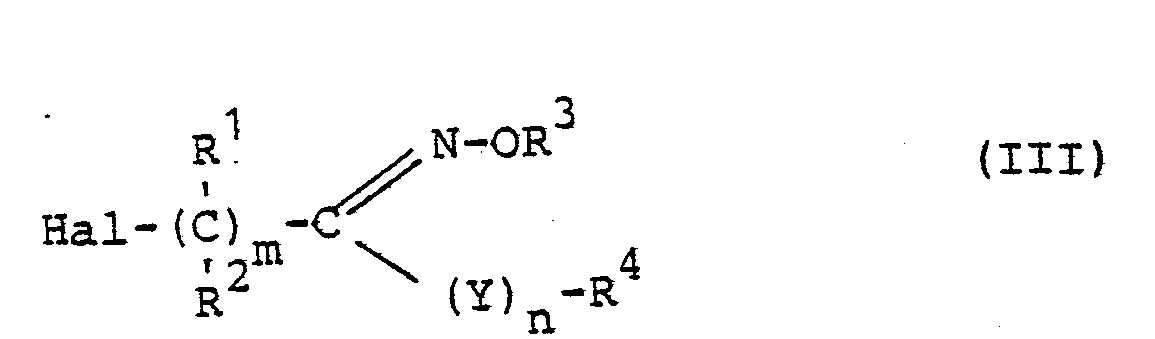
- b) Phenoxyphenole der Formel
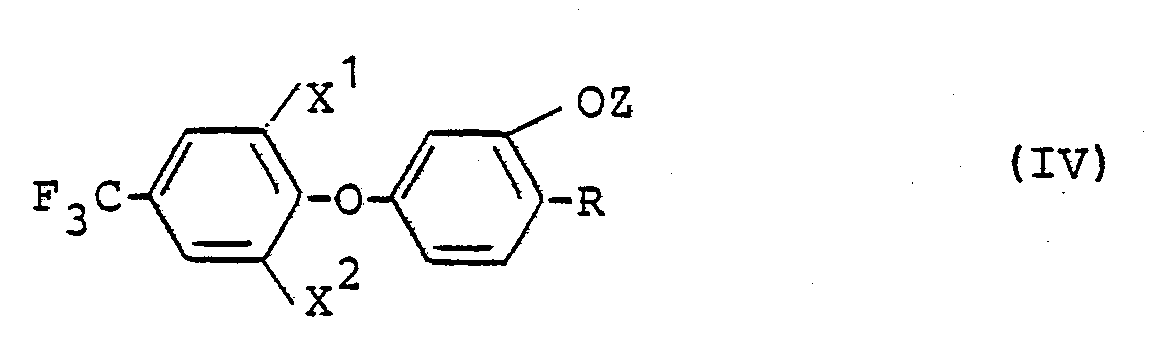

- c) Trifluormethylphenoxy-phenyl-Derivate der Formel


- d) Trifluormethylphenoxy-phenyl-Derivate der Formel


- e) Halogenide der Formel


- f) Nitrile der Formel

- g) Verbindungen der Formel

- h) Trifluormethylphenoxy-phenyl-Derivate der Formel

- i) Carbonyl-Derivate der Formel

- k) Trifluormethylbenzole der Formel

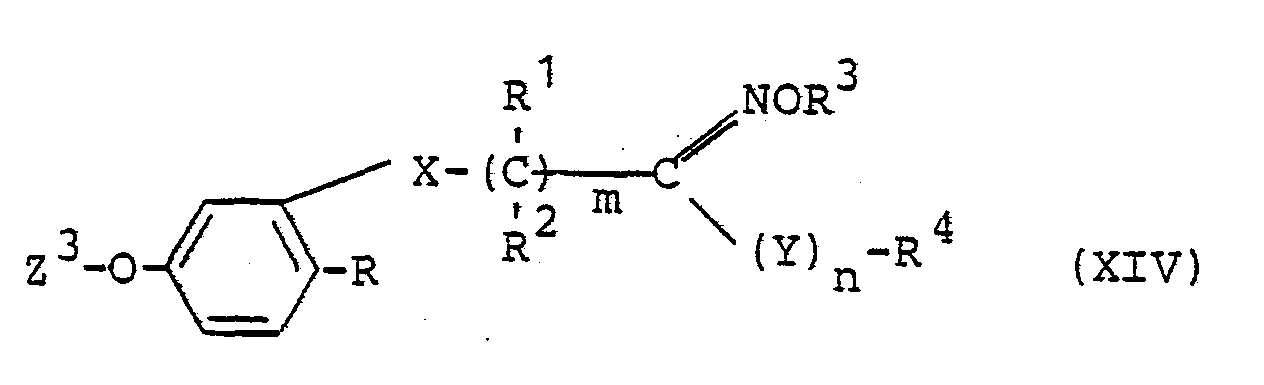
- 1) Säurehalogenide der Formel


- Schließlich wurde gefunden, daß sich die neuen Trifluormethyl-phenoxy-phenyl-Derivate der Formel (I) durch hervorragende herbizide Eigenschaften auszeichnen.
- überraschenderweise besitzen die erfindungsgemäßen Trifluormethylphenoxy-phenyl-Derivate der Formel (I) eine wesentlich bessere herbizide Wirksamkeit als der 2-[4-(2,4-Dichlorphenoxy)-phenoxy7-propionsäure-methylester, welcher ein konstitutionell ähnlicher vorbekannter Wirkstoff gleicher Wirkungsrichtung ist. Die erfindungsgemäßen Verbindungen lassen sich außerdem unerwarteterweise sehr gut zur Entlaubung von Pflanzen einsetzen.
- Die erfindungsgemäßen Trifluormethylphenoxy-phenyl-Derivate sind durch die Formel (I) allgemein definiert.
- In dieser Formel stehen vorzugsweise
- X1 für Wasserstoff, Fluor, Chlor, Nitro oder Cyano,
- X2 für Wasserstoff, Fluor oder Chlor,
- R für Wasserstoff oder Nitro,.
- X für Sauerstoff, eine -COO-Gruppe oder für die Gruppierung der Formel

- R1, R 2, R5 und R6 unabhängig voneinander für Wasserstoff, Methyl oder Ethyl,
- R 3 für Wasserstoff, Methyl, Ethyl, n-Propyl oder iso-Propyl, oder
- R 2 und R 3 gemeinsam für Ethandiyl,
- R4 für Wasserstoff, Methyl, Ethyl, n-Propyl oder iso-Propyl, oder
- R 3 und R 4 gemeinsam für Ethandiyl,
- Y für Sauerstoff, Schwefel, eine -NR7-Gruppe oder eine -CO-O-Gruppe,
- R7 für Wasserstoff, Methyl, Ethyl, n-Propyl oder iso-Propyl,
- m für die Zahl 1,
- n für die Zahlen 0 oder 1 und
- p für die Zahl 1.
- Bevorzugt sind außerdem die entsprechenden geometrischen und optischen Isomeren.
- Besonders bevorzugte optische Isomere sind dabei die R-bzw. S-Enantiomeren der Verbindungen der Formeln


- Als Beispiele für die erfindungsgemäßen Stoffe der For- meln (I) seien im einzelnen die in den folgenden Tabellen 1 und 2 formelmäßig aufgeführten Stoffe genannt.


- Verwendet man 5-(2,6-Dichlor-4-trifluormethyl-phenoxy)-2-nitro-benzoesäure und 2-Brom-1-methoximino-propan als Ausgangsstoffe, so kann der Verlauf des erfindungsgemäßen Verfahrens (a) durch das folgende Formelschema wiedergegeben werden:

- Verwendet man 5-(2-Chlor-4-trifluormethyl-phenoxy)-2-nitro-phenol und Chloressigsäure-2-(1-methoximino)-propylester als Ausgangsstoffe, so kann der Verlauf des erfindungsgemäßen Verfahrens (b) durch das folgende Formelschema wiedergegeben werden:

- Verwendet man 2-[3-(2,6-Dichlor-4-trifluormethyl-phenoxy)-phenoxy7-N-hydroxy-propionamid und 1,2-Dibromethan als Ausgangsstoffe, so kann der Verlauf des erfindungsgemäßen Verfahrens (c) durch das folgende Formelschema wiedergegeben werden:

- Verwendet man 2-[3-(2-Chlor-4-trifluormethyl-phenoxy)-phenoxy7-1-hydroximino-1-methoxy-propan und Dimethylsulfat als Ausgangsstoffe, so kann der Verlauf des erfindungsgemäßen Verfahrens (d) durch das folgende Formelschema wiedergegeben werden:
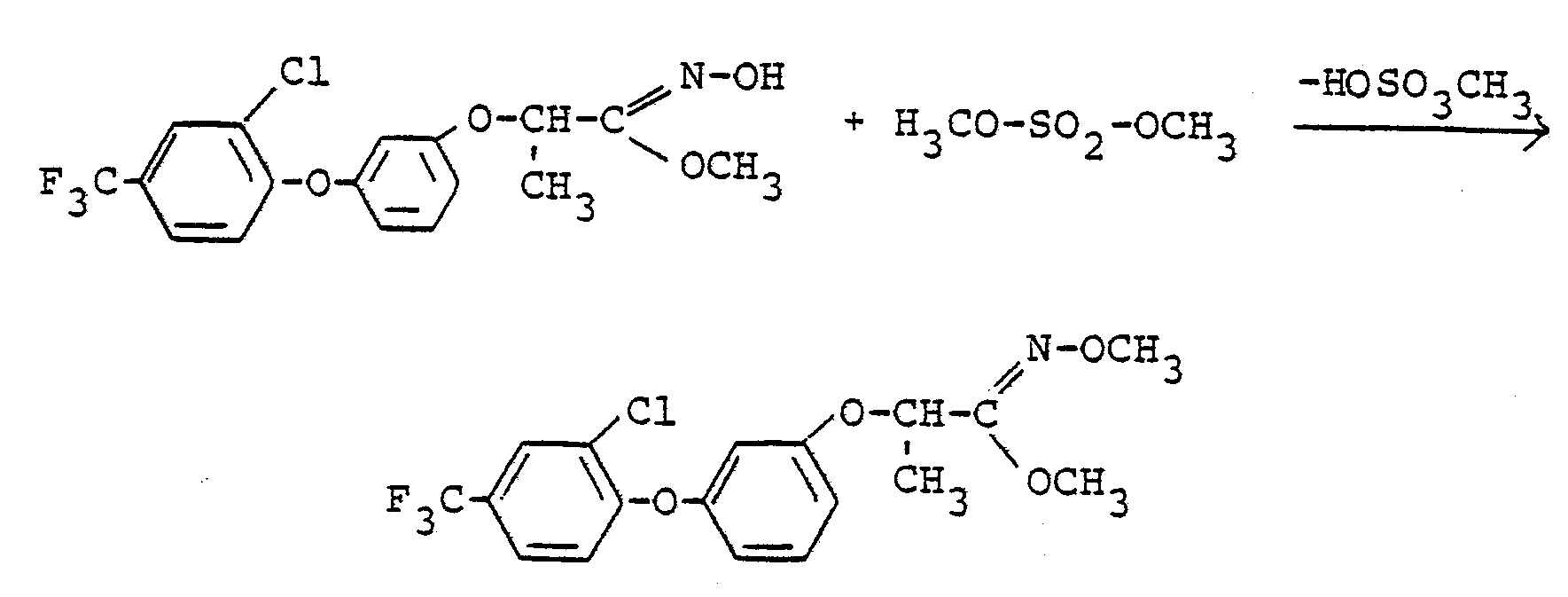
- Verwendet man 1-Chlor-2-[3-trifluormethyl-phenoxy)-phenoxy7-1-methoximino-ethan und Natriumethanolat als Ausgangsstoffe, so kann der Verlauf des erfindungsgemäßen Verfahrens (e) durch das folgende Formelschema wiedergegeben werden:
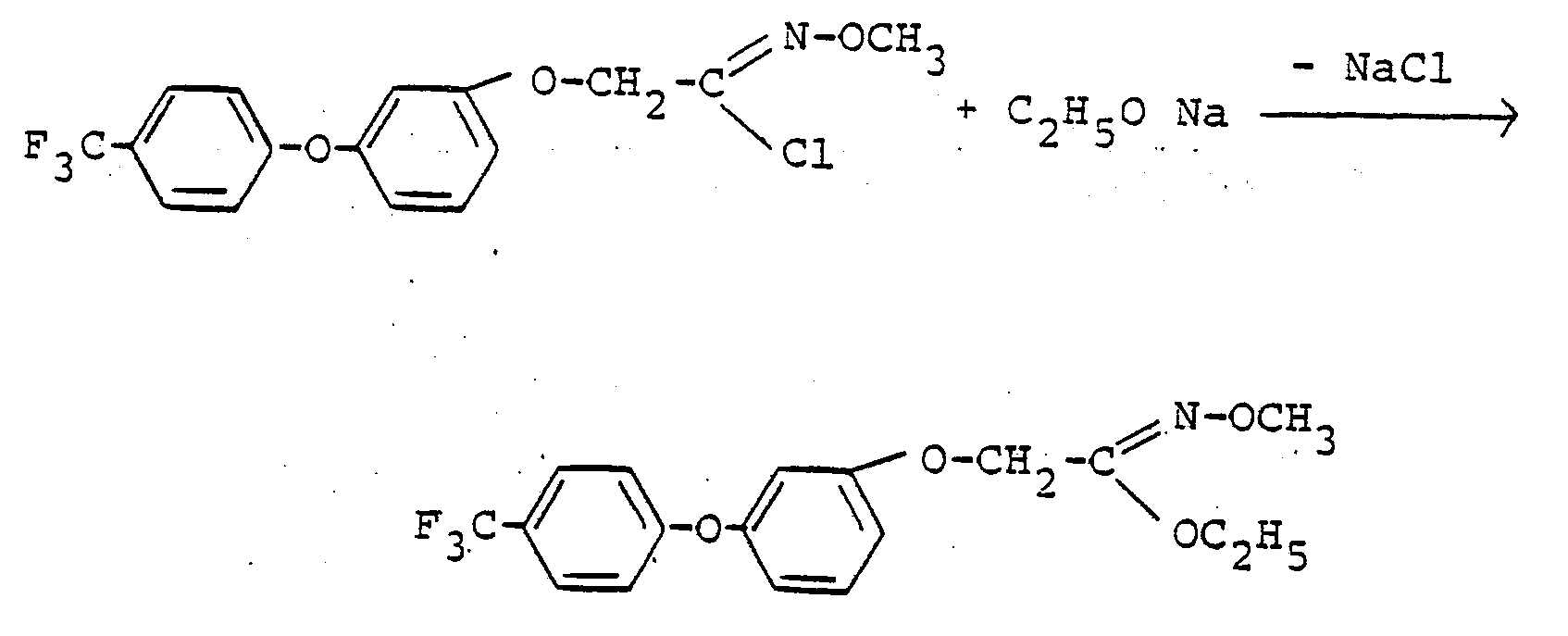
- Verwendet man 2-[3-(2-Chlor-4-trifluormethyl-phenoxy)-phenoxy7-acetonitril und Hydroxylamin als Ausgangsstoffe so kann der Verlauf des erfindungsgemäßen Verfahrens (f) durch das folgende Formelschema wiedergegeben werden:

- Verwendet man das Hydrochlorid des 2-[3-(2-Chlor-4-trifluormethyl-phenoxy)-ohenoxy]-imido-essigsäureethyl- esters und Hydroxylamin als Ausgangsstoffe, so kann der Verlauf des erfindungsgemäßen Verfahrens (g) durch das folgende Formelschema wiedergegeben werden:

- Verwendet man 3-(2,6-Dichlor-4-trifluormethyl-phenoxy)-benzoesäure-1-(1,4-diox-2-azin-3-yl)-ethylester und Salpetersäure als Ausgangsstoffe, so kann der Verlauf des erfindungsgemäßen Verfahrens (h) durch das folgende Formelschema wiedergegeben werden:

- Verwendet man 2-[3-(4-Trifluormethyl-phenoxy)-phenoxy]-propionsäureethylester und Hydroxylamin-Hydrochlorid als Ausgangsstoffe, so kann der Verlauf des erfindungsgemäßen Verfahrens (i) durch das folgende Formelschema wiedergegeben werden:

- Verwendet man 1,2,3-Trichlor-5-trifluormethyl-benzol und 1-(3-Hydroxy-phenoxy)-1-(1,4-diox-2-azin-3-yl)-ethan als Ausgangsstoffe, so kann der Verlauf des erfindungsgemäßen Verfahrens (k) durch das folgende Formelschema wiedergegeben werden:

- Verwendet man 2-[3-(4-Trifluormethylphenoxy)-phenoxy]-propionsäurechlorid und 1-Methoximino-2-propanol als Ausgangsstoffe, so kann der Verlauf des erfindungsgemäßen Verfahrens (1) durch das folgende Formelschema wiedergegeben werden:
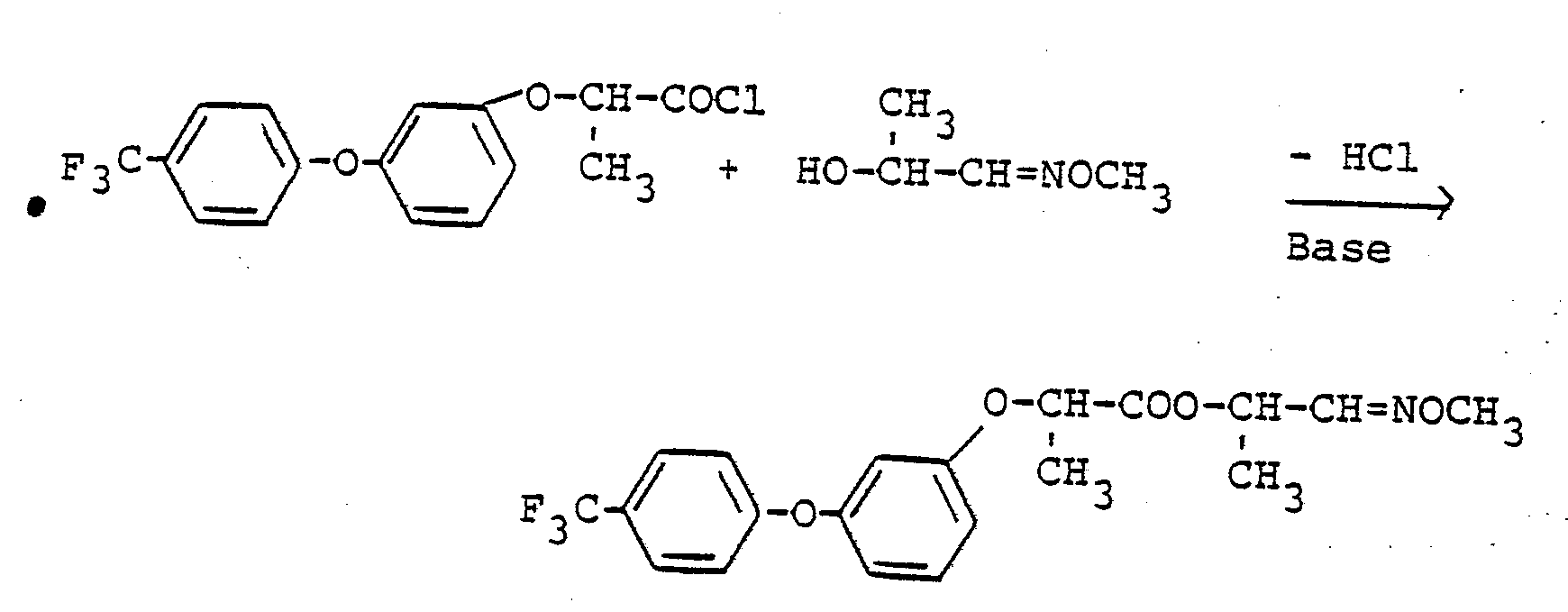
- Die bei der Durchführung des erfindungsgemäßen Verfahrens (a) als Ausgangsstoffe benötigten Diphenylether sind durch die Formel (II) definiert. In dieser Formel haben X1, x2, X und R vorzugsweise diejenigen Bedeutungen, die bereits in Zusammenhang mit der Beschreibung der erfindungsgemäßen Stoffe der Formel (I) für diese Reste vorzugsweise genannt wurden.
- Die Verbindungen der Formel (II) sind bereits bekannt oder lassen sich nach üblichen Methoden in einfacher Weise herstellen (vergl. DE-OS 2 311 638, GB-PS 2 058 055 und US-PS 4 031 131).
- Die weiterhin bei dem erfindungsgemäßen Verfahren (a) als Ausgangsstoffe benötigten Verbindungen sind durch die Formel (III) definiert. In dieser Formel haben R 1, R 2, R 3, R 4, Y, m und n vorzugsweise diejenigen Bedeutungen, die bereits in Zusammenhang mit der Beschreibung der erfindungsgemäßen Stoffe der Formel (I) vorzugsweise für diese Reste bzw. Indices genannt wurden. Hal steht für Chlor oder Brom.
- Die Verbindungen der Formel (III) sind bekannt (vgl.
- US-PS 3 896 189, DE-OS 29 22 759,, DE-OS 31 00 728 und DE-OS 19 37 454) oder lassen sich nach üblichen Methoden in einfacher Weise herstellen.
- So erhält man Verbindungen der Formel (III) z.B. dadurch, daß man
- - die zugrunde liegenden Carbonylverbindungen mit Hydroxylamin bzw. Hydroxylamin-Derivaten in Gegenwart eines Lösungsmittels, wie z.B. eines Alkohols, bei Temperaturen zwischen 0°C und 100°C, vorzugsweise zwischen 0°C und 80°C umsetzt. Das Hydroxylamin bzw. Hydroxylamin-Derivat wird dabei vorzugsweise in Form eines Salzes, insbesondere als Hydrochlorid, gegebenenfalls in Gegenwart eines Säurebindemittels, wie beispielsweise Natriumacetat, eingesetzt.
- Außerdem lassen sich Verbindungen der Formel (III) auch dadurch herstellen, daß man Verbindungen der Formel


- Bei der Durchführung des erfindungsgemäßen Verfahrens (a) arbeitet man vorzugsweise in Gegenwart eines Säureakzeptors. Als solche können alle üblichen Säurebindemittel Verwendung finden. Vorzugsweise in Frage kommen Alkali-hydroxide, wie z.B. Natrium- und Kalium-hydroxid, Alkalicarbonate und -alkoholate, wie Natrium- und Kaliumcarbonat, Natrium- und Kaliummethylat bzw. -ethylat, ferner aliphatische, aromatische oder heterocyclische Amine, beispielsweise Triethylamin, Trimethylamin, Dimethylanilin, Dimethylbenzylamin, Pyridin, Diazabicylooctan, 1, 5-Diazabicyclo[4,3,0]-non-5-en und 1,8-Diazabi-- cyclo[5,4,0]undec-7-en.
- Als Verdünnungsmittel können bei der Durchführung des erfindungsgemäßen Verfahrens (a) praktisch alle inerten organischen Solventien verwendet werden. Vorzugsweise in Betracht kommen aliphatische und aromatische, gegebenenfalls halogenierte Kohlenwasserstoffe, wie Pentan, Hexan, Heptan, Cyclohexan, Petrolether, Benzin, Ligroin, Benzol, Toluol, Xylol, Methylenchlorid, Ethylenchlorid, Chloroform, Tetrachlorkohlenstoff, Chlorbenzol und o-Dichlorbenzol, ferner Ether, wie Diethylether und Dibutylether, Glycoldimethylether und Diglycoldimethylether, Tetrahydrofuran und Dioxan, außerdem Ketone, wie Aceton, Methylethyl-, Methyl-isopropyl- und Methyl-isobutylketon, Ester wie Essigsäure-methylester und -ethylester, weiterhin Nitrile, z.B. Acetonitril und Propionitril, darüber hinaus Amide, wie z.B. Dimethylformamid, Dimethylacetamid und N-Methyl-pyrrolidon, sowie stark polare Solventien wie Dimethylsulfoxid, Tetramethylensulfon und Hexamethylphosphorsäuretriamid.
- Die Reaktionstemperaturen können bei der Durchführung des erfindungsgemäßen Verfahrens (a) innerhalb eines größeren Bereichs variiert werden. Im allgemeinen arbeitet man bei Temperaturen zwischen -20°C und +150°C, vorzugsweise zwischen 0°C und +120°C.
- Das erfindungsgemäße Verfahren (a) wird im allgemeinen bei Normaldruck ausgeführt.
- Bei der Durchführung des erfindungsgemäßen Verfahrens (a) werden die Ausgangsstoffe der Formeln (II) und (III) im allgemeinen in etwa äquimolaren Mengen eingesetzt. Ein Überschuß der einen oder anderen Komponente ist möglich. Die Umsetzung wird im allgemeinen in einem geeigneten Verdünnungsmittel in Gegenwart eines Säureakzeptors durchgeführt, und das Reaktionsgemisch wird mehrere Stunden bei der erforderlichen Temperatur gerührt. Die Aufarbeitung erfolgt nach üblichen Methoden.
- Die neuen Verbindungen fallen zum Teil in Form von ölen an, die sich zum Teil nicht unzersetzt destillieren lassen, jedoch durch sogenanntes "Andestillieren", d.h. durch längeres Erhitzen unter vermindertem Druck auf mäßig erhöhte Temperatur von den letzten flüchtigen Anteilen befreit und auf diese Weise gereinigt werden können.
- Zur Charakterisierung der neuen Substanzen dient der Brechungsindex. Soweit die neuen Produkte in fester Form anfallen, können sie durch Umkristallisation gereinigt werden. Zur Charakterisierung dient dann der Schmelzpunkt.
- Die bei der Durchführung des erfindungsgemäßen Verfahrens (b) als Ausgangsstoffe benötigten Phenoxyphenole sind durch die Formel (IV) definiert. In dieser Formel haben X1, x2 und R vorzugsweise diejenigen Bedeutungen, die bereits im Zusammenhang mit der Beschreibung der erfindungsgemäßen Stoffe der Formel (I) vorzugsweise für diese Reste genannt wurden.
- Z steht vorzugsweise für Wasserstoff, Natrium, Kalium oder für ein Calcium-Äquivalent.
- Die Phenoxyphenole der Formel (IV) sind bekannt (vgl. US-PS 3 928 416).
- Die außerdem bei dem Verfahren (b) als Ausgangsstoffe einzusetzenden Verbindungen sind durch die Formel (V) definiert. In dieser Formel haben R 1, R2, R3, R4, R5, R6,Y, m, n und p vorzugsweise diejenigen Bedeutungen, die bereits im Zusammenhang mit der Beschreibung der erfindungsgemäßen Stoffe der Formel (I) vorzugsweise für diese Reste bzw. Indices genannt wurden. Hal1 steht für Chlor oder Brom.
- Die Verbindungen der Formel (V) sind neu. Sie lassen sich dadurch herstellen, daß man
- α Carbonylverbindungen der Formel

- ß) Verbindungen der Formel

- γ) Alkohole der Formel

- δ) Alkohole der Formel


- Als Säureakzeptoren können bei dem erfindungsgemäßen Verfahren (b) alle üblichen Säurebindemittel verwendet werden. Vorzugsweise in Frage kommen alle diejenigen Säurebinder, die im Zusammenhang mit der Beschreibung des erfindungsgemäßen Verfahrens (a) genannt wurden.
- Als Verdünnungsmittel können bei der Durchführung des erfindungsgemäßen Verfahrens (b) praktisch alle inerten organischen Solventien verwendet werden. Vorzugsweise in Betracht kommen diejenigen Verdünnungsmittel, die im Zusammenhang mit der Beschreibung des erfindungsgemäßen Verfahrens (a) genannt wurden.
- Die Reaktionstemperaturen können bei der Durchführung des erfindungsgemäßen Verfahrens (b) innerhalb eines größeren Bereiches variiert werden. Im allgemeinen arbeitet man bei Temperaturen zwischen -20°C und +150°C, vorzugsweise zwischen 0°C und +120°C.
- Das erfindungsgemäße Verfahren (b) wird im allgemeinen bei Normaldruck ausgeführt.
- Bei der Durchführung des erfindungsgemäßen Verfahrens (b) werden die Ausgangsstoffe der Formeln (IV) und (V) im allgemeinen in etwa äquimolaren Mengen eingesetzt. Ein Überschuß der einen oder anderen Komponente ist möglich. Die Umsetzung wird im allgemeinen in einem geeigneten Verdünnungsmittel in Gegenwart eines Säureakzeptors durchgeführt, und das Reaktionsgemisch wird mehrere Stunden bei der erforderlichen Temperatur gerührt. Die Aufarbeitung und die Reinigung der Substanzen erfolgen nach üblichen Methoden.
- Die bei der Durchführung des erfindungsgemäßen Verfahrens (c) als Ausgangsstoffe benötigten Trifluormethyl-phenoxyphenyl-Derivate sind durch die Formel (Ia) definiert. In dieser Formel haben X , X , X, R, R , R und m vorzugsweise diejenigen Bedeutungen, die bereits im Zusammenhang mit der Beschreibung der erfindungsgemäßen Stoffe der Formel (I) vorzugsweise für diese Reste bzw. diesen Index genannt wurden.
- Die Verbindungen der Formel (Ia) sind neu; sie lassen sich jedoch nach den erfindungsgmäßen Verfahren (a), (b), (e), (g), (h), (i), (k) und (1) in einfacher Weise herstellen.
- Die außerdem bei dem Verfahren (c) als Ausgangsstoffe einzusetzenden Dihalogenalkane sind durch die Formel (VI) definiert. In dieser Formel steht q für die Zahlen 1, 2 oder 3, und Hal2 steht jeweils für Chlor oder Brom.
- Die Verbindungen der Formel (VI) sind allgemein bekannte Verbindungen der organischen Chemie.
- Als Säureakzeptoren können bei dem erfindungsgemäßen Verfahren (c) alle üblichen Säurebindemittel verwendet werden. Vorzugweise in Frage kommen alle diejenigen Säurebinder, die im Zusammenhang mit der Beschreibung des erfindungsgemäßen Verfahrens (a) genannt wurden.
- Als Verdünnungsmittel können bei der Durchführung des erfindungsgemäßen Verfahrens (c) praktisch alle inerten organischen Solventien verwendet werden. Vorzugsweise in Betracht kommen diejenigen Verdünnungsmittel, die im Zusammenhang mit der Beschreibung des erfindungsgemäßen Verfahrens (a) genannt wurden.
- Die Reaktionstemperaturen können bei der Durchführung des erfindungsgemäßen Verfahrens (c) innerhalb eines größeren Bereiches variiert werden. Im allgemeinen arbeitet man bei Temperaturen zwischen -20°C und +120°C, vorzugsweise zwischen 0°C und +80°C.
- Das erfindungsgemäße Verfahren (c) wird im allgemeinen bei Normaldruck ausgeführt.
- Bei der Durchführung des erfindungsgemäßen Verfahrens (c) werden die Ausgangsstoffe der Formeln (Ia) und (VI) im allgemeinen in etwa äquimolaren Mengen eingesetzt. Ein Überschuß der einen oder anderen Komponente ist möglich. Die Umsetzung wird im allgemeinen in einem geeigneten verdünnungsmittel in Gegenwart eines Säureakzeptors durchgeführt, und das Reaktionsgemisch wird mehrere Stunden bei der erforderlichen Temperatur gerührt. Die Aufarbeitung erfolgt nach üblichen Methoden.
- Sofern eine Reinigung der bei dem erfindungsgemäßen Verfahren (c) anfallenden Verbindungen erforderlich ist, so wird diese nach den Methoden vorgenommen, die bereits im Zusammenhang mit der Beschreibung'des erfindungsgemäßen Verfahrens (a) genannt wurden.
- Die bei der Durchführung des erfindungsgemäßen Verfahrens (d) als Ausgangsstoffe benötigten Trifluormethylphenoxy-phenyl-Derivate sind durch die Formel (Ib) defi- niert. In dieser Formel haben X1, X2, X, R, R 1, R 2, R 4, Y, m und n vorzugsweise diejenigen Bedeutungen, die bereits in Zusammenhang mit der Formel (I) vorzugsweise für diese Reste bzw. Indices genannt wurden.
- Die Verbindungen der Formel (Ib) sind neu; sie lassen sich jedoch nach den erfindungsgemäßen Verfahren (a), (b), (e), (f), (g), (i), (k) und (1) in einfacher Weise herstellen.
- Die weiterhin bei dem Verfahren (d) als Ausgangsstoffe einzusetzenden Alkylierungsmittel sind durch die Formel (VII) definiert. In dieser Formel steht R3' vorzugsweise für Methyl, Ethyl, n-Propyl und iso-Propyl. Z steht für Chlor, Brom, eine p-Toluolsulfonyl-Gruppe oder für die Gruppierung R80-S02-0-, worin R8 für Wasserstoff, Methyl, Ethyl, n-Propyl oder iso-Propyl steht.
- Die Verbindungen der Formel (VII) sind allgemein bekannte Verbindungen der organischen Chemie.
- Als Säureakzeptoren können bei dem erfindungsgemäßen Verfahren (d) alle üblichen Säurebindemittel verwendet werden. Vorzugsweise in Frage kommen alle diejenigen Säurebinder, die im Zusammenhang mit der Beschreibung des erfindungsgemäßen Verfahrens (a) genannt wurden.
- Als Verdünnungsmittel können bei der Durchführung des erfindungsgemäßen Verfahrens (d) praktisch alle inerten organischen Solventien verwendet werden. Vorzugsweise in Betracht kommen diejenigen Verdünnungsmittel, die im Zusammenhang mit der Beschreibung des erfindungsgemäßen Verfahrens (a) genannt wurden.
- Die Reaktionstemperaturen können bei der Durchführung des erfindungsgemäßen Verfahrens (d) innerhalb eines größeren Bereiches variiert werden. Im allgemeinen arbeitet man bei Temperaturen zwischen -20°C und +120°C, vorzugsweise zwischen -10°C und +100°C.
- Das erfindungsgemäße Verfahren (d) wird im allgemeinen .bei Normaldruck ausgeführt.
- Bei der Durchführung des erfindungsgemäßen Verfahrens (d) werden die Ausgangsstoffe der Formeln (Ib) und (VII) im allgemeinen in etwa äquimolaren Mengen eingesetzt. Ein Überschuß der einen oder anderen Komponente ist möglich. Die Umsetzung wird im allgemeinen in einem geeigneten Verdünnungsmittel in Gegenwart eines Säureakzeptors durchgeführt,und das Reaktionsgemisch wird mehrere Stunden bei der erforderlichen Temperatur gerührt. Die Aufarbeitung und die Reinigung der Substanzen erfolgen nach üblichen Methoden.
- Die bei der Durchführung des erfindungsgemäßen Verfahrens (e) als Ausgangsstoffe benötigten Halogenide sind durch die Formel (VIII) definiert. In dieser For- mel haben X 1, X 2, X, R, Rl, R 2, R3 und m vorzugsweise diejenigen Bedeutungen, die bereits im Zusammenhang mit der Beschreibung der erfindungsgemäßen Stoffe der Formel (I) vorzugsweise für diese Reste bzw. diesen Index genannt wurden. Hal3 steht für Chlor oder Brom.
- Die Halogenide der Formel (VIII) sind neu. Sie lassen sich herstellen, indem man Hydroxamsäure-Derivate der Formel


- Die Verbindungen der Formeln (Ih) und (Ii) sind ebenfalls neu; sie lassen sich jedoch nach den erfindungsgemäßen Verfahren (a) - (i) in einfacher Weise herstellen.
- Die weiterhin bei dem Verfahren (e) als Ausgangsstoffe einzusetzenden Verbindungen sind durch die Formel (IX) definiert. In dieser Formel hat R4 vorzugsweise diejenigen Bedeutungen, die bereits im Zusammenhang mit der Beschreibung der erfindungsgemäßen Stoffe der Formel (I) vorzugsweise diesen Rest genannt wurden. Z2 steht vorzugsweise für Wasserstoff oder ein Äquivalent eines Natrium-, Kalium- oder Calciumions. Q steht vorzugsweise für Sauerstoff, Schwefel oder für NR7, worin R vorzugsweise für Wasserstoff, Methyl, Ethyl, n-Propyl oder iso-Propyl steht. - Die Verbindungen der Formel (IX) sind bekannt.
- Als Säureakzeptoren können bei dem erfindungsgemäßen Verfahren (e) alle üblichen Säurebindemittel verwendet werden. Vorzugsweise in Frage kommen alle diejenigen Säurebinder, die im Zusammenhang mit der Beschreibung des erfindungsgemäßen Verfahrens (a) genannt wurden.
- Als Verdünnungsmittel können bei der Durchführung des erfindungsgemäßen Verfahrens (e) praktisch alle inerten organischen Solventien verwendet werden. Vorzugsweise in Betracht kommen diejenigen Verdünnungsmittel, die im Zusammenhang mit der Beschreibung des erfindungsgemäßen Verfahrens (a) genannt wurden.
- Die Reaktionstemperaturen können bei der Durchführung des erfindungsgemäßen Verfahrens (e) innerhalb eines größeren Bereiches variiert werden. Im allgemeinen arbeitet man bei Temperaturen zwischen -20 und +150°C, vorzugsweise zwischen -10 und +120°C.
- Das erfindungsgemäße Verfahren (e) wird im allgemeinen bei Normaldruck ausgeführt.
- Bei der Durchführung des erfindungsgemäßen Verfahrens (e) werden die Ausgangsstoffe der Formeln (VIII) und (IX) im allgemeinen in etwa äquimolaren Mengen eingesetzt. Ein Überschuß der einen oder anderen Komponente ist möglich. Die Umsetzung wird im allgemeinen in einem geeigneten Verdünnungsmittel in Gegenwart eines Säureakzeptors durchgeführt, und das Reaktionsgemisch wird mehrere Stunden bei der erforderlichen Temperatur gerührt. Die Aufarbeitung und die Reinigung der Substanzen erfolgen nach üblichen Methoden.
- Die bei der Durchführung des erfindungsgemäßen Verfahrens (f) als Ausgangsstoffe benötigten Nitrile sind durch die Formel (X) definiert. In dieser Formel haben X , X , X, R, R 1, R 2 und m vorzugsweise diejenigen Bedeutungen, die bereits im Zusammenhang mit der Beschreibung der erfindungsgemäßen Stoffe der Formel (I) vorzugsweise für diese Reste bzw. für diesen Index genannt wurden.
- Die Verbindungen der Formel. (X) sind teilweise bekannt (vgl. DE-OS 2 613 697). Sie können erhalten werden, indem man Verbindungen der Formel (II) mit entsprechenden Halogen-nitrilen in Gegenwart eines inerten organischen Lösungsmittels, wie z.B. Acetonitril und gegebenenfalls in Gegenwart eines Säurebindemittels, wie z.B. Kaliumcarbonat, sowie gegebenenfalls in Gegenwart eines Katalysators, wie z.B. Natriumiodid, bei Temperaturen zwischen 0. und 100°C umsetzt.
- Als Säureakzeptoren können bei dem erfindungsgemäßen Verfahren (f) alle üblichen Säurebindemittel verwendet werden. Vorzugsweise in Frage kommen alle diejenigen Säurebinder, die im Zusammenhang mit der Beschreibung des erfindungsgemäßen Verfahrens (a) genannt wurden.
- Als Verdünnungsmittel können bei der Durchführung des erfindungsgemäßen Verfahrens (f) praktisch alle inerten organischen Solventien verwendet werden. Vorzugsweise in Betracht kommen diejenigen Verdünnungsmittel, die im Zusammenhang mit der Beschreibung des erfindungsgemäßen Verfahrens (a) genannt wurden.
- Die Reaktionstemperaturen können bei der Durchführung des erfindungsgemäßen Verfahrens (f) innerhalb eines größeren Bereichs variiert werden. Im allgemeinen arbeitet man bei Temperaturen zwischen -20 und +120°C, vorzugsweise zwischen -10 und +100°C.
- Das erfindungsgemäße Verfahren (f) wird im allgemeinen bei Normaldruck ausgeführt.
- Bei der Durchführung des erfindungsgemäßen Verfahrens (f) setzt man vorzugsweise auf 1 Mol der Verbindungen der Formel (X), 1 bis 2 Mol Hydroxylamin bzw. das entsprechende Hydrochlorid oder Hydrobromid ein. Die Umsetzung wird im allgemeinen in einem geeigneten Verdünnungsmittel in Gegenwart eines Säureakzeptors durchgeführt, und das Reaktionsgemisch wird mehrere Stunden bei der erforderlichen Temperatur gerührt. Die Aufarbeitung und die Reinigung der Substanzen erfolgen nach üblichen Methoden.
- Die bei der Durchführung des erfindungsgemäßen Verfahrens (g) als Ausgangsstoffe benötigten Verbindungen sind durch die Formel (XI) definiert. In dieser Formel haben X , X , X, R, R , R , R und m vorzugsweise diejenigen Bedeutungen, die bereits im Zusammenhang mit der Beschreibung der erfindungsgemäßen Stoffe der Formel (I) vorzugsweise für diese Reste bzw. für diesen Index genannt wurden. Y1 steht für Sauerstoff oder Schwefel.
- Die Verbindungen der Formel (XI) sind neu. Sie lassen sich herstellen, indem man Nitrile der Formel


- Die Verbindungen der Formel (XXII) sind allgemein bekannte Verbindungen der organischen Chemie.
- Als Säureakzeptoren können bei dem erfindungsgemäßen Verfahren (g) alle üblichen Säurebindemittel verwendet werden. Vorzugsweise in Frage kommen alle diejenigen Säurebinder, die im Zusammenhang mit der Beschreibung des erfindungsgemäßen Verfahrens (a) genannt wurden.
- Als Verdünnungsmittel können bei der Durchführung des erfindungsgemäßen Verfahrens (g) praktisch alle inerten organischen Solventien verwendet werden. Vorzugsweise in Betracht kommen diejenigen Verdünnungsmittel, die im Zusammenhang mit der Beschreibung des erfindungsgemäßen Verfahrens (a) genannt wurden.
- Die Reaktionstemperaturen können bei der Durchführung des erfindungsgemäßen Verfahrens (g) innerhalb eines größeren Bereiches variiert werden. Im allgemeinen arbeitet man bei Temperaturen zwischen -20 und +50°C, vorzugsweise zwischen -10 und +30°C.
- Das erfindungsgemäße Verfahren (g) wird im allgemeinen bei Normaldruck ausgeführt.
- Bei der Durchführung des erfindungsgemäßen Verfahrens (g) setzt man vorzugsweise auf 1 Mol der Verbindungen der Formel (XI), 1 bis 2 Mol Hydroxylamin bzw. Hydroxylamin-hydrochlorid oder Hydroxylaminhydrobromid ein. Die Umsetzung wird im allgemeinen in einem geeigneten Verdünnungsmittel in Gegenwart eines Säureakzeptors durchgeführt, und das Reaktionsgemisch wird bei der erforderlichen Temperatur gerührt. Die Aufarbeitung und die Reinigung der Substanzen erfolgen nach üblichen Methoden.
- Die bei der Durchführung des erfindungsgemäßen Verfahrens (h) als Ausgangsstoffe benötigten Trifluormethyl-phenoxy-phenyl-Derivate, sind durch die Formel (Ic) definiert. In dieser Formel haben X, X 1, X 2, R 1, R 2, R 3, R 4, Y, m und n vorzugsweise diejenigen Bedeutungen, die bereits im Zusammenhang mit der Beschreibung der erfindungsgemäßen Stoffe der Formel (I) vorzugsweise für diese Reste bzw. Indices genannt wurden.
- Die bei dem erfindungsgemäßen Verfahren (h) als Ausgangsstoffe benötigten Verbindungen der Formel (Ic) sind neu; sie lassen sich jedoch nach den erfindungsgemäßen Verfahren (a) - (g) und Verfahren (i), (k) und (1) in einfacher Weise herstellen.
- Zur Nitrierung verwendet man im Falle des erfindungsgemäßen Verfahrens (h) vorzugsweise konzentrierte Salpetersäure.
- Das erfindungsgemäße Verfahren (h) wird gegebenenfalls unter Verwendung eines Verdünnungsmittels durchgeführt. Als Verdünnungsmittel kommen hierbei vorzugsweise halogenierte Kohlenwasserstoffe, wie z.B. Methylenchlorid, in Betracht.
- Das erfindungsgemäße Verfahren (h) wird gegebenenfalls in Gegenwart eines Katalysators durchgeführt. Als Katalysatoren kommen vorzugsweise Protonensäuren, wie z.B. Schwefelsäure oder Essigsäure, in Betracht.
- Die Reaktionstemperatur wird bei Verfahren (h) im allgemeinen zwischen -20 und +80°C, vorzugsweise zwischen 0 und 50°C gehalten. Verfahren (h) wird im allgemeinen bei Normaldruck durchgeführt.
- Zur Durchführung des erfindungsgemäßen Verfahrens (h) setzt man auf 1 Mol einer Verbindung mit der Formel (Ic) im allgemeinen 0,9 bis 2 Mol, vorzugsweise 1,0 bis 1,3 Mol an Salpetersäure und gegebenenfalls etwa die gleiche Menge eines Katalysators ein. Die Ausgangskomponenten werden vorzugsweise unter Eiskühlung zusammengegeben und dann gegebenenfalls bei leicht erhöhter Temperatur bis zum Ende der Umsetzung gerührt.
- Die Aufarbeitung erfolgt nach üblichen Methoden. Im allgemeinen verfährt man in der Weise, daß man das Reaktionsgemisch nach beendeter Umsetzung in Eiswasser.ein- gießt, absaugt und das anfallende Produkt gegebenenfalls durch Umkristallisieren reinigt.
- Die beim erfindungsgemäßen Verfahren (i) als Ausgangsstoffe benötigten Carbonyl-Derivate sind durch die Formel (XII) definiert. In dieser Formel haben X, X1, x2, R, R 1, R und m vorzugsweise diejenigen Bedeutungen, die bereits im Zusammenhang mit der Beschreibung der erfindungsgemäßen Stoffe der Formel (I) vorzugsweise für diese Reste bzw. für diesen Index genannt wurden. R9 steht vorzugsweise für Wasserstoff oder C1-C4-Alkyl.
- Die Carbonyl-Derivate der Formel (XII) sind bekannt oder lassen sich nach üblichen Methoden in einfacher Weise herstellen (vgl. DE-AS 2 304 006, GB-PS 2 058 055 und EP-OS 28 277).
- Als Säureakzeptoren können bei dem erfindungsgemäßen Verfahren (i) alle üblichen Säurebindemittel verwendet werden. Vorzugsweise in Frage kommen alle diejenigen Säurebinder, die im Zusammenhang mit der Beschreibung des'erfindungsgemäßen Verfahrens (a) genannt wurden.
- Als Verdünnungsmittel können bei der Durchführung des erfindungsgemäßen Verfahrens (i) praktisch alle inerten organischen Solventien verwendet werden. Vorzugsweise in Betracht kommen diejenigen Verdünnungsmittel, die im Zusammenhang mit der Beschreibung des erfindungsgemäßen Verfahrens (a) genannt wurden.
- Die Reaktionstemperaturen können bei der Durchführung des erfindungsgemäßen Verfahrens (i) innerhalb eines größeren Bereiches variiert werden. Im allgemeinen arbeitet man bei Temperaturen zwischen -20 und +120°C, vorzugsweise zwischen -10 und +80°C.
- Das erfindungsgemäße Verfahren (i) wird im allgemeinen bei Normaldruck ausgeführt.
- Bei der Durchführung des erfindungsgemäßen Verfahrens (i) setzt man vorzugsweise auf 1 Mol Carbonyl-Derivat der Formel (XII) 1 bis 2 Mol Hydroxylamin oder Hydroxylaminhydrochlorid ein. Die Umsetzung wird im allgemeinen in einem geeigneten Verdünnungsmittel in Gegenwart eines Säureakzeptors durchgeführt, und das Reaktionsgemisch wird bei der erforderlichen Temperatur gerührt. Die Aufarbeitung und die Reinigung der Substanzen erfolgt nach üblichen Methoden.
- Die beim erfindungsgemäßen Verfahren (k) benötigten Trifluormethylbenzole sind durch die Formel (XIII) definiert. In dieser Formel haben X1und X vorzugsweise diejenigen Bedeutungen, die bereits im Zusammenhang mit der Beschreibung der erfindungsgemäßen Stoffe der Formel (I) vorzugsweise für diese Reste genannt wurden. Hal4 steht für Chlor und Brom.
- Die Trifluormethylbenzole der Formel (XIII) sind allgemein bekannte Verbindungen der organischen Chemie.
- Die weiterhin für das Verfahren (k) als Ausgangsstoffe benötigten Verbindungen sind durch Formel (XIV) defi- niert. In dieser Formel haben X, R, R 1, R2 1 R 3, R 4, Y, m und n vorzugsweise diejenigen Bedeutungen, die bereits im Zusammenhang mit der Beschreibung der erfindungsgemäßen Stoffe der Formel (I) vorzugsweise für diese Reste bzw. Indices genannt wurden und Z3 steht vorzugsweise für Wasserstoff, Natrium oder Kalium oder für ein Äquivalent eines Calciumions.
- Die Verbindungen der Formel (XIV) sind teilweise bekannt. Sie lassen sich analog den erfindungsgemäßen Verfahren (a), (b), (c), (d), (e), (f), (g) und (i) in einfacher Weise herstellen.
- Als Säureakzeptoren können bei dem erfindungsgemäßen Verfahren (k) alle üblichen Säurebindemittel verwendet werden. Vorzugsweise in Frage kommen alle diejenigen Säurebinder, die im Zusammenhang mit der Beschreibung des erfindungsgemäßen Verfahrens (a) genannt wurden.
- Als Verdünnungsmittel können bei der Durchführung des erfindungsgemäßen Verfahrens (k) praktisch alle inerten organischen Solventien verwendet werden. Vorzugsweise in Betracht kommen diejenigen Verdünnungsmittel, die im Zusammenhang mit der Beschreibung des erfindungsgemäßen Verfahrens (a) genannt wurden.
- Die Reaktionstemperaturen können bei der Durchführung des erfindungsgemäßen Verfahrens (k) innerhalb eines größeren Bereiches variiert werden. Im allgemeinen arbeitet man bei Temperaturen zwischen 0°C und 180°C, vorzugsweise zwischen 60° und 140°C.
- Das erfindungsgemäße Verfahren (k) wird im allgemeinen bei Normaldruck ausgeführt.
- Bei der Durchführung des erfindungsgemäßen Verfahrens (k) werden die Ausgangsstoffe der Formeln (XIII) und (XIV) im allgemeinen in etwa äquimolaren Mengen eingesetzt. Ein Überschuß der einen oder anderen Komponente ist möglich. Die Umsetzung wird im allgemeinen in einem geeigneten Verdünnungsmittel in Gegenwart eines Säureakzeptors durchgeführt, und das Reaktionsgemisch wird mehrere Stunden bei der erforderlichen Temperatur gerührt. Die Aufarbeitung und die Reinigung der Substanzen erfolgen nach üblichen Methoden.
- Die für das erfindungsgemäße Verfahren (1) als Ausgangsstoffe benötigten Säurehalogenide sind durch die Formel (XV) definiert. In dieser Formel haben X 1, X2 und R vorzugsweise diejenigen Bedeutungen, die bereits im Zusammenhang mit der Beschreibung der erfindunsgemäßen Stoffe der Formel (I) vorzugsweise für diese Reste genannt wurden, und A steht für eine -CO-Gruppe oder die Gruppierung der Formel

- Die Verbindungen der Formel (XV) sind bekannt oder lassen sich nach bekannten Verfahren in einfacher Weise herstellen (vgl. DE-OS 2 906 087).
- Die weiterhin für das Verfahren (1) als Ausgangsstoffe benötigten Verbindungen sind durch die Formel (XVI) defi- niert. In dieser Formel haben R 1, R 2, R 3, R 4, Y, m und n vorzugsweise diejenigen Bedeutungen, die bereits im Zusammenhang mit der Beschreibung der erfindungsgemäßen Stoffe der Formel (I) vorzugsweise für diese Reste bzw. Indices genannt wurden.
- Die Verbindungen der Formel (XVI) sind bereits bekannt (vgl. DE-OS 31 00 728).
- Als Säureakzeptoren können bei dem erfindungsgemäßen Verfahren (1) alle üblichen Säurebindemittel verwendet werden. Vorzugweise.in Frage kommen alle diejenigen Säurebinder, die im Zusammenhang mit der Beschreibung des erfindungsgemäßen Verfahrens (a) genannt wurden.
- Als Verdünnungsmittel können bei der Durchführung des erfindungsgemäßen Verfahrens (1) praktisch alle inerten organischen Solventien verwendet werden. Vorzugsweise in Betracht kommen diejenigen Verdünnungsmittel, die im Zusammenhang mit der Beschreibung des erfindungsgemäßen Verfahrens (a) genannt wurden.
- Die Reaktionstemperaturen können bei der Durchführung des erfindungsgemäßen Verfahrens (1) innerhalb eines größeren Bereiches variiert werden. Im allgemeinen arbeitet man bei Temperaturen zwischen -40 und +160°C, vorzugsweise zwischen 0 und +110°C.
- Das erfindungsgemäße Verfahren (1) wird im allgemeinen bei Normaldruck ausgeführt.
- Bei der Durchführung des erfindungsgemäßen Verfahrens (1) werden die Ausgangsstoffe der Formeln (XV) und (XVI) im allgemeinen in etwa äquimolaren Mengen eingesetzt. Ein Überschuß der einen oder anderen Komponente ist möglich. Die Umsetzung wird im allgemeinen in einem geeigneten Verdünnungsmittel in Gegenwart eines Säureakzeptors durchgeführt, und das Reaktionsgemisch wird mehrere.Stunden bei der erforderlichen Temperatur gerührt. Die Aufarbeitung und die Reinigung der Substanzen erfolgen nach üblichen Methoden.
- Die erfindungsgemäßen Wirkstoffe können als Defoliants, Desiccants, Krautabtötungsmittel.und insbesondere als Unkrautvernichtungsmittel verwendet werden. Unter Unkraut im weitesten Sinne sind alle Pflanzen zu verstehen, die an Orten aufwachsen, wo sie unerwünscht sind. Ob die erfindungsgemäßen Stoffe als totale und selektive Herbizide wirken, hängt im wesentlichen von der angewendeten Menge ab.
- Die erfindungsgemäßen Wirkstoffe können z.B. bei den folgenden Pflanzen verwendet werden:
- Dikotyle Unkräuter der Gattungen: Sinapis, Lepidium, Galium, Stellaria, Matricaria, Anthemis, Galinsoga, Chenopodium, Urtica, Senecio, Amaranthus, Portulaca, Xanthium, Convolvulus, Ipomoea, Polygonum, Sesbania, Ambrosia, Cirsium, Carduus, Sonchus, Solanum, Rorippa, Rotala, Lindernia, Lamium, Veronica, Abutilon, Emex, Datura, Viola, Galeopsis, Papaver, Centaurea.
- Dikotyle Kulturen der Gattungen: Gossypium, Glycine, Beta, Daucus, Phaseolus, Pisum, Solanum, Linum, Ipomoea, Vicia, Nicotiana, Lycopersicon, Arachis, Brassica, Lactuca, Cucumis, Cucurbita.
- Monokotyle Unkräuter der Gattungen: Echinochloa, Setaria, Panicum, Digitaria, Phleum, Poa, Festuca, Eleusine, Brachiaria, Lolium, Bromus, Avena, Cyperus, Sorghum, Agropyron, Cynodon, Monochoria, Fimbristylis, Sagittaria, Eleocharis, Scirpus, Paspalum, Ischaemum, Sphenoclea, Dactyloctenium, Agrostis, Alopecurus, Apera.
- Monokotyle Kulturen der Gattungen: Oryza, Zea, Triticum, Hordeum, Avena, Secale, Sorghum, Panicum, Saccharum, Ananas, Asparagus, Allium.
- Die Verwendung der erfindungsgemäßen Wirkstoffe ist jedoch keineswegs auf diese Gattungen beschränkt, sondern erstreckt sich in gleicher Weise auch auf andere Pflanzen.
- Die Verbindungen eignen sich in Abhängigkeit von der Konzentration zur Totalunkrautbekämpfung z.B. auf Industrie-und.Gleisanlagen und auf Wegen und Plätzen mit und ohne Baumbewuchs. Ebenso können die Verbindungen zur Unkrautbekämpfung in Dauerkulturen., z.B. Forst-, Ziergehölz-, Wein-, Citrus-, Nuß-, Bananen-, Kaffee-, Tee-, Gummi-,. ölpalm-, Kakao-, Beerenfrucht- und Hopfenanlagen und zur selektiven Unkrautbekämpfung in einjährigen Kulturen eingesetzt werden.
- Die erfindungsgemäßen Wirkstoffe sind besonders gut zur selektiven Unkrautbekämpfung in verschiedenen wichtigen Kulturen, wie zum Beispiel Rüben und Sojabohnen, geeignet. Außerdem lassen sich die erfindungsgemäßen Wirkstoffe sehr gut zur Entlaubung und zur Austrocknung der Blätter bei Baumwolle verwenden. Weiterhin besitzen die erfindungsgemäßen Wirkstoffe auch eine insektizide Wirksamkeit.
- Die Wirkstoffe können in die üblichen Formulierungen überführt werden, wie Lösungen, Emulsionen, Spritzpulver, Suspensionen, Pulver, Stäubemittel, Pasten, Granulate, Suspensions-Emulsions-Konzentrate, wirkstoffimprägnierte Natur-und synthetische Stoffe, Feinstverkapselungen in polymeren Stoffen.
- Diese Formulierungen werden in bekannter Weise hergestellt, z.B. durch Vermischen der Wirkstoffe mit Streckmitteln, also flüssigen Lösungsmitteln und/oder festen Trägerstoffen, gegebenenfalls unter Verwendung von oberflächenaktiven Mitteln, also Emulgiermitteln und/oder Dispergiermitteln und/oder schaumerzeugenden Mitteln.
- Im Falle der Benutzung von Wasser als Streckmittel können z.B. auch organische Lösungsmittel als Hilfslösungsmittel verwendet werden. Als flüssige Lösungsmittel kommen im wesentlichen in Frage: Aromaten, wie Xylol, Toluol, oder Alkylnaphthaline, chlorierte Aromaten und chlorierte aliphatische Kohlenwasserstoffe, wie Chlorbenzole, Chlorethylene oder Methylenchlorid, aliphatische Kohlenwasserstoffe, wie Cyclohexan oder Paraffine, z.B. Erdölfraktionen, mineralische und pflanzliche öle, Alkohole, wie Butanol oder Gylcol sowie deren Ether und Ester, Ketone wie Aceton, Methylethylketon, Methylisobutylketon oder Cyclohexanon, stark polare Lösungsmittel, wie Dimethylformamid und Dimethylsulfoxid, sowie Wasser.
- Als feste Trägerstoffe kommen in Frage:
- z.B. Ammoniumsalze und natürliche Gesteinsmehle, wie Kaoline, Tonerden, Talkum, Kreide, Quarz, Attapulgit, Montmorillonit oder Diatomeenerde und synthetische Gesteinsmehle, wie hochdisperse Kieselsäure, Aluminiumoxid und Silicate; als feste Trägerstoffe für Granulate kommen in Frage: z.B. gebrochene und fraktionierte natürliche Gesteine wie Calcit, Marmor, Bims, Sepiolith, Dolomit sowie synthetische Granulate aus anorganischen und organischen Mehlen sowie Granulate aus organischem Material wie Sägemehl, Kokosnußschalen, Maiskolben und Tabakstengeln; als Emulgier- und/oder schaumerzeugende Mittel kommen in Frage: z.B. nichtionogene und anionische Emulgatoren, wie Polyoxyethylen-Fettsäure-Ester, Polyoxyethylen-Fettalkohol-Ether, z.B. Alkylaryl-polyglykolether, Alkylsulfonate, Alkylsulfate, Arylsulfonate sowie Eiweißhydrolysate; als Dispergiermittel kommen in Frage: z.B. Lignin-Sulfitablaugen und Methylcellulose.
- Es können in den Formulierungen. Haftmittel wie Carboxymethylcellulose, natürliche und synthetische pulverige, körnige oder latexförmige Polymere verwendet werden, wie Gummiarabicum, Polyvinylalkohol, Polyvinylacetat.
- Es können Farbstoffe wie anorganische Pigmente, z.B. Eisenoxid, Titanoxid, Ferrocyanblau und organische Farbstoffe, wie Alizarin-, Azo- und Metallphthalocyaninfarbstoffe und Spurennährstoffe wie Salze von Eisen, Mangan, Bor, Kupfer, Kobalt, Molybdän und Zink verwendet werden.
- Die Formulierungen enthalten im allgemeinen zwischen 0,1 und 95 Gew.-% Wirkstoff, vorzugsweise zwischen 0,5 und 90 %.
- Die erfindungsgemäßen Wirkstoffe können als solche oder in ihren Formulierungen auch in Mischung mit bekannten Herbiziden oder Pflanzenwachstumsregulatoren zur Unkrautbekämpfung bzw. als Pflanzenwuchsregulatoren Verwendung finden, wobei Fertigformulierungen oder Tankmischungen möglich sind.
- Für die Mischungen kommen bekannte Herbizide wie z.B. 1-Amino-6-ethylthio-3-(2,2-dimethylpropyl)-1,3,5-triazin-2,4 (1H, 3H)-dion oder N-(2-Benzthiazolyl)-N,N'-dimethyl-harnstoff zur Unkrautbekämpfung in Getreide; 4-Amino-3-methyl-6-phenyl-1,2,4-triazin-5 (4H)-on zur Unkrautbekämpfung in Zuckerrüben und 4-Amino-6-(1,1-dimethylethyl)-3-methylthio-1,2,4-triazin-5(4H)-on zur Unkrautbekämpfung in Sojabohnen, in Frage. Einige Mischungen zeigen überraschenderweise auch synergistische Wirkung.
- Auch eine Mischung mit anderen bekannten Wirkstoffen, wie Fungiziden, Insektiziden, Akariziden, Nematiziden, Schutzstoffen gegen Vogelfraß, Pflanzennährstoffen und Bodenstrukturverbesserungsmitteln ist möglich.
- Die Wirkstoffe können als solche, in Form ihrer Formulierungen oder den daraus durch weiteres Verdünnen bereiteten Anwendungsformen, wie gebrauchsfertige Lösungen, Suspensionen, Emulsionen, Pulver, Pasten und Granulate angewandt werden. Die Anwendung geschieht in üblicher Weise, z.B. durch Gießen, Spritzen, Sprühen, Streuen.
- Die erfindungsgemäßen Wirkstoffe können bei einer Anwendung als Herbizide sowohl vor als auch nach dem Auflaufen der Pflanzen appliziert werden. Die Anwendung wird vorzugsweise nach dem Auflaufen der Pflanzen, also im post-emergence-Verfahren, vorgenommen. Sie können auch vor der Saat in den Boden eingearbeitet werden.
- Die angewandte Wirkstoffmenge kann in einem größeren Bereich schwanken. Sie hängt im wesentlichen von der Art des gewünschten Effektes ab. Im allgemeinen liegen die Aufwandmengen zwischen 0,01 und 50 kg Wirkstoff pro Hektar Bodenfläche, vorzugsweise zwischen 0,.05 und 10 kg pro ha.
- Die Herstellung und die Verwendung der erfindungsgemäßen Wirkstoffe geht aus den nachfolgenden Beispielen hervor.
-

- In eine Lösung von 22 g (0,066 Mol) 5-(2-Chlor-4-trifluormethylphenoxy)-2-nitro-phenol und 11 g (0,08 Mol) Kaliumcarbonat in 100 ml Acetonitril werden bei 50-60°C 15 g (0,076 Mol) 2-Brom-1-methoximino-1-methoxy-propan eingetropft. Anschließend wird 25 Stunden unter Rückfluß erhitzt. Das Reaktionsgemisch wird eingeengt, und der Rückstand wird in Wasser aufgenommen. Die sich abscheidenden Kristalle werden abgesaugt. Man erhält 27,6 g (96 % der Theorie) 2-[5-(2-Chlor-4-trifluormethylphenoxy)-2-nitro-phenoxY7-1-methoxyimino-1-methoxypropan vom Schmelzpunkt 90-91°C.
-

-

- 10,9 g (0,03 Mol) 5-(2-Chlor-4-trifluormethyl-phenoxy)-2-nitrobenzoesäure in 80 ml Aceton werden mit 9 g 1,8-Dia- zabicyclo[5,4,0]undecen-7 versetzt. Anschließend werden bei 50-55°C 5,9 g (0,03 Mol) 3-(α-Bromethyl)-1,4-diox-2- azin zugetropft, und es wird 8 Stunden nachgerührt. Anschließend wird das Lösungsmittel abgezogen und der Rückstand in Toluol aufgenommen. Die organische Phase wird nacheinander mit verdünnter wäßriger Natronlauge, verdünnter Salzsäure und Wasser gewaschen. Danach wird das Lösungsmittel abdestilliert. Man erhält 13,3 g (93,5 % der Theorie) 5-(2-Chlor-4-trifluormethyl-phenoxy)-2-nitrobenzoesäure-1-(1,4-diox-2-azin-3-yl)-ethylester vom Brechnungsindex n20 D = 1,5437.
-


- 105 g (1,5 Mol) Hydroxylamin-hydrochlorid, gelöst in 660 ml Methanol werden bei 40°C mit 168 g (3 Mol) Kaliumhydroxid, in 650 ml Methanol gelöst, versetzt. Dann gibt man 132 g (1,5 Mol) Propionsäuremethylester zu, läßt 16 Stunden stehen und filtriert danach das ausgefallene Kaliumchlorid ab. Die Mutterlauge wird mit 207 g (1,5 Mol) Kaliumcarbonat unter Rühren auf 40°C erwärmt und nach tropfenweiser Zugabe von 282 g (1,5 Mol) 1,2-Dibromethan 30 Stunden bei gleicher Temperatur gehalten. Danach filtriert man, extrahiert die Salzphase noch mehrfach mit Ether und engt die organischen Anteile ein. Nach Destillation erhält man 65,1 g (38 % der Theorie) 3-Ethyl-1,4-diox-2-azin vom Brechungsindex nD 20= 1,452.
- Nach der in den vorausgehenden Beispielen beschriebenen Methode oder auch nach anderen erfindungsgemäßen Verfahren werden die in der folgenden Tabelle 3 formelmäßig aufgeführten Verbindungen hergestellt.


- In den folgenden Verwendungsbeispielen wird die nachstehend angegebene Verbindung als Vergleichssubstanz eingesetzt:

- 2-[4-(2,4-Dichlorphenoxy)-phenoxy]-propionsäure-methylester (bekannt aus DE-OS 2 223 894).
- Lösungsmittel: 5 Gewichtsteile Aceton Emulgator: 1 Gewichtsteil Alkylarylpolyglycolether
- Zur Herstellung einer zweckmäßigen Wirkstoffzubereitung vermischt man 1 Gewichtsteil Wirkstoff mit der angegebenen Menge Lösungsmittel, gibt die angegebene Menge Emulgator zu und. verdünnt das Konzentrat mit Wasser auf die gewünschte Konzentration.
- Mit der Wirkstoffzubereitung spritzt man Testpflanzen, welche eine Höhe von 5 - 15 cm haben so, daß die jeweils gewünschten Wirkstoffmengen pro Flächeneinheit ausgebracht werden. Die Konzentration der Spritzbrühe wird so gewählt, daß in 2000 1 Wasser/ha die jeweils gewünschten Wirkstoffmengen ausgebracht werden. Nach drei Wochen wird der Schädigungsgrad der Pflanzen bonitiert in % Schädigung im Vergleich zur Entwicklung der unbehandelten Kontrolle. Es bedeuten:
- 0 % = keine Wirkung (wie unbehandelte Kontrolle) 100 % = totale Vernichtung
- In diesem Test zeigen die erfindungsgemäßen Wirkstoffe eine bessere selektive herbizide Wirksamkeit als die Vergleichssubstanz (A).
- Lösungsmittel: 5 Gewichtsteile Aceton Emulgator: 1 Gewichtsteil Alkylarylpolyglykolether
- Zur Herstellung einer zweckmäßigen Wirkstoffzubereitung vermischt man 1 Gewichtsteil Wirkstoff mit der angegebenen Menge Lösungsmittel, gibt die angegebene Menge Emulgator zu und verdünnt das Konzentrat mit Was.ser auf die gewünschte Konzentration.
- Samen der Testpflanzen werden in normalen Boden. ausgesät und nach 24 Stunden mit der Wirkstoffzubereitung begossen. Dabei hält man die Wassermenge pro Flächeneinheit zweckmäßigerweise konstant. Die Wirkstoffkonzentration in der Zubereitung spielt keine Rolle, entscheidend ist nur die Aufwandmenge des Wirkstoffes pro Flächeneinheit. Nach drei Wochen wird der Schädigungsgrad der Pflanzen bonitiert in % Schädigung im Vergleich zur Entwicklung der unbehandelten Kontrolle.
- Es bedeuten:
- 0 % = keine Wirkung (wie unbehandelte Kontrolle) 100 % = totale Vernichtung
- In diesem Test zeigen die erfindungsgemäßen Wirkstoffe eine sehr gute herbizide Wirksamkeit.
- Lösungsmittel: 30 Gewichtsteile Dimethylformamid Emulgator: 1 Gewichtsteil Polyoxyethylen-SorbitanMonolaurat
- Zur Herstellung einer zweckmäßigen Wirkstoffzubereitung vermischt man 1 Gewichtsteil Wirkstoff mit den angegebenen Mengen Lösungsmittel und Emulgator und füllt mit Wasser auf die gewünschte Konzentration auf.
- Baumwollpflanzen werden im Gewächshaus bis zur vollen Entfaltung des 5. Folgeblattes angezogen. In diesem Stadium werden die Pflanzen tropfnaß mit den Wirkstoffzubereitungen besprüht. Nach 1 Woche werden der Blattfall und das Austrocknen der Blätter im Vergleich zu den Kontrollpflanzen bonitiert. Es bedeuten:
- 0 kein Austrocknen der Blätter, kein Blattfall
- + leichtes Austrocknen der Blätter, geringer Blattfall
- ++ starkes Austrocknen der Blätter,' starker Blattfall
- +++ sehr starkes Austrocknen der Blätter, sehr starker Blattfall
- In diesem Test zeigen die erfindungsgemäßen Wirkstoffe (1), (2), (5), (6), (9) und (13) eine starke bis sehr starke Wirksamkeit.
Claims (13)


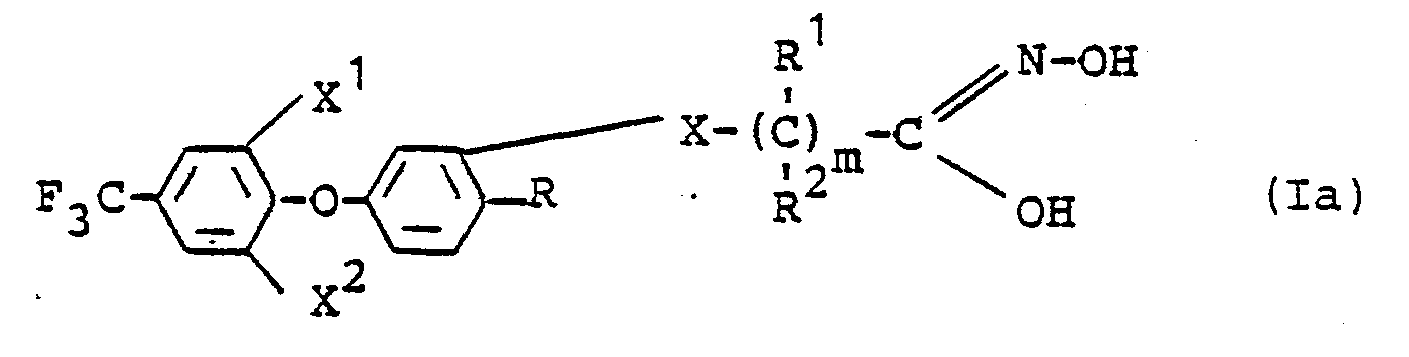


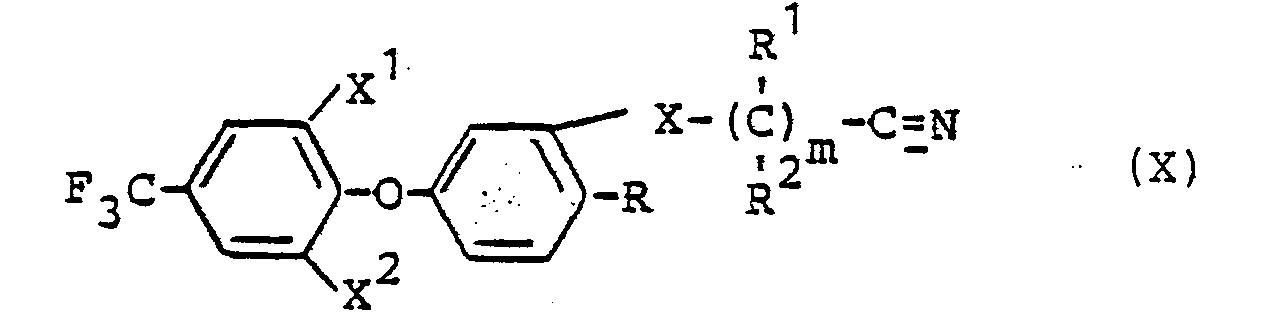


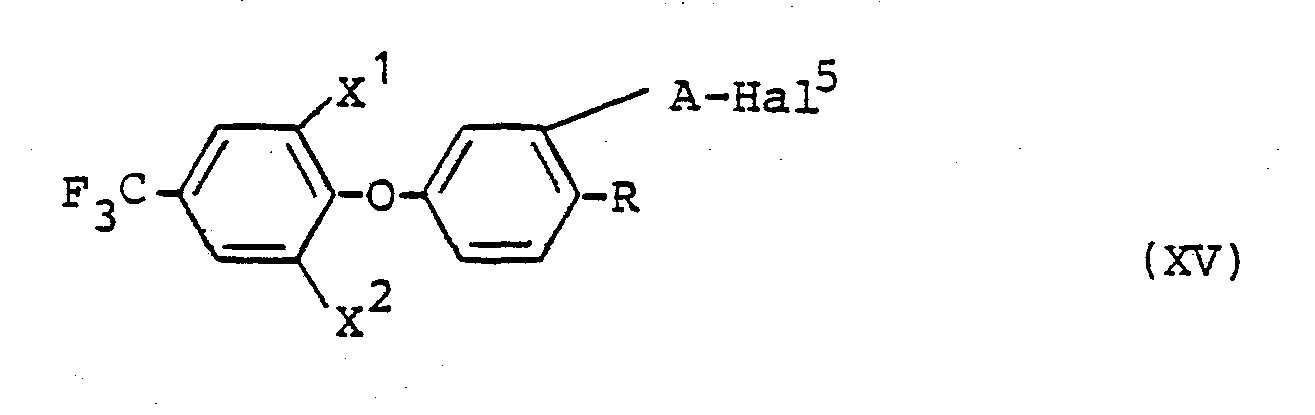


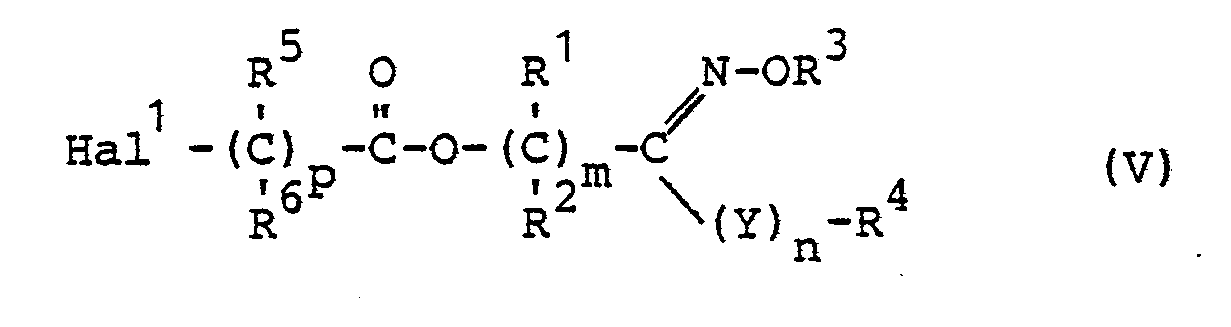


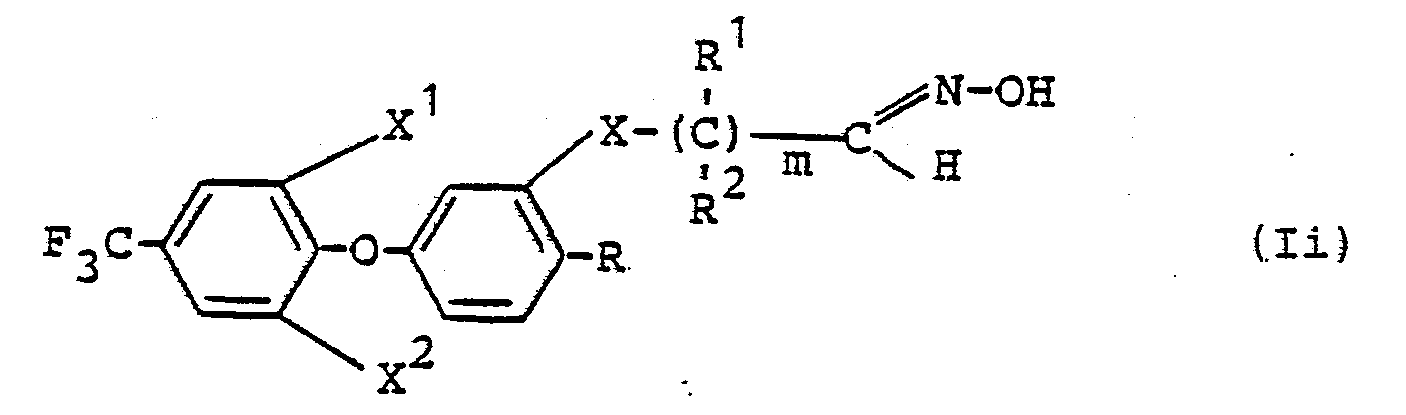
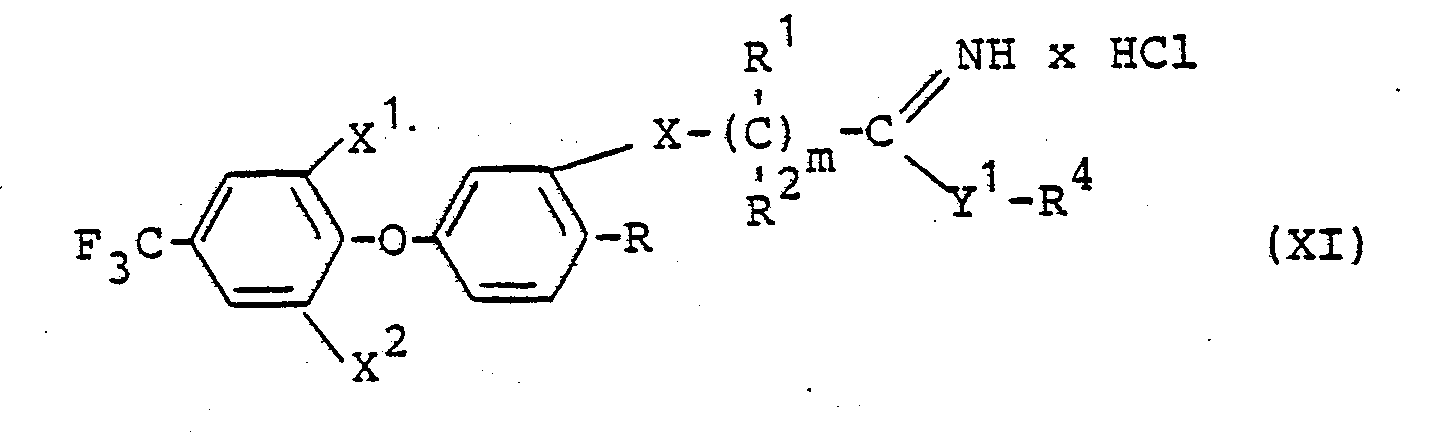


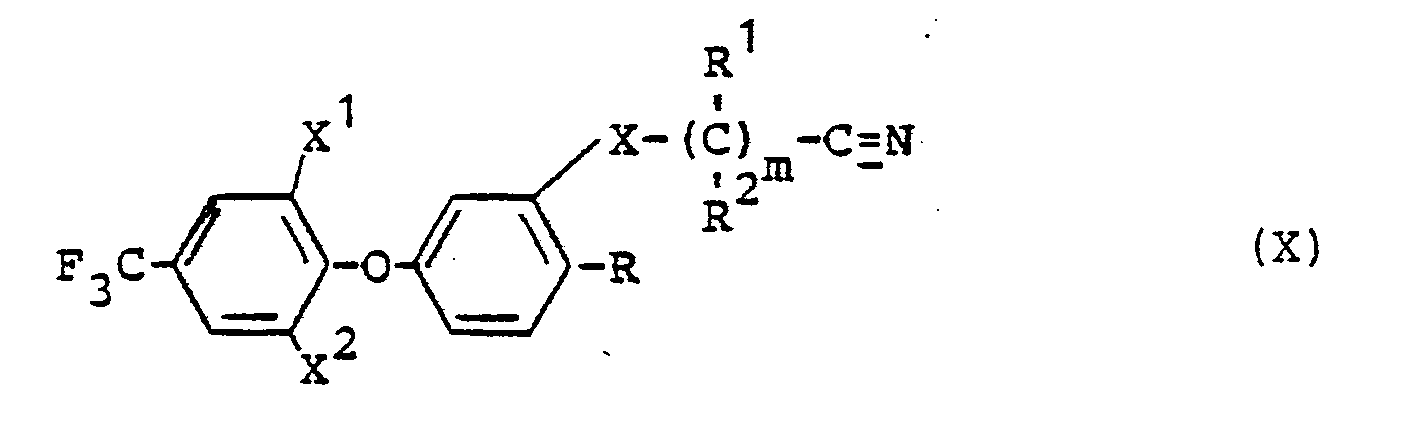

Applications Claiming Priority (2)
| Application Number | Priority Date | Filing Date | Title |
|---|---|---|---|
| DE19823220526 DE3220526A1 (de) | 1982-06-01 | 1982-06-01 | Trifluormethylphenoxy-phenyl-derivate, verfahren zu ihrer herstellung und ihre verwendung als herbizide |
| DE3220526 | 1982-06-01 |
Publications (1)
| Publication Number | Publication Date |
|---|---|
| EP0095683A1 true EP0095683A1 (de) | 1983-12-07 |
Family
ID=6164971
Family Applications (1)
| Application Number | Title | Priority Date | Filing Date |
|---|---|---|---|
| EP83105032A Withdrawn EP0095683A1 (de) | 1982-06-01 | 1983-05-20 | Trifluormethylphenoxy-phenyl-Derivate, Verfahren zu ihrer Herstellung und ihre Verwendung als Herbizide |
Country Status (8)
| Country | Link |
|---|---|
| EP (1) | EP0095683A1 (de) |
| JP (1) | JPS58219155A (de) |
| AU (1) | AU1502583A (de) |
| DE (1) | DE3220526A1 (de) |
| ES (1) | ES8406151A1 (de) |
| IL (1) | IL68815A0 (de) |
| TR (1) | TR21650A (de) |
| ZA (1) | ZA833897B (de) |
Cited By (3)
| Publication number | Priority date | Publication date | Assignee | Title |
|---|---|---|---|---|
| EP0196184A3 (en) * | 1985-03-16 | 1988-04-20 | The Wellcome Foundation Limited | New aryl derivatives |
| US4977188A (en) * | 1985-12-30 | 1990-12-11 | Burroughs Wellcome Co. | Method of treating inflammation |
| EP0464381A3 (en) * | 1990-06-16 | 1992-01-15 | Bayer Ag | 2-methoxyiminocarboxylic acid esters |
Citations (4)
| Publication number | Priority date | Publication date | Assignee | Title |
|---|---|---|---|---|
| EP0002246A2 (de) * | 1977-11-28 | 1979-06-13 | F. HOFFMANN-LA ROCHE & CO. Aktiengesellschaft | Oximester, diese enthaltende Unkrautbekämpfungsmittel, deren Verwendung als Unkrautbekämpfungsmittel sowie ein Verfahren zu deren Herstellung |
| EP0013660A1 (de) * | 1979-01-09 | 1980-07-23 | Ciba-Geigy Ag | Aminoalkylester der 2-Nitro-5-(ortho-chlor-para-trifluor-methylphenoxy)-benzoesäure, deren Herstellung, sie als Wirkstoff enthaltende herbizide Mittel und deren Verwendung |
| DE3017795A1 (de) * | 1979-05-11 | 1980-11-13 | Ppg Industries Inc | Saeuren und ester von 5-(2-ggfs. substituierten-4-trifluormethyl-6-ggfs. substituierten phenoxy)-2-nitro, -halogen oder -cyan alpha -substituierten phenylcarbonylen, -oximen und carboxyoximen und verfahren zum bekaempfen von unkraeutern damit |
| EP0034012A2 (de) * | 1980-02-01 | 1981-08-19 | Rhone-Poulenc Agrochimie | 2-Nitro-5-(substituiertes Phenoxy) phenylalkanon-oxim- und -imin-derivate mit herbizider Wirkung |
-
1982
- 1982-06-01 DE DE19823220526 patent/DE3220526A1/de not_active Withdrawn
-
1983
- 1983-05-20 EP EP83105032A patent/EP0095683A1/de not_active Withdrawn
- 1983-05-26 TR TR21650A patent/TR21650A/xx unknown
- 1983-05-27 AU AU15025/83A patent/AU1502583A/en not_active Abandoned
- 1983-05-30 IL IL68815A patent/IL68815A0/xx unknown
- 1983-05-30 ZA ZA833897A patent/ZA833897B/xx unknown
- 1983-05-31 ES ES522859A patent/ES8406151A1/es not_active Expired
- 1983-06-01 JP JP58095895A patent/JPS58219155A/ja active Pending
Patent Citations (4)
| Publication number | Priority date | Publication date | Assignee | Title |
|---|---|---|---|---|
| EP0002246A2 (de) * | 1977-11-28 | 1979-06-13 | F. HOFFMANN-LA ROCHE & CO. Aktiengesellschaft | Oximester, diese enthaltende Unkrautbekämpfungsmittel, deren Verwendung als Unkrautbekämpfungsmittel sowie ein Verfahren zu deren Herstellung |
| EP0013660A1 (de) * | 1979-01-09 | 1980-07-23 | Ciba-Geigy Ag | Aminoalkylester der 2-Nitro-5-(ortho-chlor-para-trifluor-methylphenoxy)-benzoesäure, deren Herstellung, sie als Wirkstoff enthaltende herbizide Mittel und deren Verwendung |
| DE3017795A1 (de) * | 1979-05-11 | 1980-11-13 | Ppg Industries Inc | Saeuren und ester von 5-(2-ggfs. substituierten-4-trifluormethyl-6-ggfs. substituierten phenoxy)-2-nitro, -halogen oder -cyan alpha -substituierten phenylcarbonylen, -oximen und carboxyoximen und verfahren zum bekaempfen von unkraeutern damit |
| EP0034012A2 (de) * | 1980-02-01 | 1981-08-19 | Rhone-Poulenc Agrochimie | 2-Nitro-5-(substituiertes Phenoxy) phenylalkanon-oxim- und -imin-derivate mit herbizider Wirkung |
Cited By (4)
| Publication number | Priority date | Publication date | Assignee | Title |
|---|---|---|---|---|
| EP0196184A3 (en) * | 1985-03-16 | 1988-04-20 | The Wellcome Foundation Limited | New aryl derivatives |
| US4977188A (en) * | 1985-12-30 | 1990-12-11 | Burroughs Wellcome Co. | Method of treating inflammation |
| EP0464381A3 (en) * | 1990-06-16 | 1992-01-15 | Bayer Ag | 2-methoxyiminocarboxylic acid esters |
| US5312960A (en) * | 1990-06-16 | 1994-05-17 | Bayer Aktiengesellschaft | Fungicidal 2-methoximinocarboxylic esters |
Also Published As
| Publication number | Publication date |
|---|---|
| ES522859A0 (es) | 1984-07-01 |
| ZA833897B (en) | 1984-02-29 |
| JPS58219155A (ja) | 1983-12-20 |
| ES8406151A1 (es) | 1984-07-01 |
| TR21650A (tr) | 1985-01-21 |
| AU1502583A (en) | 1983-12-08 |
| IL68815A0 (en) | 1983-09-30 |
| DE3220526A1 (de) | 1983-12-01 |
Similar Documents
| Publication | Publication Date | Title |
|---|---|---|
| EP0030676B1 (de) | Phenoxybenzoesäure-Derivate, Verfahren zu ihrer Herstellung sowie ihre Verwendung als Herbizide und Pflanzenwuchsregulatoren | |
| EP0077962A1 (de) | Trifluormethyl-phenoxy-phenyl-silicium-Derivate, Verfahren zu ihrer Herstellung und ihre Verwendung als Herbizide und Pflanzenwuchsregulatoren | |
| EP0096354B1 (de) | Substituierte Pyridyl-phenyl-ether | |
| EP0053321A2 (de) | Substituierte Phenoxyzimtsäurederivate, Verfahren zu deren Herstellung und deren Verwendung als Herbizide | |
| EP0349748B1 (de) | Substituierte N-Aryl-Stickstoffheterocyclen | |
| EP0014900B1 (de) | Phenoxycarbonsäure-carbonylalkylester, Verfahren zu ihrer Herstellung und ihre Verwendung als Herbizide sowie als Defoliants und Desiccants | |
| EP0112531B1 (de) | Optisch aktive Phenoxypropionsäure-Derivate | |
| EP0095683A1 (de) | Trifluormethylphenoxy-phenyl-Derivate, Verfahren zu ihrer Herstellung und ihre Verwendung als Herbizide | |
| EP0175199A2 (de) | Phenoxypropionsäure-Derivate | |
| EP0151945A1 (de) | Phenoxypropionyloxyalkanphosphonsäureester | |
| EP0151429A2 (de) | Optisch active Phenoxypropionsäure-Derivate | |
| EP0089538B1 (de) | Optisch aktive Phenoxybenzoesäure-Derivate, Verfahren zu ihrer Herstellung und ihre Verwendung als Herbizide | |
| DE3220524A1 (de) | 4,4'-disubstituierte diphenylether, verfahren zu ihrer herstellung und ihre verwendung als herbizide | |
| EP0095117A1 (de) | Phenoxypropionsäure-Derivate, Verfahren zu ihrer Herstellung und ihre Verwendung als Herbizide | |
| EP0127808A1 (de) | Optisch aktive Phenoxypropionsäure-Derivate | |
| EP0100425A1 (de) | Substituierte Diphenylether, Verfahren zu ihren Herstellung und ihre Verwendung als Herbizide | |
| EP0126358A2 (de) | Optisch aktive Propionsäure-ester-Derivate | |
| DE3116205A1 (de) | 5-(2,6-dichlor-4-trifluormethyl-phenoxy)-2-nitrobenzoesaeure-derivate, verfahren zu ihrer herstellung sowie ihre verwendung als herbizide und pflanzenwachstumsregulatoren | |
| DE3425123A1 (de) | Optisch aktive phenoxypropionsaeure-derivate | |
| EP0095115A1 (de) | Substituierte Diphenylether | |
| DE3221215A1 (de) | (pyridyloxy-phenoxy)-oximino-verbindungen, verfahren zu ihrer herstellung und ihre verwendung als herbizide | |
| DE3220523A1 (de) | Phenoxy-alkancarbonsaeure-ester, verfahren zu ihrer herstellung und ihre verwendung als herbizide | |
| DE3228099A1 (de) | Pyridyloxy-oximino-derivate | |
| DE3220525A1 (de) | Substituierte diphenylether, verfahren zu ihrer herstellung und ihre verwendung als herbizide | |
| EP0127048A2 (de) | Optisch aktive Diphenylether-Derivate |
Legal Events
| Date | Code | Title | Description |
|---|---|---|---|
| PUAI | Public reference made under article 153(3) epc to a published international application that has entered the european phase |
Free format text: ORIGINAL CODE: 0009012 |
|
| 17P | Request for examination filed |
Effective date: 19830520 |
|
| AK | Designated contracting states |
Designated state(s): AT BE CH DE FR GB IT LI |
|
| STAA | Information on the status of an ep patent application or granted ep patent |
Free format text: STATUS: THE APPLICATION HAS BEEN WITHDRAWN |
|
| 18W | Application withdrawn |
Withdrawal date: 19850130 |
|
| RIN1 | Information on inventor provided before grant (corrected) |
Inventor name: STETTER, JOERG, DR. Inventor name: FOERSTER, HEINZ, DR. Inventor name: SCHMIDT, ROBERT R., DR. Inventor name: LUERSSEN, KLAUS, DR. Inventor name: EUE, LUDWIG, DR. Inventor name: FUEHRER, WOLFGANG, DR. |