EP0094436A1 - N-glycidyl-substituted amide compounds - Google Patents
N-glycidyl-substituted amide compounds Download PDFInfo
- Publication number
- EP0094436A1 EP0094436A1 EP82903587A EP82903587A EP0094436A1 EP 0094436 A1 EP0094436 A1 EP 0094436A1 EP 82903587 A EP82903587 A EP 82903587A EP 82903587 A EP82903587 A EP 82903587A EP 0094436 A1 EP0094436 A1 EP 0094436A1
- Authority
- EP
- European Patent Office
- Prior art keywords
- group
- methylglycidyl
- compounds
- substituted
- methyl
- Prior art date
- Legal status (The legal status is an assumption and is not a legal conclusion. Google has not performed a legal analysis and makes no representation as to the accuracy of the status listed.)
- Granted
Links
Classifications
-
- C—CHEMISTRY; METALLURGY
- C07—ORGANIC CHEMISTRY
- C07D—HETEROCYCLIC COMPOUNDS
- C07D303/00—Compounds containing three-membered rings having one oxygen atom as the only ring hetero atom
- C07D303/02—Compounds containing oxirane rings
- C07D303/36—Compounds containing oxirane rings with hydrocarbon radicals, substituted by nitrogen atoms
Definitions
- This invention relates to novel N-monoglycidyl-substituted, N,N-diglycidyl-substituted, or N,N,N',N',N", N"-hexaglycidyl-substituted compounds derived from aliphatic or aromatic mono- and polyamide compounds.
- N-glycidyl-substituted amide compounds provided by the present invention have been unable to be prepared according to any conventional method.
- the above object of the present invention is accomplished by providing N-glycidyl-substituted amide compounds and N-2-methylglycidyl-substituted amide compounds as described hereinbelow.
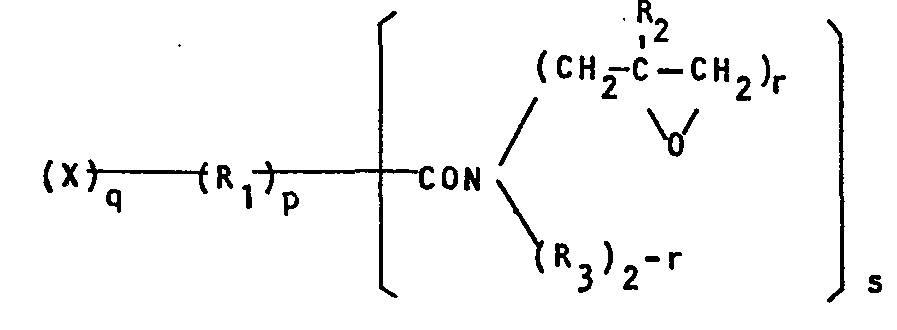
- the present invention provides N-glycidyl-substituted amide compounds having the general formula where R 1 is an aliphatic hydrocarbon radical, an aromatic hydrocarbon radical, or an alicyclic hydrocarbon radical; X is a hydrogen atom, a glycidoxy group, a 2-methylglycidoxy group, an N,N-diglycidylamino group, or an N,N-di-2-methyl- glycidylamino group.
- N-glycidyl-substituted compounds for purposes of simplification.
- they include N-monoglycidyl-substituted or N,N-diglycidyl-substituted compounds derived from aliphatic saturated or unsaturated monoamide compounds and the N-monoglycidyl-substituted or N,N-diglycidyl-substituted compounds derived from aromatic or alicyclic monoamide compounds.
- N,N,N',N'-tetraglycidyl- substituted compounds derived from aliphatic saturated or unsaturated diamide compounds N,N,N',N'-tetraglycidyl- substituted compounds derived from aromatic or alicyclic diamide compounds, N,N,N',N',N",N"-hexaglycidyi-substituted compounds derived from aromatic triamide compounds, and N,N,N',N',N",N",N"',N"'-octaglycidyl-substituted compounds derived from aromatic tetraamide compounds, and the like are included.
- compounds obtained by introducing a glycidoxy group into N,N-diglycidyl-substituted compounds derived from aliphatic saturated or unsaturated monoamide compounds compounds obtained by introducing 1 to 4 glycidoxy groups into N,N-diglycidyl-substituted compounds derived from aromatic monoamide compounds, compounds obtained by introducing 1 or 2 glycidoxy groups into N,N,N',N'- tetraglycidyl-substituted compounds derived from aromatic diamide compounds, and the like are also included.
- compounds obtained by introducing 1 or 2 N,N-diglycidylamino groups into N,N-diglycidyl-substituted compounds derived from aliphatic saturated, aromatic, or alicyclic monoamide compounds compounds obtained by introducing 1 or 2 N,N-diglycidylamino groups into N,N,N', N'-tetralycidyl-substituted compounds derived from aliphatic saturated or aromatic diamide compounds, and N,N,N',N'- tetraglycidyl-substituted compounds derived from urea are also included.
- this process comprises reacting an amide compound with a halogen-substituted compound in an aprotic solvent in the presence of a strongly basic substance, whereby an N-substituted amide compound is prepared according to the following reaction formula: where R is, for example, an alkyl group, R' is an alkyl group, and X is a halogen.
- an epihalohydrin or dihalo-propanol, or a S-methylepihalohydrin or dihalo- S -methylpropanol may be used as the halogen-substituted compound to prepare N-substituted amides having a glycidyl or 2-methylglycidyl substituent, respectively.
- a mixture of a compound as described above and a halide selected from alkyl halides, alkenyl halides, and aryl halides may be used as the halogen-substituted compound to prepare N,N-disubstituted amide compounds having a glycidyl or 2-methylglycidyl substituent and a residue corresponding to the halide.
- the compounds of the present invention can also be prepared by a number of alternative processes. Speicifically, they include a process in which an amide compound is reacted with a strongly basic substance in an aprotic solvent and, thereafter, a halogen-substituted compound is introduced into the reaction system to prepare an N-substituted amide compound; a process in which an amide compound is reacted with a halogen-substituted compound by the utilization of an phase transfer reaction to prepare an N-substituted amide compound; a process in which an N-substituted amide compound is prepared by using fluoride ions as a catalyst for the removal of hydrogen fluoride; and the like.
- N-glycidyl-substituted amides for example, the compounds of the present invention are classified into a number of categories: N-glycidyl-substituted compounds derived from monoamide compounds, N-glycidyl-substituted compounds derived from diamide and higher polyamide compounds, N-glycidyl-substituted glycidyl ether compounds derived from hydroxyl-substituted monoamide compounds, N-glycidyl-substituted glycidyl ether compounds derived from hydroxyl-substituted diamide compounds, N-glycidyl-substituted compounds derived from amino-substituted monoamide compounds, N-glycidyl-substituted compounds derived from amino-substituted diamide compounds, and the like.
- N-glycidyl-substituted amide compounds derived from monoamide compounds include monoglycidyl-substituted compounds of the general formula and diglycidyl-substituted compounds of the general formula
- R I is selected from alkyl, alkenyl, aryl, and alicyclic groups.
- the alkyl groups are represented by the general formula C n H 2n+1- where n is an integer of 0 to 20.
- the alkenyl groups are represented by the general formula C n H 2n-1 - where n is an integer of 2 to 20.
- the aryl groups are substituent groups containing an aromatic ring and include arylalkyl and arylalkenyl groups.
- the aromatic ring can be a benzene, naphthalene, anthracene ring, or the like.
- the alicyclic groups are substituent groups having an alicyclic structure.
- R1 can be any of substituent groups obtained by introducing one or more atoms of at least one halogen into the hydrocarbon moiety of the foregoing substituent groups.
- R 2 in the general formula (1) is selected from alkyl, alkenyl, and aryl groups.
- the alkyl groups are represented by the general formula C n H 2n+1 - where n is an integer of 1 to 20.
- the alkenyl groups are represented by the general formula C n H 2n-1 - where n is an integer of 2 to 20.
- the aryl groups are substituent groups containing an aromatic ring and include arylalkyl and arylalkenyl groups.
- the aromatic ring can be a benzene, naphthalene, anthracene ring, or the like.
- N-glycidyl-substituted amide compounds derived from polyamide compounds those derived from diamide compounds can be represented by the general formula where R 1 is selected from alkylene, alkenylene, arylene, and alicyclic groups.
- the alkylene groups are represented by the general formula -C n H 2n - where n is an integer of 0 to 20.
- the alkenylene groups are represented by the general formula -C n H 2n-2 - where n is an integer of 2 to 20.
- the arylene groups are substituent groups containing an aromatic ring and include arylalkylene and arylalkenylene groups.
- the aromatic ring can be a benzene, naphthalene, anthracene ring, or the like.
- the alicyclic groups are substituent groups having an alicyclic structure.
- R 1 can be any of substituent groups obtained by introducing one or more atoms of at least one halogen into the hydrocarbon moiety of the foregoing substituent groups.
- N-glycidyl-substituted amide compounds derived from triamide compounds can be represented by the general formula where R 1 is an aromatic ring or an alicyclic group.
- the aromatic ring can be a benzene, naphthalene, anthracene ring, or the like.
- R1 can be an aromatic ring substituted by one or more atoms of at least one halogen.
- the N-glycidyl-substituted amide compounds derived from tetraamide compounds can be represented by the general formula where R 1 is an aromatic ring or an alicyclic group.
- the aromatic ring can be a benzene, naphthalene, anthracene ring, or the like.
- R 1 can be an aromatic ring substituted by one or more atoms of at least one halogen.
- N-glycidyl-substituted glycidyl ether compounds derived from hydroxyl-substituted monoamide compounds can be represented by the general formula where n is an integer of 1 to 4.
- R 1 is selected from alkylene, alkenylene, and arylene groups.
- R 1 is an aromatic ring which can be a benzene, naphthalene, anthracene ring, or the like.
- the alkylene groups are represented by the general formula -C n H 2n - where n is an integer of 1 to 20.
- the alkenylene groups are represented by the general formula C n H 2n-2 - where n is an integer of 2 to 20.
- the arylene groups are substituent groups containing an aromatic ring which can be a benzene, naphthalene, anthracene ring, or the like.
- R 1 can be any of substituent groups obtained by introducing one or more atoms of at least one halogen into the hydrocarbon moiety of the foregoing substituent groups.
- N-glycidyl-substituted glycidyl ether compounds derived from hydroxyl-substituted diamide compounds can be represented by the general formula where n is an integer of 1 or 2 and R 1 is an aromatic ring which can be a benzene, naphthalene, anthracene ring, or the like. In addition, R 1 can be an aromatic ring substituted by one or more atoms of at least one halogen.
- the N-glycidyl-substituted amide compounds derived from amino-substituted monoamide compounds can be represented by the general formula where n is an integer of 1 or 4 and R 1 is selected from alkylene, arylene, and alicyclic groups.
- the alkylene groups are represented by the general formula -C n H 2n - where n is an integer of 1 to 20.
- the arylene groups are substituent groups containing an aromatic ring and include arylalkyl groups.
- the aromatic ring can be a benzene, naphthalene, anthracene ring,or the like.
- the alicyclic groups are substituent groups having an alicyclic structure.
- R 1 can be any of substituent groups obtained by introducing one or more atoms of at least one halogen into the hydrocarbon moiety of the foregoing substituent groups.
- N-glycidyl-substituted amide compounds derived from amino-substituted diamide compounds can be represented by the general formula where n is an integer of 1 or 2 and R 1 is an aromatic ring which can be a benzene, naphthalene, anthracene ring, or the like.
- R1 can be an aromatic ring substituted by one or more atoms of at least one halogen.
- N,N,N',N'-tetraglycidylurea is included as an N-glycidyl-substituted amide compound derived from urea.
- the N-monoglycidyl-substituted compounds include, for example, N-methyl-N-glycidylacetaminde, N-ethyl-N-glycidylformamide, N-butyl-N-glycidylpropionamide, N-methyl-N-glycidylstearamide, N-decyl-N-glycidyllauramide, N-stearyl-N-glycidylpropionamide, N-allyl-N-glycidylacetamide, N-methallyl-N-glycidylpropionamide, N-butenyl-N-glycidylformamide, N-hexenyl-N-glycidylstearamide, N-benzyl-
- the N,N-diglycidyl-substituted compounds include, for example, N,N-diglycidylformamide, N,N-diglycidyl- acetamide, N,N-diglycidylpropionamide, N,N-diglycidyl- butyramide, N,N-diglycidylchloroacetamide, N,N-diglycidyl- chloropropionamide, N,N-diglycidyldichloroamide, N,N-diglycidylacrylamide, N,N-diglycidylmethacrylamide, N,N-diglycidylcrotonamide, N,N-diglycidylvinylacetamide, N,N-diglycidyldecenamide, N,N-diglycidylnonadecenamide, N,N-diglycidylchloroacrylamide, N,N-diglycidylbenzamide, N,N-diglycidylnaphthalenecarboxamide
- the N-glycidyl-substituted amide compounds derived from polyamide compounds include, for example, N,N,N',N'-tetraglycidyloxamide, N,N,N',N'-tetraglycidyl- malonamide, N,N,N',N'-tetraglycidylsuccinamide, N,N,N',N'- tetraglycidylglutaramide, N,N,N',N'-tetraglycidyladipamide, N,N,N',N'-tetraglycidylpiperamide, N,N,N',N'-tetraglycidyl- suberamide, N,N,N',N'-tetraglycidylazelamide, N,N,N',N'- tetraglycidylsebacamide, N,N,N',N'-tetraglycidyloctadecanedi- carboxamide, N,N,N'
- the N-glycidyl-substituted glycidyl ether compounds derived from hydroxyl-substituted monoamide compounds include, for example, N,N-diglycidyl- glycidoxypropionamide, N,N-diglycidylglycidoxydiphenyl- acetamide, N,N-diglycidylglycidoxybutyramide, N,N-diglycidylglycidoxyheptanamide, N,N-diglycidylglycidoxy- decanamide, N,N-diglycidylglycidoxycrotonamide, N,N-diglycidylglycidoxydimethylheptynamide, N,N-diglycidyl- glycidoxybenzamide, N,N-diglycidylglycidoxytolylamide, N,N-diglycidylglycidoxyphenylbenzamide, N,N-diglycidyl- glycidoxyn
- the N-glycidyl-substituted glycidyl ether compounds derived from hydroxyl-substituted diamide compounds include N,N,N',N'-tetraglycidylglycidoxyphthalamide, N,N,N',N'-tetraglycidylglycidoxyisophthalamide, N,N,N',N'- tetraglycidylglycidoxyterephthalamide, N,N,N',N'- tetraglycidyldiglycidoxyphthalamide, N,N,N',N'-tetra glycidyldiglycidoxyisophthalamide, N,N,N',N'-tetraglycidyl- diglycidoxyterephthalamide, and the like.
- N-glycidyl-substituted compounds derived from amino-substituted monoamide compounds include N,N,N',N'- tetraglycidylglycinamide, N,N,N',N'-tetraglycidylalaninamide, N,N-diglycidylamino-N,N-diglycidylbutanamide, N,N,N',N'- tetraglycidyldiamino-N",N"-diglycidylpropionamide, N,N-diglycidylamino-N',N'-diglycidylbenzamide, N,N-diglycidyl- amino-N',N'-diglycidylchlorobenzamide, N,N-diglycidylamino-N',N'-diglycidyltribromobenzamide, N,N,N',N'-tetraglycidyldi- amino-N",N"-diglycidylbenz
- N-glycidyl-substituted compounds derived from amino-substituted diamide compounds include N,N,N',N',N",N"- hexaglycidylaspartdiamide, N,N-diglycidylamino-N',N',N",N"- tetraglycidylglutardiamide, N,N-diglycidylamino-N',N',N",N"- tetraglycidylphthalamide, N,N-diglycidylamino-N',N',N",N"- tetraglycidylisophthalamide, N,N-diglycidylamino-N',N',N",N"- tetraglycidylterephthalamide, and the like.
- N-glycidyl-substitued derivatives of urea are also included, and examples thereof are N,N,N',N'- tetraglycidylurea and the like.
- the N-mono-2-methylglycidyl-substituted compounds include, for example, N-methyl-N-2-methylglycidylacetamide, N-ethyl-N-2-methyl- glycidylformamide, N-butyl-N-2-methylglycidylpropionamide, N-methyl-N-2-methylglycidylstearamide, N-decyl-N-2-methylglycidyllauramide, N-stearyl-N-2-methylglycidyl- propionamide, N-allyl-N-2-methylglycidylacetamide, N-methallyl-N-2-methylglycidylpropionamide, N-butenyl-N-2-methylglycidylformamide, N-he
- the N,N-di-2-methylglycidyl-substituted compounds include, for example, N,N-di-2-methylglycidylformamide, N,N-di-2-methylglycidylacetamide, N,N-di-2-methylglycidyl- propionamide, N,N-di-2-methylglycidylbutyramide, N,N-di-2-methylglycidylchloroacetamide, N,N-di-2-methylglycidyl- chloropropionamide, N,N-di-2-methylglycidyldichloroamide, N,N-di-2-methylglycidylacrylamide, N,N-di-2-methylglycidyl- methacrylamide, N,N-di-2-methylglycidylcrotonamide, N,N-di-2-methylglycidylvinylacetamide, N,N-di-2-methyl- glycidylde
- the N-2-methylglycidyl-substituted amide compounds derived from polyamide compounds include, for example, N,N,N',N'-tetra-2 - methyl- glycidyloxamide, N,N,N',N'-tetra-2-methylglycidylmalonamide, N,N,N',N'-tetra-2-methylglycidylsuccinamide, N,N,N',N'- tetra-2-methylglycidylglutaramide, N,N,N',N'-tetra-2-methylglycidyladipamide, N,N,N',N'-tetra-2-methylglycidyl- pimelamide, N,N,N',N'-tetra-2-methylglycidylsuberamide, N,N,N',N'-tetra-2-methylglycidylazelamide, N,N,N',N'- tetra-2-methylglycidy
- the N-2-methylglycidyl- substituted 2-methylglycidyl ether compounds derived from hydroxyl-substituted monoamide compounds include, for example, N,N-di-2-methylglycidyl-2-methylglycidoxypropionamide, N,N-di-2-methylglycidyl-2-methylglycidoxydiphenylacetamide, N,N-di-2-methylglycidyl-2-methylglycidoxybutyramide, N,N-di-2-methylglycidyl-2-methylglycidoxyheptanamide, N,N-di-2-methylglycidyl-2-methylglycidoxydecanamide, N,N-di-2-methylglycidyl-Z-methylglycidoxycrotonamide, N,N-di-2-methylglycidyl-2-methylglycidoxydimethylheptynamide, N,N-di-2-methylglycidyl-2-methylglycid
- the N-2-methylglycidyl-substituted 2-methylglycidyl ether compounds derived from hydroxyl-substituted diamide compounds include N,N,N',N'-tetra-2-methylglycidyl-2-methylglycidoxyphthalamide, N,N,N',N'-tetra-2-methylglycidyl-2-methylglycidoxyisophthalamide, N,N,N',N'-tetra-2-methylglycidyl-2-methylglycidoxyterephthalamide, N,N,N',N'- tetra-2-methylglycidyl-di-2-methylglycidoxyphthalamide, N,N,N',N''-tetra-2-methylglycidyl-di-2-methylglycidoxy- isophthalamide, N,N,N',N'-tetra-2-methylglycidyl-di-2-methylglycidoxy- isophthalamide, N,N,N
- N-2-methylglycidyl-substituted compounds derived from amino-substituted monoamide compounds include N,N,N',N'-tetra-2-methylglycidylglycinamide, N,N,N',N'- tetra-2-methylglycidylalaninamide, N,N-di-2-methylglycidyl- amino-N',N'-di-2-methylglycidylbutanamide, N,N,N',N'- tetra-2-methylglycidyldiamino-N",N"-di-2-methylglycidyl- propionamide, N,N-di-2-methylglycidylamino-N',N'-di-2-methylglycidylbenzamide, N,N-di-2-methylglycidylamino-N',N'-di-2-methylglycidylchlorobenzamide, N,N-di-2-methylgly
- N-glycidyl-substituted compounds derived from amino-substituted diamide compounds include N,N,N',N',N", N"-hexa-2-methylglycidylaspartdiamide, N,N-di-2-methyl- glycidylamino-N',N',N",N"-tetra-2-methylglycidylglutardi- amide, N,N-di-2-methylglycidylamino-N',N',N",N"-tetra-2-methylglycidylphthalamide, N,N-di-2-methylglycidylamino-N',N',N",N"-tetra-2-methylglycidylisophthalamide, N,N-di-2-methylglycidylamino-N',N',N",N"-tetra-2-methylglycidyl- terephthalamide, and the like.
- N-2-methylglycidyl-substituted derivatives of urea are also included, and specific examples thereof are N,N,N',N'-tetra-2-methylglycidylurea and the like.
- N-glycidyl-or N-2-methylglycidyl-substituted compounds derived from lower fatty acid amides can be isolated and purified with comparative ease by such procedures as distillation and the like.
- other N-glycidyl- or N-2-methylglycidyl- substituted compounds particularly N,N-diglycidyl or N,N-di-2-methylglycidyl compounds, are so low in volatility that it is difficult to isolate them by such procedures as distillation and the like.
- glycidyl and 2-methylglycidyl groups constitute highly reactive substituents and, therefore, react with reactive compounds such as alkaline substances coexisting in the reaction system to cause side reactions such as cleavage of the epoxy ring, the ensuing addition condensation, and the like. Accordingly, the epoxy equivalent of the product tends to become higher than the theoretical value and the magnitude of the deviation depends on the reactivity of the amide compound used. Generally, aromatic amide compounds seem to give an epoxy equivalent approaching the theoretical value.
- N-glycidyl-substituted amide compounds and N-2-methylglycidyl-substituted amide compounds of the present invention have wide applications in the manufacture of reactive diluents, crosslinking agents, epoxidizing agents, resin modifiers, epoxy resins, adhesives, coating materials, electronic materials, composite materials, and the like, as is the case with conventionally known monoglycidyl ether compounds such as butyl glycidyl ether, allyl glycidyl ether, and phenyl glycidyl ether; monoglycidyl ester compounds such as glycidyl methacrylate; diglycidyl ether compounds typified by bisphenol epoxy resins; diglycidyl ester compounds such as diglycidyl phthalate; diglycidylamine compounds such as N,N-diglycidylaniline and N,N-diglycidyltoluidine; tetraglycidylamine
- DMSO dimethyl sulfoxide
- reaction mixture was filtered to remove any insoluble matter, and 200 ml of benzene and 150 ml of distilled water were added thereto. After vigorous stirring, the resulting mixture was separated in a separatory funnel and the aqueous layer was further extracted twice with 100-ml portions of benzene. The combined benzene layers were dried over magnesium sulfate and then distilled under reduced pressure. A fraction boiling at 114-116°C (3 mmHg) was collected to obtain 27 g of N,N-diglycidylpropionamide in a 73% yield.
- reaction was carried out under the conditions shown in Table 1.
- 0.05 g of phenothiazine was added to the reaction mixture.
- the reaction mixture was worked up in entirely the same manner as in Example 1 to obtain the results shown in Table 2.
- reaction mixture was filtered to remove any insoluble matter, and then stripped of the starting materials and the solvent.
- residue 100 ml of benzene and 50 ml of distilled water.
- the resulting mixture was separated in a separatory funnel and the aqueous layer was further extracted twice with 50-ml portions of benzene.
- the combined benzene layers were dried over magnesium sulfate and then distilled under reduced pressure. A fraction boiling at 103-105°C (5 mmHg) was collected to obtain 22 g of N-n-butyl-N-glycidylacrylamide in a 59% yield.
- reaction mixture was filtered to remove any insoluble matter, and then stripped of the starting materials and the solvent.
- residue 100 ml of benzene and 50 ml of distilled water.
- the resulting mixture was separated in a separatory funnel and the aqueous layer was further extracted twice with 50-ml portions of benzene.
- the combined benzene layers were dried over magnesium sulfate.
- benzene was distilled off, the remaining solvent and the like were removed by distillation at 120°C and 2 mmHg to obtain 42 g of N,N-diglycidylbenzamide in a 91% yield.
- reaction mixture was filtered to remove any insoluble matter, and the filtrate was distilled under reduced pressure. A fraction boiling at 57-59°C (2 mmHg) was collected to obtain 18 g of N-methyl-N-glycidylacrylamide in a 63% yield.
- N,N-Diglycidyl-p-glycidoxybenzamide which had been prepared in Example 17, was subjected to an adhesion test in which steel plates were bonded with the following formulation.
- a mixture of 100 parts of N,N-diglycidyl-p-glycidoxybenzamide, 6 parts of dicyandiamide, and 2 parts of aerosil was intimately blended in a three-roll mill. Subsequently, 30 parts of alumina was uniformly dispersed in the blend, which was deaerated under reduced pressure to obtain a formulation.
- a 25 mm (width) x 100 mm (length) x 1.6 mm (thickness) steel plate (JIS G3141) was degreased with acetone, and the above formulation was applied to a terminal region of one surface thereof to a length of 12.5 mm.
- Another similar steel plate was superposed thereon and both plates were fastened with a clip. Then, the formulation was cured at 180°C for 60 minutes to form a specimen.
- the tensile shear strength of the specimen was found to be 190 kg/ cm 2 .
- reaction mixture was filtered to remove any insoluble matter, and then stripped of the starting materials and the solvent.
- residue were added 200 ml of benzene and 100 ml of distilled water. After vigorous stirring, the resulting mixture was separated in a separatory funnel and the aqueous layer was further extracted twice with 100-ml portions of benzene. The combined benzene layers were dried over magnesium sulfate and then distilled under reduced pressure. A fraction boiling at 68-70°C (0.04 mmHg) was collected to obtain 35 g of N,N-di-2-methylglycidylpropionamide in a 65% yield.
- reaction was carried out in entirely the same manner as in Example 30.
- 0.05 g of phenothiazine was added to the reaction mixture.
- reaction mixture was filtered to remove any insoluble matter, and then stripped of the starting materials and the solvent.
- residue were added 200 ml of benzene and 100 ml of distilled water. After vigorous stirring, the resulting mixture was separated in a separatory funnel and the aqueous layer was further extracted twice with 100-ml portions of benzene. The combined benzene layers were dried over magnesium sulfate and then distilled under reduced pressure. A fraction boiling at 53-55°C (0.9 mmHg) was collected to obtain 24 g of N-allyl-N-2-methylglycidylacrylamide in a 53% yield.
- reaction mixture was filtered to remove any insoluble matter, and then stripped of the starting materials and the solvent.
- residue were added 200 ml of benzene and 100 ml of distilled water. After vigorous stirring, the resulting mixture was separated in a separatory funnel and the aqueous layer was further extracted twice with 100-ml portions of benzene. The combined benzene layers were dried over magnesium sulfate. After benzene was distilled off, the remaining solvent and the like were removed by distillation at 120°C and 2 mmHg to obtain 42 g of N,N,N',N'-tetra-2-methylglycidylisophthalamide in an 83% yield.
- N,N-Di-2-methylglycidyl-p-2-methylglycidoxy- benzamide which had been prepared in Example 43, was subjected to an adhesion in which steel plates were bonded with the following formulation.
- a mixture of 100 parts of N,N-di-2-methylglycidyl- p-2-methylglycidoxybenzamide, 5 parts of dicyandiamide, and 2 parts of aerosil was intimately blended in a three-roll mill. Subsequently, 30 parts of alumina was uniformly dispersed in the blend, which was deaerated under reduced pressure to obtain a formulation.
- a 25 mm (width) x 100 mm (length) x 1.6 mm (thickness) steel plate (JIS G3141) was degreased with acetone, and the above formulation was applied to a terminal region of one surface thereof to a length of 12.5 mm.
- Another similar steel plate was superposed thereon and both plates were fastened with a clip. Then, the formulation was cured at 180°C for 60 munites to form a specimen.
- the tensile shear strength of the specimen was found to be 180 kg/ cm 2 .
Landscapes
- Chemical & Material Sciences (AREA)
- Organic Chemistry (AREA)
- Epoxy Compounds (AREA)
- Organic Low-Molecular-Weight Compounds And Preparation Thereof (AREA)
- Epoxy Resins (AREA)
- Heterocyclic Carbon Compounds Containing A Hetero Ring Having Nitrogen And Oxygen As The Only Ring Hetero Atoms (AREA)
Abstract
Description
- This invention relates to novel N-monoglycidyl-substituted, N,N-diglycidyl-substituted, or N,N,N',N',N", N"-hexaglycidyl-substituted compounds derived from aliphatic or aromatic mono- and polyamide compounds.
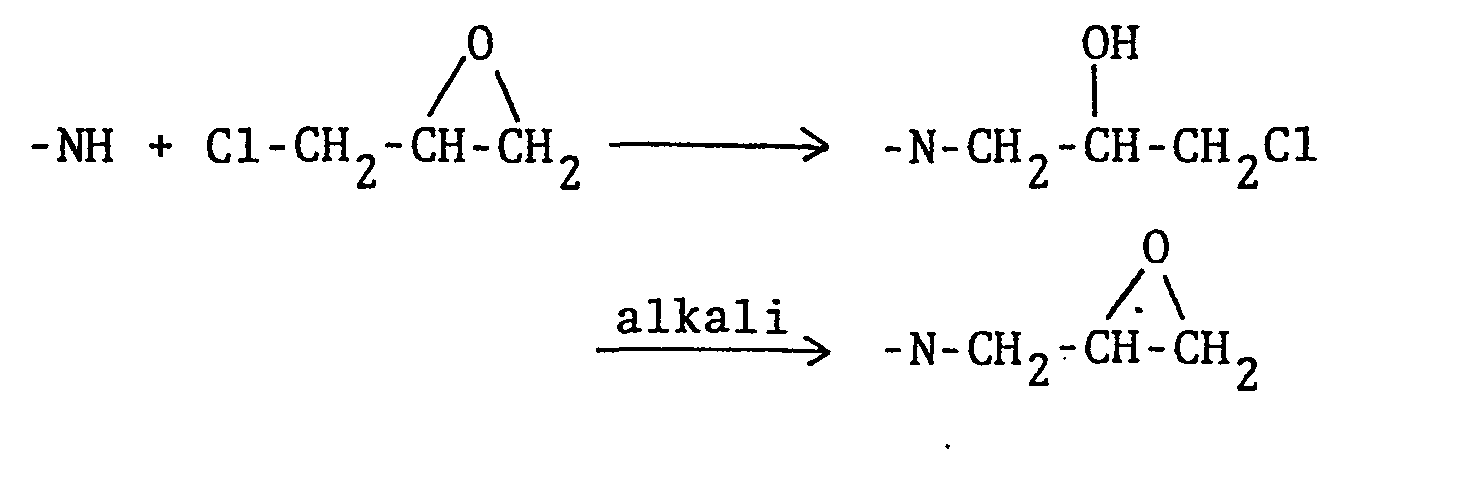
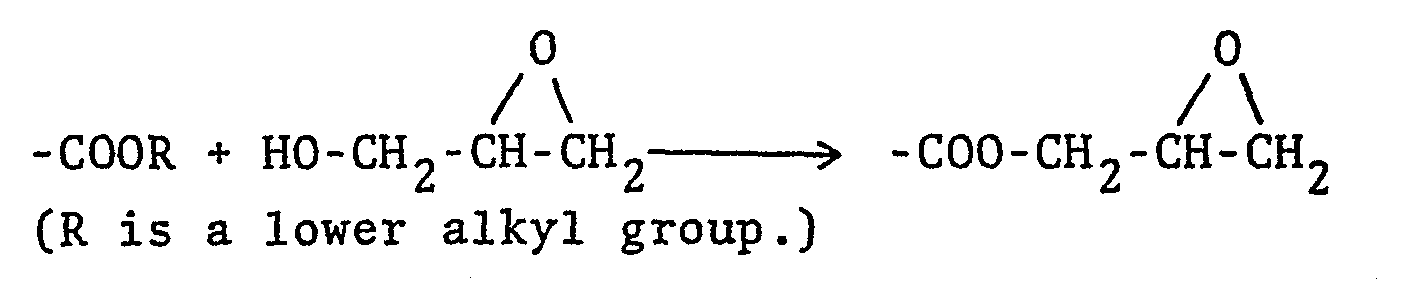
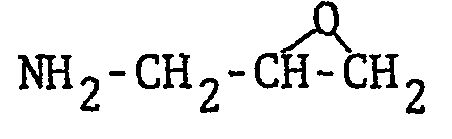
- Conventionally, the following three methods are known to be typical of the methods for the preparation of glycidyl compounds:
-

-
-

-

-
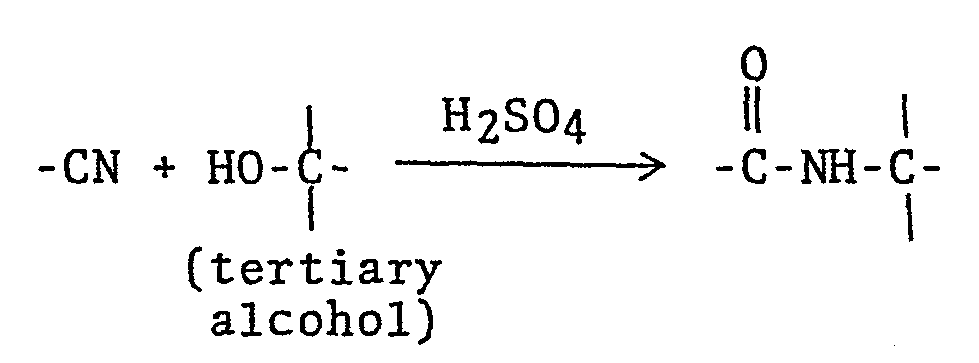

- Thus, the N-glycidyl-substituted amide compounds provided by the present invention have been unable to be prepared according to any conventional method.
- It is an object of the present invention to provide novel N-glycidyl-substituted amide compounds which are useful in organic chemical reactions and as raw materials for the manufacture of organic high-molecular compounds such as reactive diluents, crosslinking agents, epoxidizing agents, resin modifiers, epoxy resins, adhesives, coating materials, electronic materials, composite materials, and the like.
- The above object of the present invention is accomplished by providing N-glycidyl-substituted amide compounds and N-2-methylglycidyl-substituted amide compounds as described hereinbelow.
- Specifically, the present invention provides N-glycidyl-substituted amide compounds having the general formula

-
- p is an integer of 0 or 1;
- q is an integer of 1 to 4;
- R2 is a hydrogen atom or a methyl group, and when R2 is a hydrogen atom, X is a hydrogen atom, a glycidoxy group, or an N,N-diglycidylamino group, while when R2 is a methyl group, X is a hydrogen atom, a 2-methylglycidoxy group, or an N,N-di-2-methylglycidylamino group;
- R3 is an alkyl group, an alkenyl group, or an aryl group;
- r is an integer of 1 or 2; and
- s is an integer of 1 to 4;
- provided that when X is a hydrogen atom, p is 0 or 1
- and q is 0 or 1, in the case that s is 1, r is 1 or
- 2, and in the case that s is-from 2 to 4, r is 2;
- when X is a glycidoxy group or a 2-methylglycidoxy group,
- p is 1 and r is 2; and
- when X is an N,N-diglycidylamino group or an N,N-di-2-methyl- glycidylamino group, p is 0 or 1, q is 1 or 2, s is 1 or 2, and r is 2.
- The compounds which fall within the scope of the above general formula are more specifically described hereinbelow, although the description is limited to N-glycidyl-substituted compounds for purposes of simplification. First of all, they include N-monoglycidyl-substituted or N,N-diglycidyl-substituted compounds derived from aliphatic saturated or unsaturated monoamide compounds and the N-monoglycidyl-substituted or N,N-diglycidyl-substituted compounds derived from aromatic or alicyclic monoamide compounds.
- As for polyamide compounds, N,N,N',N'-tetraglycidyl- substituted compounds derived from aliphatic saturated or unsaturated diamide compounds, N,N,N',N'-tetraglycidyl- substituted compounds derived from aromatic or alicyclic diamide compounds, N,N,N',N',N",N"-hexaglycidyi-substituted compounds derived from aromatic triamide compounds, and N,N,N',N',N",N",N"',N"'-octaglycidyl-substituted compounds derived from aromatic tetraamide compounds, and the like are included.
- Moreover, compounds obtained by introducing a glycidoxy group into N,N-diglycidyl-substituted compounds derived from aliphatic saturated or unsaturated monoamide compounds, compounds obtained by introducing 1 to 4 glycidoxy groups into N,N-diglycidyl-substituted compounds derived from aromatic monoamide compounds, compounds obtained by introducing 1 or 2 glycidoxy groups into N,N,N',N'- tetraglycidyl-substituted compounds derived from aromatic diamide compounds, and the like are also included.
- Furthermore, compounds obtained by introducing 1 or 2 N,N-diglycidylamino groups into N,N-diglycidyl-substituted compounds derived from aliphatic saturated, aromatic, or alicyclic monoamide compounds, compounds obtained by introducing 1 or 2 N,N-diglycidylamino groups into N,N,N', N'-tetralycidyl-substituted compounds derived from aliphatic saturated or aromatic diamide compounds, and N,N,N',N'- tetraglycidyl-substituted compounds derived from urea are also included.
- In order to prepare the compounds of the present invention most efficiently, there can be employed the process for the preparation of N-substituted amide compounds which is disclosed in the previously filed Japanese Patent Application No. 4610/'81 and the like. More specifically, this process comprises reacting an amide compound with a halogen-substituted compound in an aprotic solvent in the presence of a strongly basic substance, whereby an N-substituted amide compound is prepared according to the following reaction formula:

- In the above reaction formula, an epihalohydrin or dihalo-propanol, or a S-methylepihalohydrin or dihalo- S-methylpropanol may be used as the halogen-substituted compound to prepare N-substituted amides having a glycidyl or 2-methylglycidyl substituent, respectively. Moreover, a mixture of a compound as described above and a halide selected from alkyl halides, alkenyl halides, and aryl halides may be used as the halogen-substituted compound to prepare N,N-disubstituted amide compounds having a glycidyl or 2-methylglycidyl substituent and a residue corresponding to the halide.
- Although the yield of the desired product is reduced as compared with the above-described process, the compounds of the present invention can also be prepared by a number of alternative processes. Speicifically, they include a process in which an amide compound is reacted with a strongly basic substance in an aprotic solvent and, thereafter, a halogen-substituted compound is introduced into the reaction system to prepare an N-substituted amide compound; a process in which an amide compound is reacted with a halogen-substituted compound by the utilization of an phase transfer reaction to prepare an N-substituted amide compound; a process in which an N-substituted amide compound is prepared by using fluoride ions as a catalyst for the removal of hydrogen fluoride; and the like.
- As regards N-glycidyl-substituted amides, for example, the compounds of the present invention are classified into a number of categories: N-glycidyl-substituted compounds derived from monoamide compounds, N-glycidyl-substituted compounds derived from diamide and higher polyamide compounds, N-glycidyl-substituted glycidyl ether compounds derived from hydroxyl-substituted monoamide compounds, N-glycidyl-substituted glycidyl ether compounds derived from hydroxyl-substituted diamide compounds, N-glycidyl-substituted compounds derived from amino-substituted monoamide compounds, N-glycidyl-substituted compounds derived from amino-substituted diamide compounds, and the like.
- The N-glycidyl-substituted amide compounds derived from monoamide compounds include monoglycidyl-substituted compounds of the general formula


- In the above formulas, RI is selected from alkyl, alkenyl, aryl, and alicyclic groups. The alkyl groups are represented by the general formula CnH2n+1- where n is an integer of 0 to 20. The alkenyl groups are represented by the general formula CnH2n-1- where n is an integer of 2 to 20. The aryl groups are substituent groups containing an aromatic ring and include arylalkyl and arylalkenyl groups. The aromatic ring can be a benzene, naphthalene, anthracene ring, or the like. The alicyclic groups are substituent groups having an alicyclic structure. In addition, R1 can be any of substituent groups obtained by introducing one or more atoms of at least one halogen into the hydrocarbon moiety of the foregoing substituent groups.
- On the other hand, R2 in the general formula (1) is selected from alkyl, alkenyl, and aryl groups. The alkyl groups are represented by the general formula CnH2n+1- where n is an integer of 1 to 20. The alkenyl groups are represented by the general formula CnH2n-1- where n is an integer of 2 to 20. The aryl groups are substituent groups containing an aromatic ring and include arylalkyl and arylalkenyl groups. The aromatic ring can be a benzene, naphthalene, anthracene ring, or the like.
- Among the N-glycidyl-substituted amide compounds derived from polyamide compounds, those derived from diamide compounds can be represented by the general formula

- The arylene groups are substituent groups containing an aromatic ring and include arylalkylene and arylalkenylene groups. The aromatic ring can be a benzene, naphthalene, anthracene ring, or the like. The alicyclic groups are substituent groups having an alicyclic structure. In addition, R1 can be any of substituent groups obtained by introducing one or more atoms of at least one halogen into the hydrocarbon moiety of the foregoing substituent groups.
- The N-glycidyl-substituted amide compounds derived from triamide compounds can be represented by the general formula
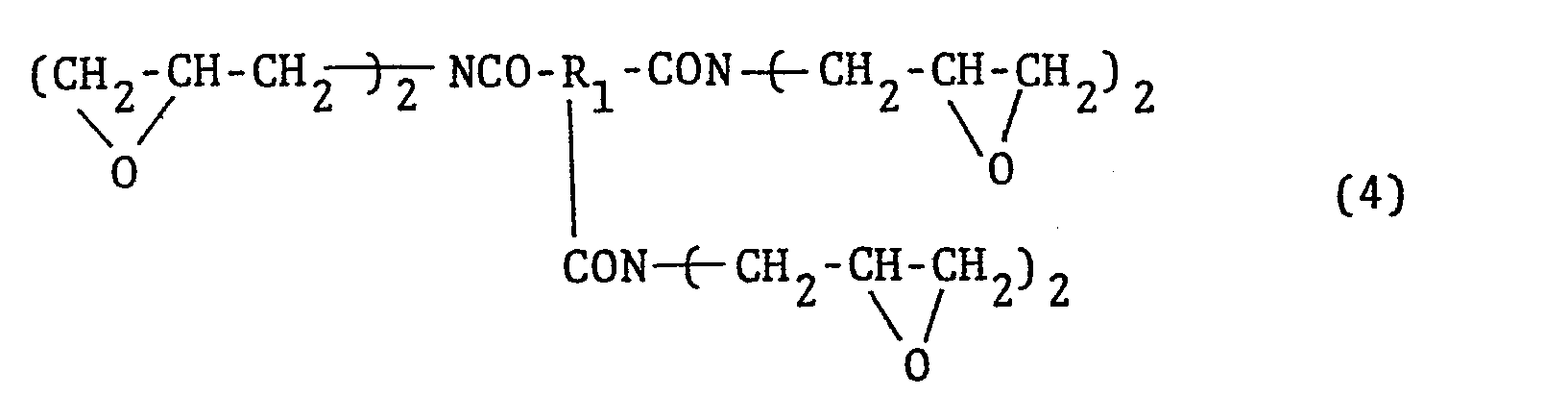
- The N-glycidyl-substituted amide compounds derived from tetraamide compounds can be represented by the general formula

- The N-glycidyl-substituted glycidyl ether compounds derived from hydroxyl-substituted monoamide compounds can be represented by the general formula

- The alkylene groups are represented by the general formula -CnH2n- where n is an integer of 1 to 20. The alkenylene groups are represented by the general formula CnH2n-2- where n is an integer of 2 to 20. The arylene groups are substituent groups containing an aromatic ring which can be a benzene, naphthalene, anthracene ring, or the like. In addition, R1 can be any of substituent groups obtained by introducing one or more atoms of at least one halogen into the hydrocarbon moiety of the foregoing substituent groups.
- The N-glycidyl-substituted glycidyl ether compounds derived from hydroxyl-substituted diamide compounds can be represented by the general formula

- The N-glycidyl-substituted amide compounds derived from amino-substituted monoamide compounds can be represented by the general formula

- The N-glycidyl-substituted amide compounds derived from amino-substituted diamide compounds can be represented by the general formula

- Besides, N,N,N',N'-tetraglycidylurea is included as an N-glycidyl-substituted amide compound derived from urea.
- Typical examples of the N-glycidyl-substituted amide compounds of the present invention are given hereinbelow. Among the N-glycidyl-substituted amide compounds derived from monoamide compounds, the N-monoglycidyl-substituted compounds include, for example, N-methyl-N-glycidylacetaminde, N-ethyl-N-glycidylformamide, N-butyl-N-glycidylpropionamide, N-methyl-N-glycidylstearamide, N-decyl-N-glycidyllauramide, N-stearyl-N-glycidylpropionamide, N-allyl-N-glycidylacetamide, N-methallyl-N-glycidylpropionamide, N-butenyl-N-glycidylformamide, N-hexenyl-N-glycidylstearamide, N-benzyl-N-glycidylformamide, N-phenetyl-N-glycidylacetamide, N-phenylpropyl-N-glycidylpropionamide, N-cinnamyl-N-glycidyllauramide, N-methyl-N-glycidylacrylamide, N-methyl-N-glycidylmethacrylamide, N-ethyl-N-glycidylcrotonamide, N-butyl-N-glycidylacrylamide, N-methyl-N-glycidyldecenamide, N-decyl-N-glycidylbutenamide, N-stearyl-N-glycidylcrotonamide, N-allyl-N-glycidylacrylamide, N-allyl-N-glycidylmethacrylamide, N-methallyl-N-glycidylcrotonamide, N-butenyl-N-glycidylmethacrylamide, N-hexyl-N-glycidyldecenamide, N-benzyl-N-glycidylacrylamide, N-phenetyl-N-glycidylacrylamide, N-phenetyl-N-glycidylcrotonamide, N-phenylpropyl-N-glycidylmethacrylamide, N-cinnamyl-N-glycidyldecenamide, N-methyl-N-glycidylbenzamide, N-ethyl-N-glycidyltolylamide, N-butyl-N-glycidylphenylacetamide, N-methyl-N-glycidylcinnamamide, N-decyl-N-glycidylnaphthalenecarboxamide, N-stearyl-N-glycidylanthracenecarboxamide, N-allyl-N-glycidylbenzamide, N-methallyl-N-glycidyltolylamide, N-butenyl-N-glycidyl- phenylacetamide, N-hexenyl-N-glycidylallylbenzamide, N-benzyl-N-glycidylbenzamide, N-phenetyl-N-glycidyltolylamide, N-benzyl-N-glycidylcinnamamide, N-phenylpropyl-N-glycidyl- phenylacetamide, N-methyl-N-glycidylcyclohexanecarboxamide, N-ethyl-N-glycidylcyclohexylacetamide, N-butyl-N-glycidylcyclohexanecarboxamide, N-decyl-N-glycidylcyclohexyl- propionamide, N-allyl-N-glycidylcyclohexanecarboxamide, N-methallyl-N-glycidylcyclohexylacetamide, N-benzyl-N-glycidylcyclohexanecarboxamide, N-phenetyl-N-glycidylcyclohexylacetamide, and the like.
- The N,N-diglycidyl-substituted compounds include, for example, N,N-diglycidylformamide, N,N-diglycidyl- acetamide, N,N-diglycidylpropionamide, N,N-diglycidyl- butyramide, N,N-diglycidylchloroacetamide, N,N-diglycidyl- chloropropionamide, N,N-diglycidyldichloroamide, N,N-diglycidylacrylamide, N,N-diglycidylmethacrylamide, N,N-diglycidylcrotonamide, N,N-diglycidylvinylacetamide, N,N-diglycidyldecenamide, N,N-diglycidylnonadecenamide, N,N-diglycidylchloroacrylamide, N,N-diglycidylbenzamide, N,N-diglycidylnaphthalenecarboxamide, N,N-diglycidyl- anthracenecarboxamide, N,N-diglycidyltolylamide, N,N-diglycidylphenylacetamide, N,N-diglycidylphenylpropionamide, N,N-diglycidylphenyldecanamide, N,N-diglycidylphenyl- acrylamide, N,N-diglycidylbenzylacrylamide, N,N-diglycidyl- cinnamamide, N,N-diglycidylallylbenzamide, N,N-diglycidyl- chlorobenzamide, N,N-diglycidyldichlorobenzamide, N,N-diglycidylchlorobromobenzamide, N,N-diglycidylcyclobutane- carboxamide, N,N-diglycidylcyclopentanecarboxamide, N,N-diglycidylcyclohexanecarboxamide, N,N-diglycidyl- cyclopentanecarboxamide, N,N-diglycidylcyclohexylacetamide, N,N-diglycidylcyclohexylpropionamide, N,N-diglycidyl- cyclohexenecarboxamide, N,N-diglycidylcyclohexadiene- carboxamide, N,N-diglycidylcyclopentylphenylacetamide, and the like.
- The N-glycidyl-substituted amide compounds derived from polyamide compounds include, for example, N,N,N',N'-tetraglycidyloxamide, N,N,N',N'-tetraglycidyl- malonamide, N,N,N',N'-tetraglycidylsuccinamide, N,N,N',N'- tetraglycidylglutaramide, N,N,N',N'-tetraglycidyladipamide, N,N,N',N'-tetraglycidylpiperamide, N,N,N',N'-tetraglycidyl- suberamide, N,N,N',N'-tetraglycidylazelamide, N,N,N',N'- tetraglycidylsebacamide, N,N,N',N'-tetraglycidyloctadecanedi- carboxamide, N,N,N',N'-tetraglycidylfumaramide, N,N,N',N'- tetraglycidylmaleamide, N,N,N',N'-tetraglycidylcitraconamide, N,N,N',N'-tetraglycidylmeasaconamide, N,N,N',N'-tetra- glycidyldecenedicarboxamide, N,N,N',N'-tetraglycidyl- octadecenedicarboxamide, N,N,N',N'-tetraglycidylphthalamide, N,N,N',N'-tetraglycidylisophthalamide, N,N,N',N'-tetra- glycidylterephthalamide, N,N,N',N'-tetraglycidylnaphthalene- dicarboxamide, N,N,N',N'-tetraglycidylanthracenedicarboxamide, N,N,N',N'-tetraglycidylcarbamoylphenylacetamide, N,N,N',N'- tetraglycidylphenylcitraconamide, N,N,N',N'-tetraglycidyl- diphenamide, N,N,N',N'-tetraglycidylchloroisophthalamide, N,N,N',N'-tetraglycidylbromoisophthalamide, N,N,N',N'- tetraglycidylcyclobutanedicarboxamide, N,N,N',N'-tetra- glycidylcyclopentanedicarboxamide, N,N,N',N'-tetraglycidyl- cyclohexanedicarboxamide, N,N,N',N'-tetraglycidylcycloheptane- dicarboxamide, N,N,N',N'-tetraglycidylcyclohexenedicarboxamide, N,N,N',N'-tetraglycidylcamphoramide, N,N,N',N',N",N"- hexaglycidylbenzenetricarboxamide, N,N,N',N',N",N"- hexaglycidylnaphthalenetricarboxamide, N,N,N',N',N",N"- hexaglycidyltoluenetricarboxamide, N,N,N',N',N",N"-hexa- glycidylchlorobenzenetricarboxamide, N,N,N',N',N",N"- hexaglycidylcyclohexanetricarboxamide, N,N,N',N',N",N",N"', N"'-octalycidylpyromellitamide, N,N,N',N',N",N",N"',N"'- octaglycidylnaphthalenetetracarboxamide, N,N,N',N',N",N", N"',N"'-octaglycidylcycloheptanetetracarboxamide, and the like.
- On the other hand, the N-glycidyl-substituted glycidyl ether compounds derived from hydroxyl-substituted monoamide compounds include, for example, N,N-diglycidyl- glycidoxypropionamide, N,N-diglycidylglycidoxydiphenyl- acetamide, N,N-diglycidylglycidoxybutyramide, N,N-diglycidylglycidoxyheptanamide, N,N-diglycidylglycidoxy- decanamide, N,N-diglycidylglycidoxycrotonamide, N,N-diglycidylglycidoxydimethylheptynamide, N,N-diglycidyl- glycidoxybenzamide, N,N-diglycidylglycidoxytolylamide, N,N-diglycidylglycidoxyphenylbenzamide, N,N-diglycidyl- glycidoxynaphthalenecarboxamide, N,N-diglycidyldiglycidoxy- benzamide, N,N-diglycidyltriglycidoxybenzamide, N,N-diglycidyldiglycidoxytolylamide, and the like.
- The N-glycidyl-substituted glycidyl ether compounds derived from hydroxyl-substituted diamide compounds include N,N,N',N'-tetraglycidylglycidoxyphthalamide, N,N,N',N'-tetraglycidylglycidoxyisophthalamide, N,N,N',N'- tetraglycidylglycidoxyterephthalamide, N,N,N',N'- tetraglycidyldiglycidoxyphthalamide, N,N,N',N'-tetra glycidyldiglycidoxyisophthalamide, N,N,N',N'-tetraglycidyl- diglycidoxyterephthalamide, and the like.
- The N-glycidyl-substituted compounds derived from amino-substituted monoamide compounds include N,N,N',N'- tetraglycidylglycinamide, N,N,N',N'-tetraglycidylalaninamide, N,N-diglycidylamino-N,N-diglycidylbutanamide, N,N,N',N'- tetraglycidyldiamino-N",N"-diglycidylpropionamide, N,N-diglycidylamino-N',N'-diglycidylbenzamide, N,N-diglycidyl- amino-N',N'-diglycidylchlorobenzamide, N,N-diglycidylamino-N',N'-diglycidyltribromobenzamide, N,N,N',N'-tetraglycidyldi- amino-N",N"-diglycidylbenzamide, N,N-diglycidylaminophenyl-N',N'-diglycidylacetamide, N,N-diglycidylaminophenyl-N',N'- diglycidylpropionamide, N,N-diglycidylamino-N',N'- diglycidylnaphthalenecarboxamide, N,N-diglycidylamino-N',N'- diglycidylcyclohexanecarboxamide, and the like.
- The N-glycidyl-substituted compounds derived from amino-substituted diamide compounds include N,N,N',N',N",N"- hexaglycidylaspartdiamide, N,N-diglycidylamino-N',N',N",N"- tetraglycidylglutardiamide, N,N-diglycidylamino-N',N',N",N"- tetraglycidylphthalamide, N,N-diglycidylamino-N',N',N",N"- tetraglycidylisophthalamide, N,N-diglycidylamino-N',N',N",N"- tetraglycidylterephthalamide, and the like.
- In addition, the N-glycidyl-substitued derivatives of urea are also included, and examples thereof are N,N,N',N'- tetraglycidylurea and the like.
- Next, typical examples of the N-2-methylglycidyl- substituted compounds of the present invention are given hereinbelow. Among the N-2-methylglycidyl-substituted amide compounds derived from monoamide compounds, the N-mono-2-methylglycidyl-substituted compounds include, for example, N-methyl-N-2-methylglycidylacetamide, N-ethyl-N-2-methyl- glycidylformamide, N-butyl-N-2-methylglycidylpropionamide, N-methyl-N-2-methylglycidylstearamide, N-decyl-N-2-methylglycidyllauramide, N-stearyl-N-2-methylglycidyl- propionamide, N-allyl-N-2-methylglycidylacetamide, N-methallyl-N-2-methylglycidylpropionamide, N-butenyl-N-2-methylglycidylformamide, N-hexenyl-N-2-methylglycidyl- stearamide, N-benzyl-N-2-methylglycidylformamide, N-phenetyl-N-2-methylglycidylacetamide, N-phenylpropyl-N-2-methyl- glycidylpropionamide, N-cinnamyl-N-2-methylglycidyllauramide, N-methyl-N-2-methylglycidylacrylamide, N-methyl-N-2-methylglycidylmethacrylamide, N-ethyl-N-2-methylglycidyl- crotonamide, N-butyl-N-2-methylglycidylacrylamide, N-methyl-N-2-methylglycidyldecenamide, N-decyl-N-2-methyl- glycidylbutenamide, N-stearyl-N-2-methylglycidylcrotonamide, N-allyl-N-2-methylglycidylacrylamide, N-allyl-N-2-methyl- glycidylmethacrylamide, N-methallyl-N-2-methylglycidyl- crotonamide, N-butenyl-N-2-methylglycidylmethacrylamide, N-hexenyl-N-2-methylglycidyldecenamide, N-benzyl-N-2-methylglycidylacrylamide, N-phenetyl-N-2-methylglycidyl- acrylamide, N-phenetyl-N-2-methylglycidylcrotonamide, N-phenylpropyl-N-2-methylglycidylmethacrylamide, N-cinnamyl-N-2-methylglycidyldecenamide, N-methyl-N-2-methylglycidyl- benzamide, N-ethyl-N-2-methylglycidyltolylamide, N-butyl-N-2-methylglycidylphenylacetamide, N-methyl-N-2-methyl- glycidylcinnamamide, N-decyl-N-2-methylglycidylnaphthalene- carboxamide, N-stearyl-N-2-methylglycidylanthracene- carboxamide, N-allyl-N-2-methylglycidylbenzamide, N-methallyl-N-2-methylglycidyltolylamide, N-butenyl-N-2-methylglycidylphenylacetamide, N-hexenyl-N-2-methylglycidyl- allylbenzamide, N-benzyl-N-2-methylglycidylbenzamide, N-phenetyl-N-2-methylglycidyltolylamide, N-benzyl-N-2-methylglycidylcinnamamide, N-phenylpropyl-N-2-methylglycidyl- phenylacetamide, N-methyl-N-2-methylglycidylcyclohexane- carboxamide, N-ethyl-N-2-methylglycidylcyclohexylacetamide, N-butyl-N-2-methylglycidylcyclohexanecarboxamide, N-decyl-N-Z-methylglycidylcyclohexylpropionamide, N-allyl-N-2-methylglycidylcyclohexanecarboxamide, N-methallyl-N-2-methylglycidylcyclohexylacetamide, N-benzyl-N-2-methyl- glycidylcyclohexanecarboxamide, N-phenetyl-N-2-methyiglycidyl- cyclohexylacetamide, and the like.
- The N,N-di-2-methylglycidyl-substituted compounds include, for example, N,N-di-2-methylglycidylformamide, N,N-di-2-methylglycidylacetamide, N,N-di-2-methylglycidyl- propionamide, N,N-di-2-methylglycidylbutyramide, N,N-di-2-methylglycidylchloroacetamide, N,N-di-2-methylglycidyl- chloropropionamide, N,N-di-2-methylglycidyldichloroamide, N,N-di-2-methylglycidylacrylamide, N,N-di-2-methylglycidyl- methacrylamide, N,N-di-2-methylglycidylcrotonamide, N,N-di-2-methylglycidylvinylacetamide, N,N-di-2-methyl- glycidyldecenamide, N,N-di-2-methylglycidylnonadecenamide, N,N-di-2-methylglycidylchloroacrylamide, N,N-di-2-methylglycidylbenzamide, N,N-di-2-methylglycidylnaphthalene- carboxamide, N,N-di-2-methylglycidylanthracenecarboxamide, N,N-di-2-methylglycidyltolylamide, N,N-di-2-methylglycidyl- phenylacetamide, N,N-di-2-methylglycidylphenylpropionamide, N,N-di-2-methylglycidylphenyldecanamide, N,N-di-2-methyl- glycidylphenylacrylamide, N,N-di-2-methylglycidylbenzyl- acrylamide, N,N-di-2-methylglycidylcinnamamide, N,N-di-2-methylglycidylallylbenzamide, N,N-di-2-methylglycidyl- chlorobenzamide, N,N-di-2-methylglycidyldichlorobenzamide, N,N-di-2-methylglycidylchlorobromobenzamide, N,N-di-2-methylglycidylcyclobutanecarboxamide, N,N-di-2-methylglycidyl- cyclopentanecarboxamide, N,N-di-2-methylglycidylcyclohexane- carboxamide, N,N-di-2-methylglycidylcyclopentanecarboxamide, N,N-di-2-methylglycidylcyclohexylacetamide, N,N-di-2-methylglycidylcyclohexylpropionamide, N,N-di-2-methyl- glycidylcyclohexenecarboxamide, N,N-di-2-methylglycidyl- cyclohexadienecarboxamide, N,N-di-2-methylglycidyl- cyclopentylphenylacetamide, and the like. The N-2-methylglycidyl-substituted amide compounds derived from polyamide compounds include, for example, N,N,N',N'-tetra-2-methyl- glycidyloxamide, N,N,N',N'-tetra-2-methylglycidylmalonamide, N,N,N',N'-tetra-2-methylglycidylsuccinamide, N,N,N',N'- tetra-2-methylglycidylglutaramide, N,N,N',N'-tetra-2-methylglycidyladipamide, N,N,N',N'-tetra-2-methylglycidyl- pimelamide, N,N,N',N'-tetra-2-methylglycidylsuberamide, N,N,N',N'-tetra-2-methylglycidylazelamide, N,N,N',N'- tetra-2-methylglycidylsebacamide, N,N,N',N'-tetra-2-methylglycidyloctadecanedicarboxamide, N,N,N',N'-tetra-2-methylglycidylfumaramide, N,N,N',N'-tetra-2-methylglycidyl- maleamide, N,N,N',N'-tetra-2-methylglycidylcitraconamide, N,N,N',N'-tetra-2-methylglycidylmesaconamide, N,N,N',N'- tetra-2-methylglycidyldecenedicarboxamide, N,N,N',N'- tetra-2-methylglycidyloctadecenedicarboxamide, N,N,N',N'- tetra-2-methylglycidylphthalamide, N,N,N',N'-tetra-2-methylglycidylisophthalamide, N,N,N',N'-tetra-2-methyl- glycidylterephthalamide, N,N,N',N'-tetra-2-methylglycidyl- naphthalenedicarboxamide, N,N,N',N'-tetra-2-methylglycidyl- anthracenedicarboxamide, N,N,N',N'-tetra-2-methylglycidyl- carbamoylphenylacetamide, N,N,N',N'-tetra-2-methylglycidyl- phenylcitraconamide, N,N,N',N'-tetra-2-methylglycidyl- diphenamide, N,N,N',N'-tetra-Z-methylglycidylchloroisophtha- lamide, N,N,N',N'-tetra-Z-methylglycidylbromoisophthalamide, N,N,N',N'-tetra-2-methylglycidylcyclobutanedicarboxamide, N,N,N',N'-tetra-2-methylglycidylcyclopentanedicarboxamide, N,N,N',N'-tetra-2-methylglycidylcyclohexanedicarboxamide, N,N,N',N'-tetra-2-methylglycidylcycloheptanedicarboxamide, N,N,N',N'-tetra-2-methylglycidylcyclohexenedicarboxamide, N,N,N',N'-tetra-2-methylglycidylcamphoramide, N,N,N',N',N", N"-hexa-2-methylglycidylbenzenetricarboxamide, N,N,N',N',N", N"-hexa-2-methylglycidylnaphthalenetricarboxamide, N,N,N',N',N",N"-hexa-2-methylglycidyltoluenetricarboxamide, N,N,N',N',N",N"-hexa-2-methylglycidylchlorobenzene- tricarboxamide, N,N,N',N',N",N"-hexa-2-methylglycidyl- cyclohexanetricarboxamide, N,N,N',N',N",N",N"',N"'-octa-2-methylglycidylpyromellitamide, N,N,N',N',N",N",N"',N"'- octa-2-methylglycidylnaphthalenetetracarboxamide, N,N,N',N', N",N",N"',N"'-octa-2-methylglycidylcycloheptanetetra- carboxamide, and the like.
- On the other hand, the N-2-methylglycidyl- substituted 2-methylglycidyl ether compounds derived from hydroxyl-substituted monoamide compounds include, for example, N,N-di-2-methylglycidyl-2-methylglycidoxypropionamide, N,N-di-2-methylglycidyl-2-methylglycidoxydiphenylacetamide, N,N-di-2-methylglycidyl-2-methylglycidoxybutyramide, N,N-di-2-methylglycidyl-2-methylglycidoxyheptanamide, N,N-di-2-methylglycidyl-2-methylglycidoxydecanamide, N,N-di-2-methylglycidyl-Z-methylglycidoxycrotonamide, N,N-di-2-methylglycidyl-2-methylglycidoxydimethylheptynamide, N,N-di-2-methylglycidyl-2-methylglycidoxybenzamide, N,N-di-2-methylglycidyl-2-methylglycidoxytolylamide, N,N-di-2-methylglycidyl-2-methylglycidoxyphenylbenzamide, N,N-di-2-methylglycidyl-2-methylglycidoxynaphthalenecarboxamide, N,N-di-2-methylglycidyl-di-2-methylglycidoxybenzamide, N,N-di-2-methylglycidyl-tri-2-methylglycidoxybenzamide, N,N-di-2-methylglycidyl-di-2-methylglycidoxytolylamide, and the like.
- The N-2-methylglycidyl-substituted 2-methylglycidyl ether compounds derived from hydroxyl-substituted diamide compounds include N,N,N',N'-tetra-2-methylglycidyl-2-methylglycidoxyphthalamide, N,N,N',N'-tetra-2-methylglycidyl-2-methylglycidoxyisophthalamide, N,N,N',N'-tetra-2-methylglycidyl-2-methylglycidoxyterephthalamide, N,N,N',N'- tetra-2-methylglycidyl-di-2-methylglycidoxyphthalamide, N,N,N',N''-tetra-2-methylglycidyl-di-2-methylglycidoxy- isophthalamide, N,N,N',N'-tetra-2-methylglycidyl-di-2-methylglycidoxyterephthalamide, and the like.
- The N-2-methylglycidyl-substituted compounds derived from amino-substituted monoamide compounds include N,N,N',N'-tetra-2-methylglycidylglycinamide, N,N,N',N'- tetra-2-methylglycidylalaninamide, N,N-di-2-methylglycidyl- amino-N',N'-di-2-methylglycidylbutanamide, N,N,N',N'- tetra-2-methylglycidyldiamino-N",N"-di-2-methylglycidyl- propionamide, N,N-di-2-methylglycidylamino-N',N'-di-2-methylglycidylbenzamide, N,N-di-2-methylglycidylamino-N',N'-di-2-methylglycidylchlorobenzamide, N,N-di-2-methylglycidylamino-N',N'-di-2-methylglycidyltribromo- benzamide, N,N,N',N'-tetra-2-methylglycidyldiamino-N",N"- di-2-methylglycidylbenzamide, N,N-di-2-methylglycidyl- aminophenyl-N',N'-di-2-methylglycidylacetamide, N,N-di-2-methylglycidylaminophenyl-N',N'-di-2-methylglycidyl- propionamide, N,N-di-2-methylglycidylamino-N',N'-di-2-methylglycidylnaphthalenecarboxamide, N,N-di-2-methylglycidyl- amino-N',N'-di-2-methylglycidylcyclohexanecarboxamide, and the like.
- The N-glycidyl-substituted compounds derived from amino-substituted diamide compounds include N,N,N',N',N", N"-hexa-2-methylglycidylaspartdiamide, N,N-di-2-methyl- glycidylamino-N',N',N",N"-tetra-2-methylglycidylglutardi- amide, N,N-di-2-methylglycidylamino-N',N',N",N"-tetra-2-methylglycidylphthalamide, N,N-di-2-methylglycidylamino-N',N',N",N"-tetra-2-methylglycidylisophthalamide, N,N-di-2-methylglycidylamino-N',N',N",N"-tetra-2-methylglycidyl- terephthalamide, and the like.
- In addition, the N-2-methylglycidyl-substituted derivatives of urea are also included, and specific examples thereof are N,N,N',N'-tetra-2-methylglycidylurea and the like.
- Among the above-enumerated compounds, N-glycidyl-or N-2-methylglycidyl-substituted compounds derived from lower fatty acid amides can be isolated and purified with comparative ease by such procedures as distillation and the like. However, other N-glycidyl- or N-2-methylglycidyl- substituted compounds, particularly N,N-diglycidyl or N,N-di-2-methylglycidyl compounds, are so low in volatility that it is difficult to isolate them by such procedures as distillation and the like. On the other hand, glycidyl and 2-methylglycidyl groups constitute highly reactive substituents and, therefore, react with reactive compounds such as alkaline substances coexisting in the reaction system to cause side reactions such as cleavage of the epoxy ring, the ensuing addition condensation, and the like. Accordingly, the epoxy equivalent of the product tends to become higher than the theoretical value and the magnitude of the deviation depends on the reactivity of the amide compound used. Generally, aromatic amide compounds seem to give an epoxy equivalent approaching the theoretical value.
- The above-described N-glycidyl-substituted amide compounds and N-2-methylglycidyl-substituted amide compounds of the present invention have wide applications in the manufacture of reactive diluents, crosslinking agents, epoxidizing agents, resin modifiers, epoxy resins, adhesives, coating materials, electronic materials, composite materials, and the like, as is the case with conventionally known monoglycidyl ether compounds such as butyl glycidyl ether, allyl glycidyl ether, and phenyl glycidyl ether; monoglycidyl ester compounds such as glycidyl methacrylate; diglycidyl ether compounds typified by bisphenol epoxy resins; diglycidyl ester compounds such as diglycidyl phthalate; diglycidylamine compounds such as N,N-diglycidylaniline and N,N-diglycidyltoluidine; tetraglycidylamine compounds such as N,N,N',N'-tetraglycidylxylylenediamine and N,N,N',N'-tetraglycidyldiaminodiphenylmethane; mono-2-methylglycidyl ether compounds such as phenyl 2-methylglycidyl ether; mono-2-methylglycidyl ester compounds such as 2-methylglycidyl methacrylate; di-2-methylglycidyl ether compounds typified by methyl-substituted bisphenol epoxy resins; di-2-methylglycidyl ester compounds such as di-2-methylglycidyl terephthalate; di-2-methylglycidylamine compounds; tetra-2-methylglycidylamine compounds; and the like.
- The present invention is further illustrated by the following examples.
- To 150 ml of dimethyl sulfoxide (hereinafter abbreviated as DMSO) were added 15 g of propionamide, 56 g of epichlorohydrin, and 20 g of sodium hydroxide. The resulting mixture was allowed to react at 40°C for 4 hours.
- After completion of the reaction, the reaction mixture was filtered to remove any insoluble matter, and 200 ml of benzene and 150 ml of distilled water were added thereto. After vigorous stirring, the resulting mixture was separated in a separatory funnel and the aqueous layer was further extracted twice with 100-ml portions of benzene. The combined benzene layers were dried over magnesium sulfate and then distilled under reduced pressure. A fraction boiling at 114-116°C (3 mmHg) was collected to obtain 27 g of N,N-diglycidylpropionamide in a 73% yield.
- Titration with perchlorate revealed that its epoxy equivalent was 94 g/eq. (theoretical value, 93 g/eq.)..
- Using the combinations of starting materials, strongly basic substance and solvent shown in Table 1, reaction was carried out under the conditions shown in Table 1. In these examples, 0.05 g of phenothiazine was added to the reaction mixture. After completion of the reaction, the reaction mixture was worked up in entirely the same manner as in Example 1 to obtain the results shown in Table 2.

- To 150 ml of DMSO were added 14 g of acrylamide, 37 g of epichlorohydrin, 46 g of n-butyl chloride, 20 g of sodium hydroxide, and 0.05 g of phenothiazine. The resulting mixture was allowed to react at 40°C for 5 hours.
- After completion of the reaction, the reaction mixture was filtered to remove any insoluble matter, and then stripped of the starting materials and the solvent. To the residue were added 100 ml of benzene and 50 ml of distilled water. After vigorous stirring, the resulting mixture was separated in a separatory funnel and the aqueous layer was further extracted twice with 50-ml portions of benzene. The combined benzene layers were dried over magnesium sulfate and then distilled under reduced pressure. A fraction boiling at 103-105°C (5 mmHg) was collected to obtain 22 g of N-n-butyl-N-glycidylacrylamide in a 59% yield.
- Titration with perchlorate revealed that its epoxy equivalent was 184 g/eq. (theoretical value, 183 g/eq.).
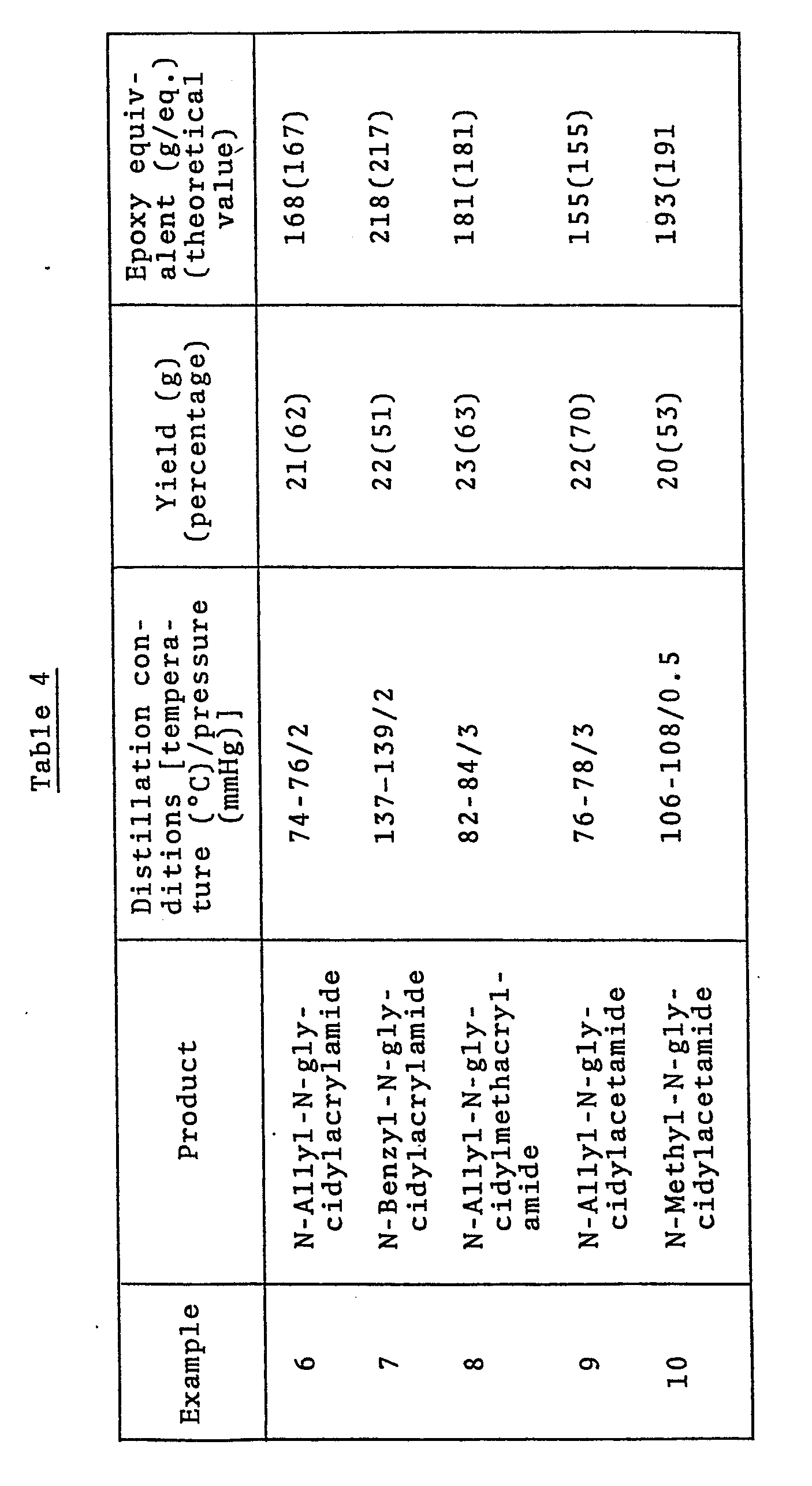
- Using the combinations of starting materials, strongly basic substance and solvent shown in Table 3, reaction was carried out under the conditions shown in Table 3. After completion of the reaction, the reaction mixture was worked up in entirely the same manner as in Example 5 to obtain the results shown in Table 4.

- To 150 ml of DMSO were added 24 g of benzamide, 56 g of epichlorohydrin, and 20 g of sodium hydroxide. The resulting mixture was allowed to react at 40°C for 2 hours.
- After completion of the reaction, the reaction mixture was filtered to remove any insoluble matter, and then stripped of the starting materials and the solvent. To the residue were added 100 ml of benzene and 50 ml of distilled water. After vigorous stirring, the resulting mixture was separated in a separatory funnel and the aqueous layer was further extracted twice with 50-ml portions of benzene. The combined benzene layers were dried over magnesium sulfate. After benzene was distilled off, the remaining solvent and the like were removed by distillation at 120°C and 2 mmHg to obtain 42 g of N,N-diglycidylbenzamide in a 91% yield.
- Titration with perchlorate revealed that its epoxy equivalent was 119 g/eq. (theoretical value, 117 g/eq.).
- Moreover, its refractive index at'25°C was found to be 1.5410.
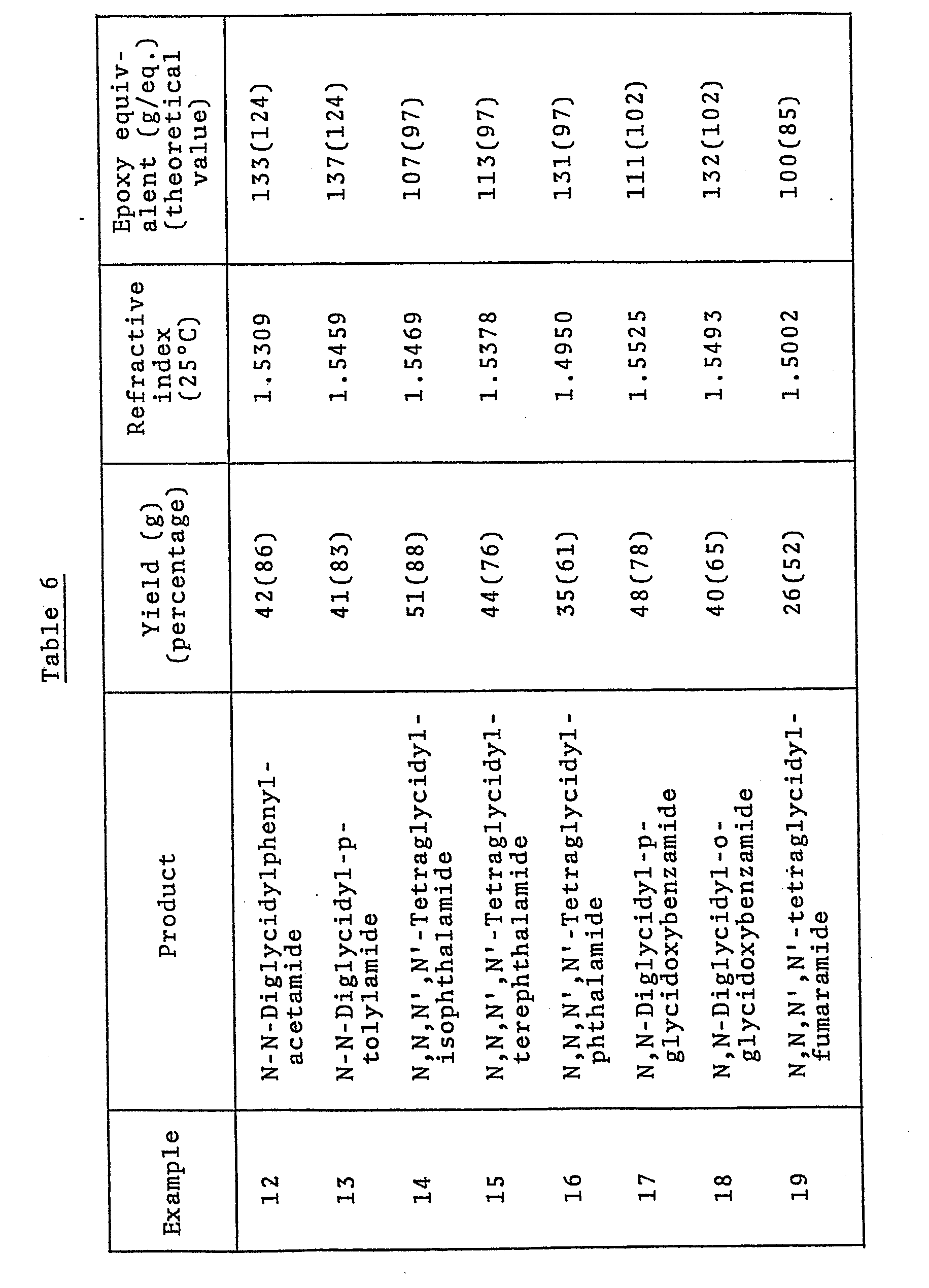
- Using the combinations of starting materials, strongly basic substance and solvent shown in Table 5, reaction was carried out under the conditions shown in Table 5. After completion of the reaction, the reaction mixture was worked up in entirely the same manner as in Example 11 to obtain the results shown in Table 6.



- To 150 ml of sulfolane were added 14 g of acrylamide, 0.05 g of phenothiazine, 37 g of epichlorohydrin, and 20 g of sodium hydroxide, followed by bubbling 15 g of methyl chloride thereinto. The resulting mixture was allowed to react at 40°C for 3 hours.
- After completion of the reaction, the reaction mixture was filtered to remove any insoluble matter, and the filtrate was distilled under reduced pressure. A fraction boiling at 57-59°C (2 mmHg) was collected to obtain 18 g of N-methyl-N-glycidylacrylamide in a 63% yield.
- Titration with perchlorate revealed that its epoxy equivalent was 142 g/eq. (theoretical value, 141 g/eq.).
- Using the combinations of starting materials, strongly basic substance and solvent shown in Table 7, reaction was carried out under the conditions shown in Table 7. After completion of the reaction, the reaction mixture was worked up in entirely the same manner as in Example 26 to obtain the results shown in Table 8.

- N,N-Diglycidyl-p-glycidoxybenzamide, which had been prepared in Example 17, was subjected to an adhesion test in which steel plates were bonded with the following formulation.
- A mixture of 100 parts of N,N-diglycidyl-p-glycidoxybenzamide, 6 parts of dicyandiamide, and 2 parts of aerosil was intimately blended in a three-roll mill. Subsequently, 30 parts of alumina was uniformly dispersed in the blend, which was deaerated under reduced pressure to obtain a formulation.
- A 25 mm (width) x 100 mm (length) x 1.6 mm (thickness) steel plate (JIS G3141) was degreased with acetone, and the above formulation was applied to a terminal region of one surface thereof to a length of 12.5 mm. Another similar steel plate was superposed thereon and both plates were fastened with a clip. Then, the formulation was cured at 180°C for 60 minutes to form a specimen.
- When measured according to the procedure of JIS K6850, the tensile shear strength of the specimen was found to be 190 kg/cm 2 .
- To 250 ml of DMSO were added 18 g of propionamide, 133 g of 8-methylepichlorohydrin, and 30 g of sodium hydroxide. The resulting mixture was allowed to react at 30°C for 5 hours.
- After completion of the reaction, the reaction mixture was filtered to remove any insoluble matter, and then stripped of the starting materials and the solvent. To the residue were added 200 ml of benzene and 100 ml of distilled water. After vigorous stirring, the resulting mixture was separated in a separatory funnel and the aqueous layer was further extracted twice with 100-ml portions of benzene. The combined benzene layers were dried over magnesium sulfate and then distilled under reduced pressure. A fraction boiling at 68-70°C (0.04 mmHg) was collected to obtain 35 g of N,N-di-2-methylglycidylpropionamide in a 65% yield.
- Titration with perchlorate revealed that its epoxy equivalent was 108 g/eq. (theoretical value, 107 g/eq.).
- Using the combinations of starting materials, strongly basic substance and solvent shown in Table 9 and the reaction conditions also shown in Table 9, reaction was carried out in entirely the same manner as in Example 30. In Examples 31 and 33, 0.05 g of phenothiazine was added to the reaction mixture.
- After completion of the reaction, the reaction mixture was worked up in entirely the same manner as in Example 30 to obtain the results shown in Table 10.
- To 250 ml of DMF were added 18 g of acrylamide, 57 g of allyl chloride, 80 g of S-methylepichlorohydrin, 42 g of potassium hydroxide, and 0.05 g of phenothiazine. The resulting mixture was allowed to react at 30°C for 5 hours.
- After completion of the reaction, the reaction mixture was filtered to remove any insoluble matter, and then stripped of the starting materials and the solvent. To the residue were added 200 ml of benzene and 100 ml of distilled water. After vigorous stirring, the resulting mixture was separated in a separatory funnel and the aqueous layer was further extracted twice with 100-ml portions of benzene. The combined benzene layers were dried over magnesium sulfate and then distilled under reduced pressure. A fraction boiling at 53-55°C (0.9 mmHg) was collected to obtain 24 g of N-allyl-N-2-methylglycidylacrylamide in a 53% yield.
- Titration with perchlorate revealed that its epoxy equivalent was 182 g/eq. (theoretical value, 181 g/eq.).
- Using the combinations of starting materials, strongly basic substance and solvent shown in Table 11 and the reaction conditions also shown in Table 11, reaction was carried out in entirely the same manner as in Example 35.
- After completion of the reaction, the reaction mixture was worked up in entirely the same manner as in Example 35 to obtain the results shown in Table 12.
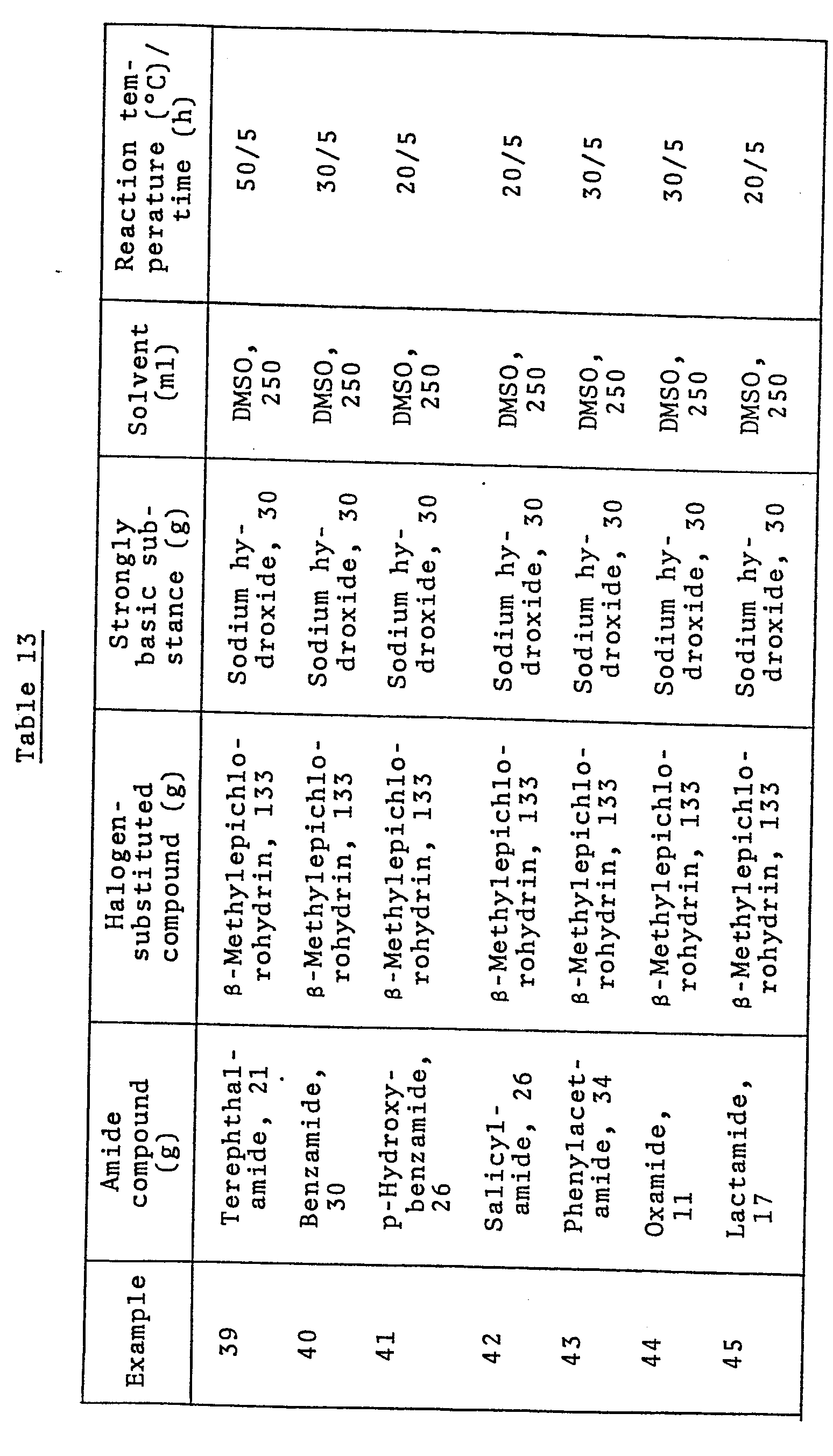
- To 250 ml of DMSO were added 21 g of isophthalamide, 133 g of p-methylepichlorohydrin, and 30 g of sodium hydroxide. The resulting mixture was allowed to react at 30°C for 5 hours.
- After completion of the reaction, the reaction mixture was filtered to remove any insoluble matter, and then stripped of the starting materials and the solvent. To the residue were added 200 ml of benzene and 100 ml of distilled water. After vigorous stirring, the resulting mixture was separated in a separatory funnel and the aqueous layer was further extracted twice with 100-ml portions of benzene. The combined benzene layers were dried over magnesium sulfate. After benzene was distilled off, the remaining solvent and the like were removed by distillation at 120°C and 2 mmHg to obtain 42 g of N,N,N',N'-tetra-2-methylglycidylisophthalamide in an 83% yield.
- Titration with perchlorate revealed that its epoxy equivalent was 121 g/eq. (theoretical value, 111 g/eq.).
- Moreover, its refractive index at 25°C was found to be 1.5311.
- Using the combinations of starting materials, strongly basic substance and solvent shown in Table 13 and the reaction conditions also shown in Table 13, reaction was carried out in entirely the same manner as in Example 40.
- After completion of the reaction, the reaction mixture was worked up in entirely the same manner as in Example 40 to obtain the results shown in Table 14.
- N,N-Di-2-methylglycidyl-p-2-methylglycidoxy- benzamide, which had been prepared in Example 43, was subjected to an adhesion in which steel plates were bonded with the following formulation.
- A mixture of 100 parts of N,N-di-2-methylglycidyl- p-2-methylglycidoxybenzamide, 5 parts of dicyandiamide, and 2 parts of aerosil was intimately blended in a three-roll mill. Subsequently, 30 parts of alumina was uniformly dispersed in the blend, which was deaerated under reduced pressure to obtain a formulation.
- A 25 mm (width) x 100 mm (length) x 1.6 mm (thickness) steel plate (JIS G3141) was degreased with acetone, and the above formulation was applied to a terminal region of one surface thereof to a length of 12.5 mm. Another similar steel plate was superposed thereon and both plates were fastened with a clip. Then, the formulation was cured at 180°C for 60 munites to form a specimen.
- When measured according to the procedure of JIS K6850, the tensile shear strength of the specimen was found to be 180 kg/cm 2.



Claims (7)

Applications Claiming Priority (4)
| Application Number | Priority Date | Filing Date | Title |
|---|---|---|---|
| JP185534/81 | 1981-11-20 | ||
| JP18553481A JPS5888373A (en) | 1981-11-20 | 1981-11-20 | N-glycidyl-substituted amide compound |
| JP12588682A JPS5916883A (en) | 1982-07-21 | 1982-07-21 | N-2-methylglycidyl substituted amide |
| JP125886/82 | 1982-07-21 |
Publications (3)
| Publication Number | Publication Date |
|---|---|
| EP0094436A1 true EP0094436A1 (en) | 1983-11-23 |
| EP0094436A4 EP0094436A4 (en) | 1984-04-27 |
| EP0094436B1 EP0094436B1 (en) | 1988-03-30 |
Family
ID=26462189
Family Applications (1)
| Application Number | Title | Priority Date | Filing Date |
|---|---|---|---|
| EP82903587A Expired EP0094436B1 (en) | 1981-11-20 | 1982-11-19 | N-glycidyl-substituted amide compounds |
Country Status (7)
| Country | Link |
|---|---|
| EP (1) | EP0094436B1 (en) |
| AU (1) | AU556551B2 (en) |
| CH (1) | CH655720A5 (en) |
| DE (1) | DE3249185T1 (en) |
| GB (1) | GB2141703B (en) |
| NL (1) | NL8220418A (en) |
| WO (1) | WO1983001776A1 (en) |
Cited By (4)
| Publication number | Priority date | Publication date | Assignee | Title |
|---|---|---|---|---|
| EP0155810A3 (en) * | 1984-03-15 | 1986-04-16 | Mitsui Toatsu Chemicals, Incorporated | N-(omega-glycidoxyalkyl)-substituted amide compounds and preparation process thereof |
| WO2003031424A1 (en) * | 2001-10-12 | 2003-04-17 | Dow Global Technologies Inc. | Polyepoxy compounds having an amide linkage |
| US7300986B2 (en) | 2001-10-12 | 2007-11-27 | Dow3Global Technologies Inc. | Polyepoxy compounds having an amide linkage |
| CN111909117A (en) * | 2020-08-28 | 2020-11-10 | 南京林业大学 | A kind of phthalic anhydride diisopropanolamide epoxy resin and preparation method and application thereof |
Families Citing this family (1)
| Publication number | Priority date | Publication date | Assignee | Title |
|---|---|---|---|---|
| TWI891825B (en) * | 2021-06-25 | 2025-08-01 | 奇美實業股份有限公司 | Liquid crystal alignment agent, liquid crystal alignment film and liquid crystal display element |
Family Cites Families (8)
| Publication number | Priority date | Publication date | Assignee | Title |
|---|---|---|---|---|
| US2131120A (en) * | 1934-11-01 | 1938-09-27 | Ig Farbenindustrie Ag | Manufacture of organic compounds containing basic substituents |
| US2730531A (en) * | 1953-03-03 | 1956-01-10 | Shell Dev | Amides of epoxyamines |
| US3904658A (en) * | 1970-09-25 | 1975-09-09 | Ciba Geigy Ag | N,n'-diglycidyl-dicarboxylic acid dianilides |
| US3931058A (en) * | 1970-09-25 | 1976-01-06 | Ciba-Geigy Ag | Polyglycidyl compounds, processes for their manufacture and use |
| CH545284A (en) * | 1970-09-25 | 1973-12-15 | Ciba Geigy Ag | Process for the preparation of new polyglycidyl compounds and their use |
| CH541552A (en) * | 1970-09-29 | 1973-09-15 | Ciba Geigy Ag | Process for the preparation of new polyglycidyl compounds |
| JPS479048A (en) * | 1971-09-26 | 1972-05-11 | ||
| JPS477398A (en) * | 1971-09-29 | 1972-04-21 |
-
1982
- 1982-11-19 GB GB08317104A patent/GB2141703B/en not_active Expired
- 1982-11-19 NL NL8220418A patent/NL8220418A/en not_active Application Discontinuation
- 1982-11-19 CH CH4065/83A patent/CH655720A5/en not_active IP Right Cessation
- 1982-11-19 AU AU91270/82A patent/AU556551B2/en not_active Ceased
- 1982-11-19 DE DE823249185T patent/DE3249185T1/en active Granted
- 1982-11-19 WO PCT/JP1982/000443 patent/WO1983001776A1/en not_active Ceased
- 1982-11-19 EP EP82903587A patent/EP0094436B1/en not_active Expired
Cited By (6)
| Publication number | Priority date | Publication date | Assignee | Title |
|---|---|---|---|---|
| EP0155810A3 (en) * | 1984-03-15 | 1986-04-16 | Mitsui Toatsu Chemicals, Incorporated | N-(omega-glycidoxyalkyl)-substituted amide compounds and preparation process thereof |
| WO2003031424A1 (en) * | 2001-10-12 | 2003-04-17 | Dow Global Technologies Inc. | Polyepoxy compounds having an amide linkage |
| US7300986B2 (en) | 2001-10-12 | 2007-11-27 | Dow3Global Technologies Inc. | Polyepoxy compounds having an amide linkage |
| CN100427476C (en) * | 2001-10-12 | 2008-10-22 | 陶氏环球技术公司 | Polyepoxides with amide linkages |
| CN111909117A (en) * | 2020-08-28 | 2020-11-10 | 南京林业大学 | A kind of phthalic anhydride diisopropanolamide epoxy resin and preparation method and application thereof |
| CN111909117B (en) * | 2020-08-28 | 2022-05-03 | 南京林业大学 | Phthalic anhydride diisopropanol amide epoxy resin and preparation method and application thereof |
Also Published As
| Publication number | Publication date |
|---|---|
| GB2141703B (en) | 1986-04-23 |
| WO1983001776A1 (en) | 1983-05-26 |
| NL8220418A (en) | 1983-10-03 |
| GB8317104D0 (en) | 1983-07-27 |
| DE3249185C2 (en) | 1989-11-02 |
| EP0094436B1 (en) | 1988-03-30 |
| DE3249185T1 (en) | 1983-11-17 |
| EP0094436A4 (en) | 1984-04-27 |
| AU9127082A (en) | 1983-06-01 |
| GB2141703A (en) | 1985-01-03 |
| CH655720A5 (en) | 1986-05-15 |
| AU556551B2 (en) | 1986-11-06 |
Similar Documents
| Publication | Publication Date | Title |
|---|---|---|
| US5414083A (en) | Method for the production of N-cyclic and N,N'-dicyclic ureas and their use as chemical solvents | |
| EP1244644B1 (en) | Process for the elimination of materials containing hydrolyzable halides and other high molecular weight materials from epihalohydrin derived epoxy resins | |
| EP0471983B1 (en) | Process for the N-alkylation of urea | |
| CA1151345A (en) | Curable mixtures containing dimethylamino derivatives | |
| DE69715869T2 (en) | EPOXY-BASED IMIDAZOLES CONTAINING CURABLE MIXTURES | |
| EP0094436B1 (en) | N-glycidyl-substituted amide compounds | |
| EP0231149A1 (en) | Polyphenols containing mercapto groups | |
| KR870000918B1 (en) | Process for preparing n-( -glycidoxyalkyl)-substituted amide compounds | |
| EP0220887B1 (en) | Method of optically resolving a racemate or a diastereomeric mixture of glycidyl compound | |
| CN117384058B (en) | Synthesis method of cetyl-PG hydroxyethyl palmitoamide | |
| US4036882A (en) | Amine formal polymers and process of making the same | |
| CN117658963A (en) | Diastereomers of vitamin C derivatives and their preparation and application | |
| JPH0372624B2 (en) | ||
| EP0288495B1 (en) | Synthesis of n-epoxypropyl lactams | |
| JPH0239505B2 (en) | ||
| US5011965A (en) | Process for production of methylene bisxanthates | |
| CN1164854A (en) | Novel synthesis of penta-substituted guanidines | |
| Marks et al. | Fluorine-containing Secondary Diamines1, 2 | |
| DE2711956A1 (en) | Unsatd. carbodiimide cpds. used in prepn. of pharmaceuticals - prepd. by reacting isothiocyanate cpds. with amine(s) and desulphurising resulting thiourea | |
| CH679043A5 (en) | ||
| US4658026A (en) | N,N'-bis(2,3-epoxypropyl) derivatives of cyclic dicarboxylic acid hydrazides and a process for the production thereof | |
| EP0302694A2 (en) | Substituted aryloxyamino-propanols and methods of preparing same | |
| DD156181A1 (en) | METHOD FOR THE PRODUCTION OF SULFONAMIDES OF WEAK BASIC AMINO-ETHEROCYCLES | |
| JPS61167677A (en) | Hydroxybenzoic acid derivative and production thereof | |
| JPH02142755A (en) | Aliphatic triamine compounds |
Legal Events
| Date | Code | Title | Description |
|---|---|---|---|
| PUAI | Public reference made under article 153(3) epc to a published international application that has entered the european phase |
Free format text: ORIGINAL CODE: 0009012 |
|
| AK | Designated contracting states |
Designated state(s): FR |
|
| 17P | Request for examination filed |
Effective date: 19831107 |
|
| GRAA | (expected) grant |
Free format text: ORIGINAL CODE: 0009210 |
|
| AK | Designated contracting states |
Kind code of ref document: B1 Designated state(s): FR |
|
| ET | Fr: translation filed | ||
| PLBE | No opposition filed within time limit |
Free format text: ORIGINAL CODE: 0009261 |
|
| STAA | Information on the status of an ep patent application or granted ep patent |
Free format text: STATUS: NO OPPOSITION FILED WITHIN TIME LIMIT |
|
| 26N | No opposition filed | ||
| PGFP | Annual fee paid to national office [announced via postgrant information from national office to epo] |
Ref country code: FR Payment date: 19901018 Year of fee payment: 9 |
|
| PG25 | Lapsed in a contracting state [announced via postgrant information from national office to epo] |
Ref country code: FR Effective date: 19920731 |
|
| REG | Reference to a national code |
Ref country code: FR Ref legal event code: ST |