EP0093653B1 - Verfahren zur Herstellung von Iodo-Thyroninen und Iodo-Thyroessigsäuren durch elektrochemische Reduktion bei kontrolliertem Potential - Google Patents
Verfahren zur Herstellung von Iodo-Thyroninen und Iodo-Thyroessigsäuren durch elektrochemische Reduktion bei kontrolliertem Potential Download PDFInfo
- Publication number
- EP0093653B1 EP0093653B1 EP83400830A EP83400830A EP0093653B1 EP 0093653 B1 EP0093653 B1 EP 0093653B1 EP 83400830 A EP83400830 A EP 83400830A EP 83400830 A EP83400830 A EP 83400830A EP 0093653 B1 EP0093653 B1 EP 0093653B1
- Authority
- EP
- European Patent Office
- Prior art keywords
- potential
- process according
- reduction
- prepare
- iodo
- Prior art date
- Legal status (The legal status is an assumption and is not a legal conclusion. Google has not performed a legal analysis and makes no representation as to the accuracy of the status listed.)
- Expired
Links
- 0 COC(CC(CC1I)OC(C(CC(CC(*)C(O)=O)C2)I)C2I)(C1O)I Chemical compound COC(CC(CC1I)OC(C(CC(CC(*)C(O)=O)C2)I)C2I)(C1O)I 0.000 description 4
- JHAANIDWIOBFDR-UHFFFAOYSA-N CC(CC(CC(C(O)=O)N)CC1I)C1OC(CCC1O)CC1I Chemical compound CC(CC(CC(C(O)=O)N)CC1I)C1OC(CCC1O)CC1I JHAANIDWIOBFDR-UHFFFAOYSA-N 0.000 description 1
- BJRPXJWNLWGHAE-UHFFFAOYSA-N NC(CC(CC(C1OC(CC2)CCC2O)I)CC1I)C(O)=O Chemical compound NC(CC(CC(C1OC(CC2)CCC2O)I)CC1I)C(O)=O BJRPXJWNLWGHAE-UHFFFAOYSA-N 0.000 description 1
- LBSPUTIBNAOMBR-UHFFFAOYSA-N NC(CC(CCC1OC(CC2)CCC2O)CC1I)C(O)=O Chemical compound NC(CC(CCC1OC(CC2)CCC2O)CC1I)C(O)=O LBSPUTIBNAOMBR-UHFFFAOYSA-N 0.000 description 1
- AKWYFXPJUHOSIR-UHFFFAOYSA-N NC(CC(CCC1OC(CCC2O)CC2I)CC1I)C(O)=O Chemical compound NC(CC(CCC1OC(CCC2O)CC2I)CC1I)C(O)=O AKWYFXPJUHOSIR-UHFFFAOYSA-N 0.000 description 1
Images


Classifications
-
- C—CHEMISTRY; METALLURGY
- C07—ORGANIC CHEMISTRY
- C07C—ACYCLIC OR CARBOCYCLIC COMPOUNDS
- C07C51/00—Preparation of carboxylic acids or their salts, halides or anhydrides
- C07C51/347—Preparation of carboxylic acids or their salts, halides or anhydrides by reactions not involving formation of carboxyl groups
- C07C51/377—Preparation of carboxylic acids or their salts, halides or anhydrides by reactions not involving formation of carboxyl groups by splitting-off hydrogen or functional groups; by hydrogenolysis of functional groups
-
- C—CHEMISTRY; METALLURGY
- C07—ORGANIC CHEMISTRY
- C07C—ACYCLIC OR CARBOCYCLIC COMPOUNDS
- C07C227/00—Preparation of compounds containing amino and carboxyl groups bound to the same carbon skeleton
- C07C227/14—Preparation of compounds containing amino and carboxyl groups bound to the same carbon skeleton from compounds containing already amino and carboxyl groups or derivatives thereof
- C07C227/16—Preparation of compounds containing amino and carboxyl groups bound to the same carbon skeleton from compounds containing already amino and carboxyl groups or derivatives thereof by reactions not involving the amino or carboxyl groups
-
- C—CHEMISTRY; METALLURGY
- C25—ELECTROLYTIC OR ELECTROPHORETIC PROCESSES; APPARATUS THEREFOR
- C25B—ELECTROLYTIC OR ELECTROPHORETIC PROCESSES FOR THE PRODUCTION OF COMPOUNDS OR NON-METALS; APPARATUS THEREFOR
- C25B3/00—Electrolytic production of organic compounds
- C25B3/20—Processes
- C25B3/25—Reduction
Definitions
- the subject of the invention is a process for the synthesis of iodo-thyronines and iodo-thyroacetic acids by selective elimination of one or two iodine atoms by electrolytic reduction with controlled potential.
- Triiodo-3,3 ', 5'-L-thyronine (reverse T 3 or rT 3 ) is one of the four iodothyronines secreted by the thyroid normally found in the blood, the other three being thyroxine or tetraiodo-3,5,3 ', 5'-L-thyronine (T 4 ), triiodo-3,5,3'-L-thyronine (T 3 ) and diiodo-3,3'-L-thyronine ( reverse T 2 or rTz).
- the iodo-thyronine formulas are shown in Table 1 below.
- rT 3 concentration of rT 3 in the plasma (Chopra, 1. J., - J. Clin. Invest., 1974, 54, 583). It is of the order of 20 to 30 ng / 100 ml whereas that of T 3 is on average 120 ng / 100 ml and that of T 4 from 6 to 8 ⁇ g / 100 ml.
- the plasma concentration of rT 2 would be less than 1 ng / 100 ml (Meinhold, H., and Shurnbrand, P. - J. Clin. Chem. Clin. Biochem., 1977, 15,419).
- rT 3 like rTz has no metabolic activity; on the other hand rT 3 is weakly inhibitory of the thyroid concentration of the I- ions (Barker, SB, et al. - Ann. NY Acad. Sci., 1960,82,545. Courrier, R., et al. - Bull. Soc. Chim Biol., 1955,37,439. Roche, J., et al. - CR Soc. Biol., 1958,152,1067).
- T 3 , rT 3 and rT z are of cellular origin.
- T 3 and rT 3 come from the deiodination in 5 'and 5 respectively of T 4 .
- rT z it seems to arise from rT 3 rather than T 3 or T 4 at the expense of which it nevertheless forms small quantities.
- a role of prehormone is therefore very often assigned to T 4 .
- Iodothyroacetic acids are thyroid metabolites which come from the corresponding iodothyronines, which undergo at the level of the tissues and mainly of the liver and the kidney, an oxidative degradation of the alanine chain, probably after passage in the form of iodothyropyruvic acids.
- the formulas of iodothyroacetic acids are shown in Table II below. Only tetra-3,5,3 ', 5'-iodothyroacetic acids (or TETRAC) and triiodo-3,5,3'-thyroacetic acid (or TRIAC) have been shown in a certain way in the 'organization (J. Roche, R. Michel, P.
- iodothyroacetic acids in particular triiodo-3,3 ', 5'-thyroacetic (or rTRIAC) diiodo-3,3'-thyroacetic (or rDIAC) acids, if their presence in the body has not yet been demonstrated, we can think, however, that they are hormonal metabolites since the corresponding iodotyronines rT 3 and rT z are compounds normally present in the organism.
- TETRAC and TRIAC have properties little different from those of the iodothyronines from which they are derived.
- the intensity of the responses on various thyroid activity tests indicate, however, that their action is less than that of their precursors.
- they prove to be elective lipolytics, in particular at the cholesterol level (R. Michel, F. Cabanne, R. Truchot and H. Tron-Loisel - CR Sci. Biol., 1957, 151, 479 - Bull. Soc. Chim. Biol., 1958, 40, 1241).
- rT 3 content of human amniotic fluid has shown that it is approximately 300 ng / 100 ml between the 15th and 30th week of gestation and becomes close to 100 ng / ml of the 31 e to the 42nd week.
- An excess of rT 3 is a sign of a deviation in the metabolism of T 4 .
- rT 3 in amniotic fluid is likely to allow early detection of hypothyroidism in some new - born which we know has to be treated very quickly after birth.
- rT 3 results from the examination of still fragmentary work on the biological activity of this hormone (Roche, J., et al. - Bull. Soc. Chim. (France), 1957, 462, and Bull Soc. Chim. (France), 1979,715) Coiro, V., et al. - Endocrinology, 1980, 106, 68) which lead us to believe that rT 3 can reduce the metabolic activities of T 3 . It therefore appears that rT 3 could be used in the treatment of hyperthyroidism characterized by an abnormally high secretion of T 4 and T 3 .
- the subject of the invention is a new process for the synthesis of tri-iodo, di-iodo and mono-iodo-thyronines, and analogously tri-iodo-, di-iodo and mono-iodo-thyroacetic acids from respec- activation of thyroxine, tri-iodo and di-iodo-thyronines, and tetra-iodo, tri-iodo and di-iodo-thyroacetic acids, by selective electrochemical reduction with controlled potential, in aqueous medium made alkaline by addition of soda, or preferably a tetraalkylammonium hydroxide.
- the subject of the invention is in particular a process for the preparation of rT 3 of high purity, by electrochemical reduction with controlled potential of thyroxine.
- the purity of the product obtained, determined by a new method of polarographic analysis is greater than an impurity level of 0.5% 0 (mole for mole) and the yield of rT 3 relative to the starting thyroxine, is quantitative .
- thyroxine and the various iodo-thyronines studied are reduced in successive stages to different potentials.
- FIG. 1 represents the polarograms of T 4 , T 3 , rT 3 and T 2 in aqueous solution at the concentration 5 - 10 - 4 M, in tetramethylammonium hydroxide (0.1 M).
- FIG. 2 represents the impulse polarogram of T 4 (in solid line) and of rT 3 (in dotted line) at a concentration of 5 - 10- 4 M in aqueous solution containing quaternary tetramethylammonium hydroxide (0.1 M) .
- the first peak (which corresponds to the first wave in Figure 1) is that of the reduction of the iodine fixed in position 5.
- the potential values at which it is necessary to operate to obtain a selective reduction can vary slightly ( ⁇ 0.2 v. Approximately) with the concentration of the raw material to be reduced, and with the concentration of the quaternary ammonium hydroxide added to the electrolytic solution. These values are therefore determined by plotting the polarogram of the substance to be reduced under the chosen operating conditions, and in the presence of 8 per 10,000 parts of gelatin in order to eliminate the polarographic maxima.
- Electrochemical reduction is then carried out in the potential domain located in the upper part of the polarographic wave.
- Di-iodo-3 ', 5'-thyronine (T' 2 ) can also be obtained by reducing the thyroxine to -1.30 v.
- reduction of triiodo-3,3 ', 5-thyronine (Ts) to -1.20 v will lead to diiodo-3,3'-thyronine (rT 2 ).
- the selective reduction process according to the invention can therefore be used for other syntheses than those of rT 3 and in particular for preparing T ′ i by reduction of T 3 or rT 2 to approximately -1.40 V, or else to prepare Ti by reduction of T 2 to approximately -1.20 V, or alternatively to prepare T'z by reduction of rT 3 to approximately -1.5 V.
- the selective reduction process according to the invention can be used for all the thyronines indicated, whether or not they contain one or more constituent atoms (iodine, carbon, nitrogen, hydrogen or oxygen) in their form of natural or stable isotopes or radioactive.
- the process according to the invention can also be applied to the synthesis of iodothyroacetic acids, the structures of which are very similar to those of iodothyronines (see Tables 1 and 11).
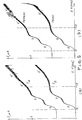
- Figure 5 shows the compared polarograms of the two iodothyronines T 4 and T 3 (fig. 5a) and two corresponding iodothyroacetic acids (TETRAC and TRIAC) (fig. 5b) at a concentration of 5. 10 4 M in medium 0.1 M tetramethylammonium hydroxide. It is noted that for the two types of structures, differing only in the group -NH 2 and in carbon condensation, the reduction of the iodines in position 3 and 5 occurs practically at the same potentials.
- Electrochemical reduction with controlled potential results in an exponential decrease in the electrolysis current as a function of time. If the reduction is not continued for a sufficient time, there may still remain unreduced product, T 4 in the present case.
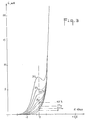
- FIG. 3 brings together the polarograms (limited to the potential domain of interest) of rT 3 prepared by the method described above to which increasing amounts of T 4 have been added in order to testing the purity of the prepared compound; it can be seen that the peak 5 of T 4 appears very clearly at the base of that of rT 3 .
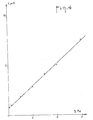
- FIG. 4 represents the curve, as a function of the percentage of impurity T 4 , of the heights of the peak, (in ⁇ , A) measured at -1.125 v on the polarograms of FIG. 3. These heights vary linearly according to the content of T 4 . If one can really quantitatively measure this impurity up to a content of the order of 1% 0 , one must be content only with an estimate for lower contents: indeed, the peak of T 4 gradually vanishes in the baseline of rT 3 . However, it will be observed that at a content of 0.5% 0 , the polarogram differs very significantly from that of rT 3 considered to be pure.
Landscapes
- Chemical & Material Sciences (AREA)
- Organic Chemistry (AREA)
- Chemical Kinetics & Catalysis (AREA)
- Engineering & Computer Science (AREA)
- Oil, Petroleum & Natural Gas (AREA)
- Electrochemistry (AREA)
- Materials Engineering (AREA)
- Metallurgy (AREA)
- Organic Low-Molecular-Weight Compounds And Preparation Thereof (AREA)
- Electrolytic Production Of Non-Metals, Compounds, Apparatuses Therefor (AREA)
- Electrochromic Elements, Electrophoresis, Or Variable Reflection Or Absorption Elements (AREA)
Claims (17)
Priority Applications (1)
| Application Number | Priority Date | Filing Date | Title |
|---|---|---|---|
| AT83400830T ATE14215T1 (de) | 1982-04-30 | 1983-04-27 | Verfahren zur herstellung von iodo-thyroninen und iodo-thyroessigsaeuren durch elektrochemische reduktion bei kontrolliertem potential. |
Applications Claiming Priority (2)
| Application Number | Priority Date | Filing Date | Title |
|---|---|---|---|
| FR8207590 | 1982-04-30 | ||
| FR8207590A FR2526016A1 (fr) | 1982-04-30 | 1982-04-30 | Procede de preparation des iodo-thyronines et en particulier de rt3 a partir de la thyroxine, par reduction electrochimique a potentiel controle |
Publications (2)
| Publication Number | Publication Date |
|---|---|
| EP0093653A1 EP0093653A1 (de) | 1983-11-09 |
| EP0093653B1 true EP0093653B1 (de) | 1985-07-10 |
Family
ID=9273626
Family Applications (1)
| Application Number | Title | Priority Date | Filing Date |
|---|---|---|---|
| EP83400830A Expired EP0093653B1 (de) | 1982-04-30 | 1983-04-27 | Verfahren zur Herstellung von Iodo-Thyroninen und Iodo-Thyroessigsäuren durch elektrochemische Reduktion bei kontrolliertem Potential |
Country Status (5)
| Country | Link |
|---|---|
| US (1) | US4490221A (de) |
| EP (1) | EP0093653B1 (de) |
| AT (1) | ATE14215T1 (de) |
| DE (1) | DE3360383D1 (de) |
| FR (1) | FR2526016A1 (de) |
Families Citing this family (9)
| Publication number | Priority date | Publication date | Assignee | Title |
|---|---|---|---|---|
| US6716452B1 (en) * | 2000-08-22 | 2004-04-06 | New River Pharmaceuticals Inc. | Active agent delivery systems and methods for protecting and administering active agents |
| US6740680B1 (en) * | 1999-04-26 | 2004-05-25 | Becton Pharma, Inc. | Pharmaceutical compositions to tetrac and methods of use thereof |
| US6627660B1 (en) * | 1999-11-16 | 2003-09-30 | New River Pharmaceuticals Inc. | Stabilized thyroxine compounds |
| US8394813B2 (en) | 2000-11-14 | 2013-03-12 | Shire Llc | Active agent delivery systems and methods for protecting and administering active agents |
| US7169752B2 (en) | 2003-09-30 | 2007-01-30 | New River Pharmaceuticals Inc. | Compounds and compositions for prevention of overdose of oxycodone |
| US20060014697A1 (en) | 2001-08-22 | 2006-01-19 | Travis Mickle | Pharmaceutical compositions for prevention of overdose or abuse |
| US7919533B2 (en) * | 2004-10-20 | 2011-04-05 | Sal Abraham | Diiodothyroacetic acid and method of use |
| US20100047662A1 (en) * | 2008-08-22 | 2010-02-25 | Ford Global Technologies, Llc | Catalyst Layers Having Thin Film Mesh Catalyst (TFMC) Supported on a Mesh Substrate and Methods of Making the Same |
| US20110143263A1 (en) * | 2010-04-29 | 2011-06-16 | Ford Global Technologies, Llc | Catalyst Layer Having Thin Film Nanowire Catalyst and Electrode Assembly Employing the Same |
Family Cites Families (4)
| Publication number | Priority date | Publication date | Assignee | Title |
|---|---|---|---|---|
| DE1072998B (de) * | 1960-01-14 | Farbwerke Hoechst Aktiengesellschaft vormals Meister Lucius &. Brüning, Frankfurt/M | Verfahren zur Herstellung von substituierten Diphenyläthern | |
| US2894977A (en) * | 1955-12-24 | 1959-07-14 | Hoechst Ag | Process of preparing phenoxycinnamic acid derivatives |
| US3477954A (en) * | 1966-06-29 | 1969-11-11 | Armour Pharma | Phosphonium iodide complexes of thyroxine,methods of preparing same,and methods of preparing 3,5,3'-l-triiodothyronine therefrom |
| US3677916A (en) * | 1971-03-11 | 1972-07-18 | Dow Chemical Co | Electrolytic reduction of 1,2,3,4-tetrachlorobenzene to obtain 1,2,4-trichlorobenzene |
-
1982
- 1982-04-30 FR FR8207590A patent/FR2526016A1/fr active Granted
-
1983
- 1983-04-27 AT AT83400830T patent/ATE14215T1/de not_active IP Right Cessation
- 1983-04-27 DE DE8383400830T patent/DE3360383D1/de not_active Expired
- 1983-04-27 EP EP83400830A patent/EP0093653B1/de not_active Expired
- 1983-04-28 US US06/489,536 patent/US4490221A/en not_active Expired - Fee Related
Also Published As
| Publication number | Publication date |
|---|---|
| EP0093653A1 (de) | 1983-11-09 |
| US4490221A (en) | 1984-12-25 |
| FR2526016B1 (de) | 1984-07-27 |
| ATE14215T1 (de) | 1985-07-15 |
| FR2526016A1 (fr) | 1983-11-04 |
| DE3360383D1 (en) | 1985-08-14 |
Similar Documents
| Publication | Publication Date | Title |
|---|---|---|
| Kidwell et al. | Environmental exposure—the stumbling block of hair testing | |
| Miyazaki et al. | Tumor necrosis factor α and insulin resistance in obese type 2 diabetic patients | |
| EP0093653B1 (de) | Verfahren zur Herstellung von Iodo-Thyroninen und Iodo-Thyroessigsäuren durch elektrochemische Reduktion bei kontrolliertem Potential | |
| Wada et al. | A simple method for the quantitative analysis of urinary delta-aminol evulinic acid to evaluate lead absorption | |
| Wirz-Justice et al. | Diurnal and seasonal variations in human platelet serotonin in man | |
| WO2001047528A2 (fr) | Nouveaux inhibiteurs de glycosidases et leurs applications pharmacologiques, notamment pour traiter le diabete | |
| Ahnlide et al. | Gold concentration in blood in relation to the number of gold restorations and contact allergy to gold | |
| WEINSTEIN et al. | Quantitative determination of griseofulvin by a spectrophotofluorometric assay | |
| Nangaku et al. | Pathogenesis and management of dialysis-related amyloid bone disease | |
| Brooks et al. | Myocardial hypoxia and reoxygenation: electrophysiologic and mechanical correlates | |
| WO2001002864A1 (fr) | Methodes et kits pour le diagnostic ou le suivi d'une pathologie synoviale ou osteoarticulaire comprenant l'utilisation d'un marqueur specifique de la degradation du tissu synovial | |
| Curzon et al. | A method for the determination of dopa and 3-O-methyldopa in the plasma of Parkinsonian patients | |
| SKOG | Sensitization to p-phenylenediamine | |
| Vrabec et al. | Determination of platinum in biological material by differential pulse polarography: analysis in urine, plasma and tissue following sample combustion | |
| CHAIT et al. | LIPODYSTROPHY WITH HYPERLIPIDAEMIA: THE ROLE OF INSULIN IN VERY LOW DENSITY LIPOPROTEIN OVER‐SYNTHESIS | |
| Okorodudu et al. | Intracellular calcium and hydrogen ions in diabetes mellitus | |
| Liewendahl et al. | Effect of anticonvulsant and antidepressant drugs on iodothyronines in serum | |
| FR2656424A1 (fr) | Procede d'electro-analyse rapide des liquides biologiques, dispositif utilise a cet effet et applications dans le domaine biologique. | |
| FR2468648A1 (fr) | Procede pour mesurer la difference de potentiel entre electrodes afin de determiner la croissance de bacteries | |
| SU1390567A1 (ru) | Способ диагностики псориаза | |
| WO1999003510A1 (en) | Diagnostics for complications of diabetes or renal insufficiency | |
| SU1397812A1 (ru) | Способ количественного определени метионина | |
| Yang et al. | The relationships between hemoglobin and insulin resistance, glucose effectiveness, and first-and second-phase insulin secretion in adult Chinese | |
| JP2000321273A (ja) | ピリジニウム誘導体 | |
| SU1746313A1 (ru) | Способ диагностики воспалительного процесса при мочекаменной болезни |
Legal Events
| Date | Code | Title | Description |
|---|---|---|---|
| PUAI | Public reference made under article 153(3) epc to a published international application that has entered the european phase |
Free format text: ORIGINAL CODE: 0009012 |
|
| AK | Designated contracting states |
Designated state(s): AT BE CH DE GB IT LI LU NL SE |
|
| 17P | Request for examination filed |
Effective date: 19831110 |
|
| ITF | It: translation for a ep patent filed | ||
| GRAA | (expected) grant |
Free format text: ORIGINAL CODE: 0009210 |
|
| RAP1 | Party data changed (applicant data changed or rights of an application transferred) |
Owner name: SPIRAL SOCIETE A RESPONSABILITE LIMITEE DITE : |
|
| AK | Designated contracting states |
Designated state(s): AT BE CH DE GB IT LI LU NL SE |
|
| REF | Corresponds to: |
Ref document number: 14215 Country of ref document: AT Date of ref document: 19850715 Kind code of ref document: T |
|
| REF | Corresponds to: |
Ref document number: 3360383 Country of ref document: DE Date of ref document: 19850814 |
|
| PLBE | No opposition filed within time limit |
Free format text: ORIGINAL CODE: 0009261 |
|
| STAA | Information on the status of an ep patent application or granted ep patent |
Free format text: STATUS: NO OPPOSITION FILED WITHIN TIME LIMIT |
|
| 26N | No opposition filed | ||
| PGFP | Annual fee paid to national office [announced via postgrant information from national office to epo] |
Ref country code: AT Payment date: 19930326 Year of fee payment: 11 |
|
| PGFP | Annual fee paid to national office [announced via postgrant information from national office to epo] |
Ref country code: SE Payment date: 19930426 Year of fee payment: 11 |
|
| ITTA | It: last paid annual fee | ||
| PGFP | Annual fee paid to national office [announced via postgrant information from national office to epo] |
Ref country code: NL Payment date: 19930430 Year of fee payment: 11 |
|
| PGFP | Annual fee paid to national office [announced via postgrant information from national office to epo] |
Ref country code: BE Payment date: 19930513 Year of fee payment: 11 |
|
| EPTA | Lu: last paid annual fee | ||
| PGFP | Annual fee paid to national office [announced via postgrant information from national office to epo] |
Ref country code: CH Payment date: 19940418 Year of fee payment: 12 |
|
| PGFP | Annual fee paid to national office [announced via postgrant information from national office to epo] |
Ref country code: GB Payment date: 19940419 Year of fee payment: 12 |
|
| PGFP | Annual fee paid to national office [announced via postgrant information from national office to epo] |
Ref country code: DE Payment date: 19940426 Year of fee payment: 12 |
|
| PG25 | Lapsed in a contracting state [announced via postgrant information from national office to epo] |
Ref country code: AT Effective date: 19940427 |
|
| PG25 | Lapsed in a contracting state [announced via postgrant information from national office to epo] |
Ref country code: SE Effective date: 19940428 |
|
| PG25 | Lapsed in a contracting state [announced via postgrant information from national office to epo] |
Ref country code: BE Effective date: 19940430 |
|
| PGFP | Annual fee paid to national office [announced via postgrant information from national office to epo] |
Ref country code: LU Payment date: 19940430 Year of fee payment: 12 |
|
| BERE | Be: lapsed |
Owner name: SPIRAL Effective date: 19940430 |
|
| PG25 | Lapsed in a contracting state [announced via postgrant information from national office to epo] |
Ref country code: NL Effective date: 19941101 |
|
| NLV4 | Nl: lapsed or anulled due to non-payment of the annual fee | ||
| EUG | Se: european patent has lapsed |
Ref document number: 83400830.2 Effective date: 19941110 |
|
| PG25 | Lapsed in a contracting state [announced via postgrant information from national office to epo] |
Ref country code: LU Free format text: LAPSE BECAUSE OF NON-PAYMENT OF DUE FEES Effective date: 19950427 Ref country code: GB Effective date: 19950427 |
|
| PG25 | Lapsed in a contracting state [announced via postgrant information from national office to epo] |
Ref country code: LI Effective date: 19950430 Ref country code: CH Effective date: 19950430 |
|
| REG | Reference to a national code |
Ref country code: CH Ref legal event code: PL |
|
| GBPC | Gb: european patent ceased through non-payment of renewal fee |
Effective date: 19950427 |
|
| PG25 | Lapsed in a contracting state [announced via postgrant information from national office to epo] |
Ref country code: DE Effective date: 19960103 |