EP0087233B1 - Process for producing low-sudsing detergent compositions - Google Patents
Process for producing low-sudsing detergent compositions Download PDFInfo
- Publication number
- EP0087233B1 EP0087233B1 EP83300540A EP83300540A EP0087233B1 EP 0087233 B1 EP0087233 B1 EP 0087233B1 EP 83300540 A EP83300540 A EP 83300540A EP 83300540 A EP83300540 A EP 83300540A EP 0087233 B1 EP0087233 B1 EP 0087233B1
- Authority
- EP
- European Patent Office
- Prior art keywords
- suds
- suppressant
- process according
- dialkylamide
- alkane
- Prior art date
- Legal status (The legal status is an assumption and is not a legal conclusion. Google has not performed a legal analysis and makes no representation as to the accuracy of the status listed.)
- Expired
Links
- 239000000203 mixture Substances 0.000 title claims abstract description 37
- 238000000034 method Methods 0.000 title claims abstract description 20
- 239000003599 detergent Substances 0.000 title claims abstract description 19
- 239000000843 powder Substances 0.000 claims abstract description 15
- 150000001335 aliphatic alkanes Chemical class 0.000 claims abstract description 10
- 239000000126 substance Substances 0.000 claims abstract description 10
- 239000011872 intimate mixture Substances 0.000 claims abstract description 6
- 238000005507 spraying Methods 0.000 claims abstract description 6
- 239000002480 mineral oil Substances 0.000 claims description 5
- 239000002270 dispersing agent Substances 0.000 claims description 4
- 238000004519 manufacturing process Methods 0.000 claims description 4
- VNWKTOKETHGBQD-UHFFFAOYSA-N methane Chemical compound C VNWKTOKETHGBQD-UHFFFAOYSA-N 0.000 claims description 4
- 239000002736 nonionic surfactant Substances 0.000 claims description 4
- 235000019271 petrolatum Nutrition 0.000 claims description 4
- 235000010446 mineral oil Nutrition 0.000 claims description 3
- OTMSDBZUPAUEDD-UHFFFAOYSA-N Ethane Chemical compound CC OTMSDBZUPAUEDD-UHFFFAOYSA-N 0.000 claims description 2
- 229910017464 nitrogen compound Inorganic materials 0.000 abstract description 2
- 150000002830 nitrogen compounds Chemical class 0.000 abstract description 2
- 230000015572 biosynthetic process Effects 0.000 abstract 1
- 239000006260 foam Substances 0.000 description 7
- 239000011734 sodium Substances 0.000 description 7
- 229910052708 sodium Inorganic materials 0.000 description 7
- 150000001875 compounds Chemical class 0.000 description 6
- 238000002474 experimental method Methods 0.000 description 6
- 239000001993 wax Substances 0.000 description 6
- -1 alkyl phosphoric acid esters Chemical class 0.000 description 5
- 239000002518 antifoaming agent Substances 0.000 description 5
- RKISUIUJZGSLEV-UHFFFAOYSA-N n-[2-(octadecanoylamino)ethyl]octadecanamide Chemical class CCCCCCCCCCCCCCCCCC(=O)NCCNC(=O)CCCCCCCCCCCCCCCCC RKISUIUJZGSLEV-UHFFFAOYSA-N 0.000 description 5
- 239000003921 oil Substances 0.000 description 5
- 235000019198 oils Nutrition 0.000 description 5
- DGAQECJNVWCQMB-PUAWFVPOSA-M Ilexoside XXIX Chemical compound C[C@@H]1CC[C@@]2(CC[C@@]3(C(=CC[C@H]4[C@]3(CC[C@@H]5[C@@]4(CC[C@@H](C5(C)C)OS(=O)(=O)[O-])C)C)[C@@H]2[C@]1(C)O)C)C(=O)O[C@H]6[C@@H]([C@H]([C@@H]([C@H](O6)CO)O)O)O.[Na+] DGAQECJNVWCQMB-PUAWFVPOSA-M 0.000 description 4
- 229940083159 ethylene distearamide Drugs 0.000 description 4
- 239000002002 slurry Substances 0.000 description 4
- 239000000344 soap Substances 0.000 description 4
- 125000000129 anionic group Chemical group 0.000 description 3
- 239000003945 anionic surfactant Substances 0.000 description 3
- 239000003795 chemical substances by application Substances 0.000 description 3
- 235000014113 dietary fatty acids Nutrition 0.000 description 3
- 239000000194 fatty acid Substances 0.000 description 3
- 229930195729 fatty acid Natural products 0.000 description 3
- 238000009472 formulation Methods 0.000 description 3
- 239000000463 material Substances 0.000 description 3
- 238000001694 spray drying Methods 0.000 description 3
- 238000005406 washing Methods 0.000 description 3
- VYPSYNLAJGMNEJ-UHFFFAOYSA-N Silicium dioxide Chemical compound O=[Si]=O VYPSYNLAJGMNEJ-UHFFFAOYSA-N 0.000 description 2
- PMZURENOXWZQFD-UHFFFAOYSA-L Sodium Sulfate Chemical compound [Na+].[Na+].[O-]S([O-])(=O)=O PMZURENOXWZQFD-UHFFFAOYSA-L 0.000 description 2
- 239000010775 animal oil Substances 0.000 description 2
- 239000007844 bleaching agent Substances 0.000 description 2
- 239000004744 fabric Substances 0.000 description 2
- 150000004665 fatty acids Chemical class 0.000 description 2
- 239000004615 ingredient Substances 0.000 description 2
- 229910052500 inorganic mineral Inorganic materials 0.000 description 2
- 238000002844 melting Methods 0.000 description 2
- 235000019381 petroleum wax Nutrition 0.000 description 2
- 159000000001 potassium salts Chemical class 0.000 description 2
- 150000003839 salts Chemical class 0.000 description 2
- 229960001922 sodium perborate Drugs 0.000 description 2
- YKLJGMBLPUQQOI-UHFFFAOYSA-M sodium;oxidooxy(oxo)borane Chemical compound [Na+].[O-]OB=O YKLJGMBLPUQQOI-UHFFFAOYSA-M 0.000 description 2
- 125000001273 sulfonato group Chemical group [O-]S(*)(=O)=O 0.000 description 2
- JNYAEWCLZODPBN-JGWLITMVSA-N (2r,3r,4s)-2-[(1r)-1,2-dihydroxyethyl]oxolane-3,4-diol Chemical class OC[C@@H](O)[C@H]1OC[C@H](O)[C@H]1O JNYAEWCLZODPBN-JGWLITMVSA-N 0.000 description 1
- 244000144725 Amygdalus communis Species 0.000 description 1
- 235000011437 Amygdalus communis Nutrition 0.000 description 1
- 102000004190 Enzymes Human genes 0.000 description 1
- 108090000790 Enzymes Proteins 0.000 description 1
- LFQSCWFLJHTTHZ-UHFFFAOYSA-N Ethanol Chemical compound CCO LFQSCWFLJHTTHZ-UHFFFAOYSA-N 0.000 description 1
- IAYPIBMASNFSPL-UHFFFAOYSA-N Ethylene oxide Chemical compound C1CO1 IAYPIBMASNFSPL-UHFFFAOYSA-N 0.000 description 1
- 241001553290 Euphorbia antisyphilitica Species 0.000 description 1
- 239000004166 Lanolin Substances 0.000 description 1
- 229910019142 PO4 Inorganic materials 0.000 description 1
- 235000019483 Peanut oil Nutrition 0.000 description 1
- 235000019774 Rice Bran oil Nutrition 0.000 description 1
- 235000019486 Sunflower oil Nutrition 0.000 description 1
- 239000012190 activator Substances 0.000 description 1
- 150000001298 alcohols Chemical class 0.000 description 1
- 125000000217 alkyl group Chemical group 0.000 description 1
- 239000008168 almond oil Substances 0.000 description 1
- 229910000323 aluminium silicate Inorganic materials 0.000 description 1
- 235000013871 bee wax Nutrition 0.000 description 1
- 239000012166 beeswax Substances 0.000 description 1
- 210000000988 bone and bone Anatomy 0.000 description 1
- 239000004204 candelilla wax Substances 0.000 description 1
- 235000013868 candelilla wax Nutrition 0.000 description 1
- 125000004432 carbon atom Chemical group C* 0.000 description 1
- 150000004649 carbonic acid derivatives Chemical class 0.000 description 1
- 239000004203 carnauba wax Substances 0.000 description 1
- 235000013869 carnauba wax Nutrition 0.000 description 1
- 239000003093 cationic surfactant Substances 0.000 description 1
- 239000003240 coconut oil Substances 0.000 description 1
- 235000019864 coconut oil Nutrition 0.000 description 1
- 239000003026 cod liver oil Substances 0.000 description 1
- 235000012716 cod liver oil Nutrition 0.000 description 1
- 230000003750 conditioning effect Effects 0.000 description 1
- 235000005687 corn oil Nutrition 0.000 description 1
- 239000002285 corn oil Substances 0.000 description 1
- 238000005260 corrosion Methods 0.000 description 1
- 230000007797 corrosion Effects 0.000 description 1
- 235000012343 cottonseed oil Nutrition 0.000 description 1
- 239000002385 cottonseed oil Substances 0.000 description 1
- 230000009849 deactivation Effects 0.000 description 1
- KTWWLYJJAXICRK-UHFFFAOYSA-L disodium;2-(carboxymethyl)butanedioate Chemical compound [Na+].[Na+].OC(=O)CC(C([O-])=O)CC([O-])=O KTWWLYJJAXICRK-UHFFFAOYSA-L 0.000 description 1
- 239000006185 dispersion Substances 0.000 description 1
- RTZKZFJDLAIYFH-UHFFFAOYSA-N ether Substances CCOCC RTZKZFJDLAIYFH-UHFFFAOYSA-N 0.000 description 1
- 229940097789 heavy mineral oil Drugs 0.000 description 1
- 229930195733 hydrocarbon Natural products 0.000 description 1
- 150000002430 hydrocarbons Chemical class 0.000 description 1
- 239000003112 inhibitor Substances 0.000 description 1
- 235000019388 lanolin Nutrition 0.000 description 1
- 229940039717 lanolin Drugs 0.000 description 1
- 229940059904 light mineral oil Drugs 0.000 description 1
- 239000007788 liquid Substances 0.000 description 1
- 230000014759 maintenance of location Effects 0.000 description 1
- 229910021645 metal ion Inorganic materials 0.000 description 1
- 125000000325 methylidene group Chemical group [H]C([H])=* 0.000 description 1
- 239000011707 mineral Substances 0.000 description 1
- 239000012170 montan wax Substances 0.000 description 1
- 235000021313 oleic acid Nutrition 0.000 description 1
- 150000002889 oleic acids Chemical class 0.000 description 1
- 239000004006 olive oil Substances 0.000 description 1
- 235000008390 olive oil Nutrition 0.000 description 1
- 239000012188 paraffin wax Substances 0.000 description 1
- 235000019809 paraffin wax Nutrition 0.000 description 1
- 239000000312 peanut oil Substances 0.000 description 1
- 239000002304 perfume Substances 0.000 description 1
- 239000003208 petroleum Substances 0.000 description 1
- 239000012169 petroleum derived wax Substances 0.000 description 1
- 235000021317 phosphate Nutrition 0.000 description 1
- 235000011007 phosphoric acid Nutrition 0.000 description 1
- 150000003013 phosphoric acid derivatives Chemical class 0.000 description 1
- 229920001495 poly(sodium acrylate) polymer Polymers 0.000 description 1
- 150000003138 primary alcohols Chemical class 0.000 description 1
- 239000008165 rice bran oil Substances 0.000 description 1
- 229920006395 saturated elastomer Polymers 0.000 description 1
- 150000003333 secondary alcohols Chemical class 0.000 description 1
- 239000008159 sesame oil Substances 0.000 description 1
- 235000011803 sesame oil Nutrition 0.000 description 1
- 239000000377 silicon dioxide Substances 0.000 description 1
- 229920002545 silicone oil Polymers 0.000 description 1
- 239000001509 sodium citrate Substances 0.000 description 1
- NLJMYIDDQXHKNR-UHFFFAOYSA-K sodium citrate Chemical compound O.O.[Na+].[Na+].[Na+].[O-]C(=O)CC(O)(CC([O-])=O)C([O-])=O NLJMYIDDQXHKNR-UHFFFAOYSA-K 0.000 description 1
- DZCAZXAJPZCSCU-UHFFFAOYSA-K sodium nitrilotriacetate Chemical compound [Na+].[Na+].[Na+].[O-]C(=O)CN(CC([O-])=O)CC([O-])=O DZCAZXAJPZCSCU-UHFFFAOYSA-K 0.000 description 1
- 229910052938 sodium sulfate Inorganic materials 0.000 description 1
- 235000011152 sodium sulphate Nutrition 0.000 description 1
- 241000894007 species Species 0.000 description 1
- 239000003381 stabilizer Substances 0.000 description 1
- 239000002600 sunflower oil Substances 0.000 description 1
- 239000003760 tallow Substances 0.000 description 1
- 229940099259 vaseline Drugs 0.000 description 1
- 239000008158 vegetable oil Substances 0.000 description 1
- 235000013311 vegetables Nutrition 0.000 description 1
- XLYOFNOQVPJJNP-UHFFFAOYSA-N water Substances O XLYOFNOQVPJJNP-UHFFFAOYSA-N 0.000 description 1
- 239000010497 wheat germ oil Substances 0.000 description 1
Classifications
-
- C—CHEMISTRY; METALLURGY
- C11—ANIMAL OR VEGETABLE OILS, FATS, FATTY SUBSTANCES OR WAXES; FATTY ACIDS THEREFROM; DETERGENTS; CANDLES
- C11D—DETERGENT COMPOSITIONS; USE OF SINGLE SUBSTANCES AS DETERGENTS; SOAP OR SOAP-MAKING; RESIN SOAPS; RECOVERY OF GLYCEROL
- C11D3/00—Other compounding ingredients of detergent compositions covered in group C11D1/00
- C11D3/16—Organic compounds
- C11D3/38—Products with no well-defined composition, e.g. natural products
- C11D3/382—Vegetable products, e.g. soya meal, wood flour, sawdust
-
- C—CHEMISTRY; METALLURGY
- C11—ANIMAL OR VEGETABLE OILS, FATS, FATTY SUBSTANCES OR WAXES; FATTY ACIDS THEREFROM; DETERGENTS; CANDLES
- C11D—DETERGENT COMPOSITIONS; USE OF SINGLE SUBSTANCES AS DETERGENTS; SOAP OR SOAP-MAKING; RESIN SOAPS; RECOVERY OF GLYCEROL
- C11D3/00—Other compounding ingredients of detergent compositions covered in group C11D1/00
- C11D3/0005—Other compounding ingredients characterised by their effect
- C11D3/0026—Low foaming or foam regulating compositions
-
- C—CHEMISTRY; METALLURGY
- C11—ANIMAL OR VEGETABLE OILS, FATS, FATTY SUBSTANCES OR WAXES; FATTY ACIDS THEREFROM; DETERGENTS; CANDLES
- C11D—DETERGENT COMPOSITIONS; USE OF SINGLE SUBSTANCES AS DETERGENTS; SOAP OR SOAP-MAKING; RESIN SOAPS; RECOVERY OF GLYCEROL
- C11D3/00—Other compounding ingredients of detergent compositions covered in group C11D1/00
- C11D3/16—Organic compounds
- C11D3/18—Hydrocarbons
-
- C—CHEMISTRY; METALLURGY
- C11—ANIMAL OR VEGETABLE OILS, FATS, FATTY SUBSTANCES OR WAXES; FATTY ACIDS THEREFROM; DETERGENTS; CANDLES
- C11D—DETERGENT COMPOSITIONS; USE OF SINGLE SUBSTANCES AS DETERGENTS; SOAP OR SOAP-MAKING; RESIN SOAPS; RECOVERY OF GLYCEROL
- C11D3/00—Other compounding ingredients of detergent compositions covered in group C11D1/00
- C11D3/16—Organic compounds
- C11D3/26—Organic compounds containing nitrogen
- C11D3/32—Amides; Substituted amides
-
- C—CHEMISTRY; METALLURGY
- C11—ANIMAL OR VEGETABLE OILS, FATS, FATTY SUBSTANCES OR WAXES; FATTY ACIDS THEREFROM; DETERGENTS; CANDLES
- C11D—DETERGENT COMPOSITIONS; USE OF SINGLE SUBSTANCES AS DETERGENTS; SOAP OR SOAP-MAKING; RESIN SOAPS; RECOVERY OF GLYCEROL
- C11D3/00—Other compounding ingredients of detergent compositions covered in group C11D1/00
- C11D3/16—Organic compounds
- C11D3/38—Products with no well-defined composition, e.g. natural products
- C11D3/384—Animal products
Definitions
- This invention relates to a process for producing low-sudsing detergent compositions, and to the compositions produced.
- Low-sudsing detergent compositions are increasing in popularity as the number of front-loading, drum-type washing machines increases, and are now widespread. They are generally in spray-dried, particulate form, although liquids are now being introduced, and are formulated with a high sudsing detergent system together with a suds-suppressant.
- the high sudsing detergent system is usually either an anionic detergent-active compound alone, or a combination of an anionic and a nonionic detergent-active compound.
- the suds-suppressant component can be selected from a wide variety of types, examples being alkyl phosphoric acid esters and their salts, hydrocarbons such as petroleum jelly and waxes, silicone oils and hydrophobed silicas, and mixtures thereof.
- the present invention provides a process for the manufacture of a low-sudsing detergent composition which comprises forming an essentially spray-dried detergent composition and adding a suds-suppressant to it by spraying, the suds-suppressant comprising an intimate mixture of an oily or waxy substance and an a,w-dialkylamide alkane having the structure: where n is the integer 1 or 2.
- the selected a,w-dialkylamide alkanes are ⁇ , ⁇ •distearamide methane and a,w-distearamide ethane, (commonly known as methylene and ethylene distearamides, respectively).
- oily substances are mineral, vegetable or animal oils, colourless mineral oils being preferred. Either light or heavy mineral oil or mixtures thereof may be employed but, of course, any substance used must be of low volatility at normal fabric-washing temperatures.
- oils which are suitable are sesame oil, cottonseed oil, corn oil, sweet almond oil, olive oil, wheat germ oil, rice bran oil or peanut oil, or animal oils such as lanolin, neat's foot oil, bone oil, sperm oil or cod liver oil.
- Preferred waxy materials are of mineral origin, especially those derived from petroleum, including microcrystalline and oxidised microcrystalline petroleum waxes and paraffin waxes.
- a preferred material is petroleum jelly, (often sold under the trade mark "Vaseline” by Cheseborough-Ponds Limited), desirably one having a drop-melting point of from 20°-120°C, preferably 45-65°C.
- the term 'drop-melting point' as used herein is used in the sense defined in ASTM designation D127-63.
- Synthetic waxes, or Montan waxes, or natural waxes such as beeswax, candelilla and carnauba waxes may also be used if desired.
- waxes described may be used alone or in admixture with other waxes.
- the suds-suppressant combination may be added to the essentially high sudsing composition in an amount such that it forms from 0.1 to 5%, preferably 0.5 to 3.5% by weight of the final composition.
- the relative proportions of the a,w-dialkylamide alkane and the oily substance in the suds-suppressant combination are generally from 2.5:97.5 to 9:1, preferably 5:95 to 1:3, the ratios being expressed by weight.
- the suds-suppressant combination may be mixed with a dispersing agent such as a nonionic surfactant.
- a dispersing agent such as a nonionic surfactant.
- Typical nonionic surfactants may for example be either ethoxylated alcohols or sorbitan esters.
- the relative proportions of dispersing agent to the suds-suppressant combination are generally from 0.2:99.8 to 3:1.
- the suds-suppressant combination may also be mixed with other antifoam ingredients such as fatty acids and their soaps, alkyl phosphoric acids and their salts with metal ions, and hydrophobed silica.
- Other antifoam ingredients such as fatty acids and their soaps, alkyl phosphoric acids and their salts with metal ions, and hydrophobed silica.
- the relative proportion of other ingredients to the a,w-dialkylamide alkanes is from 1:9 to 9:1.
- compositions prepared by the process of this invention will contain either an anionic, a nonionic, a zwitterionic or a cationic surfactant or a mixture of these.
- Other components which will normally be present include detergency builders, fabric conditioning agents, bleaching agents, bleach activators, corrosion inhibitors, anti-redeposition agents, fluorescers, stabilisers and a substantial proportion of moisture.
- Typical anionic surfactants which may be present in amounts of from about 2 to 35% by weight of the finished composition, are sodium alkylbenzene sulphonates, preferably the C 1o -C 14 alkyl compounds, sodium primary and secondary alkyl sulphates, preferably the C, o C 22 alkyl sulphonates, sodium olefine sulphonates, preferably the C 10 ⁇ C 18 sulphonates, sodium alkane sulphonates and sodium alcohol ether sulphates. Soaps of fatty acids may also be present, preferably the sodium and potassium salts of C 10 ⁇ C 22 fatty acids, both saturated and unsaturated.
- soap is the sole anionic surfactant it may be present in an amount up to about 65% by weight of the finished composition, down to about 12% by weight when other anionic surfactants are present.
- Typical soaps which can be used are those formed from coconut oil, tallow and natural oils containing high proportions of oleic acids such as sunflower oil.
- compositions produced by the process of the invention can also contain nonionic surfactants, preferably ethoxylated primary and secondary alcohols of from 8 to 25 carbon atoms containing from 3 to 25 moles of ethylene oxide per mole of alcohol. These materials may be present in an amount of from 1 to 15% by weight, based on the weight of the finished composition.
- Typical detergency builders which can be used are the water-soluble phosphates, carbonates, percarbonates and aluminosilicates, particularly the sodium and potassium salts of these compounds.
- Organic builders may also be used, examples being sodium carboxymethylsuccinate, sodium citrate, sodium polyacrylates and sodium nitrilotriacetate. Any of these compounds, or any other builder compound, in any suitable mixture, may be used in amounts of from 5 to 50% by weight of the finished composition.
- the components of the suds-suppressant must be in intimate mixture prior to spraying on to the essentially high sudsing spray-dried detergent composition, since we have discovered that if the two components are added separately, inferior suds control is produced.
- the normal method for making powdered detergent compositions is to combine the spray-dried base powder with components such as sodium perborate, sodium sulphate, enzyme compositions and perfume in a dry-dosing step.
- This step may be performed in accordance with the invention either prior to, simultaneously with, or after the spraying of the essentially high sudsing spray-dried detergent composition with the-intimate mixture of the a,w-dialkylamide alkane and the oily substance.
- the invention is illustrated by the following example.
- This Example illustrates the manufacture of a conventional detergent powder where the antifoam mixture is added to the slurry before spray drying, and the manufacture of an otherwise identical detergent powder according to the invention, the antifoam mixture being sprayed on to the base powder after spray drying.
- the Example also compares the foam control of these two powders.
Landscapes
- Chemical & Material Sciences (AREA)
- Life Sciences & Earth Sciences (AREA)
- Engineering & Computer Science (AREA)
- Wood Science & Technology (AREA)
- Chemical Kinetics & Catalysis (AREA)
- Oil, Petroleum & Natural Gas (AREA)
- Organic Chemistry (AREA)
- Zoology (AREA)
- Detergent Compositions (AREA)
Abstract
Description
- This invention relates to a process for producing low-sudsing detergent compositions, and to the compositions produced.
- Low-sudsing detergent compositions are increasing in popularity as the number of front-loading, drum-type washing machines increases, and are now widespread. They are generally in spray-dried, particulate form, although liquids are now being introduced, and are formulated with a high sudsing detergent system together with a suds-suppressant. The high sudsing detergent system is usually either an anionic detergent-active compound alone, or a combination of an anionic and a nonionic detergent-active compound. The suds-suppressant component can be selected from a wide variety of types, examples being alkyl phosphoric acid esters and their salts, hydrocarbons such as petroleum jelly and waxes, silicone oils and hydrophobed silicas, and mixtures thereof.
- In DE-A-2,043,087, low-sudsing compositions containing complex nitrogen compounds as suds control agents are described. We have now discovered that if certain selected species of these compounds are intimately admixed with an oily or waxy substance and incorporated into what would otherwise be a high-sudsing spray-dried detergent composition by spraying, then excellent low-sudsing compositions are produced. This general type of process is disclosed in our published European patent application EP-A-45208, but it is not suggested there that the process would be advantageous for application of the specific suds-suppressant mixtures of this invention, as compared with, for example the through-slurry route known to the art.
- Accordingly, the present invention provides a process for the manufacture of a low-sudsing detergent composition which comprises forming an essentially spray-dried detergent composition and adding a suds-suppressant to it by spraying, the suds-suppressant comprising an intimate mixture of an oily or waxy substance and an a,w-dialkylamide alkane having the structure:
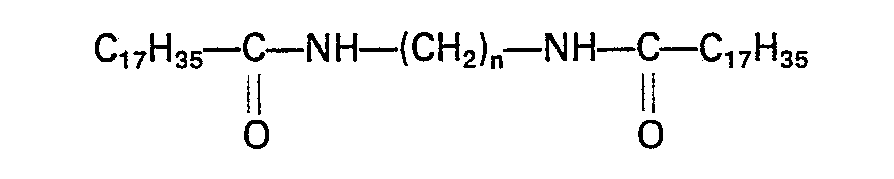
- The selected a,w-dialkylamide alkanes are α,ω•distearamide methane and a,w-distearamide ethane, (commonly known as methylene and ethylene distearamides, respectively).
- Examples of oily substances are mineral, vegetable or animal oils, colourless mineral oils being preferred. Either light or heavy mineral oil or mixtures thereof may be employed but, of course, any substance used must be of low volatility at normal fabric-washing temperatures. Other oils which are suitable are sesame oil, cottonseed oil, corn oil, sweet almond oil, olive oil, wheat germ oil, rice bran oil or peanut oil, or animal oils such as lanolin, neat's foot oil, bone oil, sperm oil or cod liver oil.
- Preferred waxy materials are of mineral origin, especially those derived from petroleum, including microcrystalline and oxidised microcrystalline petroleum waxes and paraffin waxes. A preferred material is petroleum jelly, (often sold under the trade mark "Vaseline" by Cheseborough-Ponds Limited), desirably one having a drop-melting point of from 20°-120°C, preferably 45-65°C. The term 'drop-melting point' as used herein is used in the sense defined in ASTM designation D127-63. Synthetic waxes, or Montan waxes, or natural waxes such as beeswax, candelilla and carnauba waxes may also be used if desired.
- Any of these waxes described may be used alone or in admixture with other waxes.
- The suds-suppressant combination may be added to the essentially high sudsing composition in an amount such that it forms from 0.1 to 5%, preferably 0.5 to 3.5% by weight of the final composition. The relative proportions of the a,w-dialkylamide alkane and the oily substance in the suds-suppressant combination are generally from 2.5:97.5 to 9:1, preferably 5:95 to 1:3, the ratios being expressed by weight.
- The suds-suppressant combination may be mixed with a dispersing agent such as a nonionic surfactant. Typical nonionic surfactants may for example be either ethoxylated alcohols or sorbitan esters. The relative proportions of dispersing agent to the suds-suppressant combination are generally from 0.2:99.8 to 3:1.
- The suds-suppressant combination may also be mixed with other antifoam ingredients such as fatty acids and their soaps, alkyl phosphoric acids and their salts with metal ions, and hydrophobed silica. The relative proportion of other ingredients to the a,w-dialkylamide alkanes is from 1:9 to 9:1.
- The compositions prepared by the process of this invention will contain either an anionic, a nonionic, a zwitterionic or a cationic surfactant or a mixture of these. Other components which will normally be present include detergency builders, fabric conditioning agents, bleaching agents, bleach activators, corrosion inhibitors, anti-redeposition agents, fluorescers, stabilisers and a substantial proportion of moisture.
- Typical anionic surfactants, which may be present in amounts of from about 2 to 35% by weight of the finished composition, are sodium alkylbenzene sulphonates, preferably the C1o-C14 alkyl compounds, sodium primary and secondary alkyl sulphates, preferably the C,o C22 alkyl sulphonates, sodium olefine sulphonates, preferably the C10―C18 sulphonates, sodium alkane sulphonates and sodium alcohol ether sulphates. Soaps of fatty acids may also be present, preferably the sodium and potassium salts of C10―C22 fatty acids, both saturated and unsaturated. Where soap is the sole anionic surfactant it may be present in an amount up to about 65% by weight of the finished composition, down to about 12% by weight when other anionic surfactants are present. Typical soaps which can be used are those formed from coconut oil, tallow and natural oils containing high proportions of oleic acids such as sunflower oil.
- The compositions produced by the process of the invention can also contain nonionic surfactants, preferably ethoxylated primary and secondary alcohols of from 8 to 25 carbon atoms containing from 3 to 25 moles of ethylene oxide per mole of alcohol. These materials may be present in an amount of from 1 to 15% by weight, based on the weight of the finished composition.
- Typical detergency builders which can be used are the water-soluble phosphates, carbonates, percarbonates and aluminosilicates, particularly the sodium and potassium salts of these compounds. Organic builders may also be used, examples being sodium carboxymethylsuccinate, sodium citrate, sodium polyacrylates and sodium nitrilotriacetate. Any of these compounds, or any other builder compound, in any suitable mixture, may be used in amounts of from 5 to 50% by weight of the finished composition.
- It is emphasised that the components of the suds-suppressant must be in intimate mixture prior to spraying on to the essentially high sudsing spray-dried detergent composition, since we have discovered that if the two components are added separately, inferior suds control is produced.
- The normal method for making powdered detergent compositions is to combine the spray-dried base powder with components such as sodium perborate, sodium sulphate, enzyme compositions and perfume in a dry-dosing step. This step may be performed in accordance with the invention either prior to, simultaneously with, or after the spraying of the essentially high sudsing spray-dried detergent composition with the-intimate mixture of the a,w-dialkylamide alkane and the oily substance.
- In a model experiment a spray-dried detergent powder suitable for fabric washing having the formulation shown below was dissolved in demineralised water to form a solution containing 10 g/I of the formulation.

- In two separate experiments 0.04 g/I ethylene distearamide and 0.16 g/I mineral oil were dispersed in the solution. Dispersion was achieved either by hand-shaking for 60 seconds or ultrasonically. In the first experiment the two components were added to the solution separately, whereas in the second experiment they were first intimately mixed and then dispersed.
- The foam generated by each of these two solutions, as compared with a control solution not containing antifoam was then measured using a Ross-Miles dynamic foam meter at 300 ml/min flow rate. The results are shown in Table 1, from which it can be seen that it is only in the case where the ethylene distearamide is intimately mixed with mineral oil that effective foam control is obtained.

- The invention is illustrated by the following example.
- This Example illustrates the manufacture of a conventional detergent powder where the antifoam mixture is added to the slurry before spray drying, and the manufacture of an otherwise identical detergent powder according to the invention, the antifoam mixture being sprayed on to the base powder after spray drying. The Example also compares the foam control of these two powders.
- The following two detergent powders were accordingly produced by a process involving slurry making and counter-current spray-drying steps.
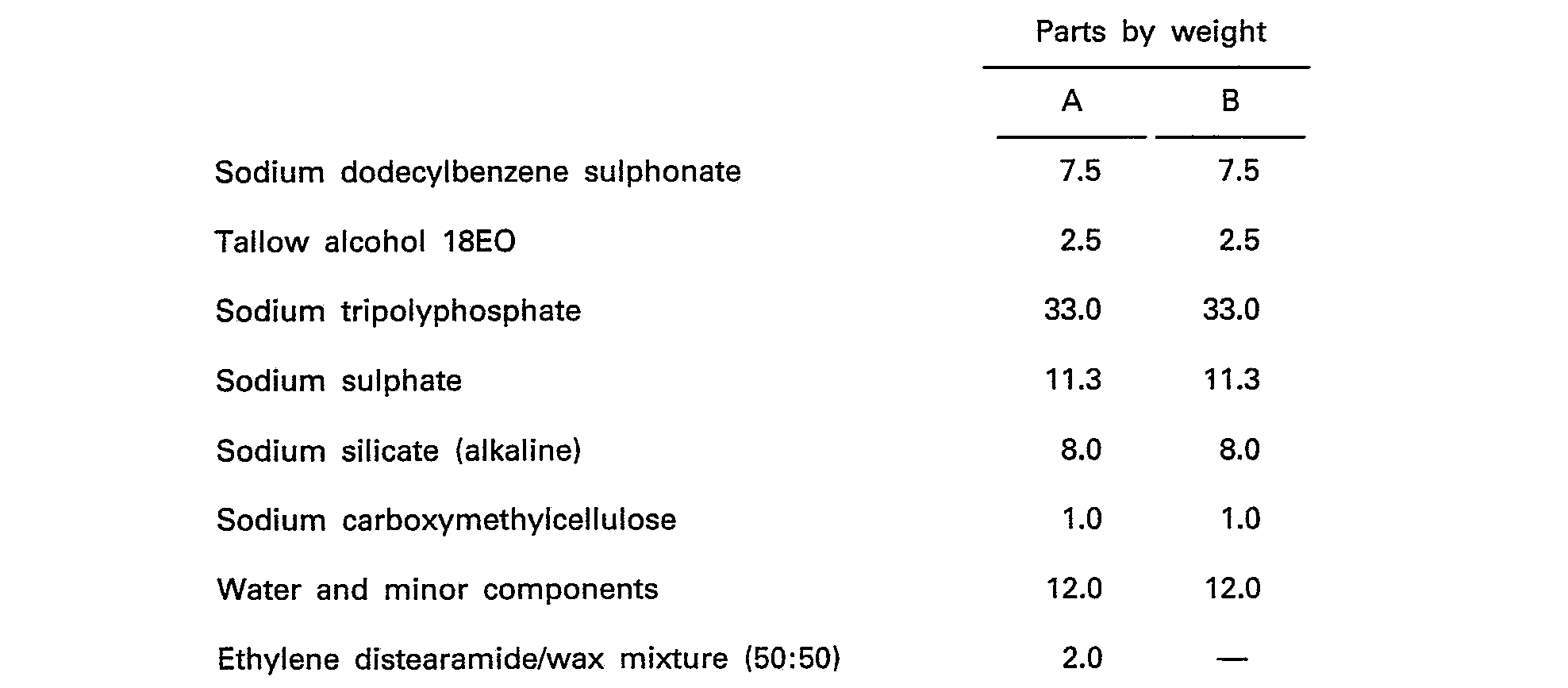
- Two parts of the ethylene distearamide/wax mixture were sprayed onto spray-dried powder B, and then both powders were dry-dosed with 18.8 parts of sodium perborate.
- The foam produced by each formulation was then assessed as described in the Experiment. The results are shown in Table 2.

- The deactivation of the antifoam processed by the through-slurry route (Powder A) is evident, whereas the good retention of foam control of the powder sprayed with the intimate mixture of ethylene distearamide and was (Powder B) is characterised by the low foam heights recorded.
Claims (9)

Priority Applications (1)
| Application Number | Priority Date | Filing Date | Title |
|---|---|---|---|
| AT83300540T ATE23560T1 (en) | 1982-02-04 | 1983-02-03 | PROCESS FOR PREPARING LOW FOAMING DETERGENT COMPOSITIONS. |
Applications Claiming Priority (2)
| Application Number | Priority Date | Filing Date | Title |
|---|---|---|---|
| GB8203233 | 1982-02-04 | ||
| GB8203233 | 1982-02-04 |
Publications (2)
| Publication Number | Publication Date |
|---|---|
| EP0087233A1 EP0087233A1 (en) | 1983-08-31 |
| EP0087233B1 true EP0087233B1 (en) | 1986-11-12 |
Family
ID=10528111
Family Applications (1)
| Application Number | Title | Priority Date | Filing Date |
|---|---|---|---|
| EP83300540A Expired EP0087233B1 (en) | 1982-02-04 | 1983-02-03 | Process for producing low-sudsing detergent compositions |
Country Status (3)
| Country | Link |
|---|---|
| EP (1) | EP0087233B1 (en) |
| AT (1) | ATE23560T1 (en) |
| DE (1) | DE3367617D1 (en) |
Cited By (2)
| Publication number | Priority date | Publication date | Assignee | Title |
|---|---|---|---|---|
| US7316995B2 (en) | 2003-02-10 | 2008-01-08 | Henkel Kommanditgesellschaft Auf Aktien | Detergents or cleaning agents comprising a water-soluble building block system and a cellulose derivative with dirt dissolving properties |
| US7375072B2 (en) | 2003-02-10 | 2008-05-20 | Henkel Kommanditgesellschaft Auf Aktien | Bleach-containing laundry detergents or cleaning compositions comprising water-soluble builder system and soil release-capable cellulose derivative |
Families Citing this family (4)
| Publication number | Priority date | Publication date | Assignee | Title |
|---|---|---|---|---|
| GB8310648D0 (en) * | 1983-04-20 | 1983-05-25 | Unilever Plc | Low sudsing liquid detergent compositions |
| GB8627181D0 (en) * | 1986-11-13 | 1986-12-10 | Procter & Gamble | Softening detergent compositions |
| DE3732947A1 (en) * | 1987-09-30 | 1989-04-13 | Henkel Kgaa | FOAM REGULATOR SUITABLE FOR USE IN WASHING AND CLEANING AGENTS |
| US6200498B1 (en) | 1997-08-29 | 2001-03-13 | Henkel Kommanditgesellschaft Auf Aktien | Process for producing paraffin-containing foam regulators |
Family Cites Families (5)
| Publication number | Priority date | Publication date | Assignee | Title |
|---|---|---|---|---|
| DE2043087A1 (en) * | 1970-08-31 | 1972-03-02 | Henkel & Cie GmbH, 4000 Dusseldorf | Low-foaming washing, cleaning and softening agent |
| DE2043088A1 (en) * | 1970-08-31 | 1972-03-02 | Henkel & Cie GmbH, 4000 Dusseldorf | Low-foaming washing, cleaning and softening agent |
| DE2043086A1 (en) * | 1970-08-31 | 1972-03-30 | Henkel & Cie GmbH, 4000 Dusseldorf | Low-foaming washing, cleaning and softening agent |
| ATE3779T1 (en) * | 1979-06-27 | 1983-06-15 | Unilever Nv | LOW FOAMING CLEANING COMPOSITIONS. |
| US4363740A (en) * | 1980-07-29 | 1982-12-14 | Lever Brothers Company | Process for making controlled sudsing detergent powder |
-
1983
- 1983-02-03 EP EP83300540A patent/EP0087233B1/en not_active Expired
- 1983-02-03 AT AT83300540T patent/ATE23560T1/en not_active IP Right Cessation
- 1983-02-03 DE DE8383300540T patent/DE3367617D1/en not_active Expired
Cited By (2)
| Publication number | Priority date | Publication date | Assignee | Title |
|---|---|---|---|---|
| US7316995B2 (en) | 2003-02-10 | 2008-01-08 | Henkel Kommanditgesellschaft Auf Aktien | Detergents or cleaning agents comprising a water-soluble building block system and a cellulose derivative with dirt dissolving properties |
| US7375072B2 (en) | 2003-02-10 | 2008-05-20 | Henkel Kommanditgesellschaft Auf Aktien | Bleach-containing laundry detergents or cleaning compositions comprising water-soluble builder system and soil release-capable cellulose derivative |
Also Published As
| Publication number | Publication date |
|---|---|
| DE3367617D1 (en) | 1987-01-02 |
| ATE23560T1 (en) | 1986-11-15 |
| EP0087233A1 (en) | 1983-08-31 |
Similar Documents
| Publication | Publication Date | Title |
|---|---|---|
| US4302364A (en) | Liquid detergent compositions comprising anionic, nonionic and cationic surfactants | |
| CN1030333C (en) | Liquid detergent composition containing suspended peroxygen bleach | |
| US4265779A (en) | Suds suppressing compositions and detergents containing them | |
| EP0482275B1 (en) | Stable liquid detergent compositions containing bleach | |
| US5275753A (en) | Stabilized alkaline liquid detergent compositions containing enzyme and peroxygen bleach | |
| EP0094250B1 (en) | Process for preparing granules containing silicone-based anti-foam | |
| JPH0477038B2 (en) | ||
| CA1122094A (en) | Built liquid detergent composition | |
| NZ232056A (en) | Aqueous liquid detergent containing magnesium ions as enzyme stabiliser | |
| JPH0639598B2 (en) | Defoaming ingredient | |
| EP0163352A2 (en) | Detergent with suds control | |
| US4362642A (en) | Alkyl phosphoric acid polyvalent salts-mineral oil lather controlled detergent compositions | |
| AU650247B2 (en) | Suspending liquid detergent compositions | |
| EP0087233A1 (en) | Process for producing low-sudsing detergent compositions | |
| EP0119746B1 (en) | Process for manufacturing detergent powder | |
| EP0045208B1 (en) | Process for making controlled sudsing detergent powder | |
| EP0242918A1 (en) | Softening and bleaching detergent compositions containing amide softening agent | |
| EP0210704A2 (en) | Dispersible fabric softeners | |
| EP0054436B1 (en) | Controlled-sudsing detergent compositions | |
| EP0274142B1 (en) | Detergent composition containing a polyamide softening agent | |
| CA1184468A (en) | Process for preparing low silicate detergent compositions | |
| EP0109247A2 (en) | Hydrocarbon anti-foam granules | |
| JPH08176590A (en) | Powder detergent composition | |
| WO1991009103A1 (en) | Concentrated aqueous liquid bleach compositions | |
| JPH0657836B2 (en) | Cleaning composition |
Legal Events
| Date | Code | Title | Description |
|---|---|---|---|
| PUAI | Public reference made under article 153(3) epc to a published international application that has entered the european phase |
Free format text: ORIGINAL CODE: 0009012 |
|
| AK | Designated contracting states |
Designated state(s): AT BE CH DE FR GB IT LI NL SE |
|
| 17P | Request for examination filed |
Effective date: 19840209 |
|
| GRAA | (expected) grant |
Free format text: ORIGINAL CODE: 0009210 |
|
| AK | Designated contracting states |
Kind code of ref document: B1 Designated state(s): AT BE CH DE FR GB IT LI NL SE |
|
| PG25 | Lapsed in a contracting state [announced via postgrant information from national office to epo] |
Ref country code: BE Effective date: 19861112 Ref country code: AT Effective date: 19861112 |
|
| REF | Corresponds to: |
Ref document number: 23560 Country of ref document: AT Date of ref document: 19861115 Kind code of ref document: T |
|
| REF | Corresponds to: |
Ref document number: 3367617 Country of ref document: DE Date of ref document: 19870102 |
|
| ET | Fr: translation filed | ||
| ITF | It: translation for a ep patent filed | ||
| PLBE | No opposition filed within time limit |
Free format text: ORIGINAL CODE: 0009261 |
|
| STAA | Information on the status of an ep patent application or granted ep patent |
Free format text: STATUS: NO OPPOSITION FILED WITHIN TIME LIMIT |
|
| 26N | No opposition filed | ||
| ITTA | It: last paid annual fee | ||
| EAL | Se: european patent in force in sweden |
Ref document number: 83300540.8 |
|
| PGFP | Annual fee paid to national office [announced via postgrant information from national office to epo] |
Ref country code: CH Payment date: 19970129 Year of fee payment: 15 |
|
| PGFP | Annual fee paid to national office [announced via postgrant information from national office to epo] |
Ref country code: FR Payment date: 19980112 Year of fee payment: 16 |
|
| PGFP | Annual fee paid to national office [announced via postgrant information from national office to epo] |
Ref country code: SE Payment date: 19980116 Year of fee payment: 16 |
|
| PGFP | Annual fee paid to national office [announced via postgrant information from national office to epo] |
Ref country code: GB Payment date: 19980126 Year of fee payment: 16 Ref country code: DE Payment date: 19980126 Year of fee payment: 16 |
|
| PGFP | Annual fee paid to national office [announced via postgrant information from national office to epo] |
Ref country code: NL Payment date: 19980218 Year of fee payment: 16 |
|
| PG25 | Lapsed in a contracting state [announced via postgrant information from national office to epo] |
Ref country code: LI Free format text: LAPSE BECAUSE OF NON-PAYMENT OF DUE FEES Effective date: 19980228 Ref country code: CH Free format text: LAPSE BECAUSE OF NON-PAYMENT OF DUE FEES Effective date: 19980228 |
|
| REG | Reference to a national code |
Ref country code: CH Ref legal event code: PL |
|
| PG25 | Lapsed in a contracting state [announced via postgrant information from national office to epo] |
Ref country code: GB Free format text: LAPSE BECAUSE OF NON-PAYMENT OF DUE FEES Effective date: 19990203 |
|
| PG25 | Lapsed in a contracting state [announced via postgrant information from national office to epo] |
Ref country code: SE Free format text: LAPSE BECAUSE OF NON-PAYMENT OF DUE FEES Effective date: 19990204 |
|
| PG25 | Lapsed in a contracting state [announced via postgrant information from national office to epo] |
Ref country code: NL Free format text: LAPSE BECAUSE OF NON-PAYMENT OF DUE FEES Effective date: 19990901 |
|
| GBPC | Gb: european patent ceased through non-payment of renewal fee |
Effective date: 19990203 |
|
| PG25 | Lapsed in a contracting state [announced via postgrant information from national office to epo] |
Ref country code: FR Free format text: LAPSE BECAUSE OF NON-PAYMENT OF DUE FEES Effective date: 19991029 |
|
| EUG | Se: european patent has lapsed |
Ref document number: 83300540.8 |
|
| PG25 | Lapsed in a contracting state [announced via postgrant information from national office to epo] |
Ref country code: DE Free format text: LAPSE BECAUSE OF NON-PAYMENT OF DUE FEES Effective date: 19991201 |
|
| REG | Reference to a national code |
Ref country code: FR Ref legal event code: ST |