EP0085262B1 - Molekularmodelle - Google Patents
Molekularmodelle Download PDFInfo
- Publication number
- EP0085262B1 EP0085262B1 EP82307038A EP82307038A EP0085262B1 EP 0085262 B1 EP0085262 B1 EP 0085262B1 EP 82307038 A EP82307038 A EP 82307038A EP 82307038 A EP82307038 A EP 82307038A EP 0085262 B1 EP0085262 B1 EP 0085262B1
- Authority
- EP
- European Patent Office
- Prior art keywords
- molecule
- cross
- atoms
- computer
- space
- Prior art date
- Legal status (The legal status is an assumption and is not a legal conclusion. Google has not performed a legal analysis and makes no representation as to the accuracy of the status listed.)
- Expired
Links
Images


Classifications
-
- G—PHYSICS
- G09—EDUCATION; CRYPTOGRAPHY; DISPLAY; ADVERTISING; SEALS
- G09B—EDUCATIONAL OR DEMONSTRATION APPLIANCES; APPLIANCES FOR TEACHING, OR COMMUNICATING WITH, THE BLIND, DEAF OR MUTE; MODELS; PLANETARIA; GLOBES; MAPS; DIAGRAMS
- G09B23/00—Models for scientific, medical, or mathematical purposes, e.g. full-sized devices for demonstration purposes
- G09B23/26—Models for scientific, medical, or mathematical purposes, e.g. full-sized devices for demonstration purposes for molecular structures; for crystallography
-
- B—PERFORMING OPERATIONS; TRANSPORTING
- B29—WORKING OF PLASTICS; WORKING OF SUBSTANCES IN A PLASTIC STATE IN GENERAL
- B29C—SHAPING OR JOINING OF PLASTICS; SHAPING OF MATERIAL IN A PLASTIC STATE, NOT OTHERWISE PROVIDED FOR; AFTER-TREATMENT OF THE SHAPED PRODUCTS, e.g. REPAIRING
- B29C64/00—Additive manufacturing, i.e. manufacturing of three-dimensional [3D] objects by additive deposition, additive agglomeration or additive layering, e.g. by 3D printing, stereolithography or selective laser sintering
- B29C64/10—Processes of additive manufacturing
- B29C64/141—Processes of additive manufacturing using only solid materials
Definitions
- the present invention comprises space filling molecular models consisting of a series of stacked, relatively thin rigid sheets of plastic or similar material separated by spacer blocks cut out to represent individual cross-sections of the molecule said rigid plastic sheets representing the space filling nature of the atoms contained therein. For convenience, generally only the portion of the molecule which is of interest is reproduced.
- the invention also includes the method of designing and constructing. such models using existing data of compounds having known molecular structures, using digital computers interfaced with appropriate visual display units and other selected input and output devices. The data used is obtained from laboratories which examine crystalline substances of known structure by x-ray spectroscopy and is stored on computer readable magnetic tapes. The data from the tapes is then stored in the memory system of a general purpose electronic digital computer.
- the computer when coupled with appropriate output devices permits visualization of the molecular structure and plotting of individual cross-sections of the molecule along a preselected axis.
- the cross-section plots thus produced are circles spaced to represent individual atoms whose radii intersect the particular plane or cross-section involved.
- the contour of the space filling nature of the atoms is drawn by connecting the atomic radii outlining open space in the cross-section.
- the contour map thus produced is transferred to a rigid sheet of plastic and the portion representing empty space is cut out of the plastic.
- the adjacent cross-sections are then stacked with appropriately sized spacers to produce a 3-dimensional model of stacked plastic sheets representing the shape of the space filling nature of the molecule as well as defining the outer surface contours of the molecule.
- the invention also provides a method of constructing a scale model of a molecule or portion thereof illustrating the space-filling nature of atoms in a molecular structure which comprises transferring x-ray crystallographic data from computer-readable magnetic tape to the memory system of a general purpose electronic digital computer, processing the data in the said memory system to produce a visual representation of a molecule on a video screen, rotating the visual representation to align the desired structural feature along the Z-axis of the video screen, recording the rotations of the X, Y and Z rotation, further processing the information in stored memory of the computer while interfacing the computer with a zeta plotter output device whereby the outline of atomic intersection of individual molecular cross-section is plotted in sequential order, selecting a series of adjacent plots or partial plots aligned to illustrate a preselected structural feature, duplicating the said plots in respective rigid transparent sheets and stacking the sheets in sequential order and in vertical alignment whereby they define a scaler representative of the space-filling nature of the molecular model or
- the present invention presents a new type of space filling molecular model which approximates the construction scale of the well-known CPK models. It also relates to a system for constructing such models or selected portions thereof using the information available from laboratories such as the Brookhaven National Laboratory including spatial coordinates of individual atoms of a preselected molecule on computer readable magnetic tape. The system is described in the block diagram of Figure 5 as follows:
- the models of the present invention may be used in conjunction with other conventional space filling models of smaller molecules to study the spatial interaction or compatibility of a large molecule such as an enzyme and the proposed substrate molecule.
- the scale of construction of the models of the present invention is compatible with the scale of the CPK models which is . approximately 1.25 cm/angstrom.
- a preferred method of model construction involves identification and construction of the portion of the enzyme molecule containing the presumed "active" site, i.e., the portion of the molecule which is believed to bind a substrate or inhibitor molecule.
- an important feature of selecting a potential candidate for inhibitation or activation of an enzyme is the geometry of the substrate molecule relative to the geometry of the "active" site of the enzyme.
- the substrate molecule in order to modify the activity of the enzyme molecule, it is believed that the substrate molecule must first be of such a space filling size and shape that it will "fit" an active site in the enzyme molecule.
- the data from x-ray spectroscopy of a preselected crystalline enzyme Rhizopus acid proteinase, is obtained from a publicly available source such as the Brookhaven National Laboratory. This input data is provided along with other information as . computer readable magnetic tapes and includes geometric coordinates of atoms within the molecule. The data available from such magnetic tapes is transferred by conventional peripheral computer hardware to the memory bank of any general purpose electronic digital computer such as International Business Machine System 370. The information stored in memory is then further processed to add further molecular structural detail to the information input from the publicly available magnetic tape.
- This input gives coordinates for the amino acid residues of the enzyme molecule and must be further processed to add necessary informational detail to locate individual atoms and their method of bonding as well as adding appropriate hydrogen atoms to complete the structural information using the MAKEBOND and the HGROW programs.
- the stored information is then processed to orient the features of the molecule which it is desired to reproduce and to plot the coordinates of the atoms on each selected cross-section in the following manner.
- the stored memory information is then processed manually using a Text Editor to extract from memory, data designating individual atoms, their individual sequence, the atom type, the amino acid residue type and residue number as well as as the geometric coordinates of the individual atoms.
- the feature of the enzyme molecule that is of interest is identified in a system employing a video display screen interfaced with a digital computer which accepts the input from the stored data.
- a digital computer which accepts the input from the stored data.
- One such computer which has been used is identifed as a Vax 11/780 computer supplied by Digital Equipment Inc. and the multipicture system by Evans and Sutherland Co., Inc.
- the C-alpha representation of the enzyme is displayed by first processing the stored data memory with the CAFILE program.
- the output of the CAFILE program is then processed with the DISMOL program whereby the C-alpha representation of the enzyme molecule is displayed on the video screen.
- the C-alpha representation displayed is then rotated to present the axis of the selected feature of the molecule parallel to the Z-axis as viewed on the video screen.
- the X, Y, and Z rotations are then recorded for use in the PLANES y program which controls the actual plotting of the cross-section planes on paper.
- Fig. 4 illustrates the method of calculating the intersection of each atom with each plane.
- the outer surface of an atom (4-1) is shown as intersecting the surface of the plane Zp(4-8).
- the radius of the circle of intersection (4-4) of the atom with the plane Zp is identified as (R e ).
- the radius of the atom (4-5) R A having its center on 4-7, the Z axis is used as described in the following mathematical expression:
- the program is set for 1.0 Angstrom spacing and interfaced with an output device known as a ZETA plotter whereby circles approximating space occupied by each atom intersecting the plane are plotted and identified with atom type and serial order number.
- the plotting requires approximately 8-10 hours and produces the entire enzyme molecule plotted as cross section planes spaced 1 Angstrom apart.
- Other models can be plotted in similar manner using appropriate sources of stored data.
- the next step in the model construction is production of the individual cross-section planes. Although it is possible to produce the entire molecule as a space filling model, it is. preferred to produce only that portion containing the "active site" of the molecule. This section should include the portion of adjacent cross-sectional planes which contain the key residues at the active site and those residues which line the surface of the site. These residues may be identified by visual inspection of the molecular display referred to hereinabove and the particular layers may be identified by hand searching of the individual plots or by use of the "PLANES" program referred to hereinabove. This complete process is graphically depicted in the system flow diagram of figure 5 described as follows:
- the adjacent cross-sections containing the active site are identified and selected along with the residues which line the surface of the active site.
- a preferred partial model can be prepared by marking out vertically aligned 30.48 cm (12") squares containing that portion of the molecule containing the active site. The marked sections of the plots are duplicated in transparent plastic sheets.
- the preferred material of construction is a 30.48 cm (12") square of 0.3175 cm (1/8 inch) plexiglass@ marked to maintain axial alignment. For ease of construction the squares are each split into. two halves before duplicating the rectangular paper plots in plastic.
- One method of duplicating the selected squares is to align the paper plot marked rectangle over the plastic sheet and transfer the contour of the atoms to the plastic using carbon paper to mark the outline on the plastic.
- the orientation is also marked on the plastic so that the adjacent cross-sections can be axially aligned.
- the adjacent sections are then assembled using approximately ten 0.9525 cm (3/8") cubes of plastic as spacers between layers, which maintains an actual distance between planes of 1.27 cm (1/2"), satisfying the preferred model scale of 1 angstrom: 1.25 cm.
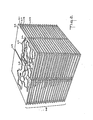
- the spacers are glued preferably to the bottom of each plane, and the planes stacked as shown in Figure 1 for the first 2 planes.
- Figure 1 is a model of a segment of a molecule illustrating the principle of assembling only the portion of a molecule showing the open active site of the molecule with the solid plastic sheet (4) representing the space filling nature of the atoms surrounding the active site (2).
- the edges (3) of the cross-section planes (4) define the surface of the active hole or site within the space filling part of the molecule and are held in parallel relation by an appropriate number of spacer blocks (1).
- FIG. 2 is perspective view of the completed construction model wherein (2-6) identifies the 19 plane cross-section of the molecule from plane 20 through plane 38; (2-3) refers to the seam caused by the split piece used in the preferred method of construction; (2-1) refers to a spacer block separating planar cross-section (2-7) and (2-8); (2-4) refers to the edge boundary of plane (2-2) representing the contour formed by the space filling atoms adjacent the empty space represented by (2-5) and (2-9) represents plane cross-section 24 illustrated in figure 3.
- Figure 3 represents a complete paper plot of plane A24 of the Rhizopus acid proteinase enzyme wherein (3-1) refers to the contour line representing the boundary between relatively filled space containing the circles (3-3) representing atom intercepts; (3-4) represents the border of the section of the plane to be transferred to plastic sheet; the area marked (cutout) representing unfilled space or "active site”; (3.5) is a dotted line representing the construction split line; and (3-2) is an extension. of the space filled portion serving to support one corner of the cutout piece.
- (3-1) refers to the contour line representing the boundary between relatively filled space containing the circles (3-3) representing atom intercepts
- (3-4) represents the border of the section of the plane to be transferred to plastic sheet
- the area marked (cutout) representing unfilled space or "active site”
- (3.5) is a dotted line representing the construction split line
- (3-2) is an extension. of the space filled portion serving to support one corner of the cutout piece.
Landscapes
- Physics & Mathematics (AREA)
- Engineering & Computer Science (AREA)
- General Physics & Mathematics (AREA)
- Chemical & Material Sciences (AREA)
- Pure & Applied Mathematics (AREA)
- Educational Administration (AREA)
- Algebra (AREA)
- Mathematical Analysis (AREA)
- Mathematical Optimization (AREA)
- Mathematical Physics (AREA)
- Spectroscopy & Molecular Physics (AREA)
- Business, Economics & Management (AREA)
- Crystallography & Structural Chemistry (AREA)
- Computational Mathematics (AREA)
- Educational Technology (AREA)
- Theoretical Computer Science (AREA)
- Materials Engineering (AREA)
- Manufacturing & Machinery (AREA)
- Mechanical Engineering (AREA)
- Optics & Photonics (AREA)
- Information Retrieval, Db Structures And Fs Structures Therefor (AREA)
- Measuring Or Testing Involving Enzymes Or Micro-Organisms (AREA)
- Steroid Compounds (AREA)
Claims (3)
Applications Claiming Priority (2)
| Application Number | Priority Date | Filing Date | Title |
|---|---|---|---|
| US334196 | 1981-12-24 | ||
| US06/334,196 US4416635A (en) | 1981-12-24 | 1981-12-24 | Molecular models |
Publications (2)
| Publication Number | Publication Date |
|---|---|
| EP0085262A1 EP0085262A1 (de) | 1983-08-10 |
| EP0085262B1 true EP0085262B1 (de) | 1986-04-02 |
Family
ID=23306054
Family Applications (1)
| Application Number | Title | Priority Date | Filing Date |
|---|---|---|---|
| EP82307038A Expired EP0085262B1 (de) | 1981-12-24 | 1982-12-22 | Molekularmodelle |
Country Status (4)
| Country | Link |
|---|---|
| US (1) | US4416635A (de) |
| EP (1) | EP0085262B1 (de) |
| JP (1) | JPS58221880A (de) |
| DE (1) | DE3270323D1 (de) |
Families Citing this family (10)
| Publication number | Priority date | Publication date | Assignee | Title |
|---|---|---|---|---|
| JP2565005B2 (ja) * | 1991-03-08 | 1996-12-18 | 富士通株式会社 | 異種結晶の合成装置 |
| EP0691194A1 (de) * | 1994-07-04 | 1996-01-10 | Pharos S.A. | Dreidimensional molekulär Muster erzeugt durch ein schnelles Verfahren zur Herstellung von Prototypen |
| US6471520B1 (en) | 1998-11-13 | 2002-10-29 | Milwaukee School Of Engineering | Model of complex structure and method of making the same |
| US6793497B2 (en) | 1999-11-12 | 2004-09-21 | Milwaukee School Of Engineering | Molecular models |
| US6884079B2 (en) * | 2002-02-08 | 2005-04-26 | Talou Co., Ltd. | Molecular model representing molecular structure |
| US6960087B2 (en) * | 2003-07-23 | 2005-11-01 | Texas Lutheran University | NMR teaching method and apparatus |
| US7048545B2 (en) * | 2003-07-23 | 2006-05-23 | Texas Lutheran University | NMR teaching method and apparatus |
| WO2017160921A1 (en) * | 2016-03-15 | 2017-09-21 | Massachusetts Institute Of Technology | Educational building blocks to model protein assembly from amino acids |
| US20180012517A1 (en) * | 2016-07-06 | 2018-01-11 | WhiteClouds Inc. | Three dimensional hinged model |
| CN108748981A (zh) * | 2018-06-07 | 2018-11-06 | 西安交通大学 | 基于辐射交联的体素成型增材制造装置及成型方法 |
Family Cites Families (14)
| Publication number | Priority date | Publication date | Assignee | Title |
|---|---|---|---|---|
| FR1099406A (fr) * | 1951-03-06 | 1955-09-05 | Procédé de restitution du relief à partir d'un plan coté à lignes de niveau, etmoyens de mise en oeuvre dudit procédé | |
| US2882616A (en) * | 1955-12-16 | 1959-04-21 | Benjamin Harry | Crystal structure device |
| US3137080A (en) * | 1962-03-16 | 1964-06-16 | Eugene E Zang | Vitavue relief model technique |
| US3168311A (en) * | 1962-05-01 | 1965-02-02 | Parker Brothers Inc | Game |
| US3802097A (en) * | 1972-10-16 | 1974-04-09 | Or Da Ind Ltd | Dna model kit |
| US3939581A (en) * | 1973-06-11 | 1976-02-24 | Clarke Jr Frank H | Organic molecular model assembly |
| US3854223A (en) * | 1973-11-26 | 1974-12-17 | C Dingman | Molecular models for nucleic acids |
| CH561943A5 (de) * | 1974-03-05 | 1975-05-15 | Dreiding Andre | |
| CH565423A5 (de) * | 1974-03-07 | 1975-08-15 | Dreiding Andre | |
| US3903616A (en) * | 1974-11-07 | 1975-09-09 | Portia L Gage | Molecule model construction kit |
| FR2368101A1 (fr) * | 1976-10-14 | 1978-05-12 | Latapie Jean Marc | Procede permettant la restitution du relief indique en plan par des courbes de niveau |
| FR2389189A1 (fr) * | 1977-04-26 | 1978-11-24 | Gueritault Francoise | Dispositif permettant la visualisation de positions dans l'espace |
| US4371345A (en) * | 1980-10-17 | 1983-02-01 | National Research Development Corporation | Multi-dimensional display equipment |
| EP0051089B1 (de) * | 1980-11-04 | 1987-01-07 | The Boeing Company | Verfahren zur Analyse abgetasteter Daten |
-
1981
- 1981-12-24 US US06/334,196 patent/US4416635A/en not_active Expired - Fee Related
-
1982
- 1982-12-22 EP EP82307038A patent/EP0085262B1/de not_active Expired
- 1982-12-22 DE DE8282307038T patent/DE3270323D1/de not_active Expired
- 1982-12-24 JP JP57226438A patent/JPS58221880A/ja active Pending
Also Published As
| Publication number | Publication date |
|---|---|
| JPS58221880A (ja) | 1983-12-23 |
| US4416635A (en) | 1983-11-22 |
| EP0085262A1 (de) | 1983-08-10 |
| DE3270323D1 (en) | 1986-05-07 |
Similar Documents
| Publication | Publication Date | Title |
|---|---|---|
| EP0085262B1 (de) | Molekularmodelle | |
| CA1246239A (en) | System and method for displaying and interactively excavating and examining a three dimensional volume | |
| US9786072B2 (en) | Techniques for visualization of data | |
| Shih | Parametric Modeling with Autodesk Inventor 2018 | |
| Shih | AutoCAD 2023 Tutorial First Level 2D Fundamentals | |
| Veen et al. | TROTS: A computer graphics system for three-dimensional reconstruction from serial sections | |
| KR960008608A (ko) | 기하학적 구속조건 표시장치 | |
| Shih | Tools for Design Using AutoCAD 2021 and Autodesk Inventor 2021 | |
| Tickoo | Exploring Autodesk Revit 2021 for Architecture | |
| Hobbs et al. | AutoCAD as a cartographic training tool: a case study | |
| JP7464423B2 (ja) | 図面の作成方法およびシステム | |
| Wuenseh | The teaching of crystallography to materials scientists and engineers | |
| MacEachren | The evolution of computer mapping and its implications for geography | |
| Schweitzer et al. | Getting to the “graphics” in a graphics exercise | |
| Iler | The use of computer mapping in planning and public works management: The case of Chicago | |
| Hiland et al. | New York Bight Study. Report 4. Geographic Information Systems and Relational Database Management System Development | |
| ISAH | STUDENT INDUSTRIAL WORK EXPERIENCE SCHEME (SIWES) | |
| Design | Designing Interactive Maps for Planning and Education | |
| Pao et al. | Engineering drafting and solid modeling with silverscreen | |
| JPH0644350A (ja) | 平面表示による6面体を主とした有限要素法の固体要素生成方法 | |
| Baker et al. | An Evaluation of SAS/GRAPH Software for Computer Cartography | |
| Bolton et al. | Automated Radar Video Map Production at NOS | |
| Huang | Rasterization of three dimensional multilayer geophysical model | |
| Martinez | Interactive procedures, data structures and 3-D editing for computer-aided architectural modeling | |
| Gabrielson | Mesh generation for two-dimensional regions using a DVST (Direct View Storage Tube) graphics terminal.[DYMESH code] |
Legal Events
| Date | Code | Title | Description |
|---|---|---|---|
| PUAI | Public reference made under article 153(3) epc to a published international application that has entered the european phase |
Free format text: ORIGINAL CODE: 0009012 |
|
| AK | Designated contracting states |
Designated state(s): CH DE FR GB LI |
|
| 17P | Request for examination filed |
Effective date: 19831218 |
|
| GRAA | (expected) grant |
Free format text: ORIGINAL CODE: 0009210 |
|
| AK | Designated contracting states |
Kind code of ref document: B1 Designated state(s): CH DE FR GB LI |
|
| PG25 | Lapsed in a contracting state [announced via postgrant information from national office to epo] |
Ref country code: FR Free format text: THE PATENT HAS BEEN ANNULLED BY A DECISION OF A NATIONAL AUTHORITY Effective date: 19860402 |
|
| REF | Corresponds to: |
Ref document number: 3270323 Country of ref document: DE Date of ref document: 19860507 |
|
| EN | Fr: translation not filed | ||
| PG25 | Lapsed in a contracting state [announced via postgrant information from national office to epo] |
Ref country code: LI Effective date: 19861231 Ref country code: CH Effective date: 19861231 |
|
| PLBE | No opposition filed within time limit |
Free format text: ORIGINAL CODE: 0009261 |
|
| STAA | Information on the status of an ep patent application or granted ep patent |
Free format text: STATUS: NO OPPOSITION FILED WITHIN TIME LIMIT |
|
| 26N | No opposition filed | ||
| GBPC | Gb: european patent ceased through non-payment of renewal fee | ||
| REG | Reference to a national code |
Ref country code: CH Ref legal event code: PL |
|
| PG25 | Lapsed in a contracting state [announced via postgrant information from national office to epo] |
Ref country code: DE Effective date: 19870901 |
|
| PG25 | Lapsed in a contracting state [announced via postgrant information from national office to epo] |
Ref country code: GB Free format text: LAPSE BECAUSE OF NON-PAYMENT OF DUE FEES Effective date: 19881122 |