EP0084411B1 - Composition and method for cleaning hydrocarbon oil from hard surfaces - Google Patents
Composition and method for cleaning hydrocarbon oil from hard surfaces Download PDFInfo
- Publication number
- EP0084411B1 EP0084411B1 EP83300048A EP83300048A EP0084411B1 EP 0084411 B1 EP0084411 B1 EP 0084411B1 EP 83300048 A EP83300048 A EP 83300048A EP 83300048 A EP83300048 A EP 83300048A EP 0084411 B1 EP0084411 B1 EP 0084411B1
- Authority
- EP
- European Patent Office
- Prior art keywords
- oil
- carbon atoms
- foregoing
- water
- cuttings
- Prior art date
- Legal status (The legal status is an assumption and is not a legal conclusion. Google has not performed a legal analysis and makes no representation as to the accuracy of the status listed.)
- Expired
Links
- 238000000034 method Methods 0.000 title claims description 31
- 239000000203 mixture Substances 0.000 title claims description 23
- 238000004140 cleaning Methods 0.000 title claims description 15
- 229930195733 hydrocarbon Natural products 0.000 title description 6
- 150000002430 hydrocarbons Chemical class 0.000 title description 6
- 239000004215 Carbon black (E152) Substances 0.000 title description 5
- 238000005520 cutting process Methods 0.000 claims description 41
- XLYOFNOQVPJJNP-UHFFFAOYSA-N water Substances O XLYOFNOQVPJJNP-UHFFFAOYSA-N 0.000 claims description 23
- 239000012141 concentrate Substances 0.000 claims description 18
- IAYPIBMASNFSPL-UHFFFAOYSA-N Ethylene oxide Chemical group C1CO1 IAYPIBMASNFSPL-UHFFFAOYSA-N 0.000 claims description 15
- 125000004432 carbon atom Chemical group C* 0.000 claims description 14
- 125000000217 alkyl group Chemical group 0.000 claims description 12
- -1 alkyl phenol Chemical compound 0.000 claims description 11
- LFQSCWFLJHTTHZ-UHFFFAOYSA-N Ethanol Chemical compound CCO LFQSCWFLJHTTHZ-UHFFFAOYSA-N 0.000 claims description 9
- 239000013535 sea water Substances 0.000 claims description 9
- 239000002904 solvent Substances 0.000 claims description 8
- 239000007864 aqueous solution Substances 0.000 claims description 7
- RTZKZFJDLAIYFH-UHFFFAOYSA-N Diethyl ether Chemical compound CCOCC RTZKZFJDLAIYFH-UHFFFAOYSA-N 0.000 claims description 6
- 238000005406 washing Methods 0.000 claims description 4
- 229910019142 PO4 Inorganic materials 0.000 claims description 3
- 150000001298 alcohols Chemical class 0.000 claims description 3
- 239000010452 phosphate Substances 0.000 claims description 3
- 239000002253 acid Substances 0.000 claims description 2
- 150000001732 carboxylic acid derivatives Chemical class 0.000 claims description 2
- 230000000694 effects Effects 0.000 claims description 2
- 125000002887 hydroxy group Chemical group [H]O* 0.000 claims description 2
- 239000003960 organic solvent Substances 0.000 claims description 2
- 150000003014 phosphoric acid esters Chemical class 0.000 claims description 2
- 239000007787 solid Substances 0.000 claims description 2
- 125000003342 alkenyl group Chemical group 0.000 claims 1
- 238000010790 dilution Methods 0.000 claims 1
- 239000012895 dilution Substances 0.000 claims 1
- 125000000816 ethylene group Chemical group [H]C([H])([*:1])C([H])([H])[*:2] 0.000 claims 1
- 238000002360 preparation method Methods 0.000 claims 1
- 238000000926 separation method Methods 0.000 claims 1
- 239000003921 oil Substances 0.000 description 52
- 238000005553 drilling Methods 0.000 description 21
- 239000004094 surface-active agent Substances 0.000 description 11
- 239000000839 emulsion Substances 0.000 description 10
- 239000012530 fluid Substances 0.000 description 10
- 239000011435 rock Substances 0.000 description 7
- 239000000243 solution Substances 0.000 description 7
- 235000013162 Cocos nucifera Nutrition 0.000 description 6
- 244000060011 Cocos nucifera Species 0.000 description 6
- DNIAPMSPPWPWGF-UHFFFAOYSA-N Propylene glycol Chemical compound CC(O)CO DNIAPMSPPWPWGF-UHFFFAOYSA-N 0.000 description 6
- LYCAIKOWRPUZTN-UHFFFAOYSA-N Ethylene glycol Chemical compound OCCO LYCAIKOWRPUZTN-UHFFFAOYSA-N 0.000 description 5
- 239000008346 aqueous phase Substances 0.000 description 4
- 239000003599 detergent Substances 0.000 description 4
- 150000003138 primary alcohols Chemical class 0.000 description 4
- 229910001209 Low-carbon steel Inorganic materials 0.000 description 3
- YXFVVABEGXRONW-UHFFFAOYSA-N Toluene Chemical compound CC1=CC=CC=C1 YXFVVABEGXRONW-UHFFFAOYSA-N 0.000 description 3
- 238000009472 formulation Methods 0.000 description 3
- 239000004615 ingredient Substances 0.000 description 3
- 239000002736 nonionic surfactant Substances 0.000 description 3
- 238000010998 test method Methods 0.000 description 3
- 239000012085 test solution Substances 0.000 description 3
- IGFHQQFPSIBGKE-UHFFFAOYSA-N 4-nonylphenol Chemical compound CCCCCCCCCC1=CC=C(O)C=C1 IGFHQQFPSIBGKE-UHFFFAOYSA-N 0.000 description 2
- CSCPPACGZOOCGX-UHFFFAOYSA-N Acetone Chemical compound CC(C)=O CSCPPACGZOOCGX-UHFFFAOYSA-N 0.000 description 2
- WSFSSNUMVMOOMR-UHFFFAOYSA-N Formaldehyde Chemical compound O=C WSFSSNUMVMOOMR-UHFFFAOYSA-N 0.000 description 2
- KFZMGEQAYNKOFK-UHFFFAOYSA-N Isopropanol Chemical compound CC(C)O KFZMGEQAYNKOFK-UHFFFAOYSA-N 0.000 description 2
- MTHSVFCYNBDYFN-UHFFFAOYSA-N diethylene glycol Chemical compound OCCOCCO MTHSVFCYNBDYFN-UHFFFAOYSA-N 0.000 description 2
- 238000009826 distribution Methods 0.000 description 2
- 239000007788 liquid Substances 0.000 description 2
- 239000002453 shampoo Substances 0.000 description 2
- 239000007762 w/o emulsion Substances 0.000 description 2
- WRIDQFICGBMAFQ-UHFFFAOYSA-N (E)-8-Octadecenoic acid Natural products CCCCCCCCCC=CCCCCCCC(O)=O WRIDQFICGBMAFQ-UHFFFAOYSA-N 0.000 description 1
- LQJBNNIYVWPHFW-UHFFFAOYSA-N 20:1omega9c fatty acid Natural products CCCCCCCCCCC=CCCCCCCCC(O)=O LQJBNNIYVWPHFW-UHFFFAOYSA-N 0.000 description 1
- QSBYPNXLFMSGKH-UHFFFAOYSA-N 9-Heptadecensaeure Natural products CCCCCCCC=CCCCCCCCC(O)=O QSBYPNXLFMSGKH-UHFFFAOYSA-N 0.000 description 1
- DGAQECJNVWCQMB-PUAWFVPOSA-M Ilexoside XXIX Chemical compound C[C@@H]1CC[C@@]2(CC[C@@]3(C(=CC[C@H]4[C@]3(CC[C@@H]5[C@@]4(CC[C@@H](C5(C)C)OS(=O)(=O)[O-])C)C)[C@@H]2[C@]1(C)O)C)C(=O)O[C@H]6[C@@H]([C@H]([C@@H]([C@H](O6)CO)O)O)O.[Na+] DGAQECJNVWCQMB-PUAWFVPOSA-M 0.000 description 1
- QZXSMBBFBXPQHI-UHFFFAOYSA-N N-(dodecanoyl)ethanolamine Chemical group CCCCCCCCCCCC(=O)NCCO QZXSMBBFBXPQHI-UHFFFAOYSA-N 0.000 description 1
- 239000005642 Oleic acid Substances 0.000 description 1
- ZQPPMHVWECSIRJ-UHFFFAOYSA-N Oleic acid Natural products CCCCCCCCC=CCCCCCCCC(O)=O ZQPPMHVWECSIRJ-UHFFFAOYSA-N 0.000 description 1
- 239000002202 Polyethylene glycol Substances 0.000 description 1
- ZLMJMSJWJFRBEC-UHFFFAOYSA-N Potassium Chemical compound [K] ZLMJMSJWJFRBEC-UHFFFAOYSA-N 0.000 description 1
- 238000013019 agitation Methods 0.000 description 1
- 125000003545 alkoxy group Chemical group 0.000 description 1
- 125000000129 anionic group Chemical group 0.000 description 1
- 239000003945 anionic surfactant Substances 0.000 description 1
- 230000015572 biosynthetic process Effects 0.000 description 1
- 239000012267 brine Substances 0.000 description 1
- 230000015556 catabolic process Effects 0.000 description 1
- 239000003093 cationic surfactant Substances 0.000 description 1
- 239000004568 cement Substances 0.000 description 1
- 239000012459 cleaning agent Substances 0.000 description 1
- 238000010276 construction Methods 0.000 description 1
- 239000010779 crude oil Substances 0.000 description 1
- 239000013527 degreasing agent Substances 0.000 description 1
- 230000001419 dependent effect Effects 0.000 description 1
- 239000006185 dispersion Substances 0.000 description 1
- 239000000975 dye Substances 0.000 description 1
- ZQPPMHVWECSIRJ-MDZDMXLPSA-N elaidic acid Chemical compound CCCCCCCC\C=C\CCCCCCCC(O)=O ZQPPMHVWECSIRJ-MDZDMXLPSA-N 0.000 description 1
- 239000003995 emulsifying agent Substances 0.000 description 1
- 238000001704 evaporation Methods 0.000 description 1
- 238000005187 foaming Methods 0.000 description 1
- 238000010438 heat treatment Methods 0.000 description 1
- 239000003752 hydrotrope Substances 0.000 description 1
- WGCNASOHLSPBMP-UHFFFAOYSA-N hydroxyacetaldehyde Natural products OCC=O WGCNASOHLSPBMP-UHFFFAOYSA-N 0.000 description 1
- QXJSBBXBKPUZAA-UHFFFAOYSA-N isooleic acid Natural products CCCCCCCC=CCCCCCCCCC(O)=O QXJSBBXBKPUZAA-UHFFFAOYSA-N 0.000 description 1
- 238000012423 maintenance Methods 0.000 description 1
- 229910052751 metal Inorganic materials 0.000 description 1
- 239000002184 metal Substances 0.000 description 1
- 244000005700 microbiome Species 0.000 description 1
- 239000002480 mineral oil Substances 0.000 description 1
- 239000007764 o/w emulsion Substances 0.000 description 1
- 239000002304 perfume Substances 0.000 description 1
- 239000003208 petroleum Substances 0.000 description 1
- 239000012071 phase Substances 0.000 description 1
- JTJMJGYZQZDUJJ-UHFFFAOYSA-N phencyclidine Chemical class C1CCCCN1C1(C=2C=CC=CC=2)CCCCC1 JTJMJGYZQZDUJJ-UHFFFAOYSA-N 0.000 description 1
- 238000000053 physical method Methods 0.000 description 1
- 229920001223 polyethylene glycol Polymers 0.000 description 1
- 229910052700 potassium Inorganic materials 0.000 description 1
- 239000011591 potassium Substances 0.000 description 1
- 239000003755 preservative agent Substances 0.000 description 1
- 238000011084 recovery Methods 0.000 description 1
- 230000002787 reinforcement Effects 0.000 description 1
- 150000003839 salts Chemical class 0.000 description 1
- 229910052708 sodium Inorganic materials 0.000 description 1
- 239000011734 sodium Substances 0.000 description 1
- HPALAKNZSZLMCH-UHFFFAOYSA-M sodium;chloride;hydrate Chemical compound O.[Na+].[Cl-] HPALAKNZSZLMCH-UHFFFAOYSA-M 0.000 description 1
- 238000003860 storage Methods 0.000 description 1
- 230000008961 swelling Effects 0.000 description 1
- 230000002195 synergetic effect Effects 0.000 description 1
- 238000010792 warming Methods 0.000 description 1
- 239000008096 xylene Substances 0.000 description 1
Classifications
-
- C—CHEMISTRY; METALLURGY
- C11—ANIMAL OR VEGETABLE OILS, FATS, FATTY SUBSTANCES OR WAXES; FATTY ACIDS THEREFROM; DETERGENTS; CANDLES
- C11D—DETERGENT COMPOSITIONS; USE OF SINGLE SUBSTANCES AS DETERGENTS; SOAP OR SOAP-MAKING; RESIN SOAPS; RECOVERY OF GLYCEROL
- C11D1/00—Detergent compositions based essentially on surface-active compounds; Use of these compounds as a detergent
- C11D1/38—Cationic compounds
- C11D1/52—Carboxylic amides, alkylolamides or imides or their condensation products with alkylene oxides
- C11D1/526—Carboxylic amides (R1-CO-NR2R3), where R1, R2 or R3 are polyalkoxylated
-
- C—CHEMISTRY; METALLURGY
- C11—ANIMAL OR VEGETABLE OILS, FATS, FATTY SUBSTANCES OR WAXES; FATTY ACIDS THEREFROM; DETERGENTS; CANDLES
- C11D—DETERGENT COMPOSITIONS; USE OF SINGLE SUBSTANCES AS DETERGENTS; SOAP OR SOAP-MAKING; RESIN SOAPS; RECOVERY OF GLYCEROL
- C11D1/00—Detergent compositions based essentially on surface-active compounds; Use of these compounds as a detergent
- C11D1/38—Cationic compounds
- C11D1/52—Carboxylic amides, alkylolamides or imides or their condensation products with alkylene oxides
- C11D1/523—Carboxylic alkylolamides, or dialkylolamides, or hydroxycarboxylic amides (R1-CO-NR2R3), where R1, R2 or R3 contain one hydroxy group per alkyl group
-
- E—FIXED CONSTRUCTIONS
- E21—EARTH OR ROCK DRILLING; MINING
- E21B—EARTH OR ROCK DRILLING; OBTAINING OIL, GAS, WATER, SOLUBLE OR MELTABLE MATERIALS OR A SLURRY OF MINERALS FROM WELLS
- E21B21/00—Methods or apparatus for flushing boreholes, e.g. by use of exhaust air from motor
- E21B21/06—Arrangements for treating drilling fluids outside the borehole
- E21B21/068—Arrangements for treating drilling fluids outside the borehole using chemical treatment
-
- E—FIXED CONSTRUCTIONS
- E21—EARTH OR ROCK DRILLING; MINING
- E21B—EARTH OR ROCK DRILLING; OBTAINING OIL, GAS, WATER, SOLUBLE OR MELTABLE MATERIALS OR A SLURRY OF MINERALS FROM WELLS
- E21B41/00—Equipment or details not covered by groups E21B15/00 - E21B40/00
- E21B41/005—Waste disposal systems
Definitions
- the present invention relates to methods of cleaning oil/rock mixtures in oil drilling operations and especially to cleaning of drilling oil from rock cuttings on offshore drilling rigs, removal of oil from the face of newly drilled holes prior to reinforcement with casing, and to the cleaning of oil muds from drilling rigs.
- drilling fluid or drilling mud In the process of drilling for oil and gas, it is necessary for a number of reasons, to use a drilling fluid or drilling mud.
- the types of drilling fluid or mud in common use are:
- Oil based drilling media (b) may also contain water in the form of water in oil emulsion. It is customary in the art to refer to a drilling medium containing up to about 15% aqueous phase by volume as oil based. Those drilling media referred to as invert fluids or muds, (c) generally contain between 15% and 55% water. This patent application is particularly concerned with types (b and c) both of which are included in the term "oil” as used herein, together with crude and refined mineral oils.
- drilling fluid One of the functions of drilling fluid is to carry drill cuttings from the drill bit to the surface, the cuttings are then removed by physical techniques, for example, by using shale shakers, screens, cyclones, and centrifuges. After removal of the cuttings the drilling fluid is re-used and the cuttings are disposed of. If the drilling is offshore then the cuttings are disposed of into the sea, where in the case of aqueous drilling fluids the cuttings disperse and settle without causing significant problems. However, in the case of oil drilling fluids the cuttings are oil wet and settle rapidly to the sea bed below the drilling rig and form an oily, sticky mass, which can interfere with drilling operations, for example, by hindering the movement of divers involved in sub-sea construction and maintenance work. It is thought that the swelling of clays in the cuttings is responsible for the formation of this mass. In addition, the cuttings cause oil pollution through gradual release of the oil.
- One technique to remove oil from cuttings is to wash the cuttings with a solvent such as diesel, this has the effect of removing most of the oil but still leaves the surfaces contaminated with hydrocarbons, which can gradually be released to the environment.
- Another way is to use a water miscible solvent, such as a glycol ether, but these are expensive.
- Yet another way is to wash the cuttings in sea water using good agitation to dislodge the oil from the surface of the cuttings. This process can be used either as the sole process for removing the drilling oil from the cuttings, or as a second step to remove an oil solvent from cuttings previously washed with a hydrocarbon. This process can be improved by adding a surfactant to the sea water, to lower the oil/water interfacial tension.
- the cuttings may then be discharged to the sea where they disperse and settle over a wide area of sea bed rather than accumulate directly in the area of the drilling operations.
- the oil in water emulsion which is formed as a result of washing the cuttings may be discharged to the sea where fine dispersion of the oil will facilitate its breakdown by micro-organisms.
- a commonly used surfactant for the foregoing purposes is a C9-11 alcohol six mole ethoxylate.
- alkoxylated non-ionic surfactants are known in the detergent art which are sometimes used as ingredients of detergent or shampoo formulations for various purposes, usually in admixture with anionic or cationic surfactants.
- Another category of known surfactant comprises the alkyl alkanolamides. These are not normally used as cleaning agents in their own right, but are widely used as minor ingredients of detergent and shampoo formulations to promote foaming.
- An object of the present invention is to provide more effective methods of cleaning oil from rock cuttings.
- An object of the present invention is to provide more effective methods of cleaning oil from rock cuttings.
- a further object of our invention is to provide a method whereby oil can be separated from the emulsion resulting from cleaning of the cuttings.
- our invention provides a method of removing oil from solid surfaces which comprises contacting the surfaces with an aqueous solution containing at least 0.5% by weight of a mixture of (A) from 5 to 95% by weight of at least one alkoxylated alcohol, carboxylic acid, alkylphenol, or nonionic phosphate ester, having in each case at least one alkyl group with from 6 to 22 carbon atoms and from 1 to 20 ethyleneoxy groups, with (B) from 95 to 5% by weight of at least one alkanolamide of the formula: wherein R is an alkyl group, having from 5 to 17 carbon atoms and x and y are each chosen from 0 and integers from 1 to 12, such that the average value of (x+y) is from 1 to 12.
- (A) is primary straight or branched chain alcohol having from 6 to 18 carbon atoms and alkoxylated with from 1 to 10 ethylene-oxy groups.
- a mixture of (A) and (B) is supplied as a concentrate which is dissolved in, or diluted with, water to provide the cleansing solution at the site of the rig.
- Such concentrates optionally contain a solvent such as water or a water miscible alcohol, glycol or glycol ether, e.g. isopropanol, ethylene glycol, propylene glycol, polyethylene glycol, or any other mono-, di- or trihydroxy alcohol, or alcohol ether, having from 2 to 8 carbon atoms, as required to provide a fluid, pourable composition under the conditions likely to be encountered.
- the concentrate may, additionally, contain minor proportions of hydrotropes, such as alkaline earth, sodium or potassium mono- di- or tri-alkyl benzene sulphonate salts having less than six aliphatic carbon atoms, e.g. toluene or xylene sulphonates, phosphate esters salts, preservatives, such as formalin, dyes and/or perfumes.
- Water may be present in any convenient proportion between zero and the final working concentration of the cleaner. Generally, the lower the proportion of the water the greater the convenience for transport and storage of the concentrate. These considerations however must be balanced against the preference for a stable, pourable composition.
- Organic solvents can add appreciably to the cost of the composition and are preferably, therefore used sparingly e.g. less than 50% and preferably less than 20% of the weight of the concentrate.
- the concentrate may typically contain from 5 to 95% by weight of (A) and from 95 to 5% by weight of (B).
- (A) is present in concentrations greater than 10% by weight, most preferably greater than 20% and usually greater than 30%.
- (B) is also preferably present in concentrations of greater than 10% by weight, more preferably greater than 20% and usually greater than 30%.
- each of A and B should be present in proportions of greater than 20% by weight, e.g. 20-60% together, optionally with up to 10% water and up to 10% of water miscible, hydroxyl containing solvent.
- a suitable mixture contains from 40% to 60% of (A), from 60% to 40% of (B) and from 0 to 20% of solvent.
- the concentrate is dissolved or dispersed in water at the site of application.
- the concentrate When used at offshore locations, the concentrate may conveniently be dissolved or dispersed in sea water.
- the concentrate is diluted to from 0.5% to 10% active matter by weight preferably from 1 to 6. We do not exclude higher concentrations, but they are unlikely to prove cost effective.
- the component (A) in our concentrate may conveniently be an ethoxylated alcohol having from 8 to 14 carbon atoms and from 2 to 7 ethylene oxide groups.
- the cuttings When used to clean rock cuttings, the cuttings are preferably agitated with the solution of the concentrate in water or brine, for a sufficient time to emulsify a substantial proportion of the oil.
- the emulsion may then be separated from the cuttings which, when sufficiently clean, are dumped.
- the emulsion may be discharged.
- the oil is recovered from the emulsion by moderate heating. Typically temperatures in excess of 40°C e.g. 50 to 70°C are sufficient to break the emulsion and permit recovery of the separated oil phase.
- the cleaning solution according to our invention may also be injected into bore holes to clean oil from the sides of the rock. This is necessary when a casing is to be bonded with cement to the sides of the bore hole.
- the solution may also be used according to our invention to clean oil mud from the rigs themselves and generally to remove viscous hydrocarbon oils from hard surfaces.
- A C9/C11 primary alcohol nominal 6 mole ethoxylate.
- B coconut monoethanolamide+2 mole ethylene oxide.
- A C10/C12 primary alcohol nominal 5 mole ethoxylate.
- A C8 /C10 primary alcohol nominal 4 mole ethoxylate.
- A nonyl phenol nominal 9 mole ethoxylate.
- A oleic acid nominal 8 mole ethoxylate.
- A mixture of mono and di- C8/C10 alkyl phosphate nominal 5.4 mole ethoxylate.
- step c) The emulsion decanted in step c) and obtained using A (3.75%)+B (1.25%) was heated to 40°C and separated into distinct oil and aqueous phases.
- a concentrate was prepared for use according to the invention consisting of 45% by weight of C10/C12 fatty alcohol 5 mole ethoxylate, 45% by weight coconut diethanolamide, 5% by weight propylene glycol, 5% by weight water.
- the product was fluid and stable at temperatures between -5°C and 35°C and readily dispersed in sea water. When evaluated in the above cuttings cleaning test the results were as follows.
- A C9/C11 primary alcohol nominal 6 mole ethoxylate. This is the surfactant most commonly used for cleaning oil mud cuttings.
- step c) of the method and obtained using the formulation of Example 7 was heated to 50°C and separated into distinct oil and aqueous phases.
- test solution used contained 7.5% of a C10/C12 fatty alcohol 5 mole ethoxylate, 7.5% coconut diethanolamide and 85% water.
- the oil was substantially removed from the surface of the mild steel leaving a clean non-oily surface.
- test solution was a commercial hydrocarbon solvent based degreaser believed to contain emulsifiers.
- the mild steel was less thoroughly cleaned and the surface was oily.
- A C9/C11 primary alcohol nominal 6 mole ethoxylate.
- surfactant A is the same as A in Example 1.
Landscapes
- Engineering & Computer Science (AREA)
- Life Sciences & Earth Sciences (AREA)
- Chemical & Material Sciences (AREA)
- Geology (AREA)
- Mining & Mineral Resources (AREA)
- Environmental & Geological Engineering (AREA)
- Chemical Kinetics & Catalysis (AREA)
- Geochemistry & Mineralogy (AREA)
- General Life Sciences & Earth Sciences (AREA)
- Fluid Mechanics (AREA)
- Physics & Mathematics (AREA)
- Oil, Petroleum & Natural Gas (AREA)
- Wood Science & Technology (AREA)
- Organic Chemistry (AREA)
- General Chemical & Material Sciences (AREA)
- Mechanical Engineering (AREA)
- Detergent Compositions (AREA)
- Earth Drilling (AREA)
Description
- The present invention relates to methods of cleaning oil/rock mixtures in oil drilling operations and especially to cleaning of drilling oil from rock cuttings on offshore drilling rigs, removal of oil from the face of newly drilled holes prior to reinforcement with casing, and to the cleaning of oil muds from drilling rigs.
- In the process of drilling for oil and gas, it is necessary for a number of reasons, to use a drilling fluid or drilling mud. The types of drilling fluid or mud in common use are:
- a) water based.
- b) oil based.
- c) water in oil emulsion based (invert).
- Oil based drilling media (b) may also contain water in the form of water in oil emulsion. It is customary in the art to refer to a drilling medium containing up to about 15% aqueous phase by volume as oil based. Those drilling media referred to as invert fluids or muds, (c) generally contain between 15% and 55% water. This patent application is particularly concerned with types (b and c) both of which are included in the term "oil" as used herein, together with crude and refined mineral oils.
- One of the functions of drilling fluid is to carry drill cuttings from the drill bit to the surface, the cuttings are then removed by physical techniques, for example, by using shale shakers, screens, cyclones, and centrifuges. After removal of the cuttings the drilling fluid is re-used and the cuttings are disposed of. If the drilling is offshore then the cuttings are disposed of into the sea, where in the case of aqueous drilling fluids the cuttings disperse and settle without causing significant problems. However, in the case of oil drilling fluids the cuttings are oil wet and settle rapidly to the sea bed below the drilling rig and form an oily, sticky mass, which can interfere with drilling operations, for example, by hindering the movement of divers involved in sub-sea construction and maintenance work. It is thought that the swelling of clays in the cuttings is responsible for the formation of this mass. In addition, the cuttings cause oil pollution through gradual release of the oil.
- One technique to remove oil from cuttings is to wash the cuttings with a solvent such as diesel, this has the effect of removing most of the oil but still leaves the surfaces contaminated with hydrocarbons, which can gradually be released to the environment. Another way is to use a water miscible solvent, such as a glycol ether, but these are expensive. Yet another way is to wash the cuttings in sea water using good agitation to dislodge the oil from the surface of the cuttings. This process can be used either as the sole process for removing the drilling oil from the cuttings, or as a second step to remove an oil solvent from cuttings previously washed with a hydrocarbon. This process can be improved by adding a surfactant to the sea water, to lower the oil/water interfacial tension. The cuttings may then be discharged to the sea where they disperse and settle over a wide area of sea bed rather than accumulate directly in the area of the drilling operations. The oil in water emulsion which is formed as a result of washing the cuttings may be discharged to the sea where fine dispersion of the oil will facilitate its breakdown by micro-organisms.
- A commonly used surfactant for the foregoing purposes is a C9-11 alcohol six mole ethoxylate. A variety of alkoxylated non-ionic surfactants are known in the detergent art which are sometimes used as ingredients of detergent or shampoo formulations for various purposes, usually in admixture with anionic or cationic surfactants.
- Another category of known surfactant comprises the alkyl alkanolamides. These are not normally used as cleaning agents in their own right, but are widely used as minor ingredients of detergent and shampoo formulations to promote foaming.
- Examples of prior art referring to the use of polyalkoxylated non-ionics surfactants and/or of alkyl alkanolamides as ingredients of various types of cleaning composition, or other products, include EP-A-0018630, AT-B-179693, DE-A-1621447, EP-A-0034393, GB-A-717866, US-A-2831814, US-A-4233174, FR-A-1413197, US―A―3031409, US―A―3507806, US―A―4002579, US―A― 4102825, US-A-3823094, US-A-4097306, US-A-4012341, US―A―4118404 and US-A-4233174. An object of the present invention is to provide more effective methods of cleaning oil from rock cuttings.
- An object of the present invention is to provide more effective methods of cleaning oil from rock cuttings. A further object of our invention is to provide a method whereby oil can be separated from the emulsion resulting from cleaning of the cuttings.
- We have discovered that a particular blend of an ethoxylated nonionic surfactant with an alkanolamide exhibits a synergistic effect permitting the more efficient cleaning of oil from rock cuttings. We have further discovered according to a preferred embodiment of our invention that when the emulsions of oil in water formed by cleaning according to our invention are heated, the emulsion is readily broken and the oil may then be recovered.
- Accordingly, our invention provides a method of removing oil from solid surfaces which comprises contacting the surfaces with an aqueous solution containing at least 0.5% by weight of a mixture of (A) from 5 to 95% by weight of at least one alkoxylated alcohol, carboxylic acid, alkylphenol, or nonionic phosphate ester, having in each case at least one alkyl group with from 6 to 22 carbon atoms and from 1 to 20 ethyleneoxy groups, with (B) from 95 to 5% by weight of at least one alkanolamide of the formula:

- Preferably (A) is primary straight or branched chain alcohol having from 6 to 18 carbon atoms and alkoxylated with from 1 to 10 ethylene-oxy groups.
- (A) may alternatively be normal or branched chain alkanoic or alkenoic acid having from 7 to 23 e.g. 8 to 20 carbon atoms, alkoxylated with from 1 to 10 ethylene-oxy groups; straight or branched chain alkyl phenol with from 6 to 12 aliphatic carbon atoms, alkoxylated with from 1 to 12 ethylene-oxy groups; nonionic phosphoric acid ester having at least one straight or branched chain alkyl group with from 6 to 22 carbon atoms, at least one alkoxy or polyalkoxy group with from 1 to 20 ethylene-oxy units.
- (B) typically has from 1 to 4 ethyleneoxy groups. While we have discovered that monoethanolamides are particularly effective synergists, and may be preferred for use in warm climates, concentrated mixture of monoethanolamide with component (A) tend to be insufficiently fluid at low temperatures for convenient handling under the conditions which may be encountered in, for example, North Sea operations. For such low temperatures we prefer to use diethanolamides.
- Typically, a mixture of (A) and (B) is supplied as a concentrate which is dissolved in, or diluted with, water to provide the cleansing solution at the site of the rig. Such concentrates optionally contain a solvent such as water or a water miscible alcohol, glycol or glycol ether, e.g. isopropanol, ethylene glycol, propylene glycol, polyethylene glycol, or any other mono-, di- or trihydroxy alcohol, or alcohol ether, having from 2 to 8 carbon atoms, as required to provide a fluid, pourable composition under the conditions likely to be encountered. The concentrate may, additionally, contain minor proportions of hydrotropes, such as alkaline earth, sodium or potassium mono- di- or tri-alkyl benzene sulphonate salts having less than six aliphatic carbon atoms, e.g. toluene or xylene sulphonates, phosphate esters salts, preservatives, such as formalin, dyes and/or perfumes. Water may be present in any convenient proportion between zero and the final working concentration of the cleaner. Generally, the lower the proportion of the water the greater the convenience for transport and storage of the concentrate. These considerations however must be balanced against the preference for a stable, pourable composition. Organic solvents can add appreciably to the cost of the composition and are preferably, therefore used sparingly e.g. less than 50% and preferably less than 20% of the weight of the concentrate.
- The concentrate may typically contain from 5 to 95% by weight of (A) and from 95 to 5% by weight of (B). Preferably however (A) is present in concentrations greater than 10% by weight, most preferably greater than 20% and usually greater than 30%. (B) is also preferably present in concentrations of greater than 10% by weight, more preferably greater than 20% and usually greater than 30%. We generally prefer that each of A and B should be present in proportions of greater than 20% by weight, e.g. 20-60% together, optionally with up to 10% water and up to 10% of water miscible, hydroxyl containing solvent. A suitable mixture contains from 40% to 60% of (A), from 60% to 40% of (B) and from 0 to 20% of solvent.
- The concentrate is dissolved or dispersed in water at the site of application. When used at offshore locations, the concentrate may conveniently be dissolved or dispersed in sea water. Typically, the concentrate is diluted to from 0.5% to 10% active matter by weight preferably from 1 to 6. We do not exclude higher concentrations, but they are unlikely to prove cost effective. The component (A) in our concentrate may conveniently be an ethoxylated alcohol having from 8 to 14 carbon atoms and from 2 to 7 ethylene oxide groups.
- When used to clean rock cuttings, the cuttings are preferably agitated with the solution of the concentrate in water or brine, for a sufficient time to emulsify a substantial proportion of the oil. The emulsion may then be separated from the cuttings which, when sufficiently clean, are dumped. The emulsion may be discharged. However, according to a preferred embodiment of our invention the oil is recovered from the emulsion by moderate heating. Typically temperatures in excess of 40°C e.g. 50 to 70°C are sufficient to break the emulsion and permit recovery of the separated oil phase.
- The cleaning solution according to our invention may also be injected into bore holes to clean oil from the sides of the rock. This is necessary when a casing is to be bonded with cement to the sides of the bore hole. The solution may also be used according to our invention to clean oil mud from the rigs themselves and generally to remove viscous hydrocarbon oils from hard surfaces.
- The solution will be illustrated by the following examples:
- The products were tested as follows:
-
- a) 43 grams of oil mud cuttings obtained from a North Sea drilling operation were added to 150 g of X% active matter surfactant solution in synthetic sea water.
- b) This was stirred for 5 minutes using a "Janke & Kunkel" (Trade Mark) stirrer at setting 2 at 800 rpm.
- c) The mixture was allowed to stand for five minutes after which time the liquid was decanted. This liquid contained the emulsified oil which could be separated by warming to above 40°C.
- d) The mixture was then made up to 150 ml with standard sea water and stirred for a further minute as in b).
- e) The mixture was then filtered through two layers of muslin.
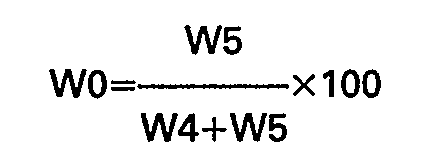
- f) 20 g of washed cuttings were weighed accurately (W1) into a 250 ml round bottomed flask and the water content was determined by the Dean and Stark method using 100-120 petroleum ether. The weight of water removed was determined as W2.
- g) A further 10 g of the washed cuttings were accurately weighed (W3) into an evaporating dish and dried to constant weight (W4) at 110°C.
- The weight of oil on the cuttings,

- The weight of oil left on the cuttings expressed as a percentage of weight of dry cuttings+weight of oil
- The test was performed in duplicate. It should be noted that we have found that the amount of oil removed from the surface of cuttings by any given surfactant or blend of surfactants is dependent on the age of the cuttings, more oil being removed from fresh cuttings than from aged cuttings.
- Using the test method above, the following results were obtained using oil mud cuttings from the North Sea.

- A=C9/C11 primary alcohol nominal 6 mole ethoxylate.
- B=coconut monoethanolamide+2 mole ethylene oxide.
-

- A=C10/C12 primary alcohol nominal 5 mole ethoxylate.
- B=coconut diethanolamide.
-

- B=coconut diethanolamide.
-

- A=nonyl phenol nominal 9 mole ethoxylate.
- B=coconut diethanolamide.
- In addition the emulsion decanted in step c) and obtained using A (1.5%)=B (3.75%) was heated to 10°C and separated into distinct oil and aqueous phases.
-

- B=coconut diethanolamide.
-

- A=mixture of mono and di- C8/C10 alkyl phosphate nominal 5.4 mole ethoxylate.
- B=coconut diethanolamide.
- The emulsion decanted in step c) and obtained using A (3.75%)+B (1.25%) was heated to 40°C and separated into distinct oil and aqueous phases.
- A concentrate was prepared for use according to the invention consisting of 45% by weight of C10/C12 fatty alcohol 5 mole ethoxylate, 45% by weight coconut diethanolamide, 5% by weight propylene glycol, 5% by weight water. The product was fluid and stable at temperatures between -5°C and 35°C and readily dispersed in sea water. When evaluated in the above cuttings cleaning test the results were as follows.

- A=C9/C11 primary alcohol nominal 6 mole ethoxylate. This is the surfactant most commonly used for cleaning oil mud cuttings.
- The emulsion decanted in step c) of the method and obtained using the formulation of Example 7, was heated to 50°C and separated into distinct oil and aqueous phases.
- The following test was used to show the effectiveness of the blend of nonionic surfactants of types A and B as defined above, for removing oil from metal surfaces.
- a) A mild steel plate was washed thoroughly in household detergent solution followed by rinsing under the tap and then with acetone.
- b) One surface of the plate was coated evenly with 0.4 g of hydrocarbon oil, e.g. crude oil.
- c) 0.6 g of test solution was then mixed intimately with the surface oil, and the plate was allowed to rest horizontally with the coated face uppermost for 15 minutes.
- d) The surface was then washed with 200 cm3 of synthetic sea water from a laboratory wash bottle.
- e) The amount of oil remaining on the plate was assessed visually.
- In this test, the test solution used contained 7.5% of a C10/C12 fatty alcohol 5 mole ethoxylate, 7.5% coconut diethanolamide and 85% water. The oil was substantially removed from the surface of the mild steel leaving a clean non-oily surface.
- In a further test, the test solution was a commercial hydrocarbon solvent based degreaser believed to contain emulsifiers. The mild steel was less thoroughly cleaned and the surface was oily.
- The test method described above (examples 1-7) was used, but the concentration of surfactant was changed.

- A=C9/C11 primary alcohol nominal 6 mole ethoxylate.
- This is the surfactant most commonly used for cleaning oil mud cuttings and over the wide concentration range studied was clearly less effective.
- The following are typical distributions.

- In Example 7, surfactant A is the same as A in Example 1.
Claims (21)

Applications Claiming Priority (2)
| Application Number | Priority Date | Filing Date | Title |
|---|---|---|---|
| GB8200376 | 1982-01-07 | ||
| GB8200376 | 1982-01-07 |
Publications (2)
| Publication Number | Publication Date |
|---|---|
| EP0084411A1 EP0084411A1 (en) | 1983-07-27 |
| EP0084411B1 true EP0084411B1 (en) | 1985-09-04 |
Family
ID=10527518
Family Applications (1)
| Application Number | Title | Priority Date | Filing Date |
|---|---|---|---|
| EP83300048A Expired EP0084411B1 (en) | 1982-01-07 | 1983-01-06 | Composition and method for cleaning hydrocarbon oil from hard surfaces |
Country Status (11)
| Country | Link |
|---|---|
| EP (1) | EP0084411B1 (en) |
| CA (1) | CA1203450A (en) |
| DE (1) | DE3360678D1 (en) |
| DK (1) | DK3483A (en) |
| ES (1) | ES8405878A1 (en) |
| GB (1) | GB2116579B (en) |
| GR (1) | GR77136B (en) |
| IE (1) | IE53660B1 (en) |
| IN (1) | IN158886B (en) |
| NO (1) | NO830032L (en) |
| PH (1) | PH19657A (en) |
Cited By (6)
| Publication number | Priority date | Publication date | Assignee | Title |
|---|---|---|---|---|
| EP0103779A3 (en) * | 1982-09-20 | 1985-01-09 | John E. Oliver | Removing contaminates from a well fluid and well system |
| US5326407A (en) * | 1992-03-26 | 1994-07-05 | Institut Francais Du Petrole | Process for washing solid particles comprising a sophoroside solution |
| US5501816A (en) * | 1994-07-12 | 1996-03-26 | Basf Corporation | Aqueous based solvent free degreaser composition |
| WO2004050790A1 (en) * | 2002-12-02 | 2004-06-17 | Marquis Fluids Inc. | Emulsified polymer drilling fluid and methods of preparation and use thereof |
| US7192527B2 (en) | 2004-08-10 | 2007-03-20 | Halliburton Energy Services, Inc. | Processes for removing oil from solid wellbore materials and produced water |
| US7229952B2 (en) | 2002-12-19 | 2007-06-12 | Halliburton Energy Services, Inc. | Additive packages for removing oil from solid materials recovered from a well bore |
Families Citing this family (7)
| Publication number | Priority date | Publication date | Assignee | Title |
|---|---|---|---|---|
| US2480613A (en) * | 1944-11-09 | 1949-08-30 | Vernon O Sipe | Building wall of angular tile |
| DE4023334A1 (en) * | 1990-07-23 | 1992-01-30 | Henkel Kgaa | LIQUID, POURABLE AND PUMPABLE SURFACTANT CONCENTRATE |
| SE468855B (en) * | 1990-08-09 | 1993-03-29 | Eriksson Tord Utveckling | PROCEDURES FOR CLEANING AND DEATH, COMPOSITION INTENDED AS PRIOR MIXTURE AND WATER AND ELECTROLYTHEATIC MICROEMULSION |
| SE500534C2 (en) * | 1990-11-12 | 1994-07-11 | Eriksson Tord Utveckling | Procedure for cleaning and degreasing |
| GB9623823D0 (en) * | 1996-11-16 | 1997-01-08 | Reckitt & Colmann Prod Ltd | Improvements in or relating to organic compositions |
| US7951755B2 (en) | 2002-12-02 | 2011-05-31 | An-Ming Wu | Emulsified polymer drilling fluid and methods of preparation |
| WO2006010375A1 (en) * | 2004-07-27 | 2006-02-02 | Rhodia Chimie | Formulation for degreasing metal comprising a demulsifyiing agent, use of the agent, and process for degreasing metal. |
Citations (1)
| Publication number | Priority date | Publication date | Assignee | Title |
|---|---|---|---|---|
| EP0018630A1 (en) * | 1979-05-07 | 1980-11-12 | Henkel Kommanditgesellschaft auf Aktien | Washing agent for textiles |
Family Cites Families (7)
| Publication number | Priority date | Publication date | Assignee | Title |
|---|---|---|---|---|
| AT179693B (en) * | 1951-04-02 | 1954-09-25 | Metallgesellschaft Ag | Acid emulsion cleaners for pickling and degreasing metals |
| NL168553C (en) * | 1951-04-02 | Takeda Chemical Industries Ltd | PROCESS FOR THE MICROBIOLOGICAL PREPARATION OF CITRIC ACID. | |
| US2831814A (en) * | 1951-12-19 | 1958-04-22 | Poor & Co | Acid pickling of metals and compositions therefor |
| GB1213792A (en) * | 1966-11-30 | 1970-11-25 | Diversey Ltd | Inhibition of corrosion of metallic surfaces |
| SE400575B (en) * | 1974-12-13 | 1978-04-03 | Nordnero Ab | BATH FOR CELLING OF COPPER AND ITS ALLOYS |
| US4280915A (en) * | 1977-06-23 | 1981-07-28 | Nl Industries, Inc. | Salt stable lubricant for water base drilling fluids |
| US4268406A (en) * | 1980-02-19 | 1981-05-19 | The Procter & Gamble Company | Liquid detergent composition |
-
1982
- 1982-12-23 GB GB08236665A patent/GB2116579B/en not_active Expired
- 1982-12-31 IN IN948/DEL/82A patent/IN158886B/en unknown
-
1983
- 1983-01-04 GR GR70199A patent/GR77136B/el unknown
- 1983-01-05 ES ES518812A patent/ES8405878A1/en not_active Expired
- 1983-01-05 PH PH28349A patent/PH19657A/en unknown
- 1983-01-06 DK DK3483A patent/DK3483A/en not_active Application Discontinuation
- 1983-01-06 EP EP83300048A patent/EP0084411B1/en not_active Expired
- 1983-01-06 NO NO830032A patent/NO830032L/en unknown
- 1983-01-06 DE DE8383300048T patent/DE3360678D1/en not_active Expired
- 1983-01-06 IE IE26/83A patent/IE53660B1/en unknown
- 1983-01-07 CA CA000419049A patent/CA1203450A/en not_active Expired
Patent Citations (1)
| Publication number | Priority date | Publication date | Assignee | Title |
|---|---|---|---|---|
| EP0018630A1 (en) * | 1979-05-07 | 1980-11-12 | Henkel Kommanditgesellschaft auf Aktien | Washing agent for textiles |
Cited By (7)
| Publication number | Priority date | Publication date | Assignee | Title |
|---|---|---|---|---|
| EP0103779A3 (en) * | 1982-09-20 | 1985-01-09 | John E. Oliver | Removing contaminates from a well fluid and well system |
| US5326407A (en) * | 1992-03-26 | 1994-07-05 | Institut Francais Du Petrole | Process for washing solid particles comprising a sophoroside solution |
| US5501816A (en) * | 1994-07-12 | 1996-03-26 | Basf Corporation | Aqueous based solvent free degreaser composition |
| WO2004050790A1 (en) * | 2002-12-02 | 2004-06-17 | Marquis Fluids Inc. | Emulsified polymer drilling fluid and methods of preparation and use thereof |
| US7229952B2 (en) | 2002-12-19 | 2007-06-12 | Halliburton Energy Services, Inc. | Additive packages for removing oil from solid materials recovered from a well bore |
| US7192527B2 (en) | 2004-08-10 | 2007-03-20 | Halliburton Energy Services, Inc. | Processes for removing oil from solid wellbore materials and produced water |
| US7374690B2 (en) | 2004-08-10 | 2008-05-20 | Halliburton Energy Services, Inc. | Processes for removing oil from solid wellbore materials and produced water |
Also Published As
| Publication number | Publication date |
|---|---|
| DK3483D0 (en) | 1983-01-06 |
| GR77136B (en) | 1984-09-07 |
| GB2116579B (en) | 1985-08-29 |
| NO830032L (en) | 1983-07-08 |
| CA1203450A (en) | 1986-04-22 |
| EP0084411A1 (en) | 1983-07-27 |
| DE3360678D1 (en) | 1985-10-10 |
| IN158886B (en) | 1987-02-07 |
| GB2116579A (en) | 1983-09-28 |
| IE830026L (en) | 1983-07-07 |
| ES518812A0 (en) | 1984-06-16 |
| IE53660B1 (en) | 1989-01-04 |
| ES8405878A1 (en) | 1984-06-16 |
| DK3483A (en) | 1983-07-08 |
| PH19657A (en) | 1986-06-09 |
Similar Documents
| Publication | Publication Date | Title |
|---|---|---|
| CA2394858C (en) | Acid based micro-emulsions | |
| US7902123B2 (en) | Microemulsion cleaning composition | |
| EP1814652B1 (en) | Surfactant system method | |
| RU2476254C2 (en) | Method of crude oil emulsion separation | |
| US5678631A (en) | Process for removing solids from a well drilling system | |
| CA1203450A (en) | Composition and method for cleaning oil from hard surfaces | |
| US3849316A (en) | Spacer composition | |
| CA2179720A1 (en) | Solvent soaps and methods employing same | |
| JP2001502749A (en) | Easy disposal of working fluid based on w / o-type inverted emulsion | |
| US6093689A (en) | Asphalt and heavy oil degreaser | |
| US6197734B1 (en) | High wax content heavy oil remover | |
| US4601836A (en) | Phosphate ester/alcohol micellar solutions in well acidizing | |
| US20040204324A1 (en) | Drilling fluid | |
| JP2001503093A (en) | Use of improved multi-component mixtures for geological exploration | |
| US5773390A (en) | Chemical additive for removing solids from a well drilling system | |
| US6300300B1 (en) | Liquid cleaning, degreasing, and disinfecting concentrate and methods of use | |
| WO1996001358A1 (en) | A chemical additive and process for removing solids from a well drilling system | |
| US12618021B2 (en) | Degreasing composition comprising an anionic surfactant mixture | |
| US20230020005A1 (en) | Demulsified composition | |
| WO2010029091A1 (en) | A method of cleaning oil contaminated solid particulates |
Legal Events
| Date | Code | Title | Description |
|---|---|---|---|
| PUAI | Public reference made under article 153(3) epc to a published international application that has entered the european phase |
Free format text: ORIGINAL CODE: 0009012 |
|
| 17P | Request for examination filed |
Effective date: 19830106 |
|
| AK | Designated contracting states |
Designated state(s): BE DE FR GB IT NL |
|
| ITF | It: translation for a ep patent filed | ||
| GRAA | (expected) grant |
Free format text: ORIGINAL CODE: 0009210 |
|
| AK | Designated contracting states |
Designated state(s): BE DE FR GB IT NL |
|
| REF | Corresponds to: |
Ref document number: 3360678 Country of ref document: DE Date of ref document: 19851010 |
|
| ET | Fr: translation filed | ||
| PLBI | Opposition filed |
Free format text: ORIGINAL CODE: 0009260 |
|
| 26 | Opposition filed |
Opponent name: HENKEL KOMMANDITGESELLSCHAFT AUF AKTIEN Effective date: 19860604 |
|
| NLR1 | Nl: opposition has been filed with the epo |
Opponent name: HENKEL KOMMANDITGESELLSCHAFT AUF AKTIEN |
|
| PGFP | Annual fee paid to national office [announced via postgrant information from national office to epo] |
Ref country code: NL Payment date: 19870131 Year of fee payment: 5 |
|
| RDAG | Patent revoked |
Free format text: ORIGINAL CODE: 0009271 |
|
| STAA | Information on the status of an ep patent application or granted ep patent |
Free format text: STATUS: PATENT REVOKED |
|
| GBPR | Gb: patent revoked under art. 102 of the ep convention designating the uk as contracting state | ||
| 27W | Patent revoked |
Effective date: 19880122 |
|
| BERE | Be: lapsed |
Owner name: ALBRIGHT & WILSON LTD Effective date: 19880131 |
|
| NLR2 | Nl: decision of opposition |