EP0082982A2 - Ammoniumsalze von Halbestern des N-Hydroxiethylimidazols, deren Herstellung und Verwendung als öllösliche Korrosionsinhibitoren - Google Patents
Ammoniumsalze von Halbestern des N-Hydroxiethylimidazols, deren Herstellung und Verwendung als öllösliche Korrosionsinhibitoren Download PDFInfo
- Publication number
- EP0082982A2 EP0082982A2 EP82111158A EP82111158A EP0082982A2 EP 0082982 A2 EP0082982 A2 EP 0082982A2 EP 82111158 A EP82111158 A EP 82111158A EP 82111158 A EP82111158 A EP 82111158A EP 0082982 A2 EP0082982 A2 EP 0082982A2
- Authority
- EP
- European Patent Office
- Prior art keywords
- carbon atoms
- formula
- compounds
- esters
- preparation
- Prior art date
- Legal status (The legal status is an assumption and is not a legal conclusion. Google has not performed a legal analysis and makes no representation as to the accuracy of the status listed.)
- Granted
Links
Classifications
-
- C—CHEMISTRY; METALLURGY
- C07—ORGANIC CHEMISTRY
- C07D—HETEROCYCLIC COMPOUNDS
- C07D231/00—Heterocyclic compounds containing 1,2-diazole or hydrogenated 1,2-diazole rings
- C07D231/02—Heterocyclic compounds containing 1,2-diazole or hydrogenated 1,2-diazole rings not condensed with other rings
- C07D231/10—Heterocyclic compounds containing 1,2-diazole or hydrogenated 1,2-diazole rings not condensed with other rings having two or three double bonds between ring members or between ring members and non-ring members
- C07D231/12—Heterocyclic compounds containing 1,2-diazole or hydrogenated 1,2-diazole rings not condensed with other rings having two or three double bonds between ring members or between ring members and non-ring members with only hydrogen atoms, hydrocarbon or substituted hydrocarbon radicals, directly attached to ring carbon atoms
-
- C—CHEMISTRY; METALLURGY
- C07—ORGANIC CHEMISTRY
- C07D—HETEROCYCLIC COMPOUNDS
- C07D233/00—Heterocyclic compounds containing 1,3-diazole or hydrogenated 1,3-diazole rings, not condensed with other rings
- C07D233/54—Heterocyclic compounds containing 1,3-diazole or hydrogenated 1,3-diazole rings, not condensed with other rings having two double bonds between ring members or between ring members and non-ring members
- C07D233/56—Heterocyclic compounds containing 1,3-diazole or hydrogenated 1,3-diazole rings, not condensed with other rings having two double bonds between ring members or between ring members and non-ring members with only hydrogen atoms or radicals containing only hydrogen and carbon atoms, attached to ring carbon atoms
-
- C—CHEMISTRY; METALLURGY
- C07—ORGANIC CHEMISTRY
- C07D—HETEROCYCLIC COMPOUNDS
- C07D249/00—Heterocyclic compounds containing five-membered rings having three nitrogen atoms as the only ring hetero atoms
- C07D249/02—Heterocyclic compounds containing five-membered rings having three nitrogen atoms as the only ring hetero atoms not condensed with other rings
- C07D249/08—1,2,4-Triazoles; Hydrogenated 1,2,4-triazoles
-
- C—CHEMISTRY; METALLURGY
- C10—PETROLEUM, GAS OR COKE INDUSTRIES; TECHNICAL GASES CONTAINING CARBON MONOXIDE; FUELS; LUBRICANTS; PEAT
- C10L—FUELS NOT OTHERWISE PROVIDED FOR; NATURAL GAS; SYNTHETIC NATURAL GAS OBTAINED BY PROCESSES NOT COVERED BY SUBCLASSES C10G OR C10K; LIQUIFIED PETROLEUM GAS; USE OF ADDITIVES TO FUELS OR FIRES; FIRE-LIGHTERS
- C10L1/00—Liquid carbonaceous fuels
- C10L1/10—Liquid carbonaceous fuels containing additives
- C10L1/14—Organic compounds
- C10L1/22—Organic compounds containing nitrogen
- C10L1/232—Organic compounds containing nitrogen containing nitrogen in a heterocyclic ring
-
- C—CHEMISTRY; METALLURGY
- C10—PETROLEUM, GAS OR COKE INDUSTRIES; TECHNICAL GASES CONTAINING CARBON MONOXIDE; FUELS; LUBRICANTS; PEAT
- C10L—FUELS NOT OTHERWISE PROVIDED FOR; NATURAL GAS; SYNTHETIC NATURAL GAS OBTAINED BY PROCESSES NOT COVERED BY SUBCLASSES C10G OR C10K; LIQUIFIED PETROLEUM GAS; USE OF ADDITIVES TO FUELS OR FIRES; FIRE-LIGHTERS
- C10L10/00—Use of additives to fuels or fires for particular purposes
- C10L10/04—Use of additives to fuels or fires for particular purposes for minimising corrosion or incrustation
Definitions
- the invention relates to ammonium salts of alkylamines and half-esters of N-hydroxyethylimidazole with phthalic acid or alkenylsuccinic acids, their preparation and their use as corrosion inhibitors in hydrocarbons.
- Benzo and tolyl triazole are universal corrosion inhibitors for non-ferrous metals, but they are expensive
- the synthesis entails high costs, and its relatively polar nature limits its solubility in media which essentially contain only aliphatic hydrocarbons.
- the aim of the invention was therefore to provide oil-soluble corrosion inhibitors which have the broadest possible spectrum of activity and application and do not have the disadvantages mentioned above.
- R is the rest of o-phthalic acid or an alkenylsuccinic acid with an alkenyl side chain of 8 to 20 carbon atoms and R 1 is an alkyl radical with 8 to 13 carbon atoms, have a protective effect on nonferrous metals and their alloys, in particular lead and zinc.
- ammonium salts of the half esters of the formula I are obtained by reacting phthalic anhydride or alkenyl succinic anhydrides with N-hydroxyethylimidazole to give the half ester and subsequent neutralization with monoamines having 8 to 13 carbon atoms.
- alkenylsuccinic anhydrides are prepared in a manner known per se by thermal ene addition of maleic anhydride to the corresponding ⁇ -olefins having 8 to 20 carbon atoms.
- N-hydroxyethyl imidazole is obtainable according to DE-PS 854 955 by reacting imidazole with ethylene oxide or according to US Pat. No. 3 178 446 by reacting imidazole with ethylene carbonate.
- ammonium salts of the half-esters according to the invention are obtained by reaction in a molar ratio of approximately 1: 1 of alkenylsuccinic anhydrides or phthalic anhydride with N-hydroxiethylimidazole in bulk or in solvents which are inert under the reaction conditions, such as acetone, methyl ethyl ketone, tetrahydrofuran, dioxane, dimethylformamide, ethyl acetate, tolyl acetate, xyl ester, and ethyl acetate etc., at temperatures between 40 and 100 ° C, preferably between 60 - 80 ° C, and subsequent neutralization with a monoamine with 8 to 13 carbon atoms at 60 - 80 ° C in the presence or absence of catalysts.
- suitable monoamines having 8 to 13 carbon atoms are ethylhexylamine and tridecylamine.
- the conversion to the ammonium salt can be followed by titration of the acid number and IR spectroscopy.
- ⁇ -olefins for the preparation of the alkenylsuccinic anhydrides are diisobutene, 1,2-dodecene, trimerbutene, tetramer propene, pentapropylene, hexapropylene, tetrabutene, pentabutene, but also ⁇ -olefin mixtures such as C 16/18 ⁇ -olefin or C 16 / 18/20 - ⁇ -olefins into consideration.
- dicarboxylic acid anhydrides are diisobutenyl succinic anhydride, pentapropenyl succinic anhydride, C 16/18 ⁇ -olefin / MA adduct and phthalic anhydride.
- ammonium salts of the half esters according to the invention are effective as corrosion inhibitors, in particular in hydrocarbons, for a large number of applications.
- the applications include technical heat transfer systems, pump pipes and other metal devices for oil production systems and pipelines, in particular fuel lines of gasoline and diesel engines and all engine parts, such as carburetors, injection pumps, pistons etc., but also tanks for storing and transporting fuels.
- the leaded parts of fuel tanks are considered to be particularly at risk of corrosion.
- the corrosion inhibitor can be added directly to the fuel in concentrations of 0.1 to 1000 ppm, preferably 1 to 500 ppm. It is also possible to add the inhibitor as part of a commercially available fuel additive mixture consisting of a valve and carburetor cleaner, an oxidation inhibitor, a film-forming corrosion protection additive (to prevent corrosion of the iron), etc.
- Unreacted maleic anhydride is distilled off in a water jet vacuum up to a bottom temperature of 155 ° C.
- Corrosion test A 250 ml glass bottle is filled with 100 ml of premium petrol (Mannheim petroleum refinery). The product according to a) is dosed in amounts between 10 and 1000 ppm. Then 4 ml of distilled water are added. Test coupons measuring 50 mm x 20 mm x 2 mm are sanded (grit 20), degreased with toluene and weighed. The test bottles are shaken vigorously for a minute so that the water is distributed in the gasoline. The metal coupons are inserted and stored at 20 to 25 ° C for 14 days. The coupons are then cleaned, degreased and dried with 15% hydrochloric acid, which still contains 1% propargyl alcohol as a pickling inhibitor. The weight loss is determined by weighing (data in% 0 weight loss). Multiple determinations are usually carried out.
Landscapes
- Chemical & Material Sciences (AREA)
- Organic Chemistry (AREA)
- Oil, Petroleum & Natural Gas (AREA)
- Engineering & Computer Science (AREA)
- Chemical Kinetics & Catalysis (AREA)
- General Chemical & Material Sciences (AREA)
- Combustion & Propulsion (AREA)
- Preventing Corrosion Or Incrustation Of Metals (AREA)
- Lubricants (AREA)
Abstract
Description
- Die Erfindung betrifft Ammoniumsalze von Alkylaminen und Halbestern des N-Hydroxiethylimidazols mit Phthalsäure bzw. Alkenylbernsteinsäuren, deren Herstellung und die Verwendung als Korrosionsinhibitoren in Kohlenwasserstoffen.
- Auf zahlreichen Anwendungsgebieten, bei denen Metalle mit Wasser, aber auch mit öl-Wasser-Zweiphasensystemen, wie z.B. wäßrigen Emulsionen oder anderen Stoffsystemen, die Wasser enthalten, in Kontakt stehen, besteht die Gefahr der Korrosion. Es ist bekannt, daß auch durch Flüssigkeiten, die nur geringe Mengen Wasser enthalten, wie Otto- und Dieselkraftstoffen, Korrosion verursacht werden kann: Kondenswasser sammelt sich in Tropfenform am Boden von Kraftstofftanks oder in Rohrleitungen und wirkt zusammen mit aus der Luft aufgenommenem Sauerstoff korrosiv, was zu Schäden an Blech-und Bleischicht von Tanks, aber auch am ganzen Kraftstoffleitungssystem von Motoren führen kann.
- In der Regel ist man bemüht, die Korrosionswirkung einer Flüssigkeit gegenüber Maschinen- und Apparateteilen, Behältern und Rohrwandungen und sonstigen metallischen Konstruktionselementen durch Korrosionsinhibitoren zu verhindern oder aufzuheben. Zur Verhinderung der Korrosion des Eisens werden normalerweise in nicht wäßrigen Flüssigkeiten langkettige, hochmolekulare organische Säuren, Ester oder Amine mit oberflächenaktiven Eigenschaften eingesetzt. Als Korrosionsschutz-Additive für Buntmetalle sind aus DE-AS 2 265 088 Benzo- und Tolyltriazol-bekannt.
- Benzo- und Tolyltriazol sind zwar universell einsetzbare Korrosionsinhibitoren für Buntmetalle, aber ihre aufwendige Synthese bringt hohe Kosten mit sich, und durch ihren relativ polaren Charakter ist ihre Löslichkeit in Medien, die im wesentlichen nur aliphatische Kohlenwasserstoffe enthalten, begrenzt.
- Das Ziel der Erfindung bestand daher in der Bereitstellung öllöslicher Korrosionsinhibitoren, die ein möglichst breites Wirkungs- und Anwendungsspektrum besitzen und die oben genannten Nachteile nicht aufweisen.
- überraschenderweise wurde nun gefunden, daß neue Verbindungen der Formel
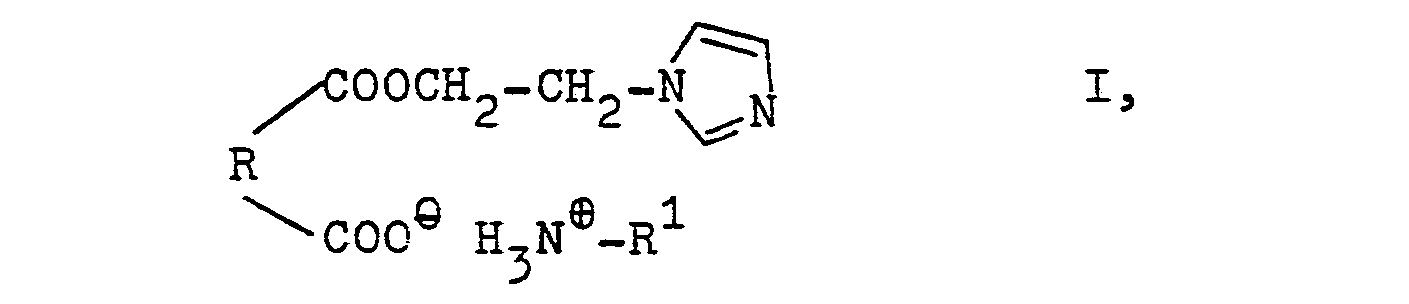
- Die Ammoniumsalze der Halbester der Formel I erhält man durch Umsetzung von Phthalsäureanhydrid oder von Alkenylbernsteinsäureanhydriden mit N-Hydroxiethylimidazol zum Halbester und anschließende Neutralisation mit Monoaminen mit 8 bis 13 Kohlenstoffatomen.
- Die Herstellung der Alkenylbernsteinsäureanhydride erfolgt in an sich bekannter Weise durch thermische En-Addition von Maleinsäureanhydrid an die entsprechenden α-Olefine mit 8 bis 20 Kohlenstoffatomen.
- Die Addition erfolgt in der aus Chemiker Zeitung 100, Nr. 5, S. 203 - 211 (1976) bekannten Weise bei 180 - 220°C unter Normaldruck oder unter Druck in Substanz oder durch Zugabe von Lösungsmitteln.
- N-Hydroxiethylimidazol ist gemäß DE-PS 854 955 durch Umsetzung von Imidazol mit Ethylenoxid oder gemäß US-PS 3 178 446 durch Umsetzung von Imidazol mit Ethylencarbonat erhältlich.
- Die erfindungsgemäßen Ammoniumsalze der Halbester erhält man durch Umsetzung im Molverhältnis von ungefähr 1:1 von Alkenylbernsteinsäureanhydriden oder Phthalsäureanhydrid mit N-Hydroxiethylimidazol in Substanz oder in unter den Reaktionsbedingungen inerten Lösungsmitteln, wie Aceton, Methylethylketon, Tetrahydrofuran, Dioxan, Dimethylformamid, Essigsäureethylester, Toluol, Xylol usw., bei Temperaturen zwischen 40 und 100°C, bevorzugt zwischen 60 - 80°C, und anschließende Neutralisation mit einem Monoamin mit 8 bis 13 Kohlenstoffatomen bei 60 - 80°C in Gegenwart oder Abwesenheit von Katalysatoren. Als Monoamine mit 8 bis 13 Kohlenstoffatomen kommen beispielsweise Ethylhexylamin und Tridecylamin in Betracht.
- Die Umsetzung zum Ammoniumsalz kann durch Titration der Säurezahl und IR-spektroskopisch verfolgt werden. Als α-Olefine zur Herstellung der Alkenylbernsteinsäureanhydride , kommen beispielsweise Diisobuten, 1,2-Dodecen, Trimerbuten, Tetramerpropen, Pentapropylen, Hexapropylen, Tetrabuten, Pentabuten, aber auch α-Olefin-Gemische wie C16/18-α-Olefin oder C16/18/20-α-Olefine in Betracht.
- Besonders bevorzugte Dicarbonsäureanhydride sind Diisobutenyl-bernsteinsäureanhydrid, Pentapropenyl-bernsteinsäureanhydrid, C16/18-α-Olefin/MSA-Addukt und Phthalsäureanhydrid.
- Die erfindungsgemäßen Ammoniumsalze der Halbester sind für eine Vielzahl von Anwendungszwecken als Korrosionsinhibitoren, insbesondere in Kohlenwasserstoffen, wirksam.
- Die Anwendungszwecke schließen technische Wärmeübertragungssysteme, Pumpenrohre und andere Metalleinrichtungen für öl-Förderanlagen und Pipelines, insbesondere Kraftstoffleitungen von Benzin- und Dieselmotoren sowie alle Motorteile, wie Vergaser, Einspritzpumpe, Kolben usw., aber auch Tanks zur Lagerung und zum Transport von Kraftstoffen mit ein. Als besonders korrosionsgefährdet gelten dabei die Vergaserbauteile (bestehend aus Zinkspritzguß = 95 % Zink, 4 % Aluminium und 1 % Kupfer) sowie die verbleiten Teile von Kraftstofftanks.
- Der Korrosionsinhibitor kann dabei direkt in Konzentrationen von 0,1 bis 1000 ppm, bevorzugt von 1 bis 500 ppm, dem Kraftstoff zugesetzt werden. Weiterhin möglich ist auch die Zugabe des Inhibitors im Rahmen eines handelsüblichen Kraftstoff-Additiv-Gemisches, bestehend aus einem Ventil- und Vergaserreiniger, einem Oxidationsinhibitor, einem filmbildenden Korrosionsschutzadditiv (zur Verhinderung der Korrosion des Eisens) usw.
- 884 g (13'Mol) Imidazol und 44,2 g Wasser werden im Rührautoklaven bei 90 - 100°C und max. 10 bar Druck mit 572 g (13 Mol) Ethylenoxid umgesetzt. Nach weiterem Rühren bis zur Druckkonstanz wird bei 90°C und Wasserstrahlvakuum (15 mm Hg) entwässert.
- Ausbeute: 1446 g (99 % d. Theorie)
- Eine Mischung aus 714 g (3 Mol) C16/18-α-Olefin wird mit 294 g (3 Mol) Maleinsäureanhydrid unter Stickstoff langsam auf 210°C erhitzt und anschließend noch 8 Std. auf diese Temperatur erhitzt.
- Nicht umgesetztes Maleinsäureanhydrid wird am Wasserstrahlvakuum bis zu einer Sumpftemperatur von 155°C abdestilliert.
- Ausbeute: 990,5 g (98 % d. Theorie) SZ: 170 mg KOH/g Theorie 167)
- a) Eine Mischung aus 268,8 g (0,8 Mol) C16/18-α-Olefin/ Maleinsäureanhydrid-Addukt und 89,7 g (0,8 Mol) N-Hydroxiethylimidazol wird 4 Stunden bei 80°C gerührt. Man erhält 350 g Halbester (98 % d. Theorie) mit SZ 107,5 (Theorie 125,2). Nach Zugabe von 500 ml Toluol wird bei Raumtemperatur langsam mit 133,7 g (0,67 Mol) Tridecylamin neutralisiert. Man rührt 2 Stunden bei 60°C nach und entfernt anschließend das Toluol am Wasserstrahlvakuum bis 60°C.
Ausbeute: 483 g (100 % d. Theorie) Tridecylammoniumsalz des Halbesters aus C16/18-α-Olefin/Maleinsäurean- hydrid-Addukt und N-Hydroxiethylimidazol. - b) Korrosionstest
Eine 250 ml-Glasflasche wird mit 100 ml Superbenzin (Erdölraffinerie Mannheim) gefüllt. Das Produkt gemäß a) wird in Mengen zwischen 10 und 1000 ppm dosiert. Dann werden 4 ml destilliertes Wasser zugegeben. Testcoupons der Größe 50 mm x 20 mm x 2 mm werden geschmirgelt (Körnung 20), mit Toluol entfettet und gewogen. Die Testflaschen schüttelt man eine Minute kräftig, damit das Wasser im Benzin verteilt wird. Die Metallcoupons werden eingelegt und 14 Tage bei 20 bis 25°C gelagert. Dann werden die Coupons mit 15%iger Salzsäure, die noch 1 % Propargylalkohol als Beizinhibitor enthält, gereinigt, entfettet und getrocknet. Die Bestimmung des Gewichtsverlustes erfolgt durch Wiegen (Angaben in %0 Gewichtsverlust). In der Regel werden Mehrfachbestimmungen durchgeführt.
- a) Eine Mischung aus 105 g (0,5 Mol) Diisobutenylbernsteinsäureanhydrid (hergestellt gemäß den Angaben unter B aus 336 g Diisobuten und 294 g Maleinsäureanhydrid) und 56,1 g (0,5 Mol) N-Hydroxiethylimidazol wird 4 Stunden bei 800C gerührt. Man erhält 160 g (99 % d.Theorie) Halbester mit SZ = 185,7 (Theorie 174,1). Nach Zugabe von 500 ml Toluol neutralisiert man bei Raumtemperatur langsam mit 106,3 g (0,53 Mol) Monotridecylamin. Man rührt 2 Stunden bei 60°C nach und entfernt anschließend das Toluol am Wasserstrahlvakuum bis 60°C.
Ausbeute: 266 g Tridecylammoniumsalz des Halbesters aus Diisobuten/Maleinsäureanhydrid und N-Hydroxiethylimidazol. - b) Korrosionstest, wie in Beispiel 1 b beschrieben, Angaben in o/oo Gewichtsverlust.

- a) Eine Mischung aus 154 g (0,5 Mol) Pentapropenylbernsteinsäureanhydrid (hergestellt gemäß den Angaben unter B aus 210 g Pentapropylen und 98 g Maleinsäureanhydrid) und 56,1 g (0,5 Mol) N-Hydroxiethylimidazol wird 4 Stunden bei 80°C gerührt. Man erhält 210 g (100 % d. Theorie) Halbester mit SZ 175 (Theorie 173,3). Nach Zugabe von 200 ml Toluol neutralisiert man bei Raumtemperatur langsam mit 99,5 g (0,5 Mol) Monotridecylamin. Man rührt 2 Stunden bei 60°C nach und entfernt das Toluol am Wasserstrahlvakuum bis 60°C. Ausbeute: 305 g (98 % d. Theorie) Tridecylammoniumsalz des Halbesters aus Pentapropylen/Maleinsäureanhydrid--Addukt und N-Hydroxiethylimidazol.
- b) Korrosionstest, gemäß den Angaben von Beispiel 1b, Angaben in o/oo Gewichtsverlust.

- a) Eine Mischung aus 74 g (0,5 Mol) Phthalsäureanhydrid und 56,1 g (0,5 Mol) N-Hydroxiethylimidazol wird 4 Stunden bei 80°C gerührt. Man erhält 125 g (96 % d. Theorie) Halbester mit SZ = 210 (Theorie 215,6). Nach Zugabe von 200 ml Toluol neutralisiert man bei Raumtemperatur langsam mit 99,5 g (0,5 Mol) Monotridecylamin. Man rührt 2 Stunden bei 60°C nach und entfernt anschließend das Toluol am Wasserstrahlvakuum bis 60°C.
Ausbeute: 224 g (100 % d. Theorie) Tridecylammoniumsalz des Halbesters aus Phthalsäureanhydrid und N-Hydroxiethylimidazol. - b) Korrosionstest, gemäß den Angaben des Beispiel 1b, Angaben in o/oo Gewichtsverlust.

Claims (5)


Applications Claiming Priority (2)
| Application Number | Priority Date | Filing Date | Title |
|---|---|---|---|
| DE3149570 | 1981-12-15 | ||
| DE19813149570 DE3149570A1 (de) | 1981-12-15 | 1981-12-15 | Ammoniumsalze von halbestern des n-hydroxiethylimidazols, deren herstellung und verwendung als oelloesliche korrosionsinhibitoren |
Publications (3)
| Publication Number | Publication Date |
|---|---|
| EP0082982A2 true EP0082982A2 (de) | 1983-07-06 |
| EP0082982A3 EP0082982A3 (en) | 1984-12-05 |
| EP0082982B1 EP0082982B1 (de) | 1986-08-06 |
Family
ID=6148735
Family Applications (1)
| Application Number | Title | Priority Date | Filing Date |
|---|---|---|---|
| EP82111158A Expired EP0082982B1 (de) | 1981-12-15 | 1982-12-02 | Ammoniumsalze von Halbestern des N-Hydroxiethylimidazols, deren Herstellung und Verwendung als öllösliche Korrosionsinhibitoren |
Country Status (2)
| Country | Link |
|---|---|
| EP (1) | EP0082982B1 (de) |
| DE (2) | DE3149570A1 (de) |
Cited By (1)
| Publication number | Priority date | Publication date | Assignee | Title |
|---|---|---|---|---|
| EP0124186A3 (en) * | 1983-05-03 | 1985-05-15 | Gist - Brocades N.V. | Imidazole-ethanol esters |
Families Citing this family (1)
| Publication number | Priority date | Publication date | Assignee | Title |
|---|---|---|---|---|
| US9994786B2 (en) * | 2016-07-14 | 2018-06-12 | Chevron Oronite Company Llc | Polyester dispersants, synthesis and use thereof |
-
1981
- 1981-12-15 DE DE19813149570 patent/DE3149570A1/de not_active Withdrawn
-
1982
- 1982-12-02 DE DE8282111158T patent/DE3272483D1/de not_active Expired
- 1982-12-02 EP EP82111158A patent/EP0082982B1/de not_active Expired
Non-Patent Citations (1)
| Title |
|---|
| Keine Entgegenhaltungen * |
Cited By (1)
| Publication number | Priority date | Publication date | Assignee | Title |
|---|---|---|---|---|
| EP0124186A3 (en) * | 1983-05-03 | 1985-05-15 | Gist - Brocades N.V. | Imidazole-ethanol esters |
Also Published As
| Publication number | Publication date |
|---|---|
| DE3149570A1 (de) | 1983-06-23 |
| EP0082982A3 (en) | 1984-12-05 |
| EP0082982B1 (de) | 1986-08-06 |
| DE3272483D1 (en) | 1986-09-11 |
Similar Documents
| Publication | Publication Date | Title |
|---|---|---|
| DE2744178C2 (de) | Dicarbonsäureestersäuren sowie deren Verwendung | |
| US4737159A (en) | Corrosion inhibitor for liquid fuels | |
| US4214876A (en) | Corrosion inhibitor compositions | |
| US4448586A (en) | Corrosion inhibitor compositions for alcohol-based fuels | |
| US3248187A (en) | Alkenyl dicarboxylic acid lactones, their method of preparation and utility | |
| US4440545A (en) | Gasohol having corrosion inhibiting properties | |
| DE69921281T2 (de) | Brennstoffe mit erhöhter Schmiereigenschaft | |
| US4478604A (en) | Gasoline compositions containing branched chain amines or derivatives thereof | |
| US2908711A (en) | Itaconic acid-amine reaction product | |
| US3035907A (en) | Hydrocarbon composition containing an itaconic acid-amine reaction product | |
| US4348210A (en) | Novel process and product | |
| US5484462A (en) | Low sulfur diesel fuel composition with anti-wear properties | |
| EP0065191B1 (de) | Inhibitoren gegen die Korrosion von H2S und CO2 in Wasser-in-Öl-Emulsionen | |
| EP0030332B1 (de) | Verwendung von 2-Hydroxypropylimidazolen als öllösliche Korrosionsinhibitoren | |
| EP0306831B1 (de) | Verwendung von Polyaralkylaminen als Korrosionsinhibitoren | |
| EP0082982B1 (de) | Ammoniumsalze von Halbestern des N-Hydroxiethylimidazols, deren Herstellung und Verwendung als öllösliche Korrosionsinhibitoren | |
| US2759894A (en) | Rust inhibitor | |
| US4456454A (en) | Mannich reaction product for motor fuels | |
| US3121059A (en) | Compositions of matter having anti-rust properties | |
| US4505717A (en) | Corrosion inhibited motor fuel | |
| DE69020998T2 (de) | Schwefelgekoppelte alkylabgeleitete Merkaptobenzothiazol-Addukte als multifunktionelle verschleissschützende Zusätze und diese enthaltende Zusammensetzungen. | |
| EP0144738B1 (de) | Bernsteinsäure-mono-dialkylamide als wasserlösliche Korrosionsschutzmittel | |
| US5492544A (en) | Lubricant compositions comprising tolyltriazole-derived tri/tetra esters as additives for distillate fuels | |
| EP0191952B1 (de) | Salze von Alkenylbernsteinsäurehalbamiden, Verfahren zu deren Herstellung und deren Verwendung als Korrosionsinhibitoren | |
| US4521219A (en) | Alcohol based fuels containing corrosion inhibitors |
Legal Events
| Date | Code | Title | Description |
|---|---|---|---|
| PUAI | Public reference made under article 153(3) epc to a published international application that has entered the european phase |
Free format text: ORIGINAL CODE: 0009012 |
|
| 17P | Request for examination filed |
Effective date: 19821202 |
|
| AK | Designated contracting states |
Designated state(s): BE DE FR GB IT NL |
|
| PUAL | Search report despatched |
Free format text: ORIGINAL CODE: 0009013 |
|
| AK | Designated contracting states |
Designated state(s): BE DE FR GB IT NL |
|
| GRAA | (expected) grant |
Free format text: ORIGINAL CODE: 0009210 |
|
| AK | Designated contracting states |
Kind code of ref document: B1 Designated state(s): BE DE FR GB IT NL |
|
| ITF | It: translation for a ep patent filed | ||
| REF | Corresponds to: |
Ref document number: 3272483 Country of ref document: DE Date of ref document: 19860911 |
|
| ET | Fr: translation filed | ||
| PLBE | No opposition filed within time limit |
Free format text: ORIGINAL CODE: 0009261 |
|
| STAA | Information on the status of an ep patent application or granted ep patent |
Free format text: STATUS: NO OPPOSITION FILED WITHIN TIME LIMIT |
|
| 26N | No opposition filed | ||
| ITTA | It: last paid annual fee | ||
| PGFP | Annual fee paid to national office [announced via postgrant information from national office to epo] |
Ref country code: FR Payment date: 19951124 Year of fee payment: 14 |
|
| PGFP | Annual fee paid to national office [announced via postgrant information from national office to epo] |
Ref country code: NL Payment date: 19951130 Year of fee payment: 14 |
|
| PGFP | Annual fee paid to national office [announced via postgrant information from national office to epo] |
Ref country code: GB Payment date: 19951201 Year of fee payment: 14 |
|
| PGFP | Annual fee paid to national office [announced via postgrant information from national office to epo] |
Ref country code: BE Payment date: 19951211 Year of fee payment: 14 |
|
| PGFP | Annual fee paid to national office [announced via postgrant information from national office to epo] |
Ref country code: DE Payment date: 19951218 Year of fee payment: 14 |
|
| PG25 | Lapsed in a contracting state [announced via postgrant information from national office to epo] |
Ref country code: GB Effective date: 19961202 |
|
| PG25 | Lapsed in a contracting state [announced via postgrant information from national office to epo] |
Ref country code: DE Effective date: 19961223 |
|
| PG25 | Lapsed in a contracting state [announced via postgrant information from national office to epo] |
Ref country code: BE Effective date: 19961231 |
|
| BERE | Be: lapsed |
Owner name: BASF A.G. Effective date: 19961231 |
|
| PG25 | Lapsed in a contracting state [announced via postgrant information from national office to epo] |
Ref country code: NL Effective date: 19970701 |
|
| GBPC | Gb: european patent ceased through non-payment of renewal fee |
Effective date: 19961202 |
|
| PG25 | Lapsed in a contracting state [announced via postgrant information from national office to epo] |
Ref country code: FR Effective date: 19970829 |
|
| NLV4 | Nl: lapsed or anulled due to non-payment of the annual fee |
Effective date: 19970701 |
|
| REG | Reference to a national code |
Ref country code: FR Ref legal event code: ST |