EP0080896B2 - Method for the formation of dye image - Google Patents
Method for the formation of dye image Download PDFInfo
- Publication number
- EP0080896B2 EP0080896B2 EP82306367A EP82306367A EP0080896B2 EP 0080896 B2 EP0080896 B2 EP 0080896B2 EP 82306367 A EP82306367 A EP 82306367A EP 82306367 A EP82306367 A EP 82306367A EP 0080896 B2 EP0080896 B2 EP 0080896B2
- Authority
- EP
- European Patent Office
- Prior art keywords
- developer
- silver
- sensitive
- silver halide
- color
- Prior art date
- Legal status (The legal status is an assumption and is not a legal conclusion. Google has not performed a legal analysis and makes no representation as to the accuracy of the status listed.)
- Expired
Links
- 238000000034 method Methods 0.000 title claims description 46
- 230000015572 biosynthetic process Effects 0.000 title description 10
- 229910052709 silver Inorganic materials 0.000 claims description 81
- 239000004332 silver Substances 0.000 claims description 81
- 239000000839 emulsion Substances 0.000 claims description 59
- -1 silver halide Chemical class 0.000 claims description 51
- 239000000463 material Substances 0.000 claims description 39
- 150000001875 compounds Chemical class 0.000 claims description 32
- 238000012545 processing Methods 0.000 claims description 24
- CPELXLSAUQHCOX-UHFFFAOYSA-M Bromide Chemical compound [Br-] CPELXLSAUQHCOX-UHFFFAOYSA-M 0.000 claims description 23
- 229910021607 Silver chloride Inorganic materials 0.000 claims description 19
- 239000003795 chemical substances by application Substances 0.000 claims description 19
- HKZLPVFGJNLROG-UHFFFAOYSA-M silver monochloride Chemical compound [Cl-].[Ag+] HKZLPVFGJNLROG-UHFFFAOYSA-M 0.000 claims description 19
- 239000013078 crystal Substances 0.000 claims description 18
- 239000002253 acid Substances 0.000 claims description 11
- VEXZGXHMUGYJMC-UHFFFAOYSA-M Chloride anion Chemical compound [Cl-] VEXZGXHMUGYJMC-UHFFFAOYSA-M 0.000 claims description 9
- 238000010494 dissociation reaction Methods 0.000 claims description 8
- 230000005593 dissociations Effects 0.000 claims description 8
- CBCKQZAAMUWICA-UHFFFAOYSA-N 1,4-phenylenediamine Chemical compound NC1=CC=C(N)C=C1 CBCKQZAAMUWICA-UHFFFAOYSA-N 0.000 claims description 6
- FOIXSVOLVBLSDH-UHFFFAOYSA-N Silver ion Chemical compound [Ag+] FOIXSVOLVBLSDH-UHFFFAOYSA-N 0.000 claims description 5
- 125000000623 heterocyclic group Chemical group 0.000 claims description 5
- KDCGOANMDULRCW-UHFFFAOYSA-N 7H-purine Chemical compound N1=CNC2=NC=NC2=C1 KDCGOANMDULRCW-UHFFFAOYSA-N 0.000 claims description 3
- GIIGHSIIKVOWKZ-UHFFFAOYSA-N 2h-triazolo[4,5-d]pyrimidine Chemical compound N1=CN=CC2=NNN=C21 GIIGHSIIKVOWKZ-UHFFFAOYSA-N 0.000 claims description 2
- OGEBRHQLRGFBNV-RZDIXWSQSA-N chembl2036808 Chemical group C12=NC(NCCCC)=NC=C2C(C=2C=CC(F)=CC=2)=NN1C[C@H]1CC[C@H](N)CC1 OGEBRHQLRGFBNV-RZDIXWSQSA-N 0.000 claims description 2
- HYZJCKYKOHLVJF-UHFFFAOYSA-N 1H-benzimidazole Chemical compound C1=CC=C2NC=NC2=C1 HYZJCKYKOHLVJF-UHFFFAOYSA-N 0.000 claims 1
- QRUDEWIWKLJBPS-UHFFFAOYSA-N benzotriazole Chemical compound C1=CC=C2N[N][N]C2=C1 QRUDEWIWKLJBPS-UHFFFAOYSA-N 0.000 claims 1
- 239000012964 benzotriazole Substances 0.000 claims 1
- 150000004820 halides Chemical class 0.000 claims 1
- 125000004433 nitrogen atom Chemical group N* 0.000 claims 1
- 238000011161 development Methods 0.000 description 42
- 239000010410 layer Substances 0.000 description 34
- 239000000975 dye Substances 0.000 description 33
- 239000000837 restrainer Substances 0.000 description 20
- BQCADISMDOOEFD-UHFFFAOYSA-N Silver Chemical compound [Ag] BQCADISMDOOEFD-UHFFFAOYSA-N 0.000 description 17
- 229940006460 bromide ion Drugs 0.000 description 17
- 108010010803 Gelatin Proteins 0.000 description 16
- 229920000159 gelatin Polymers 0.000 description 16
- 239000008273 gelatin Substances 0.000 description 16
- 235000019322 gelatine Nutrition 0.000 description 16
- 235000011852 gelatine desserts Nutrition 0.000 description 16
- ADZWSOLPGZMUMY-UHFFFAOYSA-M silver bromide Chemical compound [Ag]Br ADZWSOLPGZMUMY-UHFFFAOYSA-M 0.000 description 15
- 230000000694 effects Effects 0.000 description 13
- 239000007788 liquid Substances 0.000 description 13
- 150000003839 salts Chemical class 0.000 description 9
- LYCAIKOWRPUZTN-UHFFFAOYSA-N Ethylene glycol Chemical compound OCCO LYCAIKOWRPUZTN-UHFFFAOYSA-N 0.000 description 8
- 230000003287 optical effect Effects 0.000 description 8
- IOLCXVTUBQKXJR-UHFFFAOYSA-M potassium bromide Chemical compound [K+].[Br-] IOLCXVTUBQKXJR-UHFFFAOYSA-M 0.000 description 8
- QAOWNCQODCNURD-UHFFFAOYSA-N Sulfuric acid Chemical compound OS(O)(=O)=O QAOWNCQODCNURD-UHFFFAOYSA-N 0.000 description 7
- CSCPPACGZOOCGX-UHFFFAOYSA-N Acetone Chemical compound CC(C)=O CSCPPACGZOOCGX-UHFFFAOYSA-N 0.000 description 6
- LFQSCWFLJHTTHZ-UHFFFAOYSA-N Ethanol Chemical compound CCO LFQSCWFLJHTTHZ-UHFFFAOYSA-N 0.000 description 6
- OKKJLVBELUTLKV-UHFFFAOYSA-N Methanol Chemical compound OC OKKJLVBELUTLKV-UHFFFAOYSA-N 0.000 description 6
- KWYUFKZDYYNOTN-UHFFFAOYSA-M Potassium hydroxide Chemical compound [OH-].[K+] KWYUFKZDYYNOTN-UHFFFAOYSA-M 0.000 description 6
- 239000011241 protective layer Substances 0.000 description 6
- 239000002904 solvent Substances 0.000 description 6
- 230000000052 comparative effect Effects 0.000 description 5
- 239000011229 interlayer Substances 0.000 description 5
- 239000000203 mixture Substances 0.000 description 5
- 229920001223 polyethylene glycol Polymers 0.000 description 5
- 230000000452 restraining effect Effects 0.000 description 5
- HZAXFHJVJLSVMW-UHFFFAOYSA-N 2-Aminoethan-1-ol Chemical compound NCCO HZAXFHJVJLSVMW-UHFFFAOYSA-N 0.000 description 4
- JKFYKCYQEWQPTM-UHFFFAOYSA-N 2-azaniumyl-2-(4-fluorophenyl)acetate Chemical compound OC(=O)C(N)C1=CC=C(F)C=C1 JKFYKCYQEWQPTM-UHFFFAOYSA-N 0.000 description 4
- DGAQECJNVWCQMB-PUAWFVPOSA-M Ilexoside XXIX Chemical compound C[C@@H]1CC[C@@]2(CC[C@@]3(C(=CC[C@H]4[C@]3(CC[C@@H]5[C@@]4(CC[C@@H](C5(C)C)OS(=O)(=O)[O-])C)C)[C@@H]2[C@]1(C)O)C)C(=O)O[C@H]6[C@@H]([C@H]([C@@H]([C@H](O6)CO)O)O)O.[Na+] DGAQECJNVWCQMB-PUAWFVPOSA-M 0.000 description 4
- 239000002202 Polyethylene glycol Substances 0.000 description 4
- 229910021612 Silver iodide Inorganic materials 0.000 description 4
- SJOOOZPMQAWAOP-UHFFFAOYSA-N [Ag].BrCl Chemical compound [Ag].BrCl SJOOOZPMQAWAOP-UHFFFAOYSA-N 0.000 description 4
- 239000012190 activator Substances 0.000 description 4
- 230000006866 deterioration Effects 0.000 description 4
- 229940045105 silver iodide Drugs 0.000 description 4
- UMGDCJDMYOKAJW-UHFFFAOYSA-N thiourea Chemical compound NC(N)=S UMGDCJDMYOKAJW-UHFFFAOYSA-N 0.000 description 4
- 238000011282 treatment Methods 0.000 description 4
- WVDDGKGOMKODPV-UHFFFAOYSA-N Benzyl alcohol Chemical compound OCC1=CC=CC=C1 WVDDGKGOMKODPV-UHFFFAOYSA-N 0.000 description 3
- PEDCQBHIVMGVHV-UHFFFAOYSA-N Glycerine Chemical compound OCC(O)CO PEDCQBHIVMGVHV-UHFFFAOYSA-N 0.000 description 3
- ZMXDDKWLCZADIW-UHFFFAOYSA-N N,N-Dimethylformamide Chemical compound CN(C)C=O ZMXDDKWLCZADIW-UHFFFAOYSA-N 0.000 description 3
- ZLMJMSJWJFRBEC-UHFFFAOYSA-N Potassium Chemical compound [K] ZLMJMSJWJFRBEC-UHFFFAOYSA-N 0.000 description 3
- HEMHJVSKTPXQMS-UHFFFAOYSA-M Sodium hydroxide Chemical compound [OH-].[Na+] HEMHJVSKTPXQMS-UHFFFAOYSA-M 0.000 description 3
- NINIDFKCEFEMDL-UHFFFAOYSA-N Sulfur Chemical compound [S] NINIDFKCEFEMDL-UHFFFAOYSA-N 0.000 description 3
- 101100020289 Xenopus laevis koza gene Proteins 0.000 description 3
- 229940081735 acetylcellulose Drugs 0.000 description 3
- 229920002301 cellulose acetate Polymers 0.000 description 3
- 238000006243 chemical reaction Methods 0.000 description 3
- 230000002542 deteriorative effect Effects 0.000 description 3
- MTHSVFCYNBDYFN-UHFFFAOYSA-N diethylene glycol Chemical compound OCCOCCO MTHSVFCYNBDYFN-UHFFFAOYSA-N 0.000 description 3
- PCHJSUWPFVWCPO-UHFFFAOYSA-N gold Chemical compound [Au] PCHJSUWPFVWCPO-UHFFFAOYSA-N 0.000 description 3
- 229910052737 gold Inorganic materials 0.000 description 3
- 239000010931 gold Substances 0.000 description 3
- 239000011591 potassium Substances 0.000 description 3
- 229960003975 potassium Drugs 0.000 description 3
- 229910052700 potassium Inorganic materials 0.000 description 3
- 230000002829 reductive effect Effects 0.000 description 3
- 229920005989 resin Polymers 0.000 description 3
- 239000011347 resin Substances 0.000 description 3
- 239000011734 sodium Substances 0.000 description 3
- 229910052717 sulfur Inorganic materials 0.000 description 3
- 239000011593 sulfur Substances 0.000 description 3
- JAAIPIWKKXCNOC-UHFFFAOYSA-N 1h-tetrazol-1-ium-5-thiolate Chemical class SC1=NN=NN1 JAAIPIWKKXCNOC-UHFFFAOYSA-N 0.000 description 2
- PMWJOLLLHRDHNP-UHFFFAOYSA-N 2,3-dioctylbenzene-1,4-diol Chemical compound CCCCCCCCC1=C(O)C=CC(O)=C1CCCCCCCC PMWJOLLLHRDHNP-UHFFFAOYSA-N 0.000 description 2
- SVTBMSDMJJWYQN-UHFFFAOYSA-N 2-methylpentane-2,4-diol Chemical compound CC(O)CC(C)(C)O SVTBMSDMJJWYQN-UHFFFAOYSA-N 0.000 description 2
- WRMNZCZEMHIOCP-UHFFFAOYSA-N 2-phenylethanol Chemical compound OCCC1=CC=CC=C1 WRMNZCZEMHIOCP-UHFFFAOYSA-N 0.000 description 2
- IAZDPXIOMUYVGZ-UHFFFAOYSA-N Dimethylsulphoxide Chemical compound CS(C)=O IAZDPXIOMUYVGZ-UHFFFAOYSA-N 0.000 description 2
- VEXZGXHMUGYJMC-UHFFFAOYSA-N Hydrochloric acid Chemical compound Cl VEXZGXHMUGYJMC-UHFFFAOYSA-N 0.000 description 2
- PXHVJJICTQNCMI-UHFFFAOYSA-N Nickel Chemical compound [Ni] PXHVJJICTQNCMI-UHFFFAOYSA-N 0.000 description 2
- NBIIXXVUZAFLBC-UHFFFAOYSA-N Phosphoric acid Chemical compound OP(O)(O)=O NBIIXXVUZAFLBC-UHFFFAOYSA-N 0.000 description 2
- KAESVJOAVNADME-UHFFFAOYSA-N Pyrrole Chemical compound C=1C=CNC=1 KAESVJOAVNADME-UHFFFAOYSA-N 0.000 description 2
- BUGBHKTXTAQXES-UHFFFAOYSA-N Selenium Chemical compound [Se] BUGBHKTXTAQXES-UHFFFAOYSA-N 0.000 description 2
- 206010070834 Sensitisation Diseases 0.000 description 2
- CDBYLPFSWZWCQE-UHFFFAOYSA-L Sodium Carbonate Chemical compound [Na+].[Na+].[O-]C([O-])=O CDBYLPFSWZWCQE-UHFFFAOYSA-L 0.000 description 2
- XSQUKJJJFZCRTK-UHFFFAOYSA-N Urea Natural products NC(N)=O XSQUKJJJFZCRTK-UHFFFAOYSA-N 0.000 description 2
- HCHKCACWOHOZIP-UHFFFAOYSA-N Zinc Chemical compound [Zn] HCHKCACWOHOZIP-UHFFFAOYSA-N 0.000 description 2
- 239000000654 additive Substances 0.000 description 2
- 239000003513 alkali Substances 0.000 description 2
- 150000001412 amines Chemical class 0.000 description 2
- 238000004061 bleaching Methods 0.000 description 2
- 238000009835 boiling Methods 0.000 description 2
- KGBXLFKZBHKPEV-UHFFFAOYSA-N boric acid Chemical compound OB(O)O KGBXLFKZBHKPEV-UHFFFAOYSA-N 0.000 description 2
- 239000004327 boric acid Substances 0.000 description 2
- 235000010338 boric acid Nutrition 0.000 description 2
- CODNYICXDISAEA-UHFFFAOYSA-N bromine monochloride Chemical compound BrCl CODNYICXDISAEA-UHFFFAOYSA-N 0.000 description 2
- 239000011248 coating agent Substances 0.000 description 2
- 238000000576 coating method Methods 0.000 description 2
- 239000000084 colloidal system Substances 0.000 description 2
- 238000012733 comparative method Methods 0.000 description 2
- DOIRQSBPFJWKBE-UHFFFAOYSA-N dibutyl phthalate Chemical compound CCCCOC(=O)C1=CC=CC=C1C(=O)OCCCC DOIRQSBPFJWKBE-UHFFFAOYSA-N 0.000 description 2
- 150000002500 ions Chemical class 0.000 description 2
- 238000005259 measurement Methods 0.000 description 2
- 239000003960 organic solvent Substances 0.000 description 2
- FGIUAXJPYTZDNR-UHFFFAOYSA-N potassium nitrate Chemical compound [K+].[O-][N+]([O-])=O FGIUAXJPYTZDNR-UHFFFAOYSA-N 0.000 description 2
- 239000002243 precursor Substances 0.000 description 2
- 238000007639 printing Methods 0.000 description 2
- 230000001681 protective effect Effects 0.000 description 2
- 230000000717 retained effect Effects 0.000 description 2
- 229910052711 selenium Inorganic materials 0.000 description 2
- 239000011669 selenium Substances 0.000 description 2
- 229910052708 sodium Inorganic materials 0.000 description 2
- GEHJYWRUCIMESM-UHFFFAOYSA-L sodium sulfite Chemical compound [Na+].[Na+].[O-]S([O-])=O GEHJYWRUCIMESM-UHFFFAOYSA-L 0.000 description 2
- 230000003595 spectral effect Effects 0.000 description 2
- 238000003786 synthesis reaction Methods 0.000 description 2
- 229910052725 zinc Inorganic materials 0.000 description 2
- 239000011701 zinc Substances 0.000 description 2
- GVEYRUKUJCHJSR-UHFFFAOYSA-N (4-azaniumyl-3-methylphenyl)-ethyl-(2-hydroxyethyl)azanium;sulfate Chemical compound OS(O)(=O)=O.OCCN(CC)C1=CC=C(N)C(C)=C1 GVEYRUKUJCHJSR-UHFFFAOYSA-N 0.000 description 1
- NCNYEGJDGNOYJX-NSCUHMNNSA-N (e)-2,3-dibromo-4-oxobut-2-enoic acid Chemical compound OC(=O)C(\Br)=C(/Br)C=O NCNYEGJDGNOYJX-NSCUHMNNSA-N 0.000 description 1
- LUMLZKVIXLWTCI-NSCUHMNNSA-N (e)-2,3-dichloro-4-oxobut-2-enoic acid Chemical compound OC(=O)C(\Cl)=C(/Cl)C=O LUMLZKVIXLWTCI-NSCUHMNNSA-N 0.000 description 1
- ZRHUHDUEXWHZMA-UHFFFAOYSA-N 1,4-dihydropyrazol-5-one Chemical class O=C1CC=NN1 ZRHUHDUEXWHZMA-UHFFFAOYSA-N 0.000 description 1
- 125000001140 1,4-phenylene group Chemical group [H]C1=C([H])C([*:2])=C([H])C([H])=C1[*:1] 0.000 description 1
- ALQSHHUCVQOPAS-UHFFFAOYSA-N 1,5-Pentadiol Natural products OCCCCCO ALQSHHUCVQOPAS-UHFFFAOYSA-N 0.000 description 1
- SHCCNDIEMUQSCR-UHFFFAOYSA-N 2,5-dihydroxyhexanedioic acid Chemical class OC(=O)C(O)CCC(O)C(O)=O SHCCNDIEMUQSCR-UHFFFAOYSA-N 0.000 description 1
- NGNBDVOYPDDBFK-UHFFFAOYSA-N 2-[2,4-di(pentan-2-yl)phenoxy]acetyl chloride Chemical compound CCCC(C)C1=CC=C(OCC(Cl)=O)C(C(C)CCC)=C1 NGNBDVOYPDDBFK-UHFFFAOYSA-N 0.000 description 1
- ZNQVEEAIQZEUHB-UHFFFAOYSA-N 2-ethoxyethanol Chemical compound CCOCCO ZNQVEEAIQZEUHB-UHFFFAOYSA-N 0.000 description 1
- NEAQRZUHTPSBBM-UHFFFAOYSA-N 2-hydroxy-3,3-dimethyl-7-nitro-4h-isoquinolin-1-one Chemical compound C1=C([N+]([O-])=O)C=C2C(=O)N(O)C(C)(C)CC2=C1 NEAQRZUHTPSBBM-UHFFFAOYSA-N 0.000 description 1
- XRZDIHADHZSFBB-UHFFFAOYSA-N 3-oxo-n,3-diphenylpropanamide Chemical class C=1C=CC=CC=1NC(=O)CC(=O)C1=CC=CC=C1 XRZDIHADHZSFBB-UHFFFAOYSA-N 0.000 description 1
- XTBFKMDOQMQYPP-UHFFFAOYSA-N 4-n,4-n-diethylbenzene-1,4-diamine;hydron;chloride Chemical compound Cl.CCN(CC)C1=CC=C(N)C=C1 XTBFKMDOQMQYPP-UHFFFAOYSA-N 0.000 description 1
- HRPVXLWXLXDGHG-UHFFFAOYSA-N Acrylamide Chemical compound NC(=O)C=C HRPVXLWXLXDGHG-UHFFFAOYSA-N 0.000 description 1
- 102000009027 Albumins Human genes 0.000 description 1
- 108010088751 Albumins Proteins 0.000 description 1
- QGZKDVFQNNGYKY-UHFFFAOYSA-O Ammonium Chemical compound [NH4+] QGZKDVFQNNGYKY-UHFFFAOYSA-O 0.000 description 1
- VHUUQVKOLVNVRT-UHFFFAOYSA-N Ammonium hydroxide Chemical compound [NH4+].[OH-] VHUUQVKOLVNVRT-UHFFFAOYSA-N 0.000 description 1
- NOWKCMXCCJGMRR-UHFFFAOYSA-N Aziridine Chemical compound C1CN1 NOWKCMXCCJGMRR-UHFFFAOYSA-N 0.000 description 1
- LSNNMFCWUKXFEE-UHFFFAOYSA-M Bisulfite Chemical compound OS([O-])=O LSNNMFCWUKXFEE-UHFFFAOYSA-M 0.000 description 1
- KXDHJXZQYSOELW-UHFFFAOYSA-N Carbamic acid Chemical compound NC(O)=O KXDHJXZQYSOELW-UHFFFAOYSA-N 0.000 description 1
- RYGMFSIKBFXOCR-UHFFFAOYSA-N Copper Chemical compound [Cu] RYGMFSIKBFXOCR-UHFFFAOYSA-N 0.000 description 1
- LEVWYRKDKASIDU-QWWZWVQMSA-N D-cystine Chemical compound OC(=O)[C@H](N)CSSC[C@@H](N)C(O)=O LEVWYRKDKASIDU-QWWZWVQMSA-N 0.000 description 1
- LCGLNKUTAGEVQW-UHFFFAOYSA-N Dimethyl ether Chemical compound COC LCGLNKUTAGEVQW-UHFFFAOYSA-N 0.000 description 1
- QXNVGIXVLWOKEQ-UHFFFAOYSA-N Disodium Chemical compound [Na][Na] QXNVGIXVLWOKEQ-UHFFFAOYSA-N 0.000 description 1
- 239000004129 EU approved improving agent Substances 0.000 description 1
- PIICEJLVQHRZGT-UHFFFAOYSA-N Ethylenediamine Chemical compound NCCN PIICEJLVQHRZGT-UHFFFAOYSA-N 0.000 description 1
- PDQAZBWRQCGBEV-UHFFFAOYSA-N Ethylenethiourea Chemical compound S=C1NCCN1 PDQAZBWRQCGBEV-UHFFFAOYSA-N 0.000 description 1
- YCKRFDGAMUMZLT-UHFFFAOYSA-N Fluorine atom Chemical compound [F] YCKRFDGAMUMZLT-UHFFFAOYSA-N 0.000 description 1
- OFOBLEOULBTSOW-UHFFFAOYSA-N Malonic acid Chemical compound OC(=O)CC(O)=O OFOBLEOULBTSOW-UHFFFAOYSA-N 0.000 description 1
- GRYLNZFGIOXLOG-UHFFFAOYSA-N Nitric acid Chemical compound O[N+]([O-])=O GRYLNZFGIOXLOG-UHFFFAOYSA-N 0.000 description 1
- 239000000020 Nitrocellulose Substances 0.000 description 1
- 229910019142 PO4 Inorganic materials 0.000 description 1
- 239000004952 Polyamide Substances 0.000 description 1
- 206010036086 Polymenorrhoea Diseases 0.000 description 1
- 239000004793 Polystyrene Substances 0.000 description 1
- JUJWROOIHBZHMG-UHFFFAOYSA-N Pyridine Chemical class C1=CC=NC=C1 JUJWROOIHBZHMG-UHFFFAOYSA-N 0.000 description 1
- KJTLSVCANCCWHF-UHFFFAOYSA-N Ruthenium Chemical class [Ru] KJTLSVCANCCWHF-UHFFFAOYSA-N 0.000 description 1
- 239000002262 Schiff base Substances 0.000 description 1
- 150000004753 Schiff bases Chemical class 0.000 description 1
- PMZURENOXWZQFD-UHFFFAOYSA-L Sodium Sulfate Chemical compound [Na+].[Na+].[O-]S([O-])(=O)=O PMZURENOXWZQFD-UHFFFAOYSA-L 0.000 description 1
- DWAQJAXMDSEUJJ-UHFFFAOYSA-M Sodium bisulfite Chemical class [Na+].OS([O-])=O DWAQJAXMDSEUJJ-UHFFFAOYSA-M 0.000 description 1
- ULUAUXLGCMPNKK-UHFFFAOYSA-N Sulfobutanedioic acid Chemical class OC(=O)CC(C(O)=O)S(O)(=O)=O ULUAUXLGCMPNKK-UHFFFAOYSA-N 0.000 description 1
- YSMRWXYRXBRSND-UHFFFAOYSA-N TOTP Chemical compound CC1=CC=CC=C1OP(=O)(OC=1C(=CC=CC=1)C)OC1=CC=CC=C1C YSMRWXYRXBRSND-UHFFFAOYSA-N 0.000 description 1
- ZMZDMBWJUHKJPS-UHFFFAOYSA-M Thiocyanate anion Chemical compound [S-]C#N ZMZDMBWJUHKJPS-UHFFFAOYSA-M 0.000 description 1
- SMEGJBVQLJJKKX-HOTMZDKISA-N [(2R,3S,4S,5R,6R)-5-acetyloxy-3,4,6-trihydroxyoxan-2-yl]methyl acetate Chemical compound CC(=O)OC[C@@H]1[C@H]([C@@H]([C@H]([C@@H](O1)O)OC(=O)C)O)O SMEGJBVQLJJKKX-HOTMZDKISA-N 0.000 description 1
- FJWGYAHXMCUOOM-QHOUIDNNSA-N [(2s,3r,4s,5r,6r)-2-[(2r,3r,4s,5r,6s)-4,5-dinitrooxy-2-(nitrooxymethyl)-6-[(2r,3r,4s,5r,6s)-4,5,6-trinitrooxy-2-(nitrooxymethyl)oxan-3-yl]oxyoxan-3-yl]oxy-3,5-dinitrooxy-6-(nitrooxymethyl)oxan-4-yl] nitrate Chemical compound O([C@@H]1O[C@@H]([C@H]([C@H](O[N+]([O-])=O)[C@H]1O[N+]([O-])=O)O[C@H]1[C@@H]([C@@H](O[N+]([O-])=O)[C@H](O[N+]([O-])=O)[C@@H](CO[N+]([O-])=O)O1)O[N+]([O-])=O)CO[N+](=O)[O-])[C@@H]1[C@@H](CO[N+]([O-])=O)O[C@@H](O[N+]([O-])=O)[C@H](O[N+]([O-])=O)[C@H]1O[N+]([O-])=O FJWGYAHXMCUOOM-QHOUIDNNSA-N 0.000 description 1
- MPLZNPZPPXERDA-UHFFFAOYSA-N [4-(diethylamino)-2-methylphenyl]azanium;chloride Chemical compound [Cl-].CC[NH+](CC)C1=CC=C(N)C(C)=C1 MPLZNPZPPXERDA-UHFFFAOYSA-N 0.000 description 1
- 239000006096 absorbing agent Substances 0.000 description 1
- 125000002777 acetyl group Chemical group [H]C([H])([H])C(*)=O 0.000 description 1
- 150000008065 acid anhydrides Chemical class 0.000 description 1
- 150000007513 acids Chemical class 0.000 description 1
- HTKFORQRBXIQHD-UHFFFAOYSA-N allylthiourea Chemical compound NC(=S)NCC=C HTKFORQRBXIQHD-UHFFFAOYSA-N 0.000 description 1
- 229910000147 aluminium phosphate Inorganic materials 0.000 description 1
- 239000000908 ammonium hydroxide Substances 0.000 description 1
- 239000002518 antifoaming agent Substances 0.000 description 1
- 239000002216 antistatic agent Substances 0.000 description 1
- 125000003785 benzimidazolyl group Chemical group N1=C(NC2=C1C=CC=C2)* 0.000 description 1
- IOJUPLGTWVMSFF-UHFFFAOYSA-N benzothiazole Chemical group C1=CC=C2SC=NC2=C1 IOJUPLGTWVMSFF-UHFFFAOYSA-N 0.000 description 1
- 125000003354 benzotriazolyl group Chemical group N1N=NC2=C1C=CC=C2* 0.000 description 1
- 235000019445 benzyl alcohol Nutrition 0.000 description 1
- 239000007844 bleaching agent Substances 0.000 description 1
- 229910021538 borax Chemical group 0.000 description 1
- 238000005282 brightening Methods 0.000 description 1
- 239000000872 buffer Substances 0.000 description 1
- 230000003139 buffering effect Effects 0.000 description 1
- 150000001661 cadmium Chemical group 0.000 description 1
- 125000004432 carbon atom Chemical group C* 0.000 description 1
- 150000001732 carboxylic acid derivatives Chemical class 0.000 description 1
- 150000001767 cationic compounds Chemical class 0.000 description 1
- 239000001913 cellulose Substances 0.000 description 1
- 229920002678 cellulose Polymers 0.000 description 1
- 229910017052 cobalt Inorganic materials 0.000 description 1
- 239000010941 cobalt Substances 0.000 description 1
- GUTLYIVDDKVIGB-UHFFFAOYSA-N cobalt atom Chemical compound [Co] GUTLYIVDDKVIGB-UHFFFAOYSA-N 0.000 description 1
- 229910052802 copper Inorganic materials 0.000 description 1
- 239000010949 copper Substances 0.000 description 1
- 239000011258 core-shell material Substances 0.000 description 1
- 238000003851 corona treatment Methods 0.000 description 1
- 229960003067 cystine Drugs 0.000 description 1
- 235000014113 dietary fatty acids Nutrition 0.000 description 1
- ZBCBWPMODOFKDW-UHFFFAOYSA-N diethanolamine Chemical compound OCCNCCO ZBCBWPMODOFKDW-UHFFFAOYSA-N 0.000 description 1
- 150000002009 diols Chemical class 0.000 description 1
- ZPWVASYFFYYZEW-UHFFFAOYSA-L dipotassium hydrogen phosphate Chemical compound [K+].[K+].OP([O-])([O-])=O ZPWVASYFFYYZEW-UHFFFAOYSA-L 0.000 description 1
- 125000003438 dodecyl group Chemical group [H]C([H])([H])C([H])([H])C([H])([H])C([H])([H])C([H])([H])C([H])([H])C([H])([H])C([H])([H])C([H])([H])C([H])([H])C([H])([H])C([H])([H])* 0.000 description 1
- 239000000194 fatty acid Substances 0.000 description 1
- 229930195729 fatty acid Natural products 0.000 description 1
- 150000004665 fatty acids Chemical class 0.000 description 1
- 229910052731 fluorine Inorganic materials 0.000 description 1
- 239000011737 fluorine Substances 0.000 description 1
- 239000011521 glass Substances 0.000 description 1
- 150000002334 glycols Chemical class 0.000 description 1
- 229940051250 hexylene glycol Drugs 0.000 description 1
- ZMZDMBWJUHKJPS-UHFFFAOYSA-N hydrogen thiocyanate Natural products SC#N ZMZDMBWJUHKJPS-UHFFFAOYSA-N 0.000 description 1
- WGCNASOHLSPBMP-UHFFFAOYSA-N hydroxyacetaldehyde Natural products OCC=O WGCNASOHLSPBMP-UHFFFAOYSA-N 0.000 description 1
- LOCAIGRSOJUCTB-UHFFFAOYSA-N indazol-3-one Chemical class C1=CC=C2C(=O)N=NC2=C1 LOCAIGRSOJUCTB-UHFFFAOYSA-N 0.000 description 1
- 239000003112 inhibitor Substances 0.000 description 1
- 238000007689 inspection Methods 0.000 description 1
- CBEQRNSPHCCXSH-UHFFFAOYSA-N iodine monobromide Chemical compound IBr CBEQRNSPHCCXSH-UHFFFAOYSA-N 0.000 description 1
- 229910052741 iridium Chemical class 0.000 description 1
- GKOZUEZYRPOHIO-UHFFFAOYSA-N iridium atom Chemical class [Ir] GKOZUEZYRPOHIO-UHFFFAOYSA-N 0.000 description 1
- 239000011133 lead Substances 0.000 description 1
- 230000000873 masking effect Effects 0.000 description 1
- 239000006224 matting agent Substances 0.000 description 1
- 150000002731 mercury compounds Chemical class 0.000 description 1
- DZVCFNFOPIZQKX-LTHRDKTGSA-M merocyanine Chemical compound [Na+].O=C1N(CCCC)C(=O)N(CCCC)C(=O)C1=C\C=C\C=C/1N(CCCS([O-])(=O)=O)C2=CC=CC=C2O\1 DZVCFNFOPIZQKX-LTHRDKTGSA-M 0.000 description 1
- AFVFQIVMOAPDHO-UHFFFAOYSA-N methanesulfonic acid Substances CS(O)(=O)=O AFVFQIVMOAPDHO-UHFFFAOYSA-N 0.000 description 1
- 229940098779 methanesulfonic acid Drugs 0.000 description 1
- WSFSSNUMVMOOMR-NJFSPNSNSA-N methanone Chemical compound O=[14CH2] WSFSSNUMVMOOMR-NJFSPNSNSA-N 0.000 description 1
- 150000007522 mineralic acids Chemical class 0.000 description 1
- 229910000402 monopotassium phosphate Inorganic materials 0.000 description 1
- 235000019796 monopotassium phosphate Nutrition 0.000 description 1
- 229910000403 monosodium phosphate Inorganic materials 0.000 description 1
- 235000019799 monosodium phosphate Nutrition 0.000 description 1
- PKDBSOOYVOEUQR-UHFFFAOYSA-N mucobromic acid Natural products OC1OC(=O)C(Br)=C1Br PKDBSOOYVOEUQR-UHFFFAOYSA-N 0.000 description 1
- ZAKLKBFCSHJIRI-UHFFFAOYSA-N mucochloric acid Natural products OC1OC(=O)C(Cl)=C1Cl ZAKLKBFCSHJIRI-UHFFFAOYSA-N 0.000 description 1
- LNOPIUAQISRISI-UHFFFAOYSA-N n'-hydroxy-2-propan-2-ylsulfonylethanimidamide Chemical compound CC(C)S(=O)(=O)CC(N)=NO LNOPIUAQISRISI-UHFFFAOYSA-N 0.000 description 1
- QRBFSNYYMHZRGU-UHFFFAOYSA-N n-[2-(4-amino-n-ethyl-3-methylanilino)ethyl]methanesulfonamide;sulfuric acid;hydrate Chemical compound O.OS(O)(=O)=O.CS(=O)(=O)NCCN(CC)C1=CC=C(N)C(C)=C1 QRBFSNYYMHZRGU-UHFFFAOYSA-N 0.000 description 1
- FECCTLUIZPFIRN-UHFFFAOYSA-N n-[2-[2-amino-5-(diethylamino)phenyl]ethyl]methanesulfonamide;hydrochloride Chemical compound Cl.CCN(CC)C1=CC=C(N)C(CCNS(C)(=O)=O)=C1 FECCTLUIZPFIRN-UHFFFAOYSA-N 0.000 description 1
- 150000004780 naphthols Chemical class 0.000 description 1
- 230000007935 neutral effect Effects 0.000 description 1
- 229910052759 nickel Inorganic materials 0.000 description 1
- 150000002823 nitrates Chemical class 0.000 description 1
- 229910017604 nitric acid Inorganic materials 0.000 description 1
- 229920001220 nitrocellulos Polymers 0.000 description 1
- FYWSTUCDSVYLPV-UHFFFAOYSA-N nitrooxythallium Chemical compound [Tl+].[O-][N+]([O-])=O FYWSTUCDSVYLPV-UHFFFAOYSA-N 0.000 description 1
- 125000001117 oleyl group Chemical group [H]C([*])([H])C([H])([H])C([H])([H])C([H])([H])C([H])([H])C([H])([H])C([H])([H])C([H])([H])/C([H])=C([H])\C([H])([H])C([H])([H])C([H])([H])C([H])([H])C([H])([H])C([H])([H])C([H])([H])C([H])([H])[H] 0.000 description 1
- 150000007524 organic acids Chemical class 0.000 description 1
- 239000007800 oxidant agent Substances 0.000 description 1
- 239000002245 particle Substances 0.000 description 1
- 150000002989 phenols Chemical class 0.000 description 1
- 229940067107 phenylethyl alcohol Drugs 0.000 description 1
- 239000010452 phosphate Substances 0.000 description 1
- 125000002467 phosphate group Chemical group [H]OP(=O)(O[H])O[*] 0.000 description 1
- 150000003014 phosphoric acid esters Chemical class 0.000 description 1
- PJNZPQUBCPKICU-UHFFFAOYSA-N phosphoric acid;potassium Chemical compound [K].OP(O)(O)=O PJNZPQUBCPKICU-UHFFFAOYSA-N 0.000 description 1
- 229920002647 polyamide Polymers 0.000 description 1
- 229920000768 polyamine Polymers 0.000 description 1
- 229920000515 polycarbonate Polymers 0.000 description 1
- 239000004417 polycarbonate Substances 0.000 description 1
- 229920000728 polyester Polymers 0.000 description 1
- 229920000642 polymer Polymers 0.000 description 1
- 229920000098 polyolefin Polymers 0.000 description 1
- 229920000137 polyphosphoric acid Polymers 0.000 description 1
- 229920002223 polystyrene Polymers 0.000 description 1
- 239000011736 potassium bicarbonate Substances 0.000 description 1
- 229910000028 potassium bicarbonate Inorganic materials 0.000 description 1
- 235000015497 potassium bicarbonate Nutrition 0.000 description 1
- TYJJADVDDVDEDZ-UHFFFAOYSA-M potassium hydrogencarbonate Chemical compound [K+].OC([O-])=O TYJJADVDDVDEDZ-UHFFFAOYSA-M 0.000 description 1
- 229940086066 potassium hydrogencarbonate Drugs 0.000 description 1
- 239000004323 potassium nitrate Substances 0.000 description 1
- 235000010333 potassium nitrate Nutrition 0.000 description 1
- JVUYWILPYBCNNG-UHFFFAOYSA-N potassium;oxido(oxo)borane Chemical group [K+].[O-]B=O JVUYWILPYBCNNG-UHFFFAOYSA-N 0.000 description 1
- 238000001556 precipitation Methods 0.000 description 1
- 238000002360 preparation method Methods 0.000 description 1
- MCSKRVKAXABJLX-UHFFFAOYSA-N pyrazolo[3,4-d]triazole Chemical class N1=NN=C2N=NC=C21 MCSKRVKAXABJLX-UHFFFAOYSA-N 0.000 description 1
- 150000003242 quaternary ammonium salts Chemical class 0.000 description 1
- 239000001397 quillaja saponaria molina bark Substances 0.000 description 1
- 229910052703 rhodium Inorganic materials 0.000 description 1
- 239000010948 rhodium Chemical class 0.000 description 1
- MHOVAHRLVXNVSD-UHFFFAOYSA-N rhodium atom Chemical class [Rh] MHOVAHRLVXNVSD-UHFFFAOYSA-N 0.000 description 1
- 229910052707 ruthenium Inorganic materials 0.000 description 1
- 238000007127 saponification reaction Methods 0.000 description 1
- 229930182490 saponin Natural products 0.000 description 1
- 150000007949 saponins Chemical class 0.000 description 1
- 230000035945 sensitivity Effects 0.000 description 1
- 239000012748 slip agent Substances 0.000 description 1
- UIIMBOGNXHQVGW-UHFFFAOYSA-M sodium bicarbonate Substances [Na+].OC([O-])=O UIIMBOGNXHQVGW-UHFFFAOYSA-M 0.000 description 1
- 229910000030 sodium bicarbonate Inorganic materials 0.000 description 1
- 235000017557 sodium bicarbonate Nutrition 0.000 description 1
- 229910000029 sodium carbonate Inorganic materials 0.000 description 1
- 229910052938 sodium sulfate Inorganic materials 0.000 description 1
- 235000011152 sodium sulphate Nutrition 0.000 description 1
- 235000010265 sodium sulphite Nutrition 0.000 description 1
- 239000004328 sodium tetraborate Chemical group 0.000 description 1
- 235000010339 sodium tetraborate Nutrition 0.000 description 1
- 239000003381 stabilizer Substances 0.000 description 1
- 239000000126 substance Substances 0.000 description 1
- 125000001424 substituent group Chemical group 0.000 description 1
- KDYFGRWQOYBRFD-UHFFFAOYSA-L succinate(2-) Chemical compound [O-]C(=O)CCC([O-])=O KDYFGRWQOYBRFD-UHFFFAOYSA-L 0.000 description 1
- BUUPQKDIAURBJP-UHFFFAOYSA-N sulfinic acid Chemical compound OS=O BUUPQKDIAURBJP-UHFFFAOYSA-N 0.000 description 1
- DHCDFWKWKRSZHF-UHFFFAOYSA-N sulfurothioic S-acid Chemical compound OS(O)(=O)=S DHCDFWKWKRSZHF-UHFFFAOYSA-N 0.000 description 1
- 238000004381 surface treatment Methods 0.000 description 1
- 230000002195 synergetic effect Effects 0.000 description 1
- 229920003002 synthetic resin Polymers 0.000 description 1
- 239000000057 synthetic resin Substances 0.000 description 1
- 150000003568 thioethers Chemical class 0.000 description 1
- ANRHNWWPFJCPAZ-UHFFFAOYSA-M thionine Chemical compound [Cl-].C1=CC(N)=CC2=[S+]C3=CC(N)=CC=C3N=C21 ANRHNWWPFJCPAZ-UHFFFAOYSA-M 0.000 description 1
- 150000004764 thiosulfuric acid derivatives Chemical class 0.000 description 1
- 150000003852 triazoles Chemical class 0.000 description 1
- ZIBGPFATKBEMQZ-UHFFFAOYSA-N triethylene glycol Chemical compound OCCOCCOCCO ZIBGPFATKBEMQZ-UHFFFAOYSA-N 0.000 description 1
- BYGOPQKDHGXNCD-UHFFFAOYSA-N tripotassium;iron(3+);hexacyanide Chemical compound [K+].[K+].[K+].[Fe+3].N#[C-].N#[C-].N#[C-].N#[C-].N#[C-].N#[C-] BYGOPQKDHGXNCD-UHFFFAOYSA-N 0.000 description 1
- 229920002554 vinyl polymer Polymers 0.000 description 1
- XLYOFNOQVPJJNP-UHFFFAOYSA-N water Substances O XLYOFNOQVPJJNP-UHFFFAOYSA-N 0.000 description 1
Images


Classifications
-
- G—PHYSICS
- G03—PHOTOGRAPHY; CINEMATOGRAPHY; ANALOGOUS TECHNIQUES USING WAVES OTHER THAN OPTICAL WAVES; ELECTROGRAPHY; HOLOGRAPHY
- G03C—PHOTOSENSITIVE MATERIALS FOR PHOTOGRAPHIC PURPOSES; PHOTOGRAPHIC PROCESSES, e.g. CINE, X-RAY, COLOUR, STEREO-PHOTOGRAPHIC PROCESSES; AUXILIARY PROCESSES IN PHOTOGRAPHY
- G03C7/00—Multicolour photographic processes or agents therefor; Regeneration of such processing agents; Photosensitive materials for multicolour processes
- G03C7/30—Colour processes using colour-coupling substances; Materials therefor; Preparing or processing such materials
- G03C7/3022—Materials with specific emulsion characteristics, e.g. thickness of the layers, silver content, shape of AgX grains
-
- G—PHYSICS
- G03—PHOTOGRAPHY; CINEMATOGRAPHY; ANALOGOUS TECHNIQUES USING WAVES OTHER THAN OPTICAL WAVES; ELECTROGRAPHY; HOLOGRAPHY
- G03C—PHOTOSENSITIVE MATERIALS FOR PHOTOGRAPHIC PURPOSES; PHOTOGRAPHIC PROCESSES, e.g. CINE, X-RAY, COLOUR, STEREO-PHOTOGRAPHIC PROCESSES; AUXILIARY PROCESSES IN PHOTOGRAPHY
- G03C7/00—Multicolour photographic processes or agents therefor; Regeneration of such processing agents; Photosensitive materials for multicolour processes
- G03C7/30—Colour processes using colour-coupling substances; Materials therefor; Preparing or processing such materials
- G03C7/392—Additives
- G03C7/39208—Organic compounds
- G03C7/3924—Heterocyclic
- G03C7/39244—Heterocyclic the nucleus containing only nitrogen as hetero atoms
-
- G—PHYSICS
- G03—PHOTOGRAPHY; CINEMATOGRAPHY; ANALOGOUS TECHNIQUES USING WAVES OTHER THAN OPTICAL WAVES; ELECTROGRAPHY; HOLOGRAPHY
- G03C—PHOTOSENSITIVE MATERIALS FOR PHOTOGRAPHIC PURPOSES; PHOTOGRAPHIC PROCESSES, e.g. CINE, X-RAY, COLOUR, STEREO-PHOTOGRAPHIC PROCESSES; AUXILIARY PROCESSES IN PHOTOGRAPHY
- G03C7/00—Multicolour photographic processes or agents therefor; Regeneration of such processing agents; Photosensitive materials for multicolour processes
- G03C7/30—Colour processes using colour-coupling substances; Materials therefor; Preparing or processing such materials
- G03C7/407—Development processes or agents therefor
- G03C7/413—Developers
Definitions
- the present invention relates to a method for the formation of a dye image, and more particularly to a method which uses a high-chloride silver halide light-sensitive material and which possesses excellent deveiopabiiity and is capable of forming a satisfactorily color-reproducible dye image.
- high-chloride silver halide used herein mean a silver halide that contains silver chloride in an amount of not less than 80 mole %.
- a high-chloride silver halide since it is highly soluble as compared to silver bromide and silver iodide, is considered to be capable of being developed in a short period of time.
- a method which uses a high-chloride silver halide for the rapid and stable formation of a dye image is not a practical reality.
- FR-E-61904 discloses a method of developing colour photographic materials which consist of at least one layer containing mainly silver chloride and at least one layer containing mainly silver bromide or iodobromide which may developed using a developer essentially free from bromide ion, which ion is absent so that the silver chloride may ne differentially fixed out at a later stage in the process.
- these materials do not develop rapidly and with an acceptably low amount of fog.
- restrainers which may ne added to a color developing bath include potassium bromide, tetrazaindene derivatives and mercaptotetrazoles.
- the processing of a high-chloride silver halide light-sensitive color photographic material in a color developing bath containing one of these restrainers has disadvantages since, for example, potassium bromide not only has little fog-restraining effect during the processing of a high-chloride silver halide light-sensitive color photographic material but also reduces the rapidity of the processing ; tetrazaindene derivatives cannot be expected to display any development-restraining effect; and mercaptotetrazoles, if in a small quantity, exert only a slight fog-restraining effect, and if in a large quantity, restrain also the area that it is desired to develop, and, besides, significantly impair the function of the bleach-fixing process which follows the development process, the bleach-fixing process being a process for removing the silver produced by the
- the present invention provides a method for the formation of a dye image comprising a processing, after the imagewise exposure of a silver halide light-sensitive color photographic material having on a support thereof a cyan dye-forming coupler in a red-sensitive emulsion layer, a magenta dye-forming coupler in a gren-sensitive emulsion layer and a yellow dye-forming coupler in a blue-sensitive emulsion layer, and the silver halide crystals of the or such emulsion layer comprising silver chloride in an amount of not less than 80 mol %, in a developer containing not more than 1 x 10- 3 mole/litre of bromide ion and having the pH value of not less than 9.5, in the presence of a p-phenylenediamine color developing agent and a compound having an acid dissociation constant of not more than 1 x 10- 8 , a solubility product with silver ion of not more than 1 x 10 -10 and the next formula (I) wherein Z represents
- any heterocyclic ring may be formed by Z, but those most preferred include a benzimidazole ring, benzotriazole ring, purine ring, 8-azapurine ring, and pyrazolopyrimidine ring.
- a compound has an acid dissociation constant of not more than 1 x 10⁻⁸ and a solubility product with silver of not more than 1 x 10 -10 and is represented by Formula (1) (the compound is hereinafter referred to as a restrainer of the present invention), it may effectively be used ; the preferred acid dissociation constant range is from 1 x 10- 8 to 1 x 10-13.
- a silver halide light-sensitive color photographic material having a high-chloride silver halide-containing layer is exposed imagewise and then processed in a developer liquid which is substantially free of bromine ion and the pH of which is not less than 9.5 in the presence of at least one of the restrainers of the present invention and of a p-phenylenediamine developing agent, whereby a fog-restrained, rapid and stable development can be carried out, and further a dye image having excellent color reproducibility is obtained.
- the amount of the restrainer in the developer liquid is suitably from 0.5 mg to 50 g, and most preferably from 1 mg to 10 g per liter of developer.
- the acid dissociation constant value is that measured at normal temperature, and is described in, for example, the annex vol 2 to the "Dai Yuki-Kagaku'(Complete Organic Chemistry)" (published by Asakura Publishing Co Ltd), "The Theory of Photographic Process” written by T H james, 4th ed (published by McMillan).
- the solubility product with silver ion of the restrainer of the present invention is not more than 1 x 10 -10 .
- a compound having a solubility product exceeding this level i.e. a compound whose precipitation fluency with silver ion is less, the desired effect cannot be expected.
- the restrainer of the present invention even when used alone, exerts a sufficient effect, but in order to increase the effect, it is desirable to use the restrainer to be present together with chloride ion.
- chloride ion is dissolved out of the silver halide light-sensitive color photographic material into the color developer liquid. It is desirable that chloride ion, including the dissolved chloride ion, be present in a quantity of from 1 x 10- 3 mole to 0.5 mole, and most preferably from 2 x 10- 3 mole to 0.2 mole per liter of the color developer liquid of the present invention.
- Any p-phenylenediamine color developing agent may be used in the presence invention but those which are preferred include 4-amino-N,N-diethyl-aniline hydrochloride, 4-amino-3-methyl-N,N-diethyl-aniline hydrochloride, 4-amino-3-methyl-N-ethyl-N-( ⁇ -methanesulfonamido)ethyl-aniline sulfate-hydrate, 4-amino-3-methyl-N-ethyl-N- ⁇ -hydroxyethyl-aniline sulfate, 4-amino-3- ⁇ -(methane-sulfonamido)ethyl-N,N- diethylaniline hydrochloride, and 4-amino-N-ethyl-N-(2-methoxyethyl)-m-toluidinedi-P-toluene sulfonate.
- the agent is desirably added in a quantity of from 0.1 g to 100 g, and more preferably from 0.5 to 20 g, per liter of the developer.
- a p-phenylenediamine color developing agent may also be incorporated into the silver halide light-sensitive color photographic material, and it may be used in an amount from, say, 0.1 mole to 10 moles, preferably from 0.5 moles to 5 moles, per mole of coupler that is used in the material.
- the agent may be used as it is, or in the form of a salt of an inorganic acid (such as hydrochloric acid, sulfuric acid, phosphoric acid, boric acid or nitric acid), of a salt of an organic acid or of a derivative thereof (such as sulfonic acid, carboxylic acid, sulfamic acid, sulfinic acid, hydroxamic acid, polymer-sulfonic acid, a phosphoric acid ester, a sulfuric acid ester or a thiosulfuric acid ester), or a salt of a metallic complex (such as of nickel, zinc, lead, cobalt or copper), or further in the form of a precursor (such as a Schiff base, an imido compound or a urethane compound).
- an inorganic acid such as hydrochloric acid, sulfuric acid, phosphoric acid, boric acid or nitric acid
- a salt of an organic acid or of a derivative thereof such as sulfonic acid, carb
- the developer used in the present invention desirably has a pH value of not less than 9.5, and preferably a pH value from 10 to 13. It is well known that development can be accelerated by increasing the pH of the developer, and when processed in a high-pH developer (pH > 12), particularly in a color development, although the development is recognized to be accelerated, an increase in fog and in graininess occur, thus leading to a deterioration in photographic characteristics. In the present invention, if the developer has a pH of not less than 9.5, a rapid development can be carried out without deteriorating photographic characteristics.
- a developer substantially free of bromide ion means a developer that contains not more than 1 x 1Q- 3 molesnitre of bromide ion.
- the present invention uses, as silver halide, a high-chloride silver halide; the high-chloride silver halide is desirably pure silver chloride. However, the high-chloride silver halide can contain some silver bromide and silver iodide apart from silver chloride.
- bromide ion which is dissolved out into the developer is considered also to be partly substituted, due to several orders of difference in the solubility to silver between bromide ion and chloride ion, by the chloride ion in the area which is not the image area, i.e. in the high-chloride silver halide that is not developed even in the developer liquid, thereby to be retained in the silver halide light-sensitive color photographic material.
- the development generally-takes place at a temperature from 10°C to 70°C, and preferably from 20°C to 50°C.
- the developer used in the present invention may contain other known developer component compounds e.g. alkali agents or buffers for the developer such as sodium hydroxide, ammonium hydroxide, sodium carbonate, sodium sulfate, sodium sulfite, sodium tertiary phosphate, potassium metaborate or borax, which may be used singly or in combination.
- alkali agents or buffers for the developer such as sodium hydroxide, ammonium hydroxide, sodium carbonate, sodium sulfate, sodium sulfite, sodium tertiary phosphate, potassium metaborate or borax, which may be used singly or in combination.
- various salts such as disodium or dipotassium hydrogen phosphate, sodium or potassium dihydrogen phosphate, sodium or potassium hydrogen carbonate, boric acid or alkali nitrates.
- an accelerating agent including pyridinium compounds or other cationic compounds, such as neutral salts e.g. thallium nitrate or potassium nitrate, polyethylene glycol or derivatives thereof, organic amines, ethanolamine, ethylenediamine, diethanolamine, benzyl alcohol or phenyl-ethyl alcohol.
- polyphosphoric acid compounds or aminopolycarboxylic acids for example may be used as water softeners, and, besides, calcium- and magnesium-hiding agents may be used in the developer.
- An organic solvent may, if desired, be incorporated into the developer in order to increase the solubility of certain components of the developer ; such solvents include ethylene glycol, hexylene glycol, diethylene glycol, ethylene glycol, monomethyl ether, methanol, ethanol, acetone, triethylene glycol, dimethyl formamide and dimethyl sulfoxide.
- the image silver can be rehalogenated, if necessary, in a bleaching bath containing, for example, red prussiate or aminocarboxylic acid ferric salt and subsequently fixed in a fixing bath containing a silver-halide solvent (such as a thiosulfate, thiourea, ethylene-thiourea, a thiocyanate, a sulfurcontaining diol or a sulfur containing dibasic acid).
- a bleaching bath containing, for example, red prussiate or aminocarboxylic acid ferric salt
- a fixing bath containing a silver-halide solvent (such as a thiosulfate, thiourea, ethylene-thiourea, a thiocyanate, a sulfurcontaining diol or a sulfur containing dibasic acid).
- a silver-halide solvent such as a thiosulfate, thiourea, ethylene-thiourea, a thiocyanate,
- the silver halide crystals to be used in the present invention are silver halide crystals that comprise silver chloride in an amount not less than 80 mole %, preferably not less than 90 mole % ; more preferably the silver halide should be pure silver chloride.
- the other silver halide is mostly silver bromide, and may of course be all silver bromide.
- Silver iodide may be incorporated depending on the intended purposes, but the silver iodide, if used, should generally not be present in an amount exceeding 5 mole %, and prefarably at most 2 mole %.
- silver halides may be prepared in known manner.
- the silver halide used in the present invention may be prepared, according to the nature or use of the light-sensitive color photographic material, using the so-called core-shell emulsion, conversion emulsion, epitaxial-junction emulsion, or preliminarily optically or chemically fogged emulsions.
- the size of the silver halide crystals used in the present invention can be within the normally used range.
- the crystal size distribution may be in the form of either a polydispersed system or a monodispersed system, but the emulsion is desirably a monodispersed system emulsion.
- emulsions may be chemically sensitized by one or more of active gelatin ; sulfur sensitizers such as allylthiocar- bamide, thiourea, thiosulfates and cystine ; selenium sensitizers ; reduction sensitizers such as stannous salts and polyamines ; noble-metallic sensitizers such as gold sensitizers including potassium aurithiocyanate, potassium chloroaurate and 2-aurosulfobenzothiazole-metachloride, or for example water-soluble-salt sensitizers such as salts of ruthenium, rhodium or iridium, for example ; specific examples include ammonium chloropalladate, potassium chloroplatinate, sodium chloropalladate (some of these function as sensitizers or fogging agents, depending upon the quantities used) ; typically a gold sensitizer can be used with a sulfur sensitizer or a gold sensitizer with a selenium sensitizer.
- the silver halide may be optically sensitized to desired wavelength regions by the use of one or more spectral sensitizers such as cyanine dyes including, for example, zero-methine dye, monomethine dye, dimethine dye and trimethine dye as well as merocyanine dyes.
- spectral sensitizers such as cyanine dyes including, for example, zero-methine dye, monomethine dye, dimethine dye and trimethine dye as well as merocyanine dyes.
- the high-chloride silver halide used in the present invention hardly absorbs visible rays. Accordingly, optically green-sensitized or red-sensitized high chloride silver halide emulsion is hardly sensitive to blue light. This property is thought to be principally responsible for the color reproducibility of the light-sensitive photographic material.
- the respective red-sensitive, green-sensitive and blue-sensitive emulsions are coated as separate layers in combination with different couplers, the couplers forming different dyes during the color developing process, the combinations being a red-sensitive emulsion with a cyan dye-forming coupler, green-sensitive emulsion with a magenta dye-forming coupler, and blue-sensitive emulsion with a yellow dye-forming coupler.
- a yellow filter dye layer or a colloidal silver layer can be provided to reduce the blue-sensitivities of the red-sensitive emulsion and the green-sensitive emulsion ;
- a silver halide having large-size silver halide particles is used as the blue-sensitive emulsion thereby to make a large difference between the blue-sensitivity of the blue-sensitive emulsion and the blue-sensitivities of the red-sensitive and green-sensitive emulsions.
- the present invention since a high-chloride silver halide is used as silver halide, the blue-sensitivities of the red-sensitive and green-sensitive emulsions are negligible, so that the present invention is capable of providing a way of avoiding the cause of the turbidity that occurs at the time of exposure.
- the silver halide can be dispersed into an appropriate protective colloid to form a light-sensitive layer.
- a protective colloid for use in light-sensitive layers or other layers (component elements such as interlayers, a protective layer or filter layers), gelatin is generally used, but gelatin derivatives, colloidal albumin, cellulose derivatives and synthetic resins such as polyvinyl compounds, for example can also be used ; they can be used singly or in combination, and, in addition, may also be used in combination with an acetyl cellulose whose acetyl content is from 19 to 26%, a water-soluble ethanolamine or a cellulose acetate, for example.
- couplers for use in the present invention known couplers may be used ; these may be incorporated into either a developer or the silver halide emulsion.
- Yellow couplers usable in the present invention include benzoyl acetanilide compounds and pivaloylacetanilide compounds; magenta couplers include 5-pyrazolone compounds, pyrazolotriazole compounds, pyrazolinobenzimidazole compounds, indazolone compounds and cyanoacetyl compounds ; and cyan couplers include phenol compounds, diacylaminophenol compounds and naphthol compounds. These couplers may be of either the so-called two-equivalent type or four-equivalent type.
- couplers may also have a fluorine-containing substituent intended to adjust the hue of the dye formed by the reaction with the oxide of the aromatic primary amine compound used in the present invention.
- azo-type colored couplers intended to be used for automasking, osazone type compounds, and development diffusible dye releasing type couplers, for example. It is then desirable to use the so-called colorless coupler that is colorless before being subjected to a color development together with the above-mentioned masking coupler.
- competing couplers DIR couplers, BAR (Bleach Accelerator Releasing) couplers may also be incorporated.
- Silver halide emulsions containing such photographic couplers and the like prepared as described above can be coated on a support together with, as desired, a subbing layer, interlayers, filter layers, an anticurl layer and a protective layer, to prepare a silver halide light-sensitive photographic material for use in the present invention.
- Materials for the support which may be used include paper, laminated paper (such as polyethylene- laminated paper), glass, and film- or sheet-formed cellulose acetate, cellulose nitrate, polyester, polycarbonate, polyamide, polystyrene and polyolefin.
- These support materials, for the purpose of improving the adhesion of layers thereto may be subjected to a surface treatment such as various hydrophilic treatments, for example, saponification treatment, corona discharge treatment, subbing treatment or setting treatment.
- the light-sensitive photographic material used in the present invention may also contain in the light-sensitive layers and/or other layers thereof (such as interlayers, subbing layer, filter layers, protective layer or image-receiving layers), according to the intended purpose, various photographic additives which include stabilizers such as mercury compounds, triazoles, azaindenes, quaternary benzothiazolium and zinc or cadmium salts ; sensitizers such as quaternary ammonium salts and polyethylene glycols ; physical characteristics- improving agents such as glycerol, dihydroxyalkanes such as 1,5-pentadiol, ethylene-bis-glycolic acid esters, bisethoxydiethylene glycol succinate, acrylic acid amide and emulsion of polymers ; hardening agents such as formaldehyde, halogen-substituted fatty acids such as mucochloric acid and mucobromic acid, acid anhydrides, dicarboxylic acid chloride, disulfonic acid
- the following layers were coated on a resin-coated paper support to thereby prepare a silver halide light-sensitive color photographic material sample.
- a silver halide light-sensitive material layer having 4.0 mg of magenta coupler A, a green-sensitive silver chloride emulsion (average crystal size 0.6 ⁇ m, silver equivalent of 3.5 mg) and 20 mg of gelatin.
- compositions of the processing liquids are:
- Potassium hydroxide or sulfuric acid is used to adjust the pH to 10.7.
- the obtained sample was subjected to sensitometry and the results of the obtained dye image densities are shown in Table 2.
- chloride ion that is said to have an antifogging effect upon a silver chloride emulsion, as described in "The Theory of Photographic Process" 4th ed. by T. H. James, p. 396 (McMillan), has little effect in itself to lower Dmin, but, when used together with the restrainer of the present invention, exerts a synergistic effect to increase the restraining of Dmin, and yet does not retard the developing rate.
- the presence of chlorine ion together with the restrainer of the present invention enables the restraining effect of the invention to be more excellent
- the following layers were coated on a resin-coated paper support to thereby prepare a silver halide light-sensitive color photographic material sample.
- sample (II) On this was coated and dried a gelatin protective layer containing 10 mg of gelatin. The resulting material was regarded as sample (II).
- sample (II) and sample (I) prepared in Example 1 were exposed through an optical wedge and then processed as follows :
- compositions of the processing liquids are:
- Color developers [L] and [M] used in Example 1 and color developer [N] obtained by adding potassium bromide in the quantity of 0.7 glliter to color developer [B] also used in Example 1 were prepared.
- Sample (I) that was prepared in Example 1 was exposed through an optical wedge and then processed in accordance with the processing steps in Example 1 with the use of three developers of which the composition is the same as that in Example 1 but which have different pH values : 8.8, 10.2 and 11.8, respectively.
- the sample was processed for one minute in the developers of pH 10.2 and pH 11.8, and also processed separately for one minute and three minutes in the developer of pH 8.8.
- the resulting sensitometric curves of the sample are as shown in Figure 2.
- the sensitometric characteristics (fog, gradation, etc.) of the processed sample are hardly affected.
- the developing rate becomes reduced with the increase in fog, resulting in an extreme deterioration of the sensitometric characteristics.
- the method for the formation of a dye image of the present invention is found to be rapid and stable only when the development is made under the condition of a pH value of not less than 9.5.
- Sample (1) prepared in Example 1 was exposed through an optical wedge and then processed in accordance with the processing steps in Example 1, provided that color developers [O] to [Q] prepared by adding bromine ion in the ion concentrations given in Table 4 to developer [M] were used.
- the dye image densities obtained by processing the sample separately for periods of 15 seconds, 30 seconds and one minute in each of the above-prepared color developers are as indicated in Table 4.
- a blue-sensitive silver chlorobromide emulsion (containing 80 mole % silver bromide, average crystal size 0.8 ⁇ m, silver equivalent of 4.0 mg) was used in place of the blue-sensitive silver chloride emulsion in (1) of the above sample (III), a green-sensitive silver chlorobromide emulsion (containing 70 mole % silver bromide, average crystal size 0.5 ⁇ m, silver equivalent of 3.7 mg) was used in place of the green-sensitive silver chloride emulsion in (3), and a red-sensitive silver chlorobromide emulsion (containing 70 mole % silver bromide, average crystal size 0.4 ⁇ m, silver equivalent of 3.0 mg) was used in place of the red-sensitive silver chloride emulsion in (5). And the resulting sample was regarded as sample (IV).
- Sample (III) and sample (IV) were exposed through an optical wedge and then processed as follows :
- compositions of the processing liquids are:
- Color developers [R] and [S] were prepared by adding the compounds shown in Table 5 to color developer [B].
- Sample (III) of the invention prepared in Example 5 and comparative sample (IV) were exposed through an optical wedge and each processed in color developers which differ in pH as shown in Table 7. The processing of these samples was performed in accordance with the processing steps in Example 1, provided that sample (III) was processed for one minute, while comparative sample (IV) for three minutes because the developing speed thereof is low.
- the obtained samples were subjected to sensitometry to obtain gamma values which are shown in Table 7.
- the gamma value indicated herein is the reciprocal of the difference between the logarithm of an exposure to give the dye density of 0.8 and the logarithm of an exposure to give the dye density of 1.8, and the larger the value that represents the gradation of an image, the higher does the contrast become.
- sample (III) 10 mg of a color developing agent precursor P-1 were added to each of the layers (2) and (4) of sample (III), which is the multi-layer silver chloride photographic light-sensitive material prepared in Example 5, whereby a sample (V) was prepared.
- Sample (V) was exposed through an optical wedge and then processed as follows :
- composition of the activator :
- Potassium hydroxide or sulfuric acid is used to adjust the pH to 11.5.
- the dye image densities of the obtained samples are as shown in Table 9.
- the p-phenylenediamine type color developing agent-incorporated high-chloride silver halide color photographic light-sensitive material is processed in a color developing agent-free alkaline liquid (activator liquid) in the presence of the restrainer of the present invention, whereby an excellent dye image having a low Dmin and a high Dmax can be obtained.
- SAKURA is believed to be a Registered Trade Mark in one or more of the designated states.
Landscapes
- Physics & Mathematics (AREA)
- General Physics & Mathematics (AREA)
- Spectroscopy & Molecular Physics (AREA)
- Silver Salt Photography Or Processing Solution Therefor (AREA)
Description
- The present invention relates to a method for the formation of a dye image, and more particularly to a method which uses a high-chloride silver halide light-sensitive material and which possesses excellent deveiopabiiity and is capable of forming a satisfactorily color-reproducible dye image.
- The words "high-chloride silver halide" used herein mean a silver halide that contains silver chloride in an amount of not less than 80 mole %.
- In the color developing process for a silver halide light-sensitive photographic material, it is desirable to attain rapid development and a satisfactory maximym density (Dmax)/minimum density (Dmin), i.e. that a desirable Dmax is obtained while Dmin is kept low.
- For the purpose of accelerating the development rate, various methods have been proposed including increasing the pH of a processing liquid, processing at a high temperature, incorporating into a photographic emulsion or into a developer liquid a quaternay salt, a polyethylene glycol, a thioether compound or an amine (as described in US
Patent Nos 2 196 037, 2 496 903, 2 515 147 and 2 482 546). However, these methods, althrough effective to accelerate the development rate to a certain extent, are not considered satisfactory due to the fact that an increase in fog, i.e., a deterioration of Dmax/Dmin, and increased graininess are observed. - On the other hand, it is known that for the purpose of obtaining a satisfactory Dmax/Dmin, development can be performed in the presence of a development restrainer such as potassium bromide, an azole or an azaindene, to segregate the areas to be developed from the others. However, the use of these development restrainers at the same time tends to restrain somewhat areas that should be developed, so that they are considered to have an undesirable effect from the rapid development point of view.
- As mentioned above, the effect of the reciprocal relationship between the method of rapid development and the method for obtaining a satisfactory DmaxlDmin by restraining fog has been unavoidable. Therefore, any method capable of satisfying concurrently both rapid development that is desired in the color developing process and satisfactory Dmax/Dmin has still not been provided. Most of the conventionally conducted color developing processes are mainly intended to retain a satisfactory DmaxlDmin, and rapid development has not been attained using these processes.
- On the other hand, with respect to silver halide, a high-chloride silver halide, since it is highly soluble as compared to silver bromide and silver iodide, is considered to be capable of being developed in a short period of time. However, a method which uses a high-chloride silver halide for the rapid and stable formation of a dye image is not a practical reality.
- This is due to the fact that although a high-chloride silver halide light-sensitive color photographic material makes rapid development a possibility, no technique has been found to restrain fog at the same time.
- FR-E-61904 discloses a method of developing colour photographic materials which consist of at least one layer containing mainly silver chloride and at least one layer containing mainly silver bromide or iodobromide which may developed using a developer essentially free from bromide ion, which ion is absent so that the silver chloride may ne differentially fixed out at a later stage in the process. However these materials do not develop rapidly and with an acceptably low amount of fog.
- Generally speaking, restrainers which may ne added to a color developing bath include potassium bromide, tetrazaindene derivatives and mercaptotetrazoles. However, the processing of a high-chloride silver halide light-sensitive color photographic material in a color developing bath containing one of these restrainers has disadvantages since, for example, potassium bromide not only has little fog-restraining effect during the processing of a high-chloride silver halide light-sensitive color photographic material but also reduces the rapidity of the processing ; tetrazaindene derivatives cannot be expected to display any development-restraining effect; and mercaptotetrazoles, if in a small quantity, exert only a slight fog-restraining effect, and if in a large quantity, restrain also the area that it is desired to develop, and, besides, significantly impair the function of the bleach-fixing process which follows the development process, the bleach-fixing process being a process for removing the silver produced by the development from the light-sensitive material in such a manner that the silver is caused by an oxidizing agent to become a silver halide which is then dissolved by a silver-halide solvent, so that the developed silver still remains in the formed dye image, thus deteriorating the dye image.
- It is an object of the present invention to provide a method for the formation of a dye image which uses a high-chloride silver halide while keeping fog low, in a rapid developing process.
- The present invention provides a method for the formation of a dye image comprising a processing, after the imagewise exposure of a silver halide light-sensitive color photographic material having on a support thereof a cyan dye-forming coupler in a red-sensitive emulsion layer, a magenta dye-forming coupler in a gren-sensitive emulsion layer and a yellow dye-forming coupler in a blue-sensitive emulsion layer, and the silver halide crystals of the or such emulsion layer comprising silver chloride in an amount of not less than 80 mol %, in a developer containing not more than 1 x 10⁻³ mole/litre of bromide ion and having the pH value of not less than 9.5, in the presence of a p-phenylenediamine color developing agent and a compound having an acid dissociation constant of not more than 1 x 10⁻⁸, a solubility product with silver ion of not more than 1 x 10⁻¹⁰ and the next formula (I)

- In the present invention, if a compound has the above-mentioned characteristic values, any heterocyclic ring may be formed by Z, but those most preferred include a benzimidazole ring, benzotriazole ring, purine ring, 8-azapurine ring, and pyrazolopyrimidine ring.
- In the present invention, if a compound has an acid dissociation constant of not more than 1 x 10⁻⁸ and a solubility product with silver of not more than 1 x 10⁻¹⁰ and is represented by Formula (1) (the compound is hereinafter referred to as a restrainer of the present invention), it may effectively be used ; the preferred acid dissociation constant range is from 1 x 10⁻⁸ to 1 x 10-13.
- Thus, in the present invention, a silver halide light-sensitive color photographic material having a high-chloride silver halide-containing layer is exposed imagewise and then processed in a developer liquid which is substantially free of bromine ion and the pH of which is not less than 9.5 in the presence of at least one of the restrainers of the present invention and of a p-phenylenediamine developing agent, whereby a fog-restrained, rapid and stable development can be carried out, and further a dye image having excellent color reproducibility is obtained.
- The following are typical examples of the restrainers of the present invention, but the present invention is not limited thereto.
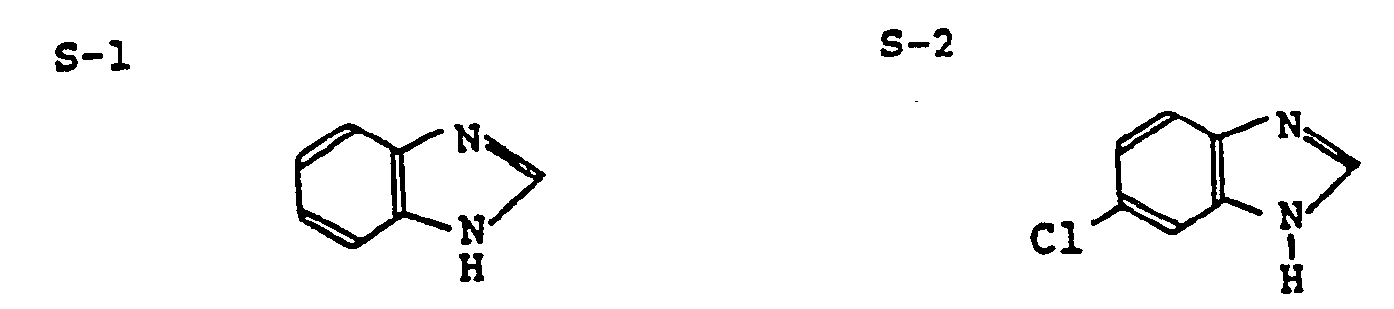


- Synthesis of these compounds is well-known, so that those skilled in the art can readily synthesize these compounds. For the synthesis of these compounds, for example, the "Shin Jikken Kagaku Koza (New Course of Experimental Chemistry)" vol 14 (published by Maruzen Co Ltd) may be consulted.
- The amount of the restrainer in the developer liquid, although varying with its nature, is suitably from 0.5 mg to 50 g, and most preferably from 1 mg to 10 g per liter of developer.
- G P Faerman ; J Phot Sci (Journal of Photographic Science), 15 22 (1967) describes that, generally, development-restraining compounds function most effectively when they are dissociated. However, according to our studies, even if the compound is one of Formula (I), if it has an acid dissociation constant exceeding 1 x 10⁻⁸, the effect of the compound, although the compound may be dissociated under development conditions, can scarcely be recognized, if at all. The acid dissociation constant value is that measured at normal temperature, and is described in, for example, the
annex vol 2 to the "Dai Yuki-Kagaku'(Complete Organic Chemistry)" (published by Asakura Publishing Co Ltd), "The Theory of Photographic Process" written by T H james, 4th ed (published by McMillan). There are several methods for the measurement of the acid dissociation constant and reference may be made to for example, the "Jikken Kagaku Koza (Course of Experimental Chemistry)" vol 11, second series, (published by Maruzen Co Ltd) pp 524 to 552. - The solubility product with silver ion of the restrainer of the present invention is not more than 1 x 10⁻¹⁰. When using a compound having a solubility product exceeding this level, i.e. a compound whose precipitation fluency with silver ion is less, the desired effect cannot be expected. For the measurement and calculation of the solubility product, reference may be made to the "Skin Jikken Kagaku Koza", vol 1 (published by Maruzen Co Ltd) pp 233 to 250.
- The restrainer of the present invention, even when used alone, exerts a sufficient effect, but in order to increase the effect, it is desirable to use the restrainer to be present together with chloride ion. During the development chloride ion is dissolved out of the silver halide light-sensitive color photographic material into the color developer liquid. It is desirable that chloride ion, including the dissolved chloride ion, be present in a quantity of from 1 x 10⁻³ mole to 0.5 mole, and most preferably from 2 x 10⁻³ mole to 0.2 mole per liter of the color developer liquid of the present invention.
- Any p-phenylenediamine color developing agent may be used in the presence invention but those which are preferred include 4-amino-N,N-diethyl-aniline hydrochloride, 4-amino-3-methyl-N,N-diethyl-aniline hydrochloride, 4-amino-3-methyl-N-ethyl-N-(β-methanesulfonamido)ethyl-aniline sulfate-hydrate, 4-amino-3-methyl-N-ethyl-N-β-hydroxyethyl-aniline sulfate, 4-amino-3-β-(methane-sulfonamido)ethyl-N,N- diethylaniline hydrochloride, and 4-amino-N-ethyl-N-(2-methoxyethyl)-m-toluidinedi-P-toluene sulfonate. For other useful agents, reference may be made to J Am Chem Soc (Joumal of American Chemical Society) 73 3100 (1951) by Bent et al and "The Theory of Photographic Process" by T H James, 4th ed (McMillan) p 315 to 320. In order to use a p-phenylene color developing agent in the developer, the agent is desirably added in a quantity of from 0.1 g to 100 g, and more preferably from 0.5 to 20 g, per liter of the developer. In addition, a p-phenylenediamine color developing agent may also be incorporated into the silver halide light-sensitive color photographic material, and it may be used in an amount from, say, 0.1 mole to 10 moles, preferably from 0.5 moles to 5 moles, per mole of coupler that is used in the material. In incorporating the agent, the agent may be used as it is, or in the form of a salt of an inorganic acid (such as hydrochloric acid, sulfuric acid, phosphoric acid, boric acid or nitric acid), of a salt of an organic acid or of a derivative thereof (such as sulfonic acid, carboxylic acid, sulfamic acid, sulfinic acid, hydroxamic acid, polymer-sulfonic acid, a phosphoric acid ester, a sulfuric acid ester or a thiosulfuric acid ester), or a salt of a metallic complex (such as of nickel, zinc, lead, cobalt or copper), or further in the form of a precursor (such as a Schiff base, an imido compound or a urethane compound).
- The developer used in the present invention desirably has a pH value of not less than 9.5, and preferably a pH value from 10 to 13. It is well known that development can be accelerated by increasing the pH of the developer, and when processed in a high-pH developer (pH > 12), particularly in a color development, although the development is recognized to be accelerated, an increase in fog and in graininess occur, thus leading to a deterioration in photographic characteristics. In the present invention, if the developer has a pH of not less than 9.5, a rapid development can be carried out without deteriorating photographic characteristics.
- On the other hand, if the pH of the developer is less than 9.5, it is naturally disadvantageous for rapid development, and besides, fog increases as the pH is reduced below 9.5, which is, of course, undesirable.
- In the practice of the present invention, it is essential to use a developer which is substantially free of bromide ion because the presence of bromide ion significantly impairs the rapidity of development. A "developer substantially free of bromide ion", as used herein, means a developer that contains not more than 1 x 1Q-3 molesnitre of bromide ion. The present invention uses, as silver halide, a high-chloride silver halide; the high-chloride silver halide is desirably pure silver chloride. However, the high-chloride silver halide can contain some silver bromide and silver iodide apart from silver chloride. Therefore, when it contains silver bromide, a slight amount of bromide ion is dissolved out into the developer during the development The bromide ion which is dissolved out into the developer is considered also to be partly substituted, due to several orders of difference in the solubility to silver between bromide ion and chloride ion, by the chloride ion in the area which is not the image area, i.e. in the high-chloride silver halide that is not developed even in the developer liquid, thereby to be retained in the silver halide light-sensitive color photographic material. However, as has been described above, as long as bromide ion, even though in only a small amount, is dissolved into the developer on developing the high-chloride silver halide, it is impossible to exclude completely the bromide ion concentration in the developer. The meaning in the present invention of "substantially free of bromide ion" is that there is no bromide ion with the exception of the bromide ion that is dissolved out and inevitably mixed into the developer ; 1 x 10⁻³ moles/litre is the upper limit of such bromide ion concentration inevitably mixed-in.
- In the present invention, the development generally-takes place at a temperature from 10°C to 70°C, and preferably from 20°C to 50°C.
- The developer used in the present invention may contain other known developer component compounds e.g. alkali agents or buffers for the developer such as sodium hydroxide, ammonium hydroxide, sodium carbonate, sodium sulfate, sodium sulfite, sodium tertiary phosphate, potassium metaborate or borax, which may be used singly or in combination. For the purpose of providing the developer with buffering ability or for the convenience of its preparation, there may also be used various salts such as disodium or dipotassium hydrogen phosphate, sodium or potassium dihydrogen phosphate, sodium or potassium hydrogen carbonate, boric acid or alkali nitrates.
- To the developer used in the present invention, if necessary, may be added an accelerating agent including pyridinium compounds or other cationic compounds, such as neutral salts e.g. thallium nitrate or potassium nitrate, polyethylene glycol or derivatives thereof, organic amines, ethanolamine, ethylenediamine, diethanolamine, benzyl alcohol or phenyl-ethyl alcohol.
- Further, polyphosphoric acid compounds or aminopolycarboxylic acids, for example may be used as water softeners, and, besides, calcium- and magnesium-hiding agents may be used in the developer.
- An organic solvent may, if desired, be incorporated into the developer in order to increase the solubility of certain components of the developer ; such solvents include ethylene glycol, hexylene glycol, diethylene glycol, ethylene glycol, monomethyl ether, methanol, ethanol, acetone, triethylene glycol, dimethyl formamide and dimethyl sulfoxide.
- After the formation of a dye image in accordance with the present invention, in order to remove the remaining image silver, the image silver can be rehalogenated, if necessary, in a bleaching bath containing, for example, red prussiate or aminocarboxylic acid ferric salt and subsequently fixed in a fixing bath containing a silver-halide solvent (such as a thiosulfate, thiourea, ethylene-thiourea, a thiocyanate, a sulfurcontaining diol or a sulfur containing dibasic acid). Alternatively, both bleaching and fixing can be carried out in a single bath.
- The silver halide crystals to be used in the present invention are silver halide crystals that comprise silver chloride in an amount not less than 80 mole %, preferably not less than 90 mole % ; more preferably the silver halide should be pure silver chloride. The other silver halide is mostly silver bromide, and may of course be all silver bromide. Silver iodide may be incorporated depending on the intended purposes, but the silver iodide, if used, should generally not be present in an amount exceeding 5 mole %, and prefarably at most 2 mole %.
- These silver halides may be prepared in known manner. For example, the silver halide used in the present invention may be prepared, according to the nature or use of the light-sensitive color photographic material, using the so-called core-shell emulsion, conversion emulsion, epitaxial-junction emulsion, or preliminarily optically or chemically fogged emulsions. The size of the silver halide crystals used in the present invention can be within the normally used range. The crystal size distribution may be in the form of either a polydispersed system or a monodispersed system, but the emulsion is desirably a monodispersed system emulsion. These emulsions may be chemically sensitized by one or more of active gelatin ; sulfur sensitizers such as allylthiocar- bamide, thiourea, thiosulfates and cystine ; selenium sensitizers ; reduction sensitizers such as stannous salts and polyamines ; noble-metallic sensitizers such as gold sensitizers including potassium aurithiocyanate, potassium chloroaurate and 2-aurosulfobenzothiazole-metachloride, or for example water-soluble-salt sensitizers such as salts of ruthenium, rhodium or iridium, for example ; specific examples include ammonium chloropalladate, potassium chloroplatinate, sodium chloropalladate (some of these function as sensitizers or fogging agents, depending upon the quantities used) ; typically a gold sensitizer can be used with a sulfur sensitizer or a gold sensitizer with a selenium sensitizer.
- Further, the silver halide may be optically sensitized to desired wavelength regions by the use of one or more spectral sensitizers such as cyanine dyes including, for example, zero-methine dye, monomethine dye, dimethine dye and trimethine dye as well as merocyanine dyes.
- The high-chloride silver halide used in the present invention hardly absorbs visible rays. Accordingly, optically green-sensitized or red-sensitized high chloride silver halide emulsion is hardly sensitive to blue light. This property is thought to be principally responsible for the color reproducibility of the light-sensitive photographic material.
- Most conventional silver halide emulsions consisting principally of silver bromide used in silver halide light-sensitive color photographic materials, if subjected to optical green-sensitization or red-sensitization, are also sensitive to blue light because the silver bromide contained therein is sensitive to blue light in addition to the desired spectral sensitivity. For this reason, when exposed to blue light, it was unavoidable that not only the blue-sensitive emulsion but also the green-sensitive and red-sensitive emulsions become sensitive to the light.
- In the silver halide light-sensitive color photographic material, the respective red-sensitive, green-sensitive and blue-sensitive emulsions are coated as separate layers in combination with different couplers, the couplers forming different dyes during the color developing process, the combinations being a red-sensitive emulsion with a cyan dye-forming coupler, green-sensitive emulsion with a magenta dye-forming coupler, and blue-sensitive emulsion with a yellow dye-forming coupler. Therefore, in a silver halide light-sensitive color photographic material consisting principally of silver bromide, after the light-sensitive material is exposed to blue light and when subjected to a color development, in addition to the dye produced by the reaction of the developing agent with the coupler in combination with the blue-sensitive emulsion, some different dyes are also formed from the couplers in combination with the red-sensitive emulsion and the green-sensitive emulsion, thereby producing a turbidity in the light-sensitive material. Thus, at the time of exposure, the cause of the turbidity has already been produced, so that color reproducibility is reduced. Various attempts have been made to prevent this reduction in color reproducibility. For example, a yellow filter dye layer or a colloidal silver layer can be provided to reduce the blue-sensitivities of the red-sensitive emulsion and the green-sensitive emulsion ; a silver halide having large-size silver halide particles is used as the blue-sensitive emulsion thereby to make a large difference between the blue-sensitivity of the blue-sensitive emulsion and the blue-sensitivities of the red-sensitive and green-sensitive emulsions. These methods are, however, inadequate as a means for improving color reproducibility despite the deterioration of the blue-sensitivity leading to an increase in the consumption of silver, an increase in fog and a reduction in the development rate, for example. In contrast to this, in the present invention, since a high-chloride silver halide is used as silver halide, the blue-sensitivities of the red-sensitive and green-sensitive emulsions are negligible, so that the present invention is capable of providing a way of avoiding the cause of the turbidity that occurs at the time of exposure.
- The silver halide can be dispersed into an appropriate protective colloid to form a light-sensitive layer. As the protective colloid for use in light-sensitive layers or other layers (component elements such as interlayers, a protective layer or filter layers), gelatin is generally used, but gelatin derivatives, colloidal albumin, cellulose derivatives and synthetic resins such as polyvinyl compounds, for example can also be used ; they can be used singly or in combination, and, in addition, may also be used in combination with an acetyl cellulose whose acetyl content is from 19 to 26%, a water-soluble ethanolamine or a cellulose acetate, for example.
- As couplers for use in the present invention, known couplers may be used ; these may be incorporated into either a developer or the silver halide emulsion. Yellow couplers usable in the present invention include benzoyl acetanilide compounds and pivaloylacetanilide compounds; magenta couplers include 5-pyrazolone compounds, pyrazolotriazole compounds, pyrazolinobenzimidazole compounds, indazolone compounds and cyanoacetyl compounds ; and cyan couplers include phenol compounds, diacylaminophenol compounds and naphthol compounds. These couplers may be of either the so-called two-equivalent type or four-equivalent type. These couplers may also have a fluorine-containing substituent intended to adjust the hue of the dye formed by the reaction with the oxide of the aromatic primary amine compound used in the present invention. Furthermore, in combination with these couplers, there may be used azo-type colored couplers intended to be used for automasking, osazone type compounds, and development diffusible dye releasing type couplers, for example. It is then desirable to use the so-called colorless coupler that is colorless before being subjected to a color development together with the above-mentioned masking coupler. In order to improve photographic characteristics, competing couplers, DIR couplers, BAR (Bleach Accelerator Releasing) couplers may also be incorporated.
- Silver halide emulsions containing such photographic couplers and the like prepared as described above can be coated on a support together with, as desired, a subbing layer, interlayers, filter layers, an anticurl layer and a protective layer, to prepare a silver halide light-sensitive photographic material for use in the present invention. Materials for the support which may be used include paper, laminated paper (such as polyethylene- laminated paper), glass, and film- or sheet-formed cellulose acetate, cellulose nitrate, polyester, polycarbonate, polyamide, polystyrene and polyolefin. These support materials, for the purpose of improving the adhesion of layers thereto, may be subjected to a surface treatment such as various hydrophilic treatments, for example, saponification treatment, corona discharge treatment, subbing treatment or setting treatment.
- The light-sensitive photographic material used in the present invention may also contain in the light-sensitive layers and/or other layers thereof (such as interlayers, subbing layer, filter layers, protective layer or image-receiving layers), according to the intended purpose, various photographic additives which include stabilizers such as mercury compounds, triazoles, azaindenes, quaternary benzothiazolium and zinc or cadmium salts ; sensitizers such as quaternary ammonium salts and polyethylene glycols ; physical characteristics- improving agents such as glycerol, dihydroxyalkanes such as 1,5-pentadiol, ethylene-bis-glycolic acid esters, bisethoxydiethylene glycol succinate, acrylic acid amide and emulsion of polymers ; hardening agents such as formaldehyde, halogen-substituted fatty acids such as mucochloric acid and mucobromic acid, acid anhydrides, dicarboxylic acid chloride, disulfonic acid chloride, methane-sulfonic acid diester, sodium hydrogen-sulfite derivatives of dialdehyde wherein the aldehyde radicals are separated by 2 or 3 carbon atoms, bisaziridine and ethylene-imine ; coating aids such as saponin, lauryl or oleyl monoether of polyethylene glycol and sulfated or alkylated polyethylene glycol salts ; coating assistants such as sulfosuccinates ; organic solvents such as coupler solvents including high boiling solvents and/or low boiling solvents such as dibutyl phthalate, tricresyl phosphate, acetone, methanol, ethanol and ethylene glycol monoethyl ether ; DIR compounds which release development inhibitors during color development and produce substantially colorless compounds ; antistatic agents, defoaming agents, ultraviolet absorbing agents, brightening agents, lanti-slip agents ; matting agents and antihalation or antiirradiation agents ; these various additives may be used singly or in combination.
- The present invention is illustrated in further detail in the following Examples.
- The following layers were coated on a resin-coated paper support to thereby prepare a silver halide light-sensitive color photographic material sample.
- In all the examples which will be described hereinafter, all various compounds to be added to the silver halide light-sensitive color photographic material, unless otherwise noticed, are to be indicated in quantities per 100 cm2.
- A silver halide light-sensitive material layer having 4.0 mg of magenta coupler A, a green-sensitive silver chloride emulsion (average crystal size 0.6 µm, silver equivalent of 3.5 mg) and 20 mg of gelatin.
- On this layer was coated and dried a gelatin protective layer containing 10 mg of gelatin. The thus obtained sample was regarded as (I). The resulting sample (I) was exposed through an optical wedge and then processed as follows:
-

-

- Potassium hydroxide or sulfuric acid is used to adjust the pH to 10.7.
- To the above-prepared developer was added each of the compounds as given in Table 1 to thereby prepare color developers [A] to [M]. The acid dissociation constants (Ka) and the solubility products with silver ion (Ksp) of the added compounds are also given in Table 1.

-

- The obtained sample was subjected to sensitometry and the results of the obtained dye image densities are shown in Table 2.

- As apparent from Table 2, it is understood that the rapid development can be carried out without deteriorating Dmax and with significantly restraining Dmin by processing a high-chloride silver halide emulsion in a developer containing the restrainer of the present invention. In contrast to this, comparative compound (1) which is one that is generally known as a restrainer for a color developer but not included in the restrainers of the present invention has only a little effect to lower Dmin, so that it cannot be practically used. On the other hand, comparative compound (3), when added in the quantity as in this example, lowers not only Dmin but also Dmax, and, when added in a smaller quantity than in this example, has no sufficient effect to lower Dmin.
- And chloride ion that is said to have an antifogging effect upon a silver chloride emulsion, as described in "The Theory of Photographic Process" 4th ed. by T. H. James, p. 396 (McMillan), has little effect in itself to lower Dmin, but, when used together with the restrainer of the present invention, exerts a synergistic effect to increase the restraining of Dmin, and yet does not retard the developing rate. Thus, the presence of chlorine ion together with the restrainer of the present invention enables the restraining effect of the invention to be more excellent
- The following layers were coated on a resin-coated paper support to thereby prepare a silver halide light-sensitive color photographic material sample.
- A light-sensitive silver halide emulsion having 4.0 mg of magenta coupler A, a green-sensitive chlorobromide emulsion (containing 80 mole % silver bromide, average crystal size 0.6 µm, silver equivalent of 3.5 mg) and 20 mg of gelatin.
- On this was coated and dried a gelatin protective layer containing 10 mg of gelatin. The resulting material was regarded as sample (II).
- The thus obtained sample (II) and sample (I) prepared in Example 1 were exposed through an optical wedge and then processed as follows :
-

- Color developers [L] and [M] used in Example 1 and color developer [N] obtained by adding potassium bromide in the quantity of 0.7 glliter to color developer [B] also used in Example 1 were prepared.
- For bleach-fixing, the same bleach-fixer as used in Example 1 was used. The dye image densities of the samples obtained when the samples were subjected to color development for three minutes are as shown in Table 3. And the changes in the sensitometric curves according to the changes obtained when processing sample (I) in color developers [M] and [N] and when processing sample (II) in color developer [N] are shown in Figure 1.

- As apparent from Table 3, it is understood that when a chlorobromide emulsion which is composed principally of silver bromide and which has conventionally been used mostly as a light-sensitive coior photographic material is processed in a color developer containing the restrainer of the present invention, Dmin of the emulsion becomes increased, so that no excellent image can be obtained, but by being processed in a color developer containing bromide ion generally known as a restrainer for color development, Dmin of the emulsion can be restrained low. However, in this case, as apparent from Figure 1, the developing rate is slow, so that no rapid development can be attained.
- And even when the high-chloride silver halide emulsion of the present invention is processed in a bromide ion-containing color developer, as seen from Figure 1, the restraining of Dmin is insufficient and, besides, the developing rate is low. In contrast to this, however, when the high-chloride silver halide emulsion is processed in a color developer containing the restrainer of the present invention, Dmin is effectively restrained low, whereby an excellent dye image having a high Dmax can be obtained in a short-period development.
- Sample (I) that was prepared in Example 1 was exposed through an optical wedge and then processed in accordance with the processing steps in Example 1 with the use of three developers of which the composition is the same as that in Example 1 but which have different pH values : 8.8, 10.2 and 11.8, respectively. As for development time, the sample was processed for one minute in the developers of pH 10.2 and pH 11.8, and also processed separately for one minute and three minutes in the developer of pH 8.8. The resulting sensitometric curves of the sample are as shown in Figure 2.
- As seen from Figure 2, even if pH values of the developer are largely different, the sensitometric characteristics (fog, gradation, etc.) of the processed sample are hardly affected. In contrast, however, when processed in the developer of pH 8.8, the developing rate becomes reduced with the increase in fog, resulting in an extreme deterioration of the sensitometric characteristics. Thus, the method for the formation of a dye image of the present invention is found to be rapid and stable only when the development is made under the condition of a pH value of not less than 9.5.
- Sample (1) prepared in Example 1 was exposed through an optical wedge and then processed in accordance with the processing steps in Example 1, provided that color developers [O] to [Q] prepared by adding bromine ion in the ion concentrations given in Table 4 to developer [M] were used.
- The dye image densities obtained by processing the sample separately for periods of 15 seconds, 30 seconds and one minute in each of the above-prepared color developers are as indicated in Table 4.

- As apparentfrom Table 4, it is understood that the rapidity of the development becomes outstandingly retarded by bromine ion. However, as has been explained in the detailed description of the invention, in a very slight concentration of bromine ion (not more than 1 x 10⁻³ molelliter) that is likely to be dissolved out of the high-chloride silver halide during the development into the developer liquid, the rapidity of the development is not affected.
- The following layers were coated in order on a resin-coated paper support to thereby prepare a silver halide light-sensitive color photographic material, which was regarded as sample (III) :
- (1) A blue-sensitive silver halide emulsion layer containing 7.8 mg of yellow coupler B, a blue-sensitive silver chloride (average crystal size 0.8 µm, silver equivalent of 4.0 mg) and 20 mg of gelatin.
- (2) An interlayer containing 0.2 mg of dioctyl hydroquinone and 10 mg of gelatin.
- (3) A green-sensitive silver halide emulsion layer containing 4.2 mg of magenta coupler A, a green-sensitive silver chloride emulsion (average crystal size 0.5 µm, silver equivalent of 3.7 mg) and 20 mg of gelatin.
- (4) An interlayer containing 0.3 mg of dioctyl hydroquinone and 15 mg of gelatin.
- (5) A red-sensitive silver halide emulsion layer containing 3.2 mg of cyan coupler C, a red-sensitive silver chloride emulsion (average crystal size 0.4 µm, silver equivalent of 3.0 mg) and 15 mg of gelatin.
- (6) A gelatin protective layer containing 10 mg of gelatin.
- The thus obtained sample was regarded as sample (III).
- Further, a comparative sample was prepared in accordance with the following manner :
- A blue-sensitive silver chlorobromide emulsion (containing 80 mole % silver bromide, average crystal size 0.8 µm, silver equivalent of 4.0 mg) was used in place of the blue-sensitive silver chloride emulsion in (1) of the above sample (III), a green-sensitive silver chlorobromide emulsion (containing 70 mole % silver bromide, average crystal size 0.5 µm, silver equivalent of 3.7 mg) was used in place of the green-sensitive silver chloride emulsion in (3), and a red-sensitive silver chlorobromide emulsion (containing 70 mole % silver bromide, average crystal size 0.4 µm, silver equivalent of 3.0 mg) was used in place of the red-sensitive silver chloride emulsion in (5). And the resulting sample was regarded as sample (IV).
- Sample (III) and sample (IV) were exposed through an optical wedge and then processed as follows :
-

- Color developers [R] and [S] were prepared by adding the compounds shown in Table 5 to color developer [B].

- For bleach-fixing, the same bleach-fixer as in Example 1 was used. The dye image densities of these samples obtained by processing sample (III) in color developers [R] and [S] and by processing sample (IV) in color developer [N] are as shown in Table 6.

- As apparent from Table 6, it is understood that, according to the present invention, even in the multilayer sample wherein silver halide emulsion layers and the like are multi-layered, the formation of an excellent dye image with the Dmax increased and with the Dmin restrained low in a short developing period can be accomplished. In contrast to this, in the case where the light-sensitive color photographic material which uses silver chlorobromide emulsions consisting principally of silver bromide and which is of the type that has been conventionally extensively used is processed in a bromine ion-containing developer of the type that has been generally used in ordinary color development, the rapidity of the development is extremely inferior to that of the present invention.
- Sample (III) of the invention prepared in Example 5 and comparative sample (IV) were exposed through an optical wedge and each processed in color developers which differ in pH as shown in Table 7. The processing of these samples was performed in accordance with the processing steps in Example 1, provided that sample (III) was processed for one minute, while comparative sample (IV) for three minutes because the developing speed thereof is low.
- The obtained samples were subjected to sensitometry to obtain gamma values which are shown in Table 7. The gamma value indicated herein is the reciprocal of the difference between the logarithm of an exposure to give the dye density of 0.8 and the logarithm of an exposure to give the dye density of 1.8, and the larger the value that represents the gradation of an image, the higher does the contrast become.

- The sensitometric characteristics of an imagewise-exposed silver halide light-sensitive color photographic material, even if the material is processed in succession over an extensive period of time or processed on different occasions, must be stably retained. However, in those methods which have been conventionally practiced, there have been unavoidable changes in the sensitometric characteristics, particularly in the gradation. As the cause of this, several factors are conceivable, but one of the largest factors is said to be the change in the pH of a developer. Also in the examples of the present invention, in the method described as of comparison which has been conventionally extensively used, the gradation is found to be significantly changed by the change in the pH of the developer. For this reason, the control of the pH of developers presently requires much labor. In contrast, it is understood that the method of the present invention, even when the pH of the developer is changed, enables to obtain a stable gradation-having dye image. Consequently, the method of the present invention reduces largely the complexity of pH control.
- The comparison between the color reproducibilities of the method of the present invention and of the comparative method which is of the conventional type was carried out in the following manner : A commercially available SAKURA Color Negative film was used to photograph a dark green landscape and then processed. Printings were made on sample (III) and sample (IV) from the processed negative film by means of a color printer. After the printing, sample (III) was processed in color developer [M] for one minute, while sample (IV) was processed in color developer [N] for three minutes. After that, both samples were bleach-fixed and washed in the same manner as in Example 1, whereby color prints of the image were obtained.
- As the result, in the color print image obtained by the comparative method of the conventional type, turbidity in color was observed in the dark green, while in the color print image obtained by the method of the present invention, pure green was reproduced.
- 10 mg of a color developing agent precursor P-1 were added to each of the layers (2) and (4) of sample (III), which is the multi-layer silver chloride photographic light-sensitive material prepared in Example 5, whereby a sample (V) was prepared.

- In addition, the method of incorporating P-1 into a light-sensitive material is detailed in Japanese Patent Publication Open to Public Inspection No. 6235/1981.
- Sample (V) was exposed through an optical wedge and then processed as follows :
-

-

- Potassium hydroxide or sulfuric acid is used to adjust the pH to 11.5.
- To the above composition-having activator was added each of the compounds given in Table 8 to thereby prepare activators [T] to [V].

- The dye image densities of the obtained samples are as shown in Table 9.

- As apparent from Table 9, it is understood that the p-phenylenediamine type color developing agent-incorporated high-chloride silver halide color photographic light-sensitive material is processed in a color developing agent-free alkaline liquid (activator liquid) in the presence of the restrainer of the present invention, whereby an excellent dye image having a low Dmin and a high Dmax can be obtained.
-

-
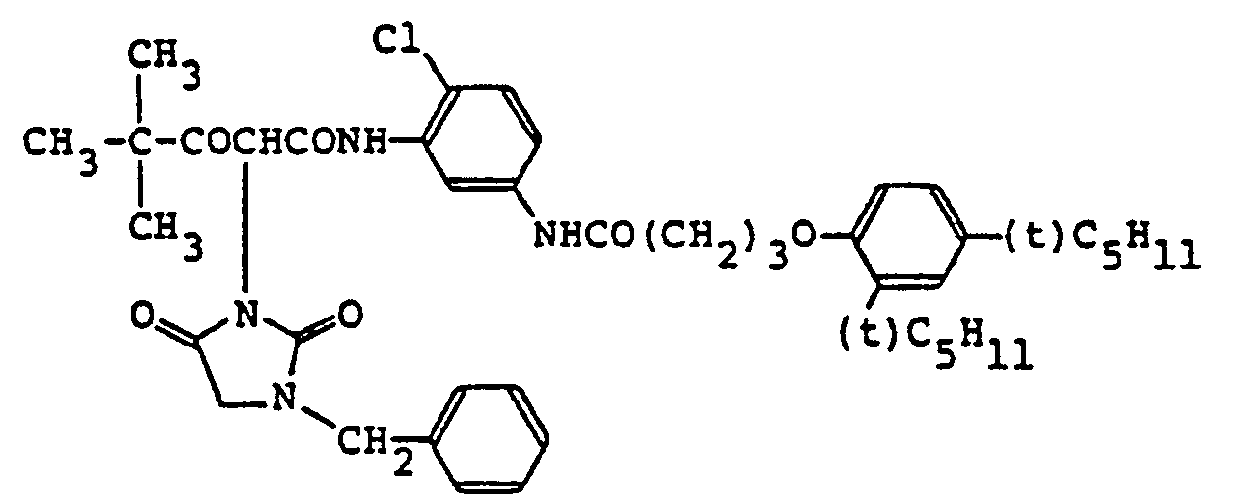
-

-
- Figure 1(1) is a graph showing the change in the sensitometric curve of sample (I) according to the difference in the developing time when the sample is processed in color developer [M]. As for the developing time, 15 seconds for curve 1, 30 seconds for
curve 2, one minute forcurve 3, and three minutes forcurve 4. - Figure 1(2) is a graph showing the change in the sensitometric curve of sample (I) according to the difference in the developing time when the sample is processed in color developer [N]. As to the developing time, 15 seconds for curve 1, 30 seconds for
curve 2, one minute forcurve 3, and three minutes forcurve 4. - Figure 1(3) is a graph showing the change in the sensitometric curve of sample (11) according to the difference in the developing time when the sample is processed in color developer [N]. As to the developing time, 15 seconds for curve 1, 30 seconds for
curve 2, one minute forcurve 3, and three minutes forcurve 4. - Figure 2 is a graph showing the change in the sensitometric curve of sample (I) according to the difference in pH of color developer [M] in which the sample is processed. As to the pH change, pH 8.8 for curve 1 (developing time: one minute), pH 8.8 for curve 2 (developing time: three minutes), pH 10.2 for curve 3 (developing time: one minute), and pH 11.8 for curve 4 (developing time: one minute).
- The word "SAKURA" is believed to be a Registered Trade Mark in one or more of the designated states.
Claims (9)

Applications Claiming Priority (2)
| Application Number | Priority Date | Filing Date | Title |
|---|---|---|---|
| JP56193443A JPS5895345A (en) | 1981-12-01 | 1981-12-01 | Formation of dye image |
| JP193443/81 | 1981-12-01 |
Publications (4)
| Publication Number | Publication Date |
|---|---|
| EP0080896A2 EP0080896A2 (en) | 1983-06-08 |
| EP0080896A3 EP0080896A3 (en) | 1983-07-20 |
| EP0080896B1 EP0080896B1 (en) | 1986-08-13 |
| EP0080896B2 true EP0080896B2 (en) | 1991-07-24 |
Family
ID=16308070
Family Applications (1)
| Application Number | Title | Priority Date | Filing Date |
|---|---|---|---|
| EP82306367A Expired EP0080896B2 (en) | 1981-12-01 | 1982-11-30 | Method for the formation of dye image |
Country Status (4)
| Country | Link |
|---|---|
| US (1) | US4565774A (en) |
| EP (1) | EP0080896B2 (en) |
| JP (1) | JPS5895345A (en) |
| DE (1) | DE3272624D1 (en) |
Families Citing this family (60)
| Publication number | Priority date | Publication date | Assignee | Title |
|---|---|---|---|---|
| JPS6052847A (en) * | 1983-09-01 | 1985-03-26 | Konishiroku Photo Ind Co Ltd | Method for developing photosensitive silver halide material |
| DE3431860A1 (en) * | 1984-08-30 | 1986-03-06 | Agfa-Gevaert Ag, 5090 Leverkusen | METHOD FOR PRODUCING COLOR PHOTOGRAPHIC IMAGES |
| JPH0612434B2 (en) * | 1985-05-17 | 1994-02-16 | 富士写真フイルム株式会社 | Processing method of silver halide color photographic light-sensitive material |
| CA1303412C (en) | 1985-05-31 | 1992-06-16 | Shigeharu Koboshi | Method for forming direct positive color image |
| JPS6265653A (en) * | 1985-09-09 | 1987-03-24 | Mori Sangyo Kk | Production of buckwheat vermicelli |
| JPH0621949B2 (en) * | 1986-01-23 | 1994-03-23 | 富士写真フイルム株式会社 | Color image forming method |
| EP0252997B1 (en) | 1986-01-23 | 1993-04-07 | Fuji Photo Film Co., Ltd. | Process for forming colored image |
| US5851741A (en) * | 1986-01-24 | 1998-12-22 | Fuji Photo Film Co., Ltd. | Method for the formation of color images |
| JPH0650382B2 (en) * | 1986-01-24 | 1994-06-29 | 富士写真フイルム株式会社 | Color image forming method |
| US4851326A (en) * | 1986-02-24 | 1989-07-25 | Fuji Photo Film Co., Ltd. | Method for processing silver halide color photographic materials using developer substantially free of bromide and benzyl alcohol |
| EP0243096B1 (en) * | 1986-04-18 | 1994-02-09 | Konica Corporation | Method for processing a light-sensitive silver halide color photographic material |
| JP2546645B2 (en) * | 1986-04-24 | 1996-10-23 | コニカ株式会社 | Silver halide color photographic light-sensitive material |
| JP2645259B2 (en) * | 1986-04-30 | 1997-08-25 | コニカ株式会社 | Processing method of silver halide color photographic light-sensitive material |
| JPH0648376B2 (en) * | 1986-05-01 | 1994-06-22 | コニカ株式会社 | Processing method of silver halide color photographic light-sensitive material |
| JPH077194B2 (en) * | 1986-05-19 | 1995-01-30 | 富士写真フイルム株式会社 | Color image forming method and silver halide color photographic light-sensitive material |
| JPH0833629B2 (en) * | 1986-06-11 | 1996-03-29 | コニカ株式会社 | A silver halide photographic light-sensitive material suitable for rapid processing and capable of obtaining a dye image excellent in light fastness. |
| US5118591A (en) * | 1986-07-10 | 1992-06-02 | Konica Corporation | Processing method for silver halide color photographic light-sensitive material |
| JPH06105345B2 (en) * | 1986-07-21 | 1994-12-21 | 富士写真フイルム株式会社 | Color photographic developer composition and method for processing silver halide color photographic light-sensitive material |
| JP2514369B2 (en) * | 1986-07-31 | 1996-07-10 | コニカ株式会社 | Method for forming dye image with excellent rapid processability |
| JPH01163732A (en) * | 1986-08-13 | 1989-06-28 | Konica Corp | Rapidly processed silver halide photographic sensitive material |
| JPH0812408B2 (en) * | 1986-11-19 | 1996-02-07 | コニカ株式会社 | Silver halide photographic material suitable for rapid processing |
| JPS63139347A (en) * | 1986-12-02 | 1988-06-11 | Konica Corp | Silver halide photographic sensitive material having excellent color regeneration |
| JP2601272B2 (en) * | 1987-04-28 | 1997-04-16 | コニカ株式会社 | Silver halide photographic light-sensitive material that does not deteriorate sensitivity and photographic performance of fog even in rapid processing, and that rot and decomposition by bacteria and mold are well prevented. |
| US5246819A (en) * | 1987-12-28 | 1993-09-21 | Fuji Photo Film Co., Ltd. | Method for processing silver halide color photographic material |
| JP2534883B2 (en) * | 1988-02-19 | 1996-09-18 | 富士写真フイルム株式会社 | Silver halide color-processing method of photographic light-sensitive material |
| DE3805699A1 (en) * | 1988-02-24 | 1989-09-07 | Agfa Gevaert Ag | PHOTOGRAPHIC COLOR DEVELOPER SOLUTION AND METHOD FOR DEVELOPING A COLOR PHOTOGRAPHIC MATERIAL |
| DE3810348C2 (en) * | 1988-03-26 | 1999-09-30 | Agfa Gevaert Ag | Process for the rapid development of color materials |
| JPH01295255A (en) * | 1988-05-23 | 1989-11-28 | Konica Corp | Method for processing silver halide color photographic sensitive material |
| JP2676225B2 (en) * | 1988-06-21 | 1997-11-12 | コニカ株式会社 | Processing method of silver halide color photographic light-sensitive material |
| JPH0228642A (en) * | 1988-07-18 | 1990-01-30 | Konica Corp | Method and device for processing silver halide color photographic sensitive material |
| JP2700474B2 (en) * | 1988-07-22 | 1998-01-21 | コニカ株式会社 | Processing method of silver halide color photographic light-sensitive material |
| JPH02132432A (en) * | 1988-07-28 | 1990-05-21 | Fuji Photo Film Co Ltd | Silver halide photographic sensitive material and image forming method using same |
| US5561040A (en) * | 1988-08-03 | 1996-10-01 | Fuji Photo Film Co., Ltd. | Method for forming image |
| JPH087416B2 (en) * | 1988-10-03 | 1996-01-29 | 富士写真フイルム株式会社 | Color image forming method |
| JPH087418B2 (en) * | 1988-10-03 | 1996-01-29 | 富士写真フイルム株式会社 | Processing method of silver halide color photographic light-sensitive material |
| JPH087415B2 (en) * | 1988-10-03 | 1996-01-29 | 富士写真フイルム株式会社 | Image forming method for silver halide color photography |
| JPH02191951A (en) * | 1988-10-03 | 1990-07-27 | Fuji Photo Film Co Ltd | Processing method for silver halide color photographic sensitive material |
| JP2671042B2 (en) * | 1988-10-03 | 1997-10-29 | 富士写真フイルム株式会社 | Processing method of silver halide color photographic light-sensitive material |
| JPH087411B2 (en) * | 1988-10-03 | 1996-01-29 | 富士写真フイルム株式会社 | Color photo image forming method |
| JPH02197837A (en) * | 1988-10-14 | 1990-08-06 | Fuji Photo Film Co Ltd | Development processing method for silver halide photographic sensitive material |
| JP2747918B2 (en) * | 1988-12-28 | 1998-05-06 | コニカ株式会社 | Processing method of silver halide color photographic light-sensitive material |
| JP2670876B2 (en) * | 1989-02-14 | 1997-10-29 | 富士写真フイルム株式会社 | Color image forming method |
| JPH02234157A (en) * | 1989-03-07 | 1990-09-17 | Fuji Photo Film Co Ltd | Method for processing silver halide color photographic sensitive material |
| JP2976377B2 (en) * | 1989-04-27 | 1999-11-10 | 富士写真フイルム株式会社 | Processing method of silver halide color photographic light-sensitive material |
| JPH02289851A (en) * | 1989-04-28 | 1990-11-29 | Konica Corp | Dye stuff image forming method |
| JP2949193B2 (en) * | 1989-05-22 | 1999-09-13 | 富士写真フイルム株式会社 | Processing method of silver halide color photographic light-sensitive material |
| JP2684224B2 (en) * | 1989-07-31 | 1997-12-03 | 富士写真フイルム株式会社 | Processing method of silver halide color photographic light-sensitive material |
| DE69030847T2 (en) * | 1989-07-31 | 1997-09-18 | Fuji Photo Film Co Ltd | Process for processing silver halide color photographic material |
| JP2893094B2 (en) * | 1989-10-27 | 1999-05-17 | 富士写真フイルム株式会社 | Color image forming method |
| JP2648971B2 (en) * | 1989-10-30 | 1997-09-03 | 富士写真フイルム株式会社 | Processing method of silver halide color photographic light-sensitive material |
| JP2673272B2 (en) * | 1989-11-17 | 1997-11-05 | 富士写真フイルム株式会社 | Processing method of silver halide color photographic light-sensitive material |
| JPH03221949A (en) * | 1990-01-29 | 1991-09-30 | Fuji Photo Film Co Ltd | Processing method for silver halide color photographic sensitive material |
| JP2673257B2 (en) * | 1990-06-01 | 1997-11-05 | 富士写真フイルム株式会社 | Processing method of silver halide color photographic light-sensitive material |
| JPH04204647A (en) * | 1990-11-30 | 1992-07-27 | Fuji Photo Film Co Ltd | Image forming method |
| JP2824881B2 (en) * | 1992-04-13 | 1998-11-18 | 富士写真フイルム株式会社 | Method for developing black-and-white silver halide photographic materials |
| JPH0635149A (en) * | 1992-07-15 | 1994-02-10 | Fuji Photo Film Co Ltd | Method for processing silver halide color photosensitive material |
| JP2607028B2 (en) * | 1993-04-15 | 1997-05-07 | 東北リコー株式会社 | Recording device |
| US5395747A (en) * | 1993-12-20 | 1995-03-07 | Minnesota Mining & Manufacturing Company | Stabilized thermal-dye-bleach constructions |
| US5756253A (en) * | 1997-07-09 | 1998-05-26 | Polaroid Corporation | Photographic element and method |
| US6372416B1 (en) * | 1999-08-26 | 2002-04-16 | Fuji Photo Film Co., Ltd. | Dye-forming method, color developing compositions, photosensitive materials and color developing agent precursors |
Family Cites Families (9)
| Publication number | Priority date | Publication date | Assignee | Title |
|---|---|---|---|---|
| NL69459C (en) * | 1942-09-02 | |||
| US2496940A (en) * | 1948-10-21 | 1950-02-07 | Eastman Kodak Co | Mixed grain photographic process |
| DE1952253C3 (en) * | 1968-10-22 | 1979-03-22 | Fuji Photo Film Co., Ltd., Ashigara, Kanagawa (Japan) | Process for developing color photographic recording materials |
| DE2308239C2 (en) * | 1973-02-20 | 1984-09-13 | Agfa-Gevaert Ag, 5090 Leverkusen | Direct positive photographic recording material |
| US3899331A (en) * | 1973-11-14 | 1975-08-12 | Polaroid Corp | Multicolor dye developer diffusion transfer processes with pyrazolo-{8 3,4d{9 {0 pyrimidines |
| GB1469480A (en) * | 1974-08-07 | 1977-04-06 | Ciba Geigy Ag | Photographic emulsion |
| GB1507989A (en) * | 1974-12-19 | 1978-04-19 | Ciba Geigy Ag | Photographic emulsions |
| DE2932185A1 (en) * | 1978-08-10 | 1980-02-21 | Ciba Geigy Ag | Photographic emulsion contg. rhombic dodecahedron silver halide - crystals pptd. in presence of divalent cadmium ions and free ammonia |
| JPS6034098B2 (en) * | 1981-01-29 | 1985-08-07 | 富士写真フイルム株式会社 | Processing method for silver halide color photosensitive materials |
-
1981
- 1981-12-01 JP JP56193443A patent/JPS5895345A/en active Granted
-
1982
- 1982-11-30 DE DE8282306367T patent/DE3272624D1/en not_active Expired
- 1982-11-30 EP EP82306367A patent/EP0080896B2/en not_active Expired
-
1984
- 1984-10-18 US US06/662,264 patent/US4565774A/en not_active Expired - Lifetime
Also Published As
| Publication number | Publication date |
|---|---|
| US4565774A (en) | 1986-01-21 |
| JPH0436375B2 (en) | 1992-06-16 |
| EP0080896A3 (en) | 1983-07-20 |
| EP0080896A2 (en) | 1983-06-08 |
| JPS5895345A (en) | 1983-06-06 |
| DE3272624D1 (en) | 1986-09-18 |
| EP0080896B1 (en) | 1986-08-13 |
Similar Documents
| Publication | Publication Date | Title |
|---|---|---|
| EP0080896B1 (en) | Method for the formation of dye image | |
| EP0304297B2 (en) | Color photographic element | |
| JPS62297849A (en) | Processing method for silver halide color photographic sensitive material | |
| JPS5836332B2 (en) | Processing method for silver halide photographic materials | |
| US4797349A (en) | Method for forming a color image comprising developing a light sensitive material containing a surfactant with a developer not containing benzyl alcohol | |
| US5451496A (en) | Color photographic materials and methods containing DIR or DIAR couplers and phenolic coupler solvents | |
| US4192681A (en) | Process for forming an amplified dye image | |
| DE69911836T2 (en) | Color photographic element with elemental silver and heterocyclic nitrogen compounds in a non-light sensitive layer | |
| JPH08248593A (en) | Photographic element | |
| US5128237A (en) | Direct positive silver halide photographic material | |
| GB2302411A (en) | Silver halide materials | |
| JPS62242938A (en) | Method for processing silver halide photographic sensitive material giving dye image with high maximum density of developed color | |
| JPS62247361A (en) | Color image forming method | |
| US5378593A (en) | Color photographic materials and methods containing DIR or DIAR couplers and carbonamide coupler solvents | |
| US4469781A (en) | Processing for silver halide color photographic materials | |
| JPH07199431A (en) | Photographic element protected against color contamination and pigment stain | |
| JPH071386B2 (en) | Silver halide color-photographic material | |
| JPS62242940A (en) | Dye image forming method | |
| JPH0588324A (en) | Silver halide color photographic sensitive material | |
| JPS61196241A (en) | Treatment of color reversal photographic sensitive material | |
| EP0465076A1 (en) | A method for processing silver halide colour photographic light-sensitive materials | |
| JPS62178961A (en) | Silver halide photographic sensitive material | |
| JPH02289851A (en) | Dye stuff image forming method | |
| JPH02149844A (en) | Method for processing silver halide color photographic sensitive material and color developing agent composition | |
| JPH05150429A (en) | Silver halide color photographic sensitive material |
Legal Events
| Date | Code | Title | Description |
|---|---|---|---|
| PUAI | Public reference made under article 153(3) epc to a published international application that has entered the european phase |
Free format text: ORIGINAL CODE: 0009012 |
|
| PUAL | Search report despatched |
Free format text: ORIGINAL CODE: 0009013 |
|
| AK | Designated contracting states |
Designated state(s): DE FR GB |
|
| AK | Designated contracting states |
Designated state(s): DE FR GB |
|
| 17P | Request for examination filed |
Effective date: 19840104 |
|
| GRAA | (expected) grant |
Free format text: ORIGINAL CODE: 0009210 |
|
| AK | Designated contracting states |
Kind code of ref document: B1 Designated state(s): DE FR GB |
|
| REF | Corresponds to: |
Ref document number: 3272624 Country of ref document: DE Date of ref document: 19860918 |
|
| ET | Fr: translation filed | ||
| PLBI | Opposition filed |
Free format text: ORIGINAL CODE: 0009260 |
|
| 26 | Opposition filed |
Opponent name: AGFA-GEVAERT AG, LEVERKUSEN Effective date: 19870212 |
|
| RAP4 | Party data changed (patent owner data changed or rights of a patent transferred) |
Owner name: KONICA CORPORATION |
|
| PGFP | Annual fee paid to national office [announced via postgrant information from national office to epo] |
Ref country code: FR Payment date: 19901114 Year of fee payment: 9 |
|
| PGFP | Annual fee paid to national office [announced via postgrant information from national office to epo] |
Ref country code: GB Payment date: 19901119 Year of fee payment: 9 |
|
| PUAH | Patent maintained in amended form |
Free format text: ORIGINAL CODE: 0009272 |
|
| STAA | Information on the status of an ep patent application or granted ep patent |
Free format text: STATUS: PATENT MAINTAINED AS AMENDED |
|
| 27A | Patent maintained in amended form |
Effective date: 19910724 |
|
| AK | Designated contracting states |
Kind code of ref document: B2 Designated state(s): DE FR GB |
|
| ET3 | Fr: translation filed ** decision concerning opposition | ||
| PG25 | Lapsed in a contracting state [announced via postgrant information from national office to epo] |
Ref country code: GB Effective date: 19911130 |
|
| GBPC | Gb: european patent ceased through non-payment of renewal fee | ||
| PG25 | Lapsed in a contracting state [announced via postgrant information from national office to epo] |
Ref country code: FR Effective date: 19920731 |
|
| REG | Reference to a national code |
Ref country code: FR Ref legal event code: ST |
|
| PGFP | Annual fee paid to national office [announced via postgrant information from national office to epo] |
Ref country code: DE Payment date: 19971205 Year of fee payment: 16 |
|
| PG25 | Lapsed in a contracting state [announced via postgrant information from national office to epo] |
Ref country code: DE Free format text: LAPSE BECAUSE OF NON-PAYMENT OF DUE FEES Effective date: 19990901 |