EP0078377B1 - Quellenzugriffskontrolle in einem Mehrprozessorsystem zur simultanen Verarbeitung mehrerer Programme - Google Patents
Quellenzugriffskontrolle in einem Mehrprozessorsystem zur simultanen Verarbeitung mehrerer Programme Download PDFInfo
- Publication number
- EP0078377B1 EP0078377B1 EP82108072A EP82108072A EP0078377B1 EP 0078377 B1 EP0078377 B1 EP 0078377B1 EP 82108072 A EP82108072 A EP 82108072A EP 82108072 A EP82108072 A EP 82108072A EP 0078377 B1 EP0078377 B1 EP 0078377B1
- Authority
- EP
- European Patent Office
- Prior art keywords
- bid
- processor
- significant
- value
- indication
- Prior art date
- Legal status (The legal status is an assumption and is not a legal conclusion. Google has not performed a legal analysis and makes no representation as to the accuracy of the status listed.)
- Expired
Links
Images

Classifications
-
- G—PHYSICS
- G06—COMPUTING OR CALCULATING; COUNTING
- G06F—ELECTRIC DIGITAL DATA PROCESSING
- G06F9/00—Arrangements for program control, e.g. control units
- G06F9/06—Arrangements for program control, e.g. control units using stored programs, i.e. using an internal store of processing equipment to receive or retain programs
- G06F9/46—Multiprogramming arrangements
- G06F9/50—Allocation of resources, e.g. of the central processing unit [CPU]
Definitions
- This invention relates to resource access control in multiprocessors.
- Mutual exclusion has as its object the control of a reusable resource so that it is never coupling more than one processor at a time. This means that a resource may not be accessed by more than one processor. Scheduling the mutually exclusiv- ity of resources under centralized synchronized (tightly coupled) control is a well-solved problem. However, scheduling external means for rapidly coordinating concurrent asynchronous processors working at different speeds is decidedly non-trivial.
- a desirable solution recognizes the occurence of race conditions and the varying speeds of tasks executing on different processors. Furthermore, two tasks on different processors may notice and act on the availability of a sharable resource before either has had opportunity to block the other. Another caution is that no individual task be blocked indefinitely by other tasks or their processors from requesting the resource. That is, the wait of a task/processor for a resource should be finite, whence bonded. Relatedly, the term 'critical region' should be taken to mean the execution of those instruction segments involving use of the sharable resource.
- scheduling processor access to resources include serialization such as by way of enqueueing so as to ensure that only one processor at a time enters a critical region. One may superimpose a priority in such a queue.
- Central to any access discipline is the establishment of synchronization.
- concurrent asynchronous processors are out of step both in phase and cycle time.
- Ford and Hamacher "Hardware Support for Interprocess Communication and Processor Sharing", IEEE Third Annual Symposium on Computer Architecture, 1975, pp. 113-118, discloses semaphores and mailbox memories with reference to an external dispatcher scheduling asynchronous processor sharing of resources. While the design is efficacious, it is slow since it requires numerous memory updates, table and status lookups.
- the present invention provides in a multiprocessor which is not essentially synchronous and includes a serially reusable resource, a resource access control mechanism incorporating a bid indicator (producing P(i)) in and for each processor and a common resolution circuit coupled to the indicators characterised in that
- a numerical bid is invoked from each of the processors.
- An unoccupied processor might raise a low bid while a busy processor would be required to raise a high bid.
- An external bid resolution device in addition to acknowledging receipt of the bid signal sends back an indication to each processor whether its most recent bid was the minimum of the set of most recently invoked bid signals.
- the processor having the low bid can then access the resource.
- the remaining processors can optionally either defer execution of a task until the minimum bid indication based upon subsequent bid comparisons is received, or abort participation by selecting another task.
- processors might simultaneously tie in the low bid competition, provision is made for distinguishing bids by appending to them identifying values unique for each processor. Because this could result in processors with higher valued identifiers being locked out or "starved", the bidding process is sometimes separated into two phases such that a processor cannot reenter the second phase until all those already in that phase have in turn won the low bid competition.
- the illustrated arrangement produces weak synchronization and scheduling of concurrent asynchronous processors in relation to a serially reusable resource. It relies upon a bidding scheme based upon the observation that any subset of a finite well-ordered set of numbers exhibits a minimum. Consequently, an externally measured n way comparison of the most recent bidding number from each of n counterpart processors must yield a minimum.
- two well-ordered sets are involved. The first is a well-ordered set of bidding numbers from which a processor may select. The other is the set of numbers which are actually bid one from each participating processor.
- each processor can raise a signal taking on one of the values in its well-ordered set asynchronously, any central polling can only detect the most recent set of instantaneous signals.
- some of the values in the signal set from which each processor selects are designated "reset to zero" values.
- the arrangement involves the centralized comparison of the most recently received set of signals to ascertain a) the minimum, b) whether the signals are "reset to zero", and c) which processor(s) have won this bidding cycle.
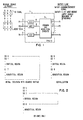
- FIG. 1 there is shown the plurality of asynchronous processors terminating in a BID resolution network. Also shown is an example "source alphabet" three bits wide defining the number sequences from 0 to 7. For purposes of this example, each processor may select a value from 0 to 7. The value 0 is the minimum of this set. Values 5 and 6 induces the network 3 to treat the receive signal as if it were 0 for comparison cycles subsequent to a cycle in which the value is the minimum of those most recently received. Each processor designated P-1, P-2 .. P-n transmits its three-bit wide bid signal to a translation component a(1), a(2), .. a(n). This component concatenates five extra bits.
- the first bit of the two-bit wide output is an acknowledgement signal.
- the second bit position is coded such that it is a 1 if and only if the most recent input among the well-ordered bidding set was a minimum, otherwise the second bit is a 0.
- the two-bit output is sent at the end of each of the n-way comparison device cycle to each procesor.
- the bidding signal 1 designating the id signal in FIG. 1 is translated by the network into n distinct signals corresponding to the n ports of the device. A different id being received for each port.
- the id signal is provided for contention resolution. It allows tie breaking when several processors simultaneously send the same signal and only one is supposed to receive the 1 bit at a time.
- the "reset to zero" signals are used to prevent critical race conditions. They provide a way to synchronize all processors at a minimum. If removed from this particular arrangement there would be no way to guarantee that processors were simultaneously in the state of having most recently sent 0. Without 'reset to 0', it would be difficult to invoke mutual exclusion by way of the id signal. There would be no way to ensure lockout avoidance.
- Each translation component a(i) represents logic which converts every value x except the value ONE into 32x. It tranforms the value ONE into 32° the port identity.
- the common BID resolution circuits/network 3 represent logic for an n-way comparison of 8-bit signals. Any one of a number of comparison ladder networks can implement such an n-way compare by way of a comparison tree. Reference may be made to Knuth, "The Art of Computer Programming", Vol. 3, Sorting and Searching, especially a comparison tree described at pp. 182-183 thereof. Such a tree would more particularly be interposed in the BID resolution circuits 39 of FIG. 3.
- network 3 is formed from n modules, an arbitrary one of which is laid out in FIG 3.
- each processor has embedded therein synchronizing primitives that bound critical sections of an executing instruction sequence utilizing a sharable, reusable resource.
- SS x is an instruction sending a bidding signal of value x to the comparator which waits until it receives an indication from the comparator that the bidding signal x is a minimum of the most recently received bidding signals.
- SB x y is an executable instruction which sends a bidding value x to the comparator and branches to an instruction at location y if the immediate response indicates that x is not the minimum of the most recently received signals.
- a special case of the instruction SB is the instruction S x.
- S x when executed, sends a bidding signal x and immediately branches to the next instruction irrespective of the external response.
- “scheduling” involves utilization by a processor of one of the following strategies; that of mutual exclusion with bounded waiting, priority synchronization, serialization, and do-once-only.
- mutual exclusion with bounded waiting is a method for preventing more than one of the asynchronous processors from acquiring a resource concurrently. It guarantees that no processor will be excluded from the resource indefinitely as long as each processor relinquishes the resource after a finite time.
- the critical region where a processor would be executing the instruction of the task utilizing the shared resource of interest is protected by embedding synchronous send instructions in the stream bounding said critical section.
- instructions SS 5 and SS 1 guard entry while S 7 represents a branch to a non-critical region.
- a loop assumes that a processor may be involved in rebidding several times.
- the instruction SS 5 represents the first phase of the bidding.
- the instruction SS 1 represents the second phase of bidding in which each processor reveals its port id. After a bid has been received from each processor in phase two, no 0 values will remain in the bidding and the processors in phase two will enter the critical region by turns in order of increasing id.
- the instruction S 7 represents the release of the resource or exit from the critical region. Receipt by the comparison logic of 7 from the current winner, allows another processor in phase two to take its place as the winner, or, in case no processors remain in phase two, allows the completion of phase one for any processors waiting there.
- the object of serialization is to weakly synchronize the processors and to ensure that only one processor at a time enters the critical region utilizing a sharable, reusable resource.
- Serialization differs from mutual exclusion only in that the processors are weakly synchronized.
- a definition of "weak synchronization" is in order.
- the term "weak synchronization" among a plurality of concurrent asynchronous processors exists if tasks being executed by the processor can have synchronization points at which processors wait until all are synchronized otherwise execution proceeds asynchronously.
- the 'do-once-only' operation shown in FIG. 2 ensures that only one of the weakly synchronized processors may execute a task in a critical region.
- the SB 3 instruction provides an upper bound to critical region.
- the SS 6 instruction constitutes a lower bound to said region. Consequently, only one processor (the one with the highest prior id) may access the region and all other processors must bypass it.
- the actions of the n-way comparison and bid resolution arrangement 1 may be envisioned over five time intervals.
- a bid value is applied from processor Pi through receiver 5 and at time t5 multiplexer MUX 1 gates the path from receiver 5 into register 1.
- the contents of register 1 are circulated over the path 7 to the other input of MUX 1 into register 1.
- the contents of an older polling would be moved from register 1 to register 2.
- a new bid value is detected by way of a comparison circuit 11 ascertaining the match or mismatch conditions between register 1 and register 2 contents over paths 7 and 9, respectively. If there is a mismatch, then the latest value represents a different bid.
- a match is taken to mean that the processor bids the same value.
- a mismatch signal conditions AND gate 15 to enable the translation component 19 to append appropriate unique identification bits to the bid value. These are applied over path 21 from the translation component a(i) through MUX 3 into register 3. In the absence of a new value, the contents of register 3 are refreshed by way of a reentrant path over 41i through MUX 4 into the input 23 to MUX 3.
- Each of the bid values is applied from each of the n modules over an appropriate path from 41(1) .. 41(i).. 41(n) to bid resolution circuit 39. As previously mentioned, the minimum value from resolution circuit 39 is entered into register 6 and broadcast simultaneously to each comparison -circuit of each module.
Landscapes
- Engineering & Computer Science (AREA)
- Software Systems (AREA)
- Theoretical Computer Science (AREA)
- Physics & Mathematics (AREA)
- General Engineering & Computer Science (AREA)
- General Physics & Mathematics (AREA)
- Multi Processors (AREA)
Claims (6)
dadurch gekennzeichnet, daß
Applications Claiming Priority (2)
| Application Number | Priority Date | Filing Date | Title |
|---|---|---|---|
| US315568 | 1981-10-27 | ||
| US06/315,568 US4445197A (en) | 1981-10-27 | 1981-10-27 | Weak synchronization and scheduling among concurrent asynchronous processors |
Publications (3)
| Publication Number | Publication Date |
|---|---|
| EP0078377A2 EP0078377A2 (de) | 1983-05-11 |
| EP0078377A3 EP0078377A3 (en) | 1984-06-06 |
| EP0078377B1 true EP0078377B1 (de) | 1986-12-30 |
Family
ID=23225037
Family Applications (1)
| Application Number | Title | Priority Date | Filing Date |
|---|---|---|---|
| EP82108072A Expired EP0078377B1 (de) | 1981-10-27 | 1982-09-02 | Quellenzugriffskontrolle in einem Mehrprozessorsystem zur simultanen Verarbeitung mehrerer Programme |
Country Status (4)
| Country | Link |
|---|---|
| US (1) | US4445197A (de) |
| EP (1) | EP0078377B1 (de) |
| JP (1) | JPS5876961A (de) |
| DE (1) | DE3274909D1 (de) |
Families Citing this family (22)
| Publication number | Priority date | Publication date | Assignee | Title |
|---|---|---|---|---|
| US4891749A (en) * | 1983-03-28 | 1990-01-02 | International Business Machines Corporation | Multiprocessor storage serialization apparatus |
| US4722048A (en) * | 1985-04-03 | 1988-01-26 | Honeywell Bull Inc. | Microcomputer system with independent operating systems |
| GB8510791D0 (en) * | 1985-04-29 | 1985-06-05 | Moller C H | Automatic computer peripheral switch |
| US5053941A (en) * | 1986-08-29 | 1991-10-01 | Sun Microsystems, Inc. | Asynchronous micro-machine/interface |
| US5025370A (en) * | 1986-09-02 | 1991-06-18 | Koegel Robert J | Circuit for preventing lock-out of high priority requests to a system controller |
| US4823304A (en) * | 1987-01-15 | 1989-04-18 | International Business Machines Incorporated | Method of providing synchronous message exchange in an asychronous operating environment |
| WO1989000734A1 (en) * | 1987-07-21 | 1989-01-26 | Stellar Computer Inc. | Detecting multiple processor deadlock |
| US5050070A (en) * | 1988-02-29 | 1991-09-17 | Convex Computer Corporation | Multi-processor computer system having self-allocating processors |
| US5159686A (en) * | 1988-02-29 | 1992-10-27 | Convex Computer Corporation | Multi-processor computer system having process-independent communication register addressing |
| GB2217064A (en) * | 1988-03-23 | 1989-10-18 | Benchmark Technologies | Interfacing asynchronous processors |
| WO1990001252A1 (en) * | 1988-08-03 | 1990-02-22 | Stellar Computer Inc. | Detecting multiple processor deadlock |
| US4985831A (en) * | 1988-10-31 | 1991-01-15 | Evans & Sutherland Computer Corp. | Multiprocessor task scheduling system |
| JPH04152465A (ja) * | 1990-10-16 | 1992-05-26 | Fujitsu Ltd | データ処理システム及びデータ処理方法 |
| US5317737A (en) * | 1991-07-29 | 1994-05-31 | Ncr Corporation | Method and apparatus for controlling a re-entrant synchronization lock tenure in a multiprocessor system |
| US6029188A (en) * | 1993-01-18 | 2000-02-22 | Institute For Personalized Information Environment | Information processing system for an architecture model capable of interfacing with humans and capable of being modified |
| JPH0887341A (ja) * | 1994-09-16 | 1996-04-02 | Fujitsu Ltd | 自動縮退立ち上げ機能を有したコンピュータシステム |
| CN101617354A (zh) | 2006-12-12 | 2009-12-30 | 埃文斯和萨瑟兰计算机公司 | 用于校准单个调制器投影仪中的rgb光的系统和方法 |
| US8358317B2 (en) | 2008-05-23 | 2013-01-22 | Evans & Sutherland Computer Corporation | System and method for displaying a planar image on a curved surface |
| US8702248B1 (en) | 2008-06-11 | 2014-04-22 | Evans & Sutherland Computer Corporation | Projection method for reducing interpixel gaps on a viewing surface |
| US8621471B2 (en) * | 2008-08-13 | 2013-12-31 | Microsoft Corporation | High accuracy timer in a multi-processor computing system without using dedicated hardware timer resources |
| US8077378B1 (en) | 2008-11-12 | 2011-12-13 | Evans & Sutherland Computer Corporation | Calibration system and method for light modulation device |
| US9641826B1 (en) | 2011-10-06 | 2017-05-02 | Evans & Sutherland Computer Corporation | System and method for displaying distant 3-D stereo on a dome surface |
Family Cites Families (11)
| Publication number | Priority date | Publication date | Assignee | Title |
|---|---|---|---|---|
| DE2546202A1 (de) * | 1975-10-15 | 1977-04-28 | Siemens Ag | Rechnersystem aus mehreren miteinander verbundenen und zusammenwirkenden einzelrechnern und verfahren zum betrieb des rechnersystems |
| US4096571A (en) * | 1976-09-08 | 1978-06-20 | Codex Corporation | System for resolving memory access conflicts among processors and minimizing processor waiting times for access to memory by comparing waiting times and breaking ties by an arbitrary priority ranking |
| US4050097A (en) * | 1976-09-27 | 1977-09-20 | Honeywell Information Systems, Inc. | Synchronization technique for data transfers over an asynchronous common bus network coupling data processing apparatus |
| US4141067A (en) * | 1977-06-13 | 1979-02-20 | General Automation | Multiprocessor system with cache memory |
| US4145739A (en) * | 1977-06-20 | 1979-03-20 | Wang Laboratories, Inc. | Distributed data processing system |
| US4223380A (en) * | 1978-04-06 | 1980-09-16 | Ncr Corporation | Distributed multiprocessor communication system |
| US4191997A (en) * | 1978-04-10 | 1980-03-04 | International Business Machines Corporation | Circuits and methods for multiple control in data processing systems |
| US4384322A (en) * | 1978-10-31 | 1983-05-17 | Honeywell Information Systems Inc. | Asynchronous multi-communication bus sequence |
| US4253144A (en) * | 1978-12-21 | 1981-02-24 | Burroughs Corporation | Multi-processor communication network |
| US4320457A (en) * | 1980-02-04 | 1982-03-16 | General Automation, Inc. | Communication bus acquisition circuit |
| US4374414A (en) * | 1980-06-26 | 1983-02-15 | Gte Automatic Electric Labs Inc. | Arbitration controller providing for access of a common resource by a duplex plurality of central processing units |
-
1981
- 1981-10-27 US US06/315,568 patent/US4445197A/en not_active Expired - Lifetime
-
1982
- 1982-09-02 DE DE8282108072T patent/DE3274909D1/de not_active Expired
- 1982-09-02 EP EP82108072A patent/EP0078377B1/de not_active Expired
- 1982-10-08 JP JP57176497A patent/JPS5876961A/ja active Granted
Non-Patent Citations (1)
| Title |
|---|
| Ford and Hamacher, "Hardware Support for Interprocess Communication and Processor Sharing", IEEE Third Annual Symposium on Computer Architecture, 1975, pp. 113-118 * |
Also Published As
| Publication number | Publication date |
|---|---|
| JPS5876961A (ja) | 1983-05-10 |
| US4445197A (en) | 1984-04-24 |
| JPS6122337B2 (de) | 1986-05-31 |
| EP0078377A2 (de) | 1983-05-11 |
| EP0078377A3 (en) | 1984-06-06 |
| DE3274909D1 (en) | 1987-02-05 |
Similar Documents
| Publication | Publication Date | Title |
|---|---|---|
| EP0078377B1 (de) | Quellenzugriffskontrolle in einem Mehrprozessorsystem zur simultanen Verarbeitung mehrerer Programme | |
| EP0218841B1 (de) | Sperrfreie Serialisierung von Zugriffen zu gemeinsamen Mitteln | |
| US4318182A (en) | Deadlock detection and prevention mechanism for a computer system | |
| US4394727A (en) | Multi-processor task dispatching apparatus | |
| US3528062A (en) | Program interlock arrangement,including task suspension and new task assignment | |
| US6697834B1 (en) | Mutual exculsion system and method for restarting critical sections of code when preempted during a critical section | |
| CN104168217B (zh) | 一种先入先出队列调度方法及装置 | |
| US3683418A (en) | Method of protecting data in a multiprocessor computer system | |
| JPS58142458A (ja) | 共通母線利用検出制御回路及び共通母線利用検出制御方法 | |
| JPH06223042A (ja) | マルチプロセッサ・システムにおいて割込みを管理するための装置及び方法 | |
| JPS6357822B2 (de) | ||
| JPS62214464A (ja) | データ処理システム | |
| US7581222B2 (en) | Software barrier synchronization | |
| US20120030370A1 (en) | Administering Connection Identifiers For Collective Operations In A Parallel Computer | |
| US20180246773A1 (en) | Request of an mcs lock by guests | |
| EP2804102B1 (de) | Parallele atomare Inkrementierung | |
| CN112306703B (zh) | 一种numa系统中的临界区执行方法及装置 | |
| CA2151673C (en) | Parallel processing system with a plurality of communication register modules | |
| KR940011041B1 (ko) | 마이크로컴퓨터 | |
| HK1202952A1 (en) | A computing system and a method for operating a lock in the computing system | |
| JPS5840215B2 (ja) | システム同期方式 | |
| Raghunathan | Extending inter-process synchronization with robust mutex and variants in condition wait | |
| JPH04355836A (ja) | 仮想計算機間データ転送処理装置 | |
| JPH03116260A (ja) | マルチプロセッサシステムにおけるスピンロック方式 | |
| JPH03138751A (ja) | 資源管理方法 |
Legal Events
| Date | Code | Title | Description |
|---|---|---|---|
| PUAI | Public reference made under article 153(3) epc to a published international application that has entered the european phase |
Free format text: ORIGINAL CODE: 0009012 |
|
| AK | Designated contracting states |
Designated state(s): DE FR GB |
|
| 17P | Request for examination filed |
Effective date: 19830823 |
|
| PUAL | Search report despatched |
Free format text: ORIGINAL CODE: 0009013 |
|
| AK | Designated contracting states |
Designated state(s): DE FR GB |
|
| GRAA | (expected) grant |
Free format text: ORIGINAL CODE: 0009210 |
|
| AK | Designated contracting states |
Kind code of ref document: B1 Designated state(s): DE FR GB |
|
| ET | Fr: translation filed | ||
| REF | Corresponds to: |
Ref document number: 3274909 Country of ref document: DE Date of ref document: 19870205 |
|
| PLBE | No opposition filed within time limit |
Free format text: ORIGINAL CODE: 0009261 |
|
| STAA | Information on the status of an ep patent application or granted ep patent |
Free format text: STATUS: NO OPPOSITION FILED WITHIN TIME LIMIT |
|
| 26N | No opposition filed | ||
| PGFP | Annual fee paid to national office [announced via postgrant information from national office to epo] |
Ref country code: GB Payment date: 19910823 Year of fee payment: 10 |
|
| PGFP | Annual fee paid to national office [announced via postgrant information from national office to epo] |
Ref country code: FR Payment date: 19910903 Year of fee payment: 10 |
|
| PGFP | Annual fee paid to national office [announced via postgrant information from national office to epo] |
Ref country code: DE Payment date: 19910926 Year of fee payment: 10 |
|
| PG25 | Lapsed in a contracting state [announced via postgrant information from national office to epo] |
Ref country code: GB Effective date: 19920902 |
|
| GBPC | Gb: european patent ceased through non-payment of renewal fee |
Effective date: 19920902 |
|
| PG25 | Lapsed in a contracting state [announced via postgrant information from national office to epo] |
Ref country code: FR Effective date: 19930528 |
|
| PG25 | Lapsed in a contracting state [announced via postgrant information from national office to epo] |
Ref country code: DE Effective date: 19930602 |
|
| REG | Reference to a national code |
Ref country code: FR Ref legal event code: ST |