EP0077287B1 - Method for increasing the digestibility of cellulose-containing animal feedstuffs - Google Patents
Method for increasing the digestibility of cellulose-containing animal feedstuffs Download PDFInfo
- Publication number
- EP0077287B1 EP0077287B1 EP82630094A EP82630094A EP0077287B1 EP 0077287 B1 EP0077287 B1 EP 0077287B1 EP 82630094 A EP82630094 A EP 82630094A EP 82630094 A EP82630094 A EP 82630094A EP 0077287 B1 EP0077287 B1 EP 0077287B1
- Authority
- EP
- European Patent Office
- Prior art keywords
- cellulose
- ammonia
- containing material
- pressure
- alfalfa
- Prior art date
- Legal status (The legal status is an assumption and is not a legal conclusion. Google has not performed a legal analysis and makes no representation as to the accuracy of the status listed.)
- Expired
Links
Images
Classifications
-
- C—CHEMISTRY; METALLURGY
- C08—ORGANIC MACROMOLECULAR COMPOUNDS; THEIR PREPARATION OR CHEMICAL WORKING-UP; COMPOSITIONS BASED THEREON
- C08B—POLYSACCHARIDES; DERIVATIVES THEREOF
- C08B1/00—Preparatory treatment of cellulose for making derivatives thereof, e.g. pre-treatment, pre-soaking, activation
-
- A—HUMAN NECESSITIES
- A23—FOODS OR FOODSTUFFS; TREATMENT THEREOF, NOT COVERED BY OTHER CLASSES
- A23K—FODDER
- A23K10/00—Animal feeding-stuffs
- A23K10/30—Animal feeding-stuffs from material of plant origin, e.g. roots, seeds or hay; from material of fungal origin, e.g. mushrooms
-
- Y—GENERAL TAGGING OF NEW TECHNOLOGICAL DEVELOPMENTS; GENERAL TAGGING OF CROSS-SECTIONAL TECHNOLOGIES SPANNING OVER SEVERAL SECTIONS OF THE IPC; TECHNICAL SUBJECTS COVERED BY FORMER USPC CROSS-REFERENCE ART COLLECTIONS [XRACs] AND DIGESTS
- Y10—TECHNICAL SUBJECTS COVERED BY FORMER USPC
- Y10S—TECHNICAL SUBJECTS COVERED BY FORMER USPC CROSS-REFERENCE ART COLLECTIONS [XRACs] AND DIGESTS
- Y10S426/00—Food or edible material: processes, compositions, and products
- Y10S426/807—Poultry or ruminant feed
Definitions
- the present invention concerns a method of treating a cellulose-containing animal feedstuff to increase its digestibility comprising the steps of contacting the cellulose-containing material at low temperature and pressure higher than atmospheric with a volatile liquid cellulose swelling agent having a vapor pressure greater than atmospheric at ambient temperature and thereafter reducing the pressure to atmospheric at a rate such as to cause the swelling agent to boil and explode the fiber structure of the material. More particularly the invention relates to a method for increasing the digestibility of cellulose-containing feedstuffs, such as alfalfa hay, wheat straw, wood fibers and corn stover, by ruminant animals. The invention further relates to a method for increasing the extractability of components such as protein from plant materials.
- the US-A-3 707 436 discloses a process of manufacturing pulp including impregnating a mass of lignocellulosic chips with anhydrous ammonia, heating the chips within a closed space under pressure and suddenly releasing the pressure to cause an explosive removal of ammonia with accompanying deformation and disintegration of the chips to a fibrous condition.
- the method according to the present invention is characterized in that said contacting of said cellulose-containing material with said volatile liquid cellulose swelling agent is carried out at ambient temperature for a period of time sufficient for the swelling agent to swell the cellulose.
- the invention comprises treating cellulose-containing materials, such as alfalfa, wheat straw, corn stover, wood fibers, etc., with a volatile chemical agent at ambient temperatures under the vapor pressure of the agent, followed by the rapid release of pressure with concomitant explosive rupture of the plant material.
- a volatile chemical agent is liquid ammonia, which boils at -33,4°C, and has a vapor pressure of 8.46 atm. at 20°C.
- Liquid ammonia is well known to swell and decrystallize pure cellulose.
- Other volatile cellulose-swelling agents are monomethylamine, monoethylamine, other primary and secondary amines, liquid nitrogen dioxide, liquid sulfur dioxide, and the like.
- the present invention may be illustrated by the use of liquid ammonia in treating sun-dried alfalfa (7 percent moisture).
- About 0.450 kg of sun-dried alfalfa ground to pass a 1 mm screen is treated, in a pressure vessel, with about 0.450 kg or less of liquid ammonia under a pressure of about 1.137 MPa and a temperature of about 25°C.
- a gate valve on the pressure vessel containing the ammonia is opened and a portion of the ammonia (about 20 percent or so) evaporates rapidly. Reduction to atmospheric pressure within the vessel takes place in several seconds.
- the pressure release allows the ammonia to "boil” within the alfalfa, thereby puffing, exploding or expanding the structure of the alfalfa. Since ammonia "boils” at about -33.4°C at atmospheric pressure, this treatment has the additional effect of freezing the alfalfa, thereby disrupting the plant material and further promoting the reactivity and ease of removal from the alfalfa of cell constituents such as protein.
- the cellulose decrystallizing or swelling reaction caused by ammonia is favored at reduced temperature so the -33°C temperature potentially allows the remainder of the ammonia, which was not immediately evaporated, to react even more extensively with the cellulose component of alfalfa to help further increase the chemical and biochemical reactivity of such cellulose.
- the liquid ammonia treatment further causes a decrease in the total amount of lignin in the alfalfa as measured by standard techniques. Lignin is known to inhibit the chemical and biochemical reactivity of cellulose.
- Table 1 shows a forage fiber analysis of treated and untreated alfalfa and Table 2 shows the effect of treatment conditions or cellulosic digestibility. Samples 8, 9 and 10 were ammonia-treated under various conditions.
- a pressure of about 1.241 MPa, an ammonia to alfalfa weight ratio of one-to-one, and a treatment time of about one half hour or less appears to be sufficient to give a highly digestible cellulose structure, as measured by soluble glucose produced by cellulose enzymes.
- the treatment is applicable to other cellulose-containing plant materials such as wheat straw, corn stover and wood.
- the preferred agent is liquid ammonia
- other volatile cellulose swelling agents such as monomethyl- and monoethylamine, nitrogen dioxide and sulfur dioxide may also be used.
- the heat of vaporization of the volatile agent is used to lower the temperature of the ligno-cellulosic material so that more favorable conditions exist for cellulose decrystallization.
- pressure release helps disrupt the structure of the lignocellulosic material as the volatile agent evaporates, and the freezing which may result, depending on the particular volatile agent chosen, further disrupts the structure of the lignocellulosic material.
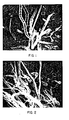
- Fig. 1 shows untreated alfalfa, ground to pass a 1.0 mm screen. Following treatment according to the present invention with liquid.ammonia, the alfalfa shows an expanded structure with more exposed fibers. The alfalfa seems to split longitudinally along its fiber axis.
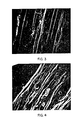
- Fig. 3 shows further untreated alfalfa, while Fig. 4 shows in more detail the longitudinal splits which occur in the fibers as a result of treatment according to the invention.
- the characteristics of the treated alfalfa are apparent from Figs. 2 and 4.
- the treated alfalfa is characterized by a large number of exposed fibers which often assume a thread-like appearance. The swelling and subsequent expansion seems to tear much of the plant tissue to pieces. This helps increase the surface area of the plant fibers for microbial attack and enzymatic or other reactions. This increase in surface area is shown by a 50% increase in the water holding capacity of alfalfa after ammonia treatment.
- the moisture content of the alfalfa also seems to contribute to the effectiveness of the process. This may be attributed at least in part of the freezing effect occurring upon the expansion of the ammonia impregnated fibers. See Table 6.
- the treatment of cellulose-containing materials with volatile swelling agents, preferably liquid anhydrous ammonia, to increase the reactivity of cellulose and the accessibility of the fiber has a number of advantages over the prior art.
- the treatment is relatively inexpensive.
- the ammonia-treated material is stable as regards its improved digestibility for long periods of time under practical conditions.
- the cellulose is left in a highly reactive form which may be more completely converted to monomeric sugars by either acid or enzyme hydrolysis or by microbial action in ruminant animals such as cattle. Since the low digestibility of cellulose in forages such as alfalfa, or in straws such as wheat straw, is the primary limitation in the use of such cellulose-containing materials as energy sources for ruminant animals, such increases in digestibility or reactivity of cellulose are extremely important.
- the present invention affords a new approach to animal feeding based on inexpensive ligno-cellulosic materials.
- One particularly attractive possibility involves a separation of alfalfa into its leaf and stem fractions.
- the leaf fraction contains a high protein content and a low fiber content so that it is especially valuable as a feed for non-ruminant animals such as hogs, poultry, etc. Since the protein is concentrated in the leaf fraction, it is somewhat more valuable than is the initial unseparated alfalfa.
- the remaining stem fraction which contains most of the cellulose present in the unseparated material, can be treated with liquid ammonia to greatly increase its cellulose digestibility while leaving behind a significant quantity of ammonia (about 1 % or so by weight of the fiber) to serve as a nitrogen source in the rumen. Therefore, ammonia-treated alfalfa stems would be greatly improved both as sources of nitrogen and digestible energy for ruminant animals.
- the treated stems or other cellulosic materials could be hydrolyzed to soluble sugars which could then be fermented to a variety of products including ethanol, or used in other reactions of importance.
- the structure of the material is expanded and disrupted by the rapid pressure release so as to increase the extractability of valuable plant components such as protein and the accessibility of all reactive agents to the fiber, and other plant components.
- the disruption of the plant material is shown by the decrease in bulk alfalfa density from 0.29 gm/cm 3 before treatment to about 0.18 gm/cm 3 after the ammonia treatment.
- the freezing caused by the evaporation of ammonia further increases the reactivity of the cellulose and increases the extractability of the protein by rupturing many plant cells. Freezing could also increase the general disruption of the plant material by embrittling the material and making it more easily shattered by the rapidly expanding gases. Since no high temperatures are used, degradation products of decreased value are not likely to be formed nor are inhibitors of fermentation likely formed.
- ammonia Since the ammonia is volatile, it can be readily recovered from the alfalfa by applying only waste heat of essentially zero value. The recompression of ammonia is simple and relatively inexpensive. Also, no third agent such as water need be added to remove the ammonia as is necessary with many of the other chemical agents which increase cellulose reactivity. This prevents cellulose recrystallization caused by the presence of water, which reduces the reactivity of the cellulose. Furthermore, the treated cellulosic material is left dry and in a stable state in which the increased reactivity is maintained over many weeks. Therefore, such treated material could conceivably be shipped or stored for significant periods of time without losing the effect of the treatment. By comparison, cellulosic materials treated by other chemical agents which would have to be removed by washing would probably require drying for transport and storage. This of course further increases the expense and inconvenience of such alternative treatments.
- ammonia is not toxic nor carcinogenic as are many of the chemical treatment agents for cellulose. Liquid ammonia exerts a strong antimicrobial action, which reduces the total microbial load of the treated cellulosic material. This may permit little or no sterilization of cellulosic feeds to fermentation processes, a potential cost savings.
- ammonia treatment also appears to actually increase the amount of cellulose measurable in the alfalfa by standard techniques.
- the removal of lignin and the disruption of the fiber seem to "uncover" cellulose which was not previously measurable. This could further increase the amount of cellulose in the fiber which is available for reaction.
- Cellulose is treated to increase its chemical and biological reactivity by contacting cellulose or cellulose-containing materials in a pressure vessel with liquid ammonia in the weight ratio of about one to one respectively at ambient temperature, and under the vapor pressure of liquid ammonia at said ambient temperature.
- the mixture is stirred for a period of time sufficient for the ammonia to wet and swell the cellulose or cellulose-containing material.
- the pressure is then rapidly reduced to atmospheric, allowing the ammonia to boil.
- Contact of the material with the ammonia is maintained at the boiling point of the ammonia, which essentially freezes the cellulose-containing material.
- the treated material is separated from the liquid and gaseous ammonia which is recovered for recycling.
Landscapes
- Chemical & Material Sciences (AREA)
- Life Sciences & Earth Sciences (AREA)
- Engineering & Computer Science (AREA)
- Polymers & Plastics (AREA)
- Health & Medical Sciences (AREA)
- Molecular Biology (AREA)
- Physiology (AREA)
- Medicinal Chemistry (AREA)
- Materials Engineering (AREA)
- Organic Chemistry (AREA)
- Biotechnology (AREA)
- Botany (AREA)
- Biochemistry (AREA)
- Mycology (AREA)
- Chemical Kinetics & Catalysis (AREA)
- Animal Husbandry (AREA)
- Zoology (AREA)
- Food Science & Technology (AREA)
- Polysaccharides And Polysaccharide Derivatives (AREA)
- Fodder In General (AREA)
- Feed For Specific Animals (AREA)
- Chemical Or Physical Treatment Of Fibers (AREA)
- Paper (AREA)
- Processing Of Solid Wastes (AREA)
- Immobilizing And Processing Of Enzymes And Microorganisms (AREA)
Priority Applications (1)
| Application Number | Priority Date | Filing Date | Title |
|---|---|---|---|
| AT82630094T ATE34990T1 (de) | 1981-10-14 | 1982-10-06 | Verfahren zur erhoehung der verdaulichkeit von cellulosehaltigen futtern. |
Applications Claiming Priority (2)
| Application Number | Priority Date | Filing Date | Title |
|---|---|---|---|
| US06/311,168 US4600590A (en) | 1981-10-14 | 1981-10-14 | Method for increasing the reactivity and digestibility of cellulose with ammonia |
| US311168 | 1981-10-14 |
Publications (3)
| Publication Number | Publication Date |
|---|---|
| EP0077287A2 EP0077287A2 (en) | 1983-04-20 |
| EP0077287A3 EP0077287A3 (en) | 1984-07-18 |
| EP0077287B1 true EP0077287B1 (en) | 1988-06-08 |
Family
ID=23205704
Family Applications (1)
| Application Number | Title | Priority Date | Filing Date |
|---|---|---|---|
| EP82630094A Expired EP0077287B1 (en) | 1981-10-14 | 1982-10-06 | Method for increasing the digestibility of cellulose-containing animal feedstuffs |
Country Status (12)
| Country | Link |
|---|---|
| US (1) | US4600590A (OSRAM) |
| EP (1) | EP0077287B1 (OSRAM) |
| JP (1) | JPS5879001A (OSRAM) |
| AT (1) | ATE34990T1 (OSRAM) |
| AU (1) | AU555217B2 (OSRAM) |
| BG (1) | BG45217A3 (OSRAM) |
| BR (1) | BR8205849A (OSRAM) |
| CA (1) | CA1240671A (OSRAM) |
| DE (1) | DE3278635D1 (OSRAM) |
| MX (1) | MX164803B (OSRAM) |
| NZ (1) | NZ202057A (OSRAM) |
| ZA (1) | ZA827241B (OSRAM) |
Cited By (1)
| Publication number | Priority date | Publication date | Assignee | Title |
|---|---|---|---|---|
| US6176176B1 (en) | 1998-04-30 | 2001-01-23 | Board Of Trustees Operating Michigan State University | Apparatus for treating cellulosic materials |
Families Citing this family (113)
| Publication number | Priority date | Publication date | Assignee | Title |
|---|---|---|---|---|
| US4644060A (en) * | 1985-05-21 | 1987-02-17 | E. I. Du Pont De Nemours And Company | Supercritical ammonia treatment of lignocellulosic materials |
| US5026571A (en) * | 1990-02-08 | 1991-06-25 | Her Majesty The Queen In Right Of Canada As Represented By The Minister Of Agriculture | Chemically treating forage |
| WO1991013099A1 (en) * | 1990-03-02 | 1991-09-05 | Afex Corporation | Biomass refining process |
| US5370999A (en) * | 1992-12-17 | 1994-12-06 | Colorado State University Research Foundation | Treatment of fibrous lignocellulosic biomass by high shear forces in a turbulent couette flow to make the biomass more susceptible to hydrolysis |
| DE4329937C1 (de) * | 1993-09-04 | 1994-11-24 | Rhodia Ag Rhone Poulenc | Verfahren zur Behandlung von Cellulose zu deren Aktivierung für nachfolgende chemische Reaktionen |
| DE59602248D1 (de) * | 1995-03-25 | 1999-07-22 | Rhodia Acetow Ag | Verfahren zur aktivierung von polysacchariden, danach hergestellte polysaccharide und deren verwendung |
| DK96595A (da) * | 1995-08-30 | 1997-03-01 | Bio Ethanol A S | Fremgangsmåde til oplukning af celluloseholdig biomasse ved behandling af materialer med en flygtig base |
| DE19628277C2 (de) * | 1996-07-12 | 1998-07-09 | Rhodia Ag Rhone Poulenc | Verfahren zur Aktivierung eines Cellulose und Harnstoff enthaltenden Gemisches, aktiviertes Cellulose und Harnstoff enthaltendes Gemisch und Verwendung des aktivierten Gemisches zur Herstellung von Cellulosecarbamat |
| DE19742692A1 (de) * | 1997-09-26 | 1999-04-01 | Rhodia Acetow Ag | Verfahren zur Aktivierung von Polysacchariden |
| US6548659B1 (en) * | 2001-01-31 | 2003-04-15 | The Board Of Supervisors Of Louisiana State University & Agricultural & Mechanical College | Process for ammoniating cellulosic materials |
| EP1737550B1 (en) | 2004-04-13 | 2016-03-09 | Iogen Energy Corporation | Recovery of inorganic salt during processing of lignocellulosic feedstocks |
| CA2666100A1 (en) * | 2005-10-11 | 2007-04-19 | Earnest Stuart | Device and method for treating biomass |
| WO2007089677A2 (en) * | 2006-01-27 | 2007-08-09 | University Of Massachusetts | Systems and methods for producing biofuels and related materials |
| EP2826869A1 (en) | 2006-05-01 | 2015-01-21 | Board of Trustees of Michigan State University | Process for the treatment of lignocellulosic biomass |
| US9206446B2 (en) | 2006-05-01 | 2015-12-08 | Board Of Trustees Of Michigan State University | Extraction of solubles from plant biomass for use as microbial growth stimulant and methods related thereto |
| US20110201091A1 (en) * | 2007-08-29 | 2011-08-18 | Board Of Trustees Of Michigan State University | Production of microbial growth stimulant with ammonia fiber explosion (AFEX) pretreatment and cellulose hydrolysis |
| WO2008020901A2 (en) * | 2006-05-01 | 2008-02-21 | Michigan State University | Separation of proteins from grasses integrated with ammonia fiber explosion (afex) pretreatment and cellulose hydrolysis |
| US8968515B2 (en) * | 2006-05-01 | 2015-03-03 | Board Of Trustees Of Michigan State University | Methods for pretreating biomass |
| US20070287795A1 (en) * | 2006-06-08 | 2007-12-13 | Board Of Trustees Of Michigan State University | Composite materials from corncob granules and process for preparation |
| US7666637B2 (en) * | 2006-09-05 | 2010-02-23 | Xuan Nghinh Nguyen | Integrated process for separation of lignocellulosic components to fermentable sugars for production of ethanol and chemicals |
| US9499635B2 (en) | 2006-10-13 | 2016-11-22 | Sweetwater Energy, Inc. | Integrated wood processing and sugar production |
| US8323923B1 (en) | 2006-10-13 | 2012-12-04 | Sweetwater Energy, Inc. | Method and system for producing ethanol |
| US7670813B2 (en) * | 2006-10-25 | 2010-03-02 | Iogen Energy Corporation | Inorganic salt recovery during processing of lignocellulosic feedstocks |
| CA2670096A1 (en) * | 2006-11-21 | 2008-05-29 | The Samuel Roberts Noble Foundation, Inc. | Biofuel production methods and compositions |
| US8247200B2 (en) * | 2007-01-25 | 2012-08-21 | Iogen Energy Corporation | Method of obtaining inorganic salt and acetate salt from cellulosic biomass |
| US20080220125A1 (en) * | 2007-03-05 | 2008-09-11 | Charles Abbas | Method of Preparing More Digestible Animal Feed |
| AU2008242769B2 (en) * | 2007-04-19 | 2013-10-17 | Mascoma Corporation | Combined thermochemical pretreatment and refining of lignocellulosic biomass |
| WO2008137639A1 (en) * | 2007-05-02 | 2008-11-13 | Mascoma Corporation | Two-stage method for pretreatment of lignocellulosic biomass |
| US20080277082A1 (en) * | 2007-05-07 | 2008-11-13 | Andritz Inc. | High pressure compressor and steam explosion pulping method |
| US20090011474A1 (en) * | 2007-06-20 | 2009-01-08 | Board Of Trustees Of Michigan State University | Process for producing sugars from cellulosic biomass |
| US20090042259A1 (en) * | 2007-08-09 | 2009-02-12 | Board Of Trustees Of Michigan State University | Process for enzymatically converting a plant biomass |
| US20090053771A1 (en) * | 2007-08-22 | 2009-02-26 | Board Of Trustees Of Michigan State University | Process for making fuels and chemicals from AFEX-treated whole grain or whole plants |
| AU2008291588A1 (en) | 2007-08-27 | 2009-03-05 | Iogen Energy Corporation | Method for the production of a fermentation product from a pretreated lignocellulosic feedstock |
| US8093019B2 (en) * | 2007-08-30 | 2012-01-10 | Iogen Energy Corporation | Method for cellulase production |
| US8367378B2 (en) * | 2007-10-03 | 2013-02-05 | Board Of Trustees Of Michigan State University | Process for producing sugars and ethanol using corn stillage |
| US20110020884A1 (en) * | 2008-02-27 | 2011-01-27 | William Greg Latouf | Method for the conversion of plant materials into fuels and chemicals by sequential action of two microorganisms |
| US20090286294A1 (en) * | 2008-04-04 | 2009-11-19 | University Of Massachusetts | Methods and Compositions for Improving the Production of Fuels in Microorganisms |
| RU2649370C2 (ru) * | 2008-04-30 | 2018-04-02 | Ксилеко, Инк. | Переработка биомассы |
| US20110111473A1 (en) * | 2008-05-09 | 2011-05-12 | University Of Georgia Research Foundation, Inc | Yeast cells and methods for increasing ethanol production |
| WO2009143481A1 (en) | 2008-05-23 | 2009-11-26 | University Of Georgia Research Foundation, Inc. | Paenibacillus ssp. and methods for fermentation of lignocellulosic materials |
| US20100105114A1 (en) * | 2008-06-11 | 2010-04-29 | University Of Massachusetts | Methods and Compositions for Regulating Sporulation |
| CA2638157C (en) * | 2008-07-24 | 2013-05-28 | Sunopta Bioprocess Inc. | Method and apparatus for conveying a cellulosic feedstock |
| CA2638150C (en) * | 2008-07-24 | 2012-03-27 | Sunopta Bioprocess Inc. | Method and apparatus for conveying a cellulosic feedstock |
| CA2638159C (en) * | 2008-07-24 | 2012-09-11 | Sunopta Bioprocess Inc. | Method and apparatus for treating a cellulosic feedstock |
| US9127325B2 (en) | 2008-07-24 | 2015-09-08 | Abengoa Bioenergy New Technologies, Llc. | Method and apparatus for treating a cellulosic feedstock |
| CA2638152C (en) * | 2008-07-24 | 2013-07-16 | Sunopta Bioprocess Inc. | Method and apparatus for treating a cellulosic feedstock |
| US8915644B2 (en) | 2008-07-24 | 2014-12-23 | Abengoa Bioenergy New Technologies, Llc. | Method and apparatus for conveying a cellulosic feedstock |
| CA2638160C (en) * | 2008-07-24 | 2015-02-17 | Sunopta Bioprocess Inc. | Method and apparatus for conveying a cellulosic feedstock |
| CA2650919C (en) * | 2009-01-23 | 2014-04-22 | Sunopta Bioprocess Inc. | Method and apparatus for conveying a cellulosic feedstock |
| CA2650913C (en) * | 2009-01-23 | 2013-10-15 | Sunopta Bioprocess Inc. | Method and apparatus for conveying a cellulosic feedstock |
| US20120094347A1 (en) | 2008-09-18 | 2012-04-19 | University Of Georgia Research Foundation, Inc. | Methods and compositions for degrading pectin |
| WO2010068637A1 (en) * | 2008-12-09 | 2010-06-17 | Jerry Wayne Horton | Ensiling biomass and multiple phase apparatus for hydrolyzation of ensiled biomass |
| BRPI1013167A2 (pt) | 2009-02-27 | 2015-10-06 | Iogen Energy Corp | enzimas celulases resistentes a lignina |
| US20100086981A1 (en) * | 2009-06-29 | 2010-04-08 | Qteros, Inc. | Compositions and methods for improved saccharification of biomass |
| US20110111456A1 (en) * | 2009-04-03 | 2011-05-12 | Xyleco, Inc. | Processing biomass |
| JP2012523852A (ja) * | 2009-04-20 | 2012-10-11 | クテロス, インコーポレイテッド | バイオマス発酵のための組成物および方法 |
| EP2933337A1 (en) | 2009-05-21 | 2015-10-21 | Board Of Trustees Of Michigan State University | Methods for pretreating biomass |
| CA2673134A1 (en) * | 2009-07-17 | 2011-01-17 | Murray J. Burke | Method and apparatus for the heat treatment of a cellulosic feedstock upstream of hydrolysis |
| US8945245B2 (en) | 2009-08-24 | 2015-02-03 | The Michigan Biotechnology Institute | Methods of hydrolyzing pretreated densified biomass particulates and systems related thereto |
| US20130244293A1 (en) * | 2009-08-24 | 2013-09-19 | Board Of Trustees Of Michingan State Unversity | Fractionated extractive products from plant biomass and methods of making and using same |
| PL2467532T3 (pl) | 2009-08-24 | 2014-11-28 | Abengoa Bioenergy New Tech Llc | Sposób wytwarzania etanolu i współproduktów z biomasy celulozowej |
| WO2011133571A2 (en) | 2010-04-19 | 2011-10-27 | Board Of Trustees Of Michigan State University | Digestible lignocellulosic biomass and extractives and methods for producing same |
| US8673031B2 (en) | 2009-08-24 | 2014-03-18 | Board Of Trustees Of Michigan State University | Pretreated densified biomass products |
| US10457810B2 (en) | 2009-08-24 | 2019-10-29 | Board Of Trustees Of Michigan State University | Densified biomass products containing pretreated biomass fibers |
| KR20110067992A (ko) * | 2009-12-15 | 2011-06-22 | 삼성전자주식회사 | 내부발열을 이용한 바이오매스의 전처리 방법 및 전처리 장치 |
| US20110183382A1 (en) * | 2009-12-15 | 2011-07-28 | Qteros, Inc. | Methods and compositions for producing chemical products from c. phytofermentans |
| BR112012020804A2 (pt) | 2010-02-11 | 2015-09-15 | Iogen Energy Corp | módulos de ligação de carboidrato com ligação reduzida à lignina |
| WO2011116185A2 (en) | 2010-03-17 | 2011-09-22 | Board Of Trustees Of Michigan State University | Biofuel and electricity producing fuel cells and systems and methods related to same |
| US10074867B2 (en) | 2010-03-17 | 2018-09-11 | Board Of Trustees Of Michigan State University | Microbial electrochemical cells and methods for producing electricity and bioproducts therein |
| GB2478791A (en) * | 2010-03-19 | 2011-09-21 | Qteros Inc | Ethanol production by genetically-modified bacteria |
| EP2571993A1 (en) | 2010-05-19 | 2013-03-27 | The Samuel Roberts Noble Foundation, Inc. | Altered leaf morphology and enhanced agronomic properties in plants |
| US8651403B2 (en) * | 2010-07-21 | 2014-02-18 | E I Du Pont De Nemours And Company | Anhydrous ammonia treatment for improved milling of biomass |
| US9493802B2 (en) | 2010-08-20 | 2016-11-15 | Codexis, Inc. | Use of glycohydrolase 61 protein variants with improved thermostability for processing cellulose |
| JP2012080818A (ja) * | 2010-10-12 | 2012-04-26 | Idemitsu Kosan Co Ltd | 固体バイオマスの糖化前処理方法、その装置、および、固体バイオマスの糖化方法 |
| US9068235B2 (en) | 2010-11-02 | 2015-06-30 | Codexis, Inc. | Fungal strains |
| US20130344541A1 (en) | 2010-11-02 | 2013-12-26 | Codexis, Inc. | Compositions and methods for production of fermentable sugars |
| US9045549B2 (en) | 2010-11-03 | 2015-06-02 | The Samuel Roberts Noble Foundation, Inc. | Transcription factors for modification of lignin content in plants |
| RU2618470C2 (ru) * | 2010-12-16 | 2017-05-03 | Реййо К. САЛМИНЕН | Способ и устройство для расщепления целлюлозных волокон, способ обработки волокнистой массы при производстве бумаги, способ высушивания бумаги и бумажный продукт, содержащий расщепленные волокна |
| WO2012131665A1 (en) | 2011-04-01 | 2012-10-04 | University Of Limerick | Lignocellulose processing |
| US9347074B1 (en) | 2011-04-07 | 2016-05-24 | Dennis Anthony Burke | Biomass pretreatment with ammonium bicarbonate / carbonate expansion process |
| US8901371B2 (en) | 2011-05-06 | 2014-12-02 | The Samuel Roberts Noble Foundation, Inc. | Compositions and methods for improved plant feedstock |
| US8926794B2 (en) | 2011-07-07 | 2015-01-06 | Tate & Lyle Ingredients Americas Llc | Process of extraction of hemicellulose from corn fiber |
| EP2748317B1 (en) | 2011-08-22 | 2017-04-19 | Codexis, Inc. | Gh61 glycoside hydrolase protein variants and cofactors that enhance gh61 activity |
| US20130084608A1 (en) | 2011-09-30 | 2013-04-04 | Codexis, Inc. | Fungal proteases |
| EP2794871A4 (en) | 2011-12-20 | 2015-12-30 | Codexis Inc | VARIANTS OF ENDOGLUCANASE-1B (EG1B) |
| EP2794893A4 (en) | 2011-12-20 | 2015-08-12 | Codexis Inc | PRODUCTION OF SATURATED FATTY ALCOHOLS FROM GENETICALLY MODIFIED MICROORGANISMS |
| JP2013143918A (ja) * | 2012-01-13 | 2013-07-25 | Jx Nippon Oil & Energy Corp | 酵素糖化用原料の製造方法、糖の製造方法、並びにエタノールの製造方法 |
| US8765430B2 (en) | 2012-02-10 | 2014-07-01 | Sweetwater Energy, Inc. | Enhancing fermentation of starch- and sugar-based feedstocks |
| US10202660B2 (en) | 2012-03-02 | 2019-02-12 | Board Of Trustees Of Michigan State University | Methods for increasing sugar yield with size-adjusted lignocellulosic biomass particles |
| ES2703631T3 (es) | 2012-04-13 | 2019-03-11 | Sweetwater Energy Inc | Procedimientos y sistemas para la sacarificación de biomasa |
| US8563277B1 (en) | 2012-04-13 | 2013-10-22 | Sweetwater Energy, Inc. | Methods and systems for saccharification of biomass |
| WO2013159055A1 (en) | 2012-04-20 | 2013-10-24 | Codexis, Inc. | Production of fatty alcohols from engineered microorganisms |
| CA2870758C (en) | 2012-04-27 | 2018-01-16 | The Michigan Biotechnology Institute D/B/A Mbi | Methods of hydrolyzing pretreated densified biomass particulates and systems related thereto |
| DK2859099T3 (da) | 2012-06-11 | 2019-07-29 | Codexis Inc | Svampe-beta-xylosidase-varianter |
| US9650655B2 (en) | 2012-07-20 | 2017-05-16 | Codexis, Inc. | Production of fatty alcohols from engineered microorganisms |
| FI20126168A7 (fi) * | 2012-11-07 | 2014-05-08 | Metsae Fibre Oy | Menetelmä sellupitoisten kuitujen avaamiseksi |
| WO2014093070A1 (en) | 2012-12-14 | 2014-06-19 | Codexis, Inc. | Modified native beta-ketoacyl-acp synthases and engineered microorganisms |
| US9809867B2 (en) | 2013-03-15 | 2017-11-07 | Sweetwater Energy, Inc. | Carbon purification of concentrated sugar streams derived from pretreated biomass |
| US9593447B2 (en) | 2013-08-20 | 2017-03-14 | Biomass Energy Enhancements, Llc | System and method using a reaction chamber to beneficiate organic-carbon-containing feedstock for downstream processes |
| US20150052812A1 (en) | 2013-08-20 | 2015-02-26 | Philip James Scalzo | Oxygen-Deficient Thermally Produced Processed Biogas from Beneficiated Organic-Carbon-Containing Feedstock |
| US10018355B2 (en) | 2014-06-16 | 2018-07-10 | CTP Biotechnology, LLC | System and process for combusting coal and beneficiated organic-carbon-containing feedstock |
| US10024533B2 (en) | 2014-06-16 | 2018-07-17 | Ctp Biotechnology Llc | System and process for combusting cleaned coal and beneficiated organic-carbon-containing feedstock |
| US9702548B2 (en) | 2014-06-16 | 2017-07-11 | Biomass Energy Enhancements, Llc | System for co-firing cleaned coal and beneficiated organic-carbon-containing feedstock in a coal combustion apparatus |
| US9683738B2 (en) | 2014-06-16 | 2017-06-20 | Biomass Energy Enhancements, Llc | System for co-firing coal and beneficiated organic-carbon-containing feedstock in a coal combustion apparatus |
| US9701918B2 (en) | 2014-06-16 | 2017-07-11 | Biomass Energy Enhancements, Llc | System of using a reaction chamber to beneficiate organic-carbon-containing feedstock for downstream processes |
| US9796940B2 (en) | 2014-06-16 | 2017-10-24 | Biomass Energy Enhancements, Llc | Processed biomass pellets from organic-carbon-containing feedstock |
| SMT202200344T1 (it) | 2014-12-09 | 2022-09-14 | Sweetwater Energy Inc | Pretrattamento rapido |
| EP3471744A4 (en) | 2016-06-15 | 2020-07-29 | Codexis, Inc. | REVISED BETA-GLUCOSIDASES AND GLUCOSYLATION PROCESSES |
| WO2018106656A1 (en) | 2016-12-06 | 2018-06-14 | Danisco Us Inc | Truncated lpmo enzymes and use thereof |
| EP3583223A4 (en) | 2017-02-16 | 2020-12-23 | Sweetwater Energy, Inc. | HIGH PRESSURE ZONE TRAINING FOR PRETREATMENT |
| US10730958B2 (en) | 2017-03-08 | 2020-08-04 | Board Of Trustees Of Michigan State University | Pretreatment of densified biomass using liquid ammonia and systems and products related thereto |
| US11440999B2 (en) | 2017-07-07 | 2022-09-13 | Board Of Trustees Of Michigan State University | De-esterification of biomass prior to ammonia pretreatment |
| AU2020412611A1 (en) | 2019-12-22 | 2022-07-14 | Apalta Patents OÜ | Methods of making specialized lignin and lignin products from biomass |
Family Cites Families (14)
| Publication number | Priority date | Publication date | Assignee | Title |
|---|---|---|---|---|
| DE169880C (OSRAM) * | 1900-01-01 | |||
| US2270326A (en) * | 1932-01-30 | 1942-01-20 | North American Rayon Corp | Manufacture of reactive forms of cellulose and the like |
| US2580491A (en) * | 1950-08-08 | 1952-01-01 | Jr Kyle Ward | Reducing the crystallinity of native fibrous cellulosic material |
| US3282313A (en) * | 1964-11-24 | 1966-11-01 | Research Corp | Method of forming wood and formed wood product |
| US3667961A (en) * | 1967-09-22 | 1972-06-06 | Santa Ynez Research Farm | Process for improving digestibility of feedstuffs for ruminant animals |
| US3707436A (en) * | 1971-03-22 | 1972-12-26 | Kimberly Clark Co | Exploding of ammonia impregnated wood chips |
| US3939286A (en) * | 1973-01-29 | 1976-02-17 | Jelks James W | Process for oxidizing and hydrolyzing plant organic matter particles to increase the digestability thereof by ruminants |
| DE2310459A1 (de) * | 1973-03-02 | 1974-09-12 | Fritz Dr Opderbeck | Verfahren zum erzeugen von faserstoff aus pflanzlichem material |
| JPS5811881B2 (ja) * | 1975-07-22 | 1983-03-05 | ライオン株式会社 | リユウサンカセルロ−スノセイゾウホウ |
| JPS534085A (en) * | 1976-07-01 | 1978-01-14 | Eru Shii Hao Pooru | Process for preparing cellulosic substance of high azotic content |
| US4136207A (en) * | 1977-01-24 | 1979-01-23 | Stake Technology Ltd. | Method of treating lignocellulose materials to produce ruminant feed |
| NZ187047A (en) * | 1977-04-27 | 1981-03-16 | Commw Scient Ind Res Org | Explosive defibration of cellulosic plant material material passes through nozzle providing tortuous path for discharging material |
| US4235707A (en) * | 1979-04-09 | 1980-11-25 | Burke, Davoud & Associates | Method and apparatus for treating solid municipal refuse and other cellulose containing material |
| US4356196A (en) * | 1980-10-20 | 1982-10-26 | Hultquist Joe H | Process for treating alfalfa and other cellulosic agricultural crops |
-
1981
- 1981-10-14 US US06/311,168 patent/US4600590A/en not_active Expired - Lifetime
-
1982
- 1982-09-30 CA CA000412559A patent/CA1240671A/en not_active Expired
- 1982-10-01 ZA ZA827241A patent/ZA827241B/xx unknown
- 1982-10-01 NZ NZ202057A patent/NZ202057A/en unknown
- 1982-10-06 DE DE8282630094T patent/DE3278635D1/de not_active Expired
- 1982-10-06 EP EP82630094A patent/EP0077287B1/en not_active Expired
- 1982-10-06 BR BR8205849A patent/BR8205849A/pt not_active IP Right Cessation
- 1982-10-06 AT AT82630094T patent/ATE34990T1/de not_active IP Right Cessation
- 1982-10-13 AU AU89322/82A patent/AU555217B2/en not_active Expired
- 1982-10-13 JP JP57179690A patent/JPS5879001A/ja active Granted
- 1982-10-13 BG BG058282A patent/BG45217A3/xx unknown
- 1982-10-14 MX MX194786A patent/MX164803B/es unknown
Non-Patent Citations (13)
| Title |
|---|
| Adv. Chem. Series 181 (1979) 1-23 * |
| Adv. Chem. Series 95 (1969) 219-220 * |
| Appl. Microbiol. Biotechnol. 22 (1985) 416 * |
| Biotechn. + Bioeng. 16 (1974) 1471-1493 * |
| Biotechn. + Bioeng. 19 (1977) 1321 * |
| Biotechn. + Bioeng. 22 (1980) 1689-1690 * |
| Biotechn. + Bioeng. 23 (1981) 419-424 * |
| Biotechn. + Bioeng. 25 (1983) 1393-1394 * |
| Biotechn. + Bioeng. 26 (1984) 1498-1504 * |
| Biotechn. + Bioeng. Symposium No. 5 (1975) 193-195 * |
| Biotechnology (Feb. 1985) 155-160 * |
| J. Annual Science 31 (1970) 781-788 * |
| Textile Res. J. 52 (1982) 423-430 * |
Cited By (1)
| Publication number | Priority date | Publication date | Assignee | Title |
|---|---|---|---|---|
| US6176176B1 (en) | 1998-04-30 | 2001-01-23 | Board Of Trustees Operating Michigan State University | Apparatus for treating cellulosic materials |
Also Published As
| Publication number | Publication date |
|---|---|
| DE3278635D1 (en) | 1988-07-14 |
| AU555217B2 (en) | 1986-09-18 |
| BG45217A3 (bg) | 1989-04-14 |
| BR8205849A (pt) | 1983-09-06 |
| ATE34990T1 (de) | 1988-06-15 |
| AU8932282A (en) | 1983-04-21 |
| JPS5879001A (ja) | 1983-05-12 |
| EP0077287A3 (en) | 1984-07-18 |
| JPH0326201B2 (OSRAM) | 1991-04-10 |
| ZA827241B (en) | 1983-08-31 |
| NZ202057A (en) | 1985-07-31 |
| MX164803B (es) | 1992-09-24 |
| EP0077287A2 (en) | 1983-04-20 |
| US4600590A (en) | 1986-07-15 |
| CA1240671A (en) | 1988-08-16 |
Similar Documents
| Publication | Publication Date | Title |
|---|---|---|
| EP0077287B1 (en) | Method for increasing the digestibility of cellulose-containing animal feedstuffs | |
| US5037663A (en) | Process for increasing the reactivity of cellulose-containing materials | |
| US5171592A (en) | Biomass refining process | |
| US4356196A (en) | Process for treating alfalfa and other cellulosic agricultural crops | |
| Klopfenstein et al. | Chemical treatment of low quality roughages | |
| Morrison | Changes in the cell wall components of laboratory silages and the effect of various additives on these changes | |
| Berger et al. | Modification of forage quality after harvest | |
| KR100307654B1 (ko) | 반추동물사료용효소보충재,이를함유한사료혼합체및이사료혼합체의생산방법 | |
| US5023091A (en) | Ruminant feed method of making and method of using | |
| McAnally | Digestion of straw by the ruminant | |
| US4082859A (en) | Conversion of cellulose and lignin organic waste material into a more digestible and manageable form | |
| BRPI0722418B1 (pt) | Processo para tratamento de biomassa lignocelulósica com vapores de amônia e de água | |
| Hart et al. | Steam treatment of crop residues for increased ruminant digestibility. I. Effects of process parameters | |
| Sewalt et al. | Lignin Impact on Fibre Degradation: 1—Quinone Methide Intermediates Formedfrom Lignin DuringIn VitroFermentation ofCorn Stover | |
| Morrison | Influence of some chemical and biological additives on the fibre fraction of lucerne on ensilage in laboratory silos | |
| CA1213164A (en) | Processing of lignocellulose materials | |
| Ballet et al. | Effect of ammonia and urea treatments on digestibility and nitrogen content of dehydrated lucerne | |
| Jones et al. | The hydrolysis of cell wall polysaccharides from freeze‐dried and oven‐dried herbage by rumen and mould carbohydrases | |
| Tengerdy et al. | Increasing the feed value of forestry waste by ammonia freeze explosion treatment | |
| Chang et al. | The ammoniation of sugar cane bagasse | |
| WO1991013099A1 (en) | Biomass refining process | |
| De Castro et al. | Substitution of sugar cane with steam-treated eucalyptus (Eucalyptus grandis): effects on intake and growth rate of dairy heifers | |
| Conner | Utilization of chemically treated cotton gin trash by ruminants | |
| Moore et al. | Chemical composition and digestion in vitro of orchardgrass hay ammoniated by different techniques | |
| US3051611A (en) | Hydrolysis of bagasse |
Legal Events
| Date | Code | Title | Description |
|---|---|---|---|
| PUAI | Public reference made under article 153(3) epc to a published international application that has entered the european phase |
Free format text: ORIGINAL CODE: 0009012 |
|
| AK | Designated contracting states |
Designated state(s): AT BE CH DE FR GB IT LI NL SE |
|
| PUAL | Search report despatched |
Free format text: ORIGINAL CODE: 0009013 |
|
| AK | Designated contracting states |
Designated state(s): AT BE CH DE FR GB IT LI NL SE |
|
| 17P | Request for examination filed |
Effective date: 19840807 |
|
| GRAA | (expected) grant |
Free format text: ORIGINAL CODE: 0009210 |
|
| AK | Designated contracting states |
Kind code of ref document: B1 Designated state(s): AT BE CH DE FR GB IT LI NL SE |
|
| REF | Corresponds to: |
Ref document number: 34990 Country of ref document: AT Date of ref document: 19880615 Kind code of ref document: T |
|
| REF | Corresponds to: |
Ref document number: 3278635 Country of ref document: DE Date of ref document: 19880714 |
|
| ET | Fr: translation filed | ||
| ITF | It: translation for a ep patent filed | ||
| PLBE | No opposition filed within time limit |
Free format text: ORIGINAL CODE: 0009261 |
|
| STAA | Information on the status of an ep patent application or granted ep patent |
Free format text: STATUS: NO OPPOSITION FILED WITHIN TIME LIMIT |
|
| 26N | No opposition filed | ||
| ITTA | It: last paid annual fee | ||
| EAL | Se: european patent in force in sweden |
Ref document number: 82630094.9 |
|
| PGFP | Annual fee paid to national office [announced via postgrant information from national office to epo] |
Ref country code: SE Payment date: 20011005 Year of fee payment: 20 |
|
| PGFP | Annual fee paid to national office [announced via postgrant information from national office to epo] |
Ref country code: GB Payment date: 20011010 Year of fee payment: 20 Ref country code: FR Payment date: 20011010 Year of fee payment: 20 |
|
| PGFP | Annual fee paid to national office [announced via postgrant information from national office to epo] |
Ref country code: AT Payment date: 20011011 Year of fee payment: 20 |
|
| PGFP | Annual fee paid to national office [announced via postgrant information from national office to epo] |
Ref country code: DE Payment date: 20011022 Year of fee payment: 20 |
|
| PGFP | Annual fee paid to national office [announced via postgrant information from national office to epo] |
Ref country code: CH Payment date: 20011029 Year of fee payment: 20 |
|
| PGFP | Annual fee paid to national office [announced via postgrant information from national office to epo] |
Ref country code: NL Payment date: 20011031 Year of fee payment: 20 |
|
| PGFP | Annual fee paid to national office [announced via postgrant information from national office to epo] |
Ref country code: BE Payment date: 20011129 Year of fee payment: 20 |
|
| REG | Reference to a national code |
Ref country code: GB Ref legal event code: IF02 |
|
| PG25 | Lapsed in a contracting state [announced via postgrant information from national office to epo] |
Ref country code: LI Free format text: LAPSE BECAUSE OF EXPIRATION OF PROTECTION Effective date: 20021005 Ref country code: GB Free format text: LAPSE BECAUSE OF EXPIRATION OF PROTECTION Effective date: 20021005 Ref country code: CH Free format text: LAPSE BECAUSE OF EXPIRATION OF PROTECTION Effective date: 20021005 |
|
| PG25 | Lapsed in a contracting state [announced via postgrant information from national office to epo] |
Ref country code: NL Free format text: LAPSE BECAUSE OF EXPIRATION OF PROTECTION Effective date: 20021006 Ref country code: AT Free format text: LAPSE BECAUSE OF EXPIRATION OF PROTECTION Effective date: 20021006 |
|
| REG | Reference to a national code |
Ref country code: GB Ref legal event code: PE20 Effective date: 20021005 |
|
| REG | Reference to a national code |
Ref country code: CH Ref legal event code: PL |
|
| EUG | Se: european patent has lapsed |
Ref document number: 82630094.9 |
|
| NLV7 | Nl: ceased due to reaching the maximum lifetime of a patent |
Effective date: 20021006 |