EP0071422B2 - Powdered cleaning compositions - Google Patents
Powdered cleaning compositions Download PDFInfo
- Publication number
- EP0071422B2 EP0071422B2 EP82303883A EP82303883A EP0071422B2 EP 0071422 B2 EP0071422 B2 EP 0071422B2 EP 82303883 A EP82303883 A EP 82303883A EP 82303883 A EP82303883 A EP 82303883A EP 0071422 B2 EP0071422 B2 EP 0071422B2
- Authority
- EP
- European Patent Office
- Prior art keywords
- cleaning
- particles
- weight
- parts
- composition according
- Prior art date
- Legal status (The legal status is an assumption and is not a legal conclusion. Google has not performed a legal analysis and makes no representation as to the accuracy of the status listed.)
- Expired
Links
Classifications
-
- C—CHEMISTRY; METALLURGY
- C11—ANIMAL OR VEGETABLE OILS, FATS, FATTY SUBSTANCES OR WAXES; FATTY ACIDS THEREFROM; DETERGENTS; CANDLES
- C11D—DETERGENT COMPOSITIONS; USE OF SINGLE SUBSTANCES AS DETERGENTS; SOAP OR SOAP-MAKING; RESIN SOAPS; RECOVERY OF GLYCEROL
- C11D3/00—Other compounding ingredients of detergent compositions covered in group C11D1/00
- C11D3/02—Inorganic compounds ; Elemental compounds
- C11D3/04—Water-soluble compounds
- C11D3/046—Salts
-
- C—CHEMISTRY; METALLURGY
- C11—ANIMAL OR VEGETABLE OILS, FATS, FATTY SUBSTANCES OR WAXES; FATTY ACIDS THEREFROM; DETERGENTS; CANDLES
- C11D—DETERGENT COMPOSITIONS; USE OF SINGLE SUBSTANCES AS DETERGENTS; SOAP OR SOAP-MAKING; RESIN SOAPS; RECOVERY OF GLYCEROL
- C11D3/00—Other compounding ingredients of detergent compositions covered in group C11D1/00
- C11D3/0005—Other compounding ingredients characterised by their effect
- C11D3/0031—Carpet, upholstery, fur or leather cleansers
-
- C—CHEMISTRY; METALLURGY
- C11—ANIMAL OR VEGETABLE OILS, FATS, FATTY SUBSTANCES OR WAXES; FATTY ACIDS THEREFROM; DETERGENTS; CANDLES
- C11D—DETERGENT COMPOSITIONS; USE OF SINGLE SUBSTANCES AS DETERGENTS; SOAP OR SOAP-MAKING; RESIN SOAPS; RECOVERY OF GLYCEROL
- C11D3/00—Other compounding ingredients of detergent compositions covered in group C11D1/00
- C11D3/02—Inorganic compounds ; Elemental compounds
- C11D3/04—Water-soluble compounds
- C11D3/06—Phosphates, including polyphosphates
-
- C—CHEMISTRY; METALLURGY
- C11—ANIMAL OR VEGETABLE OILS, FATS, FATTY SUBSTANCES OR WAXES; FATTY ACIDS THEREFROM; DETERGENTS; CANDLES
- C11D—DETERGENT COMPOSITIONS; USE OF SINGLE SUBSTANCES AS DETERGENTS; SOAP OR SOAP-MAKING; RESIN SOAPS; RECOVERY OF GLYCEROL
- C11D3/00—Other compounding ingredients of detergent compositions covered in group C11D1/00
- C11D3/02—Inorganic compounds ; Elemental compounds
- C11D3/04—Water-soluble compounds
- C11D3/08—Silicates
-
- C—CHEMISTRY; METALLURGY
- C11—ANIMAL OR VEGETABLE OILS, FATS, FATTY SUBSTANCES OR WAXES; FATTY ACIDS THEREFROM; DETERGENTS; CANDLES
- C11D—DETERGENT COMPOSITIONS; USE OF SINGLE SUBSTANCES AS DETERGENTS; SOAP OR SOAP-MAKING; RESIN SOAPS; RECOVERY OF GLYCEROL
- C11D3/00—Other compounding ingredients of detergent compositions covered in group C11D1/00
- C11D3/02—Inorganic compounds ; Elemental compounds
- C11D3/04—Water-soluble compounds
- C11D3/10—Carbonates ; Bicarbonates
-
- C—CHEMISTRY; METALLURGY
- C11—ANIMAL OR VEGETABLE OILS, FATS, FATTY SUBSTANCES OR WAXES; FATTY ACIDS THEREFROM; DETERGENTS; CANDLES
- C11D—DETERGENT COMPOSITIONS; USE OF SINGLE SUBSTANCES AS DETERGENTS; SOAP OR SOAP-MAKING; RESIN SOAPS; RECOVERY OF GLYCEROL
- C11D3/00—Other compounding ingredients of detergent compositions covered in group C11D1/00
- C11D3/16—Organic compounds
- C11D3/20—Organic compounds containing oxygen
- C11D3/2075—Carboxylic acids-salts thereof
- C11D3/2086—Hydroxy carboxylic acids-salts thereof
-
- C—CHEMISTRY; METALLURGY
- C11—ANIMAL OR VEGETABLE OILS, FATS, FATTY SUBSTANCES OR WAXES; FATTY ACIDS THEREFROM; DETERGENTS; CANDLES
- C11D—DETERGENT COMPOSITIONS; USE OF SINGLE SUBSTANCES AS DETERGENTS; SOAP OR SOAP-MAKING; RESIN SOAPS; RECOVERY OF GLYCEROL
- C11D3/00—Other compounding ingredients of detergent compositions covered in group C11D1/00
- C11D3/16—Organic compounds
- C11D3/37—Polymers
- C11D3/3703—Macromolecular compounds obtained otherwise than by reactions only involving carbon-to-carbon unsaturated bonds
-
- C—CHEMISTRY; METALLURGY
- C11—ANIMAL OR VEGETABLE OILS, FATS, FATTY SUBSTANCES OR WAXES; FATTY ACIDS THEREFROM; DETERGENTS; CANDLES
- C11D—DETERGENT COMPOSITIONS; USE OF SINGLE SUBSTANCES AS DETERGENTS; SOAP OR SOAP-MAKING; RESIN SOAPS; RECOVERY OF GLYCEROL
- C11D3/00—Other compounding ingredients of detergent compositions covered in group C11D1/00
- C11D3/16—Organic compounds
- C11D3/37—Polymers
- C11D3/3746—Macromolecular compounds obtained by reactions only involving carbon-to-carbon unsaturated bonds
-
- C—CHEMISTRY; METALLURGY
- C11—ANIMAL OR VEGETABLE OILS, FATS, FATTY SUBSTANCES OR WAXES; FATTY ACIDS THEREFROM; DETERGENTS; CANDLES
- C11D—DETERGENT COMPOSITIONS; USE OF SINGLE SUBSTANCES AS DETERGENTS; SOAP OR SOAP-MAKING; RESIN SOAPS; RECOVERY OF GLYCEROL
- C11D3/00—Other compounding ingredients of detergent compositions covered in group C11D1/00
- C11D3/16—Organic compounds
- C11D3/37—Polymers
- C11D3/3746—Macromolecular compounds obtained by reactions only involving carbon-to-carbon unsaturated bonds
- C11D3/3749—Polyolefins; Halogenated polyolefins; Natural or synthetic rubber; Polyarylolefins or halogenated polyarylolefins
-
- C—CHEMISTRY; METALLURGY
- C11—ANIMAL OR VEGETABLE OILS, FATS, FATTY SUBSTANCES OR WAXES; FATTY ACIDS THEREFROM; DETERGENTS; CANDLES
- C11D—DETERGENT COMPOSITIONS; USE OF SINGLE SUBSTANCES AS DETERGENTS; SOAP OR SOAP-MAKING; RESIN SOAPS; RECOVERY OF GLYCEROL
- C11D3/00—Other compounding ingredients of detergent compositions covered in group C11D1/00
- C11D3/16—Organic compounds
- C11D3/37—Polymers
- C11D3/3746—Macromolecular compounds obtained by reactions only involving carbon-to-carbon unsaturated bonds
- C11D3/3757—(Co)polymerised carboxylic acids, -anhydrides, -esters in solid and liquid compositions
- C11D3/3761—(Co)polymerised carboxylic acids, -anhydrides, -esters in solid and liquid compositions in solid compositions
-
- C—CHEMISTRY; METALLURGY
- C11—ANIMAL OR VEGETABLE OILS, FATS, FATTY SUBSTANCES OR WAXES; FATTY ACIDS THEREFROM; DETERGENTS; CANDLES
- C11D—DETERGENT COMPOSITIONS; USE OF SINGLE SUBSTANCES AS DETERGENTS; SOAP OR SOAP-MAKING; RESIN SOAPS; RECOVERY OF GLYCEROL
- C11D3/00—Other compounding ingredients of detergent compositions covered in group C11D1/00
- C11D3/16—Organic compounds
- C11D3/37—Polymers
- C11D3/3746—Macromolecular compounds obtained by reactions only involving carbon-to-carbon unsaturated bonds
- C11D3/3769—(Co)polymerised monomers containing nitrogen, e.g. carbonamides, nitriles or amines
Definitions
- the present invention relates to powdered cleaning compositions, i.e. dry-type cleaning compositions, in particular for cleaning textile fabrics such as pile fabrics.
- Liquid cleaning compositions such as rug and upholstery shampoos, have long dominated the market for textile cleaning products. Such liquid compositions, however, are generally recognised to suffer from a wide range of significant disadvantages, such as their tendency to cause, for example, shrinking, wicking and matting. Such compositions also tend to leave sticky, tacky detergent residue on the treated fabric, and this substantially increases the resoiling tendency of the fabric.
- Application of liquid cleaning compositions to textile substrates such as carpeting may also require protracted drying times, prior to resumption of use of the fabric. This required drying time may be very inconvenient when the fabric is a carpet and where the carpet is, for instance, in a public thoroughfare as would be the case with commercial establishments such as office buildings and theatres.
- dry-type cleaning compositions that is cleaning compositions which will flow and which can be handled as a powder under conditions of intended use. While such compositions may contain considerable amounts of a liquid such as water and/or organic solvents, in general the amount of moisture in such compositions is such that the disadvantages typically associated with liquid cleaning compositions such as drying time requirements, shrinking of the substrates and matting, are either avoided or minimised.
- U.S. Patent Specification No. 4 013 594 (Froehlich et al) also discloses the use of polymeric urea- formaldehyde particles, for use in a dry-type cleaning composition. While the particulate material disclosed by Froehlich et al is distinguished by a number of factors from that of the (earlier) French specification, particular significance is attributed to the fact that the later particles have a somewhat higher bulk density, of at least about 0.2 g/cm 3 . This characteristic apparently gives increased cleaning effectiveness (see comparative Example 6 of U.S. Patent Specification No. 4 013 594).
- the Froehlich cleaning compositions have achieved commercial success, but several disadvantages have been observed.
- the presence of solid, particulate, polymeric material having a bulk density of at least about 0.2 g/cm 3 has required the addition of from 2 to 100 % by weight of a cationic antistatic agent, to prevent the deposition of minute polymer particles onto the fibres of a fabric substrate, during use in low humidity conditions, which cannot be removed by regular vacuuming.
- the retention of such particles on the fibres has been observed to result in a shoe dusting problem, i.e. the particles tend to adhere to the shoes of those walking on the carpet. This problem is discussed in some detail at column 3, lines 45-58 of the Froehlich et al patent specification.
- the presence of the cationic antistatic agent can reduce or eliminate polymer particle deposition and shoe dusting, such agents tend to expedite the resoiling process and also to decrease the oil- and water-repellency of the cleaned fabric substrate.
- PEO polyethylene oxide
- a powdered cleaning composition comprises 100 parts by weight of a particulate polymeric material selected from polystyrene, urea-formaldehyde resins, polyvinyl chloride, polyacrylics, polyethylene and acrylonitrile-butadiene-styrene terpolymer, the material having an average particle diameter size of from 8 to 110 Jl m, an oil absorption value of at least 90, and a bulk density of at least 0.15 g/cm 3 ; and from 4 to 500 parts by weight of a fluid which is water containing a surfactant and having a surface tension of less than 50 mN/m, an organic liquid selected from C1-4 alkanols, high boiling hydrocarbon solvents and high boiling chlorinated hydrocarbon solvents such as tetrachloroethylene, methylchloroform or 1,1,2-trichloro-1,2,2-trifluoroethane, or a mixture of the surfactant-containing water and organic liquid, and is
- Urea-formaldehyde is the preferred synthetic organic polymer which may be used to prepare the polymeric particles employed in the novel composition.
- the polymeric particles may have a compact, uniform configuration which results in a bulk density of at least about 0.2 g/cm 3 .
- the bulk density may be determined by conventional techniques, involving weighing a quantity of particles which fill a calibrated container without packing.
- the polymeric particles may be quite porous; in fact, high porosity may be preferred. Porosity of the polymeric particles may be measured as an oil value, as determined by Method D281 of the American Society for Testing, and must be at least 90. Lower oil values may not carry sufficient cleaning fluid. Oil values over 130 are preferred.
- the average diameter of the particles is preferably from 30 to 110 ⁇ m, as determined by sieve analysis.
- particle size distribution should be such that not more than 10 % of the particles are larger than 105 um, and not more than 5 % of the particles are smaller than 10 ⁇ m. Larger particles do not penetrate carpet material adequately, and the use of such particles would result in only superficial cleaning at best. Larger particles also have insufficient surface area to absorb a large amount of soil per unit weight. If the particles are smaller than 10 ⁇ m in diameter, they may adhere to the individual carpet fibres and cause delustering or dulling of the colour of the carpet. While particles between 8 and 30 ⁇ m in diameter may be tolerated, they may not contribute to cleaning efficiency to any substantial extent, so that the average particles size is preferably in excess of 30 ⁇ m.
- Particles of satisfactory bulk density, porosity and size may be obtained by a wide variety of polymerisation techniques, although the mere grinding of a foamed material to a preferred size may not produce a satisfactory product because the comminuted material may not have appropriate bulk density and oil absorption characteristics to function satisfactorily.
- Certain very tough plastics such as the terpolymer formed from acrylonitrile, butadiene and styrene, may be ground to particles having the desired characteristics because they fracture in a manner which produces particles having many jagged edges and high surface area.
- existing techniques of polymerisation and insolubilisation enable the synthesis of porous particles which are sufficiently porous to take up more than their own weight of oil.
- suspension or precipitation techniques may be employed, with suitable adjustment of conditions, to obtain particles of the desired character.
- urea and formaldehyde are polymerised in an acidic aqueous mixture containing a little surfactant, to give particles exhibiting a high degree of porosity.
- Such a technique is described in U.S. Patent Specification No. 2 766 283, except that a urea/formaldehyde ratio of about 0.91/1.0 is used, and the pH of the reaction is maintained at about 1.8.
- Cleaning compositions of the present invention include, in addition to the particulate polymeric material, from 10 to 200 parts by weight of an inorganic salt.
- the salt which is used may include, in addition to the weight of the salt per se, some associated water of hydration.
- Such water of hydration is defined herein to include all water that cannot be driven off by heating a 1 to 1.5 g sample to 110° C for 2 hours.
- the inorganic salt may appropriately be referred to as an adjuvant because it can aid or modify the action of the principle ingredients of the cleaning composition, i.e. the particular polymeric material and the fluid component. Such assistance or aid may be accomplished in the form of increased cleaning efficiency, as improved soil anti-redeposition properties in the treated fabric, and as improved oil- and water-resistance properties of the treated substrate.
- a wide range of inorganic salts may be employed, so long as the salt has an average particle size of from 40 to 700 ⁇ m in diameter. Particles of less than 40 ⁇ m should not be used, because retrieval problems may occur. Particles larger than 700 ⁇ m may impair cleaning efficiency.
- Inorganic salts which may advantageously be used include sulfates, chlorides, carbonates, bicarbonates, borates, phosphates, nitrates, metasilicates and mixtures thereof.
- the most preferred inorganic salts are borate salts.
- the cleaning fluid can be water containing sufficient surfactant to lower the surface tension to below 50 mN/m, an organic liquid, or mixtures of water, surfactant and organic liquid.
- Organic liquids are selected from C 1-4 aliphatic alcohols, high boiling hydrocarbon solvents and high boiling chlorinated hydrocarbon solvents.
- Suitable hydrocarbon solvents are petroleum distillates with a boiling point between 100 and 300°C. Low boiling organic liquids are generally unsuitable, being too volatile and often inflammable; higher boiling organic liquids do not evaporate from carpet fibres at a sufficiently rapid rate.
- Suitable commercially available hydrocarbon solvents are Stoddard solvent and odourless hydrocarbon solvent. These solvents usually consist of a petroleum distillate boiling at about 150 to 200° C. The properties of these solvents are comparable to those of British Standard White Spirit and domestic Mineral Spirit. Chemically these solvents consist of a number of hydrocarbons, principally aliphatic, in the decane region. Suitable high boiling chlorinated hydrocarbon solvents are perchloroethylene, 1,1,1-trichloroethane and 1,1,2-trichloro-1,2,2-trifluoroethane. The most preferred organic liquid for use in the invention is a high boiling hydrocarbon solvent.
- surfactants of a number of classes are satisfactory for use in the compositions of this invention.
- the selection of a surfactant is not critical, but the surfactant should serve to lower the surface tension of the water in the composition preferably, to about 40 mN/m or lower.
- Preferred anionic surfactants are long chain alcohol sulfate esters such as those derived from C 10-18 alcohols sulfated with chlorosulfonic acid and neutralised with an alkali, and alkylene oxide additives of C 6-10 mono- and di-esters of orthophosphoric acid.
- Non-ionic surfactants which can be used have the formula R'(OCHR"-CH 2 ) m OR'" wherein m is 3 to 20; R' is C 12 - 22 alkyl or phenyl or naphthyl optionally substituted by C 1-10 alkyl groups; and R" and R'" are each H or CH 3 .
- cationic surfactants which can be used are quaternary compounds of the structure [RNR 1 R 2 R 3 ]+X- wherein R is C 12-22 alkyl, and includes the commercially important mixtures of alkyls obtained from tallow, hydrogenated tallow and cocoa; R 1 and R 2 are each CH 3 , (CH 3 )CH 2 0H or CH 2 CH 2 OH; R 3 is CH 3 , C 2 H 5 or C 6 H 5 CH 2 ; and X is Cl, Br, I or CH 3 SO 3 .
- the surfactant can be a mixture of a non-ionic surfactant and either an anionic surfactant or a cationic surfactant. Mixtures of anionic and cationic surfactants are suitable only in carefully selected cases.
- a preferred mixture for use in the invention contains from 1 to 4 % non-ionic surfactant and 1 to 4 % cationic surfactant.
- a satisfactory mixture of commercial anionic surfactants comprises 0.4 % of the sodium salt of a mixture of C 10-18' predominantly C 12 , alcohol sulfates; 0.4 % of the diethylcyclohexylamine salt of the same sulfate mix; and 0.2 % of the product formed by reacting a mixture of n-octyl mono- and di-esters of orthophosphoric acid with sufficient ethylene oxide to form a neutral product (usually about 2 to 4 moles of ethylene oxide per mole of phosphoric ester).
- the surfactant is normally used in an amount of from 0.5 to 5.0 % by weight, but useful amounts are not limited to this range.
- the minimum proportion of particulate material, e.g. polymeric particles and inorganic salt, in the composition is preferably 105 parts, more preferably 120 parts, per 400 parts by weight of the total composition, as it is difficult to preserve the necessary "dry" character with lower proportions of solid.
- the fluid portion of the composition may thus form from about 10 to about 70, preferably from about 20 to about 50 % by weight based upon the total composition weight.
- the cleaning fluid is a mixture of water and solvent there is no limit on the proportion of each which can be used.
- Cleaning compositions of the invention have been found to be very effective for cleaning a wide range of fabric substrates, especially carpet constructions. Cleaning efficiency may be maintained at a very high level even when fairly large amounts of inorganic salt adjuvant are present.
- the components of the novel composition can be used by any known means, in conventional manner.
- the mixing can take place in situ, by applying the fluid, polymeric particles and/or inorganic salt separately to the carpet and mixing them in the carpet fibres.
- the cleaning efficiency of a variety of cleaning compositions was determined using low level, loop, greige carpet soiled using a laboratory soil and the custom Scientific Inc. Laboratory soiler.
- the soiler consisted of a rotating drum having four ports for loading samples. A timer was used to control total cycle time as well as changing direction at a given time. 36 12.7 mm stainless steel balls were used to force the soil into the carpet. The soil was distributed from a bomb over a period of approximately 10 minutes, to prevent an uneven application of soil. Ridges between each port tend to pick the stainless steel balls up from the bottom and carry them to the top of the cylinder where they are allowed to fall to the bottom, forcing the soil found on the carpet down into the piles.
- the carpet swatches were vacuumed with 10 strokes using a canister vacuum with power head.
- Samples to be cleaned were placed on a carousel that rotated at a constant speed.
- an oscillating, no-torque floor machine which oscillates at 3400 oscillations per minute and rotates at about 40 revolutions per minute, such as Model 91064, commercially available from Holt Manufacturing Company, Massachusetts, U.S.A.
- a fan was secured, and used to accelerate the evaporation of the moisture found in the cleaning formulation.
- a vacuum cleaner was also placed in position above the carousel, having a rotating pile brush. The carousel was designed to maintain constant scrubbing, drying and vacuuming time. Powder was applied at a given flow rate (based on the weight of the cleaning formulation).
- the cleaning fluid contained 4.95 parts Triton X-45, 0.03 parts Lemon Reodourant, 8 parts Isopropyl alcohol and 0.02 parts Calcofluor.
- the Triton X-45 an alkylarylpolyether alcohol, was purchased from Rohm and Haas.
- the Lemon Reodourant was purchased from Rhodia, Inc.
- Calcofluor is an aminocoumarin compound purchased from American Cyanamid Company.
- a cleaning formulation (C5) was prepared, without any inorganic salt adjuvant but containing, in addition to the Triton X-45, Lemon Reodourant, isopropyl alcohol and Calcofluor, about 2 % of octadecyl-trimethylammonium chloride and about 0.3 % polyethylene glycol (molecular weight greater than 100,000). Further, for comparison (C6), Example 1 was repeated without adding any salt.
- Example C1 the machine was unable to deliver the required amount of compounds, and thus two passes were necessary. There are no results for Examples C2, C3 and C4 since the respective formulations resulted in non-flowable solids.
- a test programme was devised, wherein 11 participants were provided with a 1.6 kg pail of a cleaning formulation prepared as described in Example 4, together with cleaning instructions and a questionnaire directed to the area of carpet cleaned; the brand and type of vacuum cleaner employed to remove the particles; the composition of the vacuum cleaner bag le.g. cloth or paper); and the amount of pre-spray used. Other comments directed to, inter alia, observations made after the cleaning process were received. There were no reported difficulties in retrieving dried particulate material from the carpeting, and there were no reports of any shoe dusting problems.
Landscapes
- Chemical & Material Sciences (AREA)
- Life Sciences & Earth Sciences (AREA)
- Engineering & Computer Science (AREA)
- Chemical Kinetics & Catalysis (AREA)
- Oil, Petroleum & Natural Gas (AREA)
- Wood Science & Technology (AREA)
- Organic Chemistry (AREA)
- Inorganic Chemistry (AREA)
- Health & Medical Sciences (AREA)
- Emergency Medicine (AREA)
- Detergent Compositions (AREA)
Abstract
Description
- The present invention relates to powdered cleaning compositions, i.e. dry-type cleaning compositions, in particular for cleaning textile fabrics such as pile fabrics.
- Liquid cleaning compositions, such as rug and upholstery shampoos, have long dominated the market for textile cleaning products. Such liquid compositions, however, are generally recognised to suffer from a wide range of significant disadvantages, such as their tendency to cause, for example, shrinking, wicking and matting. Such compositions also tend to leave sticky, tacky detergent residue on the treated fabric, and this substantially increases the resoiling tendency of the fabric. Application of liquid cleaning compositions to textile substrates such as carpeting may also require protracted drying times, prior to resumption of use of the fabric. This required drying time may be very inconvenient when the fabric is a carpet and where the carpet is, for instance, in a public thoroughfare as would be the case with commercial establishments such as office buildings and theatres.
- In consequence, substantial efforts have been directed to the development of "dry-type" cleaning compositions, that is cleaning compositions which will flow and which can be handled as a powder under conditions of intended use. While such compositions may contain considerable amounts of a liquid such as water and/or organic solvents, in general the amount of moisture in such compositions is such that the disadvantages typically associated with liquid cleaning compositions such as drying time requirements, shrinking of the substrates and matting, are either avoided or minimised.
- A variety of solid materials has been proposed for such compositions. Urea-formaldehyde, polyurethane, polystyrene and phenol-formaldehyde resin particles are disclosed in French Patent Specification No. 2 015 972. In general, however, compositions of this type have had limited effect in removing soil.
- U.S. Patent Specification No. 4 013 594 (Froehlich et al) also discloses the use of polymeric urea- formaldehyde particles, for use in a dry-type cleaning composition. While the particulate material disclosed by Froehlich et al is distinguished by a number of factors from that of the (earlier) French specification, particular significance is attributed to the fact that the later particles have a somewhat higher bulk density, of at least about 0.2 g/cm3. This characteristic apparently gives increased cleaning effectiveness (see comparative Example 6 of U.S. Patent Specification No. 4 013 594).
- The Froehlich cleaning compositions have achieved commercial success, but several disadvantages have been observed. The presence of solid, particulate, polymeric material having a bulk density of at least about 0.2 g/cm3 has required the addition of from 2 to 100 % by weight of a cationic antistatic agent, to prevent the deposition of minute polymer particles onto the fibres of a fabric substrate, during use in low humidity conditions, which cannot be removed by regular vacuuming. The retention of such particles on the fibres has been observed to result in a shoe dusting problem, i.e. the particles tend to adhere to the shoes of those walking on the carpet. This problem is discussed in some detail at column 3, lines 45-58 of the Froehlich et al patent specification. While the presence of the cationic antistatic agent can reduce or eliminate polymer particle deposition and shoe dusting, such agents tend to expedite the resoiling process and also to decrease the oil- and water-repellency of the cleaned fabric substrate.
- Another problem which has been observed in connection with the Froehlich et al cleaning compositions is the frequent breakdown of the urea-formaldehyde particles into smaller particles, less than 10 Jlm in diameter, due at least in part to mutual particle attrition, especially during the cleaning process. Such small particles may be quite difficult to remove from the fibres of the substrate, using conventional methods for removing soil, such as vacuum cleaning and brushing. The presence of such particles may cause an objectionable discolouration or "frosted" appearance which may be particularly noticeable on dark-coloured articles. A solution is disclosed in U-A-4 108 800, i.e. to provide in cleaning formulations, of the type disclosed by Froehlich et al, from 0.25 to 5.0 % of a polyethylene oxide (PEO) having a molecular weight of at least 20,000. However, the PEO tends to expedite the resoiling process and to decrease both oil- and water-repellency.
- According to the present invention, a powdered cleaning composition comprises 100 parts by weight of a particulate polymeric material selected from polystyrene, urea-formaldehyde resins, polyvinyl chloride, polyacrylics, polyethylene and acrylonitrile-butadiene-styrene terpolymer, the material having an average particle diameter size of from 8 to 110 Jlm, an oil absorption value of at least 90, and a bulk density of at least 0.15 g/cm3; and from 4 to 500 parts by weight of a fluid which is water containing a surfactant and having a surface tension of less than 50 mN/m, an organic liquid selected from C1-4 alkanols, high boiling hydrocarbon solvents and high boiling chlorinated hydrocarbon solvents such as tetrachloroethylene, methylchloroform or 1,1,2-trichloro-1,2,2-trifluoroethane, or a mixture of the surfactant-containing water and organic liquid, and is characterized in that it further contains from 10 to 200 parts by weight of an inorganic salt having an average particle size of from 40 to 700 Jlm in diameter.
- Urea-formaldehyde is the preferred synthetic organic polymer which may be used to prepare the polymeric particles employed in the novel composition.
- In general, the polymeric particles may have a compact, uniform configuration which results in a bulk density of at least about 0.2 g/cm3. The bulk density may be determined by conventional techniques, involving weighing a quantity of particles which fill a calibrated container without packing.
- The polymeric particles may be quite porous; in fact, high porosity may be preferred. Porosity of the polymeric particles may be measured as an oil value, as determined by Method D281 of the American Society for Testing, and must be at least 90. Lower oil values may not carry sufficient cleaning fluid. Oil values over 130 are preferred.
- The average diameter of the particles is preferably from 30 to 110 µm, as determined by sieve analysis. In general, particle size distribution should be such that not more than 10 % of the particles are larger than 105 um, and not more than 5 % of the particles are smaller than 10 µm. Larger particles do not penetrate carpet material adequately, and the use of such particles would result in only superficial cleaning at best. Larger particles also have insufficient surface area to absorb a large amount of soil per unit weight. If the particles are smaller than 10 µm in diameter, they may adhere to the individual carpet fibres and cause delustering or dulling of the colour of the carpet. While particles between 8 and 30 µm in diameter may be tolerated, they may not contribute to cleaning efficiency to any substantial extent, so that the average particles size is preferably in excess of 30 µm.
- Particles of satisfactory bulk density, porosity and size may be obtained by a wide variety of polymerisation techniques, although the mere grinding of a foamed material to a preferred size may not produce a satisfactory product because the comminuted material may not have appropriate bulk density and oil absorption characteristics to function satisfactorily. Certain very tough plastics, however, such as the terpolymer formed from acrylonitrile, butadiene and styrene, may be ground to particles having the desired characteristics because they fracture in a manner which produces particles having many jagged edges and high surface area. In general, existing techniques of polymerisation and insolubilisation enable the synthesis of porous particles which are sufficiently porous to take up more than their own weight of oil. By way of example, suspension or precipitation techniques may be employed, with suitable adjustment of conditions, to obtain particles of the desired character. According to a preferred preparation, urea and formaldehyde are polymerised in an acidic aqueous mixture containing a little surfactant, to give particles exhibiting a high degree of porosity. Such a technique is described in U.S. Patent Specification No. 2 766 283, except that a urea/formaldehyde ratio of about 0.91/1.0 is used, and the pH of the reaction is maintained at about 1.8.
- Cleaning compositions of the present invention include, in addition to the particulate polymeric material, from 10 to 200 parts by weight of an inorganic salt. The salt which is used may include, in addition to the weight of the salt per se, some associated water of hydration. Such water of hydration is defined herein to include all water that cannot be driven off by heating a 1 to 1.5 g sample to 110° C for 2 hours.
- The inorganic salt may appropriately be referred to as an adjuvant because it can aid or modify the action of the principle ingredients of the cleaning composition, i.e. the particular polymeric material and the fluid component. Such assistance or aid may be accomplished in the form of increased cleaning efficiency, as improved soil anti-redeposition properties in the treated fabric, and as improved oil- and water-resistance properties of the treated substrate. A wide range of inorganic salts may be employed, so long as the salt has an average particle size of from 40 to 700 µm in diameter. Particles of less than 40 µm should not be used, because retrieval problems may occur. Particles larger than 700 µm may impair cleaning efficiency. Inorganic salts which may advantageously be used include sulfates, chlorides, carbonates, bicarbonates, borates, phosphates, nitrates, metasilicates and mixtures thereof. The most preferred inorganic salts are borate salts.
- In preparing cleaning compositions of this invention, the cleaning fluid can be water containing sufficient surfactant to lower the surface tension to below 50 mN/m, an organic liquid, or mixtures of water, surfactant and organic liquid. Organic liquids are selected from C1-4 aliphatic alcohols, high boiling hydrocarbon solvents and high boiling chlorinated hydrocarbon solvents. Suitable hydrocarbon solvents are petroleum distillates with a boiling point between 100 and 300°C. Low boiling organic liquids are generally unsuitable, being too volatile and often inflammable; higher boiling organic liquids do not evaporate from carpet fibres at a sufficiently rapid rate.
- Suitable commercially available hydrocarbon solvents are Stoddard solvent and odourless hydrocarbon solvent. These solvents usually consist of a petroleum distillate boiling at about 150 to 200° C. The properties of these solvents are comparable to those of British Standard White Spirit and domestic Mineral Spirit. Chemically these solvents consist of a number of hydrocarbons, principally aliphatic, in the decane region. Suitable high boiling chlorinated hydrocarbon solvents are perchloroethylene, 1,1,1-trichloroethane and 1,1,2-trichloro-1,2,2-trifluoroethane. The most preferred organic liquid for use in the invention is a high boiling hydrocarbon solvent.
- Surfactants of a number of classes are satisfactory for use in the compositions of this invention. The selection of a surfactant is not critical, but the surfactant should serve to lower the surface tension of the water in the composition preferably, to about 40 mN/m or lower. Preferred anionic surfactants are long chain alcohol sulfate esters such as those derived from C10-18 alcohols sulfated with chlorosulfonic acid and neutralised with an alkali, and alkylene oxide additives of C6-10 mono- and di-esters of orthophosphoric acid. Non-ionic surfactants which can be used have the formula R'(OCHR"-CH2)mOR'" wherein m is 3 to 20; R' is C12-22 alkyl or phenyl or naphthyl optionally substituted by C1-10 alkyl groups; and R" and R'" are each H or CH3. Examples of cationic surfactants which can be used are quaternary compounds of the structure [RNR1R2R3]+X- wherein R is C12-22 alkyl, and includes the commercially important mixtures of alkyls obtained from tallow, hydrogenated tallow and cocoa; R1 and R2 are each CH3, (CH3)CH20H or CH2CH2OH; R3 is CH3, C2H5 or C6H5CH2; and X is Cl, Br, I or CH3SO3.
- The surfactant can be a mixture of a non-ionic surfactant and either an anionic surfactant or a cationic surfactant. Mixtures of anionic and cationic surfactants are suitable only in carefully selected cases. A preferred mixture for use in the invention contains from 1 to 4 % non-ionic surfactant and 1 to 4 % cationic surfactant. A satisfactory mixture of commercial anionic surfactants comprises 0.4 % of the sodium salt of a mixture of C10-18' predominantly C12, alcohol sulfates; 0.4 % of the diethylcyclohexylamine salt of the same sulfate mix; and 0.2 % of the product formed by reacting a mixture of n-octyl mono- and di-esters of orthophosphoric acid with sufficient ethylene oxide to form a neutral product (usually about 2 to 4 moles of ethylene oxide per mole of phosphoric ester). The surfactant is normally used in an amount of from 0.5 to 5.0 % by weight, but useful amounts are not limited to this range.
- The minimum proportion of particulate material, e.g. polymeric particles and inorganic salt, in the composition is preferably 105 parts, more preferably 120 parts, per 400 parts by weight of the total composition, as it is difficult to preserve the necessary "dry" character with lower proportions of solid. The fluid portion of the composition may thus form from about 10 to about 70, preferably from about 20 to about 50 % by weight based upon the total composition weight. Where the cleaning fluid is a mixture of water and solvent there is no limit on the proportion of each which can be used.
- Cleaning compositions of the invention have been found to be very effective for cleaning a wide range of fabric substrates, especially carpet constructions. Cleaning efficiency may be maintained at a very high level even when fairly large amounts of inorganic salt adjuvant are present.
- In preparing the cleaning compositions of this invention, best results may be obtained by combining the porous particles with enough of the desired cleaning fluid almost to saturate the particles. Thus it will be seen that a particle with low porosity cannot carry sufficient cleaning fluid to produce a composition having the maximum cleaning power. The precise amount of cleaning fluid used must be determined by trial and error, but the oil value can serve as a guide to that amount. Particles having low oil values do not require much cleaning fluid, while those of high porosity, i.e. high oil values, require more cleaning fluid. Particles with oil values below 90 cannot carry sufficient cleaning fluid for best results. The optimum amount of cleaning fluid varies depending upon the properties of the particular particles. The soil substantivity constant aids in the determination of the optimum amount of cleaning fluid that can be used with a given particle, and is preferably greater than 1.5.
- The components of the novel composition can be used by any known means, in conventional manner. The mixing can take place in situ, by applying the fluid, polymeric particles and/or inorganic salt separately to the carpet and mixing them in the carpet fibres.
- The following Examples illustrate the invention. The cleaning efficiency of a variety of cleaning compositions was determined using low level, loop, greige carpet soiled using a laboratory soil and the custom Scientific Inc. Laboratory soiler. The soiler consisted of a rotating drum having four ports for loading samples. A timer was used to control total cycle time as well as changing direction at a given time. 36 12.7 mm stainless steel balls were used to force the soil into the carpet. The soil was distributed from a bomb over a period of approximately 10 minutes, to prevent an uneven application of soil. Ridges between each port tend to pick the stainless steel balls up from the bottom and carry them to the top of the cylinder where they are allowed to fall to the bottom, forcing the soil found on the carpet down into the piles. All samples were soiled for 20 minutes using 0.25 g of a soil comprising 38 % peat moss, 17 % cement, 17 % kaolin clay, 17 % silica, 1.75 % molacco furnace black, 0.5 % red iron oxide and 8.75 % mineral oil (Nujol).
- After soiling, the carpet swatches were vacuumed with 10 strokes using a canister vacuum with power head.
- Samples to be cleaned were placed on a carousel that rotated at a constant speed. In a stationary position on the carousel, there was placed an oscillating, no-torque floor machine which oscillates at 3400 oscillations per minute and rotates at about 40 revolutions per minute, such as Model 91064, commercially available from Holt Manufacturing Company, Massachusetts, U.S.A. At another station on the turntable, a fan was secured, and used to accelerate the evaporation of the moisture found in the cleaning formulation. A vacuum cleaner was also placed in position above the carousel, having a rotating pile brush. The carousel was designed to maintain constant scrubbing, drying and vacuuming time. Powder was applied at a given flow rate (based on the weight of the cleaning formulation). This level of application was maintained constant for all testing. Any differences in cleaning efficiency were the result of the cleaning composition, since all other variables were kept constant. All samples were measured colorimetrically using the Hunter Colour Eye. This instrument measures the relative darkness of the sample; the value is zero when there is no reflectance and is 100 when there is total reflectance. Cleaning efficiency (samples were measured by the Hunter Colour Eye before soiling, after soiling and after cleaning) was calculated as a percentage from the expression 100(LC-LS)/(LO-LS) wherein Lo is the relative darkness prior to soiling, Ls is the relative darkness after soiling, and Lc is the relative darkness after cleaning. The higher the percentage, the more efficient the cleaning. Lo was kept constant since all samples were taken from the same carpet. Ls was kept constant as much as possible.
- In the following Examples, parts and percentages are by weight unless otherwise stated. "Nujol", "Hunter Colour Eye", "Hobart", "Triton", "Lemon Reodourant", "Calcofluor" and "Florisil" may be registered Trade Marks.
- Examples 1 to 4 and Comparative Examples C1 to C6
- Dried urea-formaldehyde polymer and sodium borate decahydrate having a particle size of about 180 µm (with no particles smaller than about 53 µm and no particles larger than about 212 um), in varying proportions (given in Table I), were added to a mixing vessel for a Hobart blender. Both components were blended at speed No. 1 for 20 minutes. A mixture containing 210 parts water and 13 parts cleaning fluid was added dropwise, starting at the end of the initial 20 minute blending period.
- The cleaning fluid contained 4.95 parts Triton X-45, 0.03 parts Lemon Reodourant, 8 parts Isopropyl alcohol and 0.02 parts Calcofluor. The Triton X-45, an alkylarylpolyether alcohol, was purchased from Rohm and Haas. The Lemon Reodourant was purchased from Rhodia, Inc. Calcofluor is an aminocoumarin compound purchased from American Cyanamid Company.
- Agitation was maintained until the composition was removed from the blending vessel. On completion of the cleaning fluid addition step, blending was continued for 10 minutes at speed No. 1 and then at speed No. 2 for 5 minutes. The cleaning compound was then tested for cleaning efficiency as described above.
- By way of comparison, a cleaning formulation (C5) was prepared, without any inorganic salt adjuvant but containing, in addition to the Triton X-45, Lemon Reodourant, isopropyl alcohol and Calcofluor, about 2 % of octadecyl-trimethylammonium chloride and about 0.3 % polyethylene glycol (molecular weight greater than 100,000). Further, for comparison (C6), Example 1 was repeated without adding any salt.
- The results are summarised in Table II. (In Table I, the water figure includes water added plus certain amounts of water of hydration in excess of that which would be driven off under the conditions defined herein).

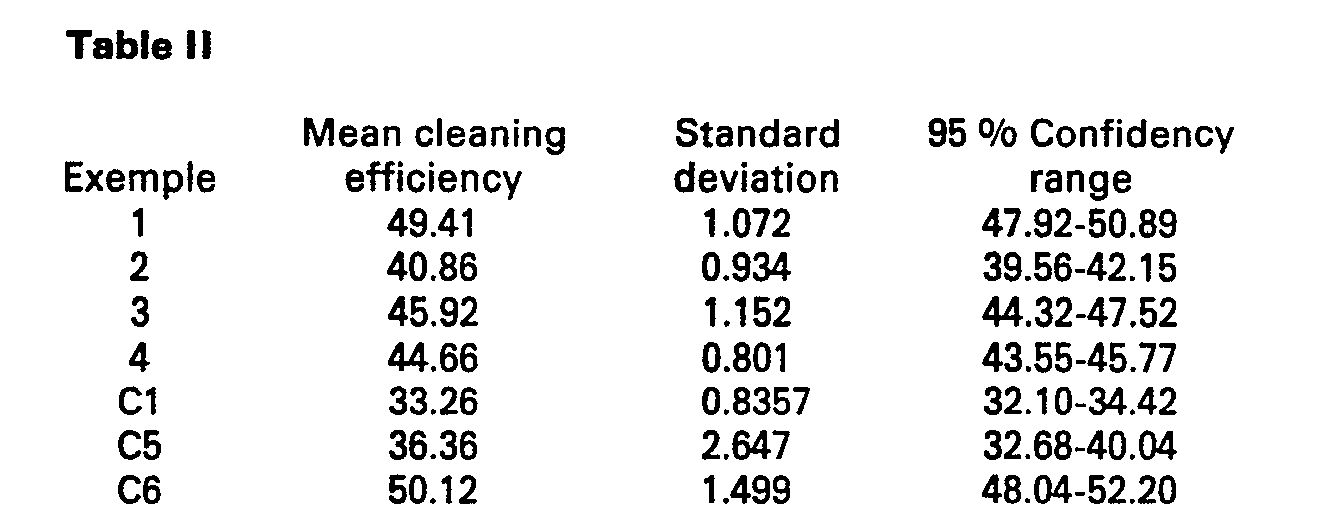
- For Example C1, the machine was unable to deliver the required amount of compounds, and thus two passes were necessary. There are no results for Examples C2, C3 and C4 since the respective formulations resulted in non-flowable solids.
- In a cleaning test on C6, the particles were strongly attracted to the cleaning machine, so that its use was practically impossible.
- The procedure of Example 4 was repeated, except that sodium borate was replaced by various inorganic salts, as summarised below in Table III. Particle sizes are calculated as for the equivalences 74 µm = 200 US mesh and 250 µm = 60 US mesh.

- A test programme was devised, wherein 11 participants were provided with a 1.6 kg pail of a cleaning formulation prepared as described in Example 4, together with cleaning instructions and a questionnaire directed to the area of carpet cleaned; the brand and type of vacuum cleaner employed to remove the particles; the composition of the vacuum cleaner bag le.g. cloth or paper); and the amount of pre-spray used. Other comments directed to, inter alia, observations made after the cleaning process were received. There were no reported difficulties in retrieving dried particulate material from the carpeting, and there were no reports of any shoe dusting problems.
Claims (6)
Priority Applications (1)
| Application Number | Priority Date | Filing Date | Title |
|---|---|---|---|
| AT82303883T ATE16022T1 (en) | 1981-07-27 | 1982-07-22 | POWDERY DETERGENT COMPOSITIONS. |
Applications Claiming Priority (2)
| Application Number | Priority Date | Filing Date | Title |
|---|---|---|---|
| US06/286,801 US4434067A (en) | 1981-07-27 | 1981-07-27 | Powdered cleaning composition |
| US286801 | 2002-11-04 |
Publications (3)
| Publication Number | Publication Date |
|---|---|
| EP0071422A1 EP0071422A1 (en) | 1983-02-09 |
| EP0071422B1 EP0071422B1 (en) | 1985-10-09 |
| EP0071422B2 true EP0071422B2 (en) | 1989-08-02 |
Family
ID=23100212
Family Applications (1)
| Application Number | Title | Priority Date | Filing Date |
|---|---|---|---|
| EP82303883A Expired EP0071422B2 (en) | 1981-07-27 | 1982-07-22 | Powdered cleaning compositions |
Country Status (7)
| Country | Link |
|---|---|
| US (1) | US4434067A (en) |
| EP (1) | EP0071422B2 (en) |
| JP (1) | JPS604880B2 (en) |
| AT (1) | ATE16022T1 (en) |
| CA (1) | CA1191069A (en) |
| DE (1) | DE3266825D1 (en) |
| ZA (1) | ZA825326B (en) |
Families Citing this family (39)
| Publication number | Priority date | Publication date | Assignee | Title |
|---|---|---|---|---|
| DE3304887A1 (en) * | 1983-02-12 | 1984-08-16 | Vorwerk & Co Interholding Gmbh, 5600 Wuppertal | CLEANING AGENT FOR TEXTILE SURFACES |
| US4581385A (en) * | 1983-07-06 | 1986-04-08 | Smith James A | Carpet cleaning composition |
| US4655952A (en) * | 1984-03-02 | 1987-04-07 | Vorwerk & Co. Interholding Gmbh | Detergent and method for producing the same |
| US4551401A (en) * | 1984-04-13 | 1985-11-05 | Chloride, Inc. | Method of suppressing lead dust |
| USH442H (en) | 1984-04-16 | 1988-03-01 | The United States Of America As Represented By The Secretary Of The Navy | Composition and method for cleaning embedded soil from surfaces having low gloss coatings |
| US4566980A (en) * | 1985-01-16 | 1986-01-28 | Creative Products Resource Associates, Ltd. | Carpet treating composition |
| US4692277A (en) * | 1985-12-20 | 1987-09-08 | The Procter & Gamble Company | Higher molecular weight diols for improved liquid cleaners |
| DE3545288A1 (en) * | 1985-12-20 | 1987-06-25 | Vorwerk Co Interholding | LIQUID CLEANING SUSPENSION |
| GB8620845D0 (en) * | 1986-08-28 | 1986-10-08 | Reckitt & Colmann Prod Ltd | Treatment of textile surfaces |
| US4855067A (en) * | 1988-05-10 | 1989-08-08 | Colgate-Palmolive Company | Household cleaning composition |
| US4908149A (en) * | 1988-06-10 | 1990-03-13 | Milliken Research Corporation | Cleaning composition for textiles containing sulfonated colorless dye site blocker |
| US4968447A (en) * | 1988-08-11 | 1990-11-06 | Gage Products Company | Cleaning composition and method |
| US5037485A (en) * | 1989-09-14 | 1991-08-06 | Dow Corning Corporation | Method of cleaning surfaces |
| US5041235A (en) * | 1990-07-16 | 1991-08-20 | Henkel Corporation | Liquid hard surface cleaner for porous surfaces |
| JPH0671376U (en) * | 1993-03-19 | 1994-10-07 | 株式会社共栄社 | Rubber crawler tension adjusting device for rubber crawler |
| US5286400A (en) * | 1993-03-29 | 1994-02-15 | Eastman Kodak Company | Flowable powder carpet cleaning formulations |
| US5669937A (en) * | 1996-03-07 | 1997-09-23 | Milliken Research Corporation | Method to remove iodine stain |
| US20040076792A1 (en) * | 2002-10-22 | 2004-04-22 | Green David E. | Topically applied antimicrobial carpet treatment |
| WO2005083170A1 (en) * | 2004-02-20 | 2005-09-09 | Milliken & Company | Compositions and methods for cleaning textile substrates |
| US7135449B2 (en) | 2004-02-20 | 2006-11-14 | Milliken & Company | Composition for removal of odors and contaminants from textiles and method |
| US20050183207A1 (en) * | 2004-02-20 | 2005-08-25 | Chan Marie S. | Compositions and methods for cleaning textile substrates |
| US7494512B2 (en) * | 2004-02-20 | 2009-02-24 | Brown Steven E | Compositions and methods for cleaning textile substrates |
| MX2007001675A (en) * | 2004-08-11 | 2007-04-10 | Procter & Gamble | Process for making a granular detergent composition having improved solubility. |
| US8557758B2 (en) | 2005-06-07 | 2013-10-15 | S.C. Johnson & Son, Inc. | Devices for applying a colorant to a surface |
| JP2008545898A (en) * | 2005-06-07 | 2008-12-18 | エス.シー. ジョンソン アンド サン、インコーポレイテッド | How to add a design to the surface |
| US20070277849A1 (en) | 2006-06-06 | 2007-12-06 | Shah Ketan N | Method of neutralizing a stain on a surface |
| US8258066B2 (en) * | 2005-12-12 | 2012-09-04 | Milliken & Company | Cleaning device |
| GB0607047D0 (en) | 2006-04-07 | 2006-05-17 | Univ Leeds | Novel cleaning method |
| US20080271259A1 (en) * | 2007-05-04 | 2008-11-06 | Daike Wang | Solid cleaning composition for imparting bleach resistance to textiles cleaned therewith |
| US7939479B2 (en) * | 2008-03-12 | 2011-05-10 | Chandler Barry E | Dry hand cleaner comprising corncob particles |
| BRPI0909346A2 (en) * | 2008-03-14 | 2016-07-05 | Unilever Nv | granular composition of polyolefin particle-containing tissue treatment, and domestic method of tissue treatment |
| US8138135B2 (en) * | 2009-03-27 | 2012-03-20 | Milliken & Company | Powder cleaning composition |
| GB201006076D0 (en) | 2010-04-12 | 2010-05-26 | Xeros Ltd | Novel cleaning apparatus and method |
| GB201015277D0 (en) | 2010-09-14 | 2010-10-27 | Xeros Ltd | Novel cleaning method |
| GB201100627D0 (en) | 2011-01-14 | 2011-03-02 | Xeros Ltd | Improved cleaning method |
| GB201100918D0 (en) | 2011-01-19 | 2011-03-02 | Xeros Ltd | Improved drying method |
| GB201212098D0 (en) | 2012-07-06 | 2012-08-22 | Xeros Ltd | New cleaning material |
| GB201319782D0 (en) | 2013-11-08 | 2013-12-25 | Xeros Ltd | Cleaning method and apparatus |
| GB201320784D0 (en) | 2013-11-25 | 2014-01-08 | Xeros Ltd | Improved cleaning Apparatus and method |
Family Cites Families (9)
| Publication number | Priority date | Publication date | Assignee | Title |
|---|---|---|---|---|
| NL6911314A (en) | 1968-08-20 | 1970-02-24 | ||
| US3630919A (en) | 1969-06-02 | 1971-12-28 | Colgate Palmolive Co | Colloidal silica cleansing compositions and method |
| CA983805A (en) | 1971-12-17 | 1976-02-17 | Helmut H. Froehlich | Cleaning composition |
| US3819517A (en) | 1972-07-03 | 1974-06-25 | Thuron Industries | Fire retardant compositions |
| US4108800A (en) | 1975-03-26 | 1978-08-22 | Milliken Research Corporation | Cleaning composition |
| US4013595A (en) * | 1975-05-23 | 1977-03-22 | S. C. Johnson & Son, Inc. | Non-flammable rug cleaning composition |
| US4161449A (en) | 1977-09-02 | 1979-07-17 | Airwick Industries, Inc. | Powdered carpet composition |
| US4194993A (en) * | 1978-03-13 | 1980-03-25 | Milliken Research Corporation | Method of manufacturing powdered cleaning composition |
| US4244834A (en) | 1979-06-05 | 1981-01-13 | United States Borax & Chemical Corporation | Carpet cleaning and deodorizing compositions |
-
1981
- 1981-07-27 US US06/286,801 patent/US4434067A/en not_active Expired - Lifetime
-
1982
- 1982-07-22 EP EP82303883A patent/EP0071422B2/en not_active Expired
- 1982-07-22 AT AT82303883T patent/ATE16022T1/en not_active IP Right Cessation
- 1982-07-22 DE DE8282303883T patent/DE3266825D1/en not_active Expired
- 1982-07-26 ZA ZA825326A patent/ZA825326B/en unknown
- 1982-07-26 CA CA000408060A patent/CA1191069A/en not_active Expired
- 1982-07-27 JP JP57131059A patent/JPS604880B2/en not_active Expired
Also Published As
| Publication number | Publication date |
|---|---|
| US4434067A (en) | 1984-02-28 |
| EP0071422B1 (en) | 1985-10-09 |
| JPS604880B2 (en) | 1985-02-07 |
| JPS5832699A (en) | 1983-02-25 |
| EP0071422A1 (en) | 1983-02-09 |
| ATE16022T1 (en) | 1985-10-15 |
| ZA825326B (en) | 1983-05-25 |
| CA1191069A (en) | 1985-07-30 |
| DE3266825D1 (en) | 1985-11-14 |
Similar Documents
| Publication | Publication Date | Title |
|---|---|---|
| EP0071422B2 (en) | Powdered cleaning compositions | |
| CA1240233A (en) | Carpet cleaning composition | |
| CA1119915A (en) | Carbonated cleaning solution | |
| US4013594A (en) | Powdered cleaning composition of urea-formaldehyde | |
| US4395347A (en) | Powdered carpet cleaner containing ether alcohol solvents | |
| EP0062536B1 (en) | Powdered cleansing composition | |
| US3910848A (en) | Liquid cleaning composition | |
| JP2505187B2 (en) | Fiber treatment composition | |
| US4440661A (en) | Powdered cleaning composition | |
| EP0257966A2 (en) | A method for the treatment of textile surfaces and compositions for use therein | |
| US5783543A (en) | Scatterable carpet cleaning formulation containing rollable particles | |
| EP0171215B1 (en) | Fabric cleaning compositions | |
| US8138135B2 (en) | Powder cleaning composition | |
| US7494512B2 (en) | Compositions and methods for cleaning textile substrates | |
| EP0345946A2 (en) | Cleaning composition for textiles containing sulfonated colorless dye site blocker | |
| US20080271259A1 (en) | Solid cleaning composition for imparting bleach resistance to textiles cleaned therewith | |
| US20050183207A1 (en) | Compositions and methods for cleaning textile substrates | |
| CA2460156C (en) | Surfactant-free cleaning compositions and processes for the use thereof | |
| CA2186637A1 (en) | Carpet cleaning agent | |
| DK154781B (en) | NON-TOXIC POWDER PREPARATION AND PROCEDURES FOR PREPARING THEREOF AND PROCEDURE FOR CLEANING LARGE TEXTILES WHEN USING IT | |
| CA2263915A1 (en) | Cleaning formulation for fabricated yarn products | |
| CA1156900A (en) | Powdered carpet cleaner | |
| WO1997035952A1 (en) | Powdered cleaning agent for carpets | |
| WO2005083170A1 (en) | Compositions and methods for cleaning textile substrates | |
| JPS6116799B2 (en) |
Legal Events
| Date | Code | Title | Description |
|---|---|---|---|
| PUAI | Public reference made under article 153(3) epc to a published international application that has entered the european phase |
Free format text: ORIGINAL CODE: 0009012 |
|
| AK | Designated contracting states |
Designated state(s): AT BE CH DE FR GB IT LI LU NL SE |
|
| 17P | Request for examination filed |
Effective date: 19830526 |
|
| RAP1 | Party data changed (applicant data changed or rights of an application transferred) |
Owner name: MILLIKEN RESEARCH CORPORATION |
|
| ITF | It: translation for a ep patent filed | ||
| GRAA | (expected) grant |
Free format text: ORIGINAL CODE: 0009210 |
|
| AK | Designated contracting states |
Designated state(s): AT BE CH DE FR GB IT LI LU NL SE |
|
| REF | Corresponds to: |
Ref document number: 16022 Country of ref document: AT Date of ref document: 19851015 Kind code of ref document: T |
|
| REF | Corresponds to: |
Ref document number: 3266825 Country of ref document: DE Date of ref document: 19851114 |
|
| ET | Fr: translation filed | ||
| PLBI | Opposition filed |
Free format text: ORIGINAL CODE: 0009260 |
|
| 26 | Opposition filed |
Opponent name: HENKEL KOMMANDITGESELLSCHAFT AUF AKTIEN Effective date: 19860702 |
|
| NLR1 | Nl: opposition has been filed with the epo |
Opponent name: HENKEL KOMMANDITGESELLSCHAFT AUF AKTIEN |
|
| ITF | It: translation for a ep patent filed | ||
| PUAH | Patent maintained in amended form |
Free format text: ORIGINAL CODE: 0009272 |
|
| STAA | Information on the status of an ep patent application or granted ep patent |
Free format text: STATUS: PATENT MAINTAINED AS AMENDED |
|
| 27A | Patent maintained in amended form |
Effective date: 19890802 |
|
| AK | Designated contracting states |
Kind code of ref document: B2 Designated state(s): AT BE CH DE FR GB IT LI LU NL SE |
|
| NLR2 | Nl: decision of opposition | ||
| NLR3 | Nl: receipt of modified translations in the netherlands language after an opposition procedure | ||
| ET3 | Fr: translation filed ** decision concerning opposition | ||
| ITTA | It: last paid annual fee | ||
| PGFP | Annual fee paid to national office [announced via postgrant information from national office to epo] |
Ref country code: LU Payment date: 19920707 Year of fee payment: 11 |
|
| EPTA | Lu: last paid annual fee | ||
| PG25 | Lapsed in a contracting state [announced via postgrant information from national office to epo] |
Ref country code: LU Free format text: LAPSE BECAUSE OF NON-PAYMENT OF DUE FEES Effective date: 19930722 |
|
| EAL | Se: european patent in force in sweden |
Ref document number: 82303883.1 |
|
| PGFP | Annual fee paid to national office [announced via postgrant information from national office to epo] |
Ref country code: CH Payment date: 20010620 Year of fee payment: 20 |
|
| PGFP | Annual fee paid to national office [announced via postgrant information from national office to epo] |
Ref country code: SE Payment date: 20010621 Year of fee payment: 20 |
|
| PGFP | Annual fee paid to national office [announced via postgrant information from national office to epo] |
Ref country code: FR Payment date: 20010625 Year of fee payment: 20 |
|
| PGFP | Annual fee paid to national office [announced via postgrant information from national office to epo] |
Ref country code: GB Payment date: 20010628 Year of fee payment: 20 Ref country code: BE Payment date: 20010628 Year of fee payment: 20 |
|
| PGFP | Annual fee paid to national office [announced via postgrant information from national office to epo] |
Ref country code: AT Payment date: 20010709 Year of fee payment: 20 |
|
| PGFP | Annual fee paid to national office [announced via postgrant information from national office to epo] |
Ref country code: NL Payment date: 20010717 Year of fee payment: 20 |
|
| PGFP | Annual fee paid to national office [announced via postgrant information from national office to epo] |
Ref country code: DE Payment date: 20010928 Year of fee payment: 20 |
|
| BE20 | Be: patent expired |
Free format text: 20020722 *MILLIKEN RESEARCH CORP. |
|
| REG | Reference to a national code |
Ref country code: GB Ref legal event code: IF02 |
|
| PG25 | Lapsed in a contracting state [announced via postgrant information from national office to epo] |
Ref country code: LI Free format text: LAPSE BECAUSE OF EXPIRATION OF PROTECTION Effective date: 20020721 Ref country code: GB Free format text: LAPSE BECAUSE OF EXPIRATION OF PROTECTION Effective date: 20020721 Ref country code: CH Free format text: LAPSE BECAUSE OF EXPIRATION OF PROTECTION Effective date: 20020721 |
|
| PG25 | Lapsed in a contracting state [announced via postgrant information from national office to epo] |
Ref country code: NL Free format text: LAPSE BECAUSE OF EXPIRATION OF PROTECTION Effective date: 20020722 Ref country code: AT Free format text: LAPSE BECAUSE OF EXPIRATION OF PROTECTION Effective date: 20020722 |
|
| REG | Reference to a national code |
Ref country code: GB Ref legal event code: PE20 Effective date: 20020721 |
|
| EUG | Se: european patent has lapsed |
Ref document number: 82303883.1 |
|
| REG | Reference to a national code |
Ref country code: CH Ref legal event code: PL |
|
| NLV7 | Nl: ceased due to reaching the maximum lifetime of a patent |
Effective date: 20020722 |