EP0068083B1 - Poly-bis-triazinylimide, ihre Herstellung, ihre Verwendung als Lichtschutzmittel für Polymere sowie die mit ihnen stabilisierten Polymeren - Google Patents
Poly-bis-triazinylimide, ihre Herstellung, ihre Verwendung als Lichtschutzmittel für Polymere sowie die mit ihnen stabilisierten Polymeren Download PDFInfo
- Publication number
- EP0068083B1 EP0068083B1 EP82102713A EP82102713A EP0068083B1 EP 0068083 B1 EP0068083 B1 EP 0068083B1 EP 82102713 A EP82102713 A EP 82102713A EP 82102713 A EP82102713 A EP 82102713A EP 0068083 B1 EP0068083 B1 EP 0068083B1
- Authority
- EP
- European Patent Office
- Prior art keywords
- bis
- formula
- polymers
- substituted
- radicals
- Prior art date
- Legal status (The legal status is an assumption and is not a legal conclusion. Google has not performed a legal analysis and makes no representation as to the accuracy of the status listed.)
- Expired
Links
- 0 CC(C1)C1C1CN(*)C1 Chemical compound CC(C1)C1C1CN(*)C1 0.000 description 2
- DYOGBUGOAOMYGY-UHFFFAOYSA-N CC(NC(C)N1)NC1N(C)C(NC(N1)Cl)N(C2CCC2)C1Cl Chemical compound CC(NC(C)N1)NC1N(C)C(NC(N1)Cl)N(C2CCC2)C1Cl DYOGBUGOAOMYGY-UHFFFAOYSA-N 0.000 description 1
Classifications
-
- C—CHEMISTRY; METALLURGY
- C08—ORGANIC MACROMOLECULAR COMPOUNDS; THEIR PREPARATION OR CHEMICAL WORKING-UP; COMPOSITIONS BASED THEREON
- C08G—MACROMOLECULAR COMPOUNDS OBTAINED OTHERWISE THAN BY REACTIONS ONLY INVOLVING UNSATURATED CARBON-TO-CARBON BONDS
- C08G73/00—Macromolecular compounds obtained by reactions forming a linkage containing nitrogen with or without oxygen or carbon in the main chain of the macromolecule, not provided for in groups C08G12/00 - C08G71/00
- C08G73/06—Polycondensates having nitrogen-containing heterocyclic rings in the main chain of the macromolecule
- C08G73/0622—Polycondensates containing six-membered rings, not condensed with other rings, with nitrogen atoms as the only ring hetero atoms
- C08G73/0627—Polycondensates containing six-membered rings, not condensed with other rings, with nitrogen atoms as the only ring hetero atoms with only one nitrogen atom in the ring
-
- C—CHEMISTRY; METALLURGY
- C08—ORGANIC MACROMOLECULAR COMPOUNDS; THEIR PREPARATION OR CHEMICAL WORKING-UP; COMPOSITIONS BASED THEREON
- C08G—MACROMOLECULAR COMPOUNDS OBTAINED OTHERWISE THAN BY REACTIONS ONLY INVOLVING UNSATURATED CARBON-TO-CARBON BONDS
- C08G73/00—Macromolecular compounds obtained by reactions forming a linkage containing nitrogen with or without oxygen or carbon in the main chain of the macromolecule, not provided for in groups C08G12/00 - C08G71/00
- C08G73/06—Polycondensates having nitrogen-containing heterocyclic rings in the main chain of the macromolecule
- C08G73/0622—Polycondensates containing six-membered rings, not condensed with other rings, with nitrogen atoms as the only ring hetero atoms
- C08G73/0638—Polycondensates containing six-membered rings, not condensed with other rings, with nitrogen atoms as the only ring hetero atoms with at least three nitrogen atoms in the ring
- C08G73/0644—Poly(1,3,5)triazines
-
- C—CHEMISTRY; METALLURGY
- C08—ORGANIC MACROMOLECULAR COMPOUNDS; THEIR PREPARATION OR CHEMICAL WORKING-UP; COMPOSITIONS BASED THEREON
- C08K—Use of inorganic or non-macromolecular organic substances as compounding ingredients
- C08K5/00—Use of organic ingredients
- C08K5/16—Nitrogen-containing compounds
- C08K5/34—Heterocyclic compounds having nitrogen in the ring
- C08K5/3467—Heterocyclic compounds having nitrogen in the ring having more than two nitrogen atoms in the ring
- C08K5/3477—Six-membered rings
- C08K5/3492—Triazines
- C08K5/34926—Triazines also containing heterocyclic groups other than triazine groups
Definitions
- the invention relates to new poly-bis-triazinylimides, a process for their preparation and their use as stabilizers for synthetic polymers.
- R 6 is identical to or different from R 5 and has the meanings given under R 5 , as well as additionally from C 3 - to C 21 -alkoxy propyl, preferably C 1 - to C 18 -alkoxypropyl and in particular C 1 - to C 2 -alkoxypropyl , from C 1 to C 18 , preferably C 1 to C 4 hydroxyalkyl or from dimethyl or diethylamino C 2 to C s alkyl.
- R 5 and R 6 together with the N atom which binds them, can also represent a pyrrolidine ring or an unsubstituted or substituted by up to four C 1 - to C 4 -alkyl groups, preferably methyl groups, piperidine, morpholine or hexamethyleneimine ring.
- R 3 stands for C 1 to C 18 , preferably C 2 to C 12 and in particular C 2 to C 6 alkylene, for C 2 to C 12 bis (propyloxy) alkylene, for C 6- to C 18 -, preferably C 6 - to C 12 - unsubstituted or substituted by up to four methyl groups, but preferably unsubstituted mono-, di- or tricycloalkylene, in which in the former two C atoms by N atoms which carry propylene groups can, can be replaced, for C 6 - to C 18 arylene, preferably phenylene, or for C 7 - to C 18 aralkylene.
- piperazinylene radicals or bicyclic radicals having 5 to 12 carbon atoms which carry an -N atom in the ring and are substituted by an amino and / or aminomethylene group can also be used.
- At least one of the radicals X 1 , X 2 , X 3 , Y or R 1 must contain a group of the formula (VI).
- the compounds of the formula (I) are isotactic with the same X 3 and Y and atactic with different ones.
- the polymeric triazinylimides are obtained by the bistriazinylimide of the formula (B ') thus obtained, each containing one chlorine atom in each triazine ring reacting with a diamine of formula (C), wherein in this formula X 3 , R 3 and Y have the meanings given above. It is 0.8 to 1.2 times, preferably 0.95 to 1.05 times and in particular the equimolar amount of diamine, and one works at 50 to 200, preferably 100 to 180 and in particular 130 to 180 ° C.
- the products according to the invention are colored jose to yellowish colored resins which naturally do not have any sharp melting points.
- inert organic solvents e.g. Petroleum ether, gasoline, acetone, ether, dioxane, benzene, toluene, xylene, mesitylene or mixtures thereof.
- Inorganic bases are also added in equivalent amounts as hydrogen halide acceptors. Suitable are e.g. Sodium hydroxide, potassium hydroxide, sodium carbonate and potassium carbonate in solid form or aqueous solution.
- triazine stabilizers containing polyalkylpiperidyl groups are known from numerous publications (DE-PSS 2 636 130, 2 636 144, DE-OSS 2 752 740, 2 933 078, 2 944 729, 3 022 896, 3 027 223, 3 045 839 , European patent applications 2,754, 3,542, 13,665 and 14,683).
- poly-bis-triazinylamines described in DE-OS 3,045,839 in which two triazine rings linked by a diamino compound form a recurring structural unit, are structurally the closest to the poly-bis-triazinylimides according to the invention.
- polyimides can be used for stabilization purposes is indicated in DE-OS 2 719 131, page 35, last paragraph, but there is no information as to what defined structure such imides should have and what properties they have in detail. This leads to the conclusion that they do not appear to be on a par with the polyesters, polyamides, polyurethanes, polyureas and polysilyl esters described in this laid-open specification, all the more so since no representative of this class of substances is presented as an example.
- novel poly-bis-triazinylimides according to the invention are now not only equivalent to the above-mentioned compounds shown in DE-OS 2719131 as unusually useful, but rather are clearly superior, this superiority being based on the volatility, washout resistance, tolerability and effectiveness, ie relates to all criteria relevant to application technology. That this superiority despite the presence of the reactive and volatile Imidgrup pe was not to be expected and is to be regarded as completely surprising.
- the new poly-bis-triazinylimides can be easily incorporated into the polymers to be stabilized and are outstandingly suitable for stabilizing them against light-induced oxidative degradation.
- the new stabilizers are characterized by their compatibility with the polymers to be stabilized, their resistance to migration against washing out with aqueous media, which plays an important role in weathering, their thermostability even at high processing temperatures and their low volatility, especially when compared to the compound Example 1 of DE-OS 2 719 131.
- Halogen-containing vinyl polymers such as polyvinyl chloride, polyvinylidene chloride, polyvinyl fluoride, polychloroprene and chlorinated rubbers, and copolymers of vinyl chloride and vinylidene chloride with one another and with other olefinically unsaturated monomers.
- Polymers derived from ⁇ , ⁇ -unsaturated acids and their derivatives such as polyacrylates and polymethacrylates, polyacrylamides and polyacrylonitrile, and their copolymers with one another and with other vinyl compounds, such as acrylonitrile-butadiene-styrene, acrylonitrile-styrene and acrylonitrile-styrene Acrylic ester copolymers.
- Polymers derived from unsaturated alcohols and amines or their acyl derivatives or acetals such as polyvinyl alcohol, polyvinyl acetate, stearate, benzoate, maleate, polyvinyl butyral, polyallylphthalate, polyallylmelamine and their copolymers with other vinyl compounds, such as ethylene-vinyl acetate copolymers.
- Homopolymers and copolymers derived from epoxides such as polyethylene oxide, or the polymers based on bisglycidyl ethers.
- Polyacetals such as polyoxymethylene and polyoxiethylene, and also those polyoximethylenes which contain ethylene oxide as a comonomer.
- Polyurethanes and polyureas are Polyurethanes and polyureas.
- Polyesters which are composed of dicarboxylic acids and dialcohols and / or hydroxycarboxylic acids or the corresponding lactones, such as polyethylene terephthalate, polybutylene terephthalate, poly-1,4-dimethylol-cyclohexane terephthalate.
- the new compounds can also be used as stabilizers in the resin and paint sector.
- examples are thermosetting and thermoplastic acrylic resins which are used for automotive coatings [Encyclopedia of Polymer Science and Technology, Interscience Publishers, New York, Volume 1 (1964), pages 273-276, and Volume 13 (1970), pages 530-532; "Understanding Paint” by W. R. Fuller, in American Paint Journal Co., St. Louis, 1965, pages 124-135], acrylic resin paints, these are the usual stoving paints [described e.g. B. in H. Kittels "Textbook of paints and coatings", Volume 1, Part 2, pages 735 and 742 (Berlin, 1972), and in H. Wagner, H.F.
- the stabilization of polyolefins, styrene polymers, polyamides, poly (meth) acrylates and of polyurethanes, for which the compounds are preferably suitable, is of particular importance.
- examples include high and low density polyethylene, polypropylene, ethylene-propylene copolymers, polystyrene, styrene-butadiene-acrylonitrile terpolymers; Mixtures of polyolefins or of styrene polymers and polyurethanes based on polyether or polyester.
- the new stabilizers are incorporated into the polymer compositions by generally customary methods.
- the incorporation can be carried out, for example, by mixing the compounds and, if appropriate, further additives into the melt by the methods customary in industry, before or during shaping, or by applying the dissolved or dispersed compounds to the polymer directly or by mixing them into a solution, suspension or Emulsion of the same, if necessary with subsequent Allow the solvent to evaporate.
- the amounts are 0.01 to 5, preferably 0.05 to 2.5 and in particular 0.1 to 1.0% by weight, based on the material to be stabilized.
- the new compounds can also be added to the plastics to be stabilized in the form of a masterbatch which contains these compounds, for example in a concentration of 1 to 50, preferably 2.5 to 20% by weight.
- plastics stabilized by the addition of the substances according to the invention may optionally also contain other known and customary additives, such as, for example, phenol and sulfide-based antioxidants, metal deactivators and light stabilizers, phosphite stabilizers, metal compounds, epoxy stabilizers and polyhydric alcohols (see also DE-OS 2 427 853, pages 18 to 24).
- additives such as, for example, phenol and sulfide-based antioxidants, metal deactivators and light stabilizers, phosphite stabilizers, metal compounds, epoxy stabilizers and polyhydric alcohols (see also DE-OS 2 427 853, pages 18 to 24).
- the UV absorbers and light stabilizers include 2- (2'-hydroxiphenyl) benzotriazoles such as the 5-chloro-3 ', 5'-di-tert-butyl and 5-chloro-3', 5'-di-tert.-amyl derivative, 2-hydroxibenzophenones such as e.g. B. the 4-heptoxi or 4-octoxy derivative, salicylates such as octyphenyl salicylate, nickel complexes such as e.g. that of 2,2'-thio-bis-4- (1,1,3,3-tetramethylbutyl) phenol with butylamine or other amines, oxalic acid diamides and sterically hindered amines.
- 2- (2'-hydroxiphenyl) benzotriazoles such as the 5-chloro-3 ', 5'-di-tert-butyl and 5-chloro-3', 5'-di-tert.-amyl derivative
- Aliphatic, aromatic or aliphatic-aromatic such as e.g. Trisnonylphenyl phosphite, tris (2,4-di-tert-butylphenyl) phosphite, tris (2-tort-butylphenyl) phosphite or esters of pentaerythritol phosphite.
- Metal compounds known as stabilizers are taken to mean: calcium, barium, strontium, zinc, cadmium, magnesium, aluminum and lead soaps of aliphatic carboxylic acid or oxicarboxylic acid with about 12 to 32 carbon atoms, salts of the metals mentioned with aromatic carboxylic acids such as benzoates or salicylates and (alkyl) phenolates of these metals, furthermore organotin compounds such as Dialkyltin thioglycolates and carboxylates.
- epoxy stabilizers are e.g. epoxidized higher fatty acids such as epoxidized soybean oil, tall oil, linseed oil or epoxidized butyl oleate as well as epoxides of long-chain olefins.
- Polyhydric alcohols can be, for example, pentaerythritol, trimethylolpropane, sorbitol or mannitol, i.e. H. preferably alcohols with 5 or 6 carbon atoms and 2 to 6 OH groups.
- An effective stabilizer combination for poly-a-olefins such as high, medium and low pressure polymers from C 2 - to C ; ⁇ -olefins, in particular polyethylene and polypropylene or of copolymers of such ⁇ -olefins, based on 100 parts by weight of polymer, for example from 0.01 to 5 parts by weight of one of the compounds to be used according to the invention, 0.05 to 5 parts by weight of a phenolic stabilizer, optionally 0 , 01 to 5 parts by weight of a sulfur-containing costabilizer and optionally 0.01 to 3 parts by weight of a basic or neutral metal soap, such as. B.
- UV stabilizer from the group of alkoxihydroxibenzophenones, 4-hydroxiphenylbenzotriazoles, benzylidene malonate or the so-called quencher, such as. B. Nickel chelates.
- plastics stabilized according to the invention can be used in a wide variety of forms, e.g. as foils, fibers, tapes, profiles or as binders for paints, adhesives or putties.
- the starting materials used are identified by numbers which refer to the numbering of the substances listed on pages 9 to 11. Since the process products are resins, the information about the melting points is “approximate” values. If only "resin” is specified, this product has the consistency of a soft resin.
- This example shows the volatility of the new triazine stabilizers compared to the closest prior art products.
- the volatilities were determined in an apparatus for thermogravimetric analysis. To this end, the same amount (500 mg) of the compounds according to the invention and the comparison substances were heated in a nitrogen atmosphere at a heating rate of 2 K / min to 300 ° C. and the loss of substance was measured in mg / cm 2 sample surface. The results are shown in the table below:
- This example is intended to demonstrate the light-stabilizing effect of the new compounds in a poly-a-olefin.
- the stabilizers were dissolved in a solvent, and the solution was added dropwise to the polypropylene powder with stirring, the majority of the solvent evaporating again by simultaneous irradiation with an IR lamp. After about 20 minutes the calcium stearate was added and mixed for a further 10 minutes. Residual solvents were removed by drying at 50 ° C / 120 min in a drying cabinet.
- the polypropylene was injected on a Windsor injection molding machine of the type SP 50 at 240 ° C to 60 x 60 x 1 mm plates. Test specimens according to DIN 53 455, form 3, reduced to a scale of 1: 3, were punched out of these plates. The test specimens required as comparison samples were produced analogously, but with the stabilizer to be tested omitted or with the addition of the comparison stabilizers.
- the samples were subjected to radiation with alternating light in a Xenotest 1200 apparatus from Original Hanau Quarzlampen GmbH.
- the lightfastness was tested according to DIN 53 387 (17 min drying period, 3 min sprinkling, black panel temperature 45 ° C, relative air humidity during the drying period 70 to 75%).
- the elongation at break was measured in hours after certain exposure times on a tensile testing machine from Instron at a take-off speed of 5 cm / min.
- the tissue samples are stretched onto a perforated cardboard so that a free opening of approx. 15.5 mm diameter remains.
- the test specimens are exposed in the Xenotest X 1200 as described in the previous example.
- the tissues are loaded centrally with a weight of 6 mm in diameter and a pressure of 0.1 N / mm 2 . Breaking through the weight counts as the failure date.
- the stabilized granulate produced as in the previous example is processed on a laboratory film blowing system (screw diameter 25 mm, length 20 D), temperature program 200, 240, 250, 255 ° C.) to form blown films of approx. 701.tm density. These films are artificated in the Xenotest X 1200 as described in Example 52 weathered. As a characteristic of damage, the carbonyl number is measured based on DIN 63 383, Part 2 (this is defined for PP as the ratio of the extinctions at 1715 cm -1 and 1524 cm -1 ). With a CO number> 2, the test specimens begin to decompose into powder.
Landscapes
- Chemical & Material Sciences (AREA)
- Health & Medical Sciences (AREA)
- Chemical Kinetics & Catalysis (AREA)
- Medicinal Chemistry (AREA)
- Polymers & Plastics (AREA)
- Organic Chemistry (AREA)
- Macromolecular Compounds Obtained By Forming Nitrogen-Containing Linkages In General (AREA)
- Compositions Of Macromolecular Compounds (AREA)
- Plural Heterocyclic Compounds (AREA)
- Polymers With Sulfur, Phosphorus Or Metals In The Main Chain (AREA)
Description
- Die Erfindung betrifft neue Poly-bis-triazinylimide, ein Verfahren zu ihrer Herstellung und ihre Verwendung als Stabilisatoren für synthetische Polymere.
- Die neuen Poly-bis-triazinylimide entsprechen der Formel (I)

- n für eine ganze Zahl von 2 bis 10 steht.
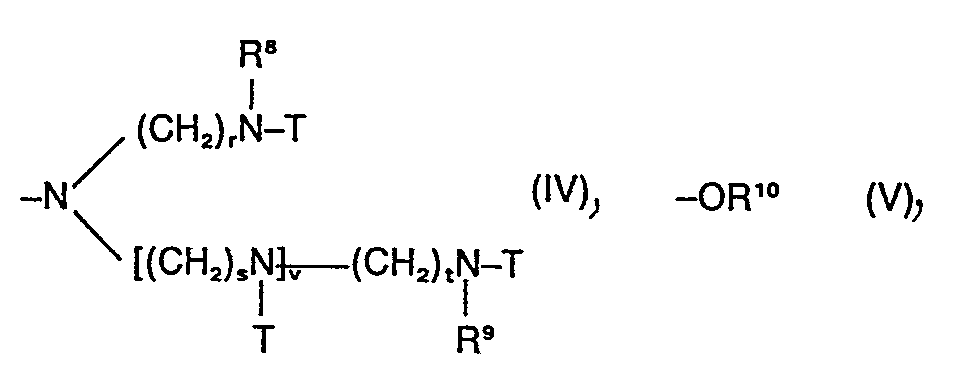
- X1 und X2 stehen für gleiche oder verschiedene, vorzugsweise gleiche Reste und haben die Bedeutung von Chlor, Phenyl, -OH, -ONa oder einer Gruppe der Formel (II), (III), (IV) oder (V), vorzugsweise (II), (III) oder (IV), insbesondere (II) oder (IV).


- R5 Wasserstoff, C1- bis C18-Alkyl, bevorzugt unsubstituiertes, gegebenenfalls aber auch durch eine C1- bis C4-Alkylgruppe substituiertes Cs- bis C12-Cycloalkyl, C3- bis C12-Alkenyl, bevorzugt unsubstituiertes, gewünschtenfalls jedoch durch ein oder zwei Cl, oder eine oder zwei C1- bis C4-Alkylgruppen, oder C1- bis C4-Alkoxi, oder C1- bis C2-Carbalkoxi substituiertes Phenyl oder C7- bis C14-, vorzugsweise C7- bis C9-Phenylalkyl, oder eine Gruppe der Formel (VI)

- R" Wasserstoff oder Methyl, vorzugsweise Wasserstoff und
- R12 Wasserstoff, C1- bis C4-Alkyl, das durch eine oder zwei OH-Gruppen substituiert sein kann, 2,3-Epoxipropyl, Allyl oder Benzyl, vorzugsweise jedoch Wasserstoff ist.
- R6 ist gleich oder verschieden von R5 und hat die unter R5 angegebenen Bedeutungen, sowie zusätzlich die von C3- bis C21-Atkoxialkyl, vorzugsweise C1- bis C18-Alkoxipropyl und insbesondere C1- bis C2-Alkoxipropyl, von C1- bis C18-, vorzugsweise C1-bis C4-Hydroxialkyl oder von Dimethyl-oder Diethylamino-C2- bis Cs-alkyl.
- R5 und R6 können ferner zusammen mit dem sie bindenden N-Atom für einen Pyrrolidin- oder einen unsubstituierten oder durch bis zu vier C1- bis C4-Alkylgruppen, vorzugsweise Methylgruppen substituierten Piperidin-, Morpholin- oder Hexamethyleniminring stehen.
- In Formel (III) hat
- R7 die unter R6 angegebenen Bedeutungen und steht
- T für eine Gruppe der Formel (VII)

- X4 und X5 gleiche oder verschiedene Reste der Formel (II), (IV) oder (V), vorzugsweise (11) oder (IV), sind.
- In Formel (IV) bedeuten die Indices
- r, s und t gleiche oder unterschiedliche ganze Zahlen von 2 bis 6, vorzugsweise 2 oder 3,
- v eine ganze Zahl von 0 bis 3, vorzugsweise 0 oder 1 und insbesondere 0, und stehen
- R8 und R9 für gleiche oder verschiedene Reste mit der Bedeutung von R5, vorzugsweise für Wasserstoff oder eine Gruppe der Formel (VI) und insbesondere für Wasserstoff, und hat
- T die vorstehend angegebenen Bedeutungen.
- In Formel (V) steht
- R10 für die unter R5 aufgeführten Reste.
- R1 steht für einen der unter R6 aufgeführten Reste.
- X3 steht für den Rest

- R13 = einer der unter R5 angeführten Reste oder Hydroxialkyl und
- Y für die Gruppe

- R14 = gleiche oder verschiedene Reste R5.
- R3 steht für C1- bis C18-, vorzugsweise C2bis C12-und insbesondere C2- bis C6-Alkylen, für C2- bis C12-Bis-(propyloxi)-alkylen, für C6-bis C18-, vorzugsweise C6- bis C12- unsubstituiertes oder durch bis zu vier Methylgruppen substituiertes, vorzugsweise jedoch unsubstituiertes Mono-, Di- oder Tricycloalkylen, in welchem bei dem erstgenannten zwei C-Atome durch N-Atome, welche Propylengruppen tragen können, ersetzt sein können, für C6- bis C18-Arylen, vorzugsweise Phenylen, oder für C7- bis C18-Aralkylen.
- Anstelle der Gruppierung -X3-R3-Y- können ferner Piperazinylenreste oder bicyclische Reste mit 5 bis 12 C-Atomen, die im Ring ein -N-Atom tragen und durch eine Amino- und/oder Aminomethylengruppe substituiert sind, treten.
- In Formel (I) muss mindestens einer der Reste X1, X2, X3, Y oder R1 eine Gruppe der Formel (VI) enthalten.
- Die Verbindungen der Formel (I) sind bei gleichem X3 und Y isotaktisch, bei verschiedenen ataktisch aufgebaut.
- Die Poly-bis-triazinylimide lassen sich in folgender Weise erhalten:
- Zunächst werden die als Ausgangsmaterial anzusprechenden Bistriazinylimide synthetisiert, indem man ein substituiertes Triazinylamin der Formel (1),

- Diese Triazinylimide der Formel (A')

- Nach Verfahrensschritt B erhält man die polymeren Triazinylimide, indem man das so erhaltene, je ein Chloratom in jedem Triazinring enthaltende Bis-triazinylimid der Formel (B')


- Die bei den einzelnen Verfahrensstufen anfallenden Produkte werden im allgemeinen jeweils isoliert, es ist jedoch auch möglich, die aufeinander folgenden Reaktionsschritte ohne Isolierung der Zwischenstufen durchzuführen, wodurch sich das Verfahren besonders einfach gestaltet.
- Die erfindungsgemässen Produkte sind farbJose bis gelbliche gefärbte Harze, die naturgemäss keine scharfen Schmelzpunkte besitzen.
- Alle Umsetzungen werden in inerten organischen Lösungsmitteln, wie z.B. Petrolether, Benzinen, Aceton, Ether, Dioxan, Benzol, Toluol, Xylol, Mesitylen oder Gemischen derselben vorgenommen. Man gibt ferner als Halogenwasserstoffakzeptoren anorganische Basen in äquivalenten Mengen zu. Geeignet sind z.B. Natriumhydroxid, Kaliumhydroxid, Natriumcarbonat und Kaliumcarbonat in fester Form oder wässriger Lösung.
- Beispiele für Ausgangs-Bis-(2,4-dichlor-1,3,- triazin-6-yl)-imide der Formel (A') sind:
- 1. Methyl-bis-(2,4-dichlor-1,3,5-triazin-6-yl)-imid
- 2. Ethyl-bis-(2,4-dichlor-1,3,5-triazin-6-yl)-imid
- 3. Butyl-bis-(2,4-dichlor-1,3,5-triazin-6-yl)-imid
- 4. 2-Ethyl-hexyl-bis-(2,4-dichlor-1,3,5-triazin-6-yl)-imid
- 5. Hexyl-bis-(2,4-dichlor-1,3,5-triazin-6-yl)-imid
- 6. Dodecyl-bis-(2,4-dichlor-1,3,5-triazin-6-yl)-imid
- 7. Octadecyl-bis-(2,4-dichlor-1,3,5-triazin-6-yl)-imid
- 8. Cyclohexyl-bis-(2,4-dichlor-1,3,5-triazin-6-yl)-imid
- 9. Benzyl-bis-(2,4-dichlor-1,3,5-triazin-6-yl)-imid
- 10. 2,4-Dichlorphenyl-bis-(2,4-dichlor-1,3,5-triazin-6-yl)-imid
- 11. 3-Methoxipropyl-bis-(2,4-dichlor-1,3,5-triazin-6-yl)-imid
- 12. 2,2,6,6-Tetramethyl-4-amino-piperidin
- 13. 2,2,6,6-Tetramethyl-4-butylamino-piperidin
- 14. 2,2,6,6-Tetramethyl-4-octadecylamino- piperidin
- 15. 2,2,6,6-Tetramethyl-4-(3-methoxi)-propylaminopiperidin
- 16. 2,2,6,6-Tetramethyl-4-(3-dimethylamino)-propylaminopiperidin
- 17. Ammoniak
- 18. Methylamin
- 19. Butylamin
- 20. Hexylamin
- 21. Dodecylamin
- 22. 2-Ethyl-hexylamin
- 23. Octadecylamin
- 24. Cyclohexylamin
- 25. Benzylamin
- 26. 3-Methoxipropylamin
- 27. 3-Octadecyloxipropylamin
- 28. 3-Dimethylaminopropylamin
- 29. Diethylamin
- 30. Dibutylamin
- 31. Dicyclohexylamin
- 32. Dioctadecylamin
- 33. 1,9-Bis-[2,4-bis-<N-(2,2,6,6-tetramethyl-4-piperidyl)-3-methoxipropylamino)-1,3,5-triazin-6-yl]-triazanonan-1,5,9
- 34. 1,7-Bis-[2,4-bis-<N-(2,2,6,6-tetramethyl-4-piperidyl)-3-methoxipropylamino)-1,3,5-triazin-6-yl]-1,4,7-triazaheptan
- 35. 1,5,12-Tris-[2,4-bis-<N-(2,2,6,6-tetramethyl-4-piperidyl)-3-methoxipropyl- amino)-1,3,5-triazin-6-yl]-1,5,8,12-tetra-azadodecan
- 36. 2-Aminopropanol-1
- 37. 2,2,6,6-Tetramethyl-4-(3-ethoxi)-propylamino-piperidin
- 38. 1,2-Diaminoethan
- 39. 1,3-Diaminopropan
- 40. 1,6-Diaminohexan
- 41. 3-Methylaminopropylamin
- 42. 3-Cyclohexylaminopropylamin
- 43. 4,7-Dioxadecan-1,10-diamin
- 44. 4,9-Dioxadodecan-1,12-diamin
- 45. N,N'-Bis-cyclododecyl-1,6-diaminohexan
- 46. 1,3-Bis-(aminomethyl)-cyclohexan
- 47. Bis-(4-aminocyclohexyl)-methan
- 48. N,N'-Bis-(3-aminopropyl)-piperazin
- 49. Piperazin
- 50. 2(3),5(6)-Bis-(aminomethyl)-norbornan (Isomerengemisch)
- 51. 3(4),8(9)-Bis-(aminomethyl)-tricyclo-[5.2.1.02.6]-decan (Isomerengemisch)
- 52. 1-Amino-2-(aminomethyl)-3,3,5-trimethyl- cyclopentan
- 53. 1-Amino-3-aza-5,7,7-trimethyl-bicyclo-[3.3.1]-nonan
- 54. N,N'-Bis-(2,2,6,6-tetramethyl-4-piperidyl)-1,2-diaminoethan
- 55. N,N'-Bis-(2,2,6,6-tetramethyl-4-piperidyl)-1,6-diaminohexan
- 56. N-(2,2,6,6-Tetramethyl-4-piperidyl)-1,6-diaminohexan
- 57. N,N'-Bis-(2,2,6,6-tetramethyl-4-piperidyl)-1,3-bis-(aminomethyl)-cyclohexan
- 58. N-(2,2,6,6-Tetramethyl-4-piperidyl)-1,3- bis-(aminomethyl)-cyclohexan
- 59. N,N'-Bis-(2,2,6,6-tetramethyl-4-piperidyl)-4,7-dioxadecan-1,10-diamin
- 60. N,N'-Bis-(2,2,6,6-tetramethyi-4-piperidyl)-2(3),5(6)-bis-aminomethyl)-norbornan (Isomerengemisch)
- 61. N-(2,2,6,6-Tetramethyl-4-piperidyl)-2(3), 5(6)-bis-(aminomethyl)-norboman (Isomerengemisch)
- 62. N,N'-Bis-(2,2,6,6-tetramethyi-4-piperidyl)-3(4),8(9)-bis-(aminomethyl)-tricycfo-[5.2.1.O2,6]-decan (isomerengemisch)
- 63. N(N')-(2,2,6,6-Tetramethyl-4-piperidyl)-3(4),8(9)-bis-(aminomethyl)-tricyclo-[5.2.1.0206]-decan (Isomerengemisch)
- Aus zahlreichen Veröffentlichungen sind eine Vielzahl von Polyalkylpiperidylgruppen-enthaltenden Triazinstabilisatoren bekannt (DE-PSS 2 636 130, 2 636 144, DE-OSS 2 752 740, 2 933 078, 2 944 729, 3 022 896, 3 027 223, 3 045 839, europäische Patentanmeldungen 2 754, 3 542, 13 665 und 14 683). Von ihnen kommen in der DE-OS 3 045 839 beschriebenen Poly-bis-triazinylamine, in denen zwei durch eine Diaminoverbindung verknüpfte Triazinringe eine wiederkehrende Struktureinheit bilden, den erfindungsgemässen Poly-bis-triazinylimiden strukturell zweifellos am nächsten.
- Dass Polyimide für Stabilisierungszwecke in Frage kommen können, ist in der DE-OS 2 719 131, Seite 35, letzter Absatz, zwar angedeutet, es fehlen jedoch jegliche Angaben darüber, welche definierte Struktur solche Imide haben sollen und welche Eigenschaften sie im einzelnen besitzen. Dies lässt den Schluss zu, dass sie den in dieser Offenlegungsschrift beschriebenen und als besonders vorteilhaft bezeichneten Polyestern, Polyamiden, Polyurethanen, Polyharnstoffen und Polysilylestern nicht ebenbürtig zu sein scheinen, um so mehr, als kein Vertreter dieser Substanzklasse beispielhaft vorgestellt wird.
- Überraschenderweise sind nun die erfindungsgemässen, neuen Poly-bis-triazinylimide den in der DE-OS 2719131 als aussergewöhnlich brauchbar dargestellten, obengenannten Verbindungen nicht nur gleichwertig, sondern vielmehr deutlich überlegen, wobei sich diese Überlegenheit auf die Flüchtigkeit, Auswaschresistenz, Verträglichkeit und Wirksamkeit, also auf alle anwendungstechnisch relevanten Kriterien bezieht. Dass diese Überlegenheit trotz des Vorhandenseins der reaktiven und unbeständigen Imidgruppe zu verzeichnen ist, war nicht zu erwarten und ist als völlig überraschend anzusehen.
- Nicht vorhersehbar war weiterhin, dass sich die erfindungsgemässen Imide auch gegenüber den Triazinylamiden der DE-OS 3 045 839 trotz der strukturellen Bedenken als mindestens gleichwertig erweisen.
- Die neuen Poly-bis-triazinylimide lassen sich problemlos in die zu stabilisierenden Polymeren einarbeiten und sind hervorragend zum Stabilisieren derselben gegen den lichtinduzierten oxidativen Abbau geeignet. Neben der ausgezeichneten Stabilisatorwirksamkeit zeichnet die neuen Stabilisatoren ihre Verträglichkeit mit den zu stabilisierenden Polymeren, ihre Migrationsfestigkeit gegen das Auswaschen mit wässrigen Medien, welche bei der Freibewitterung eine bedeutende Rolle spielt, ihre Thermostabilität auch bei hohen Verarbeitungstemperaturen und ihre geringe Flüchtigkeit, insbesondere im Vergleich zur Verbindung des Beispiels 1 der DE-OS 2 719 131, aus.
- Die neuen Substanzen dienen - wie bereits erwähnt-als Stabilisatoren für Kunststoffe und verhindern deren Schädigung durch Einwirkung von Sauerstoff, Wärme und Licht. Beispiele für solche Kunststoffe sind:
- Polymere, die sich von einfach oder doppelt ungesättigten Kohlenwasserstoffen ableiten, z.B. Polyolefine wie Polyethylen, das gegebenenfalls vernetztsein kann, Polypropylen, Polybuten-1, Polyisobuten, Polymethylbuten-1, Polymethylpenten-1, Polyisopren, Polybutadien, Polystyrol, Copolymere der den genannten Homopolymeren zugrundeliegenden Monomeren, wie Ethylen-Propylen-Copolymere, Propylen-Buten-1-Copolymere, Propylen-Isobuten-Copolymere, Styrol-Butadien-Copolymere sowie Terpolymere von Ethylen und Propylen mit einem Dien, wie z.B. Hexadien, Dicyclopentadien oder Ethylidennorbornen; Mischungen der obengenannten Homopolymeren, wie beispielsweise Gemische von Polypropylen und Polyisobutylen oder von Butadien-Acrylnitril-Copolymerisaten mit Styrol-Butadien-Copolymerisaten.
- Halogenhaltige Vinylpolymere, wie Polyvinylchlorid, Polyvinylidenchlorid, Polyvinylfluorid, Polychloropren und Chlorkautschuke sowie Copolymere von Vinylchlorid und Vinylidenchlorid untereinander und mit anderen olefinisch ungesättigten Monomeren.
- Polymere, die sich von a,ß-ungesättigten Säuren und deren Derivaten ableiten, wie Polyacrylate und Polymethacrylate, Polyacrylamide und Polyacrylnitril sowie deren Copolymere untereinander und mit anderen Vinylverbindungen, wie Acrylnitril-Butadien-Styrol-, Acrylnitril-Styrol- und Acrylnitril-Styrol-Acrylester-Copolymerisate.
- Polymere, die sich von ungesättigten Alkoholen und Aminen bzw. deren Acylderivaten oder Acetalen ableiten, wie Polyvinylalkohol, Polyvinylacetat, -stearat, -benzoat, -maleat, Polyvinylbutyral, Polyallylphthalat, Polyallylmelamin und deren Copolymere mit anderen Vinylverbindungen, wie Ethylen-Vinylacetat-Copolymere.
- Homo- und Copolymere, die sich von Epoxiden ableiten, wie Polyethylenoxid, oder die Polymerisate, die auf Bisglycidylethern basieren.
- Polyacetale, wie Polyoximethylen und Polyoxiethylen sowie solche Polyoximethylene, die als Comonomeres Ethylenoxid enthalten.
- Polyurethane und Polyharnstoffe.
- Polycarbonat, Polyamide und Copolyamide, die sich von Diaminen und Dicarbonsäuren und/oder von Aminocarbonsäuren oder den entsprechenden Lactamen ableiten, wie Polyamid 6, Polyamid 6/6, Polyamid 6/10, Polyamid 11, Polyamid 12.
- Polyester, die aus Dicarbonsäuren und Dialkoholen und/oder Hydroxicarbonsäuren oder den entsprechenden Lactonen aufgebaut sind, wie Polyethylenterephthalat, Polybutylenterephthalat, Poly-1,4-dimethylol-cyclohexanterephthalat.
- Vernetzte Polymerisate, die sich von Aldehyden einerseits und Phenolen, Harnstoffen und Melaminen andererseits ableiten, wie Phenol-Formaldehyd-, Harnstoff-Formaldehyd- und Melamin-Formaldehydharze.
- Die neuen Verbindungen lassen sich schliesslich auch als Stabilisatoren auf dem Harz- und Lacksektor einsetzen. Beispiele sind duroplastische und thermoplastische Acrylharze, welche für Autolackierungen verwendet werden [Encyclopedia of Polymer Science and Technology, Interscience Publishers, New York, Band 1 (1964), Seiten 273-276, und Band 13 (1970), Seiten 530-532; «Understanding Paint» von W. R. Fuller, in American Paint Journal Co., St. Louis, 1965, Seiten 124-135], Acrylharzlacke, das sind die üblichen Einbrennlacke [beschrieben z. B. in H. Kittels «Lehrbuch der Lacke und Beschichtungen», Band 1, Teil 2, Seite 735 und 742 (Berlin, 1972), und in H. Wagner, H.F. Sarx «Lackkunstharze», Seiten 229-235] sowie ganz besonders Mischungen auf der Basis von heissvernetzbarem Acrylharz und Styrol sowie Lacke und Beschichtungen auf der Basis von Acryl/Melaminharz und Alkyd/Acryl/ Melaminharz. Derartige Lacke können als weitere Zusatzstoffe andere übliche Lichtschutzmittel, phenolische Antioxidantien, Pigmente, Farbstoffe, Metalldesaktivatoren etc. enthalten.
- Von besonderer Bedeutung ist die Stabilisierung von Polyolefinen, Styrolpolymerisaten, Polyamiden, Poly-(meth)-acrylaten und von Polyurethanen, für die sich die Verbindungen bevorzugt eignen. Beispiele hierfür sind Polyethylen hoher und niedriger Dichte, Polypropylen, Ethylen-Propylen-Copolymerisate, Polystyrol, Styrol-Butadien-Acrylnitril-Terpolymerisate; Mischungen von Polyolefinen oder von Styrolpolymerisaten sowie Polyurethane auf Polyether- oder Polyesterbasis.
- Die neuen Stabilisatoren werden nach allgemein üblichen Methoden in die Polymermassen eingearbeitet. Die Einarbeitung kann beispielsweise durch Einmischen der Verbindungen und gegebenenfalls weitere Additive in die Schmelze nach den in der Technik üblichen Methoden, vor oder während der Formgebung, oder auch durch Aufbringen der gelösten oder dispergierten Verbindungen auf das Polymere direkt oder Einmischen in eine Lösung, Suspension oder Emulsion desselben, gegebenenfalls unter nachträglichem Verdunstenlassen des Lösungsmittels erfolgen. Die Mengen liegen bei 0,01 bis 5, vorzugsweise 0,05 bis 2,5 und insbesondere bei 0,1 bis 1,0 Gew.- %, bezogen auf das zu stabilisierende Material. Die neuen Verbindungen können auch in Form eines Masterbatches, der diese Verbindungen beispielsweise in einer Konzentration von 1 bis 50, vorzugsweise 2,5 bis 20 Gew.-% enthält, den zu stabilisierenden Kunststoffen zugesetzt werden.
- Die durch den Zusatz der erfindungsgemässen Substanzen stabilisierten Kunststoffe können gegebenenfalls noch andere bekannte und übliche Zusätze, wie beispielsweise Antioxidantien auf Phenol- und Sulfidbasis, Metalldosaktivatoren und Lichtschutzmittel, Phosphitstabilisatoren, Metallverbindungen, Epoxistabilisatoren und mehrwertige Alkohole enthalten (s. a. DE-OS 2 427 853, Seiten 18 bis 24).
- Beispiele für Antioxidantien sind sterisch gehinderte Phenole wie
- 2,6-Di-tert.-butyl-4-methylphenol,
- 4,4'-Butyliden-bis-(2,6-di-tert.-butylphenol),
- 4,4'-Thio-bis-(2-tert.-butyl-5-methylphenol),
- 2,5-Di-tert.-butyl-4-hydroxianisol,
- 2,2-Bis-(3,5-di-tert.-butyl-2-hydroxibenzyl)-malon- säuredioctadecylester,
- 1,3,5-Tris-(3,5-ditert.-butyl-4-hydroxibenzyl)-2,4,6-trimethylbenzol,
- 2,4,6-Tri-(3,5-di-tert.-butyl-4-hydroxibenzyl)-phenol,
- phenolische Triazinverbindungen wie 1,3,5-Tris-(3,5-di-tert.-butyl-4-hydroxibenzyl)-isocyanurat,
- Zu den UV-Absorbern und Lichtschutzmitteln gehören 2-(2'-Hydroxiphenyl)-benztriazole wie z.B. das 5-Chlor-3',5'-di-tert.-butyl- und 5-Chlor-3',5'-di-tert.-amyl-Derivat, 2-Hydroxibenzophenone wie z. B. das 4-Heptoxi- oder 4-Octoxi-Derivat, Salizylate wie Octyphenylsalizylat, Nickelkomplexe wie z.B. die des 2,2'-Thio-bis-4-(1,1,3,3-tetramethylbutyl)-phenols mit Butylamin oder anderen Aminen, Oxalsäurediamide und sterisch gehinderte Amine.
- Als Phosphite sind aliphatische, aromatische oder aliphatisch-aromatische wie z.B. Trisnonylphenylphosphit, Tris-(2,4-di-tert.-butylphenyl)-phosphit, Tris-(2-tort-butylphenyl)-phosphit oder auch Ester des Pentaerythritphosphits zu nennen.
- Unter als Stabilisatoren bekannten Metallverbindungen werden verstanden: Calcium-, Barium-, Strontium-, Zink-, Cadmium-, Magnesium-, Aluminium- und Bleiseifen aliphatischer Carbonsäure oder Oxicarbonsäure mit etwa 12 bis 32 C-Atomen,Salze der genannten Metalle mit aromatischen Carbonsäuren wie Benzoate oder Salizylate sowie (Alkyl)Phenolate dieser Metalle, ferner Organozinnverbindungen wie z.B. Dialkylzinnthioglykolate und -carboxilate.
- Bekannte Epoxistabilisatoren sind z.B. epoxidierte höhere Fettsäuren wie epoxidiertes Sojabohnenöl, Tallöl, Leinöl oder epoxidiertes Butyloleat sowie Epoxide langkettiger Olefine.
- Mehrwertige Alkohole können beispielsweise Pentaerythrit, Trimethylolpropan, Sorbit oder Mannit sein, d. h. bevorzugt Alkohole mit 5 oder 6 C-Atomen und 2 bis 6 OH-Gruppen.
- Eine wirksame Stabilisatorkombination für Poly-a-Olefine, wie z.B. Hoch-, Mittel- und Niederdruckpolymerisate von C2- bis C; a-Olefinen, insbesondere Polyethylen und Polypropylen oder von Copolymerisaten derartiger a-Olefine besteht, bezogen auf 100 Gewichtsteile Polymer, beispielsweise aus 0,01 bis 5 Gewichtsteilen einer der erfindungsgemäss zu verwendenden Verbindungen, 0,05 bis 5 Gewichtsteilen eines phenolischen Stabilisators, gegebenenfalls 0,01 bis 5 Gewichtsteilen eines schwefelhaltigen Costabilisators sowie gegebenenfalls 0,01 bis 3 Gewichtsteilen einer basischen oder neutralen Metallseife, wie z. B. Calciumstearat oder Zinkstearat oder der entsprechenden Oxide sowie gegebenenfalls 0,01 bis 5 Gewichtsteile eines bekannten UV-Stabilisators aus der Gruppe der Alkoxihydroxibenzophenone, 4-Hydroxiphenylbenzotriazole, Benzylidenmalonsäuremononitrilester oder der sog. Quencher, wie z. B. Nickelchelate. Als sonstige übliche Zusätze sind z. B. Weichmacher, Gleitmittel, Emulgatoren, Füllstoffe wie beispielsweise Kreide, Talkum, Asbest, Pigmente, optische Aufheller, Flammschutzmittel und Antistatika anzusehen.
- Die erfindungsgemäss stabilisierten Kunststoffe können in verschiedenster Form angewendet werden, z.B. als Folien, Fasern, Bändchen, Profile oder als Bindemittel für Lacke, Klebemittel oder Kitte.
- Die folgenden Beispiele dienen der weiteren Erläuterung der Erfindung:
- In den folgenden Herstellungsbeispielen sind die eingesetzten Ausgangsstoffe durch Ziffern gekennzeichnet, welche sich auf die Numerierung der auf den Seiten 9 bis 11 aufgelisteten Substanzen beziehen. Da es sich bei den Verfahrensprodukten um Harze handelt, sind die Angaben über die Schmelzpunkte «Ungefähr»-Werte. Ist nur «Harz» angegeben, so besitzt dieses Produkt die Konsistenz eines Weichharzes.
- In einer Rührapparatur werden 200 ml Toluol und 100 ml Aceton vorgelegt und auf 10°C abgekühlt. Nach Zugabe von 38,5 g (0,1 Mol) der Verbindung 11 (Edukt 1) werden 45,6 g (0,2 Mol) der Verbindung 15 (Edukt 2) zugetropft. Anschliessend wird auf 50°C erhitzt und 32 g (0,2 Mol) 25%ige NaOH innerhalb von 2 h zugetropft. Es wird 4 h bei 50°C nachgerührt, filtriert und die obere organische Phase des Filtrats abgetrennt, über Na2S0, getrocknet und i. Vak. zur Trockene eingeengt. Der Rückstand wird im Hochvakuum getrocknet.
- 74 g farbloses Harz vom Fp 130 °C der Struktur

- Es wurde analog Beispiel 1 gearbeitet unter Einsatz anderer Edukte.

- 1) Aceton als Lösungsmittel
- 2) Reaktionslösung wurde eingeengt, in Ethanol aufgenommen, filtriert und zur Trockene eingeengt.
- In einer Rührapparatur werden 15,4 g (0,02 Mol) der nach Beispiel 1 erhaltenen Verbindung, 9,4 g (0,02 Mol) der Verbindung 62 (= Edukt 3) +) und 1,6 g (0,04 Mol) NaOH-Pulver in 100 ml Mesitylen 8 h bei Rückflusstemperatur gerührt. Es wird heiss filtriert und das Filtrat i. Vak. zur Trockene eingeengt. Der Rückstand wird im Hochvakuum bei 120 °C getrocknet. Man erhält 22,5 g eines hellen, festen Harzes vom Fp ~115°C, welches nachstehende Struktur besitzt.

- Es wurde analog Beispiel 18 gearbeitet.

- Dieses Beispiel zeigt die Flüchtigkeit der neuen Triazinstabilisatoren im Vergleich zu Produkten des nächsten Standes der Technik.
- Die Flüchtigkeiten wurden in einer Apparatur zur thermogravimetrischen Analyse bestimmt. Gleiche Menge (500 mg) der erfindungsgemässen Verbindungen und der Vergleichssubstanzen wurden dazu in Stickstoffatmosphäre mit einer Aufheizgeschwindigkeit von 2 K/min bis auf 300°C erhitzt und der Substanzverlust in mg/cm2 Probenoberfläche gemessen. Die Ergebnisse zeigt nachstehende Tabelle:

- Dieses Beispiel soll die lichtstabilisierende Wirkung der neuen Verbindungen in einem Poly-a-Olefin aufzeigen.
- 100 Gewichtsteile Polypropylen mit dem Schmelzindex is (230°C) von ca. 6 g/10 min (bestimmt nach ASTM D 1238-62 T) und einer Dichte von 0,90 wurden mit
- 0,1 Gew.-T. Pentaerythrityl-tetrakis-3-(3,5-di-tert.-butyl-4-hydroxiphenyl)-propionat,
- 0,2 Gew.-T. Calciumstearat und
- 0,1 Gew.-T. des zu prüfenden erfindungsgemässen Stabilisators vermischt.
- Um eine möglichst gleichmässige Verteilung auf dem Polymerkorn zu erreichen, wurden die Stabilisatoren in einem Lösemittel gelöst, und die Lösung wurde unter Rühren in das Polypropylenpulver eingetropft, wobei durch gleichzeitige Bestrahlung mit einer IR-Lampe der grösste Teil des Lösemittels wieder abdampfte. Nach ca. 20 min wurde das Calciumstearat hinzugegeben und noch weitere 10 min gemischt. Lösemittelreste wurden durch Trocknen bei 50 °C/120 min im Trokkenschrank entfernt.
- Das Polypropylen wurde auf einer Windsor-Spritzgussmaschine der Type SP 50 bei 240°C zu 60 x 60 x 1 mm-Platten verspritzt. Aus diesen Platten wurden Prüfkörper nach DIN 53 455, Form 3, verkleinert im Massstab 1:3, ausgestanzt. Die als Vergleichsmuster benötigten Prüfkörper wurden analog, jedoch unter Fortlassen des zu testenden Stabilisators bzw. unter Zusatz der Vergleichsstabilisatoren, hergestellt.
- Zur Bestimmung der Lichtstabilität wurden die Proben in einer Xenotest-1200-Apparatur der Firma Original Hanau Quarzlampen GmbH der Bestrahlung mit Wechsellicht unterworfen. Die Strahlungsintensität wurde durch UV-Filter (Spezialfilterglas d = 1,7 mm) moduliert. Die Lichtbeständigkeit wurde nach DIN 53 387 (17 min Trockenperiode, 3 min beregnen, Schwarztafeltemperatur 45°C, relative Luftfeuchtigkeit während der Trokkenperiode 70 bis 75%) geprüft. Gemessen wurde die Reissdehnung nach bestimmten Belichtungszeiten in h auf einer Zugprüfmaschine der Firma Instron bei einer Abzugsgeschwindigkeit von 5 cm/min.

- In Polypropylen (° Hostalen PPU VP 1770 F der Hoechst AG) vom Schmelzindex MFI 190/ 5 = 1,9 g/10 min s. DIN 53535 werden die unten angegebenen Rezepturbestandteile über einen Laborschnellmischer eingemischt. Die Mischung wird zu Granulat verarbeitet, welches man in einem Laborextruder unter den üblichen Verarbeitungsbedingungen schmilzt und über eine Spinnpumpe mit Achtfachspinnkopf zu Monofilamenten spinnt, welche anschliessend im Verhältnis 1:3 nachverstreckt, zu Garn von 40dtex texturiert und zu Prüfgeweben verwebt werden.
- 100 Gew.-T. Polypropylen,
- 0,2 Gew.-T. Calciumstearat,
- 0,1 Gew.-T. 3,3-Bis-(3-tert.-butyl-4-hydroxiphenyl)-butan-säureethy- lenglykolester,
- 0,1 Gew.-T. Dioctadecyldisulfid,
- 0,3 Gew.-T. des zu prüfenden Stabilisators.
- Die Gewebeproben werden auf einen gelochten Karton so aufgespannt, dass eine freie Öffnung von ca. 15,5 mm Durchmesser bestehen bleibt. In dieser Form werden die Prüflinge im Xenotest X 1200 wie im vorhergehenden Beispiel beschrieben belichtet. In bestimmten Zeitabständen werden die Gewebe zentrisch mit einem Gewicht von 6 mm Durchmesser und einem Druck von 0,1 N/ mm2 belastet. Als Versagenstermin gilt das Durchbrechen des Gewichtes.

- Das wie im vorhergehenden Beispiel hergestellte stabilisierte Granulat wird auf einer Labor-Folienblasanlage (Schneckendurchmesser 25 mm, Länge 20 D), Temperaturprogramm 200, 240, 250, 255°C) zu Blasfolien von ca.701.tm Dichte verarbeitet. Diese Folien werden im Xenotest X. 1200 wie in Beispiel 52 beschrieben künstlich bewittert. Als Schädigungsmerkmal wird die Carbonylzahl in Anlehnung an DIN 63 383, Teil 2, gemessen (Diese wird für PP definiert als Verhältnis der Extinktionen bei 1715 cm-1 und 1524 cm-1). Bei einer CO-Zahl >2 beginnt der Zerfall der Prüfkörper zu Pulver.

Beispiele für monofunktionelle Aminoverbindungen, die sich von den Formeln (II) und (IV) herleiten, sind:
Beispiele für bifunktionelle Aminoverbindungen der Formel (C) sind:
Ester der ß-(3,5-Di-tert.-butyl-4-hydroxiphenyl)-propionsäure mit z. B. Octadecanol, Pentaerythrit und Tris-hydroxiethyl-isocyanurat, Ester der 3,3 Bis-(3-tert.-butyl-4-hydroxiphenyl)-butansäure mit z.B. Ethylenglykol, Thiodipropionsäureester mit Fettalkoholen, Ca- oder Ni-Salze des 3,5-Di-tert. butyl-4-hydroxibenzylphosphorsäureethylesters, Dioctadecylsulfid und -disulfid.
Claims (7)




wobei man bei allen Varianten bzw. Verfahrensstufen in inerten organischen Lösungsmitteln und bei Anwesenheit äquivalenter Mengen einer anorganischen Base als Halogenwasserstoffacceptor arbeitet und die einzelnen Reaktionsschritte auch ohne Isolierung der Zwischenprodukte durchführen kann.
Priority Applications (1)
| Application Number | Priority Date | Filing Date | Title |
|---|---|---|---|
| AT82102713T ATE19787T1 (de) | 1981-04-03 | 1982-03-31 | Poly-bis-triazinylimide, ihre herstellung, ihre verwendung als lichtschutzmittel fuer polymere sowie die mit ihnen stabilisierten polymeren. |
Applications Claiming Priority (2)
| Application Number | Priority Date | Filing Date | Title |
|---|---|---|---|
| DE19813113455 DE3113455A1 (de) | 1981-04-03 | 1981-04-03 | Poly-bis-triazinylimide, ihre herstellung, ihre verwendung als lichtschutzmittel fuer polymere sowie die mit ihnen stabilisierten polymeren |
| DE3113455 | 1981-04-03 |
Publications (2)
| Publication Number | Publication Date |
|---|---|
| EP0068083A1 EP0068083A1 (de) | 1983-01-05 |
| EP0068083B1 true EP0068083B1 (de) | 1986-05-14 |
Family
ID=6129233
Family Applications (1)
| Application Number | Title | Priority Date | Filing Date |
|---|---|---|---|
| EP82102713A Expired EP0068083B1 (de) | 1981-04-03 | 1982-03-31 | Poly-bis-triazinylimide, ihre Herstellung, ihre Verwendung als Lichtschutzmittel für Polymere sowie die mit ihnen stabilisierten Polymeren |
Country Status (10)
| Country | Link |
|---|---|
| US (1) | US4471417A (de) |
| EP (1) | EP0068083B1 (de) |
| JP (1) | JPS57177022A (de) |
| AT (1) | ATE19787T1 (de) |
| AU (1) | AU553922B2 (de) |
| BR (1) | BR8201893A (de) |
| CA (1) | CA1194870A (de) |
| DE (2) | DE3113455A1 (de) |
| MX (1) | MX160893A (de) |
| ZA (1) | ZA822285B (de) |
Families Citing this family (5)
| Publication number | Priority date | Publication date | Assignee | Title |
|---|---|---|---|---|
| CH672388B5 (de) | 1981-05-16 | 1990-05-31 | Sandoz Ag | |
| GB2221679B (en) * | 1988-07-12 | 1992-05-20 | Central Glass Co Ltd | Aminotriazine polymers and method of preparing same |
| GB2232991B (en) * | 1989-05-24 | 1994-01-05 | Central Glass Co Ltd | Metal containing derivatives of aminotriazine polymer and method of preparing same |
| US6465645B1 (en) | 2001-04-17 | 2002-10-15 | Ciba Specialty Chemicals Corporation | Long chain hindered amines and compositions stabilized therewith |
| JP4728869B2 (ja) * | 2005-04-18 | 2011-07-20 | 三井化学株式会社 | ポリアミン誘導体 |
Family Cites Families (11)
| Publication number | Priority date | Publication date | Assignee | Title |
|---|---|---|---|---|
| IT1052501B (it) * | 1975-12-04 | 1981-07-20 | Chimosa Chimica Organica Spa | Composti politriazinici utilizzabili per la stabilizzazione di polimeri sintetici e procedimento per la loro preparazione |
| IT1060458B (it) * | 1975-12-18 | 1982-08-20 | Chimosa Chimica Organica Spa | Composti piperidil triazinici adatti per la stabilizzazione di polimeri sintetici e procedimento per la loro preparazione |
| IT1123083B (it) * | 1976-11-26 | 1986-04-30 | Chimosa Chimica Organica Spa | Derivati piperidinici della 1,3,5 triazina quali stabilizzanti per polimeri sintetici che li comprendono e procedimento per la loro preparazione |
| US4315859A (en) * | 1979-01-15 | 1982-02-16 | Ciba-Geigy Corporation | 1,3,5-Triazines containing at least one piperidine radical |
| JPS55102637A (en) * | 1979-01-29 | 1980-08-06 | Ciba Geigy Ag | Polymer stabilizer*its manufacture and stabilized polymer |
| EP0013682B1 (de) * | 1979-01-29 | 1981-10-14 | Ciba-Geigy Ag | Neue Piperidyl-Triazin-Derivate, Verfahren zu ihrer Herstellung, ihre Verwendung als Stabilisatoren für Polymere und die damit stabilisierten Polymere |
| US4288593A (en) * | 1979-02-06 | 1981-09-08 | Ciba-Geigy Corporation | Polyalkylpiperidine derivatives of s-triazines |
| JPS564639A (en) * | 1979-06-23 | 1981-01-19 | Sankyo Co Ltd | Stabilizer for high-molecular material |
| DE2933078A1 (de) * | 1979-08-16 | 1981-03-26 | Hoechst Ag, 65929 Frankfurt | Neue triazinderivate, ihre herstellung und ihre verwendung als stabilisatoren fuer synthetische polymere |
| IT1151035B (it) * | 1980-07-31 | 1986-12-17 | Chimosa Chimica Organica Spa | Piperidil-derivati di copolimeri triazinici,processi per la loro preparazione e composizioni stabilizzate che li comprendono |
| DE3045839A1 (de) * | 1980-12-05 | 1982-07-08 | Hoechst Ag, 6000 Frankfurt | Poly-bis-triazinylamine, verfahren zu ihrer herstellung, ihre verwendung zum stabilisieren von synthetischen polymeren und die so stabilisierten polymeren |
-
1981
- 1981-04-03 DE DE19813113455 patent/DE3113455A1/de not_active Withdrawn
-
1982
- 1982-03-29 US US06/362,878 patent/US4471417A/en not_active Expired - Fee Related
- 1982-03-31 DE DE8282102713T patent/DE3271117D1/de not_active Expired
- 1982-03-31 EP EP82102713A patent/EP0068083B1/de not_active Expired
- 1982-03-31 AT AT82102713T patent/ATE19787T1/de not_active IP Right Cessation
- 1982-04-02 AU AU82300/82A patent/AU553922B2/en not_active Ceased
- 1982-04-02 CA CA000400401A patent/CA1194870A/en not_active Expired
- 1982-04-02 JP JP57053970A patent/JPS57177022A/ja active Granted
- 1982-04-02 MX MX192143A patent/MX160893A/es unknown
- 1982-04-02 ZA ZA822285A patent/ZA822285B/xx unknown
- 1982-04-02 BR BR8201893A patent/BR8201893A/pt unknown
Also Published As
| Publication number | Publication date |
|---|---|
| CA1194870A (en) | 1985-10-08 |
| JPH0327576B2 (de) | 1991-04-16 |
| ATE19787T1 (de) | 1986-05-15 |
| BR8201893A (pt) | 1983-03-08 |
| EP0068083A1 (de) | 1983-01-05 |
| DE3113455A1 (de) | 1982-10-21 |
| JPS57177022A (en) | 1982-10-30 |
| US4471417A (en) | 1984-09-11 |
| MX160893A (es) | 1990-06-11 |
| AU8230082A (en) | 1982-10-07 |
| AU553922B2 (en) | 1986-07-31 |
| DE3271117D1 (en) | 1986-06-19 |
| ZA822285B (en) | 1983-03-30 |
Similar Documents
| Publication | Publication Date | Title |
|---|---|---|
| EP0024338B1 (de) | Neue Triazinderivate, ihre Herstellung und ihre Verwendung als Stabilisatoren für synthetische Polymere | |
| EP0028318B1 (de) | Ether auf Basis von Polyalkyl-1-oxa-diazaspirodecanen, ihre Herstellung, ihre Verwendung, sowie mit ihnen stabilisierte synthetische Polymere | |
| EP0053775B1 (de) | Poly-bis-triazinylamine, Verfahren zu ihrer Herstellung, ihre Verwendung zum Stabilisieren von synthetischen Polymeren und die so stabilisierten Polymeren | |
| EP0029522B1 (de) | s-Triazinderivate, ihre Herstellung aus Halogentriazinylaminen und Polyaminen, und ihre Verwendung als Stabilisatoren | |
| EP0057885B1 (de) | Substituierte Diazaspirodecane, ihre Herstellung, ihre Verwendung als Stabilisatoren für organische Polymere, sowie die so stabilisierten Polymere | |
| DE2719131C2 (de) | ||
| EP0402889B1 (de) | Polymere Polyalkyl-1-oxa-diazaspirodecane | |
| EP0044499B1 (de) | Triazinylaminotriazine, ihre Herstellung, ihre Verwendung zum Stabilisieren von synthetischen Polymeren sowie die mit ihnen stabilisierten Produkte | |
| EP0025867B1 (de) | Alkylierte Diazaspirodecane, ihre Herstellung und Verwendung als Lichtschutzmittel | |
| DE3149453A1 (de) | Neue polymethylpiperidinverbindungen | |
| EP0981530B1 (de) | Verbindungen auf basis von polyalkyl-1-oxa-diazaspirodecan-verbindungen | |
| EP0042554B1 (de) | Polytriazinylamine, Verfahren zu ihrer Herstellung, ihre Verwendung als Stabilisatoren für synthetische Polymere und mit diesen Verbindungen stabilisierte Polymere | |
| EP0061659B1 (de) | Piperidingruppenhaltige Ester, Verfahren zu ihrer Herstellung, ihre Verwendung als Stabilisatoren für Polymere sowie diese Verbindungen enthaltende Polymere | |
| EP0224181B1 (de) | Substituierte Diazaoxaspirodecane, ihre Herstellung und ihre Verwendung als Stabilisatoren für Polymere | |
| EP0065169B1 (de) | Poly-bis-triazinylaminotriazinylamine, ihre Herstellung, ihre Verwendung als Lichtschutzmittel für Kunststoffe und mit ihnen stabilisierte Kunststoffe | |
| EP0068083B1 (de) | Poly-bis-triazinylimide, ihre Herstellung, ihre Verwendung als Lichtschutzmittel für Polymere sowie die mit ihnen stabilisierten Polymeren | |
| EP0064752B1 (de) | Durch Piperidylgruppen substituierte Phosphazene, Verfahren zu ihrer Herstellung, ihre Verwendung als Stabilisatoren und die mit ihnen stabilisierten Polymermassen | |
| EP0224791B1 (de) | Oligomere Diazaoxaspirodecane, ihre Herstellung und ihre Verwendung als Lichtschutzmittel für Polymere | |
| DE2920615A1 (de) | Polyalkylpiperidinverbindungen, ihre herstellung und verwendung |
Legal Events
| Date | Code | Title | Description |
|---|---|---|---|
| PUAI | Public reference made under article 153(3) epc to a published international application that has entered the european phase |
Free format text: ORIGINAL CODE: 0009012 |
|
| AK | Designated contracting states |
Designated state(s): AT BE CH DE FR GB IT LI NL SE |
|
| 17P | Request for examination filed |
Effective date: 19830507 |
|
| GRAA | (expected) grant |
Free format text: ORIGINAL CODE: 0009210 |
|
| AK | Designated contracting states |
Kind code of ref document: B1 Designated state(s): AT BE CH DE FR GB IT LI NL SE |
|
| REF | Corresponds to: |
Ref document number: 19787 Country of ref document: AT Date of ref document: 19860515 Kind code of ref document: T |
|
| ITF | It: translation for a ep patent filed | ||
| REF | Corresponds to: |
Ref document number: 3271117 Country of ref document: DE Date of ref document: 19860619 |
|
| ET | Fr: translation filed | ||
| PGFP | Annual fee paid to national office [announced via postgrant information from national office to epo] |
Ref country code: AT Payment date: 19870220 Year of fee payment: 6 |
|
| PLBE | No opposition filed within time limit |
Free format text: ORIGINAL CODE: 0009261 |
|
| STAA | Information on the status of an ep patent application or granted ep patent |
Free format text: STATUS: NO OPPOSITION FILED WITHIN TIME LIMIT |
|
| 26N | No opposition filed | ||
| PG25 | Lapsed in a contracting state [announced via postgrant information from national office to epo] |
Ref country code: AT Effective date: 19890331 |
|
| PG25 | Lapsed in a contracting state [announced via postgrant information from national office to epo] |
Ref country code: SE Effective date: 19890401 |
|
| ITTA | It: last paid annual fee | ||
| PGFP | Annual fee paid to national office [announced via postgrant information from national office to epo] |
Ref country code: FR Payment date: 19920214 Year of fee payment: 11 |
|
| PGFP | Annual fee paid to national office [announced via postgrant information from national office to epo] |
Ref country code: CH Payment date: 19920217 Year of fee payment: 11 |
|
| PGFP | Annual fee paid to national office [announced via postgrant information from national office to epo] |
Ref country code: GB Payment date: 19920221 Year of fee payment: 11 |
|
| PGFP | Annual fee paid to national office [announced via postgrant information from national office to epo] |
Ref country code: BE Payment date: 19920311 Year of fee payment: 11 |
|
| PGFP | Annual fee paid to national office [announced via postgrant information from national office to epo] |
Ref country code: NL Payment date: 19920331 Year of fee payment: 11 |
|
| PGFP | Annual fee paid to national office [announced via postgrant information from national office to epo] |
Ref country code: DE Payment date: 19920513 Year of fee payment: 11 |
|
| PG25 | Lapsed in a contracting state [announced via postgrant information from national office to epo] |
Ref country code: LI Effective date: 19930331 Ref country code: GB Effective date: 19930331 Ref country code: CH Effective date: 19930331 Ref country code: BE Effective date: 19930331 |
|
| BERE | Be: lapsed |
Owner name: HOECHST A.G. Effective date: 19930331 |
|
| PG25 | Lapsed in a contracting state [announced via postgrant information from national office to epo] |
Ref country code: NL Effective date: 19931001 |
|
| NLV4 | Nl: lapsed or anulled due to non-payment of the annual fee | ||
| PG25 | Lapsed in a contracting state [announced via postgrant information from national office to epo] |
Ref country code: FR Effective date: 19931130 |
|
| REG | Reference to a national code |
Ref country code: CH Ref legal event code: PL |
|
| GBPC | Gb: european patent ceased through non-payment of renewal fee |
Effective date: 19930331 |
|
| PG25 | Lapsed in a contracting state [announced via postgrant information from national office to epo] |
Ref country code: DE Effective date: 19931201 |
|
| REG | Reference to a national code |
Ref country code: FR Ref legal event code: ST |
|
| EUG | Se: european patent has lapsed |
Ref document number: 82102713.3 Effective date: 19900412 |