EP0066735B1 - Modified-flame thermionic detector for gas chromatographs and method for the identification of components in sample under analysis - Google Patents
Modified-flame thermionic detector for gas chromatographs and method for the identification of components in sample under analysis Download PDFInfo
- Publication number
- EP0066735B1 EP0066735B1 EP82104293A EP82104293A EP0066735B1 EP 0066735 B1 EP0066735 B1 EP 0066735B1 EP 82104293 A EP82104293 A EP 82104293A EP 82104293 A EP82104293 A EP 82104293A EP 0066735 B1 EP0066735 B1 EP 0066735B1
- Authority
- EP
- European Patent Office
- Prior art keywords
- nozzle
- flame
- electrode
- detector
- gas
- Prior art date
- Legal status (The legal status is an assumption and is not a legal conclusion. Google has not performed a legal analysis and makes no representation as to the accuracy of the status listed.)
- Expired
Links
Images


Classifications
-
- G—PHYSICS
- G01—MEASURING; TESTING
- G01N—INVESTIGATING OR ANALYSING MATERIALS BY DETERMINING THEIR CHEMICAL OR PHYSICAL PROPERTIES
- G01N30/00—Investigating or analysing materials by separation into components using adsorption, absorption or similar phenomena or using ion-exchange, e.g. chromatography or field flow fractionation
- G01N30/02—Column chromatography
- G01N30/62—Detectors specially adapted therefor
- G01N30/64—Electrical detectors
- G01N30/68—Flame ionisation detectors
Definitions
- the present invention relates to a modified-flame thermionic detector for gas chromatographs, of the type including, in a way known in itself, a burner nozzle fed with eluent gas from the chromatograph and with a combustible gas, a collecting electrode coaxial with the flame and connected to a recorder of the current emitted by the same, as well as an excitation electrode comprising an alkali source of thermions, placed on the flame axis, between the latter and the collector.
- Modified-flame thermionic detectors of the above mentioned type are already known and used in gas chromatography, for instance as indicated in US-A-3 852 037.
- the detector illustrated in this patent includes an excitation electrode consisting of a glass containing alkali, which is heated to obtain ion emission.
- This detector according to US-A-3 852 037 allows to obtain chromatograms in which the presence of a certain component is found, in particular phosphorus and/or nitrogen compounds, but however this is achieved by considerably modifying the operating conditions of the detector which requires a deep study of the situation from the operator and in practice an at least rough knowledge of the sample to be analysed, on the basis of which the detector must be adjusted.
- US-A--3 585 003 which describes a detector having a nozzle and a collecting electrode, as well as a couple of so-called “barrier” electrodes, disposed on one side and on the other of the collector.
- barrier electrodes By varying the potential of the barrier electrodes, in this case under constant conditions of gas supply to the flame nozzle, it is possible to obtain a certain variation in sensitivity, particularly to the phosphorus-containing compounds, which variation, however, is extremely reduced and little significant, as it can be noticed in the chromatograms reported in the text of the mentioned U.S. patent.
- USA-A-3 677 709 which includes a flame nozzle and a ring-shaped collecting electrode, supporting a piece of alkali salt acting as ion-emitting substance.
- the flame nozzle and the collecting electrode are reciprocally adjustable, so that it is possible, by a suitable reciprocal movement, changing the salt supported by the collecting electrode and modifying the flow in particular of the combustible gas (usually hydrogen), to obtain a certain sensitivity, particularly to carbon-containing compounds, which may also give negative peaks on the chromatogram (see figures 6 and 7 of said US-A-3 677 709).
- This detector does not recognize nitrogen and phosphorus, but only identifies carbon as different from the sum of nitrogen + phosphorus, and this by means of important variations in the combustible gas flow rate.
- DE-A-2 260 793 shows a detector substantially corresponding to that of USA-A-3 852 037 already discussed.
- This detector comprises three components: flame nozzle, excitation electrode and collector electrode.
- the nozzle can be switched into two different electrical connections (Fig. 2 and Fig. 3) and the combustible gas (H2) flow rate must be changed.
- H2 combustible gas
- an object of the present invention is to provide a new modified-flame thermionic detector for gas chromatographs, which has a configuration such as to allow its adjustment, in a very simple and practical manner, to respond to the presence of several types of compounds of phosphorus, nitrogen and carbon, with possibility however of operating in conditions corresponding to those of normal flame ionization detectors (FID).
- FID flame ionization detectors
- Another object of the present invention is to propose a new thermionic detector of the above mentioned type, which can be adjusted to respond to compounds containing one or more given chemical elements (P and N) on the basis of simple regulations of mechanical and/or electrical type to be performed on the detector itself and by the operator without need of knowing a priori the sample to be analyzed.
- the invention has the purpose of providing a new detector which is selective with respect to compounds of nitrogen, phosphorus or carbon and which may be set in selective positions towards one or more of these compounds without need of flow regulations, in particular without need of adjusting the flowrate of the combustible gas supplied to the nozzle.
- Still a further object of the present invention is to provide a new method for the identification of nitrogen, phosphorus or carbon components in a unknown sample by means of gas chromatographic analysis and detection of the eluent thanks to a thermionic detector, which method allows to determine the desired components in a very simple and quick manner by comparison of a very reduced number of chromatograms, obtained after analyses performed on the same sample, under different detecting conditions.
- the invention concerns a modified-flame thermionic detector for gas chromatographs, comprising a flame nozzle supplied with the gas eluting from the chromatograph and with a combustible gas, a collecting electrode coaxial to the flame and connected to a recorder of the emitted current, as well as an excitation electrode including an alkali source of thermions, disposed on the flame axis, between the flame nozzle and the collector, wherein the nozzle and the excitation electrode are inserted in an electrical circuit having a direct current source having a negative potential and comprising a switch to select at least two different positions of circuital connection, characterized in that the flame nozzle and the collector have a fixed distance therebetween; and that the excitation electrode is mounted on a mobile support to position at will said electrode along the flame axis between the nozzle and the collector; and in that said switch is a three-position switch, the first position corresponding to the connection of the electrode to the negative potential of the circuit and of the nozzle to ground, the second position
- the above three circuital connection conditions correspond to the following three detector features, respectively; sensitivity of the detector to nitrogen containing compounds, sensitivity of the detector to phosphorus containing compounds and finally sensitivity of the detector of both nitrogen-containing compounds and phosphorous-containing compounds.
- a movement of the excitation electrode towards the collecting electrode increases the detector response to carbon compounds, while a removal from it decreases such response as far as to bring the latter to form chromatograms with a negative peak, which allows to immediately identify these carbon compounds.
- What above said always occurs keeping constant the combustible gas flow, preferably hydrogen, as well the flow of the combustion gas which is preferably air, while the sample carrier gas, also supplied to the nozzle, is advantageously constituted by helium.
- the invention relates to a method for the identification of N, P, C, components in an unknown sample by means of gas chromatographic analysis and detection of the eluent by means of a thermionic detector as above defined, said method being characterized in that it comprises the steps to set both the switch and the excitation electrode support in a first position; to perform a first gas chromatographic analysis of the sample and obtain a first peak chromatogram; to move the switch and/or the support of the excitation electrode to at least one second position, to perform at least a second gas chromatographic analysis of the same sample obtaining at least one second peak chromatogram; and to compare the corresponding peaks of the two or more chromatograms performed, in relation to the respective positions of the switch and of the excitation electrode support; all the gas chromatographic analyses being carried out by keeping constant the combustible gas flow supplied to the nozzle.
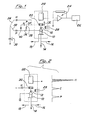
- a thermionic detector of the modified-flame type comprises, in a known manner, a nozzle 10 capable of forming a flame 12, which is supplied with the gas from the gas chromatographic column via a conduit 14, to which a second conduit 16 is connected to supply the combustible gas, in particular hydrogen, coming from a suitable source (not illustrated).
- the nozzle 10, or directly the flame 12, is also supplied with a combustion gas, in particular constituted by air, as indicated by 18.
- a combustion gas in particular constituted by air, as indicated by 18.
- an excitation electrode 20 is disposed, comprising a thermionic alkali source, which can be of any suitable type, known in itself.
- the detector comprises a second collecting electrode 22 which is connected, via an electrometric amplifier 24, to a recorder 26 which records the electrical signal coming from the collector, forming the peak chromatogram, known in itself.
- Any suitable means, schematically shown by 28, can be used to control flame ignition.
- the collecting electrode is electrically connected in such a way as to result positive both with respect to the excitation electrode 20 and to the nozzle 10.
- the excitation electrode 20 and nozzle 10 are connected to an electric circuit in continuous current, supplied by a source 30, the negative potential of which can be connected, alternatively or jointly, to a wire 32 which reaches the nozzle 10, or to a wire 34 which is connected to the excitation electrode 20.
- a shunt 36 on the wire 32 leads to a switch, schematically indicated by 38, which operates jointly with a means (not- shown) capable of circuitally connecting the wire 32 or the wire 34.
- the switch 38 has three positions, and namely a first position, indicated by N on the drawing, in which the wire 34 of the circuit is connected to the negative potential of the source 30 and therefore to the excitation electrode 20, while the nozzle 10 is connected through the shunt 36, to the ground 40.
- the second position of the switch is illustrated in fig. 1 and indicated by P, in which the nozzle 10 is connected to the negative potential of the source 30 through the shunt 32, while the wire 34 is disconnected and therefore the excitation electrode 20 is electrically insulated with respect to this circuit and to the detector mass.
- the switch 38 can be set in the position indicated by NP, in which the electrode 20 and the nozzle 10 are both connected with the negative potential of the source 30, through one or the other of the wires 32 or 34.
- the excitation electrode 20 can be moved, by means of a support on which it is mounted, axially from or towards the collecting electrode 22, in order to change, as it will be better seen later on, the response to carbon compounds.
- the response to carbon increases, while removing these two electrodes from each other the response decreases until negative peaks are obtained.
- FIG. 2 Different possible operating conditions of the detector according to the invention are schematically illustrated in figures 2 to 4, in the first one of which it can be seen that the detector is in the condition previously indicated by N, in which the nitrogen compounds are detected (see the schematical chromatogram shown as an example besides the detector scheme).
- N the condition previously indicated by the nitrogen compounds
- FIG. 4 illustrates the condition indicated by NP, which substantially corresponds to a standard operating condition, in which the sensitivity to compounds both of nitrogen and phosphorus with respect to carbon is detected.
- the operating conditions to obtain the different sensitivities of the detector according to the invention need a constant supply of hydrogen flow and the use of helium as carrier gas of the sample.
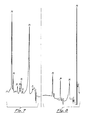
- Figures 5 and 6 show two chromatograms obtained on the same sample, the first one with a conventional flame ionization detector (FID) and the second one with a detector according to the invention, set in the condition of sensitivity to N and P with respect to C.
- FID flame ionization detector
- FIG. 5 shows two chromatograms obtained on the same sample, the first one with a conventional flame ionization detector (FID) and the second one with a detector according to the invention, set in the condition of sensitivity to N and P with respect to C.
- the chromatograms of figures 7 and 8 are, on the contrary, performed always on the same sample and with the same detector according to the invention, under conditions corresponding to N with positive C (fig. 7) and to P with negative C, respectively (fig. 8). From a comparison between the chromatograms, it can be immediately seen that the variations in the peaks allow to identify the compounds of the different chemical elements, as they have been indicated by N, P and C on the chromatograms, a posteriori, after the examination of the chromatograms themselves. Obviously, in case two subsequent chromatograms are not sufficient, it is possible to perform further analyses on the same sample, with a different adjustment of the thermionic detector. It must be noticed that the above mentioned peculiarities and features of the detector according to the invention can be modified in the details to adapt the same to different analytical situations, depending on the instruments and/or samples, without departing from the present invention as claimed.
Landscapes
- Physics & Mathematics (AREA)
- Health & Medical Sciences (AREA)
- Life Sciences & Earth Sciences (AREA)
- Chemical & Material Sciences (AREA)
- Analytical Chemistry (AREA)
- Biochemistry (AREA)
- General Health & Medical Sciences (AREA)
- General Physics & Mathematics (AREA)
- Immunology (AREA)
- Pathology (AREA)
- Other Investigation Or Analysis Of Materials By Electrical Means (AREA)
Priority Applications (1)
| Application Number | Priority Date | Filing Date | Title |
|---|---|---|---|
| AT82104293T ATE23226T1 (de) | 1981-06-09 | 1982-05-17 | Flammenveraenderungsionisationsdetektor fuer gaschromatographen und verfahren zur identifizierung von bestandteilen in einer zu analysierenden probe. |
Applications Claiming Priority (2)
| Application Number | Priority Date | Filing Date | Title |
|---|---|---|---|
| IT2219981 | 1981-06-09 | ||
| IT22199/81A IT1136664B (it) | 1981-06-09 | 1981-06-09 | Rivealtore termoionico a fiamma modificata per gas-cromatografi,e metodo di identificazione di componenti in un campione sotto analisi |
Publications (2)
| Publication Number | Publication Date |
|---|---|
| EP0066735A1 EP0066735A1 (en) | 1982-12-15 |
| EP0066735B1 true EP0066735B1 (en) | 1986-10-29 |
Family
ID=11192937
Family Applications (1)
| Application Number | Title | Priority Date | Filing Date |
|---|---|---|---|
| EP82104293A Expired EP0066735B1 (en) | 1981-06-09 | 1982-05-17 | Modified-flame thermionic detector for gas chromatographs and method for the identification of components in sample under analysis |
Country Status (6)
| Country | Link |
|---|---|
| US (1) | US4508685A (it) |
| EP (1) | EP0066735B1 (it) |
| JP (1) | JPS582648A (it) |
| AT (1) | ATE23226T1 (it) |
| DE (1) | DE3274016D1 (it) |
| IT (1) | IT1136664B (it) |
Families Citing this family (10)
| Publication number | Priority date | Publication date | Assignee | Title |
|---|---|---|---|---|
| JPS63148168U (it) * | 1987-03-23 | 1988-09-29 | ||
| JPS63255656A (ja) * | 1987-04-13 | 1988-10-21 | Yatoron:Kk | 薄層クロマトグラフ用水素炎イオン化検出装置 |
| US5073753A (en) * | 1987-08-03 | 1991-12-17 | Cambustion, Limited | Hydrocarbon flame ionization detector |
| JPS6426962U (it) * | 1987-08-08 | 1989-02-15 | ||
| JPH01117734A (ja) * | 1987-10-28 | 1989-05-10 | Nippon Suisan Kaisha Ltd | 活魚輸送用水の処理方法 |
| US4913648A (en) * | 1988-12-27 | 1990-04-03 | The United States Of America As Represented By The Secretary Of The Navy | Quartz burner for use in an atomic absorption spectrometer for the analysis of organometal compounds via hydride derivatization |
| US5126676A (en) * | 1989-11-27 | 1992-06-30 | The United States Of America As Represented By The United States Department Of Energy | Gas amplified ionization detector for gas chromatography |
| DE4011301A1 (de) * | 1990-04-06 | 1991-10-17 | Fraunhofer Ges Forschung | Schaltungsanordnung zur betriebsueberwachung eines flammenionisations-detektors und verfahren hierfuer |
| US5498548A (en) * | 1994-07-27 | 1996-03-12 | Hewlett-Packard Co. | Thermionic ionization detector with radiant heater assembly |
| US5521098A (en) * | 1994-07-27 | 1996-05-28 | Hewlett-Packard Company | Thermionic ionization detector with flow-through thermionic source |
Citations (2)
| Publication number | Priority date | Publication date | Assignee | Title |
|---|---|---|---|---|
| US3585003A (en) * | 1967-04-06 | 1971-06-15 | Varian Associates | Ionization detector for gas chromatography |
| US3852037A (en) * | 1972-05-06 | 1974-12-03 | Bodenseewerk Perkin Elmer Co | Selective ionization detector |
Family Cites Families (9)
| Publication number | Priority date | Publication date | Assignee | Title |
|---|---|---|---|---|
| US3423181A (en) * | 1966-06-06 | 1969-01-21 | Varian Associates | Thermionic detector for gas chromatography |
| FR1530453A (fr) * | 1966-11-23 | 1968-06-28 | Giravions Dorand | Détecteur à ionisation de flamme pour chromatographie en phase gazeuse |
| GB1240122A (en) * | 1967-10-31 | 1971-07-21 | Pye Ltd | Flame ionisation detector |
| DE1935624C3 (de) * | 1969-07-14 | 1979-04-19 | Hewlett-Packard Gmbh, 7030 Boeblingen | Flammenionisationsdetektor |
| US3661533A (en) * | 1969-09-22 | 1972-05-09 | Tracor | Adjustable apparatus for flame ionization and flame emission detection |
| DE2260793C3 (de) * | 1972-05-06 | 1979-05-10 | Bodenseewerk Perkin-Elmer & Co Gmbh, 7770 Ueberlingen | Selektiver Ionisationsdetektor |
| DE2257099C3 (de) * | 1972-11-21 | 1975-07-03 | Rudolf E. Dr. 6702 Bad Duerkheim Kaiser | Flammenionisationsdetektor |
| US3925025A (en) * | 1973-04-20 | 1975-12-09 | Universal Oil Prod Co | Ring-flanged slip-joint for a reactor system |
| FR2430009A1 (fr) * | 1978-06-26 | 1980-01-25 | Inst Francais Du Petrole | Detecteur a flamme ionisante pouvant fonctionner a temperature elevee |
-
1981
- 1981-06-09 IT IT22199/81A patent/IT1136664B/it active
-
1982
- 1982-05-17 AT AT82104293T patent/ATE23226T1/de not_active IP Right Cessation
- 1982-05-17 EP EP82104293A patent/EP0066735B1/en not_active Expired
- 1982-05-17 DE DE8282104293T patent/DE3274016D1/de not_active Expired
- 1982-05-26 US US06/382,313 patent/US4508685A/en not_active Expired - Fee Related
- 1982-06-09 JP JP57097922A patent/JPS582648A/ja active Pending
Patent Citations (2)
| Publication number | Priority date | Publication date | Assignee | Title |
|---|---|---|---|---|
| US3585003A (en) * | 1967-04-06 | 1971-06-15 | Varian Associates | Ionization detector for gas chromatography |
| US3852037A (en) * | 1972-05-06 | 1974-12-03 | Bodenseewerk Perkin Elmer Co | Selective ionization detector |
Also Published As
| Publication number | Publication date |
|---|---|
| IT8122199A0 (it) | 1981-06-09 |
| EP0066735A1 (en) | 1982-12-15 |
| IT1136664B (it) | 1986-09-03 |
| ATE23226T1 (de) | 1986-11-15 |
| US4508685A (en) | 1985-04-02 |
| DE3274016D1 (en) | 1986-12-04 |
| JPS582648A (ja) | 1983-01-08 |
Similar Documents
| Publication | Publication Date | Title |
|---|---|---|
| US4508685A (en) | Modified-flame thermionic detector for gas chromatographs and method for the identification of components in sample under analysis | |
| US5453613A (en) | Mass spectra interpretation system including spectra extraction | |
| US5889404A (en) | Discharge ionization detector having efficient transfer of metastables for ionization of sample molecules | |
| CA2440429A1 (en) | Method and apparatus for chromatography-high field asymmetric waveform ion mobility spectrometry | |
| EP0262223B1 (en) | Detector for gas chromatograph | |
| Lloyd et al. | Direct current atmospheric pressure argon plasma emission echelle spectrometer as a specific metal gas chromatographic detector | |
| EP0184892A1 (en) | Ionization detector for gas chromatography and method therefor | |
| EP0899560A1 (en) | Detecting compounds using induced photoionization for electron capture detection | |
| Issenberg et al. | Combined gas chromatography-mass spectrometry in flavor research. Methods and applications | |
| Stan et al. | Confirmation of organophosphorus pesticide residues in food applying gas chromatography/mass spectrometry with chemical ionization and pulsed positive negative detection | |
| Castello et al. | Analysis of polycyclic aromatic hydrocarbons with an ion-trap mass detector and comparison with other gas chromatographic and high-performance liquid chromatographic techniques | |
| GB2281627A (en) | Surface ionization detector for detecting trace amounts of organic molecules | |
| US4538066A (en) | Modulated voltage metastable ionization detector | |
| US4994748A (en) | Surface ionization detector for analyzing gas mixtures | |
| US3299693A (en) | Gas chromatographic analysis control apparatus | |
| Romanowski et al. | Gas chromatographic mass spectrometric determination of high-molecular-weight polycyclic aromatic hydrocarbons in coal tar | |
| US6107805A (en) | Extended detection zone in an ionization detector | |
| US5948141A (en) | Method and apparatus for purification of a discharge gas | |
| US3215499A (en) | Apparatus for detecting the presence of organic gases and vapours | |
| Beres et al. | A new type of argon ionisation detector | |
| Gurka et al. | Quantitation capability of a directly linked gas chromatography/Fourier transform infrared/mass spectrometry system | |
| EP0831325B1 (en) | Method and apparatus for ion discrimination in an electron capture detector | |
| US4215090A (en) | Flame ionization detector | |
| EP3788357B1 (en) | Microwave resonator flame ionization detector and corresponding method of sensing hydrocarbons in a gas sample | |
| EP1649487B1 (en) | Device for measuring and quantitative profiling of charged particle beams |
Legal Events
| Date | Code | Title | Description |
|---|---|---|---|
| PUAI | Public reference made under article 153(3) epc to a published international application that has entered the european phase |
Free format text: ORIGINAL CODE: 0009012 |
|
| AK | Designated contracting states |
Designated state(s): AT BE CH DE FR GB LI NL SE |
|
| 17P | Request for examination filed |
Effective date: 19830530 |
|
| GRAA | (expected) grant |
Free format text: ORIGINAL CODE: 0009210 |
|
| AK | Designated contracting states |
Kind code of ref document: B1 Designated state(s): AT BE CH DE FR GB LI NL SE |
|
| REF | Corresponds to: |
Ref document number: 23226 Country of ref document: AT Date of ref document: 19861115 Kind code of ref document: T |
|
| REF | Corresponds to: |
Ref document number: 3274016 Country of ref document: DE Date of ref document: 19861204 |
|
| ET | Fr: translation filed | ||
| PLBE | No opposition filed within time limit |
Free format text: ORIGINAL CODE: 0009261 |
|
| STAA | Information on the status of an ep patent application or granted ep patent |
Free format text: STATUS: NO OPPOSITION FILED WITHIN TIME LIMIT |
|
| 26N | No opposition filed | ||
| PG25 | Lapsed in a contracting state [announced via postgrant information from national office to epo] |
Ref country code: AT Effective date: 19880517 |
|
| PG25 | Lapsed in a contracting state [announced via postgrant information from national office to epo] |
Ref country code: SE Effective date: 19880518 |
|
| PG25 | Lapsed in a contracting state [announced via postgrant information from national office to epo] |
Ref country code: LI Effective date: 19880531 Ref country code: CH Effective date: 19880531 |
|
| BERE | Be: lapsed |
Owner name: CARLO ERBA STRUMENTAZIONE S.P.A. Effective date: 19880531 |
|
| REG | Reference to a national code |
Ref country code: CH Ref legal event code: PL |
|
| PG25 | Lapsed in a contracting state [announced via postgrant information from national office to epo] |
Ref country code: BE Effective date: 19890531 |
|
| PGFP | Annual fee paid to national office [announced via postgrant information from national office to epo] |
Ref country code: GB Payment date: 19900516 Year of fee payment: 9 |
|
| PGFP | Annual fee paid to national office [announced via postgrant information from national office to epo] |
Ref country code: FR Payment date: 19900522 Year of fee payment: 9 |
|
| PGFP | Annual fee paid to national office [announced via postgrant information from national office to epo] |
Ref country code: NL Payment date: 19900531 Year of fee payment: 9 |
|
| PGFP | Annual fee paid to national office [announced via postgrant information from national office to epo] |
Ref country code: DE Payment date: 19900627 Year of fee payment: 9 |
|
| PG25 | Lapsed in a contracting state [announced via postgrant information from national office to epo] |
Ref country code: GB Effective date: 19910517 |
|
| PG25 | Lapsed in a contracting state [announced via postgrant information from national office to epo] |
Ref country code: NL Effective date: 19911201 |
|
| GBPC | Gb: european patent ceased through non-payment of renewal fee | ||
| NLV4 | Nl: lapsed or anulled due to non-payment of the annual fee | ||
| PG25 | Lapsed in a contracting state [announced via postgrant information from national office to epo] |
Ref country code: FR Effective date: 19920131 |
|
| PG25 | Lapsed in a contracting state [announced via postgrant information from national office to epo] |
Ref country code: DE Effective date: 19920303 |
|
| REG | Reference to a national code |
Ref country code: FR Ref legal event code: ST |
|
| EUG | Se: european patent has lapsed |
Ref document number: 82104293.4 Effective date: 19890510 |