EP0065908B1 - ((Alkyl- et alcényl-3 pipéridyl-4)-2 éthyl)-3 indoles et leur utilisation comme médicaments - Google Patents
((Alkyl- et alcényl-3 pipéridyl-4)-2 éthyl)-3 indoles et leur utilisation comme médicaments Download PDFInfo
- Publication number
- EP0065908B1 EP0065908B1 EP82400872A EP82400872A EP0065908B1 EP 0065908 B1 EP0065908 B1 EP 0065908B1 EP 82400872 A EP82400872 A EP 82400872A EP 82400872 A EP82400872 A EP 82400872A EP 0065908 B1 EP0065908 B1 EP 0065908B1
- Authority
- EP
- European Patent Office
- Prior art keywords
- formula
- ethyl
- piperidyl
- alkyl
- indole
- Prior art date
- Legal status (The legal status is an assumption and is not a legal conclusion. Google has not performed a legal analysis and makes no representation as to the accuracy of the status listed.)
- Expired
Links
- 125000000217 alkyl group Chemical group 0.000 title claims description 7
- 150000002475 indoles Chemical class 0.000 title claims description 4
- 239000000825 pharmaceutical preparation Substances 0.000 title 1
- QZAYGJVTTNCVMB-UHFFFAOYSA-N serotonin Chemical compound C1=C(O)C=C2C(CCN)=CNC2=C1 QZAYGJVTTNCVMB-UHFFFAOYSA-N 0.000 claims description 32
- SIKJAQJRHWYJAI-UHFFFAOYSA-N Indole Chemical compound C1=CC=C2NC=CC2=C1 SIKJAQJRHWYJAI-UHFFFAOYSA-N 0.000 claims description 27
- 150000001875 compounds Chemical class 0.000 claims description 27
- PZOUSPYUWWUPPK-UHFFFAOYSA-N indole Natural products CC1=CC=CC2=C1C=CN2 PZOUSPYUWWUPPK-UHFFFAOYSA-N 0.000 claims description 13
- RKJUIXBNRJVNHR-UHFFFAOYSA-N indolenine Natural products C1=CC=C2CC=NC2=C1 RKJUIXBNRJVNHR-UHFFFAOYSA-N 0.000 claims description 13
- 238000000034 method Methods 0.000 claims description 10
- 239000002253 acid Substances 0.000 claims description 8
- 125000001495 ethyl group Chemical group [H]C([H])([H])C([H])([H])* 0.000 claims description 7
- 125000004432 carbon atom Chemical group C* 0.000 claims description 6
- 150000003839 salts Chemical class 0.000 claims description 5
- 125000003342 alkenyl group Chemical group 0.000 claims description 4
- 125000004435 hydrogen atom Chemical group [H]* 0.000 claims description 4
- HBAQYPYDRFILMT-UHFFFAOYSA-N 8-[3-(1-cyclopropylpyrazol-4-yl)-1H-pyrazolo[4,3-d]pyrimidin-5-yl]-3-methyl-3,8-diazabicyclo[3.2.1]octan-2-one Chemical class C1(CC1)N1N=CC(=C1)C1=NNC2=C1N=C(N=C2)N1C2C(N(CC1CC2)C)=O HBAQYPYDRFILMT-UHFFFAOYSA-N 0.000 claims description 3
- 150000007513 acids Chemical class 0.000 claims description 3
- 239000003814 drug Substances 0.000 claims description 3
- 125000005843 halogen group Chemical group 0.000 claims description 3
- 150000002576 ketones Chemical class 0.000 claims description 3
- 229910052751 metal Inorganic materials 0.000 claims description 3
- 239000002184 metal Substances 0.000 claims description 3
- 150000003053 piperidines Chemical class 0.000 claims description 3
- 125000003118 aryl group Chemical group 0.000 claims description 2
- 239000003795 chemical substances by application Substances 0.000 claims description 2
- 125000004663 dialkyl amino group Chemical group 0.000 claims description 2
- 229910052739 hydrogen Inorganic materials 0.000 claims description 2
- 239000001257 hydrogen Substances 0.000 claims description 2
- 239000003112 inhibitor Substances 0.000 claims description 2
- WIXJBWTUEGVXOV-UHFFFAOYSA-N C1=CC=C2C([Li])=CNC2=C1 Chemical compound C1=CC=C2C([Li])=CNC2=C1 WIXJBWTUEGVXOV-UHFFFAOYSA-N 0.000 claims 1
- 239000002269 analeptic agent Substances 0.000 claims 1
- 230000002460 anti-migrenic effect Effects 0.000 claims 1
- 230000002785 anti-thrombosis Effects 0.000 claims 1
- RTZKZFJDLAIYFH-UHFFFAOYSA-N Diethyl ether Chemical compound CCOCC RTZKZFJDLAIYFH-UHFFFAOYSA-N 0.000 description 28
- LFQSCWFLJHTTHZ-UHFFFAOYSA-N Ethanol Chemical compound CCO LFQSCWFLJHTTHZ-UHFFFAOYSA-N 0.000 description 21
- 239000000047 product Substances 0.000 description 21
- HEMHJVSKTPXQMS-UHFFFAOYSA-M Sodium hydroxide Chemical compound [OH-].[Na+] HEMHJVSKTPXQMS-UHFFFAOYSA-M 0.000 description 19
- YXFVVABEGXRONW-UHFFFAOYSA-N Toluene Chemical compound CC1=CC=CC=C1 YXFVVABEGXRONW-UHFFFAOYSA-N 0.000 description 18
- 239000000243 solution Substances 0.000 description 18
- NQRYJNQNLNOLGT-UHFFFAOYSA-N Piperidine Chemical compound C1CCNCC1 NQRYJNQNLNOLGT-UHFFFAOYSA-N 0.000 description 16
- 239000002904 solvent Substances 0.000 description 16
- VEXZGXHMUGYJMC-UHFFFAOYSA-N Hydrochloric acid Chemical compound Cl VEXZGXHMUGYJMC-UHFFFAOYSA-N 0.000 description 15
- 229940076279 serotonin Drugs 0.000 description 15
- XLYOFNOQVPJJNP-UHFFFAOYSA-N water Substances O XLYOFNOQVPJJNP-UHFFFAOYSA-N 0.000 description 15
- HEDRZPFGACZZDS-UHFFFAOYSA-N Chloroform Chemical compound ClC(Cl)Cl HEDRZPFGACZZDS-UHFFFAOYSA-N 0.000 description 14
- 238000006243 chemical reaction Methods 0.000 description 13
- XEKOWRVHYACXOJ-UHFFFAOYSA-N Ethyl acetate Chemical compound CCOC(C)=O XEKOWRVHYACXOJ-UHFFFAOYSA-N 0.000 description 12
- 239000000203 mixture Substances 0.000 description 12
- 230000002829 reductive effect Effects 0.000 description 12
- CSNNHWWHGAXBCP-UHFFFAOYSA-L Magnesium sulfate Chemical compound [Mg+2].[O-][S+2]([O-])([O-])[O-] CSNNHWWHGAXBCP-UHFFFAOYSA-L 0.000 description 10
- OKKJLVBELUTLKV-UHFFFAOYSA-N Methanol Chemical compound OC OKKJLVBELUTLKV-UHFFFAOYSA-N 0.000 description 9
- 239000012074 organic phase Substances 0.000 description 9
- CSCPPACGZOOCGX-UHFFFAOYSA-N Acetone Chemical compound CC(C)=O CSCPPACGZOOCGX-UHFFFAOYSA-N 0.000 description 8
- VYPSYNLAJGMNEJ-UHFFFAOYSA-N Silicium dioxide Chemical compound O=[Si]=O VYPSYNLAJGMNEJ-UHFFFAOYSA-N 0.000 description 7
- 210000001772 blood platelet Anatomy 0.000 description 7
- 238000009835 boiling Methods 0.000 description 7
- 239000012442 inert solvent Substances 0.000 description 7
- 239000011541 reaction mixture Substances 0.000 description 7
- QTBSBXVTEAMEQO-UHFFFAOYSA-N Acetic acid Chemical compound CC(O)=O QTBSBXVTEAMEQO-UHFFFAOYSA-N 0.000 description 6
- IJGRMHOSHXDMSA-UHFFFAOYSA-N Atomic nitrogen Chemical compound N#N IJGRMHOSHXDMSA-UHFFFAOYSA-N 0.000 description 6
- WYURNTSHIVDZCO-UHFFFAOYSA-N Tetrahydrofuran Chemical compound C1CCOC1 WYURNTSHIVDZCO-UHFFFAOYSA-N 0.000 description 6
- YYROPELSRYBVMQ-UHFFFAOYSA-N 4-toluenesulfonyl chloride Chemical compound CC1=CC=C(S(Cl)(=O)=O)C=C1 YYROPELSRYBVMQ-UHFFFAOYSA-N 0.000 description 5
- 239000003480 eluent Substances 0.000 description 5
- 238000000655 nuclear magnetic resonance spectrum Methods 0.000 description 5
- 238000010992 reflux Methods 0.000 description 5
- JLAKCHGEEBPDQI-UHFFFAOYSA-N 4-(4-fluorobenzyl)piperidine Chemical compound C1=CC(F)=CC=C1CC1CCNCC1 JLAKCHGEEBPDQI-UHFFFAOYSA-N 0.000 description 4
- MZRVEZGGRBJDDB-UHFFFAOYSA-N N-Butyllithium Chemical compound [Li]CCCC MZRVEZGGRBJDDB-UHFFFAOYSA-N 0.000 description 4
- JUJWROOIHBZHMG-UHFFFAOYSA-N Pyridine Chemical compound C1=CC=NC=C1 JUJWROOIHBZHMG-UHFFFAOYSA-N 0.000 description 4
- 239000007864 aqueous solution Substances 0.000 description 4
- HPNMFZURTQLUMO-UHFFFAOYSA-N diethylamine Chemical compound CCNCC HPNMFZURTQLUMO-UHFFFAOYSA-N 0.000 description 4
- SADQVAVFGNTEOD-UHFFFAOYSA-N indalpine Chemical compound C=1NC2=CC=CC=C2C=1CCC1CCNCC1 SADQVAVFGNTEOD-UHFFFAOYSA-N 0.000 description 4
- 229950002473 indalpine Drugs 0.000 description 4
- HSZCZNFXUDYRKD-UHFFFAOYSA-M lithium iodide Chemical compound [Li+].[I-] HSZCZNFXUDYRKD-UHFFFAOYSA-M 0.000 description 4
- 229910052943 magnesium sulfate Inorganic materials 0.000 description 4
- 235000019341 magnesium sulphate Nutrition 0.000 description 4
- 238000002844 melting Methods 0.000 description 4
- 230000008018 melting Effects 0.000 description 4
- BWHMMNNQKKPAPP-UHFFFAOYSA-L potassium carbonate Chemical compound [K+].[K+].[O-]C([O-])=O BWHMMNNQKKPAPP-UHFFFAOYSA-L 0.000 description 4
- FYSNRJHAOHDILO-UHFFFAOYSA-N thionyl chloride Chemical compound ClS(Cl)=O FYSNRJHAOHDILO-UHFFFAOYSA-N 0.000 description 4
- 125000000391 vinyl group Chemical group [H]C([*])=C([H])[H] 0.000 description 4
- ZWEHNKRNPOVVGH-UHFFFAOYSA-N 2-Butanone Chemical compound CCC(C)=O ZWEHNKRNPOVVGH-UHFFFAOYSA-N 0.000 description 3
- UHOVQNZJYSORNB-UHFFFAOYSA-N Benzene Chemical compound C1=CC=CC=C1 UHOVQNZJYSORNB-UHFFFAOYSA-N 0.000 description 3
- YMWUJEATGCHHMB-UHFFFAOYSA-N Dichloromethane Chemical compound ClCCl YMWUJEATGCHHMB-UHFFFAOYSA-N 0.000 description 3
- LYCAIKOWRPUZTN-UHFFFAOYSA-N Ethylene glycol Chemical compound OCCO LYCAIKOWRPUZTN-UHFFFAOYSA-N 0.000 description 3
- ZMANZCXQSJIPKH-UHFFFAOYSA-N Triethylamine Chemical compound CCN(CC)CC ZMANZCXQSJIPKH-UHFFFAOYSA-N 0.000 description 3
- 235000011054 acetic acid Nutrition 0.000 description 3
- WETWJCDKMRHUPV-UHFFFAOYSA-N acetyl chloride Chemical compound CC(Cl)=O WETWJCDKMRHUPV-UHFFFAOYSA-N 0.000 description 3
- 229910052799 carbon Inorganic materials 0.000 description 3
- 239000003054 catalyst Substances 0.000 description 3
- 239000002198 insoluble material Substances 0.000 description 3
- 239000002609 medium Substances 0.000 description 3
- VLKZOEOYAKHREP-UHFFFAOYSA-N n-Hexane Chemical compound CCCCCC VLKZOEOYAKHREP-UHFFFAOYSA-N 0.000 description 3
- 210000002569 neuron Anatomy 0.000 description 3
- 229910052757 nitrogen Inorganic materials 0.000 description 3
- 125000001037 p-tolyl group Chemical group [H]C1=C([H])C(=C([H])C([H])=C1*)C([H])([H])[H] 0.000 description 3
- WWPITPSIWMXDPE-UHFFFAOYSA-N para-chloroamphetamine Chemical compound CC(N)CC1=CC=C(Cl)C=C1 WWPITPSIWMXDPE-UHFFFAOYSA-N 0.000 description 3
- 239000012071 phase Substances 0.000 description 3
- 239000000741 silica gel Substances 0.000 description 3
- 229910002027 silica gel Inorganic materials 0.000 description 3
- YLQBMQCUIZJEEH-UHFFFAOYSA-N tetrahydrofuran Natural products C=1C=COC=1 YLQBMQCUIZJEEH-UHFFFAOYSA-N 0.000 description 3
- 0 **1C=Cc([n]cc2)c2C=C1 Chemical compound **1C=Cc([n]cc2)c2C=C1 0.000 description 2
- XNWFRZJHXBZDAG-UHFFFAOYSA-N 2-METHOXYETHANOL Chemical compound COCCO XNWFRZJHXBZDAG-UHFFFAOYSA-N 0.000 description 2
- IKHGUXGNUITLKF-UHFFFAOYSA-N Acetaldehyde Chemical compound CC=O IKHGUXGNUITLKF-UHFFFAOYSA-N 0.000 description 2
- 239000004215 Carbon black (E152) Substances 0.000 description 2
- WHXSMMKQMYFTQS-UHFFFAOYSA-N Lithium Chemical compound [Li] WHXSMMKQMYFTQS-UHFFFAOYSA-N 0.000 description 2
- FYYHWMGAXLPEAU-UHFFFAOYSA-N Magnesium Chemical compound [Mg] FYYHWMGAXLPEAU-UHFFFAOYSA-N 0.000 description 2
- 208000019695 Migraine disease Diseases 0.000 description 2
- 241000699670 Mus sp. Species 0.000 description 2
- 238000005481 NMR spectroscopy Methods 0.000 description 2
- PXHVJJICTQNCMI-UHFFFAOYSA-N Nickel Chemical compound [Ni] PXHVJJICTQNCMI-UHFFFAOYSA-N 0.000 description 2
- KDLHZDBZIXYQEI-UHFFFAOYSA-N Palladium Chemical compound [Pd] KDLHZDBZIXYQEI-UHFFFAOYSA-N 0.000 description 2
- ZLMJMSJWJFRBEC-UHFFFAOYSA-N Potassium Chemical compound [K] ZLMJMSJWJFRBEC-UHFFFAOYSA-N 0.000 description 2
- 150000001298 alcohols Chemical class 0.000 description 2
- 150000001412 amines Chemical class 0.000 description 2
- 239000008346 aqueous phase Substances 0.000 description 2
- PASDCCFISLVPSO-UHFFFAOYSA-N benzoyl chloride Chemical compound ClC(=O)C1=CC=CC=C1 PASDCCFISLVPSO-UHFFFAOYSA-N 0.000 description 2
- HSDAJNMJOMSNEV-UHFFFAOYSA-N benzyl chloroformate Chemical compound ClC(=O)OCC1=CC=CC=C1 HSDAJNMJOMSNEV-UHFFFAOYSA-N 0.000 description 2
- 125000001584 benzyloxycarbonyl group Chemical group C(=O)(OCC1=CC=CC=C1)* 0.000 description 2
- 230000015572 biosynthetic process Effects 0.000 description 2
- GDTBXPJZTBHREO-UHFFFAOYSA-N bromine Chemical compound BrBr GDTBXPJZTBHREO-UHFFFAOYSA-N 0.000 description 2
- 239000002775 capsule Substances 0.000 description 2
- 239000003638 chemical reducing agent Substances 0.000 description 2
- 239000000460 chlorine Substances 0.000 description 2
- 229910052801 chlorine Inorganic materials 0.000 description 2
- 150000001805 chlorine compounds Chemical class 0.000 description 2
- 238000001816 cooling Methods 0.000 description 2
- 238000002425 crystallisation Methods 0.000 description 2
- 230000008025 crystallization Effects 0.000 description 2
- 229940079593 drug Drugs 0.000 description 2
- 230000000694 effects Effects 0.000 description 2
- 239000000706 filtrate Substances 0.000 description 2
- 238000010438 heat treatment Methods 0.000 description 2
- 229930195733 hydrocarbon Natural products 0.000 description 2
- 150000002430 hydrocarbons Chemical class 0.000 description 2
- 238000005984 hydrogenation reaction Methods 0.000 description 2
- 238000006460 hydrolysis reaction Methods 0.000 description 2
- 230000002401 inhibitory effect Effects 0.000 description 2
- 230000005764 inhibitory process Effects 0.000 description 2
- 229910052744 lithium Inorganic materials 0.000 description 2
- -1 lithium triethylborohydride Chemical compound 0.000 description 2
- VXWPONVCMVLXBW-UHFFFAOYSA-M magnesium;carbanide;iodide Chemical compound [CH3-].[Mg+2].[I-] VXWPONVCMVLXBW-UHFFFAOYSA-M 0.000 description 2
- 231100000252 nontoxic Toxicity 0.000 description 2
- 230000003000 nontoxic effect Effects 0.000 description 2
- 230000000144 pharmacologic effect Effects 0.000 description 2
- 125000005936 piperidyl group Chemical group 0.000 description 2
- BASFCYQUMIYNBI-UHFFFAOYSA-N platinum Chemical compound [Pt] BASFCYQUMIYNBI-UHFFFAOYSA-N 0.000 description 2
- 239000011591 potassium Substances 0.000 description 2
- 229910052700 potassium Inorganic materials 0.000 description 2
- 229910000027 potassium carbonate Inorganic materials 0.000 description 2
- 230000003389 potentiating effect Effects 0.000 description 2
- 239000003586 protic polar solvent Substances 0.000 description 2
- UMJSCPRVCHMLSP-UHFFFAOYSA-N pyridine Natural products COC1=CC=CN=C1 UMJSCPRVCHMLSP-UHFFFAOYSA-N 0.000 description 2
- 230000000697 serotonin reuptake Effects 0.000 description 2
- 239000000377 silicon dioxide Substances 0.000 description 2
- 239000000126 substance Substances 0.000 description 2
- UOCLXMDMGBRAIB-UHFFFAOYSA-N 1,1,1-trichloroethane Chemical compound CC(Cl)(Cl)Cl UOCLXMDMGBRAIB-UHFFFAOYSA-N 0.000 description 1
- VUIMBZIZZFSQEE-UHFFFAOYSA-N 1-(1h-indol-3-yl)ethanone Chemical compound C1=CC=C2C(C(=O)C)=CNC2=C1 VUIMBZIZZFSQEE-UHFFFAOYSA-N 0.000 description 1
- NGNBDVOYPDDBFK-UHFFFAOYSA-N 2-[2,4-di(pentan-2-yl)phenoxy]acetyl chloride Chemical compound CCCC(C)C1=CC=C(OCC(Cl)=O)C(C(C)CCC)=C1 NGNBDVOYPDDBFK-UHFFFAOYSA-N 0.000 description 1
- ZCYVEMRRCGMTRW-UHFFFAOYSA-N 7553-56-2 Chemical group [I] ZCYVEMRRCGMTRW-UHFFFAOYSA-N 0.000 description 1
- 101100515517 Arabidopsis thaliana XI-I gene Proteins 0.000 description 1
- CPELXLSAUQHCOX-UHFFFAOYSA-M Bromide Chemical compound [Br-] CPELXLSAUQHCOX-UHFFFAOYSA-M 0.000 description 1
- OKTJSMMVPCPJKN-UHFFFAOYSA-N Carbon Chemical compound [C] OKTJSMMVPCPJKN-UHFFFAOYSA-N 0.000 description 1
- BVKZGUZCCUSVTD-UHFFFAOYSA-L Carbonate Chemical compound [O-]C([O-])=O BVKZGUZCCUSVTD-UHFFFAOYSA-L 0.000 description 1
- VEXZGXHMUGYJMC-UHFFFAOYSA-M Chloride anion Chemical compound [Cl-] VEXZGXHMUGYJMC-UHFFFAOYSA-M 0.000 description 1
- KZBUYRJDOAKODT-UHFFFAOYSA-N Chlorine Chemical compound ClCl KZBUYRJDOAKODT-UHFFFAOYSA-N 0.000 description 1
- ZAMOUSCENKQFHK-UHFFFAOYSA-N Chlorine atom Chemical compound [Cl] ZAMOUSCENKQFHK-UHFFFAOYSA-N 0.000 description 1
- XDTMQSROBMDMFD-UHFFFAOYSA-N Cyclohexane Chemical compound C1CCCCC1 XDTMQSROBMDMFD-UHFFFAOYSA-N 0.000 description 1
- ZAFNJMIOTHYJRJ-UHFFFAOYSA-N Diisopropyl ether Chemical compound CC(C)OC(C)C ZAFNJMIOTHYJRJ-UHFFFAOYSA-N 0.000 description 1
- XTHFKEDIFFGKHM-UHFFFAOYSA-N Dimethoxyethane Chemical compound COCCOC XTHFKEDIFFGKHM-UHFFFAOYSA-N 0.000 description 1
- PXGOKWXKJXAPGV-UHFFFAOYSA-N Fluorine Chemical compound FF PXGOKWXKJXAPGV-UHFFFAOYSA-N 0.000 description 1
- 239000007818 Grignard reagent Substances 0.000 description 1
- DGAQECJNVWCQMB-PUAWFVPOSA-M Ilexoside XXIX Chemical compound C[C@@H]1CC[C@@]2(CC[C@@]3(C(=CC[C@H]4[C@]3(CC[C@@H]5[C@@]4(CC[C@@H](C5(C)C)OS(=O)(=O)[O-])C)C)[C@@H]2[C@]1(C)O)C)C(=O)O[C@H]6[C@@H]([C@H]([C@@H]([C@H](O6)CO)O)O)O.[Na+] DGAQECJNVWCQMB-PUAWFVPOSA-M 0.000 description 1
- 239000012448 Lithium borohydride Substances 0.000 description 1
- 101100406879 Neurospora crassa (strain ATCC 24698 / 74-OR23-1A / CBS 708.71 / DSM 1257 / FGSC 987) par-2 gene Proteins 0.000 description 1
- CTQNGGLPUBDAKN-UHFFFAOYSA-N O-Xylene Chemical compound CC1=CC=CC=C1C CTQNGGLPUBDAKN-UHFFFAOYSA-N 0.000 description 1
- KJTLSVCANCCWHF-UHFFFAOYSA-N Ruthenium Chemical compound [Ru] KJTLSVCANCCWHF-UHFFFAOYSA-N 0.000 description 1
- QAOWNCQODCNURD-UHFFFAOYSA-L Sulfate Chemical compound [O-]S([O-])(=O)=O QAOWNCQODCNURD-UHFFFAOYSA-L 0.000 description 1
- 208000007536 Thrombosis Diseases 0.000 description 1
- HEDRZPFGACZZDS-MICDWDOJSA-N Trichloro(2H)methane Chemical compound [2H]C(Cl)(Cl)Cl HEDRZPFGACZZDS-MICDWDOJSA-N 0.000 description 1
- WJGAPUXHSQQWQF-UHFFFAOYSA-N acetic acid;hydrochloride Chemical compound Cl.CC(O)=O WJGAPUXHSQQWQF-UHFFFAOYSA-N 0.000 description 1
- 150000001243 acetic acids Chemical class 0.000 description 1
- 230000002378 acidificating effect Effects 0.000 description 1
- 239000013543 active substance Substances 0.000 description 1
- 230000007059 acute toxicity Effects 0.000 description 1
- 231100000403 acute toxicity Toxicity 0.000 description 1
- 238000013019 agitation Methods 0.000 description 1
- AZDRQVAHHNSJOQ-UHFFFAOYSA-N alumane Chemical compound [AlH3] AZDRQVAHHNSJOQ-UHFFFAOYSA-N 0.000 description 1
- 229910052782 aluminium Inorganic materials 0.000 description 1
- 208000022531 anorexia Diseases 0.000 description 1
- 239000003146 anticoagulant agent Substances 0.000 description 1
- 239000000935 antidepressant agent Substances 0.000 description 1
- 229940005513 antidepressants Drugs 0.000 description 1
- 229940054051 antipsychotic indole derivative Drugs 0.000 description 1
- 229960004676 antithrombotic agent Drugs 0.000 description 1
- 239000012736 aqueous medium Substances 0.000 description 1
- 125000004429 atom Chemical group 0.000 description 1
- 125000003236 benzoyl group Chemical group [H]C1=C([H])C([H])=C(C([H])=C1[H])C(*)=O 0.000 description 1
- 229910052794 bromium Inorganic materials 0.000 description 1
- 238000009903 catalytic hydrogenation reaction Methods 0.000 description 1
- 239000012320 chlorinating reagent Substances 0.000 description 1
- 238000004587 chromatography analysis Methods 0.000 description 1
- 238000006482 condensation reaction Methods 0.000 description 1
- 238000007796 conventional method Methods 0.000 description 1
- 230000001186 cumulative effect Effects 0.000 description 1
- 206010061428 decreased appetite Diseases 0.000 description 1
- 230000003247 decreasing effect Effects 0.000 description 1
- 230000001419 dependent effect Effects 0.000 description 1
- PBGGNZZGJIKBMJ-UHFFFAOYSA-N di(propan-2-yl)azanide Chemical compound CC(C)[N-]C(C)C PBGGNZZGJIKBMJ-UHFFFAOYSA-N 0.000 description 1
- 238000004821 distillation Methods 0.000 description 1
- 230000009977 dual effect Effects 0.000 description 1
- DQYBDCGIPTYXML-UHFFFAOYSA-N ethoxyethane;hydrate Chemical compound O.CCOCC DQYBDCGIPTYXML-UHFFFAOYSA-N 0.000 description 1
- 238000001704 evaporation Methods 0.000 description 1
- 230000008020 evaporation Effects 0.000 description 1
- 230000001747 exhibiting effect Effects 0.000 description 1
- 238000000605 extraction Methods 0.000 description 1
- 229910052731 fluorine Inorganic materials 0.000 description 1
- 239000011737 fluorine Substances 0.000 description 1
- 150000004795 grignard reagents Chemical class 0.000 description 1
- 150000004820 halides Chemical class 0.000 description 1
- 210000005260 human cell Anatomy 0.000 description 1
- 230000007062 hydrolysis Effects 0.000 description 1
- 230000035873 hypermotility Effects 0.000 description 1
- BCGWQEUPMDMJNV-UHFFFAOYSA-N imipramine Chemical compound C1CC2=CC=CC=C2N(CCCN(C)C)C2=CC=CC=C21 BCGWQEUPMDMJNV-UHFFFAOYSA-N 0.000 description 1
- 229960004801 imipramine Drugs 0.000 description 1
- 229910052500 inorganic mineral Inorganic materials 0.000 description 1
- 229910052740 iodine Inorganic materials 0.000 description 1
- 230000000670 limiting effect Effects 0.000 description 1
- 229910000103 lithium hydride Inorganic materials 0.000 description 1
- 239000011777 magnesium Substances 0.000 description 1
- 229910052749 magnesium Inorganic materials 0.000 description 1
- 150000002736 metal compounds Chemical class 0.000 description 1
- 229910052987 metal hydride Inorganic materials 0.000 description 1
- 150000004681 metal hydrides Chemical class 0.000 description 1
- WSFSSNUMVMOOMR-NJFSPNSNSA-N methanone Chemical compound O=[14CH2] WSFSSNUMVMOOMR-NJFSPNSNSA-N 0.000 description 1
- 206010027599 migraine Diseases 0.000 description 1
- 239000011707 mineral Substances 0.000 description 1
- 235000010755 mineral Nutrition 0.000 description 1
- 150000007522 mineralic acids Chemical class 0.000 description 1
- 230000001537 neural effect Effects 0.000 description 1
- 229910052759 nickel Inorganic materials 0.000 description 1
- 150000007524 organic acids Chemical class 0.000 description 1
- 150000007530 organic bases Chemical class 0.000 description 1
- MUMZUERVLWJKNR-UHFFFAOYSA-N oxoplatinum Chemical compound [Pt]=O MUMZUERVLWJKNR-UHFFFAOYSA-N 0.000 description 1
- 229910052763 palladium Inorganic materials 0.000 description 1
- NHKJPPKXDNZFBJ-UHFFFAOYSA-N phenyllithium Chemical compound [Li]C1=CC=CC=C1 NHKJPPKXDNZFBJ-UHFFFAOYSA-N 0.000 description 1
- 125000003386 piperidinyl group Chemical group 0.000 description 1
- 210000002381 plasma Anatomy 0.000 description 1
- 229910052697 platinum Inorganic materials 0.000 description 1
- 229910003446 platinum oxide Inorganic materials 0.000 description 1
- 229940001470 psychoactive drug Drugs 0.000 description 1
- 239000004089 psychotropic agent Substances 0.000 description 1
- 230000008929 regeneration Effects 0.000 description 1
- 238000011069 regeneration method Methods 0.000 description 1
- 230000002441 reversible effect Effects 0.000 description 1
- 229910052703 rhodium Inorganic materials 0.000 description 1
- 239000010948 rhodium Substances 0.000 description 1
- MHOVAHRLVXNVSD-UHFFFAOYSA-N rhodium atom Chemical compound [Rh] MHOVAHRLVXNVSD-UHFFFAOYSA-N 0.000 description 1
- 229910052707 ruthenium Inorganic materials 0.000 description 1
- 239000003772 serotonin uptake inhibitor Substances 0.000 description 1
- 239000011734 sodium Substances 0.000 description 1
- 229910052708 sodium Inorganic materials 0.000 description 1
- CDBYLPFSWZWCQE-UHFFFAOYSA-L sodium carbonate Substances [Na+].[Na+].[O-]C([O-])=O CDBYLPFSWZWCQE-UHFFFAOYSA-L 0.000 description 1
- 229910000029 sodium carbonate Inorganic materials 0.000 description 1
- 239000000829 suppository Substances 0.000 description 1
- 230000000946 synaptic effect Effects 0.000 description 1
- 239000003826 tablet Substances 0.000 description 1
- 150000003512 tertiary amines Chemical class 0.000 description 1
- CZDYPVPMEAXLPK-UHFFFAOYSA-N tetramethylsilane Chemical compound C[Si](C)(C)C CZDYPVPMEAXLPK-UHFFFAOYSA-N 0.000 description 1
- 230000001225 therapeutic effect Effects 0.000 description 1
- 238000002560 therapeutic procedure Methods 0.000 description 1
- 239000003440 toxic substance Substances 0.000 description 1
- 230000002110 toxicologic effect Effects 0.000 description 1
- 231100000723 toxicological property Toxicity 0.000 description 1
- 230000017105 transposition Effects 0.000 description 1
- 230000006442 vascular tone Effects 0.000 description 1
- 239000008096 xylene Substances 0.000 description 1
Classifications
-
- C—CHEMISTRY; METALLURGY
- C07—ORGANIC CHEMISTRY
- C07D—HETEROCYCLIC COMPOUNDS
- C07D211/00—Heterocyclic compounds containing hydrogenated pyridine rings, not condensed with other rings
- C07D211/04—Heterocyclic compounds containing hydrogenated pyridine rings, not condensed with other rings with only hydrogen or carbon atoms directly attached to the ring nitrogen atom
- C07D211/06—Heterocyclic compounds containing hydrogenated pyridine rings, not condensed with other rings with only hydrogen or carbon atoms directly attached to the ring nitrogen atom having no double bonds between ring members or between ring members and non-ring members
- C07D211/08—Heterocyclic compounds containing hydrogenated pyridine rings, not condensed with other rings with only hydrogen or carbon atoms directly attached to the ring nitrogen atom having no double bonds between ring members or between ring members and non-ring members with hydrocarbon or substituted hydrocarbon radicals directly attached to ring carbon atoms
- C07D211/18—Heterocyclic compounds containing hydrogenated pyridine rings, not condensed with other rings with only hydrogen or carbon atoms directly attached to the ring nitrogen atom having no double bonds between ring members or between ring members and non-ring members with hydrocarbon or substituted hydrocarbon radicals directly attached to ring carbon atoms with substituted hydrocarbon radicals attached to ring carbon atoms
-
- A—HUMAN NECESSITIES
- A61—MEDICAL OR VETERINARY SCIENCE; HYGIENE
- A61P—SPECIFIC THERAPEUTIC ACTIVITY OF CHEMICAL COMPOUNDS OR MEDICINAL PREPARATIONS
- A61P43/00—Drugs for specific purposes, not provided for in groups A61P1/00-A61P41/00
-
- C—CHEMISTRY; METALLURGY
- C07—ORGANIC CHEMISTRY
- C07D—HETEROCYCLIC COMPOUNDS
- C07D211/00—Heterocyclic compounds containing hydrogenated pyridine rings, not condensed with other rings
- C07D211/04—Heterocyclic compounds containing hydrogenated pyridine rings, not condensed with other rings with only hydrogen or carbon atoms directly attached to the ring nitrogen atom
- C07D211/06—Heterocyclic compounds containing hydrogenated pyridine rings, not condensed with other rings with only hydrogen or carbon atoms directly attached to the ring nitrogen atom having no double bonds between ring members or between ring members and non-ring members
- C07D211/08—Heterocyclic compounds containing hydrogenated pyridine rings, not condensed with other rings with only hydrogen or carbon atoms directly attached to the ring nitrogen atom having no double bonds between ring members or between ring members and non-ring members with hydrocarbon or substituted hydrocarbon radicals directly attached to ring carbon atoms
- C07D211/18—Heterocyclic compounds containing hydrogenated pyridine rings, not condensed with other rings with only hydrogen or carbon atoms directly attached to the ring nitrogen atom having no double bonds between ring members or between ring members and non-ring members with hydrocarbon or substituted hydrocarbon radicals directly attached to ring carbon atoms with substituted hydrocarbon radicals attached to ring carbon atoms
- C07D211/20—Heterocyclic compounds containing hydrogenated pyridine rings, not condensed with other rings with only hydrogen or carbon atoms directly attached to the ring nitrogen atom having no double bonds between ring members or between ring members and non-ring members with hydrocarbon or substituted hydrocarbon radicals directly attached to ring carbon atoms with substituted hydrocarbon radicals attached to ring carbon atoms with hydrocarbon radicals, substituted by singly bound oxygen or sulphur atoms
- C07D211/22—Heterocyclic compounds containing hydrogenated pyridine rings, not condensed with other rings with only hydrogen or carbon atoms directly attached to the ring nitrogen atom having no double bonds between ring members or between ring members and non-ring members with hydrocarbon or substituted hydrocarbon radicals directly attached to ring carbon atoms with substituted hydrocarbon radicals attached to ring carbon atoms with hydrocarbon radicals, substituted by singly bound oxygen or sulphur atoms by oxygen atoms
Definitions
- the subject of the present invention is the compounds of general formula: in which X represents a hydrogen or halogen atom, for example fluorine or chlorine, and R represents an alkyl or alkenyl group having 1 to 3 carbon atoms.
- the molecule of the compounds of formula II has two asymmetric carbon atoms; there are therefore, for a given meaning of X and R, two diastereoisomers, called respectively cis compound and trans compound depending on whether the group R and the group fixed in position 4 on the piperidyl ring are in cis position or in trans position l 'one over the other.
- These two diastereoisomers can be represented schematically by the following formulas:
- Each diastereoisomer corresponds to a racemic and two enantiomers, each enantiomer corresponding to an absolute configuration determined rectus (R) or sinister (S) of the carbons in positions 3 and 4 of the piperidyl ring.
- the compounds of general formula II can be prepared by reaction of an indole derivative of formula: in which X has the same meanings as in formula II with a metal derivative of formula R'Li, in which R 'represents an alkyl or aryl group or a dialkylamino group, reaction of the metal compound thus obtained (formula IV of the scheme below) below) with a piperidine derivative of formula: in which R has the same meanings as in formula II, and hydrolysis of the compound thus obtained (formula VI). All of the reactions can be diagrammed as follows:
- reaction designated above a is carried out in an inert solvent: an ether such as diethyl ether, tetrahydrofuran or dimethoxyethane or a hydrocarbon such as benzene, toluene or xylene, or a mixture of these solvents, at a temperature between -10 and + 20 ° C.
- an ether such as diethyl ether, tetrahydrofuran or dimethoxyethane
- a hydrocarbon such as benzene, toluene or xylene, or a mixture of these solvents
- R'Li use is preferably made of lithium phenyllithium, butyllithium or diisopropylamide.
- the condensation reaction b is carried out in the same solvents as reaction a and at a temperature between 0 ° C. and the boiling point of the solvent.
- the hydrolysis reaction c which consists in replacing the benzoyl group with a hydrogen atom, is carried out according to methods known per se, for example by means of sodium hydroxide in a hydroorganic medium, such as a mixture of water and ethylene glycol or a mixture of water and ethylene glycol monomethyl ether, at the boiling temperature of the medium used.
- a hydroorganic medium such as a mixture of water and ethylene glycol or a mixture of water and ethylene glycol monomethyl ether
- the piperidine derivatives of formula V can be prepared according to the following reaction scheme:
- the reaction d of benzoyl chloride on the alcohols of formula VII is advantageously carried out in the presence of an organic base such as a tertiary amine, for example triethylamine, or inorganic, such as sodium hydroxide or carbonate or potassium in aqueous solution.
- an organic base such as a tertiary amine, for example triethylamine, or inorganic, such as sodium hydroxide or carbonate or potassium in aqueous solution.
- the operation is carried out in an inert solvent such as chloroform or 1,1,1-trichloroethane at a temperature between 20 ° C. and the boiling point of the solvent used.
- reaction e of paratoluenesulfonyl chloride (tosyl chloride) with the alcohols of formula VIII is carried out at a temperature between -20 ° C. and room temperature, in an inert solvent and in the presence of a base. (preferably an amine).
- a base preferably an amine
- reaction f The products obtained, of formula IX, are then treated (reaction f) with lithium iodide in an inert solvent, such as acetone or methyl ethyl ketone, at a temperature between 0 and 30 ° C.
- an inert solvent such as acetone or methyl ethyl ketone
- the products of formula II can also be prepared by reduction of the ketone derivatives of general formula: in which R and X have the same meanings as in formula II.
- a metal hydride can be used such as sodium, potassium or lithium borohydride or lithium triethylborohydride, or alternatively aluminum and lithium hydride, within suitable solvents known for each of these. reducing agents, at temperatures between 0 ° C and the boiling point of the solvent used.
- ketone derivatives of formula X can be prepared according to the following reaction scheme:
- the Grignard reagent of formula XI in which X has the same meaning as in formula II and X 'represents a chlorine, bromine or iodine atom, is obtained by action on the corresponding indole of a halide d 'alkylmagnesium such as chloride, bromide or methylmagnesium iodide in an ether as diethyl ether, generally at the boiling point of the solvent.
- a halide d 'alkylmagnesium such as chloride, bromide or methylmagnesium iodide in an ether as diethyl ether, generally at the boiling point of the solvent.
- reaction h The cutting of the benzyloxycarbonyl group (reaction h) can be carried out with an acid such as hydrochloric acid in an inert solvent such as acetic acid or ethanol at a temperature included between 20 ° C and the boiling point of the solvent used.
- an acid such as hydrochloric acid
- an inert solvent such as acetic acid or ethanol
- the acid chlorides of formula XII can be prepared in 2 steps from the piperidyl-4 acetic acids of formula XIV below, in which R has the same meanings as in formula II according to the following reaction scheme:
- the acids of formula XIV are treated with benzyl chloroformate (BCI) in solution in a hydrocarbon in the presence of a base such as sodium hydroxide in aqueous solution at a temperature between 10 and 40 ° C.
- BCI benzyl chloroformate
- the acids obtained of formula XV are converted into acid chlorides of formula XII by the action of a chlorinating agent such as thionyl chloride in an inert solvent such as chloroform and at the boiling point of the solvent used.
- the compounds of formula II in which R represents an alkyl group having 2 to 3 carbon atoms, can also be prepared by catalytic hydrogenation of the corresponding products of formula II in which R represents an alkenyl group or their salts.
- This hydrogenation can be carried out at atmospheric pressure, at a temperature between 20 and 50 ° C in an inert solvent such as an alcohol (for example methanol or ethanol) or an acid (for example acetic acid) in the presence of a catalyst such as palladium, nickel, rhodium, ruthenium or platinum.
- the compounds of formula II in which R represents the vinyl group and whose carbon atom of the piperidine ring carrying the vinyl group has a given configuration rectus (R) or sinister (S), can be prepared by heating to a higher temperature at 50 ° C, in a protic solvent or a mixture of protic solvents, in the presence or in the absence of formaldehyde, corresponding compounds of formula II in which R represents the vinyl group and the atom of which carbon of the piperidine cycle carrying the vinyl group in the reverse, sinister (S) or rectus (R) configuration, partially or completely salified, according to the method of European patent No 0005654. Heating can be carried out in particular in an acidic aqueous medium of pH close to 6, at a temperature of 120 to 160 ° C.
- reaction mixtures obtained according to the various processes described above are treated according to conventional methods, physical (evaporation, extraction using a solvent, distillation, crystallization, chromatography, etc.) or chemical (salt formation and regeneration of the base, etc.), in order to isolate the compounds of formula II in the pure state.
- the compounds of formula II in the form of free bases can optionally be converted into addition salts with a mineral or organic acid by the action of such an acid in an appropriate solvent.
- the following examples illustrate the invention without limiting it.
- the data relating to the nuclear magnetic resonance spectra (abbreviated to NMR) appearing in these examples relate to the nuclear magnetic resonance of the protons of the compounds in the basic state in solution in deuterochloroform (unless stated otherwise).
- the chemical shifts 8 are measured using tetramethylsilane as a reference.
- Benzoyl-1 vinyl-3 (R) iodoethyl-4 (S) piperidine is prepared in 3 stages, as follows:
- Vinyl-3 (R) piperidyl-4 (S) ethanol can be prepared according to R. Lukes, "Chem. Listy ”, 47, 858 (1953).
- Hydrogenation is carried out for 3 h at room temperature and at atmospheric pressure 0.250 g of ⁇ [vinyl-3 (R) piperidyl-4 (R)] - ethyl ⁇ -3 indole in 1 ml of normal hydrochloric acid and 9 ml of ethanol in the presence of 0.04 g of platinum oxide as catalyst.
- the catalyst is filtered, the filtrate is evaporated to dryness, the residue is taken up in 100 ml of water, the aqueous phase is washed with ether, it is made alkaline with an aqueous solution of sodium hydroxide and the insoluble material is extracted with l 'ethyl acetate.
- the organic phase is dried over magnesium sulfate and evaporated to dryness under reduced pressure. 0.180 g of product melting at 150 ° C. is obtained.
- the results are expressed by an inhibitory dose 50% or 150 which represents the dose of product, in micromoles per liter, decreasing by 50% the uptake of serotonin.
- the acute toxicity of the products was determined in male CO 1 mice (Charles River) by the oral route.
- the LD 50 calculated, after 3 days of observation, by the cumulative method of JJ Reed et al. ("Am. J. Hyg.”, 27, 493, 1938) is 225 mg / kg for the compound of Example 1 and approximately 200 mg / kg for the compound of Example 4.
- the compounds according to the invention are non-toxic at 100 mg / kg and therefore behave like relatively non-toxic substances in mice.
- the compounds of the invention and their pharmaceutically acceptable salts can be used in human therapy in the form of tablets, capsules, capsules, suppositories, ingestible or injectable solutions, etc., as regulators of serotonin-dependent vascular tone, in particular for the treatment of migraines, as anti-thrombotic agents and as particularly rapid thymoanaleptic drugs (because of their action on the release of serotonin).
- the dosage depends on the desired effects and the route of administration used. For example, orally, it can be between 15 and 250 mg of active substance per day, with unit doses ranging from 5 to 50 mg.
Landscapes
- Chemical & Material Sciences (AREA)
- Organic Chemistry (AREA)
- Health & Medical Sciences (AREA)
- Chemical Kinetics & Catalysis (AREA)
- Life Sciences & Earth Sciences (AREA)
- General Chemical & Material Sciences (AREA)
- Medicinal Chemistry (AREA)
- Nuclear Medicine, Radiotherapy & Molecular Imaging (AREA)
- Bioinformatics & Cheminformatics (AREA)
- Pharmacology & Pharmacy (AREA)
- Engineering & Computer Science (AREA)
- Animal Behavior & Ethology (AREA)
- General Health & Medical Sciences (AREA)
- Public Health (AREA)
- Veterinary Medicine (AREA)
- Pharmaceuticals Containing Other Organic And Inorganic Compounds (AREA)
- Plural Heterocyclic Compounds (AREA)
- Hydrogenated Pyridines (AREA)
Description
- Le brevet français No 75.38051 (No 2334358) déposé le 12 décembre 1975 décrit des dérivés de l'indole, actifs comme inhibiteurs spécifiques de la recapture de la sérotonine par les neurones et pouvant de ce fait trouver des applications comme médicaments psychotropes, plus particulièrement antidépresseurs. Comme tels on peut mentionner spécialement le [(pipéridyl-4)-2 éthyl]-3 indole de formule:

- La présente invention a pour objet, à titre de produits nouveaux, les composés de formule générale:

- Il a en effet été trouvé, conformément à la présente invention faite dans les services de la titulaire, que les composés de formule II possèdent non seulement, comme l'indalpine, la propriété d'inhiber la recapture de la sérotonine mais aussi la propriété de provoquer la libération de la sérotonine contenue soit dans les neurones, soit dans les plaquettes sanguines. Cette double fonction se manifeste parune action plus intense et plus rapide sur la dépression en raison de la libération neuronale de sérotonine dans la fente synaptique, conjuguée à I'inhibition de la recapture. La libération dans le plasma sanguin de la sérotonine plaquettaire améliore les états migraineux; enfin, la déplétion en sérotonine des plaquettes prévient la formation de thrombi artériels.
- La molécule des composés de formule Il comporte deux atomes de carbone asymétriques; il existe donc, pour une signification donnée de X et R, deux diastéréo-isomères, dénommés respectivement composé cis et composé trans selon que le groupe R et le groupe fixé en position 4 sur le cycle pipéridyle sont en position cis ou en position trans l'un par rapport à l'autre. Ces deux diastéréo-isomères peuvent être représentés schématiquement par les formules suivantes:
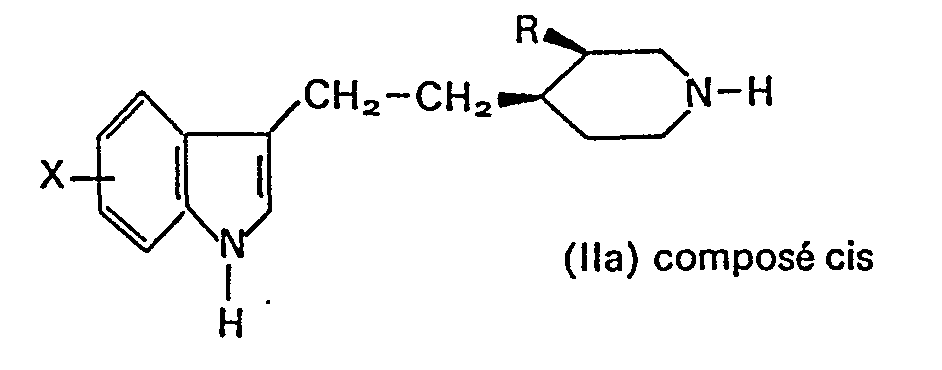

- A chaque diastéréo-isomère correspondent un racémique et deux énantiomères, chaque énantio- mère correspondant à une configuration absolue déterminée rectus (R) ou sinister (S) des carbones en position 3 et 4 du cycle pipéridyle.
- Les divers isomères signalés ci-dessus et leurs mélanges font partie de l'invention.
- Les composés de formule générale Il peuvent être préparés par réaction d'un dérivé de l'indole de formule:


- La réaction désignée ci-dessus a est effectuée au sein d'un solvant inerte: un éther tel que l'oxyde de diéthyle, le tétrahydrofuranne ou le diméthoxy- éthane ou un hydrocarbure tels que le benzène, le toluène ou le xylène, ou un mélange de ces solvants, à une température comprise entre -10 et +20°C. Comme dérivé métallique R'Li, on utilise de préférence le phényllithium, le butyllithium ou le diisopropylamidure de lithium.
- La réaction de condensation b est effectuée dans les mêmes solvants que la réaction a et à une température comprise entre 0°C et la température d'ébullition du solvant.
- La réaction d'hydrolyse c, qui consiste à remplacer le groupe benzoyle par un atome d'hydrogène, est effectuée selon des méthodes connues en soi, par exemple au moyen de l'hydroxyde de sodium en milieu hydroorganique, tel qu'un mélange d'eau et d'éthylèneglycol ou un mélange d'eau et d'éther monométhylique de l'éthylèneglycol, à la température d'ébullition du milieu utilisé.
- Les dérivés pipéridiniques de formule V peuvent être préparés selon le schéma réactionnel suivant:



- La réaction d du chlorure de benzoyle sur les alcools de formule VII est effectuée avantageusement en présence d'une base organique telle qu'une amine tertiaire, par exemple la triéthyl- amine, ou minérale, tels l'hydroxyde ou le carbonate de sodium ou de potassium en solution aqueuse. On opère au sein d'un solvant inerte tel que le chloroforme ou le trichloro-1,1,1 éthane à une température comprise entre 20°C et la température d'ébullition du solvant utilisé.
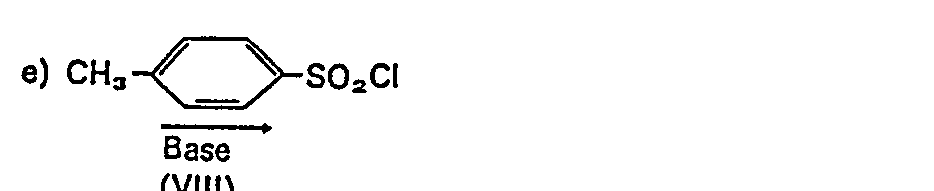
- La réaction e du chlorure de paratoluènesulfo- nyle (chlorure de tosyle) avec les alcools de formule VIII est effectuée à une température comprise entre -20°C et la température ambiante, au sein d'un solvant inerte et en présence d'une base (de préférence une amine). Une méthode avantageuse consiste à opérer au sein de la pyridine qui joue à la fois le rôle de solvant et de base.
- Les produits obtenus, de formule IX, sont ensuite traités (réaction f) par l'iodure de lithium au sein d'un solvant inerte, tel que l'acétone ou la méthyléthylcétone, à une température comprise entre 0 et 30° C.
- Les produits de formule Il peuvent également être préparés par réduction des dérivés cétoniques de formule générale:

- Comme agent réducteur, on peut utiliser un hydrure métallique tel que le borohydrure de sodium, de potassium ou de lithium ou le triéthylborohydrure de lithium, ou encore l'hydrure d'aluminium et de lithium, au sein des solvants appropriés connus pour chacun de ces agents réducteurs, à des températures comprises entre 0°C et la température d'ébullition du solvant utilisé.
- Les dérivés cétoniques de formule X peuvent être préparés selon le schéma réactionnel suivant:


- Le réactif de Grignard de formule XI, dans laquelle X à la même signification que dans la formule Il et X' représente un atome de chlore, de brome ou d'iode, est obtenu par action sur l'indole correspondant d'un halogénure d'alkylmagné- sium tel que le chlorure, le bromure ou l'iodure de méthylmagnésium au sein d'un éthertel que l'éther diéthylique, généralement à la température d'ébullition du solvant. A la solution ainsi obtenue et refroidie à une température comprise entre -10 et +20°C, on ajoute (réaction g) le chlorure d'acide de formule XI I dans laquelle B représente le groupe benzyloxycarbonyle et R a les mêmes significations que dans la formule II. On obtient ainsi les composés de formule XIII. La coupure du groupement benzyloxycarbonyle (réaction h) peut être effectuée par un acide tel que l'acide chlorhydrique au sein d'un solvant inerte tel que l'acide acétique ou l'éthanol à une température comprise entre 20°C et la température d'ébullition du solvant utilisé.
- Les chlorures d'acides de formule XII peuvent être préparés en 2 étapes à partir des acides pipéridyl-4 acétiques de formule XIV ci-dessous, dans laquelle R a les mêmes significations que dans la formule Il suivant le schéma réactionnel suivant:
- Les acides de formule XIV sont traités par le chloroformiate de benzyle (BCI) en solution dans un hydrocarbure en présence d'une base telle que l'hydroxyde de sodium en solution aqueuse à une température comprise entre 10 et 40° C. Les acides obtenus de formule XV sont transformés en chlorures d'acide de formule XII par action d'un agent de chloruration tel que le chlorure de thionyle au sein d'un solvant inerte tel que le chloroforme et à la température d'ébullition du solvant utilisé.
- Les composés de formule Il, dans laquelle R représente un groupe alkyle possédant 2 à 3 atomes de carbone, peuvent également être préparés par hydrogénation catalytique des produits correspondants de formule Il dans laquelle R représente un groupe alcényle ou de leurs sels. Cette hydrogénation peut être réalisée à la pression atmosphérique, à une température comprise entre 20 et 50°C au sein d'un solvant inerte tel qu'un alcool (par exemple le méthanol ou l'éthanol) ou un acide (par exemple l'acide acétique) en présence d'un catalyseur tel que le palladium, le nickel, le rhodium, le ruthénium ou le platine.
- Les composés de formule Il, dans laquelle R représente le groupe vinyle et dont l'atome de carbone du cycle pipéridinique porteur du groupe vinyle a une configuration donnée rectus (R) ou sinister (S), peuvent être préparés par chauffage à une température supérieure à 50°C, au sein d'un solvant protique ou d'un mélange de solvants protiques, en présence ou en l'absence de formaldéhyde, des composés correspondants de formule Il dans laquelle R représente le groupe vinyle et dont l'atome de carbone du cycle pipéridinique porteur du groupe vinyle a la configuration inverse, sinister (S) ou rectus (R), partiellement ou totalement salifiés, selon le procédé du brevet européen No 0005654. Le chauffage peut être réalisé en particulier dans un milieu aqueux acide de pH voisin de 6, à une température de 120 à 160°C.
- Les mélanges réactionnels obtenus suivant les divers procédés décrits précédemment sont traités suivant des méthodes classiques, physiques (évaporation, extraction à l'aide d'un solvant, distillation, cristallisation, chromatographie, etc.) ou chimiques (formation de sel et régénération de la base, etc.), afin d'isoler les composés de formule Il à l'état pur.
- Les composés de formule II sous forme de bases libres peuvent éventuellement être transformés en sels d'addition avec un acide minéral ou organique par action d'un tel acide au sein d'un solvant approprié.
- Les exemples suivants illustrent l'invention sans la limiter. Les données relatives aux spectres de résonance magnétique nucléaire (en abrégé RMN) figurant dans ces exemples concernent la résonance magnétique nucléaire des protons des composés à l'état de base en solution dans le deutérochloroforme (sauf mention contraire). Les déplacements chimiques 8 sont mesurés en utilisant comme référence la tétraméthylsilane.
- A 10 g d'indole dans 150 ml de toluène sous azote, on introduit, à 0°C, 52 ml d'une solution 1,6M de butyllithium dans l'hexane. Ensuite, on ajoute 15 g de benzoyl-1 éthényl-3 (R) iodoéthyl-4 (S) pipéridine en solution dans 50 ml de toluène et porte le mélange réactionnel à 50°C pendant 20 h. On verse le milieu organique sur de l'acide chlorhydrique 2N, extrait l'insoluble avec du chlorure de méthylène, lave la solution organique à l'eau, la sèche sur du sulfate de magnésium et l'évapore à sec sous pression réduite. On obtient 21 g de produit que l'on chromatographie sur de la silice au moyen d'un mélange toluène/diéthylamine (80/20) comme éluant. On récupère 5,3 g de produit que l'on traite pendant 9 h par 50 ml d'une solution aqueuse d'hydroxyde de sodium 3N et. 50 ml d'éther monométhylique de l'éthylèneglycol. On évapore les solvants sous pression réduite, partage le résidu entre l'eau et le chloroforme, lave la phase organique à l'eau, la sèche et l'évapore à sec. On récupère 2,7 g de produit que l'on recristallise dans de l'éthanol absolu, ce qui fournit 2g de vinyl-3 (R) pipéridyl-4 (R)-2 éthyl-3 indole fondant à 168°C.
- La benzoyl-1 vinyl-3 (R) iodoéthyl-4 (S) pipéridine est préparée en 3 étapes, de la façon suivante:
- On porte 2 h au reflux un mélange de 20 g de vinyl-3 (R) pipéridyl-4 (S) éthanol, de 19,7 g de chlorure de benzoyle et de 108 g de carbonate de potassium dans 250 ml de chloroforme et 11 ml d'eau.
- Après refroidissement, on filtre le mélange réactionnel et évapore le filtrat sous pression réduite. On chromatographie le résidu sur du gel de silice au moyen d'un mélange cyclohexane/ acétate d'éthyle (7/3) comme éluant. On obtient ainsi 24 g de benzoyl-1 vinyl-3 (R) pipéridyl-4 (S) éthanol sous forme d'huile.
- Spectre RMN du produit obtenu:
- C6H5 δ: 7,4 ppm -CH2-OH δ:3,6 ppm
- CH2 = CH- δ: 5 ppm
- CH2= CH- 8: 6 ppm
- Le vinyl-3 (R) pipéridyl-4 (S) éthanol peut être préparé selon R. Lukes, «Chem. Listy», 47, 858 (1953).
- On agite pendant 2 h à -10°C 80 g de benzoyl-1 vinyl-3 (R) pipéridyl-4 (S) éthanol et 73 g de chlorure de p-toluènesulfonyle dans 1 I de pyridine. On verse le mélange réactionnel dans 3 d'eau et extrait l'insoluble avec 2 1 d'éther. On lave la phase organique avec 4 fois 1 1 d'acide chlorhydrique 0,1 N et 5 fois 1 1 d'eau, la sèche sur du sulfate de magnésium anhydre, la filtre et l'évapore à sec sous pression réduite. On obtient ainsi 66 g de benzoyl-1 vinyl-3 (R) [(méthyl-4 phényl) sulfo- nyloxyéthyl]-4 (S) pipéridine sous forme d'huile.
- Spectre RMN du produit obtenu:
- C6H5 δ: 7,4 ppm; -CH2-O-SO2- δ: 4 ppm


- On agite pendant 24 h à la température ambiante 24,7 g de benzoyl-1 vinyl-3 (R) [(méthyl-4 phényl)sulfonyloxyéthyl]-4 (S) pipéridine et 16,4 g d'iodure de lithium dans 220 ml d'acétone. On filtre le mélange réactionnel, évapore le solvant sous pression réduite et redissout le résidu dans de l'acétate d'éthyle.
- On lave la phase organique avec de l'eau, la sèche sur du sulfate de magnésium et l'évapore à sec sous pression réduite. On obtient ainsi 16 g de benzoyl-1 vinyl-3 (R) iodoéthyl-4 (S) pipéridine sous forme d'huile.
- Spectre RMN du produit obtenu:
- C6H6 δ: 7,4 ppm -CH2-I δ:3,2ppm
- CH2 = CH- δ:5 ppm
- CH2 = CH- δ: 6 ppm
- A 17 g d'[éthyl-3 (R) pipéridyl-4 (S)] -2 (indo- lyl-3)-1 éthanone, dans 250 ml de tétrahydrofuranne anhydre, on ajoute, sous azote, à la température ambiante, 250 ml d'une solution molaire de triéthylborohydrure de lithium dans le tétrahydrofuranne. On porte le mélange réactionnel 18 h au reflux puis le refroidit à 0°C. On ajoute 300 ml d'eau et 400 ml d'éther éthylique, récupère la phase organique, la lave à l'eau, la sèche sur du surrate de magnésium et l'évapore à sec sous pression-réduite. On obtient 7 g de produit que l'on chromatographie sur du gel de silice au moyen d'un mélange méthanol/acétone/diéthylamine (5/5/0,5) comme éluant. Après cristallisation dans l'éther isopropylique, on obtient 3,7 g d'{ [éthyl-3 (R) pipéridyl-4 (R)] -2 éthyl}-3 indole fondant à 150°C.
- L'[éthyl-3 (R) pipéridyl-4 (S)]-2 (indolyl-3)-1 éthanone peut être préparé de la façon suivante:
- A 14 ml d'une solution 3M d'iodure de méthylmagnésium dans l'éther, on ajoute, sous azote, une solution de 2,3 g d'indole dans 15 ml d'éther éthylique. On porte le mélange réactionnel pendant 1 h au reflux puis le refroidit à 0°C. A cette température, on ajoute 15 ml d'une solution 1,3M de chlorure d'acide benzyloxycarbonyl-1 éthyl-3 (R) pipéridine-4 (S) acétique dans l'éther éthylique. On agite pendant 24 h à la température ambiante, refroidit à 0°C et ajoute 60 ml d'éther éthylique et 60 ml d'acide chlorhydrique 2N. On récupère la phase organique, la lave à l'eau, la sèche et l'évapore à sec sous pression réduite. On obtient 7 g d'huile que l'on traite par 150 ml d'éthanol chlorhydrique 10N pendant 2 h au reflux. On évapore le solvant et chromatographie le résidu sur du gel de silice avec un mélange méthanol/acétone/diéthylamine (5/5/0,5) comme éluant. On obtient ainsi 2 g d'[éthyl-3 (R) pipéridyl-4 (S)]-2 (indolyl-3)-1 éthanone sous forme d'huile.
- Spectre RMN du produit obtenu:

- H2 δ: 7,8 ppm; H4 δ: 8,4 ppm; H5, H6, H7 δ: 7,2 ppm.
- Le chlorure de l'acide benzyloxycarbonyl-1 éthyl-3 (R) pipéridine-4 (S) acétique peut être obtenu de la manière suivante:
- A 31 g de chlorhydrate de l'acide éthyl-3 (R) pipéridine-4 (S) acétique (cincholoïpon) dans 170 ml d'eau et 42 ml d'une solution aqueuse d'hydroxyde de sodium 10N, on ajoute à 10°C 62 ml d'une solution de chloroformiate de benzyle à 40% dans le toluène. On agite pendant 20 h à la température ambiante et lave la phase organique par 2 fois 250 ml d'éther éthylique. On acidifie la phase aqueuse avec de l'acide chlorhydrique concentrée et l'extrait avec 2 fois 250 ml de chloroforme. On sèche la phase organique sur du sulfate de magnésium anhydre et l'évapore à sec sous pression réduite. On obtient 45 g d'huile que l'on traite directement, au sein de 500 ml de chloroforme par 22 ml de chlorure de thionyle, pendant 2 h au reflux. On élimine le solvant sous pression réduite, on récupère 48 g de chlorure de l'acide éthyl-3 (R) pipéridine-4 (S) acétique que l'on utilise sous forme d'une solution 1,3M dans l'éther éthylique.
- On hydrogène pendant 3 h à la température ambiante et à pression atmosphérique 0,250 g de {[vinyl-3 (R) pipéridyl-4 (R)]-éthyl}-3 indole dans 1 ml d'acide chlorhydrique normal et 9 ml d'éthanol en présence de 0,04 g d'oxyde de platine comme catalyseur. On filtre le catalyseur, évapore le filtrat à sec, reprend le résidu dans 100 ml d'eau, lave la phase aqueuse à l'éther, l'alcalinise avec une solution aqueuse d'hydroxyde de sodium et extrait l'insoluble avec de l'acétate d'éthyle. On sèche la phase organique sur du sulfate de magnésium et l'évapore à sec sous pression réduite. On obtient 0,180 g de produit fondant à 150° C.
- On porte à 160° C pendant 48 h une solution de 1,36 g de [vinyl-3 (R) pipéridyl-4 (R)]-2 éthyl]-3 indole dans 210 ml d'eau et 5,3 ml d'acide chlorhydrique N. Après refroidissement, on alcalinise la solution au moyen de carbonate de potassium et l'extrait avec de l'acétate d'éthyle. On sèche la phase organique sur du sulfate de magnésium et l'évapore à sec sous pression réduite; on obtient 1,2 g de produit que l'on chromatographie sur de la silice au moyen d'un mélange toluène/diéthylamine (95/5) comme éluant. On obtient 0,45 g de produit que l'on recristallise dans de l'éthanol absolu, ce qui fournit 0,17 g de vinyl-3 (S) pipéridyl-4 (R)-2 éthyl-3 indole fondant à 168°C.
- On sait que la recapture de la sérotonine par les plaquettes sanguines constitue un bon modèle de la recapture de cette amine par les neurones [cf. J. Tuomisto,«J. Pharm., Pharmac.», 26, 92 (1974)]. Appliquée à l'étude des médicaments, une méthode mettant en oeuvre les plaquettes sanguines présente le grand intérêt de permettre l'utilisation de cellules humaines, ce qui lui confère un bon caractère prévisionnel.
- La capacité des produits à inhiber la recapture de la sérotonine ou à provoquer sa libération a été mise en évidence sur des plaquettes sanguines humaines, selon J.L. David et coll., «Platelets Function and thrombosis, a review of methods», p. 335 (Plenum Press, London 1972).
- Les résultats sont exprimés par une dose inhibitrice 50% ou 150 qui représente la dose de produit, en micromoles par litre, diminuant de 50% la recapture de la sérotonine.
- L'action des produits sur la libération de la sérotonine est testée à la concentration de 5 x 10⁻⁵ mol/1. Les résultats obtenus sont exprimés en pourcentage d'augmentation de la libération de la sérotonine par rapport aux résultats fournis par les témoins.
- Les résultats obtenus avec les composés selon l'invention sont rassemblés dans le tableau. Dans ce tableau figurent, à titre comparatif, les résultats obtenus avec deux produits de référence (imipramine et p-chloroamphétamine) et avec l'indalpine.

- Il ressort du tableau que les produits de l'invention sont non seulement de puissants inhibiteurs de recapture de la sérotonine (activités équivalentes à celle de l'indalpine), mais en outre de puissants agents de libération de la sérotonine, encore plus actifs que la p-chloroamphétamine.
- L'intérêt de ces composés réside dans le fait qu'ils induisent, comme la parachloroamphé- tamine, la libération de sérotonine sans pourtant présenter aucune des autres propriétés pharmacologiques caractéristiques des amphétaminiques (anorexie, hypermotilité).
- La toxicité aiguë des produits a été déterminée chez la souris mâle CO1 (Charles River) par voie orale. La DL50 calculée, après 3 jours d'observation, par la méthode cumulative de J.J. Reed et coll. («Am. J. Hyg.», 27, 493, 1938) est de 225 mg/kg pour le composé de l'exemple 1 et d'environ 200 mg/kg pour le composé de l'exemple 4.
- Les composés selon l'invention sont atoxiques à 100 mg/kg et se comportent donc comme des substances relativement peu toxiques chez la souris.
- Les composés de l'invention et leurs sels phar- maceutiquement acceptables peuvent être utilisés en thérapeutique humaine sous forme de comprimés, capsules, gélules, suppositoires, solutions in- gérables ou injectables, etc., comme régulateurs du tonus vasculaire sérotonino-dépendant, notamment pour le traitement des migraines, comme agents antithrombosants et comme médicaments thymoanaleptiques à action particulièrement rapide (à cause de leur action sur la libération de la sérotonine).
- La posologie dépend des effets recherchés et de la voie d'administration utilisée. Par exemple, par voie orale, elle peut être comprise entre 15 et 250 mg de substance active par jour, avec des doses unitaires allant de 5 à 50 mg.
Claims (7)


Applications Claiming Priority (2)
| Application Number | Priority Date | Filing Date | Title |
|---|---|---|---|
| FR8110219A FR2506310A1 (fr) | 1981-05-22 | 1981-05-22 | ((alkyl- et alcenyl-3 piperidyl-4)-2 ethyl)-3 indoles et leur utilisation comme medicaments |
| FR8110219 | 1981-05-22 |
Publications (2)
| Publication Number | Publication Date |
|---|---|
| EP0065908A1 EP0065908A1 (fr) | 1982-12-01 |
| EP0065908B1 true EP0065908B1 (fr) | 1984-12-05 |
Family
ID=9258781
Family Applications (1)
| Application Number | Title | Priority Date | Filing Date |
|---|---|---|---|
| EP82400872A Expired EP0065908B1 (fr) | 1981-05-22 | 1982-05-11 | ((Alkyl- et alcényl-3 pipéridyl-4)-2 éthyl)-3 indoles et leur utilisation comme médicaments |
Country Status (17)
| Country | Link |
|---|---|
| US (1) | US4435410A (fr) |
| EP (1) | EP0065908B1 (fr) |
| JP (1) | JPS57200385A (fr) |
| AR (1) | AR231290A1 (fr) |
| AU (1) | AU550319B2 (fr) |
| CA (1) | CA1183849A (fr) |
| DE (1) | DE3261441D1 (fr) |
| DK (1) | DK230282A (fr) |
| ES (2) | ES8307242A1 (fr) |
| FR (1) | FR2506310A1 (fr) |
| GR (1) | GR74753B (fr) |
| HU (1) | HU188172B (fr) |
| IL (1) | IL65512A (fr) |
| MA (1) | MA19481A1 (fr) |
| NO (1) | NO821700L (fr) |
| PT (1) | PT74916B (fr) |
| ZA (1) | ZA823489B (fr) |
Families Citing this family (3)
| Publication number | Priority date | Publication date | Assignee | Title |
|---|---|---|---|---|
| DE3430284A1 (de) * | 1984-08-17 | 1986-02-27 | Troponwerke GmbH & Co KG, 5000 Köln | Neue tryptamin-derivate, ein verfahren zu ihrer herstellung und ihre verwendung |
| FR2634207B1 (fr) * | 1988-07-12 | 1990-09-07 | Synthelabo | Derives de ((piperidinyl-4)methyl) benzazepines, leur preparation et leur application en therapeutique |
| EP0351283A1 (fr) * | 1988-07-12 | 1990-01-17 | Synthelabo | Dérivés de [(pipéridinyl-4) méthyl]-2 dihydro-2,3 1H-isoindole et tétrahydro-2,3,4,5 1H-benzazépines, leur préparation et leur application en thérapeutique |
Family Cites Families (6)
| Publication number | Priority date | Publication date | Assignee | Title |
|---|---|---|---|---|
| GB925429A (en) * | 1960-04-01 | 1963-05-08 | Irwin Neisler & Co | Indole derivatives |
| FR1289690A (fr) * | 1960-04-01 | 1962-04-06 | Irwin | Dérivés de l'indole |
| GB1023781A (en) * | 1962-02-01 | 1966-03-23 | Benger Lab Ltd | Substituted indoles and their preparation |
| US3445472A (en) * | 1965-12-03 | 1969-05-20 | American Home Prod | Mono- and di-aroyl pyridylethyl and piperidylethyl indoles |
| FR2334358A1 (fr) | 1975-12-12 | 1977-07-08 | Sogeras | Nouveaux medicaments derives de l'indole |
| US4208417A (en) * | 1978-06-29 | 1980-06-17 | Pharmindustrie | Indole derivatives and their use as anxiolytics |
-
1981
- 1981-05-22 FR FR8110219A patent/FR2506310A1/fr active Granted
-
1982
- 1982-04-16 IL IL65512A patent/IL65512A/xx unknown
- 1982-05-03 CA CA000402161A patent/CA1183849A/fr not_active Expired
- 1982-05-03 US US06/374,366 patent/US4435410A/en not_active Expired - Fee Related
- 1982-05-04 GR GR68056A patent/GR74753B/el unknown
- 1982-05-11 DE DE8282400872T patent/DE3261441D1/de not_active Expired
- 1982-05-11 EP EP82400872A patent/EP0065908B1/fr not_active Expired
- 1982-05-18 PT PT74916A patent/PT74916B/fr unknown
- 1982-05-19 ZA ZA823489A patent/ZA823489B/xx unknown
- 1982-05-19 AR AR289454A patent/AR231290A1/es active
- 1982-05-20 MA MA19687A patent/MA19481A1/fr unknown
- 1982-05-21 HU HU821642A patent/HU188172B/hu unknown
- 1982-05-21 ES ES512472A patent/ES8307242A1/es not_active Expired
- 1982-05-21 JP JP57086383A patent/JPS57200385A/ja active Pending
- 1982-05-21 NO NO821700A patent/NO821700L/no unknown
- 1982-05-21 DK DK230282A patent/DK230282A/da not_active Application Discontinuation
- 1982-05-21 AU AU84042/82A patent/AU550319B2/en not_active Ceased
-
1983
- 1983-04-13 ES ES521432A patent/ES8402284A1/es not_active Expired
Also Published As
| Publication number | Publication date |
|---|---|
| AR231290A1 (es) | 1984-10-31 |
| MA19481A1 (fr) | 1982-12-31 |
| IL65512A (en) | 1985-03-31 |
| US4435410A (en) | 1984-03-06 |
| IL65512A0 (en) | 1982-07-30 |
| PT74916A (fr) | 1982-06-01 |
| FR2506310A1 (fr) | 1982-11-26 |
| ES521432A0 (es) | 1984-01-16 |
| ES512472A0 (es) | 1983-07-01 |
| DK230282A (da) | 1982-11-23 |
| FR2506310B1 (fr) | 1984-03-09 |
| GR74753B (fr) | 1984-07-11 |
| AU8404282A (en) | 1982-11-25 |
| CA1183849A (fr) | 1985-03-12 |
| AU550319B2 (en) | 1986-03-20 |
| ES8307242A1 (es) | 1983-07-01 |
| DE3261441D1 (en) | 1985-01-17 |
| EP0065908A1 (fr) | 1982-12-01 |
| ES8402284A1 (es) | 1984-01-16 |
| HU188172B (en) | 1986-03-28 |
| PT74916B (fr) | 1983-12-07 |
| NO821700L (no) | 1982-11-23 |
| JPS57200385A (en) | 1982-12-08 |
| ZA823489B (en) | 1983-03-30 |
Similar Documents
| Publication | Publication Date | Title |
|---|---|---|
| CA1088939A (fr) | Medicaments derives de l'indole | |
| EP0042781B1 (fr) | Nouveaux dérivés de (quinolyl-4)-1 (pipéridyl ou pyrrolidinyl-2 ou -3)-2 ou -3 éthanone ou propanone, procédés pour leur préparation, et leur utilisation comme médicaments | |
| EP0012643B1 (fr) | Dérivés de la phényl-1 (pipéridyl-4)-3 propanone-1, procédés pour leur préparation, et médicaments les contenant | |
| CH671574A5 (fr) | ||
| EP0010460B1 (fr) | Nouveaux dérivés de pyrrolidine-2-méthanol, procédé pour leur préparation et médicaments les contenant | |
| EP0003445B1 (fr) | Dérivés d'aza-1 bicyclo(2,2,2)octane, leur procédé de préparation et produits intermédiaires, et médicaments les contenant | |
| EP0031753A1 (fr) | Nouveaux dérivés de la (pipéridyl-4)-2 (quinolyl-4)-1 éthanone, produits intermédiaires et procédés pour leur préparation, et leur utilisation comme médicaments | |
| EP0053964B1 (fr) | Médicaments à base de dérivés de (quinolyl-4)-1 éthanol ou propanol, nouveaux dérivés de (quinolyl-4)-1 éthanol ou propanol et procédés pour leur préparation | |
| FR2549059A1 (fr) | Procede de preparation de 1-pyridyl-alkyl-4-aryl-piperazines, leur separation en les antipodes optiques (enantiomorphes) respectifs et les stereo-isomeres ainsi obtenus | |
| EP0042322B1 (fr) | Nouveaux dérivés de l'indène, procédés pour leur préparation et des médicaments les contenant | |
| EP0842148B1 (fr) | Derives de benzenesulfonamide, leur preparation et leurs applications en therapeutique | |
| EP0327455A1 (fr) | Ethers alkyliques ou benzyliques du phénol, leurs procédés de préparation et leur application en thérapeutique | |
| EP0173585B1 (fr) | Médicaments à base de dérivés de la pipéridine, nouveaux dérivés de la pipéridine et leurs procédés de préparation | |
| EP0065908A1 (fr) | ((Alkyl- et alcényl-3 pipéridyl-4)-2 éthyl)-3 indoles et leur utilisation comme médicaments | |
| FR2669030A1 (fr) | Nouveaux derives d'imidazole, leur procede de preparation et les compositions pharmaceutiques qui les contiennent. | |
| EP0065907B1 (fr) | ((Tétra- et hexahydro pyridyl-4)-2 éthyl)-3 indoles et leur utilisation comme médicaments | |
| LU85941A1 (fr) | Derives de la naphtoxazine,leur preparation,leur application comme medicaments et compositions pharmaceutiques les contenant | |
| EP0008962B1 (fr) | Nouveaux dérivés de la ((quinolyl-4)-3 propyl-1)-4 pipéridine et médicaments les contenant | |
| MC1004A1 (fr) | Procédé de fabrication d'alcools alpha (1-aralcoylamino-alcoyl)-aralcoxy-benzyliques | |
| EP0067106B1 (fr) | Nouveaux éthers de phénol actifs sur le système cardiovasculaire, leur procédé de préparation et leur utilisation dans des médicaments | |
| EP0065909B1 (fr) | ((Pipéridyl-4)-2 alkyl-1 éthyl)-3 indoles et leur utilisation comme médicaments | |
| CA1098446A (fr) | Medicaments derives de l'indole | |
| FR2462426A1 (fr) | Nouveau derive de la 2-(1-naphtyl)piperidine, sa preparation et son application comme medicament | |
| EP0155888A1 (fr) | Dérivés de (quinol yl-4)-1 (piperidyl-4)-2 ethanamine et de (quinolyl-4)-1 (piperidyl-4)-3 propanamine, procédés pour leur préparation et médicaments les contenant | |
| EP0103500A2 (fr) | Dérivés de phénéthyl-1alpha-phényl-pipéridine-3-propanenitrile, leur préparation et leur application en thérapeutique |
Legal Events
| Date | Code | Title | Description |
|---|---|---|---|
| PUAI | Public reference made under article 153(3) epc to a published international application that has entered the european phase |
Free format text: ORIGINAL CODE: 0009012 |
|
| 17P | Request for examination filed |
Effective date: 19820514 |
|
| AK | Designated contracting states |
Designated state(s): BE CH DE FR GB IT LI LU NL SE |
|
| RAP1 | Party data changed (applicant data changed or rights of an application transferred) |
Owner name: PHARMUKA LABORATOIRES |
|
| ITF | It: translation for a ep patent filed | ||
| GRAA | (expected) grant |
Free format text: ORIGINAL CODE: 0009210 |
|
| AK | Designated contracting states |
Designated state(s): BE CH DE FR GB IT LI LU NL SE |
|
| REF | Corresponds to: |
Ref document number: 3261441 Country of ref document: DE Date of ref document: 19850117 |
|
| PG25 | Lapsed in a contracting state [announced via postgrant information from national office to epo] |
Ref country code: LU Free format text: LAPSE BECAUSE OF NON-PAYMENT OF DUE FEES Effective date: 19850531 |
|
| PLBE | No opposition filed within time limit |
Free format text: ORIGINAL CODE: 0009261 |
|
| STAA | Information on the status of an ep patent application or granted ep patent |
Free format text: STATUS: NO OPPOSITION FILED WITHIN TIME LIMIT |
|
| 26N | No opposition filed | ||
| PGFP | Annual fee paid to national office [announced via postgrant information from national office to epo] |
Ref country code: LU Payment date: 19860411 Year of fee payment: 5 |
|
| PGFP | Annual fee paid to national office [announced via postgrant information from national office to epo] |
Ref country code: NL Payment date: 19860531 Year of fee payment: 5 |
|
| PG25 | Lapsed in a contracting state [announced via postgrant information from national office to epo] |
Ref country code: SE Effective date: 19870512 |
|
| PG25 | Lapsed in a contracting state [announced via postgrant information from national office to epo] |
Ref country code: LI Effective date: 19870531 Ref country code: CH Effective date: 19870531 |
|
| BERE | Be: lapsed |
Owner name: PHARMUKA LABORATOIRES Effective date: 19870531 |
|
| PG25 | Lapsed in a contracting state [announced via postgrant information from national office to epo] |
Ref country code: NL Effective date: 19871201 |
|
| NLV4 | Nl: lapsed or anulled due to non-payment of the annual fee | ||
| PG25 | Lapsed in a contracting state [announced via postgrant information from national office to epo] |
Ref country code: FR Free format text: LAPSE BECAUSE OF NON-PAYMENT OF DUE FEES Effective date: 19880129 |
|
| REG | Reference to a national code |
Ref country code: CH Ref legal event code: PL |
|
| PG25 | Lapsed in a contracting state [announced via postgrant information from national office to epo] |
Ref country code: DE Effective date: 19880202 |
|
| GBPC | Gb: european patent ceased through non-payment of renewal fee | ||
| REG | Reference to a national code |
Ref country code: FR Ref legal event code: ST |
|
| PG25 | Lapsed in a contracting state [announced via postgrant information from national office to epo] |
Ref country code: GB Free format text: LAPSE BECAUSE OF NON-PAYMENT OF DUE FEES Effective date: 19881121 |
|
| PG25 | Lapsed in a contracting state [announced via postgrant information from national office to epo] |
Ref country code: BE Effective date: 19890531 |
|
| EUG | Se: european patent has lapsed |
Ref document number: 82400872.6 Effective date: 19880616 |