EP0065266A2 - Ventiloberteil - Google Patents
Ventiloberteil Download PDFInfo
- Publication number
- EP0065266A2 EP0065266A2 EP82104106A EP82104106A EP0065266A2 EP 0065266 A2 EP0065266 A2 EP 0065266A2 EP 82104106 A EP82104106 A EP 82104106A EP 82104106 A EP82104106 A EP 82104106A EP 0065266 A2 EP0065266 A2 EP 0065266A2
- Authority
- EP
- European Patent Office
- Prior art keywords
- housing
- valve
- valve spindle
- head piece
- spindle
- Prior art date
- Legal status (The legal status is an assumption and is not a legal conclusion. Google has not performed a legal analysis and makes no representation as to the accuracy of the status listed.)
- Granted
Links
- 239000000919 ceramic Substances 0.000 claims abstract description 27
- 238000007789 sealing Methods 0.000 claims abstract description 9
- 239000012530 fluid Substances 0.000 claims 2
- 230000037431 insertion Effects 0.000 claims 1
- 238000003780 insertion Methods 0.000 claims 1
- 230000008092 positive effect Effects 0.000 claims 1
- 230000000903 blocking effect Effects 0.000 description 6
- 230000000295 complement effect Effects 0.000 description 3
- XLYOFNOQVPJJNP-UHFFFAOYSA-N water Substances O XLYOFNOQVPJJNP-UHFFFAOYSA-N 0.000 description 3
- 239000003795 chemical substances by application Substances 0.000 description 1
- 230000007547 defect Effects 0.000 description 1
- 238000006073 displacement reaction Methods 0.000 description 1
- 239000013505 freshwater Substances 0.000 description 1
- 238000012423 maintenance Methods 0.000 description 1
- 230000001902 propagating effect Effects 0.000 description 1
- 230000000284 resting effect Effects 0.000 description 1
- 238000009827 uniform distribution Methods 0.000 description 1
Images
Classifications
-
- F—MECHANICAL ENGINEERING; LIGHTING; HEATING; WEAPONS; BLASTING
- F16—ENGINEERING ELEMENTS AND UNITS; GENERAL MEASURES FOR PRODUCING AND MAINTAINING EFFECTIVE FUNCTIONING OF MACHINES OR INSTALLATIONS; THERMAL INSULATION IN GENERAL
- F16K—VALVES; TAPS; COCKS; ACTUATING-FLOATS; DEVICES FOR VENTING OR AERATING
- F16K3/00—Gate valves or sliding valves, i.e. cut-off apparatus with closing members having a sliding movement along the seat for opening and closing
- F16K3/02—Gate valves or sliding valves, i.e. cut-off apparatus with closing members having a sliding movement along the seat for opening and closing with flat sealing faces; Packings therefor
- F16K3/04—Gate valves or sliding valves, i.e. cut-off apparatus with closing members having a sliding movement along the seat for opening and closing with flat sealing faces; Packings therefor with pivoted closure members
- F16K3/06—Gate valves or sliding valves, i.e. cut-off apparatus with closing members having a sliding movement along the seat for opening and closing with flat sealing faces; Packings therefor with pivoted closure members in the form of closure plates arranged between supply and discharge passages
- F16K3/08—Gate valves or sliding valves, i.e. cut-off apparatus with closing members having a sliding movement along the seat for opening and closing with flat sealing faces; Packings therefor with pivoted closure members in the form of closure plates arranged between supply and discharge passages with circular plates rotatable around their centres
-
- F—MECHANICAL ENGINEERING; LIGHTING; HEATING; WEAPONS; BLASTING
- F16—ENGINEERING ELEMENTS AND UNITS; GENERAL MEASURES FOR PRODUCING AND MAINTAINING EFFECTIVE FUNCTIONING OF MACHINES OR INSTALLATIONS; THERMAL INSULATION IN GENERAL
- F16K—VALVES; TAPS; COCKS; ACTUATING-FLOATS; DEVICES FOR VENTING OR AERATING
- F16K27/00—Construction of housing; Use of materials therefor
- F16K27/04—Construction of housing; Use of materials therefor of sliding valves
- F16K27/044—Construction of housing; Use of materials therefor of sliding valves slide valves with flat obturating members
- F16K27/045—Construction of housing; Use of materials therefor of sliding valves slide valves with flat obturating members with pivotal obturating members
Definitions
- Ceramic washers are a very tight and durable locking agent for valves, so only the O-rings need to be replaced if leaks occur along the valve stem over time. It is generally known to arrange the ceramic disks in a housing. This arrangement is disadvantageous in that the parts for replacing the O-rings have to be removed from the housing, which increases the assembly time and carries the risk of incorrect assembly, which can lead to the ceramic disks breaking or to an incorrect position thereof in relation to one another.
- the purpose of the present invention is to create a valve insert which is considerably more service-friendly than the known valve inserts, particularly with regard to the replacement of the mentioned 0-rings. This is done with a Valve insert with the features specified in the characterizing part of claim 1 achieved by which all previously known disadvantages are remedied by the ceramic disks can not fall out of the housing, which is designed so that it can be easily inserted into the valve without mutual predetermined positioning of the parts would have to be taken into account.
- a head piece with the features specified in claim 2 ensures that the 0-rings can be replaced without relieving the valve from the water pressure.
- valve housing is advantageous: can be produced from plastic, the recess mentioned in claim 3 being particularly simple to produce, which defines the end positions in connection with the pin in the threaded spindle.
- the pin serves to relieve the impact that would otherwise be transmitted to the ceramic disks, for example, when a handle is struck on the spindle.
- the uniform distribution of the outlet holes in the housing mentioned in claim 1 can preferably be achieved according to claim 4.
- the embodiment according to claim 4 is particularly well suited for producing the housing from plastic.
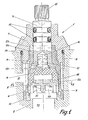
- valve insert 1 shows a valve insert 1 screwed into a fitting 2 with a valve spindle 3, which rotates a ceramic disk 5 in relation to another ceramic disk 6 via a driver 4.
- the parts mentioned are comprised on the one hand by a head piece designed as a union nut 7, screwed into the fitting 2 by means of a thread 8, and on the other hand by a housing 9 which, in the embodiment shown, is made of plastic.
- the ceramic disks 5 and 6 can be rotated between an open position and a blocking position for a flow, for example fresh water, which flows into the valve insert through an opening 10 and through an outlet opening 11 above the ceramic disk 5 again flows out.
- the outlet opening can be arranged elsewhere and can be configured differently than shown.
- the valve insert is described in more detail with reference to FIGS. 1 and 2.
- the insert consists of a preassembled unit in that the valve spindle 3 provided with O-rings 12, a thrust washer 13, the driver 4 and the ceramic disks 5 and 6 are inserted through the base 9 of the valve housing in the order given.
- the ceramic disk 6 is rotated into a position in which radially inwardly projecting projections 33 on the housing 9 come to rest in a recess 32 of the disk, in such a way that it is held in a rotationally fixed manner in relation to the housing 9.
- a stop ring 14 is pressed into the bottom of the valve housing 9, as a result of which the aforementioned parts are mutually fixed.
- valve housing 9 can be arranged in the fitting 2 and fastened by means of the union nut 7, whereby the valve partially is sealed by means of the O-rings 12 and partly by means of a further 0-ring 14.
- the stop ring 14 serves as a sealing ring between the fitting 2 and the ceramic disk 6. It follows from this that worn O-rings 12 can be replaced simply by removing the union nut 7 without the other parts of the valve insert becoming detached from one another.
- valve can be rotated between the open position and the blocking position, for which purpose a handle (not shown) is normally pressed onto a star groove 15 at the projecting end of the valve spindle 3.
- the opposite spindle end is formed with a square recess 16 for receiving a complementary pin 17 on the driver 4, which has projections 18 which engage in grooves in the ceramic disk 5.
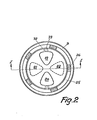
- FIG. 2 shows two complementary holes 21 and 22 in the ceramic disk 6 in broken lines.
- the valve is in its blocking position.
- the holes 19 and 20 are brought into a position aligned with one of the holes 21 and 22, which corresponds to the open valve position.
- the open position and the blocking position are defined by a pin 23 which projects radially outwards from the valve spindle and which receives a recess 24 in the head of the valve housing 9.
- the recess extends over a circular arc of 90 °.
- the pin rests on the bottom of the recess 24, which means that a handle can be opened onto the star groove 15 without the impact force propagating up to the ceramic disks 5 and 6, which could be destroyed as a result.
- the ceramic disks 5 and 6 are also secured against excessive stress by the free play between the recess 16 and the pin 17 and by the play between the projections 18 and the ceramic disk 5, which lies flat on the driver 4 outside the projections 18.
- the head of the valve housing 9 is preferably polygonal, for example hexagonal.
- the polygonal housing head interacts with complementary recesses in the union nut 7. If, for example, certain limit positions are desired for the handle when the valve is open and closed, it may be necessary in an embodiment with a square axis instead of the star groove 15 to provide an outlet opening aligned with the opening 11 in the housing 9. This limitation of the universal use of the valve insert is avoided according to the invention by a number of holes 25 (five holes are provided in FIG.
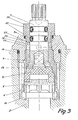
- valve insert can thus be used for fittings with an outlet opening 11 arranged in any manner above the ceramic disk 5. In Fig. 3, the outlet opening is not visible behind the driver.
- the embodiment of the valve insert according to the invention shown in FIG. 3 differs from the embodiment shown in FIG. 1 only in that the head piece consists of two parts, namely a part 27 provided with the thread cooperating with the fitting and one by means of a thread 29 part 28 which can be screwed into part 27 by ensuring a tight connection with the aid of an O-ring 30.
- the head part 28 extends in the axial direction past the O-rings 12.
- the head piece part 28 has a radially inwardly directed flange 31 which bears against the upper side of the valve housing 9.
- the O-rings 12 can be exchanged for water pressure without relieving the pressure on the fitting. This is based on the fact that the valve insert is held by the head part 27, while only the head part 28 has to be dismantled in order to replace the 0-rings 12.
- valve according to the invention represents a significant improvement in maintenance compared to the known valves, it is of course desirable to make the valve as universally usable as possible. This can be achieved, for example, by producing only two different valve housing sizes, after which the valve insert can be adapted to a large number of different fittings by providing several different union nuts, some of which are adapted to the depth of the valve opening and the thread dimensions and some to the shape of the desired handle are.
- valve spindles can be manufactured with different shapes to complete, for example, the star groove shown in the drawing figures.
Landscapes
- Engineering & Computer Science (AREA)
- General Engineering & Computer Science (AREA)
- Mechanical Engineering (AREA)
- Sliding Valves (AREA)
- Magnetically Actuated Valves (AREA)
- Valve Housings (AREA)
- Valve Device For Special Equipments (AREA)
- Valve-Gear Or Valve Arrangements (AREA)
- Vaporization, Distillation, Condensation, Sublimation, And Cold Traps (AREA)
- Fuel-Injection Apparatus (AREA)
- Temperature-Responsive Valves (AREA)
- Compressor (AREA)
- Taps Or Cocks (AREA)
- Vessels And Coating Films For Discharge Lamps (AREA)
Abstract
Description
- Keramische Scheiben sind ein sehr dichtes und haltbares Sperrmittel für Ventile, so dass einzig die O-Ringe auszuwechseln sind, wenn mit der Zeit an der Ventilspindel entlang Undichtigkeiten auftreten. Es ist allgemein bekannt, die keramischen Scheiben in einem Gehäuse anzuordnen. Diese Anordnung ist insofern unvorteilhaft als die Teile zum Auswechseln der O-Ringe aus dem Gehäuse entnommen werden müssen, was die Montierzeit verlängert und die Gefahr der Fehlmontage birgt, die zum Zerbrechen der keramischen Scheiben oder zu einer fehlerhaften Stellung derselben im Verhältnis zueinander führen kann.
- Der letztgenannte Nachteil ist durch das aus der europäischen Patentanmeldung 80200125.5 bekannte Ventil behoben, das ein Gehäuse aufweist, durch welches verhindert wird, dass die Teile im Gehäuse beim Herausnehmen desselben aus der Armatur aus dem Gehäuse herausfallen. Dieses bekannte Ventil hat jedoch den Mangel, dass das Gehäuse mittels eines Führungszapfens in der Armatur in bestimmter Weise orientiert werden muss, wobei es aufgrund einiger unten im Gehäuse vorgesehener Dichtungen schwierig ist, das Gehäuse bei der Montierarbeit in eine Stellung zu bringen, bei der der Führungszapfen korrekt eingreift. Ist dies nicht der Fall, wird das Gehäuse durch das Festschrauben einer Uberwurfmutter schief belastet, wobei die keramischen Scheiben zerbrechen können. Der letztgenannte Stand der Technik ist die andere bekannte Ventile gleichfalls insofern nachteilig,als das Auswechseln der Spindeldichtungen viel Zeit erfordert und mit der Gefahr von Fehlern verbunden ist, entweder weil die keramischen Scheiben aus dem Gehäuse herausgefallen sind, oder weil das Gehäuse zur korrekten Funktion in einer bestimmten Stellung in der Armatur anzuordnen ist.
- Zweck der vorliegenden Erfindung ist die Schaffung eines Ventileinsatzes, der insbesondere hinsichtlich des Auswechselns der genannten 0-Ringe wesentlich Servicefreundlicher ist als die bekannten Ventileinsätze. Dieser Zweck wird mit einem Ventileinsatz mit den im kennzeichnenden Teil des Anspruchs 1 angegebenen Merkmalen erreicht, durch die alle bisher bekannten Nachteile behoben werden, indem die keramischen Scheiben nicht aus dem Gehäuse herausfallen können, das so konstruiert ist, dass es ohne weiteres in die Armatur einführbar ist, ohne dass eine im voraus bestimmte gegenseitige Positionierung der Teile zu berücksichtigen wäre.
- Durch ein Kopfstück mit den im Anspruch 2 angegebenen Merkmalen wird erreicht, dass die 0-Ringe ohne Entlastung der Armatur vom Wasserdruck auswechselbar sind.
- Das Ventilgehäuse ist mit Vorteil: aus Kunststoff herstellbar, wobei die im Anspruch 3 erwähnte Ausnehmung besonders einfach herstellbar ist, die in Verbindung mit dem Stift in der Gewindespindel deren Endstellungen definiert. In Kombination mit den im Anspruch 3 gekennzeichneten Mitnehmerorganen ergibt sich desweiteren der Vorteil, dass der Stift zur Entlastung bei Schlägen dient, die beispielsweise beim Aufschlagen eines Handgriffs auf die Spindel sonst auf die keramischen Scheiben übertragen würden.
- Die im Anspruch 1 erwähnte gleichmässige Verteilung der Auslasslöcher im Gehäuse ist vorzugsweise gemäss Anspruch 4 erreichbar. Die Ausführungsform gemäss Anspruch 4 ist zur Herstellung des Gehäuses aus Kunststoff besonders gut geeignet.
- Nachstehend werden an Hand der Zeichnung einige Ausführungs- formen des 'erfindungsgemässen Ventileinsatzes beschrieben.
- Es zeigen
- Fig. 1 im Axialschnitt eine Ausführungsform des erfindungsgemässen Ventileinsatzes,
- Fig. 2 einen Schnitt nach der Linie II-II in Fig. 1, und
- Fig. 3 im Axialschnitt eine andere Ausführungsform des Ventileinsatzes.
- Fig. 1 zeigt einen in eine Armatur 2 eingeschraubten Ventileinsatz 1 mit einer Ventilspindel 3, die über einen Mitnehmer 4 eine keramische Scheibe 5 im Verhältnis zu einer anderen keramischen Scheibe 6 verdreht. Die genannten Teile werden erfindungsgemäss einerseits von einem als Uberwurfmutter 7 ausgebildeteten, mittels eines Gewindes 8 in die Armatur 2 eingeschraubten Kopfstücks und andererseits von einem Gehäuse 9 umfasst, das bei der dargestellten Ausführungsform aus Kunststoff hergestellt ist. Wie weiter unten erläutert sind die keramischen Scheiben 5 und 6 zwischen einer offenen Stellung und einer auf der Zeichnung veranschaulichten Sperrstellung für eine Strömung, beispielsweise Frischwasser verdrehbar, das durch eine Offnung 10 in den Ventileinsatz einströmt und durch eine Auslassöffnung 11 über der keramischen Scheibe 5 wieder abströmt. Die Auslassöffnung kann jedoch an anderer Stelle angeordnet und anders ausgebildet sein als dargestellt.
- Nachstehend wird der Ventileinsatz an Hand der Fig. 1 und 2 eingehender beschrieben. Der Einsatz besteht aus einer vormontierten Einheit, indem durch den Boden 9 des Ventilgehäuses in der angegebenen Reihenfolge die mit O-Ringen 12 versehene Ventilspindel 3, eine Druckscheibe 13, der Mitnehmer 4 sowie die keramischen Scheiben 5 und 6 eingeführt werden. Die keramische Scheibe 6 wird in eine Stellung gedreht, in der radial nach innen ragende Vorsprünge 33 am Gehäuse 9 in einer Ausnehmung 32 der Scheibe zu liegen kommen, und zwar derart, dass diese im Verhältnis zum Gehäuse 9 drehfest gehaltert wird. Zuletzt wird ein Stoppring 14 in den Boden des Ventilgehäuses 9 eingepresst, wodurch die vorerwähnten Teile gegenseitig fixiert sind. Hiernach kann das Ventilgehäuse 9 in der Armatur 2 angeordnet und mittels der Uberwurfmutter 7 befestigt werden, wodurch das Ventil teils mittels der O-Ringe 12 und teils mit Hilfe eines weiteren 0-Rings 14 abgedichtet wird. Der Stoppring 14 dient als Dichtungsring zwischen der Armatur 2 und der keramischen Scheibe 6. Es ergibt sich hieraus, dass verschlissene 0-Ringe 12 allein durch Abmontieren der Uberwurfmutter 7 auswechselbar sind, ohne dass sich die übrigen Teile des Ventileinsatzes von einander lösen.
- Das Ventil ist wie bereits erwähnt zwischen der offenen Stellung und der Sperrstellung verdrehbar, wozu normalerweise ein nicht dargestellter Handgriff auf eine Sternnut 15 am herausragenden Ende der Ventilspindel 3 aufgepresst ist.
- Das entgegengesetzte Spindelende ist mit einer viereckigen Ausnehmung 16 zur Aufnahme eines komplementären Zapfens 17 am Mitnehmer 4 ausgebildet, der in Nuten der keramischen Scheibe 5 eingreifende Vorsprünge 18 aufweist.
- Fig. 2 zeigt gestrichelt zwei komplementäre Löcher 21 und 22 in der keramischen Scheibe 6. In Fig. 2 befindet sich das Ventil in seiner Sperrstellung. Durch Drehen der Ventilspindel werden die Löcher 19 und 20 in eine mit je einem der Löcher 21 und 22 fluchtende Stellung gebracht, was der offenen Ventilstellung entspricht. Die offene Stellung und die Sperrstellung werden durch einen von der Ventilspindel radial nach aussen ragenden Stift 23 definiert, den eine Ausnehmung 24 im Kopf des Ventilgehäuses 9 aufnimmt. Die Ausnehmung erstreckt sich bei der in Fig. 2 gezeigten Ausführungsform der keramischen Scheiben über einen Kreisbogen von 90°. Der Stift liegt am Boden der Ausnehmung 24 an, wodurch erreicht wird, dass ein Handgriff auf die Sternnut 15 aufgeschlagen werden kann, ohne dass sich die Schlagkraft bis zu den keramischen Scheiben 5 und 6 fortpflanzt, die dadurch zerstört werden könnten. Die keramischen Scheiben 5 und 6 sind ausserdem durch das freie Spiel zwischen der Ausnehmung 16 und dem Zapfen 17 sowie durch das Spiel zwischen den Vorsprüngen 18 und der keramischen Scheibe 5 gegen Uberbeanspruchung gesichert, die ausserhalb der Vorsprünge 18 am Mitnehmer.4 eben anliegt. Bei in den Boden der Armatur 2 völlig eingeschraubter Uberwur fmutter 7 beaufschlagt diese das Gc-häuse 3 mit einem nach unten gerichteten Druck, und da das Gehäuse nicht auf dem Boden der Armatur ruht, wird der Druck über eine Druckscheibe 13, den Mitnehmer 4 und die keramischen Scheiben 5,6 zum Zusammendrücken des Dichtungsrings 14 auf diesen übertragen, so dass das Ventil in seiner Sperrstellung gegen den Wasserdruck in der Offnung 10 abgedichtet ist.
- Um bei übermässiger Beaufschlagung der Ventilspindel 3 eine Versetzung der Positionen für die offene Ventilstellung und die Sperrstellung zu vermeiden, ist der Kopf des Ventilgehäuses 9 vorzugsweise vieleckig, beispielsweise sekseckig ausgebildet. Der vieleckige Gehäusekopf wirkt mit komplementären Ausnehmungen in der Uberwurfmutter 7 zusammen. Sind beispielsweise bestimmte Grenzstellungen für den Handgriff bei jeweils offenem und geschlossenem Ventil erwünscht, kann es bei einer Ausführungsform mit einer Vierkantachse statt der Sternnut 15 erforderlich sein, im Gehäuse 9 eine mit der Offnung 11 fluchtende Auslassöffnung vorzusehen. Diese Einschränkung der universellen Verwendung des Ventileinsatzes wird erfindungsgemäss durch eine Anzahl von Löchern 25 (in Fig. 2 sind insgesamt fünf Löcher vorgesehen) vermieden, die sich zwischen axialen Speichen 26 befinden, wodurch ein von der Winkelstellung des Ventilgehäuses 9 im Verhältnis zur Armatur 2 unabhängiger, im wesentlichen konstanter Strömungswiderstand des Ventils gewährleistet ist. Der Ventileinsatz ist somit für Armaturen mit über der keramischen Scheibe 5 beliebig angeordneter Auslassöffnung 11 verwendbar. In Fig. 3 liegt die Auslassöffnung nicht sichtbar hinter dem Mitnehmer.
- Die in Fig. 3 dargestellte Ausführungsform des erfindungsgemässen Ventileinsatzes unterscheidet sich im übrigen von der in Fig. 1 gezeigten Ausführungsform lediglich dadurch, dass das Kopfstück aus zwei Teilen besteht, nämlich einem mit dem mit der Armatur zusammenwirkenden Gewinde versehenen Teil 27 und einem mittels eines Gewindes 29 in das Teil 27 einschraubbaren Teil 28, indem eine dichte Verbindung mit Hilfe eines O-Rings 30 gewährleistet ist. Erfindungsgemäss erstreckt sich das Kopfstückteil 28 in der Achsrichtung an den O-Ringen 12 vorbei. Das Kopfstückteil 28 weist einen an der Oberseite des Ventilgehäuses 9 anliegenden, radial einwärts gerichteten Flansch 31 auf. Bei der in Fig. 3 gezeigten Ausführungsform sind die O-Ringe 12 ohne Druckentlastung der Armatur vom Wasserdruck auswechselbar. Dies beruht darauf, dass der Ventileinsatz vom Kopfstückteil 27 gehaltert wird, während zum Auswechseln der 0-Ringe 12 lediglich das Kopfstückteil 28 demontiert werden muss.
- Wenn auch das erfindungsgemässe Ventil hinsichtlich der Wartung eine wesentliche Verbesserung im Vergleich zu den bekannten Ventilen darstellt, ist es natürlich wünschenswert, das Ventil möglichst universell verwendbar zu gestalten. Dies ist dadurch erreichbar, dass beispielsweise nur zwei verschiedene Ventilgehäusegrössen hergestellt werden, wonach der Ventileinsatz einer grossen Anzahl unterschiedlicher Armaturen dadurch anpassbar ist, dass mehrere verschiedene Uberwurfmuttern vorgesehen sind, die teils der Tiefe der Armaturöffnung und der Gewindeabmessung und teils der Form des gewünschten Handgriffs angepasst sind.
- Die letztgenannten Parameter sind desweiteren von Bedeutung für die Länge der Ventilspindel. Ausserdem können Ventilspindeln mit verschiedenen Formen zum Abschluss beispielsweise der auf den Zeichnungsfiguren gezeigten Sternnut hergestellt werden.
Claims (4)
Priority Applications (1)
| Application Number | Priority Date | Filing Date | Title |
|---|---|---|---|
| AT82104106T ATE23614T1 (de) | 1981-05-13 | 1982-05-12 | Ventiloberteil. |
Applications Claiming Priority (2)
| Application Number | Priority Date | Filing Date | Title |
|---|---|---|---|
| DK2115/81 | 1981-05-13 | ||
| DK211581A DK155198C (da) | 1981-05-13 | 1981-05-13 | Ventilindsats for iskruning i et armatur |
Publications (3)
| Publication Number | Publication Date |
|---|---|
| EP0065266A2 true EP0065266A2 (de) | 1982-11-24 |
| EP0065266A3 EP0065266A3 (en) | 1983-01-12 |
| EP0065266B1 EP0065266B1 (de) | 1986-11-12 |
Family
ID=8110182
Family Applications (1)
| Application Number | Title | Priority Date | Filing Date |
|---|---|---|---|
| EP82104106A Expired EP0065266B1 (de) | 1981-05-13 | 1982-05-12 | Ventiloberteil |
Country Status (5)
| Country | Link |
|---|---|
| EP (1) | EP0065266B1 (de) |
| AT (1) | ATE23614T1 (de) |
| DE (1) | DE3274284D1 (de) |
| DK (1) | DK155198C (de) |
| ES (1) | ES274460Y (de) |
Cited By (11)
| Publication number | Priority date | Publication date | Assignee | Title |
|---|---|---|---|---|
| GB2185091A (en) * | 1986-01-04 | 1987-07-08 | Danfoss As | Valve assembly for a thermostatic valve |
| FR2620508A1 (fr) * | 1987-09-11 | 1989-03-17 | Kugler Fonderie Robinetterie | Partie superieure ou chapeau de robinet |
| EP0278301A3 (en) * | 1987-01-26 | 1989-04-26 | Jacuzzi Europe Spa | Air flow regulating and noise reducing assembly specificair flow regulating and noise reducing assembly specifically for hydromassage equipments ally for hydromassage equipments |
| EP0430896A3 (en) * | 1989-11-08 | 1991-07-24 | Galatron S.R.L. | Screw type valve with ceramic disks |
| FR2719884A1 (fr) * | 1994-05-13 | 1995-11-17 | Oras Oy | Robinet d'eau et élément de vanne pour le robinet. |
| WO1997010460A1 (de) * | 1995-09-14 | 1997-03-20 | Ideal-Standard Gmbh | Wasserventiloberteil mit in einem gehäuse befindlichen keramischen dichtscheiben |
| EP0802361A3 (de) * | 1996-04-15 | 1998-05-27 | Emhart Inc. | Ventilanordnung |
| CN103195948A (zh) * | 2013-04-03 | 2013-07-10 | 台州朝日铜业有限公司 | 淋浴单摆调温陶瓷阀芯 |
| EP2829776A1 (de) * | 2013-07-23 | 2015-01-28 | Flühs Drehtechnik GmbH | Absperrventiloberteil |
| CN116398650A (zh) * | 2023-03-28 | 2023-07-07 | 江苏神通阀门股份有限公司 | 一种液氢用超低温截止阀 |
| WO2026025522A1 (zh) * | 2024-07-31 | 2026-02-05 | 广东汉特科技有限公司 | 一种角阀及装配方法 |
Families Citing this family (3)
| Publication number | Priority date | Publication date | Assignee | Title |
|---|---|---|---|---|
| EP2225487B2 (de) † | 2007-12-15 | 2016-11-23 | Grohe AG | Heisswasserarmatur |
| DE202020000677U1 (de) * | 2019-02-27 | 2020-04-30 | Aptar Dortmund Gmbh | Ventil und Abgabevorrichtung |
| CN112576764A (zh) * | 2020-12-09 | 2021-03-30 | 徐连军 | 一种双向电磁阀 |
Family Cites Families (5)
| Publication number | Priority date | Publication date | Assignee | Title |
|---|---|---|---|---|
| US3780758A (en) * | 1972-11-15 | 1973-12-25 | Wolverine Brass Works Ind Inc | Non-metallic cartridge valve |
| CA998035A (en) * | 1973-02-26 | 1976-10-05 | American Standard Inc. | Ceramic disc faucet valve |
| DE2960712D1 (en) * | 1978-01-26 | 1981-11-26 | Ideal Standard Sa | Rotary valve |
| IT7934813U1 (it) * | 1979-02-23 | 1980-08-23 | Mingori Diffusion | Rubinetto di tipo perfezionato |
| US4331176A (en) * | 1980-03-03 | 1982-05-25 | American Standard Inc. | Replaceable cartridge valve assembly |
-
1981
- 1981-05-13 DK DK211581A patent/DK155198C/da not_active IP Right Cessation
-
1982
- 1982-05-12 AT AT82104106T patent/ATE23614T1/de not_active IP Right Cessation
- 1982-05-12 EP EP82104106A patent/EP0065266B1/de not_active Expired
- 1982-05-12 DE DE8282104106T patent/DE3274284D1/de not_active Expired
- 1982-05-12 ES ES1982274460U patent/ES274460Y/es not_active Expired
Cited By (18)
| Publication number | Priority date | Publication date | Assignee | Title |
|---|---|---|---|---|
| GB2185091A (en) * | 1986-01-04 | 1987-07-08 | Danfoss As | Valve assembly for a thermostatic valve |
| GB2185091B (en) * | 1986-01-04 | 1990-06-20 | Danfoss As | Valve assembly for a thermostatic valve |
| EP0278301A3 (en) * | 1987-01-26 | 1989-04-26 | Jacuzzi Europe Spa | Air flow regulating and noise reducing assembly specificair flow regulating and noise reducing assembly specifically for hydromassage equipments ally for hydromassage equipments |
| FR2620508A1 (fr) * | 1987-09-11 | 1989-03-17 | Kugler Fonderie Robinetterie | Partie superieure ou chapeau de robinet |
| US4896693A (en) * | 1987-09-11 | 1990-01-30 | Kugler, Fonderie Et Robinetterie S.A. | Upper portion or cartridge of a tap |
| EP0430896A3 (en) * | 1989-11-08 | 1991-07-24 | Galatron S.R.L. | Screw type valve with ceramic disks |
| AU644114B2 (en) * | 1989-11-08 | 1993-12-02 | Galatron S.R.L. | Screw type valve with ceramic disks |
| FR2719884A1 (fr) * | 1994-05-13 | 1995-11-17 | Oras Oy | Robinet d'eau et élément de vanne pour le robinet. |
| WO1997010460A1 (de) * | 1995-09-14 | 1997-03-20 | Ideal-Standard Gmbh | Wasserventiloberteil mit in einem gehäuse befindlichen keramischen dichtscheiben |
| EP0802361A3 (de) * | 1996-04-15 | 1998-05-27 | Emhart Inc. | Ventilanordnung |
| US5904336A (en) * | 1996-04-15 | 1999-05-18 | Emhart Inc. | Valve assembly |
| US5971359A (en) * | 1996-04-15 | 1999-10-26 | Emhart Inc. | Valve assembly |
| US6016830A (en) * | 1996-04-15 | 2000-01-25 | Emhart, Inc. | Valve assembly |
| CN103195948A (zh) * | 2013-04-03 | 2013-07-10 | 台州朝日铜业有限公司 | 淋浴单摆调温陶瓷阀芯 |
| CN103195948B (zh) * | 2013-04-03 | 2016-07-06 | 台州朝日铜业有限公司 | 淋浴单摆调温陶瓷阀芯 |
| EP2829776A1 (de) * | 2013-07-23 | 2015-01-28 | Flühs Drehtechnik GmbH | Absperrventiloberteil |
| CN116398650A (zh) * | 2023-03-28 | 2023-07-07 | 江苏神通阀门股份有限公司 | 一种液氢用超低温截止阀 |
| WO2026025522A1 (zh) * | 2024-07-31 | 2026-02-05 | 广东汉特科技有限公司 | 一种角阀及装配方法 |
Also Published As
| Publication number | Publication date |
|---|---|
| ES274460U (es) | 1984-01-16 |
| EP0065266A3 (en) | 1983-01-12 |
| DK155198C (da) | 1989-07-31 |
| DK155198B (da) | 1989-02-27 |
| EP0065266B1 (de) | 1986-11-12 |
| ATE23614T1 (de) | 1986-11-15 |
| DE3274284D1 (de) | 1987-01-02 |
| ES274460Y (es) | 1984-08-16 |
| DK211581A (da) | 1982-11-14 |
Similar Documents
| Publication | Publication Date | Title |
|---|---|---|
| EP0065266B1 (de) | Ventiloberteil | |
| DE69526520T2 (de) | Ventilanordnung | |
| EP0355564A2 (de) | Absperr- und Regulierventil | |
| DE3421653C2 (de) | Ventil | |
| DE202005003127U1 (de) | Ventiloberteil | |
| DE3513533A1 (de) | Kugelventil mit eingebautem rueckschlagventil | |
| EP0103710B1 (de) | Oberteilkartusche für ein sanitäres Einzel-Absperrventil | |
| EP0257014A2 (de) | Geräuscharmes Ventil | |
| DE1147454B (de) | Absperrhahn | |
| DE664769C (de) | Rueckschlagventil zum Einbau in zylinderfoermige Druckbehaelter, Rohre o. dgl. | |
| DE2107645A1 (de) | Gehäuse für ein Absperrorgan | |
| DE202023102547U1 (de) | Verbindung für wasserführende Bauteile | |
| DE1019133B (de) | Absperrhahn mit Kugelkueken | |
| DE1550468B2 (de) | Doppelsitzventil | |
| DE69509149T2 (de) | Schlauchhaspel | |
| DE3223356C2 (de) | Ventil | |
| DE69227256T2 (de) | Mengen-und temperaturbegrenzungsvorrichtung fuer ein mischventil | |
| DE2340051C2 (de) | Auswechselbare Rückdichtung an einem Absperrventil | |
| DE1241214B (de) | Absperrhahn | |
| DE2202594A1 (de) | Absperrorgan mit einem drehbaren verschlussteil | |
| DE1930733A1 (de) | Kugelhahn | |
| DE2924372C3 (de) | Ventil, insbesondere thermostatisch gesteuertes Heizkörperventil mit Voreinstellung | |
| DE3316659A1 (de) | Kugelventil | |
| DE681191C (de) | Rohrkupplung, insbesondere fuer Kaeltemittelleitungen | |
| DE107968C (de) |
Legal Events
| Date | Code | Title | Description |
|---|---|---|---|
| PUAI | Public reference made under article 153(3) epc to a published international application that has entered the european phase |
Free format text: ORIGINAL CODE: 0009012 |
|
| PUAL | Search report despatched |
Free format text: ORIGINAL CODE: 0009013 |
|
| AK | Designated contracting states |
Designated state(s): AT CH DE FR GB IT NL SE |
|
| AK | Designated contracting states |
Designated state(s): AT CH DE FR GB IT LI NL SE |
|
| RHK1 | Main classification (correction) |
Ipc: F16K 3/08 |
|
| 17P | Request for examination filed |
Effective date: 19830627 |
|
| RAP1 | Party data changed (applicant data changed or rights of an application transferred) |
Owner name: AKTIESELSKABET NORDISKE KABEL-OG TRAADFABRIKER |
|
| GRAA | (expected) grant |
Free format text: ORIGINAL CODE: 0009210 |
|
| AK | Designated contracting states |
Kind code of ref document: B1 Designated state(s): AT CH DE FR GB IT LI NL SE |
|
| PG25 | Lapsed in a contracting state [announced via postgrant information from national office to epo] |
Ref country code: NL Effective date: 19861112 Ref country code: IT Free format text: LAPSE BECAUSE OF FAILURE TO SUBMIT A TRANSLATION OF THE DESCRIPTION OR TO PAY THE FEE WITHIN THE PRESCRIBED TIME-LIMIT;WARNING: LAPSES OF ITALIAN PATENTS WITH EFFECTIVE DATE BEFORE 2007 MAY HAVE OCCURRED AT ANY TIME BEFORE 2007. THE CORRECT EFFECTIVE DATE MAY BE DIFFERENT FROM THE ONE RECORDED. Effective date: 19861112 Ref country code: FR Free format text: THE PATENT HAS BEEN ANNULLED BY A DECISION OF A NATIONAL AUTHORITY Effective date: 19861112 |
|
| REF | Corresponds to: |
Ref document number: 23614 Country of ref document: AT Date of ref document: 19861115 Kind code of ref document: T |
|
| PG25 | Lapsed in a contracting state [announced via postgrant information from national office to epo] |
Ref country code: SE Effective date: 19861130 |
|
| REF | Corresponds to: |
Ref document number: 3274284 Country of ref document: DE Date of ref document: 19870102 |
|
| EN | Fr: translation not filed | ||
| NLV1 | Nl: lapsed or annulled due to failure to fulfill the requirements of art. 29p and 29m of the patents act | ||
| PG25 | Lapsed in a contracting state [announced via postgrant information from national office to epo] |
Ref country code: AT Effective date: 19870512 |
|
| PG25 | Lapsed in a contracting state [announced via postgrant information from national office to epo] |
Ref country code: LI Effective date: 19870531 Ref country code: CH Effective date: 19870531 |
|
| PLBE | No opposition filed within time limit |
Free format text: ORIGINAL CODE: 0009261 |
|
| STAA | Information on the status of an ep patent application or granted ep patent |
Free format text: STATUS: NO OPPOSITION FILED WITHIN TIME LIMIT |
|
| 26N | No opposition filed | ||
| REG | Reference to a national code |
Ref country code: CH Ref legal event code: PL |
|
| PGFP | Annual fee paid to national office [announced via postgrant information from national office to epo] |
Ref country code: GB Payment date: 19910502 Year of fee payment: 10 |
|
| PGFP | Annual fee paid to national office [announced via postgrant information from national office to epo] |
Ref country code: DE Payment date: 19910531 Year of fee payment: 10 |
|
| PG25 | Lapsed in a contracting state [announced via postgrant information from national office to epo] |
Ref country code: GB Effective date: 19920512 |
|
| GBPC | Gb: european patent ceased through non-payment of renewal fee |
Effective date: 19920512 |
|
| PG25 | Lapsed in a contracting state [announced via postgrant information from national office to epo] |
Ref country code: DE Effective date: 19930202 |