EP0062470B1 - Liquid crystal benzene derivatives - Google Patents
Liquid crystal benzene derivatives Download PDFInfo
- Publication number
- EP0062470B1 EP0062470B1 EP82301631A EP82301631A EP0062470B1 EP 0062470 B1 EP0062470 B1 EP 0062470B1 EP 82301631 A EP82301631 A EP 82301631A EP 82301631 A EP82301631 A EP 82301631A EP 0062470 B1 EP0062470 B1 EP 0062470B1
- Authority
- EP
- European Patent Office
- Prior art keywords
- liquid crystal
- trans
- carbon atoms
- benzene
- cyclohexyl
- Prior art date
- Legal status (The legal status is an assumption and is not a legal conclusion. Google has not performed a legal analysis and makes no representation as to the accuracy of the status listed.)
- Expired
Links
- 239000004973 liquid crystal related substance Substances 0.000 title claims description 31
- 125000001997 phenyl group Chemical class [H]C1=C([H])C([H])=C(*)C([H])=C1[H] 0.000 title 1
- UHOVQNZJYSORNB-UHFFFAOYSA-N Benzene Chemical compound C1=CC=CC=C1 UHOVQNZJYSORNB-UHFFFAOYSA-N 0.000 claims description 36
- 239000000203 mixture Substances 0.000 claims description 30
- 125000004432 carbon atom Chemical group C* 0.000 claims description 12
- 125000000217 alkyl group Chemical group 0.000 claims description 9
- 125000004435 hydrogen atom Chemical group [H]* 0.000 claims description 8
- 125000003545 alkoxy group Chemical group 0.000 claims description 5
- 125000000113 cyclohexyl group Chemical group [H]C1([H])C([H])([H])C([H])([H])C([H])(*)C([H])([H])C1([H])[H] 0.000 claims description 5
- 150000001555 benzenes Chemical class 0.000 claims description 3
- 150000001875 compounds Chemical class 0.000 description 20
- YXFVVABEGXRONW-UHFFFAOYSA-N Toluene Chemical compound CC1=CC=CC=C1 YXFVVABEGXRONW-UHFFFAOYSA-N 0.000 description 18
- LFQSCWFLJHTTHZ-UHFFFAOYSA-N Ethanol Chemical compound CCO LFQSCWFLJHTTHZ-UHFFFAOYSA-N 0.000 description 10
- WYURNTSHIVDZCO-UHFFFAOYSA-N Tetrahydrofuran Chemical compound C1CCOC1 WYURNTSHIVDZCO-UHFFFAOYSA-N 0.000 description 6
- 239000000126 substance Substances 0.000 description 5
- 238000006243 chemical reaction Methods 0.000 description 4
- 0 *C(CC1)CCC1C(CC1)CCC1(c(cc1)ccc1[O-])O Chemical compound *C(CC1)CCC1C(CC1)CCC1(c(cc1)ccc1[O-])O 0.000 description 3
- YGBCZZWUEAKAFO-UBBSCCEASA-N C1C[C@@H](CCC)CC[C@@H]1[C@@H]1CC[C@@H](C=2C=CC(OC)=CC=2)CC1 Chemical compound C1C[C@@H](CCC)CC[C@@H]1[C@@H]1CC[C@@H](C=2C=CC(OC)=CC=2)CC1 YGBCZZWUEAKAFO-UBBSCCEASA-N 0.000 description 3
- FYYHWMGAXLPEAU-UHFFFAOYSA-N Magnesium Chemical compound [Mg] FYYHWMGAXLPEAU-UHFFFAOYSA-N 0.000 description 3
- ZVQOOHYFBIDMTQ-UHFFFAOYSA-N [methyl(oxido){1-[6-(trifluoromethyl)pyridin-3-yl]ethyl}-lambda(6)-sulfanylidene]cyanamide Chemical compound N#CN=S(C)(=O)C(C)C1=CC=C(C(F)(F)F)N=C1 ZVQOOHYFBIDMTQ-UHFFFAOYSA-N 0.000 description 3
- 239000011777 magnesium Substances 0.000 description 3
- 229910052749 magnesium Inorganic materials 0.000 description 3
- CHKVPAROMQMJNQ-UHFFFAOYSA-M potassium bisulfate Chemical compound [K+].OS([O-])(=O)=O CHKVPAROMQMJNQ-UHFFFAOYSA-M 0.000 description 3
- 239000001120 potassium sulphate Substances 0.000 description 3
- 125000001424 substituent group Chemical group 0.000 description 3
- YLQBMQCUIZJEEH-UHFFFAOYSA-N tetrahydrofuran Natural products C=1C=COC=1 YLQBMQCUIZJEEH-UHFFFAOYSA-N 0.000 description 3
- 238000005406 washing Methods 0.000 description 3
- XLYOFNOQVPJJNP-UHFFFAOYSA-N water Substances O XLYOFNOQVPJJNP-UHFFFAOYSA-N 0.000 description 3
- IJGRMHOSHXDMSA-UHFFFAOYSA-N Atomic nitrogen Chemical compound N#N IJGRMHOSHXDMSA-UHFFFAOYSA-N 0.000 description 2
- VEXZGXHMUGYJMC-UHFFFAOYSA-N Hydrochloric acid Chemical compound Cl VEXZGXHMUGYJMC-UHFFFAOYSA-N 0.000 description 2
- UFHFLCQGNIYNRP-UHFFFAOYSA-N Hydrogen Chemical compound [H][H] UFHFLCQGNIYNRP-UHFFFAOYSA-N 0.000 description 2
- 229910000564 Raney nickel Inorganic materials 0.000 description 2
- NPXOKRUENSOPAO-UHFFFAOYSA-N Raney nickel Chemical compound [Al].[Ni] NPXOKRUENSOPAO-UHFFFAOYSA-N 0.000 description 2
- 239000004990 Smectic liquid crystal Substances 0.000 description 2
- QARVLSVVCXYDNA-UHFFFAOYSA-N bromobenzene Chemical compound BrC1=CC=CC=C1 QARVLSVVCXYDNA-UHFFFAOYSA-N 0.000 description 2
- 239000003054 catalyst Substances 0.000 description 2
- JHIVVAPYMSGYDF-UHFFFAOYSA-N cyclohexanone Chemical compound O=C1CCCCC1 JHIVVAPYMSGYDF-UHFFFAOYSA-N 0.000 description 2
- 229910001873 dinitrogen Inorganic materials 0.000 description 2
- 239000001257 hydrogen Substances 0.000 description 2
- 229910052739 hydrogen Inorganic materials 0.000 description 2
- 238000004519 manufacturing process Methods 0.000 description 2
- 230000007935 neutral effect Effects 0.000 description 2
- 238000000655 nuclear magnetic resonance spectrum Methods 0.000 description 2
- 230000000704 physical effect Effects 0.000 description 2
- 238000002360 preparation method Methods 0.000 description 2
- 239000002904 solvent Substances 0.000 description 2
- VCGRFBXVSFAGGA-UHFFFAOYSA-N (1,1-dioxo-1,4-thiazinan-4-yl)-[6-[[3-(4-fluorophenyl)-5-methyl-1,2-oxazol-4-yl]methoxy]pyridin-3-yl]methanone Chemical compound CC=1ON=C(C=2C=CC(F)=CC=2)C=1COC(N=C1)=CC=C1C(=O)N1CCS(=O)(=O)CC1 VCGRFBXVSFAGGA-UHFFFAOYSA-N 0.000 description 1
- 125000004400 (C1-C12) alkyl group Chemical group 0.000 description 1
- GRZJZRHVJAXMRR-UHFFFAOYSA-N 1-cyclohexyl-2-phenylbenzene Chemical group C1CCCCC1C1=CC=CC=C1C1=CC=CC=C1 GRZJZRHVJAXMRR-UHFFFAOYSA-N 0.000 description 1
- AKCZQKBKWXBJOF-UHFFFAOYSA-N 4-(4-propylcyclohexyl)cyclohexan-1-one Chemical compound C1CC(CCC)CCC1C1CCC(=O)CC1 AKCZQKBKWXBJOF-UHFFFAOYSA-N 0.000 description 1
- QJPJQTDYNZXKQF-UHFFFAOYSA-N 4-bromoanisole Chemical compound COC1=CC=C(Br)C=C1 QJPJQTDYNZXKQF-UHFFFAOYSA-N 0.000 description 1
- JLYNSPSTPQAEAX-UHFFFAOYSA-N 4-cyclohexylcyclohexan-1-one Chemical compound C1CC(=O)CCC1C1CCCCC1 JLYNSPSTPQAEAX-UHFFFAOYSA-N 0.000 description 1
- -1 4-substituted bromobenzene Chemical class 0.000 description 1
- CYJRNFFLTBEQSQ-UHFFFAOYSA-N 8-(3-methyl-1-benzothiophen-5-yl)-N-(4-methylsulfonylpyridin-3-yl)quinoxalin-6-amine Chemical compound CS(=O)(=O)C1=C(C=NC=C1)NC=1C=C2N=CC=NC2=C(C=1)C=1C=CC2=C(C(=CS2)C)C=1 CYJRNFFLTBEQSQ-UHFFFAOYSA-N 0.000 description 1
- KUCVWWKVZRWWDM-QAQDUYKDSA-N C1(CCCCC1)[C@@H]1CC[C@H](CC1)C1=CC=C(C=C1)OC Chemical compound C1(CCCCC1)[C@@H]1CC[C@H](CC1)C1=CC=C(C=C1)OC KUCVWWKVZRWWDM-QAQDUYKDSA-N 0.000 description 1
- VWOWRWYOHXYBRL-WGSAOQKQSA-N C1(CCCCC1)[C@@H]1CC[C@H](CC1)C1=CC=C(C=C1)OCCC Chemical compound C1(CCCCC1)[C@@H]1CC[C@H](CC1)C1=CC=C(C=C1)OCCC VWOWRWYOHXYBRL-WGSAOQKQSA-N 0.000 description 1
- XXUSEPRYHRDKFV-CTYIDZIISA-N C1C[C@@H](CCC)CC[C@@H]1C1=CC=C(C#N)C=C1 Chemical compound C1C[C@@H](CCC)CC[C@@H]1C1=CC=C(C#N)C=C1 XXUSEPRYHRDKFV-CTYIDZIISA-N 0.000 description 1
- VOEZZIYXTINFMJ-UTCHBHPLSA-N C1C[C@@H](CCC)CC[C@@H]1C1CCC(O)(C=2C=CC(OC)=CC=2)CC1 Chemical compound C1C[C@@H](CCC)CC[C@@H]1C1CCC(O)(C=2C=CC(OC)=CC=2)CC1 VOEZZIYXTINFMJ-UTCHBHPLSA-N 0.000 description 1
- GZMMUVKMQPSLLS-YSXIEMCBSA-N C1C[C@@H](CCC)CC[C@@H]1[C@@H]1CC[C@@H](C=2C=CC=CC=2)CC1 Chemical compound C1C[C@@H](CCC)CC[C@@H]1[C@@H]1CC[C@@H](C=2C=CC=CC=2)CC1 GZMMUVKMQPSLLS-YSXIEMCBSA-N 0.000 description 1
- FURZYCFZFBYJBT-JCNLHEQBSA-N C1C[C@@H](CCCCC)CC[C@@H]1C1=CC=C(C#N)C=C1 Chemical compound C1C[C@@H](CCCCC)CC[C@@H]1C1=CC=C(C#N)C=C1 FURZYCFZFBYJBT-JCNLHEQBSA-N 0.000 description 1
- NSGMZTNTQKRAFA-UAPYVXQJSA-N C1C[C@@H](CCCCCCC)CC[C@@H]1C1=CC=C(C#N)C=C1 Chemical compound C1C[C@@H](CCCCCCC)CC[C@@H]1C1=CC=C(C#N)C=C1 NSGMZTNTQKRAFA-UAPYVXQJSA-N 0.000 description 1
- AYCPARAPKDAOEN-LJQANCHMSA-N N-[(1S)-2-(dimethylamino)-1-phenylethyl]-6,6-dimethyl-3-[(2-methyl-4-thieno[3,2-d]pyrimidinyl)amino]-1,4-dihydropyrrolo[3,4-c]pyrazole-5-carboxamide Chemical compound C1([C@H](NC(=O)N2C(C=3NN=C(NC=4C=5SC=CC=5N=C(C)N=4)C=3C2)(C)C)CN(C)C)=CC=CC=C1 AYCPARAPKDAOEN-LJQANCHMSA-N 0.000 description 1
- 238000000862 absorption spectrum Methods 0.000 description 1
- 239000008186 active pharmaceutical agent Substances 0.000 description 1
- 125000004423 acyloxy group Chemical group 0.000 description 1
- 238000010531 catalytic reduction reaction Methods 0.000 description 1
- 239000012295 chemical reaction liquid Substances 0.000 description 1
- KRVSOGSZCMJSLX-UHFFFAOYSA-L chromic acid Substances O[Cr](O)(=O)=O KRVSOGSZCMJSLX-UHFFFAOYSA-L 0.000 description 1
- 238000001816 cooling Methods 0.000 description 1
- HPXRVTGHNJAIIH-UHFFFAOYSA-N cyclohexanol Chemical class OC1CCCCC1 HPXRVTGHNJAIIH-UHFFFAOYSA-N 0.000 description 1
- 125000002243 cyclohexanonyl group Chemical class *C1(*)C(=O)C(*)(*)C(*)(*)C(*)(*)C1(*)* 0.000 description 1
- 230000018044 dehydration Effects 0.000 description 1
- 238000006297 dehydration reaction Methods 0.000 description 1
- 238000000605 extraction Methods 0.000 description 1
- 238000001914 filtration Methods 0.000 description 1
- AWJWCTOOIBYHON-UHFFFAOYSA-N furo[3,4-b]pyrazine-5,7-dione Chemical compound C1=CN=C2C(=O)OC(=O)C2=N1 AWJWCTOOIBYHON-UHFFFAOYSA-N 0.000 description 1
- 239000007788 liquid Substances 0.000 description 1
- RBWRWAUAVRMBAC-UHFFFAOYSA-M magnesium;methoxybenzene;bromide Chemical compound [Mg+2].[Br-].COC1=CC=[C-]C=C1 RBWRWAUAVRMBAC-UHFFFAOYSA-M 0.000 description 1
- 239000000463 material Substances 0.000 description 1
- 238000002156 mixing Methods 0.000 description 1
- 230000003287 optical effect Effects 0.000 description 1
- 230000001590 oxidative effect Effects 0.000 description 1
- 238000001953 recrystallisation Methods 0.000 description 1
- 238000006722 reduction reaction Methods 0.000 description 1
- 238000003756 stirring Methods 0.000 description 1
Classifications
-
- C—CHEMISTRY; METALLURGY
- C07—ORGANIC CHEMISTRY
- C07C—ACYCLIC OR CARBOCYCLIC COMPOUNDS
- C07C43/00—Ethers; Compounds having groups, groups or groups
- C07C43/02—Ethers
- C07C43/20—Ethers having an ether-oxygen atom bound to a carbon atom of a six-membered aromatic ring
- C07C43/215—Ethers having an ether-oxygen atom bound to a carbon atom of a six-membered aromatic ring having unsaturation outside the six-membered aromatic rings
-
- C—CHEMISTRY; METALLURGY
- C07—ORGANIC CHEMISTRY
- C07C—ACYCLIC OR CARBOCYCLIC COMPOUNDS
- C07C13/00—Cyclic hydrocarbons containing rings other than, or in addition to, six-membered aromatic rings
- C07C13/28—Polycyclic hydrocarbons or acyclic hydrocarbon derivatives thereof
-
- C—CHEMISTRY; METALLURGY
- C07—ORGANIC CHEMISTRY
- C07C—ACYCLIC OR CARBOCYCLIC COMPOUNDS
- C07C43/00—Ethers; Compounds having groups, groups or groups
- C07C43/02—Ethers
- C07C43/20—Ethers having an ether-oxygen atom bound to a carbon atom of a six-membered aromatic ring
- C07C43/21—Ethers having an ether-oxygen atom bound to a carbon atom of a six-membered aromatic ring containing rings other than six-membered aromatic rings
-
- C—CHEMISTRY; METALLURGY
- C07—ORGANIC CHEMISTRY
- C07C—ACYCLIC OR CARBOCYCLIC COMPOUNDS
- C07C43/00—Ethers; Compounds having groups, groups or groups
- C07C43/02—Ethers
- C07C43/20—Ethers having an ether-oxygen atom bound to a carbon atom of a six-membered aromatic ring
- C07C43/23—Ethers having an ether-oxygen atom bound to a carbon atom of a six-membered aromatic ring containing hydroxy or O-metal groups
-
- C—CHEMISTRY; METALLURGY
- C09—DYES; PAINTS; POLISHES; NATURAL RESINS; ADHESIVES; COMPOSITIONS NOT OTHERWISE PROVIDED FOR; APPLICATIONS OF MATERIALS NOT OTHERWISE PROVIDED FOR
- C09K—MATERIALS FOR MISCELLANEOUS APPLICATIONS, NOT PROVIDED FOR ELSEWHERE
- C09K19/00—Liquid crystal materials
- C09K19/04—Liquid crystal materials characterised by the chemical structure of the liquid crystal components, e.g. by a specific unit
- C09K19/06—Non-steroidal liquid crystal compounds
- C09K19/08—Non-steroidal liquid crystal compounds containing at least two non-condensed rings
- C09K19/30—Non-steroidal liquid crystal compounds containing at least two non-condensed rings containing saturated or unsaturated non-aromatic rings, e.g. cyclohexane rings
- C09K19/3001—Cyclohexane rings
- C09K19/3003—Compounds containing at least two rings in which the different rings are directly linked (covalent bond)
-
- C—CHEMISTRY; METALLURGY
- C09—DYES; PAINTS; POLISHES; NATURAL RESINS; ADHESIVES; COMPOSITIONS NOT OTHERWISE PROVIDED FOR; APPLICATIONS OF MATERIALS NOT OTHERWISE PROVIDED FOR
- C09K—MATERIALS FOR MISCELLANEOUS APPLICATIONS, NOT PROVIDED FOR ELSEWHERE
- C09K19/00—Liquid crystal materials
- C09K19/04—Liquid crystal materials characterised by the chemical structure of the liquid crystal components, e.g. by a specific unit
- C09K19/06—Non-steroidal liquid crystal compounds
- C09K19/08—Non-steroidal liquid crystal compounds containing at least two non-condensed rings
- C09K19/30—Non-steroidal liquid crystal compounds containing at least two non-condensed rings containing saturated or unsaturated non-aromatic rings, e.g. cyclohexane rings
- C09K19/3098—Unsaturated non-aromatic rings, e.g. cyclohexene rings
-
- C—CHEMISTRY; METALLURGY
- C07—ORGANIC CHEMISTRY
- C07C—ACYCLIC OR CARBOCYCLIC COMPOUNDS
- C07C2601/00—Systems containing only non-condensed rings
- C07C2601/12—Systems containing only non-condensed rings with a six-membered ring
- C07C2601/14—The ring being saturated
Definitions
- This invention relates to novel liquid crystal substances which exhibit liquid crystal phases within broad temperature ranges and have low viscosities.
- Liquid crystal display elements utilize the optical anisotropy and dielectric anisotropy of liquid crystal substances, and are classified into various types such as TN type (twisted nematic type), DS type (dynamic scattering type), guest-host type, DAP type, etc, according to their display modes.
- the properties of the liquid crystal substances vary according to their respective uses. However, it is common to any liquid crystal that stability to moisture, air, heat, light, etc, are required, and it is also necessary to have a liquid crystal phase within as broad a temperature range as possible, around room temperature, and further, have an optimal value of dielectric anisotropy (Ae) varied depending on the kind of display element.
- EP-A2-0 022 183 describes cyclohexylbiphenyl compounds where R 1 is C 1-12 alkyl and R 2 is optionally perfluorinated alkyl, alkoxy or alkanoyloxy, of use in liquid crystal compositions.
- An object of the present invention is to provide novel liquid crystal compounds which are useful as components of such liquid crystal compositions and particularly suited for improvement in the low temperature characteristics of display elements.
- the present invention is directed to benzene derivatives expressed by the general formula wherein R represents a hydrogen atom or an alkyl group of 1 to 10 carbon atoms ; R' represents a hydrogen atom, an alkyl group of 1 to 10 carbon atoms or an alkoxy group of 1 to 10 carbon atoms ; and the group represents a group or a group
- the compounds of the present invention typically exhibit low values of positive dielectric anisotropy have broad liquid crystal temperature ranges; and in particular, have high liquid crystalline- transparent points (N-I point or Sm-I point), and yet have low viscosities.
- those wherein the group is the group are particularly stable to heat, air, moisture, light, etc ; hence they are extremely useful for preparing liquid crystal compositions actuating over a broad temperature range.
- the above reactions can be illustrated by chemical equations as follows : where R and R' are as defined above.
- the cyclohexanones can be obtained by oxidizing the corresponding cyclohexanols with anhydrous chromic acid.
- a magnesium shaving (1.2 g, 0.049 mol) was placed in a three-neck flask, and 30 ml of a solution of 4-bromoanisole (9.2 g, 0.049 mol) dissolved in tetrahydrofuran was slowly added dropwise with stirring while passing nitrogen gas through the flask and maintaining the reaction temperature at 30° to 35 °C.
- the magnesium dissolved in 3 hours to form a uniform solution containing 4-methoxyphenylmagnesium bromide, to which 50 ml of a solution of 4-(trans-4'-propylcyclohexyl)cyclohexanone (10.9 g, 0.049 mol) dissolved in tetrahydrofuran was dropwise added as rapidly as possible while the reaction temperature was maintained at 5° to 10 °C. After the dropwise addition, the mixture was heated up to 35 °C and agitated for 30 minutes, followed by addition of 50 ml of 3N hydrochloric acid.
- reaction liquid was then taken into a separating funnel and subjected to extraction three times with toluene, followed by washing the combined toluene layers with water till it became neutral, and then distilling off the toluene under reduced pressure to give as residue, 4-methoxy-[1'-hydroxy-4'-(trans-4"- propylcyclohexyl)cyclohexyl] benzene.
- Potassium hydrogen sulphate (6 g) was added and the mixture was subjected to dehydration in nitrogen gas current at 160 °C for 2 hours. After cooling, toluene (200 ml) was added and potassium hydrogen sulphate was filtered off followed by washing the resulting toluene layer with water till the washing water became neutral. Toluene was then distilled off under reduced pressure to give an oily substance as residue which was recrystallized from ethanol to give the objective 4-methoxy-[4'-(trans-4"- propylcyclohexyl)cyclohexen-1'-yl] benzene.
- This compound had a crystalline-smectic (C-Sm) point of 95.2 °C, a smectic-nematic (Sm-N) point of 139.2 °C and a nematic-transparent (N-I) point of 207.4 °C. Yield : 7.0 g (46 %).
- C-Sm crystalline-smectic
- Sm-N smectic-nematic
- N-I nematic-transparent
- Example 1 was repeated except that the substituents R and R' in the above formula (la) were varied.
- the yields (g and %) and physical properties of the resulting compounds are shown in Table 1 together with those for Example 1.
- This compound was 4-methoxy-[trans-4'-(trans-4"-propylcyclohexyl)cyclohexyl] benzene, and had a crystalline-smectic (C-Sm) point of 79.2 °C, a smectic-nematic (Sm-N) point of 128.4 °C and a nematic-transparent (N-I) point of 211.5 °C. Yield : 2.8 f (40 %). The fact that this product was the objective compound was confirmed by NMR spectra and elementary analysis.
- Example 62 was repeated except that the substituents were varied. The yields and physical properties of the resulting compounds are shown in Table 2 together with those for Example 62.
- a liquid crystal composition (A) consisting of
- liquid crystal composition A 80 parts were added 4-methoxy-[4'-(trans-4"-propylcyclohexyl)cyclohexen-1'-yl] benzene (10 parts) prepared in Example 4 to give a liquid crystal mixture.
- This mixture had a greatly extended a nematic temperature range of - 10 to + 81 °C. Its ⁇ was reduced down to 8.8 and its threshold voltage and saturation voltage were elevated up to 1.63 V and 2.28 V, respectively. Nevertheless, the viscosity (23 cp, 0.023 Pa.s) was unchanged.
- liquid crystal composition (A) (90 parts) was added 4'-(trans-4"-pentylcy- clohexyl)cyclohexen-l'-ylbenzene 10 parts prepared in Example 14 to give a liquid crystal mixture.
- This mixture had as extended a nematic temperature range as - 5 to + 58 °C.
- the ⁇ , threshold voltage and saturation voltage were elevated up to + 9.0 V, 1.60 V, and 2.30 V, respectively but the viscosity (23 cp, 0.023 Pa.s) was unchanged.
- Example 111 (Use Example 3)
- Example 112 (Use Example 4)
- a liquid crystal composition (B) consisting of had a N-I point of 63.3 °C and a viscosity of 48 cp (0.048 Pa.s) at 20 °C.
- Example 114 (Use Example 6)
- a composition (C) consisting of of had a N-I point of 44.3 °C and a viscosity of 40 cp (0.04 Pa.s) at 20 °C.
- To this composition (C) (90 parts) was added 1-(trans-4'-cyclohexylcyclohexyl)-4-methoxybenzene (10 parts) prepared in Example 75 to give a liquid crystal mixture having a N-I point of 44.1 °C and a viscosity of 39 cp (0.039 Pa.s) at 20 °C.
Landscapes
- Chemical & Material Sciences (AREA)
- Organic Chemistry (AREA)
- Crystallography & Structural Chemistry (AREA)
- Engineering & Computer Science (AREA)
- Materials Engineering (AREA)
- Liquid Crystal Substances (AREA)
- Organic Low-Molecular-Weight Compounds And Preparation Thereof (AREA)
Description
- This invention relates to novel liquid crystal substances which exhibit liquid crystal phases within broad temperature ranges and have low viscosities.
- Liquid crystal display elements utilize the optical anisotropy and dielectric anisotropy of liquid crystal substances, and are classified into various types such as TN type (twisted nematic type), DS type (dynamic scattering type), guest-host type, DAP type, etc, according to their display modes. The properties of the liquid crystal substances vary according to their respective uses. However, it is common to any liquid crystal that stability to moisture, air, heat, light, etc, are required, and it is also necessary to have a liquid crystal phase within as broad a temperature range as possible, around room temperature, and further, have an optimal value of dielectric anisotropy (Ae) varied depending on the kind of display element. At present, however, no single compound which alone satisfies such conditions is available and it is the present state of the art that a liquid crystal composition obtained by blending several kinds of liquid crystal compound or non-liquid crystal compound is used. Recently, display elements actuating from lower temperatures (about - 20 °C) up to higher temperatures (about 80° to 90 °C) have been particularly needed ; thus, liquid crystal compositions having superior actuation characteristics within a broader temperature range have been desired.
- European Patent Application EP-A2-0 022 183 describes cyclohexylbiphenyl compounds

- An object of the present invention is to provide novel liquid crystal compounds which are useful as components of such liquid crystal compositions and particularly suited for improvement in the low temperature characteristics of display elements.
- The present invention is directed to benzene derivatives expressed by the general formula


- The compounds of the present invention typically exhibit low values of positive dielectric anisotropy have broad liquid crystal temperature ranges; and in particular, have high liquid crystalline- transparent points (N-I point or Sm-I point), and yet have low viscosities.
- Among the compounds of the formula (I), those wherein the group


- An illustrative process for preparing compounds of the present invention is as follows :
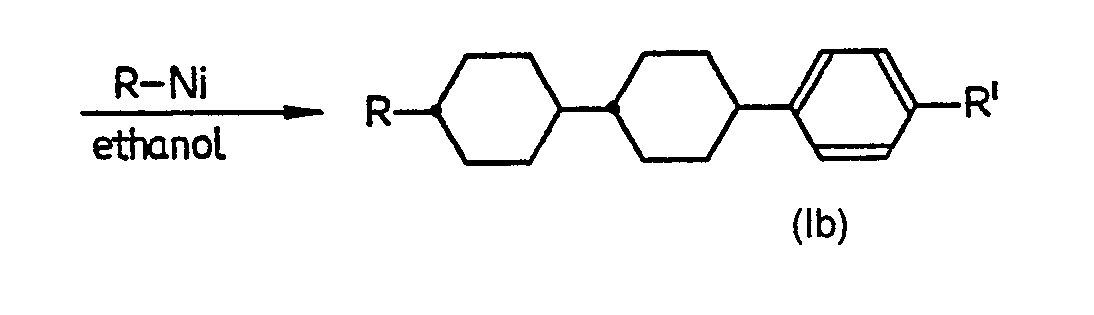
- Bromobenzene (in the case where R' is H) or a 4-substituted bromobenzene (in the case where R' is other than H) is first reacted with metallic magnesium in tetrahydrofuran or other solvent to give the corresponding 4-substituded-phenylmagnesium bromide (taking hydrogen at the 4-position to be a substituent), which is then reacted with 4-cyclohexylcyclohexanone (in the case where R is H) or a 4-(trans-4'-alkylcyclohexyl)cyclohexanone (in the case where R is other than H) to give a 4-substituted-[I'- hydroxy-4'-(optionally trans-4"-alkylcyclohexyl)cyclohexyl] benzene, which is then dehydrated, for instance in the presence of potassium hydrogen sulphate as catalyst, to give a 4-substituted-[4'-(cyclohexyl or trans-4"-alkylcyclohexyl)-cyclohexen-1-yl] benzene as one of the objective compounds. This compound can be further reduced, for example in ethanol as solvent in the presence of Raney nickel catalyst under atmospheric pressure and at about 30 °C, to give a 4-substituted-[4'-(cyclohexyl or trans-4"-alkyl-cyclohexyl)-cyclohexyl] benzene. This compound is a mixture of trans-form with cis-form, and can be recrystallized from ethanol to give an objective 4-substituted-[trans-4'-(cyclohexyl or trans-4"- alkylcyclohexyl)cyclohexyl] benzene.
- The above reactions can be illustrated by chemical equations as follows :


- The process for preparing compounds of the present invention and the use of the compounds will be further described in detail by way of Examples.
- A magnesium shaving (1.2 g, 0.049 mol) was placed in a three-neck flask, and 30 ml of a solution of 4-bromoanisole (9.2 g, 0.049 mol) dissolved in tetrahydrofuran was slowly added dropwise with stirring while passing nitrogen gas through the flask and maintaining the reaction temperature at 30° to 35 °C. As a result of the reaction, the magnesium dissolved in 3 hours to form a uniform solution containing 4-methoxyphenylmagnesium bromide, to which 50 ml of a solution of 4-(trans-4'-propylcyclohexyl)cyclohexanone (10.9 g, 0.049 mol) dissolved in tetrahydrofuran was dropwise added as rapidly as possible while the reaction temperature was maintained at 5° to 10 °C. After the dropwise addition, the mixture was heated up to 35 °C and agitated for 30 minutes, followed by addition of 50 ml of 3N hydrochloric acid. The reaction liquid was then taken into a separating funnel and subjected to extraction three times with toluene, followed by washing the combined toluene layers with water till it became neutral, and then distilling off the toluene under reduced pressure to give as residue, 4-methoxy-[1'-hydroxy-4'-(trans-4"- propylcyclohexyl)cyclohexyl] benzene.
- Potassium hydrogen sulphate (6 g) was added and the mixture was subjected to dehydration in nitrogen gas current at 160 °C for 2 hours. After cooling, toluene (200 ml) was added and potassium hydrogen sulphate was filtered off followed by washing the resulting toluene layer with water till the washing water became neutral. Toluene was then distilled off under reduced pressure to give an oily substance as residue which was recrystallized from ethanol to give the objective 4-methoxy-[4'-(trans-4"- propylcyclohexyl)cyclohexen-1'-yl] benzene. This compound had a crystalline-smectic (C-Sm) point of 95.2 °C, a smectic-nematic (Sm-N) point of 139.2 °C and a nematic-transparent (N-I) point of 207.4 °C. Yield : 7.0 g (46 %). The fact that this product was the objective compound was confirmed by NMR spectra, IR absorption spectra and elementary analysis.
- Example 1 was repeated except that the substituents R and R' in the above formula (la) were varied. The yields (g and %) and physical properties of the resulting compounds are shown in Table 1 together with those for Example 1.


- 4-methoxy-[4'-(trans-4"-propylcyclohexyl)cyclohexen-1'-yl] benzene (7.0 g) prepared in Example 1 was dissolved in ethanol (120 ml) and Raney nickel catalyst (1.0 g) was added, followed by catalytic reduction at 50 °C under atmospheric pressure (quantity of hydrogen absorbed : 500 ml). After filtering off the catalyst, the solution was subjected to recrystallization as it was. The resulting material was a mixture of cis-form with trans-form, and was further repeatedly recrystallized from ethanol to isolate the trans-form. This compound was 4-methoxy-[trans-4'-(trans-4"-propylcyclohexyl)cyclohexyl] benzene, and had a crystalline-smectic (C-Sm) point of 79.2 °C, a smectic-nematic (Sm-N) point of 128.4 °C and a nematic-transparent (N-I) point of 211.5 °C. Yield : 2.8 f (40 %). The fact that this product was the objective compound was confirmed by NMR spectra and elementary analysis.
- Example 62 was repeated except that the substituents were varied. The yields and physical properties of the resulting compounds are shown in Table 2 together with those for Example 62.


- Next, use examples will be described. Parts referred to herein are by weight.
- A liquid crystal composition (A) consisting of
- trans-4-propyl-(4'-cyanophenyl)cyclohexane (28 %),
- trans-4-pentyl-(4'-cyanophenyl)cyclohexane (43 %),
- trans-4-heptyl-(4'-cyanophenyl)cyclohexane (29 %),
- To this liquid crystal composition A (80 parts) were added 4-methoxy-[4'-(trans-4"-propylcyclohexyl)cyclohexen-1'-yl] benzene (10 parts) prepared in Example 4 to give a liquid crystal mixture. This mixture had a greatly extended a nematic temperature range of - 10 to + 81 °C. Its △ε was reduced down to 8.8 and its threshold voltage and saturation voltage were elevated up to 1.63 V and 2.28 V, respectively. Nevertheless, the viscosity (23 cp, 0.023 Pa.s) was unchanged.
- To the above liquid crystal composition (A) (90 parts) was added 4'-(trans-4"-pentylcy- clohexyl)cyclohexen-l'-ylbenzene 10 parts prepared in Example 14 to give a liquid crystal mixture. This mixture had as extended a nematic temperature range as - 5 to + 58 °C. The △ε, threshold voltage and saturation voltage were elevated up to + 9.0 V, 1.60 V, and 2.30 V, respectively but the viscosity (23 cp, 0.023 Pa.s) was unchanged.
- To the liquid crystal composition (A) (80 parts) were added 4-methoxy-[trans-4'-(trans-4"-propylcyclohexyl)cyclohexyl] benzene (10 parts) prepared in Example 62 and 4-methoxy-[trans-4'-hexylcy- clohexyl)cyclohexyl] benzene (10 parts) prepared in Example 68 to give a liquid crystal mixture. This mixture had as extended a nematic temperature range as - 10 to + 78 °C. The Δε, was reduced down to + 8.8 and the threshold voltage and saturation voltage were elevated up to 1.63 V, and 2.28 V, respectively but its viscosity (23 cp, 0.023 Pa.s) was unchanged. Thus it is seen that the compounds of the present invention are effective for lower temperature actuation.
- To the liquid crystal composition (A) (60 parts) were added [trans-4'-(trans-4"-propylcyclohexyl)cyclohexyl] benzene (20 parts) prepared in Example 72 and [trans-4'-(trans-4"-pentylcy- clohexyl)cyclohexyl] benzene (20 parts) prepared in Example 74 to give a liquid crystal mixture. This mixture had as extended a nematic temperature range as - 5 to + 73 °C. The Δε was reduced down to + 7.2 and the threshold voltage and saturation voltage were somewhat elevated up to 1.75 V, and 2.30 V, respectively but the viscosity (23 cp, 0.023 Pa.s) was unchanged. Thus, by adding the compounds of the present invention, it was possible to extend the nematic temperature range with slight increases in the threshold voltage and saturation voltage in spite of reduction in the dielectric anisotropy value.
- A liquid crystal composition (B) consisting of

- To this composition (B) (95 parts) was added 1-(trans-4'-cyclohexylcyclohexyl)-4-propoxybenzene (5 parts) prepared in Example 77 to give a liquid crystal mixture having a N-( point of 61.8 °C and a viscosity of 47.5 cp (0.047 5 Pa.s) at 20 °C.
- A composition (C) consisting of of

has a nematic temperature range of - 3 to + 52 °C, a dielectric anisotropy value Δε of + 10.5, a threshold voltage of 1.53 V and a saturation voltage of 2.12 V. Also it has a viscosity of 23 cp (0.023 Pa.s) at 20 °C.
Claims (5)




Applications Claiming Priority (10)
| Application Number | Priority Date | Filing Date | Title |
|---|---|---|---|
| JP49688/81 | 1981-04-02 | ||
| JP4968981A JPS57165328A (en) | 1981-04-02 | 1981-04-02 | 4-substituted-(trans-4'-(trans-4"-alkylcylohexyl) cyclohexyl)benzene |
| JP4968881A JPS57165327A (en) | 1981-04-02 | 1981-04-02 | 4-substituted-(4'-(trans-4"-alkylcylohexyl)cyclohexene- 1'-yl)benzene |
| JP49689/81 | 1981-04-02 | ||
| JP129070/81 | 1981-08-18 | ||
| JP12907081A JPS5832832A (en) | 1981-08-18 | 1981-08-18 | Trans-4'-(trans-4"-alkylcyclohexyl)cyclohexylbenzene |
| JP13887581A JPS5839629A (en) | 1981-09-03 | 1981-09-03 | 4'-(trans-4"-alkylcyclohexyl)cyclohexene-1'-yl-benzene derivative |
| JP138875/81 | 1981-09-03 | ||
| JP17169681A JPS5872527A (en) | 1981-10-27 | 1981-10-27 | 1,4-disubstituted benzene |
| JP171696/81 | 1981-10-27 |
Publications (2)
| Publication Number | Publication Date |
|---|---|
| EP0062470A1 EP0062470A1 (en) | 1982-10-13 |
| EP0062470B1 true EP0062470B1 (en) | 1984-08-15 |
Family
ID=27522819
Family Applications (1)
| Application Number | Title | Priority Date | Filing Date |
|---|---|---|---|
| EP82301631A Expired EP0062470B1 (en) | 1981-04-02 | 1982-03-29 | Liquid crystal benzene derivatives |
Country Status (4)
| Country | Link |
|---|---|
| US (1) | US4422951A (en) |
| EP (1) | EP0062470B1 (en) |
| DE (1) | DE3260570D1 (en) |
| HK (1) | HK44089A (en) |
Cited By (1)
| Publication number | Priority date | Publication date | Assignee | Title |
|---|---|---|---|---|
| US11884862B2 (en) | 2015-08-05 | 2024-01-30 | Merck Patent Gmbh | Liquid-crystalline medium |
Families Citing this family (37)
| Publication number | Priority date | Publication date | Assignee | Title |
|---|---|---|---|---|
| DE3006666A1 (en) * | 1980-02-22 | 1981-09-17 | Merck Patent Gmbh, 6100 Darmstadt | PHENYLCYCLOHEXEN DERIVATIVES, METHOD FOR THE PRODUCTION THEREOF, THE LIQUID CRYSTALINE CONTAINING THEM AND ELECTRO-OPTICAL DISPLAY ELEMENT |
| US4405488A (en) * | 1980-10-09 | 1983-09-20 | Chisso Corporation | Liquid-crystalline halogenobenzene derivatives |
| DE3042391A1 (en) * | 1980-11-10 | 1982-06-16 | Merck Patent Gmbh, 6100 Darmstadt | FLUORINE CYCLOHEXYLBIPHENYL DERIVATIVES, THESE DIELECTRICS AND ELECTRO-OPTICAL DISPLAY ELEMENT |
| DE3117152A1 (en) * | 1981-04-30 | 1982-11-18 | Merck Patent Gmbh, 6100 Darmstadt | "FLUORINE 4,4'-BIS (CYCLOHEXYL) BIPHENYL DERIVATIVES, THESE DIELECTRICS AND ELECTRO-OPTICAL DISPLAY ELEMENT" |
| US4477369A (en) * | 1982-01-22 | 1984-10-16 | Chisso Corporation | New high temperature liquid-crystalline substances consisting of 4 or 5 six-member-rings and liquid-crystalline compositions containing same |
| DE3211601A1 (en) * | 1982-03-30 | 1983-10-06 | Merck Patent Gmbh | HYDROTERPHENYLE |
| JPS58191782A (en) * | 1982-04-30 | 1983-11-09 | Sharp Corp | Liquid crystal composition |
| EP0099099B1 (en) * | 1982-07-16 | 1987-04-08 | Chisso Corporation | High temperature liquid crystal substances having four rings and liquid crystal compositions containing the same |
| EP0107759B1 (en) * | 1982-08-26 | 1992-12-16 | MERCK PATENT GmbH | Cyclohexane derivatives and their use as components for liquid crystals |
| US4536321A (en) * | 1983-02-18 | 1985-08-20 | Chisso Corporation | Fluorobenzene derivatives and liquid crystal compositions containing the same |
| JPS59161348A (en) * | 1983-03-02 | 1984-09-12 | Chisso Corp | Cyanotercyclohexane derivative |
| EP0122389B1 (en) * | 1983-03-16 | 1987-08-05 | F. HOFFMANN-LA ROCHE & CO. Aktiengesellschaft | Liquid crystal components having an alkenyl chain |
| GB8319849D0 (en) * | 1983-07-22 | 1983-08-24 | Secr Defence | Compounds containing fluorobiphenyl group |
| DE3565980D1 (en) * | 1984-07-14 | 1988-12-08 | Merck Patent Gmbh | Tercyclohexyles |
| DE3510434A1 (en) * | 1985-03-22 | 1986-09-25 | Merck Patent Gmbh, 6100 Darmstadt | CYCLOHEXANDERIVATE |
| US4698177A (en) * | 1985-04-16 | 1987-10-06 | Dainippon Ink And Chemicals, Inc. | Cyclohexylcyclohexene derivatives |
| US4654421A (en) * | 1985-06-20 | 1987-03-31 | Dainippon Ink And Chemicals, Inc. | 4-substituted phenyl crotyl ether derivative |
| DE3631611C2 (en) * | 1986-09-17 | 1999-05-20 | Merck Patent Gmbh | Hydroterphenyls, their use as components of liquid crystalline phases and liquid crystal phases containing them for electro-optical display elements |
| JPH0765043B2 (en) * | 1987-03-03 | 1995-07-12 | チッソ株式会社 | Liquid crystal composition |
| JP2832349B2 (en) * | 1987-11-24 | 1998-12-09 | チッソ株式会社 | Liquid crystal composition for twisted nematic mode |
| US5262084A (en) * | 1987-12-14 | 1993-11-16 | Chisso Corporation | Liquid crystal composition |
| US4946986A (en) * | 1988-02-29 | 1990-08-07 | Dainippon Ink And Chemicals | Cyclohexene derivatives |
| JPH01272537A (en) * | 1988-04-21 | 1989-10-31 | Chisso Corp | Cyclohexane derivative |
| JP2638099B2 (en) * | 1988-07-19 | 1997-08-06 | 大日本インキ化学工業株式会社 | Tricyclic cyclohexenylcyclohexane derivatives |
| US5178794A (en) * | 1989-03-01 | 1993-01-12 | Dainippon Ink And Chemicals, Inc. | Alkylene glycol derivative and liquid crystal mixture containing the same |
| JP2711714B2 (en) * | 1989-04-18 | 1998-02-10 | チッソ株式会社 | Liquid crystal composition and liquid crystal display device using the composition |
| JP2605249B2 (en) * | 1993-07-23 | 1997-04-30 | 大日本インキ化学工業株式会社 | Liquid crystal composition and liquid crystal display |
| US6366330B1 (en) | 1997-05-23 | 2002-04-02 | Kent Displays Incorporated | Cholesteric liquid crystal display that prevents image sticking |
| US6172720B1 (en) | 1997-05-23 | 2001-01-09 | Kent Displays Incorporated | Low viscosity liquid crystal material |
| EP1862526B1 (en) | 2006-05-31 | 2009-10-14 | Chisso Corporation | Liquid crystal compositions and liquid crystal display device |
| DE102010005038A1 (en) | 2009-02-14 | 2010-08-19 | Lofo High Tech Film Gmbh | Optical compensation films |
| KR102676388B1 (en) * | 2015-07-24 | 2024-06-18 | 스미또모 가가꾸 가부시끼가이샤 | Composition, optical film including the composition, and method of producing the optical film |
| KR20170062593A (en) | 2015-11-27 | 2017-06-08 | 삼성디스플레이 주식회사 | Liquid crystal composition and liquid crystal display device comprising the same |
| JP6561873B2 (en) | 2016-02-24 | 2019-08-21 | Jnc株式会社 | Compound having difluorocyclohexane ring, liquid crystal composition, and liquid crystal display device |
| CN106010580B (en) * | 2016-05-25 | 2018-08-28 | 石家庄诚志永华显示材料有限公司 | Liquid-crystal composition and its application |
| CN113072959A (en) * | 2020-01-03 | 2021-07-06 | 北京八亿时空液晶科技股份有限公司 | Liquid crystal composition with high elastic constant and containing terphenyl structure and application thereof |
| CN113072960A (en) * | 2020-01-03 | 2021-07-06 | 北京八亿时空液晶科技股份有限公司 | Liquid crystal composition containing 2-methyl-3, 4, 5 trifluorobenzene structure and application thereof |
Family Cites Families (15)
| Publication number | Priority date | Publication date | Assignee | Title |
|---|---|---|---|---|
| US3928481A (en) * | 1974-07-05 | 1975-12-23 | Texaco Inc | Preparation of polyphenyls |
| DE2701591C3 (en) * | 1977-01-15 | 1979-12-20 | Merck Patent Gmbh, 6100 Darmstadt | Hexahydroterphenyl derivatives and their use in liquid crystalline dielectrics |
| DE2702598C2 (en) * | 1977-01-22 | 1984-10-25 | Merck Patent Gmbh, 6100 Darmstadt | Cyclohexylcyclohexanes and dielectrics containing them |
| US4198130A (en) * | 1977-06-03 | 1980-04-15 | Hoffmann-La Roche Inc. | Liquid crystal mixtures |
| US4229015A (en) * | 1978-05-25 | 1980-10-21 | Ramsey Richard R | Ski pole adapted to contain a liquid |
| DE2927277A1 (en) * | 1979-07-06 | 1981-01-08 | Merck Patent Gmbh | CYCLOHEXYLBIPHENYLE, METHOD FOR THE PRODUCTION THEREOF, THESE DIELECTRICS AND ELECTRO-OPTICAL DISPLAY ELEMENT |
| DE2933563A1 (en) * | 1979-07-18 | 1981-02-05 | Bbc Brown Boveri & Cie | ANISOTROPE CONNECTIONS WITH NEGATIVE DK ANISOTROPY |
| JPS5668636A (en) * | 1979-11-07 | 1981-06-09 | Dainippon Ink & Chem Inc | Phenyl cyclohexane derivative |
| DE2948836A1 (en) * | 1979-12-05 | 1981-06-11 | Merck Patent Gmbh, 6100 Darmstadt | PARTLY HYDRATED OLIGO-1,4-PHENYLENE, ITS CONTAINING DIELECTRICS AND ELECTRO-OPTICAL DISPLAY ELEMENT |
| DE2949080A1 (en) * | 1979-12-06 | 1981-06-11 | Merck Patent Gmbh, 6100 Darmstadt | NAPHTHALINE DERIVATIVES, THESE DIELECTRICS AND ELECTRO-OPTICAL DISPLAY ELEMENT |
| CH644574A5 (en) * | 1980-06-02 | 1984-08-15 | Merck Patent Gmbh | ANISOTROPE CYCLOHEXEN COMPOUNDS AND LIQUID CRYSTAL MIXTURES. |
| JPS572386A (en) * | 1980-06-06 | 1982-01-07 | Hitachi Ltd | Nematic liquid crystal for display device |
| US4405488A (en) * | 1980-10-09 | 1983-09-20 | Chisso Corporation | Liquid-crystalline halogenobenzene derivatives |
| DE3042391A1 (en) * | 1980-11-10 | 1982-06-16 | Merck Patent Gmbh, 6100 Darmstadt | FLUORINE CYCLOHEXYLBIPHENYL DERIVATIVES, THESE DIELECTRICS AND ELECTRO-OPTICAL DISPLAY ELEMENT |
| US4432885A (en) * | 1980-12-23 | 1984-02-21 | Hoffmann-La Roche Inc. | Decalins |
-
1982
- 1982-03-16 US US06/358,794 patent/US4422951A/en not_active Expired - Lifetime
- 1982-03-29 DE DE8282301631T patent/DE3260570D1/en not_active Expired
- 1982-03-29 EP EP82301631A patent/EP0062470B1/en not_active Expired
-
1989
- 1989-05-25 HK HK440/89A patent/HK44089A/en not_active IP Right Cessation
Cited By (1)
| Publication number | Priority date | Publication date | Assignee | Title |
|---|---|---|---|---|
| US11884862B2 (en) | 2015-08-05 | 2024-01-30 | Merck Patent Gmbh | Liquid-crystalline medium |
Also Published As
| Publication number | Publication date |
|---|---|
| DE3260570D1 (en) | 1984-09-20 |
| HK44089A (en) | 1989-06-07 |
| US4422951A (en) | 1983-12-27 |
| EP0062470A1 (en) | 1982-10-13 |
Similar Documents
| Publication | Publication Date | Title |
|---|---|---|
| EP0062470B1 (en) | Liquid crystal benzene derivatives | |
| US4405488A (en) | Liquid-crystalline halogenobenzene derivatives | |
| US4676604A (en) | Liquid crystals | |
| US4565425A (en) | Liquid crystals | |
| JPH0322855B2 (en) | ||
| EP0316715B1 (en) | Cyclohexane derivatives | |
| US4439340A (en) | Cyano-mono-or diphenylbicyclohexane derivatives | |
| US4778620A (en) | Tolan derivative and a liquid crystal mixture containing the same | |
| EP0169327B1 (en) | Phenylisothiocyanates | |
| EP0280902B1 (en) | Cyclohexane derivative and liquid crystal composition containing the same | |
| EP0084974B1 (en) | Carbocyclic compounds with liquid-crystal properties | |
| JPS6239136B2 (en) | ||
| US5370822A (en) | 2-fluorobenzonitrile derivative | |
| US4908152A (en) | Cyclohexane derivative | |
| EP0422958B1 (en) | Dicyclohexylethylene derivatives | |
| JPS6313411B2 (en) | ||
| JPS6344132B2 (en) | ||
| JPS6353177B2 (en) | ||
| JPS6092228A (en) | 4-halogenobiphenyl derivative consisting of four rings | |
| JPS6360011B2 (en) | ||
| JPS6361292B2 (en) | ||
| JPH0150212B2 (en) | ||
| JPH0121817B2 (en) | ||
| JPH0158168B2 (en) | ||
| JPS632245B2 (en) |
Legal Events
| Date | Code | Title | Description |
|---|---|---|---|
| PUAI | Public reference made under article 153(3) epc to a published international application that has entered the european phase |
Free format text: ORIGINAL CODE: 0009012 |
|
| AK | Designated contracting states |
Designated state(s): CH DE GB LI |
|
| 17P | Request for examination filed |
Effective date: 19830106 |
|
| GRAA | (expected) grant |
Free format text: ORIGINAL CODE: 0009210 |
|
| AK | Designated contracting states |
Designated state(s): CH DE GB LI |
|
| REF | Corresponds to: |
Ref document number: 3260570 Country of ref document: DE Date of ref document: 19840920 |
|
| PLBE | No opposition filed within time limit |
Free format text: ORIGINAL CODE: 0009261 |
|
| STAA | Information on the status of an ep patent application or granted ep patent |
Free format text: STATUS: NO OPPOSITION FILED WITHIN TIME LIMIT |
|
| 26N | No opposition filed | ||
| PGFP | Annual fee paid to national office [announced via postgrant information from national office to epo] |
Ref country code: DE Payment date: 20010319 Year of fee payment: 20 |
|
| PGFP | Annual fee paid to national office [announced via postgrant information from national office to epo] |
Ref country code: CH Payment date: 20010327 Year of fee payment: 20 |
|
| PGFP | Annual fee paid to national office [announced via postgrant information from national office to epo] |
Ref country code: GB Payment date: 20010328 Year of fee payment: 20 |
|
| REG | Reference to a national code |
Ref country code: GB Ref legal event code: IF02 |
|
| PG25 | Lapsed in a contracting state [announced via postgrant information from national office to epo] |
Ref country code: LI Free format text: LAPSE BECAUSE OF EXPIRATION OF PROTECTION Effective date: 20020328 Ref country code: GB Free format text: LAPSE BECAUSE OF EXPIRATION OF PROTECTION Effective date: 20020328 Ref country code: CH Free format text: LAPSE BECAUSE OF EXPIRATION OF PROTECTION Effective date: 20020328 |
|
| REG | Reference to a national code |
Ref country code: GB Ref legal event code: PE20 Effective date: 20020326 |
|
| REG | Reference to a national code |
Ref country code: CH Ref legal event code: PL |