EP0059049A1 - Wound dressing - Google Patents
Wound dressing Download PDFInfo
- Publication number
- EP0059049A1 EP0059049A1 EP82300716A EP82300716A EP0059049A1 EP 0059049 A1 EP0059049 A1 EP 0059049A1 EP 82300716 A EP82300716 A EP 82300716A EP 82300716 A EP82300716 A EP 82300716A EP 0059049 A1 EP0059049 A1 EP 0059049A1
- Authority
- EP
- European Patent Office
- Prior art keywords
- conformable
- wound dressing
- film
- foam
- layer
- Prior art date
- Legal status (The legal status is an assumption and is not a legal conclusion. Google has not performed a legal analysis and makes no representation as to the accuracy of the status listed.)
- Granted
Links
- 239000006260 foam Substances 0.000 claims abstract description 72
- 230000002745 absorbent Effects 0.000 claims abstract description 18
- 239000002250 absorbent Substances 0.000 claims abstract description 18
- 239000010410 layer Substances 0.000 claims description 94
- 229920002635 polyurethane Polymers 0.000 claims description 37
- 239000004814 polyurethane Substances 0.000 claims description 37
- 239000003814 drug Substances 0.000 claims description 17
- 239000012790 adhesive layer Substances 0.000 claims description 10
- 229920001477 hydrophilic polymer Polymers 0.000 claims description 10
- 238000007906 compression Methods 0.000 claims description 9
- 230000006835 compression Effects 0.000 claims description 9
- 241000894006 Bacteria Species 0.000 claims description 4
- 239000012528 membrane Substances 0.000 claims description 4
- 238000000034 method Methods 0.000 abstract description 27
- 239000000463 material Substances 0.000 abstract description 13
- 230000008569 process Effects 0.000 abstract description 12
- 238000004519 manufacturing process Methods 0.000 abstract description 5
- 206010052428 Wound Diseases 0.000 description 89
- 208000027418 Wounds and injury Diseases 0.000 description 89
- 239000000203 mixture Substances 0.000 description 30
- 238000005266 casting Methods 0.000 description 21
- 239000000243 solution Substances 0.000 description 21
- CSCPPACGZOOCGX-UHFFFAOYSA-N Acetone Chemical compound CC(C)=O CSCPPACGZOOCGX-UHFFFAOYSA-N 0.000 description 12
- 239000007864 aqueous solution Substances 0.000 description 12
- 210000000416 exudates and transudate Anatomy 0.000 description 11
- 229920000642 polymer Polymers 0.000 description 11
- XLYOFNOQVPJJNP-UHFFFAOYSA-N water Substances O XLYOFNOQVPJJNP-UHFFFAOYSA-N 0.000 description 11
- JKXYOQDLERSFPT-UHFFFAOYSA-N 2-[2-[2-[2-[2-[2-[2-[2-[2-[2-[2-[2-[2-[2-[2-[2-[2-[2-[2-(2-octadecoxyethoxy)ethoxy]ethoxy]ethoxy]ethoxy]ethoxy]ethoxy]ethoxy]ethoxy]ethoxy]ethoxy]ethoxy]ethoxy]ethoxy]ethoxy]ethoxy]ethoxy]ethoxy]ethoxy]ethanol Chemical compound CCCCCCCCCCCCCCCCCCOCCOCCOCCOCCOCCOCCOCCOCCOCCOCCOCCOCCOCCOCCOCCOCCOCCOCCOCCOCCO JKXYOQDLERSFPT-UHFFFAOYSA-N 0.000 description 10
- WYURNTSHIVDZCO-UHFFFAOYSA-N Tetrahydrofuran Chemical compound C1CCOC1 WYURNTSHIVDZCO-UHFFFAOYSA-N 0.000 description 10
- 239000011248 coating agent Substances 0.000 description 10
- 238000000576 coating method Methods 0.000 description 10
- 239000003242 anti bacterial agent Substances 0.000 description 9
- 238000005187 foaming Methods 0.000 description 9
- 238000002360 preparation method Methods 0.000 description 9
- 239000000853 adhesive Substances 0.000 description 8
- 230000001070 adhesive effect Effects 0.000 description 8
- 210000004027 cell Anatomy 0.000 description 8
- UEJSSZHHYBHCEL-UHFFFAOYSA-N silver(1+) sulfadiazinate Chemical compound [Ag+].C1=CC(N)=CC=C1S(=O)(=O)[N-]C1=NC=CC=N1 UEJSSZHHYBHCEL-UHFFFAOYSA-N 0.000 description 8
- 239000004094 surface-active agent Substances 0.000 description 8
- RVGRUAULSDPKGF-UHFFFAOYSA-N Poloxamer Chemical compound C1CO1.CC1CO1 RVGRUAULSDPKGF-UHFFFAOYSA-N 0.000 description 7
- -1 polyethylene Polymers 0.000 description 7
- 239000004433 Thermoplastic polyurethane Substances 0.000 description 6
- 230000005540 biological transmission Effects 0.000 description 6
- 229920001577 copolymer Polymers 0.000 description 6
- 229920001971 elastomer Polymers 0.000 description 6
- 239000000839 emulsion Substances 0.000 description 6
- 229920000098 polyolefin Polymers 0.000 description 6
- 229920002803 thermoplastic polyurethane Polymers 0.000 description 6
- 229960003333 chlorhexidine gluconate Drugs 0.000 description 5
- YZIYKJHYYHPJIB-UUPCJSQJSA-N chlorhexidine gluconate Chemical compound OC[C@@H](O)[C@@H](O)[C@H](O)[C@@H](O)C(O)=O.OC[C@@H](O)[C@@H](O)[C@H](O)[C@@H](O)C(O)=O.C1=CC(Cl)=CC=C1NC(=N)NC(=N)NCCCCCCNC(=N)NC(=N)NC1=CC=C(Cl)C=C1 YZIYKJHYYHPJIB-UUPCJSQJSA-N 0.000 description 5
- 239000002131 composite material Substances 0.000 description 5
- 239000000806 elastomer Substances 0.000 description 5
- 239000012948 isocyanate Substances 0.000 description 5
- 150000002513 isocyanates Chemical class 0.000 description 5
- 239000000155 melt Substances 0.000 description 5
- 238000002156 mixing Methods 0.000 description 5
- 229920002857 polybutadiene Polymers 0.000 description 5
- 229920000570 polyether Polymers 0.000 description 5
- 229920006264 polyurethane film Polymers 0.000 description 5
- YLQBMQCUIZJEEH-UHFFFAOYSA-N tetrahydrofuran Natural products C=1C=COC=1 YLQBMQCUIZJEEH-UHFFFAOYSA-N 0.000 description 5
- WJLVQTJZDCGNJN-UHFFFAOYSA-N Chlorhexidine hydrochloride Chemical compound Cl.Cl.C=1C=C(Cl)C=CC=1NC(N)=NC(N)=NCCCCCCN=C(N)N=C(N)NC1=CC=C(Cl)C=C1 WJLVQTJZDCGNJN-UHFFFAOYSA-N 0.000 description 4
- 239000004721 Polyphenylene oxide Substances 0.000 description 4
- 229920005830 Polyurethane Foam Polymers 0.000 description 4
- 239000004820 Pressure-sensitive adhesive Substances 0.000 description 4
- 229960004504 chlorhexidine hydrochloride Drugs 0.000 description 4
- 239000004745 nonwoven fabric Substances 0.000 description 4
- 229920002589 poly(vinylethylene) polymer Polymers 0.000 description 4
- 229920001296 polysiloxane Polymers 0.000 description 4
- 239000011496 polyurethane foam Substances 0.000 description 4
- 239000000843 powder Substances 0.000 description 4
- SMZOUWXMTYCWNB-UHFFFAOYSA-N 2-(2-methoxy-5-methylphenyl)ethanamine Chemical compound COC1=CC=C(C)C=C1CCN SMZOUWXMTYCWNB-UHFFFAOYSA-N 0.000 description 3
- NIXOWILDQLNWCW-UHFFFAOYSA-N 2-Propenoic acid Natural products OC(=O)C=C NIXOWILDQLNWCW-UHFFFAOYSA-N 0.000 description 3
- GHXZTYHSJHQHIJ-UHFFFAOYSA-N Chlorhexidine Chemical class C=1C=C(Cl)C=CC=1NC(N)=NC(N)=NCCCCCCN=C(N)N=C(N)NC1=CC=C(Cl)C=C1 GHXZTYHSJHQHIJ-UHFFFAOYSA-N 0.000 description 3
- RTZKZFJDLAIYFH-UHFFFAOYSA-N Diethyl ether Chemical compound CCOCC RTZKZFJDLAIYFH-UHFFFAOYSA-N 0.000 description 3
- 239000005062 Polybutadiene Substances 0.000 description 3
- 230000001464 adherent effect Effects 0.000 description 3
- 229910003460 diamond Inorganic materials 0.000 description 3
- 239000010432 diamond Substances 0.000 description 3
- 239000012153 distilled water Substances 0.000 description 3
- 208000015181 infectious disease Diseases 0.000 description 3
- 239000007788 liquid Substances 0.000 description 3
- 239000002736 nonionic surfactant Substances 0.000 description 3
- 150000003839 salts Chemical class 0.000 description 3
- 239000007787 solid Substances 0.000 description 3
- 239000007921 spray Substances 0.000 description 3
- 238000005507 spraying Methods 0.000 description 3
- 238000003892 spreading Methods 0.000 description 3
- 230000007480 spreading Effects 0.000 description 3
- 238000004659 sterilization and disinfection Methods 0.000 description 3
- 238000011282 treatment Methods 0.000 description 3
- 239000011800 void material Substances 0.000 description 3
- CPKVUHPKYQGHMW-UHFFFAOYSA-N 1-ethenylpyrrolidin-2-one;molecular iodine Chemical compound II.C=CN1CCCC1=O CPKVUHPKYQGHMW-UHFFFAOYSA-N 0.000 description 2
- GOXQRTZXKQZDDN-UHFFFAOYSA-N 2-Ethylhexyl acrylate Chemical compound CCCCC(CC)COC(=O)C=C GOXQRTZXKQZDDN-UHFFFAOYSA-N 0.000 description 2
- 241000251468 Actinopterygii Species 0.000 description 2
- 229920002023 Pluronic® F 87 Polymers 0.000 description 2
- 239000004698 Polyethylene Substances 0.000 description 2
- 229920000153 Povidone-iodine Polymers 0.000 description 2
- 230000000844 anti-bacterial effect Effects 0.000 description 2
- 230000004888 barrier function Effects 0.000 description 2
- CQEYYJKEWSMYFG-UHFFFAOYSA-N butyl acrylate Chemical compound CCCCOC(=O)C=C CQEYYJKEWSMYFG-UHFFFAOYSA-N 0.000 description 2
- 150000001875 compounds Chemical class 0.000 description 2
- 238000010924 continuous production Methods 0.000 description 2
- 238000001035 drying Methods 0.000 description 2
- 238000001125 extrusion Methods 0.000 description 2
- 239000004744 fabric Substances 0.000 description 2
- 230000009969 flowable effect Effects 0.000 description 2
- 239000012530 fluid Substances 0.000 description 2
- 229920001903 high density polyethylene Polymers 0.000 description 2
- 239000004700 high-density polyethylene Substances 0.000 description 2
- 239000012943 hotmelt Substances 0.000 description 2
- 238000010348 incorporation Methods 0.000 description 2
- 238000010030 laminating Methods 0.000 description 2
- 238000003475 lamination Methods 0.000 description 2
- 229910052751 metal Inorganic materials 0.000 description 2
- 239000002184 metal Substances 0.000 description 2
- 229920001983 poloxamer Polymers 0.000 description 2
- 229920000728 polyester Polymers 0.000 description 2
- 229920000573 polyethylene Polymers 0.000 description 2
- 229920000036 polyvinylpyrrolidone Polymers 0.000 description 2
- 235000013855 polyvinylpyrrolidone Nutrition 0.000 description 2
- 238000011176 pooling Methods 0.000 description 2
- 229960001621 povidone-iodine Drugs 0.000 description 2
- 238000009877 rendering Methods 0.000 description 2
- GGCZERPQGJTIQP-UHFFFAOYSA-N sodium;9,10-dioxoanthracene-2-sulfonic acid Chemical compound [Na+].C1=CC=C2C(=O)C3=CC(S(=O)(=O)O)=CC=C3C(=O)C2=C1 GGCZERPQGJTIQP-UHFFFAOYSA-N 0.000 description 2
- 238000003756 stirring Methods 0.000 description 2
- 239000000758 substrate Substances 0.000 description 2
- 238000012360 testing method Methods 0.000 description 2
- 238000001291 vacuum drying Methods 0.000 description 2
- 229920002554 vinyl polymer Polymers 0.000 description 2
- YIWGJFPJRAEKMK-UHFFFAOYSA-N 1-(2H-benzotriazol-5-yl)-3-methyl-8-[2-[[3-(trifluoromethoxy)phenyl]methylamino]pyrimidine-5-carbonyl]-1,3,8-triazaspiro[4.5]decane-2,4-dione Chemical compound CN1C(=O)N(c2ccc3n[nH]nc3c2)C2(CCN(CC2)C(=O)c2cnc(NCc3cccc(OC(F)(F)F)c3)nc2)C1=O YIWGJFPJRAEKMK-UHFFFAOYSA-N 0.000 description 1
- ZCYVEMRRCGMTRW-UHFFFAOYSA-N 7553-56-2 Chemical compound [I] ZCYVEMRRCGMTRW-UHFFFAOYSA-N 0.000 description 1
- QTBSBXVTEAMEQO-UHFFFAOYSA-M Acetate Chemical compound CC([O-])=O QTBSBXVTEAMEQO-UHFFFAOYSA-M 0.000 description 1
- 229920001817 Agar Polymers 0.000 description 1
- 244000063299 Bacillus subtilis Species 0.000 description 1
- 235000014469 Bacillus subtilis Nutrition 0.000 description 1
- 229910001369 Brass Inorganic materials 0.000 description 1
- 241000700198 Cavia Species 0.000 description 1
- RGHNJXZEOKUKBD-SQOUGZDYSA-M D-gluconate Chemical compound OC[C@@H](O)[C@@H](O)[C@H](O)[C@@H](O)C([O-])=O RGHNJXZEOKUKBD-SQOUGZDYSA-M 0.000 description 1
- JOYRKODLDBILNP-UHFFFAOYSA-N Ethyl urethane Chemical compound CCOC(N)=O JOYRKODLDBILNP-UHFFFAOYSA-N 0.000 description 1
- IAYPIBMASNFSPL-UHFFFAOYSA-N Ethylene oxide Chemical group C1CO1 IAYPIBMASNFSPL-UHFFFAOYSA-N 0.000 description 1
- VEXZGXHMUGYJMC-UHFFFAOYSA-N Hydrochloric acid Chemical compound Cl VEXZGXHMUGYJMC-UHFFFAOYSA-N 0.000 description 1
- 208000005230 Leg Ulcer Diseases 0.000 description 1
- 229920000297 Rayon Polymers 0.000 description 1
- 208000025865 Ulcer Diseases 0.000 description 1
- 238000010521 absorption reaction Methods 0.000 description 1
- 238000004026 adhesive bonding Methods 0.000 description 1
- 239000008272 agar Substances 0.000 description 1
- 125000004183 alkoxy alkyl group Chemical group 0.000 description 1
- 239000005030 aluminium foil Substances 0.000 description 1
- 125000003277 amino group Chemical group 0.000 description 1
- 238000013459 approach Methods 0.000 description 1
- 230000001580 bacterial effect Effects 0.000 description 1
- 229960000686 benzalkonium chloride Drugs 0.000 description 1
- CADWTSSKOVRVJC-UHFFFAOYSA-N benzyl(dimethyl)azanium;chloride Chemical compound [Cl-].C[NH+](C)CC1=CC=CC=C1 CADWTSSKOVRVJC-UHFFFAOYSA-N 0.000 description 1
- 229920001400 block copolymer Polymers 0.000 description 1
- 239000010951 brass Substances 0.000 description 1
- MTAZNLWOLGHBHU-UHFFFAOYSA-N butadiene-styrene rubber Chemical compound C=CC=C.C=CC1=CC=CC=C1 MTAZNLWOLGHBHU-UHFFFAOYSA-N 0.000 description 1
- 230000001413 cellular effect Effects 0.000 description 1
- 230000008859 change Effects 0.000 description 1
- 238000006243 chemical reaction Methods 0.000 description 1
- 239000003795 chemical substances by application Substances 0.000 description 1
- 229960003260 chlorhexidine Drugs 0.000 description 1
- 229960002152 chlorhexidine acetate Drugs 0.000 description 1
- 238000001816 cooling Methods 0.000 description 1
- 239000011162 core material Substances 0.000 description 1
- 239000006071 cream Substances 0.000 description 1
- 238000009792 diffusion process Methods 0.000 description 1
- 239000006185 dispersion Substances 0.000 description 1
- 230000000694 effects Effects 0.000 description 1
- HQPMKSGTIOYHJT-UHFFFAOYSA-N ethane-1,2-diol;propane-1,2-diol Chemical compound OCCO.CC(O)CO HQPMKSGTIOYHJT-UHFFFAOYSA-N 0.000 description 1
- 210000002950 fibroblast Anatomy 0.000 description 1
- 239000002657 fibrous material Substances 0.000 description 1
- 229920002313 fluoropolymer Polymers 0.000 description 1
- 210000000497 foam cell Anatomy 0.000 description 1
- 238000009472 formulation Methods 0.000 description 1
- 238000007429 general method Methods 0.000 description 1
- 229940050410 gluconate Drugs 0.000 description 1
- 229920005669 high impact polystyrene Polymers 0.000 description 1
- 239000004797 high-impact polystyrene Substances 0.000 description 1
- 238000007757 hot melt coating Methods 0.000 description 1
- 230000001969 hypertrophic effect Effects 0.000 description 1
- 239000004615 ingredient Substances 0.000 description 1
- 230000005764 inhibitory process Effects 0.000 description 1
- 229910052740 iodine Inorganic materials 0.000 description 1
- 239000011630 iodine Substances 0.000 description 1
- KRVIMMAOCNANRA-UHFFFAOYSA-N iodine;pyrrolidin-2-one Chemical compound [I].O=C1CCCN1 KRVIMMAOCNANRA-UHFFFAOYSA-N 0.000 description 1
- 150000002734 metacrylic acid derivatives Chemical class 0.000 description 1
- 125000004433 nitrogen atom Chemical group N* 0.000 description 1
- 238000012856 packing Methods 0.000 description 1
- 239000002245 particle Substances 0.000 description 1
- 230000035515 penetration Effects 0.000 description 1
- 229920001993 poloxamer 188 Polymers 0.000 description 1
- 229920000058 polyacrylate Polymers 0.000 description 1
- 229920002959 polymer blend Polymers 0.000 description 1
- 229920006254 polymer film Polymers 0.000 description 1
- 229920001343 polytetrafluoroethylene Polymers 0.000 description 1
- 239000004810 polytetrafluoroethylene Substances 0.000 description 1
- 239000011527 polyurethane coating Substances 0.000 description 1
- 239000001267 polyvinylpyrrolidone Substances 0.000 description 1
- 230000000063 preceeding effect Effects 0.000 description 1
- 230000002265 prevention Effects 0.000 description 1
- MCSINKKTEDDPNK-UHFFFAOYSA-N propyl propionate Chemical compound CCCOC(=O)CC MCSINKKTEDDPNK-UHFFFAOYSA-N 0.000 description 1
- 230000009257 reactivity Effects 0.000 description 1
- 230000002940 repellent Effects 0.000 description 1
- 239000005871 repellent Substances 0.000 description 1
- 238000007761 roller coating Methods 0.000 description 1
- 239000005060 rubber Substances 0.000 description 1
- 229920006395 saturated elastomer Polymers 0.000 description 1
- 230000037390 scarring Effects 0.000 description 1
- 238000007789 sealing Methods 0.000 description 1
- 239000002356 single layer Substances 0.000 description 1
- 238000002791 soaking Methods 0.000 description 1
- 239000000126 substance Substances 0.000 description 1
- 229920003051 synthetic elastomer Polymers 0.000 description 1
- 229920001169 thermoplastic Polymers 0.000 description 1
- 239000004416 thermosoftening plastic Substances 0.000 description 1
- 231100000397 ulcer Toxicity 0.000 description 1
- 150000003673 urethanes Chemical class 0.000 description 1
- 229920003176 water-insoluble polymer Polymers 0.000 description 1
Images


Classifications
-
- A—HUMAN NECESSITIES
- A61—MEDICAL OR VETERINARY SCIENCE; HYGIENE
- A61L—METHODS OR APPARATUS FOR STERILISING MATERIALS OR OBJECTS IN GENERAL; DISINFECTION, STERILISATION OR DEODORISATION OF AIR; CHEMICAL ASPECTS OF BANDAGES, DRESSINGS, ABSORBENT PADS OR SURGICAL ARTICLES; MATERIALS FOR BANDAGES, DRESSINGS, ABSORBENT PADS OR SURGICAL ARTICLES
- A61L15/00—Chemical aspects of, or use of materials for, bandages, dressings or absorbent pads
- A61L15/16—Bandages, dressings or absorbent pads for physiological fluids such as urine or blood, e.g. sanitary towels, tampons
- A61L15/42—Use of materials characterised by their function or physical properties
- A61L15/46—Deodorants or malodour counteractants, e.g. to inhibit the formation of ammonia or bacteria
-
- A—HUMAN NECESSITIES
- A61—MEDICAL OR VETERINARY SCIENCE; HYGIENE
- A61F—FILTERS IMPLANTABLE INTO BLOOD VESSELS; PROSTHESES; DEVICES PROVIDING PATENCY TO, OR PREVENTING COLLAPSING OF, TUBULAR STRUCTURES OF THE BODY, e.g. STENTS; ORTHOPAEDIC, NURSING OR CONTRACEPTIVE DEVICES; FOMENTATION; TREATMENT OR PROTECTION OF EYES OR EARS; BANDAGES, DRESSINGS OR ABSORBENT PADS; FIRST-AID KITS
- A61F13/00—Bandages or dressings; Absorbent pads
- A61F13/00051—Accessories for dressings
- A61F13/00063—Accessories for dressings comprising medicaments or additives, e.g. odor control, PH control, debriding, antimicrobic
-
- A—HUMAN NECESSITIES
- A61—MEDICAL OR VETERINARY SCIENCE; HYGIENE
- A61F—FILTERS IMPLANTABLE INTO BLOOD VESSELS; PROSTHESES; DEVICES PROVIDING PATENCY TO, OR PREVENTING COLLAPSING OF, TUBULAR STRUCTURES OF THE BODY, e.g. STENTS; ORTHOPAEDIC, NURSING OR CONTRACEPTIVE DEVICES; FOMENTATION; TREATMENT OR PROTECTION OF EYES OR EARS; BANDAGES, DRESSINGS OR ABSORBENT PADS; FIRST-AID KITS
- A61F13/00—Bandages or dressings; Absorbent pads
- A61F13/01—Non-adhesive bandages or dressings
- A61F13/01034—Non-adhesive bandages or dressings characterised by a property
- A61F13/01046—Air-vapor permeability
-
- A—HUMAN NECESSITIES
- A61—MEDICAL OR VETERINARY SCIENCE; HYGIENE
- A61L—METHODS OR APPARATUS FOR STERILISING MATERIALS OR OBJECTS IN GENERAL; DISINFECTION, STERILISATION OR DEODORISATION OF AIR; CHEMICAL ASPECTS OF BANDAGES, DRESSINGS, ABSORBENT PADS OR SURGICAL ARTICLES; MATERIALS FOR BANDAGES, DRESSINGS, ABSORBENT PADS OR SURGICAL ARTICLES
- A61L15/00—Chemical aspects of, or use of materials for, bandages, dressings or absorbent pads
- A61L15/16—Bandages, dressings or absorbent pads for physiological fluids such as urine or blood, e.g. sanitary towels, tampons
- A61L15/22—Bandages, dressings or absorbent pads for physiological fluids such as urine or blood, e.g. sanitary towels, tampons containing macromolecular materials
- A61L15/26—Macromolecular compounds obtained otherwise than by reactions only involving carbon-to-carbon unsaturated bonds; Derivatives thereof
-
- A—HUMAN NECESSITIES
- A61—MEDICAL OR VETERINARY SCIENCE; HYGIENE
- A61L—METHODS OR APPARATUS FOR STERILISING MATERIALS OR OBJECTS IN GENERAL; DISINFECTION, STERILISATION OR DEODORISATION OF AIR; CHEMICAL ASPECTS OF BANDAGES, DRESSINGS, ABSORBENT PADS OR SURGICAL ARTICLES; MATERIALS FOR BANDAGES, DRESSINGS, ABSORBENT PADS OR SURGICAL ARTICLES
- A61L15/00—Chemical aspects of, or use of materials for, bandages, dressings or absorbent pads
- A61L15/16—Bandages, dressings or absorbent pads for physiological fluids such as urine or blood, e.g. sanitary towels, tampons
- A61L15/42—Use of materials characterised by their function or physical properties
-
- A—HUMAN NECESSITIES
- A61—MEDICAL OR VETERINARY SCIENCE; HYGIENE
- A61L—METHODS OR APPARATUS FOR STERILISING MATERIALS OR OBJECTS IN GENERAL; DISINFECTION, STERILISATION OR DEODORISATION OF AIR; CHEMICAL ASPECTS OF BANDAGES, DRESSINGS, ABSORBENT PADS OR SURGICAL ARTICLES; MATERIALS FOR BANDAGES, DRESSINGS, ABSORBENT PADS OR SURGICAL ARTICLES
- A61L15/00—Chemical aspects of, or use of materials for, bandages, dressings or absorbent pads
- A61L15/16—Bandages, dressings or absorbent pads for physiological fluids such as urine or blood, e.g. sanitary towels, tampons
- A61L15/42—Use of materials characterised by their function or physical properties
- A61L15/425—Porous materials, e.g. foams or sponges
-
- A—HUMAN NECESSITIES
- A61—MEDICAL OR VETERINARY SCIENCE; HYGIENE
- A61F—FILTERS IMPLANTABLE INTO BLOOD VESSELS; PROSTHESES; DEVICES PROVIDING PATENCY TO, OR PREVENTING COLLAPSING OF, TUBULAR STRUCTURES OF THE BODY, e.g. STENTS; ORTHOPAEDIC, NURSING OR CONTRACEPTIVE DEVICES; FOMENTATION; TREATMENT OR PROTECTION OF EYES OR EARS; BANDAGES, DRESSINGS OR ABSORBENT PADS; FIRST-AID KITS
- A61F13/00—Bandages or dressings; Absorbent pads
- A61F13/15—Absorbent pads, e.g. sanitary towels, swabs or tampons for external or internal application to the body; Supporting or fastening means therefor; Tampon applicators
- A61F13/53—Absorbent pads, e.g. sanitary towels, swabs or tampons for external or internal application to the body; Supporting or fastening means therefor; Tampon applicators characterised by the absorbing medium
- A61F13/534—Absorbent pads, e.g. sanitary towels, swabs or tampons for external or internal application to the body; Supporting or fastening means therefor; Tampon applicators characterised by the absorbing medium having an inhomogeneous composition through the thickness of the pad
-
- A—HUMAN NECESSITIES
- A61—MEDICAL OR VETERINARY SCIENCE; HYGIENE
- A61F—FILTERS IMPLANTABLE INTO BLOOD VESSELS; PROSTHESES; DEVICES PROVIDING PATENCY TO, OR PREVENTING COLLAPSING OF, TUBULAR STRUCTURES OF THE BODY, e.g. STENTS; ORTHOPAEDIC, NURSING OR CONTRACEPTIVE DEVICES; FOMENTATION; TREATMENT OR PROTECTION OF EYES OR EARS; BANDAGES, DRESSINGS OR ABSORBENT PADS; FIRST-AID KITS
- A61F13/00—Bandages or dressings; Absorbent pads
- A61F13/15—Absorbent pads, e.g. sanitary towels, swabs or tampons for external or internal application to the body; Supporting or fastening means therefor; Tampon applicators
- A61F13/53—Absorbent pads, e.g. sanitary towels, swabs or tampons for external or internal application to the body; Supporting or fastening means therefor; Tampon applicators characterised by the absorbing medium
- A61F13/539—Absorbent pads, e.g. sanitary towels, swabs or tampons for external or internal application to the body; Supporting or fastening means therefor; Tampon applicators characterised by the absorbing medium characterised by the connection of the absorbent layers with each other or with the outer layers
-
- A—HUMAN NECESSITIES
- A61—MEDICAL OR VETERINARY SCIENCE; HYGIENE
- A61F—FILTERS IMPLANTABLE INTO BLOOD VESSELS; PROSTHESES; DEVICES PROVIDING PATENCY TO, OR PREVENTING COLLAPSING OF, TUBULAR STRUCTURES OF THE BODY, e.g. STENTS; ORTHOPAEDIC, NURSING OR CONTRACEPTIVE DEVICES; FOMENTATION; TREATMENT OR PROTECTION OF EYES OR EARS; BANDAGES, DRESSINGS OR ABSORBENT PADS; FIRST-AID KITS
- A61F13/00—Bandages or dressings; Absorbent pads
- A61F13/15—Absorbent pads, e.g. sanitary towels, swabs or tampons for external or internal application to the body; Supporting or fastening means therefor; Tampon applicators
- A61F13/84—Accessories, not otherwise provided for, for absorbent pads
- A61F13/8405—Additives, e.g. for odour, disinfectant or pH control
-
- A—HUMAN NECESSITIES
- A61—MEDICAL OR VETERINARY SCIENCE; HYGIENE
- A61F—FILTERS IMPLANTABLE INTO BLOOD VESSELS; PROSTHESES; DEVICES PROVIDING PATENCY TO, OR PREVENTING COLLAPSING OF, TUBULAR STRUCTURES OF THE BODY, e.g. STENTS; ORTHOPAEDIC, NURSING OR CONTRACEPTIVE DEVICES; FOMENTATION; TREATMENT OR PROTECTION OF EYES OR EARS; BANDAGES, DRESSINGS OR ABSORBENT PADS; FIRST-AID KITS
- A61F13/00—Bandages or dressings; Absorbent pads
- A61F2013/00089—Wound bandages
- A61F2013/00119—Wound bandages elastic
-
- A—HUMAN NECESSITIES
- A61—MEDICAL OR VETERINARY SCIENCE; HYGIENE
- A61F—FILTERS IMPLANTABLE INTO BLOOD VESSELS; PROSTHESES; DEVICES PROVIDING PATENCY TO, OR PREVENTING COLLAPSING OF, TUBULAR STRUCTURES OF THE BODY, e.g. STENTS; ORTHOPAEDIC, NURSING OR CONTRACEPTIVE DEVICES; FOMENTATION; TREATMENT OR PROTECTION OF EYES OR EARS; BANDAGES, DRESSINGS OR ABSORBENT PADS; FIRST-AID KITS
- A61F13/00—Bandages or dressings; Absorbent pads
- A61F2013/00089—Wound bandages
- A61F2013/00157—Wound bandages for burns or skin transplants
-
- A—HUMAN NECESSITIES
- A61—MEDICAL OR VETERINARY SCIENCE; HYGIENE
- A61F—FILTERS IMPLANTABLE INTO BLOOD VESSELS; PROSTHESES; DEVICES PROVIDING PATENCY TO, OR PREVENTING COLLAPSING OF, TUBULAR STRUCTURES OF THE BODY, e.g. STENTS; ORTHOPAEDIC, NURSING OR CONTRACEPTIVE DEVICES; FOMENTATION; TREATMENT OR PROTECTION OF EYES OR EARS; BANDAGES, DRESSINGS OR ABSORBENT PADS; FIRST-AID KITS
- A61F13/00—Bandages or dressings; Absorbent pads
- A61F2013/00089—Wound bandages
- A61F2013/00217—Wound bandages not adhering to the wound
-
- A—HUMAN NECESSITIES
- A61—MEDICAL OR VETERINARY SCIENCE; HYGIENE
- A61F—FILTERS IMPLANTABLE INTO BLOOD VESSELS; PROSTHESES; DEVICES PROVIDING PATENCY TO, OR PREVENTING COLLAPSING OF, TUBULAR STRUCTURES OF THE BODY, e.g. STENTS; ORTHOPAEDIC, NURSING OR CONTRACEPTIVE DEVICES; FOMENTATION; TREATMENT OR PROTECTION OF EYES OR EARS; BANDAGES, DRESSINGS OR ABSORBENT PADS; FIRST-AID KITS
- A61F13/00—Bandages or dressings; Absorbent pads
- A61F2013/00089—Wound bandages
- A61F2013/00246—Wound bandages in a special way pervious to air or vapours
- A61F2013/00251—Wound bandages in a special way pervious to air or vapours with macroscopic openings
-
- A—HUMAN NECESSITIES
- A61—MEDICAL OR VETERINARY SCIENCE; HYGIENE
- A61F—FILTERS IMPLANTABLE INTO BLOOD VESSELS; PROSTHESES; DEVICES PROVIDING PATENCY TO, OR PREVENTING COLLAPSING OF, TUBULAR STRUCTURES OF THE BODY, e.g. STENTS; ORTHOPAEDIC, NURSING OR CONTRACEPTIVE DEVICES; FOMENTATION; TREATMENT OR PROTECTION OF EYES OR EARS; BANDAGES, DRESSINGS OR ABSORBENT PADS; FIRST-AID KITS
- A61F13/00—Bandages or dressings; Absorbent pads
- A61F2013/00089—Wound bandages
- A61F2013/00246—Wound bandages in a special way pervious to air or vapours
- A61F2013/00263—Wound bandages in a special way pervious to air or vapours vapour permeability >500 g/m2/24h
-
- A—HUMAN NECESSITIES
- A61—MEDICAL OR VETERINARY SCIENCE; HYGIENE
- A61F—FILTERS IMPLANTABLE INTO BLOOD VESSELS; PROSTHESES; DEVICES PROVIDING PATENCY TO, OR PREVENTING COLLAPSING OF, TUBULAR STRUCTURES OF THE BODY, e.g. STENTS; ORTHOPAEDIC, NURSING OR CONTRACEPTIVE DEVICES; FOMENTATION; TREATMENT OR PROTECTION OF EYES OR EARS; BANDAGES, DRESSINGS OR ABSORBENT PADS; FIRST-AID KITS
- A61F13/00—Bandages or dressings; Absorbent pads
- A61F2013/00361—Plasters
- A61F2013/00365—Plasters use
- A61F2013/00519—Plasters use for treating burn
-
- A—HUMAN NECESSITIES
- A61—MEDICAL OR VETERINARY SCIENCE; HYGIENE
- A61F—FILTERS IMPLANTABLE INTO BLOOD VESSELS; PROSTHESES; DEVICES PROVIDING PATENCY TO, OR PREVENTING COLLAPSING OF, TUBULAR STRUCTURES OF THE BODY, e.g. STENTS; ORTHOPAEDIC, NURSING OR CONTRACEPTIVE DEVICES; FOMENTATION; TREATMENT OR PROTECTION OF EYES OR EARS; BANDAGES, DRESSINGS OR ABSORBENT PADS; FIRST-AID KITS
- A61F13/00—Bandages or dressings; Absorbent pads
- A61F2013/00361—Plasters
- A61F2013/00727—Plasters means for wound humidity control
- A61F2013/00731—Plasters means for wound humidity control with absorbing pads
- A61F2013/0074—Plasters means for wound humidity control with absorbing pads containing foams
-
- A—HUMAN NECESSITIES
- A61—MEDICAL OR VETERINARY SCIENCE; HYGIENE
- A61F—FILTERS IMPLANTABLE INTO BLOOD VESSELS; PROSTHESES; DEVICES PROVIDING PATENCY TO, OR PREVENTING COLLAPSING OF, TUBULAR STRUCTURES OF THE BODY, e.g. STENTS; ORTHOPAEDIC, NURSING OR CONTRACEPTIVE DEVICES; FOMENTATION; TREATMENT OR PROTECTION OF EYES OR EARS; BANDAGES, DRESSINGS OR ABSORBENT PADS; FIRST-AID KITS
- A61F13/00—Bandages or dressings; Absorbent pads
- A61F2013/00361—Plasters
- A61F2013/00727—Plasters means for wound humidity control
- A61F2013/00761—Plasters means for wound humidity control with permeable adhesive layers
-
- A—HUMAN NECESSITIES
- A61—MEDICAL OR VETERINARY SCIENCE; HYGIENE
- A61F—FILTERS IMPLANTABLE INTO BLOOD VESSELS; PROSTHESES; DEVICES PROVIDING PATENCY TO, OR PREVENTING COLLAPSING OF, TUBULAR STRUCTURES OF THE BODY, e.g. STENTS; ORTHOPAEDIC, NURSING OR CONTRACEPTIVE DEVICES; FOMENTATION; TREATMENT OR PROTECTION OF EYES OR EARS; BANDAGES, DRESSINGS OR ABSORBENT PADS; FIRST-AID KITS
- A61F13/00—Bandages or dressings; Absorbent pads
- A61F2013/00361—Plasters
- A61F2013/00855—Plasters pervious to air or vapours
- A61F2013/00859—Plasters pervious to air or vapours with macroscopic openings
-
- A—HUMAN NECESSITIES
- A61—MEDICAL OR VETERINARY SCIENCE; HYGIENE
- A61F—FILTERS IMPLANTABLE INTO BLOOD VESSELS; PROSTHESES; DEVICES PROVIDING PATENCY TO, OR PREVENTING COLLAPSING OF, TUBULAR STRUCTURES OF THE BODY, e.g. STENTS; ORTHOPAEDIC, NURSING OR CONTRACEPTIVE DEVICES; FOMENTATION; TREATMENT OR PROTECTION OF EYES OR EARS; BANDAGES, DRESSINGS OR ABSORBENT PADS; FIRST-AID KITS
- A61F13/00—Bandages or dressings; Absorbent pads
- A61F2013/00361—Plasters
- A61F2013/00855—Plasters pervious to air or vapours
- A61F2013/00876—Plasters pervious to air or vapours vapour permeability >500 g/mg/24h
-
- A—HUMAN NECESSITIES
- A61—MEDICAL OR VETERINARY SCIENCE; HYGIENE
- A61F—FILTERS IMPLANTABLE INTO BLOOD VESSELS; PROSTHESES; DEVICES PROVIDING PATENCY TO, OR PREVENTING COLLAPSING OF, TUBULAR STRUCTURES OF THE BODY, e.g. STENTS; ORTHOPAEDIC, NURSING OR CONTRACEPTIVE DEVICES; FOMENTATION; TREATMENT OR PROTECTION OF EYES OR EARS; BANDAGES, DRESSINGS OR ABSORBENT PADS; FIRST-AID KITS
- A61F13/00—Bandages or dressings; Absorbent pads
- A61F2013/00361—Plasters
- A61F2013/00902—Plasters containing means
- A61F2013/0091—Plasters containing means with disinfecting or anaesthetics means, e.g. anti-mycrobic
-
- A—HUMAN NECESSITIES
- A61—MEDICAL OR VETERINARY SCIENCE; HYGIENE
- A61F—FILTERS IMPLANTABLE INTO BLOOD VESSELS; PROSTHESES; DEVICES PROVIDING PATENCY TO, OR PREVENTING COLLAPSING OF, TUBULAR STRUCTURES OF THE BODY, e.g. STENTS; ORTHOPAEDIC, NURSING OR CONTRACEPTIVE DEVICES; FOMENTATION; TREATMENT OR PROTECTION OF EYES OR EARS; BANDAGES, DRESSINGS OR ABSORBENT PADS; FIRST-AID KITS
- A61F13/00—Bandages or dressings; Absorbent pads
- A61F13/15—Absorbent pads, e.g. sanitary towels, swabs or tampons for external or internal application to the body; Supporting or fastening means therefor; Tampon applicators
- A61F13/15577—Apparatus or processes for manufacturing
- A61F2013/15821—Apparatus or processes for manufacturing characterized by the apparatus for manufacturing
-
- A—HUMAN NECESSITIES
- A61—MEDICAL OR VETERINARY SCIENCE; HYGIENE
- A61F—FILTERS IMPLANTABLE INTO BLOOD VESSELS; PROSTHESES; DEVICES PROVIDING PATENCY TO, OR PREVENTING COLLAPSING OF, TUBULAR STRUCTURES OF THE BODY, e.g. STENTS; ORTHOPAEDIC, NURSING OR CONTRACEPTIVE DEVICES; FOMENTATION; TREATMENT OR PROTECTION OF EYES OR EARS; BANDAGES, DRESSINGS OR ABSORBENT PADS; FIRST-AID KITS
- A61F13/00—Bandages or dressings; Absorbent pads
- A61F13/15—Absorbent pads, e.g. sanitary towels, swabs or tampons for external or internal application to the body; Supporting or fastening means therefor; Tampon applicators
- A61F13/53—Absorbent pads, e.g. sanitary towels, swabs or tampons for external or internal application to the body; Supporting or fastening means therefor; Tampon applicators characterised by the absorbing medium
- A61F2013/530802—Absorbent pads, e.g. sanitary towels, swabs or tampons for external or internal application to the body; Supporting or fastening means therefor; Tampon applicators characterised by the absorbing medium characterized by the foam or sponge other than superabsorbent
-
- A—HUMAN NECESSITIES
- A61—MEDICAL OR VETERINARY SCIENCE; HYGIENE
- A61F—FILTERS IMPLANTABLE INTO BLOOD VESSELS; PROSTHESES; DEVICES PROVIDING PATENCY TO, OR PREVENTING COLLAPSING OF, TUBULAR STRUCTURES OF THE BODY, e.g. STENTS; ORTHOPAEDIC, NURSING OR CONTRACEPTIVE DEVICES; FOMENTATION; TREATMENT OR PROTECTION OF EYES OR EARS; BANDAGES, DRESSINGS OR ABSORBENT PADS; FIRST-AID KITS
- A61F13/00—Bandages or dressings; Absorbent pads
- A61F13/15—Absorbent pads, e.g. sanitary towels, swabs or tampons for external or internal application to the body; Supporting or fastening means therefor; Tampon applicators
- A61F13/53—Absorbent pads, e.g. sanitary towels, swabs or tampons for external or internal application to the body; Supporting or fastening means therefor; Tampon applicators characterised by the absorbing medium
- A61F13/534—Absorbent pads, e.g. sanitary towels, swabs or tampons for external or internal application to the body; Supporting or fastening means therefor; Tampon applicators characterised by the absorbing medium having an inhomogeneous composition through the thickness of the pad
- A61F2013/53445—Absorbent pads, e.g. sanitary towels, swabs or tampons for external or internal application to the body; Supporting or fastening means therefor; Tampon applicators characterised by the absorbing medium having an inhomogeneous composition through the thickness of the pad from several sheets
-
- A—HUMAN NECESSITIES
- A61—MEDICAL OR VETERINARY SCIENCE; HYGIENE
- A61F—FILTERS IMPLANTABLE INTO BLOOD VESSELS; PROSTHESES; DEVICES PROVIDING PATENCY TO, OR PREVENTING COLLAPSING OF, TUBULAR STRUCTURES OF THE BODY, e.g. STENTS; ORTHOPAEDIC, NURSING OR CONTRACEPTIVE DEVICES; FOMENTATION; TREATMENT OR PROTECTION OF EYES OR EARS; BANDAGES, DRESSINGS OR ABSORBENT PADS; FIRST-AID KITS
- A61F13/00—Bandages or dressings; Absorbent pads
- A61F13/15—Absorbent pads, e.g. sanitary towels, swabs or tampons for external or internal application to the body; Supporting or fastening means therefor; Tampon applicators
- A61F13/53—Absorbent pads, e.g. sanitary towels, swabs or tampons for external or internal application to the body; Supporting or fastening means therefor; Tampon applicators characterised by the absorbing medium
- A61F13/539—Absorbent pads, e.g. sanitary towels, swabs or tampons for external or internal application to the body; Supporting or fastening means therefor; Tampon applicators characterised by the absorbing medium characterised by the connection of the absorbent layers with each other or with the outer layers
- A61F2013/5395—Absorbent pads, e.g. sanitary towels, swabs or tampons for external or internal application to the body; Supporting or fastening means therefor; Tampon applicators characterised by the absorbing medium characterised by the connection of the absorbent layers with each other or with the outer layers with thermoplastic agent, i.e. softened by heat
-
- A—HUMAN NECESSITIES
- A61—MEDICAL OR VETERINARY SCIENCE; HYGIENE
- A61L—METHODS OR APPARATUS FOR STERILISING MATERIALS OR OBJECTS IN GENERAL; DISINFECTION, STERILISATION OR DEODORISATION OF AIR; CHEMICAL ASPECTS OF BANDAGES, DRESSINGS, ABSORBENT PADS OR SURGICAL ARTICLES; MATERIALS FOR BANDAGES, DRESSINGS, ABSORBENT PADS OR SURGICAL ARTICLES
- A61L2300/00—Biologically active materials used in bandages, wound dressings, absorbent pads or medical devices
- A61L2300/40—Biologically active materials used in bandages, wound dressings, absorbent pads or medical devices characterised by a specific therapeutic activity or mode of action
- A61L2300/404—Biocides, antimicrobial agents, antiseptic agents
Definitions
- the present invention relates to an absorptive wound dressing suitable for use on burns or other wounds which dressing has a reduced tendency to adhere to the wound and can act as a bacterial barrier.
- the present invention also relates to the manufacture and use of such dressings.
- Burns and other related wounds such as donor sites and the like present a serious problem in that they tend to produce large amounts of exudate which can cause conventional dressings to become saturated or to stick to the wound or even become infected.
- One method of covering such wounds has been to cover the wound with a material into which new epithelial or fibroblast growth can penetrate. Dressings of this kind are disclosed in U.S. Patents Nos. 3526224, 3648692 and 3949742.
- 3888748 which describes a dressing fabricated from at least four sheet materials.
- the wound facing part of the dressing apparently consists of a grid or scrim coated with polyethylene in such manner that the polyethylene surrounds the filaments of the grid and collects any loose thread or particle that may be present in the core material. It is now realised that it is desirable to avoid the use of wound facing layers that can allow such penetration of the central layer to the wound surface. It has also been realised that it would be desirable to provide a material that was highly conformable to the wound so that it is possible to minimise the quantity of exudate between the wound surface and the dressing.
- U.S. Patents Nos. 3709221 and 3888248 disclose materials which are bonded along their edges which may reflect a desire to improve conformability.
- the dressing of the present invention allows for bonding over the whole of the operative area while retaining flexibility.
- the present invention provides a low adherency wound dressing which comprises a wound facing layer, an intermediate absorbent layer and an outer layer which wound dressing is characterised in that the wound facing layer comprises a conformable elastomeric apertured film, the intermediate absorbent layer comprises a conformable hydrophilic foam and the outer layer comprises a continuous moisture vapour transmitting conformable film.
- the three layers of the dressing of this invention are attached in a contiguous and co-extensive manner; that is the dressing is normally provided in the form of a laminate.
- the conformable elastomeric apertured film of the dressing of this invention acts as a low adherency wound facing layer. This layer allows wound exudate to pass to the absorbent layer but prevents the absorbent layer making direct contact with the wound surface.
- the elastomeric apertured film is sufficiently conformable to allow the wound dressing to conform to the body contours and thereby maintain overall contact with the wound surface to ensure that exudate from the wound is absorbed.
- the elastomeric apertured film should be sufficiently elastically extensible to adjust to any dimensional changes in the absorbent layer which may occur, for example, expansion on liquid uptake.
- the elastomeric apertured film is made of a pharmaceutically acceptable water insoluble polymer.
- Preferred polymers for use are elastomers. Suitable elastomers include polyurethanes, polybutadiene and the like. The preferred materials for the apertured films are thermoplastic polyurethanes and polybutadienes.
- thermoplastic polyurethanes are linear polyurethanes containing polyether or polyester groups-Suitable linear polyester polyurethanes are disclosed in U.S. Patent Specification No. 2,871,218. Suitable linear polyether polyurethanes are disclosed in US Patent Specification No. 2,899,411.
- Favoured thermoplastic polyurethanes include Estanes from B.F. Goodrich Corp.
- Preferred solution casting grades are Estane 5714F1, 5702, and 5703. Apreferredextrusion grade is Estane 580201.
- Suitable polybutadienes are 1,2 polybutadienes.
- Favoured 1,2 polybutadienes contain a major amount of syndiotactic 1,2 polybutadiene, have a crystallinity of 25% to 30% and an average molecular weight in excess of 100,000.
- Preferred 1,2 polybutadienes are known as RB 810, RB820 and RB 830 made by Japan Synthetic Rubber Co.
- the number and size of the apertures in,the apertured film will be sufficient to allow the wound exudate to pass through the film to the absorbent layer.
- the apertured film is adapted so that the size of apertures in combination with the thickness of the film prevent the absorbent layer contacting the wound surface.
- Suitable apertured films have apertures with a dimension of from 0.05 to 4 mm, more aptly from 0.05 to 2.5 or 0.05 to 2 mm and preferably from 0.1 to 2.5mm.
- Suitable apertured films have a thickness of 0.01 to 2.5mm, typically 0.01 to 0.25mm and preferably of 0.05 to 0.5mm.
- Favoured apertured films of the invention have 4 to 40 apertures per cm with a dimension of 0.05mm to 2.5mm.
- the wound face of the apertured film suitably will have 15 to 80% of its area void (the apertures), more suitably will have 25 to 75% of its area void and most suitably will have 35 to 65% of its area void.
- the elastomeric apertured film. is in the form of a net which is preferably an integral net.
- the term 'integral net' means a net in which the strands and junctures are formed integrally during manufacture.
- the integral net of the wound dressing of the invention can have any convenient form depending on the chosen arrangement of strand, juncture and hole areas and also their shapes and relative size.
- the net consists essentially of longitudinal and transverse strands intersecting at right angles to give a square grid hole pattern.
- Suitable nets of this type aptly have 2 to 40 strands per cm desirably 4 to 40 strands per cm and preferably 2 to 24 strands per cm in both longitudinal and transverse directions.
- Variations on the square grid pattern can give other desirable forms of the integral net.
- Unequal density of strands in either the longitudinal or transverse directions will give rectangular hole areas.
- Continuous parallel strands in one direction with a staggered arrangement of connecting strands in the other direction will give a "brickwork" pattern.
- Other apt forms of the integral polymer nets can have strands at an angle to the longitudinal or transverse direction (that is diagonal strands).
- Another preferred form of the integral polymer net can have a staggered arrangement of circular or approximately circular (for example hexagonal) arrangements of strands and hole areas.
- the integral polymer net can be in the form of a mixed pattern of two or more of the arrangements if desired.
- the apertured film used in this invention aptly will have a weight of 10 gsm to 80 g sm and preferably will have a weight of 15 gsm to 50 gsm.
- the desirable conformability of the wound dressing of the invention is consistent with the use of elastomeric materials such as integral nets of polyurethane or other elastomer.
- Suitable integral nets of polyurethane or other elastomer will have an elongation at break of 100% to 800%, desirably of 200% to 750% and preferably of 300% to 700% when measured as a 2.5 cm wide strip at 30 cm/min strain rate at 20°C.
- Suitable conformable apertured films are thin flexible elastomeric films which have been perforated.
- the continuous moisture vapour transmitting conformable film outer layer of the wound dressing of the invention may be used to regulate the moisture loss from the wound area under the dressing and also to act as a barrier to bacteria so that bacteria on the outside surface of the dressing cannot penetrate to the wound area.
- Suitable continuous conformable films will have a moisture vapour transmission rate of 300 to 5000 grams preferably 500 to 2000 grams/square metre/24 hrs at at 37.5°C at 100% to 10% relative humidity difference. It has. been found that such moisture vapour transmission rates of the continuous film allow the wound under the dressing to heal under moist conditions without causing the skin surrounding the wound to macerate.
- This outer layer will be made of polymer.
- Suitable polymers for use in the outer layer include urethanes and copolymers of alkoxy alkyl acrylates or methacrylates such as those disclosed in British Patent No. 1,280,631.
- the outer layer is a conformable polyurethane film.
- Preferred polyurethane films are made from linear polyurethanes as hereinbefore described with respect to the wound facing layer. Favoured continuous films will be 12.5 micron to 37.5 micron thick. A preferred polyurethane for use in such thickness is Estane 5714F. A 25 micron thick film of Estane 5714F has a moisture vapour transmission rate of approximately 18 0 0 g/m 2 /2 4 hours/37.5°C at 100% to 10% relative humidity difference so that it may be employed to produce a moisture vapour transmission within the preferred range.
- the outer layer can be a conformable polyurethane - incompatible polymer blend film continuing voids.
- Suitable conformable polyurethane blend films are disclosed in United Kingdom patent application No. 8122250.
- Apt conformable polyurethane blend film outer layers have a thickness of 0.0125 m to 0.125 mm.
- Such films can have a moisture vapour transmission rate of at least 500 g and preferably at'least 1000g/m 2 /24 hours/at 37.5°C at 100% to 10% relative humidity difference.
- a preferred polyurethane blend film comprises a blend of a linear polyurethane (60 parts by weight of Estane 580201 available from B.F. Goodrich) and a high impact polystyrene (40 parts by weight of compound ref. 6 mw available from R.H. Cole Limited).
- a favoured film of this composition has a thickness of 0.084 mm and a moisture vapour transmission rate of 166 0 g/m 2 / 24 hours/at 37.5 0 C at a 100% to 10% relative humidity difference.
- the continuous moisture vapour transmitting conformable film outer layer can comprise a moisture vapour transmitting adhesive layer.
- the adhesive layer will be covered by an extensible moisture vapour transmitting layer to provide a non adhesive surface on the outer layer of the dressing.
- At least one of the adhesive or extensible layers will be continuous.
- Preferred adhesive layers are continuous.
- Suitable adhesives which are moisture vapour transmitting as a continuous layer include various acrylate ester copolymers, polyvinyl ethyl ether and polyurethane pressure sensitive adhesives. Examples of suitable pressure sensitive adhesives are given in British Patent No. 1,280,631.
- a preferred pressure sensitive adhesive comprises a blend of a high and low viscosity polyvinyl ethyl ethers in particular 'adhesive composition A' disclosed in British Patent Specification No. 1,280,631.
- Other preferred pressure sensitive adhesives comprise copolymers of acrylate ester with acrylic acid for example as disclosed in United Kingdom Application No. 8106707 and in particular a copolymer of 47 parts by weight of butylacrylate, 47 parts by weight of 2 ethyl hexyl acrylate and 6 parts by weight of acrylic acid with an intrinsic viscosity of at least 1.9 dl/g polymerised in acetone according to the general method given in above United Kingdom application.
- the suitable continuous adhesive layers can have a weight per square metre of 15 g to 70 g and preferably of 20 g to 40 g.
- the extensible moisture vapour transmitting layer which covers the adhesive layer can be the comformable continuous films hereinbefore described.
- the extensible layer can be a discontinuous layer.
- Suitable discontinuous extensible layers include apertured non woven fabrics which are extensible in at least one direction.
- Preferred extensible apertured non woven fabrics include those made from bonded viscose filaments. Suitable fabrics of this kind are available as Bemliese (Trade Mark) from Asahai Chemical Company. Bemliese is available in weights per square metre ranging from 18 g to 45 g. A favoured fabric is Bemliese G204 which has a weight per square metre of 18.5 g.
- the conformable hydrophilic polymer foam absorbent layer used in the dressing of this invention is adapted to be capable of absorbing the wound exudate e.g. from a burn. It is desirable that the hydrophilic foam layer absorbs the wound exudate rapidly as this enhances the low adherency properties of the dressing. Such rapid absorption prevents pooling of exudate between the dressing and the wound and it has been found that this prevention of pooling is desirable.
- Suitable conformable hydrophilic foams will normally be flexible, open cell foams.
- open cell foams to absorb and retain fluids depends to some extent on the size of foam cells and the porosity of the foam.
- Suitable open cell hydrophilic foams of dressings of the invention have a cell size of of 30 microns to 700 microns and preferably a cell size of 50 microns to 500 microns.
- Apt open cell hydrophilic foams of dressings of the invention have 20% to 70% and preferably 30% to 60% of the total membrane area of the cells as membrane openings. Such open cell foams permit transport of fluid and cellular debris into and within the foam.
- Apt foams may be polyurethane, carboxylated butadiene styrene rubber, polyacrylate or the like foam. Such foams may be made of hydrophilic materials per se or may be treated to render them hydrophilic, for example with surfactants. It is much preferred to use foams which are made of polymer which is itself hydrophilic as it has been found that the exudate is less likely to coagulate rapidly.
- the use of such foams of hydrophilic polymer in dressings of the invention can allow the wound to-be maintained in a moist condition even when the exudate produced has been absorbed and removed from the wound surface.
- Favoured hydrophilic polymer foams are hydrophilic polyurethane and especially those which are made of crosslinked hydrophilic polyurethane. Preferred foams can be made by reacting a hydrophilic isocyanate terminated polyether prepolymer with water. Favoured hydrophilic polyurethane foams of this type include those known as Hypol foams. Hypol foams can be made from Hypol hydrophilic prepolymers marketed by W.R. Grace and Co.
- Suitable hydrophilic foam absorbent layers have a thickness of 0.5 mm to 20 mm, more suitably 0.8 mm to 15 mm and preferably 1 mm to 12 mm.
- the wound dressings of the invention preferably consist of a conformable elastomeric apertured film, an intermediate conformable hydrophilic polymer foam layer and a continuous moisture vapour transmitting conformable polymer film outer layer in which the layers are attached in a contiguous and co-extensive relationship.
- the wound dressing of this invention may be in any convenient form.
- a preferred form is a pad of rectangular shape. Suitable sizes of such a pad are from 10 cm to 20 cm x 30 cm.
- Another preferred form is an elongate strip which may be in the form of a roll. Such a strip may be used as a bandage or may be used to prepare smaller dressings.
- wound dressing of this invention are sterile.
- the wound dressing of the invention is advantageously provided in bacteria impervious pouches.
- Such packed forms can be prepared under aseptic conditions or alternatively sterilised after packing by a conventional procedure.
- a favoured sterilisation procedure is heat sterilisation, for example by steam.
- Another favoured procedure is ethylene oxide sterilisation or gamma irradiation.
- the invention provides a process of making a low adherency wound dressing which comprises bringing together of a conformable elastomeric apertured film layer, an intermediate absorbent layer comprising a conformable hydrophilic polymer foam and an outer layer comprising a continuous moisture vapour transmitting conformable film.
- the previously formed individual layers can be formed into a laminate by bonding the layers together in one or more laminating processes. Suitable bonding methods include heat sealing or adhesive bonding providing the adhesive layer is moisture vapour transmitting.
- the foam layer is formed in contact with one or both of the other layers. This process is favoured as it reduces or eliminates the number of special bonding operations.
- the outer conformable film layer is formed on the foam layer for example by spraying a solution of the polymer.
- the wound dressing can be made in the form of a continuous strip which is then cut up into suitable sized dressings.
- the conformable hydrophilic polyurethane foam can be made by mixing together an isocyanate terminated polyether having functionality of more than two with a surfactant and water and casting the mixture onto a surface.
- This surface advantageously may be the outer film of the dressing or the wound facing layer of the dressing.
- Preferred isocyanate terminated polyethers include Hypols FHP 2000, 2001, 3000, 3001, 2002 and 2000HD marketed by W.R. Grace & Co. Hypols are described in a booklet published by W.R. Grace and Co. "Hypol: foamable hydrophilic polymers - laboratory procedures and foam formulation". Their preparation and use are disclosed in British Patent Specifications No. 1,429,711 and 1,507,232.
- Suitable surfactants for forming conformable hydrophilic polymer foams include non-ionic surfactants.
- Favoured non-ionic surfactants are oxypropylene - oxyethylene block copolymers known as Pluronics marketed by BASF Wyandotte. Preferred Pluronics include L64, F87, P38, P75 and L62.
- Another favoured non-ionic surfactant is a polyoxyethylene stearyl ether known as Brij 72 marketed by Honeywell Atlas.
- Typical foaming mixtures have a cream time of about 20 sees., a rise time of about 250 sees. and a cure time of about 400 sees.
- Suitable conformable hydrophilic polymer foam layers can be made by casting the foaming mixture before it sets onto a suitable surface by means of a casting head.
- a suitable mixing and dispensing machine is known as Vario-mix supplied by Prodef Engineering Limited.
- the foam mix can conveniently be delivered to the casting head by means of a 'fish tail' die.
- the other external layer should be laminated to the expanded foam while the foam is still tacky so as to obtain a good bond.
- 2.5 minutes to 5 minutes, for example 3 mins to 3.5 mins, after the foam has been cast is suitable for bringing the foam into contact with the other external layer.
- thermoplastic film (1) with an embossed pattern on its upper surface may be fed from roll (2) to the coating head (3) where a solution (4) may be cast into the recesses of the embossed sheet.
- the wet cast net (5) on the embossed sheet may be passed into an oven (6) where it is dried.
- the dried cast net (7) may then be separated from the embossed sheet (1) and wound up onto roller (8) where it may also be interleaved with a release paper (9) fed from the roll (10).
- the dried cast net is left on the embossed sheet.
- the coating head (not shown) has an adjustable doctor blade supported on a flat bed to meter the casting solution and side guides to regulate the width of the cast net. It is preferred that the doctor blade has a base portion which is thick enough to span the discrete raised areas of the embossed film to prevent the doctor blade catching in the recessed areas of the film.
- the doctor blade and the guides can be coated or made of a fluorocarbon polymer for example polytetrafluoroethylene to reduce friction against the film.
- Alternative coating heads using fixed or rotating rollers can also be used.
- a favoured coating head comprises an adjustable doctor blade which is supported on a soft base, for example a base consisting of a movable rubber belt around two rotatable rollers, to meter the casting solution.
- Figure 2 shows discrete raised areas (11) arranged in a square pattern to give a square grid pattern of recesses (12).on the embossed casting sheet.
- FIG 3 a section through line A-A of Figure 2 shows the discrete raised areas (11) in the shape of truncated square pyramids and recesses (12).
- the integral nets of polyurethane can be made by casting the polyurethane in a flowable state onto a surface having a pattern of discrete raised areas and interconnected recessed areas and treating the cast net to form a solid integral net.
- the flowable state of the polyurethane can include solutions, dispersions, hot melts and powders which can be dried, coated, fused or otherwise to form a solid net.
- the casting surface may be in the form of a roller, an endless flexible belt or a length of sheet material. It-is preferred that the casting surface has release properties to enable the formed net to be removed from the casting surface.
- the pattern of the discrete raised areas and interconnected recessed areas on the casting surface selected dictates the structure of the resulting net.
- a preferred method of making the integral nets of polyurethane is by casting a solution of a thermoplastic polyurethane onto a melt embossed polyolefin sheet and drying the cast net in a hot oven.
- Suitable casting solutions can contain 15% to 35% by weight of thermoplastic polyurethane, preferably 20% to 30% by weight.
- Favoured casting solutions contain 20 to 25% by weight of Estane 5702 or Estane 5703 in acetone.
- Another favoured solution contains 25% to 30% by'weight of Estane 5714F in tetrahydrofuran or mixtures of tetrahydrofuran and acetone.
- the melt embossed polyolefin sheet can be made by the method given in British Patent Specification No. 1,055,963
- a suitable embossed polyolefin sheet has a pattern of 8 per cm raised areas in the form of square truncated pyramids 1 mm. wide and 0.5 mm high with side sloping to a 60 0 C conical angle and longitudinal and transverse square grid recesses 0.25 mm wide at the base and 0.75 mm at the top.
- a favoured embossed polyolefin sheet has a pattern of 6 per cm raised areas in diagonal rows (45°) of square truncated pyramids 1.35 mm wide at their base, 0.7 mm wide at their top and 0.45 mm high with sides sloping to a 70° conical angle.
- a preferred embossed polyolefin sheet has a pattern of 4 per cm raised areas in diagonal rows (45°) of square truncated pyramids 2 mm wide at their base, 1.425 mm wide at their top and 0.5 mm high with sides sloping to a 60° conical angle.
- thermoplastic polyurethane can be cast onto the embossed polyolefin surface by means of a casting head consisting of a knife over a flat bed, or knife over a roller or knife over soft bed.
- Suitable conformable polyurethane films for the outer layer of the dressing can be formed by casting or spraying from solution, hot melt coating or film extrusion in a conventional manner.
- preformed polyurethane films can be formed on a release surface for example a silicone release coated paper.
- Suitable casting solutions are described hereinbefore in relation to making integral polyurethane nets wound facing layers.
- the conformable polyurethane film can be formed on the conformable hydrophilic foam layer.
- the polyurethane solution is sprayed onto the foam layer.
- the spraying of the.polyurethane solution can be carried in a conventional manner - for example using an air spray gun.
- a suitable spray gun is model 630 available from Binks Bullow Limited.
- the adhesive layer of the outer layer can be formed by any convenient method including solution and emulsion coating, coating from a hot melt and by extrusion.
- the adhesive layer can be coated directly onto a substrate of the dressing for example the extensible apertured non woven fabric layer. However, it is preferred that the adhesive layer is coated onto a release surface and the dried adhesive transferred by lamination onto the desired substrate.
- the wound dressing of the invention can contain topically effective medicament.
- the medicament is an antibacterial agent.
- the antibacterial agent is a broad spectrum antibacterial agent such as a silver salt such as silver sulphadiazine, an acceptable iodine source such as povidone iodine (also called polyvinyl pyrrolidone iodine or PVP/I), chlorhexidine salts such as the gluconate, acetate, hydrochloride or the like salts or quaternary antibacterial agents such as benzalkonium chloride or the like.
- a silver salt such as silver sulphadiazine
- an acceptable iodine source such as povidone iodine (also called polyvinyl pyrrolidone iodine or PVP/I)
- chlorhexidine salts such as the gluconate, acetate, hydrochloride or the like salts
- quaternary antibacterial agents such as benzalkonium chloride or the like.
- a preferred medicament for inclusion in the dressing of this invention is silver sulphadiazine.
- a further preferred medicament for inclusion in the dressing of this invention is chlorhexidine which will normally be present as one of its aforementioned salts,
- the medicament may be present by 0.2% to 20%, more usually from 0.3 to 10% and preferably 0.5 to 5% by weight of the dressing, for example 1%, 1.2% or 3% and the like.
- the medicament is present in the invention in the foam layer.
- antibacterial agents can be incorporated into a hydrophilic polyurethane foam and will thereafter be available to aid in maintaining the wound to which the dressing is applied free of infection.
- medicaments such as silver sulphadiazine and chlorhexidine hydrochloride and the like can be incorporated into the proto foam prior to polymerisation since the presence of compounds containing basic nitrogen atoms may well have been expected to radically change the nature of the foam which has now been found not to occur.
- the medicament may be introduced into the foam either by incorporation prior to foaming or by incor-- poration into the intact foam which has previously been prepared.
- the medicament must either be free of reactive moities which would react with the components of the mixture to be foamed (for example it must not contain free amino groups which could react with the isocyanates present) or else the medicament must be of low solubility so that its potential reactivity is suppressed.
- medicaments such as silver sulphadiazine and chlorhexidine hydrochloride are easily incorporated into the foam by dispersing the desired amount of the meidcament into the prepolymer mixture, for example dispersing it within the aqueous solution of the surfactant before mixing with the isocyanate containing materials.
- the insoluble medicaments are in finely divided form and are most preferably micronised.
- the wound dressing may be in the form of a compression bandage.
- this invention provides a low adherency compression bandage which comprises a wound facing layer of elastomeric apertured film, an intermediate layer of a conformable hydrophilic foam and an outer layer of an elastomeric continuous moisture vapour permeable film.
- the-elastomeric apertured film is a net as hereinbefore described.
- the integral net wound facing layer, the intermediate foam layer and the outer film layer are made of polyurethane as hereinbefore described.
- Low adherency compression bandages of the invention can be used to cover skin grafts.
- the bandage may absorb exudate from the graft surrounds and at the same time exert an even pressure over the graft site which can protect against hypertrophic scarring.
- the low adherency compression bandages of this invention may also be used in the treatment of ulcers, for example leg ulcers.
- the bandages of this invention will normally be presented as rolls of from 1 to 4 metres length and 5 to 20cms width.
- wound dressing of this invention can be washed with water to remove excess surfactant and then dried.
- Dressings autoclaved using vacuum drying cycle have been found to tend to remain flat.
- the outer film layer has a puckered surface.
- Partially dried dressings that is dressings containing low levels of residual water absorbed into the foam polymer but not into foam air spaced have been discovered to be flat. This unanticipated effect is rendered even more useful since the dressing will remain flat if protected against loss of water, for example if packaged in a water proof pouch such as an aluminium foil pouch. In such partially dried dressings the film and net are not puckered.
- the dressings of this invention may be adapted to release an antibacterially effective amount of an antibacterial agent into the wound covered by the dressing.
- this invention provides a method of treating a wound so as to aid in rendering or maintaining it free of infection which comprises contacting the wound with a dressing of this invention adapted to release an antibacterial agent.
- the antibacterial agent present is favourably a silver salt such as silver sulphadiazine or a chlorhexidine salt such as chlorhexidine hydrochloride or a mixture thereof.
- the antibacterial agent present is silver-sulphadiazine.
- A-solution containing 30% by weight of Estane 5714F1 in tetrahydrofuran was cast into the recesses of a 15cm wide melt embossed high density polyethylene sheet by means of the blade over flat bed spreading technique.
- the sheet had a melt embossed pattern of 8 per cm raised areas in the form of square truncated pyramids 1mm wide at their base and 0.5mm high with sides sloping to a solid conical angle of 60°C.
- the wet cast net on the embossed film was dried by passage through a hot air circulating oven at a temperature of 90°C to 100°C for two minutes. The dried cast net was separated from the embossed film and wound onto a roller interleaved with a double sided silicone release paper.
- the resultant cast integral of elastomeric polyurethane net had the following properties:
- the net was cast in the same manner as the preceeding square net except that the casting sheet had a melt embossed pattern of 6 per cm raised areas in diagonal rows (45°) of square truncated pyramids 1.35mm wide at their base and 0.45mm high with sides sloping to a conical angle of 70°
- the spreader box was then drawn by hand along the film surface to leave a foam layer on the film
- the cast integral polyurethnae net of the description was then laminated to the foam by placing the net (smooth surface uppermost) onto the setting foam 3 minutes to 3.25 minutes after the spreading had commenced.
- the foam layer was free of large craters and was well bonded to the net.
- the wound dressing can be made in a similar manner by coating the foam onto the integral polyurethane net (preferably on the embossed film carrier) and laminating the film to the setting foam.
- Example 1 Sample wound dressings of Example 1 and the comparison hydrophilic polyurethane foam were washed with distilled water and dried at 40°C for 12 hours before being tested for wound adherency.
- Wound dressings were prepared in the same manner as Example 2 using a gap setting of 0.5 mm instead of 0.1 mm.
- Wound dressings were prepared in the same manner as Example 2 using a gap setting of 1.0 mm instead of 0.1 mm.
- Example 3 The wound dressings of Example 3 were autoclaved at 116°C for 30 minutes followed by a vacuum drying cycle.
- Example.4 The wound dressings of Example.4 were autoclaved in the same manner as Example 5.
- Example 4 The dressings of Example 4 were washed but only partially dried by padding with an absorbent towel.
- Wound dressings were prepared in the same manner as Example 3 except that silver sulphadiazine powder (0.2g) was blended into the Brij 72 emulsion with a high speed shear mixer prior to the addition of Hypol FHP 3001.
- Wound dressings were prepared in the same manner as Example 8 using 1g of chlorhexidine hydrochloride powder instead of silver sulphadiazine powder (0.2g).
- Wound dressings prepared as in Example 3 were soaked for 10 minutes in a tray containing an aqueous solution of chlorhexidine gluconate (5% weight/volume) and air dried.
- Wound dressings were prepared in the same manner as Example 10 using an aqueous solution of chlorhexidine acetate (5% weight/volume) instead of an aqueous solution of chlorhexidine gluconate.
- Wound dressings were prepared in the same manner as Example 10 using an aqueous solution of povidone iodine (10% weight/volume) instead of an aqueous solution of chlorhexidine gluconate.
- Wound dressings were prepared in the same manner as Example 7 using 20 g instead of 30 g of Brij 72.
- Wound dressings were prepared in the same manner as Example 7 using 40 g instead of 30 g of Brij 72.
- Wound dressings were prepared in the same manner as Example 7 with 0.5 ml of Pluronic L64 (10% aqueous solution) added to the surfactant emulsion.
- Wound dressings were prepared in the same manner as Example 15 using Pluronic F68 in place of Pluronic L64.
- Wound dressings were prepared in the same manner as Example 15 using Pluronic F108 instead of Pluronic L64.
- Wound dressings were prepared in the same manner as Example 1 using Brij 72 (30g as a 2.5% aqueous emulsion) instead of a mixture of Brij 72 (22.5g as a 2% aqueous emulsion) and Pluronic F87 as a 10% aqueous solution).
- Wound dressings were prepared as Example 18 using a mixture of Brij 72 and a Pluronic P75 (0.5 ml as a 10% aqueous solution).
- Wound dressings were prepared in the same manner as Example 1 using a cast polybutadiene (ref RB830) net (8 apertures per cm) instead of a polyurethane net.
- a bandage strip was made in the same manner as the wound dressing strip of Example 2 using a blade gap setting of 0.5 mm. The strip was washed in distilled water and dried in air. A 1 cm wide bandage had the following stress-strain properties:
- a solution containing 20% by weight of Estane 5714F in 60/40 (weight by weight) mixture of Tetrahydrofuran /acetone was cast into the recesses of a 15 cm wide melt embossed high density polyethylene sheet by means of a blade over soft bed coating technique.
- the sheet had a melt embossed pattern of 4 per cm raised areas in diagonal rows (45°) of square truncated pyramids 2 mm wide at their base, 1.42 mm wide at top and 0.5 mm high with sides sloping to a conical angle of 60°.
- the wet cast net in the embossed film was dried by passage through a hot air oven at temperature of 80°C for two minutes.
- the net had a weight per square metre of 33 g and had 4 per cm apertures of approximately 1.4 mm in size.
- a foaming mixture was formed by mixing Hypol FHP 2002 and Brij 72 (2% aqueous solution) in the ratio of 1:2.25.
- the foaming mixture was fed into the coating head by means of an output nozzle in the form of a 15 cm 'fish tail die' and coated onto the cast polyurethane net (on embossed film) by means of a knife over roller coating head set at a gap of 1 mm.
- the cast foam was dried by passage through an air circulating oven at a temperature of 50°C for 5 minutes.
- a solution containing 2% by weight a polyurethane of (Estane 5714F) in a 60/40 (weight by weight) mixture of tetrahydrofuran/acetone was hand sprayed onto the foam surface of the composite foam/net strip using an air spray unit (model 630 supplied by Binks Bullow Limited)and dried by passage through an air circulating oven heated to a temperature of 70 C.
- the polyurethane coating was found to be continuous and had a weight per square metre of approximately 30 grams.
- the embossed film was then removed from the three layer composite strip and the strip cut into dressings of suitable size for adherency testing.
- a foam-net composite strip on embossed film was made in the same manner as example 22.
- An extensible apertured non woven fabric (Bemliese GS 204) coated with a continuous layer of a moisture vapour transmitting acrylate copolymer adhesive (30 g/m 2 ) was laminated to the foam side of the composite strip to form a conformable outer layer.
- the adhesive was a copolymer of 47 parts by weight n-butyl acrylate, 47 parts by weight of 2-ethyl-hexyl acrylate and 6 parts by weight of acrylic acid having an intrinsic viscosity of 1.9 dl/g polymerised in acetone according to the method given in United Kingdom Application No. 8106707.
- the embossed film was then removed from the composite strip and the strip cut into suitable sized dressings of,the invention.
- Wound dressings were prepared in the same manner as Example 22 using a cast polybutadiene (Ref RB 830) net (6 apertures/cm) instead of a polyurethane net.
Landscapes
- Health & Medical Sciences (AREA)
- Chemical & Material Sciences (AREA)
- General Health & Medical Sciences (AREA)
- Veterinary Medicine (AREA)
- Engineering & Computer Science (AREA)
- Public Health (AREA)
- Life Sciences & Earth Sciences (AREA)
- Animal Behavior & Ethology (AREA)
- Materials Engineering (AREA)
- Epidemiology (AREA)
- Hematology (AREA)
- Biomedical Technology (AREA)
- Heart & Thoracic Surgery (AREA)
- Vascular Medicine (AREA)
- Medicinal Chemistry (AREA)
- Chemical Kinetics & Catalysis (AREA)
- Dispersion Chemistry (AREA)
- Materials For Medical Uses (AREA)
- Laminated Bodies (AREA)
Abstract
Description
- The present invention relates to an absorptive wound dressing suitable for use on burns or other wounds which dressing has a reduced tendency to adhere to the wound and can act as a bacterial barrier. The present invention also relates to the manufacture and use of such dressings.
- Burns and other related wounds such as donor sites and the like present a serious problem in that they tend to produce large amounts of exudate which can cause conventional dressings to become saturated or to stick to the wound or even become infected. One method of covering such wounds has been to cover the wound with a material into which new epithelial or fibroblast growth can penetrate. Dressings of this kind are disclosed in U.S. Patents Nos. 3526224, 3648692 and 3949742.
- However such dressings can be extremely painful to remove and often require surgical excision. A fundamentally different approach requiring a fundamentally different type of dressing is to employ materials that are designed to reduce the propensity to adhere to the wound. Dressings of this kind are disclosed in British Patent No. 439085, French Patent No. 947609, United States Patents Nos. 3543750,2923298 and British Patent No. 778813 which later patents cover successfully used materials such as Melolin ("Melolin" is a registered Trade Mark of T.J. Smith and Nephew Limited, Welwyn Garden City, Herts., U.K.). One more recent attempt at non-adherent dressings is United States Patent No. 3709221 which discloses a dressing having an outer microporous, liquid repellent fibrous layer, an inner macroporous fibrous layer and an absorbent intermediate layer which was also envisaged as normally being fibrous. In order to reduce the tendency of this material to adhere to the wound the inner layer had to be treated with an agent to render it non-wetted by body liquid. It is now realised that it would be desirable to provide a dressing in which the wound facing layer did not require special treatment. As it will become apparent hereinafter it has now been discovered that by avoiding fibrous materials it is possible to produce a dressing with reduced tendency to adhere to wounds without the need for special treatments. An attempt at producing an absorbent dressing is described in U.S. Patent No. 3888748 which describes a dressing fabricated from at least four sheet materials. The wound facing part of the dressing apparently consists of a grid or scrim coated with polyethylene in such manner that the polyethylene surrounds the filaments of the grid and collects any loose thread or particle that may be present in the core material. It is now realised that it is desirable to avoid the use of wound facing layers that can allow such penetration of the central layer to the wound surface. It has also been realised that it would be desirable to provide a material that was highly conformable to the wound so that it is possible to minimise the quantity of exudate between the wound surface and the dressing. U.S. Patents Nos. 3709221 and 3888248 disclose materials which are bonded along their edges which may reflect a desire to improve conformability. The dressing of the present invention allows for bonding over the whole of the operative area while retaining flexibility.
- Accordingly the present invention provides a low adherency wound dressing which comprises a wound facing layer, an intermediate absorbent layer and an outer layer which wound dressing is characterised in that the wound facing layer comprises a conformable elastomeric apertured film, the intermediate absorbent layer comprises a conformable hydrophilic foam and the outer layer comprises a continuous moisture vapour transmitting conformable film.
- Normally the three layers of the dressing of this invention are attached in a contiguous and co-extensive manner; that is the dressing is normally provided in the form of a laminate.
- The conformable elastomeric apertured film of the dressing of this invention acts as a low adherency wound facing layer. This layer allows wound exudate to pass to the absorbent layer but prevents the absorbent layer making direct contact with the wound surface.
- Preferably the elastomeric apertured film is sufficiently conformable to allow the wound dressing to conform to the body contours and thereby maintain overall contact with the wound surface to ensure that exudate from the wound is absorbed.
- It is also desirable that the elastomeric apertured film should be sufficiently elastically extensible to adjust to any dimensional changes in the absorbent layer which may occur, for example, expansion on liquid uptake.
- Normally the elastomeric apertured film is made of a pharmaceutically acceptable water insoluble polymer. Preferred polymers for use are elastomers. Suitable elastomers include polyurethanes, polybutadiene and the like. The preferred materials for the apertured films are thermoplastic polyurethanes and polybutadienes.
- Preferred thermoplastic polyurethanes are linear polyurethanes containing polyether or polyester groups-Suitable linear polyester polyurethanes are disclosed in U.S. Patent Specification No. 2,871,218. Suitable linear polyether polyurethanes are disclosed in US Patent Specification No. 2,899,411. Favoured thermoplastic polyurethanes include Estanes from B.F. Goodrich Corp. Preferred solution casting grades are Estane 5714F1, 5702, and 5703. Apreferredextrusion grade is Estane 580201.
- Suitable polybutadienes are 1,2 polybutadienes. Favoured 1,2 polybutadienes contain a major amount of syndiotactic 1,2 polybutadiene, have a crystallinity of 25% to 30% and an average molecular weight in excess of 100,000. Preferred 1,2 polybutadienes are known as RB 810, RB820 and RB 830 made by Japan Synthetic Rubber Co.
- The number and size of the apertures in,the apertured film will be sufficient to allow the wound exudate to pass through the film to the absorbent layer. Most aptly the apertured film is adapted so that the size of apertures in combination with the thickness of the film prevent the absorbent layer contacting the wound surface. Suitable apertured films have apertures with a dimension of from 0.05 to 4 mm, more aptly from 0.05 to 2.5 or 0.05 to 2 mm and preferably from 0.1 to 2.5mm. Suitable apertured films have a thickness of 0.01 to 2.5mm, typically 0.01 to 0.25mm and preferably of 0.05 to 0.5mm. Favoured apertured films of the invention have 4 to 40 apertures per cm with a dimension of 0.05mm to 2.5mm. The wound face of the apertured film suitably will have 15 to 80% of its area void (the apertures), more suitably will have 25 to 75% of its area void and most suitably will have 35 to 65% of its area void.
- In a favoured aspect of the invention the elastomeric apertured film.is in the form of a net which is preferably an integral net. The term 'integral net' means a net in which the strands and junctures are formed integrally during manufacture.
- The integral net of the wound dressing of the invention can have any convenient form depending on the chosen arrangement of strand, juncture and hole areas and also their shapes and relative size.
- In one preferred form the net consists essentially of longitudinal and transverse strands intersecting at right angles to give a square grid hole pattern.
- Suitable nets of this type aptly have 2 to 40 strands per cm desirably 4 to 40 strands per cm and preferably 2 to 24 strands per cm in both longitudinal and transverse directions.
- Variations on the square grid pattern can give other desirable forms of the integral net. Unequal density of strands in either the longitudinal or transverse directions will give rectangular hole areas. Continuous parallel strands in one direction with a staggered arrangement of connecting strands in the other direction will give a "brickwork" pattern. Other apt forms of the integral polymer nets can have strands at an angle to the longitudinal or transverse direction (that is diagonal strands). Another preferred form of the integral polymer net can have a staggered arrangement of circular or approximately circular (for example hexagonal) arrangements of strands and hole areas. The integral polymer net can be in the form of a mixed pattern of two or more of the arrangements if desired.
- The apertured film used in this invention aptly will have a weight of 10 gsm to 80 gsm and preferably will have a weight of 15 gsm to 50 gsm.
- The desirable conformability of the wound dressing of the invention is consistent with the use of elastomeric materials such as integral nets of polyurethane or other elastomer.
- Suitable integral nets of polyurethane or other elastomer will have an elongation at break of 100% to 800%, desirably of 200% to 750% and preferably of 300% to 700% when measured as a 2.5 cm wide strip at 30 cm/min strain rate at 20°C.
- Other suitable conformable apertured films are thin flexible elastomeric films which have been perforated.
- The continuous moisture vapour transmitting conformable film outer layer of the wound dressing of the invention may be used to regulate the moisture loss from the wound area under the dressing and also to act as a barrier to bacteria so that bacteria on the outside surface of the dressing cannot penetrate to the wound area.
- Suitable continuous conformable films will have a moisture vapour transmission rate of 300 to 5000 grams preferably 500 to 2000 grams/square metre/24 hrs at at 37.5°C at 100% to 10% relative humidity difference. It has. been found that such moisture vapour transmission rates of the continuous film allow the wound under the dressing to heal under moist conditions without causing the skin surrounding the wound to macerate.
- This outer layer will be made of polymer.
- Suitable polymers for use in the outer layer include urethanes and copolymers of alkoxy alkyl acrylates or methacrylates such as those disclosed in British Patent No. 1,280,631.
- Preferably the outer layer is a conformable polyurethane film.
- Preferred polyurethane films are made from linear polyurethanes as hereinbefore described with respect to the wound facing layer. Favoured continuous films will be 12.5 micron to 37.5 micron thick. A preferred polyurethane for use in such thickness is Estane 5714F. A 25 micron thick film of Estane 5714F has a moisture vapour transmission rate of approximately 1800 g/m2/24 hours/37.5°C at 100% to 10% relative humidity difference so that it may be employed to produce a moisture vapour transmission within the preferred range.
- The outer layer can be a conformable polyurethane - incompatible polymer blend film continuing voids.
- Suitable conformable polyurethane blend films are disclosed in United Kingdom patent application No. 8122250.
- Apt conformable polyurethane blend film outer layers have a thickness of 0.0125 m to 0.125 mm. Such films can have a moisture vapour transmission rate of at least 500 g and preferably at'least 1000g/m2/24 hours/at 37.5°C at 100% to 10% relative humidity difference.
- A preferred polyurethane blend film comprises a blend of a linear polyurethane (60 parts by weight of Estane 580201 available from B.F. Goodrich) and a high impact polystyrene (40 parts by weight of compound ref. 6 mw available from R.H. Cole Limited). A favoured film of this composition has a thickness of 0.084 mm and a moisture vapour transmission rate of 1660 g/m2/ 24 hours/at 37.50C at a 100% to 10% relative humidity difference.
- The continuous moisture vapour transmitting conformable film outer layer can comprise a moisture vapour transmitting adhesive layer.
- In such adhesive containing outer layers the adhesive layer will be covered by an extensible moisture vapour transmitting layer to provide a non adhesive surface on the outer layer of the dressing.
- At least one of the adhesive or extensible layers will be continuous.
- Preferred adhesive layers are continuous. Suitable adhesives which are moisture vapour transmitting as a continuous layer include various acrylate ester copolymers, polyvinyl ethyl ether and polyurethane pressure sensitive adhesives. Examples of suitable pressure sensitive adhesives are given in British Patent No. 1,280,631.
- A preferred pressure sensitive adhesive comprises a blend of a high and low viscosity polyvinyl ethyl ethers in particular 'adhesive composition A' disclosed in British Patent Specification No. 1,280,631. Other preferred pressure sensitive adhesives comprise copolymers of acrylate ester with acrylic acid for example as disclosed in United Kingdom Application No. 8106707 and in particular a copolymer of 47 parts by weight of butylacrylate, 47 parts by weight of 2 ethyl hexyl acrylate and 6 parts by weight of acrylic acid with an intrinsic viscosity of at least 1.9 dl/g polymerised in acetone according to the general method given in above United Kingdom application.
- The suitable continuous adhesive layers can have a weight per square metre of 15 g to 70 g and preferably of 20 g to 40 g.
- The extensible moisture vapour transmitting layer which covers the adhesive layer can be the comformable continuous films hereinbefore described. Alternatively the extensible layer can be a discontinuous layer. Suitable discontinuous extensible layers include apertured non woven fabrics which are extensible in at least one direction.
- Preferred extensible apertured non woven fabrics include those made from bonded viscose filaments. Suitable fabrics of this kind are available as Bemliese (Trade Mark) from Asahai Chemical Company. Bemliese is available in weights per square metre ranging from 18 g to 45 g. A favoured fabric is Bemliese G204 which has a weight per square metre of 18.5 g.
- The conformable hydrophilic polymer foam absorbent layer used in the dressing of this invention is adapted to be capable of absorbing the wound exudate e.g. from a burn. It is desirable that the hydrophilic foam layer absorbs the wound exudate rapidly as this enhances the low adherency properties of the dressing. Such rapid absorption prevents pooling of exudate between the dressing and the wound and it has been found that this prevention of pooling is desirable.
- Suitable conformable hydrophilic foams will normally be flexible, open cell foams.
- The ability of open cell foams to absorb and retain fluids depends to some extent on the size of foam cells and the porosity of the foam.
- Suitable open cell hydrophilic foams of dressings of the invention have a cell size of of 30 microns to 700 microns and preferably a cell size of 50 microns to 500 microns. Apt open cell hydrophilic foams of dressings of the invention have 20% to 70% and preferably 30% to 60% of the total membrane area of the cells as membrane openings. Such open cell foams permit transport of fluid and cellular debris into and within the foam.
- Apt foams may be polyurethane, carboxylated butadiene styrene rubber, polyacrylate or the like foam. Such foams may be made of hydrophilic materials per se or may be treated to render them hydrophilic, for example with surfactants. It is much preferred to use foams which are made of polymer which is itself hydrophilic as it has been found that the exudate is less likely to coagulate rapidly. The use of such foams of hydrophilic polymer in dressings of the invention can allow the wound to-be maintained in a moist condition even when the exudate produced has been absorbed and removed from the wound surface.
- Favoured hydrophilic polymer foams are hydrophilic polyurethane and especially those which are made of crosslinked hydrophilic polyurethane. Preferred foams can be made by reacting a hydrophilic isocyanate terminated polyether prepolymer with water. Favoured hydrophilic polyurethane foams of this type include those known as Hypol foams. Hypol foams can be made from Hypol hydrophilic prepolymers marketed by W.R. Grace and Co.
- Suitable hydrophilic foam absorbent layers have a thickness of 0.5 mm to 20 mm, more suitably 0.8 mm to 15 mm and preferably 1 mm to 12 mm.
- The wound dressings of the invention preferably consist of a conformable elastomeric apertured film, an intermediate conformable hydrophilic polymer foam layer and a continuous moisture vapour transmitting conformable polymer film outer layer in which the layers are attached in a contiguous and co-extensive relationship.
- The wound dressing of this invention may be in any convenient form. A preferred form is a pad of rectangular shape. Suitable sizes of such a pad are from 10 cm to 20 cm x 30 cm. Another preferred form is an elongate strip which may be in the form of a roll. Such a strip may be used as a bandage or may be used to prepare smaller dressings.
- It is desirable that the wound dressing of this invention are sterile. The wound dressing of the invention is advantageously provided in bacteria impervious pouches. Such packed forms can be prepared under aseptic conditions or alternatively sterilised after packing by a conventional procedure. A favoured sterilisation procedure is heat sterilisation, for example by steam. Another favoured procedure is ethylene oxide sterilisation or gamma irradiation.
- In another aspect the invention provides a process of making a low adherency wound dressing which comprises bringing together of a conformable elastomeric apertured film layer, an intermediate absorbent layer comprising a conformable hydrophilic polymer foam and an outer layer comprising a continuous moisture vapour transmitting conformable film.
- Normally the bringing together of the layers will be a lamination process.
- The previously formed individual layers can be formed into a laminate by bonding the layers together in one or more laminating processes. Suitable bonding methods include heat sealing or adhesive bonding providing the adhesive layer is moisture vapour transmitting.
- In a preferred process the foam layer is formed in contact with one or both of the other layers. This process is favoured as it reduces or eliminates the number of special bonding operations.
- In another preferred process the outer conformable film layer is formed on the foam layer for example by spraying a solution of the polymer.
- In a continuous process the wound dressing can be made in the form of a continuous strip which is then cut up into suitable sized dressings.
- The conformable hydrophilic polyurethane foam can be made by mixing together an isocyanate terminated polyether having functionality of more than two with a surfactant and water and casting the mixture onto a surface. This surface advantageously may be the outer film of the dressing or the wound facing layer of the dressing. Preferred isocyanate terminated polyethers include Hypols FHP 2000, 2001, 3000, 3001, 2002 and 2000HD marketed by W.R. Grace & Co. Hypols are described in a booklet published by W.R. Grace and Co. "Hypol: foamable hydrophilic polymers - laboratory procedures and foam formulation". Their preparation and use are disclosed in British Patent Specifications No. 1,429,711 and 1,507,232.
- Suitable surfactants for forming conformable hydrophilic polymer foams include non-ionic surfactants. Favoured non-ionic surfactants are oxypropylene - oxyethylene block copolymers known as Pluronics marketed by BASF Wyandotte. Preferred Pluronics include L64, F87, P38, P75 and L62. Another favoured non-ionic surfactant is a polyoxyethylene stearyl ether known as Brij 72 marketed by Honeywell Atlas.
- To prepare a suitable foam 100 parts by weight of Hypol FHP 2000, 2001, 3000, 3001, 2002 or 2000HD is mixed with 0.3 to 7 parts by weight of surfactant or mixtures of surfactants and 30 to 300 parts by weight of water and the foaming mixture cast onto a surface. Typical foaming mixtures have a cream time of about 20 sees., a rise time of about 250 sees. and a cure time of about 400 sees.
- In a continuous process for forming the foam the ingredients are fed into a continuous mixing and dispensing' machine. Suitable conformable hydrophilic polymer foam layers can be made by casting the foaming mixture before it sets onto a suitable surface by means of a casting head.
- A suitable mixing and dispensing machine is known as Vario-mix supplied by Prodef Engineering Limited. The foam mix can conveniently be delivered to the casting head by means of a 'fish tail' die.
- In a preferred process of forming the dressing in which the foam layer is produced in contact with an external layer it is important that the other external layer should be laminated to the expanded foam while the foam is still tacky so as to obtain a good bond. Typically 2.5 minutes to 5 minutes, for example 3 mins to 3.5 mins, after the foam has been cast is suitable for bringing the foam into contact with the other external layer.
- Figure 1 illustrates a process of making the conformable integral polymer nets of the wound dressing of the invention.
- Figure 2 is a plan view of an embossed pattern sheet casting surface for forming an integral polymer net.
- Figure 3 is a cross-section through line A-A of Figure 2.
- In Figure 1 a thermoplastic film (1) with an embossed pattern on its upper surface may be fed from roll (2) to the coating head (3) where a solution (4) may be cast into the recesses of the embossed sheet. The wet cast net (5) on the embossed sheet may be passed into an oven (6) where it is dried. The dried cast net (7) may then be separated from the embossed sheet (1) and wound up onto roller (8) where it may also be interleaved with a release paper (9) fed from the roll (10).
- In an alternative and preferred process the dried cast net is left on the embossed sheet.
- The coating head (not shown) has an adjustable doctor blade supported on a flat bed to meter the casting solution and side guides to regulate the width of the cast net. It is preferred that the doctor blade has a base portion which is thick enough to span the discrete raised areas of the embossed film to prevent the doctor blade catching in the recessed areas of the film. The doctor blade and the guides can be coated or made of a fluorocarbon polymer for example polytetrafluoroethylene to reduce friction against the film. Alternative coating heads using fixed or rotating rollers can also be used.
- - A favoured coating head comprises an adjustable doctor blade which is supported on a soft base, for example a base consisting of a movable rubber belt around two rotatable rollers, to meter the casting solution.
- Figure 2 shows discrete raised areas (11) arranged in a square pattern to give a square grid pattern of recesses (12).on the embossed casting sheet.
- In Figure 3 a section through line A-A of Figure 2 shows the discrete raised areas (11) in the shape of truncated square pyramids and recesses (12).
- The integral nets of polyurethane can be made by casting the polyurethane in a flowable state onto a surface having a pattern of discrete raised areas and interconnected recessed areas and treating the cast net to form a solid integral net. The flowable state of the polyurethane can include solutions, dispersions, hot melts and powders which can be dried, coated, fused or otherwise to form a solid net. The casting surface may be in the form of a roller, an endless flexible belt or a length of sheet material. It-is preferred that the casting surface has release properties to enable the formed net to be removed from the casting surface. The pattern of the discrete raised areas and interconnected recessed areas on the casting surface selected dictates the structure of the resulting net.
- A preferred method of making the integral nets of polyurethane is by casting a solution of a thermoplastic polyurethane onto a melt embossed polyolefin sheet and drying the cast net in a hot oven.
- Suitable casting solutions can contain 15% to 35% by weight of thermoplastic polyurethane, preferably 20% to 30% by weight. Favoured casting solutions contain 20 to 25% by weight of Estane 5702 or Estane 5703 in acetone. Another favoured solution contains 25% to 30% by'weight of Estane 5714F in tetrahydrofuran or mixtures of tetrahydrofuran and acetone.
- Analogous procedures may be used to prepare nets from other elastomers.
- The melt embossed polyolefin sheet can be made by the method given in British Patent Specification No. 1,055,963 A suitable embossed polyolefin sheet has a pattern of 8 per cm raised areas in the form of square truncated pyramids 1 mm. wide and 0.5 mm high with side sloping to a 600C conical angle and longitudinal and transverse square grid recesses 0.25 mm wide at the base and 0.75 mm at the top.
- A favoured embossed polyolefin sheet has a pattern of 6 per cm raised areas in diagonal rows (45°) of square truncated pyramids 1.35 mm wide at their base, 0.7 mm wide at their top and 0.45 mm high with sides sloping to a 70° conical angle.
- A preferred embossed polyolefin sheet has a pattern of 4 per cm raised areas in diagonal rows (45°) of square
truncated pyramids 2 mm wide at their base, 1.425 mm wide at their top and 0.5 mm high with sides sloping to a 60° conical angle. - The solution of thermoplastic polyurethane can be cast onto the embossed polyolefin surface by means of a casting head consisting of a knife over a flat bed, or knife over a roller or knife over soft bed.
- Suitable conformable polyurethane films for the outer layer of the dressing can be formed by casting or spraying from solution, hot melt coating or film extrusion in a conventional manner.
- preformed polyurethane films can be formed on a release surface for example a silicone release coated paper.
- Suitable casting solutions .are described hereinbefore in relation to making integral polyurethane nets wound facing layers.
- In an alternative process the conformable polyurethane film can be formed on the conformable hydrophilic foam layer. In an apt process the polyurethane solution is sprayed onto the foam layer. The spraying of the.polyurethane solution can be carried in a conventional manner - for example using an air spray gun. A suitable spray gun is model 630 available from Binks Bullow Limited.
- Suitable methods of making voided polyurethane - incompatible blend film outer layers are disclosed in United Kingdom Application No. 8124250.
- The adhesive layer of the outer layer can be formed by any convenient method including solution and emulsion coating, coating from a hot melt and by extrusion. The adhesive layer can be coated directly onto a substrate of the dressing for example the extensible apertured non woven fabric layer. However, it is preferred that the adhesive layer is coated onto a release surface and the dried adhesive transferred by lamination onto the desired substrate.
- The wound dressing of the invention can contain topically effective medicament. Most suitably the medicament is an antibacterial agent. Preferably the antibacterial agent is a broad spectrum antibacterial agent such as a silver salt such as silver sulphadiazine, an acceptable iodine source such as povidone iodine (also called polyvinyl pyrrolidone iodine or PVP/I), chlorhexidine salts such as the gluconate, acetate, hydrochloride or the like salts or quaternary antibacterial agents such as benzalkonium chloride or the like.
- A preferred medicament for inclusion in the dressing of this invention is silver sulphadiazine. A further preferred medicament for inclusion in the dressing of this invention is chlorhexidine which will normally be present as one of its aforementioned salts,
- The medicament may be present by 0.2% to 20%, more usually from 0.3 to 10% and preferably 0.5 to 5% by weight of the dressing, for example 1%, 1.2% or 3% and the like. The medicament is present in the invention in the foam layer.
- It is one of the surprising features of this invention that antibacterial agents can be incorporated into a hydrophilic polyurethane foam and will thereafter be available to aid in maintaining the wound to which the dressing is applied free of infection.
- It is particularly surprising that medicaments such as silver sulphadiazine and chlorhexidine hydrochloride and the like can be incorporated into the proto foam prior to polymerisation since the presence of compounds containing basic nitrogen atoms may well have been expected to radically change the nature of the foam which has now been found not to occur.
- The medicament may be introduced into the foam either by incorporation prior to foaming or by incor-- poration into the intact foam which has previously been prepared.
- If the medicament is to be introduced prior to foaming then the medicament must either be free of reactive moities which would react with the components of the mixture to be foamed (for example it must not contain free amino groups which could react with the isocyanates present) or else the medicament must be of low solubility so that its potential reactivity is suppressed. Thus for example medicaments such as silver sulphadiazine and chlorhexidine hydrochloride are easily incorporated into the foam by dispersing the desired amount of the meidcament into the prepolymer mixture, for example dispersing it within the aqueous solution of the surfactant before mixing with the isocyanate containing materials. Most suitably the insoluble medicaments are in finely divided form and are most preferably micronised.
- It has been found that more soluble salts such as chlorhexidine gluconate cannot be incorporated in this fashion since reaction with prepolymer components can occur and a more rigid and antibacterially ineffective foam results. Fortunately it has now been discovered that soluble medicaments can be included into the foam after it has been prepared by soaking the foam in a solution of the medicament. Thus for example a 2 x 2 cm dressing of this invention suspended in 50mls of 5% w/v solution of chlorhexidine gluconate for 48 hours and dried was found to posess antibacterial properties.
- In a different embodiment of the invention the wound dressing may be in the form of a compression bandage.
- Most aptly the compression bandage of this invention has more than one elastic layer. In another aspect this invention provides a low adherency compression bandage which comprises a wound facing layer of elastomeric apertured film, an intermediate layer of a conformable hydrophilic foam and an outer layer of an elastomeric continuous moisture vapour permeable film.
- Most aptly the-elastomeric apertured film is a net as hereinbefore described.
- In preferred compression bandages of this invention the integral net wound facing layer, the intermediate foam layer and the outer film layer are made of polyurethane as hereinbefore described.
- Low adherency compression bandages of the invention can be used to cover skin grafts. In this application the bandage may absorb exudate from the graft surrounds and at the same time exert an even pressure over the graft site which can protect against hypertrophic scarring.
- The low adherency compression bandages of this invention may also be used in the treatment of ulcers, for example leg ulcers.
- The bandages of this invention will normally be presented as rolls of from 1 to 4 metres length and 5 to 20cms width.
- After fabrication the wound dressing of this invention can be washed with water to remove excess surfactant and then dried.
- Surprisingly the method of drying has been found to greatly affect the appearance of the dressing.
- Some air dried dressings have been found to curl. In some cases the outer film has puckered thereby giving the film a grained appearance and texture of skin.
- Dressings autoclaved using vacuum drying cycle have been found to tend to remain flat. The outer film layer has a puckered surface. Partially dried dressings, that is dressings containing low levels of residual water absorbed into the foam polymer but not into foam air spaced have been discovered to be flat. This unanticipated effect is rendered even more useful since the dressing will remain flat if protected against loss of water, for example if packaged in a water proof pouch such as an aluminium foil pouch. In such partially dried dressings the film and net are not puckered.
- Dressings containing residual amounts of water in this way have been found to have a pleasant cooling feel.
- As previously indicated hereinbefore the dressings of this invention may be adapted to release an antibacterially effective amount of an antibacterial agent into the wound covered by the dressing. Thus in an alternative aspect this invention provides a method of treating a wound so as to aid in rendering or maintaining it free of infection which comprises contacting the wound with a dressing of this invention adapted to release an antibacterial agent. Most aptly this aspect of the invention is employed in rendering or maintaining burns free of infection. The antibacterial agent present is favourably a silver salt such as silver sulphadiazine or a chlorhexidine salt such as chlorhexidine hydrochloride or a mixture thereof. Preferably the antibacterial agent present is silver-sulphadiazine.
- The absence of fibres in the dressing enhances the non adherent properties of the wound dressings of the invention.
- A-solution containing 30% by weight of Estane 5714F1 in tetrahydrofuran was cast into the recesses of a 15cm wide melt embossed high density polyethylene sheet by means of the blade over flat bed spreading technique. The sheet had a melt embossed pattern of 8 per cm raised areas in the form of square truncated pyramids 1mm wide at their base and 0.5mm high with sides sloping to a solid conical angle of 60°C. The wet cast net on the embossed film was dried by passage through a hot air circulating oven at a temperature of 90°C to 100°C for two minutes. The dried cast net was separated from the embossed film and wound onto a roller interleaved with a double sided silicone release paper.
- The resultant cast integral of elastomeric polyurethane net had the following properties:
- Weight 40gsm; thickness 100-125 microns; aperture size 0.3 to 0.4mm; tensile strength (g/2.5cm wide), machine direction 800 + 51, transverse direction 664 + 57, elongation at break %, machine direction 389 ± 24, transverse direction 374 ± 24.
- The net was cast in the same manner as the preceeding square net except that the casting sheet had a melt embossed pattern of 6 per cm raised areas in diagonal rows (45°) of square truncated pyramids 1.35mm wide at their base and 0.45mm high with sides sloping to a conical angle of 70°
- A mixture of Brij 72 (22.5g of 2% aqueous emulsion) and Pluronic F87 (0.5ml of a 10% aqueous solution) was added to Hypol FHP3001 (15g) in a beaker and thoroughly mixed by stirring with a metal spatula until the Hypol was uniformly dispersed (20 seconds). The foaming mixture was poured into a 15cm wide brass hand spreader box set at a gap of 1.8mm above a 25 micron thick cast Estane 5714F1 film. The spreader box was then drawn by hand along the film surface to leave a foam layer on the film The cast integral polyurethnae net of the description was then laminated to the foam by placing the net (smooth surface uppermost) onto the setting
foam 3 minutes to 3.25 minutes after the spreading had commenced. The foam layer was free of large craters and was well bonded to the net. - Alternatively the wound dressing can be made in a similar manner by coating the foam onto the integral polyurethane net (preferably on the embossed film carrier) and laminating the film to the setting foam.
- Sample wound dressings of Example 1 and the comparison hydrophilic polyurethane foam were washed with distilled water and dried at 40°C for 12 hours before being tested for wound adherency.
- Brij 72 (30g as a 2.5% aqueous solution) was added to Hypol FHP 3001 (20 g) in a beaker and mixed by stirring with a metal spatula and then with a mechanical stirrer until the Hypol was uniformly dispersed (approximately 20 seconds). The foaming mixture was cast onto a 6 aperture/cm diamond pattern net as described above on its embossed film carrier by means of a blade over flat bed coating head set at a gap of 0.1 mm. A-25 micron thick film (Estane 5714F1) on a silicone release paper was laminated to the foam surface with light manual pressure to the foam surface while it was still tacky (approximately 3 minutes after spreading). After 15 minutes the embossed film and silicone coated release papers were removed from the net and film surfaces of the strip and the strip cut into 30 cm x 15 cm wound dressings. The dressings were washed in two changes of 1 litre of distilled water and dried in air.
- Wound dressings were prepared in the same manner as Example 2 using a gap setting of 0.5 mm instead of 0.1 mm.
- Wound dressings were prepared in the same manner as Example 2 using a gap setting of 1.0 mm instead of 0.1 mm.
- The wound dressings of Example 3 were autoclaved at 116°C for 30 minutes followed by a vacuum drying cycle.
- The wound dressings of Example.4 were autoclaved in the same manner as Example 5.
- The dressings of Example 4 were washed but only partially dried by padding with an absorbent towel.
- The following Examples 8 to 12 the preparation of of medicated wound dressings of the invention.
- Wound dressings were prepared in the same manner as Example 3 except that silver sulphadiazine powder (0.2g) was blended into the Brij 72 emulsion with a high speed shear mixer prior to the addition of Hypol FHP 3001.
- Wound dressings were prepared in the same manner as Example 8 using 1g of chlorhexidine hydrochloride powder instead of silver sulphadiazine powder (0.2g).
- Wound dressings prepared as in Example 3 were soaked for 10 minutes in a tray containing an aqueous solution of chlorhexidine gluconate (5% weight/volume) and air dried.
- Wound dressings were prepared in the same manner as Example 10 using an aqueous solution of chlorhexidine acetate (5% weight/volume) instead of an aqueous solution of chlorhexidine gluconate.
- Wound dressings were prepared in the same manner as Example 10 using an aqueous solution of povidone iodine (10% weight/volume) instead of an aqueous solution of chlorhexidine gluconate.
- Wound dressings were prepared in the same manner as Example 7 using 20 g instead of 30 g of Brij 72.
- Wound dressings were prepared in the same manner as Example 7 using 40 g instead of 30 g of Brij 72.
- Wound dressings were prepared in the same manner as Example 7 with 0.5 ml of Pluronic L64 (10% aqueous solution) added to the surfactant emulsion.
- Wound dressings were prepared in the same manner as Example 15 using Pluronic F68 in place of Pluronic L64.
- Wound dressings were prepared in the same manner as Example 15 using Pluronic F108 instead of Pluronic L64.
- Wound dressings were prepared in the same manner as Example 1 using Brij 72 (30g as a 2.5% aqueous emulsion) instead of a mixture of Brij 72 (22.5g as a 2% aqueous emulsion) and Pluronic F87 as a 10% aqueous solution).
- Wound dressings were prepared as Example 18 using a mixture of Brij 72 and a Pluronic P75 (0.5 ml as a 10% aqueous solution).
- Wound dressings were prepared in the same manner as Example 1 using a cast polybutadiene (ref RB830) net (8 apertures per cm) instead of a polyurethane net.
- A bandage strip was made in the same manner as the wound dressing strip of Example 2 using a blade gap setting of 0.5 mm. The strip was washed in distilled water and dried in air. A 1 cm wide bandage had the following stress-strain properties:

- To illustrate the compression properties of the bandage the pressure (P) exerted on a limb of radius (R) by a single layer of the bandage stretched by different amounts was calculated from the stress-strain properties above using the equation

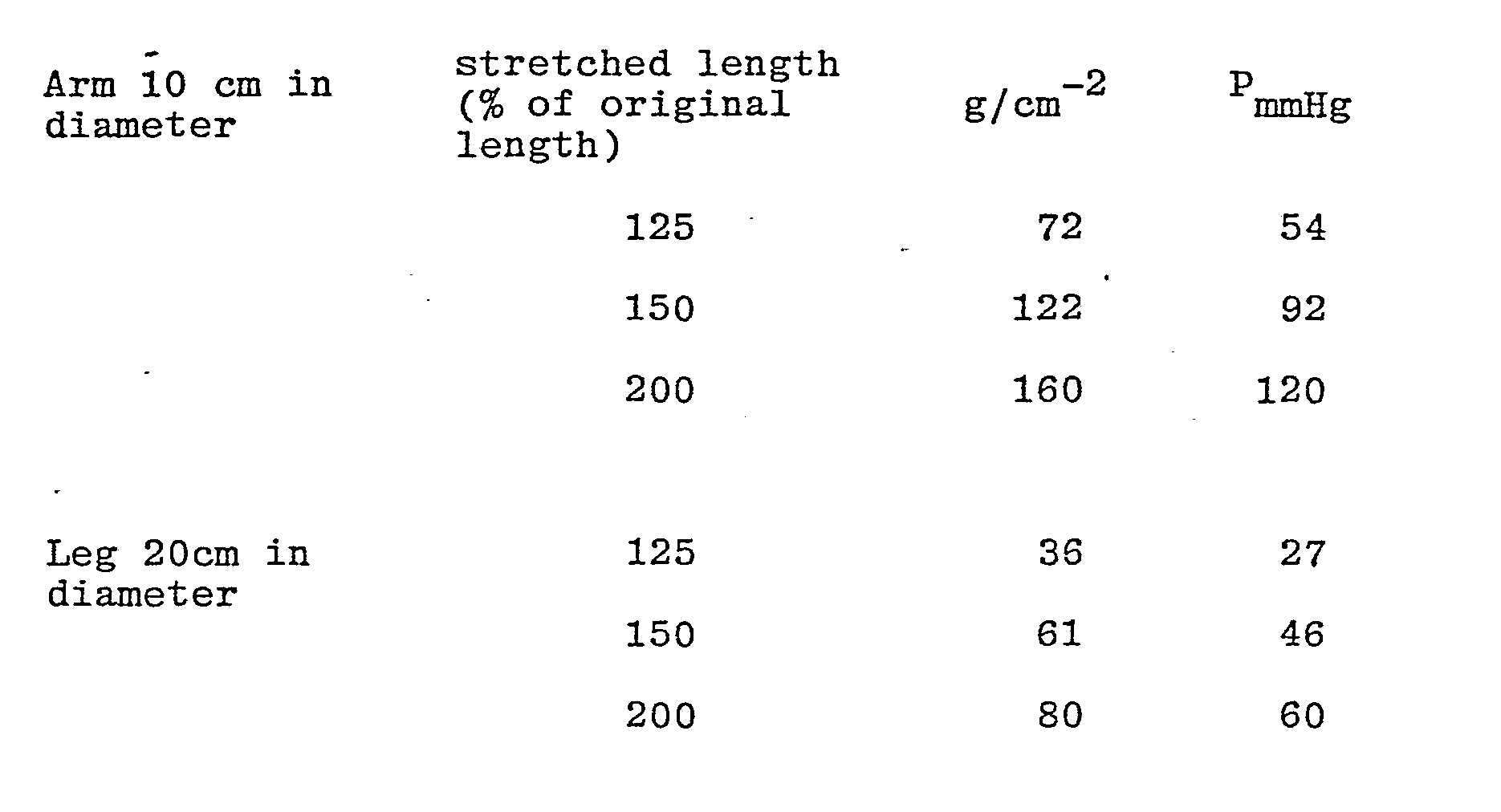
- 15 mm diameter samples of medicated wound dressings of Examples 9 to 14 were moistened and placed on agar plates seeded with staphyloccocus aureus or bacillus subtilis and incubated for 24 hours at optimum temperature for growth. The zones of inhibition produced by diffusion of the medicament from the dressings were measured.

- A solution containing 20% by weight of Estane 5714F in 60/40 (weight by weight) mixture of Tetrahydrofuran /acetone was cast into the recesses of a 15 cm wide melt embossed high density polyethylene sheet by means of a blade over soft bed coating technique. The sheet had a melt embossed pattern of 4 per cm raised areas in diagonal rows (45°) of square
truncated pyramids 2 mm wide at their base, 1.42 mm wide at top and 0.5 mm high with sides sloping to a conical angle of 60°. The wet cast net in the embossed film was dried by passage through a hot air oven at temperature of 80°C for two minutes. - The net had a weight per square metre of 33 g and had 4 per cm apertures of approximately 1.4 mm in size.
- Using a two component dispensing unit (Vario-mix supplied by Prodef Engineering Limited), a foaming mixture was formed by mixing Hypol FHP 2002 and Brij 72 (2% aqueous solution) in the ratio of 1:2.25. The foaming mixture was fed into the coating head by means of an output nozzle in the form of a 15 cm 'fish tail die' and coated onto the cast polyurethane net (on embossed film) by means of a knife over roller coating head set at a gap of 1 mm. The cast foam was dried by passage through an air circulating oven at a temperature of 50°C for 5 minutes.
- A solution containing 2% by weight a polyurethane of (Estane 5714F) in a 60/40 (weight by weight) mixture of tetrahydrofuran/acetone was hand sprayed onto the foam surface of the composite foam/net strip using an air spray unit (model 630 supplied by Binks Bullow Limited)and dried by passage through an air circulating oven heated to a temperature of 70 C.
- The polyurethane coating was found to be continuous and had a weight per square metre of approximately 30 grams.
- The embossed film was then removed from the three layer composite strip and the strip cut into dressings of suitable size for adherency testing.
- A foam-net composite strip on embossed film was made in the same manner as example 22.
- An extensible apertured non woven fabric (Bemliese GS 204) coated with a continuous layer of a moisture vapour transmitting acrylate copolymer adhesive (30 g/m2) was laminated to the foam side of the composite strip to form a conformable outer layer.
- The adhesive was a copolymer of 47 parts by weight n-butyl acrylate, 47 parts by weight of 2-ethyl-hexyl acrylate and 6 parts by weight of acrylic acid having an intrinsic viscosity of 1.9 dl/g polymerised in acetone according to the method given in United Kingdom Application No. 8106707.
- The embossed film was then removed from the composite strip and the strip cut into suitable sized dressings of,the invention.
- Wound dressings were prepared in the same manner as Example 22 using a cast polybutadiene (Ref RB 830) net (6 apertures/cm) instead of a polyurethane net.
- When tested on guinea pigs the dressing of Examples 4, 24 and 26 required only half the energy to remove them than did "Melolin" (a commercial non-adherent dressing) and Examples 1 and 2 required respectively about one eighth and one third the energy to remove them than did "Melolin".
Claims (14)
Priority Applications (1)
| Application Number | Priority Date | Filing Date | Title |
|---|---|---|---|
| AT82300716T ATE16345T1 (en) | 1981-02-13 | 1982-02-12 | WOUND BANDAGE. |
Applications Claiming Priority (4)
| Application Number | Priority Date | Filing Date | Title |
|---|---|---|---|
| GB8104568 | 1981-02-13 | ||
| GB8104568 | 1981-02-13 | ||
| GB8115742 | 1981-05-22 | ||
| GB8115742 | 1981-05-22 |
Publications (3)
| Publication Number | Publication Date |
|---|---|
| EP0059049A1 true EP0059049A1 (en) | 1982-09-01 |
| EP0059049B1 EP0059049B1 (en) | 1985-11-06 |
| EP0059049B2 EP0059049B2 (en) | 1993-10-06 |
Family
ID=26278432
Family Applications (2)
| Application Number | Title | Priority Date | Filing Date |
|---|---|---|---|
| EP82300715A Expired - Lifetime EP0059048B2 (en) | 1981-02-13 | 1982-02-12 | Wound dressing |
| EP82300716A Expired - Lifetime EP0059049B2 (en) | 1981-02-13 | 1982-02-12 | Wound dressing |
Family Applications Before (1)
| Application Number | Title | Priority Date | Filing Date |
|---|---|---|---|
| EP82300715A Expired - Lifetime EP0059048B2 (en) | 1981-02-13 | 1982-02-12 | Wound dressing |
Country Status (8)
| Country | Link |
|---|---|
| US (1) | US5147338A (en) |
| EP (2) | EP0059048B2 (en) |
| AU (1) | AU552887B2 (en) |
| CA (1) | CA1174447A (en) |
| DE (2) | DE3267220D1 (en) |
| DK (1) | DK158493C (en) |
| IE (1) | IE52669B1 (en) |
| NZ (1) | NZ199684A (en) |
Cited By (33)
| Publication number | Priority date | Publication date | Assignee | Title |
|---|---|---|---|---|
| EP0096458A1 (en) * | 1982-04-24 | 1983-12-21 | Smith and Nephew Associated Companies p.l.c. | Elastic films, method for their preparation and their use in contact with the skin |
| EP0107915A1 (en) * | 1982-10-02 | 1984-05-09 | Smith and Nephew Associated Companies p.l.c. | Surgical dressing |
| EP0122035A1 (en) * | 1983-03-10 | 1984-10-17 | Smith and Nephew Associated Companies p.l.c. | Medical device suitable for the prophylaxis of pressure sores |
| US4499896A (en) * | 1982-03-30 | 1985-02-19 | Minnesota Mining And Manufacturing Co. | Reservoir wound dressing |
| EP0171268A3 (en) * | 1984-08-02 | 1986-11-05 | Smith And Nephew Associated Companies P.L.C. | Wound dressing |
| DE3615471A1 (en) * | 1985-05-15 | 1986-11-20 | The Kendall Co., Boston, Mass. | Wound bandage |
| EP0141592A3 (en) * | 1983-10-22 | 1987-02-04 | Smith And Nephew Associated Companies P.L.C. | Polymer blend films |
| EP0099748B1 (en) * | 1982-07-21 | 1987-05-27 | Smith and Nephew Associated Companies p.l.c. | Adhesive wound dressing |
| EP0106440B1 (en) * | 1982-08-12 | 1987-11-25 | Smith and Nephew Associated Companies p.l.c. | Wound dressing and its manufacture |
| WO1990010424A1 (en) * | 1989-03-16 | 1990-09-20 | Smith & Nephew Plc | Absorbent devices and precursors therefor |
| US5010883A (en) * | 1983-12-24 | 1991-04-30 | Smith & Nephew Associated Companies Plc | Surgical dressing |
| GB2249266B (en) * | 1990-11-02 | 1994-12-14 | Smith & Nephew | Dressing packs |
| WO1995012373A1 (en) * | 1993-11-03 | 1995-05-11 | Smith & Nephew Plc | Padding |
| DE19804665A1 (en) * | 1998-02-06 | 1999-08-12 | Beiersdorf Ag | Occlusion plaster used for correcting squints, especially in children |
| FR2781679A1 (en) * | 1998-07-31 | 2000-02-04 | Lhd Lab Hygiene Dietetique | NEW WATERPROOF HYDROCELLULAR DRESSING AND USE OF A HYDROCOLLOID ADHESIVE MASS |
| WO2008055586A1 (en) * | 2006-11-07 | 2008-05-15 | Paul Hartmann Ag | Multi-layer, absorbing wound dressing having a hydrophilic wound contact layer |
| EP1964580A1 (en) * | 2007-03-01 | 2008-09-03 | Mölnlycke Health Care AB | Silver-containing foam structure |
| US8242325B2 (en) | 2006-02-06 | 2012-08-14 | Collano Ag | Wound covering and its method of production by extrusion coating |
| WO2013054103A1 (en) * | 2011-10-10 | 2013-04-18 | Queen Mary University Of London | Antimicrobial coatings |
| WO2019012068A1 (en) * | 2017-07-12 | 2019-01-17 | Smith & Nephew Plc | Wound care materials, devices and uses |
| WO2021209846A1 (en) * | 2020-04-13 | 2021-10-21 | 3M Innovative Properties Company | Medical adhesive articles having a low effective modulus of elasticity |
| US11730854B2 (en) | 2017-07-12 | 2023-08-22 | Smith & Nephew Plc | Polymer foam material, device and use |
| US11730852B2 (en) | 2017-07-12 | 2023-08-22 | Smith & Nephew Plc | Antimicrobial or wound care materials, devices and uses |
| US20240024164A1 (en) * | 2011-12-16 | 2024-01-25 | 3M Innovative Properties Company | Releasable medical drapes |
| US20240226367A9 (en) * | 2017-01-09 | 2024-07-11 | 3M Innovative Properties Company | Wound dressing layer for improved fluid removal |
| US12097094B2 (en) | 2008-03-05 | 2024-09-24 | Solventum Intellectual Properties Company | Dressing and method for applying reduced pressure to and collecting and storing fluid from a tissue site |
| US12127917B2 (en) | 2014-03-03 | 2024-10-29 | Solventum Intellectual Properties Company | Low profile flexible pressure transmission conduit |
| US12156786B2 (en) | 2012-11-16 | 2024-12-03 | Solventum Intellectual Properties Company | Medical drape with pattern adhesive layers and method of manufacturing same |
| US12220302B2 (en) | 2015-09-01 | 2025-02-11 | Solventum Intellectual Properties Company | Dressing with increased apposition force |
| US12226289B2 (en) | 2014-12-17 | 2025-02-18 | Solventum Intellectual Properties Company | Dressing with offloading capability |
| US12324725B2 (en) | 2013-10-30 | 2025-06-10 | Solventum Intellectual Properties Company | Dressing with sealing and retention interface |
| US12396894B2 (en) | 2015-09-17 | 2025-08-26 | Solventum Intellectual Properties Company | Hybrid silicone and acrylic adhesive cover for use with wound treatment |
| US12521478B2 (en) | 2015-05-08 | 2026-01-13 | Solventum Intellectual Properties Company | Low acuity dressing with integral pump |
Families Citing this family (109)
| Publication number | Priority date | Publication date | Assignee | Title |
|---|---|---|---|---|
| US2592994A (en) * | 1942-05-28 | 1952-04-15 | Smidth & Co As F L | Method and apparatus for grinding by the use of grinding bodies subjected to centrifugal force |
| US5445604A (en) * | 1980-05-22 | 1995-08-29 | Smith & Nephew Associated Companies, Ltd. | Wound dressing with conformable elastomeric wound contact layer |
| EP0077034B1 (en) | 1981-10-09 | 1985-05-02 | Rauscher & Co. Verbandstoff- und Wattefabriken | Absorbent wound dressing |
| GB9102089D0 (en) * | 1991-01-31 | 1991-03-13 | Johnson & Johnson Medical | Net wound dressings |
| EP0584361B1 (en) * | 1991-05-07 | 1997-08-06 | Kotec Limited | Wound covering material |
| DK5492A (en) * | 1992-01-17 | 1993-07-18 | Coloplast As | A dressing |
| USD357742S (en) | 1992-12-31 | 1995-04-25 | Alza Corporation | Electrotransport drug delivery system |
| GB2276087B (en) * | 1993-03-08 | 1997-04-30 | Ultra Lab Ltd | Wound dressings |
| US5466231A (en) * | 1993-11-04 | 1995-11-14 | Merocel Corporation | Laminated sponge device |
| US5356372A (en) * | 1993-12-01 | 1994-10-18 | Ludlow Corporation | Occlusive pressure-reducing wound dressing |
| HU222768B1 (en) * | 1994-06-30 | 2003-10-28 | The Procter & Gamble Company | Liquid transport web with surface energy gradient, method for producing and absorbent article containing it |
| US5631301A (en) * | 1994-09-27 | 1997-05-20 | Virotex Corporation | Topical antibiotic composition providing optimal moisture environment |
| US5905092A (en) * | 1994-09-27 | 1999-05-18 | Virotex Corporation Reel/Frame | Topical antibiotic composition providing optimal moisture environment for rapid wound healing that reduces skin contraction |
| US7214847B1 (en) | 1997-09-22 | 2007-05-08 | Argentum Medical, L.L.C. | Multilayer conductive appliance having wound healing and analgesic properties |
| US6861570B1 (en) | 1997-09-22 | 2005-03-01 | A. Bart Flick | Multilayer conductive appliance having wound healing and analgesic properties |
| US8801681B2 (en) | 1995-09-05 | 2014-08-12 | Argentum Medical, Llc | Medical device |
| US5814094A (en) | 1996-03-28 | 1998-09-29 | Becker; Robert O. | Iontopheretic system for stimulation of tissue healing and regeneration |
| US8455710B2 (en) | 1997-09-22 | 2013-06-04 | Argentum Medical, Llc | Conductive wound dressings and methods of use |
| US6087549A (en) | 1997-09-22 | 2000-07-11 | Argentum International | Multilayer laminate wound dressing |
| US5750918A (en) * | 1995-10-17 | 1998-05-12 | Foster-Miller, Inc. | Ballistically deployed restraining net |
| DE19631421C2 (en) * | 1996-08-06 | 2002-07-18 | Beiersdorf Ag | Antimicrobial wound dressings |
| US6333093B1 (en) | 1997-03-17 | 2001-12-25 | Westaim Biomedical Corp. | Anti-microbial coatings having indicator properties and wound dressings |
| US6191341B1 (en) | 1998-04-21 | 2001-02-20 | Ronald D. Shippert | Medical absorbent pack substantially free of unwanted adhesion properties |
| US6458109B1 (en) | 1998-08-07 | 2002-10-01 | Hill-Rom Services, Inc. | Wound treatment apparatus |
| US7045673B1 (en) | 1998-12-08 | 2006-05-16 | Quick-Med Technologies, Inc. | Intrinsically bactericidal absorbent dressing and method of fabrication |
| US7709694B2 (en) * | 1998-12-08 | 2010-05-04 | Quick-Med Technologies, Inc. | Materials with covalently-bonded, nonleachable, polymeric antimicrobial surfaces |
| US6544642B2 (en) * | 1999-02-02 | 2003-04-08 | The Procter & Gamble Company | Disposable absorbent articles with improved adhesive for attachment to the skin to facilitate adhesion in oily conditions |
| DE29905808U1 (en) | 1999-03-02 | 1999-08-12 | Meyer-Schwarz, Tatjana, 65589 Hadamar | band Aid |
| US6695823B1 (en) * | 1999-04-09 | 2004-02-24 | Kci Licensing, Inc. | Wound therapy device |
| DE19925973A1 (en) * | 1999-06-08 | 2000-12-14 | Beiersdorf Ag | Film plasters, in particular for covering wounds and preventing or treating blisters, using carrier films with improved sliding properties and good stretchability, achieved by optimizing the surface structure and hardness |
| US6495229B1 (en) * | 1999-09-17 | 2002-12-17 | Avery Dennison Corporation | Pattern coated adhesive article |
| PL366290A1 (en) | 1999-11-29 | 2005-01-24 | Hill-Rom Services, Inc. | Wound treatment apparatus |
| US6764462B2 (en) * | 2000-11-29 | 2004-07-20 | Hill-Rom Services Inc. | Wound treatment apparatus |
| US6824533B2 (en) | 2000-11-29 | 2004-11-30 | Hill-Rom Services, Inc. | Wound treatment apparatus |
| ES2277908T3 (en) * | 2000-01-03 | 2007-08-01 | Biomed Sciences Inc. | NEW SALE FOR WOUNDS AND METHOD FOR THE MANUFACTURE OF THE SAME. |
| HUP0302301A2 (en) | 2000-05-22 | 2003-10-28 | Arthur C. Coffey | Combination sis and vacuum bandage and method |
| US6855135B2 (en) | 2000-11-29 | 2005-02-15 | Hill-Rom Services, Inc. | Vacuum therapy and cleansing dressing for wounds |
| US6685681B2 (en) | 2000-11-29 | 2004-02-03 | Hill-Rom Services, Inc. | Vacuum therapy and cleansing dressing for wounds |
| EP2204213B2 (en) | 2001-07-12 | 2020-04-01 | KCI Licensing, Inc. | Control of vacuum level rate of change |
| US6663584B2 (en) | 2001-08-27 | 2003-12-16 | Kimberly-Clark Worldwide Inc. | Elastic bandage |
| CA2462877A1 (en) | 2001-10-11 | 2003-04-17 | Hill-Rom Services, Inc. | Waste container for negative pressure therapy |
| US7534927B2 (en) | 2001-12-26 | 2009-05-19 | Hill-Rom Services, Inc. | Vacuum bandage packing |
| WO2003057070A2 (en) | 2001-12-26 | 2003-07-17 | Hill-Rom Services Inc. | Vented vacuum bandage and method |
| AU2002359830A1 (en) | 2001-12-26 | 2003-07-24 | Hill-Rom Services, Inc. | Wound vacuum therapy dressing kit |
| US7287650B2 (en) * | 2002-01-31 | 2007-10-30 | Kx Technologies Llc | Structures that inhibit microbial growth |
| EP1487389B1 (en) | 2002-02-28 | 2011-10-05 | KCI Medical Resources | External catheter access to vacuum bandage |
| AU2002359824A1 (en) | 2002-04-10 | 2003-10-27 | Hill-Rom Services, Inc. | Access openings in vacuum bandage |
| US6770793B2 (en) * | 2002-08-08 | 2004-08-03 | Kimberly-Clark Worldwide, Inc. | Disposable absorbent wound dressing with skin health treatment additives |
| JP2005536275A (en) | 2002-08-21 | 2005-12-02 | ヒル−ロム サービシズ,インコーポレイテッド | Wound packing to prevent wound closure |
| EP1587502B2 (en) * | 2002-12-31 | 2025-05-21 | BSN medical GmbH | Wound dressing |
| US20050003178A1 (en) | 2003-04-21 | 2005-01-06 | Detert James W. | Apparatus and methods for the attachment of materials to polyurethane foam, and articles made using them |
| DE10328261B4 (en) * | 2003-06-23 | 2007-10-25 | Beiersdorf Ag | Disinfecting coating with silver coating and its use |
| WO2004112852A1 (en) * | 2003-06-23 | 2004-12-29 | Beiersdorf Ag | Antimicrobial wounddressing |
| US20050035327A1 (en) * | 2003-08-14 | 2005-02-17 | Canada T. Andrew | Topical silver-based antimicrobial composition for wound care devices |
| US20050037057A1 (en) * | 2003-08-14 | 2005-02-17 | Schuette Robert L. | Silver-containing antimicrobial fabric |
| US20050147657A1 (en) * | 2003-08-14 | 2005-07-07 | Milliken & Company | White silver-containing wound care device |
| US7118761B2 (en) | 2003-08-14 | 2006-10-10 | Canada T Andrew | Method for producing a silver-containing wound care device |
| US7842306B2 (en) * | 2003-08-14 | 2010-11-30 | Milliken & Company | Wound care device having fluid transfer properties |
| US8563447B2 (en) * | 2003-08-14 | 2013-10-22 | Milliken & Company | Silver-containing wound care device |
| EP1675536B1 (en) | 2003-09-17 | 2016-01-20 | BSN medical GmbH | Wound dressing and method for manufacturing the same |
| US7531711B2 (en) * | 2003-09-17 | 2009-05-12 | Ossur Hf | Wound dressing and method for manufacturing the same |
| US7358282B2 (en) | 2003-12-05 | 2008-04-15 | Kimberly-Clark Worldwide, Inc. | Low-density, open-cell, soft, flexible, thermoplastic, absorbent foam and method of making foam |
| US7951124B2 (en) * | 2004-04-13 | 2011-05-31 | Boehringer Technologies, Lp | Growth stimulating wound dressing with improved contact surfaces |
| US7884258B2 (en) * | 2004-04-13 | 2011-02-08 | Boehringer Technologies, L.P. | Wound contact device |
| EP1598172A1 (en) * | 2004-05-18 | 2005-11-23 | Innovative Elastics Ltd. | Perforated elastic sheet |
| EP1765230A4 (en) * | 2004-06-22 | 2009-08-12 | Bsn Medical Inc | Water resistant undercast padding |
| US7291382B2 (en) | 2004-09-24 | 2007-11-06 | Kimberly-Clark Worldwide, Inc. | Low density flexible resilient absorbent open-cell thermoplastic foam |
| US7161056B2 (en) * | 2005-01-28 | 2007-01-09 | Ossur Hf | Wound dressing and method for manufacturing the same |
| US7309809B2 (en) * | 2005-02-26 | 2007-12-18 | Xennovate Medical Llc | Adhesive attachment and removal device |
| CA2503456A1 (en) * | 2005-04-05 | 2006-10-05 | Imre Virag | Multi purpose cartridge system for delivery of beneficial agents |
| US8353883B2 (en) * | 2005-12-15 | 2013-01-15 | Kimberly-Clark Worldwide, Inc. | Elastomeric glove containing a foam donning layer |
| US8158689B2 (en) | 2005-12-22 | 2012-04-17 | Kimberly-Clark Worldwide, Inc. | Hybrid absorbent foam and articles containing it |
| US20070148433A1 (en) * | 2005-12-27 | 2007-06-28 | Mallory Mary F | Elastic laminate made with absorbent foam |
| BRPI0707382A2 (en) * | 2006-01-31 | 2011-05-03 | Tyco Healthcare | super soft foams |
| DE102006016636A1 (en) * | 2006-04-08 | 2007-10-18 | Bayer Materialscience Ag | Polyurethane foams for wound treatment |
| US8629195B2 (en) | 2006-04-08 | 2014-01-14 | Bayer Materialscience Ag | Production of polyurethane foams |
| DE102006016639A1 (en) * | 2006-04-08 | 2007-10-11 | Bayer Materialscience Ag | Process for the production of polyurethane foams |
| DE102006043589A1 (en) * | 2006-09-16 | 2008-03-27 | Bayer Materialscience Ag | Alkyl polyglycosides as stabilizers for polyurethane foams |
| JP5426822B2 (en) * | 2006-11-07 | 2014-02-26 | コラノ・アクチェンゲゼルシャフト | Wound covering and method for producing the same |
| US7931651B2 (en) | 2006-11-17 | 2011-04-26 | Wake Lake University Health Sciences | External fixation assembly and method of use |
| US8377016B2 (en) | 2007-01-10 | 2013-02-19 | Wake Forest University Health Sciences | Apparatus and method for wound treatment employing periodic sub-atmospheric pressure |
| US9463119B2 (en) * | 2007-01-18 | 2016-10-11 | Abigo Medical Ab | Wound dressing with a bacterial adsorbing composition and moisture holding system |
| EP2014314A1 (en) | 2007-07-10 | 2009-01-14 | Bayer Innovation GmbH | Method for manufacturing polyurethane foams for treating wounds |
| DE102007048078A1 (en) | 2007-10-05 | 2009-04-09 | Bayer Materialscience Ag | Polyurethane foams for wound treatment |
| DE102007048079A1 (en) | 2007-10-05 | 2009-04-09 | Bayer Materialscience Ag | Process for the production of polyurethane foams |
| EP2045279A1 (en) * | 2007-10-05 | 2009-04-08 | Bayer MaterialScience AG | Polyurethane foams for treating wounds |
| ES2661762T3 (en) | 2007-10-10 | 2018-04-03 | Wake Forest University Health Sciences | Devices to treat spinal cord tissue |
| RU2517588C2 (en) | 2008-01-09 | 2014-05-27 | Уэйк Форест Юниверсити Хелс Сайенсиз | Device and method for treating pathologies of central nervous system |
| CN104771197A (en) | 2008-07-18 | 2015-07-15 | 韦克福里斯特大学健康科学院 | Apparatus and method for cardiac tissue modulation by topical application of vacuum to minimize cell death and damage |
| AR074999A1 (en) | 2009-01-24 | 2011-03-02 | Bayer Materialscience Ag | TWO COMPONENT POLYURETHANE DISPERSION FOAMS |
| AR075000A1 (en) | 2009-01-24 | 2011-03-02 | Bayer Materialscience Ag | POLYURETHANE FOAMS STABILIZED WITH POLYURETHANE TENSIOACTIVE |
| EP2281587A1 (en) * | 2009-08-03 | 2011-02-09 | nolax AG | Absorbable polyurethane foam wound covering |
| RU2012126815A (en) | 2009-12-30 | 2014-02-10 | Зм Инновейтив Пропертиз Компани | METHOD FOR PRODUCING AUXETIC NET |
| KR101869568B1 (en) | 2009-12-30 | 2018-06-20 | 쓰리엠 이노베이티브 프로퍼티즈 컴파니 | Filtering face-piece respirator having an auxetic mesh in the mask body |
| WO2011098444A1 (en) | 2010-02-11 | 2011-08-18 | Bayer Materialscience Ag | Active substance-releasing wound dressing |
| US8758547B2 (en) | 2011-02-08 | 2014-06-24 | Kimberly-Clark Worldwide, Inc. | Method of manufacturing a body adhering absorbent article orientated in the cross-machine direction with reduced curl |
| US8764922B2 (en) | 2011-02-08 | 2014-07-01 | Kimberly-Clark Worldwide, Inc. | Method of manufacturing a body adhering absorbent article orientated in the machine direction with reduced curl |
| EP2844202B1 (en) | 2012-05-01 | 2016-07-20 | Pharmaplast SAE | A wound dressing laminate comprising a layer impregnated with an antimicrobial agent, a method of manufacturing the wound dressing laminate and wound dressings made of the wound dressing laminate |
| US9517212B1 (en) | 2012-11-15 | 2016-12-13 | Chandra Zaveri | Medicated adhesive pad arrangement |
| US10086017B2 (en) | 2013-09-19 | 2018-10-02 | Medline Industries, Inc. | Wound dressing containing polysaccharides |
| US10342891B2 (en) | 2013-09-19 | 2019-07-09 | Medline Industries, Inc. | Wound dressing containing saccharide and collagen |
| EP2944565B1 (en) | 2014-05-13 | 2017-09-27 | Entrotech, Inc. | Erosion protective sleeve |
| US10583228B2 (en) | 2015-07-28 | 2020-03-10 | J&M Shuler Medical, Inc. | Sub-atmospheric wound therapy systems and methods |
| KR101787192B1 (en) * | 2015-08-12 | 2017-10-18 | 주식회사 제네웰 | Antimicrbacterial dressing material and method for preparing thereof |
| JP6751435B2 (en) * | 2016-03-28 | 2020-09-02 | 富士フイルム株式会社 | Support with antibacterial layer and laminate |
| US11524091B2 (en) | 2018-08-21 | 2022-12-13 | Augusta University Research Institute, Inc. | GILZ formulations for wound healing |
| EP4041158B1 (en) | 2019-10-07 | 2025-11-26 | Solventum Intellectual Properties Company | A wound dressing |
| US11160917B2 (en) | 2020-01-22 | 2021-11-02 | J&M Shuler Medical Inc. | Negative pressure wound therapy barrier |
| DE102022204206A1 (en) | 2022-04-29 | 2023-11-02 | Benecke-Kaliko Aktiengesellschaft | Aqueous dispersions for the production of flame-retardant foamed films and composite structures equipped with them |
Citations (6)
| Publication number | Priority date | Publication date | Assignee | Title |
|---|---|---|---|---|
| GB1049196A (en) * | 1963-10-10 | 1966-11-23 | Smith & Nephew | Improvements in and relating to surgical dressings |
| GB1245691A (en) * | 1968-01-19 | 1971-09-08 | Johnson & Johnson | Absorbent pad |
| BE831023A (en) * | 1975-07-04 | 1975-11-03 | MATERIAL INTENDED FOR THE MAKING OF DRESSINGS | |
| US3927669A (en) * | 1973-11-16 | 1975-12-23 | Linda R Glatt | Bandage construction |
| US3972328A (en) * | 1975-07-28 | 1976-08-03 | E. R. Squibb & Sons, Inc. | Surgical bandage |
| US4015604A (en) * | 1976-03-25 | 1977-04-05 | Personal Products Company | Absorbent product with side leakage control means |
Family Cites Families (11)
| Publication number | Priority date | Publication date | Assignee | Title |
|---|---|---|---|---|
| GB439085A (en) * | 1935-02-06 | 1935-11-28 | Ernst Gelinsky | Improvements in or relating to dressings for wounds and the like |
| US2896618A (en) * | 1958-01-21 | 1959-07-28 | Johnson & Johnson | Corrugated dressing |
| GB1142323A (en) * | 1965-04-08 | 1969-02-05 | Smith & Nephew | Improvements in and relating to surgical dressings |
| NO134790C (en) * | 1968-07-09 | 1984-03-22 | Smith & Nephew | Kleber ,; PRESSURE SENSITIVE, WATERPUME-PERMEABLE PRODUCT FOR SKIN USE BY HUMANS. |
| US3491753A (en) * | 1969-01-14 | 1970-01-27 | Price Brothers & Co Ltd | Medical dressings |
| US3674027A (en) * | 1969-08-06 | 1972-07-04 | Raul Fleischmajer | Disposable wet compresses |
| US3709221A (en) * | 1969-11-21 | 1973-01-09 | Pall Corp | Microporous nonadherent surgical dressing |
| US3678933A (en) * | 1970-07-17 | 1972-07-25 | Moore Perk Corp | Surgical sponge or bandage |
| JPS51139900A (en) * | 1975-05-15 | 1976-12-02 | Grace W R & Co | Hydrophilic polyurethane foam like natural sponge |
| US4860737A (en) * | 1981-02-13 | 1989-08-29 | Smith And Nephew Associated Companies P.L.C. | Wound dressing, manufacture and use |
| US4753231A (en) * | 1981-02-13 | 1988-06-28 | Smith & Nephew Associated Companies P.L.C. | Adhesive wound dressing |
-
1982
- 1982-02-10 NZ NZ199684A patent/NZ199684A/en unknown
- 1982-02-11 IE IE307/82A patent/IE52669B1/en not_active IP Right Cessation
- 1982-02-11 AU AU80375/82A patent/AU552887B2/en not_active Expired
- 1982-02-12 EP EP82300715A patent/EP0059048B2/en not_active Expired - Lifetime
- 1982-02-12 DE DE8282300716T patent/DE3267220D1/en not_active Expired
- 1982-02-12 CA CA000396191A patent/CA1174447A/en not_active Expired
- 1982-02-12 EP EP82300716A patent/EP0059049B2/en not_active Expired - Lifetime
- 1982-02-12 DE DE8282300715T patent/DE3264978D1/en not_active Expired
- 1982-02-12 DK DK063882A patent/DK158493C/en not_active IP Right Cessation
-
1991
- 1991-06-17 US US07/717,167 patent/US5147338A/en not_active Expired - Lifetime
Patent Citations (6)
| Publication number | Priority date | Publication date | Assignee | Title |
|---|---|---|---|---|
| GB1049196A (en) * | 1963-10-10 | 1966-11-23 | Smith & Nephew | Improvements in and relating to surgical dressings |
| GB1245691A (en) * | 1968-01-19 | 1971-09-08 | Johnson & Johnson | Absorbent pad |
| US3927669A (en) * | 1973-11-16 | 1975-12-23 | Linda R Glatt | Bandage construction |
| BE831023A (en) * | 1975-07-04 | 1975-11-03 | MATERIAL INTENDED FOR THE MAKING OF DRESSINGS | |
| US3972328A (en) * | 1975-07-28 | 1976-08-03 | E. R. Squibb & Sons, Inc. | Surgical bandage |
| US4015604A (en) * | 1976-03-25 | 1977-04-05 | Personal Products Company | Absorbent product with side leakage control means |
Cited By (56)
| Publication number | Priority date | Publication date | Assignee | Title |
|---|---|---|---|---|
| US4499896A (en) * | 1982-03-30 | 1985-02-19 | Minnesota Mining And Manufacturing Co. | Reservoir wound dressing |
| US4863778A (en) * | 1982-04-24 | 1989-09-05 | Smith And Nephew Associated Companies P.L.C. | Products, processes and use |
| EP0096458A1 (en) * | 1982-04-24 | 1983-12-21 | Smith and Nephew Associated Companies p.l.c. | Elastic films, method for their preparation and their use in contact with the skin |
| EP0099748B1 (en) * | 1982-07-21 | 1987-05-27 | Smith and Nephew Associated Companies p.l.c. | Adhesive wound dressing |
| EP0106440B1 (en) * | 1982-08-12 | 1987-11-25 | Smith and Nephew Associated Companies p.l.c. | Wound dressing and its manufacture |
| EP0107915A1 (en) * | 1982-10-02 | 1984-05-09 | Smith and Nephew Associated Companies p.l.c. | Surgical dressing |
| US4657006A (en) * | 1982-10-02 | 1987-04-14 | Smith And Nephew Associated Companies P.L.C. | Surgical dressing |
| EP0122035A1 (en) * | 1983-03-10 | 1984-10-17 | Smith and Nephew Associated Companies p.l.c. | Medical device suitable for the prophylaxis of pressure sores |
| EP0141592A3 (en) * | 1983-10-22 | 1987-02-04 | Smith And Nephew Associated Companies P.L.C. | Polymer blend films |
| US5010883A (en) * | 1983-12-24 | 1991-04-30 | Smith & Nephew Associated Companies Plc | Surgical dressing |
| EP0171268A3 (en) * | 1984-08-02 | 1986-11-05 | Smith And Nephew Associated Companies P.L.C. | Wound dressing |
| DE3615471A1 (en) * | 1985-05-15 | 1986-11-20 | The Kendall Co., Boston, Mass. | Wound bandage |
| GB2244921B (en) * | 1989-03-16 | 1992-10-28 | Smith & Nephew | Absorbent devices and precursors therefor |
| GB2244921A (en) * | 1989-03-16 | 1991-12-18 | Smith & Nephew | Absorbent devices and precursors therefor |
| WO1990010424A1 (en) * | 1989-03-16 | 1990-09-20 | Smith & Nephew Plc | Absorbent devices and precursors therefor |
| AU635254B2 (en) * | 1989-03-16 | 1993-03-18 | Smith & Nephew Plc | Absorbent devices and precursors therefor |
| AU648950B2 (en) * | 1989-03-16 | 1994-05-05 | Smith & Nephew Plc | Absorbent devices |
| GB2249266B (en) * | 1990-11-02 | 1994-12-14 | Smith & Nephew | Dressing packs |
| GB2298162A (en) * | 1993-11-03 | 1996-08-28 | Smith & Nephew | Padding |
| WO1995012373A1 (en) * | 1993-11-03 | 1995-05-11 | Smith & Nephew Plc | Padding |
| AU696714B2 (en) * | 1993-11-03 | 1998-09-17 | Smith & Nephew Plc | Padding |
| DE19804665A1 (en) * | 1998-02-06 | 1999-08-12 | Beiersdorf Ag | Occlusion plaster used for correcting squints, especially in children |
| DE19804665B4 (en) * | 1998-02-06 | 2004-09-23 | Beiersdorf Ag | Opaque eye patch |
| US6890551B2 (en) | 1998-02-06 | 2005-05-10 | Beiersdorf Ag | Light occlusive patch |
| FR2781679A1 (en) * | 1998-07-31 | 2000-02-04 | Lhd Lab Hygiene Dietetique | NEW WATERPROOF HYDROCELLULAR DRESSING AND USE OF A HYDROCOLLOID ADHESIVE MASS |
| US8242325B2 (en) | 2006-02-06 | 2012-08-14 | Collano Ag | Wound covering and its method of production by extrusion coating |
| WO2008055586A1 (en) * | 2006-11-07 | 2008-05-15 | Paul Hartmann Ag | Multi-layer, absorbing wound dressing having a hydrophilic wound contact layer |
| EP1923077A1 (en) * | 2006-11-07 | 2008-05-21 | Paul Hartmann AG | Multilayer, absorbent wound dressing with a hydophilic wound contact layer |
| EP1964580A1 (en) * | 2007-03-01 | 2008-09-03 | Mölnlycke Health Care AB | Silver-containing foam structure |
| WO2008104276A1 (en) * | 2007-03-01 | 2008-09-04 | Mölnlycke Health Care Ab | Silver-containing foam structure |
| US8263100B2 (en) | 2007-03-01 | 2012-09-11 | Mölnlycke Health Care Ab | Silver-containing foam structure |
| AU2008221041B2 (en) * | 2007-03-01 | 2012-12-20 | Molnlycke Health Care Ab | Silver-containing foam structure |
| CN101631572B (en) * | 2007-03-01 | 2013-03-20 | 墨尼克医疗用品有限公司 | Silver-containing foam structure |
| KR101433058B1 (en) * | 2007-03-01 | 2014-08-22 | 묄른뤼케 헬스 케어 에이비 | Silver-containing foam structure |
| US12097094B2 (en) | 2008-03-05 | 2024-09-24 | Solventum Intellectual Properties Company | Dressing and method for applying reduced pressure to and collecting and storing fluid from a tissue site |
| WO2013054103A1 (en) * | 2011-10-10 | 2013-04-18 | Queen Mary University Of London | Antimicrobial coatings |
| US12279932B2 (en) * | 2011-12-16 | 2025-04-22 | Solventum Intellectual Properties Company | Releasable medical drapes |
| US20240024164A1 (en) * | 2011-12-16 | 2024-01-25 | 3M Innovative Properties Company | Releasable medical drapes |
| US12156786B2 (en) | 2012-11-16 | 2024-12-03 | Solventum Intellectual Properties Company | Medical drape with pattern adhesive layers and method of manufacturing same |
| US12324725B2 (en) | 2013-10-30 | 2025-06-10 | Solventum Intellectual Properties Company | Dressing with sealing and retention interface |
| US12127917B2 (en) | 2014-03-03 | 2024-10-29 | Solventum Intellectual Properties Company | Low profile flexible pressure transmission conduit |
| US12226289B2 (en) | 2014-12-17 | 2025-02-18 | Solventum Intellectual Properties Company | Dressing with offloading capability |
| US12521478B2 (en) | 2015-05-08 | 2026-01-13 | Solventum Intellectual Properties Company | Low acuity dressing with integral pump |
| US12220302B2 (en) | 2015-09-01 | 2025-02-11 | Solventum Intellectual Properties Company | Dressing with increased apposition force |
| US12396894B2 (en) | 2015-09-17 | 2025-08-26 | Solventum Intellectual Properties Company | Hybrid silicone and acrylic adhesive cover for use with wound treatment |
| US20240226367A9 (en) * | 2017-01-09 | 2024-07-11 | 3M Innovative Properties Company | Wound dressing layer for improved fluid removal |
| US12239747B2 (en) * | 2017-01-09 | 2025-03-04 | Solventum Intellectual Properties Company | Wound dressing layer for improved fluid removal |
| WO2019012068A1 (en) * | 2017-07-12 | 2019-01-17 | Smith & Nephew Plc | Wound care materials, devices and uses |
| US12083232B2 (en) | 2017-07-12 | 2024-09-10 | Smith & Nephew Plc | Wound care materials, devices and uses |
| US12064523B2 (en) | 2017-07-12 | 2024-08-20 | Smith & Nephew Plc | Antimicrobial or wound care materials, devices and uses |
| EP4353271A1 (en) | 2017-07-12 | 2024-04-17 | Smith & Nephew plc | Antimicrobial or wound care materials, devices and uses |
| AU2018300758B2 (en) * | 2017-07-12 | 2024-04-04 | Smith & Nephew Plc | Wound care materials, devices and uses |
| US11730852B2 (en) | 2017-07-12 | 2023-08-22 | Smith & Nephew Plc | Antimicrobial or wound care materials, devices and uses |
| US11730854B2 (en) | 2017-07-12 | 2023-08-22 | Smith & Nephew Plc | Polymer foam material, device and use |
| CN110868971A (en) * | 2017-07-12 | 2020-03-06 | 史密夫及内修公开有限公司 | Wound care materials, devices and uses |
| WO2021209846A1 (en) * | 2020-04-13 | 2021-10-21 | 3M Innovative Properties Company | Medical adhesive articles having a low effective modulus of elasticity |
Also Published As
| Publication number | Publication date |
|---|---|
| EP0059048B2 (en) | 1993-10-06 |
| EP0059049B2 (en) | 1993-10-06 |
| AU8037582A (en) | 1982-08-19 |
| CA1174447A (en) | 1984-09-18 |
| DK158493B (en) | 1990-05-28 |
| DE3264978D1 (en) | 1985-09-05 |
| AU552887B2 (en) | 1986-06-26 |
| NZ199684A (en) | 1985-03-20 |
| EP0059049B1 (en) | 1985-11-06 |
| EP0059048A1 (en) | 1982-09-01 |
| IE52669B1 (en) | 1988-01-20 |
| US5147338A (en) | 1992-09-15 |
| EP0059048B1 (en) | 1985-07-31 |
| DK63882A (en) | 1982-08-14 |
| DK158493C (en) | 1990-10-29 |
| DE3267220D1 (en) | 1985-12-12 |
| IE820307L (en) | 1982-08-13 |
Similar Documents
| Publication | Publication Date | Title |
|---|---|---|
| EP0059049B1 (en) | Wound dressing | |
| US5445604A (en) | Wound dressing with conformable elastomeric wound contact layer | |
| EP0097517B1 (en) | Wound dressing, manufacture and use | |
| US4753231A (en) | Adhesive wound dressing | |
| EP0099748B1 (en) | Adhesive wound dressing | |
| US4995382A (en) | Wound dressing, manufacture and use | |
| US4860737A (en) | Wound dressing, manufacture and use | |
| EP0486522B1 (en) | Adhesive dressings | |
| EP0106440B1 (en) | Wound dressing and its manufacture | |
| US5409472A (en) | Adhesive polymeric foam dressings | |
| GB2093702A (en) | Wound dressings for burns | |
| EP0171268B1 (en) | Wound dressing | |
| EP0106439B1 (en) | Wound dressing and its manufacture | |
| EP1133325A1 (en) | Coating useful as a dispenser of an active ingredient on dressings and bandages | |
| GB2093703A (en) | Wound dressings for burns | |
| JP3025010B2 (en) | Adhesive dressing | |
| JPH0313902B2 (en) |
Legal Events
| Date | Code | Title | Description |
|---|---|---|---|
| PUAI | Public reference made under article 153(3) epc to a published international application that has entered the european phase |
Free format text: ORIGINAL CODE: 0009012 |
|
| AK | Designated contracting states |
Designated state(s): AT BE CH DE FR IT NL SE |
|
| RAP1 | Party data changed (applicant data changed or rights of an application transferred) |
Owner name: SMITH AND NEPHEW ASSOCIATED COMPANIES P.L.C. |
|
| 17P | Request for examination filed |
Effective date: 19821102 |
|
| ITF | It: translation for a ep patent filed | ||
| GRAA | (expected) grant |
Free format text: ORIGINAL CODE: 0009210 |
|
| AK | Designated contracting states |
Designated state(s): AT BE CH DE FR IT LI NL SE |
|
| PG25 | Lapsed in a contracting state [announced via postgrant information from national office to epo] |
Ref country code: AT Effective date: 19851106 |
|
| REF | Corresponds to: |
Ref document number: 16345 Country of ref document: AT Date of ref document: 19851115 Kind code of ref document: T |
|
| REF | Corresponds to: |
Ref document number: 3267220 Country of ref document: DE Date of ref document: 19851212 |
|
| ET | Fr: translation filed | ||
| PLBI | Opposition filed |
Free format text: ORIGINAL CODE: 0009260 |
|
| 26 | Opposition filed |
Opponent name: JOHNSON & JOHNSON Effective date: 19860726 |
|
| NLR1 | Nl: opposition has been filed with the epo |
Opponent name: JOHNSON & JOHNSON |
|
| ITTA | It: last paid annual fee | ||
| PUAH | Patent maintained in amended form |
Free format text: ORIGINAL CODE: 0009272 |
|
| STAA | Information on the status of an ep patent application or granted ep patent |
Free format text: STATUS: PATENT MAINTAINED AS AMENDED |
|
| RAP2 | Party data changed (patent owner data changed or rights of a patent transferred) |
Owner name: SMITH & NEPHEW PLC |
|
| 27A | Patent maintained in amended form |
Effective date: 19931006 |
|
| AK | Designated contracting states |
Kind code of ref document: B2 Designated state(s): AT BE CH DE FR IT LI NL SE |
|
| REG | Reference to a national code |
Ref country code: CH Ref legal event code: AEN |
|
| REG | Reference to a national code |
Ref country code: CH Ref legal event code: PFA Free format text: SMITH & NEPHEW PLC |
|
| NLT2 | Nl: modifications (of names), taken from the european patent patent bulletin |
Owner name: SMITH & NEPHEW PLC TE LONDEN, GROOT-BRITTANNIE. |
|
| NLR2 | Nl: decision of opposition | ||
| ITF | It: translation for a ep patent filed | ||
| ET3 | Fr: translation filed ** decision concerning opposition | ||
| NLR3 | Nl: receipt of modified translations in the netherlands language after an opposition procedure | ||
| NLXE | Nl: other communications concerning ep-patents (part 3 heading xe) |
Free format text: PAT.BUL.05/86 CORR.:SMITH & NEPHEW PLC LONDON, GREAT BRITAIN PAT.BUL.22/93 SHOULD BE DELETED |
|
| EAL | Se: european patent in force in sweden |
Ref document number: 82300716.6 |
|
| APAC | Appeal dossier modified |
Free format text: ORIGINAL CODE: EPIDOS NOAPO |
|
| APAC | Appeal dossier modified |
Free format text: ORIGINAL CODE: EPIDOS NOAPO |
|
| PGFP | Annual fee paid to national office [announced via postgrant information from national office to epo] |
Ref country code: DE Payment date: 20010205 Year of fee payment: 20 |
|
| PGFP | Annual fee paid to national office [announced via postgrant information from national office to epo] |
Ref country code: SE Payment date: 20010206 Year of fee payment: 20 |
|
| PGFP | Annual fee paid to national office [announced via postgrant information from national office to epo] |
Ref country code: FR Payment date: 20010213 Year of fee payment: 20 Ref country code: CH Payment date: 20010213 Year of fee payment: 20 |
|
| PGFP | Annual fee paid to national office [announced via postgrant information from national office to epo] |
Ref country code: NL Payment date: 20010228 Year of fee payment: 20 |
|
| PGFP | Annual fee paid to national office [announced via postgrant information from national office to epo] |
Ref country code: BE Payment date: 20010427 Year of fee payment: 20 |
|
| BE20 | Be: patent expired |
Free format text: 20020212 *SMITH & NEPHEW P.L.C. |
|
| PG25 | Lapsed in a contracting state [announced via postgrant information from national office to epo] |
Ref country code: LI Free format text: LAPSE BECAUSE OF EXPIRATION OF PROTECTION Effective date: 20020211 Ref country code: CH Free format text: LAPSE BECAUSE OF EXPIRATION OF PROTECTION Effective date: 20020211 |
|
| PG25 | Lapsed in a contracting state [announced via postgrant information from national office to epo] |
Ref country code: NL Free format text: LAPSE BECAUSE OF EXPIRATION OF PROTECTION Effective date: 20020212 |
|
| REG | Reference to a national code |
Ref country code: CH Ref legal event code: PL |
|
| EUG | Se: european patent has lapsed |
Ref document number: 82300716.6 |
|
| NLV7 | Nl: ceased due to reaching the maximum lifetime of a patent | ||
| APAH | Appeal reference modified |
Free format text: ORIGINAL CODE: EPIDOSCREFNO |