EP0056571A2 - Vielfachemitter-npn-Transistor - Google Patents
Vielfachemitter-npn-Transistor Download PDFInfo
- Publication number
- EP0056571A2 EP0056571A2 EP82100033A EP82100033A EP0056571A2 EP 0056571 A2 EP0056571 A2 EP 0056571A2 EP 82100033 A EP82100033 A EP 82100033A EP 82100033 A EP82100033 A EP 82100033A EP 0056571 A2 EP0056571 A2 EP 0056571A2
- Authority
- EP
- European Patent Office
- Prior art keywords
- emitter
- base
- region
- npn transistor
- type
- Prior art date
- Legal status (The legal status is an assumption and is not a legal conclusion. Google has not performed a legal analysis and makes no representation as to the accuracy of the status listed.)
- Granted
Links
- 238000009413 insulation Methods 0.000 description 8
- 230000003071 parasitic effect Effects 0.000 description 6
- 230000015572 biosynthetic process Effects 0.000 description 5
- 238000002955 isolation Methods 0.000 description 5
- 230000003321 amplification Effects 0.000 description 4
- 238000003199 nucleic acid amplification method Methods 0.000 description 4
- 238000009792 diffusion process Methods 0.000 description 3
- 239000012535 impurity Substances 0.000 description 3
- VYPSYNLAJGMNEJ-UHFFFAOYSA-N silicon dioxide Inorganic materials O=[Si]=O VYPSYNLAJGMNEJ-UHFFFAOYSA-N 0.000 description 3
- 239000000758 substrate Substances 0.000 description 3
- 238000010276 construction Methods 0.000 description 2
- 238000004519 manufacturing process Methods 0.000 description 2
- 239000004065 semiconductor Substances 0.000 description 2
- XUIMIQQOPSSXEZ-UHFFFAOYSA-N Silicon Chemical compound [Si] XUIMIQQOPSSXEZ-UHFFFAOYSA-N 0.000 description 1
- XAGFODPZIPBFFR-UHFFFAOYSA-N aluminium Chemical compound [Al] XAGFODPZIPBFFR-UHFFFAOYSA-N 0.000 description 1
- 229910052782 aluminium Inorganic materials 0.000 description 1
- 230000000694 effects Effects 0.000 description 1
- 238000012986 modification Methods 0.000 description 1
- 230000004048 modification Effects 0.000 description 1
- 229910052710 silicon Inorganic materials 0.000 description 1
- 239000010703 silicon Substances 0.000 description 1
- 235000012239 silicon dioxide Nutrition 0.000 description 1
- 239000000377 silicon dioxide Substances 0.000 description 1
Images



Classifications
-
- H—ELECTRICITY
- H10—SEMICONDUCTOR DEVICES; ELECTRIC SOLID-STATE DEVICES NOT OTHERWISE PROVIDED FOR
- H10D—INORGANIC ELECTRIC SEMICONDUCTOR DEVICES
- H10D62/00—Semiconductor bodies, or regions thereof, of devices having potential barriers
- H10D62/10—Shapes, relative sizes or dispositions of the regions of the semiconductor bodies; Shapes of the semiconductor bodies
- H10D62/13—Semiconductor regions connected to electrodes carrying current to be rectified, amplified or switched, e.g. source or drain regions
- H10D62/133—Emitter regions of BJTs
- H10D62/135—Non-interconnected multi-emitter structures
-
- H—ELECTRICITY
- H10—SEMICONDUCTOR DEVICES; ELECTRIC SOLID-STATE DEVICES NOT OTHERWISE PROVIDED FOR
- H10D—INORGANIC ELECTRIC SEMICONDUCTOR DEVICES
- H10D48/00—Individual devices not covered by groups H10D1/00 - H10D44/00
- H10D48/30—Devices controlled by electric currents or voltages
- H10D48/32—Devices controlled by only the electric current supplied, or only the electric potential applied, to an electrode which does not carry the current to be rectified, amplified or switched
- H10D48/34—Bipolar devices
- H10D48/345—Bipolar transistors having ohmic electrodes on emitter-like, base-like, and collector-like regions
-
- H—ELECTRICITY
- H10—SEMICONDUCTOR DEVICES; ELECTRIC SOLID-STATE DEVICES NOT OTHERWISE PROVIDED FOR
- H10D—INORGANIC ELECTRIC SEMICONDUCTOR DEVICES
- H10D64/00—Electrodes of devices having potential barriers
- H10D64/20—Electrodes characterised by their shapes, relative sizes or dispositions
- H10D64/27—Electrodes not carrying the current to be rectified, amplified, oscillated or switched, e.g. gates
- H10D64/281—Base electrodes for bipolar transistors
Definitions
- the present invention relates to a multi-emitter type npn transistor.
- a multi-emitter type npn transistor generally has a structure as shown in Figs. 1 and 2.
- the structure as shown in Figs. 1 and 2 there is a problem of the formation of a parasitic lateral npn transistor at a region indicated by the broken line, that is, between the two adjacent emitter regions.
- a conventional npn transistor as shown in Figs.
- 1 and 2 comprises a p-type substrate 2, an n-type epytaxial layer 4 formed on the substrate 2, an n +- type region 6 for collector contact formed in the epytaxial layer 4 by the diffusion of an n-type impurity, a p +- type base region 8 formed in the epytaxial layer 4 by the diffusion of a p-type impurity, emitter regions 10-1 and 10-2 formed in the base region 8 by the diffusion of an n +- type impurity, a p +- type isolation region 11, an insulation film 12 having contact holes of predetermined pattern formed on the major surface of the semiconductor body of this construction, and electrodes 14, 16-1, 16-2 and 18 which are in contact with the regions 6, 10-1, 10-2 and 8 through contact holes formed in the insulation film 12.
- the isolation region 11 and insulation film 12 are omitted in Fig. 1 for simplification. Since the two emitter regions 10-1 and 10-2 are arranged relatively close to each other, the electrons injected to the base region 8 from one emitter region 10-1, for example, reach the other emitter region 10-2, forming a parasitic lateral npn transistor 20 having the emitter region 10-1 as an emitter, the base region 8 as a base, and the emitter region 10-2 as a collector. This parasitic lateral npn transistor affects the original function of the logic circuit formed on the epytaxial layer 4, resulting in erroneous operation of the logic circuit.
- the present invention has been made in consideration of this and has for its object to provide a multi-emitter type npn transistor of a construction so that the formation of an undesirable parasitic lateral npn transistor may be prevented.
- a multi-emitter type npn transistor comprising:
- Figs. 3 and 4 show a multi-emitter type npn transistor according to an embodiment of the present invention.
- an n-type epytaxial layer 24 is formed on a silicon substrate 22 of p conductivity type.
- an n +- type collector contact region 26 In the epytaxial layer 24 are formed an n +- type collector contact region 26, and a p +- type base region 28. Within the p +- type base region 28 are formed two emitter regions 30-1 and 30-2.
- a p +- type region 32 is an isolation region.
- the epytaxial layer 24 defines the collector region.
- An insulation film 34 of, for example, Si0 2 (silicon dioxide) having contact holes of predetermined pattern is formed on the major surface of the semiconductor body of this configuration.
- Electrodes 36, 38-1, 38-2 and 40 of aluminum, for example, are formed in the n +- type collector contact region 26, the n + -type emitter regions 30-1 and 30-2, and the p +- type base region 28 through the contact holes formed in the insulation film 34.
- the isolation region 32 and insulation film 34 are omitted in Fig. 3 for the sake of simplification.
- the contact hole for contact with the base is formed at the position of the midpoint between the emitter regions 30-1 and 30-2.
- a base electrode 40 is formed on the p +- type base region 28 through this base region contact hole. In other words, the base electrode 40 is in contact with the part of the base region 28 which is between the two adjacent emitter regions 30-1 and 30-2.
- the base electrode 40 is connected to an external power supply of positive potential to be kept at a positive potential, and the p-n junction between the p +- type base region 28 and the emitter regions 30-1 and 30-2 is biased in the forward direction. Therefore, most of the electrons injected into the base region 28 from the emitter electrode 38-1 through the emitter region 30-1 are attracted toward the interface between the base region 28 and the base electrode 40 and are recombined with the holes at this interface. As a consequence, the electrons which are injected into the base region 28 from the emitter region 30-1 are prevented from reaching the emitter region 30-2, so that the formation of the parasitic lateral npn transistor of the regions 30-1, 28 and 30-2 is prevented.
- curve I is the characteristic curve for the conventional npn transistor
- curve II is the characteristic curve for the npn transistor of the present invention.
- the ordinate and abscissa in Fig. 5 are both logarithmic scales.
- the distance between the emitters on the mask during the manufacture of the conventional npn transistor of the curve I was set to 40 um, and the distance between the emitters on the mask during the manufacture of the npn transistor of the present invention of the curve II was set'to 30 ⁇ m.
- the distance between the emitters in the npn transistor according to the present invention is set smaller than the distance between the emitter regions of the conventional npn transistor.
- the current amplification 6 of the conventional npn transistor (curve I) is 2 to 4 while the current amplification S of the npn transistor (curve II) of the present invention is about 0.1 in the low current range and is 0.5 to 0.7 even in the high current range. In this way, it is seen that the npn transistor of the present invention shown in Fig. 4 achieves better results than the npn transistor shown in Figs. 1 and 2.
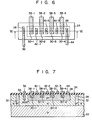
- Figs. 6 and 7 show another embodiment of the present invention, wherein the number of the emitter regions is increased. Since the configuration of the npn transistor of this embodiment is substantially the same except for the emitter regions and the emitter electrodes as the embodiment shown in Figs. 3 and 4, the same reference numerals denote the same parts and the description thereof will be omitted.
- Base region contact holes are formed at the positions of the insulation film which correspond to the emitter regions 30-1, 30-2, 30-3 and 30-4.
- a base electrode 42-1 is in contact with the base region portion between the emitter regions 30-1 and 30-2, base electrode 42-2 is in contact with the base region portion between the emitter regions 30-2 and 30-3.
- a base electrode 42-3 is in contact with the base region portion between the emitter regions 30-3 and 30-4.
- a base electrode 44 is in contact with the base region portion which is not sandwiched between the emitter regions (the right edge of the base region 28 shown in Figs. 6 and 7) through the contact hole.
- the isolation region 32 and insulation film 34 are omitted in Fig. 6.
- the base electrode 44 is for connection with an external power supply (not shown) at positive potential and is connected with such an external power supply during operation.
- the base electrodes 42-1, 42-2 and 42-3 are the electrodes for attracting the electrons. Although these electrodes 42-1, 42-2 and 42-3 are not directly connected to the external power supply, they are electrically connected to the external power supply through the base region 28 since the base electrode 44 is connected to the external power supply to be kept at a positive potential. Therefore, these electrodes 42-1, 42-2 and 42-3 are kept at substantially the same positive potential (potential of the external power supply) as the base electrode 44.
- the electrons injected to the base region 28 from the emitter regions 30-1, 30-2 and 30-3, and 30-4 are attracted to the base electrodes 42-1, 42-2 and 42-3 and the interfaces between these base electrodes and the base region 28 so that these electrons may be recombined with the holes at these interfaces.
- the electrons injected into the base region 28 are prevented from reaching the other emitter regions, so that the formation of lateral npn transistors between the adjacent emitter regions is prevented.
- the base electrodes 42-1, 42-2 and 42-3 are electrically connected to the base electrode 44 for connection with the external power supply through the base region 28, so that the base electrodes are kept at substantially the same potential as the base electrode 44.
- the present invention is not limited to this configuration.
- the layer defining the base electrodes 42-1, 42-2 and 42-3 is extended to form a common connection layer to which an external power supply is connected. In this case, all the base electrodes 42-1, 42-2 and 42-3 are directly connected to the external power supply. In this case, the base electrode 44 for connection with the external power supply in the embodiment shown in Figs. 6 and 7 is not necessary.
- the base electrodes 42-1, 42-2 and 42-3 may be extended and may be connected to the external power supply.
- the base electrodes 42-2 and 42-3 are electrically connected to the base electrode 42-1 through the base region 28, so that the base electrodes 42-2 and 42-3 are kept at substantially the same potential as the base electrode 42-1 (potential of the external power supply).
- the base electrode 44 for connection with the external power supply as in Figs. 6 and 7 need not be formed.
- a base electrode is arranged at the base region portion between two adjacent emitter regions.
- a positive voltage is applied to the base electrode, so that the electrons injected into the base region from one emitter region may be attracted to the interface between the base electrode and the base region to be recombined with the holes at this interface. Therefore, injected electrons are prevented from reaching the other emitter region, and the formation of a parasitic lateral npn transistor may be prevented.
Landscapes
- Bipolar Transistors (AREA)
- Bipolar Integrated Circuits (AREA)
- Electrodes Of Semiconductors (AREA)
Applications Claiming Priority (2)
| Application Number | Priority Date | Filing Date | Title |
|---|---|---|---|
| JP56004653A JPS57118669A (en) | 1981-01-16 | 1981-01-16 | Multiemitter type npn transistor |
| JP4653/81 | 1981-01-16 |
Publications (3)
| Publication Number | Publication Date |
|---|---|
| EP0056571A2 true EP0056571A2 (de) | 1982-07-28 |
| EP0056571A3 EP0056571A3 (en) | 1982-08-04 |
| EP0056571B1 EP0056571B1 (de) | 1986-04-02 |
Family
ID=11589903
Family Applications (1)
| Application Number | Title | Priority Date | Filing Date |
|---|---|---|---|
| EP82100033A Expired EP0056571B1 (de) | 1981-01-16 | 1982-01-05 | Vielfachemitter-npn-Transistor |
Country Status (3)
| Country | Link |
|---|---|
| EP (1) | EP0056571B1 (de) |
| JP (1) | JPS57118669A (de) |
| DE (1) | DE3270193D1 (de) |
Cited By (5)
| Publication number | Priority date | Publication date | Assignee | Title |
|---|---|---|---|---|
| EP0290268A3 (de) * | 1987-05-08 | 1990-01-10 | Raytheon Company | Verfahren zum Herstellen eines bipolaren Transistors |
| EP0240273A3 (de) * | 1986-03-31 | 1990-10-10 | Exar Corporation | Programmierbare Transistoren |
| US4992848A (en) * | 1990-02-20 | 1991-02-12 | At&T Bell Laboratories | Self-aligned contact technology |
| US5068702A (en) * | 1986-03-31 | 1991-11-26 | Exar Corporation | Programmable transistor |
| EP0951074A3 (de) * | 1998-04-16 | 2000-03-22 | Nec Corporation | Vielfachemitter Bipolartransistor |
Families Citing this family (1)
| Publication number | Priority date | Publication date | Assignee | Title |
|---|---|---|---|---|
| JPH02110935A (ja) * | 1988-10-19 | 1990-04-24 | Sanyo Electric Co Ltd | 高速スイッチング用トランジスタ |
Family Cites Families (1)
| Publication number | Priority date | Publication date | Assignee | Title |
|---|---|---|---|---|
| US3408542A (en) * | 1963-03-29 | 1968-10-29 | Nat Semiconductor Corp | Semiconductor chopper amplifier with twin emitters |
-
1981
- 1981-01-16 JP JP56004653A patent/JPS57118669A/ja active Pending
-
1982
- 1982-01-05 DE DE8282100033T patent/DE3270193D1/de not_active Expired
- 1982-01-05 EP EP82100033A patent/EP0056571B1/de not_active Expired
Cited By (6)
| Publication number | Priority date | Publication date | Assignee | Title |
|---|---|---|---|---|
| EP0240273A3 (de) * | 1986-03-31 | 1990-10-10 | Exar Corporation | Programmierbare Transistoren |
| US5068702A (en) * | 1986-03-31 | 1991-11-26 | Exar Corporation | Programmable transistor |
| EP0290268A3 (de) * | 1987-05-08 | 1990-01-10 | Raytheon Company | Verfahren zum Herstellen eines bipolaren Transistors |
| US4992848A (en) * | 1990-02-20 | 1991-02-12 | At&T Bell Laboratories | Self-aligned contact technology |
| EP0443253A1 (de) * | 1990-02-20 | 1991-08-28 | AT&T Corp. | Selbstjustierte Kontakt-Technologie |
| EP0951074A3 (de) * | 1998-04-16 | 2000-03-22 | Nec Corporation | Vielfachemitter Bipolartransistor |
Also Published As
| Publication number | Publication date |
|---|---|
| EP0056571B1 (de) | 1986-04-02 |
| DE3270193D1 (en) | 1986-05-07 |
| EP0056571A3 (en) | 1982-08-04 |
| JPS57118669A (en) | 1982-07-23 |
Similar Documents
| Publication | Publication Date | Title |
|---|---|---|
| US5014102A (en) | MOSFET-gated bipolar transistors and thyristors with both turn-on and turn-off capability having single-polarity gate input signal | |
| US4969023A (en) | SOS transistor structure | |
| US4117507A (en) | Diode formed in integrated-circuit structure | |
| US4547791A (en) | CMOS-Bipolar Darlington device | |
| US5686750A (en) | Power semiconductor device having improved reverse recovery voltage | |
| US4639754A (en) | Vertical MOSFET with diminished bipolar effects | |
| US4016593A (en) | Bidirectional photothyristor device | |
| GB1002734A (en) | Coupling transistor | |
| GB1154805A (en) | Monolithic Semiconductor Microcircuits with Improved Means for Connecting Points of Common Potential | |
| JPH01134960A (ja) | 電荷のサブストレートへの注入を遮へいするための集積装置 | |
| US5187554A (en) | Bipolar transistor | |
| JP2635044B2 (ja) | 半導体デバイス | |
| EP0056571A2 (de) | Vielfachemitter-npn-Transistor | |
| US4649411A (en) | Gallium arsenide bipolar ECL circuit structure | |
| JPS6094772A (ja) | 主電流部とエミユレ−シヨン電流部を有する電力用半導体素子 | |
| US4520277A (en) | High gain thyristor switching circuit | |
| US4885628A (en) | Semiconductor integrated circuit device | |
| GB2151399A (en) | A semiconductor device | |
| US3755722A (en) | Resistor isolation for double mesa transistors | |
| US4277794A (en) | Structure for logic circuits | |
| US5624855A (en) | Process of producing insulated-gate bipolar transistor | |
| US5304832A (en) | Vertical power field effect transistor having base region inwardly projecting from corners thereof into source region | |
| US4502071A (en) | FET Controlled thyristor | |
| GB2095907A (en) | Semiconductor device | |
| US5237195A (en) | Semiconductor integrated circuit arrangement for preventing latch up |
Legal Events
| Date | Code | Title | Description |
|---|---|---|---|
| PUAI | Public reference made under article 153(3) epc to a published international application that has entered the european phase |
Free format text: ORIGINAL CODE: 0009012 |
|
| PUAL | Search report despatched |
Free format text: ORIGINAL CODE: 0009013 |
|
| 17P | Request for examination filed |
Effective date: 19820202 |
|
| AK | Designated contracting states |
Designated state(s): DE FR GB NL |
|
| AK | Designated contracting states |
Designated state(s): DE FR GB NL |
|
| RAP1 | Party data changed (applicant data changed or rights of an application transferred) |
Owner name: KABUSHIKI KAISHA TOSHIBA |
|
| GRAA | (expected) grant |
Free format text: ORIGINAL CODE: 0009210 |
|
| AK | Designated contracting states |
Kind code of ref document: B1 Designated state(s): DE FR GB NL |
|
| ET | Fr: translation filed | ||
| REF | Corresponds to: |
Ref document number: 3270193 Country of ref document: DE Date of ref document: 19860507 |
|
| PLBE | No opposition filed within time limit |
Free format text: ORIGINAL CODE: 0009261 |
|
| STAA | Information on the status of an ep patent application or granted ep patent |
Free format text: STATUS: NO OPPOSITION FILED WITHIN TIME LIMIT |
|
| 26N | No opposition filed | ||
| PGFP | Annual fee paid to national office [announced via postgrant information from national office to epo] |
Ref country code: GB Payment date: 19961227 Year of fee payment: 16 |
|
| PGFP | Annual fee paid to national office [announced via postgrant information from national office to epo] |
Ref country code: FR Payment date: 19970109 Year of fee payment: 16 |
|
| PGFP | Annual fee paid to national office [announced via postgrant information from national office to epo] |
Ref country code: DE Payment date: 19970113 Year of fee payment: 16 |
|
| PGFP | Annual fee paid to national office [announced via postgrant information from national office to epo] |
Ref country code: NL Payment date: 19970130 Year of fee payment: 16 |
|
| PG25 | Lapsed in a contracting state [announced via postgrant information from national office to epo] |
Ref country code: GB Free format text: LAPSE BECAUSE OF NON-PAYMENT OF DUE FEES Effective date: 19980105 |
|
| PG25 | Lapsed in a contracting state [announced via postgrant information from national office to epo] |
Ref country code: FR Free format text: THE PATENT HAS BEEN ANNULLED BY A DECISION OF A NATIONAL AUTHORITY Effective date: 19980131 |
|
| PG25 | Lapsed in a contracting state [announced via postgrant information from national office to epo] |
Ref country code: NL Free format text: LAPSE BECAUSE OF NON-PAYMENT OF DUE FEES Effective date: 19980801 |
|
| GBPC | Gb: european patent ceased through non-payment of renewal fee |
Effective date: 19980105 |
|
| NLV4 | Nl: lapsed or anulled due to non-payment of the annual fee |
Effective date: 19980801 |
|
| PG25 | Lapsed in a contracting state [announced via postgrant information from national office to epo] |
Ref country code: DE Free format text: LAPSE BECAUSE OF NON-PAYMENT OF DUE FEES Effective date: 19981001 |
|
| REG | Reference to a national code |
Ref country code: FR Ref legal event code: ST |