EP0054563B1 - Verfahren zur herstellung aromatischer polyester sowie vorrichtung zur durchführung diesen verfahrens - Google Patents
Verfahren zur herstellung aromatischer polyester sowie vorrichtung zur durchführung diesen verfahrens Download PDFInfo
- Publication number
- EP0054563B1 EP0054563B1 EP81901816A EP81901816A EP0054563B1 EP 0054563 B1 EP0054563 B1 EP 0054563B1 EP 81901816 A EP81901816 A EP 81901816A EP 81901816 A EP81901816 A EP 81901816A EP 0054563 B1 EP0054563 B1 EP 0054563B1
- Authority
- EP
- European Patent Office
- Prior art keywords
- dispersing device
- dispersion
- phase
- acid chloride
- mixture
- Prior art date
- Legal status (The legal status is an assumption and is not a legal conclusion. Google has not performed a legal analysis and makes no representation as to the accuracy of the status listed.)
- Expired
Links
- 238000000034 method Methods 0.000 title claims abstract description 22
- 229920000728 polyester Polymers 0.000 title claims abstract description 22
- 125000003118 aryl group Chemical group 0.000 title claims abstract description 5
- 239000006185 dispersion Substances 0.000 claims abstract description 19
- 238000002156 mixing Methods 0.000 claims abstract description 16
- 239000002904 solvent Substances 0.000 claims abstract description 14
- NGNBDVOYPDDBFK-UHFFFAOYSA-N 2-[2,4-di(pentan-2-yl)phenoxy]acetyl chloride Chemical compound CCCC(C)C1=CC=C(OCC(Cl)=O)C(C(C)CCC)=C1 NGNBDVOYPDDBFK-UHFFFAOYSA-N 0.000 claims abstract description 13
- 239000000203 mixture Substances 0.000 claims abstract description 12
- 238000006243 chemical reaction Methods 0.000 claims abstract description 11
- 239000008346 aqueous phase Substances 0.000 claims abstract description 9
- 238000006068 polycondensation reaction Methods 0.000 claims abstract description 8
- 239000011541 reaction mixture Substances 0.000 claims abstract description 7
- 239000012071 phase Substances 0.000 claims abstract description 5
- 150000001805 chlorine compounds Chemical class 0.000 claims abstract description 4
- 150000008044 alkali metal hydroxides Chemical class 0.000 claims abstract description 3
- -1 aromatic dicarboxylic acids Chemical class 0.000 claims abstract description 3
- 238000002360 preparation method Methods 0.000 claims abstract description 3
- 238000011144 upstream manufacturing Methods 0.000 claims abstract description 3
- 239000007788 liquid Substances 0.000 claims description 11
- XLYOFNOQVPJJNP-UHFFFAOYSA-N water Substances O XLYOFNOQVPJJNP-UHFFFAOYSA-N 0.000 claims description 11
- 239000012074 organic phase Substances 0.000 claims description 7
- 239000003444 phase transfer catalyst Substances 0.000 claims description 6
- KKEYFWRCBNTPAC-UHFFFAOYSA-N Terephthalic acid Chemical compound OC(=O)C1=CC=C(C(O)=O)C=C1 KKEYFWRCBNTPAC-UHFFFAOYSA-N 0.000 claims description 4
- QQVIHTHCMHWDBS-UHFFFAOYSA-N isophthalic acid Chemical compound OC(=O)C1=CC=CC(C(O)=O)=C1 QQVIHTHCMHWDBS-UHFFFAOYSA-N 0.000 claims description 4
- XKZQKPRCPNGNFR-UHFFFAOYSA-N 2-(3-hydroxyphenyl)phenol Chemical compound OC1=CC=CC(C=2C(=CC=CC=2)O)=C1 XKZQKPRCPNGNFR-UHFFFAOYSA-N 0.000 claims description 2
- 102400000830 Saposin-B Human genes 0.000 claims 1
- 101800001697 Saposin-B Proteins 0.000 claims 1
- 239000003795 chemical substances by application Substances 0.000 claims 1
- 239000003960 organic solvent Substances 0.000 claims 1
- 239000007791 liquid phase Substances 0.000 abstract description 12
- 238000012696 Interfacial polycondensation Methods 0.000 abstract description 3
- 239000002253 acid Substances 0.000 abstract 1
- 239000000243 solution Substances 0.000 description 12
- KFZMGEQAYNKOFK-UHFFFAOYSA-N Isopropanol Chemical compound CC(C)O KFZMGEQAYNKOFK-UHFFFAOYSA-N 0.000 description 8
- HEMHJVSKTPXQMS-UHFFFAOYSA-M Sodium hydroxide Chemical compound [OH-].[Na+] HEMHJVSKTPXQMS-UHFFFAOYSA-M 0.000 description 6
- WSLDOOZREJYCGB-UHFFFAOYSA-N 1,2-Dichloroethane Chemical compound ClCCCl WSLDOOZREJYCGB-UHFFFAOYSA-N 0.000 description 4
- LFQSCWFLJHTTHZ-UHFFFAOYSA-N Ethanol Chemical compound CCO LFQSCWFLJHTTHZ-UHFFFAOYSA-N 0.000 description 4
- HTZCNXWZYVXIMZ-UHFFFAOYSA-M benzyl(triethyl)azanium;chloride Chemical compound [Cl-].CC[N+](CC)(CC)CC1=CC=CC=C1 HTZCNXWZYVXIMZ-UHFFFAOYSA-M 0.000 description 4
- 238000001816 cooling Methods 0.000 description 4
- OKKJLVBELUTLKV-UHFFFAOYSA-N Methanol Chemical compound OC OKKJLVBELUTLKV-UHFFFAOYSA-N 0.000 description 3
- 229920003023 plastic Polymers 0.000 description 3
- 239000004033 plastic Substances 0.000 description 3
- 229920000642 polymer Polymers 0.000 description 3
- QPFMBZIOSGYJDE-UHFFFAOYSA-N 1,1,2,2-tetrachloroethane Chemical compound ClC(Cl)C(Cl)Cl QPFMBZIOSGYJDE-UHFFFAOYSA-N 0.000 description 2
- CSCPPACGZOOCGX-UHFFFAOYSA-N Acetone Chemical compound CC(C)=O CSCPPACGZOOCGX-UHFFFAOYSA-N 0.000 description 2
- QVGXLLKOCUKJST-UHFFFAOYSA-N atomic oxygen Chemical compound [O] QVGXLLKOCUKJST-UHFFFAOYSA-N 0.000 description 2
- FDQSRULYDNDXQB-UHFFFAOYSA-N benzene-1,3-dicarbonyl chloride Chemical compound ClC(=O)C1=CC=CC(C(Cl)=O)=C1 FDQSRULYDNDXQB-UHFFFAOYSA-N 0.000 description 2
- 230000015572 biosynthetic process Effects 0.000 description 2
- 229910052799 carbon Inorganic materials 0.000 description 2
- 125000004432 carbon atom Chemical group C* 0.000 description 2
- 238000010438 heat treatment Methods 0.000 description 2
- 239000012535 impurity Substances 0.000 description 2
- 238000004519 manufacturing process Methods 0.000 description 2
- 238000002844 melting Methods 0.000 description 2
- 230000008018 melting Effects 0.000 description 2
- 229910052760 oxygen Inorganic materials 0.000 description 2
- 239000001301 oxygen Substances 0.000 description 2
- LXEJRKJRKIFVNY-UHFFFAOYSA-N terephthaloyl chloride Chemical compound ClC(=O)C1=CC=C(C(Cl)=O)C=C1 LXEJRKJRKIFVNY-UHFFFAOYSA-N 0.000 description 2
- 238000001291 vacuum drying Methods 0.000 description 2
- 238000005406 washing Methods 0.000 description 2
- RYHBNJHYFVUHQT-UHFFFAOYSA-N 1,4-Dioxane Chemical compound C1COCCO1 RYHBNJHYFVUHQT-UHFFFAOYSA-N 0.000 description 1
- YWFPGFJLYRKYJZ-UHFFFAOYSA-N 9,9-bis(4-hydroxyphenyl)fluorene Chemical compound C1=CC(O)=CC=C1C1(C=2C=CC(O)=CC=2)C2=CC=CC=C2C2=CC=CC=C21 YWFPGFJLYRKYJZ-UHFFFAOYSA-N 0.000 description 1
- VOWWYDCFAISREI-UHFFFAOYSA-N Bisphenol AP Chemical compound C=1C=C(O)C=CC=1C(C=1C=CC(O)=CC=1)(C)C1=CC=CC=C1 VOWWYDCFAISREI-UHFFFAOYSA-N 0.000 description 1
- ISWSIDIOOBJBQZ-UHFFFAOYSA-N Phenol Chemical compound OC1=CC=CC=C1 ISWSIDIOOBJBQZ-UHFFFAOYSA-N 0.000 description 1
- 239000000470 constituent Substances 0.000 description 1
- 238000000354 decomposition reaction Methods 0.000 description 1
- 230000007547 defect Effects 0.000 description 1
- 238000010292 electrical insulation Methods 0.000 description 1
- 238000001125 extrusion Methods 0.000 description 1
- 238000001746 injection moulding Methods 0.000 description 1
- 238000011068 loading method Methods 0.000 description 1
- 238000000691 measurement method Methods 0.000 description 1
- 239000000155 melt Substances 0.000 description 1
- 230000005501 phase interface Effects 0.000 description 1
- 239000002244 precipitate Substances 0.000 description 1
- 239000000047 product Substances 0.000 description 1
- 238000005086 pumping Methods 0.000 description 1
- 238000000926 separation method Methods 0.000 description 1
- 239000000779 smoke Substances 0.000 description 1
- 238000003756 stirring Methods 0.000 description 1
- 238000003786 synthesis reaction Methods 0.000 description 1
- 238000005979 thermal decomposition reaction Methods 0.000 description 1
- 230000001988 toxicity Effects 0.000 description 1
- 231100000419 toxicity Toxicity 0.000 description 1
Images
Classifications
-
- B—PERFORMING OPERATIONS; TRANSPORTING
- B01—PHYSICAL OR CHEMICAL PROCESSES OR APPARATUS IN GENERAL
- B01J—CHEMICAL OR PHYSICAL PROCESSES, e.g. CATALYSIS OR COLLOID CHEMISTRY; THEIR RELEVANT APPARATUS
- B01J19/00—Chemical, physical or physico-chemical processes in general; Their relevant apparatus
- B01J19/18—Stationary reactors having moving elements inside
- B01J19/1868—Stationary reactors having moving elements inside resulting in a loop-type movement
- B01J19/1881—Stationary reactors having moving elements inside resulting in a loop-type movement externally, i.e. the mixture leaving the vessel and subsequently re-entering it
-
- C—CHEMISTRY; METALLURGY
- C08—ORGANIC MACROMOLECULAR COMPOUNDS; THEIR PREPARATION OR CHEMICAL WORKING-UP; COMPOSITIONS BASED THEREON
- C08G—MACROMOLECULAR COMPOUNDS OBTAINED OTHERWISE THAN BY REACTIONS ONLY INVOLVING UNSATURATED CARBON-TO-CARBON BONDS
- C08G63/00—Macromolecular compounds obtained by reactions forming a carboxylic ester link in the main chain of the macromolecule
-
- C—CHEMISTRY; METALLURGY
- C08—ORGANIC MACROMOLECULAR COMPOUNDS; THEIR PREPARATION OR CHEMICAL WORKING-UP; COMPOSITIONS BASED THEREON
- C08G—MACROMOLECULAR COMPOUNDS OBTAINED OTHERWISE THAN BY REACTIONS ONLY INVOLVING UNSATURATED CARBON-TO-CARBON BONDS
- C08G63/00—Macromolecular compounds obtained by reactions forming a carboxylic ester link in the main chain of the macromolecule
- C08G63/02—Polyesters derived from hydroxycarboxylic acids or from polycarboxylic acids and polyhydroxy compounds
- C08G63/12—Polyesters derived from hydroxycarboxylic acids or from polycarboxylic acids and polyhydroxy compounds derived from polycarboxylic acids and polyhydroxy compounds
- C08G63/16—Dicarboxylic acids and dihydroxy compounds
- C08G63/18—Dicarboxylic acids and dihydroxy compounds the acids or hydroxy compounds containing carbocyclic rings
- C08G63/19—Hydroxy compounds containing aromatic rings
- C08G63/193—Hydroxy compounds containing aromatic rings containing two or more aromatic rings
-
- B—PERFORMING OPERATIONS; TRANSPORTING
- B01—PHYSICAL OR CHEMICAL PROCESSES OR APPARATUS IN GENERAL
- B01J—CHEMICAL OR PHYSICAL PROCESSES, e.g. CATALYSIS OR COLLOID CHEMISTRY; THEIR RELEVANT APPARATUS
- B01J2219/00—Chemical, physical or physico-chemical processes in general; Their relevant apparatus
- B01J2219/00049—Controlling or regulating processes
- B01J2219/00051—Controlling the temperature
- B01J2219/00074—Controlling the temperature by indirect heating or cooling employing heat exchange fluids
- B01J2219/00087—Controlling the temperature by indirect heating or cooling employing heat exchange fluids with heat exchange elements outside the reactor
- B01J2219/00094—Jackets
Definitions
- the invention relates to a process for the preparation of aromatic polyesters by polycondensation of diphenols with chlorides of aromatic dicarboxylic acids such as isophthalic acid and / or terephthalic acid by the two-phase interfacial polycondensation process, and an apparatus for carrying out this process.
- the aqueous phase consisting of a solution of the diphenol, alkali metal hydroxide to form the diphenolate in a stoichiometric ratio or in slight excess
- a phase transfer catalyst in water and optionally an organic one Solvent as a solubilizer with the organic liquid phase, consisting of a solution of the acid chloride in a chlorinated solvent
- the organic liquid phase consisting of a solution of the acid chloride in a chlorinated solvent
- the inherent viscosity achieved on the synthesized polyesters is not very high. This is particularly the case when it is a question of polyesters for the synthesis of which diphenolates are used which have a central carbon atom in such a way that groups bound to this carbon atom are prevented from rotating freely.
- the invention is based on the object of specifying a process for the production of polyesters of the type mentioned above, in which, under otherwise identical conditions, a higher inherent viscosity of the synthesized polyester is achieved than in the known processes.
- the object on which the invention is based is achieved in the process according to the invention, which is characterized in that the reaction mixture, which is prepared as a dispersion of the aqueous and the organic-liquid phase, is passed in a circuit through a dispersing device, with this being carried out in a largely anhydrous chlorinated solvent dissolved acid chloride to be used is continuously fed to this circuit at a point in the direction of flow upstream of the dispersing device.
- a dispersion can advantageously be prepared and maintained from the aqueous phase to be used and a portion of the solvent to be used in the organic liquid phase, to which the acid chloride solution to be used is then fed.
- the portion of the solvent of the organic-liquid phase to be used, which is used to produce a dispersion of the reaction mixture, contains no acid chloride and therefore - in contrast to the solvent used to dissolve the acid chloride to be supplied - does not have to meet high purity requirements, particularly with regard to a substantial absence of water.
- the process according to the invention is characterized in that the mixture of these two components is passed through the dispersing device to produce the dispersion from the aqueous phase and a portion of the chlorinated solvent of the organic-liquid phase to be used.
- the reaction mixture in the dispersing device is passed through one or more mixing stages connected in series, the batch being divided into one or more partial flows in each mixing stage, the partial flows with their flow limitations transverse to their main flow directions movements at medium speeds of Execute greater than 5 m / s and the partial flows lead into a mixing chamber provided with at least one outlet channel, in which the kinetic energy of the batch is reduced to a value that is low compared to its maximum value, the batch regions flowing in the mixing chamber changing at least almost periodically changing flow conditions are exposed.
- Such a dispersing device is part of the prior art in the production of high molecular weight polyesters by the phase interface process (DE-A-2 728 849).
- the invention is also based on the object of specifying an advantageous device for carrying out the method according to the invention.
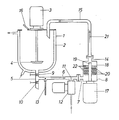
- the device according to the invention which is characterized by a reaction kettle with agitator, a dispersing device, the input or output of which is connected to the reaction kettle via a pipe, and a pipe connected in the pipe leading from the reaction kettle to the inlet of the dispersing device Device for entering the acid chloride.
- the device for carrying out the polycondensation has a boiler 1 with a cooling jacket 2 and an agitator consisting of a high-speed motor 3 and a turbo stirrer 4.
- a pipe socket 5 leads away from the boiler bottom, from which a pipe 6 branches off, which leads to the inlet 7 of a dispersing device 8, shut-off valves 9 and 10 being arranged in the pipe socket 5 on both sides of this branch.
- a device 11 with metering pump 12 for metered supply of a reaction component and a thermometer 13 are also switched on in the pipeline 6.
- the output 14 of the dispersing device 8 is via another Pipeline 15 connected to the interior of the boiler.
- a closable loading opening 16 is arranged in the boiler lid.
- the dispersing device 8 is provided with a shaft 19, driven by a motor 17 and mounted in a housing 18, on which three rotor disks 20 provided with radial slots are placed.
- a stationary disk 22 connected to the housing wall and provided with radial slots is provided in such a way that each rotor disk 20 with the stationary disk 22 arranged downstream of it results in a mixing stage.
- the cooled solution is now introduced into the kettle 1 of the device described in the drawing, 10 l of distilled 1,2-dichloroethane are added to the solution, and finally, after opening the shut-off valve 9, the agitator, the dispersing device 8 and the water cooling in the cooling jacket 2 are switched on. Because of its pumping action, the dispersing device 8 maintains a constant flow of the liquid mixture used in the direction 21. After about 2 minutes, the action of the agitator and the dispersing device 8 converts the liquid mixture used into a fine dispersion.
- the dispersion is then discharged from the device into a separation vessel by opening the shut-off valve 10, in which the two phases separate in a relatively short time.
- the polyester solution forming the organic liquid phase is then separated off and washed well with water to remove ionic constituents.
- the polyester is then precipitated from this solution by adding isopropanol, filtered off and any ionic impurities still present are removed from it by washing with isopropanol, water and again isopropanol.
- the polymer is then dried to constant weight in a vacuum drying cabinet at 80 ° C.
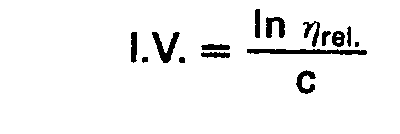
- the inherent viscosity (IV) is determined at 30 ° C. on a solution of 0.5 g polymer in 100 ml solvent (60% phenol, 40% tetrachloroethane) using an Ubbelohde viscometer (capillary constant 0.01).
- the effectiveness of the dispersing device 8 results from the fact that in each mixing stage a liquid mixture passing through it and consisting of two immiscible liquid phases is brought to speeds when it passes through the radial slots of the rotating rotor disk 20, the components of which run perpendicular to the axial direction have sizes of more than Have 5 m / s.
- the kinetic energy of the liquid mixture before it leaves the mixing chamber through the radial slots in the stationary disk 22 is abruptly brought to a very low value, the in the mixture areas flowing into the mixing chamber are exposed to at least almost periodically changing flow conditions. This creates a very intensive turbulence in the mixing chamber, which causes the formation or improvement of a very fine dispersion in the liquid mixture.
- the organic-liquid phase is then separated, as in Example 1, washed and finally, with vigorous stirring, from it by slowly adding Acetone and methanol of the polyester precipitate.
- This polyester is filtered off and any ionic impurities that may still be present are removed from it by washing with ethanol, water and again ethanol.
- the polymer is then dried to constant weight in a vacuum drying cabinet at 80 ° C.
- high-temperature-resistant aromatic polyesters with a high molecular weight can be synthesized, in particular using the device according to the invention, from which z. B. from the solution cast films or by extrusion or injection molding from the melt produced films, plates or parts that can be used in many cases, especially for electrical insulation purposes where a high permanent temperature resistance is required.
- a high oxygen index of the plastic is required.
- a high oxygen index of plastics is increasingly required especially in those applications in which the thermal decomposition of the plastic used, as can occur in the event of a defect or accident, but especially in the event of a fire, results in smoke development and the toxicity of the resulting decomposition products should be as low as possible.
Landscapes
- Chemical & Material Sciences (AREA)
- Organic Chemistry (AREA)
- Chemical Kinetics & Catalysis (AREA)
- Health & Medical Sciences (AREA)
- Medicinal Chemistry (AREA)
- Polymers & Plastics (AREA)
- Polyesters Or Polycarbonates (AREA)
Description
- Die Erfindung betrifft ein Verfahren zur Herstellung aromatischer Polyester durch Polykondensation von Diphenolen mit Chloriden aromatischer Dicarbonsäuren wie Isophthalsäure und/ oder Terephthalsäure nach den Zweiphasengrenzflächen-Polykondensationsverfahren, sowie eine Vorrichtung zur Durchführung dieses Verfahrens.
- Bei einem in der US-PS 3 216 970 beschriebenen Zweiphasengrenzflächen-Polykondensationsverfahren wird aus der wäßrigen Phase, bestehend aus einer Lösung aus dem Diphenol, AIkalihydroxyd zur Bildung des Diphenolates im stöchiometrischen Verhältnis oder in geringem Überschuß, sowie einem Phasentransferkatalysator in Wasser und gegebenenfalls einem organischen Lösungsmittel als Lösungsvermittler mit der organisch-flüssigen Phase, bestehend aus einer Lösung des Säurechlorids in einem chlorierten Lösungsmittel eine feine Dispersion hergestellt, wobei das mit Hilfe des Phasentransferkatalysators in die organisch-flüssige Phase übergeführte Diphenolat mit Säurechlorid zur Bildung des Polyesters eine Polykondensationsreaktion eingeht und der gebildete Polyester in der organischen Phase gelöst wird. Bei den in dieser US-PS beschriebenen Beispielen ist die an den synthetisierten Polyestern erreichte Inherente Viskosität nicht sehr hoch. Dies ist insbesondere dann der Fall, wenn es sich um Polyester handelt, zu deren Synthesen Diphenolate eingesetzt werden, die ein zentrales Kohlenstoffatom aufweisen, derart, daß an dieses Kohlenstoffatom gebundene Gruppen in ihrer freien Drehung gehindert sind.
- Der Erfindung liegt nun die Aufgabe zugrunde, ein Verfahren zur Herstellung von Polyestern der obengenannten Art anzugeben, bei dem unter sonst gleichen Bedingungen eine höhere Inherente Viskosität des synthetisierten Polyesters erzielt wird als bei den bekannten Verfahren.
- Die der Erfindung zugrundeliegende Aufgabe wird in dem erfindungsgemäßen Verfahren gelöst, das dadurch gekennzeichnet ist, daß das Reaktionsgemisch, das als Dispersion der wäßrigen und der organisch-flüssigen Phase hergestellt wird, in einem Kreislauf durch eine Dispergiereinrichtung geführt wird, wobei das in einem weitgehend wasserfreiem chlorierten Lösungsmittel gelöste einzusetzende Säurechlorid diesem Kreislauf an einer in Strömungsrichtung vor der Dispergiereinrichtung gelegenen Stelle laufend zugeführt wird. Dabei kann vorteilhaft aus der einzusetzenden wäßrigen Phase und einer Teilmenge des einzusetzenden Lösungsmittels der organisch flüssigen Phase eine Dispersion hergestellt und aufrechterhalten werden, der dann die einzusetzende Säurechloridlösung zugeführt wird. Die Teilmenge des Lösungsmittels der einzusetzenden organisch-flüssigen Phase, die zur Herstellung einer Dispersion des Reaktionsgemisches dient, enthält kein Säurechlorid und muß daher - im Gegensatz zu dem zum Auflösen des zuzuführenden Säurechlorids dienenden Lösungsmittels - auch keinen hohen Reinheitsanforderungen insbesondere hinsichtlich einer weitgehenden Wasserfreiheit genügen.
- Gemäß einer vorteilhaften Ausgestaltung der Erfindung ist das erfindungsgemäße Verfahren dadurch gekennzeichnet, daß zur Herstellung der Dispersion aus der wäßrigen Phase und einer Teilmenge des einzusetzenden chlorierten Lösungsmittels der organisch-flüssigen Phase das Gemenge aus diesen beiden Komponenten durch die Dispergiereinrichtung geführt wird.
- Nach einer anderen vorteilhaften Ausgestaltung der Erfindung wird das Reaktionsgemisch in der Dispergiereinrichtung durch eine oder mehrere hintereinander geschaltete Mischstufen geführt, wobei in jeder Mischstufe das Gemenge in eine oder mehrere Teilströmungen aufgeteilt wird, die Teilströmungen mit ihren Strömungsbegrenzungen quer zu ihren Hauptströmungsrichtungen Bewegungen mit mittleren Geschwindigkeiten von größer als 5 m/s ausführen und die Teilströmungen in einer mit zumindest einem Ausgangskanal versehenen Mischkammer münden, in der die kinetische Energie des Gemenges auf einen gegenüber ihren Höchstwert geringen Wert herabgesetzt wird, wobei die in der Mischkammer strömenden Gemengebereiche sich zumindest nahezu periodisch verändernden Strömungsverhältnissen ausgesetzt sind.
- Eine derartige Dispergiereinrichtung gehört bei der Herstellung hochmolekularer Polyester nach dem Phasengrenzflächenverfahren zum Stand der Technik (DE-A-2 728 849).
- Der Erfindung liegt ferner die Aufgabe zugrunde, eine vorteilhafte Vorrichtung zur Durchführung des erfindungsgemäßen Verfahrens anzugeben.
- Diese Aufgabe wird in der erfindungsgemäßen Vorrichtung gelöst, die gekennzeichnet ist durch einen Reaktionskessel mit Rührwerk, einer Dispergiereinrichtung, deren Ein- bzw. Ausgang jeweils über eine Rohrleitung mit dem Reaktionskessel verbunden ist, und eine in der vom Reaktionskessel zum Eingang der Dispergiereinrichtung führenden Rohrleitung eingeschaltete Einrichtung zur Eingabe des Säurechlorids.
- Die Vorrichtung zur Durchführung der Polykondensation weist einen Kessel 1 auf mit einem Kühlmantel 2 und einem aus einem hochtourigen Motor 3 und einem Turborührer 4 bestehenden Rührwerk. Vom Kesselboden führt ein Rohrstutzen 5 weg, von dem eine Rohrleitung 6 abzweigt, die zum Eingang 7 einer Dispergiereinrichtung 8 führt, wobei in dem Rohrstutzen 5 beiderseits dieser Abzweigung Absperrhähne 9 und 10 angeordnet sind. In der Rohrleitung 6 ist ferner eine Einrichtung 11 mit Dosierpumpe 12 zur dosierten Zufuhr einer Reaktionskomponente sowie ein Thermometer 13 eingeschaltet. Der Ausgang 14 der Dispergiereinrichtung 8 ist über eine weitere Rohrleitung 15 mit dem Kesselinnenraum verbunden. Im Kesseldeckel ist eine verschließbare Beschickungsöffnung 16 angeordnet.
- Die Dispergiereinrichtung 8 ist mit einer durch einen Motor 17 angetriebenen und in einem Gehäuse 18 gelagerten Welle 19 versehen, auf welcher drei mit Radialschlitzen versehene Rotorscheiben 20 aufgesetzt sind. Zu jeder Rotorscheibe 20 ist - in Strömungsrichtung 21 nachgeordnet - eine mit der Gehäusewand verbundene, mit Radialschlitzen versehene stationäre Scheibe 22 vorgesehen, derart, daß jede Rotorscheibe 20 mit der ihr nachgeordneten stationären Scheibe 22 eine Mischstufe ergibt.
- In einem beheizbaren Gefäß werden als einzusetzende wäßrige Phase 4,0 Mol (1160 g) 1,1-Bis(4-hydroxyphenyl)-1-phenyläthan (Schmelzpunkt: 189-191°C) in 81 Wasser und 2) tsopropanol mit 8,3 Mol (322 g) Natriumhydroxyd durch Erwärmen gelöst.
- Die wieder erkaltete Lösung wird nun in den Kessel 1 der in der Zeichnung beschriebenen Vorrichtung eingebracht, der Lösung 10 I destilliertes 1,2-Dichloräthan zugegeben und schließlich nach Öffnen des Absperrhahnes 9 das Rührwerk, die Dispergiereinrichtung 8 und die Wasserkühlung im Kühlmantel 2 eingeschaltet. Wegen ihrer Pumpwirkung wird dabei durch die Dispergiereinrichtung 8 eine ständige Strömung des eingesetzten Flüssigkeitsgemisches in Richtung 21 aufrechtgehalten. Nach etwa 2 min ist durch die Wirkung des Rührwerks und der Dispergiereinrichtung 8 das eingesetzte Flüssigkeitsgemisch in eine feine Dispersion übergeführt.
- Jetzt werden dieser Dispersion als Phasentransferkatalysator 0,2 Mol (46 g) Benzyltriäthylammoniumchlorid gelöst in 300 ml Wasser zugesetzt und kurz darauf - bei weiter eingeschaltetem Rührwerk und Dispergiereinrichtung 8 - über die Zuführeinrichtung 11 eine Lösung aus 2,0 Mol (406 g) Isophthalsäuredichlorid und 2,0 Mol (406 g) Terephthalsäuredichlorid in 2 I absolutiertem 1,2-Dichloräthan mittels der Dosierpumpe 12 während 60 min kontinuierlich zugeführt und schließlich das Rührwerk und die Dispergiereinrichtung in einer Nachreaktionszeit noch während weiterer 60 min weiter laufen gelassen, wobei die Temperatur der Dispersion durch die Kühlung unter 25°C gehalten und mit dem Thermometer 23 laufend kontrolliert wird.
- Damit ist die Polykondensationsreaktion abgeschlossen, der gebildete Polyester in der organisch-flüssigen Phase gelöst.
- Die Dispersion wird nun durch Öffnung des Absperrhahnes 10 aus der Vorrichtung in ein Trenngefäß abgelassen, in dem sich die beiden Phasen in relativ kurzer Zeit trennen. Die die organisch-flüssige Phase bildende Polyesterlösung wird nun abgetrennt und mit Wasser zur Entfernung ionischer Bestandteile gut gewaschen. Der Polyester wird dann durch Zugabe von Isopropanol aus dieser Lösung gefällt, abfiltriert und aus ihm durch Waschen mit Isopropanol, Wasser und nochmals Isopropanol eventuell noch vorhandene ionische Verunreinigungen entfernt. Anschließend wird das Polymer in einem Vakuumtrockenschrank bei 80° C bis zur Gewichtskonstanz getrocknet.
- Man erhält 1586 g (das sind 94,4% der nach der Theorie möglichen Menge) eines farblosen, halogenfreien Polyesters mit einer Inherente Viskosität von 1,84 dl/g.
- Die Inherente Viskosität (I. V.) wird bei 30°C an einer Lösung von 0,5 g Polymer in 100 ml Lösungsmittel (60% Phenol, 40% Tetrachloräthan) mit Hilfe eines Ubbelohde-Viskosimeters (Kapillarkonstante 0,01) bestimmt.
- Die Wirksamkeit der Dispergiereinrichtung 8 ergibt sich daraus, daß in jeder Mischstufe ein durch sie hindurchtretendes aus zwei nicht mischbaren flüssigen Phasen bestehendes Flüssigkeitsgemisch bei seinem Durchtritt durch die Radialschlitze der rotierenden Rotorscheibe 20 auf Geschwindigkeiten gebracht werden, deren senkrecht zur Achsrichtung verlaufenden Komponenten Größen von mehr als 5 m/s haben. Im Raum zwischen der Rotorscheibe 20 und der nachgeordneten stationären Scheibe 22, der die Mischkammer bildet, wird die kinetische Energie des Flüssigkeitsgemisches, bevor es durch die Radialschlitze in der stationären Scheibe 22 die Mischkammer verläßt, abrupt auf einen sehr niedrigen Wert gebracht, wobei die in der Mischkammer strömenden Gemischbereiche sich zumindest nahezu periodisch verändernden Strömungsverhältnissen ausgesetzt sind. Dadurch wird in der Mischkammer eine sehr intensive Turbulenz erzeugt, welche das Entstehen bzw. die Verbesserung einer sehr feinen Dispersion im Flüssigkeitsgemisch bewirkt.
- Zur Herstellung der wäßrigen Phase werden 2,0 Mol (700 g) 9,9-Bis(4-hydroxyphenyl)-fluoren (Schmelzbereich: 227-229°C) in 41 Wasser und 21 Dioxan mit 4,15 Mol (166 g) Natriumhydroxyd, ähnlich wie im Beispiel 1 angegeben, durch schwaches Erwärmen gelöst. Die wieder erkaltete Lösung wird in den Kessel 1 eingebracht und ihr 7 1 destilliertes 1,2-Dichloräthan zugegeben. Darauf wird - jeweils analog wie in Beispiel 1 beschrieben - das eingesetzte Flüssigkeitsgemisch in eine feine Dispersion übergeführt, als Phasentransferkatalysator 0,1 Mol (23 g) Benzyltriäthylammoniumchlorid, gelöst in 100 ml Wasser, zugegeben, über die Zufuhreinrichtung 11 eine Lösung aus 1 Mol (203 g) Isophthalsäuredichlorid und 1 Mol (203 g) Terephthalsäuredichlorid in 1 I absolutiertem 1,2-Dichloräthan während 30 min kontinuierlich zugesetzt und während weiterer 30 min einer Nachreaktion unterworfen.
- Von der aus der Vorrichtung abgelassenen Dispersion, in welcher der gebildete Polyester in der organisch-flüssigen Phase gelöst ist, wird nun, so wie gemäß Beispiel 1, die organisch-flüssige Phase abgetrennt, gewaschen und schließlich unter kräftigem Rühren aus ihr durch langsame Zugabe von Aceton und Methanol der Polyester gefällt. Dieser Polyester wird abfiltriert und aus ihm durch Waschen mit Äthanol, Wasser und nochmals Äthanol eventuell noch vorhandene ionische Verunreinigungen entfernt. Das Polymer wird anschließend in einem Vakuumtrockenschrank bei 80° C bis zur Gewichtskonstanz getrocknet.
- Man erhält 900 g (das sind 94% der nach der Theorie möglichen) eines farblosen, halogenfreien Polyesters mit einer Inherenten Viskosität von 1,67 dl/g (bestimmt nach dem in Beispiel 1 angegebenen Meßverfahren).
- Mit dem erfindungsgemäßen Verfahren können insbesondere unter Verwendung der erfindungsgemäßen Vorrichtung hochtemperaturbeständige aromatische Polyester mit hohem Molekulargewicht synthetisiert werden, aus denen man z. B. aus der Lösung gegossene Folien oder durch Extrusion oder Spritzguß aus der Schmelze hergestellte Folien, Platten bzw. Teile herstellt, die man insbesondere auch für Elektroisolierzwecke in vielen Fällen dort einsetzen kann, wo eine hohe Dauertemperaturbeständigkeit benötigt wird.
- Weitere wichtige Anwendungen liegen dort, wo ein hoher Sauerstoffindex des Kunststoffs gefordert wird. Ein hoher Sauerstoffindex von Kunststoffen wird nämlich in zunehmendem Maße speziell in solchen Anwendungen verlangt, bei denen bei einer thermischen Zersetzung des eingesetzten Kunststoffs, wie sie bei einem Defekt oder Unfall, insbesondere aber auch im Falle eines Brandes eintreten kann, die Rauchentwicklung sowie die Giftigkeit der entstehenden Zersetzungsprodukte möglichst gering sein sollen.
Claims (5)
Applications Claiming Priority (2)
| Application Number | Priority Date | Filing Date | Title |
|---|---|---|---|
| AT3344/80 | 1980-06-20 | ||
| AT0334480A AT368533B (de) | 1980-06-26 | 1980-06-26 | Verfahren zur herstellung aromatischer polyester sowie vorrichtung zur durchfuehrung dieses verfahrens |
Publications (3)
| Publication Number | Publication Date |
|---|---|
| EP0054563A1 EP0054563A1 (de) | 1982-06-30 |
| EP0054563B1 true EP0054563B1 (de) | 1984-08-29 |
| EP0054563B2 EP0054563B2 (de) | 1988-08-31 |
Family
ID=3549127
Family Applications (1)
| Application Number | Title | Priority Date | Filing Date |
|---|---|---|---|
| EP81901816A Expired EP0054563B2 (de) | 1980-06-26 | 1981-06-26 | Verfahren zur herstellung aromatischer polyester sowie vorrichtung zur durchführung diesen verfahrens |
Country Status (7)
| Country | Link |
|---|---|
| US (2) | US4401803A (de) |
| EP (1) | EP0054563B2 (de) |
| JP (1) | JPH0230331B2 (de) |
| AT (2) | AT368533B (de) |
| DE (1) | DE3165773D1 (de) |
| IT (1) | IT1137255B (de) |
| WO (1) | WO1982000149A1 (de) |
Families Citing this family (18)
| Publication number | Priority date | Publication date | Assignee | Title |
|---|---|---|---|---|
| DE3278240D1 (en) * | 1981-05-07 | 1988-04-21 | Isovolta | High-molecular aromatic polyester, process for preparing films therefrom and such films, an electrical conductor with an insulation of this polyester, and process for making such an insulation |
| DE3432430A1 (de) * | 1984-09-04 | 1986-03-13 | Robert Bosch Gmbh, 7000 Stuttgart | Verfahren zur ueberpruefung von steuergeraeten |
| JPH0739478B2 (ja) * | 1985-10-31 | 1995-05-01 | 住友化学工業株式会社 | 芳香族ポリエステルの製造方法 |
| AT386217B (de) * | 1986-10-21 | 1988-07-25 | Isovolta | Verfahren zur herstellung aromatischer polyester |
| US5149769A (en) * | 1986-10-02 | 1992-09-22 | Isovolta Osterreichische Isolierstoffwerke | Process for the production of aromatic polyesters |
| AT392475B (de) * | 1988-12-09 | 1991-04-10 | Isovolta | Verfahren zur polykondensation von diphenolen mit halogeniden von dicarbonsaeuren |
| US5295040A (en) * | 1989-05-05 | 1994-03-15 | Minnesota Mining And Manufacturing Company | High purity aromatic polyesters |
| US5318938A (en) * | 1989-05-05 | 1994-06-07 | Minnesota Mining And Manufacturing Company | Thermographic elements |
| US4967306A (en) * | 1989-05-05 | 1990-10-30 | Minnesota Mining And Manufacturing Company | High purity aromatic polyesters |
| US5921679A (en) * | 1995-09-25 | 1999-07-13 | Rutgers, The State University Of New Jersey | Method of chaotic mixing and improved stirred tank reactors |
| US6066919A (en) * | 1997-05-27 | 2000-05-23 | Bowser; Roger C. | Lighting device, components therefor and method of manufacture |
| CN1231288C (zh) * | 2000-01-31 | 2005-12-14 | 利乐拉瓦尔集团及财务有限公司 | 混合方法和装置 |
| US7022772B2 (en) * | 2000-11-14 | 2006-04-04 | Ferraria Technologies S.P.A. | Optical film comprising polyarylates containing bis-(hydroxyphenyl)-fluorene-ortho-disubstituted bisphenols |
| ITSV20010013A1 (it) | 2001-04-24 | 2002-10-24 | Ferrania Spa | 9,9-bis-(4-idrossifenil)-fluorene ad alta purezza e metodo perla sua preparazione e purificazione |
| US8497343B2 (en) * | 2005-04-06 | 2013-07-30 | Sabic Innovative Plastics Ip B.V. | Polyarylate compositions and articles therefrom |
| US20070264435A1 (en) * | 2006-05-10 | 2007-11-15 | Kenrick Venett | Material processing system through an injection nozzle |
| CN102908966B (zh) * | 2012-10-11 | 2015-04-08 | 四川省精细化工研究设计院 | 一种环保型液体循环反应釜 |
| CN108676154B (zh) * | 2018-07-10 | 2020-11-06 | 安徽恒隆新材料有限公司 | 一种聚酯树脂及其搅拌反应釜和应用 |
Family Cites Families (11)
| Publication number | Priority date | Publication date | Assignee | Title |
|---|---|---|---|---|
| GB1024053A (en) * | 1962-11-01 | 1966-03-30 | British Titan Products | Treatment of particulate solids |
| US2880076A (en) * | 1954-04-28 | 1959-03-31 | Detrex Chem Ind | Apparatus for producing polyvinyl chloride |
| US3010804A (en) * | 1956-06-21 | 1961-11-28 | Shell Oil Co | Fluid mixer with rotating baffles |
| US3216970A (en) † | 1956-12-14 | 1965-11-09 | Gevaert Photo Prod Nv | Production of linear aromatic polyesters containing isophthalic acid |
| US3351624A (en) * | 1957-04-26 | 1967-11-07 | Production of linear aromatic polyesters | |
| US3013866A (en) * | 1959-07-29 | 1961-12-19 | Shell Oil Co | Fluid mixer with rotating baffles |
| US3498950A (en) * | 1964-04-24 | 1970-03-03 | Hooker Chemical Corp | Process for preparation of a polyester polymer |
| AT343917B (de) * | 1976-06-29 | 1978-06-26 | Isovolta | Verfahren zur herstellung von hochmolekularen polymeren nach der zweiphasen-grenzflachenmethode |
| US4201855A (en) † | 1977-06-17 | 1980-05-06 | Allied Chemical Corporation | Novel polyesters and preparation thereof by interfacial condensation of bifunctional acid halides or anhydrides with bisphenols |
| US4157427A (en) * | 1977-10-11 | 1979-06-05 | General Motors Corporation | Method for entraining gas in a liquid chemical precursor for reaction injection molding |
| JPS5796017A (en) * | 1980-12-04 | 1982-06-15 | Mitsubishi Gas Chem Co Inc | Production of aromatic polyester copolymer |
-
1980
- 1980-06-26 AT AT0334480A patent/AT368533B/de not_active IP Right Cessation
-
1981
- 1981-06-24 IT IT22534/81A patent/IT1137255B/it active
- 1981-06-26 US US06/342,007 patent/US4401803A/en not_active Expired - Fee Related
- 1981-06-26 JP JP56502155A patent/JPH0230331B2/ja not_active Expired - Lifetime
- 1981-06-26 DE DE8181901816T patent/DE3165773D1/de not_active Expired
- 1981-06-26 AT AT81901816T patent/ATE9164T1/de not_active IP Right Cessation
- 1981-06-26 EP EP81901816A patent/EP0054563B2/de not_active Expired
- 1981-06-26 WO PCT/AT1981/000016 patent/WO1982000149A1/de not_active Ceased
-
1983
- 1983-06-28 US US06/508,723 patent/US4873060A/en not_active Expired - Lifetime
Also Published As
| Publication number | Publication date |
|---|---|
| ATE9164T1 (de) | 1984-09-15 |
| DE3165773D1 (en) | 1984-10-04 |
| WO1982000149A1 (en) | 1982-01-21 |
| EP0054563B2 (de) | 1988-08-31 |
| JPH0230331B2 (de) | 1990-07-05 |
| EP0054563A1 (de) | 1982-06-30 |
| AT368533B (de) | 1982-02-15 |
| US4873060A (en) | 1989-10-10 |
| US4401803A (en) | 1983-08-30 |
| JPS57501129A (de) | 1982-07-01 |
| IT8122534A0 (it) | 1981-06-24 |
| IT1137255B (it) | 1986-09-03 |
| ATA334480A (de) | 1982-02-15 |
Similar Documents
| Publication | Publication Date | Title |
|---|---|---|
| EP0054563B1 (de) | Verfahren zur herstellung aromatischer polyester sowie vorrichtung zur durchführung diesen verfahrens | |
| DE2834537C2 (de) | ||
| DE2942659C2 (de) | ||
| DE1520131A1 (de) | Polysulfone und Verfahren zu deren Herstellung | |
| EP0361247A2 (de) | Verfahren zur Herstellung feindisperser Polymermischungen | |
| EP0146827A2 (de) | Thermoplastische Polysiloxan-Polyester(carbonat)-Block-copolymere, ihre Herstellung und Verwendung | |
| EP0139303A2 (de) | Vollaromatische Polyester und deren Herstellung | |
| EP0032163B1 (de) | Verfahren zum Regenerieren und Aufarbeiten von inaktivem linearen Poly(alkylenterephthalat) | |
| DE69029078T2 (de) | Verfahren zur kontinuierlichen herstellung von elastischen polyestern | |
| DE10357183A1 (de) | Vorrichtung und Verfahren zum Ausdampfen von Monomeren und anderen flüchtigen Bestandteilen aus Polymerschmelzen | |
| EP0201830B1 (de) | Verfahren zur Herstellung von Copolyphosphonaten mit hoher Kerbschlagzähigkeit | |
| DE1495956C3 (de) | Verfahren zur Herstellung von Organopolysiloxancopolymeren | |
| DE69609462T2 (de) | Verfahren zur kontinuierlichen Herstellung von Organopolysiloxanemulsionen | |
| DE1545043B2 (de) | Vorrichtung zur kontinuierlichen herstellung von reaktionsprodukten hoher viskositaet durch polykondensation | |
| DE69006915T2 (de) | Organopolysiloxan-Pfropfpolyester und Verfahren zu seiner Herstellung. | |
| EP0287602B1 (de) | Verfahren zur herstellung aromatischer polyester | |
| DE1645493A1 (de) | Kontinuierlich arbeitendes Polykondensationsgeraet | |
| DE68928156T2 (de) | Verfahren zur Herstellung aromatischer Polyester | |
| EP0022752B1 (de) | Glasfaserverstärkte Polyesterformmassen und deren Verwendung | |
| DE3732370C2 (de) | ||
| DE3929483C2 (de) | Vorrichtung und Verfahren zum kontinuierlichen Polymerisieren | |
| EP0224629A1 (de) | Verfahren zur Herstellung eines niedermolekularen Polyesters sowie Polyester erhältlich nach diesem Verfahren | |
| DE2841340A1 (de) | Verfahren zur isolierung eines polyarylenesters | |
| EP0031469B1 (de) | Verfahren zum Kondensieren von linearem Poly(alkylenterephthalat) | |
| DE2046966A1 (de) | Verfahren zur Herstellung von Propylen glykolalginat |
Legal Events
| Date | Code | Title | Description |
|---|---|---|---|
| PUAI | Public reference made under article 153(3) epc to a published international application that has entered the european phase |
Free format text: ORIGINAL CODE: 0009012 |
|
| AK | Designated contracting states |
Designated state(s): AT CH DE FR GB SE |
|
| 17P | Request for examination filed |
Effective date: 19820720 |
|
| RBV | Designated contracting states (corrected) |
Designated state(s): AT CH DE FR GB LI SE |
|
| GRAA | (expected) grant |
Free format text: ORIGINAL CODE: 0009210 |
|
| AK | Designated contracting states |
Designated state(s): AT CH DE FR GB LI SE |
|
| REF | Corresponds to: |
Ref document number: 9164 Country of ref document: AT Date of ref document: 19840915 Kind code of ref document: T |
|
| REF | Corresponds to: |
Ref document number: 3165773 Country of ref document: DE Date of ref document: 19841004 |
|
| ET | Fr: translation filed | ||
| PLBI | Opposition filed |
Free format text: ORIGINAL CODE: 0009260 |
|
| 26 | Opposition filed |
Opponent name: BAYER AG, LEVERKUSEN KONZERNVERWALTUNG RP PATENTAB Effective date: 19850221 |
|
| PUAH | Patent maintained in amended form |
Free format text: ORIGINAL CODE: 0009272 |
|
| STAA | Information on the status of an ep patent application or granted ep patent |
Free format text: STATUS: PATENT MAINTAINED AS AMENDED |
|
| 27A | Patent maintained in amended form |
Effective date: 19880831 |
|
| AK | Designated contracting states |
Kind code of ref document: B2 Designated state(s): AT CH DE FR GB SE |
|
| ET3 | Fr: translation filed ** decision concerning opposition | ||
| PGFP | Annual fee paid to national office [announced via postgrant information from national office to epo] |
Ref country code: DE Payment date: 19940514 Year of fee payment: 14 |
|
| PGFP | Annual fee paid to national office [announced via postgrant information from national office to epo] |
Ref country code: GB Payment date: 19940516 Year of fee payment: 14 Ref country code: CH Payment date: 19940516 Year of fee payment: 14 |
|
| PGFP | Annual fee paid to national office [announced via postgrant information from national office to epo] |
Ref country code: AT Payment date: 19940517 Year of fee payment: 14 |
|
| PGFP | Annual fee paid to national office [announced via postgrant information from national office to epo] |
Ref country code: FR Payment date: 19940519 Year of fee payment: 14 |
|
| PGFP | Annual fee paid to national office [announced via postgrant information from national office to epo] |
Ref country code: SE Payment date: 19940524 Year of fee payment: 14 |
|
| EAL | Se: european patent in force in sweden |
Ref document number: 81901816.9 |
|
| PG25 | Lapsed in a contracting state [announced via postgrant information from national office to epo] |
Ref country code: GB Effective date: 19950626 Ref country code: AT Effective date: 19950626 |
|
| PG25 | Lapsed in a contracting state [announced via postgrant information from national office to epo] |
Ref country code: SE Effective date: 19950627 |
|
| PG25 | Lapsed in a contracting state [announced via postgrant information from national office to epo] |
Ref country code: LI Effective date: 19950630 Ref country code: CH Effective date: 19950630 |
|
| GBPC | Gb: european patent ceased through non-payment of renewal fee |
Effective date: 19950626 |
|
| PG25 | Lapsed in a contracting state [announced via postgrant information from national office to epo] |
Ref country code: FR Effective date: 19960229 |
|
| REG | Reference to a national code |
Ref country code: CH Ref legal event code: PL |
|
| PG25 | Lapsed in a contracting state [announced via postgrant information from national office to epo] |
Ref country code: DE Effective date: 19960301 |
|
| EUG | Se: european patent has lapsed |
Ref document number: 81901816.9 |
|
| REG | Reference to a national code |
Ref country code: FR Ref legal event code: ST |