EP0054443A1 - Circuit pour l'allumage et la commande graduelle d'une lampe fluorescente - Google Patents
Circuit pour l'allumage et la commande graduelle d'une lampe fluorescente Download PDFInfo
- Publication number
- EP0054443A1 EP0054443A1 EP81401679A EP81401679A EP0054443A1 EP 0054443 A1 EP0054443 A1 EP 0054443A1 EP 81401679 A EP81401679 A EP 81401679A EP 81401679 A EP81401679 A EP 81401679A EP 0054443 A1 EP0054443 A1 EP 0054443A1
- Authority
- EP
- European Patent Office
- Prior art keywords
- circuit
- lamp
- control device
- contact
- gradual control
- Prior art date
- Legal status (The legal status is an assumption and is not a legal conclusion. Google has not performed a legal analysis and makes no representation as to the accuracy of the status listed.)
- Withdrawn
Links
- 238000010438 heat treatment Methods 0.000 claims abstract description 7
- 230000001360 synchronised effect Effects 0.000 claims description 3
- 230000001105 regulatory effect Effects 0.000 claims description 2
- 230000004044 response Effects 0.000 claims description 2
- 239000003990 capacitor Substances 0.000 description 4
- 230000004907 flux Effects 0.000 description 3
- 230000002457 bidirectional effect Effects 0.000 description 2
- 230000008033 biological extinction Effects 0.000 description 2
- 230000007423 decrease Effects 0.000 description 2
- 230000037452 priming Effects 0.000 description 2
- 239000007858 starting material Substances 0.000 description 2
- 230000009471 action Effects 0.000 description 1
- 230000006978 adaptation Effects 0.000 description 1
- 238000010276 construction Methods 0.000 description 1
- 230000001276 controlling effect Effects 0.000 description 1
- 230000002950 deficient Effects 0.000 description 1
- 230000003111 delayed effect Effects 0.000 description 1
- 230000000694 effects Effects 0.000 description 1
- 238000001914 filtration Methods 0.000 description 1
- 238000005286 illumination Methods 0.000 description 1
- 230000000977 initiatory effect Effects 0.000 description 1
- 238000003780 insertion Methods 0.000 description 1
- 230000037431 insertion Effects 0.000 description 1
- 230000004048 modification Effects 0.000 description 1
- 238000012986 modification Methods 0.000 description 1
- 244000045947 parasite Species 0.000 description 1
- 230000003071 parasitic effect Effects 0.000 description 1
- 230000009467 reduction Effects 0.000 description 1
Images
Classifications
-
- H—ELECTRICITY
- H05—ELECTRIC TECHNIQUES NOT OTHERWISE PROVIDED FOR
- H05B—ELECTRIC HEATING; ELECTRIC LIGHT SOURCES NOT OTHERWISE PROVIDED FOR; CIRCUIT ARRANGEMENTS FOR ELECTRIC LIGHT SOURCES, IN GENERAL
- H05B41/00—Circuit arrangements or apparatus for igniting or operating discharge lamps
- H05B41/02—Details
- H05B41/04—Starting switches
- H05B41/048—Starting switches using electromagnetic relays
-
- H—ELECTRICITY
- H05—ELECTRIC TECHNIQUES NOT OTHERWISE PROVIDED FOR
- H05B—ELECTRIC HEATING; ELECTRIC LIGHT SOURCES NOT OTHERWISE PROVIDED FOR; CIRCUIT ARRANGEMENTS FOR ELECTRIC LIGHT SOURCES, IN GENERAL
- H05B41/00—Circuit arrangements or apparatus for igniting or operating discharge lamps
- H05B41/02—Details
- H05B41/04—Starting switches
- H05B41/10—Starting switches magnetic only
Definitions
- the present invention relates to a circuit for the ignition and the gradual control of a fluorescent lamp and, more particularly, of a lamp with high ignition voltage, such as the new lamp 26 mm in diameter.
- a fluorescent lamp devoid of any ignition assistance means requires to light a preheating of its electrodes and the application of a starting voltage peak between these electrodes. After ignition, the atmosphere of the lamp remains ionized, which facilitates re-ignition at each alternation of the alternating supply current, while the discharge maintains the temperature of the electrodes.
- corona choke consists of a discharge tube containing a bimetallic strip.
- This choke is inserted in a circuit comprising in series, between the two poles of the alternative power source, a switch, a regulating inductance called ballast, an electrode of the lamp, the choke, the other electrode of the lamp.
- ballast a regulating inductance called ballast
- an electrode of the lamp the choke
- the choke the other electrode of the lamp.
- the short-circuited choke conducts the lamp preheating current. This lasts for the time that the bimetallic strip cools and then opens the preheating circuit.
- the ballast generates an overvoltage. The lamp, assuming, among other things, that these electrodes are fairly hot, lights up.
- the amplitude of the overvoltage depends on the instant of the opening of the preheating circuit with respect to the alternating current. If it is insufficient, the lamp does not light up.
- the choke which has returned to its initial state then completes a new operating cycle as described above. In this way, after one or more cycles of the choke, the lamp finally lights up. The voltage across its terminals is such that the starter can no longer complete the cycle described.
- the present invention therefore provides for using this.
- fluorescent lamp ignition device in connection with a gradual control device. It is characterized by the fact that an additional contact is provided on the ignition relay for switching on the gradual control device.
- the instant of closing of this additional contact is adjusted so that the gradual control device can only start operating on the first full alternation of the voltage across the lamp, so as not to risk extinction. untimely lamp.
- the invention further provides for adapting the known gradual control device for use with lamps with high ignition voltage such as the new lamp 26 mm in diameter.
- the adaptation essentially includes the insertion of a symmetrical clipping circuit between the input of the device and its triggering circuit, making it possible to obtain an alternative square wave of defined amplitude, for a triggering of the device and a gradual control independent of the characteristics of the lamp.
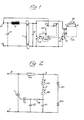
- the entire circuit essentially comprises a ballast inductor B, the fluorescent lamp F, a parasitic capacitor C2, a timed and synchronized ignition circuit CM controlling a relay RA, a contact CA of the relay RA, for the heating of the electrodes of the lamp F, another contact CC of the relay RA, for switching on a gradual control device CG.
- a capacitor C1 can be added between the terminals A1 and A2, for the compensation of the power factor and the filtering of the parasites generated by the circuit.
- the assembly supplied by terminals A1 and A2, is subjected to an alternating voltage of 220V, when a switch not shown is closed.
- the lamp F cannot function because its electrodes el and e2 are still cold and because the rarefied gas which it contains is not ionized.
- the circuit CM receives the supply voltage, since its terminal A is directly connected to the input terminal Al and its terminal B is connected to the input terminal A2, by means of the electrode e2 of the tube F.
- this circuit controls the relay RA so that it closes the contact CA and opens its contact CC. With the contact AC closed, the electrodes el and e2 of the lamp are traversed by a current which raises their temperature.
- the CK circuit described in the French patent application already cited, measures a determined time interval for optimal heating of the electrodes of the lamp F. At the end of this period, it acts on the relay RA so that the latter opens its AC contact, in a precise instant with respect to the supply voltage, then closes its DC contact.
- the contact CA opens the heating circuit of the electrodes of the lamp F. This results in an overvoltage generated by the ballast B, capable of initiating a first discharge in the lamp.
- the opening of the contact AC occurs at a defined instant with respect to the alternating supply voltage so as to obtain an optimal overvoltage in order to strike the lamp F.
- the latter thus lights in the best conditions, which is conducive to its longevity, and there is no need to provide for a renewal of the ignition operation. If it has not taken place, it can be concluded that the lamp is defective.
- the DC contact after a slight delay (one or more milliseconds) obtained by an appropriate mechanical construction of the relay, switches on the gradual control device CG. This delay prevents the circuit CG from receiving the voltage peak intended for the lamp F, for its ignition.
- the operation of the two contacts is also determined by an appropriate adjustment of the synchronization circuit, according to the present invention, so that the switching on of the device CG does not risk causing an untimely extinction of the lamp F.
- the device CG performs a gradual control of the light emission of the lamp F by short-circuiting the latter during part of each alternation of the alternating current. This effect is measured by means of a potentiometer MC connected between the control terminals G and H. More specifically, the short circuit provided by the device CG begins after a minimum delay measured from the start of an alternation and s' extends to the end of this. Since the CG device is switched on during an alternation, care must be taken that, taking into account the minimum delay above, it cannot function during this incomplete alternation but only on the occasion of the 'complete alternation next. This result is obtained by adjusting the circuit CM such that the contacts CA and CC operate and switch on the device CG towards the end of an alternation so that it cannot operate before the start of the next alternation and n 'has no action during the first incomplete alternation.
- a resistor R can be provided, as indicated in the figure, in parallel on the contact CC. It prevents the CG device from receiving an electric shock when the CC contact opens.
- the circuit of FIG. 2 comprises, between the terminals E and I, a bidirectional or triac controlled rectifier T, a diode with bidirectional threshold or diac D and a control member constituted by the capacitor C3 and C4, the resistor R2 and a potentiometer MC.
- a bidirectional or triac controlled rectifier T is conventional.
- the ignition angle of the triac T depends on the charging speed of the capacitor C3, which depends on the resistance of the potentiometer MC.
- the triac T short-circuits the lamp and decreases the value of the effective current flowing through it. The luminous flux is thus reduced. It will be noted that thus the triac T lets pass a current which maintains the temperature of the electrodes.
- a second potentiometer MB in series with the first, defines an adjustable minimum resistance, that is to say the minimum delay mentioned above.
- the circuit of FIG. 2 also comprises a resistor 'R3 and two Zener diodes DZ1 and DZ2 mounted head to tail.
- All of these three elements constitute a symmetrical clipping circuit.
- the voltage supplied between the terminals E and I of the device is that of the electrodes of the lamp F in FIG. 1. It is strongly distorted with respect to the supply sine wave and has voltage spikes that are all the higher. that the current in the lamp decreases, particularly in the case of a 26 mm diameter lamp.
- the clipping circuit allows it to be reduced to a symmetrical rectangular wave, which makes it possible to overcome the influence of the lamp in the control of the triac T.
- the device CG can be put into service at the end of the alternation provided that the minimum resistance determined by the potentiometer MB does not allow the circuit CA, R2, C3, D to trigger the triac T before the end of this alternation or even, which would be even more annoying, just at the time of the voltage reversal. It is easy to adjust the MB potentiometer so that this risk is zero.
Landscapes
- Physics & Mathematics (AREA)
- Electromagnetism (AREA)
- Circuit Arrangements For Discharge Lamps (AREA)
Applications Claiming Priority (2)
| Application Number | Priority Date | Filing Date | Title |
|---|---|---|---|
| FR8026645 | 1980-12-16 | ||
| FR8026645A FR2496383A1 (fr) | 1980-12-16 | 1980-12-16 | Circuit pour l'allumage et la commande graduelle d'une lampe fluorescente |
Publications (1)
| Publication Number | Publication Date |
|---|---|
| EP0054443A1 true EP0054443A1 (fr) | 1982-06-23 |
Family
ID=9249136
Family Applications (1)
| Application Number | Title | Priority Date | Filing Date |
|---|---|---|---|
| EP81401679A Withdrawn EP0054443A1 (fr) | 1980-12-16 | 1981-10-23 | Circuit pour l'allumage et la commande graduelle d'une lampe fluorescente |
Country Status (2)
| Country | Link |
|---|---|
| EP (1) | EP0054443A1 (OSRAM) |
| FR (1) | FR2496383A1 (OSRAM) |
Cited By (2)
| Publication number | Priority date | Publication date | Assignee | Title |
|---|---|---|---|---|
| EP0132008A3 (en) * | 1983-07-13 | 1985-03-06 | N.V. Philips' Gloeilampenfabrieken | Arrangement provided with a dc/ac converter for igniting and feeding a gas- and/or vapour discharge lamp |
| GB2155258A (en) * | 1984-01-27 | 1985-09-18 | Concord Controls Limited | Control circuit for a fluorescent tube |
Citations (2)
| Publication number | Priority date | Publication date | Assignee | Title |
|---|---|---|---|---|
| BE525669A (OSRAM) * | ||||
| US3760224A (en) * | 1971-08-05 | 1973-09-18 | Tokai Rika Co Ltd | Discharge lamp igniting circuit |
-
1980
- 1980-12-16 FR FR8026645A patent/FR2496383A1/fr active Granted
-
1981
- 1981-10-23 EP EP81401679A patent/EP0054443A1/fr not_active Withdrawn
Patent Citations (2)
| Publication number | Priority date | Publication date | Assignee | Title |
|---|---|---|---|---|
| BE525669A (OSRAM) * | ||||
| US3760224A (en) * | 1971-08-05 | 1973-09-18 | Tokai Rika Co Ltd | Discharge lamp igniting circuit |
Cited By (2)
| Publication number | Priority date | Publication date | Assignee | Title |
|---|---|---|---|---|
| EP0132008A3 (en) * | 1983-07-13 | 1985-03-06 | N.V. Philips' Gloeilampenfabrieken | Arrangement provided with a dc/ac converter for igniting and feeding a gas- and/or vapour discharge lamp |
| GB2155258A (en) * | 1984-01-27 | 1985-09-18 | Concord Controls Limited | Control circuit for a fluorescent tube |
Also Published As
| Publication number | Publication date |
|---|---|
| FR2496383A1 (fr) | 1982-06-18 |
| FR2496383B3 (OSRAM) | 1983-09-23 |
Similar Documents
| Publication | Publication Date | Title |
|---|---|---|
| EP0288924B1 (fr) | Dispositif d'alimentation d'une lampe à décharge | |
| EP0633710B1 (fr) | Générateur d'alimentation électrique d'une lampe à arc | |
| EP0066481A1 (fr) | Dispositif d'alimentation électronique pour lampes à décharge | |
| FR2614166A1 (fr) | Circuit a semi-conducteur pour le fonctionnement d'une lampe a decharge a courant continu | |
| FR2493092A1 (fr) | Circuit d'amorcage et de commande pour lampes a decharge | |
| FR2473831A1 (fr) | Appareil auxiliaire electronique pour amorcer une lampe a decharge dans un gaz et/ou dans une vapeur et faire fonctionner celle-ci sous tension alternative | |
| FR2493091A1 (fr) | Circuit d'amorcage et de commande pour lampes a decharge | |
| EP0152026A1 (fr) | Dispositif d'alimentation pour commander l'intensité lumineuse d'au moins une lampe à décharge et utilisation dudit dispositif | |
| FR2771590A1 (fr) | Circuit de commande de lampe fluorescente | |
| EP0054443A1 (fr) | Circuit pour l'allumage et la commande graduelle d'une lampe fluorescente | |
| FR2466169A1 (fr) | Montage d'alimentation variable pour lampes a decharge haute-pression | |
| EP0063507B1 (fr) | Starter électronique pour tube fluorescent, comportant un circuit temporisateur coopérant avec un circuit de surtension et un circuit de préchauffage | |
| US7119490B2 (en) | Starter for minimizing damage to lamp electrodes of a discharge lamp at startup | |
| CH644486A5 (en) | Electronic starter for fluorescent lamp | |
| EP0053951A1 (fr) | Circuit d'allumage pour lampe fluorescente | |
| FR2488095A1 (fr) | Starter electronique pour lampe fluorescente | |
| EP0105042A1 (fr) | Dispositif de démarrage pour lampes à décharge | |
| FR2461429A1 (fr) | Perfectionnement apporte aux convertisseurs de frequence utilises pour l'allumage et l'alimentation d'une lampe a decharge | |
| CH570096A5 (en) | Two-terminal fluorescent lamp starter - has threshold trigger cct. delivering control pulses to bidirectional-conduction electronic switch | |
| FR3039033A3 (fr) | Arrangement de circuit destine a la gradation de sources de lumiere a led | |
| FR2583856A1 (fr) | Circuit de coupure temporisee d'un bruleur a gaz | |
| FR2805957A1 (fr) | Dispositif d'alimentation de lampe d'eclairage notamment pour scanner | |
| FR2507052A1 (fr) | Dispositif d'amorcage de lampes du type lampes d'eclairage a decharge et lampes fluorescentes | |
| FR2486629A1 (fr) | Dispositif de controle de flamme a sequenceur, pour appareil a bruleurs | |
| FR2492211A1 (fr) | Appareil generateur de lumiere-eclair electrique |
Legal Events
| Date | Code | Title | Description |
|---|---|---|---|
| PUAI | Public reference made under article 153(3) epc to a published international application that has entered the european phase |
Free format text: ORIGINAL CODE: 0009012 |
|
| AK | Designated contracting states |
Designated state(s): AT BE CH DE FR GB IT LU NL SE |
|
| 17P | Request for examination filed |
Effective date: 19820922 |
|
| STAA | Information on the status of an ep patent application or granted ep patent |
Free format text: STATUS: THE APPLICATION IS DEEMED TO BE WITHDRAWN |
|
| 18D | Application deemed to be withdrawn |
Effective date: 19840503 |
|
| RIN1 | Information on inventor provided before grant (corrected) |
Inventor name: HESS, JEAN-MARC Inventor name: NORE, MICHEL Inventor name: AUDET, JACQUES DENIS JULIEN |