EP0043598B1 - Procédé de transformation de furfural ou de nitro-5 furfural en furonitrile ou en nitro-5 furonitrile - Google Patents
Procédé de transformation de furfural ou de nitro-5 furfural en furonitrile ou en nitro-5 furonitrile Download PDFInfo
- Publication number
- EP0043598B1 EP0043598B1 EP81200543A EP81200543A EP0043598B1 EP 0043598 B1 EP0043598 B1 EP 0043598B1 EP 81200543 A EP81200543 A EP 81200543A EP 81200543 A EP81200543 A EP 81200543A EP 0043598 B1 EP0043598 B1 EP 0043598B1
- Authority
- EP
- European Patent Office
- Prior art keywords
- furfural
- nitro
- furonitrile
- transformation
- temperature
- Prior art date
- Legal status (The legal status is an assumption and is not a legal conclusion. Google has not performed a legal analysis and makes no representation as to the accuracy of the status listed.)
- Expired
Links
- HYBBIBNJHNGZAN-UHFFFAOYSA-N furfural Chemical compound O=CC1=CC=CO1 HYBBIBNJHNGZAN-UHFFFAOYSA-N 0.000 title claims abstract description 58
- 238000000034 method Methods 0.000 title claims abstract description 26
- 230000009466 transformation Effects 0.000 title claims abstract description 15
- SXINBFXPADXIEY-UHFFFAOYSA-N 5-Nitrofurfural Chemical compound [O-][N+](=O)C1=CC=C(C=O)O1 SXINBFXPADXIEY-UHFFFAOYSA-N 0.000 title claims abstract description 13
- DUJNJLFQOODDNJ-UHFFFAOYSA-N 5-nitrofuran-2-carbonitrile Chemical compound [O-][N+](=O)C1=CC=C(C#N)O1 DUJNJLFQOODDNJ-UHFFFAOYSA-N 0.000 title claims abstract description 10
- 238000003786 synthesis reaction Methods 0.000 claims abstract description 16
- 230000015572 biosynthetic process Effects 0.000 claims abstract description 13
- 150000002443 hydroxylamines Chemical class 0.000 claims abstract description 13
- SECXISVLQFMRJM-UHFFFAOYSA-N N-Methylpyrrolidone Chemical compound CN1CCCC1=O SECXISVLQFMRJM-UHFFFAOYSA-N 0.000 claims abstract description 6
- 239000000126 substance Substances 0.000 claims abstract description 3
- WTDHULULXKLSOZ-UHFFFAOYSA-N Hydroxylamine hydrochloride Chemical compound Cl.ON WTDHULULXKLSOZ-UHFFFAOYSA-N 0.000 claims description 8
- 239000002904 solvent Substances 0.000 claims description 7
- 238000004821 distillation Methods 0.000 claims description 3
- 238000011065 in-situ storage Methods 0.000 claims 1
- 239000000203 mixture Substances 0.000 claims 1
- 150000003839 salts Chemical class 0.000 claims 1
- ZMXDDKWLCZADIW-UHFFFAOYSA-N N,N-Dimethylformamide Chemical compound CN(C)C=O ZMXDDKWLCZADIW-UHFFFAOYSA-N 0.000 description 11
- WEVYAHXRMPXWCK-UHFFFAOYSA-N Acetonitrile Chemical compound CC#N WEVYAHXRMPXWCK-UHFFFAOYSA-N 0.000 description 9
- 238000006243 chemical reaction Methods 0.000 description 8
- UYTMLDBQFLIQJA-XQRVVYSFSA-N (nz)-n-(furan-2-ylmethylidene)hydroxylamine Chemical compound O\N=C/C1=CC=CO1 UYTMLDBQFLIQJA-XQRVVYSFSA-N 0.000 description 4
- IAZDPXIOMUYVGZ-UHFFFAOYSA-N Dimethylsulphoxide Chemical compound CS(C)=O IAZDPXIOMUYVGZ-UHFFFAOYSA-N 0.000 description 4
- YLQBMQCUIZJEEH-UHFFFAOYSA-N Furan Chemical compound C=1C=COC=1 YLQBMQCUIZJEEH-UHFFFAOYSA-N 0.000 description 4
- 230000015556 catabolic process Effects 0.000 description 4
- 238000006731 degradation reaction Methods 0.000 description 4
- 239000012429 reaction media Substances 0.000 description 4
- FZENGILVLUJGJX-NSCUHMNNSA-N (E)-acetaldehyde oxime Chemical compound C\C=N\O FZENGILVLUJGJX-NSCUHMNNSA-N 0.000 description 3
- 150000001299 aldehydes Chemical class 0.000 description 3
- 150000003934 aromatic aldehydes Chemical class 0.000 description 3
- 238000009835 boiling Methods 0.000 description 3
- 230000035484 reaction time Effects 0.000 description 3
- IJGRMHOSHXDMSA-UHFFFAOYSA-N Atomic nitrogen Chemical compound N#N IJGRMHOSHXDMSA-UHFFFAOYSA-N 0.000 description 2
- RTZKZFJDLAIYFH-UHFFFAOYSA-N Diethyl ether Chemical compound CCOCC RTZKZFJDLAIYFH-UHFFFAOYSA-N 0.000 description 2
- HUMNYLRZRPPJDN-UHFFFAOYSA-N benzaldehyde Chemical compound O=CC1=CC=CC=C1 HUMNYLRZRPPJDN-UHFFFAOYSA-N 0.000 description 2
- 239000003153 chemical reaction reagent Substances 0.000 description 2
- 230000000052 comparative effect Effects 0.000 description 2
- 238000002474 experimental method Methods 0.000 description 2
- 238000000605 extraction Methods 0.000 description 2
- 239000012074 organic phase Substances 0.000 description 2
- 238000002360 preparation method Methods 0.000 description 2
- 239000000047 product Substances 0.000 description 2
- FVSKHRXBFJPNKK-UHFFFAOYSA-N propionitrile Chemical compound CCC#N FVSKHRXBFJPNKK-UHFFFAOYSA-N 0.000 description 2
- FUBFWTUFPGFHOJ-UHFFFAOYSA-N 2-nitrofuran Chemical compound [O-][N+](=O)C1=CC=CO1 FUBFWTUFPGFHOJ-UHFFFAOYSA-N 0.000 description 1
- WSGYTJNNHPZFKR-UHFFFAOYSA-N 3-hydroxypropanenitrile Chemical compound OCCC#N WSGYTJNNHPZFKR-UHFFFAOYSA-N 0.000 description 1
- 238000005481 NMR spectroscopy Methods 0.000 description 1
- 239000003905 agrochemical Substances 0.000 description 1
- 238000004458 analytical method Methods 0.000 description 1
- 239000006227 byproduct Substances 0.000 description 1
- 239000003245 coal Substances 0.000 description 1
- 230000008034 disappearance Effects 0.000 description 1
- 238000002955 isolation Methods 0.000 description 1
- 238000002844 melting Methods 0.000 description 1
- 230000008018 melting Effects 0.000 description 1
- 238000005065 mining Methods 0.000 description 1
- 150000002825 nitriles Chemical class 0.000 description 1
- 229910052757 nitrogen Inorganic materials 0.000 description 1
- 150000002894 organic compounds Chemical class 0.000 description 1
- 239000003960 organic solvent Substances 0.000 description 1
- QNGNSVIICDLXHT-UHFFFAOYSA-N para-ethylbenzaldehyde Natural products CCC1=CC=C(C=O)C=C1 QNGNSVIICDLXHT-UHFFFAOYSA-N 0.000 description 1
- 229920000642 polymer Polymers 0.000 description 1
- 238000000746 purification Methods 0.000 description 1
- 238000001953 recrystallisation Methods 0.000 description 1
- 229920002994 synthetic fiber Polymers 0.000 description 1
- 235000013311 vegetables Nutrition 0.000 description 1
- 239000002699 waste material Substances 0.000 description 1
Classifications
-
- C—CHEMISTRY; METALLURGY
- C07—ORGANIC CHEMISTRY
- C07D—HETEROCYCLIC COMPOUNDS
- C07D333/00—Heterocyclic compounds containing five-membered rings having one sulfur atom as the only ring hetero atom
- C07D333/02—Heterocyclic compounds containing five-membered rings having one sulfur atom as the only ring hetero atom not condensed with other rings
- C07D333/04—Heterocyclic compounds containing five-membered rings having one sulfur atom as the only ring hetero atom not condensed with other rings not substituted on the ring sulphur atom
- C07D333/26—Heterocyclic compounds containing five-membered rings having one sulfur atom as the only ring hetero atom not condensed with other rings not substituted on the ring sulphur atom with hetero atoms or with carbon atoms having three bonds to hetero atoms with at the most one bond to halogen, e.g. ester or nitrile radicals, directly attached to ring carbon atoms
- C07D333/38—Carbon atoms having three bonds to hetero atoms with at the most one bond to halogen, e.g. ester or nitrile radicals
-
- C—CHEMISTRY; METALLURGY
- C07—ORGANIC CHEMISTRY
- C07D—HETEROCYCLIC COMPOUNDS
- C07D307/00—Heterocyclic compounds containing five-membered rings having one oxygen atom as the only ring hetero atom
- C07D307/02—Heterocyclic compounds containing five-membered rings having one oxygen atom as the only ring hetero atom not condensed with other rings
- C07D307/34—Heterocyclic compounds containing five-membered rings having one oxygen atom as the only ring hetero atom not condensed with other rings having two or three double bonds between ring members or between ring members and non-ring members
- C07D307/56—Heterocyclic compounds containing five-membered rings having one oxygen atom as the only ring hetero atom not condensed with other rings having two or three double bonds between ring members or between ring members and non-ring members with hetero atoms or with carbon atoms having three bonds to hetero atoms with at the most one bond to halogen, e.g. ester or nitrile radicals, directly attached to ring carbon atoms
- C07D307/68—Carbon atoms having three bonds to hetero atoms with at the most one bond to halogen
-
- C—CHEMISTRY; METALLURGY
- C07—ORGANIC CHEMISTRY
- C07D—HETEROCYCLIC COMPOUNDS
- C07D307/00—Heterocyclic compounds containing five-membered rings having one oxygen atom as the only ring hetero atom
- C07D307/02—Heterocyclic compounds containing five-membered rings having one oxygen atom as the only ring hetero atom not condensed with other rings
- C07D307/34—Heterocyclic compounds containing five-membered rings having one oxygen atom as the only ring hetero atom not condensed with other rings having two or three double bonds between ring members or between ring members and non-ring members
- C07D307/56—Heterocyclic compounds containing five-membered rings having one oxygen atom as the only ring hetero atom not condensed with other rings having two or three double bonds between ring members or between ring members and non-ring members with hetero atoms or with carbon atoms having three bonds to hetero atoms with at the most one bond to halogen, e.g. ester or nitrile radicals, directly attached to ring carbon atoms
- C07D307/70—Nitro radicals
- C07D307/71—Nitro radicals attached in position 5
Definitions
- the invention relates to a process for converting furfural or 5-nitro furfural into furonitrile or 5-nitro furonitrile.
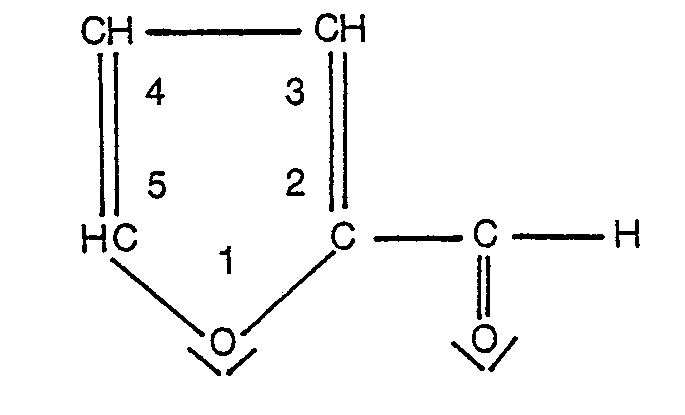
- Furan carboxaldehyde-2 commonly called “furfural” has the following chemical formula:
- furonitrile and its 5-nitro derivative are basic products used in multiple syntheses, in particular in the pharmaceutical industries, the chemistry of polymers and synthetic materials and the agrochemical sectors.
- furfural and its 5-nitro derivative are organic compounds derived from agro-resources and which often come from their waste or by-products. It is conceivable under these conditions the considerable economic interest of the chemistry of these bodies and in particular of the processes making it possible to transform these aldehydes of vegetable origin which thus come to replace the petrochemical derivatives, to allow the synthesis of the corresponding furonitriles from which many organic syntheses can be performed.
- the present invention relates to a method of this type.
- this type of process has the serious drawback of requiring long reaction times (of the order of 3 to 4 hours) so that their cost is Student.
- this type of process is necessarily carried out under an inert atmosphere (in particular nitrogen) and, for certain solvents such as acetonitrile and propionitrile, under pressure.
- the present invention proposes to indicate a transformation process which makes it possible to transform in a single step furfural or its 5-nitro derivative, into furonitrile or derivative under remarkable economic conditions, in terms of the yields obtained and the reaction times.
- An objective of the invention is in particular to completely and directly transform furfural into furonitrile without obtaining the very stable intermediate body usually obtained in the chemistry of furfural, namely furfuraloxime.
- Another objective is to indicate a process in which the synthesis reaction between the furfural and the hydroxylamine salt is quantitative or substantially quantitative, so that these bodies are consumed entirely without residues, the yield being close to 100%.
- Another objective is to indicate a process which does not cause any degradation of the reaction medium and in particular no coaling, with a "reactive solvent” capable of being entirely recycled without appreciable loss.
- Another objective is to allow a synthesis of furfural or of its 5-nitro derivative in very short periods of time, less than 1 hour (and even of the order of a few minutes by bringing the temperature to appropriate values).
- Another objective is to indicate a process whose implementation can be carried out at the ambient atmospheric pressure.
- the transformation process according to the invention of the type in which furfural or 5-nitro furfural is brought into contact with a hydroxylamine salt is characterized in that the synthesis of furonitrile or 5-nitro furonitrile is carried out in a single step by bringing together furfural or 5-nitro furfural and the hydroxylamine salt in N-methyl-pyrrolidone (NMP), the bodies present being brought to a temperature between 120 ° C and 165 ° C.
- NMP N-methyl-pyrrolidone
- this solvent provides, in the case of the transformation of furfural or its 5-nitro derivative, exceptional performances in terms of yield and speed of synthesis, and this, at ambient atmospheric pressure. In addition, no degradation is observed in the reaction medium, and the N.M.P. used is found in full at the end of the reaction.
- the hydroxylamine salt which advantageously consists of hydroxylamine hydrochloride, and furfural or its 5-nitro derivative are brought into contact in the N.M.P., in relative stoichiometric amounts.
- the organic phase is constituted at the end of the reaction by furonitrile alone (or 5-nitro derivative) in solution in N.M.P.
- the furonitrile can be separated in particular by distillation under partial vacuum and the N.M.P. is fully recycled.
- the reaction time is an inverse function of the temperature and, in the range of 120 ° to 165 ° C, this time is between 60 min and 5 min.
- Examples 1, 2 described below are intended to illustrate the process of the invention, while the unexpected performances of this process are illustrated, by comparison, in Examples 3 and 4, which describe experiments carried out by the inventors on furfural with solvents of the type recommended for aromatic aldehydes with 6 atoms in the Japanese patent already cited.
- the furonitrile is extracted by distillation under partial vacuum (boiling temperature: 38 ° C under 14 mm / Hg, or 1841 pascals).
- a solution is prepared containing 0.01 mole of 5-nitro furfural and 0.013 mole of hydroxylamine hydrochloride in 25 cm3 of N-methyl pyrrolidone.
- the 5-nitro furonitrile is extracted with ether and crystallized (melting point: 65 ° C).
- Example 1 The synthesis of Example 1 is reiterated under analogous experimental conditions, but using dimethylformamide (D.M.F.) as solvent instead of N.M.P. recommended by the present invention.
- D.M.F. dimethylformamide
- the boiling point of the D.M.F. is 156 ° at normal pressure so that the temperature of 160 ° C cannot be reached.
- Example 1 The synthesis of Example 1 is repeated, using acetonitrile as solvent at its boiling point (82 ° C.) at ambient atmospheric pressure.
Landscapes
- Chemical & Material Sciences (AREA)
- Organic Chemistry (AREA)
- Organic Low-Molecular-Weight Compounds And Preparation Thereof (AREA)
- Low-Molecular Organic Synthesis Reactions Using Catalysts (AREA)
- Plural Heterocyclic Compounds (AREA)
Description
- L'invention concerne un procédé de transformation de furfural ou de nitro-5 furfural en furonitrile ou en nitro-5 furonitrile.
- Le furanne carboxaldéhyde-2, couramment appelé "furfural", possède la formule chimique suivante:
- On sait que le furonitrile et son dérivé 5-nitro sont des produits de base utilisés dans de multiples synthèses, notamment dans les industries pharmaceutiques, la chimie des polymères et matières synthétiques et les secteurs agrochimiques. Or, le furfural et son dérivé 5-nitro sont des composés organiques issus des agro- ressources et qui proviennent souvent de leurs déchets ou sous-produits. On conçoit dans ces conditions l'intérêt économique considérable de la chimie de ces corps et notamment des procédés permettant de transformer ces aldéhydes d'origine végétale qui viennent ainsi se substituer aux dérivés pétrochimiques, pour permettre la synthèse des furonitriles correspondants à partir desquels de nombreuses synthèses organiques peuvent être effectuées.
- Parmi les différentes voies de synthèses possibles des furonitriles, il existe un type de procédés faisant intervenir un sel d'hydroxylamine; la présente invention concerne un procédé de ce type.
- La plupart des procédés de ce type actuellement mis en oeuvre exige, pour la synthèse du furonitrile ou de ses dérivés, deux étapes, la première consistant à obtenir et à isoler l'aldoxime (notamment par recristailisation), et la seconde réalisant la transformation de l'aldoxime ainsi séparée en furonitrile correspondant, qui peut être effectuée par plusieurs types de traitement où interviennent un ou des réactifs supplémentaires. Ce processus de synthèse est de mise en oeuvre lourde, délicate et relativement onéreuse, en raison de la double étape nécessaire, des opérations d'isolement et de purification de l'aldoxime et de l'addition de réactifs supplémentaires dans la deuxième étape, qui sont généralement non recyclables; en outre, les rendements de chaque étape ne sont pas quantitatifs, ce qui limite notablement le rendement global de la transformation.
- De plus, dans ces procédés, le furonitrile formé aux termes des deux étapes sus-évoquées est le plupart du temps présent dans un milieu réactionnel complexe et son extraction de ce milieu en est parfois rendue délicate.
- Par ailleurs, on a proposé dans un domaine voisin concernant les aldéhydes aromatiques à 6 atomes diversement substitués (tel que le benzaldéhyde et quelques uns de ses principaux dérivés) un procédé de transformation en une seule étape de l'aldéhyde en nitrile correspondant. On pourra se reporter à cet égard au brevet japonais n° 56450/1972 déposé le 8 juin 1972 et publié sous le n° 14442/1974. Ce type de procédé consiste à faire réagir l'aldéhyde et le sel d'hydroxylamine à une température de 120°C en présence d'un solvant organique spécifique, choisi parmi les corps suivants: acétonitrile, diméthylsulfoxide (D.M.S.O.), diméthylformamide (D.M.F), éthylènecyanohydrine et propionitrile.
- Toutefois, ce type de procédés n'est pas transposable en pratique à la transformation du furfural (comme le démontreront les exemples indiqués plus loin) et est donc inapte à permettre à l'homme de l'art de résoudre le problème de la synthèse du fùronitrile ou de son dérivé 5-nitro dans des conditions économiques satisfaisantes.
- Il convient par ailleurs de remarquer que, même appliqué aux aldéhydes aromatiques à 6 atomes, ce type de procédé présente le grave inconvénient d'exiger des durées de réaction importante (de l'ordre de 3 à 4 heures) de sorte que leur coût est élevé. De plus, ce type de procédé est obligatoirement mis en oeuvre sous atmosphère inerte (en particulier azote) et, pour certains solvants tels que l'acétonitrile et le propionitrile, sous pression.
- La présente invention se propose d'indiquer un procédé de transformation qui permettre de transformer en une seule étape le furfural ou son dérivé 5-nitro, en furonitrile ou dérivé dans de remarquables conditions économiques, sur le plan des rendements obtenus et des durées réactionnelles.
- Un objectif de l'invention est en particulier de transformer totalement et directement le furfural en furonitrile sans obtenir le corps intermédiaire très stable habituellement obtenu dans la chimie du furfural, à savoir la furfuraloxime.
- Un autre objectif est d'indiquer un procédé dans lequel la réaction de synthèse entre le furfural et le sel d'hydroxylamine est quantitative ou sensiblement quantitative, de sorte que ces corps sont consommés intégralement sans résidus, le rendement étant proche de 100%.
- Un autre objectif est d'indiquer un procédé ne suscitant aucune dégradation du milieu réactionnel et notamment aucun charbonnage, avec un "solvant réactif" susceptible d'être entièrement recyclé sans perte sensible.
- Un autre objectif est de permettre une synthèse du furfural ou de son dérivé 5-nitro dans des laps de temps très courts, inférieurs à 1 heure (et même de l'ordre de quelques minutes en portant la température à des valeurs appropriées).
- Un autre objectif est d'indiquer un procédé dont la mise en oeuvre puisse être effectuée à la presion atmosphérique ambiante.
- A cet effect, le procédé de transformation conforme à l'invention du type dans lequel le furfural ou le nitro-5 furfural est mis en présence avec un sel d'hydroxylamine, est caractérisé en ce que la synthèse du furonitrile ou du nitro-5 furonitrile est réalisée en une seule étape en mettant en présence le furfural ou le nitro-5 furfural et le sel d'hydroxylamine dans de la N-méthyl-pyrrolidone (N.M.P.), les corps en présence étant portés à une température comprise entre 120°C et 165°C.
- Les expérimentations ont montré de façon inattendue que ce solvant fournissait dans le cas de la transformation du furfural ou de son dérivé 5-nitro, des performances exceptionnelles sur le plan du rendement et de la rapidité de synthèse, et ce, à pression atmosphérique ambiante. De plus, on n'observe aucune dégradation dans le milieu réactionnel, et la N.M.P. utilisée se retrouve intégralement en fin de réaction.
- Selon un mode de mise en oeuvre préféré, le sel d'hydroxylamine, qui est avantageusement constitué par du chlorhydrate d'hydroxylamine, et le furfural ou son dérivé 5-nitro sont mis en présence dans la N.M.P., en quantités relatives stoechiométriques.
- Dans ces conditions, compte-tenu du caractère quantitatif de la réaction et de la non dégradation du milieu, la phase organique est constituée en fin de réaction par du furonitrile seul (ou dérivé 5-nitro) en solution dans la seule N.M.P. On peut séparer le furonitrile notamment par distillation sous vide partiel et recycler intégralement la N.M.P.
- La durée de réaction est fonction inverse de la température et, dans la plage de 120° à 165°C, cette durée est comprise entre 60 mn et 5 mn.
- Les exemples 1, 2 décrits ci-après sont destinés à illustrer le procédé de l'invention, cependant que les performances inattendues de ce procédé sont illustrées, par comparaison, par les exemples 3 et 4, qui décrivent des expérimentations menées par les inventeurs sur le furfural avec des solvants du type de ceux préconisés pour les aldéhydes aromatiques à 6 atomes dans le brevet japonais déjà cité.
- Ainsi, sera mis en évidence le rôle surprenant que joue la N.M.P. dans la réaction du furfural avec le sel d'hydroxylamine.
- Synthèse du cyano-2 furanne (furonitrile à partir du furanne carboxaldéhyde-2 (furfural).
- Dans un réacteur, on place 0,01 mole de furfural et 0,013 mole de chlorhydrate d'hydroxylamine en solution dans 25 cm3 de N-méthyl pyrrolidone (conditions standards).
- Le milieu est alors agité à la pression atmosphérique ambiante:
- . soit pendant 10 mn à la température de 160°C,
- . soit pendant 30 mn à la température de 140°C,
- . soit pendant 60 mn à la température de 120°C.
- Ces conditions permettent une transformation totale du furfural en furonitrile (analyse en C.P.V. sur colonne OV-17, et identification en spectrométrie de résonance magnétique nucléaire).
- On peut constater en fin de réaction, après extraction classique de la phase organique, une disparition totale du furfural et une absence complète de la furfuraloxime, (qui est le corps stable intermédiaire habituellement obtenu).
- Le furonitrile est extrait par distillation sous vide partiel (température d'ébullition: 38°C sous 14 mm/Hg, soit 1841 pascals).
- Synthèse du nitro-5 furonitrile à partir du nitro-5 furanne carboxaldéhyde-2.
- On prépare une solution contenant 0,01 mole de nitro-5 furfural et 0,013 mole de chlorhydrate d'hydroxylamine dans 25 cm3 de N-méthyl pyrrolidone.
- On porte à 140°C et on agite pendant 30 mn à la pression atmosphérique ambiante. Les résultats sont comparables sur le plan du rendement à ceux de l'exemple 1.
- Le nitro-5 furonitrile est extrait à l'éther et cristallisé (point de fusion: 65°C).
- On réitère la synthèse de l'exemple 1 dans des conditions expérimentales analogues, mais en utilisant comme solvant la diméthylformamide (D.M.F.) au lieu de la N.M.P. préconisée par la présente invention.
- Les résultats sont résumés dans le tableau ci-après:

- Il est à noter que la température d'ébullition de la D.M.F. est de 156° à pression normale de sorte que la température de 160°C ne peut être atteinte.
- On constate en premier lieu un faible pourcentage de furonitrile obtenu quelles que soient les conditions: on obtient surtour la furfuraloxime, produit majoritaire en fin de réaction. De plus, on observe une dégradation du milieu réactionnel qui augmente avec la température; les charbonnages sont importants à 156°C.
- Une telle réaction est tout à fait inapte en pratique à permettre une préparation du furonitrile dans des conditions économiques satisfaisantes.
- On réitère la synthèse de l'exemple 1 en utilisant comme solvant l'acétonitrile à sa température d'ébullition (82°C) à la pression atmosphérique ambiante.
- Au bout de 60 minutes, on constate que 90% de furfural n'ont pas été transformés et que les 10% ayant réagi se retrouvent pour la majeure partie sous forme de furfuraloxime. On obtient au bout de ce laps de temps un pourcentage de furonitrile qui n'est pas quantitativement significatif (inférieur à 4%).
- Une telle réaction est tout à fait inapte à permettre une préparation industrielle du furonitrile.
Claims (5)
Priority Applications (1)
| Application Number | Priority Date | Filing Date | Title |
|---|---|---|---|
| AT81200543T ATE8398T1 (de) | 1980-07-09 | 1981-05-21 | Verfahren zum umsetzen von furfural oder 5-nitro- furfural in furonitril oder in 5-nitro- furonitril. |
Applications Claiming Priority (2)
| Application Number | Priority Date | Filing Date | Title |
|---|---|---|---|
| FR8015335A FR2486520A1 (fr) | 1980-07-09 | 1980-07-09 | Procede de transformation d'un aldehyde en nitrile, notamment du furfural en furonitrile |
| FR8015335 | 1980-07-09 |
Publications (2)
| Publication Number | Publication Date |
|---|---|
| EP0043598A1 EP0043598A1 (fr) | 1982-01-13 |
| EP0043598B1 true EP0043598B1 (fr) | 1984-07-11 |
Family
ID=9244059
Family Applications (1)
| Application Number | Title | Priority Date | Filing Date |
|---|---|---|---|
| EP81200543A Expired EP0043598B1 (fr) | 1980-07-09 | 1981-05-21 | Procédé de transformation de furfural ou de nitro-5 furfural en furonitrile ou en nitro-5 furonitrile |
Country Status (4)
| Country | Link |
|---|---|
| EP (1) | EP0043598B1 (fr) |
| AT (1) | ATE8398T1 (fr) |
| DE (1) | DE3164703D1 (fr) |
| FR (1) | FR2486520A1 (fr) |
Families Citing this family (1)
| Publication number | Priority date | Publication date | Assignee | Title |
|---|---|---|---|---|
| CN109593073A (zh) * | 2019-01-22 | 2019-04-09 | 河北工业大学 | 一种2,5-呋喃二甲醛催化合成2,5-二氰基呋喃的方法 |
Family Cites Families (1)
| Publication number | Priority date | Publication date | Assignee | Title |
|---|---|---|---|---|
| JPS4914442A (fr) * | 1972-06-08 | 1974-02-07 |
-
1980
- 1980-07-09 FR FR8015335A patent/FR2486520A1/fr active Granted
-
1981
- 1981-05-21 AT AT81200543T patent/ATE8398T1/de not_active IP Right Cessation
- 1981-05-21 DE DE8181200543T patent/DE3164703D1/de not_active Expired
- 1981-05-21 EP EP81200543A patent/EP0043598B1/fr not_active Expired
Also Published As
| Publication number | Publication date |
|---|---|
| EP0043598A1 (fr) | 1982-01-13 |
| ATE8398T1 (de) | 1984-07-15 |
| FR2486520A1 (fr) | 1982-01-15 |
| DE3164703D1 (en) | 1984-08-16 |
| FR2486520B1 (fr) | 1983-02-25 |
Similar Documents
| Publication | Publication Date | Title |
|---|---|---|
| CA2032988C (fr) | Procede de preparation de derives de la 1-phenyl imidazoline 2,5-dione | |
| FR2590892A1 (fr) | Procede pour l'hydroformylation d'olefines pour la preparation d'aldehydes | |
| CH636848A5 (fr) | Procede de production de n,n-di(ethyl)-meta-toluamide. | |
| FR2583746A1 (fr) | Procede de dedoublement optique d'un derive de l'acide phenylacetique | |
| EP0377381A1 (fr) | Procédé de préparation du phényl-1 diéthylaminocarbonyl-1 phtalimidométhyl-2 cyclopropane Z | |
| FR2669636A1 (fr) | Procede de fabrication de furane 2,5-dicarboxaldehyde. | |
| EP0030528B1 (fr) | Procédé pour la fixation de groupes alkyles, aralkyles ou cycloalkyles sur une chaîne carbonée portant un groupe fonctionnel | |
| EP1620390B1 (fr) | Procede de synthese de la 4-hydroxyisoleucine et de ses derives | |
| EP0043598A1 (fr) | Procédé de transformation de furfural ou de nitro-5 furfural en furonitrile ou en nitro-5 furonitrile | |
| EP0053981B1 (fr) | Procédé de fabrication de thiochloroformiates | |
| EP0266815B1 (fr) | Procédé pour la fabrication de l'acide bêta-hydroxybutyrique et de ses sels par hydrolyse d'oligomères de l'acide bêta-hydroxybutyrique en milieu basique | |
| EP0679629B1 (fr) | Procédé de préparation d'un acide alpha-(hydroxyphenoxy)-alcanecarboxylique optiquement actif et de ses dérivés | |
| FR2788271A1 (fr) | Nouveau procede de preparation d'aminoacides chiraux | |
| JPH07242633A (ja) | 5−アミノエチルアミノメチル−2−クロロピリジンの製造方法 | |
| EP0876374B1 (fr) | Procede de preparation de la 4'-demethylepipodophyllotoxine a partir de la podophyllotoxine | |
| EP0822184B1 (fr) | Procédé de préparation de lactames N-substitués | |
| EP0184572B1 (fr) | Procédé de préparation d'acides alpha-hydroxy-alcanoiques | |
| EP0058591B1 (fr) | Procédé d'épimérisation d'acides trans chrysanthémiques et nouveaux intermédiaires obtenus | |
| FR2525590A1 (fr) | Preparation en phase liquide d'esters d'acides delta-cetocarboxyliques utilisant un catalyseur insoluble dans la phase liquide | |
| BE1014908A3 (fr) | Propenoates substitues et procedes pour les preparer. | |
| EP0000302B1 (fr) | Nouveau procédé de préparation de la quinidine. | |
| EP0124407B1 (fr) | Procédé de préparation d'acides alkanoiques | |
| FR2634765A1 (fr) | Procede pour la preparation de levo- et de dextro-dropropizine | |
| EP1615902B1 (fr) | Procede de preparation du 4,10 beta-diacetoxy-2 alpha- benzoyloxy-5 beta 20-epoxy-1,13 alpha-dihydroxy-9-oxo-19- norcyclopropa[g]tax-11-ene | |
| BE1003794A3 (fr) | Procede pour la production d'isocyanates. |
Legal Events
| Date | Code | Title | Description |
|---|---|---|---|
| PUAI | Public reference made under article 153(3) epc to a published international application that has entered the european phase |
Free format text: ORIGINAL CODE: 0009012 |
|
| AK | Designated contracting states |
Designated state(s): AT BE CH DE GB IT LU NL SE |
|
| 17P | Request for examination filed |
Effective date: 19820301 |
|
| ITF | It: translation for a ep patent filed | ||
| GRAA | (expected) grant |
Free format text: ORIGINAL CODE: 0009210 |
|
| AK | Designated contracting states |
Designated state(s): AT BE CH DE GB IT LI LU NL SE |
|
| REF | Corresponds to: |
Ref document number: 8398 Country of ref document: AT Date of ref document: 19840715 Kind code of ref document: T |
|
| REF | Corresponds to: |
Ref document number: 3164703 Country of ref document: DE Date of ref document: 19840816 |
|
| PLBE | No opposition filed within time limit |
Free format text: ORIGINAL CODE: 0009261 |
|
| STAA | Information on the status of an ep patent application or granted ep patent |
Free format text: STATUS: NO OPPOSITION FILED WITHIN TIME LIMIT |
|
| PG25 | Lapsed in a contracting state [announced via postgrant information from national office to epo] |
Ref country code: LU Free format text: LAPSE BECAUSE OF NON-PAYMENT OF DUE FEES Effective date: 19850531 |
|
| 26N | No opposition filed | ||
| PGFP | Annual fee paid to national office [announced via postgrant information from national office to epo] |
Ref country code: AT Payment date: 19860530 Year of fee payment: 6 |
|
| PGFP | Annual fee paid to national office [announced via postgrant information from national office to epo] |
Ref country code: NL Payment date: 19860531 Year of fee payment: 6 |
|
| PG25 | Lapsed in a contracting state [announced via postgrant information from national office to epo] |
Ref country code: AT Effective date: 19870521 |
|
| PG25 | Lapsed in a contracting state [announced via postgrant information from national office to epo] |
Ref country code: SE Effective date: 19870522 |
|
| PG25 | Lapsed in a contracting state [announced via postgrant information from national office to epo] |
Ref country code: LI Effective date: 19870531 Ref country code: CH Effective date: 19870531 |
|
| BERE | Be: lapsed |
Owner name: AGRIFURANE S.A. Effective date: 19870531 |
|
| PG25 | Lapsed in a contracting state [announced via postgrant information from national office to epo] |
Ref country code: NL Effective date: 19871201 |
|
| NLV4 | Nl: lapsed or anulled due to non-payment of the annual fee | ||
| REG | Reference to a national code |
Ref country code: CH Ref legal event code: PL |
|
| PG25 | Lapsed in a contracting state [announced via postgrant information from national office to epo] |
Ref country code: DE Effective date: 19880202 |
|
| GBPC | Gb: european patent ceased through non-payment of renewal fee | ||
| PG25 | Lapsed in a contracting state [announced via postgrant information from national office to epo] |
Ref country code: GB Free format text: LAPSE BECAUSE OF NON-PAYMENT OF DUE FEES Effective date: 19881118 |
|
| PG25 | Lapsed in a contracting state [announced via postgrant information from national office to epo] |
Ref country code: BE Effective date: 19890531 |
|
| EUG | Se: european patent has lapsed |
Ref document number: 81200543.7 Effective date: 19880601 |