EP0040894B1 - Perfume compositions and perfumed articles containing esters of substituted bicyclo (2.2.1)heptane- and heptene-carboxylic acids as perfume base - Google Patents
Perfume compositions and perfumed articles containing esters of substituted bicyclo (2.2.1)heptane- and heptene-carboxylic acids as perfume base Download PDFInfo
- Publication number
- EP0040894B1 EP0040894B1 EP81200585A EP81200585A EP0040894B1 EP 0040894 B1 EP0040894 B1 EP 0040894B1 EP 81200585 A EP81200585 A EP 81200585A EP 81200585 A EP81200585 A EP 81200585A EP 0040894 B1 EP0040894 B1 EP 0040894B1
- Authority
- EP
- European Patent Office
- Prior art keywords
- esters
- heptane
- methyl
- perfume
- carboxylic acids
- Prior art date
- Legal status (The legal status is an assumption and is not a legal conclusion. Google has not performed a legal analysis and makes no representation as to the accuracy of the status listed.)
- Expired
Links
- 239000000203 mixture Substances 0.000 title claims description 53
- 150000002148 esters Chemical class 0.000 title claims description 24
- 239000002304 perfume Substances 0.000 title claims description 23
- CWMPPVPFLSZGCY-UHFFFAOYSA-N oct-2-enoic acid Chemical class CCCCCC=CC(O)=O CWMPPVPFLSZGCY-UHFFFAOYSA-N 0.000 title claims 3
- 125000002496 methyl group Chemical group [H]C([H])([H])* 0.000 claims description 14
- 125000004432 carbon atom Chemical group C* 0.000 claims description 5
- 125000003342 alkenyl group Chemical group 0.000 claims description 4
- 125000004435 hydrogen atom Chemical group [H]* 0.000 claims description 4
- 125000000217 alkyl group Chemical group 0.000 claims description 2
- 239000000463 material Substances 0.000 claims 5
- 125000005466 alkylenyl group Chemical group 0.000 claims 3
- 125000003903 2-propenyl group Chemical group [H]C([*])([H])C([H])=C([H])[H] 0.000 claims 1
- 239000003205 fragrance Substances 0.000 description 22
- 239000002253 acid Substances 0.000 description 19
- YXFVVABEGXRONW-UHFFFAOYSA-N Toluene Chemical compound CC1=CC=CC=C1 YXFVVABEGXRONW-UHFFFAOYSA-N 0.000 description 15
- 150000001875 compounds Chemical class 0.000 description 13
- XLYOFNOQVPJJNP-UHFFFAOYSA-N water Substances O XLYOFNOQVPJJNP-UHFFFAOYSA-N 0.000 description 13
- OKKJLVBELUTLKV-UHFFFAOYSA-N Methanol Chemical compound OC OKKJLVBELUTLKV-UHFFFAOYSA-N 0.000 description 12
- 238000002360 preparation method Methods 0.000 description 12
- 150000007513 acids Chemical class 0.000 description 10
- LFQSCWFLJHTTHZ-UHFFFAOYSA-N Ethanol Chemical compound CCO LFQSCWFLJHTTHZ-UHFFFAOYSA-N 0.000 description 9
- 150000004702 methyl esters Chemical class 0.000 description 9
- 238000009835 boiling Methods 0.000 description 7
- KFZMGEQAYNKOFK-UHFFFAOYSA-N Isopropanol Chemical compound CC(C)O KFZMGEQAYNKOFK-UHFFFAOYSA-N 0.000 description 6
- HEMHJVSKTPXQMS-UHFFFAOYSA-M Sodium hydroxide Chemical compound [OH-].[Na+] HEMHJVSKTPXQMS-UHFFFAOYSA-M 0.000 description 6
- XDTMQSROBMDMFD-UHFFFAOYSA-N Cyclohexane Chemical compound C1CCCCC1 XDTMQSROBMDMFD-UHFFFAOYSA-N 0.000 description 5
- -1 essential oils Natural products 0.000 description 5
- 125000004494 ethyl ester group Chemical group 0.000 description 5
- 239000001117 sulphuric acid Substances 0.000 description 5
- 241000402754 Erythranthe moschata Species 0.000 description 4
- MHAJPDPJQMAIIY-UHFFFAOYSA-N Hydrogen peroxide Chemical compound OO MHAJPDPJQMAIIY-UHFFFAOYSA-N 0.000 description 4
- QAOWNCQODCNURD-UHFFFAOYSA-N Sulfuric acid Chemical compound OS(O)(=O)=O QAOWNCQODCNURD-UHFFFAOYSA-N 0.000 description 4
- CRPUJAZIXJMDBK-UHFFFAOYSA-N camphene Chemical compound C1CC2C(=C)C(C)(C)C1C2 CRPUJAZIXJMDBK-UHFFFAOYSA-N 0.000 description 4
- ZSWFCLXCOIISFI-UHFFFAOYSA-N cyclopentadiene Chemical compound C1C=CC=C1 ZSWFCLXCOIISFI-UHFFFAOYSA-N 0.000 description 4
- 230000000694 effects Effects 0.000 description 4
- 238000000034 method Methods 0.000 description 4
- 239000000126 substance Substances 0.000 description 4
- 235000011149 sulphuric acid Nutrition 0.000 description 4
- ANWYHSPZGOCQQF-UHFFFAOYSA-N CC1(C(CCCCC1)(C1CCCCCC1)C(=O)O)C Chemical class CC1(C(CCCCC1)(C1CCCCCC1)C(=O)O)C ANWYHSPZGOCQQF-UHFFFAOYSA-N 0.000 description 3
- IMNFDUFMRHMDMM-UHFFFAOYSA-N N-Heptane Chemical group CCCCCCC IMNFDUFMRHMDMM-UHFFFAOYSA-N 0.000 description 3
- 235000006484 Paeonia officinalis Nutrition 0.000 description 3
- 244000170916 Paeonia officinalis Species 0.000 description 3
- DNIAPMSPPWPWGF-UHFFFAOYSA-N Propylene glycol Chemical compound CC(O)CO DNIAPMSPPWPWGF-UHFFFAOYSA-N 0.000 description 3
- 238000013019 agitation Methods 0.000 description 3
- 239000003795 chemical substances by application Substances 0.000 description 3
- MTHSVFCYNBDYFN-UHFFFAOYSA-N diethylene glycol Chemical compound OCCOCCO MTHSVFCYNBDYFN-UHFFFAOYSA-N 0.000 description 3
- 229930002839 ionone Natural products 0.000 description 3
- 239000002904 solvent Substances 0.000 description 3
- 239000007921 spray Substances 0.000 description 3
- CXWXQJXEFPUFDZ-UHFFFAOYSA-N tetralin Chemical compound C1=CC=C2CCCCC2=C1 CXWXQJXEFPUFDZ-UHFFFAOYSA-N 0.000 description 3
- RMSGQZDGSZOJMU-UHFFFAOYSA-N 1-butyl-2-phenylbenzene Chemical group CCCCC1=CC=CC=C1C1=CC=CC=C1 RMSGQZDGSZOJMU-UHFFFAOYSA-N 0.000 description 2
- NGNBDVOYPDDBFK-UHFFFAOYSA-N 2-[2,4-di(pentan-2-yl)phenoxy]acetyl chloride Chemical compound CCCC(C)C1=CC=C(OCC(Cl)=O)C(C(C)CCC)=C1 NGNBDVOYPDDBFK-UHFFFAOYSA-N 0.000 description 2
- 0 CC1(*)C(CC2)CC2C1* Chemical compound CC1(*)C(CC2)CC2C1* 0.000 description 2
- 241000218645 Cedrus Species 0.000 description 2
- 235000014493 Crataegus Nutrition 0.000 description 2
- 241001092040 Crataegus Species 0.000 description 2
- GLZPCOQZEFWAFX-UHFFFAOYSA-N Geraniol Chemical compound CC(C)=CCCC(C)=CCO GLZPCOQZEFWAFX-UHFFFAOYSA-N 0.000 description 2
- VEXZGXHMUGYJMC-UHFFFAOYSA-N Hydrochloric acid Chemical compound Cl VEXZGXHMUGYJMC-UHFFFAOYSA-N 0.000 description 2
- 235000008331 Pinus X rigitaeda Nutrition 0.000 description 2
- 235000011613 Pinus brutia Nutrition 0.000 description 2
- 241000018646 Pinus brutia Species 0.000 description 2
- PXRCIOIWVGAZEP-UHFFFAOYSA-N Primaeres Camphenhydrat Natural products C1CC2C(O)(C)C(C)(C)C1C2 PXRCIOIWVGAZEP-UHFFFAOYSA-N 0.000 description 2
- XCPQUQHBVVXMRQ-UHFFFAOYSA-N alpha-Fenchene Natural products C1CC2C(=C)CC1C2(C)C XCPQUQHBVVXMRQ-UHFFFAOYSA-N 0.000 description 2
- IGODOXYLBBXFDW-UHFFFAOYSA-N alpha-Terpinyl acetate Chemical compound CC(=O)OC(C)(C)C1CCC(C)=CC1 IGODOXYLBBXFDW-UHFFFAOYSA-N 0.000 description 2
- QUKGYYKBILRGFE-UHFFFAOYSA-N benzyl acetate Chemical compound CC(=O)OCC1=CC=CC=C1 QUKGYYKBILRGFE-UHFFFAOYSA-N 0.000 description 2
- SESFRYSPDFLNCH-UHFFFAOYSA-N benzyl benzoate Chemical compound C=1C=CC=CC=1C(=O)OCC1=CC=CC=C1 SESFRYSPDFLNCH-UHFFFAOYSA-N 0.000 description 2
- 229930006739 camphene Natural products 0.000 description 2
- ZYPYEBYNXWUCEA-UHFFFAOYSA-N camphenilone Natural products C1CC2C(=O)C(C)(C)C1C2 ZYPYEBYNXWUCEA-UHFFFAOYSA-N 0.000 description 2
- 239000003054 catalyst Substances 0.000 description 2
- HQKQRXZEXPXXIG-VJOHVRBBSA-N chembl2333940 Chemical compound C1[C@]23[C@H](C)CC[C@H]3C(C)(C)[C@H]1[C@@](OC(C)=O)(C)CC2 HQKQRXZEXPXXIG-VJOHVRBBSA-N 0.000 description 2
- QMVPMAAFGQKVCJ-UHFFFAOYSA-N citronellol Chemical compound OCCC(C)CCC=C(C)C QMVPMAAFGQKVCJ-UHFFFAOYSA-N 0.000 description 2
- JOZKFWLRHCDGJA-UHFFFAOYSA-N citronellol acetate Chemical compound CC(=O)OCCC(C)CCC=C(C)C JOZKFWLRHCDGJA-UHFFFAOYSA-N 0.000 description 2
- 239000012459 cleaning agent Substances 0.000 description 2
- KSMVZQYAVGTKIV-UHFFFAOYSA-N decanal Chemical compound CCCCCCCCCC=O KSMVZQYAVGTKIV-UHFFFAOYSA-N 0.000 description 2
- 239000003599 detergent Substances 0.000 description 2
- FLKPEMZONWLCSK-UHFFFAOYSA-N diethyl phthalate Chemical compound CCOC(=O)C1=CC=CC=C1C(=O)OCC FLKPEMZONWLCSK-UHFFFAOYSA-N 0.000 description 2
- HFJRKMMYBMWEAD-UHFFFAOYSA-N dodecanal Chemical compound CCCCCCCCCCCC=O HFJRKMMYBMWEAD-UHFFFAOYSA-N 0.000 description 2
- RRAFCDWBNXTKKO-UHFFFAOYSA-N eugenol Chemical compound COC1=CC(CC=C)=CC=C1O RRAFCDWBNXTKKO-UHFFFAOYSA-N 0.000 description 2
- 229960002163 hydrogen peroxide Drugs 0.000 description 2
- PQNFLJBBNBOBRQ-UHFFFAOYSA-N indane Chemical compound C1=CC=C2CCCC2=C1 PQNFLJBBNBOBRQ-UHFFFAOYSA-N 0.000 description 2
- 150000002499 ionone derivatives Chemical class 0.000 description 2
- ZXEKIIBDNHEJCQ-UHFFFAOYSA-N isobutanol Chemical compound CC(C)CO ZXEKIIBDNHEJCQ-UHFFFAOYSA-N 0.000 description 2
- 150000002576 ketones Chemical class 0.000 description 2
- CDOSHBSSFJOMGT-UHFFFAOYSA-N linalool Chemical compound CC(C)=CCCC(C)(O)C=C CDOSHBSSFJOMGT-UHFFFAOYSA-N 0.000 description 2
- UWKAYLJWKGQEPM-LBPRGKRZSA-N linalyl acetate Chemical compound CC(C)=CCC[C@](C)(C=C)OC(C)=O UWKAYLJWKGQEPM-LBPRGKRZSA-N 0.000 description 2
- 230000003647 oxidation Effects 0.000 description 2
- 238000007254 oxidation reaction Methods 0.000 description 2
- BDERNNFJNOPAEC-UHFFFAOYSA-N propan-1-ol Chemical compound CCCO BDERNNFJNOPAEC-UHFFFAOYSA-N 0.000 description 2
- 239000011541 reaction mixture Substances 0.000 description 2
- 229920006395 saturated elastomer Polymers 0.000 description 2
- 239000000344 soap Substances 0.000 description 2
- 235000011121 sodium hydroxide Nutrition 0.000 description 2
- 239000007858 starting material Substances 0.000 description 2
- 238000005406 washing Methods 0.000 description 2
- DCXXKSXLKWAZNO-UHFFFAOYSA-N (2-methyl-6-methylideneoct-7-en-2-yl) acetate Chemical compound CC(=O)OC(C)(C)CCCC(=C)C=C DCXXKSXLKWAZNO-UHFFFAOYSA-N 0.000 description 1
- HLCSDJLATUNSSI-JXMROGBWSA-N (2e)-3,7-dimethylocta-2,6-dienenitrile Chemical compound CC(C)=CCC\C(C)=C\C#N HLCSDJLATUNSSI-JXMROGBWSA-N 0.000 description 1
- 239000001490 (3R)-3,7-dimethylocta-1,6-dien-3-ol Substances 0.000 description 1
- 239000001724 (4,8-dimethyl-2-propan-2-ylidene-3,3a,4,5,6,8a-hexahydro-1H-azulen-6-yl) acetate Substances 0.000 description 1
- QMVPMAAFGQKVCJ-SNVBAGLBSA-N (R)-(+)-citronellol Natural products OCC[C@H](C)CCC=C(C)C QMVPMAAFGQKVCJ-SNVBAGLBSA-N 0.000 description 1
- CDOSHBSSFJOMGT-JTQLQIEISA-N (R)-linalool Natural products CC(C)=CCC[C@@](C)(O)C=C CDOSHBSSFJOMGT-JTQLQIEISA-N 0.000 description 1
- UFLHIIWVXFIJGU-ARJAWSKDSA-N (Z)-hex-3-en-1-ol Chemical compound CC\C=C/CCO UFLHIIWVXFIJGU-ARJAWSKDSA-N 0.000 description 1
- QUMXDOLUJCHOAY-UHFFFAOYSA-N 1-Phenylethyl acetate Chemical compound CC(=O)OC(C)C1=CC=CC=C1 QUMXDOLUJCHOAY-UHFFFAOYSA-N 0.000 description 1
- HECLRDQVFMWTQS-RGOKHQFPSA-N 1755-01-7 Chemical compound C1[C@H]2[C@@H]3CC=C[C@@H]3[C@@H]1C=C2 HECLRDQVFMWTQS-RGOKHQFPSA-N 0.000 description 1
- FYERTDTXGGOMGT-UHFFFAOYSA-N 2,2-diethoxyethylbenzene Chemical compound CCOC(OCC)CC1=CC=CC=C1 FYERTDTXGGOMGT-UHFFFAOYSA-N 0.000 description 1
- WNJSKZBEWNVKGU-UHFFFAOYSA-N 2,2-dimethoxyethylbenzene Chemical compound COC(OC)CC1=CC=CC=C1 WNJSKZBEWNVKGU-UHFFFAOYSA-N 0.000 description 1
- BEARMGATPGLSKG-UHFFFAOYSA-N 2,6-dimethyloct-7-en-2-yl acetate Chemical compound C=CC(C)CCCC(C)(C)OC(C)=O BEARMGATPGLSKG-UHFFFAOYSA-N 0.000 description 1
- WRFXXJKURVTLSY-UHFFFAOYSA-N 2,6-dimethyloctan-2-ol Chemical compound CCC(C)CCCC(C)(C)O WRFXXJKURVTLSY-UHFFFAOYSA-N 0.000 description 1
- GQDUXZKNWUFJLT-UHFFFAOYSA-N 2-(2-pentylcyclopentyl)acetic acid Chemical compound CCCCCC1CCCC1CC(O)=O GQDUXZKNWUFJLT-UHFFFAOYSA-N 0.000 description 1
- AWNOGHRWORTNEI-UHFFFAOYSA-N 2-(6,6-dimethyl-4-bicyclo[3.1.1]hept-3-enyl)ethyl acetate Chemical compound CC(=O)OCCC1=CCC2C(C)(C)C1C2 AWNOGHRWORTNEI-UHFFFAOYSA-N 0.000 description 1
- ROKSAUSPJGWCSM-UHFFFAOYSA-N 2-(7,7-dimethyl-4-bicyclo[3.1.1]hept-3-enyl)ethanol Chemical compound C1C2C(C)(C)C1CC=C2CCO ROKSAUSPJGWCSM-UHFFFAOYSA-N 0.000 description 1
- MJTPMXWJHPOWGH-UHFFFAOYSA-N 2-Phenoxyethyl isobutyrate Chemical compound CC(C)C(=O)OCCOC1=CC=CC=C1 MJTPMXWJHPOWGH-UHFFFAOYSA-N 0.000 description 1
- PJXHBTZLHITWFX-UHFFFAOYSA-N 2-heptylcyclopentan-1-one Chemical compound CCCCCCCC1CCCC1=O PJXHBTZLHITWFX-UHFFFAOYSA-N 0.000 description 1
- RIWRBSMFKVOJMN-UHFFFAOYSA-N 2-methyl-1-phenylpropan-2-ol Chemical compound CC(C)(O)CC1=CC=CC=C1 RIWRBSMFKVOJMN-UHFFFAOYSA-N 0.000 description 1
- SSVKYZDOIWXDIO-UHFFFAOYSA-N 2-methylbicyclo[2.2.1]hept-5-ene-3-carboxylic acid Chemical compound C1C2C=CC1C(C)C2C(O)=O SSVKYZDOIWXDIO-UHFFFAOYSA-N 0.000 description 1
- YZBOGUZXKOTDJI-UHFFFAOYSA-N 2-methylbicyclo[2.2.1]heptane-3-carboxylic acid Chemical compound C1CC2C(C(O)=O)C(C)C1C2 YZBOGUZXKOTDJI-UHFFFAOYSA-N 0.000 description 1
- BJLRAKFWOUAROE-UHFFFAOYSA-N 2500-83-6 Chemical compound C12C=CCC2C2CC(OC(=O)C)C1C2 BJLRAKFWOUAROE-UHFFFAOYSA-N 0.000 description 1
- ZZGALJOLYVMECF-UHFFFAOYSA-N 3,3-dimethyl-2-methylidenebicyclo[2.2.1]heptane-4-carboxylic acid Chemical compound C1CC2(C(O)=O)C(C)(C)C(=C)C1C2 ZZGALJOLYVMECF-UHFFFAOYSA-N 0.000 description 1
- DLHQZZUEERVIGQ-UHFFFAOYSA-N 3,7-dimethyl-3-octanol Chemical compound CCC(C)(O)CCCC(C)C DLHQZZUEERVIGQ-UHFFFAOYSA-N 0.000 description 1
- MTDAKBBUYMYKAR-UHFFFAOYSA-N 3,7-dimethyloct-6-enenitrile Chemical compound N#CCC(C)CCC=C(C)C MTDAKBBUYMYKAR-UHFFFAOYSA-N 0.000 description 1
- GOLORTLGFDVFDW-UHFFFAOYSA-N 3-(1h-benzimidazol-2-yl)-7-(diethylamino)chromen-2-one Chemical compound C1=CC=C2NC(C3=CC4=CC=C(C=C4OC3=O)N(CC)CC)=NC2=C1 GOLORTLGFDVFDW-UHFFFAOYSA-N 0.000 description 1
- BWVZAZPLUTUBKD-UHFFFAOYSA-N 3-(5,6,6-Trimethylbicyclo[2.2.1]hept-1-yl)cyclohexanol Chemical compound CC1(C)C(C)C2CC1CC2C1CCCC(O)C1 BWVZAZPLUTUBKD-UHFFFAOYSA-N 0.000 description 1
- BDUBTLFQHNYXPC-UHFFFAOYSA-N 3-methylbut-2-enoyl chloride Chemical compound CC(C)=CC(Cl)=O BDUBTLFQHNYXPC-UHFFFAOYSA-N 0.000 description 1
- INIOTLARNNSXAE-UHFFFAOYSA-N 4,8-dimethyl-2-propan-2-ylidene-3,3a,4,5,6,8a-hexahydro-1h-azulen-6-ol Chemical compound CC1CC(O)C=C(C)C2CC(=C(C)C)CC12 INIOTLARNNSXAE-UHFFFAOYSA-N 0.000 description 1
- MQBIZQLCHSZBOI-UHFFFAOYSA-N 4-(4-Methyl-3-pentenyl)-3-cyclohexene-1-carboxaldehyde Chemical compound CC(C)=CCCC1=CCC(C=O)CC1 MQBIZQLCHSZBOI-UHFFFAOYSA-N 0.000 description 1
- ORMHZBNNECIKOH-UHFFFAOYSA-N 4-(4-hydroxy-4-methylpentyl)cyclohex-3-ene-1-carbaldehyde Chemical compound CC(C)(O)CCCC1=CCC(C=O)CC1 ORMHZBNNECIKOH-UHFFFAOYSA-N 0.000 description 1
- MBZRJSQZCBXRGK-UHFFFAOYSA-N 4-tert-Butylcyclohexyl acetate Chemical compound CC(=O)OC1CCC(C(C)(C)C)CC1 MBZRJSQZCBXRGK-UHFFFAOYSA-N 0.000 description 1
- LJSJTXAZFHYHMM-UHFFFAOYSA-N 7-methyloctyl acetate Chemical compound CC(C)CCCCCCOC(C)=O LJSJTXAZFHYHMM-UHFFFAOYSA-N 0.000 description 1
- 241000717739 Boswellia sacra Species 0.000 description 1
- NPBVQXIMTZKSBA-UHFFFAOYSA-N Chavibetol Natural products COC1=CC=C(CC=C)C=C1O NPBVQXIMTZKSBA-UHFFFAOYSA-N 0.000 description 1
- 235000002548 Cistus Nutrition 0.000 description 1
- 241000984090 Cistus Species 0.000 description 1
- JOZKFWLRHCDGJA-LLVKDONJSA-N Citronellyl acetate Natural products CC(=O)OCC[C@H](C)CCC=C(C)C JOZKFWLRHCDGJA-LLVKDONJSA-N 0.000 description 1
- 238000005698 Diels-Alder reaction Methods 0.000 description 1
- ZFDIRQKJPRINOQ-HWKANZROSA-N Ethyl crotonate Chemical compound CCOC(=O)\C=C\C ZFDIRQKJPRINOQ-HWKANZROSA-N 0.000 description 1
- XRHCAGNSDHCHFJ-UHFFFAOYSA-N Ethylene brassylate Chemical compound O=C1CCCCCCCCCCCC(=O)OCCO1 XRHCAGNSDHCHFJ-UHFFFAOYSA-N 0.000 description 1
- 239000005770 Eugenol Substances 0.000 description 1
- 239000004863 Frankincense Substances 0.000 description 1
- 239000005792 Geraniol Substances 0.000 description 1
- GLZPCOQZEFWAFX-YFHOEESVSA-N Geraniol Natural products CC(C)=CCC\C(C)=C/CO GLZPCOQZEFWAFX-YFHOEESVSA-N 0.000 description 1
- UFHFLCQGNIYNRP-UHFFFAOYSA-N Hydrogen Chemical compound [H][H] UFHFLCQGNIYNRP-UHFFFAOYSA-N 0.000 description 1
- KDLHZDBZIXYQEI-UHFFFAOYSA-N Palladium Chemical compound [Pd] KDLHZDBZIXYQEI-UHFFFAOYSA-N 0.000 description 1
- XBDQKXXYIPTUBI-UHFFFAOYSA-M Propionate Chemical compound CCC([O-])=O XBDQKXXYIPTUBI-UHFFFAOYSA-M 0.000 description 1
- QOSMNYMQXIVWKY-UHFFFAOYSA-N Propyl levulinate Chemical compound CCCOC(=O)CCC(C)=O QOSMNYMQXIVWKY-UHFFFAOYSA-N 0.000 description 1
- UVMRYBDEERADNV-UHFFFAOYSA-N Pseudoeugenol Natural products COC1=CC(C(C)=C)=CC=C1O UVMRYBDEERADNV-UHFFFAOYSA-N 0.000 description 1
- 241001529742 Rosmarinus Species 0.000 description 1
- UAVFEMBKDRODDE-UHFFFAOYSA-N Vetiveryl acetate Chemical compound CC1CC(OC(C)=O)C=C(C)C2CC(=C(C)C)CC12 UAVFEMBKDRODDE-UHFFFAOYSA-N 0.000 description 1
- 150000001241 acetals Chemical class 0.000 description 1
- 230000002378 acidificating effect Effects 0.000 description 1
- 239000000443 aerosol Substances 0.000 description 1
- 239000002386 air freshener Substances 0.000 description 1
- 150000001298 alcohols Chemical class 0.000 description 1
- 150000001299 aldehydes Chemical class 0.000 description 1
- 150000007824 aliphatic compounds Chemical class 0.000 description 1
- 125000005907 alkyl ester group Chemical group 0.000 description 1
- JKRWZLOCPLZZEI-UHFFFAOYSA-N alpha-Trichloromethylbenzyl acetate Chemical compound CC(=O)OC(C(Cl)(Cl)Cl)C1=CC=CC=C1 JKRWZLOCPLZZEI-UHFFFAOYSA-N 0.000 description 1
- WUOACPNHFRMFPN-UHFFFAOYSA-N alpha-terpineol Chemical compound CC1=CCC(C(C)(C)O)CC1 WUOACPNHFRMFPN-UHFFFAOYSA-N 0.000 description 1
- 229940062909 amyl salicylate Drugs 0.000 description 1
- 230000001166 anti-perspirative effect Effects 0.000 description 1
- 239000003213 antiperspirant Substances 0.000 description 1
- 125000003118 aryl group Chemical group 0.000 description 1
- 239000012752 auxiliary agent Substances 0.000 description 1
- 229940007550 benzyl acetate Drugs 0.000 description 1
- 229960002903 benzyl benzoate Drugs 0.000 description 1
- 125000001797 benzyl group Chemical group [H]C1=C([H])C([H])=C(C([H])=C1[H])C([H])([H])* 0.000 description 1
- JGQFVRIQXUFPAH-UHFFFAOYSA-N beta-citronellol Natural products OCCC(C)CCCC(C)=C JGQFVRIQXUFPAH-UHFFFAOYSA-N 0.000 description 1
- FHHKIXVYEXBWKW-UHFFFAOYSA-N bicyclo[2.2.1]heptane;oct-2-enoic acid Chemical class C1CC2CCC1C2.CCCCCC=CC(O)=O FHHKIXVYEXBWKW-UHFFFAOYSA-N 0.000 description 1
- 230000015572 biosynthetic process Effects 0.000 description 1
- 150000001717 carbocyclic compounds Chemical class 0.000 description 1
- 238000010531 catalytic reduction reaction Methods 0.000 description 1
- 229940119201 cedar leaf oil Drugs 0.000 description 1
- 235000000484 citronellol Nutrition 0.000 description 1
- 239000004567 concrete Substances 0.000 description 1
- 238000001816 cooling Methods 0.000 description 1
- 239000002537 cosmetic Substances 0.000 description 1
- 239000006071 cream Substances 0.000 description 1
- BLBJUGKATXCWET-UHFFFAOYSA-N cyclaprop Chemical compound C12CC=CC2C2CC(OC(=O)CC)C1C2 BLBJUGKATXCWET-UHFFFAOYSA-N 0.000 description 1
- SQIFACVGCPWBQZ-UHFFFAOYSA-N delta-terpineol Natural products CC(C)(O)C1CCC(=C)CC1 SQIFACVGCPWBQZ-UHFFFAOYSA-N 0.000 description 1
- XXJWXESWEXIICW-UHFFFAOYSA-N diethylene glycol monoethyl ether Chemical compound CCOCCOCCO XXJWXESWEXIICW-UHFFFAOYSA-N 0.000 description 1
- 229940075557 diethylene glycol monoethyl ether Drugs 0.000 description 1
- XSNQECSCDATQEL-UHFFFAOYSA-N dihydromyrcenol Chemical compound C=CC(C)CCCC(C)(C)O XSNQECSCDATQEL-UHFFFAOYSA-N 0.000 description 1
- 229930008394 dihydromyrcenol Natural products 0.000 description 1
- USIUVYZYUHIAEV-UHFFFAOYSA-N diphenyl ether Chemical compound C=1C=CC=CC=1OC1=CC=CC=C1 USIUVYZYUHIAEV-UHFFFAOYSA-N 0.000 description 1
- 238000004851 dishwashing Methods 0.000 description 1
- 239000003814 drug Substances 0.000 description 1
- 229940079593 drug Drugs 0.000 description 1
- 125000004185 ester group Chemical group 0.000 description 1
- 230000032050 esterification Effects 0.000 description 1
- 238000005886 esterification reaction Methods 0.000 description 1
- 150000002170 ethers Chemical class 0.000 description 1
- NYNCZOLNVTXTTP-UHFFFAOYSA-N ethyl 2-(1,3-dioxoisoindol-2-yl)acetate Chemical compound C1=CC=C2C(=O)N(CC(=O)OCC)C(=O)C2=C1 NYNCZOLNVTXTTP-UHFFFAOYSA-N 0.000 description 1
- CVCQFCVMUMOBBJ-UHFFFAOYSA-N ethyl 2-methylbicyclo[2.2.1]hept-5-ene-3-carboxylate Chemical class C1C2C(C(=O)OCC)C(C)C1C=C2 CVCQFCVMUMOBBJ-UHFFFAOYSA-N 0.000 description 1
- FNHFZUBMDKWPGO-UHFFFAOYSA-N ethyl 2-methylbicyclo[2.2.1]heptane-3-carboxylate Chemical class C1CC2C(C(=O)OCC)C(C)C1C2 FNHFZUBMDKWPGO-UHFFFAOYSA-N 0.000 description 1
- 229940093468 ethylene brassylate Drugs 0.000 description 1
- 229960002217 eugenol Drugs 0.000 description 1
- WBJINCZRORDGAQ-UHFFFAOYSA-N formic acid ethyl ester Natural products CCOC=O WBJINCZRORDGAQ-UHFFFAOYSA-N 0.000 description 1
- HIGQPQRQIQDZMP-UHFFFAOYSA-N geranil acetate Natural products CC(C)=CCCC(C)=CCOC(C)=O HIGQPQRQIQDZMP-UHFFFAOYSA-N 0.000 description 1
- 229940113087 geraniol Drugs 0.000 description 1
- HIGQPQRQIQDZMP-DHZHZOJOSA-N geranyl acetate Chemical compound CC(C)=CCC\C(C)=C\COC(C)=O HIGQPQRQIQDZMP-DHZHZOJOSA-N 0.000 description 1
- 150000002391 heterocyclic compounds Chemical class 0.000 description 1
- UFLHIIWVXFIJGU-UHFFFAOYSA-N hex-3-en-1-ol Natural products CCC=CCCO UFLHIIWVXFIJGU-UHFFFAOYSA-N 0.000 description 1
- 229930195733 hydrocarbon Natural products 0.000 description 1
- 150000002430 hydrocarbons Chemical class 0.000 description 1
- 229910052739 hydrogen Inorganic materials 0.000 description 1
- 239000001257 hydrogen Substances 0.000 description 1
- 238000005984 hydrogenation reaction Methods 0.000 description 1
- 230000007062 hydrolysis Effects 0.000 description 1
- 238000006460 hydrolysis reaction Methods 0.000 description 1
- WPFVBOQKRVRMJB-UHFFFAOYSA-N hydroxycitronellal Chemical compound O=CCC(C)CCCC(C)(C)O WPFVBOQKRVRMJB-UHFFFAOYSA-N 0.000 description 1
- 235000000396 iron Nutrition 0.000 description 1
- HEBMCVBCEDMUOF-UHFFFAOYSA-N isochromane Chemical compound C1=CC=C2COCCC2=C1 HEBMCVBCEDMUOF-UHFFFAOYSA-N 0.000 description 1
- 229930007744 linalool Natural products 0.000 description 1
- UWKAYLJWKGQEPM-UHFFFAOYSA-N linalool acetate Natural products CC(C)=CCCC(C)(C=C)OC(C)=O UWKAYLJWKGQEPM-UHFFFAOYSA-N 0.000 description 1
- 239000006210 lotion Substances 0.000 description 1
- 150000007931 macrolactones Chemical class 0.000 description 1
- HRGPYCVTDOECMG-RHBQXOTJSA-N methyl cedryl ether Chemical compound C1[C@@]23[C@H](C)CC[C@H]2C(C)(C)[C@]1([H])[C@@](OC)(C)CC3 HRGPYCVTDOECMG-RHBQXOTJSA-N 0.000 description 1
- 125000004492 methyl ester group Chemical group 0.000 description 1
- 238000002156 mixing Methods 0.000 description 1
- 210000004400 mucous membrane Anatomy 0.000 description 1
- DUNCVNHORHNONW-UHFFFAOYSA-N myrcenol Chemical compound CC(C)(O)CCCC(=C)C=C DUNCVNHORHNONW-UHFFFAOYSA-N 0.000 description 1
- 229930008383 myrcenol Natural products 0.000 description 1
- 229930014626 natural product Natural products 0.000 description 1
- 230000007935 neutral effect Effects 0.000 description 1
- 150000002825 nitriles Chemical class 0.000 description 1
- UMRZSTCPUPJPOJ-KNVOCYPGSA-N norbornane Chemical compound C1C[C@H]2CC[C@@H]1C2 UMRZSTCPUPJPOJ-KNVOCYPGSA-N 0.000 description 1
- 239000003921 oil Substances 0.000 description 1
- 230000001590 oxidative effect Effects 0.000 description 1
- ZRSNZINYAWTAHE-UHFFFAOYSA-N p-methoxybenzaldehyde Chemical compound COC1=CC=C(C=O)C=C1 ZRSNZINYAWTAHE-UHFFFAOYSA-N 0.000 description 1
- 239000012437 perfumed product Substances 0.000 description 1
- WVDDGKGOMKODPV-ZQBYOMGUSA-N phenyl(114C)methanol Chemical compound O[14CH2]C1=CC=CC=C1 WVDDGKGOMKODPV-ZQBYOMGUSA-N 0.000 description 1
- SATCULPHIDQDRE-UHFFFAOYSA-N piperonal Chemical compound O=CC1=CC=C2OCOC2=C1 SATCULPHIDQDRE-UHFFFAOYSA-N 0.000 description 1
- 239000000843 powder Substances 0.000 description 1
- 239000011347 resin Substances 0.000 description 1
- 229920005989 resin Polymers 0.000 description 1
- 238000000926 separation method Methods 0.000 description 1
- 229940083608 sodium hydroxide Drugs 0.000 description 1
- UIIMBOGNXHQVGW-UHFFFAOYSA-N sodium;hydron;carbonate Chemical compound [Na+].OC(O)=O UIIMBOGNXHQVGW-UHFFFAOYSA-N 0.000 description 1
- 238000003756 stirring Methods 0.000 description 1
- 239000000758 substrate Substances 0.000 description 1
- 238000003786 synthesis reaction Methods 0.000 description 1
- 239000000454 talc Substances 0.000 description 1
- 229910052623 talc Inorganic materials 0.000 description 1
- 235000012222 talc Nutrition 0.000 description 1
- 229940116411 terpineol Drugs 0.000 description 1
- 239000001789 thuja occidentalis l. leaf oil Substances 0.000 description 1
- 210000001519 tissue Anatomy 0.000 description 1
- ZFDIRQKJPRINOQ-UHFFFAOYSA-N transbutenic acid ethyl ester Natural products CCOC(=O)C=CC ZFDIRQKJPRINOQ-UHFFFAOYSA-N 0.000 description 1
- 230000017105 transposition Effects 0.000 description 1
- MWOOGOJBHIARFG-UHFFFAOYSA-N vanillin Chemical compound COC1=CC(C=O)=CC=C1O MWOOGOJBHIARFG-UHFFFAOYSA-N 0.000 description 1
- FGQOOHJZONJGDT-UHFFFAOYSA-N vanillin Natural products COC1=CC(O)=CC(C=O)=C1 FGQOOHJZONJGDT-UHFFFAOYSA-N 0.000 description 1
- 235000012141 vanillin Nutrition 0.000 description 1
- 229940117960 vanillin Drugs 0.000 description 1
- 239000000341 volatile oil Substances 0.000 description 1
- 239000002023 wood Substances 0.000 description 1
- ZFNVDHOSLNRHNN-UHFFFAOYSA-N xi-3-(4-Isopropylphenyl)-2-methylpropanal Chemical compound O=CC(C)CC1=CC=C(C(C)C)C=C1 ZFNVDHOSLNRHNN-UHFFFAOYSA-N 0.000 description 1
Classifications
-
- C—CHEMISTRY; METALLURGY
- C11—ANIMAL OR VEGETABLE OILS, FATS, FATTY SUBSTANCES OR WAXES; FATTY ACIDS THEREFROM; DETERGENTS; CANDLES
- C11B—PRODUCING, e.g. BY PRESSING RAW MATERIALS OR BY EXTRACTION FROM WASTE MATERIALS, REFINING OR PRESERVING FATS, FATTY SUBSTANCES, e.g. LANOLIN, FATTY OILS OR WAXES; ESSENTIAL OILS; PERFUMES
- C11B9/00—Essential oils; Perfumes
- C11B9/0042—Essential oils; Perfumes compounds containing condensed hydrocarbon rings
- C11B9/0046—Essential oils; Perfumes compounds containing condensed hydrocarbon rings containing only two condensed rings
-
- A—HUMAN NECESSITIES
- A61—MEDICAL OR VETERINARY SCIENCE; HYGIENE
- A61L—METHODS OR APPARATUS FOR STERILISING MATERIALS OR OBJECTS IN GENERAL; DISINFECTION, STERILISATION OR DEODORISATION OF AIR; CHEMICAL ASPECTS OF BANDAGES, DRESSINGS, ABSORBENT PADS OR SURGICAL ARTICLES; MATERIALS FOR BANDAGES, DRESSINGS, ABSORBENT PADS OR SURGICAL ARTICLES
- A61L9/00—Disinfection, sterilisation or deodorisation of air
- A61L9/01—Deodorant compositions
Definitions
- the invention relates to perfume compositions containing esters of substituted bicyclo[2.2.1]-heptane- and heptene-carboxylic acids as perfume base and to articles perfumed with these compounds.
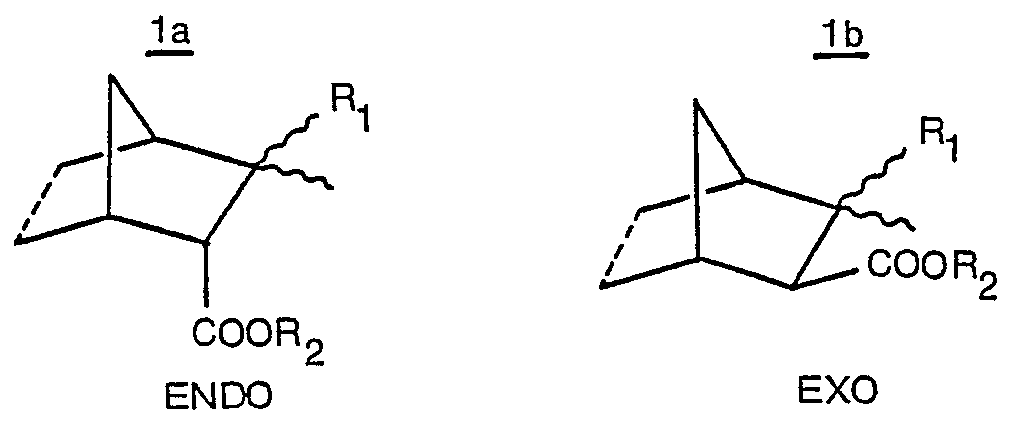
- esters of methyl-substituted bicyclo[2.2.1]heptane- and -heptene-carboxylic acids having structures according to formulae in which the dotted line is a single or double bond, R i is a hydrogen atom or methyl group and R 2 is an alkyl or alkenyl group having 1-4 carbon atoms, are valuable fragrances having a fresh and very natural, strongly coniferous odour with spicy and sometimes minty and/or fruity notes.
- esters according to the invention may have the endo- or exo-configuration, respectively represented by above formulae 1 a and 1 b. Moreover, when R i is a methyl group, the remaining methyl group may have the cis- or trans-position in respect to the ester group.
- methyl esters of the compounds according to the invention are known as such.
- the methyl esters of endo- and exo-3.3-dimethyl-bicyclo[2.2.1 ]heptane-2-carboxylic acid in the literature often indicated as camphenic acid and isocamphenic acid
- camphenic acid and isocamphenic acid are described in Monatsh. Chem. 107 (1976) 945-8 and 109 (1978) 3-9 as compounds which could be used as starting compounds for the synthesis of drugs and fragrances.
- esters as well as the methyl esters of endo- and exo-6.6-dimethyl- bicyclo[2.2.ljhept-2-ene-carboxylic acid are mentioned in Chem. Ber. 90 (1957) 1830-37 also without any indication of olfactory properties.
- exo-2-bicyclo[2.2.1]heptyl-acetic acid esters are suitable as fragrances having a fruity and floral odour.
- the esters according to the invention distinguish themselves therefrom not only by a chemical structure which is clearly different but also by a totally different odour in which the coniferous character dominates.
- esters according to the invention can be prepared according to methods known per se for analogous compounds by esterifying the corresponding acids. These acids can be prepared as described in the above mentioned references in Monatsh. Chem. Ber.
- esters according to the invention are powerful fragrances having a very natural coniferous odour.
- methyl-3.3-dimethyl-bicyclo[2.2.1 Iheptane-2-carboxylate has an odour especially pronounced of pines with a clear rosemary note and a somewhat fruity nuance.
- the corresponding isopropyl- and propylester also have a piney odour but with a somewhat floral nuance and the allylester has besides the piney odour an olibanum-like note.
- the odour of the isobutylester is reminescent of cedar wood.
- the methyl- and ethylester of 3-methyl-bicyclo[2.2.1 ]-heptane-2-carboxylic acid and the methylester of 6.6-dimethyl-bicyclo[2.2.1]-hept-2-en-5-carboxylic acid have a somewhat minty odour strongly reminescent of cedarleaf oil with tageteslike and fruity notes.
- the ethyl- and isopropylesters of this acid have a piney odor with the ethylester also having minty and the isopropylester floral (muguet) and spicy notes.
- the ethyl ester of 6-methyl-bicyclo[2.2.1]hept-2-en-5-carboxylic acid has a conifer-woody odor with floral notes.
- esters according to the invention can be used successfully in perfume compositions or also as such as odour imparting agents. By their stability these esters are very suitable for perfuming of for instance soaps, washing and cleaning agents. In particular the saturated esters are also very stable in oxidative mediums like modern detergents.
- perfume composition is used to mean a mixture of fragrance and optionally auxiliary substances that may be dissolved in an appropriate solvent or mixed with a powdery substrate and used to impart a desired odour to the skin and/or various products.
- examples of said products are: soaps, washing agents, dish washing and cleaning agents, air fresheners and room sprays, pommanders, candles, cosmetics such as creams, colognes, pre- and after-shaving lotions, talcum powders, hair care agents, body deoderants and antiperspirants.
- Fragrances and mixtures thereof which can be used for the preparation of perfume compositions are e.g. natural products such as essential oils, absolutes, resinoids, resins, concretes etc, but also synthetic fragrances, such as hydrocarbons, alcohols, aldehydes, ketones, ethers, acids, esters, acetals, ketals, nitriles etc, covering saturated and unsaturated compounds, aliphatic, carbocyclic and heterocyclic compounds.
- fragrances to be used in combination with the compounds according to the invention are: geraniol, geranyl acetate, linalool, linalyl acetate, tetrahydrolinalool, citronellol, citronellyl acetate, myrcenol, myrcenyl acetate, dihydro myrcenol, dihydro myrcenyl acetate, tetrahydro myrcenol, terpineol, terpinyl acetate, nopol, nopyl acetate, ⁇ -phenyl-ethanol, A-phenylethyl acetate, benzyl alcohol, benzyl acetate, benzyl salcylate, benzyl benzoate, amyl salicylate, styrallyl acetate, dimethylbenzyl carbinol, trichloromethylphenylcarbinyl acetate, p-tert.buty
- perfume compositions according to the invention are e.g. ethanol, isopropanol, diethyleneglycol monoethylether, diethyl phthalate etc.
- the amount of the esters that can be used in a perfume composition or in a perfumed product can be varied within broad limits and depends e.g. on the product wherein the perfume is used, the nature and the amount of the further components of the perfume compositions and the odour effect desired. Therefore, it is only possible to indicate very rough limits, which give, however, a person skilled in the art sufficient information concerning the odour strength and possibilities for the use of the esters. In most cases a quantity of only 0.1 % in a perfume composition is sufficient to obtain a clearly observable odour effect.
- the concentration is lower and depends on the quantity of the composition used in the product. In some cases, however concentrations of 30% are usable in the compositions to obtain special odour effects.
- a mixture of 27.2 g camphene and 30 g ethylformate is refluxed. During several hours 30 g 60% hydrogenperoxide is carefully added dropwise with continuous agitation. Subsequently the mixture is stirred for another 2.5 hours. Then the solvent is distilled off at atmospheric pressure. 20 g Toluene is added to the residue, the water layer is separated and the oranic layer is washed twice with water. Then 40 g 20% sodiumhydroxide solution is added with vigorous stirring whereafter the mixture is refluxed for another hour. The water layer is separated, acidified with concentrated hydrochloric acid to pH 1 and extracted twice with toluene. The toluene layer is washed with water and then evaporated in vacuo.
- the methylesters are prepared by adding 60 ml methanol and 8 g concentrated sulphuric acid. The reaction mixture is refluxed under agitation during 3.5 hours. Then about 40 mi methanol is distilled off and the residue is mixed with 20 ml toluene. This solution is subsequently washed with two times 20 ml water, 10 ml 5%'s soda solution and again 10 ml water. The solution is then evaporated in vacuo and the residue is distilled in vacuo: boiling point 80-83°C/0.4 kPa.
- the acid chloride is hydrolyzed by adding it over a period of 30 minutes to a solution of 80 g NaOH in 300 ml water, the temperature rises to about 60°C. The mixture is stirred and refluxed for another hour. After the mixture is cooled it is extracted twice with cyclohexane. Then the water layer is acidified to pH 1 with 25%'s-sulphuric acid and again extracted twice with cyclohexane. The cyclohexane layer is evaporated and the residue obtained is distilled in vacuo. The yield is 47 g dimethyl- bicycloheptane-carbocyclic acid; boiling point: 110-120°C/0.4 kPa.
- the ethylesters and isopropylesters were prepared in similar way, using the above mentioned mixture of acids and ethanol respectively isopropanol as starting components.
- a perfume composition of the "pine type” is prepared according to the following recipe:
- a perfume composition of the "Cedar type" for use in room sprays is prepared according to the following recipe:
- a room spray may be prepared by mixing 27.2 g anhydrous ethanol, 2 g propylene glycol, 4.8 g diethylene glycol and 166 g freon with 1.2 g of above mentioned perfume composition. Aerosol cans were filled with this mixture.
- a perfume composition of the "conifer-type” is prepared according to the following recipe:
Landscapes
- Chemical & Material Sciences (AREA)
- Health & Medical Sciences (AREA)
- Life Sciences & Earth Sciences (AREA)
- Engineering & Computer Science (AREA)
- General Health & Medical Sciences (AREA)
- Public Health (AREA)
- Veterinary Medicine (AREA)
- Animal Behavior & Ethology (AREA)
- Epidemiology (AREA)
- Chemical Kinetics & Catalysis (AREA)
- Oil, Petroleum & Natural Gas (AREA)
- Wood Science & Technology (AREA)
- Organic Chemistry (AREA)
- Fats And Perfumes (AREA)
- Organic Low-Molecular-Weight Compounds And Preparation Thereof (AREA)
- Cosmetics (AREA)
Description
- The invention relates to perfume compositions containing esters of substituted bicyclo[2.2.1]-heptane- and heptene-carboxylic acids as perfume base and to articles perfumed with these compounds.
- There is a continuous interest for the preparation and application of synthetic fragrances because these fragrances can always be prepared in the quantity desired and with uniform quality, this contrary to naturally occurring substances. Especially there is a demand for synthetic fragrances having a natural odour character. Moreover, for some applications like perfuming of modern detergents a high chemical stability is required.
- It was found that esters of methyl-substituted bicyclo[2.2.1]heptane- and -heptene-carboxylic acids having structures according to formulae

- The esters according to the invention may have the endo- or exo-configuration, respectively represented by above formulae 1 a and 1 b. Moreover, when Ri is a methyl group, the remaining methyl group may have the cis- or trans-position in respect to the ester group.
- Several fragrances having a bicycio[2.2.1]heptane skeleton are known from the prior art. For instance U.S. patent specification 4,053,657 mentions many compounds having such a structure and a great variety of odours. However, none of these compounds has a bicyclo[2.2.1]heptane carboxyl-unit so that these compounds strongly differ chemically from the compounds according to the invention.
- On the other hand some methyl esters of the compounds according to the invention are known as such. For instance the methyl esters of endo- and exo-3.3-dimethyl-bicyclo[2.2.1 ]heptane-2-carboxylic acid (in the literature often indicated as camphenic acid and isocamphenic acid), as well as the acids themselves, are described in Monatsh. Chem. 107 (1976) 945-8 and 109 (1978) 3-9 as compounds which could be used as starting compounds for the synthesis of drugs and fragrances. However, nothing is mentioned about the possible fragrance properties of the compounds themselves. Further the above mentioned esters as well as the methyl esters of endo- and exo-6.6-dimethyl- bicyclo[2.2.ljhept-2-ene-carboxylic acid are mentioned in Chem. Ber. 90 (1957) 1830-37 also without any indication of olfactory properties.
- In NL-A-76,05914 it is described that monoesters, derived from methyl- and dimethyl- bicyc)o[2.2.1]heptane and -heptene-carboxylic acids and alkyleneglycols or dialkyleneglycols have a physiological cooling effect when these compounds are brought into contact with internal or external surface tissues of the body (skin, mucous membranes). However, there is nothing mentioned about the odour and possible fragrance properties of these compounds.
- Further it is described in NL-A-78,10966 that both 3.3-dimethyl-bicyclo[2.2.1]heptane- carboxylic acids are fragrances having a somewhat acidic odour reminiscent of cistus oil and olibanum. However, it is not deductable from this publication that the alkyl esters of above mentioned acids would be suitable as fragrances.
- Finally it is known from NL-A-76,03354 that exo-2-bicyclo[2.2.1]heptyl-acetic acid esters are suitable as fragrances having a fruity and floral odour. The esters according to the invention distinguish themselves therefrom not only by a chemical structure which is clearly different but also by a totally different odour in which the coniferous character dominates.
- The esters according to the invention can be prepared according to methods known per se for analogous compounds by esterifying the corresponding acids. These acids can be prepared as described in the above mentioned references in Monatsh. Chem. Ber.
- In Monatsh. Chem. 107 (1976) 387-94 the preparation of 6.6-dimethyl-bicyclo[2.2.1]hapt-2-en-5-yl-methylketone is described which can be converted to the corresponding acid by oxidation with hypohalite. The corresponding dimethylbicycloheptane-acid may then be obtained by catalytic reduction. The 6-methyl- and 6.6-dimethyl-bicyclo[2.2.1]hept-2-en-5-carboxylic acids can be prepared by a Diels-Alder-reaction between cyclopentadiene and betamethacryloyl or beta,beta-dimethyl- acryloylchloride respectively, followed by hydrolysis and esterification. This method is described in Chem. Ber. 93 (1960) 2271-81.
- In NL-A-78,10966 is described how a mixture of about 80% endo- and 20% exo-3.3-dimethylbicyclo[2.2.1]heptane-2-carboxylic acid can be obtained by means of oxidation of camphene with hydrogen peroxide. Also the other above mentioned methods yield mixtures of endo- and exo-acid, which can be separated into the individual components according to methods known per se, for instance via the iodolactone, as described in Chem. Ber. 90 (1957) 1830-37. However, it is very advantageous to use the mixtures of endo- and exo-esters as such as fragrances because these mixtures are also very suitable for this aim without further separation.
- As already mentioned the esters according to the invention are powerful fragrances having a very natural coniferous odour. For instance methyl-3.3-dimethyl-bicyclo[2.2.1 Iheptane-2-carboxylate has an odour especially reminiscent of pines with a clear rosemary note and a somewhat fruity nuance. The corresponding isopropyl- and propylester also have a piney odour but with a somewhat floral nuance and the allylester has besides the piney odour an olibanum-like note. The odour of the isobutylester is reminescent of cedar wood. The methyl- and ethylester of 3-methyl-bicyclo[2.2.1 ]-heptane-2-carboxylic acid and the methylester of 6.6-dimethyl-bicyclo[2.2.1]-hept-2-en-5-carboxylic acid have a somewhat minty odour strongly reminescent of cedarleaf oil with tageteslike and fruity notes. However, the ethyl- and isopropylesters of this acid have a piney odor with the ethylester also having minty and the isopropylester floral (muguet) and spicy notes. The ethyl ester of 6-methyl-bicyclo[2.2.1]hept-2-en-5-carboxylic acid has a conifer-woody odor with floral notes.
- The esters according to the invention can be used successfully in perfume compositions or also as such as odour imparting agents. By their stability these esters are very suitable for perfuming of for instance soaps, washing and cleaning agents. In particular the saturated esters are also very stable in oxidative mediums like modern detergents.
- The phrase "perfume composition" is used to mean a mixture of fragrance and optionally auxiliary substances that may be dissolved in an appropriate solvent or mixed with a powdery substrate and used to impart a desired odour to the skin and/or various products. Examples of said products are: soaps, washing agents, dish washing and cleaning agents, air fresheners and room sprays, pommanders, candles, cosmetics such as creams, colognes, pre- and after-shaving lotions, talcum powders, hair care agents, body deoderants and antiperspirants.
- Fragrances and mixtures thereof which can be used for the preparation of perfume compositions are e.g. natural products such as essential oils, absolutes, resinoids, resins, concretes etc, but also synthetic fragrances, such as hydrocarbons, alcohols, aldehydes, ketones, ethers, acids, esters, acetals, ketals, nitriles etc, covering saturated and unsaturated compounds, aliphatic, carbocyclic and heterocyclic compounds.
- Examples of fragrances to be used in combination with the compounds according to the invention are: geraniol, geranyl acetate, linalool, linalyl acetate, tetrahydrolinalool, citronellol, citronellyl acetate, myrcenol, myrcenyl acetate, dihydro myrcenol, dihydro myrcenyl acetate, tetrahydro myrcenol, terpineol, terpinyl acetate, nopol, nopyl acetate, Ø-phenyl-ethanol, A-phenylethyl acetate, benzyl alcohol, benzyl acetate, benzyl salcylate, benzyl benzoate, amyl salicylate, styrallyl acetate, dimethylbenzyl carbinol, trichloromethylphenylcarbinyl acetate, p-tert.butyl-cyclohexyl acetate, isononyl acetate, vetiveryl acetate, vetiverol, a-hexyl-cinnamaldehyde, 2-methyl-3-(p-tert.butylphenyl)-propanal, 2-methyl-3-(p-isopropylphenyl)-propanal, 3-(p-tert.butylphenyl)-propanal, tricyclodecenyl acetate, tricyclodecenyl propionate, 4-(4-hydroxy-4-methylpentyl)-3-cyclohexene carbaldehyde, 4-(4-methyl-3-pentenyl)-3-cyclohexene carbaldehyde, 4-acetoxy-3-pentyi-tetrahydropyran, 3-carboxymethyl-2-pentylcyclopentane, 2-n-heptyl-cyclopentanone, 3-methyl-2-pentyl-2-cyclopentanone, n-decanal, n-dodecanal, dec-9-en-l-oi, phenoxyethyl isobutyrate, phenyl-acetaldehyde dimethylacetal, phenyl-acetaldehyde diethylacetal, geranyl nitrile, citronellyl nitrile, cedryl acetate, 3-isocamphyl cyclohexanol, cedrylmethyl ether, isolongifolanon, aubepine nitrile, aubepine, heliotropine, coumarin, eugenol, vanillin, diphenyl oxide, hydroxy citronellal, ionones, methyl ionones, isomethyl ionones, irones, cis-3-hexenol and esters thereof, indan musk fragrances, tetralin musk fragrances, isochroman musk fragrances, macrocyclic ketones, macrolactone musk fragrances, ethylene brassylate, aromatic nitromusk fragrances.
- Auxiliary agents and solvents that may be incorporated into perfume compositions according to the invention are e.g. ethanol, isopropanol, diethyleneglycol monoethylether, diethyl phthalate etc.
- The amount of the esters that can be used in a perfume composition or in a perfumed product can be varied within broad limits and depends e.g. on the product wherein the perfume is used, the nature and the amount of the further components of the perfume compositions and the odour effect desired. Therefore, it is only possible to indicate very rough limits, which give, however, a person skilled in the art sufficient information concerning the odour strength and possibilities for the use of the esters. In most cases a quantity of only 0.1 % in a perfume composition is sufficient to obtain a clearly observable odour effect.
- In products perfumed with the aid of perfume compositions according to the invention the concentration is lower and depends on the quantity of the composition used in the product. In some cases, however concentrations of 30% are usable in the compositions to obtain special odour effects.
- The following examples only illustrate the preparation and the use of the esters and do not restrict the invention thereto.
- Preparation of a mixture of methylesters of endo- and exo-3.3-dimethyl-bicyclo[2.2.1]heptane- carboxylic acid.
- A mixture of 27.2 g camphene and 30 g ethylformate is refluxed. During several hours 30 g 60% hydrogenperoxide is carefully added dropwise with continuous agitation. Subsequently the mixture is stirred for another 2.5 hours. Then the solvent is distilled off at atmospheric pressure. 20 g Toluene is added to the residue, the water layer is separated and the oranic layer is washed twice with water. Then 40 g 20% sodiumhydroxide solution is added with vigorous stirring whereafter the mixture is refluxed for another hour. The water layer is separated, acidified with concentrated hydrochloric acid to pH 1 and extracted twice with toluene. The toluene layer is washed with water and then evaporated in vacuo.
- Preparation of the methylesters.
- From the above obtained mixture of acids the methylesters are prepared by adding 60 ml methanol and 8 g concentrated sulphuric acid. The reaction mixture is refluxed under agitation during 3.5 hours. Then about 40 mi methanol is distilled off and the residue is mixed with 20 ml toluene. This solution is subsequently washed with two times 20 ml water, 10 ml 5%'s soda solution and again 10 ml water. The solution is then evaporated in vacuo and the residue is distilled in vacuo: boiling point 80-83°C/0.4 kPa.
- Yield: 80%, calculated on the used acid

- Preparation of a mixture of propylesters of the dimethylbicycloheptane-carboxylic acids.
- 60 g n-propanol and 4 g concentrated sulphuric acid are added to 20 g of the mixture of acids obtained according to the first part of example I. The mixture is refluxed for 3 hours after which water is distilled off azotropically. The residue is mixed with 20 ml toluene, washed twice with water, once with 5% soda-solution and again once with water. The solution is evaporated and the residue is distilled in vacuo. Boiling point: 123-128°C/2 kPa, yield 40%.
n22 1.4641. - Preparation of the mixture of isobutylesters of the dimethyl-bicycloheptane-carboxylic acids.
- The isobutylesters are prepared in the way according to example II from 20 g of the mixture of acids and 60 ml isobutanol. Boiling point: 92-94°C/0.2 kPa, yield: 30%, np = 1.4616.
- Preparation of a mixture of isopropylesters of the dimethylbicycloheptane-carboxylic acids.
- 20 g Of the mixture of acids according to example I, 60 g isopropanol and 4 g concentrated sulphuric acid are refluxed for 7 hours. Then the water is distilled off azeotropically and the residue is treated as decribed in example II.
Boiling point: 70-75°C/0.2 kPa. Yield: 23%.
n22 = 1.4600. - Preparation of a mixture of methylesters of endo- and exo-6.6-dimethyl-bicycle[2.2.1]hept-2-en-5-carboxylic acid.
- 300 g Dicyclopentadiene is heated to 150°C whereafter in 50 minutes 100 g β,β-dimethyl- acrylylchloride is added. Subsequently the mixture is refluxed for another 10 hours at 150°C. The mixture is then distilled in vacuo whereby the unreacted starting material is removed and finally at 100-130°C/0.7 kPa bicycloheptenecarboxylic acid chloride is obtained; yield: 129 g.
- The acid chloride is hydrolyzed by adding it over a period of 30 minutes to a solution of 80 g NaOH in 300 ml water, the temperature rises to about 60°C. The mixture is stirred and refluxed for another hour. After the mixture is cooled it is extracted twice with cyclohexane. Then the water layer is acidified to pH 1 with 25%'s-sulphuric acid and again extracted twice with cyclohexane. The cyclohexane layer is evaporated and the residue obtained is distilled in vacuo. The yield is 47 g dimethyl- bicycloheptane-carbocyclic acid; boiling point: 110-120°C/0.4 kPa.
- 25 g Sulphuric acid is added in 30 minutes to a mixture of the above obtained acid and 150 ml methanol whereby the temperature rises to about 45°C. The mixture is refluxed for another 1.5 hours under agitation. Then the methanol is evaporated and the residue is mixed with cyclohexane. This solution is washed neutral with a Na2co3-solution and washed once with water. The cyclohexane is then evaporated and the residue is distilled in vacuo. Yield: 29 g of the desired methylesters (76%, calculated on the acid); boiling point: 75°C/0.7 kPa.
n22 = 1,4830. - The ethylesters and isopropylesters were prepared in similar way, using the above mentioned mixture of acids and ethanol respectively isopropanol as starting components.
- Preparation of 6-methyl-bicyclo[2.2.1]hept-2-en-5-carboxylic acid-ethylesters.
- 148 g Ethylcrotonate is heated at about 65°C whereafter 115 g cyclopentadiene is added in two hours. The temperature rises to about 120°C. The mixture is stirred for another 4 hours at this temperature. Then the reaction mixture is distilled in vacuo, obtaining 114 g of the desired mixture of esters; boiling point: 66―76°C/7 kPa;

- Preparation of 3-methyl-bicyclo[2.2.1]heptane-2-carboxylic acid-ethylesters.
- 10 g Of the mixture of esters obtained according to example IV is dissolved in 100 ml absolute ethanol whereafter 100 mg hydrogenation catalyst (5% Pd on carbon) are added. Then the mixture is hydrogenated at atmospheric pressure till the theoretical quantity of hydrogen is taken up. Subsequently the catalyst is filtered off, the ethanol evaporated and the residue distilled in vacuo; the yield of

- A perfume composition of the "pine type" is prepared according to the following recipe:

- A perfume composition of the "Cedar type" for use in room sprays is prepared according to the following recipe:

- A room spray may be prepared by mixing 27.2 g anhydrous ethanol, 2 g propylene glycol, 4.8 g diethylene glycol and 166 g freon with 1.2 g of above mentioned perfume composition. Aerosol cans were filled with this mixture.
- A perfume composition of the "conifer-type" is prepared according to the following recipe:

Claims (7)


Applications Claiming Priority (2)
| Application Number | Priority Date | Filing Date | Title |
|---|---|---|---|
| NL8003068 | 1980-05-28 | ||
| NL8003068A NL8003068A (en) | 1980-05-28 | 1980-05-28 | PERFUME COMPOSITIONS AND PERFUMED MATERIALS AND ARTICLES CONTAINING ESTERS OF BICYCLIC MONOTERPEENIC ACIDS AS RAW MATERIAL. |
Publications (3)
| Publication Number | Publication Date |
|---|---|
| EP0040894A2 EP0040894A2 (en) | 1981-12-02 |
| EP0040894A3 EP0040894A3 (en) | 1981-12-09 |
| EP0040894B1 true EP0040894B1 (en) | 1984-01-25 |
Family
ID=19835372
Family Applications (1)
| Application Number | Title | Priority Date | Filing Date |
|---|---|---|---|
| EP81200585A Expired EP0040894B1 (en) | 1980-05-28 | 1981-05-27 | Perfume compositions and perfumed articles containing esters of substituted bicyclo (2.2.1)heptane- and heptene-carboxylic acids as perfume base |
Country Status (5)
| Country | Link |
|---|---|
| US (1) | US4442025A (en) |
| EP (1) | EP0040894B1 (en) |
| JP (1) | JPS5721350A (en) |
| DE (1) | DE3162017D1 (en) |
| NL (1) | NL8003068A (en) |
Cited By (1)
| Publication number | Priority date | Publication date | Assignee | Title |
|---|---|---|---|---|
| CN103201250A (en) * | 2010-11-12 | 2013-07-10 | 三菱瓦斯化学株式会社 | Novel carboxylic acid ester compound and production therefor, and perfume composition thereof |
Families Citing this family (18)
| Publication number | Priority date | Publication date | Assignee | Title |
|---|---|---|---|---|
| JPS5998295A (en) * | 1982-11-27 | 1984-06-06 | 能美防災工業株式会社 | Alarm and controller for semiconductor plant or the like |
| JPS5998294A (en) * | 1982-11-27 | 1984-06-06 | 能美防災工業株式会社 | Alarm and controller for semiconductor plant or the like |
| JPS5998293A (en) * | 1982-11-27 | 1984-06-06 | 能美防災工業株式会社 | Alarm and controller for semiconductor plant or the like |
| JPS60252408A (en) * | 1984-05-18 | 1985-12-13 | Nippon Oil Co Ltd | Tricyclo(2.2.1.02,6)heptane derivative, its preparation and perfumery containing same |
| US4661285A (en) * | 1986-05-05 | 1987-04-28 | National Distillers And Chemical Corporation | Balsamic fragrance composition and process for preparation |
| JPH0237103Y2 (en) * | 1988-11-14 | 1990-10-08 | ||
| JPH0237105Y2 (en) * | 1988-11-16 | 1990-10-08 | ||
| JPH0413756Y2 (en) * | 1988-11-22 | 1992-03-30 | ||
| US6534574B1 (en) * | 2001-03-24 | 2003-03-18 | Milliken & Company | Highly nucleated thermoplastic articles |
| EP1318190A1 (en) * | 2001-12-07 | 2003-06-11 | Givaudan SA | Organic compounds |
| US7683023B2 (en) * | 2005-07-01 | 2010-03-23 | Firmenich Sa | Perfuming ingredients of the woody type |
| US8877139B2 (en) * | 2010-08-13 | 2014-11-04 | The Procter & Gamble Company | Compositions comprising a functional perfume component mixture |
| US9156774B2 (en) | 2011-03-25 | 2015-10-13 | Mitsubishi Gas Chemical Company, Inc. | Carboxylic acid ester compound and method for producing same, and fragrance composition |
| EP3109309B1 (en) * | 2012-01-18 | 2022-06-08 | The Procter & Gamble Company | Perfume systems |
| JP6985409B2 (en) * | 2017-03-21 | 2021-12-22 | シムライズ アーゲー | 5-Vicyclo [2.2.1] hepta-2-enyl-acetate as a flavoring agent and / or flavoring agent |
| JP7562288B2 (en) * | 2020-05-18 | 2024-10-07 | エステー株式会社 | Essential oils, refined water and fiber components and their manufacturing methods |
| JP7838937B2 (en) * | 2021-09-17 | 2026-04-01 | エステー株式会社 | Tree extract and method for producing the same |
| WO2024045134A1 (en) * | 2022-09-01 | 2024-03-07 | Givaudan Sa | Organic compounds |
Family Cites Families (9)
| Publication number | Priority date | Publication date | Assignee | Title |
|---|---|---|---|---|
| NL277216A (en) * | 1900-01-01 | |||
| BE756583A (en) * | 1969-10-06 | 1971-03-24 | Givaudan & Cie Sa | NORBORNYL DERIVATIVES |
| DE2517620A1 (en) * | 1975-04-21 | 1976-11-04 | Henkel & Cie Gmbh | USE OF EXO-NORBORNYL-2-ACETIC ACID ESTERS AS FRAGRANCES AND THESE FRAGRANCE COMPOSITIONS |
| GB1502680A (en) * | 1975-06-03 | 1978-03-01 | Wilkinson Sword Ltd | Compositions for application to or consumption by the human body and containing compounds having a physiological cooling effect |
| US4053657A (en) * | 1976-12-03 | 1977-10-11 | International Flavors & Fragrances Inc. | Foods and flavor use of 1-(3,3-dimethyl-2-norbornyl-2-propanone |
| US4218347A (en) * | 1977-09-15 | 1980-08-19 | Firmenich Sa | Bicyclic aldehyde perfuming and flavoring ingredients |
| US4132677A (en) * | 1977-12-15 | 1979-01-02 | Givaudan Corporation | Perfume compositions containing 2-(2-cyanoethylidene)-2-methyl-bicyclo(2.2.1)hept-5-enes |
| NL7810966A (en) * | 1978-11-03 | 1980-05-07 | Naarden International Nv | PERFUME COMPOSITIONS AND PERFUMED PRODUCTS CONTAINING BICYCLIC MONOTERPENIC ACID AS PERFUME RAW. |
| US4319036A (en) * | 1980-03-25 | 1982-03-09 | International Flavors & Fragrances Inc. | Carboalkoxy alkyl norbornanes and process for preparing same |
-
1980
- 1980-05-28 NL NL8003068A patent/NL8003068A/en not_active Application Discontinuation
-
1981
- 1981-05-27 DE DE8181200585T patent/DE3162017D1/en not_active Expired
- 1981-05-27 EP EP81200585A patent/EP0040894B1/en not_active Expired
- 1981-05-27 US US06/267,644 patent/US4442025A/en not_active Expired - Lifetime
- 1981-05-28 JP JP8177481A patent/JPS5721350A/en active Granted
Cited By (4)
| Publication number | Priority date | Publication date | Assignee | Title |
|---|---|---|---|---|
| CN103201250A (en) * | 2010-11-12 | 2013-07-10 | 三菱瓦斯化学株式会社 | Novel carboxylic acid ester compound and production therefor, and perfume composition thereof |
| US8829228B2 (en) | 2010-11-12 | 2014-09-09 | Mitsubishi Gas Chemical Company, Inc. | Carboxylate compound and method of producing the same and perfume composition thereof |
| CN103201250B (en) * | 2010-11-12 | 2015-08-05 | 三菱瓦斯化学株式会社 | Novel carboxylic acid ester cpds and manufacture method thereof and its flavor compositions |
| TWI579267B (en) * | 2010-11-12 | 2017-04-21 | 三菱瓦斯化學股份有限公司 | Novel carboxylic acid ester compounds and methods for their manufacture, and perfumery |
Also Published As
| Publication number | Publication date |
|---|---|
| DE3162017D1 (en) | 1984-03-01 |
| EP0040894A2 (en) | 1981-12-02 |
| NL8003068A (en) | 1982-01-04 |
| JPH0224317B2 (en) | 1990-05-29 |
| JPS5721350A (en) | 1982-02-04 |
| US4442025A (en) | 1984-04-10 |
| EP0040894A3 (en) | 1981-12-09 |
Similar Documents
| Publication | Publication Date | Title |
|---|---|---|
| US4442025A (en) | Perfume compositions and perfumed articles containing esters of substituted bicyclo [2.2.1]heptane and heptene-carboxylic acids as perfume base | |
| EP0049545A1 (en) | High-pressure mercury vapour discharge lamp | |
| EP0062368B1 (en) | Perfume compositions as well as perfumed products containing alkyl substituted benzyl cyanides as a fragrance | |
| EP0673408B1 (en) | Dimethyl-cyclohexanecarboxylic acid esters in perfumery | |
| US7015189B2 (en) | Oxime methyl ethers | |
| US8785677B1 (en) | Organoleptic compound | |
| US4843061A (en) | Cyclohexane-, cyclohexene- and cyclohexadiene-, bicyclo (2.2.1)-heptenecarboxylic acid esters, and also perfume compositions and perfumed products which contain one or more of said compounds as perfume component | |
| US20090068137A1 (en) | Organoleptic compounds and their use in perfume compositions | |
| US7678756B2 (en) | Substituted hydrogenated naphthalene derivatives and their use in fragrance formulations | |
| JP5238116B2 (en) | New aromatic compounds | |
| EP1496055B1 (en) | Acetonide fragrance compound | |
| CN100509749C (en) | Fragrance compound | |
| MX2008014730A (en) | Patchouli odorant. | |
| US4404127A (en) | Perfume compositions and perfumed materials and articles, containing phenyl-tetrahydrofurans as a fragrance | |
| EP0965575A1 (en) | Novel fragrance compounds | |
| JPS62169743A (en) | Isopropyl-methyl-butenoyl-cyclohexane derivative | |
| US7074967B1 (en) | Derivatives of 3-cyclopropyl-1-propanone compounds and their use in perfume compositions | |
| GB2034586A (en) | Perfume compositions containing a bicyclic monterpenic acid | |
| DE69309710T2 (en) | METHYLBUTOXYPROPIONITRILE AND THEIR USE AS A FRAGRANCE | |
| EP3183330B1 (en) | Perfume compositions containing isomeric alkadienals | |
| EP1947078B1 (en) | Novel macrocyclic musk | |
| EP0134613A1 (en) | Perfume compositions and perfumed products which contain at least one or more esters of 2-ethyl-2-methyl-butanoic acid as the perfume base | |
| US20100145107A1 (en) | Novel propanol and related compounds and their use in perfume compositions | |
| CA2941402A1 (en) | Perfume compositons containing isomeric alkadienenitriles | |
| US20020107154A1 (en) | Cyclohexenyl cyclopropyl ketone |
Legal Events
| Date | Code | Title | Description |
|---|---|---|---|
| PUAI | Public reference made under article 153(3) epc to a published international application that has entered the european phase |
Free format text: ORIGINAL CODE: 0009012 |
|
| PUAL | Search report despatched |
Free format text: ORIGINAL CODE: 0009013 |
|
| AK | Designated contracting states |
Designated state(s): CH DE FR GB IT NL |
|
| AK | Designated contracting states |
Designated state(s): CH DE FR GB IT NL |
|
| 17P | Request for examination filed |
Effective date: 19811222 |
|
| ITF | It: translation for a ep patent filed | ||
| GRAA | (expected) grant |
Free format text: ORIGINAL CODE: 0009210 |
|
| AK | Designated contracting states |
Designated state(s): CH DE FR GB IT LI NL |
|
| REF | Corresponds to: |
Ref document number: 3162017 Country of ref document: DE Date of ref document: 19840301 |
|
| ET | Fr: translation filed | ||
| PLBE | No opposition filed within time limit |
Free format text: ORIGINAL CODE: 0009261 |
|
| STAA | Information on the status of an ep patent application or granted ep patent |
Free format text: STATUS: NO OPPOSITION FILED WITHIN TIME LIMIT |
|
| 26N | No opposition filed | ||
| ITTA | It: last paid annual fee | ||
| PGFP | Annual fee paid to national office [announced via postgrant information from national office to epo] |
Ref country code: FR Payment date: 19990412 Year of fee payment: 19 |
|
| PGFP | Annual fee paid to national office [announced via postgrant information from national office to epo] |
Ref country code: GB Payment date: 19990420 Year of fee payment: 19 |
|
| PGFP | Annual fee paid to national office [announced via postgrant information from national office to epo] |
Ref country code: DE Payment date: 19990426 Year of fee payment: 19 Ref country code: CH Payment date: 19990426 Year of fee payment: 19 |
|
| PGFP | Annual fee paid to national office [announced via postgrant information from national office to epo] |
Ref country code: NL Payment date: 19990427 Year of fee payment: 19 |
|
| PG25 | Lapsed in a contracting state [announced via postgrant information from national office to epo] |
Ref country code: GB Free format text: LAPSE BECAUSE OF NON-PAYMENT OF DUE FEES Effective date: 20000527 |
|
| PG25 | Lapsed in a contracting state [announced via postgrant information from national office to epo] |
Ref country code: LI Free format text: LAPSE BECAUSE OF NON-PAYMENT OF DUE FEES Effective date: 20000531 Ref country code: CH Free format text: LAPSE BECAUSE OF NON-PAYMENT OF DUE FEES Effective date: 20000531 |
|
| PG25 | Lapsed in a contracting state [announced via postgrant information from national office to epo] |
Ref country code: NL Free format text: LAPSE BECAUSE OF NON-PAYMENT OF DUE FEES Effective date: 20001201 |
|
| REG | Reference to a national code |
Ref country code: CH Ref legal event code: PL |
|
| GBPC | Gb: european patent ceased through non-payment of renewal fee |
Effective date: 20000527 |
|
| PG25 | Lapsed in a contracting state [announced via postgrant information from national office to epo] |
Ref country code: FR Free format text: LAPSE BECAUSE OF NON-PAYMENT OF DUE FEES Effective date: 20010131 |
|
| NLV4 | Nl: lapsed or anulled due to non-payment of the annual fee |
Effective date: 20001201 |
|
| PG25 | Lapsed in a contracting state [announced via postgrant information from national office to epo] |
Ref country code: DE Free format text: LAPSE BECAUSE OF NON-PAYMENT OF DUE FEES Effective date: 20010301 |
|
| REG | Reference to a national code |
Ref country code: FR Ref legal event code: ST |