EP0038897B1 - Prothèse intramédullaire non scellée pour articulation de la hanche - Google Patents
Prothèse intramédullaire non scellée pour articulation de la hanche Download PDFInfo
- Publication number
- EP0038897B1 EP0038897B1 EP80420150A EP80420150A EP0038897B1 EP 0038897 B1 EP0038897 B1 EP 0038897B1 EP 80420150 A EP80420150 A EP 80420150A EP 80420150 A EP80420150 A EP 80420150A EP 0038897 B1 EP0038897 B1 EP 0038897B1
- Authority
- EP
- European Patent Office
- Prior art keywords
- unit
- femoral
- cephalic
- femur
- stem
- Prior art date
- Legal status (The legal status is an assumption and is not a legal conclusion. Google has not performed a legal analysis and makes no representation as to the accuracy of the status listed.)
- Expired
Links
- 210000004394 hip joint Anatomy 0.000 title description 3
- 210000000689 upper leg Anatomy 0.000 claims abstract description 29
- 210000001624 hip Anatomy 0.000 claims abstract description 7
- 210000000588 acetabulum Anatomy 0.000 claims abstract description 4
- 230000000295 complement effect Effects 0.000 claims abstract description 4
- 210000000988 bone and bone Anatomy 0.000 claims description 6
- PNEYBMLMFCGWSK-UHFFFAOYSA-N Alumina Chemical compound [O-2].[O-2].[O-2].[Al+3].[Al+3] PNEYBMLMFCGWSK-UHFFFAOYSA-N 0.000 claims description 4
- XAGFODPZIPBFFR-UHFFFAOYSA-N aluminium Chemical compound [Al] XAGFODPZIPBFFR-UHFFFAOYSA-N 0.000 claims 1
- 229910052782 aluminium Inorganic materials 0.000 claims 1
- 239000004411 aluminium Substances 0.000 claims 1
- 229910010293 ceramic material Inorganic materials 0.000 claims 1
- 230000014759 maintenance of location Effects 0.000 claims 1
- 238000009434 installation Methods 0.000 description 3
- 206010028851 Necrosis Diseases 0.000 description 2
- 230000002349 favourable effect Effects 0.000 description 2
- 230000017074 necrotic cell death Effects 0.000 description 2
- TWNQGVIAIRXVLR-UHFFFAOYSA-N oxo(oxoalumanyloxy)alumane Chemical compound O=[Al]O[Al]=O TWNQGVIAIRXVLR-UHFFFAOYSA-N 0.000 description 2
- 238000011477 surgical intervention Methods 0.000 description 2
- 239000004568 cement Substances 0.000 description 1
- 230000000694 effects Effects 0.000 description 1
- 230000003100 immobilizing effect Effects 0.000 description 1
- 238000012423 maintenance Methods 0.000 description 1
- 229910052751 metal Inorganic materials 0.000 description 1
- 239000002184 metal Substances 0.000 description 1
- 239000011224 oxide ceramic Substances 0.000 description 1
- 229910052574 oxide ceramic Inorganic materials 0.000 description 1
- 230000035515 penetration Effects 0.000 description 1
Images
Classifications
-
- A—HUMAN NECESSITIES
- A61—MEDICAL OR VETERINARY SCIENCE; HYGIENE
- A61F—FILTERS IMPLANTABLE INTO BLOOD VESSELS; PROSTHESES; DEVICES PROVIDING PATENCY TO, OR PREVENTING COLLAPSING OF, TUBULAR STRUCTURES OF THE BODY, e.g. STENTS; ORTHOPAEDIC, NURSING OR CONTRACEPTIVE DEVICES; FOMENTATION; TREATMENT OR PROTECTION OF EYES OR EARS; BANDAGES, DRESSINGS OR ABSORBENT PADS; FIRST-AID KITS
- A61F2/00—Filters implantable into blood vessels; Prostheses, i.e. artificial substitutes or replacements for parts of the body; Appliances for connecting them with the body; Devices providing patency to, or preventing collapsing of, tubular structures of the body, e.g. stents
- A61F2/02—Prostheses implantable into the body
- A61F2/30—Joints
- A61F2/32—Joints for the hip
- A61F2/36—Femoral heads ; Femoral endoprostheses
-
- A—HUMAN NECESSITIES
- A61—MEDICAL OR VETERINARY SCIENCE; HYGIENE
- A61F—FILTERS IMPLANTABLE INTO BLOOD VESSELS; PROSTHESES; DEVICES PROVIDING PATENCY TO, OR PREVENTING COLLAPSING OF, TUBULAR STRUCTURES OF THE BODY, e.g. STENTS; ORTHOPAEDIC, NURSING OR CONTRACEPTIVE DEVICES; FOMENTATION; TREATMENT OR PROTECTION OF EYES OR EARS; BANDAGES, DRESSINGS OR ABSORBENT PADS; FIRST-AID KITS
- A61F2/00—Filters implantable into blood vessels; Prostheses, i.e. artificial substitutes or replacements for parts of the body; Appliances for connecting them with the body; Devices providing patency to, or preventing collapsing of, tubular structures of the body, e.g. stents
- A61F2/02—Prostheses implantable into the body
- A61F2/30—Joints
- A61F2/32—Joints for the hip
- A61F2/36—Femoral heads ; Femoral endoprostheses
- A61F2/3609—Femoral heads or necks; Connections of endoprosthetic heads or necks to endoprosthetic femoral shafts
-
- A—HUMAN NECESSITIES
- A61—MEDICAL OR VETERINARY SCIENCE; HYGIENE
- A61F—FILTERS IMPLANTABLE INTO BLOOD VESSELS; PROSTHESES; DEVICES PROVIDING PATENCY TO, OR PREVENTING COLLAPSING OF, TUBULAR STRUCTURES OF THE BODY, e.g. STENTS; ORTHOPAEDIC, NURSING OR CONTRACEPTIVE DEVICES; FOMENTATION; TREATMENT OR PROTECTION OF EYES OR EARS; BANDAGES, DRESSINGS OR ABSORBENT PADS; FIRST-AID KITS
- A61F2/00—Filters implantable into blood vessels; Prostheses, i.e. artificial substitutes or replacements for parts of the body; Appliances for connecting them with the body; Devices providing patency to, or preventing collapsing of, tubular structures of the body, e.g. stents
- A61F2/02—Prostheses implantable into the body
- A61F2/30—Joints
- A61F2002/30001—Additional features of subject-matter classified in A61F2/28, A61F2/30 and subgroups thereof
- A61F2002/30316—The prosthesis having different structural features at different locations within the same prosthesis; Connections between prosthetic parts; Special structural features of bone or joint prostheses not otherwise provided for
- A61F2002/30329—Connections or couplings between prosthetic parts, e.g. between modular parts; Connecting elements
- A61F2002/30331—Connections or couplings between prosthetic parts, e.g. between modular parts; Connecting elements made by longitudinally pushing a protrusion into a complementarily-shaped recess, e.g. held by friction fit
- A61F2002/30362—Connections or couplings between prosthetic parts, e.g. between modular parts; Connecting elements made by longitudinally pushing a protrusion into a complementarily-shaped recess, e.g. held by friction fit with possibility of relative movement between the protrusion and the recess
- A61F2002/30364—Rotation about the common longitudinal axis
- A61F2002/30367—Rotation about the common longitudinal axis with additional means for preventing said rotation
-
- A—HUMAN NECESSITIES
- A61—MEDICAL OR VETERINARY SCIENCE; HYGIENE
- A61F—FILTERS IMPLANTABLE INTO BLOOD VESSELS; PROSTHESES; DEVICES PROVIDING PATENCY TO, OR PREVENTING COLLAPSING OF, TUBULAR STRUCTURES OF THE BODY, e.g. STENTS; ORTHOPAEDIC, NURSING OR CONTRACEPTIVE DEVICES; FOMENTATION; TREATMENT OR PROTECTION OF EYES OR EARS; BANDAGES, DRESSINGS OR ABSORBENT PADS; FIRST-AID KITS
- A61F2/00—Filters implantable into blood vessels; Prostheses, i.e. artificial substitutes or replacements for parts of the body; Appliances for connecting them with the body; Devices providing patency to, or preventing collapsing of, tubular structures of the body, e.g. stents
- A61F2/02—Prostheses implantable into the body
- A61F2/30—Joints
- A61F2002/30001—Additional features of subject-matter classified in A61F2/28, A61F2/30 and subgroups thereof
- A61F2002/30316—The prosthesis having different structural features at different locations within the same prosthesis; Connections between prosthetic parts; Special structural features of bone or joint prostheses not otherwise provided for
- A61F2002/30329—Connections or couplings between prosthetic parts, e.g. between modular parts; Connecting elements
- A61F2002/30405—Connections or couplings between prosthetic parts, e.g. between modular parts; Connecting elements made by screwing complementary threads machined on the parts themselves
-
- A—HUMAN NECESSITIES
- A61—MEDICAL OR VETERINARY SCIENCE; HYGIENE
- A61F—FILTERS IMPLANTABLE INTO BLOOD VESSELS; PROSTHESES; DEVICES PROVIDING PATENCY TO, OR PREVENTING COLLAPSING OF, TUBULAR STRUCTURES OF THE BODY, e.g. STENTS; ORTHOPAEDIC, NURSING OR CONTRACEPTIVE DEVICES; FOMENTATION; TREATMENT OR PROTECTION OF EYES OR EARS; BANDAGES, DRESSINGS OR ABSORBENT PADS; FIRST-AID KITS
- A61F2/00—Filters implantable into blood vessels; Prostheses, i.e. artificial substitutes or replacements for parts of the body; Appliances for connecting them with the body; Devices providing patency to, or preventing collapsing of, tubular structures of the body, e.g. stents
- A61F2/02—Prostheses implantable into the body
- A61F2/30—Joints
- A61F2002/30001—Additional features of subject-matter classified in A61F2/28, A61F2/30 and subgroups thereof
- A61F2002/30316—The prosthesis having different structural features at different locations within the same prosthesis; Connections between prosthetic parts; Special structural features of bone or joint prostheses not otherwise provided for
- A61F2002/30329—Connections or couplings between prosthetic parts, e.g. between modular parts; Connecting elements
- A61F2002/30476—Connections or couplings between prosthetic parts, e.g. between modular parts; Connecting elements locked by an additional locking mechanism
- A61F2002/30492—Connections or couplings between prosthetic parts, e.g. between modular parts; Connecting elements locked by an additional locking mechanism using a locking pin
-
- A—HUMAN NECESSITIES
- A61—MEDICAL OR VETERINARY SCIENCE; HYGIENE
- A61F—FILTERS IMPLANTABLE INTO BLOOD VESSELS; PROSTHESES; DEVICES PROVIDING PATENCY TO, OR PREVENTING COLLAPSING OF, TUBULAR STRUCTURES OF THE BODY, e.g. STENTS; ORTHOPAEDIC, NURSING OR CONTRACEPTIVE DEVICES; FOMENTATION; TREATMENT OR PROTECTION OF EYES OR EARS; BANDAGES, DRESSINGS OR ABSORBENT PADS; FIRST-AID KITS
- A61F2/00—Filters implantable into blood vessels; Prostheses, i.e. artificial substitutes or replacements for parts of the body; Appliances for connecting them with the body; Devices providing patency to, or preventing collapsing of, tubular structures of the body, e.g. stents
- A61F2/02—Prostheses implantable into the body
- A61F2/30—Joints
- A61F2002/30001—Additional features of subject-matter classified in A61F2/28, A61F2/30 and subgroups thereof
- A61F2002/30316—The prosthesis having different structural features at different locations within the same prosthesis; Connections between prosthetic parts; Special structural features of bone or joint prostheses not otherwise provided for
- A61F2002/30535—Special structural features of bone or joint prostheses not otherwise provided for
- A61F2002/30537—Special structural features of bone or joint prostheses not otherwise provided for adjustable
- A61F2002/30538—Special structural features of bone or joint prostheses not otherwise provided for adjustable for adjusting angular orientation
- A61F2002/3054—Special structural features of bone or joint prostheses not otherwise provided for adjustable for adjusting angular orientation about a connection axis or implantation axis for selecting any one of a plurality of radial orientations between two modular parts, e.g. Morse taper connections, at discrete positions, angular positions or continuous positions
-
- A—HUMAN NECESSITIES
- A61—MEDICAL OR VETERINARY SCIENCE; HYGIENE
- A61F—FILTERS IMPLANTABLE INTO BLOOD VESSELS; PROSTHESES; DEVICES PROVIDING PATENCY TO, OR PREVENTING COLLAPSING OF, TUBULAR STRUCTURES OF THE BODY, e.g. STENTS; ORTHOPAEDIC, NURSING OR CONTRACEPTIVE DEVICES; FOMENTATION; TREATMENT OR PROTECTION OF EYES OR EARS; BANDAGES, DRESSINGS OR ABSORBENT PADS; FIRST-AID KITS
- A61F2/00—Filters implantable into blood vessels; Prostheses, i.e. artificial substitutes or replacements for parts of the body; Appliances for connecting them with the body; Devices providing patency to, or preventing collapsing of, tubular structures of the body, e.g. stents
- A61F2/02—Prostheses implantable into the body
- A61F2/30—Joints
- A61F2/30767—Special external or bone-contacting surface, e.g. coating for improving bone ingrowth
- A61F2/30771—Special external or bone-contacting surface, e.g. coating for improving bone ingrowth applied in original prostheses, e.g. holes or grooves
- A61F2002/3085—Special external or bone-contacting surface, e.g. coating for improving bone ingrowth applied in original prostheses, e.g. holes or grooves with a threaded, e.g. self-tapping, bone-engaging surface, e.g. external surface
-
- A—HUMAN NECESSITIES
- A61—MEDICAL OR VETERINARY SCIENCE; HYGIENE
- A61F—FILTERS IMPLANTABLE INTO BLOOD VESSELS; PROSTHESES; DEVICES PROVIDING PATENCY TO, OR PREVENTING COLLAPSING OF, TUBULAR STRUCTURES OF THE BODY, e.g. STENTS; ORTHOPAEDIC, NURSING OR CONTRACEPTIVE DEVICES; FOMENTATION; TREATMENT OR PROTECTION OF EYES OR EARS; BANDAGES, DRESSINGS OR ABSORBENT PADS; FIRST-AID KITS
- A61F2220/00—Fixations or connections for prostheses classified in groups A61F2/00 - A61F2/26 or A61F2/82 or A61F9/00 or A61F11/00 or subgroups thereof
- A61F2220/0025—Connections or couplings between prosthetic parts, e.g. between modular parts; Connecting elements
-
- A—HUMAN NECESSITIES
- A61—MEDICAL OR VETERINARY SCIENCE; HYGIENE
- A61F—FILTERS IMPLANTABLE INTO BLOOD VESSELS; PROSTHESES; DEVICES PROVIDING PATENCY TO, OR PREVENTING COLLAPSING OF, TUBULAR STRUCTURES OF THE BODY, e.g. STENTS; ORTHOPAEDIC, NURSING OR CONTRACEPTIVE DEVICES; FOMENTATION; TREATMENT OR PROTECTION OF EYES OR EARS; BANDAGES, DRESSINGS OR ABSORBENT PADS; FIRST-AID KITS
- A61F2220/00—Fixations or connections for prostheses classified in groups A61F2/00 - A61F2/26 or A61F2/82 or A61F9/00 or A61F11/00 or subgroups thereof
- A61F2220/0025—Connections or couplings between prosthetic parts, e.g. between modular parts; Connecting elements
- A61F2220/0033—Connections or couplings between prosthetic parts, e.g. between modular parts; Connecting elements made by longitudinally pushing a protrusion into a complementary-shaped recess, e.g. held by friction fit
Definitions
- the present invention relates to an unsealed intramedullary prosthesis for hip joint.
- hip prosthesis Two types of hip prosthesis are currently used, namely: sealed double cup prostheses and intramedullary prostheses.
- Prostheses with double sealed cup have a metal cup sealed on the countersunk head of the femur and a plastic cup sealed on the acetabulum.
- This kind of . prosthesis has the disadvantage of a difficult installation since the head of the femur must be milled beforehand.
- the cancellous bone must be corticalized, that is to say that it acquires a certain hardness.
- this corticalization phenomenon occurs all the better as the cancellous bone is subjected to mechanical stresses, which is rarely the case with the rods usually used.
- an unsealed intramedullary prosthesis for hip joint comprising two elements capable of being fixed to each other, namely a femoral element essentially formed of a rod intended to be engaged in the medullary canal of the femur considered and a cephalic element supporting a sphere adaptable to the end of the femoral element not engaged in the femur, this sphere being intended to be engaged and to take support in the acetabulum of the corresponding hip.
- the rod carries a thread allowing its fixing to the femur by screwing in the intramedullary canal and on the other hand, the means of assembly of the cephalic element to the femoral element comprise on the one hand , a notching of the respective bearing surfaces ensuring their connection in rotation in the desired angular position and, on the other hand, an immobilizing screw.
- the thread of the stem of the femoral element is conical and, on the other hand, the means of joining the two elements include, in the femoral element, a conical bore with a slight slope, coaxial with the rod and opening into the end of the latter not engaged in the medullary canal of the femur and, in the cephalic element, projecting on its bearing face against the aforementioned end of the femoral element, a conical rod of profile complementary to the conical bore of the femoral element, and allowing the two elements to be joined by simple mutual wedging resulting from the slight slope of the cones , means being provided for locating and preserving the angular position of the cephalic element with respect to the femoral element during their assembly.
- this prosthesis is very quick to install since the element can be screwed in a few turns, or even a fraction of a turn.
- the end of the femoral element not engaged in the medullary canal of the femur carries a collar coaxial with the rod whose lower face is intended to bear against the resected end of the femur and whose upper face is intended to serve as face of support to the cephalic element, means being provided to allow its rotation drive during its screwing.
- these means consist of holes in which the lugs of a drive key can be engaged.
- the means for locating, guiding and maintaining the angular position of the cephalic element relative to the femoral element consist of at least one lug carried by the bearing face of the cephalic element and a series of holes of corresponding profile provided on the upper face of the collar of the femoral element concentrically with its conical bore and in one chosen from which the aforementioned lug can be engaged, before the conical rod of the cephalic element is conceded in the tapered bore of the femoral component.
- the holes provided on the collar of the femoral element for locating and guiding the angular position of the cephalic element and those for the rotational drive of the femoral element are combined.
- the threads of the conical thread of the stem of the femoral element are coated with alumina ceramic favorable to the corticalization of the cancellous bone such as aluminum oxide.
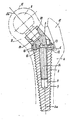
- This prosthesis essentially comprises two elements: a femoral element 2 and a cephalic element 3.
- the femoral element 2 essentially consists of a rod intended to be engaged and fixed in the medullary canal of the femur 4 of a patient.
- this rod externally carries a conical thread 5 and its large diameter end, that is to say that opposite that which is intended to be engaged in the medullary canal of the femur 4, has a flange 6 coaxial with the axis 5a of the thread 5.
- this femoral element 2 has a conical bore 7 with a slight slope.
- the second element namely the cephalic element 3 intended to replace on the one hand, the neck 8 of the femur 4 and, on the other hand, by a sphere 9 which it supports, the head 11 of the femur 4 is intended to be assembled with the femoral element 2.
- the cephalic element 3 is substantially in the form of a cylindrical part.
- One 12 of the ends of this element 3 which is intended to bear on the collar 6 of the femoral element 2 is constituted by a flat surface forming with the axis 3a an angle 13 corresponding to the angle normally formed between l axis of the femur 4 and the axis of its neck.
- In the center of this bearing surface 6, projects a conical rod 14 of profile complementary to the conical bore 7 of the femoral element 2 and intended to be engaged in this bore to ensure, by wedging, the fixing of the cephalic element 3 to femoral element 2.
- the flange 6 has, on its assembly face, holes 15 regularly distributed along a ring concentric with the axis 5a and, on the other hand, the element 3 has a projection 16 on its bearing face 12 with a lug 16 of the same section as the holes 15 and capable of being engaged in one chosen from the said holes.
- This engagement therefore has the effect of ensuring the immobilization in rotation of the elements 2 and 3 of this prosthesis even in the presence of significant forces transmitted by the acetabular cavity of the patient's hip to the sphere 9 carried by the cephalic element 3 .
- the practitioner can therefore determine the angular position of the cephalic element 3 relative to the femoral element 2 depending on the desired anteversion.
- the conical thread 5 is at a relatively large pitch, such as of the order of 4 to 6 mm, so as to allow its good penetration and good bonding in the cancellous bone of the medullary canal of the femur. 4.
- they are advantageously coated with an aluminum oxide ceramic favorable to the corticalization of this cancellous bone.
- the sphere 9 intended to replace the head of the patient's femur can be removably assembled with the cephalic element 3 in order to facilitate the storage conditions of this prosthesis.
- this assembly is advantageously carried out as described in patent FR-A-2 349 319 by providing on the one hand, a conical fitting as shown in 18 and, on the other hand, an assembly by screwing as shown in 19.
Landscapes
- Health & Medical Sciences (AREA)
- Orthopedic Medicine & Surgery (AREA)
- Cardiology (AREA)
- Oral & Maxillofacial Surgery (AREA)
- Transplantation (AREA)
- Engineering & Computer Science (AREA)
- Biomedical Technology (AREA)
- Heart & Thoracic Surgery (AREA)
- Vascular Medicine (AREA)
- Life Sciences & Earth Sciences (AREA)
- Animal Behavior & Ethology (AREA)
- General Health & Medical Sciences (AREA)
- Public Health (AREA)
- Veterinary Medicine (AREA)
- Prostheses (AREA)
Description
- La présente invention concerne une prothèse intramédullaire non scellée pour articulation de la hanche.
- On utilise actuellement deux types de prothèse de hanche, à savoir: les prothèses à double cupule scellée et les prothèses intramédullaires.
- Les prothèses à double cupule scellée comportent une cupule métallique scellée sur la tête fraisée du fémur et une cupule en matière plastique scellée sur le cotyle. Ce type de . prothèse présente l'inconvénient d'une pose difficile puisque la tête du fémur doit être préalablement fraisée. En outre, il existe des risques de nécrose de la tête sous le ciment, nécrose entraînant des cassures rendant nécessaire une nouvelle intervention chirurgicale.
- Pour obtenir de bons résultats avec des tiges fémorales non scellées, il faut que l'os spongieux se corticalise, c'est-à-dire qu'il acquiert une certaine dureté. Or, ce phénomène de corticalisation se produit d'autant mieux que l'os spongieux est soumis à des contraintes mécaniques, ce qui est rarement le cas avec les tiges utilisées habituellement.
- On connait cependant (FR-A-2 295 729, EP-A-549) une prothèse intramédullaire non scellée, pour articulation de la hanche, comportant deux éléments aptes à être fixés l'un à l'autre, à savoir un élément fémoral formé essentiellement d'une tige destinée à être engagée dans le canal médullaire du fémur considéré et un élément céphalique supportant une sphère adaptable à l'extrémité de l'élément fémoral non engagé dans le fémur, cette sphère étant destinée à être engagée et à prendre appui dans la cavité cotyloïdienne de la hanche correspondante.
- Dans cette prothèse, d'une part la tige porte un filetage permettant sa fixation au fémur par vissage dans le canal intramédullaire et d'autre part, les moyens d'assemblage de l'élément céphalique à l'élément fémoral comprennent d'une part, un crantage des surfaces d'appui respectives assurant leur liaison en rotation dans la position angulaire désirée et, d'autre part, une vis d'immobilisation.
- On conçoit aisément qu'un réglage fin de la position angulaire de l'élément céphalique par rapport à la partie fémorale nécessite un crantage fin, ce qui est incompatible avec une bonne tenue mécanique de la liaison en rotation des deux éléments. En outre, il est évident que la mise en place de cette prothèse est longue, ce qui augments les risques de l'intervention chirurgicale.
- La présente invention vise à remédier à ces inconvénients. A cet effet, dans la prothèse qu'elle concerne, et qui est du type précité, d'une part, le filetage de la tige de l'élément fémoral est conique et, d'autre part, les moyens d'assemblage des deux éléments comprennent, dans l'élément fémoral, un alésage conique à faible pente, coaxial à la tige et débouchant dans l'extrémité de celle-ci non engagée dans le canal médullaire du fémur et, dans l'élément céphalique, en saillie sur sa face d'appui contre l'extrémité précitée de l'élément fémoral, une tige conique de profil complémentaire de l'alésage conique de l'élément fémoral, et permettant la solidarisation des deux éléments par simple coincement mutuel résultant de la faible pente des cônes, des moyens étant prévus pour répérer et conserver la position angulaire de l'élément céphalique par rapport à l'élément fémoral lors de leur assemblage.
- Grâce au filetage conique de la tige de son élément fémoral, cette prothèse est d'une mise en place très rapide puisque l'élément peut être vissé en peu de tours, voire même fraction de tour.
- L'extrémité de l'élément fémoral non engagée dans le canal médullaire du fémur porte une collerette coaxiale à la tige dont la face inférieure est destinée à prendre appui contre l'extrémité réséquée du fémur et dont la face supérieure est destinée à servir de face d'appui à l'élément céphalique, des moyens étant prévus pour permettre son entraînement en rotation lors de son vissage.
- Par exemple, ces moyens sont constitués par des trous dans lesquels peuvent être engagés des ergots d'une clé d'entraînement.
- Les moyens de repérage, de guidage et de maintien de la position angulaire de l'élément céphalique par rapport à l'élément fémoral sont constitués par au moins un ergot porté par la face d'appui de l'élément céphalique et une série de trous de profil correspondant prévus sur la face supérieure de la collerette de l'élément fémoral concentriquement à son alésage conique et dans l'un choisi desquels peut être engagé l'ergot précité, avant que la tige conique de l'élément céphalique ne soit concée dans l'alésage conique de l'élément fémoral.
- De préférence, les trous prévus sur la collerette de l'élément fémoral pour le repérage et le guidage de la position angulaire de l'élément céphalique et ceux pour l'entraînement en rotation de l'élément fémoral sont confondus.
- Suivant encore une autre caractéristique de l'invention, les filets du filetage conique de la tige de l'élément fémoral sont revêtus de céramique d'alumine favorable à la corticalisation de l'os spongieux tel que l'oxyde d'aluminium.
- De toute façon, l'invention sera bien comprise à l'aide de la description qui suit, en référence au dessin schématique annexé dont l'unique figure représente, vue en coupe axiale, une forme d'exécution de cette prothèse donnée à titre d'exemple non limitatif.
- Cette prothèse comprend essentiellement deux éléments: un élément fémoral 2 et un élément céphalique 3.
- L'élément fémoral 2 se compose essentiellement d'une tige destinée à être engagée et fixée dans le canal médullaire du fémur 4 d'un patient. Comme le montre le dessin, cette tige porte extérieurement un filetage conique 5 et son extrémité de grand diamètre, c'est-à-dire celle opposée à celle qui est destinée à être engagée dans le canal médullaire du fémur 4, présente une collerette 6 coaxiale à l'axe 5a du filetage 5.
- En outre, débouchant au centre de la collerette 6 cet élément fémoral 2 présente un alésage conique 7 à faible pente.
- Le second élément, à savoir l'élément céphalique 3 destiné à remplacer d'une part, le col 8 du fémur 4 et, d'autre part, par une sphère 9 qu'il supporte, la tête 11 du fémur 4 est destiné à être assemblé à l'élément fémoral 2. L'élément céphalique 3 se présente sensiblement comme une pièce cylindrique. L'une 12 des extrémités de cet élément 3 qui est destinée à prendre appui sur la collerette 6 de l'élément fémoral 2 est constituée par une surface plane formant avec l'axe 3a un angle 13 correspondant à l'angle formé normalement entre l'axe du fémur 4 et l'axe de son col. Au centre de cette surface d'appui 6, fait saillie une tige conique 14 de profil complémentaire à l'alésage conique 7 de l'élément fémoral 2 et destinée à être engagée dans cet alésage pour assurer, par coincement, la fixation de l'élément céphalique 3 à l'élément fémoral 2.
- Pour permettre le repérage, le guidage et le maintien de la position angulaire de l'élément céphalique 3 par rapport à l'autre autour de l'axe 5a, d'une part, la collerette 6 présente, sur sa face d'assemblage, des trous 15 répartis régulièrement suivant une couronne concentrique à l'axe 5a et, d'autre part, l'élément 3 présente en saillie sur sa face d'appui 12 un ergot 16 de même section que les trous 15 et apte à être engagé dans l'un choisi des dits trous. Cet engagement a donc pour effet d'assurer l'immobilisation en rotation des éléments 2 et 3 de cette prothèse même en présence d'efforts importants transmis par la cavité cotyloïdienne de la hanche du patient à la sphère 9 portée par l'élément céphalique 3.
- Lors de la mise en place de cette prothèse, le praticien peut donc déterminer la position angulaire de l'élément céphalique 3 par rapport à l'élément fémoral 2 en fonction de l'antéversion désirée.
- Pour cette mise en place, il suffit donc de fixer l'élément fémoral 2 seul dans le canal médullaire du fémur 4 en utilisant, par exemple, les trous 15 pour son entraînement en rotation. Pour cela, il suffit de disposer d'une clé à ergot engageable dans au moins deux trous 15. Il faut noter que la conicité du filetage 5 permet un engagement direct de l'élément fémoral 2 dans le canal médullaire du fémur 4 et que l'opération de vissage n'est nécessaire qu'en fin de cet engagement, ce qui permet une mise en place très rapide.
- En outre, le fait de pouvoir mettre en place l'élément fémoral 2 avant l'assemblage de l'élément céphalique 3 permet de conserver au patient le grand trauchantère 17.
- Comme le montre le dessin, le filetage conique 5 est à un pas relativement important, tel que de l'ordre de 4 à 6 mm, de manière à permettre sa bonne pénétration et un bôn accrochage dans l'os spongieux du canal médullaire du fémur 4. En outre, ils sont avantageusement revêtus d'une céramique d'oxyde d'aluminium favorable à la corticalisation de cet os spongieux.
- Comme le montre également le dessin, la sphère 9 destinée à remplacer la tête du fémur du patient peut être assemblée de manière amovible à l'élément céphalique 3 afin de faciliter les conditions de stockage de cette prothèse. Dans ce cas, cet assemblage est avantageusement réalisé comme décrit dans le brevet FR-A-2 349 319 en prévoyant d'une part, un emmanchemant conique comme montré en 18 et, d'autre part., un assemblage par vissage comme montré en 19.
- .Comme il va de soi et comme il ressort de ce qui précède, l'invention ne se limite pas à la seule forme d'exécution de cette prothèse qui a été décrite ci-dessus à titre d'exemple non limitatif; elle en embrasse, au contraire, toutes les variantes de réalisation.
Claims (5)
Priority Applications (1)
| Application Number | Priority Date | Filing Date | Title |
|---|---|---|---|
| AT80420150T ATE6029T1 (de) | 1980-04-30 | 1980-12-31 | Nicht zementierte endoprothese fuer ein hueftgelenk. |
Applications Claiming Priority (2)
| Application Number | Priority Date | Filing Date | Title |
|---|---|---|---|
| FR8010134A FR2481596A1 (fr) | 1980-04-30 | 1980-04-30 | Prothese intramedullaire non scellee pour articulations de la hanche |
| FR8010134 | 1980-04-30 |
Publications (2)
| Publication Number | Publication Date |
|---|---|
| EP0038897A1 EP0038897A1 (fr) | 1981-11-04 |
| EP0038897B1 true EP0038897B1 (fr) | 1984-02-01 |
Family
ID=9241694
Family Applications (1)
| Application Number | Title | Priority Date | Filing Date |
|---|---|---|---|
| EP80420150A Expired EP0038897B1 (fr) | 1980-04-30 | 1980-12-31 | Prothèse intramédullaire non scellée pour articulation de la hanche |
Country Status (4)
| Country | Link |
|---|---|
| EP (1) | EP0038897B1 (fr) |
| AT (1) | ATE6029T1 (fr) |
| DE (1) | DE3066446D1 (fr) |
| FR (1) | FR2481596A1 (fr) |
Cited By (1)
| Publication number | Priority date | Publication date | Assignee | Title |
|---|---|---|---|---|
| US7323013B2 (en) | 1998-04-14 | 2008-01-29 | Encore Medical Asset Corporation | Differential porosity prosthetic hip system |
Families Citing this family (22)
| Publication number | Priority date | Publication date | Assignee | Title |
|---|---|---|---|---|
| US4578081A (en) * | 1982-02-17 | 1986-03-25 | Howmedica International, Inc. | Bone prosthesis |
| GB2162753A (en) * | 1984-06-22 | 1986-02-12 | Thackray C F Ltd | Sleeve for metal implant into bone |
| FR2575383B1 (fr) * | 1984-12-27 | 1990-11-30 | Lecestre Pierre | Prothese pour articulation diarthrose |
| FR2580171B1 (fr) * | 1985-04-10 | 1989-12-01 | Rambert Andre | Partie femorale de prothese pour articulation de la hanche |
| FR2580926B1 (fr) * | 1985-04-24 | 1991-04-12 | Montagne Patrick | Prothese femorale a col modulaire independant et variable en longueur et direction pour implantations de protheses femorales simples ou de protheses totales de hanche |
| DE3535158A1 (de) * | 1985-10-02 | 1987-04-09 | Gmt Medizinische Technik Gmbh | Sattelprothese |
| EP0257359B1 (fr) * | 1986-08-15 | 1991-11-27 | Boehringer Mannheim Corporation | Prothèse modulaire pour la hanche |
| GB8625174D0 (en) * | 1986-10-21 | 1986-11-26 | Edwards Barry Noel | Dental prostheses |
| FR2622791A1 (fr) * | 1987-11-06 | 1989-05-12 | Biomecanique Integree | Prothese du type femoral |
| GB2222776B (en) * | 1988-09-15 | 1992-12-02 | Mclardy Smith Peter David | A prosthesis |
| FR2640497B1 (fr) * | 1988-12-19 | 1997-10-03 | Mesguich Alain | Implant femoral pour prothese de hanche |
| US5108452A (en) * | 1989-02-08 | 1992-04-28 | Smith & Nephew Richards Inc. | Modular hip prosthesis |
| FR2647335A1 (fr) * | 1989-05-23 | 1990-11-30 | Bousquet Gilles | Tige intramedullaire pour prothese vissee |
| ATE151621T1 (de) * | 1990-06-06 | 1997-05-15 | Ronald Sekel | Hüftprothese |
| FR2673832A1 (fr) * | 1991-03-11 | 1992-09-18 | Serf | Element femoral pour prothese de la hanche. |
| FR2677879B1 (fr) * | 1991-06-21 | 1998-05-15 | Medical Op | Systeme d'accrochage mecanique pour adjonction de pieces a angulation variable et hauteur variable dit multi-angulaire et plus particulierement destine a la prothese totale de hanche. |
| EP0547354A1 (fr) * | 1991-12-17 | 1993-06-23 | Dr.Ing.h.c. F. Porsche Aktiengesellschaft | Endoprothèse réglable pour l'articulation de la hanche |
| CH687230A5 (de) * | 1993-02-18 | 1996-10-31 | Peter Prof Dr Schawalder | Schaftkomponente fuer eine Endogelenkprothese. |
| FR2718954B1 (fr) * | 1994-04-25 | 1996-08-02 | Euros Sa | Ensemble prothétique modulaire pour l'articulation de l'épaule. |
| FR2720628B1 (fr) * | 1994-06-03 | 1996-10-04 | Provis Sa | Prothèse pour l'articulation trapézo-métacarpienne. |
| GB9828085D0 (en) * | 1998-12-18 | 1999-02-17 | Benoist Girard & Cie | Femoral component |
| US7135044B2 (en) | 2004-03-09 | 2006-11-14 | Howmedics Osteonics Corp. | Modular prosthesis kits |
Family Cites Families (6)
| Publication number | Priority date | Publication date | Assignee | Title |
|---|---|---|---|---|
| DE2340546A1 (de) * | 1973-08-10 | 1975-02-27 | Pfaudler Werke Ag | Metallisches implantat und verfahren zu seiner herstellung |
| FR2366005A2 (fr) * | 1976-07-28 | 1978-04-28 | Mahay Cie | Prothese totale de la hanche |
| DE2734249A1 (de) * | 1977-07-29 | 1979-02-08 | Bayer Ag | Oberschenkelhalsprothese |
| DE2808740A1 (de) * | 1978-03-01 | 1979-09-06 | Omar Pacha Nabil Dr | Gelenkprothese |
| EP0010527A1 (fr) * | 1978-10-06 | 1980-04-30 | L.I.M.A. Lualdi Industrie MeccanicheAnduis Srl. | Prothèse pour membres |
| FR2438470A1 (fr) * | 1978-10-12 | 1980-05-09 | Rambert Andre | Prothese de hanche |
-
1980
- 1980-04-30 FR FR8010134A patent/FR2481596A1/fr active Granted
- 1980-12-31 AT AT80420150T patent/ATE6029T1/de not_active IP Right Cessation
- 1980-12-31 DE DE8080420150T patent/DE3066446D1/de not_active Expired
- 1980-12-31 EP EP80420150A patent/EP0038897B1/fr not_active Expired
Cited By (1)
| Publication number | Priority date | Publication date | Assignee | Title |
|---|---|---|---|---|
| US7323013B2 (en) | 1998-04-14 | 2008-01-29 | Encore Medical Asset Corporation | Differential porosity prosthetic hip system |
Also Published As
| Publication number | Publication date |
|---|---|
| ATE6029T1 (de) | 1984-02-15 |
| FR2481596B1 (fr) | 1984-09-14 |
| FR2481596A1 (fr) | 1981-11-06 |
| EP0038897A1 (fr) | 1981-11-04 |
| DE3066446D1 (en) | 1984-03-08 |
Similar Documents
| Publication | Publication Date | Title |
|---|---|---|
| EP0038897A1 (fr) | Prothèse intramédullaire non scellée pour articulation de la hanche | |
| EP0549480B1 (fr) | Prothèse huméralemodulaire | |
| EP1510190B1 (fr) | Composant glénoidien de prothèse d'épaule et prothèse totale d'épaule incorporant un tel composant | |
| EP0069683B1 (fr) | Prothèse totale du genou | |
| EP0190981B1 (fr) | Prothèse totale de hanche à fixation primaire | |
| EP0299889B1 (fr) | Prothèse totale de l'épaule | |
| EP0028546B1 (fr) | Prothèse de hanche | |
| EP0485311B1 (fr) | Tige fémorale perfectionnée pour prothèse de hanche | |
| WO1991008714A1 (fr) | Implant dentaire | |
| EP1591084B1 (fr) | Glenoid implant for an inverted total shoulder prothesis and prothesis therefor. | |
| FR2579454A1 (fr) | Prothese gleno-humerale | |
| FR2664809A1 (fr) | Systeme de prothese d'epaule. | |
| WO1987005490A1 (fr) | Cupule de prothese | |
| FR2718014A1 (fr) | Dispositif d'ancrage par vis ou pointes d'une cupule prothétique. | |
| EP0581667A1 (fr) | Prothèse de glène vissée | |
| EP0839016A1 (fr) | Implant cotyloidien fixe sans ciment | |
| FR2575383A1 (fr) | Prothese pour articulation diarthrose | |
| FR2782262A1 (fr) | Cotyle d'essai ou implantable a orientation reglable | |
| FR2860425A1 (fr) | Implant humeral pour prothese de l'epaule | |
| FR2634371A1 (fr) | Prothese de hanche et procede de fabrication d'une telle prothese | |
| FR2781362A1 (fr) | Cupule de cotyle pour prothese de hanche | |
| CA1283251C (fr) | Partie femorale de prothese pour articulation de la hanche | |
| FR2692776A1 (fr) | Prothèse totale pour articulations des os, notamment de la main et du pied. | |
| FR2651995A1 (fr) | Anneau pour implant cotylouidien. | |
| FR2737847A1 (fr) | Implant-taraud comprimant |
Legal Events
| Date | Code | Title | Description |
|---|---|---|---|
| PUAI | Public reference made under article 153(3) epc to a published international application that has entered the european phase |
Free format text: ORIGINAL CODE: 0009012 |
|
| AK | Designated contracting states |
Designated state(s): AT BE CH DE GB IT LU NL SE |
|
| 17P | Request for examination filed |
Effective date: 19811012 |
|
| ITF | It: translation for a ep patent filed | ||
| GRAA | (expected) grant |
Free format text: ORIGINAL CODE: 0009210 |
|
| AK | Designated contracting states |
Designated state(s): AT BE CH DE GB IT LI LU NL SE |
|
| REF | Corresponds to: |
Ref document number: 6029 Country of ref document: AT Date of ref document: 19840215 Kind code of ref document: T |
|
| REF | Corresponds to: |
Ref document number: 3066446 Country of ref document: DE Date of ref document: 19840308 |
|
| PGFP | Annual fee paid to national office [announced via postgrant information from national office to epo] |
Ref country code: DE Payment date: 19841102 Year of fee payment: 5 |
|
| PLBE | No opposition filed within time limit |
Free format text: ORIGINAL CODE: 0009261 |
|
| STAA | Information on the status of an ep patent application or granted ep patent |
Free format text: STATUS: NO OPPOSITION FILED WITHIN TIME LIMIT |
|
| PGFP | Annual fee paid to national office [announced via postgrant information from national office to epo] |
Ref country code: CH Payment date: 19841214 Year of fee payment: 5 |
|
| PG25 | Lapsed in a contracting state [announced via postgrant information from national office to epo] |
Ref country code: LU Free format text: LAPSE BECAUSE OF NON-PAYMENT OF DUE FEES Effective date: 19841231 |
|
| PGFP | Annual fee paid to national office [announced via postgrant information from national office to epo] |
Ref country code: SE Payment date: 19841231 Year of fee payment: 5 |
|
| 26N | No opposition filed | ||
| PGFP | Annual fee paid to national office [announced via postgrant information from national office to epo] |
Ref country code: AT Payment date: 19861230 Year of fee payment: 7 |
|
| PGFP | Annual fee paid to national office [announced via postgrant information from national office to epo] |
Ref country code: NL Payment date: 19871231 Year of fee payment: 8 |
|
| ITTA | It: last paid annual fee | ||
| PGFP | Annual fee paid to national office [announced via postgrant information from national office to epo] |
Ref country code: BE Payment date: 19890110 Year of fee payment: 9 |
|
| PG25 | Lapsed in a contracting state [announced via postgrant information from national office to epo] |
Ref country code: LI Effective date: 19891231 Ref country code: GB Effective date: 19891231 Ref country code: CH Effective date: 19891231 Ref country code: BE Effective date: 19891231 Ref country code: AT Effective date: 19891231 |
|
| PG25 | Lapsed in a contracting state [announced via postgrant information from national office to epo] |
Ref country code: SE Effective date: 19900101 |
|
| BERE | Be: lapsed |
Owner name: BOUSQUET GILLES Effective date: 19891231 Owner name: RAMBERT ANDRE Effective date: 19891231 |
|
| PG25 | Lapsed in a contracting state [announced via postgrant information from national office to epo] |
Ref country code: NL Effective date: 19900701 |
|
| NLV4 | Nl: lapsed or anulled due to non-payment of the annual fee | ||
| GBPC | Gb: european patent ceased through non-payment of renewal fee | ||
| REG | Reference to a national code |
Ref country code: CH Ref legal event code: PL |
|
| PG25 | Lapsed in a contracting state [announced via postgrant information from national office to epo] |
Ref country code: DE Effective date: 19900901 |
|
| EUG | Se: european patent has lapsed |
Ref document number: 80420150.7 Effective date: 19901106 |