EP0038735B1 - Procédé de préparation de produits ayant un groupement perfluoroalkyle en présence de zinc en milieu acide - Google Patents
Procédé de préparation de produits ayant un groupement perfluoroalkyle en présence de zinc en milieu acide Download PDFInfo
- Publication number
- EP0038735B1 EP0038735B1 EP81400552A EP81400552A EP0038735B1 EP 0038735 B1 EP0038735 B1 EP 0038735B1 EP 81400552 A EP81400552 A EP 81400552A EP 81400552 A EP81400552 A EP 81400552A EP 0038735 B1 EP0038735 B1 EP 0038735B1
- Authority
- EP
- European Patent Office
- Prior art keywords
- acid
- process according
- solvent
- preparation
- zinc
- Prior art date
- Legal status (The legal status is an assumption and is not a legal conclusion. Google has not performed a legal analysis and makes no representation as to the accuracy of the status listed.)
- Expired
Links
- 238000000034 method Methods 0.000 title claims description 27
- HCHKCACWOHOZIP-UHFFFAOYSA-N Zinc Chemical compound [Zn] HCHKCACWOHOZIP-UHFFFAOYSA-N 0.000 title claims description 17
- 239000011701 zinc Substances 0.000 title claims description 17
- 239000002253 acid Substances 0.000 title claims description 13
- 238000002360 preparation method Methods 0.000 title claims description 13
- 229910052725 zinc Inorganic materials 0.000 title claims description 13
- 150000001875 compounds Chemical class 0.000 title 1
- 125000005010 perfluoroalkyl group Chemical group 0.000 title 1
- 230000008569 process Effects 0.000 claims description 18
- 239000002904 solvent Substances 0.000 claims description 17
- 238000006243 chemical reaction Methods 0.000 claims description 15
- -1 perfluoroalkyl iodide Chemical compound 0.000 claims description 13
- 125000000524 functional group Chemical group 0.000 claims description 5
- 229910052500 inorganic mineral Inorganic materials 0.000 claims description 5
- 239000011707 mineral Substances 0.000 claims description 5
- 150000002825 nitriles Chemical group 0.000 claims description 5
- 125000004423 acyloxy group Chemical group 0.000 claims description 4
- 150000001408 amides Chemical group 0.000 claims description 4
- 150000002148 esters Chemical group 0.000 claims description 4
- 239000002184 metal Substances 0.000 claims description 4
- 229910052751 metal Inorganic materials 0.000 claims description 4
- 150000003254 radicals Chemical class 0.000 claims description 4
- ZMZDMBWJUHKJPS-UHFFFAOYSA-M thiocyanate group Chemical group [S-]C#N ZMZDMBWJUHKJPS-UHFFFAOYSA-M 0.000 claims description 4
- 150000003573 thiols Chemical group 0.000 claims description 4
- 150000002118 epoxides Chemical group 0.000 claims description 3
- 125000004435 hydrogen atom Chemical group [H]* 0.000 claims description 3
- 239000003960 organic solvent Substances 0.000 claims description 3
- 125000000217 alkyl group Chemical group 0.000 claims description 2
- 239000000956 alloy Substances 0.000 claims description 2
- 229910045601 alloy Inorganic materials 0.000 claims description 2
- 150000005840 aryl radicals Chemical class 0.000 claims description 2
- 125000003178 carboxy group Chemical group [H]OC(*)=O 0.000 claims description 2
- 125000004122 cyclic group Chemical group 0.000 claims description 2
- 125000000753 cycloalkyl group Chemical group 0.000 claims description 2
- 229910052736 halogen Inorganic materials 0.000 claims description 2
- 150000002367 halogens Chemical group 0.000 claims description 2
- 125000002887 hydroxy group Chemical group [H]O* 0.000 claims description 2
- 150000007524 organic acids Chemical group 0.000 claims description 2
- 150000003568 thioethers Chemical group 0.000 claims description 2
- 230000015572 biosynthetic process Effects 0.000 claims 1
- 125000001183 hydrocarbyl group Chemical group 0.000 claims 1
- 239000000047 product Substances 0.000 description 19
- 150000001336 alkenes Chemical class 0.000 description 14
- UHOVQNZJYSORNB-UHFFFAOYSA-N Benzene Chemical compound C1=CC=CC=C1 UHOVQNZJYSORNB-UHFFFAOYSA-N 0.000 description 12
- XBDQKXXYIPTUBI-UHFFFAOYSA-N dimethylselenoniopropionate Natural products CCC(O)=O XBDQKXXYIPTUBI-UHFFFAOYSA-N 0.000 description 11
- 239000000203 mixture Substances 0.000 description 9
- JRZJOMJEPLMPRA-UHFFFAOYSA-N olefin Natural products CCCCCCCC=C JRZJOMJEPLMPRA-UHFFFAOYSA-N 0.000 description 9
- NLHHRLWOUZZQLW-UHFFFAOYSA-N Acrylonitrile Chemical compound C=CC#N NLHHRLWOUZZQLW-UHFFFAOYSA-N 0.000 description 5
- IAZDPXIOMUYVGZ-UHFFFAOYSA-N Dimethylsulphoxide Chemical compound CS(C)=O IAZDPXIOMUYVGZ-UHFFFAOYSA-N 0.000 description 5
- 238000005481 NMR spectroscopy Methods 0.000 description 5
- 239000010949 copper Substances 0.000 description 5
- 235000019260 propionic acid Nutrition 0.000 description 5
- IUVKMZGDUIUOCP-BTNSXGMBSA-N quinbolone Chemical compound O([C@H]1CC[C@H]2[C@H]3[C@@H]([C@]4(C=CC(=O)C=C4CC3)C)CC[C@@]21C)C1=CCCC1 IUVKMZGDUIUOCP-BTNSXGMBSA-N 0.000 description 5
- XLYOFNOQVPJJNP-UHFFFAOYSA-N water Substances O XLYOFNOQVPJJNP-UHFFFAOYSA-N 0.000 description 5
- SMZOUWXMTYCWNB-UHFFFAOYSA-N 2-(2-methoxy-5-methylphenyl)ethanamine Chemical compound COC1=CC=C(C)C=C1CCN SMZOUWXMTYCWNB-UHFFFAOYSA-N 0.000 description 4
- VEXZGXHMUGYJMC-UHFFFAOYSA-N Hydrochloric acid Chemical compound Cl VEXZGXHMUGYJMC-UHFFFAOYSA-N 0.000 description 4
- NIXOWILDQLNWCW-UHFFFAOYSA-N acrylic acid group Chemical group C(C=C)(=O)O NIXOWILDQLNWCW-UHFFFAOYSA-N 0.000 description 4
- 230000009466 transformation Effects 0.000 description 4
- QTBSBXVTEAMEQO-UHFFFAOYSA-N Acetic acid Chemical compound CC(O)=O QTBSBXVTEAMEQO-UHFFFAOYSA-N 0.000 description 3
- YXFVVABEGXRONW-UHFFFAOYSA-N Toluene Chemical compound CC1=CC=CC=C1 YXFVVABEGXRONW-UHFFFAOYSA-N 0.000 description 3
- XTXRWKRVRITETP-UHFFFAOYSA-N Vinyl acetate Chemical compound CC(=O)OC=C XTXRWKRVRITETP-UHFFFAOYSA-N 0.000 description 3
- 230000002378 acidificating effect Effects 0.000 description 3
- 125000000896 monocarboxylic acid group Chemical group 0.000 description 3
- 239000000376 reactant Substances 0.000 description 3
- BULLJMKUVKYZDJ-UHFFFAOYSA-N 1,1,1,2,2,3,3,4,4,5,5,6,6-tridecafluoro-6-iodohexane Chemical compound FC(F)(F)C(F)(F)C(F)(F)C(F)(F)C(F)(F)C(F)(F)I BULLJMKUVKYZDJ-UHFFFAOYSA-N 0.000 description 2
- XJSRKJAHJGCPGC-UHFFFAOYSA-N 1,1,1,2,2,3,3,4,4,5,5,6,6-tridecafluorohexane Chemical compound FC(F)C(F)(F)C(F)(F)C(F)(F)C(F)(F)C(F)(F)F XJSRKJAHJGCPGC-UHFFFAOYSA-N 0.000 description 2
- XXROGKLTLUQVRX-UHFFFAOYSA-N allyl alcohol Chemical compound OCC=C XXROGKLTLUQVRX-UHFFFAOYSA-N 0.000 description 2
- 239000006227 byproduct Substances 0.000 description 2
- 229910052799 carbon Inorganic materials 0.000 description 2
- OPQARKPSCNTWTJ-UHFFFAOYSA-L copper(ii) acetate Chemical compound [Cu+2].CC([O-])=O.CC([O-])=O OPQARKPSCNTWTJ-UHFFFAOYSA-L 0.000 description 2
- 239000006185 dispersion Substances 0.000 description 2
- 238000004821 distillation Methods 0.000 description 2
- QMPHOSZUUXOKIV-UHFFFAOYSA-N ethyl 4,4,5,5,6,6,7,7,8,8,9,9,9-tridecafluorononanoate Chemical compound CCOC(=O)CCC(F)(F)C(F)(F)C(F)(F)C(F)(F)C(F)(F)C(F)(F)F QMPHOSZUUXOKIV-UHFFFAOYSA-N 0.000 description 2
- BDAGIHXWWSANSR-UHFFFAOYSA-N formic acid Substances OC=O BDAGIHXWWSANSR-UHFFFAOYSA-N 0.000 description 2
- ZMZDMBWJUHKJPS-UHFFFAOYSA-N hydrogen thiocyanate Natural products SC#N ZMZDMBWJUHKJPS-UHFFFAOYSA-N 0.000 description 2
- 238000004949 mass spectrometry Methods 0.000 description 2
- 238000007342 radical addition reaction Methods 0.000 description 2
- 239000011541 reaction mixture Substances 0.000 description 2
- 238000003756 stirring Methods 0.000 description 2
- 125000001424 substituent group Chemical group 0.000 description 2
- 238000005406 washing Methods 0.000 description 2
- RYHBNJHYFVUHQT-UHFFFAOYSA-N 1,4-Dioxane Chemical compound C1COCCO1 RYHBNJHYFVUHQT-UHFFFAOYSA-N 0.000 description 1
- OSWFIVFLDKOXQC-UHFFFAOYSA-N 4-(3-methoxyphenyl)aniline Chemical compound COC1=CC=CC(C=2C=CC(N)=CC=2)=C1 OSWFIVFLDKOXQC-UHFFFAOYSA-N 0.000 description 1
- QTBSBXVTEAMEQO-UHFFFAOYSA-M Acetate Chemical compound CC([O-])=O QTBSBXVTEAMEQO-UHFFFAOYSA-M 0.000 description 1
- HRPVXLWXLXDGHG-UHFFFAOYSA-N Acrylamide Chemical compound NC(=O)C=C HRPVXLWXLXDGHG-UHFFFAOYSA-N 0.000 description 1
- XFXPMWWXUTWYJX-UHFFFAOYSA-N Cyanide Chemical compound N#[C-] XFXPMWWXUTWYJX-UHFFFAOYSA-N 0.000 description 1
- VGGSQFUCUMXWEO-UHFFFAOYSA-N Ethene Chemical compound C=C VGGSQFUCUMXWEO-UHFFFAOYSA-N 0.000 description 1
- JIGUQPWFLRLWPJ-UHFFFAOYSA-N Ethyl acrylate Chemical compound CCOC(=O)C=C JIGUQPWFLRLWPJ-UHFFFAOYSA-N 0.000 description 1
- 239000005977 Ethylene Substances 0.000 description 1
- 238000004566 IR spectroscopy Methods 0.000 description 1
- CERQOIWHTDAKMF-UHFFFAOYSA-N Methacrylic acid Chemical compound CC(=C)C(O)=O CERQOIWHTDAKMF-UHFFFAOYSA-N 0.000 description 1
- BZHJMEDXRYGGRV-UHFFFAOYSA-N Vinyl chloride Chemical compound ClC=C BZHJMEDXRYGGRV-UHFFFAOYSA-N 0.000 description 1
- 230000004913 activation Effects 0.000 description 1
- 230000009286 beneficial effect Effects 0.000 description 1
- 238000009835 boiling Methods 0.000 description 1
- 125000004432 carbon atom Chemical group C* 0.000 description 1
- 238000004587 chromatography analysis Methods 0.000 description 1
- 150000001879 copper Chemical class 0.000 description 1
- TVZPLCNGKSPOJA-UHFFFAOYSA-N copper zinc Chemical compound [Cu].[Zn] TVZPLCNGKSPOJA-UHFFFAOYSA-N 0.000 description 1
- 230000008878 coupling Effects 0.000 description 1
- 238000010168 coupling process Methods 0.000 description 1
- 238000005859 coupling reaction Methods 0.000 description 1
- 238000010908 decantation Methods 0.000 description 1
- 239000000539 dimer Substances 0.000 description 1
- 238000000605 extraction Methods 0.000 description 1
- 238000001914 filtration Methods 0.000 description 1
- 238000004817 gas chromatography Methods 0.000 description 1
- 239000011521 glass Substances 0.000 description 1
- 125000005843 halogen group Chemical group 0.000 description 1
- 150000002430 hydrocarbons Chemical group 0.000 description 1
- 229910052739 hydrogen Inorganic materials 0.000 description 1
- 239000001257 hydrogen Substances 0.000 description 1
- XMBWDFGMSWQBCA-UHFFFAOYSA-N hydrogen iodide Chemical compound I XMBWDFGMSWQBCA-UHFFFAOYSA-N 0.000 description 1
- 238000007327 hydrogenolysis reaction Methods 0.000 description 1
- 230000007062 hydrolysis Effects 0.000 description 1
- 238000006460 hydrolysis reaction Methods 0.000 description 1
- 150000004694 iodide salts Chemical class 0.000 description 1
- LVHBHZANLOWSRM-UHFFFAOYSA-N itaconic acid Chemical class OC(=O)CC(=C)C(O)=O LVHBHZANLOWSRM-UHFFFAOYSA-N 0.000 description 1
- 229910052745 lead Inorganic materials 0.000 description 1
- 239000007788 liquid Substances 0.000 description 1
- 238000004519 manufacturing process Methods 0.000 description 1
- 229910052753 mercury Inorganic materials 0.000 description 1
- 150000002739 metals Chemical class 0.000 description 1
- 125000005395 methacrylic acid group Chemical group 0.000 description 1
- SYSQUGFVNFXIIT-UHFFFAOYSA-N n-[4-(1,3-benzoxazol-2-yl)phenyl]-4-nitrobenzenesulfonamide Chemical class C1=CC([N+](=O)[O-])=CC=C1S(=O)(=O)NC1=CC=C(C=2OC3=CC=CC=C3N=2)C=C1 SYSQUGFVNFXIIT-UHFFFAOYSA-N 0.000 description 1
- 238000010534 nucleophilic substitution reaction Methods 0.000 description 1
- 239000012074 organic phase Substances 0.000 description 1
- 238000010653 organometallic reaction Methods 0.000 description 1
- PNJWIWWMYCMZRO-UHFFFAOYSA-N pent‐4‐en‐2‐one Natural products CC(=O)CC=C PNJWIWWMYCMZRO-UHFFFAOYSA-N 0.000 description 1
- 239000000843 powder Substances 0.000 description 1
- 239000012429 reaction media Substances 0.000 description 1
- 230000009257 reactivity Effects 0.000 description 1
- 230000009467 reduction Effects 0.000 description 1
- 238000000926 separation method Methods 0.000 description 1
Classifications
-
- C—CHEMISTRY; METALLURGY
- C07—ORGANIC CHEMISTRY
- C07C—ACYCLIC OR CARBOCYCLIC COMPOUNDS
- C07C255/00—Carboxylic acid nitriles
-
- C—CHEMISTRY; METALLURGY
- C07—ORGANIC CHEMISTRY
- C07C—ACYCLIC OR CARBOCYCLIC COMPOUNDS
- C07C17/00—Preparation of halogenated hydrocarbons
- C07C17/23—Preparation of halogenated hydrocarbons by dehalogenation
-
- C—CHEMISTRY; METALLURGY
- C07—ORGANIC CHEMISTRY
- C07C—ACYCLIC OR CARBOCYCLIC COMPOUNDS
- C07C253/00—Preparation of carboxylic acid nitriles
- C07C253/14—Preparation of carboxylic acid nitriles by reaction of cyanides with halogen-containing compounds with replacement of halogen atoms by cyano groups
-
- C—CHEMISTRY; METALLURGY
- C07—ORGANIC CHEMISTRY
- C07C—ACYCLIC OR CARBOCYCLIC COMPOUNDS
- C07C51/00—Preparation of carboxylic acids or their salts, halides or anhydrides
- C07C51/347—Preparation of carboxylic acids or their salts, halides or anhydrides by reactions not involving formation of carboxyl groups
- C07C51/363—Preparation of carboxylic acids or their salts, halides or anhydrides by reactions not involving formation of carboxyl groups by introduction of halogen; by substitution of halogen atoms by other halogen atoms
Definitions
- the functional groups constituting the substituents of the olefin (II) can be very varied and are for example hydroxy groups (-OH), halogen atoms, acid functions (-COOH), nitrile, ester (-COOR) , epoxide, amide, acyloxy (-OCOR), thiol (-SH), thioether (-SR) or thiocyanate (-SCN).
- the products obtained according to the process of the invention are not all new products but the preparation methods known to date all require at least two reaction steps.
- the derivatives where R i and R 2 are hydrogen that is to say were obtained by nucleophilic substitution reactions of R F CH 2 CH 2 1 optionally followed by appropriate chemical transformations.
- the derivative R F -CH 2 CH 2 COOH was for example obtained by hydrolysis of the nitrile R F CH 2 CH 2 -CN itself obtained by reaction of R F C 2 H 4 1 with a metallic cyanide (BF 1 560 544), the R F C 2 H 4 1 being prepared by radical addition of the R F I to ethylene.
- Example No. 2 of this addition certificate thus describes the reaction of C 6 F 13 I and acrylonitrile in DMSO medium and in the presence of the Zn / Cu couple which provided C S F 13 C 2 H 4 CN with a yield of 50%.
- this reaction does not provide reproducible results and the yields remain low.
- the process according to the invention consists in reacting the perfluoroalkyl iodide and the olefin with zinc powder dispersed in an acidic solvent.
- This solvent can be an organic acid such as formic, acetic or propionic acid for example, a mineral acid (for example hydrochloric acid) or a mixture of an organic or mineral acid and an organic solvent such as benzene, toluene or dioxane for example.
- the amount of solvent used can be very variable and depends essentially on the nature of the perfluoroalkyl iodide and the olefin used. In general, about 100 to 1000 ml of solvent are used per mole of perfluoroalkyl iodide.
- the zinc used in this process is commercial zinc powder but it is generally beneficial to activate this sinc powder according to the methods known from the literature (for example HOUBEN WEYL 1973 XIII 2 a p. 570 to 574 and 815) either by attack with a strong mineral acid such as hydrochloric acid or the acid sulfuric, or better by forming alloys with other metals, such as the Zn / Na, Zn / Pb, Zn / Hg or Zn / Cu pairs. Due to the ease of preparation of the Zn / Cu couple and its very high reactivity, most of the organometallic reactions of zinc are made with this Zn / Cu couple and it is this method of activation of zinc which was used for the invention.
- the process according to the invention requires a stoichiometric quantity of zinc, but it is advantageously possible to use a slight excess of zinc (5 to 50%) relative to the perfluoroalkyl iodide.
- Perfluoroalkyl iodide and olefin are generally used in stoichiometric quantities, but in order to be able to transform the reactants quantitatively it may be advantageous to use an excess of one of the two reactants. Considering the high price of perfluoroatkyl iodides, it is preferred to use in this case an excess of olefin in order to have a total conversion rate of iodide.
- the process according to the invention can be carried out over a wide temperature range.
- work is generally carried out at atmospheric pressure and at a temperature between room temperature and the boiling temperature of the reaction mixture, preferably between 20 and 100 ° C.
- the process consisted in simultaneously introducing, with stirring, the perfluoroalkyl iodide and the olefin into the dispersion of zinc in the solvent.
- the perfluoroalkyl iodide and the olefin into the dispersion of zinc in the solvent.
- the products obtained according to this method are isolated from the reaction medium by suitable conventional means such as washing with water, decantation, extraction, distillation or filtration.
- the olefins which can be used in this process for manufacturing fluorinated derivatives are very varied. Mention may be made, for example, of acrylonitrile, acrylic and methacrylic acid, acrylic and methacrylic esters, acrylamide, allyl alcohol, vinyl acetate, aliyl acetate, vinyl chloride, and derivatives of crotonic, maleic, fumaric or itaconic acids.
- the products obtained according to the invention can in certain cases be mixtures of isomers, the perfluorinated residue being able to be fixed, according to the nature of the residues R 1 , R 2 and y, as well on the carbon atom located in ⁇ that 'in ⁇ of group y. However, in general, only one well-defined product is obtained.
- the process according to the invention can also provide, in greater or lesser quantities, by-products such as for example coupling products such as:
- Example 2 A series of tests was carried out according to the procedure of Example 1, but by modifying the nature of the solvent. These tests were carried out by dispersing 4 g of coarse powdered zinc in a solution of 100 mg of copper acetate in 30 ml of acid, by varying the latter. The dispersion of the zinc-copper metal couple is cooled to room temperature and a mixture of 23 g of C 6 F 13 I (0.05 mole) and 2.7 g of acrylonitrile is introduced therein over one hour. . One hour after the end of the addition of the two reactants, the reaction mixture is washed with water and analyzed by nuclear magnetic resonance. The results are shown in Table 1 where the percentages shown are molar percentages.
Landscapes
- Chemical & Material Sciences (AREA)
- Organic Chemistry (AREA)
- Chemical Kinetics & Catalysis (AREA)
- Health & Medical Sciences (AREA)
- Toxicology (AREA)
- Engineering & Computer Science (AREA)
- Oil, Petroleum & Natural Gas (AREA)
- Organic Low-Molecular-Weight Compounds And Preparation Thereof (AREA)
Description
- La présente invention a pour objet un procédé de préparation de produits fluorés de formule:

- - RF représente une chaîne perfluorée droite ou ramifiée CnF2n+1, n étant un nombre entier de 1 à 20.
- - y est un groupement fonctionnel choisi parmi les groupements hydroxy, carboxy, nitrile, ester, halogènes, époxyde, amide, acyloxy, thiol, thioeter ou thiocyanate ou une chaîne hydrocarbonée substituée par un ou plusieurs de cas groupements fonctionnels.
- - R, et R2, identiques ou différents, peuvent être soit y, soit un atome d'hydrogène, soit un radical alkyle, cyclo-alkyle ou aryle, ou également constituer ensemble un radical divalent et former ainsi un dérivé cyclique.
- Le procédé de préparation de ces produits est caractérisé par le fait qu'on fait réagir un iodure de perfluoroalkyle RFI avec une oléfine de formule:

- Les groupes fonctionnels constituant les substituants de l'oléfine (II) peuvent être très variés et sont par exemple des groupes hydroxy (-OH), des atomes d'halogène, des fonctions acide (-COOH), nitrile, ester (-COOR), époxyde, amide, acyloxy (-OCOR), thiol (-SH), thioéther (-SR) ou thiocyanate (-SCN).
- Les produits obtenus selon le procédé de l'invention ne sont pas tous des produits nouveaux mais les méthodes de préparation connues à ce jour nécessitent toutes au moins deux étapes réactionnelles. Ainsi les dérivés où Ri et R2 sont de l'hydrogène, c'est-à-dire

- Les mêmes produits ont aussi été obtenus par addition radicalaire des RFI sur des oléfines portant des substituants fonctionnels. Cette réaction décrite par exemple dans les brevets américain 3 145 222 et français 2103459 fournit des dérivés iodés qui peuvent être transformés, en particulier par réduction avec le zinc ou par hydrogénolyse, en produits identiques à ceux du procédé de l'invention:

- D'après le certificat d'addition français n° 2 373 503 il est possible de faire réagir des iodures de perfluoroalkyle avec des oléfines en milieu diméthylsulfoxyde et en présence de couples métalliques. L'exemple n° 2 de ce certificat d'addition décrit ainsi la réaction de C6F13I et d'acrylonitrile en milieu DMSO et en présence du couple Zn/Cu qui a fourni CSF13C2H4CN avec un rendement de 50%. Cependant cette réaction ne fournit pas de résultats reproductibles et les rendements restent faibles.
- En revanche, il a été constaté que si la réaction est réalisée dans un solvant acide, on obtient de façon reproductible d'excellents résultats selon une méthode très facile à mettre en oeuvre. Le procédé selon l'invention consiste à faire réagir l'iodure de perfluoroalkyle et l'oléfine avec de la poudre de zinc dispersée dans un solvant acide. Ce solvant peut être un acide organique tel que l'acide formique, acétique ou propionique par exemple, un acide minéral (par exemple acide chlorhydrique) ou un mélange d'un acide organique ou minéral et d'un solvant organique tel que le benzène, le toluène ou le dioxanne par exemple. La quantité de solvant utilisé peut être très variable et dépend essentiellement de la nature de l'iodure de perfluoroalkyle et de l'oléfine engagés. On utilise en général environ 100 à 1000 ml de solvant par mole d'iodure de perfluoroalkyle.
- Le zinc utilisé dans ce procédé est de la poudre de zinc commerciale mais on a en général intérêt à activer cette poudre de sinc selon les méthodes connues d'après la littérature (par exemple HOUBEN WEYL 1973 XIII 2 a p. 570 à 574 et 815) soit par attaque avec un acide minéral fort comme par exemple l'acide chlorhydrique ou l'acide sulfurique, soit mieux par formation d'alliages avec d'autres métaux, tels que les couples Zn/Na, Zn/Pb, Zn/Hg ou Zn/Cu. En raison de la facilité de préparation du couple Zn/Cu et de sa très grande réactivité, la plupart des réactions organométalliques du zinc sont faites avec ce couple Zn/Cu et c'est cette méthode d'activation du zinc qui a été utilisée pour l'invention. Le procédé selon l'invention nécessite une quantité stoechiométrique de zinc, mais on peut avantageusement utiliser un léger excès de zinc (5 à 50%) par rapport à l'iodure de perfluoroalkyle.
- L'iodure de perfluoroalkyle et l'oléfine sont en général engagés en quantité stoechiométrique, mais en vue de pouvoir transformer quantitativement les réactifs il peut être avantageux d'engager un excès de l'un des deux réactifs. Comptetenu du prix élevé des iodures de perfluoroatkyle, on préfère utiliser dans ce cas un excès de l'oléfine afin d'avoir un taux de transformation total de l'iodure.
- Le procédé selon l'invention peut être réalisé dans une grande gamme de température. Pour faciliter la mise en oeuvre du procédé on travaille en général sous la pression atmosphérique et à une température comprise entre la température ambiante et la température d'ébullition du mélange réactionnel, de préférence entre 20 et 100° C.
- Le procédé consisté à introduire simultanément, sous agitation., l'iodure de perfluoroalkyle et l'oléfine dans la dispersion du zinc dans le solvant. Selon la nature de l'oléfine, il est aussi possible de faire préalablement un mélange de l'oléfine et de l'iodure de perfluoroalkyle et d'introduire directement ce mélange qui peut d'ailleurs aussi être dilué par le solvant.
- Les produits obtenus selon cette méthode sont isolés du milieu réactionnel par des moyens appropriés classiques tels que lavage à l'eau, décantation, extraction, distillation ou filtration.
- Les oléfines utilisables dans ce procédé de fabrication de dérivés fluorés sont très variées. On peut citer par exemple l'acrylonitrile, l'acide acrylique et méthacrylique, les esters acryliques et méthacryliques, l'acrylamide, l'alcool allylique, l'acétate de vinyle, l'acétate d'aliyle, Ie chlorure de vinyle, et les dérivés des acides crotonique, maléique, fumarique ou itaconique.
- Les produits obtenus selon l'invention peuvent dans certains cas être des mélanges d'isomères, le reste perfluoré pouvant se fixer, selon la nature des restes R1, R2 et y, aussi bien sur l'atome de carbone situé en α qu'en β du groupe y. Néanmoins on obtient en général un seul produit bien défini.
- En dehors des produits normaux de la réaction, c'est-à-dire les dérivés de formule:


- On peut par ailleurs aussi obtenir d'autres produits secondaires, particulièrement les dérivés de formule RFH et RF―RF. Les proportions de ces différents sous-produits dépendent principalement de la nature des oléfines engagées et des conditions opératoires.
- Dans un réacteur agité en verre, on introduit 400 g d'acide propionique et 2 g d'acétate de cuivre (CH3COO)2Cu puis 68,3 g de poudre de zinc. On coule ensuite sous agitation, en maintenant la température à 35° C, en 2 h 30 un mélange de:
- C6F13I 446 g (1 mole)
- CH2=CHCN 53 g (1 mole)
- A la fin de l'addition le mélange est encore maintenu pendant une heure à 35°C, puis lavé à température ambiante avec 2 fois 400 ml d'eau. On obtient ainsi 365 g de phase organique qui fournit par distillation:
- a) 69 g de fraction de tête contenant de faibles quantités d'eau, d'acide propionique et d'acrylonitrile, 74% de C6F13H et 6% de C6F13C2H4CN;
- b) 253 g de liquide distillant à 79°C sous 5 mm Hg et identifié par spectrométrie RMN, IR et spectrographie de masse et par comparaison avec un échantillon obtenu selon un autre procédé, comme étant C6F13C2H4CN de pureté supérieure à 99,5%;
- c) 38 g de résidu contenant 11% de C6F13C2H4CN et des produits lourds constitués principalement par:


- - 16% en C6F13H
- - 70% en C6F13C2H4CN
- Un essai réalisé dans les mêmes conditions que l'essai 1, mais en engageant uniquement de la poudre de zinc, en absence de sel de cuivre, a fourni les résultats suivants:
- - Taux de transformation en C6Fi3H 20%
- - Taux de transformation en C6F13C2H4CN 61 %
- Une série d'essais a été réalisée selon le mode opératoire de l'exemple 1, mais en modifiant la nature du solvant. Ces essais ont été faits en dispersant 4 g de zinc en poudre grossière dans une solution de 100 mg d'acétate de cuivre dans 30 ml d'acide, en faisant varier celui-ci. La dispersion du couple métallique zinc-cuivre est refroidie à température ambiante et on y introduit sous agitation, en une heure, un mélange de 23 g de C6F13I (0,05 mole) et de 2,7 g d'acrylonitrile. Une heure après la fin de l'addition des deux réactifs, le mélange réactionnel est lavé à l'eau et analysé par résonance magnétique nucléaire. Les résultats sont indiqués dans le tableau 1 où les pourcentages indiqués sont des pourcentages molaires.

- Selon le mode opératoire des exemples 3 à 7, on fait un essai en utilisant comme solvant un mélar ge de 80% de benzène et de 20% d'acide propionique. On obtient dans ce cas un produit contenant en dehors du benzène:

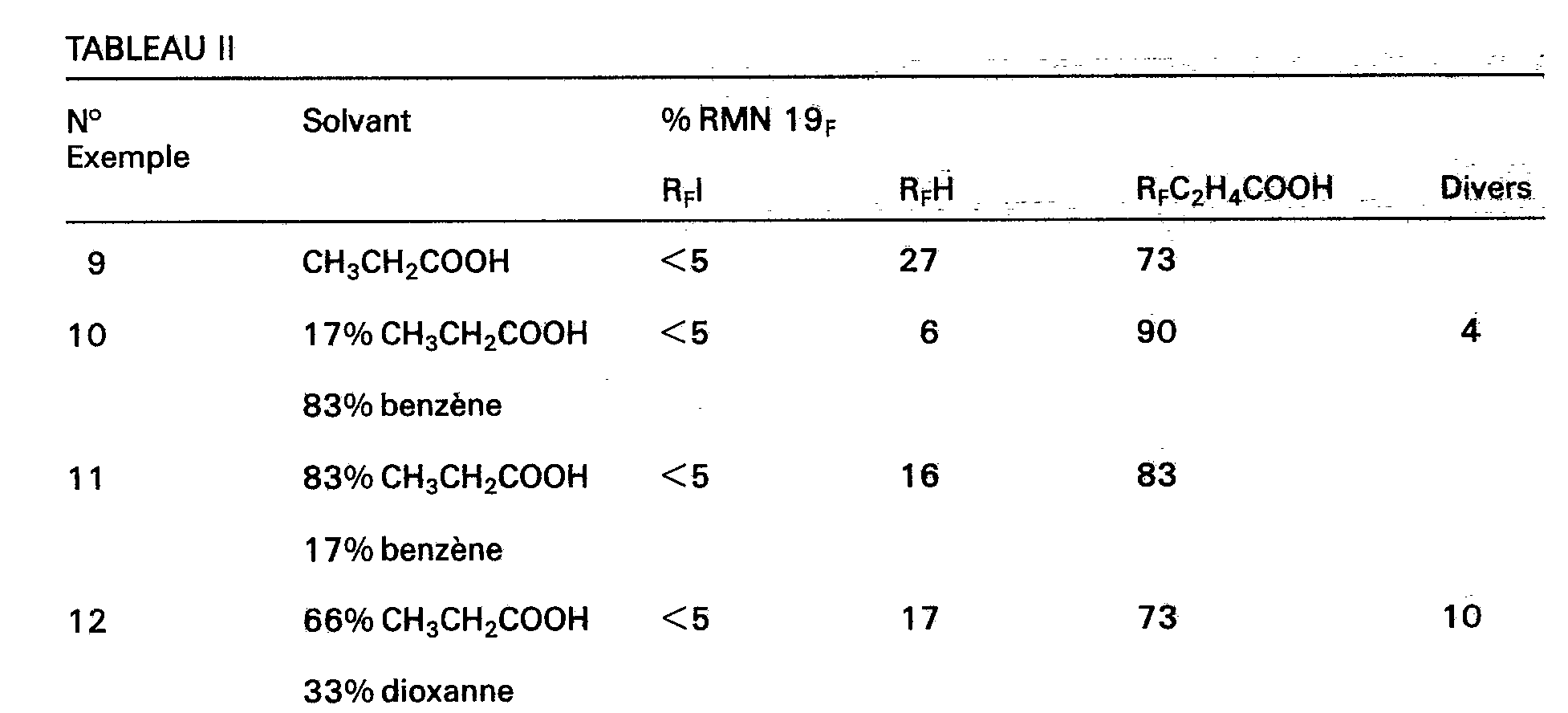
- Selon le mode opératoire des exemples 3 à 7, on a fait réagir C4F9f (17,3 g) et de l'acide acrylique (3,7 g). On a ainsi obtenu l'acide C4F9C2H4COOH identifié spectroscopiquement et comparé à un échantillon connu de ce produit. Les résultats de cette réaction sont indiqués dans le tableau II pour différents solvants:
- Dans les mêmes conditions que celles des exemples 9 à 12, on a fait réagir avec I'acide acrylique le C6F12I dans un solvant constitué de 17% d'acide propionique et de 83% de benzène. Après traitement on a obtenu un produit contenant d'après l'analyse RMN:

- Dans les mêmes conditions que celles de l'exemple 13, on a fait réagir C8F17I avec de l'acide acrylique et on a obtenu:

- En faisant réagir 23 g de C6F13I et 5 g d'acrylate d'éthyle dans les conditions des exemples 3 à 7, on a obtenu C6F13C2H4COOC2H5 et un dimère de formule:


- Par réaction de C4F9l avec de l'acétate de vinyle dans les exemples 3 à 7, on obtient:


- En faisant réagier dans les conditions des exemples 19 à 22, l'acétate de vinyle (0,05 mole) avec 0,5 mole de C6F13I dans un mélange de solvants constitué de:


Claims (6)

consistant à faire réagir un iodure de perfluoroalkyle et une olefine CHR1 =CR2y, caractérisé par le fait que la réaction a lieu en présence de poudre de zinc dispersée dans un solvant acide.
Applications Claiming Priority (2)
| Application Number | Priority Date | Filing Date | Title |
|---|---|---|---|
| FR8008721A FR2480742A1 (fr) | 1980-04-18 | 1980-04-18 | Procede de preparation de produits ayant un groupement perfluoroalkyle en presence de zinc en milieu acide |
| FR8008721 | 1980-04-18 |
Publications (2)
| Publication Number | Publication Date |
|---|---|
| EP0038735A1 EP0038735A1 (fr) | 1981-10-28 |
| EP0038735B1 true EP0038735B1 (fr) | 1983-11-30 |
Family
ID=9241060
Family Applications (1)
| Application Number | Title | Priority Date | Filing Date |
|---|---|---|---|
| EP81400552A Expired EP0038735B1 (fr) | 1980-04-18 | 1981-04-07 | Procédé de préparation de produits ayant un groupement perfluoroalkyle en présence de zinc en milieu acide |
Country Status (7)
| Country | Link |
|---|---|
| US (1) | US4478760A (fr) |
| EP (1) | EP0038735B1 (fr) |
| JP (1) | JPS56152427A (fr) |
| BR (1) | BR8102329A (fr) |
| CA (1) | CA1153775A (fr) |
| DE (1) | DE3161532D1 (fr) |
| FR (1) | FR2480742A1 (fr) |
Families Citing this family (15)
| Publication number | Priority date | Publication date | Assignee | Title |
|---|---|---|---|---|
| DE3374684D1 (en) * | 1982-08-31 | 1988-01-07 | Daikin Ind Ltd | A method to trap the enolate ion of the malonic acid or its derivatives |
| DE3338300A1 (de) * | 1983-10-21 | 1985-05-02 | Hoechst Ag, 6230 Frankfurt | Verfahren zur herstellung von fluoralkylsubstituierten iod-alkanen |
| FR2559479B1 (fr) * | 1984-02-14 | 1986-07-18 | Atochem | Synthese d'acides perfluoroalcane-carboxyliques |
| US4650913A (en) * | 1984-11-29 | 1987-03-17 | E. I. Du Pont De Nemours And Company | Sulfinate-initiated addition of perfluorinated iodides to olefins |
| DE3673245D1 (de) * | 1985-05-27 | 1990-09-13 | Tosoh Corp | Verfahren zur herstellung von fluor enthaltenden aliphatischen carbonsaeuren. |
| US4833168A (en) * | 1986-10-03 | 1989-05-23 | Merck & Co., Inc. | Avermectin reformatsky adducts |
| FR2613357B1 (fr) * | 1987-04-06 | 1989-06-16 | Atochem | Trifluoromethylation de composes organiques insatures |
| US5350878A (en) * | 1989-07-26 | 1994-09-27 | Dow Corning Corporation | Fluorinated compounds containing hetero atoms and polymers thereof |
| DE69315030D1 (de) * | 1992-08-07 | 1997-12-11 | Fujikura Kasei Kk | Elektrosensitive Zusammensetzung |
| US5493049A (en) * | 1993-02-10 | 1996-02-20 | Dow Corning Corporation | Fluorinated compounds containing hetero atoms and polymers thereof |
| US5608116A (en) * | 1994-06-21 | 1997-03-04 | E. I. Du Pont De Nemours And Company | Process for the alkoxylation of fluorinated alcohols |
| JP5620117B2 (ja) * | 2010-02-12 | 2014-11-05 | 国立大学法人お茶の水女子大学 | パーフルオロアルキル基含有化合物の製造方法 |
| WO2023090086A1 (fr) * | 2021-11-19 | 2023-05-25 | 国立大学法人 奈良先端科学技術大学院大学 | Produit d'addition sélectif de monohydrofluoroalcane secondaire et son procédé de production |
| JP7315186B2 (ja) * | 2021-11-19 | 2023-07-26 | 国立大学法人 奈良先端科学技術大学院大学 | 第2級モノヒドロフルオロアルカン類の選択的付加体及びその製造方法 |
| CN115160130B (zh) * | 2022-07-07 | 2024-12-20 | 武汉肯达科讯科技有限公司 | 一种高导热性氟化液的制备方法 |
Family Cites Families (7)
| Publication number | Priority date | Publication date | Assignee | Title |
|---|---|---|---|---|
| US3016406A (en) * | 1960-09-21 | 1962-01-09 | Du Pont | Reactions of perfluoroalkyl iodides and olefins in the presence of esters |
| US3145222A (en) * | 1961-02-23 | 1964-08-18 | Du Pont | Addition of polyfluoroalkyl iodides to unsaturated compounds and products produced thereby |
| SE353896B (fr) * | 1967-10-04 | 1973-02-19 | Ciba Geigy Ag | |
| FR1560544A (fr) * | 1968-01-31 | 1969-03-21 | ||
| US4073817A (en) * | 1970-08-24 | 1978-02-14 | Ciba-Geigy Ag | Process for the manufacture of perfluoroalkyl iodide-olefine adducts |
| CH555793A (de) * | 1970-08-24 | 1974-11-15 | Ciba Geigy Ag | Verfahren zur herstellung von gegebenenfalls substituierten perfluoralkyljodid-olefin- bzw.-cycloolefin-1:1-addukten. |
| FR2373503A2 (fr) * | 1976-12-10 | 1978-07-07 | Ugine Kuhlmann | Procede de fonctionnalisation de radicaux perfluores |
-
1980
- 1980-04-18 FR FR8008721A patent/FR2480742A1/fr active Granted
-
1981
- 1981-03-30 US US06/249,069 patent/US4478760A/en not_active Expired - Fee Related
- 1981-03-31 JP JP4657681A patent/JPS56152427A/ja active Granted
- 1981-04-07 DE DE8181400552T patent/DE3161532D1/de not_active Expired
- 1981-04-07 EP EP81400552A patent/EP0038735B1/fr not_active Expired
- 1981-04-15 BR BR8102329A patent/BR8102329A/pt unknown
- 1981-04-16 CA CA000375637A patent/CA1153775A/fr not_active Expired
Also Published As
| Publication number | Publication date |
|---|---|
| JPS6241650B2 (fr) | 1987-09-03 |
| DE3161532D1 (en) | 1984-01-05 |
| EP0038735A1 (fr) | 1981-10-28 |
| BR8102329A (pt) | 1981-12-08 |
| JPS56152427A (en) | 1981-11-26 |
| US4478760A (en) | 1984-10-23 |
| FR2480742B1 (fr) | 1982-03-19 |
| CA1153775A (fr) | 1983-09-13 |
| FR2480742A1 (fr) | 1981-10-23 |
Similar Documents
| Publication | Publication Date | Title |
|---|---|---|
| EP0038735A1 (fr) | Procédé de préparation de produits ayant un groupement perfluoroalkyle en présence de zinc en milieu acide | |
| EP0206899B1 (fr) | Procédé de fabrication de (méth)acrylates d'alkyles fluorés | |
| EP0102283B1 (fr) | Nouveau procédé de préparation de dérivés de la quinuclidine substitués en position 3 | |
| EP0024224B1 (fr) | Procédé de préparation des 1,1,2,2-tétrahydro perfluoro alcanols et des esters de ces alcools | |
| EP0267828B1 (fr) | Composés polyfluorés et leur procédé de préparation | |
| EP0030528A1 (fr) | Procédé pour la fixation de groupes alkyles, aralkyles ou cycloalkyles sur une chaîne carbonée portant un groupe fonctionnel | |
| FR2596755A1 (fr) | Procede de preparation de composes carbonyles ethyleniques | |
| BE1005256A3 (fr) | Synthese des perfluoroalkyl-2 ethanethiols. | |
| CA2017133C (fr) | Procede de synthese de cyanures d'acyle | |
| EP0025740B1 (fr) | Nouveaux alcools gras insaturés et leur procédé de préparation | |
| CA2243667A1 (fr) | Synthese d'acides carboxyalkylthiosucciniques | |
| FR2745286A1 (fr) | Synthese de composes organiques iodo-fluores | |
| CA1261319A (fr) | Procede de preparation de derives n-methyles de l'ergoline | |
| EP0127536B1 (fr) | Procédé de préparation de composés carbonyles alpha-delta-diéthyléniques | |
| EP0146439B1 (fr) | Procédé de préparation de dérivés acétyléniques, nouveaux dérivés obtenus et leur emploi | |
| FR2759079A1 (fr) | Procede de preparation d'anthraquinones substituees et application a la preparation de rheines | |
| FR2581641A1 (fr) | Procede de preparation d'acides 6-alkoxy(inferieur)-1-naphtoiques et des esters correspondants et utilisation de ce procede pour la preparation d'acides 6-alkoxy(inferieur)-5-halo-1-naphtoiques et des esters correspondants | |
| CH648821A5 (fr) | Procedes de preparation de derives cyclopropaniques tetra-substitues. | |
| FR2521552A1 (fr) | Synthese du (z, z)-11, 13-hexadecadienal pheromone du ver d'orange navel et produit obtenu, procede de separation du 15-halo-(z, z)-3,5 pentadecadiene et procede de separation d'un diene conjugue de ses isomeres | |
| EP0888318A1 (fr) | Procede ameliore pour la preparation de derives de l'acide 3-(10-phenothiazyl)propanoique ou 3-(10-phenoxazyl)propanoique | |
| EP0171307A1 (fr) | Procédé de fabrication de composés silylmétallocènes et composés obtenus par ce procédé | |
| CH655722A5 (fr) | Procede de preparation de derives de l'acide 2-thiophene acetique. | |
| EP0406065B1 (fr) | Procédé de préparation de la pseudo-ionone | |
| CA2149195C (fr) | Procede de synthese d'halogenoalkylferrocenes | |
| CA2463185A1 (fr) | Procede de preparation de derives de l'acide hexahydropyridazine-3-carboxylique |
Legal Events
| Date | Code | Title | Description |
|---|---|---|---|
| PUAI | Public reference made under article 153(3) epc to a published international application that has entered the european phase |
Free format text: ORIGINAL CODE: 0009012 |
|
| 17P | Request for examination filed |
Effective date: 19810410 |
|
| AK | Designated contracting states |
Designated state(s): BE CH DE FR GB NL SE |
|
| GRAA | (expected) grant |
Free format text: ORIGINAL CODE: 0009210 |
|
| AK | Designated contracting states |
Designated state(s): BE CH DE FR GB LI NL SE |
|
| REF | Corresponds to: |
Ref document number: 3161532 Country of ref document: DE Date of ref document: 19840105 |
|
| RAP2 | Party data changed (patent owner data changed or rights of a patent transferred) |
Owner name: SOCIETE ATOCHEM |
|
| PLBE | No opposition filed within time limit |
Free format text: ORIGINAL CODE: 0009261 |
|
| STAA | Information on the status of an ep patent application or granted ep patent |
Free format text: STATUS: NO OPPOSITION FILED WITHIN TIME LIMIT |
|
| 26N | No opposition filed | ||
| PGFP | Annual fee paid to national office [announced via postgrant information from national office to epo] |
Ref country code: SE Payment date: 19890307 Year of fee payment: 9 |
|
| PGFP | Annual fee paid to national office [announced via postgrant information from national office to epo] |
Ref country code: NL Payment date: 19890430 Year of fee payment: 9 Ref country code: GB Payment date: 19890430 Year of fee payment: 9 |
|
| PGFP | Annual fee paid to national office [announced via postgrant information from national office to epo] |
Ref country code: BE Payment date: 19890517 Year of fee payment: 9 |
|
| PGFP | Annual fee paid to national office [announced via postgrant information from national office to epo] |
Ref country code: CH Payment date: 19890608 Year of fee payment: 9 |
|
| PG25 | Lapsed in a contracting state [announced via postgrant information from national office to epo] |
Ref country code: GB Effective date: 19900407 |
|
| PG25 | Lapsed in a contracting state [announced via postgrant information from national office to epo] |
Ref country code: SE Effective date: 19900408 |
|
| PG25 | Lapsed in a contracting state [announced via postgrant information from national office to epo] |
Ref country code: LI Effective date: 19900430 Ref country code: CH Effective date: 19900430 Ref country code: BE Effective date: 19900430 |
|
| BERE | Be: lapsed |
Owner name: ATOCHEM Effective date: 19900430 |
|
| PG25 | Lapsed in a contracting state [announced via postgrant information from national office to epo] |
Ref country code: NL Effective date: 19901101 |
|
| GBPC | Gb: european patent ceased through non-payment of renewal fee | ||
| NLV4 | Nl: lapsed or anulled due to non-payment of the annual fee | ||
| REG | Reference to a national code |
Ref country code: CH Ref legal event code: PL |
|
| PGFP | Annual fee paid to national office [announced via postgrant information from national office to epo] |
Ref country code: DE Payment date: 19940408 Year of fee payment: 14 |
|
| PGFP | Annual fee paid to national office [announced via postgrant information from national office to epo] |
Ref country code: FR Payment date: 19940411 Year of fee payment: 14 |
|
| EUG | Se: european patent has lapsed |
Ref document number: 81400552.6 Effective date: 19910115 |
|
| PG25 | Lapsed in a contracting state [announced via postgrant information from national office to epo] |
Ref country code: FR Effective date: 19951229 |
|
| PG25 | Lapsed in a contracting state [announced via postgrant information from national office to epo] |
Ref country code: DE Effective date: 19960103 |
|
| REG | Reference to a national code |
Ref country code: FR Ref legal event code: ST |