EP0033402B1 - Perfusate for preserving organ to be transplanted and preserving method - Google Patents
Perfusate for preserving organ to be transplanted and preserving method Download PDFInfo
- Publication number
- EP0033402B1 EP0033402B1 EP80300245A EP80300245A EP0033402B1 EP 0033402 B1 EP0033402 B1 EP 0033402B1 EP 80300245 A EP80300245 A EP 80300245A EP 80300245 A EP80300245 A EP 80300245A EP 0033402 B1 EP0033402 B1 EP 0033402B1
- Authority
- EP
- European Patent Office
- Prior art keywords
- perfluoro
- liquid composition
- composition according
- perfluorocarbon compound
- albumin
- Prior art date
- Legal status (The legal status is an assumption and is not a legal conclusion. Google has not performed a legal analysis and makes no representation as to the accuracy of the status listed.)
- Expired
Links
Classifications
-
- A—HUMAN NECESSITIES
- A01—AGRICULTURE; FORESTRY; ANIMAL HUSBANDRY; HUNTING; TRAPPING; FISHING
- A01N—PRESERVATION OF BODIES OF HUMANS OR ANIMALS OR PLANTS OR PARTS THEREOF; BIOCIDES, e.g. AS DISINFECTANTS, AS PESTICIDES OR AS HERBICIDES; PEST REPELLANTS OR ATTRACTANTS; PLANT GROWTH REGULATORS
- A01N1/00—Preservation of bodies of humans or animals, or parts thereof
- A01N1/10—Preservation of living parts
-
- A—HUMAN NECESSITIES
- A01—AGRICULTURE; FORESTRY; ANIMAL HUSBANDRY; HUNTING; TRAPPING; FISHING
- A01N—PRESERVATION OF BODIES OF HUMANS OR ANIMALS OR PLANTS OR PARTS THEREOF; BIOCIDES, e.g. AS DISINFECTANTS, AS PESTICIDES OR AS HERBICIDES; PEST REPELLANTS OR ATTRACTANTS; PLANT GROWTH REGULATORS
- A01N1/00—Preservation of bodies of humans or animals, or parts thereof
- A01N1/10—Preservation of living parts
- A01N1/12—Chemical aspects of preservation
- A01N1/122—Preservation or perfusion media
- A01N1/126—Physiologically active agents, e.g. antioxidants or nutrients
Definitions
- This invention relates to a perfusate for preserving an organ to be transplanted and to a method of preservation using the perfusate. More particularly, the invention relates to a method for preserving an organ to be transplanted using as perfusate a mixture comprising a Ringer's solution, used as basal salt solution, albumin and a perfluorocarbon emulsion.
- the technical progress achieved in methods of preserving an organ for transplantation is remarkable; in particular, the progress achieved in developing the technique for preserving kidneys has promoted the growth of cadaveric kidney transplantation.
- Such progress is much indebted to improvement of the perfusate.
- the clinical methods for preserving kidneys for transplantation are broadly classified into two categories, one being the hypothermic storage (by immersion) [Lancet, 2, 1219-1222 (1969)] and the other the hypothermic continuous perfusion [Lancet, 2, 536 (1967)].
- the former is used in short period preservation and the latter in long period preservation.
- the long period preservation that is perfusional preservation, will gain in importance.
- cadaveric kidney transplantation since most of the kidneys are donated by individuals who have run into accidents, the necessary steps to be taken between the time of emergence of a cadaveric kidney and the time of transplantation include histcompatibility testings between the cadaveric kidney and the patient, selection of a competent recipient, transportation of the donated kidney, and preparations for the transplantation. For these reasons, it is necessary to preserve the donated kidney as long as possible. In fact, as a part of studies on the cadaveric kidney transplantation, many attempts have heretofore been made to preserve the cadaveric kidney for a long period of time. One of the primary objects of these attempts is the development and improvement of perfusates.
- cryoprecipitated plasma technique involved a great risk of emboliformation during the perfusion, which is caused by the residual fibrinogen, lipoprotein or neutral fat globules, whereas the risk is greatly reduced with the cryoprecipitated plasma treated with silica gel, which has been developed by Joledo-Pereyla et al.
- cryoprecipitated plasmas still have several problems associated with their use. Firstly, the preparative procedure has not been adequately developed and the composition of the prepared plasma tends to fluctuate, making it difficult to obtain preparations of constant protein content and constant electrolyte composition. Secondly, there still exists some fear of fat emboli formation during perfusion due to incomplete removal of the insoluble fat fraction.
- cryoprecipitated plasma is an excellent perfusate for the preservation of kidney, it still has several defects as mentioned above.
- the long-period preservation of a kidney requires a perfusate having a certain colloid osmotic pressure at low temperature as well as an adequate electrolyte composition and, in addition, a certain amount of oxygen.
- the kidney consumes much less oxygen than when at room temperature, yet requires a certain amount of oxygen in order to maintain its function.
- the oxygen consumption of a kidney at 8° to 10°C is about 3 ⁇ I/g/minute which corresponds to about 20% of the consumption at room temperature. Accordingly, in preserving a kidney it is a general practice to perfuse it with a perfusate while being oxygenated.
- a saturated perfluoro organic compound (hereinafter referred to as PFC) is a liquid capable of dissolving a considerable volume of oxygen and functions as an oxygen carrier when used in the form of an emulsion.
- Developmental researches are in progress on an artificial blood which utilizes the above-noted characteristic property of the PFC emulsion.
- the PFC emulsion functions well as an oxygen carrier either in vivo or in vitro (in an excorporeal system such as a perfusion system).
- an excorporeal system such as a perfusion system.
- Such a property suggests that a PFC emulsion can be utilized to advantage as an oxygen carrier in kidney preservation. Beside being a good solvent for oxygen, the selected PFC is biologically insert and presents no problem of direct toxicity to tissues. Therefore, when it is used as perfusate in preserving a kidney, no problems concerning toxicity will be aroused.
- a PFC (10% perfluorotributylamine) has also been used as perfusate in rat liver using Ringer's solution containing 2% bovine serum albumin (see Taira et al, Igaku no Ayumi 1978, 107(4),246-8).
- the kidney perfused with the FC-43 emulsion well retained the mitochondrion function and higher activity levels of glycolytic and gluconeogenetic key enzymes, indicating that the oxygen transportation by FC-43 exerts an effective influence on the retention of functions by the perfused kidney.
- the above-noted authors directed their research efforts mainly to the biological aspect, but not to the transplantation of a preserved kidney. It is Bercowitz who reported the results of transplantation of a canine kidney preserved by perfusion containing a PFC emulsion [J Surg. Res., 20, 595-600 (1976)].
- the invention provides a perfusate which is a liquid composition comprising a modified Ringer's solution characterized by containing potassium ion in a concentration of 8 to 20 meq/liter, albumin dissolved therein, and an emulsified liquid saturated perfluorocarbon compound and a method for the perfusional preservation of an organ for transplantation by the use of said perfusate.
- the basal Ringer's solution used in the modified Ringer's solution of this invention is subject to no special restriction but can be a conventional one or one as modified by Locke, Tyrode, Earle, Hanks or Krebs.
- These Ringer's solutions are aqueous solutions containing potassium chloride, sodium chloride and calcium chloride, the potassium ion being present in an amount of from 4 to 6 meq/litre.
- the modification according to this invention consists in that the potassium ion concentration is increased from the ordinary level of 4 to 6 meq/litre to 8 to 20, preferably 8 to 15 meq/litre. Such an increased concentration is adopted in order to approximate more closely the potassium ion level in the extracellular fluid.
- the modified Ringer's solution of a composition in accordance with this invention has an osmolarity of 290 to 300 m Osm/liter and a pH of 7.1 to 7.7 at 20°C.
- Table 1 are shown, for reference, salt compositions of some typical Ringer's solutions modified in this manner, together with that of a normal plasma which is a prototype of an ordinary Ringer's solution.
- the perfusion fluid in accordance with this invention for preserving an organ can be prepared by mixing together an emulsion of PFC in the modified Ringer's solution, albumin and the modified Ringer's solution so that the concentrations of PFC and albumin may assume respectively the predetermined values.
- the PFC emulsion used in a composition of the invention is prepared from a liquid perfluoro- carbon compound capable of absorbing oxygen by a known method disclosed in, for example, U.S. Patent 3,958,014, 3,911,138, 3,962,439, or West German Patent Application DT-OS 2630586.
- U.S. Patent 3,958,014, 3,911,138, 3,962,439, or West German Patent Application DT-OS 2630586 disclose the preparation of a stable emulsion suitable for use as an artificial blood by emulsifying a perfluorocarbon compound with a phospholipid as emulsifier (U.S. 3,958,014), a phospholipid and a Cg -22 fatty acid as auxiliary agent (U.S.
- Patent 3,962,439 or by using a polyoxyethylene-polyoxypropylene copolymer (molecular weight, 2,000 to 20,000) as nonionic emulsifier (U.S. Patent 3,911,138); or by using a polyoxyethylene alkyl ether or polyoxyalkyl allyl ether or cojointly using the above-noted fatty acids, nonionic emulsifiers and the above-noted auxiliary emulsifying agent (West German Patent Application DT-OS 2630586).
- the perfluorocarbon compounds to be emulsified are those not giving adverse effects to the organs or tissues, and are saturated perfluorocarbon compounds preferably having as a whole 9 to 12 carbon atoms some or all of which may form at least one saturated alicyclic ring, heterocyclic ring together with hetero nitrogen atom and/or oxygen atom, aliphatic tertiary amine together with nitrogen atom or aliphatic ether together with oxygen atom or atoms.
- a first group of the perfluorocarbon compounds used in a composition in accordance with the invention is that of a perfluoroalkane, perfluorocycloalkane or perfluoro(alkylcycloalkane), for example, perfluoro(Cg_ 12- alkanes) such as perfluorodecane, and perfluorododecane; perfluoro(C3-s-alkyl- cyclohexanes) such as perfluoro(methylpropylcyclohexanes), perfluoro(butylcyclohexanes), perfluoro-(trimethylcyclohexanes), perfluoro(ethylpropylcyclohexanes) and perfluoro(pentylcyclohexanes); perfluorodecalin, perfluoro(methyldecalins) and perfluoro(dimethyldicalins).
- perfluoro(Cg_ 12- alkanes) such as per
- a second group is that of a perfluoro(alkylsaturated heterocyclic compound), for example, perfluoro(alkyltetrahydropyrans) such as perfluoro(butyltetrahydropyrans), perfluoro(pentyltetra- hydropyrans) and perfluoro(hexyltetrahydropyrans); perfluoro(alkyltetrahydrofurans) such as perfluoro-(pentyltetrahydrofurans), perfluoro(hexyltetrahydrofurans) and perfluoro(heptyltetrahydrofurans); perfluoro(N-alkylpiperidines) such as perfluoro(N-pentylpiperidines), perfluoro(N-hexylpiperidines) and perfluoro(N-butylpiperidine); and perfluoro(N-alkylmorpholines) such as perfluoro(N-pent
- a third group is that of a perfluoro(tert-amine), for example, perfluoro(tributylamine), perfluoro-(diethylhexylamine), perfluoro(dipropylbutylamine) and perfluoro(diethylcyclohexylamine); and a perfluoro(dioxaalkane), that is, perfluoro(alkylene glycol dialkyl ether), such as perfluoro(3,8-dioxa-2,9-dimethyldecane) or perfluoro(tetramethylene glycol diisopropyl ether), perfluoro(3,7-dioxa-2,8-di- methylnonane) or perfluoro(trimethylene glycol diisopropyl ether) and perfluoro(4,6-dioxa-5,5-di- methylnonane), or perfluoro(isopropylene glycol di
- An emulsion of PFC in the modified Ringer's solution for use in a composition embodying the invention has a particle size of 0.05 to 0.3 ⁇ contains 10 to 50% (W/V) of PFC, 2.0 to 5% (W/V) of an emulsifier and, if necessary, 0.1 to 1.0% (W/V) of an auxiliary emulsifier, and can be stored in stable state for a long period.
- a perfusate composition embodying the invention for preserving an organ for transplantation is prepared, before using, by mixing together the above PFC emulsion, a commercial bovine or human albumin and the aforementioned modified Ringer's solution so that the resulting fluid may contain 7.5 to 12.5% (W/V) of PFC,1 to 8% (W/V) of albumin.
- pharmaceuticals such as procaine hydrochloride, heparin, phenoxybenzamine, insulin, dexamethasone ("Decadron”), methyl- prednisolone, antibiotics and urokinase can be added.
- the limits of PFC concentration given above were set up in order to ensure the graft survival after transplantation of the organ preserved by perfusion of the fluid.
- the concentration of albumin within the above-mentioned limits is suitable for adjusting the colloid osmotic pressure so that the perfusion fluid may be kept physiologically isotonic.
- the preservation of an organ to be transplanted is carried out in a customary way under oxygenation with oxygen by means of a customary equipment. For instance, 400 ml of a 25% (W/V) PFC emulsion, 360 ml of the modified Ringer's solution and 240 ml of a 25% (W/V) human albumin solution in the modified Ringer's solution are mixed together to make a total of 1 liter. The resulting mixture is fed to a a perfusate reservoir and perfused through the organ for transplantation, while being oxygenated with a mixed gas (95-98% oxygen and 5-2% carbon dioxide) or oxygen alone by means of an oxygenator of the membrane type or bubbling type.
- a mixed gas 95-98% oxygen and 5-2% carbon dioxide
- the rate of circulation of the perfusate is 15 to 50 ml/g kidney/hour and the perfusate is oxygenated with 95% O 2 ⁇ 5% C0 2 at a flow rate of 30 to 1500 ml/min.
- the above-noted pharmaceuticals can be added to the perfusate, without causing deterioration of the perfusate.
- the perfusional preservation it is also possible to recycle, by means of a pulsatile pump, the perfusate fed to the artery side reservoir of an organ preservation equipment.
- a perfusate composition embodying this invention can be used not only in perfusional preservation but also in the field of bench surgery.
- the method of this invention makes it possible to preserve an organ very safely for a long period until the time of transplantation. Since the graft survival rate is very high, the present method will allow commercial success of organ transplantation in the field of practical medical treatment.
- % (W/V) means the proportion of a material by weight (gram) based on 100 ml of the resulting liquid.
- the concentration of perfluorodecalin in the resulting fine emulsion was 31.3% (W/V) and the average particle diameter was 0.09 to 0.1 ⁇ , as measured by the method of centrifugal sedimentation. After 6 months of storage of the emulsion at 4°C, coalesceece of the particles was not noticed and the average particle diameter remained substantially unchanged.
- a modified Ringer's solution was prepared by dissolving in distilled water, in g/liter, 6.51 NaCI, 0.4 MgS0 4 , 0.8 KCI, 0.24 NaHC0 3 , 0.14 Na Z HP0 4 , 6.0 glucose, forming a solution of the following electrolyte composition, in meq/liter: 112 Na+, 11 K + , 7 Mg ++ , 118 CI-, 3 HCO 3 - , 2 HPO 4 -, 7 SO 4 -- , 33 glucose.
- a 570 ml portion of the modified Ringer's solution and 330 ml of the fluorocarbon emulsion were mixed and thoroughly stirred.
- the mixture was sterilized by heating in a sterilizer at 115°C for 12 minutes.
- the sterilized mixture was mixed with 100 ml of the albumin solution which had been passed through a bacterial filter.
- the resulting mixture was stored in a cool place at 1 to 10°C and used at need as a perfusion fluid for preserving an organ for transplantation.
- the mixed fluid was stored in a cool place at 1 to 10°C and used, when needed, as a perfusion fluid for preserving an organ to be transplanted.
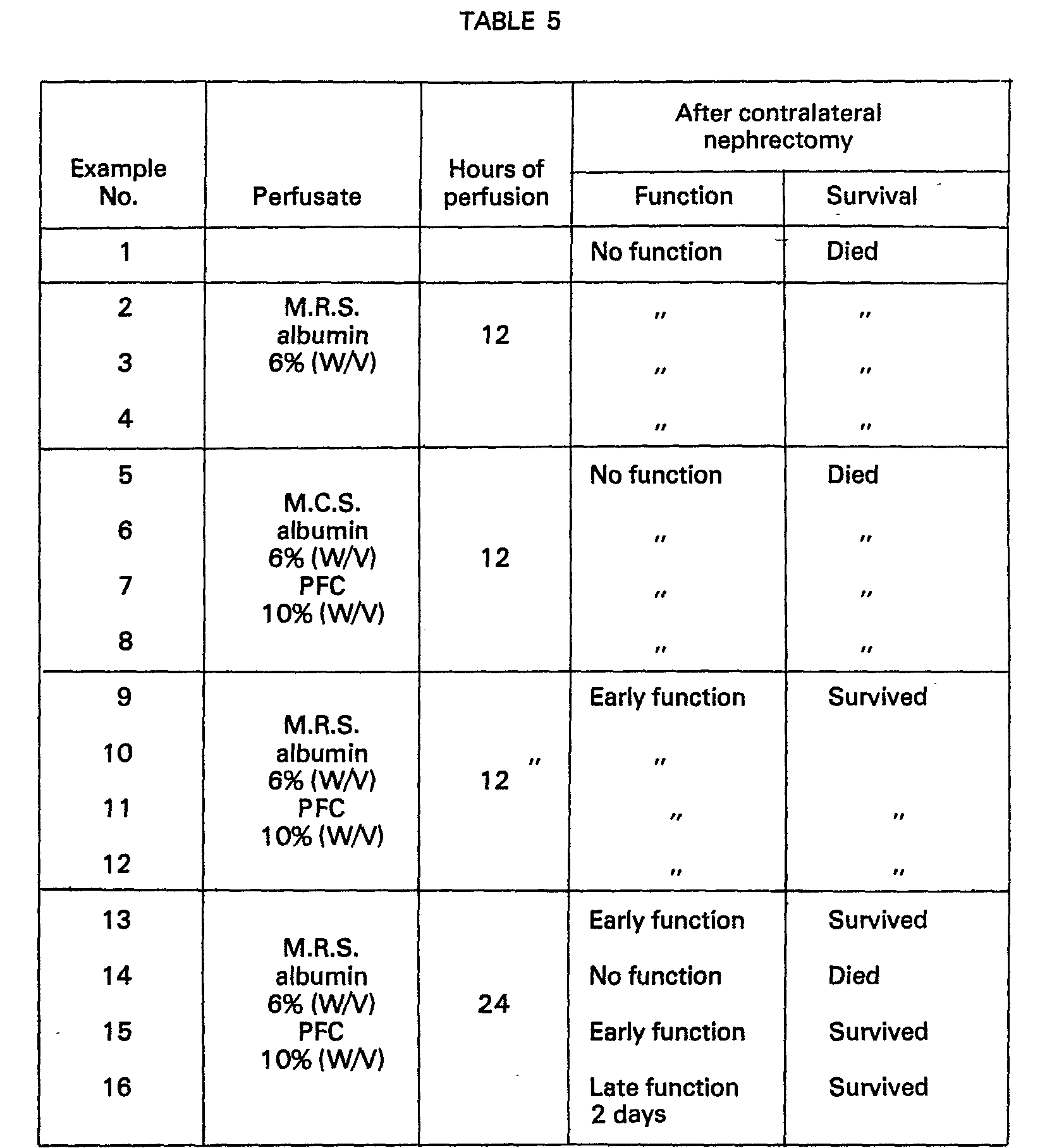
- the term "early function” means that urination was observed in two days after the contralateral nephrectomy; the term “late function” means that no urination was observed in two days after the contralateral nephrectomy but afterwards the function of the kidney gradually improved until urination was observed and the animal under test has survived; the term “necrosis” means the death of the tissues in localized areas of the transplanted kidney before the contralateral naphrectomy (the experiment was discontinued); and "A.T.N.” (acute tubular necrosis) means that after the contralateral nephrectomy the animal suffered from anuria, loss of appetite and frequent vomiting until death due to acute renal insufficiency.
- the persusates used in this experiment were 10% PFC emulsion in modified Ringer's solution, which was prepared by the use of PFC emulsion prepared in Preparation Example 6, and contained different concentrations of human albumin.
- the kidneys were perfused for 72 hours at 5° to 8°C under oxygenation with the oxygen-containing gas used in Experimental Example 1 at a flow rate of 300 to 500 ml/min and then autotransplanted as in Experiment Example 1.
- the perfusion flow rate was maintained between 15 and 18 ml/g/hour during perfusion.
- the contralateral nephrectomy was carried out one week later after autotransplantation.
- the concentrations of albumin and PFC in the perfusion fluid were 6% (W/V) and 10% (W/V), respectively.
- the kidneys were autotransplanted as in Experiment Example 1, the contralateral nephrectomy was carried out after one week from the autotransplantation and symptoms were observed. The results were as shown in Table 4.
- the plasma levels of creatinine and BUN of the survived animals became normal in 3 weeks.
- kidneys transplantation experiments were conducted similarly to Experiment Example 1.
- Each kidney was preserved at 18° to 22°C for 12 or 24 hours by perfusion at a perfusion flow rate of 40 to 50 ml/g/hour under oxygenation with the mixed gas (95%O 2 ⁇ 5%CO 2 ) at a flow rate of 300 to 500 ml/min.
- the perfusion fluid was prepared by using the M.R.S. of Preparation Example 1 as the basal salt solution and adding thereto the PFC emulsion of Preparation Example 2 and a bovine serum albumin.
- the concentrations of the PFC and albumin in the perfusion fluid were 10%(W/V) and 6%(W/V), respectively.
- the kidneys were autotransplanted.
Landscapes
- Life Sciences & Earth Sciences (AREA)
- Health & Medical Sciences (AREA)
- Engineering & Computer Science (AREA)
- Dentistry (AREA)
- General Health & Medical Sciences (AREA)
- Wood Science & Technology (AREA)
- Zoology (AREA)
- Environmental Sciences (AREA)
- Agricultural Chemicals And Associated Chemicals (AREA)
- Micro-Organisms Or Cultivation Processes Thereof (AREA)
- Medicinal Preparation (AREA)
- Acyclic And Carbocyclic Compounds In Medicinal Compositions (AREA)
Abstract
Description
- This invention relates to a perfusate for preserving an organ to be transplanted and to a method of preservation using the perfusate. More particularly, the invention relates to a method for preserving an organ to be transplanted using as perfusate a mixture comprising a Ringer's solution, used as basal salt solution, albumin and a perfluorocarbon emulsion.
- In recent years, the technical progress achieved in methods of preserving an organ for transplantation is remarkable; in particular, the progress achieved in developing the technique for preserving kidneys has promoted the growth of cadaveric kidney transplantation. Such progress is much indebted to improvement of the perfusate. For instance, the clinical methods for preserving kidneys for transplantation are broadly classified into two categories, one being the hypothermic storage (by immersion) [Lancet, 2, 1219-1222 (1969)] and the other the hypothermic continuous perfusion [Lancet, 2, 536 (1967)]. In practice, the former is used in short period preservation and the latter in long period preservation. With further growth of cadaveric kidney transplantation, the long period preservation, that is perfusional preservation, will gain in importance.
- In cadaveric kidney transplantation, since most of the kidneys are donated by individuals who have run into accidents, the necessary steps to be taken between the time of emergence of a cadaveric kidney and the time of transplantation include histcompatibility testings between the cadaveric kidney and the patient, selection of a competent recipient, transportation of the donated kidney, and preparations for the transplantation. For these reasons, it is necessary to preserve the donated kidney as long as possible. In fact, as a part of studies on the cadaveric kidney transplantation, many attempts have heretofore been made to preserve the cadaveric kidney for a long period of time. One of the primary objects of these attempts is the development and improvement of perfusates.
- The ever spreading clinical use of the hypothermic continuous perfusion originates from the research work of Belzer et al. [Lancet 536 (1967)]. They succeeded in preserving a canine kidney for 72 hours by employing as the perfusate a plasma freed from fibrinogen as far as possible prepared by freezing and melting a cryoprecipitated plasma. Since the publication of their report, cryoprecipitated plasma has chiefly been employed as a perfusate for kidneys.
- In 1974, Toledo-Pereyra et al [Surg. Gynecol. Obstet, 138, 901-905 (1974)] developed a new perfusate of silica gel-treated cryoprecipitated plasma which is free from f3-lipoprotein of fibrinogen, still remained in the conventional cryoprecipitated plasma, and in which the level of insoluble fat fraction, i.e. triglycerides, has been reduced to one-third. The conventional cryoprecipitated plasma technique involved a great risk of emboliformation during the perfusion, which is caused by the residual fibrinogen, lipoprotein or neutral fat globules, whereas the risk is greatly reduced with the cryoprecipitated plasma treated with silica gel, which has been developed by Joledo-Pereyla et al. Such cryoprecipitated plasmas, however, still have several problems associated with their use. Firstly, the preparative procedure has not been adequately developed and the composition of the prepared plasma tends to fluctuate, making it difficult to obtain preparations of constant protein content and constant electrolyte composition. Secondly, there still exists some fear of fat emboli formation during perfusion due to incomplete removal of the insoluble fat fraction. In order to reduce the risk, it is necessary to use an expensive membrane oxygenator. Thirdly, an important and unavoidable problem is the lack of an adequate inactivation treatment against hepatitis virus, leading to the fear of possible infection with hepatitis virus. Although the cryoprecipitated plasma is an excellent perfusate for the preservation of kidney, it still has several defects as mentioned above.
- It is reported that in order to overcome the above difficulties associated with the cryoprecipitated plasma, an attempt was made to use an albumin solution as the perfusate and this achieved success in an animal experiment. Grundman et al [Transpl., 17, 299-305 (1974)] perfused a canine kidney with a 6% albumin solution and successfully preserved the kidney for 96 hours. Their perfusate was a Krebs Ringer's solution containing 6% (W/V) of human albumin. The canine kidney perfused for 96 hours at a low temperature was autotransplanted and the graft survival was over 80%, indicating that the albumin solution is an excellent perfusate comparable favourably to the cryoprecipitated plasma.
- The long-period preservation of a kidney requires a perfusate having a certain colloid osmotic pressure at low temperature as well as an adequate electrolyte composition and, in addition, a certain amount of oxygen. When preserved at low temperatures, the kidney consumes much less oxygen than when at room temperature, yet requires a certain amount of oxygen in order to maintain its function. According to a classic study of Levy [American Journal Physiology 197, 1111-1114, (1959)], the oxygen consumption of a kidney at 8° to 10°C is about 3 µI/g/minute which corresponds to about 20% of the consumption at room temperature. Accordingly, in preserving a kidney it is a general practice to perfuse it with a perfusate while being oxygenated.
- A saturated perfluoro organic compound (hereinafter referred to as PFC) is a liquid capable of dissolving a considerable volume of oxygen and functions as an oxygen carrier when used in the form of an emulsion. Developmental researches are in progress on an artificial blood which utilizes the above-noted characteristic property of the PFC emulsion. The PFC emulsion functions well as an oxygen carrier either in vivo or in vitro (in an excorporeal system such as a perfusion system). Such a property suggests that a PFC emulsion can be utilized to advantage as an oxygen carrier in kidney preservation. Beside being a good solvent for oxygen, the selected PFC is biologically insert and presents no problem of direct toxicity to tissues. Therefore, when it is used as perfusate in preserving a kidney, no problems concerning toxicity will be aroused.
- A PFC (10% perfluorotributylamine) has also been used as perfusate in rat liver using Ringer's solution containing 2% bovine serum albumin (see Taira et al, Igaku no Ayumi 1978, 107(4),246-8).
- The studies on the preservation of a kidney by the use of a PFC emulsion started quite recently and originate from the work of Nakaya et al. (Proceedings of Symposium on Perfluorochemical Artificial Blood, Kyoto 1976, 187-201). They examined the viability of kidney in a biological way by perfusing a rabbit kidney with FC-43 emulsion (a perfluorotributylamine emulsion) for 9 hours at room temperature. As compared with a control group perfused with Ringer's solution, the kidney perfused with the FC-43 emulsion well retained the mitochondrion function and higher activity levels of glycolytic and gluconeogenetic key enzymes, indicating that the oxygen transportation by FC-43 exerts an effective influence on the retention of functions by the perfused kidney. The above-noted authors, however, directed their research efforts mainly to the biological aspect, but not to the transplantation of a preserved kidney. It is Bercowitz who reported the results of transplantation of a canine kidney preserved by perfusion containing a PFC emulsion [J Surg. Res., 20, 595-600 (1976)]. He perfused a canine kidney for 24 hours at a low temperature with a PFC emulsion containing albumin and a cryoprecipitated plasma. The preserved kidney was then autotransplanted and the graft survival rate was examined. The rate was found to be 100% in all five cases, whereas the rate was 62% in five control cases out of eight where the perfusate contained no FC-43 emulsion, indicating significantly the advantage of the FC-43 system.
- The two reports, cited above, showed that the PFC emulsion is an effective perfusate for preserving a kidney at both low temperature and room temperature. However, the preservation periods described in both reports are not sufficiently long to ascertain the practicability of the preserving methods. Particularly, the FC-43 emulsion containing albumin is not sufficiently stable to produce a normalized preparation.
- Under the aforementioned circumstances, we conducted studies on the perfusate containing PFC-43 for the long term preservation of an organ, particularly a kidney, for transplantation, and have found a PFC perfusate which, in contrast to the above-mentioned perfusates, is effective for the long- term preservation of organs for transplantation.
- The invention provides a perfusate which is a liquid composition comprising a modified Ringer's solution characterized by containing potassium ion in a concentration of 8 to 20 meq/liter, albumin dissolved therein, and an emulsified liquid saturated perfluorocarbon compound and a method for the perfusional preservation of an organ for transplantation by the use of said perfusate.
- The basal Ringer's solution used in the modified Ringer's solution of this invention is subject to no special restriction but can be a conventional one or one as modified by Locke, Tyrode, Earle, Hanks or Krebs. These Ringer's solutions are aqueous solutions containing potassium chloride, sodium chloride and calcium chloride, the potassium ion being present in an amount of from 4 to 6 meq/litre. The modification according to this invention consists in that the potassium ion concentration is increased from the ordinary level of 4 to 6 meq/litre to 8 to 20, preferably 8 to 15 meq/litre. Such an increased concentration is adopted in order to approximate more closely the potassium ion level in the extracellular fluid. By the choice of such a concentration of potassium ion, it becomes possible to bring about a great increase in the graft survival rate of an organ, particularly kidney, preserved for a long period by perfusion. The modified Ringer's solution of a composition in accordance with this invention has an osmolarity of 290 to 300 m Osm/liter and a pH of 7.1 to 7.7 at 20°C. In Table 1 are shown, for reference, salt compositions of some typical Ringer's solutions modified in this manner, together with that of a normal plasma which is a prototype of an ordinary Ringer's solution.

- The perfusion fluid in accordance with this invention for preserving an organ can be prepared by mixing together an emulsion of PFC in the modified Ringer's solution, albumin and the modified Ringer's solution so that the concentrations of PFC and albumin may assume respectively the predetermined values.
- The PFC emulsion used in a composition of the invention is prepared from a liquid perfluoro- carbon compound capable of absorbing oxygen by a known method disclosed in, for example, U.S. Patent 3,958,014, 3,911,138, 3,962,439, or West German Patent Application DT-OS 2630586. These patent specifications disclose the preparation of a stable emulsion suitable for use as an artificial blood by emulsifying a perfluorocarbon compound with a phospholipid as emulsifier (U.S. 3,958,014), a phospholipid and a Cg-22 fatty acid as auxiliary agent (U.S. Patent 3,962,439); or by using a polyoxyethylene-polyoxypropylene copolymer (molecular weight, 2,000 to 20,000) as nonionic emulsifier (U.S. Patent 3,911,138); or by using a polyoxyethylene alkyl ether or polyoxyalkyl allyl ether or cojointly using the above-noted fatty acids, nonionic emulsifiers and the above-noted auxiliary emulsifying agent (West German Patent Application DT-OS 2630586).
- The perfluorocarbon compounds to be emulsified are those not giving adverse effects to the organs or tissues, and are saturated perfluorocarbon compounds preferably having as a whole 9 to 12 carbon atoms some or all of which may form at least one saturated alicyclic ring, heterocyclic ring together with hetero nitrogen atom and/or oxygen atom, aliphatic tertiary amine together with nitrogen atom or aliphatic ether together with oxygen atom or atoms.
- A first group of the perfluorocarbon compounds used in a composition in accordance with the invention is that of a perfluoroalkane, perfluorocycloalkane or perfluoro(alkylcycloalkane), for example, perfluoro(Cg_12-alkanes) such as perfluorodecane, and perfluorododecane; perfluoro(C3-s-alkyl- cyclohexanes) such as perfluoro(methylpropylcyclohexanes), perfluoro(butylcyclohexanes), perfluoro-(trimethylcyclohexanes), perfluoro(ethylpropylcyclohexanes) and perfluoro(pentylcyclohexanes); perfluorodecalin, perfluoro(methyldecalins) and perfluoro(dimethyldicalins).
- A second group is that of a perfluoro(alkylsaturated heterocyclic compound), for example, perfluoro(alkyltetrahydropyrans) such as perfluoro(butyltetrahydropyrans), perfluoro(pentyltetra- hydropyrans) and perfluoro(hexyltetrahydropyrans); perfluoro(alkyltetrahydrofurans) such as perfluoro-(pentyltetrahydrofurans), perfluoro(hexyltetrahydrofurans) and perfluoro(heptyltetrahydrofurans); perfluoro(N-alkylpiperidines) such as perfluoro(N-pentylpiperidines), perfluoro(N-hexylpiperidines) and perfluoro(N-butylpiperidine); and perfluoro(N-alkylmorpholines) such as perfluoro(N-pentylmorpholines), perfluoro(N-hexylmorpholines) and perfluoro(N-heptylmorpholines).
- A third group is that of a perfluoro(tert-amine), for example, perfluoro(tributylamine), perfluoro-(diethylhexylamine), perfluoro(dipropylbutylamine) and perfluoro(diethylcyclohexylamine); and a perfluoro(dioxaalkane), that is, perfluoro(alkylene glycol dialkyl ether), such as perfluoro(3,8-dioxa-2,9-dimethyldecane) or perfluoro(tetramethylene glycol diisopropyl ether), perfluoro(3,7-dioxa-2,8-di- methylnonane) or perfluoro(trimethylene glycol diisopropyl ether) and perfluoro(4,6-dioxa-5,5-di- methylnonane), or perfluoro(isopropylene glycol di-n-propyl ether).
- An emulsion of PFC in the modified Ringer's solution for use in a composition embodying the invention has a particle size of 0.05 to 0.3 µ contains 10 to 50% (W/V) of PFC, 2.0 to 5% (W/V) of an emulsifier and, if necessary, 0.1 to 1.0% (W/V) of an auxiliary emulsifier, and can be stored in stable state for a long period.
- A perfusate composition embodying the invention for preserving an organ for transplantation is prepared, before using, by mixing together the above PFC emulsion, a commercial bovine or human albumin and the aforementioned modified Ringer's solution so that the resulting fluid may contain 7.5 to 12.5% (W/V) of PFC,1 to 8% (W/V) of albumin. If necessary, pharmaceuticals such as procaine hydrochloride, heparin, phenoxybenzamine, insulin, dexamethasone ("Decadron"), methyl- prednisolone, antibiotics and urokinase can be added. The limits of PFC concentration given above were set up in order to ensure the graft survival after transplantation of the organ preserved by perfusion of the fluid. The concentration of albumin within the above-mentioned limits is suitable for adjusting the colloid osmotic pressure so that the perfusion fluid may be kept physiologically isotonic.
- The preservation of an organ to be transplanted is carried out in a customary way under oxygenation with oxygen by means of a customary equipment. For instance, 400 ml of a 25% (W/V) PFC emulsion, 360 ml of the modified Ringer's solution and 240 ml of a 25% (W/V) human albumin solution in the modified Ringer's solution are mixed together to make a total of 1 liter. The resulting mixture is fed to a a perfusate reservoir and perfused through the organ for transplantation, while being oxygenated with a mixed gas (95-98% oxygen and 5-2% carbon dioxide) or oxygen alone by means of an oxygenator of the membrane type or bubbling type. The rate of circulation of the perfusate is 15 to 50 ml/g kidney/hour and the perfusate is oxygenated with 95% O2―5% C02 at a flow rate of 30 to 1500 ml/min. If necessary, the above-noted pharmaceuticals can be added to the perfusate, without causing deterioration of the perfusate. In the perfusional preservation, it is also possible to recycle, by means of a pulsatile pump, the perfusate fed to the artery side reservoir of an organ preservation equipment. In the long-period preservation, it is desirable to refresh appropriately the perfusate. A perfusate composition embodying this invention can be used not only in perfusional preservation but also in the field of bench surgery.
- The method of this invention makes it possible to preserve an organ very safely for a long period until the time of transplantation. Since the graft survival rate is very high, the present method will allow commercial success of organ transplantation in the field of practical medical treatment.
- Illustrative examples of the methods of preparing each component of the present perfusate and the procedure of preparing the perfusate are described below. The symbol "% (W/V)" referred to herein means the proportion of a material by weight (gram) based on 100 ml of the resulting liquid.
- In 8 liters of a modified Ringer's solution (described later), was dissolved 300 g of a poly- oxyethylenepolyoxypropylene copolymer (molecular weight 8,350). After addition of 3 kg of perfluorodecalin, the resulting mixture was stirred in a mixer to form a coarse emulsion. The coarse emulsion was fed to the reservoir of a jet-type emulsifier (Monton-Gaulin type homogenizer) to circulate the emulsion. Emulsification was carried out at 35 ± 5°C under a pressure of 200 to 500 kg/cm2. The concentration of perfluorodecalin in the resulting fine emulsion was 31.3% (W/V) and the average particle diameter was 0.09 to 0.1 µ, as measured by the method of centrifugal sedimentation. After 6 months of storage of the emulsion at 4°C, coalesceece of the particles was not noticed and the average particle diameter remained substantially unchanged.
- A commercial preparation of human serum albumin was dissolved in a concentration of 25% (W/V) in the modified Ringer's solution described below.
- A modified Ringer's solution was prepared by dissolving in distilled water, in g/liter, 6.51 NaCI, 0.4 MgS04, 0.8 KCI, 0.24 NaHC03, 0.14 NaZHP04, 6.0 glucose, forming a solution of the following electrolyte composition, in meq/liter: 112 Na+, 11 K+, 7 Mg++, 118 CI-, 3 HCO3 -, 2 HPO4-, 7 SO4 --, 33 glucose.
- A 570 ml portion of the modified Ringer's solution and 330 ml of the fluorocarbon emulsion were mixed and thoroughly stirred. The mixture was sterilized by heating in a sterilizer at 115°C for 12 minutes. The sterilized mixture was mixed with 100 ml of the albumin solution which had been passed through a bacterial filter. The resulting mixture was stored in a cool place at 1 to 10°C and used at need as a perfusion fluid for preserving an organ for transplantation.
- In 8 liters of the modified Ringer's solution, was dissolved 330 g of polyoxyethylene octyl ether having an average molecular weight of 3,500. To the solution, were added 40 g of soybean phospholipid and 2 g of potassium oleate. The mixture was stirred in a mixer to form a suspension. The suspension was admixed with 3 kg of perfluoro (tributylamine) and stirred in a mixer to form a coarse emulsion. The coarse emulsion was further emulsified in the same manner as in Example 1. The fine emulsion thus obtained was divided into vials and sterilized by heating in a rotary sterilizer at 115°C for 12 minutes. The concentration of the perfluorocarbon in the sterilized emulsion was 29.7% (W/V). On storage at 4°C for 6 months, the emulsion showed no coalescence of the particles.
- A 550 ml portion of the modified Ringer's solution used in Preparation Example 1, 100 ml of the albumin solution and 350 ml of the fluorocarbon emulsion obtained above were mixed. The mixed fluid was stored in a cool place at 1 to 10°C and used, when needed, as a perfusion fluid for preserving an organ to be transplanted.
- The procedure described in Preparation Example 1 was repeated, except that perfluoromethyl- propylcyclohexane was used in place of the perfluorodecalin. The perfusion fluid obtained was similar in properties to that obtained in Preparation Example 1.
- The procedure described in Preparation Example 1 was repeated, except that each of the per- fluorobutylcyclohexane, perfluorotrimethylcyclohexane, perfluoroethylpropylcyclohexane, perfluoro- methyldecalin, perfluorohexyltetrahydropyran, perfluoropentyltetrahydrofuran, perfluoroheptyltetra- hydrofuran and perfluorodecane was used in place of the perfluorodecalin. The perfusion fluids obtained were similar to that obtained in Preparation Example 1.
- The procedure described in Preparation Example 1 was repeated, except that each of the perfluoro N,N-dibutylmonomethylamine, perfluoro N,N-diethylpentylamine, perfluoro N,N-dipropyl- butylamine, perfluorotripropylamine, perfluoro N,N-diethylcyclohexylamine, perfluoro N-pentyl- piperidine, perfluoro N-hexylpiperidine, perfluoro N-butylpiperidine, perfluoro N-pentylmorpholine, perfluoro N-hexylmorpholine, and perfluoro N-heptylmorpholine was used in place of the perfluorodecalin. The perfusion fluids obtained were similar to that obtained in Preparation Example 1.
- The procedure described in Preparation Example 1 was repeated, except that perfluorotributylamine was used in place of the perfluorodecalin. The perfusion fluid obtained was similar to that obtained in Preparation Example 1.
- The procedure of Preparation Example 1 was repeated, except that a polyoxyethylene-polyoxypropylene copolymer having a molecular weight of 15,800 was used in place of the copolymer having a molecular weight of 8,350. The perfusion fluid obtained was similar in properties to that obtained in Preparation Example 1.
- Below are shown examples of comparative experiments to demonstrate by animal experiments the effectiveness of the perfusional preserving fluids of this invention in transplantation of the kidney preserved by perfusion. The survival or death of the graft was determined by observing the function of the grafted kidney after the contralateral normal kidney had been removed. In the tables, the term "early function" means that urination was observed in two days after the contralateral nephrectomy; the term "late function" means that no urination was observed in two days after the contralateral nephrectomy but afterwards the function of the kidney gradually improved until urination was observed and the animal under test has survived; the term "necrosis" means the death of the tissues in localized areas of the transplanted kidney before the contralateral naphrectomy (the experiment was discontinued); and "A.T.N." (acute tubular necrosis) means that after the contralateral nephrectomy the animal suffered from anuria, loss of appetite and frequent vomiting until death due to acute renal insufficiency.
- It is necessary and essential to determine the PFC concentration most suitable for perfusion, because with the increase in PFC concentration of an PFC emulsion, the oxygen carrying capacity of the emulsion increases, while, on the other hand, the viscosity increases considerably at low temperatures. In order to determine the optimal PFC concentration during perfusion, a series of perfusion fluids with varied PFC concentrations were prepared using as the basal saline solution a modified Collin's solution (M.C.S.) [The Lancet, 2, 1219-1222 (1969)], which is said to be the most favorable for hypothermic storage of organs and has an electrolyte composition resembling that of intracellular fluid. Varied amounts of the fluorocarbon emulsion obtained in Preparation Example 2 were added to M.C.S. so that the ultimate PFC concentrations in the perfusion fluids thus obtained became 5, 7.5, 10, 12.5 and 15% (W/V). Experiments were run to preserve canine kidneys for transplantation by perfusion with the above fluids at 5° to 8°C at a perfusion flow rate of 15 to 18 ml/g/hour for 24 hours under oxygenation with an oxygen-containing gas (95% O2, 5% CO2) at a flow rate of 300 to 500 ml/minute. By using five dogs per group, the preserved kidneys were autotransplanted. On the 7th day after autotransplantation, the contralateral normal kidney of each dog was excised and the subsequent survival days of each dog were counted. When a dog survived for 4 weeks or longer, the graft survival was assumed to be positive, because in such a dog, after 2 weeks both BUN (blood urea nitrogen) and creatinine levels remained normal and urination was observed. From the data obtained, the optimal PFC concentration in the perfusate was determined.
- The experiment was run in a customary way in accordance with the following procedural sequence:


- The results obtained were as shown in Table 2. As can be seen from Table 2, a high rate of graft survival was obtained at a PFC concentration of 7.5 to 12.5% (W/V). If the PFC concentration exceeded 12.5% (W/V) and reached 15% (W/V), hematuria was observed in all cases on resumption of the blood flow after transplantation. Two dogs who survived for over 2 weeks showed the sign of hematuria for several days after contralateral nephrectomy, then recovered and survived. From the above results it was concluded that a perfusion fluid adjusted to a PFC concentration of 10% (W/V) is most effective for the perfusional preservation of an excised kidney.
- Long-period low temperature perfusional preservation experiments were carried out in order to select a suitable basal salt solution. The salt solutions examined were M.C.S. (described before) Ringer's solution and modified Ringer's solution (M.R.S.) prepared in Preparation Example 1. Perfusion fluids for preservation were prepared by adding the perfluorocarbon emulsion of Preparation Example 2 and the bovine serum albumin to a salt solution so that the ultimate concentration became 10% (W/V) of PFC and 6% (W/V) of albumin. Perfusion was carried out on canine kidneys (5 per group) at 5° to 8°C for 72 hours following the procedure of Experiment Example 1. After transplantation and resumption of the blood flow, examinations were made on the movement of blood through the kidney, color and tone of the kidney, urination, and symptoms due to contralateral nephrectomy performed on the 7th day after transplantation. The perfusate (2,000 ml in total volume) was not refreshed during 72 hours of perfusion but recycled at a rate of 15-18 ml/g/hour. Except for the cases where M.R.S. was used as the basal salt solution, the results of transplantation were very unfavorable and almost all of the test animals died due to acute kidney insufficiency in 10 days after the contralateral nephrectomy. On the contrary, in the cases where M.R.S. was used as the basal salt solution, all of the animals recovered uneventfully without exception.
- The persusates used in this experiment were 10% PFC emulsion in modified Ringer's solution, which was prepared by the use of PFC emulsion prepared in Preparation Example 6, and contained different concentrations of human albumin. The kidneys were perfused for 72 hours at 5° to 8°C under oxygenation with the oxygen-containing gas used in Experimental Example 1 at a flow rate of 300 to 500 ml/min and then autotransplanted as in Experiment Example 1. The perfusion flow rate was maintained between 15 and 18 ml/g/hour during perfusion. The contralateral nephrectomy was carried out one week later after autotransplantation.
- The results were as shown in Table 3.

- Transplantation experiments on canine kidneys carried out in a manner similar to that in Experiment Example 1. Each kidney was preserved for one week by perfusion at 5° to 8°C and a perfusion flow rate of 15 to 18 mg/g/hour under oxygenation with the gas at a flow rate of 300 to 500 ml/min. The perfusion fluid was prepared by using the M.R.S. of Preparation Example 1 as the basal salt solution and adding thereto bovine serum albumin and the PFC emulsion of Preparation Example 2 or a PFC emulsion prepared in the same manner as in Preparation Example 2, except that perfluorodecalin was used in place of the perfluorotributylamine. The concentrations of albumin and PFC in the perfusion fluid were 6% (W/V) and 10% (W/V), respectively. After one week of the perfusional perservation, the kidneys were autotransplanted as in Experiment Example 1, the contralateral nephrectomy was carried out after one week from the autotransplantation and symptoms were observed. The results were as shown in Table 4. The plasma levels of creatinine and BUN of the survived animals became normal in 3 weeks.

- Using canine kidneys, transplantation experiments were conducted similarly to Experiment Example 1. Each kidney was preserved at 18° to 22°C for 12 or 24 hours by perfusion at a perfusion flow rate of 40 to 50 ml/g/hour under oxygenation with the mixed gas (95%O2―5%CO2) at a flow rate of 300 to 500 ml/min. The perfusion fluid was prepared by using the M.R.S. of Preparation Example 1 as the basal salt solution and adding thereto the PFC emulsion of Preparation Example 2 and a bovine serum albumin. The concentrations of the PFC and albumin in the perfusion fluid were 10%(W/V) and 6%(W/V), respectively. After 12 hours or 24 hours of preservation, the kidneys were autotransplanted. The contralateral nephrectomy was carried out one week after the autotransplantation and the symptoms were observed. In Table 5 are shown the results of the above experiments, together with the results of a control experiment wherein no PFC was added and a comparative experiment wherein M.C.S. was used as the basal salt solution.
Claims (18)
Priority Applications (2)
| Application Number | Priority Date | Filing Date | Title |
|---|---|---|---|
| DE8080300245T DE3064724D1 (en) | 1980-01-25 | 1980-01-25 | Perfusate for preserving organ to be transplanted and preserving method |
| HK60885A HK60885A (en) | 1980-01-25 | 1985-08-15 | Perfusate for preserving organ to be transplanted and preserving method |
Applications Claiming Priority (1)
| Application Number | Priority Date | Filing Date | Title |
|---|---|---|---|
| US05/950,071 US4186253A (en) | 1978-10-10 | 1978-10-10 | Perfusate for preserving organ to be transplanted and preserving method |
Publications (2)
| Publication Number | Publication Date |
|---|---|
| EP0033402A1 EP0033402A1 (en) | 1981-08-12 |
| EP0033402B1 true EP0033402B1 (en) | 1983-09-07 |
Family
ID=25489899
Family Applications (1)
| Application Number | Title | Priority Date | Filing Date |
|---|---|---|---|
| EP80300245A Expired EP0033402B1 (en) | 1978-10-10 | 1980-01-25 | Perfusate for preserving organ to be transplanted and preserving method |
Country Status (6)
| Country | Link |
|---|---|
| US (1) | US4186253A (en) |
| EP (1) | EP0033402B1 (en) |
| JP (1) | JPS5551016A (en) |
| AT (1) | ATE4572T1 (en) |
| AU (1) | AU517547B2 (en) |
| WO (1) | WO1981002103A1 (en) |
Cited By (1)
| Publication number | Priority date | Publication date | Assignee | Title |
|---|---|---|---|---|
| US10070643B2 (en) | 2013-03-28 | 2018-09-11 | The Trustees Of Columbia University In The City Of New York | Reperfusion with omega-3 glycerides promotes donor organ protection for transplantation |
Families Citing this family (91)
| Publication number | Priority date | Publication date | Assignee | Title |
|---|---|---|---|---|
| US4186253A (en) * | 1978-10-10 | 1980-01-29 | The Green Cross Corporation | Perfusate for preserving organ to be transplanted and preserving method |
| DE3277769D1 (en) * | 1981-09-08 | 1988-01-14 | Green Cross Corp | Perfluorochemicals, process for preparing the same and their use as blood substitutes |
| JPS58170782A (en) * | 1982-01-22 | 1983-10-07 | アイ・エス・シ−・ケミカルズ・リミテツド | Perfluorinated heterocyclic compound and emulsion containing same |
| US4397870A (en) * | 1982-07-27 | 1983-08-09 | The University Of Pennsylvania | Process for prolonging retention of emulsion particles in the bloodstream |
| DE3366683D1 (en) * | 1982-08-07 | 1986-11-13 | Green Cross Corp | PERFLUORO-1-AZATRICYCLIC AMINE COMPOUND |
| JPS5946218A (en) * | 1982-09-09 | 1984-03-15 | Green Cross Corp:The | Fluorocarbon emulsion preparation |
| US4663166A (en) * | 1984-06-22 | 1987-05-05 | Veech Richard L | Electrolyte solutions and in vivo use thereof |
| DE3586946D1 (en) * | 1984-06-22 | 1993-02-11 | Richard L Veech | ELECTROLYTE SOLUTIONS AND THEIR USE IN VITRO. |
| US5284645A (en) * | 1987-08-05 | 1994-02-08 | Alliance Pharmaceutical Corp. | Fluorocarbon emulsions containing amino acid based anti-inflamatory agents and buffer systems |
| US5684050A (en) * | 1986-01-24 | 1997-11-04 | Hemagen/Pfc | Stable emulsions of highly fluorinated organic compounds |
| US5514720A (en) * | 1986-07-09 | 1996-05-07 | Hemagen/Pfc | Stable emulsions of highly fluorinated organic compounds |
| US5240701A (en) * | 1986-05-15 | 1993-08-31 | Emory University | Method of performing angioplasty procedures |
| US4997644A (en) * | 1986-05-15 | 1991-03-05 | Emory University | Method of treating adult respiratory distress syndrome |
| US5071649A (en) * | 1986-05-15 | 1991-12-10 | Emory University | Method of preventing blockage in catheters |
| US5030448A (en) * | 1986-05-15 | 1991-07-09 | Emory University | Method of delivering drugs to damaged or diseased tissue |
| US5064643A (en) * | 1986-05-15 | 1991-11-12 | Emory University | Method for treating sickle cell disease |
| US5032394A (en) * | 1986-05-15 | 1991-07-16 | Emory University | Method of treating burns |
| US5198211A (en) * | 1986-05-15 | 1993-03-30 | Emory University | Method of treating myocardial damage |
| US5080894A (en) * | 1986-05-15 | 1992-01-14 | Emory University | Method and composition for reducing tissue damage |
| US4801452A (en) * | 1986-05-15 | 1989-01-31 | Hunter Robert L | Fibrinolytic composition |
| US5089260A (en) * | 1986-05-15 | 1992-02-18 | Emory University | Method of treating ischemic tissue |
| US5078995A (en) * | 1986-05-15 | 1992-01-07 | Emory University | Fibrionolytic composition |
| US4897263A (en) * | 1986-05-15 | 1990-01-30 | Emory University | Methods and compositions for treatment of pathological hydrophobic interactions in biological fluids |
| US5047236A (en) * | 1986-05-15 | 1991-09-10 | Emory University | Method of treating stroke |
| US5648071A (en) * | 1986-05-15 | 1997-07-15 | Emory University | Method of treating tumors |
| US5039520A (en) * | 1986-05-15 | 1991-08-13 | Emory University | Plasma extender |
| US4873083A (en) * | 1986-05-15 | 1989-10-10 | Emory University | Fibrinolytic composition |
| US5028599A (en) * | 1986-05-15 | 1991-07-02 | Emory University | Method of treating mycardial damage |
| US5041288A (en) * | 1986-05-15 | 1991-08-20 | Emory University | Method of treating tissue damaged by reperfusion injury |
| US4937070A (en) * | 1986-05-15 | 1990-06-26 | Emory University | Methods and compositions for treatment of pathological hydrophobic interactions in biological fluids |
| US4837014A (en) * | 1986-05-15 | 1989-06-06 | Emory University | An improved method of treating sickle cell anemia |
| US4879109A (en) * | 1986-05-15 | 1989-11-07 | Emory University | Method for treating burns |
| US5182106A (en) * | 1986-05-15 | 1993-01-26 | Emory University | Method for treating hypothermia |
| US5250294A (en) * | 1986-05-15 | 1993-10-05 | Emory University | Improved perfusion medium for transplantation of organs |
| JPH0610139B2 (en) * | 1986-05-15 | 1994-02-09 | エモリ ユニバーシティ | Mixtures of fibrinolytic compounds and agents for dissolving blood clots in blood vessels |
| US5152979A (en) * | 1986-05-15 | 1992-10-06 | Emory University | Method for treating vascular obstructions caused by abnormal cells |
| US5017370A (en) * | 1986-05-15 | 1991-05-21 | Emory University | Improved method of performing angioplasty procedures |
| US5674911A (en) * | 1987-02-20 | 1997-10-07 | Cytrx Corporation | Antiinfective polyoxypropylene/polyoxyethylene copolymers and methods of use |
| JPS63208572A (en) * | 1987-02-24 | 1988-08-30 | Daikin Ind Ltd | Perfluoro nitrogen-containing cyclic compound and production thereof |
| US4873315A (en) * | 1987-08-25 | 1989-10-10 | Air Products And Chemicals, Inc. | Perfluorinated propyl derivative compounds |
| US4777304A (en) * | 1987-08-25 | 1988-10-11 | Air Products & Chemicals, Inc. | Perfluorinated butyl derivative compounds |
| US5171755A (en) * | 1988-04-29 | 1992-12-15 | Hemagen/Pfc | Emulsions of highly fluorinated organic compounds |
| US5073383A (en) * | 1989-04-21 | 1991-12-17 | Affinity Biotech, Inc. | Inhibiting aggregation in fluorocarbon emulsions |
| US4938961A (en) * | 1989-04-28 | 1990-07-03 | Geoffrey Collins | Organ preservation solution containing pokyethylene gycol and method of performing cardioplegia |
| US5110722A (en) * | 1989-11-09 | 1992-05-05 | Cryolife, Inc. | Cell, tissue or organ storage solution |
| US5358931A (en) * | 1990-01-17 | 1994-10-25 | The Regents Of The University Of California | Interaction of thermal hysteresis proteins with cells and cell membranes and associated applications |
| WO1991010361A1 (en) * | 1990-01-17 | 1991-07-25 | The Regents Of The University Of California | Composition to improve survival of biological materials |
| AU650678B2 (en) * | 1990-08-10 | 1994-06-30 | Analytical Control Systems, Inc. | Stabilization (using gelatin from a cold water fish) of enzymes in diagnostic controls |
| CH683485A5 (en) * | 1990-11-20 | 1994-03-31 | Pasteur Merieux Serums Vacc | infusion solutions, preservation and organ perfusion. |
| USRE38558E1 (en) | 1991-03-19 | 2004-07-20 | Cytrx Corporation | Polyoxypropylene/polyoxyethylene copolymers with improved biological activity |
| US5696298A (en) * | 1991-03-19 | 1997-12-09 | Cytrx Corporation | Polyoxypropylene/polyoxyethylene copolymers with improved biological activity |
| EP0576612B1 (en) * | 1991-03-19 | 1999-12-01 | Cytrx Corporation | Polyoxypropylene/polyoxyethylene copolymers with improved biological activity |
| US5403575A (en) * | 1991-12-12 | 1995-04-04 | Hemagen/Pfc | Highly fluorinated, chloro-substituted organic compound-containing emulsions and methods of using them |
| US5470568A (en) * | 1992-02-13 | 1995-11-28 | Arch Development Corporation | Methods and compositions of a polymer (poloxamer) for cell repair |
| US5605687A (en) * | 1992-05-15 | 1997-02-25 | Arch Development Corporation | Methods and compositions of a polymer (poloxamer) for repair of electrical injury |
| AU6409594A (en) * | 1993-03-16 | 1994-10-11 | Alliance Pharmaceutical Corporation | Preservation solution and method for warm organ preservation |
| JP2686405B2 (en) * | 1993-04-06 | 1997-12-08 | 全国農業協同組合連合会 | Cryopreservation method of bovine fertilized eggs |
| WO1995012310A1 (en) * | 1993-11-02 | 1995-05-11 | Emory University | Composition for tissue and organ transplantation preservation |
| US5658560A (en) * | 1994-01-18 | 1997-08-19 | Serikov; Vladimir B. | Method of treating endotoxemia by administering tyloxapol |
| US5502094A (en) * | 1994-05-20 | 1996-03-26 | Minnesota Mining And Manufacturing Company | Physiologically acceptable emulsions containing perfluorocarbon ether hydrides and methods for use |
| US5658962A (en) | 1994-05-20 | 1997-08-19 | Minnesota Mining And Manufacturing Company | Omega-hydrofluoroalkyl ethers, precursor carboxylic acids and derivatives thereof, and their preparation and application |
| US5614170A (en) * | 1994-11-30 | 1997-03-25 | Hemagen/Pfc | Paramagnetic complexes of N-alkyl-N-hydroxylamides of organic acids and emulsions containing same for magnetic resonance imaging (MRI) |
| GB9512529D0 (en) * | 1995-06-20 | 1995-08-23 | Bnfl Fluorchem Ltd | Cell treatment |
| WO1997025978A1 (en) * | 1996-01-15 | 1997-07-24 | BELOYARTSEV, Arkady Felixovich | Method of obtaining perfluorocarbon emulsions for medical purposes |
| SE511587C2 (en) * | 1997-07-08 | 1999-10-25 | Sandvik Ab | Ways of making cutters with holes for clamping |
| US5843024A (en) | 1996-05-17 | 1998-12-01 | Breonics, Inc. | Solution and process for resuscitation and preparation of ischemically damaged tissue |
| US6679859B1 (en) | 1997-10-24 | 2004-01-20 | Alliance Pharmaceutical Corp. | Amelioration of ischemic damage using synthetic oxygen carriers |
| US20010055809A1 (en) * | 1998-01-30 | 2001-12-27 | Harpal S. Mangat | Extending tissue preservation |
| EP1111992A4 (en) * | 1998-09-09 | 2003-01-15 | Univ Pittsburgh | IMPROVED ARTIFICIAL BLOOD FLUIDS |
| KR20000023874A (en) * | 1999-04-09 | 2000-05-06 | 김욱진 | High concentration oxygenated fluid |
| MXPA03005940A (en) * | 2000-12-29 | 2004-05-04 | Otkrytoe Aktsionernoe Obschest | TERTIARY PERFLUOROCICLOAMINS AS A BASE FOR GAS TRANSPORTATION EMULSIONS AND PROCESS TO PREPARE THE SAME. |
| RU2200544C1 (en) * | 2001-06-29 | 2003-03-20 | Воробьев Сергей Иванович | Method of sterile perfluorocarbon emulsions preparing for artificial perfluorocarbon blood substitutes |
| NZ591524A (en) | 2004-10-07 | 2012-09-28 | Transmedics Inc | Method for timing pulsatile flow of normothermic perfusate to the heart in ex-vivo organ care |
| US12010987B2 (en) | 2004-10-07 | 2024-06-18 | Transmedics, Inc. | Systems and methods for ex-vivo organ care and for using lactate as an indication of donor organ status |
| US8304181B2 (en) | 2004-10-07 | 2012-11-06 | Transmedics, Inc. | Method for ex-vivo organ care and for using lactate as an indication of donor organ status |
| US9078428B2 (en) * | 2005-06-28 | 2015-07-14 | Transmedics, Inc. | Systems, methods, compositions and solutions for perfusing an organ |
| US8535691B2 (en) * | 2006-02-16 | 2013-09-17 | Peach Technologies, LLC. | Perflurochemical treatment process and apparatus |
| KR100767811B1 (en) * | 2006-10-25 | 2007-10-17 | 강원대학교산학협력단 | In Vitro Perfusion of Transplant Organs |
| US9457179B2 (en) | 2007-03-20 | 2016-10-04 | Transmedics, Inc. | Systems for monitoring and applying electrical currents in an organ perfusion system |
| US20090226876A1 (en) * | 2007-11-19 | 2009-09-10 | THE UNITED STATES GOVERMENT as represented by the DEPARTMENT OF VETERAN'S AFFAIRS | Compositions And Methods For Cardiovascular Surgery |
| US8420380B2 (en) | 2008-01-31 | 2013-04-16 | Transmedics, Inc. | Systems and methods for ex vivo lung care |
| EP2393353A4 (en) * | 2009-02-05 | 2013-12-25 | Resolvyx Pharmaceuticals Inc | COMPOSITIONS AND METHODS FOR ORGANIZATION OF THE ORGAN |
| CN102395548A (en) * | 2009-04-15 | 2012-03-28 | 奥斯金生医公司 | Emulsions of perfluorocarbons |
| US20120064178A1 (en) * | 2010-09-13 | 2012-03-15 | Carolyn Flora Anne Dean | Cell-8 Solution |
| EP2704560B1 (en) | 2011-04-14 | 2022-04-06 | Transmedics, Inc. | Organ care solution for ex-vivo machine perfusion of donor lungs |
| US20130330706A1 (en) * | 2012-06-06 | 2013-12-12 | Evan C. Unger | Fluid for Suspended Animation |
| US10076112B2 (en) | 2014-06-02 | 2018-09-18 | Transmedic, Inc. | Ex vivo organ care system |
| WO2016090498A1 (en) | 2014-12-12 | 2016-06-16 | Freed Darren | Apparatus and method for organ perfusion |
| EP3347084B1 (en) | 2015-09-09 | 2020-11-11 | Transmedics, Inc. | Aortic cannula for ex vivo organ care system |
| CA3025673A1 (en) | 2016-05-30 | 2017-12-07 | Tevosol, Inc. | Apparatus and method for ex vivo lung ventilation with a varying exterior pressure |
| WO2024046999A1 (en) | 2022-08-31 | 2024-03-07 | Johann Wolfgang Goethe-Universität Frankfurt am Main | Lecithin-modified nanoscale oxygen carriers (lenox) |
Family Cites Families (5)
| Publication number | Priority date | Publication date | Assignee | Title |
|---|---|---|---|---|
| US3843455A (en) * | 1972-09-13 | 1974-10-22 | M Bier | Apparatus and technique for preservation of isolated organs through perfusion |
| US3911138B1 (en) * | 1973-02-26 | 1996-10-29 | Childrens Hosp Medical Center | Artificial blood and method for supporting oxygen transport in animals |
| JPS5331209B2 (en) * | 1973-10-05 | 1978-09-01 | ||
| JPS5835485B2 (en) * | 1976-02-03 | 1983-08-03 | 株式会社ミドリ十字 | oxygen delivery infusion |
| US4186253A (en) * | 1978-10-10 | 1980-01-29 | The Green Cross Corporation | Perfusate for preserving organ to be transplanted and preserving method |
-
1978
- 1978-10-10 US US05/950,071 patent/US4186253A/en not_active Expired - Lifetime
-
1979
- 1979-06-04 JP JP6958579A patent/JPS5551016A/en active Granted
-
1980
- 1980-01-25 EP EP80300245A patent/EP0033402B1/en not_active Expired
- 1980-01-25 AT AT80300245T patent/ATE4572T1/en not_active IP Right Cessation
- 1980-01-28 WO PCT/JP1980/000011 patent/WO1981002103A1/en not_active Ceased
- 1980-01-29 AU AU55002/80A patent/AU517547B2/en not_active Ceased
Cited By (1)
| Publication number | Priority date | Publication date | Assignee | Title |
|---|---|---|---|---|
| US10070643B2 (en) | 2013-03-28 | 2018-09-11 | The Trustees Of Columbia University In The City Of New York | Reperfusion with omega-3 glycerides promotes donor organ protection for transplantation |
Also Published As
| Publication number | Publication date |
|---|---|
| AU517547B2 (en) | 1981-08-06 |
| WO1981002103A1 (en) | 1981-08-06 |
| ATE4572T1 (en) | 1983-09-15 |
| JPS6210201B2 (en) | 1987-03-05 |
| US4186253A (en) | 1980-01-29 |
| JPS5551016A (en) | 1980-04-14 |
| EP0033402A1 (en) | 1981-08-12 |
Similar Documents
| Publication | Publication Date | Title |
|---|---|---|
| US4186253A (en) | Perfusate for preserving organ to be transplanted and preserving method | |
| US5747071A (en) | Plasma-like substance | |
| DE60102359T2 (en) | METHOD AND COMPOSITION FOR ORGAN AND FABRIC CONSERVATION AND HYPOTHERMIC BLOOD POWDER | |
| US5702881A (en) | Method and solution for organ preservation comprising retinal-derived growth factor, cyclodextrin, mucopolysaccharide and fluorocarbon | |
| US5514536A (en) | Solutions for tissue preservation and bloodless surgery and methods using same | |
| US5306711A (en) | Organ preservative solution | |
| DE60121027T2 (en) | SOLUTION FOR EVALUATION AND PRESERVATION | |
| US5374624A (en) | Fluorocarbon blood substitute | |
| JPH0768082B2 (en) | Solution for organ preservation | |
| US6054261A (en) | Coenzyme Q10 compositions for organ protection during perfusion | |
| CA2112952A1 (en) | Methods, apparatus and perfusion-solutions for preservation of explanted organs | |
| WO2014059316A1 (en) | Compositions and methods for organ preservation | |
| US5407428A (en) | Solutions for use as plasma expanders and substitutes | |
| US6627393B2 (en) | Solutions for use as plasma expanders and substitutes | |
| CA1124649A (en) | Perfusional preservation of organs by ringer's solution with potassium, and albumin and perfluorcarbon | |
| KR830000629B1 (en) | Manufacturing method of perfusion preservation liquid of transplant organ | |
| Voiglio et al. | Aerobic preservation of organs using a new perflubron/lecithin emulsion stabilized by molecular dowels | |
| JP2956998B2 (en) | Preservative solution for transplant organ perfusion and preservation method for transplant organ perfusion | |
| CA2032032A1 (en) | Internal organ-preserving liquid and method for preserving internal organs | |
| JP2949843B2 (en) | Organ preservation solution and organ preservation method | |
| FI65009C (en) | PERFUSIONSVAETSKA FOER KONSERVERING AV ETT ORGAN SOM SKALL TRANSPLANTERAS OCH KONSERVERINGSFOERFARAS | |
| EP2988594A1 (en) | Organ and tissue preservation solutions having increased oxygen-content, stability and shelf life | |
| EP4520171A1 (en) | Organ perfusion solution | |
| NO151769B (en) | CASE FOR CONSERVATION BY PERFUSION OF AN ORGAN CALCULATED FOR TRANSPLANTING AND APPLICATION OF THE CASE | |
| Hall-Craggs et al. | Structural changes following hypothermic preservation of human cadaveric kidneys |
Legal Events
| Date | Code | Title | Description |
|---|---|---|---|
| PUAI | Public reference made under article 153(3) epc to a published international application that has entered the european phase |
Free format text: ORIGINAL CODE: 0009012 |
|
| AK | Designated contracting states |
Designated state(s): AT CH DE FR GB SE |
|
| RBV | Designated contracting states (corrected) |
Designated state(s): AT CH DE FR GB SE |
|
| 17P | Request for examination filed |
Effective date: 19810922 |
|
| GRAA | (expected) grant |
Free format text: ORIGINAL CODE: 0009210 |
|
| AK | Designated contracting states |
Designated state(s): AT CH DE FR GB SE |
|
| REF | Corresponds to: |
Ref document number: 4572 Country of ref document: AT Date of ref document: 19830915 Kind code of ref document: T |
|
| REF | Corresponds to: |
Ref document number: 3064724 Country of ref document: DE Date of ref document: 19831013 |
|
| ET | Fr: translation filed | ||
| ET1 | Fr: translation filed ** revision of the translation of the patent or the claims | ||
| PLBE | No opposition filed within time limit |
Free format text: ORIGINAL CODE: 0009261 |
|
| STAA | Information on the status of an ep patent application or granted ep patent |
Free format text: STATUS: NO OPPOSITION FILED WITHIN TIME LIMIT |
|
| 26N | No opposition filed | ||
| PGFP | Annual fee paid to national office [announced via postgrant information from national office to epo] |
Ref country code: FR Payment date: 19910110 Year of fee payment: 12 |
|
| PGFP | Annual fee paid to national office [announced via postgrant information from national office to epo] |
Ref country code: AT Payment date: 19910111 Year of fee payment: 12 |
|
| PGFP | Annual fee paid to national office [announced via postgrant information from national office to epo] |
Ref country code: GB Payment date: 19910114 Year of fee payment: 12 |
|
| PGFP | Annual fee paid to national office [announced via postgrant information from national office to epo] |
Ref country code: SE Payment date: 19910117 Year of fee payment: 12 |
|
| PGFP | Annual fee paid to national office [announced via postgrant information from national office to epo] |
Ref country code: CH Payment date: 19910128 Year of fee payment: 12 |
|
| PGFP | Annual fee paid to national office [announced via postgrant information from national office to epo] |
Ref country code: DE Payment date: 19910228 Year of fee payment: 12 |
|
| PG25 | Lapsed in a contracting state [announced via postgrant information from national office to epo] |
Ref country code: GB Effective date: 19920125 Ref country code: AT Effective date: 19920125 |
|
| PG25 | Lapsed in a contracting state [announced via postgrant information from national office to epo] |
Ref country code: SE Effective date: 19920126 |
|
| PG25 | Lapsed in a contracting state [announced via postgrant information from national office to epo] |
Ref country code: CH Effective date: 19920131 |
|
| GBPC | Gb: european patent ceased through non-payment of renewal fee | ||
| PG25 | Lapsed in a contracting state [announced via postgrant information from national office to epo] |
Ref country code: FR Effective date: 19920930 |
|
| REG | Reference to a national code |
Ref country code: CH Ref legal event code: PL |
|
| PG25 | Lapsed in a contracting state [announced via postgrant information from national office to epo] |
Ref country code: DE Effective date: 19921001 |
|
| REG | Reference to a national code |
Ref country code: FR Ref legal event code: ST |
|
| EUG | Se: european patent has lapsed |
Ref document number: 80300245.0 Effective date: 19920806 |