EP0032452A2 - Herstellung von Formlingen für Schallplatten durch Anwendung von Koextrusion und hergestellte Formlinge und Schallplatten - Google Patents
Herstellung von Formlingen für Schallplatten durch Anwendung von Koextrusion und hergestellte Formlinge und Schallplatten Download PDFInfo
- Publication number
- EP0032452A2 EP0032452A2 EP81300123A EP81300123A EP0032452A2 EP 0032452 A2 EP0032452 A2 EP 0032452A2 EP 81300123 A EP81300123 A EP 81300123A EP 81300123 A EP81300123 A EP 81300123A EP 0032452 A2 EP0032452 A2 EP 0032452A2
- Authority
- EP
- European Patent Office
- Prior art keywords
- recording
- layer
- record
- accepting
- coextruded
- Prior art date
- Legal status (The legal status is an assumption and is not a legal conclusion. Google has not performed a legal analysis and makes no representation as to the accuracy of the status listed.)
- Withdrawn
Links
- 238000004519 manufacturing process Methods 0.000 title claims description 29
- 239000010410 layer Substances 0.000 claims abstract description 57
- 239000012792 core layer Substances 0.000 claims abstract description 29
- 238000000034 method Methods 0.000 claims abstract description 26
- 239000000463 material Substances 0.000 claims description 36
- 239000011162 core material Substances 0.000 claims description 30
- 229920002554 vinyl polymer Polymers 0.000 claims description 22
- 230000001464 adherent effect Effects 0.000 claims description 19
- 229920001169 thermoplastic Polymers 0.000 claims description 17
- 239000004416 thermosoftening plastic Substances 0.000 claims description 15
- 239000011229 interlayer Substances 0.000 claims description 11
- 239000012815 thermoplastic material Substances 0.000 claims description 10
- 239000000945 filler Substances 0.000 claims description 9
- 239000002245 particle Substances 0.000 claims description 8
- 230000009477 glass transition Effects 0.000 claims description 7
- 238000002844 melting Methods 0.000 claims description 7
- 230000008018 melting Effects 0.000 claims description 7
- 239000002344 surface layer Substances 0.000 claims description 6
- 239000007787 solid Substances 0.000 claims description 3
- 238000005520 cutting process Methods 0.000 abstract description 7
- 230000006835 compression Effects 0.000 abstract 1
- 238000007906 compression Methods 0.000 abstract 1
- 229920000642 polymer Polymers 0.000 description 18
- 238000003825 pressing Methods 0.000 description 17
- 235000015895 biscuits Nutrition 0.000 description 16
- 238000000748 compression moulding Methods 0.000 description 11
- 125000000391 vinyl group Chemical group [H]C([*])=C([H])[H] 0.000 description 11
- 239000004033 plastic Substances 0.000 description 9
- 229920003023 plastic Polymers 0.000 description 8
- 239000011347 resin Substances 0.000 description 8
- 229920001577 copolymer Polymers 0.000 description 7
- 229920005989 resin Polymers 0.000 description 7
- 238000010438 heat treatment Methods 0.000 description 6
- 239000000203 mixture Substances 0.000 description 6
- 238000000465 moulding Methods 0.000 description 6
- 230000008569 process Effects 0.000 description 6
- 238000012360 testing method Methods 0.000 description 6
- -1 vinyl arene Chemical class 0.000 description 6
- 239000004793 Polystyrene Substances 0.000 description 5
- 238000001816 cooling Methods 0.000 description 5
- 238000001125 extrusion Methods 0.000 description 5
- 229920003229 poly(methyl methacrylate) Polymers 0.000 description 5
- 229920002223 polystyrene Polymers 0.000 description 5
- 239000000126 substance Substances 0.000 description 5
- 229920006397 acrylic thermoplastic Polymers 0.000 description 4
- 239000007788 liquid Substances 0.000 description 4
- 239000000047 product Substances 0.000 description 4
- ISXSCDLOGDJUNJ-UHFFFAOYSA-N tert-butyl prop-2-enoate Chemical compound CC(C)(C)OC(=O)C=C ISXSCDLOGDJUNJ-UHFFFAOYSA-N 0.000 description 4
- BZHJMEDXRYGGRV-UHFFFAOYSA-N Vinyl chloride Chemical group ClC=C BZHJMEDXRYGGRV-UHFFFAOYSA-N 0.000 description 3
- 229920002433 Vinyl chloride-vinyl acetate copolymer Polymers 0.000 description 3
- 239000000853 adhesive Substances 0.000 description 3
- 230000001070 adhesive effect Effects 0.000 description 3
- 239000006229 carbon black Substances 0.000 description 3
- 238000000576 coating method Methods 0.000 description 3
- 238000005516 engineering process Methods 0.000 description 3
- 229920001519 homopolymer Polymers 0.000 description 3
- 238000001746 injection moulding Methods 0.000 description 3
- 239000012071 phase Substances 0.000 description 3
- 229920002959 polymer blend Polymers 0.000 description 3
- 239000004800 polyvinyl chloride Substances 0.000 description 3
- 229920000915 polyvinyl chloride Polymers 0.000 description 3
- 238000003908 quality control method Methods 0.000 description 3
- 239000007790 solid phase Substances 0.000 description 3
- 229920006163 vinyl copolymer Polymers 0.000 description 3
- XDTMQSROBMDMFD-UHFFFAOYSA-N Cyclohexane Chemical compound C1CCCCC1 XDTMQSROBMDMFD-UHFFFAOYSA-N 0.000 description 2
- 239000004606 Fillers/Extenders Substances 0.000 description 2
- XTXRWKRVRITETP-UHFFFAOYSA-N Vinyl acetate Chemical group CC(=O)OC=C XTXRWKRVRITETP-UHFFFAOYSA-N 0.000 description 2
- 238000013459 approach Methods 0.000 description 2
- 230000008901 benefit Effects 0.000 description 2
- 239000003086 colorant Substances 0.000 description 2
- 150000002148 esters Chemical group 0.000 description 2
- 239000000835 fiber Substances 0.000 description 2
- 238000002156 mixing Methods 0.000 description 2
- 229920000098 polyolefin Polymers 0.000 description 2
- 238000012545 processing Methods 0.000 description 2
- 238000004064 recycling Methods 0.000 description 2
- 239000000243 solution Substances 0.000 description 2
- 238000003860 storage Methods 0.000 description 2
- 229920001897 terpolymer Polymers 0.000 description 2
- 241000220479 Acacia Species 0.000 description 1
- 241001120493 Arene Species 0.000 description 1
- 235000010643 Leucaena leucocephala Nutrition 0.000 description 1
- 239000006057 Non-nutritive feed additive Substances 0.000 description 1
- 239000004743 Polypropylene Substances 0.000 description 1
- 241001422033 Thestylus Species 0.000 description 1
- 239000011354 acetal resin Substances 0.000 description 1
- 150000001252 acrylic acid derivatives Chemical class 0.000 description 1
- NIXOWILDQLNWCW-UHFFFAOYSA-N acrylic acid group Chemical group C(C=C)(=O)O NIXOWILDQLNWCW-UHFFFAOYSA-N 0.000 description 1
- 125000004423 acyloxy group Chemical group 0.000 description 1
- 239000000654 additive Substances 0.000 description 1
- 230000002411 adverse Effects 0.000 description 1
- 239000003963 antioxidant agent Substances 0.000 description 1
- 125000003118 aryl group Chemical group 0.000 description 1
- 230000009286 beneficial effect Effects 0.000 description 1
- HGAZMNJKRQFZKS-UHFFFAOYSA-N chloroethene;ethenyl acetate Chemical compound ClC=C.CC(=O)OC=C HGAZMNJKRQFZKS-UHFFFAOYSA-N 0.000 description 1
- 239000011248 coating agent Substances 0.000 description 1
- 239000002826 coolant Substances 0.000 description 1
- 230000007423 decrease Effects 0.000 description 1
- 230000000694 effects Effects 0.000 description 1
- 230000002349 favourable effect Effects 0.000 description 1
- 239000012467 final product Substances 0.000 description 1
- 238000009472 formulation Methods 0.000 description 1
- 229910052736 halogen Inorganic materials 0.000 description 1
- 150000002367 halogens Chemical group 0.000 description 1
- 239000011256 inorganic filler Substances 0.000 description 1
- 229910003475 inorganic filler Inorganic materials 0.000 description 1
- 238000003475 lamination Methods 0.000 description 1
- 239000000314 lubricant Substances 0.000 description 1
- 238000007734 materials engineering Methods 0.000 description 1
- 239000011159 matrix material Substances 0.000 description 1
- 238000005259 measurement Methods 0.000 description 1
- 238000013508 migration Methods 0.000 description 1
- 230000005012 migration Effects 0.000 description 1
- 230000000116 mitigating effect Effects 0.000 description 1
- 238000012986 modification Methods 0.000 description 1
- 230000004048 modification Effects 0.000 description 1
- 239000012766 organic filler Substances 0.000 description 1
- 238000004806 packaging method and process Methods 0.000 description 1
- 239000000049 pigment Substances 0.000 description 1
- 239000004014 plasticizer Substances 0.000 description 1
- 239000004417 polycarbonate Substances 0.000 description 1
- 229920000515 polycarbonate Polymers 0.000 description 1
- 229920006254 polymer film Polymers 0.000 description 1
- 239000004926 polymethyl methacrylate Substances 0.000 description 1
- 229920006324 polyoxymethylene Polymers 0.000 description 1
- 229920001155 polypropylene Polymers 0.000 description 1
- 229920002689 polyvinyl acetate Polymers 0.000 description 1
- 239000011118 polyvinyl acetate Substances 0.000 description 1
- 239000013641 positive control Substances 0.000 description 1
- 238000002360 preparation method Methods 0.000 description 1
- 239000011253 protective coating Substances 0.000 description 1
- 238000001228 spectrum Methods 0.000 description 1
- HKSZLNNOFSGOKW-HMWZOHBLSA-N staurosporine Chemical compound C12=C3N4C5=CC=CC=C5C3=C3CNC(=O)C3=C2C2=CC=CC=C2N1[C@@H]1C[C@H](NC)[C@H](OC)[C@@]4(C)O1 HKSZLNNOFSGOKW-HMWZOHBLSA-N 0.000 description 1
- 229920001059 synthetic polymer Polymers 0.000 description 1
- 229920003002 synthetic resin Polymers 0.000 description 1
- 239000003017 thermal stabilizer Substances 0.000 description 1
- 229920005992 thermoplastic resin Polymers 0.000 description 1
- 229920001187 thermosetting polymer Polymers 0.000 description 1
- 229920001567 vinyl ester resin Polymers 0.000 description 1
- 238000011179 visual inspection Methods 0.000 description 1
- 239000013585 weight reducing agent Substances 0.000 description 1
Images
Classifications
-
- B—PERFORMING OPERATIONS; TRANSPORTING
- B29—WORKING OF PLASTICS; WORKING OF SUBSTANCES IN A PLASTIC STATE IN GENERAL
- B29C—SHAPING OR JOINING OF PLASTICS; SHAPING OF MATERIAL IN A PLASTIC STATE, NOT OTHERWISE PROVIDED FOR; AFTER-TREATMENT OF THE SHAPED PRODUCTS, e.g. REPAIRING
- B29C43/00—Compression moulding, i.e. applying external pressure to flow the moulding material; Apparatus therefor
- B29C43/02—Compression moulding, i.e. applying external pressure to flow the moulding material; Apparatus therefor of articles of definite length, i.e. discrete articles
-
- B—PERFORMING OPERATIONS; TRANSPORTING
- B29—WORKING OF PLASTICS; WORKING OF SUBSTANCES IN A PLASTIC STATE IN GENERAL
- B29C—SHAPING OR JOINING OF PLASTICS; SHAPING OF MATERIAL IN A PLASTIC STATE, NOT OTHERWISE PROVIDED FOR; AFTER-TREATMENT OF THE SHAPED PRODUCTS, e.g. REPAIRING
- B29C48/00—Extrusion moulding, i.e. expressing the moulding material through a die or nozzle which imparts the desired form; Apparatus therefor
- B29C48/03—Extrusion moulding, i.e. expressing the moulding material through a die or nozzle which imparts the desired form; Apparatus therefor characterised by the shape of the extruded material at extrusion
- B29C48/09—Articles with cross-sections having partially or fully enclosed cavities, e.g. pipes or channels
-
- B—PERFORMING OPERATIONS; TRANSPORTING
- B29—WORKING OF PLASTICS; WORKING OF SUBSTANCES IN A PLASTIC STATE IN GENERAL
- B29C—SHAPING OR JOINING OF PLASTICS; SHAPING OF MATERIAL IN A PLASTIC STATE, NOT OTHERWISE PROVIDED FOR; AFTER-TREATMENT OF THE SHAPED PRODUCTS, e.g. REPAIRING
- B29C48/00—Extrusion moulding, i.e. expressing the moulding material through a die or nozzle which imparts the desired form; Apparatus therefor
- B29C48/16—Articles comprising two or more components, e.g. co-extruded layers
- B29C48/18—Articles comprising two or more components, e.g. co-extruded layers the components being layers
- B29C48/21—Articles comprising two or more components, e.g. co-extruded layers the components being layers the layers being joined at their surfaces
-
- B—PERFORMING OPERATIONS; TRANSPORTING
- B29—WORKING OF PLASTICS; WORKING OF SUBSTANCES IN A PLASTIC STATE IN GENERAL
- B29C—SHAPING OR JOINING OF PLASTICS; SHAPING OF MATERIAL IN A PLASTIC STATE, NOT OTHERWISE PROVIDED FOR; AFTER-TREATMENT OF THE SHAPED PRODUCTS, e.g. REPAIRING
- B29C48/00—Extrusion moulding, i.e. expressing the moulding material through a die or nozzle which imparts the desired form; Apparatus therefor
- B29C48/25—Component parts, details or accessories; Auxiliary operations
- B29C48/30—Extrusion nozzles or dies
- B29C48/305—Extrusion nozzles or dies having a wide opening, e.g. for forming sheets
- B29C48/307—Extrusion nozzles or dies having a wide opening, e.g. for forming sheets specially adapted for bringing together components, e.g. melts within the die
-
- B—PERFORMING OPERATIONS; TRANSPORTING
- B29—WORKING OF PLASTICS; WORKING OF SUBSTANCES IN A PLASTIC STATE IN GENERAL
- B29C—SHAPING OR JOINING OF PLASTICS; SHAPING OF MATERIAL IN A PLASTIC STATE, NOT OTHERWISE PROVIDED FOR; AFTER-TREATMENT OF THE SHAPED PRODUCTS, e.g. REPAIRING
- B29C48/00—Extrusion moulding, i.e. expressing the moulding material through a die or nozzle which imparts the desired form; Apparatus therefor
- B29C48/03—Extrusion moulding, i.e. expressing the moulding material through a die or nozzle which imparts the desired form; Apparatus therefor characterised by the shape of the extruded material at extrusion
- B29C48/07—Flat, e.g. panels
-
- B—PERFORMING OPERATIONS; TRANSPORTING
- B29—WORKING OF PLASTICS; WORKING OF SUBSTANCES IN A PLASTIC STATE IN GENERAL
- B29L—INDEXING SCHEME ASSOCIATED WITH SUBCLASS B29C, RELATING TO PARTICULAR ARTICLES
- B29L2017/00—Carriers for sound or information
- B29L2017/001—Carriers of records containing fine grooves or impressions, e.g. disc records for needle playback, cylinder records
- B29L2017/003—Records or discs
-
- Y—GENERAL TAGGING OF NEW TECHNOLOGICAL DEVELOPMENTS; GENERAL TAGGING OF CROSS-SECTIONAL TECHNOLOGIES SPANNING OVER SEVERAL SECTIONS OF THE IPC; TECHNICAL SUBJECTS COVERED BY FORMER USPC CROSS-REFERENCE ART COLLECTIONS [XRACs] AND DIGESTS
- Y10—TECHNICAL SUBJECTS COVERED BY FORMER USPC
- Y10S—TECHNICAL SUBJECTS COVERED BY FORMER USPC CROSS-REFERENCE ART COLLECTIONS [XRACs] AND DIGESTS
- Y10S425/00—Plastic article or earthenware shaping or treating: apparatus
- Y10S425/81—Sound record
-
- Y—GENERAL TAGGING OF NEW TECHNOLOGICAL DEVELOPMENTS; GENERAL TAGGING OF CROSS-SECTIONAL TECHNOLOGIES SPANNING OVER SEVERAL SECTIONS OF THE IPC; TECHNICAL SUBJECTS COVERED BY FORMER USPC CROSS-REFERENCE ART COLLECTIONS [XRACs] AND DIGESTS
- Y10—TECHNICAL SUBJECTS COVERED BY FORMER USPC
- Y10T—TECHNICAL SUBJECTS COVERED BY FORMER US CLASSIFICATION
- Y10T156/00—Adhesive bonding and miscellaneous chemical manufacture
- Y10T156/10—Methods of surface bonding and/or assembly therefor
- Y10T156/1002—Methods of surface bonding and/or assembly therefor with permanent bending or reshaping or surface deformation of self sustaining lamina
- Y10T156/1039—Surface deformation only of sandwich or lamina [e.g., embossed panels]
-
- Y—GENERAL TAGGING OF NEW TECHNOLOGICAL DEVELOPMENTS; GENERAL TAGGING OF CROSS-SECTIONAL TECHNOLOGIES SPANNING OVER SEVERAL SECTIONS OF THE IPC; TECHNICAL SUBJECTS COVERED BY FORMER USPC CROSS-REFERENCE ART COLLECTIONS [XRACs] AND DIGESTS
- Y10—TECHNICAL SUBJECTS COVERED BY FORMER USPC
- Y10T—TECHNICAL SUBJECTS COVERED BY FORMER US CLASSIFICATION
- Y10T156/00—Adhesive bonding and miscellaneous chemical manufacture
- Y10T156/10—Methods of surface bonding and/or assembly therefor
- Y10T156/1002—Methods of surface bonding and/or assembly therefor with permanent bending or reshaping or surface deformation of self sustaining lamina
- Y10T156/1039—Surface deformation only of sandwich or lamina [e.g., embossed panels]
- Y10T156/1041—Subsequent to lamination
-
- Y—GENERAL TAGGING OF NEW TECHNOLOGICAL DEVELOPMENTS; GENERAL TAGGING OF CROSS-SECTIONAL TECHNOLOGIES SPANNING OVER SEVERAL SECTIONS OF THE IPC; TECHNICAL SUBJECTS COVERED BY FORMER USPC CROSS-REFERENCE ART COLLECTIONS [XRACs] AND DIGESTS
- Y10—TECHNICAL SUBJECTS COVERED BY FORMER USPC
- Y10T—TECHNICAL SUBJECTS COVERED BY FORMER US CLASSIFICATION
- Y10T428/00—Stock material or miscellaneous articles
- Y10T428/25—Web or sheet containing structurally defined element or component and including a second component containing structurally defined particles
-
- Y—GENERAL TAGGING OF NEW TECHNOLOGICAL DEVELOPMENTS; GENERAL TAGGING OF CROSS-SECTIONAL TECHNOLOGIES SPANNING OVER SEVERAL SECTIONS OF THE IPC; TECHNICAL SUBJECTS COVERED BY FORMER USPC CROSS-REFERENCE ART COLLECTIONS [XRACs] AND DIGESTS
- Y10—TECHNICAL SUBJECTS COVERED BY FORMER USPC
- Y10T—TECHNICAL SUBJECTS COVERED BY FORMER US CLASSIFICATION
- Y10T428/00—Stock material or miscellaneous articles
- Y10T428/31504—Composite [nonstructural laminate]
- Y10T428/31855—Of addition polymer from unsaturated monomers
- Y10T428/31909—Next to second addition polymer from unsaturated monomers
-
- Y—GENERAL TAGGING OF NEW TECHNOLOGICAL DEVELOPMENTS; GENERAL TAGGING OF CROSS-SECTIONAL TECHNOLOGIES SPANNING OVER SEVERAL SECTIONS OF THE IPC; TECHNICAL SUBJECTS COVERED BY FORMER USPC CROSS-REFERENCE ART COLLECTIONS [XRACs] AND DIGESTS
- Y10—TECHNICAL SUBJECTS COVERED BY FORMER USPC
- Y10T—TECHNICAL SUBJECTS COVERED BY FORMER US CLASSIFICATION
- Y10T428/00—Stock material or miscellaneous articles
- Y10T428/31504—Composite [nonstructural laminate]
- Y10T428/31855—Of addition polymer from unsaturated monomers
- Y10T428/31909—Next to second addition polymer from unsaturated monomers
- Y10T428/31928—Ester, halide or nitrile of addition polymer
Definitions
- This invention relates to the art of manufacturing recording discs (phonorecord discs and video discs) and blanks from which such recording discs can be made utilizing known compression molding techniques.
- An aspect of this invention relates to layered recording discs comprising a core layer and at least one recording groove-accepting thermoplastic layer in adherent contact with the core layer.
- Still another aspect of this invention relates to the preparation of a layered sheet from which either recording disc-size blanks or relatively thicker, undersize blanks can be made by cutting the sheet into discrete segments.
- Still another aspect of this invention relates to the layered blanks themselves or layered recording discs produced from these blanks.
- a vinyl polymer including various vinyl copolymers and vinyl arene resins such as polystyrene.
- vinyl is most often used in reference to vinyl halide homopolymers and copolymers containing at least some vinyl ester units, e.g. polyvinyl chloride and its copolymers, particularly the vinyl chloride-vinyl acetate polymers having a major amount of vinyl chloride units.
- the vinyl chloride-type polymers account for.80% of the materials used in manufacturing records in the United States, though European firms and video disc manufacturers have shown considerable interest in acrylics.
- polystyrene is more commonly used in the United States, although the industry in some countries prefers vinyl chloride copolymers even for the 45's.
- a new formulation introduced recently comprises a styrene-vinyl aromatic-acrylic ester copolymer.
- this invention involves bringing to a common die an extrudable flow which provides the core layer for the ultimate recording disc product and an extrudable flow comprising a thermoplastic material having good quality in terms of recording groove-accepting properties, and coextruding from the common die a substantially laminar flow of the core material and, in adherent contact therewith, a layer of the recording groove-accepting thermoplastic material (the aforementioned thermoplastic layers suitable for accepting recording grooves are preferably provided on both major surfaces of the core layer).
- "ahderent contact" can be either direct (without any interlayer) or indirect, i.e. using a so-called interlayer adhesive to increase adherent forces.
- the adherence of the recording groove-accepting thermoplastic layer or layers to the core layer results at least in part from the coextruding step, and, if desired, adherent forces can be increased through the use of "interlayer adhesives", which are actually intermediate, compatible or semi-compatible coextruded thermoplastic layers.
- the laminar flow which emerges from the common die of the coextrusion apparatus can be cut into discrete segments, each segment containing at least enough material to manufacture a layered record disc. These discrete segments can be either (a) approximately equal in surface area and thickness to a record disc, so that the pressing step or steps merely introduce a record disc profile and recording grooves into the discrete segment (i.e.
- ACA is a structure having a core layer C and sound groove-acepting layers A in adherent contact with the core layer C.
- the ABCBA structure includes interlayer layers B, which are coextrudable compatabilizing layers for improving adherent contact between the C layer and the A layers. That is, indirect adherent contact between core C and layers.A is obtained from coextrusion-created adherence assisted by compatibilizing interlayer B.
- the layered structure permits the use of relatively inexpensive core materials which reduce the overall materials cost of manufacture for phonorecords and video discs.
- core material which reduce the overall materials cost of manufacture for phonorecords and video discs.
- the use of such core material would not result in any sacrifice of wear resistance (particularly likely to be a problem with stylus-read discs) or fidelity of reproduction.
- new or exotic and relatively superior groove-accepting plastics could be used without serious cost consequences, since the major amount of the record can still be a cheap core material.
- the use of a core material permits the simplification of conventional means of recycling unsold or returned or rejected recording discs.
- elaborate procedures are typically used to remove the labels from these substandard or unsold discs, since the presence of even a miniscule amount of paper fibers in the groove areas of a finished product made from recycled material can interfere with fidelity of reproduction (e.g. hissing sounds, "pops", "cracks", and the like).
- the recycled discs can be ground up as is to a particle size suitable for a coextruder feed and used as core material, and there will be substantially no possibility of loss of fidelity of reproduction due to paper fibers in the core.
- this invention can simplify the recycling of mold "flash" (excess) and other types of plastic scrap, since such material can always be added to the core.
- the layered structures of this invention permit the use of clear (unpigmented) plastic in the surface layers or-groove-accepting layers.
- the conventional practice in the industry is to load the recording disc-forming plastic with sufficient carbon black to produce a recording disc which will be essentially totally black in color on its groove-accepting surfaces. This practice facilitates quality control procedures, e.g. checking the surfaces of the record for imperfections.
- the presence of carbon black particles in the recording disc can increase the risk of losses in fidelity of reproduction, since filler particles of any kind tend to produce a hissing sound.
- the core layer can be pigmented, while the recording groove-accepting layers need not be pigmented. The black color can still show through to the surface and facilitate quality control procedures, but no filler particles or colorant need be present on the surface of the recording disc.
- multi-layer discs permit the use of color coding techniques and the like (i.e. different colors in the different layers) which can provide a policing means for detecting record piracy.
- coextrusion permits the introduction of temperature gradient phenomena not presently obtainable with conventional biscuit extruders. It is within the capability of present day coextrusion technology to provide a difference in temperature of as much as 40 or even 45° C. between coextruded layers.
- the core layer (the C layer) can be made 40° cooler or warmer as compared to the outer layers (the A layers).
- a record disc blank with a heat reservoir or heat sink can be provided. That is, the core layer could be made hotter so as to be a heat source which will keep the groove-accepting layers warm prior to pressing, thereby reducing the heating cycle in the press.
- the core layer can be selected to provide anti-warp properties to the product which emerges from the press or stamper. It is a common practice in the record industry to cool the compression-molded record in the press long enough to cool the record down, so that it will resist warping after pressing, e.g. when removed from the press. A convention practice involves circulating a coolant through the press for this purpose. Even shipping and handling can lead to warpage problems, which can be particularly serious for video discs. By building in anti-warp properties in records made according to this invention, energy costs resulting from wide heating and cooling cycles are reduced and, perhaps equally important, record production is increased through shorter cycle times. In addition, storage of the records at temperatures approaching the T may have less adverse effect.
- any of the aforementioned desirable core properties can be provided through materials engineering techniques presently available in the arts of coextrusion and "solid phase forming". Some of the desired properties (e.g. a higher Tg for the core) can be provided by selecting polymers, filled resins, or other materials not presently used in record manufacture, since the requirements of high fidelity, wear resistance, ability to accept recording grooves, etc. apply only to the groove-accepting layers and not to the core layer.
- "scrapless forming" engineering techniques generally can be used to reduce heat cycle times, hence the residence time in the press. For example, the record blank can be heated just up to its glass-transition temperature or only slightly higher.
- a record disc profile and/or recording grooves can be impressed upon the blank with minimal heat'input, hence shorter heating and cooling cycles.
- This approach would be particularly applicable in the case wherein a record profile (see Figure 2) was impressed upon the blank in a separate step, prior to impressing of the grooves.
- Grooves can be introduced into a pre-formed, profiled disc more quickly and more easily than into a formless biscuit.
- the recording groove-accepting material If the recording groove-accepting material is to be played or read by a stylus, it will be subjected to loads of several tons per square centimeter, depending upon the size of the stylus and its weight. Such loads far exceed the elastic limit of most thermoplastic materials, but experience has shown that a variety of thermoplastics have the ability to withstand such stresses.
- Conventional groove sizes and the like are generally dictated by standard record sizes and playing times, and the type of recorded signal (analog audio, analog video, digital audio, or other analog or digital information).
- a 33-1/3 rpm record for example, normally has a playing time of about 30 minutes per side, which requires more than about 75 grooves per millimeter of record-playing surface.
- a video disc rotates at a much higher rate (e.g. 450 rpm) and can have groove widths of less than 3 ⁇ m.
- Polymer or resin viscosity can be determined in a number of ways, e.g. as inherent viscosity in accordance with ASTM test D-123-60, as melt flow using modifications of ASTM D569-59 (Rossi-Peaks flow test) or D1204-54 (Melt Rheometer flow test), and any of the classic viscosity measurements can also be considered.
- Preferred specific viscosity values have been reported to be in the range of 0.49 to 0.53 (if reported either as inherent viscosity or as relative viscosity of a 1 wt.-% solution in cyclohexane, these values are reported as between 1.5 and 1.6). Polymer performance in a record can be evaluated by several different tests.
- the toughness of the plastic as judged by the apparent elastic modulus can be determined by a stiffness test (ASTM D747-63). In accordance with this test, a typical acceptable value is generally above about 70 MPa (10,000 psi). With reference to these criteria, known polycarbonates, acetal resins, and even some polyolefins (e.g. polypropylene) are potential recording groove-accepting thermoplastics. Even though some of these known resins may be more expensive than the preferred vinyl chloride-vinyl acetate copolymers, selection of a suitable core material can result in a coextrudate with extremely thin surface layers, thereby reducing the overall cost of the final product, despite the greater expense of the small amount of surface resin material. The total amount of material in a typical 33-1/3 rpm record is normally more than 100 grams (and can approach 200 grams), hence a relatively thick core with relatively thin surface layers could provide a disc wherein more than 50 grams of the total disc weight is inexpensive core material.
- the conventional vinyl copolymers and homopolymer/copolymer mixtures have excellent wear resistance, resistance to warpage, and ease of processibility and provide excellent standards by which other materials can be evaluated.
- the vinyl copolymers presently preferred by the record industry typically comprise 85-95% by weight of vinyl chloride units and 5 to 15% (preferably 13-15%) by weight of vinyl acetate units, the vinyl acetate acting as a built-in plasticizer which contributes to good molding characteristics without seriously altering the mechanical properties.
- the optimum relative viscosity (1.0 wt.-% in cyclohexane) is 1.5 to 1.56, and the glass transition temperature is preferably above 50° C. for storability and below 150° C.
- thermoplastic polymer compositions for adequate flow at reasonable pressing temperatures, the typical T range being about 60-70° C., e.g. 65-67° C.
- copolymers should be understood to include terpolymers and polymers containing even greater varieties of comonomeric units.
- polyvinyl chloride homopolymer can be added to the copolymer to provide a mixture with less overall polyvinyl acetate character.
- Thermal stabilizers (which tie up liberated HC1), lubricants, processing aids, antioxidants, and other additives are conventionally included in the thermoplastic polymer compositions used in compression molding of both video and. audio discs.
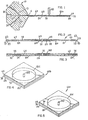
- Figure 1 illustrates a typical coextrusion die 10 which is a common die for a plurality of extrudible streams of material, in this case three such streams 13, 23, and 33.
- the three streams 13, 23, and 33 flow through separate channels 14, 24, and 34, which are configured to provide a laminar flow of three-layer extrudate 60 from die orifice 11.
- Other types of coextrusion dies are known (e.g.
- streams 13 and 33 are thermoplastic recording groove-accepting vinyl polymers (preferably vinyl chloride-vinyl acetate copolymer) and stream 23 is obtained from a blend comprising 5-95% by weight ground up scrap vinyl and 95-5% by weight filler particles, the particles being small enough to facilitate extrusion. Since the three streams 13, 23, and 33 are essentially compatible, the coextrusion process itself provides sufficient interlayer adhesion, and no coextruded compatibilizing adherence-improving interlayers are required for extrudate 60. That is, the layers 64, 74, and 84 of extrudate 60 are in direct interfacial adherent contact, as opposed to indirect adherent contact involving a compatibilizing interlayer.
- orifice 11 of die 10 can be wider than one blank width or even wider than several blank widths.
- the width of orifice 11 is such that the width of coextrudate 60 is exactly equal to a single blank width, thereby eliminating the need for longitudinal slitting. It is within the scope of this invention to produce a coextrudate 60 having a thickness approximately equal to record disc thickness, in which case the coextrudate can be diecut with a cutting die having a circular periphery.
- cutting tool 20 makes a single, straight transverse cut, resulting in rectangular coextrudate segments 60a (see also Figure 4).
- the rectangular coextrudate segment 60b has a core layer 74 and recording groove-accepting thermoplastic layers 64 and 84 in adherent contact with both major surfaces of core layer 74.
- the record disc label 401 has been applied to the top surface of extrudate 60b, and a' second label 402 (shown in phantom) has been applied to the bottom surface.
- the location of the hole.403 for the phonograph spindle is also shown in phantom; in accordance with the typical practice of compression molding of biscuits, the hole can be molded into the finished record during pressing or may even be punched out after pressing.
- Figure 4 illustrates the production of a coextrudate segment wherein the flow from the coextruder was stable, laminar, and hence well controlled.
- the interfaces 70 and 80 between layers 64 and 74 and 74 and 84 are substantially planar and substantially parallel to the top and bottom surfaces of coextrudate 60b. This stable flow condition is normally desirable for good quality control.
- Figure 5 illustrates the type of interfacial boundaries 70 and 80 which are observed when the coextrudate (in this case coextrudate segment 60c) was formed under conditions of incipient interfacial flow instability. Some of the parallelism of flow lines has not been lost, but the smooth planar character of the interfaces 70 and 80 is no longer present.
- a typical practice is to include a gram or two of excess material in each biscuit (or, in the case of this invention, each blank), which excess material typically shows up as mold flash. The mold flash is automatically trimmed off and recycled.
- the record disc blank cut from the coextrudate is a substantially record- thickness blank of circular periphery or a thicker blank having a much smaller surface area (e.g. rectangular blank or coextrudate segment 60b)
- some sort of impressing or compression molding step can be used to introduce the recording grooves.
- Conventional presses are designed to provide adequate temperature and pressure for a great deal of flow, since conventional vinyl biscuits are very large in thickness and very small in surface area as compared to a record disc.
- a conventional press can accept a blank of the type shown in Figure.4, provided this blank or coextrudate segment 60b is maintained (brought up to or held at) a suitable temperature just prior to entering the mold or press.
- the desired temperature is above T g (e.g. above 60 or 70° C.). If the material (polymer or polymer mixture) in blank 60b (particularly layers 64 and 84) has sufficient crystalline character to have a true melting point, the upper limit on the blank material temperature before (and preferably even during) pressing is ordinarily the melting point of the material.
- the upper limit is preferably the "flow point” or "flow temperature", i.e..the temperature at which the polymer molecules glide readily past one another when the material is stretched, with little intramolecular stretching. See Sweeting, The Science and Technology of Polymer Films, Vol. I, Interscience Publishers, New York, N.Y., pp. 460-464.
- Typical "flow temperatures” are below 250° C., more typically below 200° or even 150° C.
- a conventional heating/cooling cycle in audio disc compression molding involves heating the press initially to about 150° C. or close to the "flow temperature”, quickly cooling the press to 35 or 40° C., so that the record is below T , e.g.
- Figure 2 illustrates the record profile of a disc made from a three-layer coextruded blank such as blank 60b ( Figure 4).
- disc 100 of Figure 2 is still a blank in the sense that it does not as yet carry any frequency information.
- Disc 100 ( Figure 2) is provided with top and bottom labels 103 and 104 and hole 101 for the phonograph spindle.
- the top and bottom groove-accepting layers are 64 and 84 and the core layer is 74.
- the edges 65, 75, and 85 of layers 64, 74 and 84 can be perceived, even by the naked eye.
- This characteristic layered structure can provide at least a superficial check on whether the record disc being sold is original with the manufacturer or most probably made from different materials and/or on different equipment, thus indicating the possibility of piracy.
- the disc thickness gradually increases until one reaches the point along the radius indicated by 109, which point is typically about 125 mm from the center of the record (e.g. 127 mm). At this point, the record thickness has increased slightly beyond one millimeter but normally less than 1.1 mm, a typical value-being 1.07 mm (0.042 inches). At edge 107 of label 103 or label 104, the thickness of the disc is almost back to what it was at 113, a typical thickness being between 1.5 and 2 mm, e.g. 1.73 mm (0.068 inches). In the label area, the thickness decreases again very slightly, e.g. to about 1.6 mm.
- core layer 74 can be pigmented with a dark pigment, e.g. carbon black.
- layers 64 and 84 can be unpigmented.
- Figure 3 shows the cross section of a laser-read disc 200. Since disc 200 was coated with top and bottom protective coatings 94 after pressing, the record profile shown in Figure 2 is of far less importance, and the thickness of disc 200 can be substantially equal all along its radius.. Coatings or layers 94 are unpigmented so as to permit the uninterrupted passage of a beam of light such as a laser beam. Layers 64, 74, and 84 are similar to those of Figure 2, the recording grooves having been impressed in layers 64 and 84 prior to application of coatings 94.
- liquid surface coatings can be used to protect or lubricate the stamper or the surfaces of the disc. If the liquid coating agent has a measurable vapor pressure at normal ambient temperature (e.g. 20-25° C.), the pressed discs can be wiped off and held out from packaging until the liquid has evaporated. More preferably, the liquid is intended to remain on the disc to provide anti-static properties or the like.
Landscapes
- Engineering & Computer Science (AREA)
- Mechanical Engineering (AREA)
- Manufacturing & Machinery (AREA)
- Extrusion Moulding Of Plastics Or The Like (AREA)
- Manufacturing Optical Record Carriers (AREA)
Applications Claiming Priority (2)
| Application Number | Priority Date | Filing Date | Title |
|---|---|---|---|
| US111535 | 1980-01-14 | ||
| US06/111,535 US4315878A (en) | 1980-01-14 | 1980-01-14 | Manufacture of blanks for recording discs utilizing coextrusion and blanks and records made thereby |
Publications (2)
| Publication Number | Publication Date |
|---|---|
| EP0032452A2 true EP0032452A2 (de) | 1981-07-22 |
| EP0032452A3 EP0032452A3 (de) | 1983-01-26 |
Family
ID=22339081
Family Applications (1)
| Application Number | Title | Priority Date | Filing Date |
|---|---|---|---|
| EP81300123A Withdrawn EP0032452A3 (de) | 1980-01-14 | 1981-01-13 | Herstellung von Formlingen für Schallplatten durch Anwendung von Koextrusion und hergestellte Formlinge und Schallplatten |
Country Status (5)
| Country | Link |
|---|---|
| US (1) | US4315878A (de) |
| EP (1) | EP0032452A3 (de) |
| JP (1) | JPS56501875A (de) |
| CA (1) | CA1144483A (de) |
| WO (1) | WO1981001981A1 (de) |
Cited By (2)
| Publication number | Priority date | Publication date | Assignee | Title |
|---|---|---|---|---|
| FR2520288A1 (fr) * | 1982-01-26 | 1983-07-29 | Rca Corp | Procede de realisation d'un disque stratifie enregistre |
| EP0130900A1 (de) * | 1983-07-04 | 1985-01-09 | Thomson-Csf | Herstellung optischer Platten nach dem Pressverfahren und derartig hergestellte Platten |
Families Citing this family (5)
| Publication number | Priority date | Publication date | Assignee | Title |
|---|---|---|---|---|
| US4515830A (en) * | 1983-11-29 | 1985-05-07 | Rca Corporation | Solvent-cast capacitive high density information disc |
| JPS60143454A (ja) * | 1983-12-30 | 1985-07-29 | Victor Co Of Japan Ltd | 高密度情報信号記録媒体 |
| JP4425668B2 (ja) * | 2004-03-01 | 2010-03-03 | 東洋鋼鈑株式会社 | 複層の無延伸フィルムの製造方法および複層樹脂被覆金属板の製造方法 |
| US7862011B2 (en) | 2004-12-23 | 2011-01-04 | Az Evap, Llc | Non uniform water distribution system for an evaporative cooler |
| US7510174B2 (en) * | 2006-04-14 | 2009-03-31 | Kammerzell Larry L | Dew point cooling tower, adhesive bonded heat exchanger, and other heat transfer apparatus |
Family Cites Families (14)
| Publication number | Priority date | Publication date | Assignee | Title |
|---|---|---|---|---|
| US2529683A (en) * | 1950-11-14 | Yieldable connector for the back rest of chairs | ||
| US2039140A (en) * | 1932-09-30 | 1936-04-28 | Rca Corp | Method of forming phonograph records |
| DE1040808B (de) * | 1956-03-29 | 1958-10-09 | Grammophon Ges M B H Deutsche | Press- oder Spritzverfahren zur Herstellung von Schallplatten |
| FR1196983A (fr) * | 1957-12-03 | 1959-11-27 | Pechiney Cie De Prod Chim & El | Moulage plastique stratifié |
| GB856112A (en) * | 1958-07-23 | 1960-12-14 | Deutsche Grammophon Gmbh | Improvements in or relating to the manufacture of gramophone records |
| US3072519A (en) * | 1958-08-29 | 1963-01-08 | Allied Record Mfg Co | Method of making phonograph record blanks from composite material |
| GB1029286A (en) * | 1961-11-10 | 1966-05-11 | Eastman Kodak Co | Sound-reproducing record |
| DE2016228A1 (de) * | 1970-04-04 | 1971-10-28 | Matuschke W | |
| US3687769A (en) * | 1970-05-18 | 1972-08-29 | Harold F Dague | Laminated picture-type phonograph record,and method of making the same |
| US3665136A (en) * | 1971-03-16 | 1972-05-23 | Martin Gaber | Reed switch construction |
| US3846843A (en) * | 1971-07-19 | 1974-11-05 | Minnesota Mining & Mfg | Composite film |
| US3996090A (en) * | 1972-01-06 | 1976-12-07 | William C. Heller, Jr. | Method of making container article having heatable stratified material portion |
| US4034033A (en) * | 1976-03-26 | 1977-07-05 | Fredrick M. Kerr | Method for recovering material from the centers of phonograph records |
| FR2415535A1 (fr) * | 1978-01-30 | 1979-08-24 | Ato Chimie | Feuilles thermoplastiques multicouches |
-
1980
- 1980-01-14 US US06/111,535 patent/US4315878A/en not_active Expired - Lifetime
-
1981
- 1981-01-13 CA CA000368355A patent/CA1144483A/en not_active Expired
- 1981-01-13 EP EP81300123A patent/EP0032452A3/de not_active Withdrawn
- 1981-01-14 WO PCT/US1981/000050 patent/WO1981001981A1/en not_active Ceased
- 1981-01-14 JP JP50073381A patent/JPS56501875A/ja active Pending
Cited By (3)
| Publication number | Priority date | Publication date | Assignee | Title |
|---|---|---|---|---|
| FR2520288A1 (fr) * | 1982-01-26 | 1983-07-29 | Rca Corp | Procede de realisation d'un disque stratifie enregistre |
| EP0130900A1 (de) * | 1983-07-04 | 1985-01-09 | Thomson-Csf | Herstellung optischer Platten nach dem Pressverfahren und derartig hergestellte Platten |
| FR2548578A1 (fr) * | 1983-07-04 | 1985-01-11 | Thomson Csf | Procede de fabrication de disques optiques par pressage et disque obtenu par un tel procede |
Also Published As
| Publication number | Publication date |
|---|---|
| CA1144483A (en) | 1983-04-12 |
| EP0032452A3 (de) | 1983-01-26 |
| JPS56501875A (de) | 1981-12-24 |
| US4315878A (en) | 1982-02-16 |
| WO1981001981A1 (en) | 1981-07-23 |
Similar Documents
| Publication | Publication Date | Title |
|---|---|---|
| US3959432A (en) | Coextrusion process | |
| US5985079A (en) | Flexible composite surfacing film and method for producing same | |
| US4100237A (en) | Co-extrusion of ABS/polystyrene multiple-layered sheeting | |
| RU2461074C2 (ru) | Пленка для изготовления вплавляемой этикетки, способ повышения ее технологичности, способ этикетирования изделий и этикетированное изделие (варианты) | |
| AU634708B2 (en) | Container closure caps and compositions for forming gaskets for them | |
| US5527601A (en) | Biaxially oriented polypropylene film | |
| US20090252935A1 (en) | Multilayer film for use in simultaneous injection molding-lamination method | |
| CA2145828A1 (en) | Material and process for manufacturing plastic parts | |
| US4315878A (en) | Manufacture of blanks for recording discs utilizing coextrusion and blanks and records made thereby | |
| US9827747B2 (en) | Multi-layer film, decorative molding film and molded body | |
| JPS6097852A (ja) | 共押し出し多層物品 | |
| US3968196A (en) | Method of co-extrusion of polyvinylidene fluoride/polystyrene multiple-layered sheeting | |
| US3687769A (en) | Laminated picture-type phonograph record,and method of making the same | |
| CA1061973A (en) | Matt and scratch-resistant films and process for their manufacture | |
| US9162429B2 (en) | Decorative sheet, process for producing the same, and injection-molded article with decorative sheet | |
| US4051293A (en) | Co-extrusion of polyvinylidene fluoride/polystyrene multiple-layered sheeting | |
| CA2268743C (en) | Textured release sheet, method of making textured decorative laminates therewith, and decorative laminate lay-ups including such sheet | |
| US4221836A (en) | Coextruded plastic sheeting | |
| US2649622A (en) | Process for molding synthetic linear polyesters | |
| US3584094A (en) | Method of making picture-type phonograph records | |
| CN112123902A (zh) | 一种可直接纸塑复合用的bopp薄膜及其制备方法 | |
| GB1190698A (en) | Process for the Production of Stretched Films Consisting of Synthetic Thermoplastic High-Polymer Material. | |
| CA2004958C (en) | Thermoformable polyaryletherketone/polyvinyl fluoride laminates | |
| CN111993708A (zh) | 一种离型膜及其制备方法 | |
| US6808780B2 (en) | Low birefringence film |
Legal Events
| Date | Code | Title | Description |
|---|---|---|---|
| PUAI | Public reference made under article 153(3) epc to a published international application that has entered the european phase |
Free format text: ORIGINAL CODE: 0009012 |
|
| AK | Designated contracting states |
Designated state(s): AT BE DE FR GB IT NL SE |
|
| RBV | Designated contracting states (corrected) |
Designated state(s): AT BE DE FR GB IT NL SE |
|
| 17P | Request for examination filed |
Effective date: 19811016 |
|
| PUAL | Search report despatched |
Free format text: ORIGINAL CODE: 0009013 |
|
| AK | Designated contracting states |
Designated state(s): AT BE DE FR GB IT NL SE |
|
| STAA | Information on the status of an ep patent application or granted ep patent |
Free format text: STATUS: THE APPLICATION IS DEEMED TO BE WITHDRAWN |
|
| 18D | Application deemed to be withdrawn |
Effective date: 19860210 |
|
| RIN1 | Information on inventor provided before grant (corrected) |
Inventor name: LINDMARK, RICHARD C., JR. Inventor name: VAN DOVER, DENNIS W. |