EP0027935B1 - Dielectric liquid composition used in an electrical capacitor - Google Patents
Dielectric liquid composition used in an electrical capacitor Download PDFInfo
- Publication number
- EP0027935B1 EP0027935B1 EP80106138A EP80106138A EP0027935B1 EP 0027935 B1 EP0027935 B1 EP 0027935B1 EP 80106138 A EP80106138 A EP 80106138A EP 80106138 A EP80106138 A EP 80106138A EP 0027935 B1 EP0027935 B1 EP 0027935B1
- Authority
- EP
- European Patent Office
- Prior art keywords
- capacitor
- dielectric
- weight
- diphenyl
- ethane
- Prior art date
- Legal status (The legal status is an assumption and is not a legal conclusion. Google has not performed a legal analysis and makes no representation as to the accuracy of the status listed.)
- Expired
Links
Images
Classifications
-
- H—ELECTRICITY
- H01—ELECTRIC ELEMENTS
- H01G—CAPACITORS; CAPACITORS, RECTIFIERS, DETECTORS, SWITCHING DEVICES, LIGHT-SENSITIVE OR TEMPERATURE-SENSITIVE DEVICES OF THE ELECTROLYTIC TYPE
- H01G4/00—Fixed capacitors; Processes of their manufacture
- H01G4/002—Details
- H01G4/018—Dielectrics
- H01G4/20—Dielectrics using combinations of dielectrics from more than one of groups H01G4/02 - H01G4/06
- H01G4/22—Dielectrics using combinations of dielectrics from more than one of groups H01G4/02 - H01G4/06 impregnated
-
- H—ELECTRICITY
- H01—ELECTRIC ELEMENTS
- H01G—CAPACITORS; CAPACITORS, RECTIFIERS, DETECTORS, SWITCHING DEVICES, LIGHT-SENSITIVE OR TEMPERATURE-SENSITIVE DEVICES OF THE ELECTROLYTIC TYPE
- H01G4/00—Fixed capacitors; Processes of their manufacture
- H01G4/002—Details
- H01G4/018—Dielectrics
- H01G4/20—Dielectrics using combinations of dielectrics from more than one of groups H01G4/02 - H01G4/06
- H01G4/22—Dielectrics using combinations of dielectrics from more than one of groups H01G4/02 - H01G4/06 impregnated
- H01G4/221—Dielectrics using combinations of dielectrics from more than one of groups H01G4/02 - H01G4/06 impregnated characterised by the composition of the impregnant
-
- C—CHEMISTRY; METALLURGY
- C10—PETROLEUM, GAS OR COKE INDUSTRIES; TECHNICAL GASES CONTAINING CARBON MONOXIDE; FUELS; LUBRICANTS; PEAT
- C10M—LUBRICATING COMPOSITIONS; USE OF CHEMICAL SUBSTANCES EITHER ALONE OR AS LUBRICATING INGREDIENTS IN A LUBRICATING COMPOSITION
- C10M2207/00—Organic non-macromolecular hydrocarbon compounds containing hydrogen, carbon and oxygen as ingredients in lubricant compositions
- C10M2207/02—Hydroxy compounds
- C10M2207/023—Hydroxy compounds having hydroxy groups bound to carbon atoms of six-membered aromatic rings
- C10M2207/026—Hydroxy compounds having hydroxy groups bound to carbon atoms of six-membered aromatic rings with tertiary alkyl groups
-
- C—CHEMISTRY; METALLURGY
- C10—PETROLEUM, GAS OR COKE INDUSTRIES; TECHNICAL GASES CONTAINING CARBON MONOXIDE; FUELS; LUBRICANTS; PEAT
- C10M—LUBRICATING COMPOSITIONS; USE OF CHEMICAL SUBSTANCES EITHER ALONE OR AS LUBRICATING INGREDIENTS IN A LUBRICATING COMPOSITION
- C10M2207/00—Organic non-macromolecular hydrocarbon compounds containing hydrogen, carbon and oxygen as ingredients in lubricant compositions
- C10M2207/04—Ethers; Acetals; Ortho-esters; Ortho-carbonates
- C10M2207/042—Epoxides
-
- C—CHEMISTRY; METALLURGY
- C10—PETROLEUM, GAS OR COKE INDUSTRIES; TECHNICAL GASES CONTAINING CARBON MONOXIDE; FUELS; LUBRICANTS; PEAT
- C10M—LUBRICATING COMPOSITIONS; USE OF CHEMICAL SUBSTANCES EITHER ALONE OR AS LUBRICATING INGREDIENTS IN A LUBRICATING COMPOSITION
- C10M2207/00—Organic non-macromolecular hydrocarbon compounds containing hydrogen, carbon and oxygen as ingredients in lubricant compositions
- C10M2207/08—Aldehydes; Ketones
-
- C—CHEMISTRY; METALLURGY
- C10—PETROLEUM, GAS OR COKE INDUSTRIES; TECHNICAL GASES CONTAINING CARBON MONOXIDE; FUELS; LUBRICANTS; PEAT
- C10N—INDEXING SCHEME ASSOCIATED WITH SUBCLASS C10M RELATING TO LUBRICATING COMPOSITIONS
- C10N2040/00—Specified use or application for which the lubricating composition is intended
- C10N2040/14—Electric or magnetic purposes
- C10N2040/16—Dielectric; Insulating oil or insulators
-
- C—CHEMISTRY; METALLURGY
- C10—PETROLEUM, GAS OR COKE INDUSTRIES; TECHNICAL GASES CONTAINING CARBON MONOXIDE; FUELS; LUBRICANTS; PEAT
- C10N—INDEXING SCHEME ASSOCIATED WITH SUBCLASS C10M RELATING TO LUBRICATING COMPOSITIONS
- C10N2040/00—Specified use or application for which the lubricating composition is intended
- C10N2040/14—Electric or magnetic purposes
- C10N2040/17—Electric or magnetic purposes for electric contacts
Definitions
- the present invention provides an electrical capacitor, having a sealed casing, a capacitor pack in the casing composed of alternately wound electrical conductive strips and dielectric layers, and a dielectric liquid composition impregnating said dielectric characterized in that said dielectric liquid composition comprises a mixture of methyl diphenyl ethane of the formula: where R i is a methyl group and R 2 , R 3 and R 4 are either methyl groups or hydrogen; and alkyl diphenyl of the formula: or mixtures thereof where R 5 is an alkyl group containing 1 to 4 carbon atoms and Rr, is an alkyl group containing 1 to 4 carbon atoms or hydrogen.
- chlorinated biphenyls have seen wide use as dielectric liquids in electrical equipment.
- the polychlorinated biphenyls are particularly well suited in applications where fire hazards are a problem because of their relatively high fire point. While the polychlorinated biphenyls produce an effective dielectric system for electrical equipment, their usage has provided certain ecological problems, in that the polychlorinated biphenyls are virtually nonbiodegradable, with the result, that if leakage or rupture occurs in the electrical equipment, or if the equipment is discarded as obsolete, the polychlorinated biphenyl will remain as a pollutant in the environment and will not degrade to any appreciable extent over extended period of years.
- patents 4,054,937 and 3,796,934 disclose liquid dielectrics for capacitors utilizing an alkyl diphenyl.
- the alkyl diphenyl is combined with a diaryl sulfone
- patent 4,054,937 discloses a dielectric liquid composition composed of a mixture of mono or di alkyl derivatives of diphenyl, diphenyl oxide or diphenyl methane.
- the United States patent 3812407 discloses a capacitor which is impreganted with a non-halogenated non-sulfonated aromatic hydrocarbon oil of certain physico-chemical properties.
- 1-Phenyl 1-xylyl ethane is an example while bis-dimethyl compounds are not taken into consideration.
- the invention relates to an electrical capacitor having an improved dielectric system.
- the capacitor includes alternate layers of metal foil and a dielectric sheet material, such as polymeric film or Kraft paper.
- the dielectric sheet material is impregnated with a liquid dielectric composition composed of a mixture of a methyl diphenyl ethane and a mono or dialkyl diphenyl.
- the composition may contain small amounts of an antioxidant, or an epoxide scavenger.
- the capacitor of the invention exhibits low dielectric losses and has a good discharge inception voltage (DIV) over the normal operating range of -40°C to +90°C.
- the dielectric liquid composition as used in the capacitor of the invention, is non-halogenated and thus biodegradable, with the result that the composition will decompose into harmless compounds if exposed to the atmosphere through leakage or rupture of the casing, and there are no presently known or foreseen adverse effects on the environment.
- the capacitor of the invention is capable of operating under electrical stress at elevated temperatures up to 100°C without degradation of the dielectric sheet material or the liquid dielectric composition.
- the increased stability at elevated temperatures enables the dielectric system to be used in large power factor correction capacitors, which generally have an operational temperature range of -40°C to +50°C ambient, as well as in smaller ballast or specialty capacitors that may be subjected to operational temperatures up to 100°C.
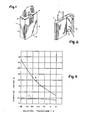
- Fig. 1 illustrates a typical capacitor comprising an outer casing 1 having side walls 2, a bottom wall 3 and a cover 4.
- the casing is hermetically sealed and is provided with a small seal hole 5 through which the dielectric liquid is introduced into the casing during processing.
- a vacuum line can be connected to hole 5 for vacuum drying of the capacitor during processing.
- a pair of terminals 6 project through the cover 4 and are insulated from the cover.
- each capacitor pack 7 includes wound layers of metal foil 8 separated by a dielectric layer 9. Electrodes 10 are connected to the foil layers 8 and the electrodes of the various packs are connected together in series for final connection to the terminals 6.
- the foil layers 8 can be formed of any desired electrically conductive material, generally a metallic material, such as aluminum, copper, or the like.
- the layers 8 may be in the form of flat sheets or the layers can be provided with surface irregularities, such as a series of deformations formed by indentations on one side of the foil and corresponding elevations on the other side, as disclosed in United States patent 3,746,953.
- the dielectric layers 9 can be composed of a polymeric film, or Kraft paper.
- the polymeric film can take the form of polypropylene, polyethylene, polyester, polycarbonate, or the like.
- the dielectric layers 9 can be provided with a layer of fine polymeric fibers adhering to the surface of the polymeric film, as disclosed in United States Patent 3,772,578.
- the surface of the polymeric film layer 9 and/or the contiguous surface of the metal foil 8 have surface irregularities or deformations, so that the two contiguous surfaces are not in continuous intimate contact.
- the surface irregularities provide a wicking or capillary effect for the liquid dielectric enablying the liquid to thoroughly impregnate the polymeric film during processing.
- the dielectric layers 9 are impregnated with a liquid dielectric compositions which is composed of a mixture of about 5% to 95% by weight methyl diphenyl ethane and 95% to 5% by weight of mono or di-alkyl diphenyl. A mixture of about 25% to 75% of the methyl diphenyl ethane and 75% to 25% of alkyl diphenyl is preferred.
- the methyl diphenyl ethane has the following chemical structure: Where R, is a methyl group, and R 2 , R 3 and R 4 are either methyl groups or hydrogen.
- the alkyl diphenyl to be used in the dielectric compositions has the following structural formula: or mixtures thereof where R s is an alkyl group containing 1 to 4 carbon atoms, and R 6 is an alkyl group containing 1 to 4 carbon atoms or is hydrogen.
- R s is an alkyl group containing 1 to 4 carbon atoms
- R 6 is an alkyl group containing 1 to 4 carbon atoms or is hydrogen.
- Mono or di-propyl diphenyls are preferred, and both normal propyl and isopropyl derivatives can be utilized.
- the dielectric composition can also include from 0.01% to 10.0% by weight, and preferably from about 0.2% to 1.5% by weight of an epoxide scavenger which will act to neutralize decomposition products that are released from or generated from the liquid impregnant and other materials in the capacitor during its operation.
- an epoxide scavenger which will act to neutralize decomposition products that are released from or generated from the liquid impregnant and other materials in the capacitor during its operation.
- the neutralizing agents or scavengers can take the form of 1, 2-epoxy-3-phenoxypropane; bis (3,4-epoxy-6-methylcylohexylmethyl) adipate; 1-epoxyethyl-3,4-epoxycyclohexane; 3,4-epoxycyclohexy[methyl-3,4-epoxycyclohexanecarboxylate; 3,4-epoxy-6-methylcyclohexylmethyl-3,4-epoxy-6-methylcyclohexanecarboxylate; and mixtures thereof.
- the epoxy compounds are effective to rapidly neutralize decomposition products, thereby improving the dielectric properties and service life of the capacitor.
- the dielectric composition can also include up to about 5.0% of anti-oxidant, and preferably about 0.01% to about 0.2%.
- Anti-oxidants that can be used are di-t-butylphenol, di-t-butyl-paracresol, and the like.
- the dielectric composition can also contain up to about 2%, and preferably about 0.01% to 0.05% of an agent to improve the corona resistance, such as anthraquinone, Beta-methylanthraquinone or Beta-chloranthraquinone.
- an agent to improve the corona resistance such as anthraquinone, Beta-methylanthraquinone or Beta-chloranthraquinone.
- the capacitor casing containing the capacitor packs is initially vacuum dried at a temperature preferably less than 60°C for a period of time sufficient to remove water vapor and other gases from the interior of the capacitor.
- a vacuum less than 0,66 mbar is usually employed, and preferably below 0,13 mbar, and a drying period longer than 40 hours is customary, although the time period depends on the magnitude of the vacuum.
- the liquid dielectric composition is separately subjected to a vacuum treatment to remove gases, and in this degassing treatment, a vacuum less than 0,13 mbar is utilized, with a vacuum less than 0,066 mbar being preferred.
- the liquid can be agitated either by circulating the liquid through a closed system, or subjecting it to stirring or mixing action.
- the time of degassing depends upon the viscosity of the liquid, the magnitude of the vacuum and the type of agitation. In general, the liquid is subjected to the vacuum treatment for a period in excess of 12 hours and during degassing is maintained at a temperature below 60°C and preferably at room temperature.
- the degassed dielectric liquid composition is then introduced into the capacitor casing and a positive pressure in the range of about 0,7 to 35 kPa is applied to the dielectric liquid.
- the positive pressure will result in the walls of the casing being bulged or expanded, within its elastic limit, to provide a slight increase in volume in the interior of the casing.
- the positive pressure is maintained on the liquid for a period in excess of 24 hours and the casing is thereafter sealed while maintaining some positive pressure.
- the capacitor After sealing, the capacitor is subjected to an elevated temperature, of about 65°C, for a period in excess of 24 hours to insure impregnation of the dielectric layers by the liquid dielectric composition.
- the application of the positive pressure on the liquid in the casing is an important factor in the processing.
- the liquid dielectric composition has a coefficient of thermal expansion approximately ten times greater than that of the metal casing of the capacitor.
- the shrinkage in volume of the liquid will be compensated for by the contraction of the expanded casing, so that a vacuum is not created in the casing at low temperatures.
- the casing is sealed off under either negative or atmospheric pressure, cooling of the capacitor in service will create a shrinkage in the liquid volume and a partial vacuum within the casing is possible.
- the partial vacuum can reduce the discharge inception voltage (DIV) and the discharge extinction voltage (DEV). Since damage caused by partial discharges may be cumulative, premature failure of a capacitor may result.
- the application of a positive pressure to the liquid serves an important function of expanding the casing, so that the shrinkage in volume of the liquid, when the capacitor is cooled, will be compensated for by the contraction of the casing, thereby preventing the creation of a vacuum within the casing.
- a capacitor was constructed having an approximate casing size of 8,89 cm x 12,7 cm x 63,5 cm and containing capacitor packs formed of alternate layers of two sheets of polypropylene film having a 37,5 ,um total thickness and aluminum foil having a thickness of 6 ⁇ m.
- a layer of Kraft paper insulation was applied to the inner wall of the casing.
- the capacitor casing was initially preheated to a temperature of 50°C and thereafter subjected to a vacuum less than 0,13 mbar for a period of 48 hours while maintaining the 50°C temperature. The casing was then disconnected from the vacuum line and after that it was permitted to cool to room temperature. The capacitor was then connected to a vacuum line of an impregnator and maintained at a vacuum of less than 0,13 mbar for a period of 24 hours, at room temperature, to complete the drying of the capacitor.
- a dielectric liquid composition composed of approximately 33% by weight of 1,1-bis (3,4-dimethylphenyl) ethane (DXE, Gulf Oil Chemicals Co.) and 67% by weight of iso-propyl diphenyl (Sun X-489-17), Sun Oil Co.) was separately degassed by subjecting the liquid at room temperature to a vacuum of less than 0,13 mbar while circulating the fluid for a period of over 12 hours through a closed system. After degassing, the dielectric composition was pumped into the degassed casing and a positive pressure of 3,5 kPa was applied to the liquid. The liquid was maintained under this positive pressure for a period of 72 hours at room temperature. The pressure caused the walls of the casing to expand to provide an increase in casing volume approximately 10%. The casing was sealed while maintaining the positive pressure.
- the capacitor was'disconnected from the pressure line and heated to a temperature of 65°C for a period of about 44 hours to insure impregnation of the polypropylene film by the liquid dielectric.
- the dielectric composition used in the capacitor has low dielectric losses, as illustrated in the graph shown in Fig. 3.
- This graph plots the dissipation factor against various constituent mixtures of 1,1-bis (3,4-dimethylphenyl) ethane (DXE, Gulf Oil Chemicals Co.) and iso-propyl diphenyl (SUN X-489-17, Sun Oil Co.).
- the dissipation factor was determined using a Balsbaugh cell and ASTM-D-924 test procedure. The test was run at 500 volts with a 1,25 mm gap between the casing and the central electrode of the cell.
- the results, as illustrated in Fig. 3 show that the dissipation factor of mixtures of methyl diphenyl ethane and propyl diphenyl decrease as the percentage of methyl diphenyl ethane increases. This indicates that the composition of this invention has extremely low dielectric losses
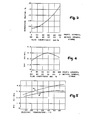
- the capacitor of the invention has excellent partial discharge characteristics, as illustrated in Fig. 5, which compares the discharge inception voltage (DIV) of a miniature capacitor made in accordance with the invention and utilizing 25% by weight of 1,1-bis-(3,4-dimethylphenyl) ethane (DXE, Gulf Oil Chemicals Co.) and iso-propyl diphenyl (SUN X-489-17, Sun Oil Company), with a similar miniature capacitor utilizing a mixture of about 17% by weight of mono-chlorodiphenyl oxide and 83% by weight of butylmonochlorodiphenyl oxide, as the liquid impregnant.
- DIV discharge inception voltage
- DXE 1,1-bis-(3,4-dimethylphenyl) ethane
- SUN X-489-17 iso-propyl diphenyl
- All of the capacitor samples included polypropylene film having a total thickness of 25,um and deformed aluminum foil having a nominal thickness of 6,25,um.
- the polypropylene film and the foil were wound convolutely in packs and inserted in steel casings which were vacuum dried at 20°C for 120 hours at a vacuum of about.
- the dielectric liquid in each case was separately vacuum degassed at room temperature for 48 hours at a vacuum less than 100 microns.
- the dielectric liquids were introduced into the respective capacitor casings and held at room temperature for 96 hours under a vacuum of about 0,027 mbar. After this period of soaking, the vacuum was released and the capacitors were sealed.
- the isopropyl diphenyl used in the examples is SUN x-489-17 which comprises 95,5 percent monoisopropyl diphenyl, 4 percent diisopropyl diphenyl and 0,5 percent diphenyl.
- the capacitor samples were operated under electrical stress at room temperature for a period of more than 500 hours at 1000 volts per 25 ,um. After this operating period, the DIV was determined at various temperatures from -40°C to +90°C.
- Fig. 5 show that the sample capacitors of the invention (Curve A) had a higher DIV over the entire temperature range than similar sample capacitors using the mixture of mono- chlorodiphenyl oxides (Curve B).
- the increased DIV of the capacitor of the invention provides an improved saftey margin, insuring that the normal operational stress will be well below the corona voltage.
- the improved corona characteristics of the capacitor of the invention will permit an increase in the number of volts per 25 pm without a sacrifice in the ratio of DIV to operating stress.
- Fig. 4 is a graph plotting the DIV of capacitors utilizing various mixtures of 1,1-bis(3,4-dimethylphenyl) ethane (DXE, Gulf Oil Chemicals Co.) and iso-propyl diphenyl (SUN X-489-17, Sun Oil Co.) at -40°C.
- the capacitors were processed in the same manner as previously outlined in connection with the data appearing in the graph of Fig. 5.
- Fig. 6 compares the dissipation factors of the miniature capacitors described above in connection with Fig. 5.
- the capacitors of the invention (Curve A) had a relatively constant dissipation factor throughout the entire range of temperatures from -50°C to +10°C.
- the capacitors utilizing the mixture of monochlorodiphenyl oxides as the impregnant, as shown by Curve B had a very high dissipation factor at -50°C, which decreases rapidly with an increase in temperature. This data shows the extremely low dielectric losses exhibited by the capacitor of the invention, particularly at low temperatures.
- the capacitor of the invention has a relatively high DIV over the entire normal operating temperature range, thereby providing good corona characteristics and exhibiting low dielectric losses.
- the higher DIV results in an increased safety margin, insuring that the volts per 25,um will be well below the DIV, or alternatively, permitting an increase in the volts per 25 ,um without a decrease in the safety margin.
- capacitors using mixtures of methyl diphenyl ethane and the alkyl diphenyl exhibit an unexpected increase in DIV, as compared to the DIV of capacitors using the individual components as the liquid dielectric.
- the capacitor of the invention also has extremely low dielectric losses, particularly at lower temperatures.
Landscapes
- Engineering & Computer Science (AREA)
- Power Engineering (AREA)
- Manufacturing & Machinery (AREA)
- Microelectronics & Electronic Packaging (AREA)
- Fixed Capacitors And Capacitor Manufacturing Machines (AREA)
- Organic Insulating Materials (AREA)
Applications Claiming Priority (2)
| Application Number | Priority Date | Filing Date | Title |
|---|---|---|---|
| US06/084,293 US4320034A (en) | 1979-10-12 | 1979-10-12 | Electrical capacitor having an improved dielectric system |
| US84293 | 1979-10-12 |
Publications (2)
| Publication Number | Publication Date |
|---|---|
| EP0027935A1 EP0027935A1 (en) | 1981-05-06 |
| EP0027935B1 true EP0027935B1 (en) | 1984-07-25 |
Family
ID=22184034
Family Applications (1)
| Application Number | Title | Priority Date | Filing Date |
|---|---|---|---|
| EP80106138A Expired EP0027935B1 (en) | 1979-10-12 | 1980-10-09 | Dielectric liquid composition used in an electrical capacitor |
Country Status (18)
| Country | Link |
|---|---|
| US (1) | US4320034A (OSRAM) |
| EP (1) | EP0027935B1 (OSRAM) |
| JP (1) | JPS5673422A (OSRAM) |
| KR (1) | KR830002749B1 (OSRAM) |
| AU (1) | AU534016B2 (OSRAM) |
| BE (1) | BE885572A (OSRAM) |
| BR (1) | BR8006543A (OSRAM) |
| CA (1) | CA1154503A (OSRAM) |
| CH (1) | CH644712A5 (OSRAM) |
| DE (1) | DE3068703D1 (OSRAM) |
| FI (1) | FI803222A7 (OSRAM) |
| FR (1) | FR2467475B1 (OSRAM) |
| GB (1) | GB2061316B (OSRAM) |
| IL (1) | IL61215A (OSRAM) |
| IN (1) | IN154024B (OSRAM) |
| IT (1) | IT1133685B (OSRAM) |
| PH (1) | PH17675A (OSRAM) |
| ZA (1) | ZA806247B (OSRAM) |
Families Citing this family (24)
| Publication number | Priority date | Publication date | Assignee | Title |
|---|---|---|---|---|
| US4347169A (en) * | 1980-06-30 | 1982-08-31 | Nippon Petrochemicals Company, Limited | Electrical insulating oil and oil-filled electrical appliances |
| US4420791A (en) * | 1981-12-28 | 1983-12-13 | Emhart Industries, Inc. | Dielectric fluid |
| JPS5951407A (ja) * | 1982-09-16 | 1984-03-24 | 日本石油化学株式会社 | 新規な電気絶縁油 |
| JPS5975502A (ja) * | 1982-10-25 | 1984-04-28 | 日本石油化学株式会社 | 新しい電気絶縁油 |
| AU547842B2 (en) * | 1983-03-14 | 1985-11-07 | Matsushita Electric Industrial Co., Ltd. | Oil impregnated capacitor |
| GB8329134D0 (en) * | 1983-11-01 | 1983-12-07 | Exxon Research Engineering Co | Dielectric fluid |
| JPH088009B2 (ja) * | 1986-09-04 | 1996-01-29 | 日本石油化学株式会社 | 電気絶縁油組成物 |
| JPH088010B2 (ja) * | 1986-09-04 | 1996-01-29 | 日本石油化学株式会社 | 電気絶縁油組成物 |
| US4744000A (en) * | 1987-07-29 | 1988-05-10 | Cooper Industries, Inc. | Electrical capacitor having improved dielectric system |
| JPS6476607A (en) * | 1987-09-16 | 1989-03-22 | Kureha Chemical Ind Co Ltd | Electric insulation oil |
| DE3809934A1 (de) * | 1988-03-24 | 1989-10-05 | Bayer Ag | Dielektrische fluessigkeiten |
| US6037537A (en) * | 1995-12-21 | 2000-03-14 | Cooper Industries, Inc. | Vegetable oil based dielectric coolant |
| US6398986B1 (en) * | 1995-12-21 | 2002-06-04 | Cooper Industries, Inc | Food grade vegetable oil based dielectric fluid and methods of using same |
| US6352655B1 (en) | 1995-12-21 | 2002-03-05 | Cooper Industries, Inc. | Vegetable oil based dielectric fluid |
| US5766517A (en) * | 1995-12-21 | 1998-06-16 | Cooper Industries, Inc. | Dielectric fluid for use in power distribution equipment |
| DE19858387A1 (de) * | 1998-12-17 | 2000-06-21 | Bsh Bosch Siemens Hausgeraete | Kältegerät |
| US6234343B1 (en) | 1999-03-26 | 2001-05-22 | Papp Enterprises, Llc | Automated portable medication radial dispensing apparatus and method |
| US6585917B2 (en) | 2001-04-12 | 2003-07-01 | Cooper Industries, Inc. | Dielectric fluid |
| AU2004319508A1 (en) * | 2004-04-24 | 2005-11-17 | Inrange Systems, Inc. | Universal medication carrier |
| US8414962B2 (en) * | 2005-10-28 | 2013-04-09 | The Penn State Research Foundation | Microcontact printed thin film capacitors |
| US20080110786A1 (en) * | 2006-11-09 | 2008-05-15 | Bossi Christopher E | Blister card carrier |
| CN101903958A (zh) * | 2007-10-18 | 2010-12-01 | 库帕技术公司 | 用于改进的电容器性能的介电流体 |
| BR112014018917A8 (pt) * | 2012-02-03 | 2017-07-11 | Jx Nippon Oil & Energy Corp | Composição de óleo isolante elétrico tendo propriedades excelentes em ampla faixa de temperatura |
| FR3008708B1 (fr) * | 2013-07-19 | 2016-09-23 | Arkema France | Composition de fluide dielectrique ou caloporteur |
Family Cites Families (11)
| Publication number | Priority date | Publication date | Assignee | Title |
|---|---|---|---|---|
| JPS4886066A (OSRAM) * | 1972-01-31 | 1973-11-14 | ||
| JPS4980045A (OSRAM) * | 1972-12-08 | 1974-08-02 | ||
| JPS49109856A (OSRAM) * | 1973-02-21 | 1974-10-18 | ||
| JPS5527401B2 (OSRAM) * | 1973-06-05 | 1980-07-21 | ||
| JPS553764B2 (OSRAM) * | 1973-07-11 | 1980-01-26 | ||
| JPS5033500A (OSRAM) * | 1973-07-30 | 1975-03-31 | ||
| JPS5086699A (OSRAM) * | 1973-12-06 | 1975-07-12 | ||
| JPS5086700A (OSRAM) * | 1973-12-06 | 1975-07-12 | ||
| US4053941A (en) * | 1974-06-20 | 1977-10-11 | Matsushita Electric Industrial Co., Ltd. | Oil impregnated electric device |
| US4054937A (en) * | 1976-04-28 | 1977-10-18 | Westinghouse Electric Corporation | Capacitor |
| CA1135495A (en) * | 1978-08-31 | 1982-11-16 | Lyon Mandelcorn | Capacitor having dielectric fluid with high di-isopropyl biphenyl content |
-
1979
- 1979-10-12 US US06/084,293 patent/US4320034A/en not_active Expired - Lifetime
-
1980
- 1980-10-01 AU AU62860/80A patent/AU534016B2/en not_active Ceased
- 1980-10-04 IN IN1134/CAL/80A patent/IN154024B/en unknown
- 1980-10-06 IL IL61215A patent/IL61215A/xx unknown
- 1980-10-08 CA CA000361810A patent/CA1154503A/en not_active Expired
- 1980-10-08 CH CH752180A patent/CH644712A5/fr not_active IP Right Cessation
- 1980-10-08 IT IT25196/80A patent/IT1133685B/it active
- 1980-10-08 BE BE1/9978A patent/BE885572A/fr not_active IP Right Cessation
- 1980-10-09 ZA ZA00806247A patent/ZA806247B/xx unknown
- 1980-10-09 PH PH24695A patent/PH17675A/en unknown
- 1980-10-09 DE DE8080106138T patent/DE3068703D1/de not_active Expired
- 1980-10-09 EP EP80106138A patent/EP0027935B1/en not_active Expired
- 1980-10-09 GB GB8032635A patent/GB2061316B/en not_active Expired
- 1980-10-10 BR BR8006543A patent/BR8006543A/pt unknown
- 1980-10-10 FI FI803222A patent/FI803222A7/fi not_active Application Discontinuation
- 1980-10-10 FR FR8021697A patent/FR2467475B1/fr not_active Expired
- 1980-10-11 KR KR1019800003902A patent/KR830002749B1/ko not_active Expired
- 1980-10-13 JP JP14355980A patent/JPS5673422A/ja active Pending
Also Published As
| Publication number | Publication date |
|---|---|
| IN154024B (OSRAM) | 1984-09-08 |
| IT1133685B (it) | 1986-07-09 |
| US4320034A (en) | 1982-03-16 |
| EP0027935A1 (en) | 1981-05-06 |
| IT8025196A0 (it) | 1980-10-08 |
| FI803222L (fi) | 1981-04-13 |
| JPS5673422A (en) | 1981-06-18 |
| GB2061316A (en) | 1981-05-13 |
| GB2061316B (en) | 1983-06-15 |
| IL61215A0 (en) | 1980-12-31 |
| AU6286080A (en) | 1981-04-16 |
| FR2467475A1 (fr) | 1981-04-17 |
| AU534016B2 (en) | 1983-12-22 |
| FR2467475B1 (fr) | 1986-02-21 |
| ZA806247B (en) | 1981-10-28 |
| FI803222A7 (fi) | 1981-04-13 |
| PH17675A (en) | 1984-11-02 |
| CH644712A5 (fr) | 1984-08-15 |
| KR830002749B1 (ko) | 1983-12-10 |
| BR8006543A (pt) | 1981-04-14 |
| CA1154503A (en) | 1983-09-27 |
| BE885572A (fr) | 1981-04-08 |
| IL61215A (en) | 1984-02-29 |
| DE3068703D1 (en) | 1984-08-30 |
| KR830004653A (ko) | 1983-07-16 |
Similar Documents
| Publication | Publication Date | Title |
|---|---|---|
| EP0027935B1 (en) | Dielectric liquid composition used in an electrical capacitor | |
| US4744000A (en) | Electrical capacitor having improved dielectric system | |
| US4266264A (en) | Meta isopropyl biphenyl insulated electrical apparatus | |
| US4355346A (en) | Electrical apparatus having an improved dielectric system | |
| EP1390958B1 (en) | Dielectric fluid | |
| US4097913A (en) | Electrical capacitor having an impregnated dielectric system | |
| US4108789A (en) | Dielectric compositions containing benzyl esters | |
| US3796934A (en) | Capacitor with non-halogenated impregnant | |
| US3996505A (en) | Capacitor with liquid polybutene dielectric | |
| US4521826A (en) | Dielectric fluid for a compacitor | |
| US4535382A (en) | Oil-impregnated capacitor | |
| US4097912A (en) | Electrical capacitor having an impregnated dielectric | |
| US3588644A (en) | Electrical apparatus and stabilized dielectric therefor | |
| US4538208A (en) | Alternating current capacitor | |
| US3948788A (en) | Dielectric composition for impregnating electrical capacitors | |
| US4142223A (en) | Capacitor with a stabilized non halogenated impregnant | |
| US3745432A (en) | Impregnated capacitor | |
| US4104184A (en) | Electrical devices containing select vinylsiloxane dielectric fluids | |
| CA1046754A (en) | Dielectric system for an electrical apparatus | |
| CA1155939A (en) | Electrical apparatus having improved dielectric system | |
| CA1070103A (en) | Electrical apparatus having an improved dielectric system | |
| JPH0213807B2 (OSRAM) | ||
| KR800001404B1 (ko) | 개량된 유전 시스템을 갖는 캐패시터 | |
| GB1582312A (en) | Impregnated electrical capacitor | |
| CA1149602A (en) | Non-toxic impregnant for electrical capacitors |
Legal Events
| Date | Code | Title | Description |
|---|---|---|---|
| PUAI | Public reference made under article 153(3) epc to a published international application that has entered the european phase |
Free format text: ORIGINAL CODE: 0009012 |
|
| AK | Designated contracting states |
Designated state(s): DE NL SE |
|
| 17P | Request for examination filed |
Effective date: 19811106 |
|
| GRAA | (expected) grant |
Free format text: ORIGINAL CODE: 0009210 |
|
| AK | Designated contracting states |
Designated state(s): DE NL SE |
|
| REF | Corresponds to: |
Ref document number: 3068703 Country of ref document: DE Date of ref document: 19840830 |
|
| PGFP | Annual fee paid to national office [announced via postgrant information from national office to epo] |
Ref country code: DE Payment date: 19841228 Year of fee payment: 5 |
|
| PGFP | Annual fee paid to national office [announced via postgrant information from national office to epo] |
Ref country code: SE Payment date: 19841231 Year of fee payment: 5 |
|
| PLBE | No opposition filed within time limit |
Free format text: ORIGINAL CODE: 0009261 |
|
| STAA | Information on the status of an ep patent application or granted ep patent |
Free format text: STATUS: NO OPPOSITION FILED WITHIN TIME LIMIT |
|
| 26N | No opposition filed | ||
| PGFP | Annual fee paid to national office [announced via postgrant information from national office to epo] |
Ref country code: NL Payment date: 19871031 Year of fee payment: 8 |
|
| PG25 | Lapsed in a contracting state [announced via postgrant information from national office to epo] |
Ref country code: DE Effective date: 19880701 |
|
| PG25 | Lapsed in a contracting state [announced via postgrant information from national office to epo] |
Ref country code: SE Effective date: 19881010 |
|
| PG25 | Lapsed in a contracting state [announced via postgrant information from national office to epo] |
Ref country code: NL Effective date: 19890501 |
|
| NLV4 | Nl: lapsed or anulled due to non-payment of the annual fee | ||
| EUG | Se: european patent has lapsed |
Ref document number: 80106138.3 Effective date: 19890614 |