EP0027727B1 - Polyamides suitable for use as hot-melt adhesives, process for their production, and adhesive compositions comprising them - Google Patents
Polyamides suitable for use as hot-melt adhesives, process for their production, and adhesive compositions comprising them Download PDFInfo
- Publication number
- EP0027727B1 EP0027727B1 EP80303674A EP80303674A EP0027727B1 EP 0027727 B1 EP0027727 B1 EP 0027727B1 EP 80303674 A EP80303674 A EP 80303674A EP 80303674 A EP80303674 A EP 80303674A EP 0027727 B1 EP0027727 B1 EP 0027727B1
- Authority
- EP
- European Patent Office
- Prior art keywords
- polyamide
- graft
- methacrylate
- styrene
- carbon atoms
- Prior art date
- Legal status (The legal status is an assumption and is not a legal conclusion. Google has not performed a legal analysis and makes no representation as to the accuracy of the status listed.)
- Expired
Links
- 239000004952 Polyamide Substances 0.000 title claims description 86
- 229920002647 polyamide Polymers 0.000 title claims description 86
- 238000000034 method Methods 0.000 title claims description 25
- 239000000203 mixture Substances 0.000 title claims description 18
- 239000000853 adhesive Substances 0.000 title claims description 17
- 230000001070 adhesive effect Effects 0.000 title claims description 17
- 230000008569 process Effects 0.000 title claims description 17
- 239000004831 Hot glue Substances 0.000 title claims description 13
- PPBRXRYQALVLMV-UHFFFAOYSA-N Styrene Chemical compound C=CC1=CC=CC=C1 PPBRXRYQALVLMV-UHFFFAOYSA-N 0.000 claims description 31
- 125000004432 carbon atom Chemical group C* 0.000 claims description 20
- 150000003254 radicals Chemical class 0.000 claims description 14
- -1 alkyl methacrylate Chemical compound 0.000 claims description 12
- 229920001971 elastomer Polymers 0.000 claims description 10
- 150000001991 dicarboxylic acids Chemical class 0.000 claims description 9
- 239000000806 elastomer Substances 0.000 claims description 9
- CERQOIWHTDAKMF-UHFFFAOYSA-N Methacrylic acid Chemical compound CC(=C)C(O)=O CERQOIWHTDAKMF-UHFFFAOYSA-N 0.000 claims description 7
- 125000000217 alkyl group Chemical group 0.000 claims description 7
- 150000002148 esters Chemical class 0.000 claims description 7
- 229920002725 thermoplastic elastomer Polymers 0.000 claims description 7
- NLHHRLWOUZZQLW-UHFFFAOYSA-N Acrylonitrile Chemical compound C=CC#N NLHHRLWOUZZQLW-UHFFFAOYSA-N 0.000 claims description 6
- SOGAXMICEFXMKE-UHFFFAOYSA-N Butylmethacrylate Chemical compound CCCCOC(=O)C(C)=C SOGAXMICEFXMKE-UHFFFAOYSA-N 0.000 claims description 6
- 230000005855 radiation Effects 0.000 claims description 6
- KGIGUEBEKRSTEW-UHFFFAOYSA-N 2-vinylpyridine Chemical compound C=CC1=CC=CC=N1 KGIGUEBEKRSTEW-UHFFFAOYSA-N 0.000 claims description 5
- GYCMBHHDWRMZGG-UHFFFAOYSA-N Methylacrylonitrile Chemical compound CC(=C)C#N GYCMBHHDWRMZGG-UHFFFAOYSA-N 0.000 claims description 5
- 150000001491 aromatic compounds Chemical class 0.000 claims description 5
- 229920001400 block copolymer Polymers 0.000 claims description 5
- 125000002843 carboxylic acid group Chemical group 0.000 claims description 5
- 125000004433 nitrogen atom Chemical group N* 0.000 claims description 5
- XYLMUPLGERFSHI-UHFFFAOYSA-N alpha-Methylstyrene Chemical compound CC(=C)C1=CC=CC=C1 XYLMUPLGERFSHI-UHFFFAOYSA-N 0.000 claims description 4
- 150000001412 amines Chemical class 0.000 claims description 4
- 239000000178 monomer Substances 0.000 claims description 4
- 150000003440 styrenes Chemical class 0.000 claims description 4
- VVQNEPGJFQJSBK-UHFFFAOYSA-N Methyl methacrylate Chemical compound COC(=O)C(C)=C VVQNEPGJFQJSBK-UHFFFAOYSA-N 0.000 claims description 3
- 239000004793 Polystyrene Substances 0.000 claims description 3
- SUPCQIBBMFXVTL-UHFFFAOYSA-N ethyl 2-methylprop-2-enoate Chemical compound CCOC(=O)C(C)=C SUPCQIBBMFXVTL-UHFFFAOYSA-N 0.000 claims description 3
- 230000001678 irradiating effect Effects 0.000 claims description 3
- 125000002496 methyl group Chemical group [H]C([H])([H])* 0.000 claims description 3
- 229920002223 polystyrene Polymers 0.000 claims description 3
- 150000003141 primary amines Chemical class 0.000 claims description 3
- 150000003335 secondary amines Chemical class 0.000 claims description 3
- WDQMWEYDKDCEHT-UHFFFAOYSA-N 2-ethylhexyl 2-methylprop-2-enoate Chemical compound CCCCC(CC)COC(=O)C(C)=C WDQMWEYDKDCEHT-UHFFFAOYSA-N 0.000 claims description 2
- RUMACXVDVNRZJZ-UHFFFAOYSA-N 2-methylpropyl 2-methylprop-2-enoate Chemical compound CC(C)COC(=O)C(C)=C RUMACXVDVNRZJZ-UHFFFAOYSA-N 0.000 claims description 2
- 239000004606 Fillers/Extenders Substances 0.000 claims description 2
- 125000004122 cyclic group Chemical group 0.000 claims description 2
- OIWOHHBRDFKZNC-UHFFFAOYSA-N cyclohexyl 2-methylprop-2-enoate Chemical compound CC(=C)C(=O)OC1CCCCC1 OIWOHHBRDFKZNC-UHFFFAOYSA-N 0.000 claims description 2
- 239000000945 filler Substances 0.000 claims description 2
- 239000004848 polyfunctional curative Substances 0.000 claims description 2
- 239000003381 stabilizer Substances 0.000 claims description 2
- KFDVPJUYSDEJTH-UHFFFAOYSA-N 4-ethenylpyridine Chemical compound C=CC1=CC=NC=C1 KFDVPJUYSDEJTH-UHFFFAOYSA-N 0.000 claims 1
- 229920000642 polymer Polymers 0.000 description 21
- 150000004985 diamines Chemical class 0.000 description 12
- 239000000463 material Substances 0.000 description 12
- 239000000758 substrate Substances 0.000 description 11
- YXFVVABEGXRONW-UHFFFAOYSA-N Toluene Chemical compound CC1=CC=CC=C1 YXFVVABEGXRONW-UHFFFAOYSA-N 0.000 description 9
- IJGRMHOSHXDMSA-UHFFFAOYSA-N Atomic nitrogen Chemical compound N#N IJGRMHOSHXDMSA-UHFFFAOYSA-N 0.000 description 8
- 230000015572 biosynthetic process Effects 0.000 description 7
- 229920000578 graft copolymer Polymers 0.000 description 7
- CSCPPACGZOOCGX-UHFFFAOYSA-N Acetone Chemical compound CC(C)=O CSCPPACGZOOCGX-UHFFFAOYSA-N 0.000 description 6
- 238000002360 preparation method Methods 0.000 description 6
- 125000003118 aryl group Chemical group 0.000 description 5
- 150000001875 compounds Chemical class 0.000 description 5
- PIICEJLVQHRZGT-UHFFFAOYSA-N Ethylenediamine Chemical compound NCCN PIICEJLVQHRZGT-UHFFFAOYSA-N 0.000 description 4
- 239000002253 acid Substances 0.000 description 4
- 125000001931 aliphatic group Chemical group 0.000 description 4
- 239000000539 dimer Substances 0.000 description 4
- 150000002432 hydroperoxides Chemical class 0.000 description 4
- 229910052757 nitrogen Inorganic materials 0.000 description 4
- 150000002978 peroxides Chemical class 0.000 description 4
- XFNJVJPLKCPIBV-UHFFFAOYSA-N trimethylenediamine Chemical compound NCCCN XFNJVJPLKCPIBV-UHFFFAOYSA-N 0.000 description 4
- 235000014113 dietary fatty acids Nutrition 0.000 description 3
- USIUVYZYUHIAEV-UHFFFAOYSA-N diphenyl ether Chemical compound C=1C=CC=CC=1OC1=CC=CC=C1 USIUVYZYUHIAEV-UHFFFAOYSA-N 0.000 description 3
- 239000000194 fatty acid Substances 0.000 description 3
- 229930195729 fatty acid Natural products 0.000 description 3
- 150000004665 fatty acids Chemical class 0.000 description 3
- 230000009477 glass transition Effects 0.000 description 3
- 229920001903 high density polyethylene Polymers 0.000 description 3
- 239000004700 high-density polyethylene Substances 0.000 description 3
- 150000002430 hydrocarbons Chemical group 0.000 description 3
- 239000001257 hydrogen Substances 0.000 description 3
- 229910052739 hydrogen Inorganic materials 0.000 description 3
- 238000007654 immersion Methods 0.000 description 3
- 239000003999 initiator Substances 0.000 description 3
- 229920000768 polyamine Polymers 0.000 description 3
- 238000010992 reflux Methods 0.000 description 3
- 238000005406 washing Methods 0.000 description 3
- 229920002633 Kraton (polymer) Polymers 0.000 description 2
- OFOBLEOULBTSOW-UHFFFAOYSA-N Malonic acid Chemical compound OC(=O)CC(O)=O OFOBLEOULBTSOW-UHFFFAOYSA-N 0.000 description 2
- 150000007513 acids Chemical class 0.000 description 2
- 230000002411 adverse Effects 0.000 description 2
- 238000004458 analytical method Methods 0.000 description 2
- 230000008901 benefit Effects 0.000 description 2
- 238000006243 chemical reaction Methods 0.000 description 2
- MVPPADPHJFYWMZ-UHFFFAOYSA-N chlorobenzene Chemical compound ClC1=CC=CC=C1 MVPPADPHJFYWMZ-UHFFFAOYSA-N 0.000 description 2
- 239000000839 emulsion Substances 0.000 description 2
- RTZKZFJDLAIYFH-UHFFFAOYSA-N ether Substances CCOCC RTZKZFJDLAIYFH-UHFFFAOYSA-N 0.000 description 2
- NAQMVNRVTILPCV-UHFFFAOYSA-N hexane-1,6-diamine Chemical compound NCCCCCCN NAQMVNRVTILPCV-UHFFFAOYSA-N 0.000 description 2
- 230000000977 initiatory effect Effects 0.000 description 2
- 239000007788 liquid Substances 0.000 description 2
- 229920001684 low density polyethylene Polymers 0.000 description 2
- 239000004702 low-density polyethylene Substances 0.000 description 2
- 238000002156 mixing Methods 0.000 description 2
- 230000004048 modification Effects 0.000 description 2
- 238000012986 modification Methods 0.000 description 2
- 239000003607 modifier Substances 0.000 description 2
- 230000000704 physical effect Effects 0.000 description 2
- 238000006116 polymerization reaction Methods 0.000 description 2
- 229920000098 polyolefin Polymers 0.000 description 2
- KIDHWZJUCRJVML-UHFFFAOYSA-N putrescine Chemical compound NCCCCN KIDHWZJUCRJVML-UHFFFAOYSA-N 0.000 description 2
- 229920006395 saturated elastomer Polymers 0.000 description 2
- 239000002904 solvent Substances 0.000 description 2
- 239000000126 substance Substances 0.000 description 2
- 238000005979 thermal decomposition reaction Methods 0.000 description 2
- KGRVJHAUYBGFFP-UHFFFAOYSA-N 2,2'-Methylenebis(4-methyl-6-tert-butylphenol) Chemical compound CC(C)(C)C1=CC(C)=CC(CC=2C(=C(C=C(C)C=2)C(C)(C)C)O)=C1O KGRVJHAUYBGFFP-UHFFFAOYSA-N 0.000 description 1
- HIXDQWDOVZUNNA-UHFFFAOYSA-N 2-(3,4-dimethoxyphenyl)-5-hydroxy-7-methoxychromen-4-one Chemical compound C=1C(OC)=CC(O)=C(C(C=2)=O)C=1OC=2C1=CC=C(OC)C(OC)=C1 HIXDQWDOVZUNNA-UHFFFAOYSA-N 0.000 description 1
- RYONYLONAVARPB-UHFFFAOYSA-N 2-nonyldecane-1,10-diamine Chemical compound CCCCCCCCCC(CN)CCCCCCCCN RYONYLONAVARPB-UHFFFAOYSA-N 0.000 description 1
- KCGKUMZADDHXEJ-UHFFFAOYSA-N 3-octyldodecane-1,12-diamine Chemical compound CCCCCCCCC(CCN)CCCCCCCCCN KCGKUMZADDHXEJ-UHFFFAOYSA-N 0.000 description 1
- YBRVSVVVWCFQMG-UHFFFAOYSA-N 4,4'-diaminodiphenylmethane Chemical compound C1=CC(N)=CC=C1CC1=CC=C(N)C=C1 YBRVSVVVWCFQMG-UHFFFAOYSA-N 0.000 description 1
- OXEZLYIDQPBCBB-UHFFFAOYSA-N 4-(3-piperidin-4-ylpropyl)piperidine Chemical compound C1CNCCC1CCCC1CCNCC1 OXEZLYIDQPBCBB-UHFFFAOYSA-N 0.000 description 1
- 239000004342 Benzoyl peroxide Substances 0.000 description 1
- OMPJBNCRMGITSC-UHFFFAOYSA-N Benzoylperoxide Chemical compound C=1C=CC=CC=1C(=O)OOC(=O)C1=CC=CC=C1 OMPJBNCRMGITSC-UHFFFAOYSA-N 0.000 description 1
- 239000004215 Carbon black (E152) Substances 0.000 description 1
- UFHFLCQGNIYNRP-UHFFFAOYSA-N Hydrogen Chemical compound [H][H] UFHFLCQGNIYNRP-UHFFFAOYSA-N 0.000 description 1
- 239000004677 Nylon Substances 0.000 description 1
- 229920002292 Nylon 6 Polymers 0.000 description 1
- 229920002302 Nylon 6,6 Polymers 0.000 description 1
- 239000004698 Polyethylene Substances 0.000 description 1
- 229920002396 Polyurea Polymers 0.000 description 1
- 150000001279 adipic acids Chemical class 0.000 description 1
- 150000007933 aliphatic carboxylic acids Chemical class 0.000 description 1
- 125000002947 alkylene group Chemical group 0.000 description 1
- 125000005263 alkylenediamine group Chemical group 0.000 description 1
- 239000012298 atmosphere Substances 0.000 description 1
- QVGXLLKOCUKJST-UHFFFAOYSA-N atomic oxygen Chemical compound [O] QVGXLLKOCUKJST-UHFFFAOYSA-N 0.000 description 1
- 235000019400 benzoyl peroxide Nutrition 0.000 description 1
- FACXGONDLDSNOE-UHFFFAOYSA-N buta-1,3-diene;styrene Chemical compound C=CC=C.C=CC1=CC=CC=C1.C=CC1=CC=CC=C1 FACXGONDLDSNOE-UHFFFAOYSA-N 0.000 description 1
- RGTXVXDNHPWPHH-UHFFFAOYSA-N butane-1,3-diamine Chemical compound CC(N)CCN RGTXVXDNHPWPHH-UHFFFAOYSA-N 0.000 description 1
- 239000000969 carrier Substances 0.000 description 1
- 230000008859 change Effects 0.000 description 1
- 230000000052 comparative effect Effects 0.000 description 1
- 238000009833 condensation Methods 0.000 description 1
- 230000005494 condensation Effects 0.000 description 1
- 230000008602 contraction Effects 0.000 description 1
- 229920001577 copolymer Polymers 0.000 description 1
- YQLZOAVZWJBZSY-UHFFFAOYSA-N decane-1,10-diamine Chemical compound NCCCCCCCCCCN YQLZOAVZWJBZSY-UHFFFAOYSA-N 0.000 description 1
- 230000006866 deterioration Effects 0.000 description 1
- KEIQPMUPONZJJH-UHFFFAOYSA-N dicyclohexylmethanediamine Chemical compound C1CCCCC1C(N)(N)C1CCCCC1 KEIQPMUPONZJJH-UHFFFAOYSA-N 0.000 description 1
- 238000010894 electron beam technology Methods 0.000 description 1
- JBKVHLHDHHXQEQ-UHFFFAOYSA-N epsilon-caprolactam Chemical compound O=C1CCCCCN1 JBKVHLHDHHXQEQ-UHFFFAOYSA-N 0.000 description 1
- 230000001747 exhibiting effect Effects 0.000 description 1
- 239000004744 fabric Substances 0.000 description 1
- 239000000835 fiber Substances 0.000 description 1
- 239000012530 fluid Substances 0.000 description 1
- 150000002311 glutaric acids Chemical class 0.000 description 1
- VOZRXNHHFUQHIL-UHFFFAOYSA-N glycidyl methacrylate Chemical group CC(=C)C(=O)OCC1CO1 VOZRXNHHFUQHIL-UHFFFAOYSA-N 0.000 description 1
- 238000010438 heat treatment Methods 0.000 description 1
- 125000000623 heterocyclic group Chemical group 0.000 description 1
- 229930195733 hydrocarbon Natural products 0.000 description 1
- 125000004435 hydrogen atom Chemical group [H]* 0.000 description 1
- 239000011261 inert gas Substances 0.000 description 1
- 239000003112 inhibitor Substances 0.000 description 1
- 150000002531 isophthalic acids Chemical class 0.000 description 1
- 239000011159 matrix material Substances 0.000 description 1
- 238000005259 measurement Methods 0.000 description 1
- 238000002844 melting Methods 0.000 description 1
- 230000008018 melting Effects 0.000 description 1
- 229910052751 metal Inorganic materials 0.000 description 1
- 239000002184 metal Substances 0.000 description 1
- 150000002739 metals Chemical class 0.000 description 1
- 239000012299 nitrogen atmosphere Substances 0.000 description 1
- QJGQUHMNIGDVPM-UHFFFAOYSA-N nitrogen group Chemical group [N] QJGQUHMNIGDVPM-UHFFFAOYSA-N 0.000 description 1
- 229920001778 nylon Polymers 0.000 description 1
- 239000001301 oxygen Substances 0.000 description 1
- 229910052760 oxygen Inorganic materials 0.000 description 1
- 125000001997 phenyl group Chemical group [H]C1=C([H])C([H])=C(*)C([H])=C1[H] 0.000 description 1
- 150000003022 phthalic acids Chemical class 0.000 description 1
- 229920000728 polyester Polymers 0.000 description 1
- 229920000573 polyethylene Polymers 0.000 description 1
- 229920000346 polystyrene-polyisoprene block-polystyrene Polymers 0.000 description 1
- 229920002635 polyurethane Polymers 0.000 description 1
- 239000004814 polyurethane Substances 0.000 description 1
- 238000003825 pressing Methods 0.000 description 1
- 230000001737 promoting effect Effects 0.000 description 1
- 125000004076 pyridyl group Chemical group 0.000 description 1
- 239000012966 redox initiator Substances 0.000 description 1
- 239000012763 reinforcing filler Substances 0.000 description 1
- 238000001226 reprecipitation Methods 0.000 description 1
- 238000007789 sealing Methods 0.000 description 1
- 150000003330 sebacic acids Chemical class 0.000 description 1
- 238000004611 spectroscopical analysis Methods 0.000 description 1
- 238000010561 standard procedure Methods 0.000 description 1
- 239000007858 starting material Substances 0.000 description 1
- 229920000468 styrene butadiene styrene block copolymer Polymers 0.000 description 1
- 150000003442 suberic acids Chemical class 0.000 description 1
- 150000003444 succinic acids Chemical class 0.000 description 1
- 239000000725 suspension Substances 0.000 description 1
- 229920001059 synthetic polymer Polymers 0.000 description 1
- 150000003504 terephthalic acids Chemical class 0.000 description 1
- 229920001169 thermoplastic Polymers 0.000 description 1
- 239000004416 thermosoftening plastic Substances 0.000 description 1
Classifications
-
- C—CHEMISTRY; METALLURGY
- C08—ORGANIC MACROMOLECULAR COMPOUNDS; THEIR PREPARATION OR CHEMICAL WORKING-UP; COMPOSITIONS BASED THEREON
- C08F—MACROMOLECULAR COMPOUNDS OBTAINED BY REACTIONS ONLY INVOLVING CARBON-TO-CARBON UNSATURATED BONDS
- C08F283/00—Macromolecular compounds obtained by polymerising monomers on to polymers provided for in subclass C08G
- C08F283/04—Macromolecular compounds obtained by polymerising monomers on to polymers provided for in subclass C08G on to polycarbonamides, polyesteramides or polyimides
-
- C—CHEMISTRY; METALLURGY
- C09—DYES; PAINTS; POLISHES; NATURAL RESINS; ADHESIVES; COMPOSITIONS NOT OTHERWISE PROVIDED FOR; APPLICATIONS OF MATERIALS NOT OTHERWISE PROVIDED FOR
- C09J—ADHESIVES; NON-MECHANICAL ASPECTS OF ADHESIVE PROCESSES IN GENERAL; ADHESIVE PROCESSES NOT PROVIDED FOR ELSEWHERE; USE OF MATERIALS AS ADHESIVES
- C09J151/00—Adhesives based on graft polymers in which the grafted component is obtained by reactions only involving carbon-to-carbon unsaturated bonds; Adhesives based on derivatives of such polymers
- C09J151/08—Adhesives based on graft polymers in which the grafted component is obtained by reactions only involving carbon-to-carbon unsaturated bonds; Adhesives based on derivatives of such polymers grafted on to macromolecular compounds obtained otherwise than by reactions only involving carbon-to-carbon unsaturated bonds
-
- C—CHEMISTRY; METALLURGY
- C08—ORGANIC MACROMOLECULAR COMPOUNDS; THEIR PREPARATION OR CHEMICAL WORKING-UP; COMPOSITIONS BASED THEREON
- C08L—COMPOSITIONS OF MACROMOLECULAR COMPOUNDS
- C08L2666/00—Composition of polymers characterized by a further compound in the blend, being organic macromolecular compounds, natural resins, waxes or and bituminous materials, non-macromolecular organic substances, inorganic substances or characterized by their function in the composition
- C08L2666/02—Organic macromolecular compounds, natural resins, waxes or and bituminous materials
- C08L2666/24—Graft or block copolymers according to groups C08L51/00, C08L53/00 or C08L55/02; Derivatives thereof
-
- Y—GENERAL TAGGING OF NEW TECHNOLOGICAL DEVELOPMENTS; GENERAL TAGGING OF CROSS-SECTIONAL TECHNOLOGIES SPANNING OVER SEVERAL SECTIONS OF THE IPC; TECHNICAL SUBJECTS COVERED BY FORMER USPC CROSS-REFERENCE ART COLLECTIONS [XRACs] AND DIGESTS
- Y10—TECHNICAL SUBJECTS COVERED BY FORMER USPC
- Y10S—TECHNICAL SUBJECTS COVERED BY FORMER USPC CROSS-REFERENCE ART COLLECTIONS [XRACs] AND DIGESTS
- Y10S174/00—Electricity: conductors and insulators
- Y10S174/08—Shrinkable tubes
-
- Y—GENERAL TAGGING OF NEW TECHNOLOGICAL DEVELOPMENTS; GENERAL TAGGING OF CROSS-SECTIONAL TECHNOLOGIES SPANNING OVER SEVERAL SECTIONS OF THE IPC; TECHNICAL SUBJECTS COVERED BY FORMER USPC CROSS-REFERENCE ART COLLECTIONS [XRACs] AND DIGESTS
- Y10—TECHNICAL SUBJECTS COVERED BY FORMER USPC
- Y10S—TECHNICAL SUBJECTS COVERED BY FORMER USPC CROSS-REFERENCE ART COLLECTIONS [XRACs] AND DIGESTS
- Y10S428/00—Stock material or miscellaneous articles
- Y10S428/913—Material designed to be responsive to temperature, light, moisture
-
- Y—GENERAL TAGGING OF NEW TECHNOLOGICAL DEVELOPMENTS; GENERAL TAGGING OF CROSS-SECTIONAL TECHNOLOGIES SPANNING OVER SEVERAL SECTIONS OF THE IPC; TECHNICAL SUBJECTS COVERED BY FORMER USPC CROSS-REFERENCE ART COLLECTIONS [XRACs] AND DIGESTS
- Y10—TECHNICAL SUBJECTS COVERED BY FORMER USPC
- Y10T—TECHNICAL SUBJECTS COVERED BY FORMER US CLASSIFICATION
- Y10T428/00—Stock material or miscellaneous articles
- Y10T428/28—Web or sheet containing structurally defined element or component and having an adhesive outermost layer
- Y10T428/2813—Heat or solvent activated or sealable
- Y10T428/2817—Heat sealable
- Y10T428/2826—Synthetic resin or polymer
Definitions
- This invention relates to adhesives, and especially to hot-melt adhesives that are based on polyamides.
- hot-melt adhesives for bonding a variety of materials. Due to the properties of these adhesives and their ease of application to substrates, they have been widely used for bonding materials such as synthetic polymers to substrates including the same or different polymers, and metals.
- One problem encountered with hot-melt adhesives is that they become brittle at low temperatures, and so suffer from reduced sealing ability. Also, their brittleness can cause the adhesive to crack at low temperatures because of relative movement between the substrates, for example due to thermal contraction or mechanical vibration.
- a modification to fibre-forming polyamides such as polyhexamethylene adipamide, is disclosed in U.S.-A-3338985 and U.S.-A-3424820 (both continuations-in-part of the same parent application) for the purpose of improving adhesion and imparting increase-resistance to fabrics made therefrom.
- the modification is to graft to the polymer a compound which contains at least one epoxy-ethylene radical and at least one polymerizable aliphatically unsaturated double bond.
- the preferred modifier is glycidyl methacrylate. Grafting is initiated by high energy radiation in U.S.-A-3424820, the side chains bearing from about 45-3000 equivalent of basic nitrogens par 10 6 gms of substrate polymer.
- a process for modifying the properties of a synethetic condensation polymer is disclosed in UK-A-862768.
- the process is applicable to polyamides, polyureas, polyesters, polyurethanes, polythioesters, and polysulphonamides.
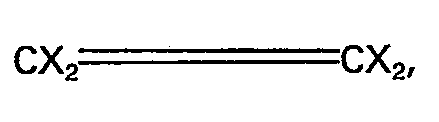
- the technique is to produce a graft copolymer by contacting the polymer in its molten state with a fluid modifier compound of formula: wherein X is hydrogen, an organic radical or an inorganic radical, with the proviso that at least one X is other than hydrogen.
- the present invention provides a polyamide suitable for use as a hot-melt adhesive, and formed of a backbone derived from dicarboxylic acids and poly-primary or secondary amines (preferably secondary), in which the carboxylic acid groups of the dicarboxylic acids or the nitrogen atoms of the amines or both are separated by an average of at least fifteen carbon atoms, the polyamide containing pendant graft copolymerised chains derived from one or more aromatic compounds having at least one olefinically unsaturated moiety, one or more lower esters of methacrylic acid having an O-alkyl group that contains not more than 11 carbon atoms, acrylonitrile or methacrylonitrile, and containing 0.2% by weight or less of free graft comonomer.
- the ester of methacrylic acid is an alkyl methacrylate having an alkyl group which may be linear, branched or cyclic, but is preferably linear, and more preferably having an alkyl group of from 4 to 8 carbon atoms.
- Preferred esters of methacrylic acid include methyl methacrylate, ethyl methacrylate, n-butyl methacrylate, isobutyl methacrylate, cyclohexyl methacrylate and 2-ethylhexyl methacrylate.
- the alkyl group has fewer than seven carbon atoms it is usually desirable, although not essential, to graft copolymerise only one alkyl methacrylate, that is, to form homopolymerised graft chains, while if the alkyl methacrylate has seven or more carbon atoms, especially if it has at least nine carbon atoms in its alkyl group, it may be advantageous to employ an alkyl methacrylate having fewer than six carbon atoms in its alkyl group, e.g. methyl methacrylate or ethyl methacrylate, as an additional graft comonomer.
- aromatic compounds those having a monocyclic aromatic moiety which may be homo- or heterocyclic may be mentioned, especially those having a phenyl or pyridyl ring.
- the preferred compounds are vinyl pyridines, styrene, or analogues thereof having one or more alkyl substituents (which may be on the aryl or olefinic moiety).
- the vinyl pyridines or styrene are unsubstituted or substituted by one or more alkyl groups having from 1 to 4 carbon atoms, preferably methyl groups, and more preferably, if they are substituted, have only one methyl substituent.
- the most preferred compounds are styrene, a-methyl styrene and vinyl pyridines.
- the invention provides a polyamide suitable for use as a hot-melt adhesive and formed of a backbone derived from dicarboxylic acids and poly-primary or secondary amines (preferably secondary) in which the carboxylic acid groups of the dicarboxylic acids or the nitrogen atoms of the amines or both are separated by an average of at least fifteen carbon atoms, the polyamide containing pendant graft copolymerised chains derived from styrene and/or one or more substituted styrenes, one or more esters of methacrylic acid having an O-alkyl group that contains not more than 11 carbon atoms, acrylonitrile or methacrylonitrile, and containing 0.2% by weight or less of free graft conomoner.
- n-butyl methacrylate and styrene especially when used as the sole graft comonomer.
- Ungrafted polyamides that is polyamides before any pendant chains have been grafted thereto, which are suitable for use as hot-melt adhesives and which have the specified backbone structure generally have amorphous structures in contrast with the more highly crystalline, fibre forming polyamides such as nylon 6.6 or nylon 6.
- a number of suitable polyamides are described in UK Patent Specifications Nos. 1,100,968, 1,107,524,1,122,138,1,216,230,1,352,809,1,139,437, US Specification No. 3,792,002, German Specification No. 2,809,769 and Australian Specification No. 290,457.
- any dicarboxylic acid in which the carboxylic acid groups are separated by a bivalent hydrocarbon group which may be saturated or unsaturated, aliphatic, aromatic or cycloaliphatic or which may have two or more aliphatic, aromatic or cycloaliphatic moieties, can be used to form the polyamides.
- long chain diamines that is diamines having chains of at least fifteen carbon atoms separating the nitrogen atoms
- dicarboxylic acids such as adipic, sebacic, suberic, succinic, glutaric, isophthalic, terephthalic and phthalic acids may be, and preferably are, use.
- dicarboxylic acids dimeric fatty acids are preferred.
- dimeric fatty acid is intended to include any acid obtained by dimerising saturated, ethylenically unsaturated or acetylenically unsaturated naturally occurring or synthetic monobasic aliphatic carboxylic acids containing from 8 to 24 carbon atoms. Such dimeric fatty acids are fully described in US Patent Specification No. 4,018,733.
- the nitrogen atoms are separated by a hydrocarbon group which may be aliphatic, cycloaliphatic or aromatic or may have a combination of any two or more aliphatic, cycloaliphatic or aromatic moieties, and, in addition, it may contain ether linkages such as in the diamines prepared from diphenyl ether.
- a hydrocarbon group which may be aliphatic, cycloaliphatic or aromatic or may have a combination of any two or more aliphatic, cycloaliphatic or aromatic moieties, and, in addition, it may contain ether linkages such as in the diamines prepared from diphenyl ether.
- diamines include straight chain or branched alkylene diamines, having from 2 to 40 carbon atoms in the alkylene group, e.g.
- ethylene diamine 1,3-diaminopropane, hexamethylene diamine, 9-aminomethylstearylamine and 10-aminoethylstearylamine; 1,3-di-4-piperidyl propane, diaminodicyclohexylmethane; methylene dianiline and bis(aminoethyl)diphenyl oxide.
- Dimeric fat diamines and "ether diamines" may also be used. These diamines are also described in U.S. Patent No. 4,018,733 mentioned above, and U.S. Patent No. 3,010,782.
- Diamines having on average fewer than 15 carbon atoms can only be used in the preparation of the ungrafted copolyamides when the dicarboxylic acid has an average at least 15 carbon atoms separating the carboxylic acid groups or when the diamines are used together with longer chain polyamines.
- Such short chain diamines include ethylene diamine, 1,3-diaminopropane, 1,3-diaminobutane, tetramethylene diamine and decamethylene diamine.
- Monoalkanolamines as described in the above U.S. Patent No. 4,018,733, may also be employed as starting materials in conjunction with polyamines.
- small quantities of other compounds commonly used in the preparation of such polyamides may also be used, for example cyclic lactams such as e-caprolactam, and w-aminocarboxylic acids.
- the polyamides are preferably formed by condensing the dicarboxylic acids with excess polyamine sufficient to form a polyamide having an amine number of at least 5 (measured in accordance with ASTM D 2074 - 66).
- the ungrafted polyamides are chosen so that they will have physical properties that make them suitable for use as adhesives. For example they will advantageously have an elongation at break of greater than 400%, at 20°C, a ring and ball softening point in the range of from 90 to 150°C and a glass transition temperature less than or equal to 0°C.
- Additional components may advantageously be incorporated with the polyamides, for example hardeners, fillers, extenders, fortifiers, carriers and stabilizers in known manner.
- the grafted polyamide according to the invention contains substantially no free graft comonomer, that is, that the polyamide contains not more than 0.2%, preferably not more than 0.1 % and especially not more than 0.05% by weight of any residual free graft comonomer since this will adversely affect the adhesion of the grafted copolyamide to a substrate.
- the preferred polyamides will contain less than 0.01 % residual free graft comonomer by weight, this being the detectable limit of the comonomer using currently used techniques.
- the copolyamide be free from substantial quantities of any ungrafted polymer derived from the graft comonomer, since substantial quantities of such ungrafted polymers can reduce the adhesion of the polyamide to certain materials. In generat it is preferred that any quantity of ungrafted polymer derived from the graft that is present in insufficient to form a separate phase from that of the polyamide.
- the polyamides according to the invention may be produced by forming free radical sites in an ungrafted polyamide that is suitable for use as a hot-melt adhesive, allowing one or more of the graft comonomers specified above to polymerise on the free radical sites, and, if necessary, then removing unreacted graft comonomer from the polyamide.
- the free radical sites may be formed by irradiating the polyamide, for example with ultraviolet radiation, high energy electrons or gamma radiation, or by means of chemical initiators, e.g. peroxides. Whichever method is used, it may be desirable to employ polymerisation auxiliaries to aid the graft polymerisation reaction and/or certain polymerisation inhibitors to inhibit the formation of ungrafted polymeric products.
- the polymerisation is initiated by means of high energy electrons, e.g. from an electron accelerator, or gamma radiation, in which case the polyamide preferably receives a dose of not more than 10 Mrad, expecially from 4 to 6 Mrad. Doses significantly in excess of 10 Mrad may cause some of the properties of the polyamide such as its tensile strength or elongation to be adversely affected.
- the ungrafted polyamide may be irradiated prior to being contacted with the graft comonomer, the irradiation being conducted in the presence of oxygen or air or in an inert gas, or the polyamide may be irradiated in the presence of the graft comonomer.
- the polyamide is irradiated in an inert atmosphere, usually in nitrogen, thereby forming free radicals on the polyamide polymer chains.
- the irradiated material is then immersed in the graft comonomer for up to 20 hours during which time the graft comonomer is absorbed in the polyamide and is grafted onto the free radical sites. After immersion the material is washed free of monomer using large quantities of solvent, e.g. acetone, and/or it is allowed to dry in a current of warm air.
- solvent e.g. acetone
- the free radicals formed on irradiation have a limited lifetime (a half life in the order of ten hours) it is desirable to immerse the irradiated material in the graft comonomer without excessive delay after irradiation, preferably less than 20 hours and especially less than 10 hours after irradiation, otherwise, in order to graft a significant quantity of comonomer onto the polyamide, a dose of greater than 10 Mrads will be needed. It is believed that this process leads almost entirely to the formation of grafted polymer and to the formation only of small quantities of free polymer derived from the graft comonomer, especially if conducted at room temperature so that thermal initiation of polymerisation reactions is reduced.
- the polyamide material is irradiated in the presence of air leading to the formation of peroxidized and hydroperoxidized polymer.
- the irradiated material is then immersed in bulk graft comonomer, or a solution thereof at elevated temperature so that thermal decomposition of the peroxides and hydroperoxides formed on irradiation will initiate the formation of graft copolymer chains.
- the irradiated material may be refluxed in a solution of graft comonomer (e.g. in toluene) for 3 hours. Excess free graft comonomer may be removed by reprecipitation.
- any free polymer formed may be removed together with the unreacted graft comonomer in the washing step.
- This process has the advantage that, due to the formation of peroxides and hydroperoxides which are more stable than the free radicals formed on irradiation, the irradiated polyamide material may be left for some time before treatment with the graft comonomer.
- a further process for the preparation of the graft polyamides comprises irradiating the ungrafted polyamide material in the presence of the graft comonomer, the graft comonomer being present as a liquid or vapour or in solution. The irradiated material is then washed and dried as described above. While this process has the advantage that the free radicals formed on the polyamide polymer chains are utilized rapidly and efficiently, a quantity of free polymer derived from the graft comonomer is formed, probably due to irradiation of the free monomer. This is pronounced where the graft comonomer is present in excess.
- the graft polyamides may also be formed by solution or emulsion polymerisation processes using chemical initiators. Any form of initiator may be used provided that the free radicals formed are capable of promoting polymerisation of the graft copolymer. For example peroxides or azo compounds may be used for solution polymerisation while redox initiators may be used for emulsion or suspension polymerisation.
- the ungrafted polyamide is refluxed in a 0.2 to 0.5M solution of graft comonomer in either chlorobenzene or toluene and in the presence of benzoyl peroxide at a concentration of about 3x10- 3 M based on the total volume of monomer and solvent. After refluxing for several hours the product is reprecipitated by mixing the hot solution in acetone, and the reprecipitated product is washed and dried as described above.
- the polyamides have a grafted chain content of not more than 10%, especially in the range of 1 to 5% by weight based on the total weight of the grafted copolyamide.
- the content of grafted chains can be measured by infra-red or'H n.m.r. spectroscopy or by nitrogen analysis of the copolyamide before and after grafting according to standard techniques. Where styrene or substituted styrenes are used as the graft comonomer, the content of grafted chains may be ascertained using the Hilton method (Rubber Age, August 1959 pp. 782-785).
- the conditions of the grafting reaction (temperature, graft comonomer concentration etc.) and the duration of immersion in the graft comonomer required to form a product having the preferred grafted chain content can easily be determined for any initial radiation doses by analysis of the product.
- an adhesive composition which comprises a polyamide according to the invention and an elastomer, at least part of which is compatible with the pendant graft copolymerised chains.
- the elastomer is a thermoplastic elastomer, and especially one which comprises a linear or radial A-B-A block copolymer.
- thermoplastic elastomers usually have end blocks or A blocks formed from a hard polymer, that is, formed from a polymer having a glass transition temperature above room temperature, and one or more intermediate or B blocks formed from an elastomeric polymer with a glass transition temperature below room temperature.
- the end blocks agglomerate, due to their incompatibility with the elastomeric polymer, to form domains in which the end blocks are held together by physical forces and/or hydrogen bonding, while the intermediate blocks form elastomeric domains or an elastomeric matrix.
- the block copolymers comprise at least 50%, and preferably from 60 to 90 elastomeric blocks, in which case, according to one model (Holden, Bishop and Legge, J. Polym. Sci. 1969,26, 37), the end-block domains act as a reinforcing filler and provide thermally labile crosslinks, thereby allowing the block copolymers to be processed by conventional thermoplastic techniques and to be recycled without deterioration of their physical properties.
- the end-blocks of the A-B-A block copolymer are preferably formed from polystyrene or a substituted styrene polymer, e.g., poly a-methylstyrene, and especially from polystyrene.
- the intermediate blocks may be formed from amorphous, substituted or unsubstituted hydrocarbon homo- or copolymers.
- Thermoplastic elastomers which may be used in the compositions are described in U.S. Patent Specifications Nos. 3,265,765, 3,281,383 smf 3,787,531.
- the polyamide and the elastomer may be blended in any convenient manner to form the composition, for example in a 2 roll mill, a Z-blade mixer or in the screw of an extruder, the blending being performed at an elevated temperature or at room temperature.
- compositions containing up to 100%, and especially up to 25% of elastomer by weight, based on the weight of the grafted polyamide are preferred.
- the polyamides and polyamide/elastomer compositions according to the present invention may be used in many applications where an adhesive is to be applied to an article that is likely to be exposed to low temperatures and especially a polymeric article, for example, an article formed from a polyolefin. Accordingly, the present invention also provides an article, especially an article comprising a polyolefin, at least part of which has been coated with a grafted polyamide according to the invention or a composition containing such a grafted polyamide.
- Heat-recoverable articles are articles having a dimensional configuration that may be made substantially to change when subjected to heat treatment. Heat-recoverable articles may be produced by deforming a dimensionally heat-stable configuration to a heat-unstable configuration, in which case the article tends to assume the original heat-stable configuration on the application of heat alone.
- An example of such an article is found in US Patents Nos. 2,027,962 and 3,086,242.
- Plaques of the grafted adhesive having a thickness of 1 mm were formed at a temperature of 110°C and a force of 20 tons (200 KN). Joints were then prepared by pressing 25 mm squares of the adhesives between two pieces of a medium to high density polyethylene substrate (Manolene 5203 Trademark) each being 25 mmx75 mm in size. The surfaces of the substrate were abraded and degreased prior to preparation of the joints and the joints were pressed at 150°C for 20 minutes in an oven using a pre-heated jig and 5 Ibs weight (2.27 kg weight). The resultant T-peel joints were pulled on a Hounsfield Tensometer in accordance with ASTM D1876 speed 50 mm/min.
- Versalon 1300 was irradiated by high energy electrons in air to 3, 5 or 10 Mrads and then reacted by refluxing in a solution of styrene in toluene for about 3 hours. The grafted products were reprecipitated, filtered, washed and dried. Plaques were pressed and peel strengths determined using Manolene and Carlona in T-peel mode.
- a sample of Versalon 1300 copolyamide were grafted with acrylonitrile according to Example 2 to form a product having a graft copolymer content of from 2 to 5% by weight.
- the peel strength was determined as in Example 1 using Manolene 5203 as substrate and found to be 240 N/25 mm. This example may be repeated using methacrylonitrile as graft comonomer and a similar result obtained.
- Example 2 may be repeated using a methacrylate ester as the graft comonomer and similar improvements in the T-peel values as compared to the ungrafted copolyamide be observed.
- a polyamide sold by Karlerling GmbH under the trade name SK600 was grafted with styrene according to Example 2 using an electron dose of 5 Mrads.
- the graft content was measured to be 4% by the Hilton method.
- the peel strengths at various temperatures were measured as in Example 1 and are given in Table V.
- Example 8 was repeated with the exception that the polyamide hot-melt adhesive (Versalon 1300) was grafted with a number of graft comonomers falling outside the scope of those defined in the invention.
- the peel strengths are shown in Table IX.
Landscapes
- Chemical & Material Sciences (AREA)
- Chemical Kinetics & Catalysis (AREA)
- Organic Chemistry (AREA)
- Health & Medical Sciences (AREA)
- Medicinal Chemistry (AREA)
- Polymers & Plastics (AREA)
- Laminated Bodies (AREA)
- Adhesives Or Adhesive Processes (AREA)
- Graft Or Block Polymers (AREA)
- Manufacture Of Macromolecular Shaped Articles (AREA)
Description
- This invention relates to adhesives, and especially to hot-melt adhesives that are based on polyamides.
- The use of hot-melt adhesives for bonding a variety of materials is well known. Due to the properties of these adhesives and their ease of application to substrates, they have been widely used for bonding materials such as synthetic polymers to substrates including the same or different polymers, and metals. One problem encountered with hot-melt adhesives, however, is that they become brittle at low temperatures, and so suffer from reduced sealing ability. Also, their brittleness can cause the adhesive to crack at low temperatures because of relative movement between the substrates, for example due to thermal contraction or mechanical vibration.
- A modification to fibre-forming polyamides, such as polyhexamethylene adipamide, is disclosed in U.S.-A-3338985 and U.S.-A-3424820 (both continuations-in-part of the same parent application) for the purpose of improving adhesion and imparting increase-resistance to fabrics made therefrom. In U.S.-A-3338985, the modification is to graft to the polymer a compound which contains at least one epoxy-ethylene radical and at least one polymerizable aliphatically unsaturated double bond. The preferred modifier is glycidyl methacrylate. Grafting is initiated by high energy radiation in U.S.-A-3424820, the side chains bearing from about 45-3000 equivalent of basic nitrogens par 106 gms of substrate polymer.
- A process for modifying the properties of a synethetic condensation polymer is disclosed in UK-A-862768. The process is applicable to polyamides, polyureas, polyesters, polyurethanes, polythioesters, and polysulphonamides. The technique is to produce a graft copolymer by contacting the polymer in its molten state with a fluid modifier compound of formula:
- The present invention provides a polyamide suitable for use as a hot-melt adhesive, and formed of a backbone derived from dicarboxylic acids and poly-primary or secondary amines (preferably secondary), in which the carboxylic acid groups of the dicarboxylic acids or the nitrogen atoms of the amines or both are separated by an average of at least fifteen carbon atoms, the polyamide containing pendant graft copolymerised chains derived from one or more aromatic compounds having at least one olefinically unsaturated moiety, one or more lower esters of methacrylic acid having an O-alkyl group that contains not more than 11 carbon atoms, acrylonitrile or methacrylonitrile, and containing 0.2% by weight or less of free graft comonomer.
- Preferably the ester of methacrylic acid is an alkyl methacrylate having an alkyl group which may be linear, branched or cyclic, but is preferably linear, and more preferably having an alkyl group of from 4 to 8 carbon atoms. Preferred esters of methacrylic acid include methyl methacrylate, ethyl methacrylate, n-butyl methacrylate, isobutyl methacrylate, cyclohexyl methacrylate and 2-ethylhexyl methacrylate. Where the alkyl group has fewer than seven carbon atoms it is usually desirable, although not essential, to graft copolymerise only one alkyl methacrylate, that is, to form homopolymerised graft chains, while if the alkyl methacrylate has seven or more carbon atoms, especially if it has at least nine carbon atoms in its alkyl group, it may be advantageous to employ an alkyl methacrylate having fewer than six carbon atoms in its alkyl group, e.g. methyl methacrylate or ethyl methacrylate, as an additional graft comonomer.
- Of the aromatic compounds, those having a monocyclic aromatic moiety which may be homo- or heterocyclic may be mentioned, especially those having a phenyl or pyridyl ring. The preferred compounds are vinyl pyridines, styrene, or analogues thereof having one or more alkyl substituents (which may be on the aryl or olefinic moiety). Preferably the vinyl pyridines or styrene are unsubstituted or substituted by one or more alkyl groups having from 1 to 4 carbon atoms, preferably methyl groups, and more preferably, if they are substituted, have only one methyl substituent. The most preferred compounds are styrene, a-methyl styrene and vinyl pyridines.
- According to another aspect, the invention provides a polyamide suitable for use as a hot-melt adhesive and formed of a backbone derived from dicarboxylic acids and poly-primary or secondary amines (preferably secondary) in which the carboxylic acid groups of the dicarboxylic acids or the nitrogen atoms of the amines or both are separated by an average of at least fifteen carbon atoms, the polyamide containing pendant graft copolymerised chains derived from styrene and/or one or more substituted styrenes, one or more esters of methacrylic acid having an O-alkyl group that contains not more than 11 carbon atoms, acrylonitrile or methacrylonitrile, and containing 0.2% by weight or less of free graft conomoner.
- Of particular note are n-butyl methacrylate and styrene, especially when used as the sole graft comonomer.
- Ungrafted polyamides, that is polyamides before any pendant chains have been grafted thereto, which are suitable for use as hot-melt adhesives and which have the specified backbone structure generally have amorphous structures in contrast with the more highly crystalline, fibre forming polyamides such as nylon 6.6 or nylon 6. A number of suitable polyamides are described in UK Patent Specifications Nos. 1,100,968, 1,107,524,1,122,138,1,216,230,1,352,809,1,139,437, US Specification No. 3,792,002, German Specification No. 2,809,769 and Australian Specification No. 290,457.
- In general, any dicarboxylic acid in which the carboxylic acid groups are separated by a bivalent hydrocarbon group which may be saturated or unsaturated, aliphatic, aromatic or cycloaliphatic or which may have two or more aliphatic, aromatic or cycloaliphatic moieties, can be used to form the polyamides. Where long chain diamines are used, that is diamines having chains of at least fifteen carbon atoms separating the nitrogen atoms, dicarboxylic acids such as adipic, sebacic, suberic, succinic, glutaric, isophthalic, terephthalic and phthalic acids may be, and preferably are, use. Of the dicarboxylic acids, dimeric fatty acids are preferred. The term "dimeric fatty acid" is intended to include any acid obtained by dimerising saturated, ethylenically unsaturated or acetylenically unsaturated naturally occurring or synthetic monobasic aliphatic carboxylic acids containing from 8 to 24 carbon atoms. Such dimeric fatty acids are fully described in US Patent Specification No. 4,018,733.
- In the diamines that may be used in the preparation of the ungrafted polyamide, the nitrogen atoms are separated by a hydrocarbon group which may be aliphatic, cycloaliphatic or aromatic or may have a combination of any two or more aliphatic, cycloaliphatic or aromatic moieties, and, in addition, it may contain ether linkages such as in the diamines prepared from diphenyl ether. Examples of such diamines include straight chain or branched alkylene diamines, having from 2 to 40 carbon atoms in the alkylene group, e.g. ethylene diamine, 1,3-diaminopropane, hexamethylene diamine, 9-aminomethylstearylamine and 10-aminoethylstearylamine; 1,3-di-4-piperidyl propane, diaminodicyclohexylmethane; methylene dianiline and bis(aminoethyl)diphenyl oxide. Dimeric fat diamines and "ether diamines" may also be used. These diamines are also described in U.S. Patent No. 4,018,733 mentioned above, and U.S. Patent No. 3,010,782.
- Diamines having on average fewer than 15 carbon atoms can only be used in the preparation of the ungrafted copolyamides when the dicarboxylic acid has an average at least 15 carbon atoms separating the carboxylic acid groups or when the diamines are used together with longer chain polyamines. Such short chain diamines include ethylene diamine, 1,3-diaminopropane, 1,3-diaminobutane, tetramethylene diamine and decamethylene diamine.
- Monoalkanolamines as described in the above U.S. Patent No. 4,018,733, may also be employed as starting materials in conjunction with polyamines. In addition, small quantities of other compounds commonly used in the preparation of such polyamides may also be used, for example cyclic lactams such as e-caprolactam, and w-aminocarboxylic acids.
- The polyamides are preferably formed by condensing the dicarboxylic acids with excess polyamine sufficient to form a polyamide having an amine number of at least 5 (measured in accordance with ASTM D 2074-66).
- As will be appreciated, the ungrafted polyamides are chosen so that they will have physical properties that make them suitable for use as adhesives. For example they will advantageously have an elongation at break of greater than 400%, at 20°C, a ring and ball softening point in the range of from 90 to 150°C and a glass transition temperature less than or equal to 0°C.
- Additional components may advantageously be incorporated with the polyamides, for example hardeners, fillers, extenders, fortifiers, carriers and stabilizers in known manner.
- It is an essential requirement that the grafted polyamide according to the invention contains substantially no free graft comonomer, that is, that the polyamide contains not more than 0.2%, preferably not more than 0.1 % and especially not more than 0.05% by weight of any residual free graft comonomer since this will adversely affect the adhesion of the grafted copolyamide to a substrate. The preferred polyamides will contain less than 0.01 % residual free graft comonomer by weight, this being the detectable limit of the comonomer using currently used techniques.
- It is preferable that the copolyamide be free from substantial quantities of any ungrafted polymer derived from the graft comonomer, since substantial quantities of such ungrafted polymers can reduce the adhesion of the polyamide to certain materials. In generat it is preferred that any quantity of ungrafted polymer derived from the graft that is present in insufficient to form a separate phase from that of the polyamide.
- The polyamides according to the invention may be produced by forming free radical sites in an ungrafted polyamide that is suitable for use as a hot-melt adhesive, allowing one or more of the graft comonomers specified above to polymerise on the free radical sites, and, if necessary, then removing unreacted graft comonomer from the polyamide. The free radical sites may be formed by irradiating the polyamide, for example with ultraviolet radiation, high energy electrons or gamma radiation, or by means of chemical initiators, e.g. peroxides. Whichever method is used, it may be desirable to employ polymerisation auxiliaries to aid the graft polymerisation reaction and/or certain polymerisation inhibitors to inhibit the formation of ungrafted polymeric products. Advantageously the polymerisation is initiated by means of high energy electrons, e.g. from an electron accelerator, or gamma radiation, in which case the polyamide preferably receives a dose of not more than 10 Mrad, expecially from 4 to 6 Mrad. Doses significantly in excess of 10 Mrad may cause some of the properties of the polyamide such as its tensile strength or elongation to be adversely affected. The ungrafted polyamide may be irradiated prior to being contacted with the graft comonomer, the irradiation being conducted in the presence of oxygen or air or in an inert gas, or the polyamide may be irradiated in the presence of the graft comonomer.
- In one process, the polyamide is irradiated in an inert atmosphere, usually in nitrogen, thereby forming free radicals on the polyamide polymer chains. The irradiated material is then immersed in the graft comonomer for up to 20 hours during which time the graft comonomer is absorbed in the polyamide and is grafted onto the free radical sites. After immersion the material is washed free of monomer using large quantities of solvent, e.g. acetone, and/or it is allowed to dry in a current of warm air. In view of the fact that the free radicals formed on irradiation have a limited lifetime (a half life in the order of ten hours) it is desirable to immerse the irradiated material in the graft comonomer without excessive delay after irradiation, preferably less than 20 hours and especially less than 10 hours after irradiation, otherwise, in order to graft a significant quantity of comonomer onto the polyamide, a dose of greater than 10 Mrads will be needed. It is believed that this process leads almost entirely to the formation of grafted polymer and to the formation only of small quantities of free polymer derived from the graft comonomer, especially if conducted at room temperature so that thermal initiation of polymerisation reactions is reduced.
- In another process, the polyamide material is irradiated in the presence of air leading to the formation of peroxidized and hydroperoxidized polymer. The irradiated material is then immersed in bulk graft comonomer, or a solution thereof at elevated temperature so that thermal decomposition of the peroxides and hydroperoxides formed on irradiation will initiate the formation of graft copolymer chains. For example the irradiated material may be refluxed in a solution of graft comonomer (e.g. in toluene) for 3 hours. Excess free graft comonomer may be removed by reprecipitation. Although it is thought that this process may lead to the formation of some ungrafted polymer by thermal initiation or by thermal decomposition of the hydroperoxides (the hydroperoxides leading to equivalent quantities of grafted polymer and free polymer), any free polymer formed may be removed together with the unreacted graft comonomer in the washing step. This process has the advantage that, due to the formation of peroxides and hydroperoxides which are more stable than the free radicals formed on irradiation, the irradiated polyamide material may be left for some time before treatment with the graft comonomer.
- A further process for the preparation of the graft polyamides comprises irradiating the ungrafted polyamide material in the presence of the graft comonomer, the graft comonomer being present as a liquid or vapour or in solution. The irradiated material is then washed and dried as described above. While this process has the advantage that the free radicals formed on the polyamide polymer chains are utilized rapidly and efficiently, a quantity of free polymer derived from the graft comonomer is formed, probably due to irradiation of the free monomer. This is pronounced where the graft comonomer is present in excess.
- The graft polyamides may also be formed by solution or emulsion polymerisation processes using chemical initiators. Any form of initiator may be used provided that the free radicals formed are capable of promoting polymerisation of the graft copolymer. For example peroxides or azo compounds may be used for solution polymerisation while redox initiators may be used for emulsion or suspension polymerisation. In a preferred process, the ungrafted polyamide is refluxed in a 0.2 to 0.5M solution of graft comonomer in either chlorobenzene or toluene and in the presence of benzoyl peroxide at a concentration of about 3x10⁻³M based on the total volume of monomer and solvent. After refluxing for several hours the product is reprecipitated by mixing the hot solution in acetone, and the reprecipitated product is washed and dried as described above.
- Preferably, the polyamides have a grafted chain content of not more than 10%, especially in the range of 1 to 5% by weight based on the total weight of the grafted copolyamide. The content of grafted chains can be measured by infra-red or'H n.m.r. spectroscopy or by nitrogen analysis of the copolyamide before and after grafting according to standard techniques. Where styrene or substituted styrenes are used as the graft comonomer, the content of grafted chains may be ascertained using the Hilton method (Rubber Age, August 1959 pp. 782-785). The conditions of the grafting reaction (temperature, graft comonomer concentration etc.) and the duration of immersion in the graft comonomer required to form a product having the preferred grafted chain content can easily be determined for any initial radiation doses by analysis of the product.
- It is possible, by varying the choice of initial ungrafted polyamides or graft comonomers or by varying the conditions of the irradiation or graft reaction, to vary the properties of the resulting grafted product. Thus, in certain cases it is possible to form grafted polyamides having a significantly higher melting or softening point than that of the initial polyamide, thereby increasing the possible temperature range over which the polyamides may be used as hot-melt adhesives. As an example of this, when styrene is grafted onto Versalon 1300 (trademark), a polyamide of a dimer acid, dimer diamine and ethylene diamine, the start of softening of the polyamide is increased from about 50°C to over 70°C (for grafted chain contents of 3% and over). Also, in many cases, it is possible for the adhesion of the grafted copolyamide to certain substrates, for example polyethylene, to be improved considerably, sometimes exhibiting peel strengths of up to, or even more than, two and one half times that of the ungrafted copolyamide.
- According to a preferred aspect of the invention, there is provided an adhesive composition which comprises a polyamide according to the invention and an elastomer, at least part of which is compatible with the pendant graft copolymerised chains.
- Preferably the elastomer is a thermoplastic elastomer, and especially one which comprises a linear or radial A-B-A block copolymer. These thermoplastic elastomers usually have end blocks or A blocks formed from a hard polymer, that is, formed from a polymer having a glass transition temperature above room temperature, and one or more intermediate or B blocks formed from an elastomeric polymer with a glass transition temperature below room temperature. At normal temperatures the end blocks agglomerate, due to their incompatibility with the elastomeric polymer, to form domains in which the end blocks are held together by physical forces and/or hydrogen bonding, while the intermediate blocks form elastomeric domains or an elastomeric matrix. Advantageously the block copolymers comprise at least 50%, and preferably from 60 to 90 elastomeric blocks, in which case, according to one model (Holden, Bishop and Legge, J. Polym. Sci. 1969,26, 37), the end-block domains act as a reinforcing filler and provide thermally labile crosslinks, thereby allowing the block copolymers to be processed by conventional thermoplastic techniques and to be recycled without deterioration of their physical properties.
- The end-blocks of the A-B-A block copolymer are preferably formed from polystyrene or a substituted styrene polymer, e.g., poly a-methylstyrene, and especially from polystyrene. The intermediate blocks may be formed from amorphous, substituted or unsubstituted hydrocarbon homo- or copolymers. Thermoplastic elastomers which may be used in the compositions are described in U.S. Patent Specifications Nos. 3,265,765, 3,281,383 smf 3,787,531.
- The polyamide and the elastomer may be blended in any convenient manner to form the composition, for example in a 2 roll mill, a Z-blade mixer or in the screw of an extruder, the blending being performed at an elevated temperature or at room temperature.
- It has been found that it is possible to form adhesive compositions of the polyamides with the elastomers that have improved elastomeric properties at low temperatures as compared with the polyamide adhesives from which they are formed, usually with no significant loss of room temperature adhesion.
- There is no absolute limit to the quantity of elastomer that may be present in the composition. Compositions containing up to 100%, and especially up to 25% of elastomer by weight, based on the weight of the grafted polyamide are preferred. The polyamides and polyamide/elastomer compositions according to the present invention may be used in many applications where an adhesive is to be applied to an article that is likely to be exposed to low temperatures and especially a polymeric article, for example, an article formed from a polyolefin. Accordingly, the present invention also provides an article, especially an article comprising a polyolefin, at least part of which has been coated with a grafted polyamide according to the invention or a composition containing such a grafted polyamide.
- The polyamides and compositions are particularly suitable for use with dimensionally heat-recoverable articles. Heat-recoverable articles are articles having a dimensional configuration that may be made substantially to change when subjected to heat treatment. Heat-recoverable articles may be produced by deforming a dimensionally heat-stable configuration to a heat-unstable configuration, in which case the article tends to assume the original heat-stable configuration on the application of heat alone. An example of such an article is found in US Patents Nos. 2,027,962 and 3,086,242.
- The following Examples illustrate the invention.
- A number of samples of a polyamide hot-melt adhesive, Versalon (trademark) 1300 based on dimer acids, dimer diamines and ethylene diamine, were irradiated in a 6 MeV electron beam with a range of doses and in a nitrogen atmosphere. After irradiation the adhesive was immersed in liquid graft comonomer for 20 hours and then washed with large quantities of acetone and dried in a current of warm air. The content of grafted chains in the resulting adhesive (% graft content) was calculated from measurement of the initial and final nitrogen content.
- Plaques of the grafted adhesive having a thickness of 1 mm were formed at a temperature of 110°C and a force of 20 tons (200 KN). Joints were then prepared by pressing 25 mm squares of the adhesives between two pieces of a medium to high density polyethylene substrate (Manolene 5203 Trademark) each being 25 mmx75 mm in size. The surfaces of the substrate were abraded and degreased prior to preparation of the joints and the joints were pressed at 150°C for 20 minutes in an oven using a pre-heated jig and 5 Ibs weight (2.27 kg weight). The resultant T-peel joints were pulled on a Hounsfield Tensometer in accordance with ASTM D1876 speed 50 mm/min.
- The joints were tested using three substrates, namely: Alkathene (trademark) 77/11, a low density polyethylene; Carlona (trademark) 30-002BA, a low density polyethylene; Manolene (trademark) 5203, a medium to high density polyethylene. The results are given in tables I and II.


- Versalon 1300 was irradiated by high energy electrons in air to 3, 5 or 10 Mrads and then reacted by refluxing in a solution of styrene in toluene for about 3 hours. The grafted products were reprecipitated, filtered, washed and dried. Plaques were pressed and peel strengths determined using Manolene and Carlona in T-peel mode.
- The results are shown in Table III.

- Peel strengths were determined over a wide temperature range (-20°C to +100°C) for Versalon 1300, Versalon 1300 grafted with 5% styrene prepared according to Example 2 and Versalon 1300 blended with 5% of a tackifier notably Piccolastic A50 and Piccolastic A75 (trademarks) for results being shown in Table IV. Although the blend of Versalon 1300 with 5% Piccolastic A50 shows enhanced peel strength at 20°C, this is not seen at higher or lower temperatures.

- Samples of Versalon 1300 copolyamide were irradiated with a dose of about 5 Mrad of 6 MeV electrons and were grafted using a-methylstyrene as graft comonomer according to Example 2 to form a product having a graft copolymer content of from 2 to 5% by weight. Peel strengths using Carlona 30-002BA and Manolene 5203 were determined as in Example 1 and were found to be 170 and 210 N/25 mm respectively.
- A sample of Versalon 1300 copolyamide were grafted with acrylonitrile according to Example 2 to form a product having a graft copolymer content of from 2 to 5% by weight. The peel strength was determined as in Example 1 using Manolene 5203 as substrate and found to be 240 N/25 mm. This example may be repeated using methacrylonitrile as graft comonomer and a similar result obtained.
- Example 2 may be repeated using a methacrylate ester as the graft comonomer and similar improvements in the T-peel values as compared to the ungrafted copolyamide be observed.
- A polyamide sold by Kommerling GmbH under the trade name SK600 was grafted with styrene according to Example 2 using an electron dose of 5 Mrads. The graft content was measured to be 4% by the Hilton method. The peel strengths at various temperatures were measured as in Example 1 and are given in Table V.

- Samples of a polyamide hot-melt adhesive (Versalon 1300) were grafted with a number of graft comonomers according to one of the methods (1) to (3) below and the peel strengths of the grafted adhesive between two high density polyethylene substrates (Manolene 5203) were measured as described in Example 1. The results are shown in Table VI. Table VI also shows, for comparison, the peel strengths recorded for the individual batches of ungrafted polyamide from which the grafted polyamides were formed.
- Methods of preparation of the grafted polyamide:
- (1) Irradiation in nitrogen followed by immersion in the graft comonomer and washing as described in Example 1.
- (2) Irradiation in air followed by refluxing in the graft comonomer and washing as described in Example 2.
- (3) The polyamide was soaked for a period of from 6 to 24 hours in undiluted graft comonomer. The surface was wiped clean to remove excess graft comonomer and the polyamide was then irradiated with 6MeV electrons to a dose of from 0.5 to 5 Mrads. After irradiation the grafted polyamide was washed as described in Example 1.

- Samples of Versalon 1300 (trademark) that had been grafted with 2% of styrene graft comonomer according to Example 2 were blended with a thermoplastic elastomer comprising a styrene-butadienestyrene or a styrene-isoprene-styrene block copolymer sold under the trade names Kraton 1102 and Kraton 1107 respectively. The peel strengths of the blends were determined as in Example 1 and the ultimate elongations of the blends were tested in accordance with ASTM D1708-56 with a crosshead speed of 55 mm/minute. The results are given in Table VII.

- A sample of Versalon 1300 grafted with styrene to give a product having a 2.5% by weight graft content was blended with 20% (based on the weight of the grafted polyamide) of a styrene-ethylene-butylene- styrene thermoplastic elastomer*. The peel strengths and ultimate elongations were determined as in Example 9 at a number of temperatures and are shown in Table VIII.

- Example 8 was repeated with the exception that the polyamide hot-melt adhesive (Versalon 1300) was grafted with a number of graft comonomers falling outside the scope of those defined in the invention. The peel strengths are shown in Table IX.

Claims (11)
Applications Claiming Priority (2)
| Application Number | Priority Date | Filing Date | Title |
|---|---|---|---|
| GB7936505 | 1979-10-20 | ||
| GB7936505 | 1979-10-20 |
Publications (2)
| Publication Number | Publication Date |
|---|---|
| EP0027727A1 EP0027727A1 (en) | 1981-04-29 |
| EP0027727B1 true EP0027727B1 (en) | 1985-06-19 |
Family
ID=10508677
Family Applications (1)
| Application Number | Title | Priority Date | Filing Date |
|---|---|---|---|
| EP80303674A Expired EP0027727B1 (en) | 1979-10-20 | 1980-10-17 | Polyamides suitable for use as hot-melt adhesives, process for their production, and adhesive compositions comprising them |
Country Status (4)
| Country | Link |
|---|---|
| US (1) | US4378448A (en) |
| EP (1) | EP0027727B1 (en) |
| JP (1) | JPS5665066A (en) |
| DE (1) | DE3070783D1 (en) |
Families Citing this family (6)
| Publication number | Priority date | Publication date | Assignee | Title |
|---|---|---|---|---|
| US4504699A (en) * | 1982-02-08 | 1985-03-12 | Raychem Pontoise S.A. | Sealable recoverable articles |
| US6479588B1 (en) * | 1999-08-23 | 2002-11-12 | Anderson Development Co. | Graft copolymer of polyamide and a glycidyl group-containing acrylate copolymer, process for preparation and coating composition containing the graft copolymer |
| JP6870616B2 (en) * | 2016-06-28 | 2021-05-12 | 東レ株式会社 | Composite sheet-like material and its manufacturing method |
| CN109971165B (en) * | 2019-03-22 | 2022-12-20 | 华南理工大学 | A kind of grafted nylon material and preparation method thereof |
| WO2025205377A1 (en) * | 2024-03-27 | 2025-10-02 | 三菱ケミカル株式会社 | Polymer, resin additive, resin composition, molded body, and method for producing polymer |
| CN118995123B (en) * | 2024-10-25 | 2025-02-18 | 山东凯恩新材料科技有限公司 | PA hot melt adhesive material applied to low-pressure injection molding and preparation method thereof |
Family Cites Families (44)
| Publication number | Priority date | Publication date | Assignee | Title |
|---|---|---|---|---|
| US2027962A (en) * | 1933-03-03 | 1936-01-14 | Nat Carbon Co Inc | Production of articles from plastic compositions |
| US2518148A (en) * | 1944-12-29 | 1950-08-08 | Armour & Co | Polyamide polymers and process for preparing same |
| GB872514A (en) | 1956-07-02 | 1961-07-12 | Du Pont | Process for the production of shaped structures, especially fibres or filaments |
| US2824848A (en) * | 1956-08-08 | 1958-02-25 | Gen Mills Inc | Polyamide resin suspensoids |
| BE561742A (en) * | 1956-10-18 | |||
| GB893904A (en) | 1957-09-14 | 1962-04-18 | Dunlop Rubber Co | Composite products of rubber and textiles |
| BE572579A (en) | 1957-10-31 | 1900-01-01 | ||
| US2959565A (en) | 1958-01-29 | 1960-11-08 | Dow Chemical Co | Compositions comprising graft copolymers of certain monomeric polyglycol esters of acrylates and methacrylates on superpolyamide substrates |
| US3068122A (en) * | 1958-03-10 | 1962-12-11 | Du Pont | Selected graft polymers and their preparation |
| US3026292A (en) * | 1959-01-07 | 1962-03-20 | Dow Chemical Co | Nu-vinyl-3-morpholinone-polyamie graft copolymer and method of preparing same |
| GB862768A (en) | 1959-01-09 | 1961-03-15 | Du Pont | Improvements in the modification of condensation polymers |
| US3088791A (en) * | 1959-02-06 | 1963-05-07 | Du Pont | Graft polymerization of a vinyl monomer to a polymeric substrate by low temperature irradiation |
| US3008920A (en) * | 1959-04-27 | 1961-11-14 | Dow Chemical Co | Method of inhibiting homopolymerization in graft copolymers with copper salts |
| NL251263A (en) | 1959-05-06 | |||
| US3061581A (en) * | 1959-07-09 | 1962-10-30 | Nat Distillers Chem Corp | Vinyl modification of branched chain polyamides |
| BE598869A (en) | 1960-01-07 | |||
| US3010782A (en) * | 1960-01-18 | 1961-11-28 | Gen Mills Inc | Corrosion inhibiting method and composition |
| US3078544A (en) * | 1960-05-19 | 1963-02-26 | Du Pont | Crimpable synthetic filaments and process of manufacturing same |
| NL130678C (en) * | 1960-07-15 | 1900-01-01 | ||
| NL288289A (en) * | 1962-01-29 | |||
| US3281383A (en) * | 1962-08-09 | 1966-10-25 | Phillips Petroleum Co | Branched polymers prepared from monolithium-terminated polymers and compounds having at least three reactive sites |
| GB1052323A (en) * | 1964-06-11 | 1966-12-21 | ||
| GB1107524A (en) | 1964-08-04 | 1968-03-27 | Schering Ag | Manufacture of new polyamides |
| US3440194A (en) | 1964-10-20 | 1969-04-22 | Mobil Oil Corp | Wax composition containing ethylene vinyl acetate or ethylene ethyl acrylate and a graft copolymer of ethylene with maleic acid |
| DE1595737A1 (en) | 1965-04-15 | 1970-04-23 | Gen Mills Inc | Process for producing polyamides of high toughness |
| US3483237A (en) | 1965-11-01 | 1969-12-09 | Gen Mills Inc | Polyamide compositions of a polymeric fat acid and a mixture of diamines |
| DE1569909A1 (en) | 1966-02-23 | 1969-08-14 | Basf Ag | Hot melt adhesive |
| US3471386A (en) * | 1966-05-18 | 1969-10-07 | Ppg Industries Inc | Highly radiation-sensitive telomerized polyamides |
| BE697601A (en) | 1966-05-23 | 1967-10-02 | ||
| US3338985A (en) * | 1966-11-14 | 1967-08-29 | Du Pont | Graft copolymers of epoxyethylene groups of polyamide or polyester substrates |
| US3424820A (en) * | 1966-12-21 | 1969-01-28 | Du Pont | Graft copolymers of amine compounds on polyamide and polyester substrates |
| FR1566914A (en) | 1967-06-01 | 1969-05-09 | ||
| DE1720753A1 (en) | 1967-11-28 | 1971-07-15 | Bayer Ag | Acrylonitrile graft polymers |
| US3736281A (en) * | 1968-06-25 | 1973-05-29 | Flintkote Co | Method of making pressure-sensitive hot-melt adhesives |
| US3787531A (en) * | 1969-04-04 | 1974-01-22 | Minnesota Mining & Mfg | Pressure-sensitive adhesives comprising a block copolymer and a tackifier |
| NL7002832A (en) | 1970-02-27 | 1971-08-31 | ||
| US3796771A (en) * | 1970-09-10 | 1974-03-12 | Rohm & Haas | Acrylic modifiers for polycarbonamides |
| DE2118796A1 (en) * | 1971-04-17 | 1972-11-02 | Schering Ag, 1000 Berlin Und 4619 Bergkamen | Hot melt pressure sensitive adhesive |
| DE2131931A1 (en) | 1971-06-26 | 1973-01-18 | Schering Ag | MELT ADHESIVE |
| US3868433A (en) * | 1972-04-03 | 1975-02-25 | Exxon Research Engineering Co | Thermoplastic adhesive compositions |
| US4018733A (en) * | 1972-09-25 | 1977-04-19 | Raychem Corporation | Hot melt adhesive composition comprising an acidic ethylene polymer and a polyamide |
| JPS5850607B2 (en) * | 1976-07-14 | 1983-11-11 | 日本原子力研究所 | Method for producing graft copolymer |
| IT1094186B (en) | 1977-03-07 | 1985-07-26 | Unilever Emery | POLYAMIDES |
| US4278777A (en) * | 1980-03-27 | 1981-07-14 | Abcor, Inc. | Grafted polymers and method of preparing and using same |
-
1980
- 1980-09-29 US US06/192,341 patent/US4378448A/en not_active Expired - Lifetime
- 1980-10-17 DE DE8080303674T patent/DE3070783D1/en not_active Expired
- 1980-10-17 EP EP80303674A patent/EP0027727B1/en not_active Expired
- 1980-10-20 JP JP14750480A patent/JPS5665066A/en active Pending
Also Published As
| Publication number | Publication date |
|---|---|
| DE3070783D1 (en) | 1985-07-25 |
| JPS5665066A (en) | 1981-06-02 |
| EP0027727A1 (en) | 1981-04-29 |
| US4378448A (en) | 1983-03-29 |
Similar Documents
| Publication | Publication Date | Title |
|---|---|---|
| US4880487A (en) | Hot melt adhesives containing poly(p-hydroxystyrene) homopolymers and copolymers and bonding methods employing same | |
| US4467071A (en) | Epoxy modified structural adhesives having improved heat resistance | |
| CA1329296C (en) | Modified structural adhesives | |
| US5342894A (en) | Graft polymers of ε-caprolactam | |
| US4869772A (en) | Diazabicyclo and triazabicyclo primer compositions and use thereof in bonding non-polar substrates | |
| US4404345A (en) | Novel adhesive compositions | |
| EP0502733B1 (en) | Air-activatable polymerisable compositions | |
| JPS62273257A (en) | Impact resistant polyamide molding material | |
| JPH04500090A (en) | modified polymer | |
| US4378448A (en) | Polyamide graft as hot-melt adhesive, and elastomer blend | |
| US3738950A (en) | Polyamides modified with adipic acid and process for their preparation | |
| EP0714943A2 (en) | Impact modifier vinyl chloride resin composition, and graft copolymer compositions | |
| EP0441545A1 (en) | Two-component curable hot-melt resin compositions | |
| GB2061981A (en) | Hot melt adhesive comprising grafted polyamides | |
| USRE34122E (en) | Hot melt adhesives containing poly(p-hydroxystyrene) homopolymers and copolymers and bonding methods, employing same | |
| US5883172A (en) | Polyamide hotmelt adhesive | |
| US4675210A (en) | Maleic modified butene copolymers for adhering polypropylene | |
| US4882414A (en) | Polyamide from polymeric fatty acid and long chain dicarboxylic acid | |
| JPH0224309B2 (en) | ||
| US4652327A (en) | Bonding poly(vinylidene chloride) | |
| US4485233A (en) | Poly(ester-amide) hot-melt adhesives | |
| WO2006121476A1 (en) | Universal solvent cement | |
| US3335029A (en) | Polyester coated with the reaction product of a vinylidene chloride copolymer and a polyepoxide and process for producing the same | |
| EP0228013B1 (en) | A process for adhering a latex film to polymeric surfaces and its product | |
| Avella et al. | Preparation of poly (β‐hydroxybutyrate)/poly (methyl methacrylate) blends by reactive blending and their characterisation |
Legal Events
| Date | Code | Title | Description |
|---|---|---|---|
| PUAI | Public reference made under article 153(3) epc to a published international application that has entered the european phase |
Free format text: ORIGINAL CODE: 0009012 |
|
| 17P | Request for examination filed |
Effective date: 19801030 |
|
| AK | Designated contracting states |
Designated state(s): DE FR |
|
| GRAA | (expected) grant |
Free format text: ORIGINAL CODE: 0009210 |
|
| AK | Designated contracting states |
Designated state(s): DE FR |
|
| REF | Corresponds to: |
Ref document number: 3070783 Country of ref document: DE Date of ref document: 19850725 |
|
| ET | Fr: translation filed | ||
| PLBE | No opposition filed within time limit |
Free format text: ORIGINAL CODE: 0009261 |
|
| STAA | Information on the status of an ep patent application or granted ep patent |
Free format text: STATUS: NO OPPOSITION FILED WITHIN TIME LIMIT |
|
| 26N | No opposition filed | ||
| PGFP | Annual fee paid to national office [announced via postgrant information from national office to epo] |
Ref country code: FR Payment date: 19901012 Year of fee payment: 11 |
|
| PGFP | Annual fee paid to national office [announced via postgrant information from national office to epo] |
Ref country code: DE Payment date: 19901130 Year of fee payment: 11 |
|
| PG25 | Lapsed in a contracting state [announced via postgrant information from national office to epo] |
Ref country code: FR Effective date: 19920630 |
|
| PG25 | Lapsed in a contracting state [announced via postgrant information from national office to epo] |
Ref country code: DE Effective date: 19920701 |
|
| REG | Reference to a national code |
Ref country code: FR Ref legal event code: ST |