EP0025376B1 - Transducteur piézoélectrique en matériau polymère, et son procédé de fabrication - Google Patents
Transducteur piézoélectrique en matériau polymère, et son procédé de fabrication Download PDFInfo
- Publication number
- EP0025376B1 EP0025376B1 EP80401184A EP80401184A EP0025376B1 EP 0025376 B1 EP0025376 B1 EP 0025376B1 EP 80401184 A EP80401184 A EP 80401184A EP 80401184 A EP80401184 A EP 80401184A EP 0025376 B1 EP0025376 B1 EP 0025376B1
- Authority
- EP
- European Patent Office
- Prior art keywords
- film
- transducer
- accordance
- zone
- electroshaped
- Prior art date
- Legal status (The legal status is an assumption and is not a legal conclusion. Google has not performed a legal analysis and makes no representation as to the accuracy of the status listed.)
- Expired
Links
Images
Classifications
-
- H—ELECTRICITY
- H10—SEMICONDUCTOR DEVICES; ELECTRIC SOLID-STATE DEVICES NOT OTHERWISE PROVIDED FOR
- H10N—ELECTRIC SOLID-STATE DEVICES NOT OTHERWISE PROVIDED FOR
- H10N30/00—Piezoelectric or electrostrictive devices
- H10N30/01—Manufacture or treatment
- H10N30/09—Forming piezoelectric or electrostrictive materials
- H10N30/098—Forming organic materials
-
- H—ELECTRICITY
- H04—ELECTRIC COMMUNICATION TECHNIQUE
- H04R—LOUDSPEAKERS, MICROPHONES, GRAMOPHONE PICK-UPS OR LIKE ACOUSTIC ELECTROMECHANICAL TRANSDUCERS; ELECTRIC HEARING AIDS; PUBLIC ADDRESS SYSTEMS
- H04R17/00—Piezoelectric transducers; Electrostrictive transducers
- H04R17/005—Piezoelectric transducers; Electrostrictive transducers using a piezoelectric polymer
-
- H—ELECTRICITY
- H10—SEMICONDUCTOR DEVICES; ELECTRIC SOLID-STATE DEVICES NOT OTHERWISE PROVIDED FOR
- H10N—ELECTRIC SOLID-STATE DEVICES NOT OTHERWISE PROVIDED FOR
- H10N30/00—Piezoelectric or electrostrictive devices
- H10N30/01—Manufacture or treatment
- H10N30/04—Treatments to modify a piezoelectric or electrostrictive property, e.g. polarisation characteristics, vibration characteristics or mode tuning
- H10N30/045—Treatments to modify a piezoelectric or electrostrictive property, e.g. polarisation characteristics, vibration characteristics or mode tuning by polarising
-
- Y—GENERAL TAGGING OF NEW TECHNOLOGICAL DEVELOPMENTS; GENERAL TAGGING OF CROSS-SECTIONAL TECHNOLOGIES SPANNING OVER SEVERAL SECTIONS OF THE IPC; TECHNICAL SUBJECTS COVERED BY FORMER USPC CROSS-REFERENCE ART COLLECTIONS [XRACs] AND DIGESTS
- Y10—TECHNICAL SUBJECTS COVERED BY FORMER USPC
- Y10S—TECHNICAL SUBJECTS COVERED BY FORMER USPC CROSS-REFERENCE ART COLLECTIONS [XRACs] AND DIGESTS
- Y10S310/00—Electrical generator or motor structure
- Y10S310/80—Piezoelectric polymers, e.g. PVDF
-
- Y—GENERAL TAGGING OF NEW TECHNOLOGICAL DEVELOPMENTS; GENERAL TAGGING OF CROSS-SECTIONAL TECHNOLOGIES SPANNING OVER SEVERAL SECTIONS OF THE IPC; TECHNICAL SUBJECTS COVERED BY FORMER USPC CROSS-REFERENCE ART COLLECTIONS [XRACs] AND DIGESTS
- Y10—TECHNICAL SUBJECTS COVERED BY FORMER USPC
- Y10T—TECHNICAL SUBJECTS COVERED BY FORMER US CLASSIFICATION
- Y10T29/00—Metal working
- Y10T29/42—Piezoelectric device making
Definitions
- the present invention relates to transducers, the active element of which consists of a film of polymeric material having piezoelectric and pyroelectric properties similar to those possessed by bodies belonging to certain classes of crystals.
- the acquisition of the properties in question is based on the creation of an electric anisotropy thanks to an intense electric field applied perpendicular to the main faces of the polymer film.
- the stretching of the polymer film precedes the electrical polarization, in order to obtain a mechanical anisotropy by thinning which is favorable to the formation of a polar phase.
- Such transducers are described in European patent application EP-A-0 002 161 filed in the name of the Applicant.
- the most common base polymer material used to make piezoelectric or pyroelectric transducers is polyvinylidene fluoride (PVF 2 ). Given the small thickness of the film used to produce these transducers, it is advantageous to give it a self-supporting form by molding or thermoforming on a non-developable surface. The shape obtained is electrically polarized by means of electrodes covering these faces. These electrodes can be solid, liquid or gaseous, but the polarization operation generally requires that the thermoformed film be replaced on a mold, since it tends to curl up as soon as it is brought by heating to a relatively high temperature. This manufacturing technique is advantageous insofar as it makes it possible to produce complex shapes which can correspond to very large elongations.
- PVF 2 polyvinylidene fluoride
- thermoforming manufacturing technique is therefore ill-suited to the production of simple shapes requiring great dimensional stability. It also has the disadvantage of implementing separate operations which are the shaping of the film and subsequently its electrical polarization.
- the invention provides for shaping the polymer film in the non-polar phase by stretching it over a metallic shape and by causing the relaxation of the mechanical tensions thus created under the action of the electric polarization field transforming the non-polar phase in polar phase.
- the subject of the invention is a method of manufacturing a transducer, the active element of which consists of a polymer film electrically polarized in a direction perpendicular to the faces and forming a self-supporting structure, characterized in that it consists in tensioning a flat film of non-polar a-phase polymeric material on a non-developable conductive surface; electroforming this stretched film using an ionizing electric discharge produced by means of an electrode provided with spikes which overhang this conductive surface and providing electrodes with the faces of the electroformed area of this film.
- the invention also relates to a piezoelectric transducer, the active element of which consists of a polymer film forming a self-supporting structure provided with electrodes on its two faces, characterized in that the part of the film comprised between these electrodes contains at least a mechanically relaxed electroformed area with a polar phase.
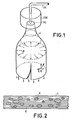
- This device comprises a crucible 100 which contains the polymer at a temperature close to that of melting.
- the bottom of the crucible is provided with an annular ejection orifice 30 which gives the extruded polymer a tubular shape.
- a pipe 20 communicating with the central part delimiting the orifice 30 allows the blowing of a gas inside the extruded tubular form. Due to the internal pressure p and the traction t exerted on the tubular form 4, a flaring of the extruded envelope is obtained. This is transformed at the bottom into a sheath of uniform thickness which can develop into a bi-stretched flat film when a cut is made 5.
- the circumferential stretch 6 is produced by the action of pressure p, while that the axial stretch 7 results from the traction t.
- the bi-stretched film 4 is plane after development.
- the internal structure is composed of crystalline clusters 9 enclosed in an amorphous matrix 8.
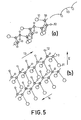
- the bi-stretched film is in the non-polar a phase, because the macromolecular chains inside the crystal clusters have a helical arrangement. Such an arrangement is represented in (a) in FIG. 5.
- the carbon atoms 10, the hydrogen atoms 12 and the fluorine atoms 11 are arranged along a macromolecular chain having a helical structure 13.
- phase p where the macromolecular chains have the zigzag configuration represented in (b) in FIG. 5. It can be seen that the phase is polar, but in the case of the molten polymer it is largely in the minority compared to the non-polar phase a . It is useful to recall that phase a can give rise to the polar phase ⁇ with macromolecular chains in zig-zag, when the polymer film is stretched below the melting temperature.
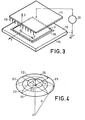
- a device for electrically polarizing a polymer film 4 comprises a conductive plate 16 connected to ground M.
- the polymer film 4 is deposited on the flat face 15 of the plate 16.
- a electrode 17 provided with spikes 18 overhangs the surface 15.
- a high-voltage generator 19 is connected to the plate 16 and to the electrode 17.
- the bias voltage is chosen so as to produce a corona discharge.
- the ionization generated by the tips 18 makes it possible to create a very intense electric field within the film. Due to the high charge density existing on the faces of the film 4, a high electrostatic pressure tends to crush it, so much so that it lengthens and can wrinkle locally.
- the wrinkling of the film 4 can be prevented by coating the conductive plane 15 with an appropriate lubricant such as a silicone oil.
- an appropriate lubricant such as a silicone oil.
- the film 4 polarized in the direction 3 isotropically extends in the directions 1 and 2.
- the elongation observed in the case of a bi-stretched polymer film is isotropic in the plane containing the directions 1 and 2 provided that its thickness is uniform.
- a support 16 of polished aluminum suitably lubricated with an electrode 17 whose points 18 are spaced fifteen millimeters from the surface 15.
- the bias voltage required for the electroforming of the film 4 is of the order of 15 kV.
- the permanent deformation is acquired after a time of application of the tension of approximately twenty seconds.
- the film 4 is then polarized at saturation, because if the polarization time is extended, the piezoelectric coefficients do not increase.
- the piezoelectric coefficients d 31 and d 32 are defined in the book “Physical Properties of Crystals” by JF NYE. OXFORD AT THE CLARENDON PRESS, 1976, more particularly on pages 110 et seq.
- the film in the initial state has been bi-stretched at a temperature close to that of melting, so that it consists mainly of the non-polar isotropic phase.
- This is confirmed by the examination of the infrared absorption spectra and reference can be made to illustration (a) of FIG. 5 which shows the configuration of a macromolecular chain.
- phase a is transformed into phase known as ap where one chain out of two is turned over so that the dipoles associated with two neighboring and parallel chains add their effects. This situation is illustrated in (b) in FIG. 5.
- the film 4 Before electrical polarization, the film 4 is mechanically tensioned. For this, the film 4 is stretched on the support 16 and it is maintained in the deformed state 26 by means of adhesive tapes bordering this contour. The film 4 is then polarized and it is noted that the mechanical tensions which existed in directions 1 and 2 have relaxed. After removing the adhesive tapes, the film retains the extended shape 26.
- Electrodes are deposited on both sides of the film 4 and if an alternating voltage is applied to these electrodes so that the assembly functions as a piezoelectric transducer appli, the film vibrates in thickness and undergoes isotropic elongations in its plane, but this alternating excitation voltage has no harmful influence on the polarization and the extension acquired during the electroforming operation.
- Electroforming a polymer film is of real interest when it comes to giving a flat film of uniform thickness a self-supporting shape.
- a very thin flat film has no mechanical resistance to the stresses acting perpendicularly to its surface. It is therefore necessary to tension it on a curved support, which complicates the production of a transducer and tends to decrease its performance.
- a flat film does not lend itself well to the implementation of an arching effect which makes it possible to convert small elongations in directions 1 and 2 into a strongly amplified displacement in direction 3.
- FIG 4 there is shown a non-developable surface in the form of a spherical cap 24.
- the radius of curvature of this cap is R, its height is h and the diameter of its periphery 23 is 2 I o .
- the above results show that electroforming leads to self-supporting structures whose bending is sufficient to ensure the good performance of the film.
- the electroformed zone can be polarized to saturation throughout its entire extent, which ensures very homogeneous operation of the transducer both in piezoelectric applications and in pyroelectric applications.
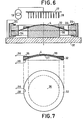
- FIG. 6 represents a device intended for implementing the electroforming method according to the invention. It comprises a table 31 connected to the ground of an electric generator 19. A conductive mold 16 rests on the table 31. Its lubricated upper face follows the convex shape of a cap spherical. A film of polymeric material 4 is pinched in the planar state between two rings 33 and 34 held tight against one another by clips 35. The assembly formed by the film 4 and the annular frame 33, 34, 35 comes to cap the upper face of the mold 16. Oous the action of the weight and if necessary of a vertical thrust, the film 4 stretches on the mold 4 closely following the shape of its upper face.
- An electrode 17 connected to the generator 19 is placed overhanging the stretched area of the film 4; this electrode is provided with points 18 which make it possible to obtain a corona discharge.
- An annular part 32 can be fixed on the periphery of the film 4 before the application of the electroforming electric voltage. This very rigid annular part 32 surrounds the film 4 in the area in the form of a spherical cap.
- the transducer element of FIG. 7 is obtained by leveling off the film 4 which exceeds the contour of the flange 32.
- Conductive deposits 36 and 37 are made on the main faces of the film 4. One of these deposits can without any problem cover the collar 32.
- Supply wires 38 and 39 are connected to the deposits 36 and 37, in order to allow the application of an alternating excitation voltage in the case of operation as a piezoelectric motor.
- the wires 38 and 39 are used to collect an electrical voltage during reverse operation as a piezoelectric vibration sensor and when used as a pyroelectric radiation detector.
- the fixing of the flange 32 can take place after the electroforming of the film 4.
- the stretched areas of the film 4 not subject to the electroforming field can relax thanks to the relaxation of the tensions in the central part of the film 4, but these non-electroformed areas retain the flat shape of the film 4 not stretched.
- the transducer of FIG. 7 advantageously constitutes a piezoelectric speaker usable between 8 and 40 kHz.
- the collar 32 steel and carry out the deposition 36 and 3 7 with vacuum evaporation of aluminum it is possible the collar 32 steel and carry out the deposition 36 and 3 7 with vacuum evaporation of aluminum.
- FIG. 7 lends itself well to the production of membranes for piezoelectric headphones and diaphragms for piezoelectric microphones. It can also be used as a pyroelectric sensor, in particular for the detection of intruders and for fire detection.
- the polymer film can also be obtained by dissolving the polymer in a solvent to form a thin layer which becomes a solid film after evaporation of the solvent.
- Electroforming is not limited to a spherical shape having a circular perimeter. Any self-supporting form allowing the film to be stretched so as to create elongations of a few percent is appropriate.
- the film can be tensioned by means of a clamping frame and a convex mold, but mechanical tensioning can also be provided by the action of a gas under pressure or by suction.
Landscapes
- Engineering & Computer Science (AREA)
- Manufacturing & Machinery (AREA)
- Physics & Mathematics (AREA)
- Acoustics & Sound (AREA)
- Signal Processing (AREA)
- Treatments Of Macromolecular Shaped Articles (AREA)
- Manufacture Of Macromolecular Shaped Articles (AREA)
- Shaping By String And By Release Of Stress In Plastics And The Like (AREA)
- Transducers For Ultrasonic Waves (AREA)
Applications Claiming Priority (2)
| Application Number | Priority Date | Filing Date | Title |
|---|---|---|---|
| FR7921086A FR2464005A1 (fr) | 1979-08-21 | 1979-08-21 | Transducteur piezo-electrique en materiau polymere et son procede de fabrication |
| FR7921086 | 1979-08-21 |
Publications (2)
| Publication Number | Publication Date |
|---|---|
| EP0025376A1 EP0025376A1 (fr) | 1981-03-18 |
| EP0025376B1 true EP0025376B1 (fr) | 1983-05-11 |
Family
ID=9228980
Family Applications (1)
| Application Number | Title | Priority Date | Filing Date |
|---|---|---|---|
| EP80401184A Expired EP0025376B1 (fr) | 1979-08-21 | 1980-08-13 | Transducteur piézoélectrique en matériau polymère, et son procédé de fabrication |
Country Status (7)
| Country | Link |
|---|---|
| US (2) | US4345359A (enExample) |
| EP (1) | EP0025376B1 (enExample) |
| JP (1) | JPS5632782A (enExample) |
| CA (1) | CA1147844A (enExample) |
| DE (1) | DE3063138D1 (enExample) |
| FR (1) | FR2464005A1 (enExample) |
| GB (1) | GB2059151B (enExample) |
Families Citing this family (28)
| Publication number | Priority date | Publication date | Assignee | Title |
|---|---|---|---|---|
| FR2464005A1 (fr) * | 1979-08-21 | 1981-02-27 | Thomson Csf | Transducteur piezo-electrique en materiau polymere et son procede de fabrication |
| FR2516442A1 (fr) * | 1981-11-16 | 1983-05-20 | Solvay | Procede et appareillage d'extrusion de films en polymeres d'olefines halogenees, utilisation comme films piezo-electriques, apres traitement de polarisation |
| FR2525820A1 (fr) * | 1982-04-26 | 1983-10-28 | Solvay | Procede pour la production de films piezo-electriques et pyro-electriques par polarisation electrique de films en polymeres vinyliques fluores |
| FR2531784B1 (fr) * | 1982-08-12 | 1985-06-07 | France Etat | Dosimetre-radiametre pour la mesure d'un debit de dose de rayonnement ionisant et procede de linearisation de la reponse electrique d'un detecteur de rayonnement y afferant |
| US4512941A (en) * | 1983-02-14 | 1985-04-23 | At&T Bell Laboratories | Polarizing of piezoelectric material |
| JPS59205779A (ja) * | 1983-05-09 | 1984-11-21 | Daikin Ind Ltd | 高分子圧電性材料の製法 |
| US5438553A (en) * | 1983-08-22 | 1995-08-01 | Raytheon Company | Transducer |
| US4583975A (en) * | 1983-12-23 | 1986-04-22 | Baxter Travenol Laboratories, Inc. | Indirect piezoelectric drop counter and method |
| FR2563959B1 (fr) * | 1984-05-04 | 1990-08-10 | Lewiner Jacques | Perfectionnements aux transducteurs electro-acoustiques a electret |
| US4833659A (en) * | 1984-12-27 | 1989-05-23 | Westinghouse Electric Corp. | Sonar apparatus |
| FR2583579B1 (fr) * | 1985-06-14 | 1987-08-07 | Thomson Csf | Procede d'obtention d'un materiau piezoelectrique et dispositif de mise en oeuvre |
| US4824107A (en) * | 1985-10-10 | 1989-04-25 | French Barry J | Sports scoring device including a piezoelectric transducer |
| US5192470A (en) * | 1986-02-27 | 1993-03-09 | Raytheon Company | Method of stretching and polarizing polymer materials |
| US4706069A (en) * | 1986-04-08 | 1987-11-10 | Rca Corporation | Security system |
| GB8714259D0 (en) * | 1987-06-18 | 1987-07-22 | Cogent Ltd | Piezoelectric polymer transducers |
| US5045747A (en) * | 1990-02-28 | 1991-09-03 | Industrial Technology Research Institute | Apparatus for poling a piezoelectric ceramic |
| US5061760A (en) * | 1990-03-09 | 1991-10-29 | Hoechst Celanese Corporation | Vinylidene cyanide alternating copolymers exhibiting nonlinear optical and piezoelectric properties |
| US5057588A (en) * | 1990-03-09 | 1991-10-15 | Hoechst Celanese Corp. | Vinylidene cyanide alternating copolymers |
| CA2032015A1 (en) * | 1990-12-11 | 1992-06-12 | Martin Perlman | Method to double the piezo - and pyroelectric constants of polyvinylinde fluoride (pvdf) films |
| US5310511A (en) * | 1992-03-24 | 1994-05-10 | Eastman Kodak Company | Method and apparatus for poling a planar polarizable body |
| US5659346A (en) * | 1994-03-21 | 1997-08-19 | Spectra, Inc. | Simplified ink jet head |
| FR2727215B1 (fr) * | 1994-11-18 | 1996-12-20 | Thomson Csf | Dispositif de veille panoramique infrarouge statique a detecteurs matriciels multiples |
| US5663606A (en) * | 1995-09-15 | 1997-09-02 | Beurrier; Henry Richard | Apparatus for poling a piezoelectric actuator |
| FR2750487B1 (fr) * | 1996-06-28 | 2005-10-21 | Thomson Csf | Revetement pour la protection personnelle d'un fantassin |
| US20050084122A1 (en) * | 1998-09-24 | 2005-04-21 | American Technology Corporation | Method for constructing a parametric transducer having an emitter film |
| FR2790635B1 (fr) | 1999-03-05 | 2001-04-13 | France Etat | Dispositif triboelectrique |
| JP2007149880A (ja) * | 2005-11-25 | 2007-06-14 | Matsushita Electric Works Ltd | 電歪アクチュエータの製造方法 |
| KR100743836B1 (ko) | 2006-03-21 | 2007-07-30 | 연세대학교 산학협력단 | 코로나 방전을 이용한 고분자 박막의 제조 방법 및 그방법에 의해 제조된 고분자 박막 |
Family Cites Families (9)
| Publication number | Priority date | Publication date | Assignee | Title |
|---|---|---|---|---|
| US3391044A (en) * | 1962-04-02 | 1968-07-02 | Olin Mathieson | Method for improving electric glow discharge treatment of plastic materials |
| JPS5410214B2 (enExample) * | 1973-10-15 | 1979-05-02 | ||
| CA1043289A (en) * | 1974-06-17 | 1978-11-28 | Allen L. Taylor | Poling machine |
| JPS51122427A (en) * | 1975-04-17 | 1976-10-26 | Matsushita Electric Ind Co Ltd | Electric acoustic transducer |
| FR2409654B1 (fr) * | 1977-11-17 | 1985-10-04 | Thomson Csf | Dispositif transducteur piezoelectrique et son procede de fabrication |
| GB2020483B (en) * | 1978-03-21 | 1982-07-07 | Post Office | Piezoelectric materials and to apparatus and methods for producing such materials |
| GB2045522B (en) * | 1979-04-03 | 1983-03-16 | Standard Telephones Cables Ltd | Piezo-electric film manufacture |
| US4241128A (en) * | 1979-03-20 | 1980-12-23 | Bell Telephone Laboratories, Incorporated | Production of piezoelectric PVDF films |
| FR2464005A1 (fr) * | 1979-08-21 | 1981-02-27 | Thomson Csf | Transducteur piezo-electrique en materiau polymere et son procede de fabrication |
-
1979
- 1979-08-21 FR FR7921086A patent/FR2464005A1/fr active Granted
-
1980
- 1980-08-13 DE DE8080401184T patent/DE3063138D1/de not_active Expired
- 1980-08-13 EP EP80401184A patent/EP0025376B1/fr not_active Expired
- 1980-08-15 GB GB8026782A patent/GB2059151B/en not_active Expired
- 1980-08-18 CA CA000358455A patent/CA1147844A/en not_active Expired
- 1980-08-18 US US06/179,220 patent/US4345359A/en not_active Expired - Lifetime
- 1980-08-19 JP JP11391980A patent/JPS5632782A/ja active Pending
-
1982
- 1982-04-21 US US06/370,591 patent/US4419599A/en not_active Expired - Fee Related
Also Published As
| Publication number | Publication date |
|---|---|
| DE3063138D1 (en) | 1983-06-16 |
| US4345359A (en) | 1982-08-24 |
| US4419599A (en) | 1983-12-06 |
| FR2464005B1 (enExample) | 1982-04-02 |
| CA1147844A (en) | 1983-06-07 |
| GB2059151A (en) | 1981-04-15 |
| EP0025376A1 (fr) | 1981-03-18 |
| FR2464005A1 (fr) | 1981-02-27 |
| GB2059151B (en) | 1983-09-14 |
| JPS5632782A (en) | 1981-04-02 |
Similar Documents
| Publication | Publication Date | Title |
|---|---|---|
| EP0025376A1 (fr) | Transducteur piézoélectrique en matériau polymère, et son procédé de fabrication | |
| EP0035426B1 (fr) | Transducteur électromécanique à suspension active, et son procédé de fabrication | |
| EP0002161B1 (fr) | Dispositif transducteur piezoélectrique et son procédé de fabrication | |
| KR101643754B1 (ko) | 전도성 채널로서 구부러진 탄소나노튜브 필름을 갖는 신축성 트랜지스터 | |
| EP1653205B1 (fr) | Détecteur bolométrique à isolation thermique par constriction | |
| FR3094573A1 (fr) | Procede de preparation d’une couche mince de materiau ferroelectrique | |
| US20110006286A1 (en) | Transverse Force, Pressure and Vibration Sensors using Piezoelectric Nanostructures | |
| EP2150995A2 (fr) | Transistor a effet de champ a nanotubes de carbone | |
| FR3063854A1 (fr) | Resonateur saw a couches d'attenuation d'ondes parasites | |
| EP2785633A1 (fr) | Dispositif et procede de generation d'une seconde variation de temperature a partir d'une premiere variation de temperature | |
| EP0035425A1 (fr) | Procédé de fabrication de transducteurs électromécaniques utilisant au moins un film en polymère, et dispositif destiné à la mise en oeuvre de ce procédé | |
| FR2624603A1 (fr) | Detecteur thermique | |
| CA2598596C (fr) | Dispositif electronique de detection et detecteur comprenant un tel dispositif | |
| FR2730853A1 (fr) | Procede pour polariser une feuille de materiau ferroelectrique de grande surface | |
| FR2583579A1 (fr) | Procede d'obtention d'un materiau piezoelectrique et dispositif de mise en oeuvre | |
| EP0119706B1 (en) | Improved polarizing of material | |
| EP3065415B1 (fr) | Dispositif a membranes actionnables et haut-parleur digital comportant au moins un tel dispositif | |
| CH688596A5 (fr) | Procédé pour polariser au moins une zone d'une feuille de matériau ferroélectrique et application du procédé pour réaliser un élément polarisé pour capteur piézoélectrique ou pyroélectrique. | |
| Basov et al. | Comparative Study of Different Polarization Methods on the Structure and Electrophysical Properties of Polymer Ferroelectric Films | |
| FR3048844B1 (fr) | Procede de realisation d'un dispositif a electret | |
| FR2776422A1 (fr) | Detecteur de rayonnement electromagnetique, notamment thermique | |
| EP2197805B1 (fr) | Procede de fixation de lamelles d'un materiau lamellaire sur un substrat approprie | |
| FR3147863A1 (fr) | Dispositif piezoelectrique flexible de mesure de deformation, unidirectionnel, bidirectionel ou omnidirectionnel | |
| FR2475836A1 (fr) | Transducteur electro-acoustique de type piezoelectrique | |
| JP3244380B2 (ja) | 多結晶半導体膜の製造方法 |
Legal Events
| Date | Code | Title | Description |
|---|---|---|---|
| PUAI | Public reference made under article 153(3) epc to a published international application that has entered the european phase |
Free format text: ORIGINAL CODE: 0009012 |
|
| AK | Designated contracting states |
Designated state(s): DE NL SE |
|
| 17P | Request for examination filed |
Effective date: 19810404 |
|
| GRAA | (expected) grant |
Free format text: ORIGINAL CODE: 0009210 |
|
| AK | Designated contracting states |
Designated state(s): DE NL SE |
|
| REF | Corresponds to: |
Ref document number: 3063138 Country of ref document: DE Date of ref document: 19830616 |
|
| PLBE | No opposition filed within time limit |
Free format text: ORIGINAL CODE: 0009261 |
|
| STAA | Information on the status of an ep patent application or granted ep patent |
Free format text: STATUS: NO OPPOSITION FILED WITHIN TIME LIMIT |
|
| 26N | No opposition filed | ||
| PGFP | Annual fee paid to national office [announced via postgrant information from national office to epo] |
Ref country code: NL Payment date: 19840720 Year of fee payment: 5 |
|
| PGFP | Annual fee paid to national office [announced via postgrant information from national office to epo] |
Ref country code: DE Payment date: 19840723 Year of fee payment: 5 |
|
| PGFP | Annual fee paid to national office [announced via postgrant information from national office to epo] |
Ref country code: SE Payment date: 19840930 Year of fee payment: 5 |
|
| PG25 | Lapsed in a contracting state [announced via postgrant information from national office to epo] |
Ref country code: SE Effective date: 19850814 |
|
| PG25 | Lapsed in a contracting state [announced via postgrant information from national office to epo] |
Ref country code: NL Effective date: 19860301 |
|
| NLV4 | Nl: lapsed or anulled due to non-payment of the annual fee | ||
| PG25 | Lapsed in a contracting state [announced via postgrant information from national office to epo] |
Ref country code: DE Effective date: 19860501 |
|
| EUG | Se: european patent has lapsed |
Ref document number: 80401184.9 Effective date: 19860729 |